



Abstract
Once legislators delegate policymaking responsibility to executive agencies, they have the ability to oversee and potentially influence the actions of these agencies. In this article, we examine, first, whether the actions of agencies reflect the preferences of legislators, and second, whether legislative professionalism enhances the ability of legislatures to influence executive agencies and obtain more preferred outcomes. We study these effects in the context of annual nursing home inspections performed by state administrators and make two predictions. First, as Democratic legislators will, on average, prefer a more activist role for government and for government agencies, we should see agencies issue more citations for violations of regulations when state legislatures are Democratic and fewer when they are Republican. Second, as more professionalized legislatures are better able to monitor the agency inspectors’ actions and inspection outcomes, this effect should be intensified for legislatures with greater professionalism. We find support for both arguments: agencies faced with more Democrats in the legislature will be more activist, and this effect is strengthened for more professional legislatures.
Introduction
Given the broad array of policies and issues that state legislatures address, state legislators clearly cannot design the minute details of every policy and then follow up to make sure that all the rules and requirements set out in laws are being followed. As a result, these legislators utilize the same approach as members of Congress: they delegate. Delegation, however, produces a well-known conundrum. On one hand, it is necessary, given the crush of policy areas they must address, for legislatures to enlist the support of expert agencies in formulating and implementing policies. On the other hand, however, once legislatures delegate, agencies may then take policies in directions different from what the legislature intended. And when this happens, it places delegation at odds with democratic theory, as it attenuates the link that runs from citizens through elected officials to policy outcomes.
In this article, we examine whether agencies do indeed take actions that are consistent with the desires of state legislatures. More specifically, we examine and provide evidence on two related questions. First, are the actions of state agencies consistent with the desires of state legislatures? When, for example, the state legislature’s preference—which we capture here using partisanship in the legislature—is for a less activist government, do we find that agencies behave in a less activist manner? Second, as higher levels of professionalism provide legislatures with a greater capacity to achieve their goals, does the link between legislative preferences and agency actions vary with the level of the legislature’s professionalism?
To address these questions, we focus on a policy area—the regulation of nursing homes—that is especially well-suited to a state-level analysis, due to both the availability of detailed data at the state level and also the degree of discretion that states have in enforcing federal nursing home guidelines. In particular, given that state agencies conduct investigations of nursing homes, we examine whether they issue more citations for violations when the legislature is Democratic, and whether that effect increases for more professional legislatures. Thus, our article makes three main contributions. First, it adds to the surprisingly limited number of studies that have used cross-sectional, time-series approaches to examine the effect of legislative preferences on agency actions. Second, it makes use of institutional variation at the state level to show that this effect is contingent on a legislature’s capacity. And third, it helps to provide insight into why the nursing home industry is regulated more heavily in some states than in others.
The article proceeds as follows. We begin by briefly discussing previous research on legislative influence over agencies. We then describe in more detail why the policy area of nursing home care—in particular, the inspection of nursing homes—provides a useful forum for testing theories of political influence. Next, we develop our theoretical argument and hypotheses and conduct our tests of political influence. After discussing our results and considering alternative interpretations of our findings, we conclude with suggestions for further research.
Previous Research
Scholarship on political influence over government agencies is often divided into two categories. 1 First, some studies examine whether current office holders influence the ongoing actions of agencies through oversight or ex post influence. Second, other studies examine whether earlier office holders can influence future agency actions (i.e., ex ante influence; see McCubbins 1985 and McCubbins, Noll, and Weingast 1989). As our focus is on the former, in this section, we briefly overview studies that fall into this category. 2
Oversight involves legislative influence that occurs either contemporaneously (i.e., as the agency is in the process of making decisions and taking actions) or ex post (i.e., “correcting” agency actions after the fact). For years, scholars decried the lack of congressional oversight, noting that legislatures rarely appeared to pay close attention to agencies (e.g., Ogul 1976; Scher 1963). Other scholars then soon began to point out that this lack of congressional action did not necessarily imply a lack of influence. To begin with, Congress was increasingly relying on more passive forms of control, waiting, for example, for “fire alarms” to be pulled to notify them of potentially objectionable agency actions, rather than engaging in more active “police patrols” (Aberbach 1990; McCubbins and Schwartz 1984). Furthermore, the lack of visible oversight activity does not necessarily imply abdication, since a lack of activity would be equally consistent with an agency that is doing exactly what the legislature wants or a legislature that is paying no attention to the agency (Kiewiet and McCubbins 1991; Weingast and Moran 1983).
The realization that there were multiple paths to political influence, and that scholars should not simply equate a greater number of hearings with effective oversight, led to a series of studies that explored both the many and often subtle ways in which oversight could occur and also whether the actions of agencies are consistent with the preferences of their political principals. Some of these initial studies were primarily theoretical (e.g., Calvert, McCubbins, and Weingast 1989; Ferejohn and Shipan 1990; Steunenberg 1992), some were primarily empirical (e.g., Moe 1982; Weingast and Moran 1983), and others contained a mix of theory and empirics (e.g., Ferejohn and Shipan 1989; Moe 1985; Scholz and Wei 1986; Weingast and Moran 1983). But the general conclusion was that the presence of ex post controls (e.g., funding, oversight, etc.) should, and often does, cause agencies to be attuned to politicians’ preferences.
Although by now there is a good amount of evidence of the contemporaneous influence that elected politicians have over agencies at the national level (e.g., Wood 1990; Wood and Waterman 1994; Whitford 2002), evidence at the state level is more limited. There are, of course, numerous studies that examine the relationship between legislatures and agencies at the state level, but many of these focus on how legislatures design agency programs and what preferences legislators have over the different tools of influence that they might use (e.g., Poggione and Reenock 2004; 2008; Potoski 1999), or use surveys of bureaucrats that indicate which oversight tools and political actors they find most influential (e.g., Potoski and Woods 2001; Waterman, Rouse, and Wright 2004; Woods and Baranowski 2006). Most directly relevant for our purposes are the handful of studies that examine the influence of legislatures on agency actions. Johnson and Meier (1990), Teske (1990), Wood (1992), and Ka and Teske (2002), for example, find that Democratic legislatures influence agency actions and the level of regulation. 3 Meanwhile, Sigelman and Smith (1980), Perry (1981), and Ka and Teske (2002) found associations between a legislature’s professionalism and political influence, although Baranowski (2001) did not (see also Woods and Baranowski 2006).
Thus, while there is some evidence of the influence of state legislative preferences on agency actions, it is limited to a handful of studies, many of which focus on rate-setting and taxation. Furthermore, no study examines whether this influence is contingent on other political factors. Our focus on the states thus allows us to make three contributions: first, we provide further influence that political influence over agencies exists at the state level; second, we provide a better understanding of how a prominent policy area—the regulation of nursing homes—works; and third, we examine how a prominent institutional feature within a state modifies the level of political influence over agencies.
Theoretical Argument
The starting point for our argument stems from the earlier studies discussed above. Because legislators cannot possibly address all of the policy areas that demand attention, they end up delegating responsibility over some of these areas to government agencies. This delegation has the positive effect of allowing agencies to draw upon their expertise, which leads to the possibility of improved policies and outcomes. But along with this potential benefit is a potential cost: agencies might choose policies that differ from those that the legislature would choose if it had invested the time and effort to make policy on its own. Whether legislators are motivated specifically by policy concerns, or whether they are motivated by electoral concerns, policy choices by agencies that differ from their own preferred choices therefore can reduce their utility.
Legislators, however, can (and do) use a variety of tactics, including police patrols and fire alarms, to learn about potential agency actions (Aberbach 1990; McCubbins and Schwartz 1984). Similarly, these sorts of tools allow the legislature to respond to the agency or, more importantly, to pressure the agency before it makes a decision. Because of the wide range of tools available to the legislature—the ability to hold hearings that could potentially embarrass the agency, the power to request reports and conduct investigations, the threat of enacting new laws—agencies have a clear incentive to stay attuned to the preferences of the legislature. Thus, consistent with much previous literature, our first hypothesis is that agency actions will reflect legislative preferences. When legislatures lean to the left and favor a more activist role for government, we should expect agencies to be more active in terms of regulating an industry—monitoring more frequently, finding more violations and issuing more citations, engaging in stricter enforcement, and so on. When they lean to the right, however, legislatures prefer less governmental intrusion into industry activities, which in turn means that agencies attuned to these preferences will play a less active role.
This first hypothesis is both standard and straightforward—although, as we discussed above, it has not been subject to nearly as much systematic analysis at the state level as at the national level. The second part of our argument starts by maintaining that not all legislatures will be equally able to influence agencies. Preferences might lead legislatures to prefer that agencies engage in either more or less regulation, but legislatures will then differ in their capacity to influence agencies. Thus, we argue that legislative influence will be contingent, with some legislatures more able to influence agencies than others, due to their greater capacity to engage in oversight.
The legislatures that possess a greater capacity to influence agencies are those with higher levels of professionalism. More professional legislatures meet more frequently, have committees that develop their own expertise and can more accurately assess what agencies are doing, have staff that can investigate what agencies are doing, and attract more qualified (and more ambitious) members. More generally, then, as Mooney (1994, 70-71) has explained, legislative professionalism captures “the capacity of the legislature” to work with other actors involved in the policymaking process. Note that we make no predictions about the effect the legislative professionalism on its own will have on the level of regulation by an agency. Rather, our second hypothesis holds that higher levels of professionalism will magnify the effects predicted by our first hypothesis.
Consider, for example, two states in which the legislatures both have the same preferences regarding the level of regulation, due to the same size Democratic majority in each state. In the first state, however, the legislature has a low level of professionalism, while in the second state, it has a high level of professionalism. In the first state, then, due to the Democratic majority, we would expect to see the agency behaving in a manner that is at least somewhat activist—measured, as we will discuss below, by the agency inspecting an industry more carefully and finding more violations. The agency does, for reasons spelled out above, have reason to be concerned about the legislature’s ability to investigate the agency, to hold hearings, to pass new laws, and so on, and as a result, it will behave in a manner that is more activist than if it were faced by a legislature with, say, a Republican majority. In the second state, however, the agency will be much more concerned about the legislature’s oversight abilities, as its greater professionalism gives it a higher capacity to oversee and influence the agency. Thus, in this second legislature, we would expect to find a higher level of activism by the agency.
This novel argument, which indicates that a legislature’s ability to influence agencies is contingent on the level of professionalism, draws on insights from earlier studies. First, some studies of oversight have demonstrated that the influence of legislatures on agencies is contingent on other political factors. But because these studies were done at the national level, they could not utilize the different institutional structures found in the states, and instead look at distances between committees and floors over time (Shipan 2004) or at differences across members in terms of their preferences for engaging in oversight (Bawn 1997). 4
Second, some studies have demonstrated that a legislature’s level of professionalism affects other aspects of its relationship with agencies. To begin with, legislatures with higher levels of professionalism are more likely to enact laws that include fire alarms for both environmental interest groups and industry, thereby making it easier for these legislators to closely supervise agency actions (Potoski 1999). In addition, professionalism is a necessary condition for legislatures to write detailed statutes that constrain agency discretion (Huber and Shipan 2002; Huber, Shipan, and Pfahler 2001). Finally, Poggione and Reenock (2004; 2008) suggest that when legislators have more staff at hand, they are more likely to have a favorable view of engaging in direct oversight.
What we contribute, above and beyond earlier studies, is the realization that to fully understand political influence over agencies, we need to examine the interaction between preferences and capacity. Our first hypothesis provides a baseline by establishing that the level of agency activity will be influenced by legislative preferences. Our second hypothesis argues that this effect is contingent, with capacity, captured by professionalism, playing a mediating role. We turn now to a discussion of the policy area in which we will test these hypotheses.
Nursing Home Oversight
To examine state legislators’ ability to influence administrative actions, we utilize data on state-run inspections of skilled nursing facilities. The nursing home industry offers an excellent opportunity to test for legislative control, both because of data availability and due to the structure of regulation and oversight. More than two decades ago, strict oversight and reporting procedures emerged due to the industry’s lengthy history of poor performance and mistreatment of residents as well as its great financial importance. 5 As more than half of the funding for these activities comes from government sources through Medicare and Medicaid, the federal government has a major stake in ensuring quality of care.
The rules governing standards in nursing facilities that wish to accept payments from Medicare or Medicaid are set by the federal government under the Omnibus Budget Reconciliation Act of l987 (Public Law 100–203), with occasional modifications in the specifications occurring over time. Responsibility for setting the precise standards was given to the Centers for Medicare and Medicaid Services (CMS; formerly the Health Care Financing Administration) in 1995; in particular, CMS implemented an on-site survey system to ensure compliance and penalize poorly performing facilities. 6
Under these regulations, skilled nursing facilities receiving Medicare or Medicaid payments are subject to regular surveys. These surveys should be conducted every 9 to 15 months, with the interval not to exceed 18 months. A team of state-selected surveyors, which may include nurses, social workers, or dietitians (Harrington, Mullan, and Carillo 2004), spends a few days in each facility examining resident care and characteristics and determining whether specific federal requirements are met regarding more than 150 separate items. If a requirement is not met, this results in a citation, or deficiency. Inspectors rate deficiencies based on their scope and severity; in combination, these produce a 12-item scale (A–L) summarizing each deficiency. Deficiencies rated G or above, which involve actual harm to residents, are commonly referred to as severe deficiencies. These deficiencies cover a wide range of concerns, including nutrition, access to medical records, standards of care, and safety and security of residents. Facilities with deficiencies at the D level or above are considered to be out of compliance and face a host of potential penalties, including denials of payment for new admissions, civil and monetary penalties (CMPs), or even termination (Harrington, Mullan, and Carillo 2004). In addition to regular surveys, surveyors are responsible for investigating resident complaints, which can also result in citations and penalties.
Although the Federal government sets the overall standards for these nursing facilities, responsibility for implementation of the survey process—and investigation of whether these standards are being met—falls to state survey agencies, which have responsibility for hiring and training surveyors. Consequently, although consistent minimum regulations are set for nursing homes in all states, enforcement of those regulations is delegated to state survey agencies under the watchful eye of state elected officials. As Walshe and Harrington (2002) summarize, “The federal nursing facility regulatory system is largely decentralized or devolved to states and relies on state agencies for all the firstline regulatory activities” (p. 476). For the purposes of our analysis, then, we can focus on the oversight role that state legislators play as the regulatory structure is largely held fixed. We should note that many states have added regulations beyond those dictated by the federal government—for example, all but 11 states have increased minimum nurse staffing level (Bowblis 2011)—but these states still operate under the same overall federal inspection and reporting systems, which makes the results of the regular surveys comparable across states.
The delegation of oversight and enforcement to the state level has, not surprisingly, produced what appear to be fairly divergent outcomes across the states. Although states all operate under the same minimal standards and requirements, there is likely to be a fair amount of variation in the desire and ability of state legislators regarding the implementation of those standards. Some states, especially those with more Republicans in the legislature, may be more probusiness or antiregulation than other states and may therefore interpret and enforce CMS’s regulations with less zeal. Similarly, these states may prioritize other areas of enforcement or government action and therefore devote a smaller share of their budget to nursing home oversight, again leading to lower levels of regulation. Thus, the legislature has multiple points at which it can engage in oversight: its control of the budgeting process, potential influence on hiring practices, and direct intervention on behalf of facilities.
Studies of state survey agencies demonstrate that such variation does exist. Although the federal government pays for most of the cost of licensing and inspections, the amount that states kick in—often to receive matching funds—varies widely. For example, Walshe and Harrington (2002) note that although federal funding constitutes on average 61% of total regulation costs, wide variation exists, from 35.8% in California to 87.8% in Montana. There is also great variation in the number of surveyors relative to the number of beds or facilities in the state (Walshe and Harrington 2002). In response to the authors’ survey, members in 39% of state survey agencies reported that “their use of [available federal] funding was being impeded at a state level by legislatures and/or administrations that had imposed hiring caps or moratoriums or were not supportive of increased regulation” (Walshe and Harrington 2002, 481). In the end, these differences in resources and potential differences in the strictness of the application of CMS’s oversight guidelines have produced great variation across states in common measures of the stringency of state oversight.
The most common measures of the quality of state enforcement mechanisms are based on the deficiencies issued during a regular survey. These citations include the average number of deficiencies per survey, the average number of severe (level G and above) deficiencies, the proportion of surveyed facilities that receive no deficiencies, and the average number of state and federal CMPs issued (see, for example, Bowblis 2011; Government Accountability Office 2005; Harrington and Carrillo 1999; Harrington, Mullan, and Carillo 2004; Walshe and Harrington 2002). Studies suggest that legislators do at least occasionally intervene on behalf of facilities, both directly and indirectly, to encourage them to go easy on certain facilities. In a 2004 letter to the head of CMS, Senator Chuck Grassley quoted surveyors as asserting that “among those allegedly pressuring [them] are state lawmakers acting on behalf of facility administrators” (Grassley letter, 3) while others report that “high level state bureaucrats . . . ‘tie their hands’ routinely” (Grassley letter, 4). 7 A more systematic report provides circumstantial evidence by noting that states downgrade anywhere from 0% to 38% of deficiencies on average, with states with more deficiencies actually downgrading fewer of them (Office of the Inspector General 2003, 19).
These examples and findings fit with our argument that state legislators pressure surveyors, and to the extent that this pressure varies in both amount and direction, it can produce differential rates across states. They also underscore the use of ex post oversight as intervention by legislators after a poor survey can lead surveyors and their superiors either to actively reduce the number of deficiencies or to proactively avoid citing as many in the first place. Second, they also indicate the importance of legislative capacity because legislators in more professional states can better handle constituent service requests by facilities in their districts. Of course, this works only if the legislature as a whole does not want to implement strict oversight standards and also has the capacity to monitor inspection results in their districts as well as across the states. This underscores the importance of accounting for preferences when evaluating the effect of professionalism.
Data and Method
To study the effect of preferences and professionalism on state oversight of skilled nursing facilities, we analyze the number of deficiencies identified for each nursing facility during its annual health inspection. 8 During inspections, surveyors look for and report on possible violations of nearly 200 different deficiencies by both scope and severity; here, we aggregate across these deficiencies to produce a count of the total number of violations, as is common in the literature. The federal government makes data on the three most recent inspections available through its Online Survey, Certification, and Reporting (OSCAR) database for all facilities receiving Medicare or Medicaid payments, which includes almost all such facilities in the country (Walshe and Harrington 2002). 9 These data also include information on nursing home residents, staffing, and other facility characteristics.
This approach gives us observations at the facility-inspection level with information on the results of 137,092 regular surveys conducted at 17,133 different facilities over an approximately 10-year period starting in 2002 and ending in 2011. During this time, the average inspection results in 7.09 deficiencies, ranging from 3.5 in Rhode Island to 11.9 in California; the average for the proportion of surveys with no deficiencies ranges from 1.5% to 23%, with an average of 9%. 10
To isolate the effects of varying state-level features, we control for a number of nursing home characteristics that are included in the OSCAR database and that relate to quality of care. These variables are commonly employed by scholars to explain variation in deficiencies across nursing home facilities (see, for example, Boehmke 2007; Grabowski and Castle 2004; Harrington et al. 2000; Walshe and Harrington 2002), and controlling for them allows us to investigate the effect of partisan and political factors on deficiencies, above and beyond what might be predicted by features of the nursing homes themselves. These variables include the number of beds, occupancy rates (the proportion of beds that are occupied), the number of registered nurse hours worked per day per resident, and certified nurse assistant hours similarly measured. We also control for ownership characteristics of each facility with indicator variables for whether it is for-profit, nonprofit, or government-owned (the omitted category) and whether it is located within a hospital or is part of a nursing home chain. We control for patient mix by including indicator variables for whether the home accepts Medicare or Medicaid patients or both, with Medicare as the omitted category. Because of the way CMS reports these data, characteristics of nursing homes are available only from the latest survey and must be treated as constant over the period since the previously accessed data. We report descriptive statistics for all variables included in the analysis in Table 1.
Summary Statistics for Variables Used in the Analysis.

To these data, we add information on state characteristics, measured in the same year in which a survey takes place, to test our hypotheses about oversight. Our primary independent variables focus on political characteristics of the state in which each facility resides. First, although we cannot measure legislators’ preferences for stricter oversight directly, we maintain that partisan differences exert a strong influence over preferences for greater regulation and enforcement, with Democratic legislators likely to prefer greater levels of both. We measure partisanship, therefore, with the proportion of Democratic legislators across both chambers. 11
Second, we use legislative professionalism to measure the legislature’s capacity. We utilize Squire’s (2007) index, which combines legislator pay, session length, and number of staff, measured relative to Congress to create an index of professionalism. This measure serves as a proxy for the overall capacity of the legislature and its relative resources for overseeing and monitoring bureaucratic actions. Again, we expect this factor to condition the effect of legislative partisanship, with the effect of Democratic legislatures on the levels of deficiencies increasing as professionalism increases. Because we anticipate that partisanship influences the desired level of oversight, we interact partisanship with our measure of professionalism. 12
We also control for other political factors. First, citizen ideology has been found to influence state policymaking. Thus, we include the well-known Berry, Rindquist, Fording, and Hanson (1998) and Berry, Rindquist, Fording, Hanson, and Klarner (2010) measure of citizen ideology (BRFH). Second, we include indicator variables for unified Republican and unified Democratic control, with the former expected to produce lower levels of regulation and the latter expected to produce higher levels. Third, because some studies have found that the political party of the governor has an effect on the level of regulation (e.g., Wood 1992), we include a dummy variable measuring the party of the government, with a value of 1 indicating a Democratic governor.
Last, we control for year and state fixed effects (coefficients not reported). State fixed effects will capture constant differences in enforcement zeal, additional regulatory requirements, and other characteristics across states, including the previously discussed time-invariant measures of nursing home oversight stringency. Because the dependent variable represents a count of the number of deficiencies reported in a survey and many surveys have no or few deficiencies, we estimate a negative binomial regression model. To account for heteroskedasticity, we estimate standard errors clustered by a variable indicating the intersection of state and year, as that corresponds to the level at which our variables of interest vary. 13
Results
Table 2 reports the results of our analyses. In Model 1, we start by presenting the findings for a baseline model with no interactions, which allows an initial test of our first hypothesis. Then we add interactions and unified government controls in Models 2 and 3.
Negative Binomial Regression of Number of Deficiencies per Nursing Home Inspection.

Note. N = 102,765. Estimated using nbreg command in Stata 13; 49 states included in the analysis (missing Nebraska). Year and state fixed effects included (not reported). Standard errors clustered on state-year. RN = registered nurse.
Coefficient significantly different from zero *at the .10 level, **at the .05 level, ***at the .01 level.
Before focusing on the partisanship and professionalism variables, we first note that the results for the nursing-home-specific variables comport with prior research. More specifically, we find fewer reported deficiencies in nursing homes that have a higher number of registered nurse hours and nurse assistant hours worked per resident and that have a greater percentage of beds occupied. Conversely, there are more deficiencies in facilities that accept Medicaid patients (whether only Medicaid or a mixture of Medicaid and Medicare), that are part of a hospital, that are part of a chain, that have more residents, and that are for-profit facilities.
In terms of our theoretical variables, the first model indicates that nursing homes in states with a higher proportion of Democrats across both chambers receive a significantly greater number of violations. This supports our first hypothesis, which holds that Democrats prefer a greater level of regulation and oversight stringency than Republicans. We also find no significant effect for our political controls. Of special note is that we find no significant effect for the professionalism of a legislature. A plausible view might be that professional legislatures prefer to be more activist (e.g., Ka and Teske 2002), but we find no evidence of such an effect here. On its own, of course, this finding does not speak to our conditional hypothesis, as we need to test whether the effect of Democratic control increases with legislative professionalism.
To evaluate the conditional relationship between preferences and capacity—here captured by partisanship and professionalism—the second model adds an interaction between professionalism and the proportion of Democrats in the legislature. The interaction term is significant and positive, consistent with our expectation that the effect of the proportion of Democrats increases with legislative professionalism. Similar results obtain in the third model, which adds indicator variables for unified control. Before we turn to a full interpretation of the interactive effect, we also note that while we find a small, negative, and insignificant effect of a Democratic governor, states with unified Republican control issue significantly fewer violations. These effects, however, are relatively small compared to the effect of legislative influence.
Because we have an interaction between professionalism and Democratic control, we need to do some additional interpretation to discern the estimated effect and significance of each variable. To this end, the top graph in Figure 1 plots the marginal effect of the proportion of Democrats in the legislature against the value of professionalism. More specifically, we plot
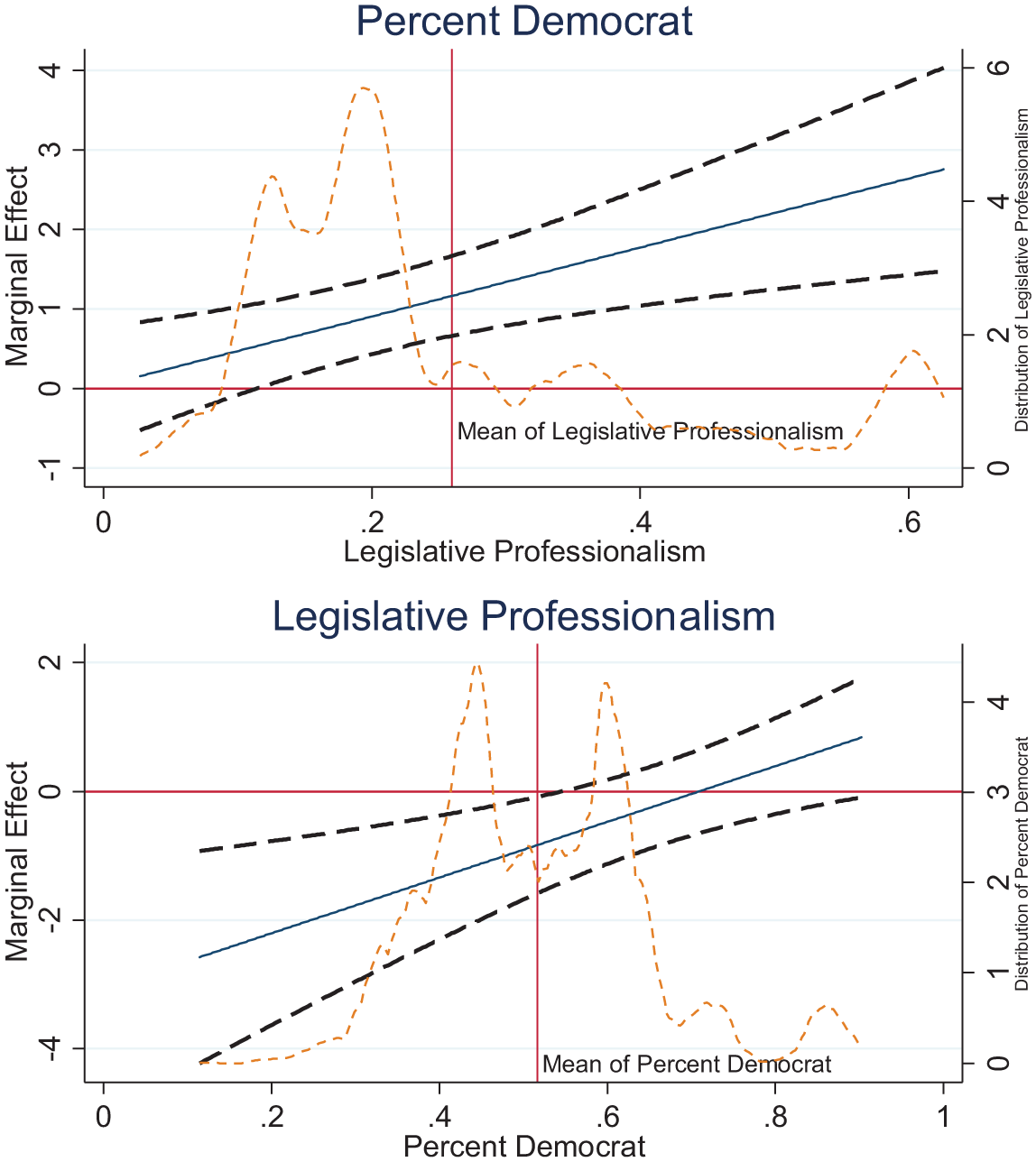
Marginal effects of legislative composition and professionalism on nursing home deficiencies.
If our expectation is correct, then professionalism should modify—and strengthen—the effects of partisanship. Thus, a highly professional legislature with a high proportion of Democrats should be able to better implement its preferences of more stringent oversight than one with a similar proportion and low professionalism. The marginal effects bear this out: as professionalism increases, the effect of percent Democrat gets larger. Further, consistent with our preference assumption, for most values of professionalism, we find that the marginal effect of percent Democrat exceeds 0 and differs from it at the .05 level or better, as indicated by the dashed lines. Specifically, whenever professionalism exceeds about .12, which occurs in about three-quarters of our cases, the marginal effect is positive.
Our conditional hypothesis also suggests another way to look at this effect. If we are correct that professionalism enhances the ability of legislatures to get what they want, and that Democrats prefer more enforcement, then we ought to see a positive and increasing effect of professionalism as Democratic control increases. To explore this conjecture, the bottom plot depicts the marginal effect of legislative professionalism against the proportion of Democrats. The plot produces results generally in line with our expectations regarding the relationship between professionalism and preferences. First, in states with a majority of Republicans, professionalism has a negative effect. Second, as the proportion of Democrats increases, this effect increases until it reaches 0 and becomes positive when Democrats hold approximately 70% of seats (although it does not become significant). And third, as expected based on the regression results, values at the high end of the proportion Democrats scale differ significantly from those at the low end. Although these marginal effects support our expectations, they do not speak to the issue of substantive importance. Figure 2 therefore plots the expected number of citations per survey in an average state. We vary the proportion of Democratic legislators from its minimum to its maximum in our data and present results for a low professionalism state and a high professionalism state. 15 The left-hand plot corresponds to cases with low professionalism. Here, we see a small relationship between partisan makeup and citations with the expected citation rate increasing from just below 5 in Republican states to about 8 in highly Democratic states. In states with a high level of professionalism, though, the right-hand plot shows a positive and substantively large effect, increasing from just below 3 to about 9 over the range of Democratic control. For a change from 0.4 Democrat to 0.6 Democrat, the number of citations increases by more than a third, from 4.2 to 5.8. This represents a sizable substantive change given all of the other important explanatory factors in the model.

Predicted number of nursing home deficiencies, varying legislative composition, and professionalism.
Additional Considerations
Although our results provide clear evidence that increasingly Democratic legislatures lead to more citations when they have greater capacity to monitor bureaucratic actions, two alternative interpretations exist. First, it could be that Republican legislators prefer greater levels of oversight and manage to accomplish this in situations of low professionalism. Of course, this just mirrors our main finding but puts a different interpretation on its cause. We think this unlikely, however, both based on the fact that the two parties have fairly clear preferences over regulatory enforcement at the margins and that our predicted effects appear to show much greater oversight in professional Democratic legislatures than in unprofessional Republican ones.
Second, nursing facilities respond to the oversight structure created by regulators. If legislators do guide the level of enforcement, then facilities in states with stricter enforcement might rationally choose a higher level of compliance. This would produce fewer citations in states with more stringent oversight, meaning that our findings could reflect a greater preference for oversight in more professional Republican legislatures. Although it remains difficult to sort out the interaction between compliance and enforcement with citation data, we have some evidence that discounts the possibility that lower citations reflect greater enforcement.
Since 2002, the federal government has engaged in a series of monitoring surveys in which it performs independent inspections within 30 days of a state inspection (see Government Accountability Office 2008 for more information). These so-called comparative surveys therefore offer a consistent metric against which to evaluate state survey results. If state surveys routinely exhibit fewer citations than these compliance surveys in Republican states relative to Democratic states, this would suggest a less stringent level of oversight among inspectors in the former. Although we do not have access to the disaggregated data, summary information from a government report (Government Accountability Office 2008) allows us to examine average differences. 16 In short, as Figure A.1 in our online appendix shows, the average number of missed citations from 2002 to 2007 increases with the average proportion of Republican legislators over that same time period, with a correlation of −0.35. For every 10% increase in Democratic control, 0.4 fewer citations get missed. These results support our interpretation that greater enforcement represents greater oversight.
Conclusion
When legislators delegate policy responsibility to agencies, they give these agencies authority but do not relinquish control. Indeed, legislatures maintain a number of tools that they can utilize to help ensure that agency actions remain consistent with the legislature’s preferences. In this study, we draw on a detailed and comprehensive dataset regarding state-level nursing home inspections to examine, first, whether inspection outcomes reflect legislative preferences, and second, whether this effect is greater under certain conditions—namely, when legislatures have a greater capacity to conduct oversight. Nursing home inspections provide an ideal forum for testing legislative influence, as the federal government mandates inspections but then essentially leaves the oversight system up to each state.
Based on our analysis, we find two clear results. First, partisan legislators appear able to use the resources at their control to shape bureaucratic results to their preferences. As expected, we find that legislative preferences do translate into varying levels of oversight, with increasing Democratic control of the legislative branch leading to greater enforcement under all regimes. Second, we find that this effect is magnified when the legislature is more professionalized, and thus has a greater capacity to engage in oversight activities. More specifically, we find high levels of regulation when the percentage of Democrats in the legislature increases, and this effect is magnified in states where the level of professionalism is higher.
Given these strong findings, future work should consider the exact mechanism through which these effects occur. For example, legislative professionalism consists of three distinct components, each of which suggests differing avenues. States with greater legislator pay will likely attract legislators with more ability to engage in oversight, those with longer sessions might provide greater opportunities to intervene through informal or formal legislative processes (as in Hall and Miler 2008), and those with greater staff might provide more resources to devote attention to oversight activities.17 Furthermore, influence might occur through the strategic appointment of surveyors who share the legislature’s goal, as well as through influencing the actions of surveyors (regardless of whether they were appointed strategically). Thus, a focus on agency appointments would produce further insights into the precise mechanisms by which legislatures influence agency actions (e.g., Wood and Waterman 1994). In all of these cases, however, our findings here indicate that future studies should take into account how institutional differences across the states can affect the ability of legislatures to influence agencies.
Footnotes
Acknowledgements
We thank Gerald Wright and Dick Winters for comments on previous drafts. Charles R. Shipan also thanks the U.S. Studies Centre at the University of Sydney for support and Frederick J. Boehmke thanks the Robert Wood Johnson Foundation for support
Authors’ Note
A previous version of this article was presented at the annual meeting of the American Political Science Association, Boston, Massachusetts, August 2008, and at the Regulation in the States Symposium at Florida State University. Replication data for analyses performed in this article are available on Frederick J. Boehmke’s website ( ) and Dataverse.
Declaration of Conflicting Interests
The author(s) declared no potential conflicts of interest with respect to the research, authorship, and/or publication of this article.
Funding
The author(s) received no financial support for the research and/or authorship of this article.