



Abstract
Foundational studies in political science endeavored to explain the dynamics of voter turnout in America over time. Two theories, one focused on legal-institutional factors and the other on behavioral elements such as party mobilization strategies, were born from the need to account for temporal fluctuations in aggregate voter turnout. A comprehensive test of these competing theories has been hindered by the fact that reliable measures of the behavioral factors driving turnout have proven elusive. In this article, I develop and test an interactive theory of voter turnout that focuses on the impact of legal-institutional barriers to the franchise conditional on party organizational strength and mobilization efforts. To this end, I use data on the circulation of party-sponsored newspapers, coupled with information on the spread of voter registration requirements, to capture the effects of both behavioral and legal-institutional factors in Pennsylvania between 1876 and 1948. My results offer modest empirical support for an interactive theory of aggregate voter turnout. In isolation, however, the effects of behavioral factors are quite limited. On the contrary, legal-institutional variables exert a sizable impact on voter turnout in the state. Contrary to other recent work on the subject, careful analysis of the Pennsylvania case therefore provides a great deal of evidence in favor of legal-institutional accounts of the changes in aggregate voter turnout that were witnessed at the beginning of the twentieth century while demonstrating that behavioral factors, such as the decline of the partisan press, served to enhance the deleterious effects of legal reforms on turnout.
Keywords
Introduction
Around the turn of the twentieth century, aggregate voter turnout in the United States—in the South as well as in the North—began to plummet. This steep decline briefly abated in the 1930s, but turnout would never fully return to the levels seen in the nineteenth century (Burnham 1965). Explanations for the drop in voter turnout typically include both legal-institutional and behavioral elements, and for decades, a scholarly debate has raged concerning the relative balance that ought to be afforded to each explanation (for reviews, see Piven and Cloward 1988 and Mayfield 1993).
Walter Dean Burnham (1965; 1970; 1974a; 1974b; 1986) anchored one side of the discussion. Throughout a series of works, Burnham presented a theory that focused on a decline in party mobilization efforts as the key determinant of the drop in voter turnout that was witnessed at the beginning of the twentieth century. Although in later iterations of his thesis he readily acknowledged the role that legal reforms instituted in the name of fraud prevention played in discouraging members of the electorate from turning out to vote, for Burnham, the onus was squarely on “behavioral” factors related to party activity. He would update his theory throughout his various publications on the subject, but the basic song remained the same: the blame for the post-1900 decline in voter turnout lay not at the feet of legal reforms but in “the party system functioning as an instrument of social organization and representation” (Dugan and Taggart 1995, 470). Others would later come to join Burnham in advocating for the primacy of behavioral explanations (Dugan and Taggart 1995; Franklin 2004, chap. 4; Kleppner 1982b; Kleppner and Baker 1980).
Phil Converse (1972; 1974) and Jerrold Rusk (1974) countered by arguing that the early-twentieth-century decline in voter turnout was chiefly the result of legal-institutional reforms that cut down on fraud and increased the costs of voting to the point that it discouraged peripheral members of the electorate from turning out to vote (see also Walker 1966). Their critiques of Burnham’s theory have proven difficult to address, as core concepts in the “behavioral” explanation are “extremely difficult to operationalize” (Rusk 1974, 1031). Moreover, according to Rusk (1974, 1031), it is “equally difficult to find empirical information on them.” Consequently, one key independent variable in behavioral accounts of the turn-of-the-century decline in voter turnout—party organizational strength and mobilization efforts—has often been proxied using measures of electoral closeness and political competition (Engstrom 2012; Franklin 2004; Kleppner and Baker 1980; Perez 2013).
The chief problem with the use of such measures as a stand-in for party strength is that elections can be close for any number of reasons that have precious little to do with the health and vitality of the party system or the efficaciousness of the parties’ respective mobilization strategies (Pomper 1990; Sorauf 1963). Scandal or poor performance while in office can make electoral contests close even in jurisdictions that lack the presence of two effective parties. Conversely, blowouts can happen in elections where two equally matched and motivated political parties, each fielding quality candidates, compete to put their man or woman in office. Party competition is therefore neither a necessary nor a sufficient condition to create a contest in which the vote ends up being fairly close. And as Nicholson and Miller (1997, 205–206) noted, ex post measures of electoral closeness fail to capture the information environment in which individuals weigh the decision of whether to show up at the polls on the day of an election. Moreover, the demobilizing effects of voter registration requirements and other legal restrictions on the franchise might have benefitted one party to the detriment of another, making it appear as if party competition declined at the same time and confounding efforts at disentangling the independent effects of legal-institutional and behavioral factors (see Stein, Owens, and Leighley 2003).
What is needed, then, to adjudicate between legal-institutional and behavioral theories of aggregate voter turnout, is an ex ante measure of party competition that is unlikely to be affected by legal-institutional changes. In this article, I forward one such measure: the circulation of party-affiliated newspapers. Coupled with information on the spread of voter registration requirements, and other legal changes—such as ballot reforms, the statewide direct primary, and the enfranchisement of women—I use Gentzkow, Shapiro, and Sinkinson’s (2011) data on the circulation of party newspapers, collected from various editions of Ayer’s American Newspaper Annual and the Editor and Publisher Yearbook, to explore the relative contributions of behavioral and legal-institutional forces to changes over time in aggregate voter turnout.
In this article, I focus on presidential elections in the State of Pennsylvania over the period from 1876 to 1948. 1 I do so for a multitude of reasons, some of which are purely practical, whereas others are related to the central role that the state has played in the scholarly conversation surrounding the reasons why turnout declined at the beginning of the twentieth century (Burnham 1965; 1970; Mayfield 1993; Piven and Cloward 1988). For one, Pennsylvania provides a near-unique opportunity to test the combined impact of voter registration requirements and party mobilization efforts on turnout (Shoji 2013; see also Nicholson-Crotty and Meier 2002). Other states that rolled out voter registration requirements in a piecemeal fashion over time (see Ansolabehere and Konisky 2006; Burden and Neiheisel 2013) did so long after party-sponsored newspapers had given way to an independent press (Petrova 2011; Rubin 1981). 2 Moreover, as Dugan and Taggart (1995, 474) noted, data on voter registration requirements at the national level “are diffuse, less than complete, and difficult to employ” (see also Engstrom 2012). Focusing on a single state makes the process of collecting detailed information on the spread of voter registration requirements more tractable (see also Cox and Kousser 1981).
In addition, as an “organization state” (Mayhew 1986), Pennsylvania has long played host to a robust system of party organizations, not only in traditional machine cities such as Pittsburgh and Philadelphia but also in suburban or even rural areas of the state (Sorauf 1963, 59). Although party organizations in other states had faded into near irrelevance by the midpoint of the twentieth century, parties in the Keystone State were still a major force in politics until at least the late 1960s (Mayhew 1986). Correspondingly, according to data gathered by Gentzkow, Shapiro, and Sinkinson (2011), the State of Pennsylvania consistently boasted of the greatest number of party-affiliated newspapers in the country over the period under examination in this article. 3 This simple fact recommends the use of Pennsylvania as a test case and serves as a “gut check” of sorts on the use of partisan circulation figures as a proxy for party organizational strength and mobilization efforts.
And while numerous investigations have endeavored to determine which explanation (whether legal-institutional or behavioral) best accounts for the observed patterns in aggregate voter turnout (Kleppner 1982b; Kleppner and Baker 1980; Perez 2013), in this article, I build upon work by Piven and Cloward (1988), Valelly (1995; 2004), and others (Oliver 1996; Stein, Owens, and Leighley 2003; Stein and Vonnahme 2011) to put forth an interactive theory that incorporates both elements into a more unified framework (see also Cox and Kousser 1981). Specifically, I hypothesize that voter registration requirements had larger demobilizing effects in the absence of strong political parties. In the sections that follow, I further elaborate upon this theory, describing the way in which party newspapers served as a mobilizing force in early-twentieth-century American electoral politics. I then go on to detail the particular features of the Pennsylvania case that make it an especially attractive setting in which to explore the joint effects of legal-institutional and behavioral factors on aggregate voter turnout.
Parties, the Press, and Electoral Mobilization in the American Political Landscape
Party-sponsored newspapers, as a key part of the party organizational apparatus (Aldrich 2011; Valelly 2004, 87–88), have long served as a mobilizing force in American politics (Carson and Hood 2014; Laracey 2008). As Rubin (1981, 65) noted, the partisan press was an “important tool for securing and mobilizing popular opinion and votes” (see also Kleppner 1970, 255). Increases in advertising revenues, though, bought journalists and newspaper editors a measure of distance from the parties, and their newfound financial independence made them less reliant on their former (partisan) patrons (Petrova 2011; Rubin 1981). Although other factors undoubtedly played a role (see Petrova 2011), ad dollars broke the grip that the parties held on this instrument that they formerly could count on to drum up support and rally the party faithful (Kleppner 1970, 255). At long last, increases in advertising revenue made it so that “the political returns were not sufficient to warrant the exertion of establishing party news organs” (Rubin 1981, 95). Facing limited resources and an institutional culture that encouraged selective mobilization efforts, the parties were therefore forced to make strategic choices concerning which jurisdictions they would choose to contest (Valelly 1995, 205–206).
Crucially, such a transformation took place quite apart from the legal changes that were going on in the realm of additional restrictions on the franchise (to include new, personal voter registration requirements) and ballot reforms that were instituted in an effort to break the grip of the parties on the electoral process (see Engstrom and Kernell 2005; Ware 2000). On this point, it is worth quoting Burnham (1970, 76) at some length: Although legislation had little if any direct part in it, the disappearance of the old partisan-centered press and the rise of a modern mass journalism which conspicuously prided itself on being far above mere partisan politics constituted a major sea change of the period. While the party press was not the only means by which a political organization could communicate with its following, it had been of immense importance in “spreading the word” and in contributing to the massive mobilizations characteristic of the third system. Its disappearance signaled not only the partial demise of a critically important partisan communication function but a basic cultural change in the mass public, which in turn required the development of entirely new party and candidate strategies for winning elections.
Although derided by Rusk (1974, 1034) as “more propaganda rags stirring up party loyalty than conveyors of in-depth information on the issues,” the party press served to mobilize the party rank and file, drilling them to the polls in a “militaristic” (Jensen 1971) fashion that required little in the way of issue content. Moreover, in his counter to Rusk (1974) and Converse’s (1974) criticisms, Burnham (1974a) noted that literacy was widespread among the white electorate at the end of the nineteenth century, particularly in the North. It is therefore entirely plausible that large swathes of would-be voters heeded the clarion call sounded by the partisan press of the day.
The mobilizing influence of the party papers provides the first piece of the puzzle of early twentieth century voter turnout. In isolation, legal-institutional reforms may have had little impact on turnout in the presence of strong local party organizations. However, when the parties folded up their news operations, they effectively ceded control of one important component of their mobilization operation—“communications ‘sinews of war’” that were part of “an elaborate, well-staffed, and strongly motivated organizational structure” (Burnham 1970, 72). It was likely only as the parties shifted away from a strategy of mobilization, as described by Richard Jensen (1971), and toward a more persuasion-based strategy, that voter registration requirements would begin to exact their toll on civic life in America (see also Ware 2000).
Reconciling Legal-Institutional and Behavioral Perspectives
As the preceding discussion intimates, there is good cause to understand political parties as institutions that helped to moderate, at least in part, the additional costs levied on voters by the introduction of new, more restrictive voter registration regimes. “Political parties,” John Aldrich (2011, 106) noted, “have long relied on cost-reduction techniques as the centerpieces of their turnout drives” (see also Piven and Cloward 1988; Rosenstone and Hansen 1993). Indeed, throughout a series of works that stretch back to Burnham’s (1965) seminal article, scholars have acknowledged that the decline in turnout that the nation experienced after the turn of the century was a function of both legal changes to the way in which Americans voted (precipitated by good government “reformers” or, as Burnham suggests, pro-business partisans seeking an electoral advantage by changing the composition of the electorate) and changes in how the parties competed for votes (Cox and Kousser 1981).
Much of the debate, however, has centered on the extent to which each force was responsible for the observed decline in voter turnout. The different parties to this academic discussion have sought to determine whether legal reforms or “behavioral” elements were chiefly to blame for the drop-off in turnout that occurred around the turn of the century. Kleppner and Baker (1980), for instance, found declining electoral competitiveness to be the primary culprit, as did Perez (2013) in a more recent attempt at adjudicating between legal-institutional and behavioral perspectives (see also Dugan and Taggart 1995; cf. Valelly 2004, 129).
Nearly lost in such exchanges over which explanation accounts for more of the post-1900 decline in voter turnout is any sense that the effect of legal-institutional changes, such as the introduction of a new, personal registration requirement, is conditional on the strength and vitality of local party organizations. 4 Instead, most scholars have focused on collecting ever more nuanced measures of the legal prerequisites for voting across key states (Kleppner and Baker 1980; Perez 2013; Rusk 1974). And although great strides have been made toward documenting the spread of voter registration requirements across jurisdictions over time (Perez 2013; Springer 2012; 2014), to date, even the most sophisticated analyses have relied on imperfect proxies for party activity, such as measures of electoral competitiveness (though for notable exceptions, see Hill and Leighley 1993 and Perez 2014).
What is more, legal-institutional and behavioral elements are most often examined independently, with one being pitted against the other as competing explanations for the observed dynamics of aggregate voter turnout across time and space. As Piven and Cloward (1988, 95, emphasis added) noted, though, “a decline in party competition, weakened and re-organized parties, and new rules restricting access to the ballot—worked together to depress turnout.” A more complete accounting of the various forces that conspired to shape the American political universe at the beginning of the twentieth century therefore requires attending to the interactive nature of the relationship between restrictive registration laws and the party system. Put another way, this article examines the role that “institutional complimentarity” (Valelly 2004, 127) played in the declines in turnout that were witnessed in the early 1900s.
Other studies have found, using data from a variety of different electoral contexts, that party mobilization efforts can effectively moderate the effect of institutional reforms on voter turnout. Oliver (1996), for instance, showed that the effects of the permissiveness of a jurisdiction’s provisions for absentee voting are conditional on party activity. Work by Stein, Owens, and Leighley (2003) similarly demonstrates that providing voters with an opportunity to vote early has little impact on voter turnout in the absence of efforts by partisan elites to use such provisions to their advantage.
Journalistic accounts of the 2012 presidential race likewise suggest that the Obama campaign strategically used resources in such a way so as to counteract the presumed deleterious effects of voter ID laws on (Democratic) turnout. In doing so, the campaign provided information about how to navigate newly passed legal-institutional barriers to the franchise to those members of the electorate who numbered among the most likely to be affected by changes in the way elections are run (The Washington Post 2012). Partisan news organs were used in just such a way in the nineteenth century through the first half of the twentieth century, as the parties sponsored newspapers in an effort to (1) raise the perceived stakes of upcoming elections (oftentimes by warning of the other side’s intention to perpetrate frauds—see Cox and Kousser 1981) and (2) provide their supporters with the information necessary to guide them through the (newly reformed) electoral process.
Having already described the linkages between the partisan press and party mobilization efforts more broadly, the following section details how the laws governing how elections were conducted in Pennsylvania evolved throughout the time period under investigation and provides a look at the second piece of the puzzle of the post-1900 decline in voter turnout. Coupled with changes in the way that political campaigns were prosecuted in the state—changes of which the slow demise of the partisan press was but one, particularly visible symptom—restrictions on the franchise would work to decrease turnout, especially in jurisdictions that were devoid of partisan institutions.
The Pennsylvania Case: Legal-Institutional Changes
Pennsylvania’s first system of voter registration was passed into law in 1836. It required assessors in the county of Philadelphia to make a complete enumeration of qualified electors (Harris 1929; Keyssar 2000; Piven and Cloward 1988). As a nonpersonal system of registration, few costs were imposed on the voters themselves (Piven and Cloward 1988). This system of voter registration would last for 32 years before being supplanted by a new, statewide regime in 1868. It was not long, however, before this new law providing for the registration of voters would be ruled unconstitutional (Alderfer and Luhrs 1948). 5 The state legislature would enact another statewide registration law the following year. That law, too, would effectively be rendered toothless by the Constitutional Convention of 1873, which provided that “no elector shall be deprived of the privilege of voting by reason of his name not being upon the registry” (quoted in Harris 1929, 79). For more than 30 years, then, the State of Pennsylvania boasted of a registration law that provided little barrier to the franchise.
Then, “[i]n 1901, the Constitution was amended to permit the legislature to regulate registration and to make it a qualification for voting” (Alderfer and Luhrs 1948, 1; Harris 1929). Five years after this change, in 1906, the state legislature would move to require annual personal registration in cities of the first and second class (Burnham 1970; Harris 1929; Mayfield 1993). The cities that were initially covered by personal voter registration requirements include Philadelphia (the one city of the first class in the state), Pittsburgh, Allegheny, and Scranton (second class cities).
6
Personal registration would be extended to cities of the third class in 1911 (Alderfer and Luhrs 1948; Harris 1929). This system would persist until 1937, with voter registration spreading only as additional municipalities were incorporated as cities. “Prior to 1937, more than half the state’s counties, lacking cities of at least the third class within their borders, had no mandatory personal-registration requirements” (Burnham 1970, 87). As a result of the “little New Deal,” Burnham (1970) went on to note, voter registration was extended beyond just the cities to the rest of the State of Pennsylvania. After 1937, [e]lectors living in cities of the first, second, and third classes . . . noticed very little change except they no longer need[ed] to register annually, but for electors living in boroughs, towns, or townships it was almost a completely new system. (Alderfer and Luhrs 1948, 8)
7
It is this progression of voter registration requirements across the state that provides the leverage necessary to examine the effect of the introduction of voter registration on county-level turnout in Pennsylvania.
Apart from voter registration, other legal changes occurred in Pennsylvania over the time period under observation here that may have affected turnout in the state. For instance, the Australian (secret) ballot was introduced in the state in 1891 (Albright 1942; Evans 1917). Initially, the ballot used was a “mixed form of ballot, partly ‘party column’ and partly ‘office group,’ but with a special method of voting a straight party ticket” (Luddington 1911, 62; see also Ware 2000). In 1893, the state moved to a regular party-column ballot (the so-called “Indiana” ballot—see Mayfield 1993; Walker 1966), even as it retained a provision for party-line voting. A decade later, the party column was done away with, and the office-block format was adopted. The option to cast a straight party ticket was retained (Allen 1906; Luddington 1911; Mayfield 1993). Although the office-block ballot in its “pure” form was developed in an effort to break the grip of the parties on the electoral process, the inclusion of special “party circles” (Luddington 1911, 62) allowed the parties to retain a great deal of control (Ware 2000). Thus, although I control for such changes in the analysis that follows, there is little reason to suspect that the introduction of the Australian ballot had much, if any, negative effect on voter turnout in the state (cf. Engstrom 2012; Valelly 1995; 2004). Indeed, Dugan and Taggart (1995) even found that states that used the secret ballot actually experienced higher rates of voter turnout over the period from 1880 to 1960 than those that did not.
In addition to the Australian ballot and various forms of voter registration requirements, the State of Pennsylvania adopted the direct primary statewide in 1907 (Shoji 2013; Ware 2002). Prior to 1907, Pennsylvania played host to a dizzying array of different candidate selection methods. The state was the birthplace of the direct primary (also called the Crawford County system) in 1842, but as Shoji (2013) painstakingly documented, it would continue to exhibit a great deal of county-level variability over time in how primaries (on both sides) were conducted. There is reason to expect that the direct primary had an effect on voter turnout, as “the development of the direct-primary alternative to a general election” effectively destroyed “the minority party’s monopoly of opposition” (Burnham 1970, 51), which, in turn, lead to declines in two-party competition in some areas of the country, including Pennsylvania. One recent study, however, found no effect of the introduction of the direct primary on voter turnout (Perez 2014).
The extension of the franchise to women in 1920 is widely believed to have decreased voter turnout across the nation owing to an increase in the size of the eligible electorate (the denominator in the traditional turnout calculation) without a corresponding increase in the number of voters (the numerator; see Franklin 2004). It is well-documented that women were less likely to vote than men throughout much of the period under observation in this study (Engstrom 2012; Kleppner 1982a; 1982b; Merriam and Gosnell 1924). As such, I expect the introduction of the 19th Amendment to have decreased voter turnout in Pennsylvania.
Finally, two other legal changes would have made it easier to vote in the Keystone State. The passage of the Dunn Act of 1921 liberalized registration requirements in the state to an extent, as it stipulated, that “previous registers should be supplied to the precinct registration officers, and that a person who had registered in the precinct previously could register simply by signing his name” (Harris 1929, 81). More than a decade later, in 1933, the taxpaying requirement would also be removed as a stipulation for voting in Pennsylvania (Keyssar 2000, 183). Such changes almost certainly would have decreased the costs of voting, which, in turn, should have precipitated an increase in voter turnout. Springer (2014), however, found no relationship between the frequency of periodic registration and voter turnout at the state level.
Data and Method
The data needed to test whether an interactive relationship exists between legal-institutional and behavioral factors have, of necessity, been drawn from a number of different sources. The dependent variable (county-level voter turnout in presidential years), one key independent variable (the total circulation at the county level of all local newspapers sponsored by one of the two major parties), and the number of eligible voters in each county were culled from a data set initially compiled by Gentzkow, Shapiro, and Sinkinson (2011). Voter turnout and the number of eligible voters by county come from Interuniversity Consortium for Political and Social Research (ICPSR) Study 8611, and were constructed using linear interpolation of Census data. Turnout is calculated in the usual manner by dividing the total number of votes for president in a given year by the number of eligible voters. The legal-institutional factors discussed above, including changes in ballot form (office block vs. party column), women’s suffrage (implemented in the State of Pennsylvania in 1919 via the 19th Amendment), the introduction of the Australian ballot, whether there was a race for the U.S. Senate (after the ratification of the 17th Amendment, which provided for the direct election of senators), the passage of the Dunn Act, the removal of the taxpaying requirement, and the statewide introduction of the direct primary, are captured with a series of dummy variables. 8
Another key independent variable, the spread of voter registration requirements throughout the state, is measured by adding up the populations of those cities that were covered by a system of personal voter registration in each county and dividing by the total population of the county. Information on the populations of the jurisdictions that registered voters prior to the statewide introduction of a permanent system of voter registration (the numerator) was collected from various editions of Smull’s Legislative Handbook and Manual of the State of Pennsylvania, whereas total county population (the denominator) was pulled from the Census. 9 Intercensal figures on both the numerator and denominator in this calculation were estimated using linear interpolation. As was the case with many other states (see Ansolabehere and Konisky 2006; Burden and Neiheisel 2013; Perez 2014), voter registration in Pennsylvania was rolled out over time, first, in large urban areas in the state and, then, expanded to include additional third-class cities, as they were incorporated over the period from 1906 to 1937, when voter registration as implemented statewide. Pre-1906, all observations take on a value of 0 on this particular dimension, whereas all post-1937 observations take on a value of 1. This particular variable construction mimics that used by Ansolabehere and Konisky (2006), Neiheisel and Burden (2012), and Perez (2014). After 1906, but prior to the statewide introduction of voter registration requirements in the late 1930s, observations range from 0 in rural counties in which not a single borough, township, or town was covered under a system of voter registration to 1 in Philadelphia County—a jurisdiction that is coterminous with the City of Philadelphia.
Given that voter registration requirements varied by municipality, rather than by county, the ideal data set would include measures of voter turnout at the municipal level. The denominator in the traditional turnout calculation—the number of eligible voters—is not readily available below the county level, however. Although imperfect, the approach that I take here is a marked improvement upon previous efforts that have simply examined differences in turnout between “registration” counties and “non-registration” counties (Burnham 1970; Kleppner and Baker 1980) or have ignored the impact of voter registration requirements altogether owing to the fact that “the data are diffuse, less than complete, and difficult to employ” (Dugan and Taggart 1995, 474). The analysis that I undertake in this article is also considerably more fine-grained than similar efforts that use states as the unit of analysis (Perez 2013; 2014; Springer 2012; 2014).
A measure of one of the behavioral factors that has long been thought to affect turnout is included in the models as well. To capture party competition—the “effort” that the parties put into contesting elections at a local level and mobilizing votes—I simply summed the total circulation in each county of newspapers that were sponsored by the two major parties. The resulting quantity was then logged (after adding 1 so as to avoid taking the log of 0) in an effort to reduce the influence of outliers.
In some model specifications, I also include a number of demographic controls, including the share of the county population that is white, the proportion of the county that consists of males who are 21 years of age or older, those living in cities with more than 25,000 residents, those living in municipalities with 2,500 residents or more, and (logged) per capita manufacturing output as a proxy for county-level income (see Gomez and Hansford 2015 on the importance of taking into account local economic conditions). These variables were pulled from ICPSR Study 2896. As manufacturing output at the county level was not measured in every decennial census, I also included a dummy variable capturing those years for which information on manufacturing output was not available so as to preserve as much of the time series as possible (see Gentzkow, Shapiro, and Sinkinson 2011). 10
Legal-institutional variables, such as the statewide introduction of the direct primary and the move to the office-block ballot format, are highly collinear with year fixed effects. To examine the influence of these factors, then, I estimate separate models that include a linear time trend in addition to a series of dummies capturing a host of different legal-institutional changes to the way that elections were conducted in the Keystone State. 11
My analytic strategy borrows much from previous work by Franklin (2004), and deals with unmeasured variation over time and space in several different ways. I correct for serial correlation through the inclusion of a lagged dependent variable on the right-hand side of the regression equation. Observed cross-county variability that is attributable to factors other than those that are included in the model as independent variables are dealt with in some cases through the use of the fixed-effects estimator (see also Clark and Linzer 2015).
Results
In this section, I present results from a series of models geared toward testing the impact of both legal-institutional and behavioral factors on voter turnout in presidential elections in the State of Pennsylvania. I begin with a basic model that includes a variable tapping the spread of voter registration requirements throughout the state, the (logged) total circulation of party-sponsored newspapers in each county, a multiplicative term that interacts these two variables (so as to examine the impact of registration requirements conditional on different levels of party activity), lagged turnout, and a control for the (logged) number of eligible voters in the county so as to account for the fact that the counties in the data set differ, sometimes greatly, in terms of the number of eligible voters contained within their borders. The standard errors in this basic model, the results from which are displayed in the first column in Table 1, and all subsequent models are clustered at the county level.
Legal-Institutional and Behavioral Influences on Turnout in Presidential Elections, 1876–1948.

Note. Clustered standard errors are in parentheses.
p < .05.
As anticipated, voter registration is a statistically significant predictor in the model, driving down voter turnout in presidential elections over this time period. Owing to the presence of a multiplicative term in the model, it is necessary to interpret the effect of voter registration conditional on a particular value of partisan circulation. In counties with zero partisan papers, all else equal, the introduction of voter registration requirements is associated with nearly a 10 percentage point drop in aggregate voter turnout. The effect of the circulation of party-sponsored newspapers is also negative and is statistically significant at conventional levels, thereby indicating that in the absence of voter registration requirements, larger circulation figures for party-affiliated news organs are associated with decreases in voter turnout. The sign on this particular coefficient remains negative even after excluding the interaction term from the model but is no longer statistically significant (results not shown). As predicted by the conditional theory propounded above, there is a significant interactive effect of voter registration requirements and partisan circulation figures on voter turnout at the county level.
This basic pattern of results remains even after including county and year fixed effects in the model. The second, third, and fourth columns in Table 1 present results from a series of models that are similar in specification to the model detailed in the first column in the table, but with some notable exceptions. The model estimates displayed in the second column are from a model that includes year fixed effects. The inclusion of a series of year dummies reduces the effect of registration requirements on voter turnout (see also Ansolabehere and Konisky 2006; Burden and Neiheisel 2013). In the absence of party newspapers, the introduction of voter registration requirements over the whole of the county reduced turnout by less than 5 percentage points after taking into account the impact of election-year shocks. It is also worth noting that the effect of the circulation of party-sponsored newspapers is no longer statistically significant in the absence of voter registration requirements in these models. The interaction term, however, remains significant at conventional levels and is appropriately signed. This same pattern of findings obtains after using the fixed-effects estimator (see the third and fourth columns in Table 1) and after controlling for election-specific shocks with the inclusion of year dummies (see the model results displayed in the fourth column in Table 1). 12
To aid in the interpretation of the effect of voter registration requirements on voter turnout, conditional on the parties’ efforts at mobilizing voters through the sponsorship of party newspapers, Figure 1 plots the marginal effect of voter registration requirements on voter turnout over the observed range of the (logged) circulation of partisan newspapers using the estimates from the model detailed in the fourth column in Table 1. Over a portion of this modifying variable’s range, the marginal effect of voter registration is statistically significant and serves to drive down turnout. This effect is tempered, however, in counties that boasted of high circulation figures for party-sponsored newspapers. Whereas the negative effect of voter registration requirements on county-level turnout is more than 5 percentage points in counties where neither party sponsored a local newspaper, the effect is less than 1 percentage point in those locales that saw widespread circulation of party news organs. The pattern displayed in Figure 1 therefore lends some degree of support to an interactive theory of voter turnout and helps to reconcile, in part, the legal-institutional and behavioral accounts. Although such explanations have often been pitched as competing theoretical frameworks, these results suggest that a fuller understanding of the forces that led to the observed decline in voter turnout at the beginning of the twentieth century requires attending to the ways in which legal-institutional and behavioral factors worked in concert with each other.
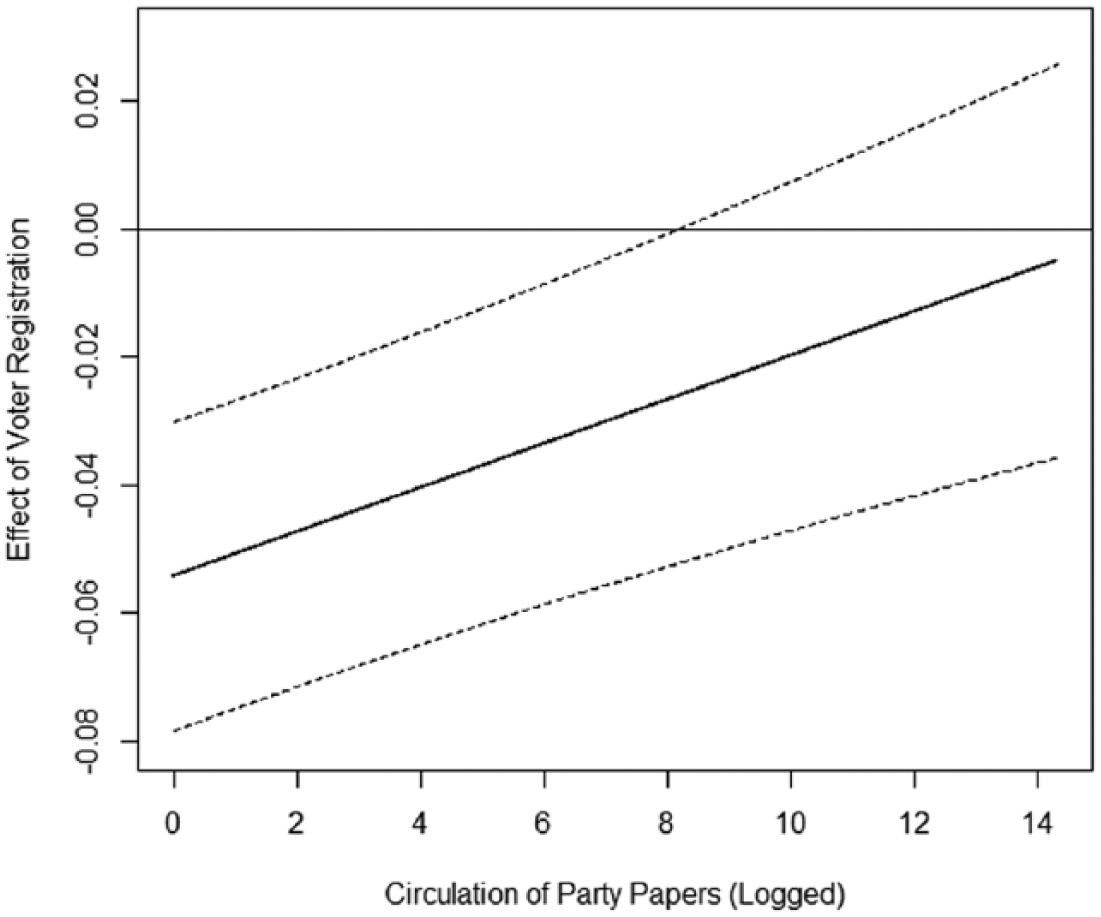
The marginal effect of registration requirements on turnout.
This same constellation of results holds even after adding a number of demographic controls. The first and second columns in Table 2 present estimates from models that include a variety of additional control variables (all of which were detailed in the previous section) apart from both county and and/or year fixed effects. The effect of voter registration requirements is wholly unchanged and is again statistically significant at conventional levels. The interaction term multiplying the presence of voter registration requirements by (logged) partisan circulation is likewise statistically significant and is positively signed. In substantive terms, the effects of each variable are quite similar to those reported in the models detailed in the second and fourth columns in Table 1, thereby demonstrating their robustness to the inclusion of both fixed effects and demographic controls.
Legal-Institutional, Behavioral, and Demographic Influences on Turnout in Presidential Elections, 1876–1948.
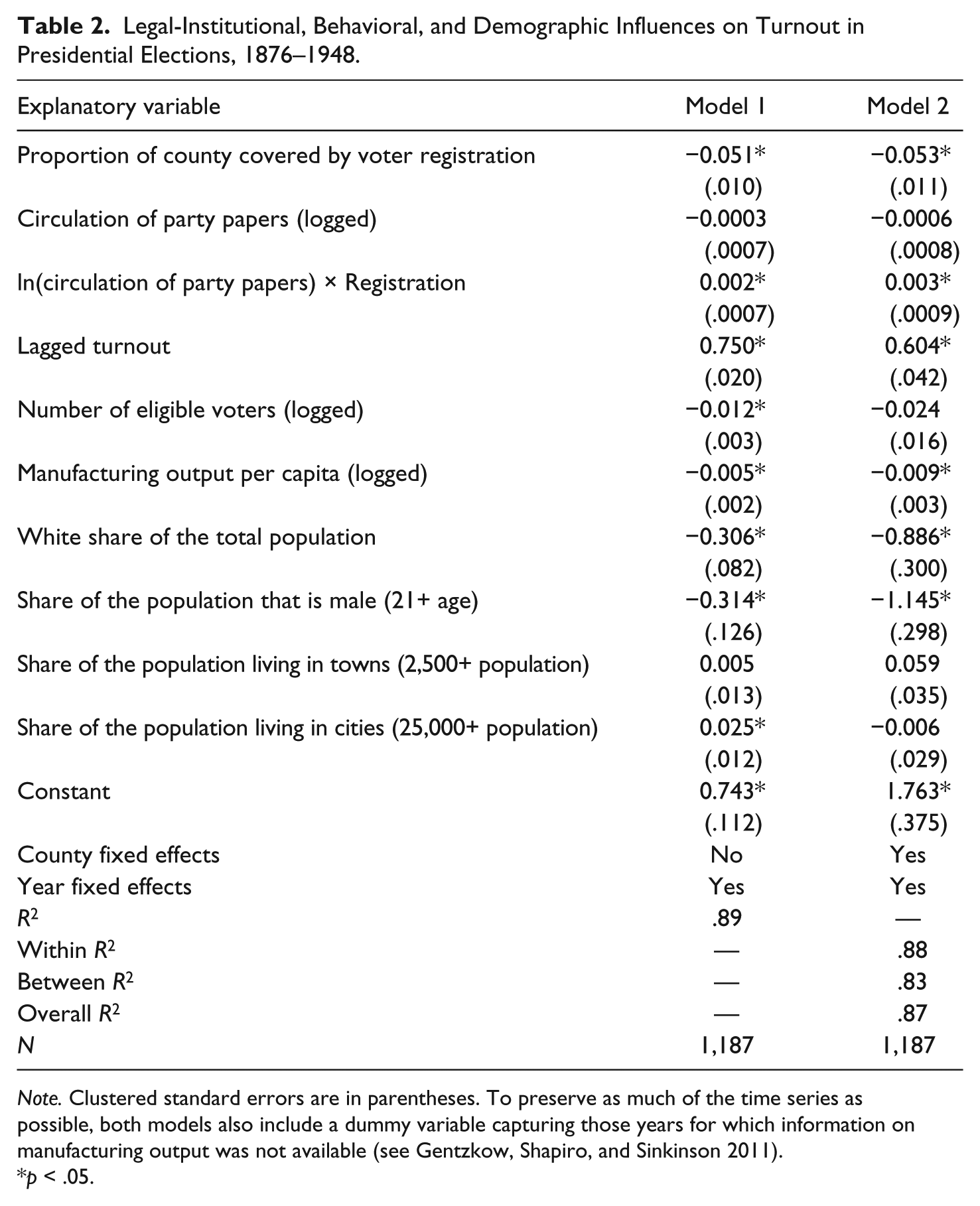
Note. Clustered standard errors are in parentheses. To preserve as much of the time series as possible, both models also include a dummy variable capturing those years for which information on manufacturing output was not available (see Gentzkow, Shapiro, and Sinkinson 2011).
p < .05.
However, none of the models shown in either Table 1 or Table 2 permit an examination of the impact of other legal-institutional factors that might influence turnout levels. Because these reforms, unlike voter registration requirements, were rolled out statewide (with the exception of the direct primary—see Shoji 2013) over the time period under observation, it is not possible to estimate a model that includes both year fixed effects and indicators for these other factors. I therefore estimated a model that includes the basic specification reported in the first column in Table 1 with one key change: year dummies have been dropped in favor of a time trend variable. The model specification also includes variables tapping whether there was also a senate election in a given year (after the implementation of the 17th Amendment), the introduction of women’s suffrage in the state in 1920, the introduction of the Australian ballot, the use of party-column and office-block ballots, the statewide introduction of the direct primary, the elimination of taxpaying requirements for voting, and the passage of the Dunn Act. Each of these variables is described in greater detail above, along with my expectations regarding each’s likely impact on turnout.
Results from this model are displayed in the first column in Table 3. As before, the effect of voter registration requirements is statistically significant and substantively quite important. Similarly, the multiplicative term interacting voter registration requirements by the (logged) total of the two major parties’ circulation figures in each county is positive and statistically significant.
Legal-Institutional and Behavioral Influences on Voter Turnout in Presidential Elections (Circulation of Partisan Papers with Additional Legal-Institutional Variables).
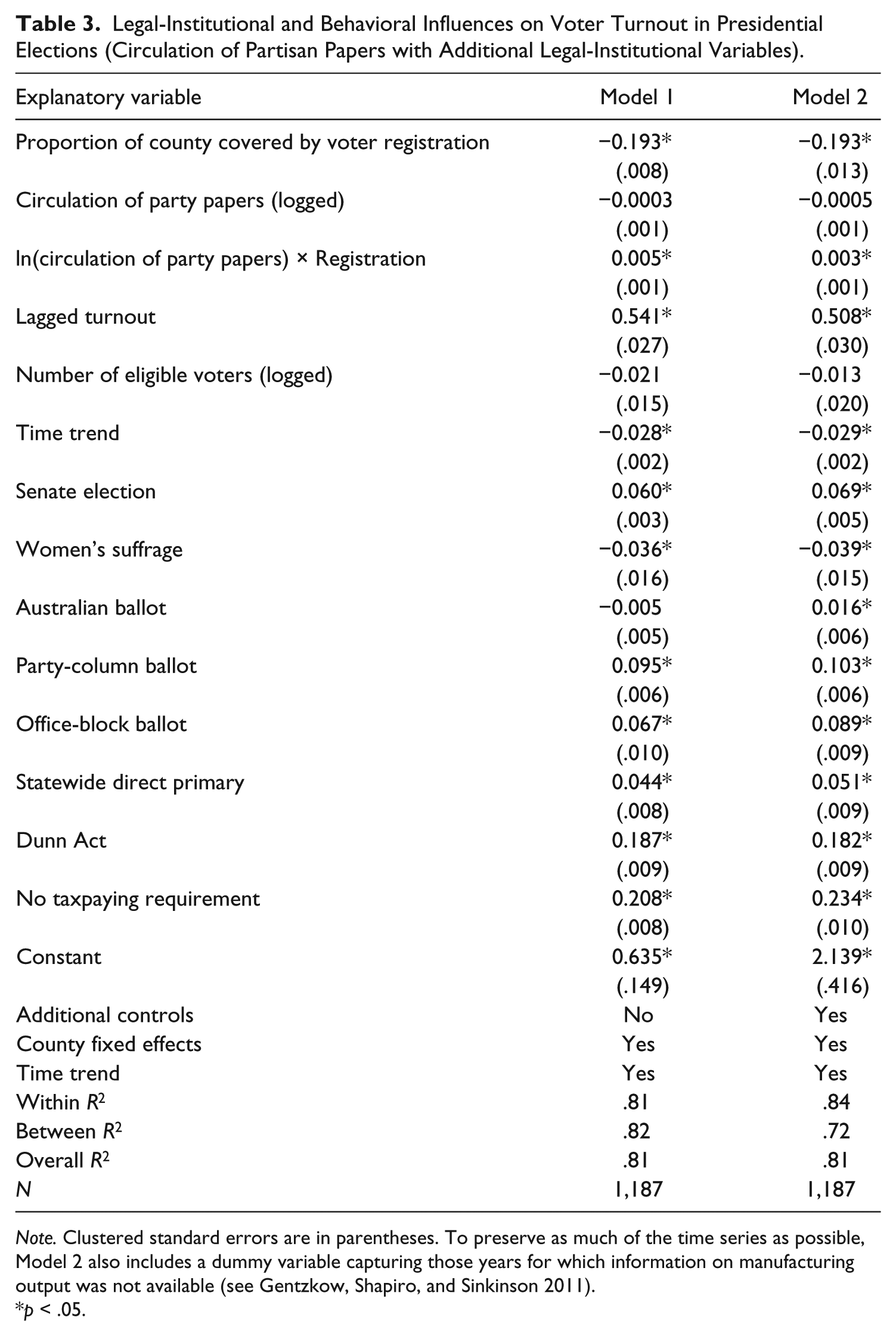
Note. Clustered standard errors are in parentheses. To preserve as much of the time series as possible, Model 2 also includes a dummy variable capturing those years for which information on manufacturing output was not available (see Gentzkow, Shapiro, and Sinkinson 2011).
p < .05.
Contests for the U.S. Senate increased voter turnout to some extent, whereas women’s suffrage decreased turnout slightly. As expected, the introduction of the Australian ballot had no discernible effect on voter turnout. Statewide use of the party-column ballot actually appears to be associated with higher levels of voter turnout, as is the introduction of the office-block ballot format. The retention of a provision for straight-party voting in Pennsylvania along with the introduction of ballot reforms such as the office-block ballot format appears to have increased turnout. Elsewhere, however, the adoption of ballot types that were calculated to break the grip of the parties on the electoral process worked to drive down voter turnout (see Engstrom 2012).
The statewide introduction of the direct primary had an effect on turnout that runs counter to expectation. Although at least one recent study found no effect of the direct primary on voter turnout (Perez 2014), the increase in voter turnout that is associated with the statewide introduction of the direct primary in the models shown in Table 3 is not reflected in the literature. Some observers, however, have long speculated that primaries in the state were easier for the parties to control than were the other kinds of candidate selection mechanisms that existed in Pennsylvania (such as local meetings and conventions) prior to the statewide adoption of the direct primary (Mayhew 1986, 226; Sorauf 1963). As such, the parties’ ability to mobilize their core supporters was likely enhanced after the 1907 law took effect.
The passage of the Dunn Act, which liberalized voter registration requirements in the state to some extent by doing away with periodic registration requirements, is associated with a large increase (more than 18 percentage points) in voter turnout. This last result, in particular, cuts against other recent work on the subject that has found no linkage between the frequency of periodic registration and voter turnout at the state level (see Springer 2014) but makes a great deal of sense within the cost–benefit framework so often used in explorations of the correlates of voter turnout. It is possible, however, that my findings diverge from those reported by Springer due to differences in measurement, as she examined the effects of the frequency of periodic registration on voter turnout and not the impact of moving from a periodic system of voter registration to a permanent one. Much as is the case with the passing of periodic registration requirements, the estimates displayed in Table 3 show that the elimination of the taxpaying requirement as a prerequisite for voting likewise increased voter turnout to a healthy degree.
Importantly, as the model estimates displayed in the second column in Table 3 attest, these results hold even after controlling for the same complement of demographic controls that were included in the models described in Table 2. There is one notable exception to this general pattern: the coefficient associated with the introduction of the Australian ballot in the state is positive and statistically significant in the model that includes additional demographic control variables in the specification. This result is certainly not without precedent, as Dugan and Taggart (1995) also found the adoption of the secret ballot to be associated with increases in voter turnout.
Discussion and Conclusion
In this article, I set out to develop and test a conditional theory of voter turnout that incorporates insights from both legal-institutional and behavioral theories into a single, unified framework. Although others have taken a similar theoretical tack (e.g., Cox and Kousser 1981; Piven and Cloward 1988), the empirical test that I use in this article is a novel one. By combining detailed information on the spread of voter registration requirements with a measure of party competition that does not rely on ex post measures of electoral closeness, I sought to operationalize key elements in both legal-institutional and behavioral accounts of voter turnout in the early twentieth century.
A frequent critique of behavioral perspectives on aggregate voter turnout is that it is difficult, if not impossible, to measure many core concepts in the behavioral account (see Rusk 1974). As a result, any variation in aggregate voter turnout that is “left over” after taking into account legal-institutional factors is often taken as evidence in favor of behavioral theories (Burnham 1970; Kleppner and Baker 1980). By contrast, I use the party sponsorship of local newspapers as a proxy for the vitality of party organizations and the parties’ efforts at mobilizing support at the local level—the centerpiece of behavioral accounts by Burnham (1965; 1970; 1974b) and others (Kleppner and Baker 1980). The analyses presented here provide some evidence that party newspapers helped to offset declines wrought by the introduction of voter registration requirements. In substantive terms, however, the impact of party-sponsored news organs pales in comparison with the effects of voter registration and other legal-institutional changes on voter turnout.
As hypothesized, the introduction of the Australian (secret) ballot had no discernible impact on turnout (or even had a slight positive effect). Other studies have reported similar findings (Dugan and Taggart 1995). The statewide introduction of the direct primary similarly influenced voter turnout, but in a direction that runs counter to other work on the subject. Nevertheless, my results generally comport with broader theories of voter turnout that are rooted in rational choice understandings of the microlevel motivations behind the act of voting.
Taken together, the results presented here lend a great deal of support to legal-institutional accounts of the turn-of-the-century decline in aggregate voter turnout, with the crucial caveat that robust party organizations can help to soften the impact of increases in the costs of participation. As I demonstrate in this article, counties with no party news organs saw roughly a 5 percentage point decrease in voter turnout as a result of the introduction of voter registration requirements. The negative effect of more stringent registration laws on turnout was a few percentage points less in counties with widespread circulation of party-sponsored newspapers. Although this finding helps to underscore the importance of taking behavioral factors into account, in addition to legal-institutional changes in the way elections are run, the observed moderating effect of party efforts on the demobilizing impact of registration laws on turnout may be limited to states, like Pennsylvania, where party organizations were quite strong. As Sorauf (1963, 147) noted in his book on politics in the Keystone State, “In most respects [the] operations [of the parties] reflect a level of strength and activity matched by the parties of few states.” It is therefore worth investigating whether the parties were able to soften the blow dealt to voter turnout by more restrictive voter registration systems in other states. Data availability concerns, however, loom large in this arena.
On balance, the existing literature has come down in favor of behavioral theories (Burnham 1965; 1970; 1974a; 1974b; Dugan and Taggart 1995; Engstrom 2012; Kleppner 1982b; Kleppner and Baker 1980; Perez 2014). These studies, almost without exception, use proxies for electoral competition that likely overstate the role played by the parties in generating turnout. On the contrary, the measure of party “effort” used here almost certainly understates the reach of the parties, as it captures only one aspect of the parties’ broader efforts at getting out the vote: the circulation of party-sponsored newspapers. Importantly, partisan circulation figures do link up with one element in the behavioralist account and, unlike other indicators of party activity (the “ground game,” so to speak), are available throughout the time period under observation. This particular measure also has the significant advantage of not being tied to the outcome of a particular electoral contest, as is the case with more traditional means of gauging the level of party competition (see Nicholson and Miller 1997; Pomper 1990; Sorauf 1963).
Therefore, even though the measure of party competition used in this article represents, I believe, a step in the right direction, I make no claims that it captures all of the forces that are forwarded as explanatory factors in Burnham’s (1970) canonical statement of the behavioral account. What is needed, then, are better indicators of party activity during the early 1900s. Absent documentation from party leaders at the time detailing where they directed their efforts at mobilizing their supporters and demobilizing their opponents, however, researchers are unlikely to make much in the way of progress toward settling the debate over why turnout declined during the first part of the twentieth century. Gerald Gamm (1997, 12) once wrote in an exchange in The Political Methodologist that “history bequeaths relics but social science creates evidence.” Further adjudication between legal-institutional and behavioral accounts of voter turnout, it seems, may just require more in the way of historical relics. Enterprising future researchers might find that single-state case studies, like the one presented here, provide perhaps the best opportunity to unearth such treasures (see also Nicholson-Crotty and Meier 2002).
There is something of a silver lining to be found in the results presented in this article, though, as the liberalization of voting requirements, in the form of the Dunn Act of 1921, and the removal of the taxpaying requirement for voting in 1933, appear to have had sizable, positive effects on voter turnout. Recent investigations of the impact of voter registration requirements on turnout have found that the negative effects of voter registration requirements are quite minimal after taking into account other confounding influences, such as state culture (see Ansolabehere and Konisky 2006; Burden and Neiheisel 2013; see also Engstrom 2012). These revised estimates of the declines in voter turnout attributable to the introduction of registration laws have convinced many that any future gains in terms of voter participation are unlikely to result from decreases in the costs of voting imposed by restrictions on the franchise (Hanmer 2009). That making voter registration permanent rather than periodic can act as a countervailing force to legal barriers to the vote is a profoundly positive takeaway and may force would-be reformers to rethink approaches to stimulating turnout that focus on behavioral fixes, rather than institutional changes.
Footnotes
Acknowledgements
The author would like to thank Julia Azari, Jack Edelson, Harvey Palmer, Guy Whitten, and three anonymous reviewers for providing a number of helpful comments. He would also like to thank the fine people at Bloomsburg University of Pennsylvania’s Andruss Library for their assistance with the archival materials used in this article.
Author’s Note
A previous version of this article was presented at the Policy History Conference, Columbus, Ohio, June 4–6, 2014.
Declaration of Conflicting Interests
The author(s) declared no potential conflicts of interest with respect to the research, authorship, and/or publication of this article.
Funding
The author(s) received no financial support for the research, authorship, and/or publication of this article.
Notes
Author Biography
References
Supplementary Material
Please find the following supplemental material available below.
For Open Access articles published under a Creative Commons License, all supplemental material carries the same license as the article it is associated with.
For non-Open Access articles published, all supplemental material carries a non-exclusive license, and permission requests for re-use of supplemental material or any part of supplemental material shall be sent directly to the copyright owner as specified in the copyright notice associated with the article.
