



Abstract
Judicial elections have two opposing effects on legitimacy perceptions for state supreme courts. Elections not only provide a boost to legitimacy through the chance to hold officials accountable but also involve campaign activity that decreases legitimacy perceptions. This article examines these two opposing effects using a nationally representative survey that includes items assessing diffuse support for state supreme courts. It uses multiple indicators to differentiate between states with highly active election systems involving large amounts of campaign activity and states with less active elections systems that involve little campaign activity. The results from the survey show that the legitimacy of elected courts is higher than appointed courts but only in states with little election activity. In states with high amounts of election activity, the legitimacy of elected courts is lower than appointed courts.
Many scholars concerned about the potential for judicial elections to undermine the perceived legitimacy of courts take solace in the empirical findings from James Gibson and colleagues (Gibson 2012; Gibson et al. 2011) showing that the net effect of elections is to increase legitimacy. This empirical finding, if confirmed, would blunt one major criticism of judicial elections put forth by those wishing to move states away from traditional elections—that the politicizing aspects of judicial elections decrease a court’s legitimacy. However, the studies from Gibson and colleagues are based on just two election cycles in two states that may not be generally representative of judicial elections.
Although there has been a trend toward “new-style” judicial elections in which candidates engage in active campaigning and extensive fundraising (Hojnacki and Baum 1992), these “new-style” elections do not occur to the same extent in every state. In some states, judicial elections resemble those of the past in which candidates raise little money and engage in little campaign activity. In these states, many people’s interaction with a judicial election begins and ends with reading the names on the ballot. The state of North Dakota offers a good example of this type of state. Although ostensibly a state with nonpartisan elections, those elections involve little to no campaign activity. Of the seven elections for the North Dakota State Supreme Court from 2002 to 2012, all candidates ran unopposed, and no candidate collected campaign donations. Idaho provides another example of a nonpartisan election state in which elections rarely if ever determine who ends up on the state supreme court. During this time period, the membership on Idaho’s state supreme court changed five times, but in four of these, the incumbent retired early to allow the governor to appoint a replacement. On only one occasion was the appointed incumbent challenged during the next election. The one time the governor did not appoint the replacement, the public was not offered a choice because only one person ran to replace the departing justice. This system, while technically involving nonpartisan elections, is in effect much closer to an appointment system. The governor initially chooses judges, and these choices are rarely challenged during subsequent elections.
Although North Carolina also used a nonpartisan election system during this time period, the differences with Idaho and North Dakota could not be starker. Out of the 11 elections in North Carolina from 2002 to 2012, all 11 were challenged, eight were competitive, 1 and the candidates raised about $6,500,000 in total campaign donations. Residents in North Carolina will have much greater exposure to campaign activities and information that Gibson (2012) shows decreases perceived legitimacy such as attacks ads that portray judges as ordinary politicians and campaign contributions from litigants or interest groups.
Understanding the effect of judicial elections on legitimacy perceptions requires making a distinction between states like North Carolina and North Dakota. Although both conducted elections, only North Carolina residents experienced substantial campaigning from judicial candidates. Importantly, these two aspects of a state’s overall judicial selection system—the existence of elections and the campaigning associated with those elections—have opposite effects on legitimacy. Gibson (2012) and Gibson et al. (2011) show that many types of campaigning decrease perceived legitimacy, but elections are also the quintessential legitimizing event of any democracy. During an election, the public gets to hold their representatives accountable, and empirical evidence suggests elections provide democratic legitimacy to a political system and its constituent institutions (Esaiasson 2011; Singh, Karakoc, and Blais 2012). Determining the overall effect of elections on perceived legitimacy requires taking into account both the positive boost provided by electoral accountability and the negative effects caused by campaign activity.
The findings confirming the legitimizing effect of elections generally concern the overall political system rather than courts, which are supposed to be different from the other branches of government. The special nature of courts could potentially lead to elections not providing democratic legitimacy in the same way that they do for legislatures and executives, but empirical evidence suggests otherwise. Geyh’s (2003) “Axiom of 80” shows that although the public holds courts to different standards than traditional politicians, they also support the idea of electing judges. The axiom states that approximately 80% of the population believes that elected judges will be influenced by campaign contributions—that is, they believe that elections will politicize the judiciary. At the same time, approximately 80% of the population supports electing judges. Thus, it seems that the public can be turned off by certain aspects of judicial elections while still supporting the concept of electing judges. Understanding the overall effect of a state’s judicial selection system requires understanding the tension in the public’s mind caused by these potentially conflicting thoughts. The public desires a judiciary that is accountable to the people through some sort of electoral process, but they also want those elections—which are an inherently political event—to be apolitical.
Because of the way in which judges are supposed to be unbiased, impartial, and separated from politics, it is unsurprising to find conflicting thoughts concerning judicial elections, but Americans are also conflicted about other types of more traditional elections. In their seminal work on American’s feelings toward political institutions, Hibbing and Theiss-Morse (1995) noted that although virtually all Americans desire electoral democracy, they want a sanitized and unrealistic version of democracy devoid of compromise, conflict, and bargaining, which some would call the essence of politics. It would seem that Americans—whether it is a legislative election or a judicial one—approve of electing their public officials but want an unrealistic version of electoral politics. Hibbing and Theiss-Morse (1995) show that exposure to the unsanitized politics of legislative elections causes a large decrease in public support for legislative institutions. Although judicial elections involve less overt political activity than legislative ones, the question to be answered in the current study is whether that smaller amount of activity overpowers the positive boost in legitimacy provided through electoral accountability.
Gibson (2012) and Gibson et al. (2011) recognized the opposing effects of judicial elections on perceived legitimacy and conclude that in the election cycles from the two states they investigate, the positive effects resulting from electoral accountability outweigh the negative effects caused by certain types of campaigning. The current study examines these same two conflicting effects on legitimacy using a different empirical strategy that allows it to generalize the results to every American state. It uses a nationally representative survey to compare the perceived legitimacy across all state supreme courts and is the first study of this form to use the type of items recommended by Gibson, Caldeira, and Spence (2003) to measure diffuse support. It uses multiple indicators such as the number of competitive elections to differentiate between states with active and competitive election systems and those with less active election systems and presumably less campaign activity. The results reveal two opposing effects: (1) The presence of an election system increases legitimacy, and (2) legitimacy perceptions decrease as an election system becomes more active and involves more campaign activity. This leads to the legitimacy of elected courts being higher than appointed courts but only in states with less active election systems. In states with highly active election systems, the legitimacy of courts is lower than in states with appointed courts because the negative effect of large amounts of election activity overpowers the positive boost in legitimacy provided by electoral accountability.
Existing Research
Existing research on the relationship between judicial selection method and the perceived legitimacy of state supreme courts can be split into three categories. The first includes experiments examining the effect of campaign activity. The results across these studies show that campaign advertisements tend to decrease legitimacy, but attack ads portraying judges as ordinary politicians are deemed especially bad. Gibson et al. (2011) showed the subjects three different types of advertisements. In one condition, the subject saw a series of ads in which one candidate attacks another. In another, a super political action committee told voters to vote no on all judges. The third was a positive advertisement concentrating on the endorsements received by the candidate. Compared with a neutral control condition, the level of perceived legitimacy was lower in all three experimental conditions, showing that various types of ads can decrease legitimacy. In a separate study, Gibson (2008a) showed subjects various types of attack ads and asked whether the ads were appropriate. In that study, attack ads portraying judges as ordinary politicians were deemed the most inappropriate. These studies, taken together, suggest that campaign ads do decrease legitimacy, but those portraying judges as ordinary politicians have the greatest negative effect.
Gibson (2008b, 2009) examines the effect of campaign contributions on perceived legitimacy and finds that accepting contributions from judges and litigants decreases perceived legitimacy. These types of studies, specifically examining the effect of campaign activity, cannot assess the overall effect of elections on legitimacy because they neglect the positive boost provided by electoral accountability. Instead, these studies provide examples of the type of campaign activity that can decrease legitimacy—exposure to information concerning campaign contributions and campaign ads, especially those portraying judges as ordinary politicians.
The second category uses cross-sectional surveys to compare the level of legitimacy in the four traditional categories of judicial selection method—partisan elections, nonpartisan elections, retention elections, and appointment systems. In these studies, the most consistent finding is that public support is lowest among states with partisan elections (Benesh 2006; Cann and Yates 2008; Jamieson and Hardy 2008; Wenzel, Bowler, and Lanoue 2003). 2 Although these studies provide useful insight, they do not differentiate between states with differing levels of campaign and election activity. They concentrate only on the differences between the four traditional categories of judicial selection systems, but as the above discussion shows, each category contains states with vastly different levels of election activity. This means they cannot differentiate between the positive effect caused by the existence of an election system and the negative effect caused by certain types of campaign activity. 3
The third category can differentiate between these two effects by using panel studies to measure the legitimacy of a state supreme court in one state before and after an election that includes judicial candidates. In addition, these studies either manipulate (Gibson et al. 2011) or measure (Gibson 2012) the subject’s exposure to negative campaign activity that decreases legitimacy. In both studies, the perceived legitimacy of the state supreme court increased for most people over the course of the election, even when controlling for the negative effects of campaign activity. In Gibson (2012), perceived legitimacy did decrease for some but only among the minute percentage of the population exposed to extremely negative campaign activity. These studies confirm that judicial elections provide both a positive boost to legitimacy based on electoral accountability and a negative effect from campaign activity. The negative effects frequently cancel out a portion of the positive effects and in extremely rare circumstances overpower them altogether. Some benefits of the current study are to generalize these findings beyond the two states of Kentucky and Pennsylvania, to compare states with different levels of election activity, and to see if the effects identified by the panel studies lead to elected courts having a higher level of legitimacy than appointed ones in a cross-sectional survey.
The current study also addresses a potential problem with the panel studies. Other more salient elections were held at the same time as the judicial elections examined in Gibson et al. (2011) and Gibson (2012). It is possible that the increase in legitimacy recorded in those studies results from these other more salient nonjudicial races. Elections increase the perceived legitimacy of the overall political system and its constituent institutions (Esaiasson 2011; Singh, Karakoc, and Blais 2012). If this is the case, a state supreme court will receive a boost in legitimacy over the course of an election, even when no judge faces election or it is an appointed court. Thus, the overall increase in legitimacy found by these studies could replicate even in a state with an appointment system. Gibson (2012) includes evidence that the legitimacy of a state supreme court increases, even among people who were not given a chance to vote for that office. The Kentucky State Supreme Court uses a district system where only people within a defined district vote for the judge. In 2006, two districts had no state supreme court election, and in one, a judge ran unopposed. However, the level of legitimacy change did not significantly vary across district or based on whether an election was held in that district, meaning the legitimacy of the court increased even in places where no judge faced election.
Gibson (2012) also emphasizes the importance of the public’s expectations about how a court should operate. His analysis shows that exposure to partisan ads only has a negative effect on legitimacy for those who want the court to operate in a nonpolitical way. For those who want the court to operate in a politicized manner, exposure to partisan ads has no effect on legitimacy. This research highlights that for some people, the politicizing aspects of judicial campaigns may not negatively affect legitimacy like it does for the vast majority of the population. This possibility does not undermine the theoretical mechanisms and empirical results described here but instead offers a potential limitation. When averaging across the whole population, politicized campaign activity decreases perceived legitimacy, but the negative effect may not apply to those who desire a political court. This study concentrates on examining the average effect of elections and campaign activity, and because it does not include items assessing expectations, it cannot confirm the empirical finding that the negative effect of campaigning varies based on expectations concerning decision-making processes.
Election Activeness
Judicial elections over the last few decades have transformed from somber sleepy affairs “small in scale, low-key and devoid of issue content” (Hojnacki and Baum 1992, 921) to more active election systems that involve “new-style” judicial campaigns that are “nastier, noisier and costlier” (Schotland 2001, 850). However, this transformation did not result from states changing institutional arrangements codified in law. Instead, it resulted from a change in the norms surrounding judicial elections. In the past, highly funded challengers to incumbents rarely emerged to make elections competitive. Today, the norms discouraging judicial elections from resembling elections for other types of offices have declined. Because these changing norms have not spread evenly across the states, some states have highly active election systems involving many competitive elections with lots of campaign activity while other states have less active election systems involving little competition or campaign activity.
Because differences in election activity are, in part, based on norms rather than something codified in law, measuring the activeness of a state’s election system is more difficult than for something like partisan versus nonpartisan ballots. Campaign activities can range from running a television or radio commercial to talking to voters at a state fair, and it is virtually impossible to directly measure the total amount of campaign activity. An alternative is to look for variables such as campaign funding that act as a proxy for campaign activity. Presumably, as campaigns raise more money, they engage in more campaign activity. This allows campaign funding data to act as one indicator that can be used to differentiate between states with an active election system involving large amounts of campaign activity and states with less active election systems involving little campaign activity. However, the use of campaign funding data is potentially problematic because the data only include funds donated directly to political candidates. The data do not include spending by outside groups, which in some cases can dwarf the amount spent by the candidate themselves. The campaign funding measure is the natural log of the total amount of campaign donations to judicial candidates over the five election cycles prior to the survey in 2013 divided by the state’s population. The data came from the online database of the National Institute on Money in State Politics.
Another type of indicator identifies the types of elections that involve substantial amounts of campaign activity and counts the number of elections with those characteristics over a certain time period. Campaign activity requires an upcoming election, and a simple count of the number of elections is one indicator of campaign activity. However, this method is imprecise because many elections are unchallenged and most involve little campaign activity. One requirement for having a robust campaign is the existence of a challenger. Without the possibility of losing, an unopposed candidate will engage in little campaign activity. 4 A challenged election makes large amounts of campaign activity more likely, but even many races involving challengers involve little campaign activity. Challengers for judicial elections (Hall and Bonneau 2006) as well as legislative elections (Abramowitz 1991; Lublin 1994; Van Dunk 1997) come in varying quality, and incumbents facing a challenger of low quality rarely need to worry about losing an election. As a result, they do not need to engage in extensive campaigning to defend their seat.
Two other types of elections—those involving an open-seat and those involving a competitive race—offer a better chance of isolating elections with large amounts of campaign activity. Incumbents enjoy a substantial advantage when running for reelection (Bonneau and Hall 2009). Potential quality challengers, donors, and political activists are keenly aware of this advantage, and many times when an incumbent is sure to win reelection, potential political opponents offer no opposition or only token opposition. Research shows that open-seat races are usually more competitive and more likely to involve high-quality challengers because candidates who have been planning a run for years finally get the chance to compete to replace the incumbent (Bonneau 2006; Herrnson 2001). To be considered an open-seat race, none of the candidates can be an incumbent who has been previously elected or retained to that court. 5 Competitive elections are also more likely to involve a high level of campaign activity. If both candidates have a chance to win the seat, this gives donors and activists more incentive to invest time and money, resulting in more campaign activity. Competitiveness also encourages the media to cover the race, providing more exposure to the campaigns. Also, if an election is competitive, many times this results from a quality challenger emerging who has the resources and skills to make it competitive through large amounts of campaign activity. To be considered competitive, no candidate can receive more than 60% of the combined vote for the top two candidates.
This discussion leads to four different indicators of campaign activity. The variables used in the subsequent analyses are counts of the number of these types of elections over the five election cycles prior to the survey in 2013 (generally 2002–12). This provides a long-term view of a state’s elections and is limited to the time after Republican Party of Minnesota v White, which possibly changed judicial campaigns. Specifically, the indicators are counts of the total number of elections, the number of challenged elections, the number of open-seat elections, and the number of competitive elections. I gathered this data from the websites of state election agencies. Because appointment states by definition have zero elections and no campaign funding, these states are coded as a 0 on these measures.
The final indicator uses an item from the survey asking whether the subject’s state supreme court is elected or appointed. Knowledge concerning selection methods for state supreme courts is low. In this data set, only 60% of those in states with multicandidate elections knew their state supreme court was elected. However, this percentage varies across the states and acts as an indicator of election activeness. In those states with more active elections, a greater percentage of the population should know their state’s court is elected. Thus, the percentage of people from the survey sample within each state who say the court in their state is elected acts as the final indicator.
Each indicator, whether campaign funding, counts of specific types of elections, or one based on public perceptions, is designed to act as a proxy for the norms, which cannot be directly measured, that cause some states to have elections with large amounts of campaign activity and other states elections with little to no campaign activity. See Table 1 for the distribution of each indicator.
Distribution of Election Activeness Indicators.

Study Design
The study relies on a national survey fielded by YouGov in March 2013 with a weighted stratified sample of 819 respondents. Surveys conducted by YouGov are completed by respondents over the Internet. 6 The survey used a stratified sample in which each of the four traditional categories of judicial selection method is equally represented. This ensures an adequate sample from all types of selection systems. Because the sample is composed of individuals embedded in states, all analyses use a multilevel model with a random intercept by state. The 18 subjects who said they had never heard of the court are excluded from the analysis.
Measurement
The legitimacy items come from the scale developed in Gibson et al. (2003). It assesses whether people support making fundamental changes to how an institution operates. It has been used extensively in previous studies and is the standard legitimacy scale in the judicial literature. The subjects are asked their level of agreement with four statements concerning their state’s highest court that ask about reducing the power of the institution or getting rid of it. 7 All items use the official name of that state’s court of last resort. For most states, it follows the pattern of “(State Name) Supreme Court,” but in states like New York where the highest court is called “New York Court of Appeals,” the official name is used. 8 The legitimacy perceptions variable is an additive index of the four items. It has a Cronbach’s alpha of .74 and ranges from 0 to 16 with a median of 10 and a mean of 9.63.
The model also includes a number of control variables. The demographic controls include gender, education, age, and indicators for Hispanic and black. Two variables assess the subject’s attitude toward the political system with one concentrating on support for the overall national political system and the other concentrating on the state political system. Support for the rule of law assesses their support for the overall political system as well as general democratic values. Another variable assesses the subject’s perception of the fairness of elections in their state, which helps to control for the subject’s feelings toward the overall state political system. The model also includes a variable assessing the subject’s awareness of their state’s supreme court. Research shows that greater knowledge concerning courts leads to a higher level of perceived legitimacy (Gibson and Caldeira 2009b). Support for the rule of law, perceived election fairness, and court awareness are all additive scales constructed from two items. The exact text of all the items used in the study is included in the online appendix.
The model includes two items addressing ideological perceptions. The first is the subject’s ideological self-placement on a 5-point scale. The second assesses the subject’s perceived ideological distance from the court. The item asks whether the court is too liberal, somewhat too liberal, just about right, somewhat too conservative, or much too conservative. This variable speaks to the debate between Bartels and Johnston (2013) and Gibson and Nelson (2015) concerning the size of the effect of subjective ideological distance on the legitimacy of the U.S. Supreme Court. The method of measuring perceived ideological distance in the current study differs from these two previous studies. Rather than assess the subjects’ perceived ideology of the court and create a difference measure using their own ideological self-placement, one item is used to directly ask for the subject’s perceived ideological distance from the court. Like Bartels and Johnston (2013), the analysis uses an indicator variable for each level of ideological disagreement because the effect may be nonlinear. Separate indicator variables are included for the too liberal and too conservative options to determine whether the effect is not only nonlinear but also asymmetrical.
Data Analysis
The model in column 1 of Table 2 includes a set of control variables and indicators for the four traditional categories of judicial selection method. Appointment states are the baseline comparison category. The control variables are included in the model but not shown in the table to conserve space. The indicator variables and the difference between any two categories never approach statistical significance at p < .05. 9 That no statistical difference emerges between the four traditional categories contrasts with existing research showing lower levels of support in partisan election states. Most likely, this results from using a somewhat different measure of legitimacy that excludes items assessing trust, confidence, and decision-making perceptions. 10 The next set of models examines the effect of election activity in two ways. First, each indicator of election activity is examined individually. Second, a structural equation model is used to model election activity as a latent variable, and the six variables are used simultaneously as indicators of that latent variable.
Election Activeness and Legitimacy Perceptions.
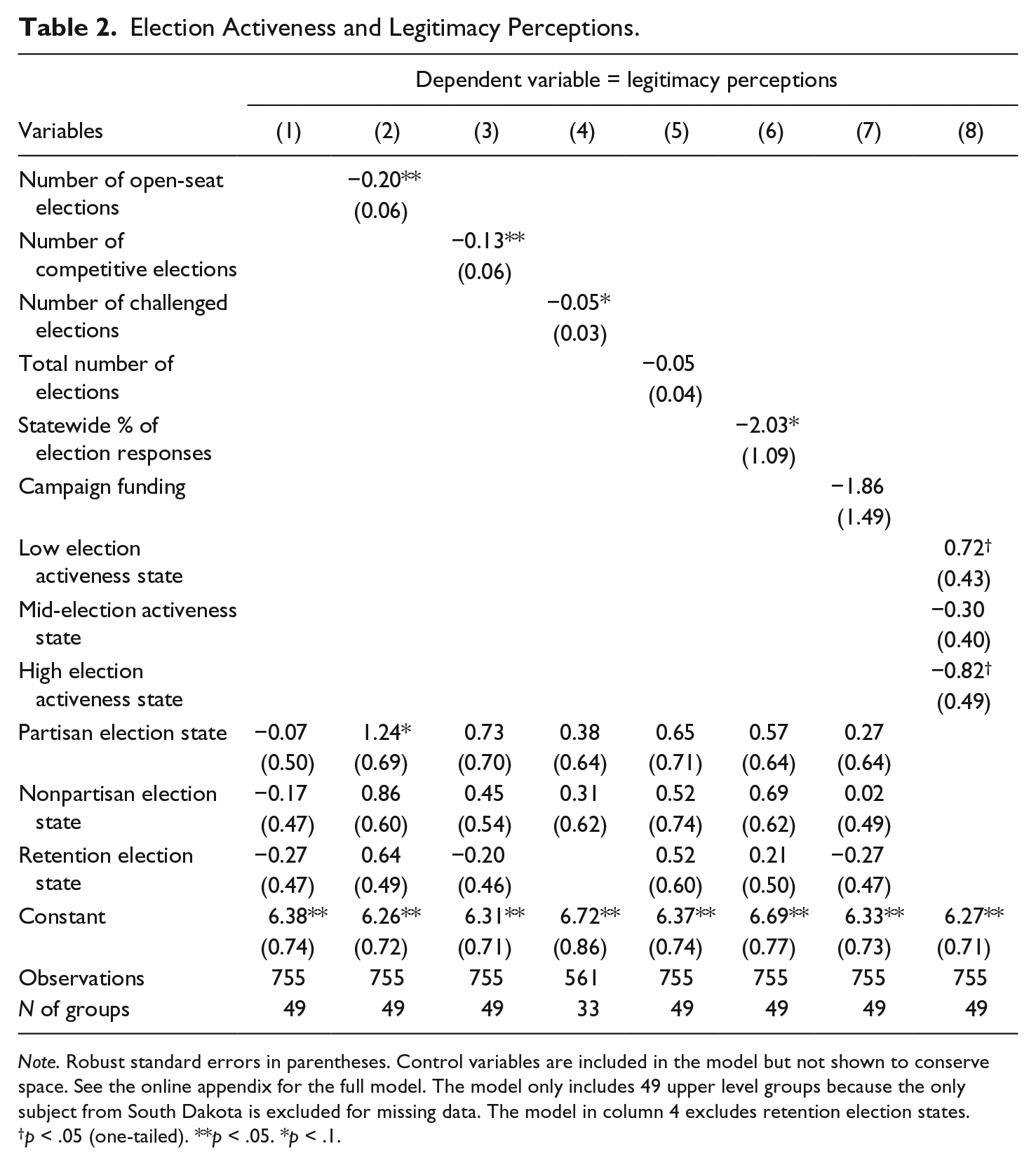
Note. Robust standard errors in parentheses. Control variables are included in the model but not shown to conserve space. See the online appendix for the full model. The model only includes 49 upper level groups because the only subject from South Dakota is excluded for missing data. The model in column 4 excludes retention election states.
p < .05 (one-tailed). **p < .05. *p < .1.
Individual Indicators
Columns 2 to 5 test the effect of the indicators designed to identify the type of elections in which large amounts of campaign activity are present. Of these four indicators, the two that best isolate elections involving large amounts of campaign activity—the number of open-seat elections (column 2) and the number of competitive elections (column 3)—are negative and significant at p < .05. Perceived legitimacy decreases as the number of open-seat and competitive elections increases. The model in column 4 tests the effect of the number of challenged elections. Because retention elections are by definition unchallenged elections, this indicator does not work well within that category, and the retention election states are excluded from this analysis. As the model shows, the coefficient is negative and significant at p < .1. 11 The final indicator of this type—the total number of elections—performs the worst. It is in the right direction but insignificant.
These results form an understandable pattern. They become stronger as the indicators become better at isolating elections that should involve higher levels of campaign activity. The number of open-seat elections and the number of competitive elections are significant at p < .05 and include only elections that should involve at least some substantial campaign activity. The total number of elections indicator is insignificant and includes many elections that involve no campaign activity. The number of challenged elections is in the middle in both statistical significance and how well it isolates elections involving substantial campaign activity. It is marginally significant, and although it excludes those elections that involve absolutely no campaign activity, it still includes some elections with only token opposition and little to no campaign activity.
The other two indicators are shown in columns 6 and 7. The statewide percentage of election responses is negative and significant at p < .1, and the amount of campaign funding is in the right direction but insignificant. Overall, these results provide good support for the hypothesis that as the amount of election activity increases, the level of perceived legitimacy for a state supreme court decreases. Although two of the indicators are insignificant, both are potentially problematic. The total number of elections includes many elections that are unchallenged and have no campaign activity. The campaign funding variable is problematic because it only includes the funds donated directly to candidates and does not include spending by outside groups, which can dwarf the amount raised by the candidates.
Latent Variable Model
The next analysis uses structural equation modeling to model election activity as a latent variable. In the model, the six indicator variables used above act as indicators of the latent election activity variable. To take further advantage of the latent variable model, legitimacy perceptions are also modeled as a latent variable with the four legitimacy items as indicators. The measurement models for the two latent variables are estimated simultaneously with a structural equation that includes the latent legitimacy variable as the dependent variable. The predictor variables in the structural equation model are the latent election activity variable, the four traditional categories of selection method and the same additional control variables as in Table 2. The model does not include random effects, but the standard errors are corrected to take into account the state-level clustering of the data. 12 The results from the model are shown in Figure 1. To simplify the figure, only the results of the measurement models for the latent variables and the effect of election activity on legitimacy perceptions are shown. The complete results are included in an online appendix. The results for the measurement models show that for both latent variables, all the indicator variables are significantly related to them. Most importantly, the results from the structural equation show that the effect of election activity on legitimacy perceptions is statistically significant at p < .05 and negative.

Election activity and legitimacy perceptions as latent variables.
Substantive Interpretation
The above results show that four of the six individual indicators and a latent variable estimated using all six indicators negatively affect legitimacy perceptions. Graphing the predicted values of legitimacy across different levels of election activity will help to illustrate the overall effect of elections and campaign activity on legitimacy perceptions. Because the results are similar across the indicators, only the variable with the strongest effect will be displayed. Figure 2 displays the predicted level of legitimacy across the range of the open-seat elections variable for each traditional category of selection method, setting the perceived ideological distance variable at “just about right” and holding all other variables at their mean. Because every state in the appointment category has zero elections, it appears as a dot. A thin line extends from it to ease comparisons with the other categories. At low levels of election activeness, the legitimacy of elected courts is higher than appointed courts, and at high levels, the legitimacy of elected courts is lower. Because the legitimacy scale has 16 points, the difference between elected and appointed courts at the highest level of election activeness is just above 7% of legitimacy’s range for both partisan and nonpartisan election states. The difference at the lowest level is just below 4% of legitimacy’s range. 13
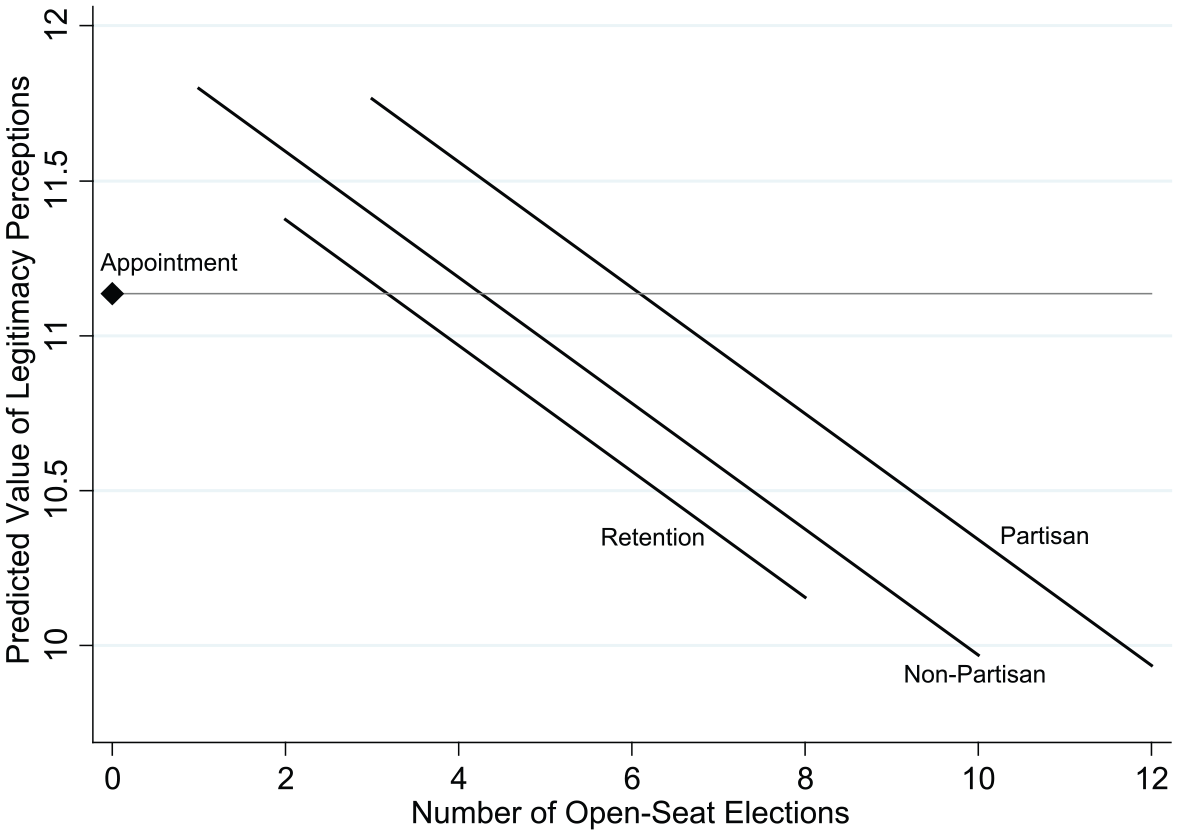
Election activeness and legitimacy perceptions.
Using these models, it is difficult to determine whether the differences between elected courts at some point on the election activeness indicator are significantly different from appointed courts. To accomplish this, the model in column 8 includes three dichotomous variables representing states at different levels of the open-seat election variable. One for the 10 states in the bottom 25%, one for the 9 states in the top 25%, and one indicator for the remaining 19 election states in the middle. Each variable provides a statistical test of the difference between an appointed court and the respective type of elected court. States low in election activeness have a significantly higher level of legitimacy than appointed courts at p < .05 (one-tailed). The level of legitimacy for appointed courts and those in the middle category of election activeness is similar. The level of legitimacy for those high in election activeness is significantly lower than appointed courts at p < .05 (one-tailed).
Testing Interactions with Election Activity
The above analysis assumes that election activity has a constant negative effect on perceived legitimacy. This next section will test whether the effect varies by selection system or individual characteristics. Table 3 includes a series of models testing whether selection system moderates the effect of election activity by running separate models for retention election states and for states with multiple candidate elections. Rather than show 10 separate full models, the table includes only the coefficients for the election activity indicators. The models from which these coefficients are drawn include the same control variables as those shown in Table 2.
Effect of Election Activity Indicators in Different Selection Systems.
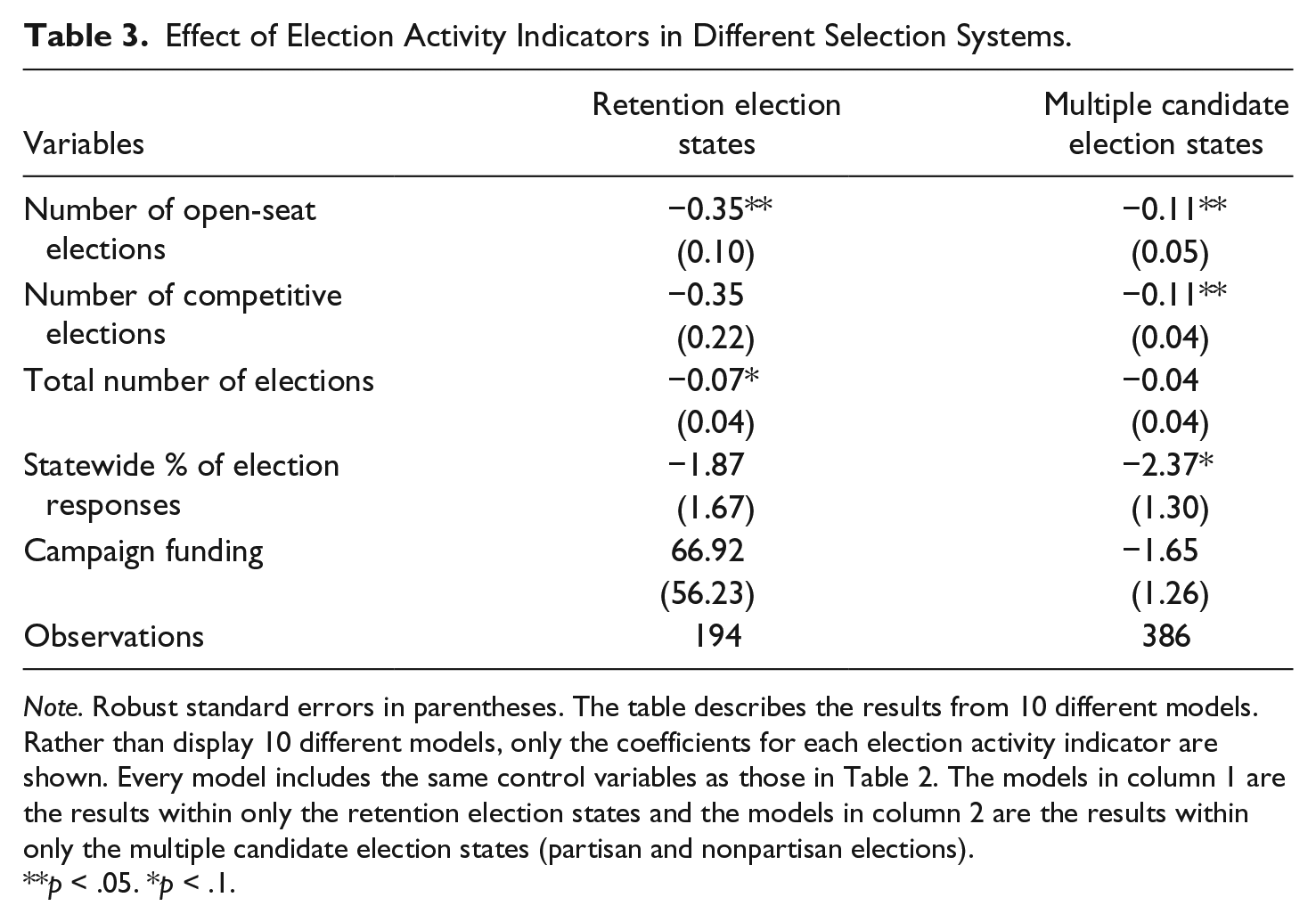
Note. Robust standard errors in parentheses. The table describes the results from 10 different models. Rather than display 10 different models, only the coefficients for each election activity indicator are shown. Every model includes the same control variables as those in Table 2. The models in column 1 are the results within only the retention election states and the models in column 2 are the results within only the multiple candidate election states (partisan and nonpartisan elections).
p < .05. *p < .1.
The most interesting results concern the number of open-seat elections and the number of competitive elections. Although both have a significant effect at p < .05 for states with multiple candidate elections, the effect is much larger for states with retention elections. For both indicators, the effect is just over 3 times larger in the retention election states. However, in retention election states, only the number of open-seat elections is significant at p < .05. The coefficient for the number of competitive elections is insignificant because the size of the standard error is very large. The coefficient is just above traditional levels of statistical significant with a p = .11. The much larger standard error most likely results from the small amount of variation on that metric within the retention election states. From these results, it appears that election activity has a greater effect in retention election states. This could result from the different expectations that people hold in retention election states compared with those in states with more traditional multicandidate elections. The people in multicandidate election states could see the judges as more similar to traditional politicians and have greater toleration for campaign and election activity.
The effects for the other indicators of election activity do not vary dramatically across the two categories of selection systems. For both the total number of elections and for the percentage of statewide election responses, one coefficient is marginally significant at p < .1, and the other is slightly smaller without reaching marginal significance. This pattern indicates that although the effect may be somewhat larger in one category the differences between the two categories are not substantial or statistically significant. The campaign funding variable is insignificant in both, matching its results from the full sample model.
The effects of election activity may vary by individual characteristics as well. Positivity theory (Gibson and Caldeira 2009b; Gibson, Lodge, and Woodson 2014) emphasizes how knowledge of courts changes the manner in which people evaluate them. If this same dynamic appears with election activity, individual-level characteristics like court awareness may moderate the effect of election activity. To assess this possibility, the analysis examines the interaction between each of the six election activity indicators and the six nondemographic individual-level variables included in the model. These are court awareness, support for the rule of law, perceived election fairness, education, political interest, and ideological self-placement. This involves 36 different models that include the same variables as those in Table 2 with the addition of one interaction between the election activity indicator and one of the individual-level variables (models not shown). Of these 36 interaction terms, none are significant at p < .05. Only the interaction between the number of open-seat elections and court awareness is significant at p < .1. 14 However, through random chance, three of the 36 interaction terms would be expected to be significant at p < .1, meaning little confidence should be placed in this finding.
Subjective Ideological Distance and Other Control Variables
Although not the emphasis of this study, the control variables included in the models provide some interesting results that confirm previous findings, and in one case, provide an interesting pattern deserving further research. Across the various models in Table 2, court awareness, education, and political interest all consistently have positive effects on legitimacy perceptions that are significant at p < .05. This reaffirms the long-standing finding that as people are more exposed to courts, they become more supportive of them (Gibson and Caldeira 2009a). In addition, the coefficient for support for the rule of law is positive and significant at p < .05, reaffirming a finding from previous studies (Gibson and Caldeira 2009a).
The most interesting results come from the subjective ideological distance item. This variable speaks to the debate between Bartels and Johnston (2013) and Gibson and Nelson (2015) over the size of the relationship between subjective ideological disagreement and perceived legitimacy, but applies that debate to state supreme courts rather than the U.S. Supreme Court. The item asks the subjects whether they think the court makes decision that are much too liberal, somewhat too liberal, just about right, somewhat too conservative, or much too conservative. In the model, an indicator variable is included for each category, with the excluded comparison group being the “just about right” category. With this coding, each indicator variable compares its respective category with the “just about right” category. Using this type of coding is important because the effect of subjective ideological disagreement is both nonlinear and varies based on the ideological direction of that disagreement.
Figure 3 shows the predicted values of legitimacy across the different levels of subjective ideological distance. 15 These predicted values come from the model in column 2 of Table 1 that includes the number of open-seat elections variable. 16 When the public perceives the court’s decisions as “just about right,” the predicted value of legitimacy is 11.13. This decreases to 9.17 among those who believe it is somewhat too conservative and then decreases slightly to 8.98 among those who believe it is much too conservative. The 2.16 difference between “much too conservative” and “just about right” represents 13.4% of the legitimacy index’s total range. Among those who believe the court is too conservative, the effect of subjective ideological disagreement is nonlinear. Moving from ideological agreement to a low level of ideological disagreement has a substantial negative effect on perceived legitimacy, but there is not much difference between mild ideological disagreement and large amounts of ideological disagreement. The size of the effect is comparable with that in Bartels et al. (2013) in which moving from strong ideological agreement to strong disagreement shifted the predicted value of legitimacy by 13.9% of legitimacy’s range.
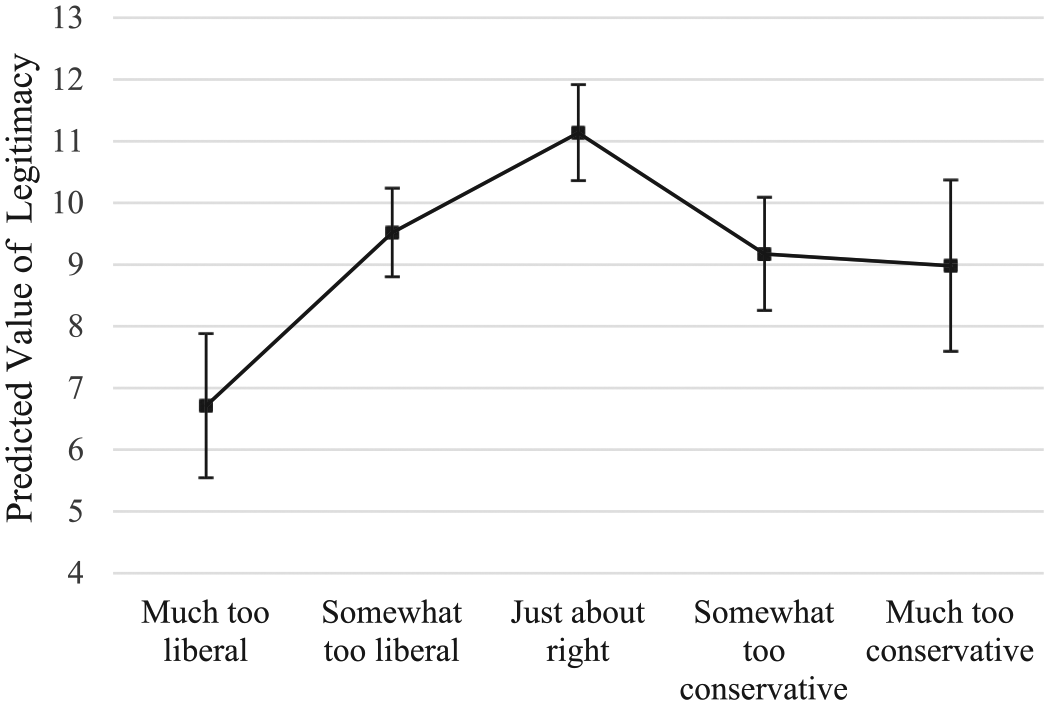
Subjective ideological disagreement and perceived legitimacy.
The pattern of results differs among those who believe the court is too liberal. The predicted level of legitimacy for those who believe the court is somewhat too liberal is 9.52, which is of similar magnitude to those who believe the court is somewhat too conservative. However, the level of legitimacy among those who say the court is “much too liberal” is much lower with a predicted value of 6.71. Importantly, the predicted value for “much too liberal” is significantly lower at p < .05 than for those who answered “much too conservative.” The 4.43 difference between “much too liberal” and “just about right” represents 28% of legitimacy’s range, which is just over twice the size of the effect in Bartels et al. (2013). 17
It is important to note that the difference in effects between perceiving the court as “much too liberal” and perceiving it as “much too conservative” are not driven by conservatives attributing less legitimacy to the court. The model includes ideological self-placement, and it is insignificant. Being conservative does not necessarily lead to a decrease in legitimacy. 18 It is only when a conservative perceives the court as “much too liberal” that legitimacy decreases. Because conservatives are more likely to perceive the court as too liberal and liberals more likely to perceive it as too conservative, these results do suggest that conservatives may punish the court more for perceived ideological disagreement than liberals. Although these results cannot resolve the dispute between Gibson and Nelson (2015) and Bartels et al. (2013), they do show that future studies concerning the relationship between subjective ideological disagreement and legitimacy perceptions should take into account the potential for both nonlinear effects and that perceiving a court as too liberal may have a greater effect than perceiving it as too conservative.
Conclusion
Whether a state has partisan, nonpartisan, or retention elections does not directly affect legitimacy perceptions. Instead, it is whether the norms surrounding those elections encourage an active election system. The empirical results above can be explained if the positive effect associated with electoral accountability causes a boost in legitimacy for every elected court. As these election systems become more active and candidates campaign more, the negative effects on legitimacy begin to accumulate, and at higher levels of election activity, overpower the positive effect of electoral accountability.
These findings confirm some findings from the three categories of existing literature on the relationship between judicial elections and perceived legitimacy while providing qualifications for others. The findings largely coincide with the literature concerning the effect of campaigning on perceived legitimacy. That literature concentrates on examining the effect of specific types of campaign activity like politicized television advertisements (Gibson 2008a; Gibson et al. 2011) or accepting campaign contributions (Gibson 2008b, 2009). The current study did not examine specific types of campaign activity but instead attempted to assess the overall amount of campaign activity through indicators of election activity. As the overall amount of campaign activity increases, the level of perceived legitimacy decreases. Although this study cannot determine exactly which aspects of campaigning decrease legitimacy, it does suggest that judicial campaigns commonly contain the types of activities that decrease perceived legitimacy, and as campaigns become more active, the public becomes more exposed to these legitimacy-decreasing aspects.
This study’s findings are most at odds with existing studies using one-wave surveys to assess variation in perceived legitimacy across America’s 50 state supreme courts. In this category of studies, the most consistent finding is that public support is lowest among partisan election states (Benesh 2006; Cann and Yates 2008; Jamieson and Hardy 2008; Wenzel, Bowler, and Lanoue 2003), but the current study found no evidence for this or any difference between the four traditional categories of judicial selection. This could result not only from the current survey being fielded during a different time period but also from the surveys using different measures of institutional support. The dependent variable in the current study excludes any items assessing confidence, trust, or perceptions of the court’s decision-making process. Support for public institutions is a complex concept involving various types of support with different determinants and resistance to change. Much of the time, the debate over how to measure institutional support concerns the difference between diffuse and specific support (Easton 1965). The measure used in this study was designed to tap into diffuse support—a long-standing commitment to the institution—without being contaminated by either specific support—short-term evaluations of a court’s output—or perceptions of the process a court uses to make its decisions.
The relationship of judicial selection to diffuse support, specific support, and process perceptions deserves further inquiry, but studies must be careful to note which type of support they are measuring and to clarify that their findings apply to only that form of support. Studies using different types of support may come to different conclusions. Rather than one study being used to undermine the results of the other, their results should be examined together to determine systematic ways in which the determinants of various types of support differ. Perhaps, the proper conclusion to draw from the current study is not that courts in states with partisan elections have the same level of public support as those in other types of states. Instead, it is that while some types of public support for courts may be lower in partisan election states, no evidence shows that perceived legitimacy measured using items assessing whether people want to make changes to how the institution operates is lower in partisan election states.
In some ways, the results from the current study largely match those found in the panel studies from Gibson (2012) and Gibson et al. (2011). Both show that elections provide a boost to legitimacy through electoral accountability and a negative effect through campaigning. Importantly, the studies differ in their predictions for how often the negative effects from campaigning overpower the positive effects from electoral accountability. The Gibson studies conclude that elections do not undermine the legitimacy of courts because in the two statewide election cycles they examine, the overall effect is positive for most people, zero for some, and negative for almost no one. By generalizing beyond these two states, the current study shows that those studies underestimated how often the overall effect of elections on perceived legitimacy is negative. In at least nine states with highly active elections, the level of legitimacy is lower in elected courts than it is in appointed courts because the negative effect from elections is larger than their positive boost.
This empirical discrepancy in how often elections have an overall negative effect on legitimacy causes the conclusion from the current study to diverge from those of the Gibson panel studies. The Gibson panel studies paint a rosy picture in which America can have robust judicial election campaigns without undermining the legitimacy of courts. These robust campaigns help to provide accountability by informing voters about the candidates and allowing them to make an informed choice. Without these campaigns, elections return to their traditional status as low-key affairs that leave voters uninformed and unmotivated.
Both election critics (Geyh 2003) and proponents (Bonneau and Hall 2009) say this results in ineffective judicial elections that do not provide an adequate level of accountability. The solution of election critics is to move toward an appointment system that provides greater judicial independence. The solution of election proponents is to call for more robust judicial campaigns that encourage more voter knowledge and participation, which provides greater judicial accountability. Although the current study cannot end the debate between these two sides because it involves many normative issues unrelated to legitimacy, it does suggest that more robust judicial campaigns can decrease perceived legitimacy. It seems that election proponents can choose between three options: elections that increase legitimacy but provide voters with little information through campaign activity, elections that decrease legitimacy but provide voters with large amounts of information through campaign activity, or a middle ground in which elections involve some but not an overwhelming amount of campaign activity, provide some information to voters, and have no overall effect on legitimacy.
The next question becomes whether the amount of information provided to voters in the middle ground option is enough to allow an adequate level of public accountability. Although the current study cannot provide an answer for this question, it does provide guidance depending on the answer. If the question is answered in the affirmative, election proponents should concentrate on incremental reforms that limit the excesses of judicial campaigns so they do not decrease the legitimacy of courts. If the answer is no, election proponents must choose between either elections with robust campaigns that decrease legitimacy but encourage an informed electorate or elections that have no effect on legitimacy but leave the electorate uninformed. Critics of judicial elections would certainly respond that neither is acceptable and the best way forward is to scrap elections altogether.
Footnotes
Declaration of Conflicting Interests
The author(s) declared no potential conflicts of interest with respect to the research, authorship, and/or publication of this article.
Funding
The author(s) disclosed receipt of the following financial support for the research, authorship, and/or publication of this article: This research was funded by a grant from the Law and Social Science Division of the National Science Foundation (1223199).
