



Abstract
Most state supreme court justices have time-bound terms that require them to be reappointed or reelected after a certain amount of time. In three American states, South Carolina, Vermont, and Virginia, the legislature has the sole power to retain justices. Legislatures, and their specialized judiciary committees, are well positioned to monitor judicial behavior and can reject retention for justices who are unacceptable. This turns the legislature’s oversight authority into influence over policy making by justices who still need to be reappointed to additional terms. But some justices (co-partisans) are insulated from this influence by their connections to the majority party, which substantially increases the likelihood of their retention. I show that, between 1995 and 2014, justices appointed by the minority party who were eligible for a new term voted more in line with the preferences of their legislature than those who were no longer eligible for a new term due to mandatory or voluntary retirement. No similar effect is found among appointees of the majority party. To support my argument that it is the legislature’s reappointment authority that gives them this power, I conduct a placebo test to show that governors in these states enjoy no comparable influence on reappointment-seeking justices. This legislative influence represents a substantial limitation on judicial independence.
Keywords
The judicial power is perhaps the most vexing component of the modern democratic state. The core tension is intuitive: effective democracy requires that justice be impartial, consistent, and able to enforce the limitations on other political actors, but a purely independent judge lacks the accountability and representativeness required in a democracy. In a system of independent judicial power, there are few responses to undesirable judicial outcomes short of difficult constitutional amendments. But in a system of tight political control of the judiciary, policy may swing dramatically with the political winds, and other branches may be free to exceed their constitutional prerogatives. While the federal system has come down firmly on the side of judicial independence, states have developed a variety of institutional structures to control both how people become and remain judges. The most common such system involves at least one popular election, positioning justices within an explicitly democratic structure. Other systems place judges directly in the sway of another major branch of the state government, such as the legislature. In these cases, justices are accountable, but they are accountable to some of the very actors they are meant to check within the American separation-of-powers framework. And unlike the low-information environment of judicial elections, legislatures, with their specialized committees and staff, effectively monitor judicial behavior and actually exercise their oversight power. This induces justices to behave strategically, limiting judicial independence, and thereby creates influence for the legislature.
The existing literature on state supreme courts is highly informative about the impact of judicial retention systems: relative to having life terms, they create substantial incentives for justices to behave strategically. But the focus in this literature has largely been on the impact of electing judges. While very successful for describing the impact of electoral institutions, it has led to a narrowed focus on the situations in which we think electorates might influence judges: highly salient cases (such as death penalty reviews) that are likely to receive media coverage, with extra attention on cases near the end of a judicial term. But systems of political reappointment by legislatures merit their own separate, tailored theorizing and empirical analysis. In this article, I explore the situations in which justices have incentives to behave strategically to increase their likelihood of being reappointed by their legislature.
Modern legislatures, made up of political elites, have the institutional capacity and resources to closely track judicial behavior (both actively and retrospectively) across the length of a justice’s term. Today’s legislative structures are the result of centuries of development and reform that have promoted expertise development. They are able to monitor judicial behavior with the looming threat of an uncertain retention as their enforcement mechanism. This enables legislators to effectively exercise their oversight authority, creating the incentives for strategic behavior by justices. Despite their powers, legislatures do have to overcome internal collective-action problems. The difficulty of managing intraparty disputes means that the legislature’s power will be most easily exercised against judicial appointees of the out (or minority) party, who lack close connections with the majority party and its leaders.
To evaluate my arguments, I leverage state mandatory retirement ages to compare votes taken by justices in their final (retiring) term to those they took earlier in their careers when they were still eligible to be reappointed by the legislature. I test my hypothesis on a 20-year period of criminal-law cases decided in all three states that use legislative retention for state supreme court justices. The results indicate that out-party appointees who still need to be reappointed vote far more often in line with their legislature’s preferences than they do once they are in their final term. As legislatures become more liberal, so do the justices needing to be reappointed. I detect this effect systematically in a large dataset of votes that range over justices’ entire terms, and include a substantial docket of cases, many of which never received any public attention, but which are well within the view of the legislature. This effect is also considerably larger than the similar effect of eligibility for reappointment among in-party appointees.
These results imply that justices in legislative-reappointment states behave strategically rather than sincerely when they need to guarantee that they keep their jobs. This strategic behavior functions as a form of influence for the legislature, which constrains justices from deciding cases (and setting policy) as they might in the absence of reappointment. Because of the legislature’s informational capacities, this influence extends across time and down the docket, representing an arguably stronger limitation on judicial independence than found in electoral states.
Strategic Judicial Behavior and Legislative Influence
A recurring focus in the study of judicial politics (and essentially all political actors) is the difference between “sincere” and “strategic” behavior. In some situations, justices and judges act “sincerely,” deciding according to their own set of personal preferences, which are most often seen as attitudinal (see Segal and Spaeth 2002), but could also be legalistic, or derived from any number of combinations of those and other factors. In contrast, strategic behavior diverts in some way from sincerity in the immediate decision to achieve an ultimate outcome that is closest to a judge’s preferences, typically at some later point in time or on a different level of outcome.
Strategic behavior by judges is frequently thought of in the separation of powers context, in which the judiciary must divert from its sincere preferences to achieve its most favored possible outcome, in light of the powers and preferences of the other branches of government. The formalized version of the Separation of Powers (SOP) game (see Epstein, Knight, and Martin 2001; Langer 2002) typically treats a court as a unified actor (embodied in a median justice), which must make policy through deciding cases. The key feature of SOP models is that the other branches of government also have a role and the capacity to retaliate if they do not like the court’s decision. Thus, courts must always make policy with the likely responses of their co-equal branches in mind, which can sometimes induce them to behave strategically rather than sincerely. In this way, sincere versus strategic considerations invoke judicial independence. An independent judiciary is one capable of sincere voting. A judiciary forced to be strategic is less independent. In addition to this context, strategic behavior has been found within the judicial hierarchy itself (Clark 2009), within electoral contexts (Huber and Gordon 2004), and in the words of the opinions justices write (Black et al. 2016), to name just a few diverse examples.
In state supreme courts, the clearest pressure that can induce strategic judicial behavior is retention politics. The great majority of American state supreme court justices serve lengthy, but time-limited, terms. This institutional choice by state founders and subsequent reformers reflects concerns about the unrestrained independence of life terms. A time-bound term allows for the possibility of removing corrupt or incompetent judges, who might have remained on the bench for decades in a system with life terms. Limiting the length of judicial terms also created a new institutional power: someone must choose whether a sitting justice will remain on the bench after the end of their initial term. Some states have granted this power to governors, and a majority of states allow voters to decide. In three states, however, legislatures play the decisive role. In South Carolina and Virginia, the legislatures conduct both initial appointment and reappointment. In Vermont, the legislature chooses whether to retain justices initially appointed by the governor. Like elections and executive reappointment, legislative reappointment constrains judicial behavior, and, thus, independence, in comparison with life terms. However, legislators are different from voters and governors in important and distinct ways, and this points us in the direction of when and how we might observe strategic judicial behavior. Placing the retention power in the hands of the legislative branch, an explicitly ideological institution in modern American politics, points to the possibility of systematic ideological influence. In this section, I outline the underlying assumptions and arguments that collectively lead to the expectation of legislative influence on judicial behavior.
I follow Langer (2002) in assuming that justices care primarily about two things: case outcomes and their own professional success. First, I assume that justices have preferences for how any given case should be decided, which inform “sincere” decision-making. This assumption is agnostic as to what informs these preferences, which are only defined as existing prior to any external pressures or strategic considerations. Second, I assume that justices care about their own professional success and want to keep their prestigious office, its compensation, and the power to decide even more cases in the future. There is evidence that elected justices show an “electoral connection” (Canes-Wrone, Clark, and Kelly 2014; Canes-Wrone, Clark, and Park 2012; Melinda Hall 1992) analogous to what we find in other politicians, such as members of Congress. It is logical that this connection would also exist among those whose “electorate” is the membership of the state General Assembly. This desire to retain their office creates the incentives for justices to act strategically, which I conceive of here as voting insincerely in cases to increase their likelihood of retention. These accumulated insincere votes represent a form of legislative influence over justices who still need to be reappointed to future terms.
A remaining question is when we should observe justices acting strategically with regard to retention politics. They should only do so when it is necessary to keep their jobs. 1 Thus, the extent to which they act strategically is a function of the capacity of the legislature to monitor and punish their behavior. The legislature must have detailed knowledge and understanding of judicial behavior to induce strategic deference. Second, they must have some means of enforcement, typically a form of punishment, to serve as their retaliation mechanism. Both elements are necessary. Information without an enforcement mechanism is impotent. Similarly, an enforcement mechanism employed in a state of ignorance is a blunt and useless tool. Only when an enforcement mechanism is combined with expertise in when and how it should be used can it have the intended effect of incentivizing judicial deference. Legislatures combine both of these elements. They have the institutional resources and structure to cheaply develop expertise in judicial behavior and also the power to reject retention (effectively to fire). I now explore these two prongs—monitoring capacity and enforcement power—in more detail.
The first major reason we should expect to see strategic behavior among justices in legislature-retention states is that legislatures have substantial professional resources and internal structures that make acquiring information and developing expertise efficient and effective. Legislatures have staff that can perform research and write reports. Although state legislatures are generally underfunded compared with their federal counterparts, they still have sufficient resources to track state supreme court decision-making. Legislatures also profit from centuries of institutional development that encouraged the efficient cultivation of expertise. The hallmark of this is the committee system (see, for example, Krehbiel 1992). Recent work has shown that this extends to state legislative committees, including judiciary committees (Battista 2012; Hamm, Hedlund, and Post 2011). Vermont, Virginia, and South Carolina are no exceptions. The South Carolina House of Representatives and Senate have Judiciary Committees with 25 and 23 members, respectively. Virginia’s House of Delegates and Senate have 22- and 15-member Courts of Justice standing committees, respectively. Vermont’s House and Senate have 11- and 5-member Judiciary committees, respectively. Thus, each state has at least 16 legislators on a committee, which allows them to specialize in the judiciary. These committees hold hearings, compose reports, and also serve as a magnet for outside actors (such as interest groups and bar associations) to deliver information. 2
Committees also have clerks, attorneys, and support staff. South Carolina’s House committee, for example, has two permanent staff attorneys. Thus, these committees are able to monitor and understand state supreme court decision-making. In addition to regular judiciary committees, Vermont has an eight-member Joint Committee on Judicial Retention focused specifically on this task. South Carolina has a 10-member nominating commission, which has the first move in the retention process, and which includes six members of the legislature. 3
This level of expertise development stands in stark contrast to the informational environment explored by most existing studies of retention politics, that of popular judicial elections. Voters in judicial elections are notoriously low-information voters, often swayed by a small number (as few as one) of recent and highly salient cases. Thus, the literature that has developed around this area has, understandably, looked for effects on judicial voting on highly divisive issues such as death penalty (Canes-Wrone, Clark, and Kelly 2014; Melinda Hall 1992) and abortion decisions (Caldarone, Canes-Wrone, and Clark 2009). I argue that legislatures have sufficient informational advantages that it is reasonable to expect influence not only on the most salient cases, but on a variety of cases up and down the ballot. The legislature does not rely exclusively on media and activist attention to become aware of a case. Reports compiled in advance of an appointment or reappointment vote typically contain extensive and diverse documentation on a justice’s entire body of work, as well as personal, financial, and other information.
When the existing literature has looked at issues that might be more appropriate for elite-reappointment systems, it has tended to focus on situations in which another branch is the party to a case (Shepherd 2009) or when a law passed by the other branches is challenged (Langer 2002). These tests provide strong evidence of elite influence when given the power to reappoint justices, but do not test for ideological influence. Given the increasing ideological consistency and polarization among elected politicians in the last several decades, this is an important place to look for influence. Thus, the scope of my argument—and the testing I pursue in subsequent sections—is broader and different than the existing theoretical and empirical literature. I argue that justices have the ability to influence ideological behavior even in cases in which they are not parties and when the issue is not likely to receive media attention.
Monitoring capacity is a necessary but insufficient condition to induce strategic behavior from justices. If the legislature cannot punish justices in any way, then even a very informed legislature would have little or no influence. Legislatures lack day-to-day enforcement mechanisms, although they may engage in the politics of salary control and jurisdiction limitation (such as in the federal example outlined by Clark 2011). They also have roles to play in policy making as typically described in SOP theory. But, most important, they have a powerful tool to control justice behavior: the power to fire them. At set intervals (10 years in South Carolina, 12 in Virginia, and six in Vermont), justices face a retention vote in their general assemblies. This is a strong, if infrequently available, enforcement mechanism that strikes at one of the two key interests I have assumed justices have: professional success. The loss of a job, its prestige, and its power to set policy is a serious blow for many justices. Because this is a fate they would strongly prefer to avoid, the legislature’s enforcement mechanism has the necessary bite to be an effective influencer.
These two features—monitoring capacity and an enforcement mechanism—work in tandem. Monitoring capacity ensures that the enforcement mechanism can be precisely and reliably applied, which enhances its effectiveness. Justices know that their legislature—or at least specialized parts of it that are delegated that task—can follow their judicial decisions. And that if those votes are sufficiently out of step with the legislature’s preferences, they have the capacity to take away that justice’s job. Their detailed monitoring capacity ensures that their influence is not limited to the most visible and salient issues. This has one clear implication: a self-interested justice’s decisions will be strategic, avoiding stepping too far away from the legislature’s preferences.
Despite these strengths, legislatures do have limitations. Namely, they face collective-action problems and have a large number of tasks to accomplish with limited time. While the barriers to agreement are not nearly so great as for electorates of millions of voters, legislatures must coordinate within partisan structures to build majorities to achieve anything, including rejecting retention. 4 Retention votes in these legislative chambers feature the same types of partisan vote whipping and organization as other legislative activities that are more familiar to scholars. 5 And once a justice is rejected, legislators face a horse-race battle to find a replacement. On top of these barriers, legislators serve long careers, with recurring committee positions, meaning that some or even a majority of those responsible for putting a justice on the court could also be responsible for the retention. This may give those legislatures a level of responsibility for and attachment to that justice, who was likely the favored candidate of some of the principal movers in the majority party at the time of their initial appointment. This may make it costlier for them to reject the justice, dramatically increasing the policy flexibility a justice can sincerely work in. Langer (2002) uses a spatial model to describe policy flexibility that justices can have, describing “safety zones” in which justices can vote sincerely. She shows that when legislative coalitions are harder to develop against a justice and when there is less ideological distance between the justice and the legislature, a justice’s safety zone is larger, leading to less strategic behavior. In-party and out-party justices diverge in both of these criteria and, as a result, in-party justices are able to vote far more sincerely than out-party justices.
These limitations have one clear implication for which justices we might expect to behave strategically: justices will primarily be concerned when they were appointees of the out-of-power party (or “out-party”). When justices were initially appointed by the party still controlling the legislature (the “in-party”), policing their behavior is a much harder task. They were agreeable to the majority caucus to get the position in the first place, and policing their behavior would take considerable effort within the party. As Shepherd (2009) argued, legislative appointees have strong connections to the legislatures that picked them. I refine this slightly and argue that these appointees have strong connections to the majority coalitions that picked them. It would not be worth the political cost to organize within the majority to replace a co-partisan justice and then agree upon a replacement. The gains of replacing a justice of their ideological stripe with one marginally closer to their ideal would be relatively small compared with this cost. Thus, this kind of oversight should only prevent the most extreme ideological defections.
If in-party appointees have little reason to be strategic because they are insulated by existing relationships and the collective-action barriers faced within the party, then out-party appointees are in the exact opposite situation. Lacking the existing relationships and prior endorsement, they are the most obvious targets of a new legislative majority. It is nowhere near as difficult for the party to organize internally around replacing an appointee of the rival party. And the likely gains are much larger (potentially replacing a liberal with a conservative and swinging a court, for example), making it worth the time and political effort. Thus, justices have substantial incentive to behave strategically—by moderating their decision-making to appear more in line with the legislature and reduce the potential gains of replacement.
Legislatures are also limited by the uncertainty that justices may have over the identity (and, thus, preferences) of the legislature that will exist at the time of their reappointment. In some cases, justices may still have years left in their term. But those justices will still know that they will be evaluated for decisions taken across their term. In such a situation, the present legislature is an informative (but imperfect) proxy for what the future legislature is likely to look like. State legislatures did not change frequently in this time period, and individual legislators (such as the members of judicial committees) have long and stable careers. Thus, I assume that justices look to the legislative preferences at the time of their decision as their best indication of future conditions. To the extent that this assumption is incorrect, my resulting empirical tests will be biased against finding the effect I argue for.
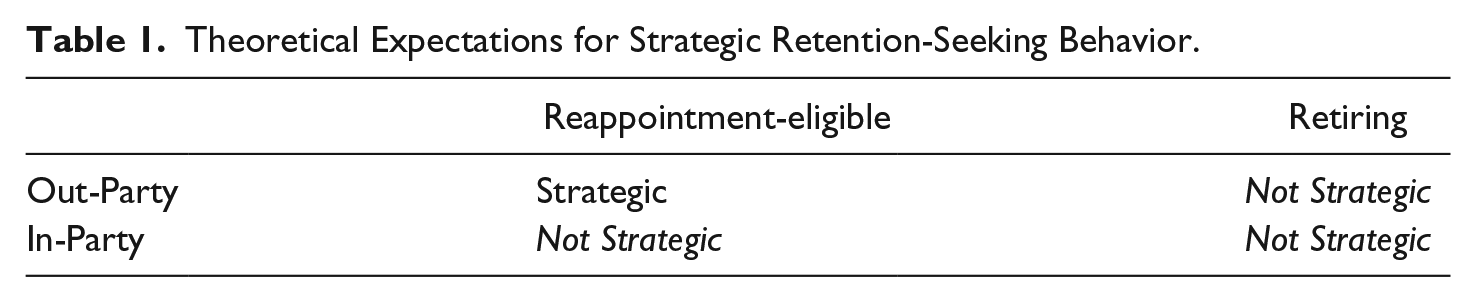
One key fact remains—only some justices are eligible for a reappointment. Due to mandatory retirement ages, some justices are beyond the reach of their legislature. 6 If they cannot be reappointed no matter what they do, then they have no incentive to vote strategically around the issue of retention—because the legislature no longer has the means to punish them. This status is unique for each justice. In each case, some justices of the court are still eligible for an additional term, while others are forced into retirement due to their age. This, combined with the preceding arguments, yields a set of four expectations for when retention concerns would induce strategic behavior from justices to increase their retention likelihood. These expectations are presented in Table 1 and then in an explicit hypothesis below.
Theoretical Expectations for Strategic Retention-Seeking Behavior.
Legislative Influence Hypothesis
Reappointment-eligible, out-party appointee justices vote in line with their legislature’s preferences more often than reappointment-ineligible, out-party justices do, and this effect is systematically greater than the comparable effect for in-party justices.
The Legislative Influence Hypothesis states that out-party appointees are more strategically deferential to their legislature’s preferences when eligible for further terms than when ineligible or when they are majority-party appointees. My explicit empirical prediction is that retention-eligible, out-party appointees vote more in line with their legislature than out-party retiring justices, and that this difference is greater than the difference between eligible and retiring justices among in-party appointees. I test this hypothesis on a set of all criminal cases between 1995 and 2014 from high courts in South Carolina, Vermont, and Virginia—the universe of states that use legislative appointments for judicial retention. I show that out-party justices are more deferential to their legislature’s preferences when they are eligible for another term, while there is no difference between retiring and eligible in-party justices, and that the difference between these two differences is pronounced and statistically distinguishable. Finally, in a placebo test, I show that these justices show no such deference to their governors, who lack the ability to reappoint them. Collectively, these tests support the Legislative Influence Hypothesis.
Testing
The Data
I construct a cumulative dataset of all criminal-case justice votes from 1995 to 2014 in the three states where legislatures reappoint justices—Vermont, South Carolina, and Virginia. For the years 1995 to 2010, I rely on Matthew Hall and Windett’s (2013) dataset of all state supreme court cases. I extended this to 2014 for the three aforementioned states to increase temporal range and also to increase the number of justices in the dataset. 7 Criminal cases have several helpful features for my analysis. First, criminal-law outcomes map well onto ideological preferences. Modern American liberalism and conservatism are distinctly opposed in terms of limits on police investigative power, defendants’ protections in criminal trials, and favored levels of punitiveness in sentencing. I assume that, all else equal, liberals prefer more pro-defendant rulings than conservatives do. I do not assume that liberals prefer exclusively pro-defendant rulings, only that they should be systematically more likely than conservatives to favor defendants.
Second, choosing criminal law partially mitigates research-design concerns about court agenda control. In most studies of courts, discretionary jurisdiction allows justices to pick the cases they will decide. This creates the potential for biased inference that is often unmeasurable and uncorrectable, even with sophisticated statistical methods. However, state-court justices have less freedom over criminal cases than United States Supreme Court justices have over their docket. The weakness, workloads, or total absence of intermediate appellate courts place extra weight on state supreme courts to be part of the administration of justice rather than pure arbiters of theoretical legal questions. Vermont, for example, lacks an intermediate appellate court, leaving the state’s appellate work to its Supreme Court. This means that the court lacks discretion over taking criminal cases. Virginia and South Carolina’s supreme courts are each required to hear appeals for capital cases, and have discretionary jurisdiction over appeals in noncapital cases. In general, criminal appeals, with their significant prison-time penalties, are heard at high rates because there is a greater obligation for each case to end with a just outcome.
Variables
The dependent variable, Liberal Vote, takes the value “1” when a justice’s vote is pro-defendant and “0” when it is pro-prosecution. In a small subset of cases (about 5%), the defendant won on some questions but not on others. For example, one conviction may be overturned but all others affirmed. These cases are difficult to reliably code because the relative weights of answers to different legal questions are highly subjective and difficult to consistently evaluate. Therefore, I exclude these cases from the analysis.
There are three main independent variables. First, I measure whether a justice was eligible for an additional term at the time a case was decided. Second, I include a measure of the ideology of the legislature serving at the time the case was decided. Finally, I interact the two. The Legislative Influence Hypothesis predicts that eligible justices’ votes will better match the preference of the legislature than the votes of ineligible justices do. Therefore, the Legislative Influence Hypothesis only includes a direct prediction about the interaction term: the difference between the two groups (eligible and ineligible) in terms of how highly their votes covary with the preferences of the legislature.
The first independent variable, Eligible, takes the value “1” when the justice was eligible for an additional term on the date the decision was published and “0” if the justice was no longer eligible for another term. I accumulated the information necessary to code Eligible from newspaper articles, official state documents, and state- or media-provided biographies. Justices are deemed ineligible when they could not legally hold another term due to age restrictions or had already announced an intention to retire or take a different job (such as an appointment to the federal judiciary). This method is imperfect because it counts as eligible those justices who had already decided to retire but who had not announced it yet. Any error in this direction biases tests against my predictions because it counts as eligible those who are, in fact, not concerned with subsequent terms, diminishing the ability to differentiate between the eligible and ineligible. This coding is also very blunt in that it treats those with 12 years left in their term identically to those with one year left, which makes for a more conservative test. My goal in this article is not to search for localized effects at the very end of terms. Instead, I argue that legislatures’ monitoring capacities mean they should have influence over a broad range of cases, and that their influence should be sufficiently systematic to be detectable in the votes of justices across various stages in their terms and careers. 8 My strategy with the Eligible variable is equivalent to studies (e.g., Melinda Hall 2014; Shepherd 2009) that analyze the differences in final-term behavior, 9 although I focus semantically on describing the eligibility for an additional term to be consonant with the treatment I describe: the need for an additional term induces the strategic deviation away from sincere behavior. In subsequent empirical tests, I argue that the differences in behavior between the eligible and the ineligible (and between eligible and ineligible periods within a justice’s own career) are owed to retention-seeking strategic behavior.
I also include a measure of Legislature Liberalism as a second independent variable. Because I argue that reappointment-eligible justices defer to the ideological preferences of their reappointment, their decisions should be correlated with the ideologies of their reappointing legislatures. All justices—even those in their final terms—have reasons to be responsive to their legislature: legislatures determine pay and court structure and can take “court curbing” actions similar to those Congress takes against the United States Supreme Court (see Clark 2011). Similarly, justices’ own preferences may be responsive to the same social forces that shape political change in other elites, leading to justices becoming more liberal or conservative as other branches do. However, because I analyze the difference between eligible and ineligible justices, this does not threaten the validity of my analyses. I analyze the additional legislative influence specific to eligible justices and attribute it to their unique retention dilemma. I use Shor and McCarty’s (2011) measures of state legislature ideology, which is derived from state roll-call votes and mapped onto a common space using survey measures of candidate ideology. South Carolina, Vermont, and Virginia provide significant within-legislatures and between-states variation. Using the most updated version of their dataset, only two state-years are missing (1995 and 2009 in Virginia). I exclude all votes from those years and have no reason to believe that this biases my analyses. I include the score for the legislature as of the date that the case decision was announced.
The measure of ideology should match the actual way the votes are taken for judicial retention. Thus, for Vermont and South Carolina, which conduct judicial retention votes in the entire assembly (House and Senate combined), I use the ideology score of the median member in the combined chamber. Virginia conducts separate and equal votes in each chamber and, thus, I take an average of the medians of each chamber as the measure of the Virginia legislature’s ideology. 10 While Shor and McCarty scores increase in conservatism, I flip this scale to increase in liberalism to be consonant with the dependent variable and other ideology measures in the model. In Figure 1, I present these weighted scores for the reappointment bodies. 11

Changing preferences of legislative judicial reappointment bodies between 1995 and 2014.
Finally, I combine these two variables into an interaction term, Eligible × Legislature Liberalism. This variable measures the difference between eligible and ineligible justices for the levels of covariation between votes and the legislature’s ideology. If the Legislative Influence Hypothesis is correct, I should find a positive coefficient for this interaction term among out-party appointees and no, or a significantly smaller, effect among in-party appointees. As Legislature Liberalism increases, eligible justices should be more likely to vote liberally in comparison to ineligible justices.
In addition to the dependent and independent variables, I control for other determinants of judicial decision-making. The most important factor to control for is a justice’s own ideology. My strategy to deal with this (and all other justice-specific factors) is the inclusion of justice fixed effects. This creates a within-justice analysis in which information about the independent variable is derived from changing behavior within each individual justices’ career. This does explicitly assume that judicial ideology is constant across time. 12 By including justice-specific intercepts and designating being retention eligible as the treated condition, I identify votes taken by retiring justices as the closest approximation of their “sincere” preferences, and then use the independent variables to measure diversions from that owed to requiring a reappointment.
Judges have been shown to be responsive to public opinion in a variety of high-salience situations (Besley and Payne 2013; Brace and Boyea 2008; Caldarone, Canes-Wrone, and Clark 2009; Canes-Wrone, Clark, and Kelly 2014; Canes-Wrone, Clark, and Park 2012; Melinda Hall 1992). This responsiveness is weaker in less visible cases (Cann and Wilhelm 2011). If justices are responsive to public opinion and legislature preferences closely mirror public opinion, then Legislature Liberalism may show a significant effect even if public opinion drives the effect. Therefore, I control for public opinion. I measure state Voter Liberalism by comparing how the states voted in presidential elections. I assume that voting for a Democrat is a sign of increased liberalism relative to voting for a Republican candidate. Unlike state-specific elections (such as gubernatorial contests), presidential elections provide a common reference point across all states because each state votes on the same two candidates. Specifically, I subtract the national democratic share of the two-party presidential vote from the state’s democratic share of the two-party presidential vote. 13 This creates positive scores for states more liberal than the nation as a whole and negative scores for those that are more conservative. This method provides values only for election years, so to complete the time-series, I assume a constant, linear change between elections. I reproduce 2012’s score for 2013 and 2014. Figure 2 presents these values for all three states between 1995 and 2014.

Changing levels of voter liberalism between 1995 and 2014.
Justices may also be responsive to governors, who share the legislature’s power to alter justice compensation and jurisdiction, and who can influence the enforcement of judicial decisions. Johnson (2014; 2015) has recently found evidence of executive influence of judicial decision-making at the state level. Therefore, I include Governor Ideology, measured as Bonica’s (2013) CFscore of the governor serving on the day the decision is published—except in the brief period between Election Day and Inauguration Day, in which the governor-elect’s score is used. CFscores are based on campaign donations and provide a consistent scale across states and time. To be consonant with other measures in the model, I flip Bonica’s scale to be increasing in liberalism rather than conservatism.
Finally, I include a case-specific covariate. Defendant Appealed is coded as a “1” when the defendant brought the appeal and “0” otherwise. This doubles both as important information on the procedural history of the case and an indicator of the ideological direction of the lower-court’s decision. In most situations, when defendants bring appeals, it is because they lost at the lower court (either at trial or an intermediate appellate court). This lower-court ruling is the best proxy we have of the proper application of existing law. Therefore, all else equal, defendants should be less likely to win at the state supreme court level when they brought the appeal. 14
Results
To test the Legislative Influence Hypothesis, I estimate a logistic regression with Liberal Vote as the dependent variable; Eligible, Legislature Liberalism, and Eligible × Legislature Liberalism as the independent variables; plus Defendant Appealed and justice fixed effects. The interaction term, Eligible × Legislature Liberalism, identifies the higher or lower level of covariation between justices’ voting and legislatures’ preferences for those still reappointment-eligible compared with those that are not. The Legislative Influence Hypothesis predicts that reappointment-eligible out-party justices are more deferential than their retiring colleagues. “Deference” in statistical terms represents a slope effect—the changing probability of a liberal vote as the legislature’s ideology changes. Thus, to support the hypothesis, the interaction term should be positive and statistically significant among out-party appointees, and significantly greater than the interaction term among in-party appointees.
I use the terms in-party and out-party to describe parties in and out of power. Thus, an “in-party appointee” is a justice who was appointed by a party that is in power when the justice casts a vote in a case. 15 I code all other justices as out-party appointees. 16 In total, about 65.9% of votes were cast by minority-party appointees. This number is so high because of the partisan realignment in Virginia and South Carolina. Many justices, especially in the first half of the time range, were appointed by southern Democrats in the final years of their control of southern legislatures. Those justices’ careers continued into the many years of Republican control. This results in a high rate of justices having been appointed by the rival party. Importantly, this realignment was nearly or totally finished by the time my analysis begins in 1995. These partisan shifts do pose some problems for the analysis, however. Justices appointed by the Democratic Party in the late 1980s may not have been as ideologically out of step with the Republicans in the 2000s as the basic partisan labels might indicate. However, this limitation biases against finding differences in the two groups, making my tests more conservative. In addition, the underlying logic of the importance of partisan connections to create collective-action barriers to protect in-party appointees applies to these justices appointed under the older partisan alignment.
I estimate two models for each relevant subset. Model 1 and Model 2 are estimated on the set of votes cast by out-party appointees. Model 2 differs from Model 1 only by having its standard errors clustered on justices. 17 Models 3 and 4 are estimated on the set of votes cast by in-party appointees. Again, Model 4 differs from Model 3 only in standard error clustering. The results are presented in Table 2.
Differing Levels of Deference among Majority- and Minority-Party Appointees.

Note. Numbers in columns are logistic regression coefficients with standard errors in parentheses. Bolded coefficients are statistically significant at the p < .05 level or better (two-tailed tests).
Table 2 indicates that out-party, retention-eligible 18 appointees are systematically deferential to their retaining legislatures. Within a justice’s career, they vote more in line with the preferences of their legislature when they are an out-party justice that still needs to be reappointed to additional terms. When their appointing party falls out of power, justices may see this as a signal of what awaits them at the end of their term and moderate themselves accordingly. At the same time, justices appointed by the current majority party show no signs of deference. This implies that justices feel relatively safe while the party that appointed them remains in power. Once that party falls out of power, however, justices begin to moderate themselves to be more acceptable to the new majority. The difference between the out-party and in-party effects is statistically significant, comparing across Models 1 and 3 (p < .10) or 2 and 4 (p < .05). Contrary to the findings of Huber and Gordon (2004) in the electoral context, I also find no evidence that retention-eligible justices are systematically more punitive. Figure 3 presents Model 2’s main effect graphically, showing the effect of being retention eligible on the probability of casting a liberal vote for differing levels of Legislature Liberalism.

Marginal effect of retention eligibility as legislature liberalism increases, out-party appointees.
The key result depicted in Figure 3 is that, among out-party appointees, retention eligible justices—as opposed to those in their final term—vote much more in line with their legislature’s preferences. When the legislature is more liberal, these justices vote for defendants at higher rates. When the legislature is more conservative, they vote against defendants at higher rates. This trend is fairly consistent across values of Legislature Liberalism, and is locally distinguishable from zero at both ends of the graph. All three states feature at least five general assemblies (typically two years each) in statistically distinguishable regions of the graph, indicating that the results are not driven only by one state. The off-centered nature of the graph, and the stronger effect size on the liberal side of the graph is likely due to the asymmetries of northern and southern Democratic politics, especially when viewed over the last 30 years. The gap between Democrats and Republicans is greater in the states that populate the right side of the graph (primarily Vermont and recent Democratic successes in Virginia) than it is in the left side of the graph (primarily South Carolina and years of Republican ascendancy in Virginia), where southern Democratic appointees from the 1980s and 1990s need only moderate themselves slightly to be palatable to the Republicans that have controlled the state for the last two decades.
While Figure 3 presents Legislature Liberalism’s influence on the direction and size of the retention eligibility effect among out-party justices, another way to look at the same data is to consider how a justice’s status vis-à-vis retention impacts the importance of the legislature’s preferences in their decision-making. In Figure 4, I present the results of Models 2 and 4 in this light. The numbers presented are the marginal effects of a one-point change in Legislature Liberalism on a justice’s probability of casting a liberal vote. On the left side of the figure are justices appointed by the out-party (Model 2) and on the right side are justices appointed by the in-party (Model 4). Within each half, justices are separated by whether they are retiring or whether they remain eligible for an additional term. The important comparisons for assessing the Legislative Influence Hypothesis are the differences between Retiring and Not Retiring in each half of the graph (whether the legislature has influence through retention power), and the difference between those two differences (whether the legislature’s influence is greater on out-party appointees).

Marginal effect of legislature liberalism for different types of justices.
In Figure 4, one group of justices stands out: the retention-eligible out-party appointees, the subject of this article and also the group pointed out in Table 1. For in-party appointees as well as retiring out-party appointees, the marginal effect of a one-point increase in Legislature Liberalism is about a 0.1 increase in the probability of a liberal vote, although this is not statistically distinguishable from zero for either of these three groups. For retention-eligible out-party appointees, however, the estimate is an increase of 0.24, more than double the size and distinguishable from zero at p < .001. Within out-party justices, the difference in effect of Legislature Liberalism between Retiring and Nonretiring justices is 14.9 percentage points and is statistically distinguishable at the p < .01 level. The comparable difference among in-party justices (−4.4 percentage points) is not statistically significant. The logic of my analysis is that if retention is important, then nonretiring justices should behave differently than comparable retiring justices. This difference is creditable to eligibility for additional terms and, thus, is best explained by strategic retention-seeking behavior. Among out-party justices, that pattern holds (there is a statistically distinguishable difference). Among in-party justices, the pattern does not hold. In fact, I estimate that retiring in-party judges actually voted in line with their legislature more often than nonretiring in-party justices did (although this difference is not significant). The difference between these differences (19.3 percentage points) is significant (p < .05), indicating that legislative retention influence was far greater on out-party appointees.
When taken together, Figures 3 and 4 strongly support the Legislative Influence Hypothesis. The best interpretation of these data is that two criteria are necessary for strategic deference to the legislature driven by retention pressures: first, a justice needs to be an out-party appointee; and second, a justice needs to be eligible for additional terms, thus, needing the legislature’s approval. These are exactly the two criteria I argue for in this article.
Notably, these results differ from the most comparable analysis in the literature. Shepherd (2009) did not find substantial differences in behavior between justices eligible for another term and those retiring in states where legislatures reappoint justices. Shepherd argued that this was explained by the strong connections that justices have with the long-serving legislators, meaning that even justices who cannot be reappointed still have connections that make them deferential and like-minded. I build on these arguments by differentiating between in-party and out-party appointees, which vary considerably on the level of connections to the deciding majority in the legislature. I show that once this additional layer is taken into account, meaningful differences between eligible and retiring justices are found for those out-party appointees who have weaker connections to the majority.
The coefficients on the remaining control variables provide interesting information about other research questions in state courts. Governor Liberalism is strongly associated with more pro-defendant rulings. Given the use of fixed effects, this indicates that when conservative governors are replaced with liberal governors, justices vote more liberally. 19 This at least partially comports with recent findings by Johnson (2014; 2015), indicating that governors can influence state supreme court decision-making, even in the absence of reappointment powers. There are a variety of potential explanations, including the governor’s influence over law enforcement and the governor’s role in the lawmaking process that determines pay raises, jurisdiction, and workload.
In terms of responsiveness to the public, only in-party justices consistently show such a relationship. It is impossible to say that this is due to deference to public opinion. It may also be that justices—members of the public—are acted upon by the same events and social forces that alter public opinion. Canes-Wrone, Clark, and Kelly (2014) find that justices who are retained through elite reappointment are responsive to public opinion. My results for in-party appointees echo theirs, but differ for out-party appointees, who are responsive to the legislature and not the public. The reason for the difference between the groups is not clear. Retention concerns are likely primary for out-party appointees, while secondary audiences (see Baum 2009) become important for in-party justices who are insulated from retention worries by their connections in the legislature.
A Placebo Test: Executive Influence in Legislative-Reappointment States
I argue that legislatures have influence specifically because they have the power to reappoint. This is the mechanism through which I arrive at the data presented in the preceding sections. If this is true, then it should be that other major actors who lack this reappointment power should not show similar levels of influence. The most apparent rival actor is a governor. In these three states, governors are not necessary for reappointment to the court. Although they have other means of influence, there is no reason for retention-eligible justices to behave differently from retiring justices with respect to the governor. To add support to the mechanism I highlight, I conduct a placebo test and replicate Table 2, except instead of interacting Eligible with Legislature Liberalism, I interact it with Governor Liberalism. If I am right, I should see no significant relationship. Again, I separate between out-party and in-party appointees, except now defined by the party of the governor. 20 The results are reported in Table 3.
Placebo Test of Gubernatorial Influence.

Note. Numbers in columns are logistic regression coefficients with standard errors in parentheses. Bolded coefficients are statistically significant at the p < .05 level or better (two-tailed tests).
The placebo test in Table 3 is passed. The interaction term is insignificant in all four models and improperly signed in Models 1 and 2, pertaining to out-party justices. The clearest interpretation of these data is that the governor’s ideology does not matter more for those who need to be reappointed than to those who are retiring. This supports the idea that the key mechanism is the power to reappoint—exclusively held by legislatures rather than governors. While governors’ ideology is strongly associated with judicial votes, as the models in Table 2 also indicate, it is important to note that this applies evenly to all justices and does not vary based on whether justices are leaving office, which indicates that something other than retention politics is the source of executive influence.
Conclusion
This article is about the strategic ways that justices respond to legislative oversight and appointment authority, and the influence this creates for the legislative branch. “Oversight” carries connotations of meritocracy and correction. Things are overseen so that problems are prevented or resolved. Indeed, corrupt, unethical, and capricious judges can, and are, removed through retention procedures. Yet, oversight also brings influence. The ability to remove undesirable justices induces strategic compliance in understandably self-interested justices who wish to retain their job. Thus, “oversight” limits judicial independence, which likely has value in certain areas of good governance (Maskin and Tirole 2004). In states with legislative judicial reappointments, this oversight power is entrusted to a group of blatantly political, partisan, and ideological actors: state legislators. It should be no surprise then that their reappointment power brings with it ideological influence over judicial decision-making. Legislators are strongly positioned to make use of this potential influence. Because they can internally delegate to committees and party structures and have legislative staff to perform research, the costs to track the behavior of the supreme court are small. The capacity to monitor and then punish justices who veer too far from desired decisions turns legislators from overseers to influencers, particularly of out-party appointees.
The result of these legislative capabilities is that oversight becomes influence. Rationally self-interested justices, specifically those who lack connections with the majority party, defer to the preferences of the legislature, making sure to remain acceptable to the legislative majority. This influence is consistent over time and is detectable in a large docket of criminal cases. Collectively, these findings indicate that when states choose to invest power over courts in their state legislature, they are reducing judicial independence and giving the legislature substantial ideological influence on judicial outcomes.
Although I believe these findings are generalizable to a variety of issues that legislatures may care about, these results have special implications for criminal law. In total, South Carolina, Virginia, and Vermont held 60,924 people in prison as of the end of 2014 (E. A. Carson 2015). In the 20-year period of criminal appeals I analyze, South Carolina and Virginia executed 115 individuals. As of January 1, 2016, those two states held 50 prisoners with a pending death sentence (NAACP Legal Defense and Educational Fund 2016). The stakes of criminal justice are always high. These are the cases that most require objectivity, independence, and a fair and predictable application of existing law. Yet, my analysis implies that at least some part of the fate of a criminal defendant was determined at the ballot box, when voters decided the composition of their state legislature. This brings back into the focus the democratic conflict I discuss in the introduction of this article. That criminal justice outcomes fluctuate and vary across defendants due to the political context poses significant normative problems in a system in which similarly situated people should receive similar outcomes. Yet, at the same time, justices being responsive to representatives of the people also has democratic appeal. This article adds to our knowledge of the extent and depth of the legislature’s influence in systems where they get to retain state supreme court justices. The implications of a judiciary so closely tied to its legislature deserve further thought and investigation.
Footnotes
Appendix
Acknowledgements
Thanks to David Klein, Jeff Jenkins, Craig Volden, Andrew Clarke, Adam Hughes, and the editors and helpful reviewers at State Politics & Policy Quarterly for comments and feedback on this article.
Declaration of Conflicting Interests
The author(s) declared no potential conflicts of interest with respect to the research, authorship, and/or publication of this article.
Funding
The author(s) disclosed receipt of the following financial support for research, authorship, and/or publication of this article: The author would like to acknowledge the financial support of the Bankard Fund at the University of Virginia.