




Abstract
Unlike most other countries, in the United States, subnational governments (states) have substantial authority over collective bargaining and union organization laws. Because states compete for business investment and union (dis)organization likely has spillover effects beyond state borders, weak unions in one state may affect union organization in other states. We examine how union decline in one state is associated with union decline in neighboring states, and whether the presence of prounion (left-leaning) governments may limit the spread of union decline. Examining a period of major union decline (1983–2014), we find that union weakness in one state is associated with union weakness in nearby states. We observe that Democratic power in Congress is associated with higher unionization rates, but that liberal state governments have been relatively powerless to stop union decline in this period. These findings have important implications for understanding the historical and contemporary weakness of American unions and for the future of union strength in the United States.
Keywords
Introduction
American unions have historically been weaker than those in most other affluent democracies, and union membership rates have been declining since the 1970s (Francia 2006). Unlike most other countries, in the United States, subnational, state governments have significant authority over labor relations and collective bargaining laws, and we have seen a number of states enact antiunion policies and otherwise encourage weaker unions in recent years (Pugh 2012; Snavely 2014). Since states compete for business investment and union weakness may have spillover effects, it is possible that union weakness spreads among the states. On the contrary, scholars of comparative politics have long observed that left-leaning governments have practical political and ideological reasons to prefer strong unions and that unions are stronger where the left holds more power in government (Greenstone 1970; Korpi 1978; Western 1995). Can the presence of prounion, that is, left-leaning governments bolster unions even in the face of these external downward pressures on union strength? We examine how these competing dynamics are associated with union strength in the U.S. states in the article that follows.
Strong unions have the ability to shape many political and economic processes and outcomes, both nationally and in specific states (Bucci 2018; Franko and Witko 2017; Hacker and Pierson 2010; Hartney and Flavin 2011; Kelly and Witko 2012; Leighley and Nagler 2007; Western and Rosenfeld 2011). Thus, it is important to understand the sources of union weakness and decline. Students of American exceptionalism have often noted the extreme weakness of labor organization in America compared with other affluent democracies (Lipset 1996). Yet, after World War II approximately one-third of the workforce was represented by a union, and unions were one of the most powerful forces in American politics, mobilizing resources and voters on behalf of liberal candidates and contributing to broadly shared prosperity (Goldfield 1983; Greenstone 1970; Hacker and Pierson 2010). Now, unionization rates are similar to what they were before the passage of the National Labor Relations Act (NLRA) first gave workers the right to organize in 1935—in 2014 only 6.6% of the private sector workforce was unionized.1 As even former bastions of unionism, like Michigan and Wisconsin, embark on efforts to weaken unions, it is important to consider how union strength in one state is associated with union strength in another, and what ability relatively prounion governments may have to withstand these external pressures.
Union weakness may spread among states for a few reasons. First, as unions become weaker in competitor states, governments may feel pressure to pursue policies weakening unions to attract business investment. Second, even if state governments do not respond to such competitive pressures, firms in unionized industries may pursue relocations and expansions in locations with relatively weak unions, or workers may not pursue unionization due to the fear that their employer will flee to such a location. In this scenario, the decisions of private actors are shaped by the existence of weak union environments. Finally, union organization has spillover effects or externalities for other states. Weak unions will have fewer slack resources to pursue the organization of new workers in other locations.
Based on existing literature, left-leaning state governments might have some ability to bolster the strength of unions even with these pressures because, as we explain, states have control over many policies that affect the ability of unions to organize. In a comparative sense, the United States has relatively conservative government at all levels, but there is variation in government conservatism across states, and some states have governments that are relatively left-leaning and prounion. Similarly, while union strength has declined over the last few decades in all states, there is considerable variation in the rate and extent of decline, as we show below. Can this variation be explained by the strength of the left in government, or are state governments that prefer stronger unions relatively powerless to achieve this goal in the face of external pressures on union strength?
To answer these questions, we examine how interstate pressures and government leftism or liberalism (in the American sense) have together shaped union density in the 48 contiguous U.S. states. Using data from 1983 to 2014, we find that weaker unions in nearby states are associated with lower union strength in one’s own state. While we do observe that Democratic strength in the U.S. Congress is associated with stronger unions, we fail to observe any relationship between state government liberalism and union strength. Thus, our findings highlight the ways in which the politics of union strength in America are similar to other countries and the ways that unusual aspects of America’s institutional structure and federalized system of labor relations contribute to “exceptional” union weakness and the likelihood of continuing union decline in the coming years.
Institutions, Politics, and Union Strength in America
For decades, scholars have debated why organizations representing working class and lower income citizens in America are so weak (Lipset 1996; Lowi 1984). While we are ultimately concerned with how political factors and interstate pressures shape union strength, a variety of other factors can explain unionization rates in affluent countries. Not surprisingly, given what we know of their relative weakness, American unions are disadvantaged by many of these factors. For instance, America’s larger, more diverse population, the limited role for unions in the provision of social welfare benefits and, more recently, high levels of globalization and extensive deindustrialization probably all contribute to weaker unions in America (Brady 2007; Coombs 2008; Lee 2006; Scruggs 2002; Stephens and Wallerstein 1991; Wallerstein 1989; Western 1995). However, while the United States stands out in terms of population size and diversity, many other countries leave a minimal role for unions in the provision of social welfare benefits and are highly globalized. As Godard (2003) notes, Canada is very highly globalized and unions remain much stronger there compared with the United States. What can explain such differences?
Federalism and Union Strength
One possible factor potentially contributing to union weakness that is often overlooked in the United States is the federalized system of labor relations. Federalism, per se, may not inhibit the growth of strong unions. Federalist countries in the Organisation for Economic Co-operation and Development (OECD) do have lower unionization rates than unitary countries, but the difference is relatively modest.2 Furthermore, some federalist countries have very high unionization rates, including some of the countries that are economically most similar to the United States, such as Canada and Australia (Godard 2003). Unlike many other nominally federalist countries, however, U.S. labor law reserves more authority to the states to make policy regulating labor relations, and this decentralization of labor relations policy likely contributes to union weakness.
As in other countries, policy decisions by the national government are critically, perhaps primarily, important for labor union strength in the United States. Since the 1930s, labor unions have been a strong ally of the Democratic Party (Dark 1999). Most scholars agree that labor unions have benefited from Democratic control of the federal government (Francia 2006; Tope and Jacobs 2009), even if Democratic governments have sometimes enacted laws that have harmed unions (e.g., Taft Hartley). A unified Democratic national government enacted the NLRA, or “Wagner Act” of 1935, which for the first time ensured that American workers would have the legal right to form and join unions with the power to collectively bargain on their behalf, and the National Labor Relations Board was established to oversee union recognition elections (Tope and Jacobs 2009). In the two decades following this law’s enactment, union membership rates (union density) increased dramatically.
The NLRA left substantial authority for the states to influence union strength, however. Perhaps most importantly, state governments have the authority to establish collective bargaining laws for employees exempted from the NLRA, which initially comprised a substantial percentage of workers in certain states (including public sector, agricultural, and household employees). Some states have extended collective bargaining rights to many of these employees, while other states have not.
Furthermore, a mere dozen years after the passage of the NLRA, the Taft-Hartley Act devolved even more authority over the system of labor relations to the states. Most controversially, Taft-Hartley allows states to forbid “union security clauses,” such as a requirement of union membership as a condition of employment at a particular company, a policy known as “right-to-work.”3 Twenty-eight states have enacted right to work legislation.4 There is some debate over the effectiveness of right-to-work laws in weakening unions, but it does appear that they weaken union political power (Feigenbaum, Hertel-Fernandez, and Williamson 2018).
Above and beyond specific authority to regulate labor relations, the large amount of general policymaking authority reserved to the states under America’s system of federalism means that states have the ability to use fiscal, regulatory, or other types of policy to affect union strength. For instance, some states have sought to prohibit any company that contracts with the state from using revenue generated by public contracts to discourage union organizing campaigns, while other states have placed limits on how unions can use their resources in the political sphere (Witko 2005). Though labor confrontations are not as bloody as they once were, whether the state government sides with strikers or management in labor disputes can have an important influence on how such disputes play out. In some states, law enforcement was traditionally used to limit labor organization, while in other states officials intervened on the side of workers in disputes over union organization (Marshall 1967). In 2014, as workers at a Volkswagen plant in Tennessee debated whether to form a union, the Governor and members of the legislature used the threat of withdrawing tax breaks for the plant if a union vote were successful (Snavely 2014). The vote ultimately failed. Thus, a variety of policy tools that are not inherently labor-relations policy can be used to shape union strength by state governments. These policies are likely to matter for union weakness, but of course states also have their unique economic conditions and histories which lay the groundwork for contemporary union strength.
We think it is likely that the decentralized, federalist structure of labor relations in the United States means that weak unions in one state may contribute to weak unions in other states. If union decline is “contagious,” why? Union weakness in one state may spread union weakness to another state by affecting the calculations of public officials regarding labor union policies, affecting the calculations of either firm managers or workers, or by shaping the resources available to unions to pursue organizing. We elaborate on each of these potential mechanisms below.
Perhaps the most obvious way that the existence of weak union states may shape the strength of unions in other states is by shaping the attitudes of public officials toward unions. State governments compete for business investment, and if state officials believe that firms prefer locations without substantial union strength, then they can potentially use policy to weaken unions. There is a large literature on how competition for business investment may lead to a “race to the bottom” in business regulation, welfare programs, and so forth. There is evidence that states do mimic their neighbors’ regulatory, social, and fiscal policy to some degree (Bailey and Rom 2004; Berry, Fording, and Hanson 2003; Konisky 2007; Peterson 1995; Witko and Newmark 2010).
Considering the most conspicuous antiunion policy, right-to-work laws, we see a clear geographical pattern of diffusion throughout history. Almost the entire Southeast, a band of states from Texas to North Dakota and some Mountain West states have right-to-work laws, while these laws have not been enacted in the Northeast or West Coast. Most recently, these laws have spread in the Midwest, which was once a source of union strength. Observers noted at the time that the passage of the Indiana right to work law may prompt other states to take similar steps, and indeed, neighbors Michigan and Wisconsin soon followed suit (Pugh 2012). Suppressing unions has long been an economic development approach in some U.S. states (Marshall 1967), and these recent attempts to weaken unions were very explicitly advanced as a means of attracting business investment in response to the fact that other states had right-to-work laws (Pugh 2012). But, as we have seen, right-to-work laws are only one way to weaken unions. Threats to withhold tax breaks are subtler and perhaps just as effective. It may be the case that the strength of unions is not a major consideration for firm managers when deciding location decisions, but even if it is not, if officials believe it is, or can use this possibility to further their own deeply held antiunion view by convincing others to support antiunion laws, then the existence of some areas with weak unions can lead to policy changes in other states that would also weaken unions. Lafer (2017) documents these attempts to weaken unions via public policy in the states, which were often initiated by interests representing wealthy capitalists who find unions inimical to their interests (see also, Hertel-Fernandez 2014; Hertel-Fernandez and Skocpol 2016).
There is a debate over whether policies like right-to-work cause union weakness or are more a reflection of union weakness (Moore 1998). For instance, it is impossible to imagine that Michigan would have enacted a right-to-work law during the heyday of industrial unionization. However, even if public officials never pursue antiunion policies (perhaps due to their leftism, which we discuss below) or these policies simply do not have much of an effect on unionization, the existence of deunionized environments can affect the decisions of private actors in a way that can lead to union weakness. Firms, looking to save on labor costs, may choose to expand or relocate in areas where unions are relatively weak. If jobs are relocated from a strong union environment to a weak union environment, the net effect will be fewer unionized jobs in the former state, without any commensurate increase in the latter state. For firms that are expanding operations in states with weak unions and not relocating existing jobs, there may be no decline in the number of union jobs in the prounion environment, but jobs that would have otherwise been unionized will instead materialize in an area where they will not be unionized. Thus, what could have been an increase in union jobs will instead be no net gain of unionized jobs.
Workers who are considering voting to form a union can also be influenced by the existence of union weakness in other states. When considering whether to join a union, workers in mobile industries consider the possibility that the jobs will be taken elsewhere. This concern was present in the 2014 debate over organizing Volkswagen in Tennessee. With abundant antiunion environments nearby, some workers were concerned that if they voted to join a union the jobs would be sent to other states with very little union presence (Snavely 2014). Thus, union weakness in nearby states may affect both firm manager and worker decisions in ways that have negative implications for union strength.
Finally, union weakness in one state may have externalities or spillovers for other states for more tangible reasons, even if these other mechanisms are not present. Weak unions do not have slack resources to organize additional workers in other states. Unions face a trade-off between using their resources to pursue the goals of their current members versus trying to organize new members. As unions have declined, this trade-off has become more severe and disagreements over this trade-off have been at the center of conflict within the union movement in recent decades (Francia 2006). The Change to Win Coalition of unions left the AFL-CIO precisely because they thought the latter was not investing enough in new union organizing. In contrast, if unions in most states are strong, there will be more resources to spare for organizing. Before the merger with the AFL, stronger CIO unions based in Northeastern and Midwestern states provided resources for organizing drives in other states (Zieger 1997). In this way, union strength in one state can feed union strength in another, and vice versa. In the period we analyze, unions are growing weaker so there will be generally negative spillovers and externalities of union weakness.
Our goal in this research is not to specifically test any one of these mechanisms, which we leave to future research. All of them can be (and often are) at play at any time and it would be very difficult to obtain data to test some of these mechanisms (i.e., honest statements from firm managers about union avoidance techniques). Our point is simply that there are a number of ways that union weakness may spread from one area to another, even if government officials do not change policies at all in response to pressures for business investment. As a first step, we want to know whether union weakness spreads among the states. We also ask, given these myriad ways that the federalized labor law structure may contribute to the spread of union weakness to other states, can state governments that prefer stronger unions have an impact on union strength?
Government Leftism and Union Strength
Despite these common competitive pressures, union strength varies dramatically across the states. At the extremes, in 2013 (the last year included in the data set that we analyze) private sector union density in North Carolina was just 1.6%, while 15.1% of private sector workers in New York state were represented by labor unions, a union density figure not too far below the OECD average. Of course, North Carolina never had strong unions due to its history of labor repression and traditionally agricultural economy. However, Indiana and New York had very similar private sector union density rates in the early 1980s—25% and 24%, respectively. In 2013 New York had a private sector union density rate of 15.1%, as noted, but Indiana’s was only 7.5%.
Some of these differences across states simply reflect demographic and economic variation. These differences also reflect that not all states compete with one another to the same degree. In general, states that are geographically closer are in closer competition for business investment because it is easier for firms to move a shorter distance (sometimes even to a different state within the same metro area) and geographic proximity is a proxy for similarities in climate, natural resource endowments, human capital stocks, and other factors that businesses consider when deciding where to expand or locate, but which would be extremely difficult to measure by other means. So far, the new wave of antiunion activity discussed at the outset of this article has been confined largely to the Midwest.
It has been conservative state governments leading the way in these recent antiunion policies and sentiments. Indeed, comparative scholars of union strength note that one of the core features of Western democracies that is associated with stronger unions is the strength of left parties in government. In a number of countries, unions have, of course, formed labor parties to advance their agenda in the electoral realm (Archer 2010), while in other countries socialist or communist parties have represented unions alongside other actors (Allern and Bale 2012). Given their ideologies and historical relationships with labor unions, left parties of various stripes enact policies that are more favorable to union organizing (Korpi 1978; Stephens and Wallerstein 1991). Thus, countries with governments controlled by these types of left parties have higher rates of unionization and have been less likely to experience major union decline over the last few decades (Brady 2007; Western 1995). The fact that the United States famously lacks a true left-wing party (Lipset 1996) contributes to union weakness in America.
Despite the fact that a true left-wing party does not exist, there is still significant variation in the strength of the left in government over time and across states. Arguably since at least 1896, the Democratic Party has been the more left-leaning alternative in Washington, DC, and during the New Deal era the national Democratic Party essentially absorbed smaller, radical left-wing parties (Hirano and Snyder 2007) and formed an open alliance with organized labor (Dark 1999; Greenstone 1970). From the 1930s through the 1960s, organized labor provided most of the financial resources and many of the voters for liberal candidates in Washington, DC and, when elected, these candidates enacted legislation to strengthen unions (Dark 1999; Greenstone 1970). Some scholars argue that the resurgence of the Republican Party in national elections after 1980 has contributed to union decline (Tope and Jacobs 2009), just as comparative theories would predict.
But in the United States, state governments have substantial authority over labor law. As in national governments, liberal or left-leaning politicians in the states support unions because they often share ideological commitments with the union movement and unions support them in their quest to win office and govern (Feigenbaum, Hertel-Fernandez, and Williamson 2018; Kelly and Witko 2012; Witko and Newmark 2005). It seems clear that efforts to suppress labor organization were historically greatest in conservative states, especially in the South, while more left-leaning governments in other parts of the country have been more favorable toward union organizing (Griffith 1988; Marshall 1967). Though unions are weaker than in the past, unions remain an important source of resources for left-leaning politicians in many states (Feigenbaum, Hertel-Fernandez, and Williamson 2018; Witko and Newmark 2005).
Therefore, it is not surprising that all of the recent antiunion policies mentioned earlier (in Indiana, Michigan, Tennessee, and Wisconsin) have been enacted by conservative Republican governors with conservative Republican legislative majorities. Left-leaning governments may be less likely to take steps to accelerate the decline of unions, and may even attempt to strengthen unions as they decline from exogenous economic and social factors. For instance, many states expanded collective bargaining in the public sector over the last few decades, just as private sector unionization was plummeting. They can use the assortment of policies discussed above to shape union strength.
If left-leaning governments are able to counter the potential race-to-the-bottom in union strength and take steps to strengthen unions in their own jurisdiction, this would explain some of the variation in levels of unionization across the states historically and the uneven declines in union strength across states in this recent era of intensified economic competition and deunionization. For the conservative resurgence at the federal level that has contributed to deunionization (Tope and Jacobs 2009) has not happened everywhere. While some states did shift to the right around 1980 when the federal government did, other states did not. And if left-leaning parties in the states act in the manner of other left parties in affluent democracies, where these parties thrive, unions will be stronger.
Though states with left-leaning governments must still compete for business investment, they are unlikely to do so by suppressing organized labor. Furthermore, they can indirectly create additional resources for unions by enacting prounion policies (e.g., public sector collective bargaining), and these additional resources can have positive spillovers for union organizing in nearby states. In the New York and Indiana comparison, it is clear that, in general, New York has been a more liberal state over the last few decades. Of course, these are just two states that are not necessarily representative of the remaining states, and we are concerned with relationships in the population of states. In our analysis, we examine how union weakness in other states and government liberalism combine to shape union strength in the states.
Data and Analysis
Because changes to laws only play some role in union weakness and choices by private actors play a major role, to understand how federalized labor law contributes to union weakness it is not sufficient to examine the diffusion of policies across states, and whether left-leaning governments are less likely to enact antiunion policies, which is fairly certain. It is necessary to directly model how union weakness itself spreads, and whether left-leaning governments are able to bolster unions even with these pressures.
Outcome Variable: Union Density
The unit of analysis in our study is the state-year for the 48 contiguous U.S. states between 1983 and 2014.5 There are a number of ways to measure union strength, but here we use the standard measure of union density—the percentage of the nonagricultural workforce represented by a union in collective bargaining—as the outcome variable, because labor’s bargaining and political power are directly tied to the proportion of workers represented by unions (Witko and Newmark 2005; Western and Rosenfeld 2011).6 Because public sector union density is not susceptible to the same competitive pressures (state governments cannot be moved to another location), most workers are employed in the private sector, and it is this sector that has seen the greatest union decline in recent decades, we focus mostly on private sector union density in our analysis. However, we do include total union density models in the online appendix and briefly discuss results from these models in the main text. The union density data were originally collected and periodically updated by Hirsch, Macpherson, and Vroman (2001).7
Explanatory Variables
Our main theoretical concerns are with how government ideology and interstate pressures may influence union strength. Therefore, we consider whether the leftism of state government may shape union density. While at the federal level the Democrats have been to the left of the Republican Party since at least the early 1930s, things are more complicated at the state level because there is considerable ideological variation within the same party across different states. Therefore, to measure the ideology of state government we use Berry et al.’s (1998) measure of state government ideology, which generates information about both the partisan control of government and the “leftness” of both parties in a way that is comparable across states. This is done by applying an ideological score to each state party based on the ideology of their copartisans in the state’s national congressional delegation and then weighting these state party scores by partisan control of the institutions of state government (each legislative chamber at 0.25 and the governor 0.50). We use the DW-nominate version of this measure.8
One concern with examining the effect of left-leaning state parties on union density is that union density may also influence the leftism of state government (i.e., introduce simultaneity bias). Indeed, this is suggested by the comparative research on links between left parties and labor unions (Korpi 1978; Stephens and Wallerstein 1991). To consider this possibility, we examined whether union density was significantly associated with future left power in state government, controlling for the lagged level of government ideology, Berry et al.’s (1998) measure of citizen ideology or “mood,” the nonwhite proportion of the state’s population, population size, and economic controls. Unions were not a significant determinant of state left power in this model. Over the longer term, there is likely to be some effect of union strength on state government ideology, but in the short term we can conclude that government ideology is at least weakly exogenous to union strength in a statistical sense, allowing for unbiased estimates on short-term lags.
To examine how union weakness in one state translates into union weakness in others, we estimate a “spatial lag” in our model, which directly estimates the effect of union strength in neighboring and nearby states on own-state union strength. Because proximity is a proxy for many difficult to measure similarities and it seems that antiunion policies are most likely to spread to nearby states, we initially estimate models using contiguous states as competitors. But as robustness checks we also estimate models with five, 10, and 15 nearest neighbor competitor definitions, which includes states that may be hundreds or even thousands of miles away. This allows us to determine whether interstate pressures are localized or more widespread. We discuss the modeling approach more below, but our spatial lag approach is similar to that used by Konisky (2007).
If we find that government ideology does shape union density and that the spatial lag is also significantly associated with changes in union density, then together this would provide evidence that antiunion government actions in one state do lead to union weakness in another state, but also that state government leftism can limit the spread of antiunion policies and union decline. If we find that only the spatial lag is significant, then we can conclude that governments are relatively powerless, at least in the short term and in the time period that we examine, to bolster union strength in the face of interstate pressures.9
Social and Economic Controls
Though we are focused primarily on the effect of state economic competition and state government ideology, we do control for partisan control of federal government since this may influence the strength of unions in the states, given that the left-leaning Democratic Party has long been an ally of organized labor, and has the ability to influence union strength via legislation or regulation (Tope and Jacobs 2009). The first federal government variable is party control of the presidency. Because this variable was integrated, we use the first-difference of this variable, meaning that it ranges from 0 to 1, and only takes on nonzero values when there is a switch in party control of the Presidency (1981, 1993, 2001, 2009 in our data set). We also include a measure of the partisan balance in the U.S. Congress, which is the proportion of seats held by Democrats. Again, we take the first-difference of this variable since it is integrated.
Different scholars argue that good economic conditions may either encourage or discourage unionization. Firms will have less of an incentive to resist unionization during periods of rapid economic growth when they can more easily absorb the additional labor costs associated with unions (Ashenfelter and Pencavel 1969; Hirsch and Addison 1986; Tope and Jacobs 2009). Workers will also consider their labor market position when considering forming or joining a union. On one hand, it seems intuitive that workers are most likely to press for unions if they think they will not lose their jobs as a result, or when unemployment is low. On the other, workers need unions less for wage bargaining purposes when unemployment is low because firms will offer higher wages to attract scarcer employees. How these contradictory considerations balance out is an empirical question, but some research finds that higher unemployment leads to greater unionization, for certain types of unions (Stepan-Norris and Southworth 2010). While expectations are unclear, we control for the growth rate of gross state product (GSP) and the state unemployment rate. These data are from the Bureau of Economic Analysis and the Bureau of Labor Statistics, respectively.10
The United States has undergone a period of deindustrialization which may affect unionization; therefore, we control for the percentage of GSP derived from manufacturing activity. Intense manufacturing has historically been associated with higher unionization rates and explains some of the variation in unionization across countries, but states with a large manufacturing sector have also undergone the most rapid deindustrialization and some of the largest declines in unionization. Therefore, the effect that manufacturing activity has on unionization at the state level in our study period on net is not entirely clear, though it is important to control for this variable.11 The comparative literature shows that the size and the diversity of the population may also affect unionization rates. Previous research in the United States also shows that factors like immigration and racial/ethnic diversity influence union strength and the passage of antiunion legislation (Hannan and Freeman 1987; Jacobs and Dixon 2006). Therefore, we include the proportion of the population that is nonwhite and the size of the logged state population as controls.12
Finally, though we are not primarily concerned with exploring policy mechanisms in detail in this article, in some models we do control for the enactment of a right-to-work law in a given state given the salience of this policy, and also as a proxy for other antiunion policies.
Modeling Spatial Dependence
Our interest in this analysis is in the spatial diffusion of deunionization across neighboring states. Spatial lag models have been widely used to model such spatial diffusion (see, e.g., Anselin 1988; Beck, Skrede, and Beardsley 2006; Darmofal 2015). The logic behind such models is simple. If diffusion is present, neighboring units influence each others’ behavior. This diffusion of behavior is captured with a spatially lagged dependent variable that models this between-neighbor influence.
Our spatial lag model employs a maximum likelihood (ML) panel data estimation approach that directly incorporates the geographical and spatial element of our theory about unionization rates in neighboring states via this spatially lagged dependent variable. In its simplest notation, this panel data model takes the form:

where W Yt is the spatially lagged dependent variable at time t. Here, W is an N T × N T spatial weights matrix that denotes which states are neighbors of each other. Within any given t, wij ≠ 0 if states i and j are neighbors, wij = 0 if they are not neighbors, and wii = 0. ρ captures the spatial dependence, if any, in unionization rates among neighboring states (Darmofal 2009). A positive and significant value for ρ indicates positive spatial autocorrelation (neighboring states share similar unionization rates), a negative and significant value for ρ indicates negative spatial autocorrelation (neighboring states have dissimilar unionization rates), and a ρ that is not statistically significant indicates no spatial autocorrelation.
We employ multiple spatial neighbor definitions for the 48 contiguous United States to examine the robustness of spatial pressures across different neighbor definitions. We exclude Alaska and Hawaii from our analysis because their distances from the remaining 48 states arguably make them less susceptible to spatial deunionization pressures. The first is a contiguous neighbors definition (in the terminology of spatial analysis, a queen contiguity neighbor definition) in which all states that are directly contiguous to state i are neighbors of i and all states that are not contiguous to i are nonneighbors of i. This contiguous neighbor definition is widely used in studies of state politics (Berry and Berry 1990; Makse and Volden 2011) and applied spatial research (Anselin et al. 2010; Chen and Rodden 2013). We employ the contiguous neighbor definition because it is across contiguous borders that both plant mobility and competitive economic pressures for deunionization are likely to be most present.
To examine the robustness of the results from the contiguity analysis, we also employ multiple k-nearest neighbor definitions. Nearest neighbor analyses are frequently employed in applied spatial research, as in Baller, Anselin, Messner, Deane, and Hawkins’ (2001) influential analysis of county-level homicide rates and Mann, Folch, Kauffman, and Anselin’s (2015) recent analysis of information technology outsourcing. As the latter authors note, a k-nearest neighbor approach is particularly flexible in not requiring any prior knowledge of the geographic distances at which spatial dependence may exist and is therefore particularly attractive in applications in which there is significant heterogeneity in distances between units, as is the case with American states (Mann et al. 2015, 195–6). A k-nearest neighbors approach is a particularly nice robustness check for our contiguity analysis, as it can be applied to both large and distant Western states and small and proximate Eastern states equally.
We employ three nearest neighbor definitions to examine the robustness of our spatial results. These measures are 5-nearest, 10-nearest, and 15-nearest neighbor definitions. The 5-nearest neighbors definition counts the five states whose centroids are closest to the centroid of state i as neighbors of state i and all other states as nonneighbors of i. The 10-nearest neighbors definition does the same for the 10 states whose centroids are closest to the centroid of i and the 15-nearest neighbors definition does likewise for the 15 states whose centroids are closest to i’s centroid. To preview our results, the principal results are robust across all four neighbor definitions.
At first glance, the spatial lag model in equation 1 bears similarity to a panel data model with a temporally lagged dependent variable. This similarity, however, is misleading, and estimation of the spatial lag model is significantly more complex than the standard panel data model with a temporally lagged dependent variable. This results from the difference in the dimensionality of the dependence in the two models. In the panel data model with a temporally lagged dependent variable, influence flows in only one direction, from the past to the present. As a consequence, in the absence of serial correlation in the errors, ordinary least squares (OLS) can be used for large sample inference in this standard panel data model.
In contrast, spatial lag dependence reflects a simultaneous, multidimensional process. In the spatial lag model, state i’s unionization rate is influenced by its neighbors’ unionization rates and simultaneously influences these neighbors’ rates (and these neighbors simultaneously have this same relationship with their own neighbors). This simultaneous spatial lag dependence makes estimation of the panel data model with a spatially lagged dependent variable significantly more complex than its temporally lagged dependent variable counterpart.
Due to the simultaneity of spatial dependence, the spatially lagged dependent variable is correlated with the errors at all locations and OLS is a biased and inconsistent estimator of the spatial lag parameter, ρ, regardless of whether there is serial correlation in the errors. Instead, estimation must proceed via an ML or instrumental variables approach that accounts for the simultaneity in the spatial dependence. In this article, we employ ML estimation of the spatial panel data model with fixed state effects, because each state’s history of unionization is also an important determinant of its current deunionization, which may not be fully captured in covariates.
We employ the standard, absorbing regression approach to estimation for the fixed effects model. In this approach, the dependent variable and the covariates are demeaned so that unit i’s observations on these variables are now the differences between the original values on the variable and the mean on the variable for unit i. As a consequence of this demeaning, the intercept is absorbed and is not estimated. The log-likelihood function for the demeaned equation then is:

where
Results
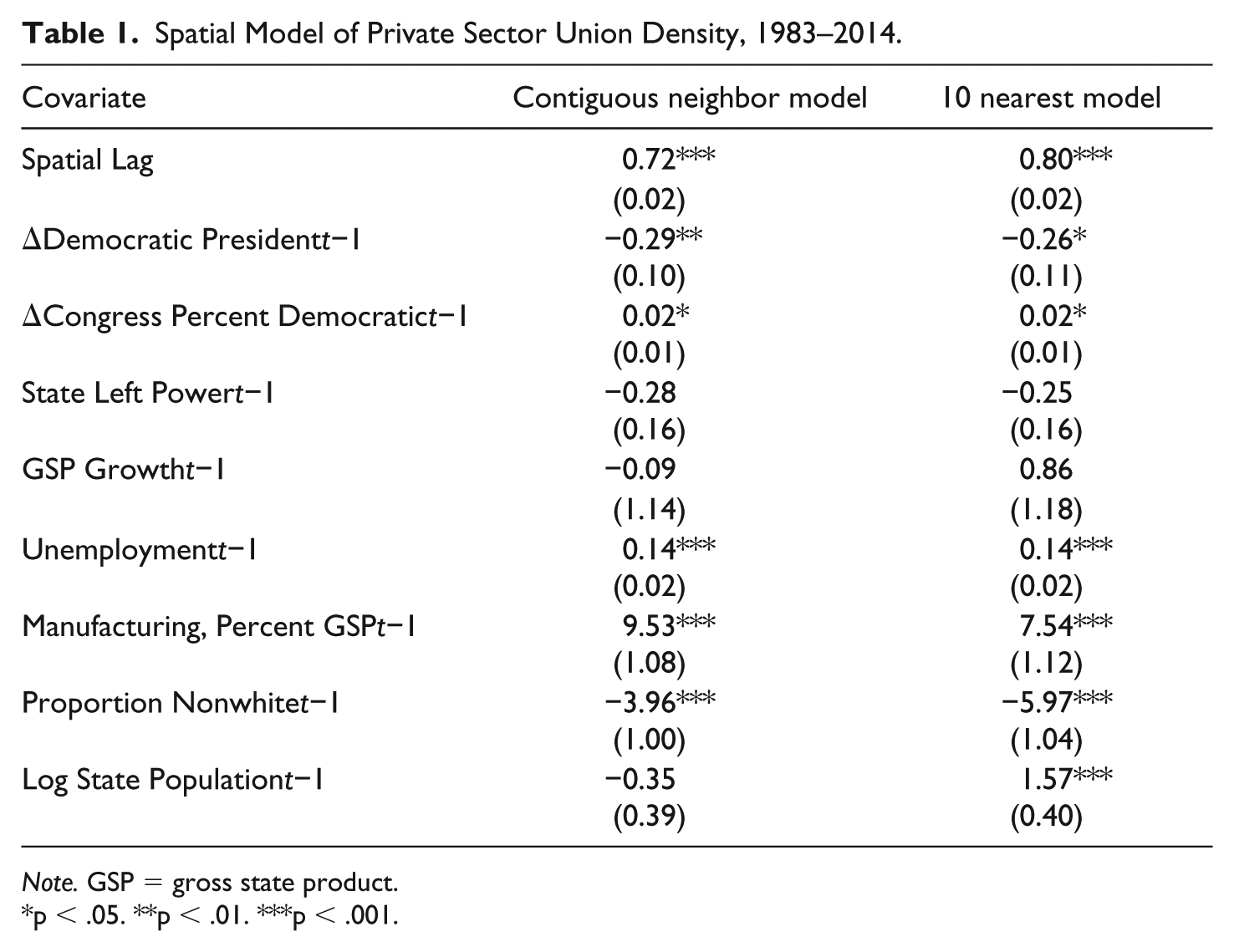
Table 1 presents our results both for the contiguous neighbors definition and, as a robustness check, for our 10-nearest neighbors definition, with other neighbor definitions included in the online appendix as robustness checks.13 Beginning with the spatial effects, we find strong evidence that deunionization in one state diffuses to neighboring states. In Table 1, we see that when private sector unionization rates are lower in one state, private sector unionization rates are also lower in “neighboring” states. This strong spatial effect is evidenced in the positive and statistically significant estimates for the “spatial lag” (i.e., ρ parameters) in our models. Consider, first, the model for directly contiguous neighbors in the first column of results in Table 1. The estimate for the spatial lag in this model is 0.72, and is statistically significant at a p < .001 value. This is strong evidence of a positive spatial lag effect in deunionization for a state’s contiguous neighbors. What happens in Wisconsin doesn’t stay in Wisconsin.
Spatial Model of Private Sector Union Density, 1983–2014.
Note. GSP = gross state product.
p < .05. **p < .01. ***p < .001.
Furthermore, this strong spatial diffusion effect is not limited to the most immediate neighbors of state i. Consider, for example, the 10-nearest neighbors analysis in the second column of Table 1. Here, we also find a strong positive spatial lag effect, with a ρ estimate of 0.80 (again, statistically significant at a p < .001 level). We find similar results when we use either a 5- or 15-nearest neighbor definition (see Table 2 in the online appendix for these results). In short, union politics isn’t all local. What happens in one state is strongly associated with what happens in nearby states.
Can state governments slow the decline of private sector unions within their borders? We do not find any support for this argument in any of our private sector unionization models, in which the coefficient for the state government ideology variable is never significant. Thus, it does not seem that liberal governments can strengthen private sector unions. Nor does it seem that conservative governments can weaken them very much, however. It is possible that state liberalism might have mattered in earlier periods, when more liberal, prounion state governments were in place. However, in the time period we examine, one marked by declining unionization and a shift toward conservative economic policies, we find no relationship between state government liberalism and private sector unionization rates.
We do find that national political factors are significantly associated with unionization rates. As Congress becomes more Democratic, union rates in the United States increase. The coefficient for Democratic presidents demonstrates a negative association, but keep in mind that this reflects only the first year of a Democratic President’s term (since we use the first difference because this variable is integrated), so is not a great indicator of the overall effect of a Democratic President.
It seems that unionization rates in the states primarily reflect shifting economic conditions. We observe a significant association between unemployment rates and unionization. Higher levels of unemployment in one period are associated with higher levels of unionization in the next period. Manufacturing levels in the preceding year are also positively and significantly associated with unionization in the following year. Economic growth, however, is unrelated to unionization. The other control variables are also generally significant in the expected direction. For instance, we find that states with larger nonwhite populations have lower rates of unionization. In contrast with some comparative research, we find that states with a larger population actually have higher union density, although this significant effect only holds for our 10 and 15 nearest neighbors analyses.
Much popular discussion of deunionization has focused on right-to-work laws as a key source of declining union rates in the United States. To examine this possible effect, we also estimated models incorporating a variable for right-to-work laws (see Tables 3 and 4 in the online appendix). In none of our model specifications across our four neighbor definitions were right-to-work laws significantly associated with private sector unionization. Only five states (Idaho, Indiana, Michigan, Oklahoma, and Texas) instituted right-to-work laws in the time period of our analysis, however.
A spatial lag panel data model such as ours has two components to its substantive effects. A covariate has a direct, local effect on unit i itself. In addition to this direct effect, there is also an indirect effect via the spatially lagged dependent variable. That is, the covariate affects the value of the dependent variable in unit i and then, through the spatially lagged dependent variable, affects other units. For our application, for example, Wisconsin’s manufacturing employment affects its private union density via a direct effect. Because Wisconsin’s manufacturing activity affects Wisconsin’s union density, and Wisconsin’s union density affects its neighboring states’ union density, Wisconsin’s manufacturing rate thus also has a spatial diffusion effect on neighboring states’ union density. The total effect of any covariate in our model is thus the combination of its direct effect within state i and its indirect effect on other states which are seen in Figure 1. We see that, though the Democratic congressional power variable coefficient is significant, its effect is relatively small compared with the economic and demographic factors occurring within states. The decline of manufacturing seems to be the factor that has most contributed to weakening unions in the U.S. states.
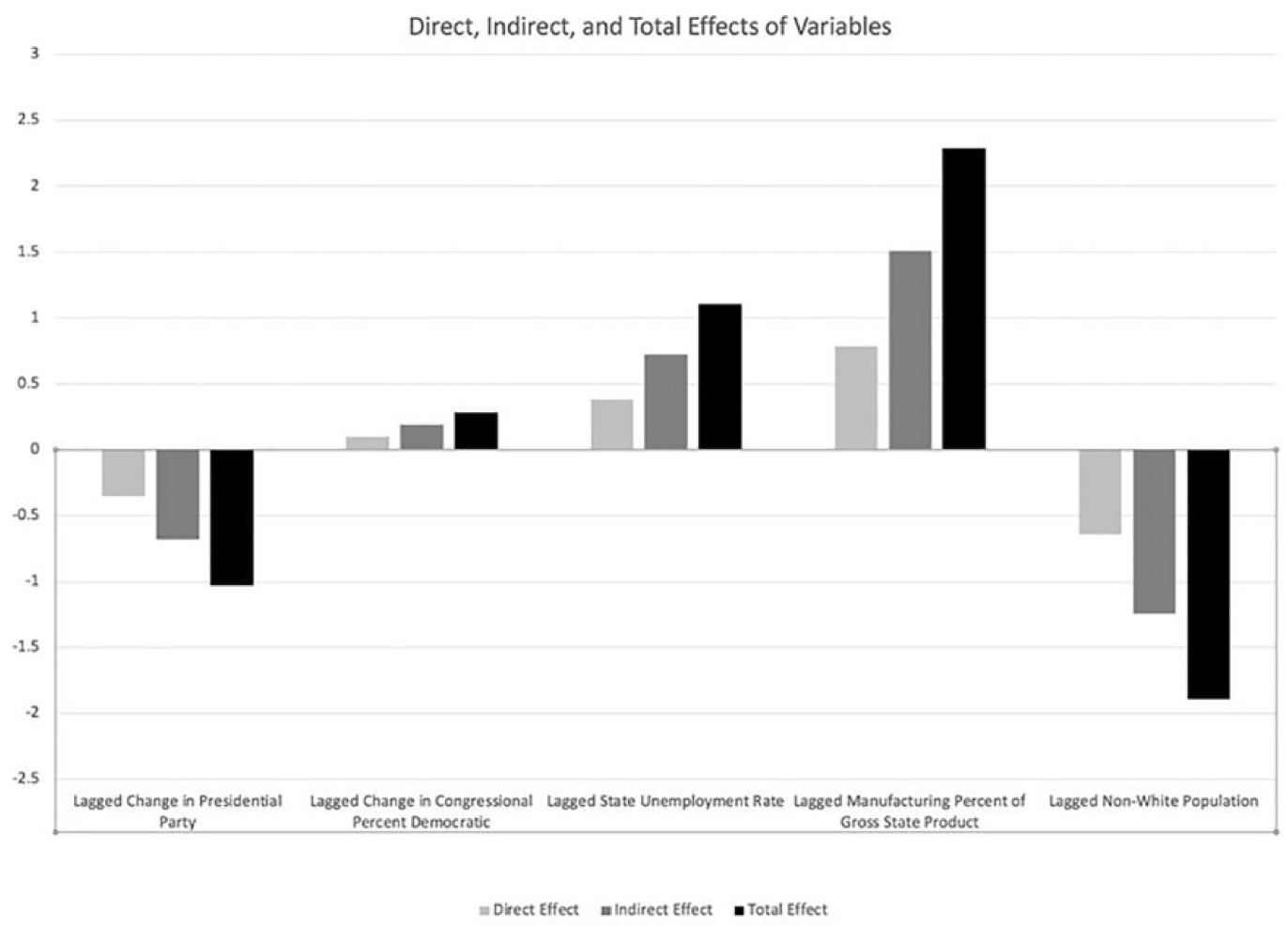
Simulated effects of the direct, indirect, and total effects of the covariates on private union density.
Total Union Density Analysis
Our analysis indicates that economic conditions have a stronger association with private sector union density than right-to-work laws, state government ideology, or even Democratic power in Congress, and that these state conditions diffuse spatially. Because state governments directly determine union strength in the public sector, state government liberalism may have a stronger relationship with public sector union density. Unfortunately, the small state-level sample sizes of public sector workers in the surveys used to develop measures of union density make directly examining public sector unionization rates separately inadvisable. However, we can examine total union density, which includes both public and private sector workers. While the results should be similar—because most workers work in the private sector—if we do see differences in the coefficient for the state government ideology variable, this might indicate that state governments may be able to shape union strength in the public sector. To this end, we estimated spatial models with total union density as our dependent variable and the same set of covariates. These results are reported in Tables 5 through 8 in the online appendix. Because the total union density series extends farther back in time, we are also able to estimate these models going back to 1977 utilizing a slightly reduced model specification. These results are reported in Tables 9 through 12 in the online appendix.
Recall that the coefficient for government liberalism was actually in the negative direction in the private sector density models, though it was not significant. In contrast, in the total union density models the coefficient for government liberalism is positive and significant or close to significant in a number of models. This suggests that state government liberalism is likely associated with union strength in the public sector, which is not so surprising considering that state governments can directly make laws mandating or preventing public sector unionization, and state governments are not mobile. Of course, because most workers work in the private sector, even if liberal state governments can strengthen public sector unions, this does not directly help strengthen unions very much. However, strong public sector unions might indirectly shape private sector union density and public sector union strength might have very important implications for the political power of unions and the success of their preferred candidates (Feigenbaum, Hertel-Fernandez, and Williamson 2018).
Conclusion
Scholars have long speculated about the relative weakness of unions in America, and in recent decades union strength has declined to the point that unions are almost completely absent from certain economic sectors and entire geographic regions. One factor that scholars of American unions have mostly overlooked in their discussion of why unions are so weak is the federalized system of labor relations. When paired with the need for states to compete with one another for business investment and the ease of firm mobility across state borders, this federalized system of labor relations, in which some states choose to suppress labor unions to attract business investment, or more consistent with our results, simply do nothing while union strength declines due to secular economic change and other factors, has the potential to set off a race-to-the-bottom in union power. On the contrary, one consistent finding from comparative research is that polities governed by left parties have stronger unions.
In our analysis of the U.S. states during a period of intense deunionization, we find that, indeed, the federalized system of labor relations does appear to contribute to union weakness in the states, in so far as union weakness in one state is associated with union weakness in another state. We also observe, however, that though Democratic power in the U.S. Congress is significantly associated with private sector union density, the ideology of state governments is not generally significantly associated with union strength in the private sector. State governments can shape many state-level economic outcomes (Franko and Witko 2017; Jones 1990; Kelly and Witko 2012) but it does seem that, at least in the period we examine, they have been relatively powerless to stop labor decline. On the contrary, this indicates that it has not been primarily conservative state governments that have driven union weakness in the United States (admittedly, it is too soon to understand the effects of the recent adoption of right-to-work laws in the Midwest). Instead, it appears that economic factors are primarily associated with declining union power. We should note that this finding does not mean that left-leaning state governments have never mattered for union strength. Perhaps in a time of growing union strength, left-leaning state governments have a greater ability to increase union power. Future research should examine a longer time period than we do here, though many of the variables we examine are not available prior to the 1970s. In any case, it is certainly important to understand how state governments have shaped union power in the last few decades, as we do here.
It is also important to understand how union strength in one state is associated with union strength in neighboring states. We observe that union weakness in one state spreads to another state, underscoring the ways that federalized labor relations contribute to union weakness in the current era. We should not be surprised that spatial dynamics have contributed to deunionization across the American states. The ability of firms to move plants and facilities produces pressures for deunionization across neighboring states. Faced with this firm mobility and the desire of companies to move to locations with lower rates of unionization, workers may well become less likely to support unionization. Even if this isn’t the case, if heavily unionized industries leave states with strong unions for states with weak unions, then the net result is less union strength overall. And as union strength declines in the various states, national union organizations are less able to organize workers. Of course, in periods of union growth, the opposite would be true, as union strength in one state would spread to other states. However, one question for future research is whether the effects of right-to-work laws and other antiunion policies may be asymmetric—they have little additional effect on weakening unions that are already weak (as in most of the period that we examine), but prevent unions from increasing in strength when unions in neighboring states are doing so. Another question for future research is how unionization in the public sector might spill over to affect unionization in the private sector, and vice versa. The mechanisms of the “spread” of union decline are also worthy of more study.
Overall, our research indicates that the federalized system of labor relations in the United States has contributed to the exceptional union weakness in America. Because unions push economic policies and outcomes in the states in an egalitarian direction, the federalized system of labor relations contributes to the rapidly growing economic inequality in the United States (Franko and Witko 2017). Our findings should not be taken to imply that state governments can do nothing to affect union strength. It seems like they probably do affect public sector union density. However, even in the most optimistic scenario, the U.S. system of labor relations makes it harder even for liberal states to strengthen unions. Considering this, those who wish to strengthen labor unions ought to make reforming national labor laws a high priority the next time Democrats are in control of the federal government.
Supplemental Material
Supplemental_Appendix_1 – Supplemental material for Federalism, Government Liberalism, and Union Weakness in America
Supplemental material, Supplemental_Appendix_1 for Federalism, Government Liberalism, and Union Weakness in America by David Darmofal, Nathan J. Kelly, Christopher Witko and Sarah Young in State Politics & Policy Quarterly
Footnotes
Declaration of Conflicting Interests
The author(s) declared no potential conflicts of interest with respect to the research, authorship, and/or publication of this article.
Funding
The author(s) received no financial support for the research, authorship, and/or publication of this article.
Supplemental Material
Supplemental material is available for this article in online.
Notes
Author Biographies
References
Supplementary Material
Please find the following supplemental material available below.
For Open Access articles published under a Creative Commons License, all supplemental material carries the same license as the article it is associated with.
For non-Open Access articles published, all supplemental material carries a non-exclusive license, and permission requests for re-use of supplemental material or any part of supplemental material shall be sent directly to the copyright owner as specified in the copyright notice associated with the article.
