




Abstract
This paper explores the conditions under which local governments are likely to engage in formalized intergovernmental developmental cooperation. The author theorizes that policy competition, informational and divisional transaction costs, and resources condition the likelihood of institutional collective action. Data from a variety of sources—including a unique author-conducted survey of local officials in Colorado—are used to test hypotheses in a dyadic model of local cooperation. Results indicate that agreements are more likely in competitive policymaking environments and when jurisdictions have more informational resources.
Of the 39,017 cities, towns, and counties in the United States, just more than 23% of them reported transferring money to another local jurisdiction in the 2007 Census of Governments (U.S. Census Bureau, 2007). When the population of jurisdictions is restricted to those with more than 25,000 people, that percentage rises to 50%. The evidence is clear: American local governments are working together.
More than a half-century of research has identified the various scale efficiencies that can be achieved by interlocal service cooperation—cooperation to provide such goods as emergency transportation, energy, and garbage collection. However, the contemporary scope of interlocal cooperation is much broader than just service delivery; we are also seeing cities cooperate on matters of economic development. Though some scholarship has been skeptical that developmental cooperation can be achieved and sustained (Norris, 2001; Wood, 2006), American cities of all sizes are working together to build roads, develop commercial and residential properties, finance arenas and convention centers, create mass-transit systems, and even manage land use. According to a 2002 survey of American cities by the International City and County Management Association (ICMA), 39.7 percent of the respondent jurisdictions reported that regional organizations participate in the development of their economic development strategies (ICMA, 2005). Not only are cities working together on specific development projects, they are also formally and informally planning development together.
This paper asks, “Under what conditions do policymakers formalize interlocal developmental agreements?” In the following sections I offer a brief review of the literature on metropolitan collective action and local economic development. Drawing on this scholarship, I develop three theories (competition theory, transaction cost theory, and resource theory) and test them using an original dyadic data set of Colorado cities and counties. This data set, described in the Research Design section below, includes spatial and network variables in addition to standard dyadic variables. The results of the analysis emphasize two key points. First, cooperation is a tool used by cities to manage the fiscal costs and risks associated with policy competition. And second, the human relationships that exist among local officials are critical for overcoming the complex and potentially costly barriers to formal cooperation.
Metropolitan Collective Action
Public choice scholars have identified scale and metropolitan fragmentation as particularly important for understanding interlocal cooperation. Ostrom, Tiebout, and Warren’s (1961) insight was that more fragmented (“polycentric”) metropolitan areas have economic and political benefits over more unified (“gargantuan”) metropolitan areas. Though the unified metropolitan area may benefit from certain economies-of-scale, a polycentric system, they argued, allows for individual jurisdictions (cities, counties, special districts) to be more responsive to their residents and, in some cases, to be more efficient (Burns, 1994; Dilorenzo, 1983; Ostrom, 1972; Ostrom et al., 1961; Schneider, 1986; Wagner & Weber, 1975; Williams, 1967). Among the several explanations for this increased responsiveness and efficiency is that polycentric systems help to facilitate the separation of provision (the policy itself) from production (the tool used to implement the policy). In fragmented areas, opportunities to cater to multiple, geographically bound constituencies allow policy production alternatives to be more easily realized and efficiencies to be more easily gained (Oakerson, 1999; Stein, 1990). Interjurisdictional cooperation between existing substate governments is an extension of the polycentric framework. Interlocal cooperation constitutes a polycentric activity that takes advantage of the fragmented nature of many contemporary metropolitan areas: a mutual production decision among multiple cities that have independently made the same policy provision decision.
The Institutional Collective Action (ICA) framework has been the most realized effort to understand the prerequisites and causes of contemporary governmental cooperation. This research has identified three types of local integrated decision making: centralized authority, network embeddedness, and mutually binding contracts (Feiock, 2004, 2009; Feiock, Lee, Park, & Lee, 2010; Feiock & Scholz, 2010). Centralized authority is the assumption of responsibility by higher-level or third-party (overlapping) governments such as the state, county, or a special district. Third-party governments take on these roles for a multitude of reasons, including failure to act on the part of lower-level governments (Burns, 1994). Network embeddedness characterizes the “agreements among local units that are coordinated and enforced through a network of social, economic and political relationships rather than formal authority” (Feiock et al., 2010, p. 10). Embeddedness has been identified as particularly important for understanding local regulation of common-pool resources such as rivers and fisheries (Lubell, Schneider, Scholz, & Mete, 2002; Schneider & Jacoby, 2003). The formal incarnation of embeddedness is contracting in which “fragmented governments legally bind themselves to mutual action” (Feiock, 2010, p. 10). With contracting, jurisdictions formalize their relationships with one another in order to achieve and enforce a mutually held goal.
Developmental Policy and the Choice to Cooperate
Developmental policies are those engaged with the objective of increasing the economic well-being of the jurisdiction (Peterson, 1981). Many policies meet this criterion at the substate level. Sometimes cities try to achieve this goal by enacting policies aimed at attracting new firms or residents into the jurisdiction and other times they try to achieve it by enacting policies designed to increase the economic benefit of staying put. Local development policies include company-specific relocation incentives, tax revenue policies, and the provision of public goods with developmental aims. Developmental public goods can take many forms, including dollars put toward improving and expanding infrastructure, building new parks and making existing ones more desirable, and developing entertainment and cultural amenities such as museums, libraries, and arenas (Clarke & Gaile, 1998; Eisinger, 2000; Florida, 2002; Pagano & Bowman, 1997; Peterson, 1981). Developmental policies can even include the growth management policies that jurisdictions implement in order to limit the geographic area of the jurisdiction and increase community desirability and property values (Fischel, 2001). Cities and other substate jurisdictions must then make determinations about which of these goods to provide and how to produce them.
The place of economic development on the local political agenda has been much researched and much critiqued, but the frequent cooperative nature of that development has received only limited attention. Indeed, intergovernmental developmental agreements have become fairly commonplace across the country. They can involve a myriad of configurations of cities, counties, special districts, states, and private entities. Agreements that function to produce “big-ticket” projects such as professional sports arenas and convention centers frequently involve private entities, the creation of overlapping special districts, and often the state (Altshuler & Luberoff, 2003). Although these agreements on big projects are the ones that make news, they constitute only a small fraction of the developmental collective action occurring in American substate government. Cooperation on comparatively smaller projects such as roads, shopping centers, recreation centers, and office buildings is more common.
When is cooperation likely to occur? The research on this has focused on service cooperation, which has been shown to be associated with a range of variables. There is evidence that cities with more fiscal and institutional resources at their disposal are more likely to want to cooperate while cities in more fragmented areas face collective action problems that reduce cooperation (Kwon & Feiock, 2010; Shrestha & Feiock, 2011). LeRoux and Carr (2007) find evidence that lower-density jurisdictions are more likely to cooperate due to the gains achieved with economies of scale. They also show that as communities become wealthier they are less likely to cooperate but that the very wealthiest communities are quite likely to cooperate. Others have looked at more expressly political motivations behind cooperation; there is some evidence that the successful negotiation of interlocal agreements increases the likelihood that local elected officials will seek higher office—the agreements extend candidate reach to new attentive publics (Bickers, Stein, & Post, 2010; Steinacker, 2002). If this is the case, it is also possible that officials hoping to extend their reach devote more resources into negotiation.
While there is likely overlap, the conditions underlying cooperative service provision and cooperative development are not necessarily the same. When two nearby cities desire to operate a single sewage system or emergency medical service and neither can afford to do so alone but both can afford to do so together, the economies of scale of cooperation are a natural place to turn. However, when the potential benefits of cooperation are higher for one jurisdiction than the other and the costs and benefits are difficult to divide, cooperation is a considerably less obvious step. Such is the case with developmental policy: Though cooperative development is going on all of the time (Gillette, 2001; Johnson & Neiman, 2004; Parks & Oakerson, 1993; Summers, 2000), researchers have yet to sufficiently capture the underlying metropolitan conditions that explain when it is likely to occur within metropolitan areas.
What makes the logic that underlies developmental cooperation trickier than that which underlies service cooperation is that developmental policy carries with it the distinct potential for positive externalities (primarily economic growth) that extend beyond jurisdictional borders. With the cooperative provision of services, the division of upfront costs can be accurately estimated and the benefits almost entirely lie in efficiency (getting more by paying less). This is not the case with cooperative developmental policy, where the benefits are both difficult to measure and difficult to divide. If a business locates within a city’s boundaries because of a developmental policy, both the recruiting city and nearby cities and counties may benefit from increased sales and property tax revenues when those associated with the business purchase homes and frequent businesses. While all cooperation is a relational activity, it is in this way that developmental cooperation is a uniquely relational activity where policy production decisions necessarily flow from complex economic, political, informational, and geographic contexts.
Consider the example of the Northwest Parkway in Colorado—a toll road developed via a 1999 interlocal agreement between Boulder County, and the cities of Lafayette, Louisville, and Broomfield. The toll road constitutes one section of the unfinished the Denver Metropolitan Area “beltway” that consists of multiple, separately and independently developed highways and toll roads. Prior to the construction of the Northwest Parkway, Denver’s northeastern, eastern, and southern suburbs had direct access to the beltway, but the northwest (and western) suburbs lacked such access. The agreement provided for the eventual construction of the road and the preservation of rural areas around the road (County of Boulder, 1999). In addition to offering residents of this metropolitan subregion easier access to Denver’s airport, the cities involved hoped the highway would make both cities more desirable locations for businesses to locate and, in the case of Broomfield, a better out-of-town conference location (Plunkett, 2006). In contrast, divergent preferences and growth contexts continue to impede Denver’s western and northwestern suburbs from reaching an agreement to finish their portion of the beltway (Aguilar, 2012).
Revenue sharing and joint development are also occurring in Colorado. In 2004, the cities of Thornton and Westminster reached an agreement to jointly manage an area of land that straddles both jurisdictions. The agreement provided for joint planning and zoning of the area, joint authority over the annexation of land into the area, and for an equitable splitting of the revenues obtained from property, sales, and use taxes within the area. This area had been projected to be a center of population growth and many developers had expressed interest to the cities about developing it. Rather than compete over who could provide the best incentives for development, the cities agreed that they would be best served by coordinating their development and sharing the revenues (City of Thornton, 2004; Murphy, 2005; Alsever & Arellano, 2004).
The question of what conditions lead to this type of cooperation persists. Why have some of Denver’s suburbs been able to cooperate while others have not been able to? Why are Thornton and Westminster engaged in the cooperative development of land and so many other pairs of jurisdictions are not? One potential answer may lie in the dynamics of the competitive system that these governments are situated in. Scott argues that there are “intermediate institutional arrangements” that constitute neither true market activity nor true hierarchical economic activity. Intermediate institutional arrangements “combine varying degrees of centralized and decentralized decision making” to constitute what Scott calls “flexible production agglomerations” (Scott, 1992, p. 224). These “flexible production agglomerations” stem from learned failures of a market-based (competitive) system. In other words, competition can lead to institutionalized cooperation. Research on the competition to cooperation theory remains limited. In their survey of the Minneapolis Metropolitan Area, Goetz and Kayser (1993) found that substantially less than half of the surveyed cities viewed competition as being beneficial to economic development. However, more recent survey work on local economic development by Lee et al. (Lee, Feiock, & Lee, 2012) found that many cities are willing to informally cooperate with their perceived competitors.
Another place to look for answers is in the transaction costs literature. “Transaction cost analysis [is] an examination of the comparative costs of planning, adapting, and monitoring task completion under alternative governance structures. . . . Some transactions are simple and easy to mediate. Others are difficult and require a good deal more attention” (Williamson, 1981, pp. 552-553). Whenever organizations have the opportunity to cooperate they either formally or informally engage in a cost-benefit analysis to determine whether the cooperation will be worth the economic and political investment. Feiock et al. (Feiock, Steinacker, & Park, 2009) identify certain transaction costs as playing a more important role in local cooperation than others. For example, the costs of bargaining (time) and enforcement (the settlement of disputes) are fairly low. Alternatively, information costs (collection of information about potential cooperators), agency costs (getting formal or informal resident approval), and division costs (splitting up the costs and benefits of the cooperation) are notable obstacles in the way of formalizing interlocal agreements.
Agency costs—the costs of local democracy—have received the most attention in the literature. Some agreements require voter approval, elected officials face reelection, and professional officials are at risk of losing their jobs (Steinacker, 2002). Consequently, local agents must be careful to accurately represent city interests when negotiating agreements if they are to maintain their position and/or ensure the agreement remains in place (Gerber & Gibson, 2009; Kwon & Feiock, 2010). With all intergovernmental contracts, agreement must be reached to determine how to divvy up costs and benefits. Intergovernmental agreements necessarily mean that jurisdictions are giving up some amount of their authority to act independently. While the participating jurisdictions remain integral to the decision-making process for the agreed-upon area or project, that role becomes substantially more complicated with the need for all participating governments to approve action (Dixit, 1996; Frant, 1996; Gerber & Gibson, 2006, 2009; Heckathorn & Maser, 1987). For example, cities in California with similar partisan makeups have been shown to be more likely to cooperate (Gerber, Henry, & Lubell, 2010).
With the unique exception of Gerber et al. (2010), the previous research on local cooperation (of all types) has primarily taken the nonrelational approach of examining individual governments’ participation in cooperative activities. This approach is instructive for determining which governments want to participate but is less instructive for determining the set of conditions under which they do participate because it neglects the traits of potential partners. Drawing on the ideas presented above, the following section details three relational theories for understanding the conditions under which we should expect to see developmental cooperation.
Theory
Most local developmental cooperation is motivated by complementary objectives: reducing costs and increasing gains. Costs and gains can be economic where policymakers seek to reduce financial commitments and increase return on investment (either through direct revenues or the indirect revenues that come from successful development). Costs and gains can also be political where policymakers seek to ensure that policies have positive impacts on their careers. It would be hard to dispute that these objectives are the underlying causal factors for understanding why developmental cooperation occurs: If officials do not believe that costs are likely to be reduced and gains are likely to be had, it would seem unlikely that they would cooperate. A theory of developmental cooperation is thus not a theory of why local governments cooperate but a theory of when they cooperate. As such, the theory presented here identifies the conditions under which policymakers are likely to see cooperation as beneficial and achievable.
I offer three theories for when we should and should not expect to see developmental cooperation. The first, policy competition theory, involves examining submetropolitan geographic policy dynamics. I argue that as policy competition increases, local governments will seek out more efficient means of policy production. Policy competition theory sets the stage for the other two theories: transaction cost theory and resource theory. The transaction cost theory identifies barriers to cooperation that arise from the differences that exist between potential partners. And resource theory considers the assets—fiscal and human—that help jurisdictions to overcome barriers to cooperation and increase its likelihood of occurring. All three theories emphasize that formal developmental cooperation is a complex and interconnected policy production process.
In order to capture the interconnected nature of the process, I conceptualize and operationalize cooperation as a relational phenomenon. It takes more than one government to cooperate, and the likelihood of reaching institutionalized agreements is a function of each of the governments involved in the potential agreement. Previous empirical research on local cooperation has not explicitly modeled this dyadic reality—City A cannot cooperate without City B’s consent and City B cannot cooperate without City A’s consent. Variables that connect both cities are critical for whatever agreement City A and City B reach (or do not reach). Though the details of the relational data used in this article’s analysis are discussed in depth in the research design section, it is important to note here that the hypotheses presented below are specifically constructed for testing in a dyadic context where all observations are pairs of governments. As such, the language I use to discuss the theory follows from this dyadic approach where each concept can take one of three types: (1) dichotomous, (2) combined, and (3) differenced.
Policy Competition Theory
American local governments face a variety of political, policy, and economic forces from the outside and these forces can have an important impact on a government’s own choices. As nearby cities and counties elect and employ different officials, implement different policies, and achieve different economic goals, governments are forced to adjust their own strategies in order to stay economically viable and politically relevant (Minkoff, 2012). Policy competition is the idea that jurisdictions compete to provide desirable policy bundles to their own residents and potential movers. Here I argue that pairs of governments situated in high–policy competition regions are more likely to cooperate than pairs of governments situated in low-competition regions.
Competition among cities is frequently described in the context of economic outcomes (median income, employment rates, etc.). These indicators are helpful at characterizing how successful a jurisdiction has been with its policies but fail to capture the policies themselves. Whether they have achieved their desired economic goals or not, most local governments are competing to provide desirable bundles of developmental good. This idea of policy competition is hardly new to the literature on subnational policymaking; considerable research has examined the two-way relationship that exists between local policy bundles and human mobility (Hirschman, 1970; Oates & Schwab, 1988; Peterson, 1981; Peterson & Rom, 1990; Tiebout, 1956). I add that policy competition is doing more than just influencing policy provision; it is also influencing policy production.
Consider two neighboring cities, both aiming to attract new residents and new employers. While one city may be populated with high-income single-family homes and the other with middle-income townhomes and apartments, both cities have the potential to be engaging any level of developmental goods provision. Researchers interested in how governments are trying to achieve developmental policy goals must look at the policies themselves in addition to policy consequences.
Interlocal agreements are elite-level production activities that are generally not of interest to the average resident. Policy outcomes, on the other hand, are of considerable interest to the average city resident. In competitive developmental policy environments—that is, regions within metropolitan areas, where jurisdictions aggressively engage developmental policies—people are more aware of the relevant policy choices. When nearby cities are building new roads, financing the construction of new shopping centers, constructing arenas, and offering companies tax breaks it is easier for residents and firms to make assessments about their own city’s activities and to be knowledgeable about their exit options. People are more likely to have (and then reveal) their development preferences in competitive regions leading to increased developmental policy demand. In some cases, the demand may be for new infrastructure, in other cases it may be for firm relocation incentives, and in still other cases it may be for open space. No matter the public consensus, high–policy competition levels make development policy simultaneously essential and risky.
As local officials feel the pressure to keep up with nearby cities, the fiscal costs and political risks of developmental policy increase. Keeping up with nearby cities requires spending more, which typically means some combination of collecting and borrowing more to meet new obligations. Even when cities attempt to buffer themselves from aggressive nearby development, local officials are taking a financial risk in assuming that increased tax revenues from rising property values will offer a sufficient alternative to the increased revenues that would come from new residents and firms. In addition to increasing financial costs, policy competition can increase the probability of policy failure because more jurisdictions are offering a desirable developmental policy bundle. With more high-quality exit options and pressure to maintain fiscal equivalence, some cities will inevitably be left behind; that is, some cities will fail to attract enough new residents, firms, and capital to meet their economic goals and recover the costs of their policy outputs. 1 Policy failure can wreak havoc on a jurisdiction’s budget, elected officials may lose their office, and government professionals can lose their jobs. Formal policy cooperation, or, as Scott (1992) calls it, “flexible production agglomeration,” is thus a political adaptation to the perceived difficulties of the market-based policy system.
When developmental policy demand is high due to policy competition, many of the potential risks associated with actually doing that development increase. It necessarily means that the exit options (nearby cities and counties) have invested in the goods that residents and/or firms want. Under these conditions, governments are forced to invest in development but also run the risk that their policy will not be as fruitful as their neighbors’—the probability of policy failure increases. Such is not the case under conditions of low policy competition where governments can invest in developmental goods without being forced to keep up with their neighbors and without the fear that their policies will have comparatively weaker results.
Cooperative development ties the fortunes of local governments together. At the point at which officials see development as mutually achieved, rather than as something that is individually achieved, new developmental norms can be established that are not as costly and not as risky as competitive policymaking. By institutionalizing cooperation with revenue sharing, development, and growth management agreements, local officials create economies of scale that reduce per-unit commitment. If the development policy fails, the economies of scale decrease each city’s hit: Each government puts less cash or liability into the effort to begin with so the damages to the local treasury, local campaign, and the local bureaucrat’s career ambitions are reduced upon policy failure. Though the per-unit benefits are also reduced, formalized developmental cooperation may offset this by increasing the probability of policy success by bringing together actors with different perspectives and creative ideas. Such is the case with growth management policies: By reducing sprawl, each jurisdiction is able to sell itself as a more desirable place to live and work.
In sum, robust policy competition (independent of economic outcomes) forces governments to be developmentally aggressive in the face of increased probability of policy failure. This aggressiveness stimulates cities to consider policy tools that (a) reduce the fiscal burden on the city and (b) reduce the heavy political burden of potential policy failure on policymakers.
Hypothesis 1: The greater the combined level of developmental policy competition for a dyad, the greater the probability that the dyad will have a formalized interlocal developmental agreement, all else being equal.
Transaction Cost Theory
Transaction costs play a key role in institutional collective action. As costs go up and down the interest governments will have in cooperation and their ability to formalize it will fluctuate. I emphasize the role of informational and divisional transaction costs. The variability in how these costs present themselves and the capacity that governments have for overcoming them influence how policymakers are likely to conceive of and engage in the cooperative process.
Informational transaction costs involve the collection of information about how to actually engage in the cooperation and whether or not the relationship is likely to be beneficial. For a local government this can be a daunting task. In addition to the work of estimating a project’s costs and benefits, cooperation entails research on potential partners. The interest of other governments must be gauged amidst the fear that governments could be hiding information in order to preserve their bargaining leverage (Feiock, 2009; Inman & Rubinfeld, 1997; Katz, 2000). Should a government believe a potential partner has a low probability of committing to the project, it may not be worth it for the government go through the exercise of evaluating the costs and benefits of the agreement. As informational transaction costs increase—that is, as it becomes more difficult to collect information about collaborators—the less likely it is that governments are going to be able to complete the tasks requisite for cooperation.
A similar logic can be applied to divisional transaction costs: whether or not an equitable split of the joint costs and joint gains of the cooperation can be reached. Like information collection, division can be complicated. When cities work together to develop a piece of land that straddles a coterminous border or an unincorporated space, officials must determine how to equitably break up the tax revenue that comes from the development. When cities cooperate to build roads it is often more difficult then just paying for the portion of the road that falls within a city’s borders. The cities involved must determine which government will pay for what and/or who will take on the necessary financial liabilities. The road must be maintained and if there are tolls, tollbooth operators must be hired and supervised and the collected fees must be split. Cities may even wish to have a stake in each other’s developmental success by collecting some of their partner’s tax revenues. As division costs increase the likelihood of agreements between pairs of governments should decrease.
Under what conditions are informational and divisional costs high? Here I explore the idea that these costs are highest when the jurisdictions in the dyad are socioeconomically and politically different. Consider a difference as simple as population size. Cities of different sizes can and do work together; however, the transaction costs for the cooperation are higher than when cities are of similar size. It is difficult for small cities to collect information on big cities (to know what their policy goals are, to know what their resources are, etc.). Likewise, cities of different sizes are likely to face difficulties finding agreement on how to split up the costs and benefits of the deal. These divisional difficulties stem from two sources. First, cities of different sizes may have different policy goals—even if they agree that both benefit from some form of mutual project, what they want out of the project may be different. Second, the greater the difference in city size, the harder it is to determine what percentage of the costs/benefits go where. There are solutions to these problems—some of which are addressed below—but as the costs of cooperation increase it makes sense that we will see it with less frequency.
Beyond population, I also explore jurisdictional differences based on economy type (reliance on sales taxes), wealth (household median income), race (percent non-white), partisanship (party registration), and developmental policy commitment (developmental goods spending). And the same logic applies: The more different jurisdictions are along these dimensions the higher the informational and divisional transactions costs are going to be. Pairs of cities with similar minority populations, similar economies, and similar political outlooks can be expected to learn about one another more easily, communicate with one another better, and find a fair division of gains with less effort. In short, the more similar the jurisdictions in the dyad are, the more likely it should be that they have a formalized developmental agreement.
Hypothesis 2: As the differences (population, economy type, income, race, partisanship, and developmental policy) between jurisdictions in a dyad decrease, the greater the probability that the dyad will have a formalized interlocal developmental agreement, all else being equal.
Resource Theory
Institutional collective action is complex—particularly when it comes to developmental cooperation. Potential collective action necessitates estimating the potential economic costs and benefits for the jurisdiction. When thinking about the conditions under which cities are likely to cooperate, it is important to see that some are better equipped to overcome transaction costs. Even when the transactions costs for a dyad are fairly low (socioeconomically and politically similar), the costs of cooperation are not zero and some dyads have the tools to overcome those costs efficiently and others do not.
Previous research, such as that by Feiock et al. (2009) and LeRoux and Carr (2007) has also identified the importance of resources for overcoming transaction costs. However, this work has not considered resources in a dyadic context. I explore four types of resources and the effect they could have on local cooperation. The first three types are fairly simple: fiscal resources, age, and professionalized government. The more fiscal resources the cities in a dyad have at their disposal, the more likely it is that they will overcome transaction costs (or any other barriers to formal cooperation). Having access to professional management allows local officials to obtain the information they need to help them make an informed judgment about whether to cooperate. Age is also a resource; older cities have developed institutional memories and experiences—the “tricks of the trade”—that ought to increase the likelihood that they know how to make cooperation beneficial to them. And finally, cities that have more professionalized staff (in this case, a city manager and/or an economic development officer, etc.) ought to be more equipped to handle the transaction costs associated with development.
Hypothesis 3A: The greater the combined quantity of resources (fiscal resources, age, professionalized government) for a dyad, the greater the probability that the dyad will have a formalized interlocal developmental agreement, all else being equal.
The second type of resource, informational awareness, is both more complex and more interesting. Informational awareness is conceptualized here as the position of a city’s officials within the region’s social network of officials. Over the past three decades, scholars in various disciplines have begun to identify the importance of networks for policy selection. Coordination and innovation are fundamental to cooperative policymaking and government networks help to facilitate these attributes in a variety of contexts (Burt, 1987; Hafner-Burton & Montgomery, 2006; Schneider, Scholz, Lubell, Mindruta, & Edwardsen, 2003). Among the best examples of the importance of networks for local governance is the research done by Schneider et al. They find that networks that span a diverse set of interests (government officials, nonprofit leaders, and policy experts) facilitate the coordination of estuary governance. Their argument is that the networks enhance the necessary communication, trust, and shared investment necessary for cooperation.
Feiock et al. (2009) offer evidence that informal networks exist even in the competitive world of metropolitan development: “Informal networks constitute a macro-level regional governance structure . . . [where] local actors are able to enter or exit relationships and seek out partners embedded in network relationships that reduce risk, improve information or ensure commitments” (p. 22). These structures can help to facilitate the sort of multifaceted governance and regionalism of consequence to local governments and essential for formalized cooperation (Andersen & Pierre, 2010).
Local elected and unelected officials communicate with one another. They do this as politicians, policymakers, and policy practitioners and these relationships can permeate their respective governments. Some cities have long-established relationships with other cities where information is proactively shared. Other cities are connected to the cities that proactively share information. This informal communication ought to be critical to the process of formalizing developmental cooperation as it can facilitate the movement of information about a metropolitan area. Feiock et al. (2009) tested the network argument with respect to developmental collective action and find a positive and significant relationship. Their measures of network centrality, however, are ego-centric. Using a national sample of cities, they utilize government-reported connections as the measure of centrality. As will be described shortly, the approach taken in this article is considerably different.
The concept of network centrality refers to how connected an actor in a network is to other actors in the network (Bavelas, 1950; Freeman, 1979; Scott, 2009). Being more central within the informal metropolitan network facilitates the learning necessary to formalize intergovernmental cooperation. Though intergovernmental agreements are not a new concept, some officials may know more about them than others. Intergovernmental agreements are complicated. To some local elected officials they may even be enigmatic—a policy production tool they have heard about but have never dealt with and would not know where to begin if they wanted to pursue one. Being part of a network of other jurisdictions increases the likelihood that the jurisdiction will be aware of cooperative policy tools as an option and that another government will approach with cooperative opportunities.
Network centrality facilitates the learning necessary to overcome impending information and division costs (Granovetter, 1973). Network ties can help local officials obtain information about what is equitable. Though intergovernmental contracts are public information, the details of the negotiations that lead to the contract are not. Ties to other governments may offer “inside information” about ways to successfully leverage a deal. Furthermore, more “socially” central governments may have even taken on a leadership role with respect to facilitating informal regional governance. The more central a jurisdiction is within the entire political social network that describes a region, the more likely it is that that jurisdiction will find a developmental agreement that works for them. From a structural perspective, each end of the dyad is independently situated within the network. The probability of an agreement is thus a function of the combined network centrality of the dyad. When that combination is very low (two isolated jurisdictions), an agreement is unlikely; as the combination increases so should the probability of an agreement.
Hypothesis 3B: The greater the combined informal network centrality of a dyad, the higher the probability that the dyad will have a formalized interlocal developmental agreement, all else being equal.
Research Design
Most previous research on interlocal cooperation has analyzed city-level data on agreements without consideration of whom the agreement is with (e.g., Feiock et al., 2009; LeRoux & Carr, 2007). The theoretical approach taken here is that information associated with both jurisdictions in any agreement (or lack of agreement) is essential to understanding the conditions under which this institutional collective action occurs. As such, the theory demands that the unit of analysis be the jurisdiction–jurisdiction dyad. To accomplish this I used federal, state, and author-collected survey data to assemble an undirected dyadic data set of Colorado cities, towns, and counties. Complimentary Log-Log models were then used to estimate the likelihood of formalized cooperation among jurisdictional pairs. Appendix 1 contains a list of all of the variables in the analysis, their measurement, and their source.
To understand the scope of the analysis and the universe of cases, it is first necessary to understand the dependent variable and the instrument used to collect information on it. The dependent variable is the presence or absence of a formal developmental agreement in a jurisdiction–jurisdiction dyad. Measurement of formal cooperation was done via a survey sent to the 92 cities, towns, and counties that make up Colorado’s Front Range. 2 Included on the survey was a network battery that asked respondent to identify the cities and counties with which they have formalized developmental agreements. Developmental agreements were defined to respondents as “formal joint initiatives aimed at mutual economic growth [including] tax-incremental financing, tax abatements, business parks, zoning adjustments, infrastructure improvements, among other activities.” Of the 92 governments that received surveys, 38 responded. Fortunately, a 100% response rate was not required to compile a data set with most of the Front Range jurisdictions in it as all the reported relationships were treated as mutual even if one of the jurisdictions was a nonrespondent. Consequently, missing data from the survey is restricted to only connections between mutually nonrespondent jurisdictions. Undirected dyads were then constructed between the 88 jurisdictions for which their was either a survey response or the indication of a relationship based on a survey response (3,828 dyads). Because agreements are unlikely among jurisdictions that are very far apart, the pool of dyads was scaled back to those less than 50 miles apart (2,249 dyads) and subsequently to those less than 30 miles apart (987 dyads) and those less than 10 miles apart (278 dyads) for hypothesis testing.
On average, jurisdictions had formal developmental agreements with 2.92 other jurisdictions; however, the standard deviation (3.76) is greater than the mean indicating a skewed distribution. In this case, the distribution is skewed left with 21 jurisdictions having no agreements and 19 jurisdictions having an agreement with only one other jurisdiction. From a dyadic perspective, only 5.58% of the 50 mile or less dyads (9.11% of the 30 mile or less dyads and 25.1% of the 10 mile or less dyads) have formal agreements. So while the possible number of ties is very large, the actual formalization of an agreement is a rare event in the larger universe of cases and a less than common one in the smaller universe. 3
The independent variables in the analysis (with the exception of the network cooperation, age, and professionalization variables) are derived the Decennial Census, Census Populations Estimates, American Community Survey, Census of Governments, and Colorado data on Redistricting and Reapportionment. As the exact date of each agreement was not obtained in the survey, there is the risk that data collected for the explanatory variables described below measures the independent variable after the agreement was formalized. To help deal with this potential problem, data for two time points between 1999 and 2009 were averaged for all explanatory variables for which it was possible. As such, the analysis ought to be looked at as an examination of that entire period. The measurement of most of these independent variables is fairly straightforward and presented in Appendix 1. Two of the independent variables—policy competition (Hypothesis 1) and cooperative network centrality (Hypothesis 3B)—require additional explanation.
Measuring Policy Competition
Policy competition is the extent to which nearby jurisdictions are actively pursuing development policies. To measure the level of developmental policy competition that each jurisdiction is situated in, I use a spatially lagged variable. The variable is the spatially weighted average of the level of per capita economic development spending by each jurisdiction’s neighbors. 4 Economic development spending is measured by adding together per capita infrastructure, roads, parks, and recreation expenditures as reported in the 2002 and 2007 Census of Governments. A city’s competitive environment is thus the spatially weighted average of that sum such that near jurisdictions are weighted more than distant jurisdictions. The result is a measure of development policy competition that recognizes that even nearby cities may be situated in different policymaking contexts. As the developmental spending going on in nearby jurisdictions increases, the more developmental policy competition the “home” jurisdiction faces. Map 1 presents policy competition for the Denver Metropolitan Area where each city is shaded based on the spatially weighted average policy choice of all other cities in the analysis. The reader will observe that even within a single metropolitan area, policymaking environments vary. The expectation articulated in Hypothesis 1 is that as spatially lagged economic development spending (competition) increases, so will the likelihood of an agreement.
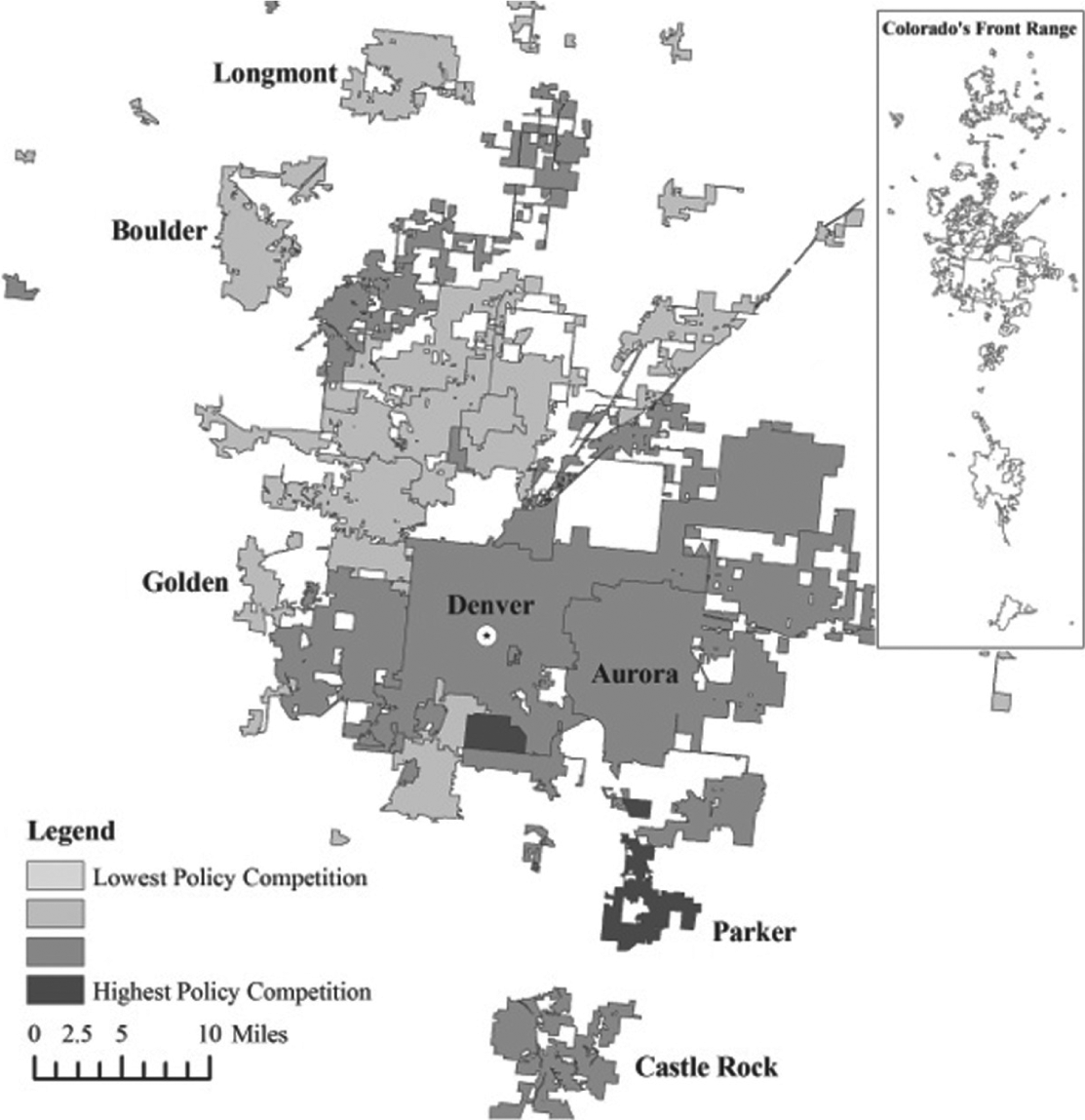
Developmental policy competition in Colorado: Spatially lagged economic development spending.
Measuring Network Centrality
To measure each jurisdiction’s cooperative network centrality, an undirected social network of all the jurisdictions in the analysis was constructed from the dyadic data set described above. This social network was based on a combination of the responses to the formalized agreement variable described above and another survey question that asked respondents to indicate all of the other cities, towns, and counties with which his or her jurisdiction had information exchanges, informal agreements, and constructive relationships (for brevity’s sake, I refer to these as “informal relationships”). 5 Figure 1 is a visualization of the formal and informal relationships between Colorado jurisdictions. Darker lines between nodes indicate the presence of both a formal and informal relationship while lighter lines indicate only an informal relationship. Each jurisdiction’s network centrality score was then generated from the informal network for incorporation in the formalized agreement model. 6 Consequently, any city’s centrality is a function not only their own responses to the survey (as was the case in Feiock et al., 2009) but also the responses of all of the other cities surveyed.
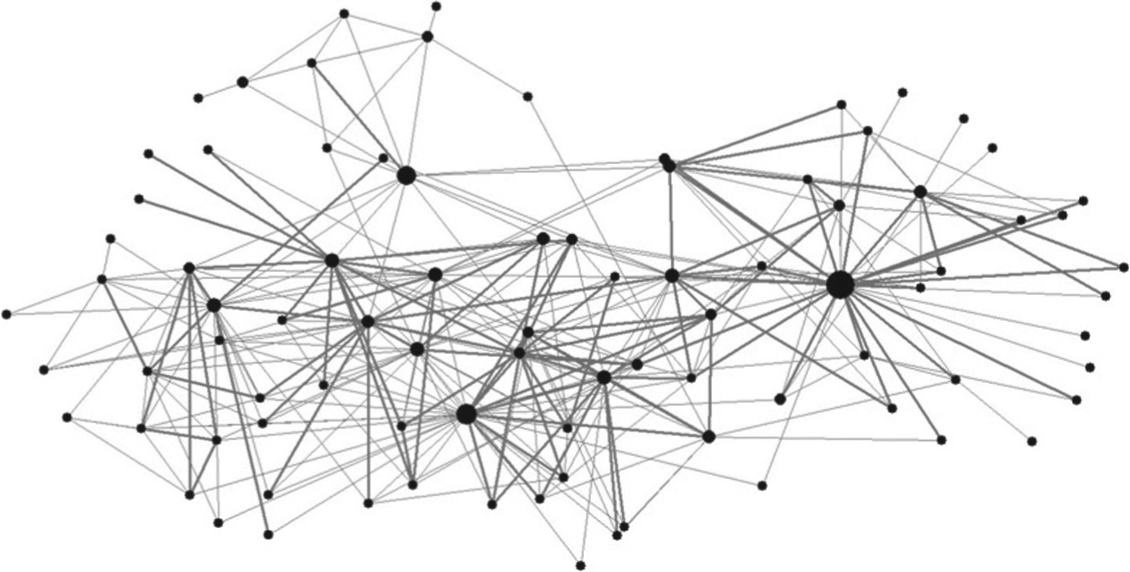
Front-range interlocal formal and informal cooperative network.
There are several different measures of network centrality that are used by social network analysts. For this analysis, a measure of betweenness centrality called “flow betweenness” was employed. All betweenness centrality measures go beyond simply measuring the number of other actors that the network node (the jurisdiction) is tied to; betweenness situates the node within the broader context of the entire network. Though some nodes may not be connected to many other nodes, they may still be connected to nodes that have multiple ties making them more central to the overall network than a minimally connected node that is connected to another minimally connected node (Freeman, Borgatti, & White, 1991; Scott, 2009). Flow betweenness centrality is a modification on Freeman’s more commonly used betweenness measure that is based on independent pairs of nodes rather than the shortest geodesic distance between nodes. The measure “adds up how involved that actor is in all of the flows between all other pairs of actors” (Hanneman & Riddle, 2005). Accordingly, flow centrality more accurately operationalizes informational connectivity in a metropolitan area where information does not always travel the shortest path between nodes (Freeman et al., 1991). The structure of the analysis requires the flow centrality scores of the jurisdictions in each dyad to be added together (see Appendix 1).
Returning to the network visualization in Figure 1, it is clear that formal connections between cities do not constitute the full context in which interlocal relationships exist. 7 While some jurisdictions are connected formally, many are connected only informally: On average, jurisdictions reported informal relationships with 3.46 more jurisdictions than they reported having formal relationships with. Moreover, cooperative connections appear to cross subnetworks in a way that formal network do not. Node size in Figure 1 increases with that city’s centrality score indicating which cities are best situated within the network to give and receive information. 8 Though the nodes with higher centrality scores do appear to have more formal agreements (as Hypothesis 3B predicts), it is important to not draw any final conclusions from the visualization as there are no control variables. Moreover, one of the purposes of utilizing a dyadic model is that it allows agreements to be analyzed in the context of nonagreements.
The model of interlocal developmental agreements presented below does not relate the presence of a reported informal relationship in the dyad with the presence of a reported formal relationship in the same dyad. Rather, the analysis relates the total flow betweenness centrality for the dyad with the presence of a formal relationship in the same dyad. This is done for several reasons not the least of which is that formal agreements necessitate a simultaneous informal relationship (a formal relationship is always paired within an informal one). Furthermore, Hypothesis 4 is about information flow throughout the whole network and not just information flow across the dyad. The flow centrality score for a single jurisdiction (node) measures how connected that jurisdiction is to all of the other jurisdictions in the analysis. The combined centrality score for the dyad measures the overall centrality of the dyad within the larger informal network of cities.
Model and Control Variables
The analysis requires a model for estimating a binary dependent variable that is also a rare event—occurring in only 5.29% of the observations in the 50-mile pool. As such, standard logit or probit regression would underestimate the probability of the event occurring (King & Zeng, 2001a, 2001b). To deal with this rareness, I estimate complementary log-log regression models with robust standard errors. 9 The complementary log-log model is similar to the more commonly used logit model; but unlike a logit, the complementary log-log model has an asymmetric distribution that makes it more appropriate for rare-events data. 10
The model includes two groups of control variables. The first group is made up of the counterpart variables for the combined and differenced hypothesis variables. Whenever a differenced variable is included in the model (e.g., differenced median income) the combined version of the same variable is also included (e.g., combined median income). 11 The second group of control variables includes those that rule out alternative causes. These include whether or not the dyad contains a county, whether the jurisdictions in the dyad are in the same county, a dummy variable for whether the dyad contains the city of Denver, the distance between the jurisdictions in the dyad, and the total number of other jurisdictions within 10 miles of the jurisdictions in the dyad.
Results
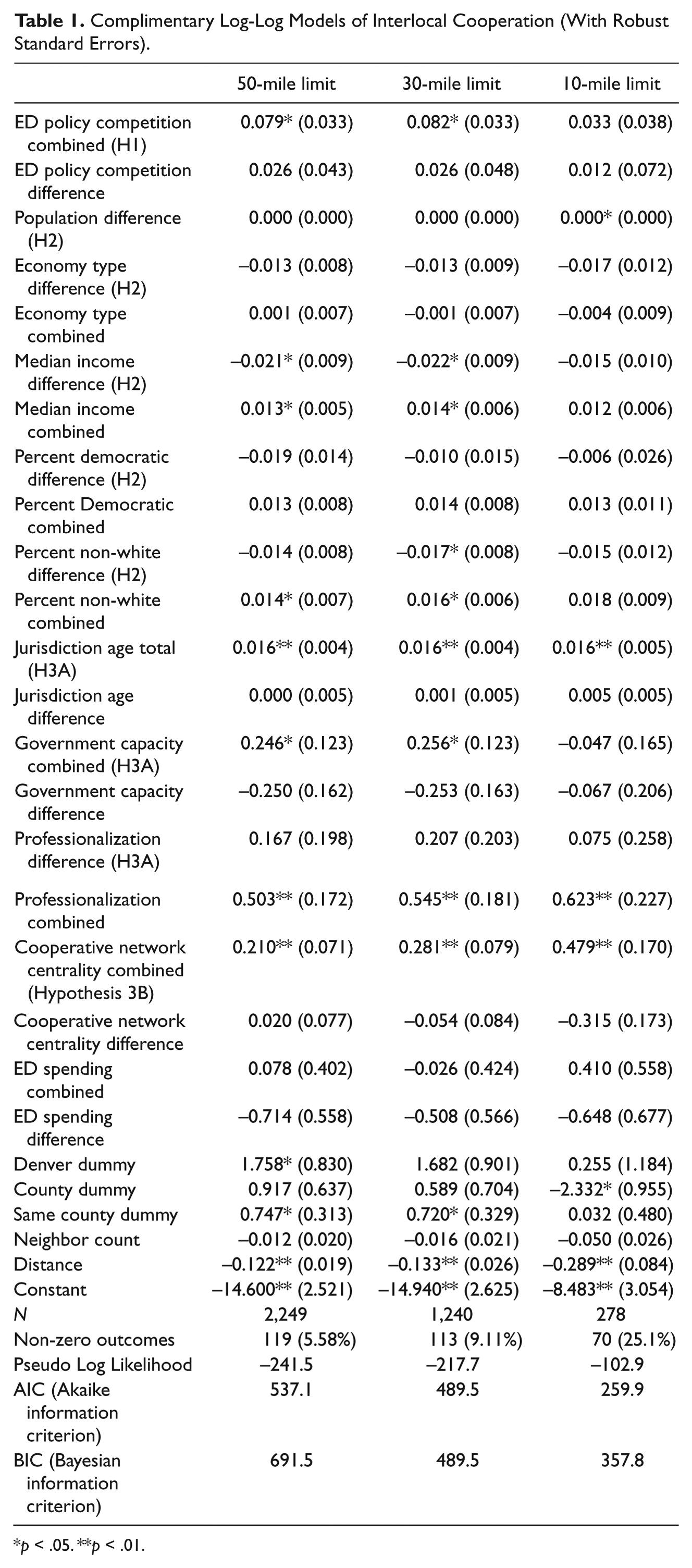
Table 1 presents the results of the models of formal interlocal developmental cooperation for the three dyad-distance pools. Note that the results are quite consistent in significance and magnitude across the pools. Because of this consistency, I focus most the discussion on the 50-mile dyad pool. To ease interpretation of the hypothesis tests in this model, Figure 2 is a dot plot that indicates the size of estimated change in rate ratio (the exponentiated coefficient) for a 1 standard deviation increase in the independent variable (Table 1 reports coefficients for a 1-unit increase). The dot plot also includes 95% confidence intervals. Those variables whose confidence intervals do not cross the 1.0 mark are statistically significant at the 95% level or better. Before proceeding to the hypotheses tests, I will point out that the control variables in the model perform roughly as expected. In particular, the distance variable is significant in all three models and in the expected negative direction: Jurisdictions that are farther apart are less likely to cooperate.
Complimentary Log-Log Models of Interlocal Cooperation (With Robust Standard Errors).
*p < .05. **p < .01.
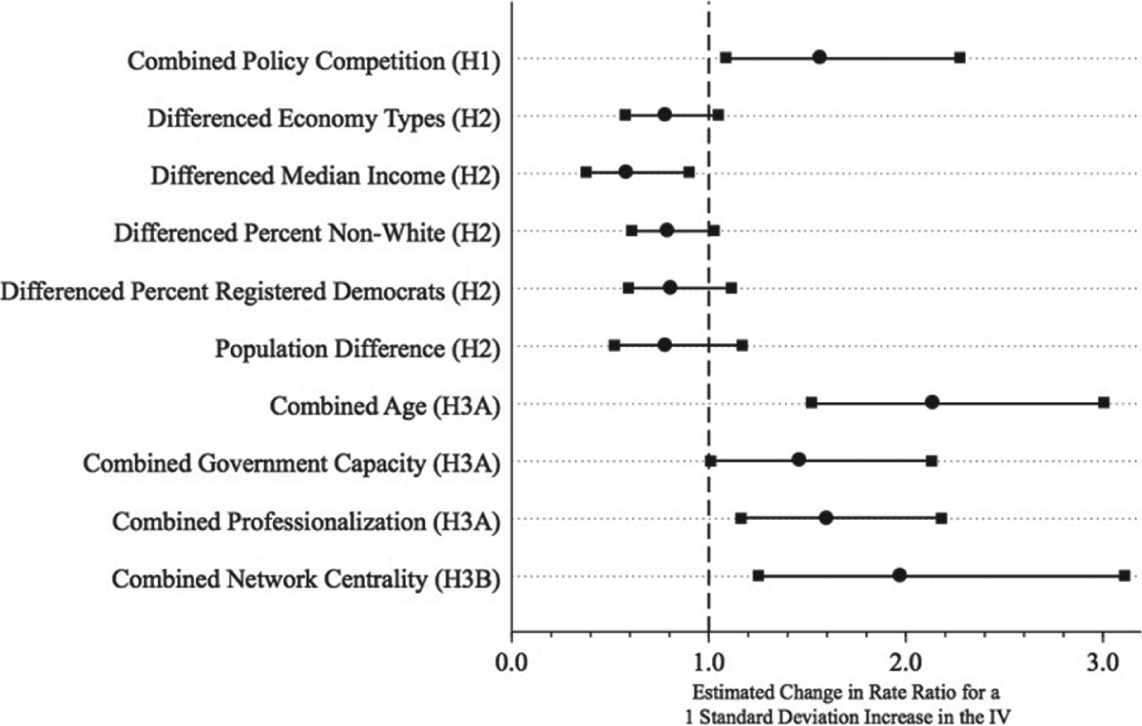
50-mile model estimates dot plot for hypothesized variables (with 95% confidence intervals).
Hypothesis 1 projected that overall developmental policy competition in the dyad would increase the probability of an interlocal agreement. This hypothesis is supported at the p < .05 level in the 50- and 25-mile dyad pools with coefficients of about .08 but is insignificant in the 10-mile pool. To obtain a better understanding of what this result means, Figure 3 presents the predicted probabilities of a developmental agreement as policy competition increases from its minimum in the data set to its maximum given that the jurisdictions are in the same county and 15 miles apart (using the 50-mile pool with all other variables held at their mean). 12 Cities and counties situated in the least policy competitive areas of Colorado are considerably less likely to have formal developmental agreements than those in the most competitive areas. The mean probability of an agreement in a same county 15-mile dyad is about 3.8%. A US$10.00 increase in spatially lagged per capita developmental spending (the measure of competition) above the mean would boost the probability of an agreement to approximately 8.3%—this is a sizeable increase for a rare event. The certainty of this result is tempered a bit by its statistical insignificance in the 10-mile pool—though the coefficient is in the expected direction. The smaller pool includes considerably fewer formal agreements (nonzero outcomes) than the other two pools and a less diverse set of competition dyads from which to estimate. While caution should be taken in interpreting the result, its significance in the 50-mile and 30-mile pool models constitutes a strong indication that developmental competition is a factor in understanding developmental cooperation.
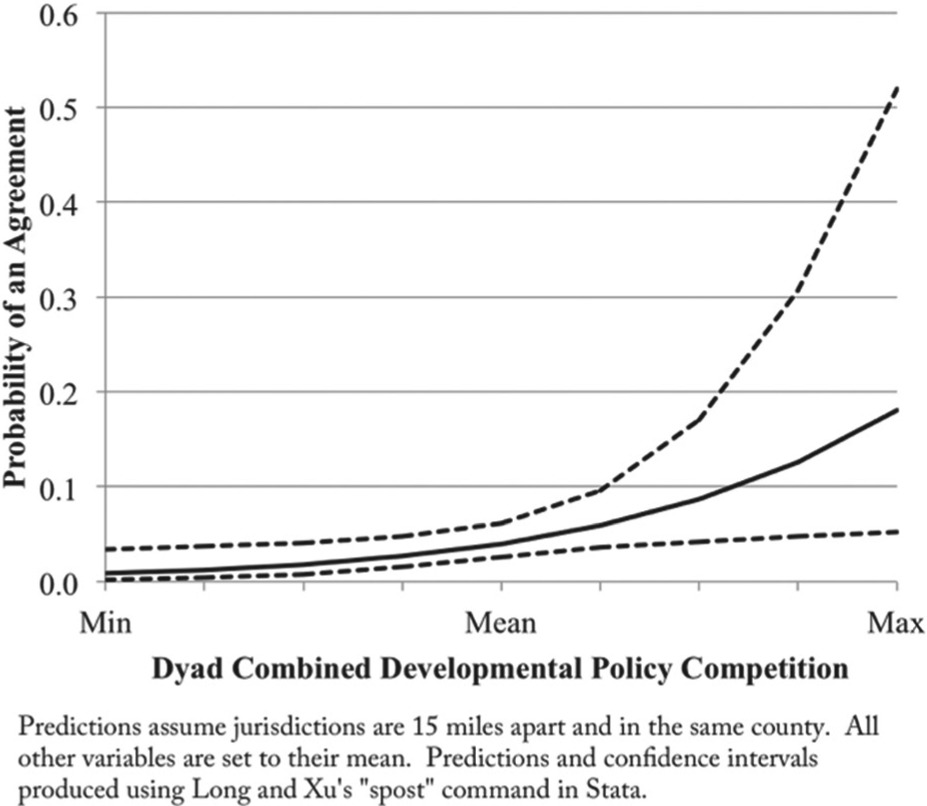
Effect of policy competition on the probability of an agreement (prediction and 95% confidence interval).
The competition result is consistent with the idea that there are geographic subregions within the metropolitan area that have different policy provision dynamics and, all else being, these policy provision dynamics influence policy production dynamics. In the competitive areas of the state, cooperation appears to serve as a tool to achieve economies of scale and reduce the consequences of policy failure. The result also demonstrates that the policy provision choices of other jurisdictions in the metropolitan area matter for the policy production choices that are selected back home. It is important to look at the policy competition hypothesis as being about policy context and not about transaction costs. The role of policy competition in this cooperation story is that it facilitates a situation in which governments are more likely to use their resources and overcome the barriers—whatever they may be—to cooperation.
Hypothesis 2 put forward that increased transaction costs should decrease the likelihood of an agreement. This hypothesis was tested by examining dyad differences in population, economy type, median income, partisan affiliation, race, and development policy. While all six of these variables are in the expected direction, only median income is significant in more than one model. As the difference in median income between the jurisdictions in the dyad increases, the likelihood of an agreement decreases. The mean median income dyad difference is US$24,000. A 1 standard deviation increase in that difference (US$25,000) reduces the probability of an agreement from 3.8% to 2.2%. While this change is not huge, it is certainly nontrivial for a rare event. The economy type (difference in sales tax reliance) and race (difference in percent non-white) variables are near the 95% threshold significance in the 50-mile models and race is significant in the 30-mile model. Overall, there is moderate but not overwhelming support for Hypothesis 2 as tested here. Clearly differences between jurisdictions matter for cooperation, but those differences do not appear to include population and partisan makeup. For scholars of local politics, the insignificance of partisanship here will not come as a surprise—while partisan politics are prevalent in big cities they tend to be less of a factor in suburban cities and this looks to extend to developmental cooperation. 13 The insignificance of population differences is more surprising as it suggests that major scale differences do not prevent cooperative developmental action.
The results for Hypotheses 3A and 3B are considerably more robust than those for Hypothesis 2. Hypothesis 3A contended that the more resources (combined government capacity, age, and professionalization) that a dyad has, the more likely it will be to formally cooperate. The tests for the resource variables were positive and significant (the lone exception being government capacity in the 10-mile model). The professionalization variable is particularly interesting. A same-county 15-mile dyad where neither government has a city manager or an economic development officer has a 1.4% probability of cooperating. Alternatively, when both governments in the dyad have city managers and economic development officers, the probability of cooperation is 10.0%. Similar relationships exist for overall fiscal assets and jurisdiction age.
The more interesting of the resource hypotheses was Hypothesis 3B, which focused on informational resources by way of informal network centrality. Indeed, dyads for which the jurisdictions combined to be situated at a central position in the network of informal relationships among local government officials in Colorado were significantly more likely to have formal developmental agreements (p < .001 in all three models). Figure 4 uses the same technique and variable values as Figure 3 to show the influence of network centrality on the probability of an agreement: All else being equal, cities that are central to the informal network are very likely to act collectively with their nearby neighbors on development projects while unconnected jurisdictions are quite unlikely to work with their nearby neighbors on development products. Still, Figure 4 should be viewed with some caution as the median overall centrality score in the under-50-mile pool is 0.67 and the most substantial increases in probability occur for those jurisdictions in the top centrality quartile (scores greater than 2.08), meaning that cooperation tends to occur much more frequently among the most centralized dyads and considerably less between those dyads that have low or only average centrality scores. The value of the result should also not be minimized: The strong and statistically significant relationship between informal network centrality and formal institutional collective action indicates that cities that make the effort to reach out informally are likely to see those efforts rewarded formally.

Effect of network centrality on the probability of an agreement (prediction and 95% confidence interval).
The robust support for Hypotheses 3A and 3B must be examined in the context of the moderate support for Hypothesis 2. If increased resources leads to increased cooperation, those resources must have a purpose. The support for Hypotheses 3A and 3B indicates that there are obstacles—transaction costs—that governments must overcome to achieve formalized cooperation, so it is somewhat perplexing to see only moderate support for one of the transaction costs hypotheses but strong support for the resource hypothesis. Possible explanations for the unexpected results include ineffective measurement, failure to identify (and subsequently measure) other important transactions costs, and the potential that the estimates are idiosyncratic to the dataset.
Discussion
The theory and analysis presented here make several important contributions to our understanding of local development policy generally and intergovernmental development efforts more specifically. The statistically significant relationships uncovered in the model emphasize the importance of studying intergovernmental agreements with a dyadic approach. Modeling collective action necessitates that measurement take place on a collective level. Without accounting for the characteristics of both the jurisdictions that could potentially be involved in the agreement, it is difficult to assess the probability of formalization with confidence.
Local governments engage the development enterprise differently for many reasons; here I have explored aspects of their submetropolitan geopolitical environment as potential conditional causes. To gain empirical leverage on developmental policy competition, I used a spatially lagged measure of developmental goods provision. Variation in this policy competition variable itself demonstrates that there is geographic variation in policy action within metropolitan areas: All of the cities along Colorado’s Front Range do not operate in the same policymaking environment. Beyond influencing which policies cities pursue (Minkoff, 2012), this environment influences the production methods they use to provide them. As we search for clear underlying conditions for developmental cooperation the policy competition finding should not be understated. Public officials who more seriously encounter the budgetary and political difficulties that intense competition presents are also more likely to seek out ways to economize via partnerships.
The idea that increased competition leads to cooperation is at once a little puzzling and quite sensible. Local developmental policy is, at its core, about drawing capital out of other cities and into another city—this would seem to be a solitary endeavor. Based on the research presented here, formalized cooperation presents itself as a viable policy production alternative as policy competition becomes less and less bearable. Indeed, metropolitan areas are ripe with efforts to attract the wealthiest residents and the best firms, but these efforts can be both economically and politically burdensome for jurisdictions. Cooperation offers a way to reduce these costs, even if it means continuing to compete—often with the same governments—on other fronts.
The role of resources for understanding local cooperation has also been explored. Of particular importance is the effect of social network centrality. Even within the relatively small world of Colorado’s Front Range, local officials can be positioned in different places within the network that structures information flow about the area. To date, social networks have primarily been a tool of psychology (behavioral, political, etc.) scholars; however, they also clearly play a role in the metropolitan regions that characterize American substate governance. I utilized a measure of each jurisdiction’s flow centrality within the network and find that the pairs of jurisdictions that are more centrally positioned within the network are more likely to have formalized developmental agreements. In keeping with the ICA literature on embeddedness, I theorize that this is because network centrality allows official to be more aware of the cooperative tools available to them for achieving developmental ends. Moreover, just as there are costs with competition, there are also costs with cooperation: Network centrality allows officials to collect the information necessary to overcome the division and enforcement costs associated with intergovernmental agreements. For policymakers in metropolitan areas this may be an important lesson. Cities cannot expect to work cooperatively with other jurisdictions that, for many possible reasons, exist outside the informal network’s centers. True regional approaches to policy problems may require more tied-in cities to reach out to more isolated cities.
Though there are certainly other conditions that lead to formal institutional collective action on matters of economic development, the results above paint an interesting picture of when this collective action is likely to occur and what it takes to get it done. In this analysis, the generalization of a national sample was substituted for a closer look at a single region. As such, it is difficult to know the generalizability of the findings (though, where there is theoretical overlap, the results are fairly consistent with the previous nondyadic research). Future research using dyadic, spatial, and network approaches of other metropolitan areas will better inform the generalizability question. For now though, it is important to note that understanding local policy provision and production requires us to model multiple aspects of the complex geopolitical intergovernmental environment that America’s local governments are positioned within.
Footnotes
Appendix 1
Declaration of Conflicting Interests
The author(s) declared no potential conflicts of interest with respect to the research, authorship, and/or publication of this article.
Funding
Some of the data collection was supported by the National Science Foundation. Award # 1064784. Project Name: “Doctoral Dissertation Research in Political Science: The Proximate Polity: Exit, Space, and Networks in Local Development Politics.