




Abstract
Most research on media effects in political science deals with the news media or political campaigns. Although some recent work looks at the effects of soft news on beliefs and opinions, little attention has been paid to the potential consequences of media that are fictional. Although viewers typically watch fiction for entertainment, the themes, plots, and dialogue may nevertheless influence their thoughts about politics. This article examines the effects of fiction on political beliefs. We do this in the context of an experimental design, where subjects in the treatment group watched the outlandish movie, Wag the Dog. The results show that those who watched the film were more likely to believe in a far-fetched conspiracy, namely that the U.S. government has and will fabricate a war for political gain. The findings stretch the boundaries of fictional influence by focusing on extreme, conspiratorial beliefs. We suggest that political science and communications scholars should focus greater attention on the implications of fiction for beliefs and attitudes, as the consequences can be perverse.
Introduction
Today’s media environment affords citizens tremendous choice. Information can be acquired instantaneously through the Internet, 24 hours news networks, or smart phones. So, too, the options in entertainment media are only a mouse click or scroll of the finger away. This dual rise in choice and in technology has not been without consequence. Evidence suggests that those who attend closely to the news—a relatively small percentage of the public—have seen gains in their political knowledge, thanks to the now-readily available sources of information (Prior, 2007). But for the majority of the public, because today’s media environment offers ever more opportunities to navigate away from the news, citizens are spending considerable time with entertainment. This trend has contributed to disparities in political knowledge and turnout (Prior, 2005, 2007).
As exposure to entertainment media rises, scholars are left with the question of whether this exposure, in and of itself, has consequences. It may simply be that entertainment crowds out opportunities for citizens to learn about politics. If true, such media are fairly innocuous—in a normative sense, they neither aid nor harm citizens. Alternatively, some research suggests that at least one segment of the entertainment media, soft news, can increase viewers’ awareness of public affairs. 1 Here citizens can be exposed to issues and ideas that they would otherwise miss, and actually learn something about politics as a result (Baum, 2002, 2003). However, because much of entertainment media is distorted and riddled with error, it could be that exposure to such media leads to misinformation, if consumers believe that such works of fiction offer insight about society and politics.
Why would one expect consumers of entertainment media to learn from it? Works of fiction make no claims of truth, and moreover, should be expected to contain any number of factual inaccuracies and errors. Ostensibly, viewers should perceive fiction as merely pleasurable distraction, with the contents of such programming inconsequential for beliefs and attitudes about politics. Yet fictional media often contain socially or politically relevant topics, themes, plots, dialogue and imagery. People watch fiction to be entertained, but they may do so with an eye toward accessing distant—but realistic—places, people; and situations. None of us have fought in the Civil War, and few will ever have the opportunity to investigate a murder, captain a submarine, or treat a dying patient. But we can do all of these things through fiction. Entertainment media can expand our horizons and introduce us vicariously to new feelings and experiences—all without leaving our homes. Although viewers likely approach fiction mindful of its shortcomings, they also know that it can provide lessons for real life.
We examine the effects of fictional media for political beliefs. We canvas an emerging literature that suggests that people learn from fiction. We discuss and subsequently explore the processes by which fiction could influence beliefs, drawing from both dual-mode theories of persuasion and the concept of perceived realism. We then test whether information in fiction influences political beliefs through an experimental research design. Those in the treatment group watched the movie Wag the Dog—A satire on government, the news media, and public opinion. We demonstrate that watching an outlandish film can make people receptive to a far-fetched conspiracy theory, namely that it is possible for the U.S. government to fabricate a war for political gain. Our theory and findings challenge scholars to take fictional media seriously, as the consequences of such media for beliefs about politics are alarming.
Fictional Media and Real-World Beliefs
Although scholarly attention to fiction is limited in comparison to the news media or campaigns, there are several areas of research that have pointed to the influence of fiction. Much attention has been focused on its potentially harmful ramifications for the young, particularly violence (Anderson, Gentile, & Buckley, 2007, for reviews; see Huesmann & Taylor, 2006) and portrayals of sexual behavior (Brown et al., 2006; Chandra et al., 2008; Collins et al., 2004; Eyal, Kunkel, Biely, & Finnerty, 2007; Zhang, Miller, & Harrison, 2008). An emerging literature has shown that fiction can effect learning and real world beliefs for adult audiences as well. Early research explored the consequences of exposure to the miniseries Amerika, a fictional account of life in the United States in the aftermath of Communist control. Scholars found that viewers had heightened concerns about the Soviet Union (Lenart & McGraw, 1989). Feldman and Sigelman’s (1985) study of the film The Day After—which chronicled the potential consequences of a devastating nuclear war—found that the content affected the audiences’ levels of political knowledge, but it did not fundamentally alter their political attitudes. More recently, Mutz and Nir (2010) randomly assigned subjects to either a positive or negative portrayal of the criminal justice system by the crime drama Law & Order. They found that participants’ perceptions of the justice system and their views about the death penalty were affected by exposure to the entertainment media, particularly among those who empathized with the characters.
Several studies have offered evidence that fiction can influence attitudes and even perceptions of public officials. Davis and Davenport (1997) showed that African Americans who saw the movie Malcolm X became more race-conscious and concerned about race relations as a result. Similarly, experiments by Holbrook and Hill (2004, 2005) demonstrated that dramas including Without A Trace and ER, increased perceptions of crime and health care as important issues, respectively, and that this media influenced respondents’ perceptions of Presidents Clinton and Bush. Mulligan and Habel (2011) offered evidence that the way in which fiction frames issues could affect political attitudes. In like manner to politicians or the news media, fictional media also frame issues, and such framing was shown to matter for related attitudes on abortion in the case of incest and the extent to which one follows his/her own conscience.
Moreover, research from communications and psychology suggests that those who consume fiction incorporate blatantly false information into their store of knowledge. Studies demonstrate that when people are exposed to information known to be factually incorrect, the fiction nevertheless interferes with their abilities to answer related knowledge questions (Gerrig & Prentice, 1991; Rapp, 2008). Similarly, a series of laboratory experiments have shown that viewers, after they were exposed to fictional narratives, confused fact with fiction (Levine, Serota, & Shulman, 2010) and drew from fictional information when answering knowledge questions about the actual world (Butler, Zaromb, Lyle, Henry, & Roediger, 2009; Marsh, Meade, & Roediger, 2003). According to Marsh and Fazio (2006), “Readers rely on fiction as a source of information, even when fiction contradicts relatively well known facts about the world” (p. 1140).
Fictional Media and Conspiracy Beliefs
Given evidence that fiction could be influential, we address whether fiction could matter for political beliefs related to a far-fetched theory about government, one that has dire normative implications. We explore whether fictional media influences beliefs in the possibility of the U.S. government fabricating a war for political gain. Specifically, we test whether participants who were exposed to a fictional film with a conspiratorial message are more likely to believe that the U.S. government can stage a fake war. Thus, our study stretches the boundaries of fictional influence, not only by testing fiction’s consequences for political beliefs, but by examining implications for extreme, conspiratorial ones.
Our study follows two previous works on the effects of fiction for conspiratorial views about politicians and government. Douglas and Sutton (2008) found that exposing participants to conspiratorial information about the death of Princess Diana changed perceptions of the causes of her fatal car crash. Butler, Koopman, and Zimbardo (1995) focused on the effect of Oliver Stone’s movie JFK for beliefs about President Kennedy, a film which blended fact with fiction in chronicling the assassination of the President. The movie implicated several institutions and politicians in the assassination and alleged cover-up, and Butler et al. (1995) found that many viewers bought into Oliver Stone’s conspiracy theory.
Although both of these studies are suggestive of the power of fiction to influence conspiratorial beliefs, they are limited in at least three respects. First, conspiracy theories have surrounded the death of Princess Diana and the Kennedy assassination for some time. In fact, conspiracies about the death of President Kennedy remain among the most widely held in American society (McCauley & Jacques, 1979; McHoskey, 1995). A second considerable limitation is the blending of both historical and conspiratorial information in both studies. For example, in the film JFK, real events—and even actual footage of President Kennedy’s final moments—were conflated with dramatic fiction. In fact, Mutz and Nir (2010) point to this fusion of fact and fiction as a shortcoming related to a number of studies of fictional influence. The third limiting factor, related to the Butler et al. (1995) study, is that the research participants were a convenience sample of those who had purchased tickets to see JFK at the movie theater, meaning subjects self-selected into the treatment group. These participants, having decided on their own to spend an evening watching JFK, may have been more receptive to the movie’s conspiratorial messages than people who chose not to watch this movie. Given the publicity and controversy surrounding the film at the time it was released, some viewers likely decided to go see it—and others avoided it—for that very reason.
Mechanisms of Influence
We argue that fiction could matter for even conspiratorial beliefs, although the process(es) by which this could occur remains unexplored. Early studies on the effects of fiction were grounded in cultivation theory, and recent advances suggest that for heavy users of fiction, television reality is more accessible than the real-world. Green (2004) and Busselle and Bilandzic (2008) refer to this concept as perceived realism, which can further be conceptualized as external and narrative realism. External realism is the extent to which the narrative is perceived as mirroring reality, where the setting, plot, characters, and dialogue appear quite plausible and lifelike to the viewer. Narrative realism reflects the internal coherence and logic of the story, whether the relationships among characters, story events, and plot fit together in reasonable ways. According to these authors, viewers of fiction are not blank slates, but rather they have mental models of the real-world (Busselle, 2001; Busselle & Bilandzic, 2008; Busselle & Greenberg, 2000; Oatley, 2002). To the extent that viewers incorporate the information from fiction into their cognitive structures, they will perceive the fiction as real. Thus, viewers highest in measures of the concept of perceived realism should be the most likely to be influenced by the fiction, even adopting conspiratorial views about government (Busselle, 2001; Green, 2004; Green, Brock, & Kaufman, 2004; Slater, Rouner, & Long, 2006).
We also consider a second process: scrutiny. Dual-mode theories posit that persuasion occurs through one of two general processes or “routes,” where opinion change depends on the motivation and ability of the individual to scrutinize the persuasive message (Chaiken, 1980; Petty & Cacioppo, 1995). 2 Although dual-mode theories are centered on attitude change rather than belief change, these theories nevertheless could prove useful for understanding when and how people adopt information presented in fiction as true. According to dual-mode theory, when motivation and ability are high, people tend to evaluate messages carefully and are persuaded (or not) based on a thoughtful consideration of the argument. When motivation or ability are lacking, individuals do not scrutinize the message, but instead they rely on peripheral cues or information shortcuts (For a review, see Chaiken & Trope, 1999). 3 Applied to the persuasive effects of fiction, we theorize that influence is likely to occur through a low effort process. One reason for this is that those who evaluate the messages in fiction carefully should recognize that fiction lacks credibility as a source of information. And because people typically turn to fiction to be entertained and not informed, one should expect that people do not scrutinize the messages they receive (Prentice & Gerrig, 1999). Viewers may be cognitively busy following the story (Fazio & Marsh, 2008; Marsh & Fazio, 2006), and could lack the mental resources necessary to evaluate the information in fiction.
Several studies have addressed this hypothesis empirically. Consistent with dual-mode theory, initial research suggested that fiction is less influential when the setting is close to home rather than in a less familiar context (Prentice, Gerrig, & Bailis, 1997). In contrast, other work has shown that fiction is just as influential when people know the setting well as when they do not (Wheeler, Green, & Brock, 1999). Others have failed to demonstrate that fiction works through a low effort process. Experiments by Fazio and Marsh (2008) reduced the effort necessary to examine a fictional story by presenting it at a sixth grade reading level and slowing the speed in which it was presented aurally. Contrary to expectations, they found that participants in these conditions were no less likely than those in the control conditions to adopt false facts as true. Studies have also made it easier for participants to scrutinize fictional sources by reminding them that fiction often contains inaccuracies. This research demonstrated that general warnings about inaccuracies do little to diminish the effects of fiction. Mulligan and Habel (2011) failed to observe differences in those motivated to carefully attend to the messages in fiction compared to those who were not.
To date, the only situations in which the effects of fiction have been shown to be diminished are when participants are told explicitly that the information they encounter is factually incorrect, or when subjects are required to evaluate each sentence as true or false as they read it. Even then, the effects of fiction are not necessarily eliminated (Butler et al., 2009; Fazio & Marsh, 2008). “Readers of fiction are surprisingly passive,” Fazio and Marsh, (2008, p. 183) conclude, as they “appear to passively accept information presented in stories and need a constant reminder to monitor for errors” (p. 180).
Wag the Dog Experiment
To explore the implications of fiction for conspiratorial beliefs about politics, we selected the film Wag the Dog, which centers on a farcical plot. Here the U.S. president and his staff stage a fake war in a Hollywood studio as a means of distracting the public’s attention from a domestic scandal. Unlike many previous studies, the film does not blend fact with fiction. No actual historical events or persons were used in the film. Rather, WTD offers an outlandish take on U.S. democracy, portraying the president and his emissary as unconstrained by other actors. The characters wield tremendous political power, far beyond what would be conceivable in a system with the separation of powers, checks and balances, and an independent media. The film presents politicians as corrupt, authoritarian, and manipulative—capable of doing whatever it takes to stay in power.
To describe the film briefly, WTD begins as the president, in the midst of his reelection campaign, is caught in a sex scandal with a “Firefly Girl.” The president (whose identity and party affiliation are not known) hires a political consultant (played by Robert DeNiro) to help distract attention from the scandal. The consultant accomplishes his task by staging a fake war with Albania through the aide of a Hollywood filmmaker (played by Dustin Hoffman). Together they create footage and hire actors (including a deranged murderer played by Woody Harrelson, who portrays a military hero in the fake war) to fool the media and the public into thinking that the United States is at war with Albania. The plan works. The president’s scandal falls from the agenda, and the public and news media rally around the president. Clearly, WTD should be perceived by viewers as outlandish fiction. The notion that the government has or will fabricate a war in a Hollywood studio should seem outrageous. But our theory suggests that for some viewers, watching the movie could have perverse consequences for their beliefs about politics, that viewers could adopt conspiratorial views—believing in the possibility of a Wag the Dog-like scheme.
To test the effects of fiction on political beliefs, in the spring of 2008, we recruited 191 participants from an introductory course in U.S. politics in exchange for course credit. 4 Although some have raised concerns over whether the findings from student samples are generalizable to the population of U.S. adults, we believe that the use of a student sample here is appropriate. Druckman and Kam (2011) note that student samples present a threat to mundane realism (more so than external validity) if “. . .the magnitude and direction of the treatment effect depends upon a particular (set of) covariate(s) that are peculiarly distributed within a student sample.” We do not expect this to be the case. Rather, given the higher levels of education and political knowledge among our student sample when compared with the general population, we should expect to find less evidence of fictional influence. That is, viewing WTD should matter less for the political beliefs of our audience than for those of the general population of U.S. adults.
The participants were randomly assigned to a treatment group, N = 92, or a control group, N = 99. 5 All participants, both those in the treatment and control conditions, were presented with the following scenario before being asked about their beliefs in the likelihood of a fake war. For those in the treatment group, these slides were placed within a larger questionnaire that was administered after viewing the film. For those in the control, students completed the questionnaire upon entering the laboratory, and they then participated in a different study. Each slide appeared separately on participants’ screens, and they were instructed to proceed to the next slide after they finished reading the current one.
Slide 1 Consider a scenario in which an American president—any president who has been elected in the past or may be elected in the future—faces a scandal that causes the president’s opinion poll ratings to go down.
Slide 2 In order to increase his opinion ratings—say, during his reelection campaign, or for some other reason—the president and his assistants work with a film producer to stage a fake war.
Slide 3 The intention is not actually to go to war. Rather, the intention is to create fake video scenes of a war so that the news media and citizens will think the country is at war.
Slide 4 The video footage of the fake war is given to members of the news media, who think they are real, and play them on television as if they were real.
Slide 5 The news media and the public think the country has gone to war. They rally around the president during this time of trouble. The president’s opinion poll ratings go way up.
We devised the above description carefully, so that the scenario presented to all participants closely matched the plot of the film. Thus those who watched WTD should immediately recognize the scenario as corresponding to movie. We expect that their responses will be influenced by the contents of the film. Those in the control group, however, should evaluate the information presented according to the merits, whether or not the scenario is plausible.
Following the presentation of the five slides, all participants were asked two questions. One question read, “How likely is it that a U.S. president WILL stage a fake war IN THE FUTURE?” with emphasis included. Subjects were offered a fully labeled 6-point scale ranging from extremely unlikely to extremely likely. A second question read, “Generally speaking, how likely is it that a U.S. president HAS ACTUALLY STAGED a fake war in the past?” using the same 6-point Likert-type scale, again with emphasis as listed. Participants’ responses to these two questions subsequently serve as the dependent variables in our analysis. According to our theory, those in the treatment group should be more likely to believe in the likelihood of a future faked war and a past staged war.
Dual-Mode Manipulation and a Measure of Perceived Realism
The experiment also included a manipulation designed to test the expectation that the effects of fiction are more pronounced under a low-effort process. Participants in the treatment group were randomly assigned to one of two conditions: low or high motivation to scrutinize. Those in the low-scrutiny condition were asked to watch the movie as they would normally. Those in the high-scrutiny group were asked to “pay careful attention throughout the movie” because “you will be tested on what you remember about it.” Through this fairly standard dual-mode procedure (Chaiken & Trope, 1999), we test whether participants who have been experimentally motivated to scrutinize the film are less influenced by it than those in the “watch-normally” condition.
We also included, as part of the questionnaire for those in the treatment group, a six-item measure of perceived realism. 6 These questions tap the extent to which viewers perceived the plot, story, characters, and the movie generally, as realistic. The scale, adapted from Green, Brock, and Kaufman (2004), and related to Busselle and Bilandzic (2009), is linked with external realism more so than narrative realism. In the context of WTD, evaluations of the plausibility of the story are more critical to beliefs than viewers’ perceptions of the internal coherence and logic of the film. Consistent with theory, we anticipate that viewers perceiving WTD as resembling reality will be more likely to adopt conspiratorial beliefs (Busselle & Bilandzic, 2009; Green, 2004; Green et al., 2004).
How We Addressed Potential Demand Characteristics
For this study to be internally valid, changes in dependent variables must be attributed unambiguously to the manipulations. Internal validity demands that factors that could affect an outcome variable other than a treatment be constant across treatment and control groups. Lack of constancy between groups with respect to extraneous factors introduces the possibility of confounds. This study, like most experiments, relies on random assignment to assume that extraneous factors are distributed evenly between treatment and control groups. However, potential violations of constancy may occur whenever the act of participating in an experiment influences treatment and control participants in different ways. Such demand characteristics can occur when participants implicitly seek to carry out what they perceive as their appropriate role as subjects in an experiment and, importantly, these interpretations differ systematically between treatment and control groups (Orne, 1962; Rosenthal, 1966; Shadish, Cook, & Campbell, 2002; Webber & Cook, 1972). In the present context, this could have happened if treatment subjects implicitly saw their role as one of “Going along” with the farcical WTD scenario, and this implied believing that it could happen in real life.
Although the possibility of demand characteristics cannot be completely eliminated, we attempted to address these and related concerns in three ways. First, the graduate research assistant who seated participants at their workstations was unaware of whether participants were assigned to treatment or control, and also unaware of the purpose of the study. 7 Two, participants were deceived about the true purpose of the study. Aronson and Carlsmith (1968) refer to deception in the context of an experiment as “A cognitive analogy to a placebo” (p. 73), because all subjects in both treatment and control are led to believe the study has the same (false) purpose. To elaborate, in our study, upon entering the lab, each participant was informed in writing that the experiment was about how people perceive a story in film versus in text. Treatment participants were unaware that they would watching a film advocating a conspiratorial message, and moreover, that they would subsequently be asked about the influence of the film on their political beliefs. Third, participants in both the treatment and control groups encountered the same procedure. Entering the lab, control group participants were assigned to a computer work station where they answered questions relevant to this study and then watched a film for a separate, unrelated experiment. Subjects in the treatment group began with a questionnaire irrelevant to this study, and then they watched WTD, which was followed by the questionnaire related to WTD. All participants—both treatment and control—wore headphones and watched the film on private monitors. The procedure should have appeared functionally same for all subjects. 8
Results
Our expectations are that participants who watched WTD will be more likely than those in the control group to believe that the president will fake a war in the future and that he has faked a war in the past. We present our findings in two ways: first, visually, by contrasting the distribution of responses to the two questions separately among treatment and control groups; and second, statistically, by estimating ordered logit models. 9 Following these results, we address a potential confound—whether the similarity of the WTD scenario to President Clinton’s bombing of Afghanistan and Sudan late in his presidency, an event that many at the time suggested bore some similarity to the plot of WTD (see Baum, 2003, for a discussion). Then we take up whether participants in the low scrutiny condition were more influenced by the film, followed by tests of perceived realism.
We now turn to the effects of watching WTD on conspiratorial beliefs. Two figures contrast the distribution on our dependent variables for treatment and control groups. Figure 1 shows the percentage of participants in each category for the question of whether the scenario depicted in the film is likely to happen in the future, and Figure 2 presents the same information for whether such events have already transpired.
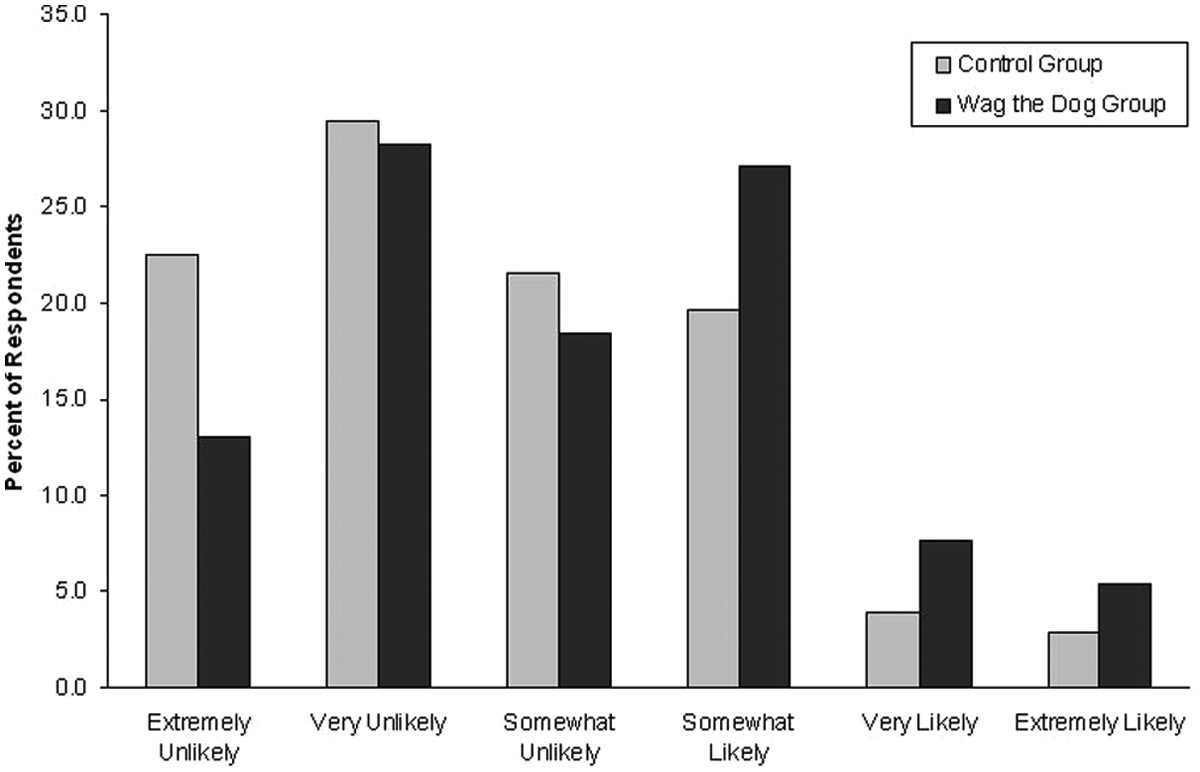
Distribution of beliefs in a future fake war
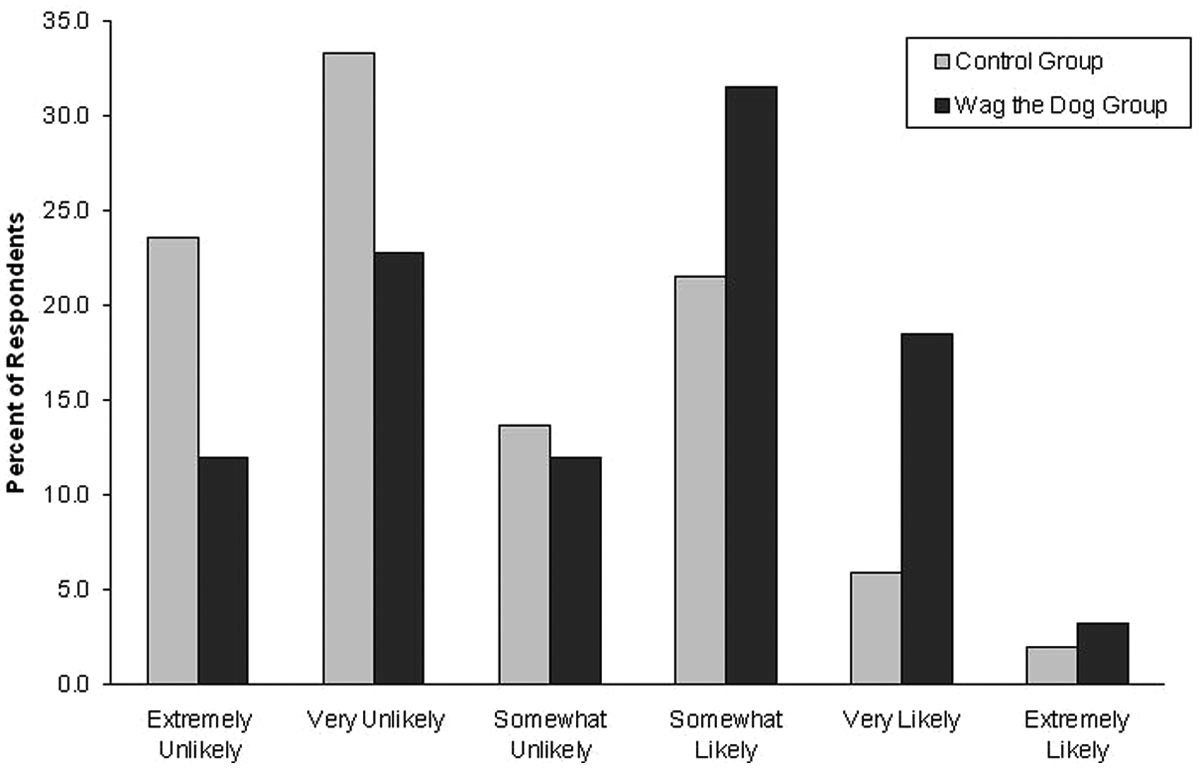
Distribution of beliefs in a past faked war
The figures, respectively, demonstrate that participants who watched the film were more likely to adopt the position that a future president will engage in a WTD-like scheme, and that a past president has already done so. Each of the three “Likely” response categories has more treatment participants than control, and each “Unlikely” category has more control group participants than treatment. One should consider that it is one thing for viewers to “Learn” that a conspiracy scenario might be likely in the future, as we see in Figure 1. It is something else for viewers to decide that a president of the United States has already conspired and deceived the polity into believing that the United States has fabricated a war, as we find in Figure 2. This preliminary analysis suggests that WTD did lead viewers to adopt conspiratorial views.
Ordered logit models provide a more formal test. We present the results in Table 1, where we include a single indicator for having seen the film. Because participants were randomly assigned to treatment and control, it is not necessary to include control variables. 10 For both the future war and past war question, the coefficient on the indicator of whether participants watched the movie is positive and statistically significant. We confirm what we observed visually: Fiction can drive perverse views about democracy and governance. 11
Models of Beliefs in the Likelihood of a Future Fake War and a Past Staged War

Ordered logit coefficients.
Standard errors in parentheses.
Two-tailed significance tests.
p < .10, **p < .05.
WTD and Clinton’s Attacks on Terrorist Sites
We pause briefly to consider that the WTD scenario bears some similarity to an actual event that transpired near the time of the movie’s release. On August 20, 1998, shortly after President Clinton testified before a grand jury about his relationship with Monica Lewinsky, the President ordered airstrikes on suspected terrorist sites in Afghanistan and Sudan. According to Baum (2003), in the week following the attacks, one-sixth of the TV news stories on the missile strikes, and more than three-fourths of soft news stories, “addressed the Wag the Dog theme, repeatedly questioning whether the President launched the missile strikes to distract the nation from the Lewinsky scandal.” In December of that year, Clinton ordered air strikes against Iraq on grounds of their failure to comply with U.N. weapons inspectors. Here again, the President was accused of distracting attention away from his domestic troubles, this time from his ongoing impeachment hearings. The fact that the media asked whether Clinton “wagged the dog” in 1998 raises the possibility that participants in our study recalled this event. If true, this presents a confound. Did viewers who said that the scenario is likely have this event in mind?
We can address this confound in two ways, one logically and one empirically. First, because we drew participants from an undergraduate student population, it is important to note that most of our subjects were children in the autumn of 1998, having been born in the late 1980s or early 1990s. Their exposure to news and soft news linking the real world events of 1998 and the movie was, presumably, very low. Second, we included in the questionnaire for both control and treatment groups a question related to which president had staged a war. We asked participants who believed that it was at least “Somewhat” likely that a president had staged a fake war to identify the likely perpetrators. 12 Figure 3 shows the distribution of responses to this question. The results show that only 8 participants—5 in the WTD group and 3 in the control—attributed Clinton with having orchestrated a fake war. Rather, both Presidents George H. W. Bush and George W. Bush were much more likely to be implicated.
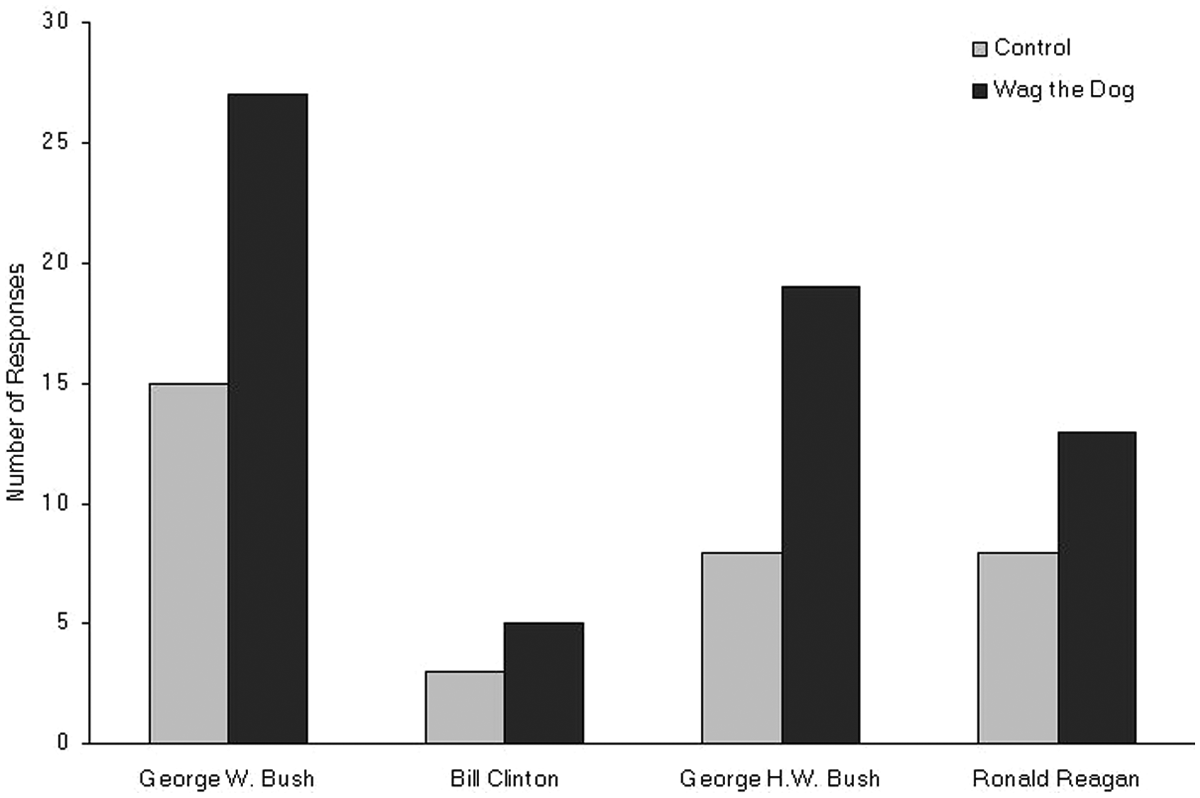
Actual presidents identified as having faked a war
Dual-Mode Manipulation
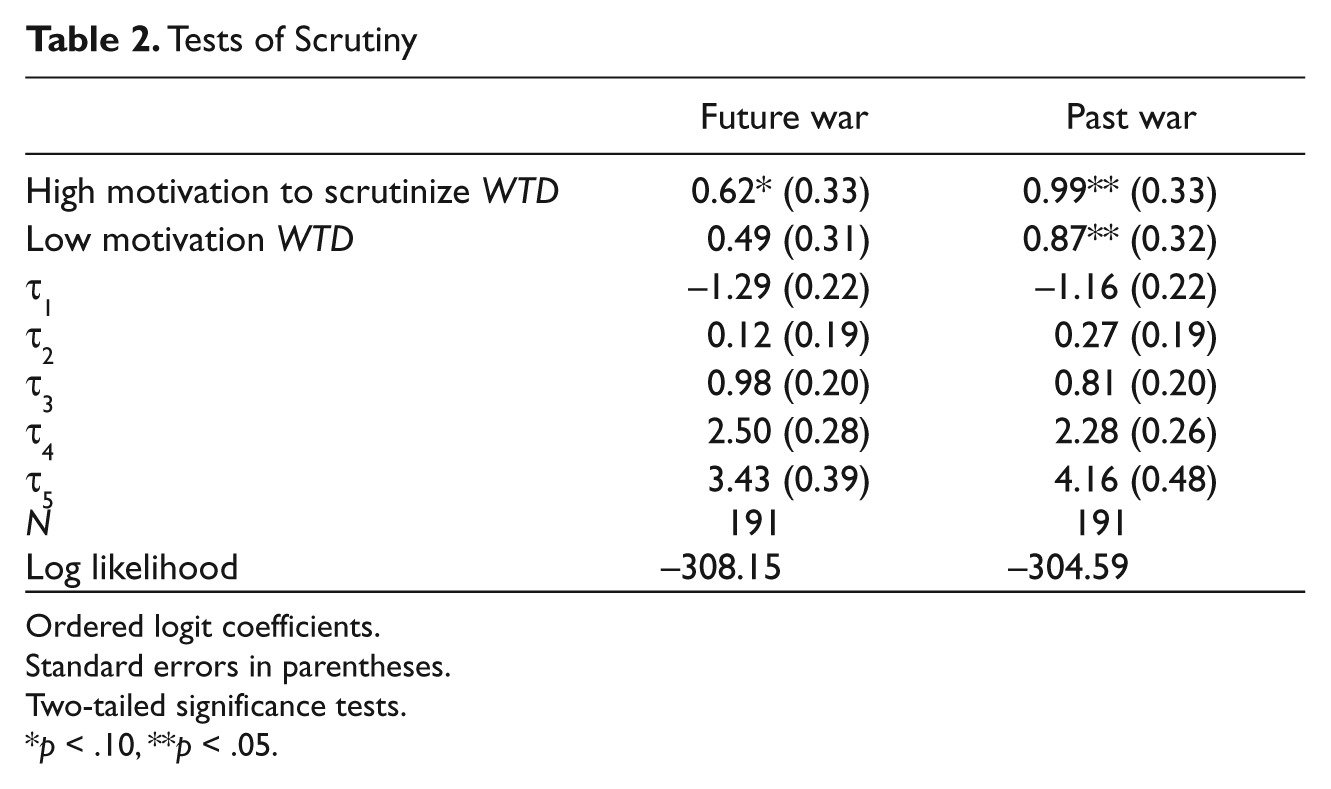
We now move to addressing the effects of motivated scrutiny and perceived realism. As we outlined, belief change may stem from a low effort process, although alternative research suggests that fiction may be as influential for those motivated to scrutinize as those who are not motivated. We examined the effect of scrutiny by estimating two additional ordered logit models, one for both the future war and past war questions. We include the results of these models in Table 2. Both models have two explanatory variables—one for participants who watched WTD and were in the high scrutiny condition, and another for those who saw and the movie and were in the low scrutiny group. Thus the excluded category is the control group, those who did not watch the film.
Tests of Scrutiny
Ordered logit coefficients.
Standard errors in parentheses.
Two-tailed significance tests.
p < .10, **p < .05.
The results suggest that scrutiny is not the mechanism whereby fiction influences political beliefs. For the model in the first column, we do observe a difference between those in high motivation to scrutinize and low scrutiny groups, but in the opposite direction from what would be expected. Here those motivated to scrutinize were more likely to adopt conspiratorial beliefs than those in the low motivation group. In the second model, we observe that both groups were significantly more likely to adopt conspiratorial beliefs compared to those in the control, but these groups are not statistically distinct from one another. Our results together indicate that the effects of the movie on beliefs about a fake war did not occur through a low effort process.
Perceived Realism
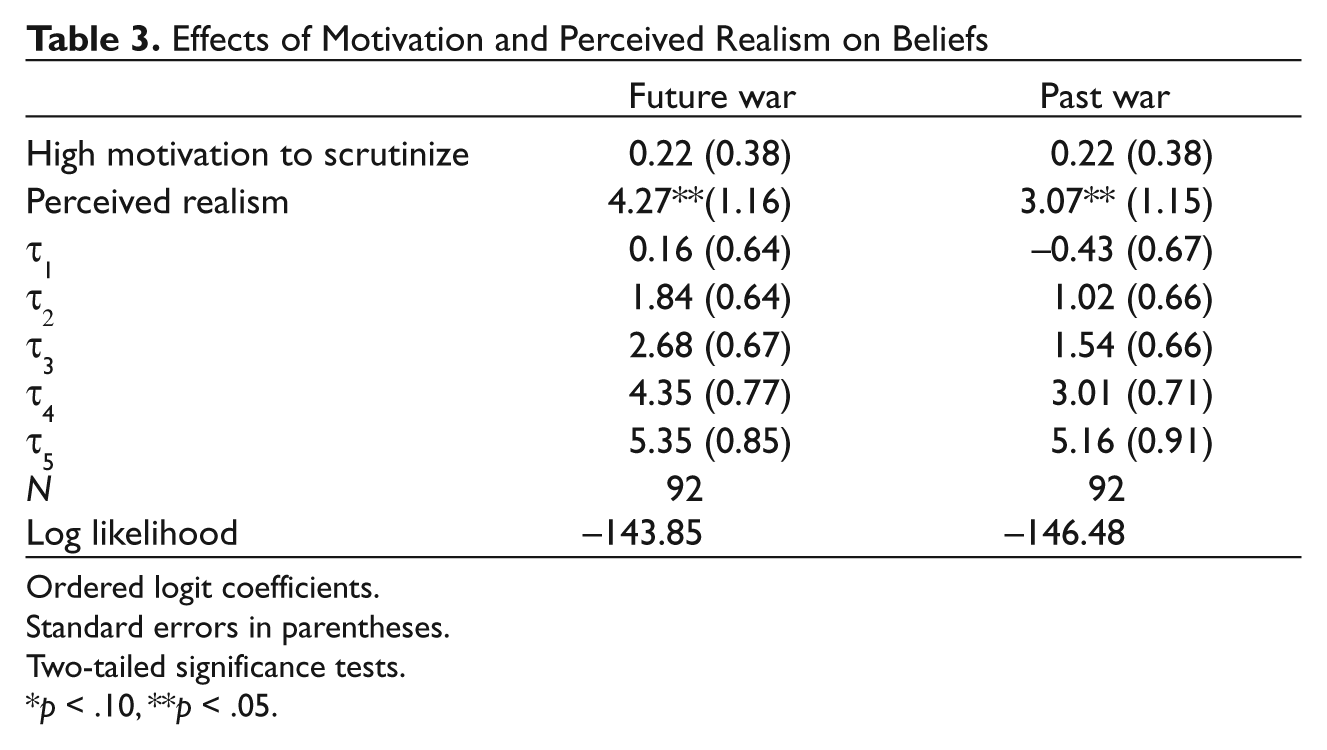
Another potential mechanism for influence is the extent to which the film is perceived as reflecting reality. We examine this by estimating two additional ordered logit models, one for each question, and including an indicator of scrutiny. Participants who did not watch the movie, because they could not logically perceive it as real or unreal, were excluded from this analysis. 13 The results of the two ordered logit models are displayed in Table 3.
Effects of Motivation and Perceived Realism on Beliefs
Ordered logit coefficients.
Standard errors in parentheses.
Two-tailed significance tests.
p < .10, **p < .05.
The results of both the future war and past war models speak to our expectations about perceived realism. The coefficient on perceived realism is positive and statistically significant. Participants who thought the movie was highly realistic were more likely to believe that a future president will stage a fake war and that a previous president has already done so. This finding is intuitive; as viewers are drawn into the fabricated story of the film, they are more likely to see its message as having implications for the real-world in which they live.
Discussion
The findings present rather startling evidence that fictional media matter for conspiratorial beliefs about politics, findings that have perverse implications for democratic governance. Participants in the treatment group, who were assigned at random to view the film Wag the Dog, were significantly more likely to believe that a president will stage a fake war in the future and that an actual president has done so in the past. We also examined two processes of fictional influence: perceived realism and critical scrutiny. The results showed that participants who thought the movie was realistic were more likely to be affected by its content than those who saw it as less realistic. Our findings also showed that the movie influenced participants’ beliefs regardless of whether or not they were motivated to scrutinize the film.
Considering that the treatment was a fictional film with wholly concocted characters and plot, the fact that we find viewers changed their beliefs cannot be overstated. Our results suggest that scholars of political science should take fiction seriously. The opportunities for citizens to seek out fictional entertainment media are greater than ever—and research has shown that most people avail themselves of these opportunities, turning off the news and turning on entertainment. This article demonstrated that this choice of entertainment over reality could have dire normative consequences. Citizens can learn from fiction, and when that fiction provides information that suggests government can lay the foundations for a fake war to deceive the citizenry, viewers can “Learn’’ such antidemocratic messages.
The results also have implications for the understanding of mass media effects on public opinion more generally. Some of the earliest media research, including Cantril and colleagues’ (1940) classic Invasion From Mars: A Study in the Psychology of Panic, concluded that media influence could be profound. The results from this study would seem to be a throwback to this early research. Of course not all of the participants who watched WTD believed that an actual U.S. president had staged a fake war in a movie studio, but many did, just as many of those who heard Mercury Theatre’s War of the Worlds radio program in 1938 thought that New Jersey had been invaded by Martians. It could be that researchers have been looking for media effects in the wrong place. News media may have less-than-large effects because the news strives for factual objectivity, or because citizens filter information through their partisanship or ideology. Entertainment fiction, however, makes no claims of truth, is typically nonideological, and it is watched by almost everyone. Although it would be premature to make bold claims based on this single study, the results suggest that the effects of fiction are a potentially large, and they are a largely untapped, reservoir of media effects.
The findings also point to the broader role of culture in influencing beliefs and attitudes. Scholars have perceived that news and entertainment media affect how citizens think about the world around them. Such concerns motivate the many studies of media violence and media effects on children more generally. The findings here challenge researchers to focus again on ways in which our popular culture, as expressed through entertainment media, shape citizens’ views. From what we have seen here, because fiction could matter for even far-fetched political beliefs, it is reasonable to think that fiction, as an expression of culture, could have broad implications for changing levels of trust in government, feelings of political efficacy, and citizens’ cynicism or apathy about politics.
These implications notwithstanding, future work remains. First, this study did not have a true placebo group. In our experiment, participants entered the lab and were randomly assigned to treatment or control conditions. A true blind placebo study would run treatment and control participants in separate rooms or separate times to create the illusion that everyone in the study receives the same treatment. Alternatively, one could attempt to make the movie-watching experience more lifelike, enhancing external realism by having participants watch a film together in small groups in a causal, living room environment, or even with a large group in a movie theater. Such alternative research designs could remove confounds, or possibly introduce new ones.
Second, we assume that the WTD conspiracy plot drove responses to the real-world conspiracy questions. But it is possible that factors unrelated to the conspiracy per se, such as the dishonesty, corruption, or manipulativeness of the fictional president in WTD may have been partially responsible for the results. In this context, viewers could have been reacting to the negative portrayal of the president and politicians moreso, or in addition to, the conspiratorial message of the film. Future work could begin to disentangle the extent to which the conspiratorial message or the negative portrayal of politicians influenced beliefs by showing control group participants a movie that portrays a president in a negative fashion, and yet does not advance a conspiratorial message. Alternatively, one could conceive of editing portions of the Wag the Dog film accordingly.
Related, the article examined two mechanisms of fictional influence– perceived realism and motivation to scrutinize—but these are only two of many potential processes. We believe that our findings offer an important step toward understanding what drives influence, although we recognize that it is difficult to test for mechanisms. And perhaps the result for perceived realism is not all that surprising: Those who perceived the film as more like reality were more likely to buy into its message. The fact of the matter is that we know relatively little about the moderators of the effects of fiction on politically-consequential beliefs. Research on news media has focused on content, accessibility, and subjective importance of news topics, while work on narrative fiction has tended to deal with realism, emotional absorption, and identification with story characters. Future research should move beyond what we and others have accomplished to explore systematically the ways that fiction affects political beliefs.
Third, several recent studies have addressed the decay of media effects, finding some evidence that what appeared to be, initially, a strong effect of campaign advertisements or frames could dissipate fairly rapidly (Chong & Druckman, 2010; Gerber, Gimpel, Green, & Shaw, 2011). Alternatively, because work suggests that false evidence from fiction can displace factual knowledge (Marsh et al., 2003; Marsh & Fazio, 2006), we might expect fiction to have longer-lasting effects. At least two recent studies show that fictional media can have what Hovland, Lumsdaine, and Sheffield (1949) called a sleeper effect, where the effects of fiction on beliefs actually increase over time (Appel & Richter, 2007), even when the information is false and perceived realism is low (Jensen, Bernat, Wilson, & Goonewardene, 2011).
Finally, scholars might also investigate what types of films and film genres tend to be most consequential for real-world political views. We tested the effects of a far-fetched drama, but other forms of drama and comedy, and even suspense/thrillers, action, and romance films may have implications for perceptions, stereotypes, and beliefs. Such an effort could expand our understanding of the effects of fiction on political views by looking at the types of politically relevant content in fiction, their prevalence, and effects on public opinion in the aggregate. Although this study has examined deleterious consequences of fiction, it may also be true that where fiction presents accurate information, or information that could enhance social capital, fiction could have normatively positive consequences. Finally, researchers should explore whether and how fictional media effects differ from those of news. If the results of this study are any indication, we should not be surprised if the effects of fiction are shown to be strong indeed.
Footnotes
Acknowledgements
The authors thanks the editor and three anonymous reviewers for their comments. The authors also thank Timothy Hill, Scott McClurg, Tobin Grant, Shane Gleason, Steve Bloom, Ana Langer, and members of the Works in Progress Seminar at the Southern Illinois University and faculty in the School of Social and Political Sciences at the University of Glasgow for their helpful comments. The authors thank Shane Gleason, Drew Seib, Joshua Mitchell, and Brendan Toner for research assistance.
Declaration of Conflicting Interests
The authors declared no potential conflicts of interest with respect to the research, authorship, and/or publication of this article.
Funding
The authors received no financial support for the research, authorship, and/or publication of this article.
Authors’ Note
A previous version of this article was presented at the 2009 annual meeting of the Midwest Political Science Association.