




Abstract
Since most Americans are politically unsophisticated, but political attitudes are reasonably predictable, what is it that guides political behavior? This study suggests it is moral judgment. The article first lays down the mechanisms explaining the role of morality in attitude strength, extremity of attitude, tendency to issue voting, and participation, and then examines the extent these are accounted for by moral convictions. Sentimental and reasoned moral convictions are strong political cues, available to both ideological sides, and independent of political sophistication. Since political attitudes may be based on moral judgments that occur very quickly, via emotional and intuitive responses, coherent public opinion does not require unusual levels of political competence and motivation.
Keywords
While the success of representative democracy depends on the public’s ability to develop political attitudes, seminal works in political science have demonstrated that the vast majority of Americans are politically unsophisticated (Converse, 1964; Delli Carpini & Keeter, 1996). However, despite this evidence, public opinion is overall stable and intelligible (Page & Shapiro, 1992). Consequently, a great deal of political science literature is aimed at finding what it is that guides political behavior. This article suggests and tests the thesis of the moral compass, arguing that political behavior is directed by moral judgment.
Indeed, political arguments on both ends of the spectrum frequently amount to a question of right and wrong, and underlying many central political issues, such as abortion, gay rights, and the death penalty, are moral imperatives, strong moral emotions, and a sense of fairness, justice, and harm. Political pundits and scholars often view the uncompromising nature of moral convictions as a key explanation for the tone of the civic discourse, and specifically for political polarization and the culture war in current American politics (Callahan, 2007; Frank, 2004; Lakoff, 2002; Twenge, 2007; Uslaner, 2002). Mass media views morality as a guide to political behavior as well. In the lead-up to the 2004, 2008, and 2012 presidential elections, the press was crammed with news stories and editorials advising candidates to find religion, discussing the moral values and religious affiliations of candidates, and attributing victory to the candidate’s values, especially in the 2004 elections where the modally named “most important issue” in the exit poll results was “moral values.”
Still, the role of morality in political attitude formation has mostly been neglected by empirical political scientists (but see Haider-Markel & Meier, 2003; Monroe & McDermott, 2010; Mooney & Schuldt, 2008; Petersen, 2010; Skitka & Bauman, 2008). Until recently, moral judgment was conceptualized as an effortful application of principles (Kohlberg, 1969; Piaget, 1932/1965; Turiel, 1983). Thus, viewing morality as underlying political behavior required the assumption that citizens are able and willing to thoroughly analyze politics using abstract ethical theories, which seems unreasonable to expect given the unknowledgeable public. Yet, in contrast to the traditionally dominant view that moral judgment is governed by a cognitive reasoning process, recent empirical evidence show that moral judgment often relies on swift emotions and intuitions (Haidt, 2001; Koenigs et al., 2007). Informed by such affective and intuitive moral compass, public opinion may still be coherent even when lacking political information, thereby explaining the evidence of a rational yet unsophisticated public.
This article focuses on investigating the guiding role of emotional and cognitive moral judgment in forming attitudes on gay adoption, capital punishment, and abortion, holding constant alternative explanations such as religiosity, ideology, authoritarianism, openness to experience, empathy, and political sophistication. Taking a cue from cutting-edge literature in political psychology, philosophy, and neuroscience, I show that morality robustly increases attitude strength—certainty and importance—which in turn, affects political involvement and attitudinal extremity. I show that moral conviction is a strong political cue, available to both ideological sides, and independent of political sophistication.
To test the thesis of the moral compass, this study starts by clarifying the working definitions of moral conviction. 1 It then moves to lay down the psychological mechanisms explaining the role of morality in political attitude strength, extremity of attitude, tendency to issue voting, and political participation, and to examine the extent these are accounted for by moral convictions, using a representative New York State sample. Results show that sentimental and reasoned moral conviction robustly increase attitude strength, and affect both political involvement and attitudinal extremity on gay adoption, capital punishment, and abortion, holding constant key alternative explanations. The presented evidence on the role of morality in political behavior dovetails with the conflicting evidence on the rationality and political naïveté of public opinion.
The Twofold Nature of Moral Conviction
There is an ongoing debate on the nature of moral judgment, that is, the evaluation of an act as morally wrong or right. The vast interdisciplinary literature on moral judgment over the years can be overall divided into two schools of thought regarding the definition of moral judgment: the rationalist school, which focuses on the role of cognition in moral judgment (Kant, 1785/2002; Kohlberg, 1969; Piaget, 1932/1965; Turiel, 1983), and the sentimentalist school, which emphasizes emotions (Haidt, 2001; Hume, 1777/1960).
The rationalist domain theory postulates a distinction between moral and conventional rules. The moral domain pertains to the welfare of others, including matters of harm, justice, and rights, whereas the conventional domain pertains to arbitrary social rules (Turiel, 1983). Moral transgressions, that is, actions causing harm to others’ welfare, are viewed as inherently wrong since they have an intrinsic effect on the well-being of others (following Dworkin, 1978; Rawls, 1971). In contrast, rules in the conventional domain are derived from social norms, authority, and tradition (e.g., stopping at a stop sign) and thus hold force through the social organization they define and can be changed on decision.
What is special about matters of harm is that they can be directly derived from the features of the situation rather than from social organizations and norms. This nonarbitrary nature of moral rules that differentiates them from social conventions is defined by several formal characteristics. Under domain theory, moral regularities are universal, authority independent, and unalterable. The attribute of universality or generalizability means that transgressions in the moral domain are judged to be wrong and impermissible across different social contexts. Independence from rules and authority sanctions mean that transgressions would be wrong even in the absence of rules or when the authority is unaware of the rule violation. Unalterability means that moral obligations should not be alterable by consensus or a majority.
Consequently, dozens of studies robustly verify that scenarios presenting social interactions that do and do not entail intrinsic harm, such as causing injury or injustice, are judged differently on their formal characteristics and that rules in the moral domain are judged more severely and considered more punishable compared to conventions (Nucci, 2001; Turiel, 1998). In fact, children as young as 3 years old are able to distinguish moral obligations from social conventions above and beyond stimuli, settings, and cultures (Smetana, 1981). Still, harmfulness can be mediated by the social context, by varying informational assumptions regarding potential, unseen harm (Turiel, Hildebrandt, & Wainryb, 1991). Accordingly, harmful features in a situation can be affected by information, such that holding all else constant, an act can be classified in the moral domain when information on harm exists and in the conventional domain without such information. 2
Sentimentalist approaches to moral judgment typically question the contents of the moral domain, arguing that some matters considered by domain theorists as harmless conventions are actually perceived by some as moral (e.g., serving the family’s dead pet for dinner; Haidt, 2001). They thus suggest that by and large moral judgment is based on moral emotions. Studies confirm that moral emotions, specifically disgust, play a causal role in moral judgment, such that experimentally manipulating repulsion can alter one’s responses to moral violations. For instance, Schnall, Haidt, Clore, and Jordan (2008) show that respondents seated at a filthy desk with such objects as a used tissue and a greasy pizza box express harsher moral judgment compared to those seated in a clean environment (contingent on high private body consciousness; see also Haidt & Bjorklund, 2008; Koenigs et al., 2007; Valdesolo & DeSteno, 2006). A possible alternative explanation for this evidence is that disgust is produced by drawing attention to negative features of the moral situation rather than by inducing emotion. However, Wheatley and Haidt (2005) demonstrated the effect of disgust on moral appraisal even where no negative features could be made accessible.
Some sentimentalists conclude from these studies that moral judgment is usually shaped by the affective reaction emerging in response to moral transgressions; moral reasoning, if it occurs, then justifies post hoc a preceding intuition (Haidt, 2001). Yet this perspective does not explain why emotions like disgust and anger sometimes do not generate a sense of morality at all (one may be angry at a person speeding, but not consider speeding immoral). Nor does it account for the consistent evidence that moral appraisal is responsive to assumptions about harm and that children as young as 3 years of age overwhelmingly judge moral but not conventional transgressions as generalizably wrong and rule-independent (Smetana, 1981; Turiel, 1998).
Accordingly, moral judgment seems to include both sentimental and reasoned components. A recent study integrated domain theory and sentimentalism to suggest that moral conviction in politics is bidimensional, with one dimension pertaining to harm and the other to moral emotions (Ben-Nun Bloom, 2013). Two experiments demonstrate that priming harm associations and the moral emotion of disgust prior to a political issue facilitates moral conviction on the political issue as well as a harsher moral judgment compared to no-prime and to nonmoral emotional and cognitive negative primes (sadness and damage to objects). Furthermore, harm cues and disgust, but not sadness or damage, interact with the preexisting attitude toward the political issue in affecting moral conviction (Ben-Nun Bloom, 2013).
Indeed, contemporary literature in psychology suggests that both automatic-sentimentalist and controlled-cognitive processes are employed in information processing (Chaiken & Trope, 1999; Fazio & Olson, 2003). In fact, it seems that, neuropsychologically speaking, the two systems are not separate at all (Damasio, 1994). Indeed, fMRI studies demonstrate the presence of both emotional and reasoned brain activities while solving different moral dilemmas (Greene, 2008; Greene & Haidt, 2002; Koenigs et al., 2007; Sanfey, Rilling, Aronson, Nystrom, & Cohen, 2003).
Moral Conviction and Attitude Strength
Attitude strength is a multidimensional phenomenon, defined as the extent to which attitudes manifest the qualities of durability and impactfulness (Petty & Krosnick, 1995), with attitude certainty and importance being two of its most prominent components (see Alvarez & Franklin, 1994; Bassili, 1993; Krosnick, Boninger, Chuang, Berent, & Carnot, 1993).
Despite empirical studies associating morality with attitude strength (Mooney & Schuldt, 2008; Skitka, Bauman, & Sargis, 2005), little is known of the reasons for this relationship, nor its type or direction. This study argues that a tie to the harm schema magnifies the tendency to generalize a preexistent stance toward new information, as “causing harm” means that something is intrinsically wrong under all circumstances. People thus become predictably biased in their decision making, generalizing their preexisting moral standpoint to new information (Taber & Lodge, 2006). That is, binding oneself to a specific moral narrative results in blindness to alternative moral worlds (Haidt, 2012).
This decision-making process leads to the formation of a univalenced distribution of considerations regarding the political object (Zaller & Feldman, 1992) such that the vast majority of information related to the issue gathered in one’s memory is similar in tone and content. Drawing from such a one-sided distribution leads to vastly consistent responses, thus increasing experienced attitude certainty. On appraisal, the emotional reaction colors all aspects of the situation (Mullen & Skitka, 2006), making one relatively insensitive to its particulars (Bartels & Medin, 2007), which further augments certainty as the experience is revisited.
In addition to certainty, attitude importance is also a symptom of moral conviction. Morals play a role in establishing one’s self-concept and identity (Rokeach, 1968), and are related to the manner in which one self-defines. Deriving an attitude from one’s morals thus involves the self in a way that conventional attitudes do not. This suggests that threat to a moral attitude induces threat to identity concepts and that attitudes derived from personal morals will have higher personal relevance (Haugtvedt & Wegener, 1994; Johnson & Eagly, 1989).
Accordingly, moral attitudes are hypothesized to be more important than nonmoral attitudes, which are less related to one’s identity. The causal chain in this story should now be clear: certainty and importance are symptoms of the moral emotions and universal attributes of the schema. It is thus hypothesized that moral conviction will increase attitude strength, that is, certainty and importance (H1).
Moral Conviction and Political Involvement
Morals are often viewed as intrinsically action-guiding, and even as motivations in and of themselves (Wren, 1991). There are several cognitive explanations for the action-oriented role of morality. First, there is evidence indicating the primacy of affect in motivating behavior, and the key role played by emotions in increasing the probability of one’s choosing to act (Damasio & Van Hoesen, 1983; Frijda, 1986; Zajonc, 1980).
If an individual holds an emotionally laden moral conviction on some issue, he is expected to be more motivated to take action to promote his view of the issue, and thus to engage in political life. The motivational force of morality can also be attributed to the value-expressive function of moral convictions and the overwhelming drive to protect one’s identity in the face of challenge, manifested as a higher probability of political interest and participation.
Similarly, the vast importance attributed to moral issues may loom large in electoral choices. An issue viewed with moral conviction may be weighted more heavily when appraising the attractiveness of a candidate or a political party and may even be the only dimension evaluated in making voting decisions, a phenomenon called “issue voting” (Congleton, 1991).
Another reason for increased participation and issue voting in the presence of moral conviction may relate to the ease with which morals can be applied to politics. As moral convictions produce a consistent and effortless view of the political issue, people may choose to derive their attitudes from their moral stances. They then tend to experience higher certainty and thus to base their vote on these issues that they both care about and grasp. Indeed, studies on morality policies suggest that little information is needed on moral issues, and since moral issues are also typically highly salient, they allow for greater citizen mobilization and draw more individual-level participation (Haider-Markel & Meier, 2003).
As a result of these findings, the next hypothesis suggests that moral conviction will increase issue-based political participation and tendency to issue voting (H2). In addition, it could be the case that the effect of moral conviction on the probability of participation is at least partly mediated by attitude strength (H2a) such that moral emotions and categorization increase attitude certainty and importance, which in turn lead to a tendency to act.
Moral Conviction and Extremity
Morality policies are not amenable to compromise and debating them is often defined by its portrayal of emotional environments involving resentment and hostility (Hunter, 1991; Meier, 1999; Mooney & Schuldt, 2008; White, 2002). Thus the emotional nature of moral convictions may explain the extremity 3 underlying the debate on moral issues. I have suggested that moral convictions affectively color the political object, with more extreme responses expected as consistently univalenced associations accrue. Also, evidence shows that people express more extreme and severe moral judgments when emotion is induced (Schnall et al., 2008; Trafimow, Bromgard, Finlay, & Ketelaar, 2005). Documented sources of attitudinal extremity also include repeated attitude expression and thoughts about the attitude (Petty & Krosnick, 1995). As the issue gains in importance and becomes easier to communicate due to increased certainty, one is more likely to revisit and express the attitude, and this results in a further increase in extremity. The following hypotheses suggest that moral conviction increases attitudinal extremity (H3) and that this relationship is at least partly mediated by attitude strength (H3a).
Morality for All
Given the efficiency of moral conviction in determining political attitudes, it is expected to be ideologically symmetrical, affecting attitude strength, participation, and extremity regardless of the direction of one’s attitude—opposition to or support for some practice. Similarly, moral conviction is not expected to depend on particular cognitive capabilities such as political knowledge. Still, some may argue that reasoned moral conviction may increase with ability to scrutinize the issue, while others find that being affected by emotions in the activation of highly charged political concepts increases with political sophistication (Lodge & Taber, 2005). Thus I tested whether ideology and political knowledge moderate the effects of moral conviction, with the expectation that moral conviction does not interact with attitude valence (H4) or political knowledge (H5) in explaining involvement and extremity.
Moral judgment is a particularly good cue to rely on, as it is intuitive, universal, and generalizable beyond time and place (unlike moral metaphors and political values); does not necessitate awareness (unlike core values; see Schwartz, 1992); is easily communicated; is strongly motivating; is readily applicable not only to political issues but also to nonpolitical ones (so developing a singular schema for political principles is unnecessary); yet can still reflect the complexity of politics with just a few guidelines (especially as compared to the large number of political attitudes). Thus it can be hypothesized that moral judgment guides political attitudes above and beyond political principles, core values, partisanship, and personality (H6).
Method
The data comes from a telephone survey of a representative sample of New York State residents 18 years or older, executed by the Center for Survey Research at Stony Brook University in November-December, 2009, and funded by a grant from the National Science Foundation (N = 788). Respondents were randomly assigned to answer questions on one of three political issues: gay adoption, abortion, or capital punishment. 4 Of the sample, 39% self-identified as liberals and 37% as conservatives (the rest as independents); the age varied from 18 to 92 with a mean of 54, and 41% were males. Dependent variables were measured prior to reasoned and emotional moral conviction.
Measures
The appendix presents the full measures as well as their means, standard deviations, and reliability coefficient when appropriate. To facilitate interpretation, all measures except age (in years) were normalized to vary 0 to 1.
The appendix also discusses the construction of the moral convictions scales in detail. 5 Since contemporary literature suggests that moral judgment employs both intuitive and reasoned (or System-1 and System-2) processes, the issue-specific moral conviction measure employed in the study includes both dimensions (measures adopted from Ben-Nun Bloom, 2013). Reasoned moral conviction: Items were adapted from Turiel et al. (1991), and tap the extent to which a political practice is judged to be wrong and impermissible across different social contexts (universality) such that the moral rule is unalterable by consensus (alterability) or by authority such as the legal system (authority independence). At one extreme are people who view a rule as strictly conventional, that is, think that the rule is totally context-dependent, and is right or wrong based on the norms and legalities in a specific environment. At the other extreme are those categorizing the rule as strictly belonging to the moral domain, regarding it as totally context-independent and right or wrong regardless of what the majority of people or various laws and norms have to say in the matter. Sentimental moral conviction: Moral emotions concern the welfare of participants other than the judging person’s (Haidt, 2003), with prototypical moral emotions including disgust, anger, contempt, guilt, and shame. Accordingly, the measure for the sentimental dimension asked participants to evaluate their self-directed feelings of guilt and shame on transgression of some rule as well as their feelings of disgust and anger toward people they personally know (“other-directed emotions”) and people in other countries (“third parties-related emotions”) violating the rule (see Ben-Nun Bloom, 2013; Prinz, 2008).
Results
Attitude strength, intentions to participate, tendency to issue voting, and attitudinal extremity on three different political issues were each submitted to a regression model—either linear regression or ordered probit, depending on level of measurement—with reasoned moral conviction, emotional moral conviction, and alternative explanations. Table 1 presents the regression coefficients for the 12 models.
The Effect of Moral Conviction on Attitude Strength, Extremity, Issue Voting, and Participation on the Issues of Abortion, Gay Adoption, and Capital Punishment.

Entries in the attitude strength and participation models are OLS coefficients. Entries in the voting and extremity models are maximum-likelihood estimates of ordered probit. All scales are coded to range from 0 to 1, with the exception of age (years). **p < .05, two-tailed. *p < .05, one-tailed; note that hypotheses were directional. Standard errors in parentheses. Mediation analysis comes from models where moral conviction is averaged for its two types, and tests the mediation effect of attitude strength on moral conviction for each DV. In the OLS models, the estimates and significance test come from a Sobel test. In the ordered probits, the estimates come from comparing the predicted value of moral conviction on the DV when attitude strength is omitted and specified.
Moral conviction and attitude strength
Moral conviction exerts a vast influence on attitude strength, and is by far the strongest and most consistent among the specified independent variables. 6 Reasoned moral conviction increases attitude strength by about 31% of its range on average, and emotional moral conviction increases attitude strength by about 17% of its range on average, such that, ceteris paribus, participants held stronger attitudes for one or the other ideological side to the extent that they scored high on domain theory’s formal characteristics and reported stronger moral emotions on transgression. When rerunning these three models with both components of moral conviction averaged, the combined index increased strength by 45% of its range on average (38% for abortion, t = 5.16; 47% for gay adoption, t = 6.00; 50% for capital punishment, t = 8.41), holding all else equal. Other factors that exhibited a significant effect on attitude strength were feminism and empathy, which increased attitude strength on abortion; older age, which increased strength on gay adoption and capital punishment; and ideology, which affected attitudes on capital punishment, such that conservatism led to stronger attitudes.
Moral conviction was specified in these models to reflect the strength of conviction, holding constant its ideological direction. However, does respecifying other independent variables from reflecting a political tendency toward conservatism or liberalism to tap nondirectional strength change the pattern of results? To test this possibility, ideology and party identification were both integrated in the model in their folded form, altering them from their 7-point scale to a 4-point scale such that the two extreme categories were collapsed and coded as the highest (i.e., 1), with the middle category coded as 0. However, folded ideology and partisanship still had no significant effect on attitude strength on the three issues, with the exception of a significant effect of folded ideology on attitude strength on abortion (β = .138, t = 2.52), while moral conviction retained its effect size in all models. These results suggest that the vast influence of moral conviction is not an artifact of its unidirectional specification.
Moderation by Support for the Practice and Knowledge
Is the effect of moral conviction ideologically asymmetrical? To test this possibility, each of the two measures of moral conviction was interacted with ideological direction (a binary variable in which 0 = opposition and 1 = support), and these interactions and their components were submitted to three regressions, one for each political issue. None of these six interactive terms approached statistical significance, with the exception of emotional moral conviction on abortion (where moral emotions increased attitude strength among people opposed to abortion, β = .350, t = 2.96, but not among supporters, β = .029, t = .40). These results suggest that moral conviction increases attitude strength on both ideological sides.
Next, each component of moral conviction was interacted with political knowledge, and these interactions were submitted to three regressions, one for each political issue. None of these six interactive terms approached statistical significance, with the exception of reasoned moral conviction on gay adoption (where reasoned moral conviction increased attitude strength among the most unknowledgeable participants, β = .770, t = 3.68, but not among the most knowledgeable, β = .169, t = 1.34), suggesting that the effect of moral conviction on attitude strength is not contingent on political knowledge.
Moral conviction, extremity, issue voting, and participation
To test the extent to which moral conviction affects extremity, issue voting, and intentional participation, they were submitted to an ordered probit (the first two) and a linear regression analysis (the latter), with both classes of moral conviction and controls. Table 1 above presents the coefficients for the nine models, three for each issue, and Table 2 presents the predicted probabilities from the ordered-probit models of extremity and issue voting. Overall, the results show that both forms of moral conviction robustly and consistently increase extremity and issue-based involvement above and beyond the political issues and all alternative explanations.
Predicted Probabilities of Extremity and of Issue Voting Over the Range of Reasoned and Emotional Moral Conviction for the Ordered-Probit Models.
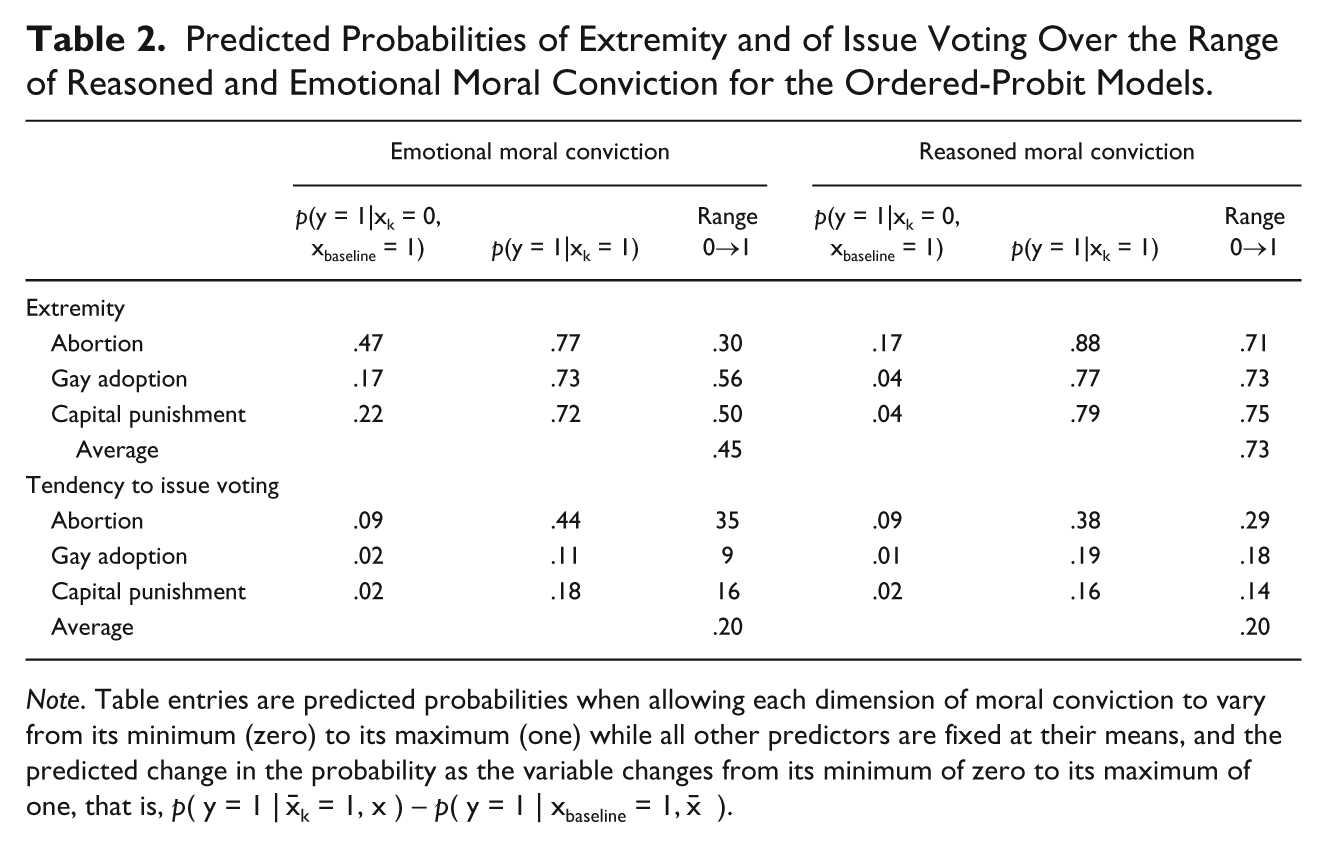
Note. Table entries are predicted probabilities when allowing each dimension of moral conviction to vary from its minimum (zero) to its maximum (one) while all other predictors are fixed at their means, and the predicted change in the probability as the variable changes from its minimum of zero to its maximum of one, that is, p( y = 1 |
First, reasoned and emotional moral conviction both significantly increased attitude extremity on all three issues tested, holding all else constant. Ceteris paribus, moving from the minimum to the maximum of emotional moral conviction increased the predicted probability of holding an extreme position on either ideological side by 45% on average (30% for abortion, 56% for gay adoption, and 50% for capital punishment; see Table 2). Even more remarkably, reasoned moral conviction increased the predicted probability of attitude extremity by 73% on average, when moving from its minimum to its maximum (abortion: 71%; gay adoption: 73%; capital punishment: 75%), holding all else constant. When rerunning these three models with both components of moral conviction averaged, the combined index increased the predicted probability of attitude extremity by 77% on average, holding all else constant, when moving from minimal to maximal conviction (abortion: there is an 18% chance of holding an extreme attitude on abortion when moral conviction is at its minimum and 86% when it is at its maximum, z = 5.40; gay adoption: 2% vs. 81%, z = 6.56; capital punishment: 3% vs. 88%, z = 7.51).
Second, holding all else constant, the tendency to issue voting was far more likely as both dimensions of moral conviction increased. Emotional moral conviction increased the predicted probability of viewing a candidate’s position on a specific political issue as crucial when deciding how to vote in an election by about 20% on average, when moving from its minimum to its maximum (abortion: 35%; gay adoption: 9%; capital punishment: 16%). Reasoned moral conviction increased the predicted probability of issue voting by 20% on average as well, when moving from its minimum to its maximum (abortion: 29%; gay adoption: 18%; capital punishment: 14%). When combined, the two classes of moral conviction increased the predicted probability of viewing a candidate’s view on a political issue as extremely important in voting by 28% on average, when moving from its minimum to its maximum (abortion: 1% vs. 48%, z = 4.63; gay adoption: 2% vs. 14%, z = 4.31; capital punishment: 1% vs. 25%, z = 5.63).
Next, sentimental conviction increased intentional participation by about 9% of its range on average 7 (abortion: 13%; gay adoption: 6%; capital punishment: 7%), such that, ceteris paribus, participants were more likely to try to persuade people to change their minds on this particular issue, volunteer for an organization that is dealing with it, or write a letter or post a comment online about this issue to the extent that they were more morally convinced about the issue. Similarly, reasoned moral conviction increased issue-based political participation on the issues of abortion and capital punishment (abortion: 9%; gay adoption: 6%; capital punishment: 13%), such that participants reported more political activity for the issues of abortion and capital punishment to the extent that they categorized the issue in their moral domain, holding all else constant. Combined, the two dimensions increased issue-based participation by 17% of its range on average (abortion: 22%, t = 4.34; gay adoption: 12%, t = 2.79; capital punishment: 18%, t = 5.27), all else equal.
To test the robustness of these results, the models were respecified with ideology and party identification integrated in their folded form, which indicates nondirectional ideological and partisan extremity, and moral conviction averaged across the two types. Coded this way, ideological extremity showed a significant positive effect on extremity for the issues of abortion and gay adoption, on participation for the issue of abortion alone, and on issue voting intentions for the issues of abortion and capital punishment. However, partisan extremity still held no significant effects in these models, and moral conviction retained its significant effects and showed much bigger coefficients than folded ideology.
Moderation by the Level of Political Knowledge and the Direction of One’s Opinion
Next, interactions of each of the two measures of moral conviction with ideological direction (a dummy in which 0 = opposition and 1 = support for the issue) were integrated into the models. Overall, the effect of moral conviction was not ideologically asymmetrical, with the effect of neither dimension of moral conviction systematically interacting with the attitude’s direction. There were only three exceptions out of the eighteen specified interactive terms.
To test the view that the application of moral conviction is contingent on political sophistication, each of the two dimensions of moral conviction was interacted with political knowledge. Only two of these eighteen interactive terms reached statistical significance.
Mediation by Attitude Strength
It was hypothesized that the effect of moral conviction on participation, extremity, and issue voting is at least partly mediated by attitude strength (H2a, H3a), such that increased moral conviction leads to increased perceived importance of the issue and to higher certainty in the attitude, and in turn, it is this attitude strength that induces increased involvement and extremity. This was tested using a mediation analysis and Sobel tests, 8 estimating the extent to which the effect of moral conviction (averaged across its components) could be attributed to attitude strength. First, as the bottom row of Table 1 shows, the effect of moral conviction on participation was significantly mediated by attitude strength on abortion (28%) and capital punishment (21%), but not on gay adoption. Next, to determine the extent to which attitude strength mediated the effect of moral conviction in the ordered probit models, where the Sobel test could not be performed, I calculated the mediation analysis manually. 9 This calculation shows that moral conviction lost an average of 56% from its effect on the likelihood of issue voting when attitude strength was included in the model (abortion: 37%, gay adoption: 64%; capital punishment: 66%). The same procedure indicates that the effect of moral conviction on extremity was mediated by attitude strength for all three issues (25%, 28%, and 29%, respectively).
Robust analysis: reverse causation
Does moral conviction affect one’s attitude strength, or is it the other way around? There are two major ways of confronting such endogeneity concerns: theoretically and empirically. First, according to the theory presented here, causality should mostly flow from moral conviction to political attitudes, as certainty in an attitude is a symptom of a low variance and univalenced distribution of considerations on the issue, and its importance results from the object’s intimate relations with one’s identity. Additionally, the assumption that political attitudes are subordinate to morality is based on a developmental line of research indicating that political attitudes develop at a much older age than moral judgment. Toddlers readily express emotions like disgust and anger, and are known to apply domain theory’s formal characteristics from the age of three (Smetana, 1981), whereas forming political opinions requires a comprehension of abstract concepts such as nationality, institutions, and laws that develop much later (Piaget & Weil, 1951; Torney-Purta, 1990).
Still, I use the statistical solution of two-stage-least-squares (2SLS) to empirically test this option. Using 2SLS necessitates an instrumental variable that explains moral conviction, but at the same time is properly excluded from the original model explaining the political attitude (Bartels, 1991). If when we substitute this new predicted variable for the original morality variable, the effect on the political attitude still emerges, it will alleviate the endogeneity concern and strengthen the confidence in the ordinary least squares (OLS) results.
More often than not, good instruments are very difficult to come by, as any variable that is correlated with moral conviction can also be expected to be correlated with the attitude on which it is held. Fortunately, I have previously collected an experimental database comparing priming for disgust and harm with a control of no-prime (see Ben-Nun Bloom, 2013), which makes for a perfect instrumental variable with which to test for a reversed causality of moral conviction and political attitudes. In this experiment, participants were randomly assigned to one of three conditions (disgust prime; harm prime; control) X 2 political issues (regulation of Internet porn and intervention in Darfur). Disgust was induced by an essay on disgusting food delicacies, such as Vietnamese raw blood soup, accompanied by vivid pictures of each dish. Harm was manipulated by an essay on first aid treatment in the case of serious harm, and presenting pictures of dummies receiving treatments such as CPR. No manipulation was presented in the control condition. This manipulation was found to successfully and significantly affect moral conviction, while the attitudes and attitude strength questions were undoubtedly not affected by it because they were measured before it was presented. OLS and 2SLS estimates of the effect of moral conviction (averaged over the two classes) alongside controls for political attitude and attitude strength are presented in Table 3. 10
Moral Conviction and Political Attitudes—2SLS vs. OLS.
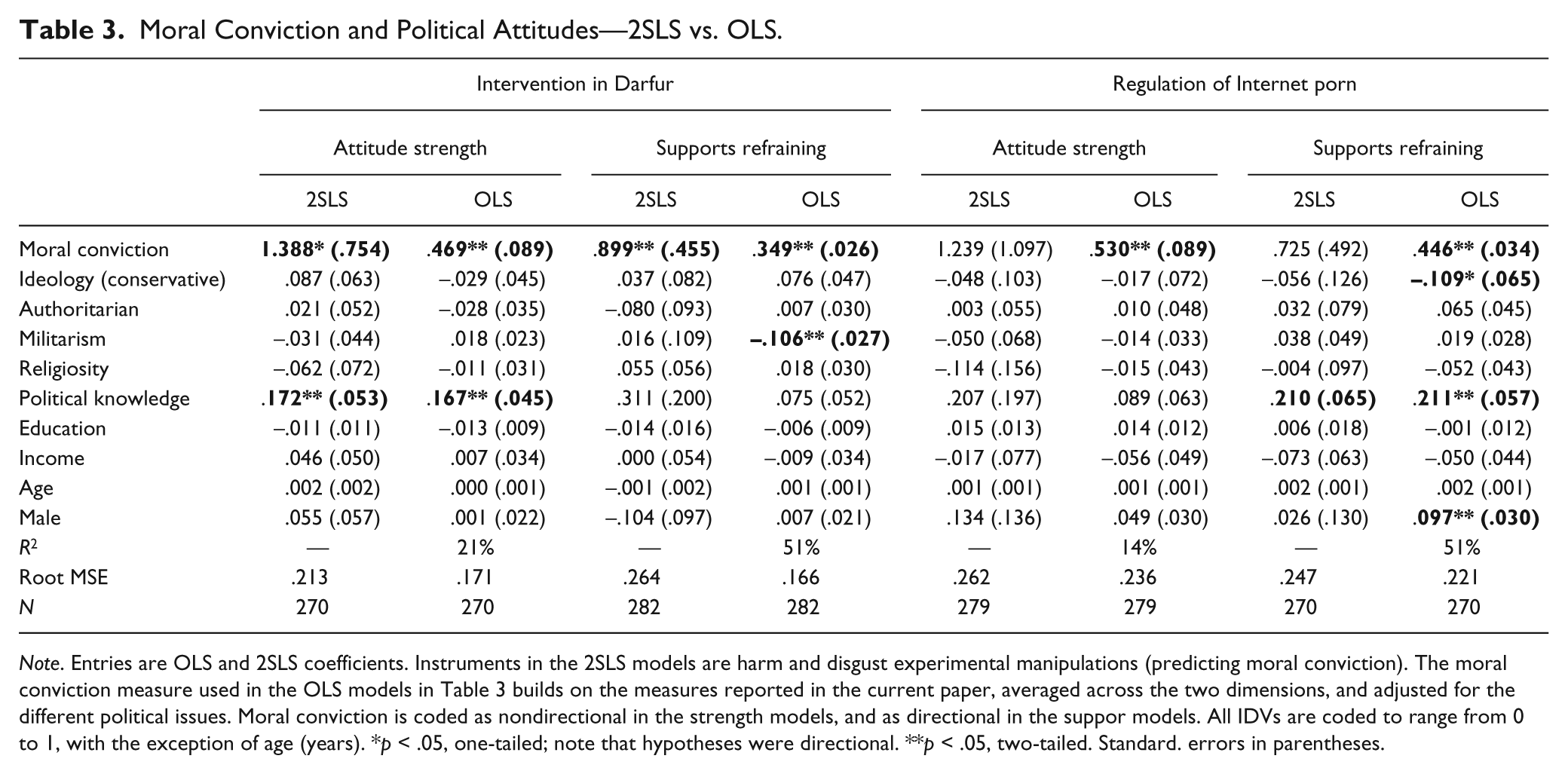
Note. Entries are OLS and 2SLS coefficients. Instruments in the 2SLS models are harm and disgust experimental manipulations (predicting moral conviction). The moral conviction measure used in the OLS models in Table 3 builds on the measures reported in the current paper, averaged across the two dimensions, and adjusted for the different political issues. Moral conviction is coded as nondirectional in the strength models, and as directional in the suppor models. All IDVs are coded to range from 0 to 1, with the exception of age (years). *p < .05, one-tailed; note that hypotheses were directional. **p < .05, two-tailed. Standard. errors in parentheses.
Although ideal in other respects, the instrumental variables in these models, as is always the case with instruments, do not perfectly explain the right hand side endogenous variable, and thus introduce noise into the primary equation, which considerably increases the standard errors, and makes it difficult to reject the null. Indeed, a comparison of the standard errors produced by OLS and 2SLS indicate that the latter are 13 times larger on average. Despite considerably larger errors, moral conviction shows effects in the right direction in all four models, and in the case of the issue of intervention in Darfur, its effects are statistically significant.
Starting with attitude strength, both 2SLS and OLS show that moral conviction significantly increases attitude strength regarding intervention in Darfur. Similarly, moral conviction increases attitude strength concerning Internet porn regulation, but was only significant via OLS (note that while the 2SLS coefficient is twice as large as the coefficient produced by OLS, the standard errors in 2SLS are 12 times as large, making it harder to reject the null hypothesis).
In the models estimating the effect of moral conviction on the actual attitude on these issues, the morality measure was altered to capture the direction of one’s conviction (which was irrelevant in the models tapping attitude strength). In this directional version of the measure, subjects received a −1 when opposed to the practice and a 1 when supporting it, consistent with the coding for the dependent variable, based on their response to the items used for branching.
For the issue of intervention in Darfur, both 2SLS and OLS showed that increasing moral conviction toward support for refraining from intervention significantly increased one’s support for intervention. The same relationship held for the issue of porn regulation as well, except that it was significant only for the OLS estimates (note that while the 2SLS coefficient is larger than the OLS coefficient by a factor of 1.6, the standard errors in 2SLS are 14 times larger).
Next, a Hausman test was performed to determine whether the differences between the two models are large enough to suggest that the OLS estimates are inconsistent due to endogeneity. Its null indicates that the OLS estimator is consistent, and a rejection of the null implies that there are considerable effects from an endogenous regressor, and thus estimation by 2SLS is needed.
For the issue of intervention in Darfur, the Hausman test yields a marginally significant chi-square for the political attitude, χ2 = 3.66; p(χ2) = .056, and a significant chi-square for attitude strength, χ2 = 13.01; p(χ2) = .002, which leads to the rejection of the null and to the conclusion that some reversed causation occurs in the model, and that we should rely on the 2SLS coefficients. Note however, that the 2SLS coefficients in this case replicate the significant results from OLS.
However, for porn regulation, the Hausman test yields an insignificant chi-square both for the political attitude, χ2 = .39; p(χ2) = .531, and for attitude strength, χ2 = .51; p(χ2) = .475, suggesting that the null of no endogeneity cannot be rejected, and that OLS is a consistent estimator when it comes to reversed causality. Thus, statistical results overall show that even when controlling for reverse causality, moral conviction still significantly affects both political attitudes and attitude strength.
Conclusions
The most complex human cognitions, which even the most sophisticated computers are unable to imitate, are often the simplest and least effortful for people to engage in. Moral conviction is a wonderful example of such a task. A person can decide almost instantly that some political practice he or she heard about a couple of minutes ago, like a bloody war in a distant country or researchers using stem cells, is just wrong. According to the adaptationist framework, which suggests that natural selection has designed organisms to solve problems they faced throughout the history of the species (Tooby & Cosmides, 1992), the reason that complex tasks like moral conviction, recognizing gender, or using grammar are so easily engaged in is that they serve greater evolutionary goals.
How is the moral state of mind manifested in political attitudes? This is the main question that this study has attempted to answer. The results support the theory of the moral compass, and show that both dimensions of moral conviction are related to increased involvement, extremity, and attitude strength. This is the case for both the knowledgeable and the unsophisticated and for both supporters and opponents, holding constant a host of political principles, partisanship, values, personality traits, and demographics, suggesting that moral mechanisms are available to all, regardless of specific ideology or skills. This conclusion is at odds with both Converse’s nonattitude outlook and the rational choice homo economicus perspective.
One of the main findings of this paper is that reasoned and emotional moral conviction both have unique effects on political behavior. This result leads to the conclusion that the Kantian and Humean views of morality are complementary rather than in conflict.
In addition, the comparison of the effects of the reasoned and cognitive dimensions raises some interesting practical implications and directions for future research. In step with recent research on morality that tends to stress its emotional nature (e.g., Haidt, 2001, 2012), emotional content plays an increasingly important role both in political campaigns, with about three quarters of American campaign ads strongly appealing to emotions (Brader, 2006), and in political media coverage, manifested in a focus on the emotional aspects of private lives of politicians at the expense of more cognitive contents, such as principles and political parties (Meyer, 2002). This use of emotions by media and politicians is done with the hope of increasing public attention and message convincingness. However, results from the current study suggest that the role of moral reasoning should not be understated. Even with the emotional dimension held constant, cognitive moral conviction prevails, and in the case of attitude strength, tendency to issue voting and extremity even exhibits a stronger explanatory power than its emotional counterpart.
Following these results, future research in political persuasion can test the extent to which cognitive moral appeals outperform emotional moral appeals under some circumstances. For instance, the literature demonstrates that persuasive ads induce more attitude change when their arguments match the affective or cognitive basis of the recipient’s attitude toward the issue (Fabrigar & Petty, 1999; Maio & Haddock, 2007), suggesting that the efficiency of moral rhetoric may loom large when tailored to match the moral basis of a specific issue public. In addition, people and groups systematically differ in need for affect and cognition, such that they may be chronically more vulnerable to moral persuasion relying on either emotional or reasoned moral content (Haddock, Maio, Arnold, & Huskinson, 2008). Still, future research is needed to directly test the effectiveness of messages based on the two moral dimensions (see also Ben-Nun Bloom & Levitan, 2011).
Next, differentiating between the two dimensions of moral conviction is beneficial also since moral emotions allow explaining fluctuations in public opinion, such as the increase in support for legal abortion in the weeks following the January 1973 Roe v. Wade Supreme Court ruling (e.g., Hanley, Salamone, & Wright, 2012). 11
Overall, both dimensions have strong advantages for politics, encouraging involvement, and at the same time are disadvantageous, as they breed extremity. Yet, neither political participation nor political moderation is completely normatively good; nor are their inverses entirely normatively bad, for citizens in a democracy. The morally motivated action tendency and radicalism may result in suicide terrorism and political assassinations, and lead to a polarized, antagonistic, and discriminatory social climate (Skitka & Morgan, 2009). Still, at the other extreme of low conviction are found disenchantment with the public sphere, political and social alienation, and voter fatigue. This is exactly why moral conviction is so fascinating to study in a political framework: normatively good or bad, strong conviction integrates other-regarding motivations into individual payoffs, links individuals to the social world, and relates them to something larger than themselves—and this is what political behavior is all about.
Footnotes
Appendix
Measures and Descriptive Statistics.
| Item No. | Question wording |
|---|---|
| Moral conviction measures | |
| Reasoned moral conviction | |
| Items: 1 | Act evaluation: In general, would you say [practice] is alright, somewhat alright, somewhat not alright, or not alright? (4-point scale). |
| 2 | Contingency on common practice in the United States: Suppose that [practice] were [common/uncommon] in the United States, would it definitely be alright [to engage in act] in this country, mostly alright, mostly not alright, or definitely not alright? |
| 3 | Legal status in the United States: Do you think that there should or should not be a law that [prohibits/ allows practice] in this country? |
| 4 | Legal contingency: Suppose there were a law [allowing/prohibiting practice]. Do you think it would be definitely alright [to engage in act] if there were a law prohibiting it, mostly alright, mostly not alright, or definitely not alright? |
| 5 | Contingency on common practice in another country: Suppose that there were another country where [practice] is very [common/uncommon]. In this country, do you think it would be definitely alright [to engage in act], mostly alright, mostly not alright, or definitely not alright? |
| 6 | Legal status in another country: Do you think that ALL countries should definitely pass a law [allowing/prohibiting practice], probably, probably not, or definitely not pass a law? |
| Scale | Measures were adapted from Turiel et al. (1991). The measure was composed of answers to Items 2 to 6, which were branched by the responses to item 1. Participants answering that a certain political practice is alright or somewhat alright were asked about their response to a situation where it is generally unaccepted or legally prohibited, whereas participants viewing the practice as somewhat not alright or not alright were asked about a situation where it is commonly accepted or legally allowed. Participants who voluntarily answered “don’t know” or refused the branching question, were randomly branched to one of the two sets of questions. Participants got a 0 or a 1/3, respectively, for each time they shifted their answer from their original attitude to “definitely” or “mostly”—and 2/3 or 1 in absolute value if they kept their initial attitude. This yielded a 20-point scale, 1 being high on reasoned moral conviction, holding constant the attitude’s direction. Abortion = .62, sA = .31, α = .70; Gay adoption = .61, sGA = .26, α = .64; Capital punishment = .58, sCP = .26, α = .69. |
| Correlations with emotional moral conviction: rA = .32; rGA = .38; rCP = .37, p < .05 for all. | |
| Sentimental moral conviction | |
| Items: 1-2 | Self-directed: Imagine that you work in [relevant job], and as part of your job [have to engage in act/ have to refuse performing the act]. How ashamed would this make you feel? How guilty? (5-point scale from extremely to not at all). α = .62. |
| 3-4 | Other-directed: Imagine that someone you know who works in a [relevant job] regularly [engages in act/ refuses to perform act]. How angry? How disgusted? α = .68. |
| 5 | Third-party directed: Imagine another country in which [relevant population] [frequently engages in act/ always refuses to perform act]. How disgusted would this make you feel? |
| Scale | Participants answering that a certain political practice is alright or somewhat alright were asked about their response to a situation where it is not allowed or they are forced to deny it, whereas participants viewing the practice as somewhat not alright or not alright were asked about a situation where it is allowed or they are forced to engage in it (e.g., “How guilty would [hosting a thriving pornographic website, while refraining from any regulation or monitoring/ censoring a pornographic website hosted in your portal], make you feel?”). A Likert scale was composed of the relevant items, and was then coded to vary between 0 and 1, 1 being high on emotional moral conviction, holding constant the attitude’s direction. |
| Dependent variables measures | |
| Attitude strength | An index averaging certainty (“how certain are you of your views on [issue]?” 5-point scale, from not at all certain to extremely certain) and importance (“how important is [issue] to you compared to the way you feel about other social and political issues?” 5-point scale, from not at all important to extremely important). |
| Extremity | To what extent do you favor or oppose [issue]? Originally varying from 1 (strongly oppose) to 7 (strongly favor), and folded such that 1 and 7 indicate high extremity (coded 1), 2 and 6 are coded 0.666, 3 and 5 are coded 0.333, and 4 indicates low extremity (coded 0). |
| Political participation | A series of three 4-point scale questions: Do you ever try to convince people to change their attitude on [issue]?; In the last 12 months, did you ever write a letter or a comment regarding [issue] to the newspaper, to a website on the internet, or to a politician or other official?; In the past two years, have you volunteered for any institution that deals with [issue]? (Often; Sometimes; Rarely; Never). |
| Tendency to issue voting | How important is a candidate’s position on [issue] in deciding how you vote in an election? 5-point scale, from not at all to extremely important. XA = .56, s = .32; |
| Controls | |
| Ideology | In general, when it comes to politics, do you consider yourself…? From extremely liberal to extremely conservative, 7-point scale, |
| Social conservatism | Four items adapted from Conover and Feldman (1981): “Society should be more accepting of people whose appearance or values are very different from most,” reversed; “This country would be better off if there were more emphasis on traditional family ties,” |
| Party Id. | Generally speaking, do you usually think of yourself as a…? from strong Republican to a strong Democrat, reversed, 7 point scale, |
| Feminism | Two items adapted from Morgan (1996): Men have too much influence in American politics compared to women, reversed, |
| Authoritarianism | Three items adapted from Feldman and Stenner (1997): For example, “Would you say that it is more important for a child to be independent or respectful of their elders?” |
| Openness to experience | Three items adapted from Buchanan et al. (2005): For example, “I enjoy hearing new ideas,” |
| Empathy | Three items adapted from Caruso and Mayer (1998), for example, “Seeing other people smile makes me smile,” |
| Disgust sensitivity | Three items adapted from the Revised Disgust Scale (see Haidt, McCauley, & Rozin, 1994; Olatunji et al., 2007), for example, “How disgusting would you find each of the following experiences?” For example, “Your friend’s cat dies, and you have to pick up the dead body with your bare hands.” |
| Religiosity | How often do you attend religious services, apart from occasional weddings, funerals, and other important ceremonies? 6-point scale, from never to more than once a week, |
| Knowledge | Four multiple choice items scale, for example, “Who is the president of Russia?” α = .59, |
| Demographics | Age (in years), |
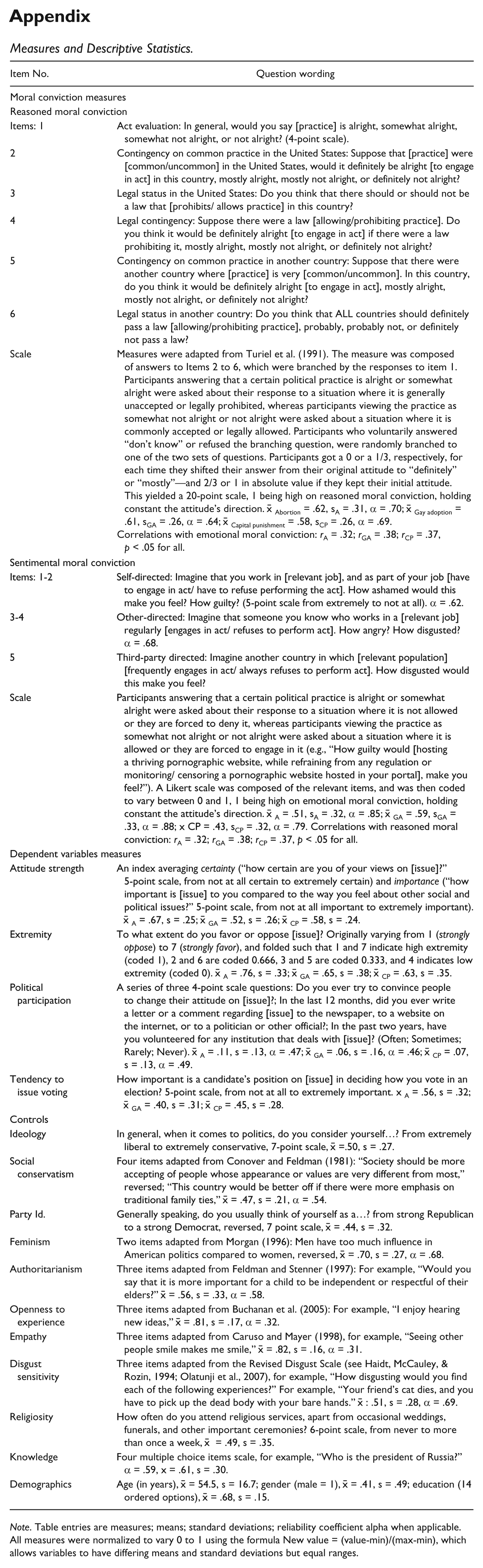
Note. Table entries are measures; means; standard deviations; reliability coefficient alpha when applicable. All measures were normalized to vary 0 to 1 using the formula New value = (value-min)/(max-min), which allows variables to have differing means and standard deviations but equal ranges.
Acknowledgements
For invaluable advice and support at different stages of the project, I am grateful to Stanley Feldman, Leonie Huddy, Howard Lavine and Linda Skitka. I also greatly benefited from comments on early versions of the article from seminar participants at Stony Brook University, University of California-Merced, Hebrew University of Jerusalem, Tel Aviv University, IDC-Herzliya, Haifa University, the journal’s editor, and anonymous reviewers. I thank Bryan Lew for superb research assistance. All remaining errors are my own.
Declaration of Conflicting Interests
The author(s) declared no potential conflicts of interest with respect to the research, authorship, and/or publication of this article.
Funding
The author(s) disclosed receipt of the following financial support for the research, authorship, and/ or publication of this article: I gratefully acknowledge the generous financial support from the National Science Foundation (NSF Grant No. 0917998) and the Marie Curie Grant of the 7th European Community Framework Programme (CIG Grant No. 293769).