




Abstract
How do campaigns decide what issues to emphasize for voters? According to most studies, campaigns rely on factors outside of their control—issue salience, party issue ownership, and district ideology. In this article, I argue that campaign messages are designed primarily based on the candidate. I examine the issue content of campaign advertisements from U.S. House and Senate campaigns from 2000 to 2004 and develop a measure that determines if candidates have developed a reputation on a particular issue. When candidates have developed such a reputation, their campaign is more likely to highlight that issue to voters than campaigns whose candidate has not developed such a reputation. This relationship is consistent across most issues and across two different measures of a campaign’s issue agenda.
Campaigns “win votes by emphasizing issues where they perceive an advantage, thereby making these issues prominent in voters’ minds” (Sides, 2006, p. 47). Campaigns seek to identify advantageous issues—usually those issues where the views of their candidates and those of the electorate are well-aligned—and make them the basis for voters’ decisions. As such, campaigns become battles to control the issue agenda and make it favorable toward one’s candidate. John Petrocik (1995) postulates that campaigns do this by emphasizing “owned” issues. Owned issues are those on which the public believes that their candidate can handle better than the opponent. Scholars usually focus on issue ownership by political parties. The two major American political parties hold long-standing advantages in the minds of voters on particular sets of issues. Campaigns should therefore emphasize the issues their party “owns” in the minds of voters.
In this article, I examine a different type of issue ownership. Candidates can “own” issues because of the reputation a candidate develops by working on a particular issue. Political campaigns develop their issue agenda first by looking inward, at the strengths and weaknesses of their own candidate. Campaigns then identify and highlight the issues that compliment the strengths of their candidate and eschew those that emphasize their candidate’s weaknesses. Campaigns want to connect their candidate’s personal credibility to the issue that concern voters. If a candidate has passed a bill, has served on a legislative committee, or has a particular experience in the private sector, the candidate can “own” the issues that match with that past service. Voters will find candidates’ statements on such an issue more credible, and, as a result, their campaign should want to highlight that issue.
I develop a measure of a candidate’s issue reputation and incorporate this measure into a model of issue agendas. When candidates have developed a positive reputation on a particular issue, their campaigns are more likely to highlight that issue than campaigns whose candidate has not developed such a reputation. This positive relationship is consistent across a broad array of issues and is robust to two different measurements of a campaign’s issue agenda. The effect can also be significant; on some issues, campaigns are twice as likely to discuss an issue when their candidate has developed a positive reputation on that issue.
An important democratic function of elections is to present issues to the voting public. Elections provide an avenue for parties and candidates to present new ideas and critiques of extant policies to the public as well as a method for voters to choose between these policy views. Elections are also contests between particular individuals, with their own idiosyncratic mix of strengths and weaknesses. The results presented here show that these two elements of elections are more intimately connected than previously assumed. The issue agendas of political campaigns and the individual characteristics and reputations of particular candidates are complementary. While candidates of the same party hold advantages on party-owned issues, they can have vastly different personal reputations and, thus, different issue advantages.
In addition, these results demonstrate the importance of candidates themselves in determining what campaigns say to voters. Previous studies of campaign issue agendas have not focused on candidate reputation, or any candidate-centered variables, and have instead focused on exogenous factors, such as district ideology and the national issue agenda. These exogenous factors play important agenda setting roles, but the ability of candidates to convey messages on national issues is not equally distributed across all members of a party. Endogenous factors, such as issue reputation, help determine how effective candidates will be in conveying a message to voters. Thus, issue agendas are larger than presumed by current models of political science and our models need to expand to account for exogenous explanations in addition to endogenous ones.
The Origins of Issue Agendas
Political campaigns seek to shape electoral choice by manipulating the issue agenda. William Riker (1983, p. 60) defines such actions as herestethics, arguing that “[t]he point of an heresthetical act is to structure the situation so that the actor wins, regardless of whether or not the other participants are persuaded” (see also Riker, 1986, 1996). Rather than “trying to figure out what positions to take, then, political campaigns are turned into contests about what the issue dimensions of the campaign will be” (Hammonds & Humes, 1993, p. 142).
Herestethics, in Riker’s formulation, stand in contrast to two more common theories of campaign strategy: convergence and persuasion. Convergence follows the prediction of the median voter theorem (Downs, 1957)—candidates will shift their positions to approach those of the median voter. Shifting positions though can be quite costly for campaigns; candidates who shift their positions lose credibility among voters. Persuasion is the attempt to convince voters to support a candidate’s extant issue positions. Persuasion though fits poorly with psychological theories of information processing. Voters can filter out information with which they disagree (cf. Festinger, 1957) or process information to confirm with their preexisting attitudes (cf. Fiske & Taylor, 1991). Under both circumstances, voters resist persuasion attempts by political campaigns.
I argue that campaigns use a herestetical perspective to develop their message strategy and do so by highlighting favorable issues and make them the basis for voters’ decisions. Political scientists have noted the effectiveness of this strategy from the earliest studies of political behavior. In Voting, Berelson, Lazarsfeld, and McPhee (1954) argue that “[i]t is difficult to change people’s preferences; it is easier to affect the priorities and weights they give to subpreferences bearing on the central decision” (p. 206).
The most detailed explanation for how campaigns can beneficially affect the priorities and weights that voters give to their subpreferences is the theory of issue ownership. John Petrocik (1996) argues that the “critical difference among elections . . . is the problem concerns of the voters not their policy attitudes” (p. 826). Issue ownership theory holds that campaigns have an “effect when a candidate successfully frames the vote choice as a decision to be made in terms of problems facing the country that he is better able to ‘handle’ than his opponent” (p. 826). In Petrocik’s model, campaigns should highlight issues on which their candidate has a handling advantage over their opponent. How do these handling advantages originate? Petrocik posits that they come from two sources: “[o]wnership of problems is conferred by the record of the incumbent and the constituencies of the parties” (p. 827).
Most scholars identify issue ownership theory with the second in Petrocik’s two sources—political parties. Both American political parties have long-standing reputations among voters for being better able to handle particular problems better than the opposing party. Petrocik, as noted, argues that these party advantages originate in the constituencies of each party. But Petrocik identifies another source of issue ownership first—the record of a candidate. Candidates can own issues based on their actions in office and the reputation they develop for action on that issue. These reputations are attached to individual candidates and created by their own action and not exogenously created by the actions of their political party.
Riker (1996, p. 106) argues that “when one side has an advantage on an issue, the other side ignores it,” which he identifies as “the Dominance Principle.” Thus the theoretical prediction of the theory of issue ownership is that campaigns should focus on issues where they have a handling advantage and ignore all others. From a partisan standpoint, Democratic campaigns should focus on Democratic-owned issues (e.g., social welfare issues, the environment, civil rights, etc.) and ignore Republican-owned ones (e.g., defense, taxes, crime, etc.). Conversely, Republicans should focus on their owned issues and ignore Democratic issues. Empirical tests of have produced mixed findings as to whether campaigns are more likely to highlight issues on which their party has a handling advantage. Some studies show an effect (Brasher, 2003; Budge & Farlie, 1983; Kahn & Kenney, 1999; Spiliotes & Vavreck, 2002; Sulkin & Evans, 2006), while other works find little to no effect (Damore, 2004, 2005; Kaplan, Park, & Ridout, 2006; Sigelman & Buell, 2004). Sides (2006) finds middle ground in this debate. He finds that while campaigns are willing to trespass on issues owned by the opposite party, they do so on their own terms, by framing their rhetoric on those issues around larger themes of their party.
As noted, campaigns can also own an issue based on the reputation their candidate has earned on that issue. Yet, with the notable exception of Sides (2006), none of these studies of issue ownership includes a candidate’s reputation as a variable that influences the issue agenda of a campaign. 1 That these studies have not examined candidate reputation stands in contrast to findings that show the importance of candidates themselves and their reputation to campaign message strategy. Presidential campaigns make “experience images”—which focus on past jobs, political positions, or accomplishments—the most commonly used personal trait in television advertisements (McDermott, 1999; Shyles, 1984). Campaigns discuss their candidate’s biography, private sector experience, or record in elected office in the vast majority of advertisements (Arbour, 2007). Providing information about a candidate’s background and reputation is not only a common campaign tactic but is also quite an effective one. Even the appearance of a candidate’s occupational title on a ballot helps to win votes (McDermott, 2005).
Sellers (1998) provides the most detailed analysis of the role that a candidate’s reputation plays in campaigns. He finds that messages are more effective if they emphasize issues on which candidates have a reputation that appears favorable to voters. Or as he puts it, “[c]andidates win more favorable evaluations if they focus on their records” (p. 170). Campaigns messages are less successful when they focus on issues on which a candidate has not developed such a positive feeling among voters. Thus what research has been done on the role of candidates in campaign message strategy finds that campaigns benefit when they focus on issues on which their candidate has developed a positive reputation.
In addition, members of Congress are well known for their efforts at “claiming credit” in their district for the actions of the whole body (Mayhew, 1973). These efforts are designed to enhance the reputation of a particular member in their efforts as “single-minded seekers of reelection.” In addition, members of Congress develop a “home style” that melds their personality with their view of the constituents of their district. This also works to create a positive reputation for them, which should redound to their electoral benefit (Fenno, 1978). Of course, congressional elections are often held in low-information environments, in which the average voter has sparse knowledge, at best, of the candidates and their issue priorities. Candidate reputations would develop from news coverage of their work on particular issues. Thus, turning the focus during the campaign to issues in which the candidate has developed a positive reputation before the campaign allows campaigns to try to connect the small bits of information voters have about their candidate.
A candidate’s reputation has an important effect on a voter’s perceptions of a candidate because of the importance of credibility. Candidates with a positive reputation on an issue should have more credibility to discuss that issue. When a respondent finds the source of a communication to be credible, the source’s message is more persuasive (Hovland, Janis, & Kelley, 1953; Hovland & Weiss, 1951-1952; McGuire, 1968). Source credibility theory suggests that the source of a communication has an important effect on a respondent’s willingness to accept a message. Thus political campaigns should identify issues where their candidate is most credible to voters. 2 Naturally, one source of credibility available to candidates is the reputation their party has earned over time (Iyengar & Valentino, 2000). A party’s reputation can even affect the trait characteristics voters associate with a candidate (Hayes, 2005). But just as important, if not more so, are the individual components of credibility for a candidate. Voters are examining individual candidates, not parties, when voting. The credibility a candidate earned through his or her own work on a particular issue is more proximate to this decision than the credibility of a candidate’s entire party.
That credibility is so important to the standing of candidates that meets with the thoughts and ideas of campaign professionals. Media consultants and campaign managers want to show voters “who their candidate is.” Doing so can help a candidate’s credibility and likeability. Stories about the candidate, which can feature information from the personal background or the political record of the candidate, are an effective way to woo voters. The architects of campaign messages then want to connect these stories about candidates to a particular issue and policy agenda. When the stories about the candidate match well with issues of a campaign, consultants find their messages most effective. When the match between reputation and issues is tenuous, the messages are less successful (Arbour, 2007).
A candidate’s reputation on an issue would enhance his or her credibility with voters for three reasons. First, a “candidate’s record may indicate that she has developed extensive expertise on a particular issue” (Sellers, 1998, p. 160). By highlighting an issue on which their candidate has a positive reputation, campaigns hope to increase voters’ trust that their candidate will be able to solve problems if elected. Second, issues that tap into a candidate’s reputation on an issue help demonstrate “a history of commitment to a particular issue and position” (Sellers, 1998, p. 160). In other words, focusing on issues on which a candidate has already developed a positive reputation allows a campaign to focus on favorable ground. Samuel Popkin (1994) explains why improving a candidate’s sincerity is important for political campaign.
When voters watch a candidate perform on television, making promises and taking hard-line rhetorical positions on issues, they question if there is congruence between avowal and actual feelings—whether the candidate’s support for a cause represents a genuine personal commitment or only a campaign tactic . . . When voters estimate a candidate’s preferences, they take account of sincerity—whether the candidate really cares about their concerns. (p. 65)
Third, campaigns are looking for ways to demonstrate their candidate’s sincerity to voters. Highlighting issues that candidates own based on their personal reputations provides a credible and effective method to do this.
I argue that a candidate’s reputation is an important influence on the issue agenda of political campaigns. When a candidate has a favorable reputation on an issue, his or her campaign will seek to highlight that issue to voters. I hypothesize that when a candidate lacks a favorable reputation on an issue, his or her campaign will be more likely to eschew such an issue. Furthermore, the effect of a candidate’s reputation will be robust controlling for the effect of a party’s issue handling advantage.
Measuring Issue Agendas and Candidate Reputations
To test my hypothesis, I need to determine the issue agendas of political campaigns as well as the issue reputations of candidates. To determine the issue agenda, I utilize television advertising data from the Wisconsin Advertising Project for general election U.S. House and Senate campaigns from 2000 to 2004 (Goldstein, Franz, & Ridout, 2002; Goldstein & Rivlin, 2005, 2007). The data, acquired from the TNSMI/Campaign Media Analysis Group (CMAG), tracks the satellite transmissions for broadcast channels for most of the country. 3 The system’s software differentiates advertisements from normal programming. The Wisconsin Advertising Project codes the first four issues that appear in each advertisement. They also count how many times an advertisement airs. 4
I limited the data set to include only advertisements produced by campaigns for use in the general election. Therefore, no primary election advertisements are included, 5 nor are advertisements produced by political parties or by interest groups or other independent expenditure groups. The data set includes 5,285 separate advertisements produced by 760 different campaigns and which aired 832,419 times over the course of the three elections.
The advertising data allow me to determine the issue agendas of the House and Senate campaigns under study. I use these data to create two separate measures of campaign issue agendas. The first is straightforward; I simply count the number of advertisements in which a particular issue is mentioned based on the Wisconsin Advertising Project coding. Table 1 shows the number of advertisements that mention each issue and the percentage of all ads that discuss that issue. The three rightmost columns show the percentage of ads that mention each issue for each election cycle. This shows the change in the issue agenda over the course of the three election cycles. 6
Campaign Issue Agendas; “One Issue at a Time” Measurement, U.S. House and Senate Campaigns, 2000-2004.
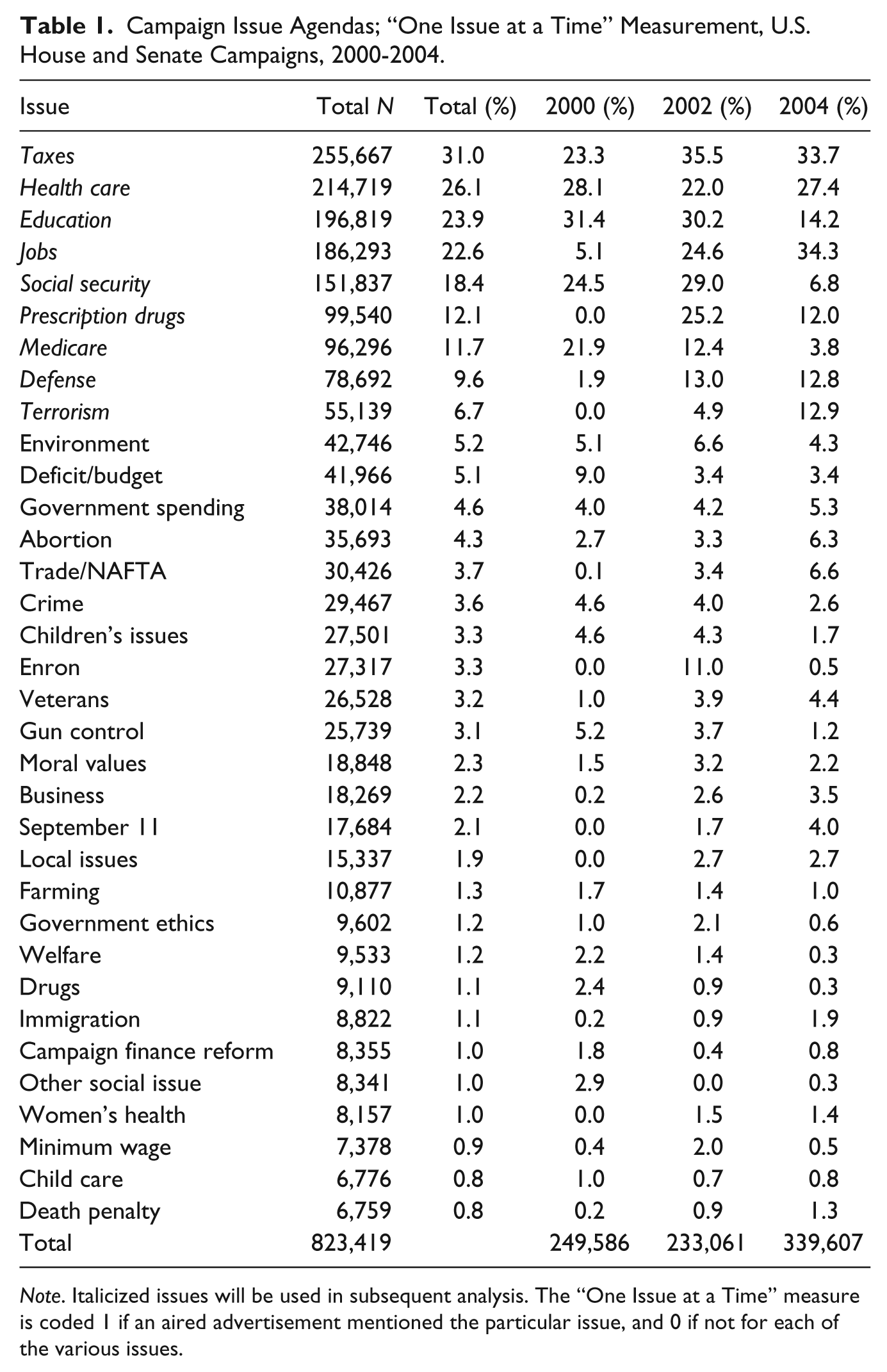
Note. Italicized issues will be used in subsequent analysis. The “One Issue at a Time” measure is coded 1 if an aired advertisement mentioned the particular issue, and 0 if not for each of the various issues.
The second measure of campaign issue agendas is similar to the one used by John Sides (2006) and tries to measure “issue time” for each specific campaign. I calculated the number of issues mentioned throughout a campaign’s general election broadcast advertising campaign and then calculated the number of times each specific issue was mentioned by a campaign. To determine “issue time,” I simply divided the number of specific issue mentions by the number of total issue mentions. The result is a proportion. 7
Why is a second measure of issue agendas necessary? A second measure addresses some potential flaws with a measure that simply counts issue appearances. Under the counting method, campaigns that air more advertisements are represented more frequently. Under the “issue time” measure, any systematic biases created by concentrating much of the data set into a particular set of campaigns are reduced. For example, Senate campaigns and campaigns in more competitive races air, on average, more advertisements (Kahn & Kenney, 1998). While there are no theoretical reasons to believe that these types of campaigns might or might not emphasize issues on which their candidate has a reputation, the “issue time” measure serves as a check on some unanticipated reason they would do so. The second reason to use another measure is to avoid “clustering” of variables. In multivariate analysis, many of the independent variables are at the campaign level and, thus, are at a different level than the advertising level dependent variable. While I try to account for this clustering in models that use the counting measure, the “issue time” measure provides a more robust check since it compares campaign-level variables to a campaign-level variable.
Table 2 shows the mean “issue time” across all campaigns. It also shows the mean for the issues for each year under study, again allowing for an examination of how the issue agenda changed over the three elections under study.
Campaign Issue Agendas; Mean “Issue Time” Measurement, U.S. House and Senate Campaigns, 2000-2004.
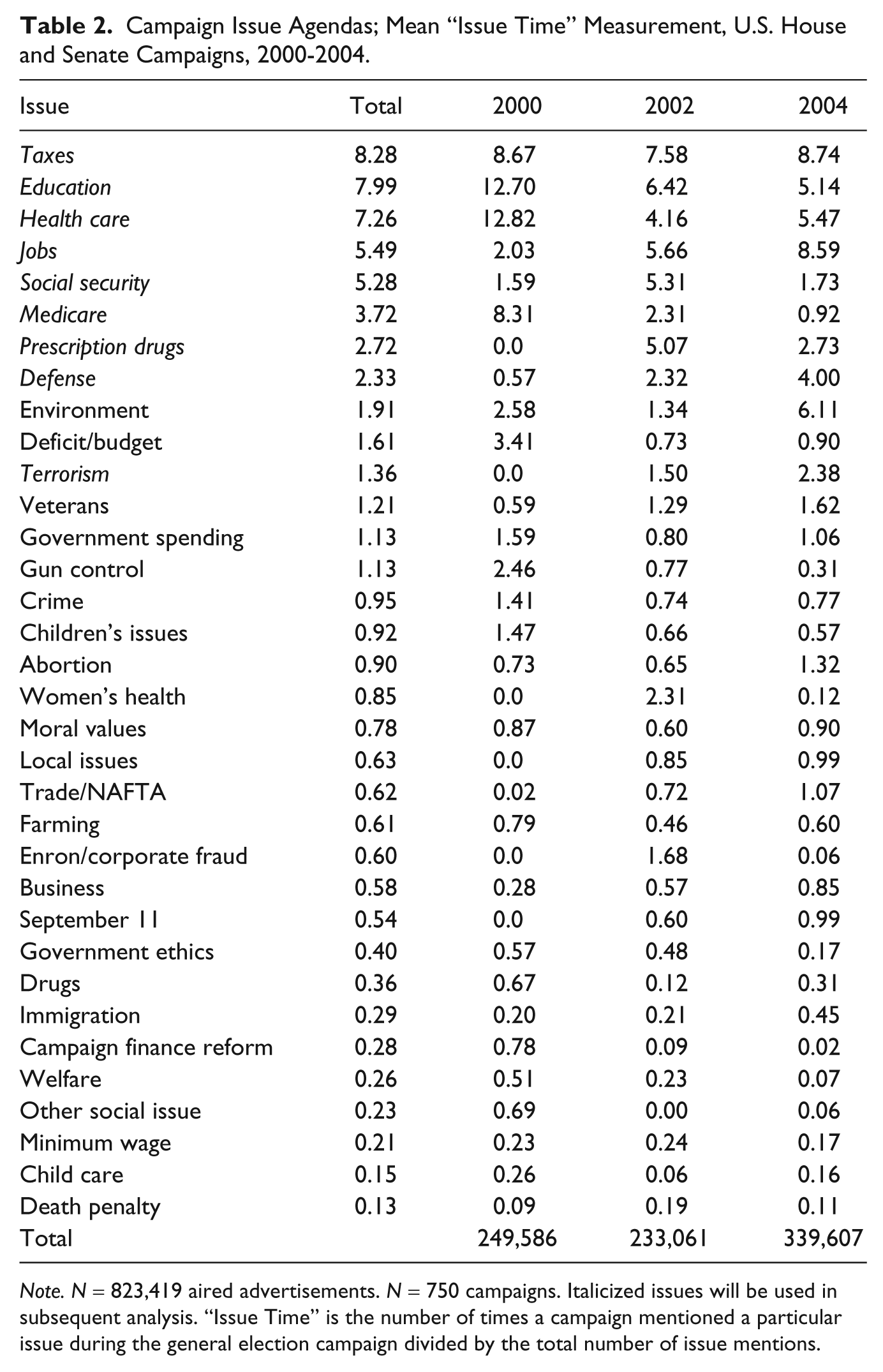
Note. N = 823,419 aired advertisements. N = 750 campaigns. Italicized issues will be used in subsequent analysis. “Issue Time” is the number of times a campaign mentioned a particular issue during the general election campaign divided by the total number of issue mentions.
Tables 1 and 2 show the diversity of the issue agenda, which is not surprising given the large number of candidates, campaigns, states, and districts in the data. At the top of the issue agenda across the three elections is Taxes, which was mentioned in more than 30% of the advertisements aired. The time measure shows that discussion of Taxes took up 8.28% of the issue space across the three elections. A series of domestic issues followed. Health Care was the second most mentioned issue, but Education took up the third most “issue time.” 8 Jobs and the Economy were the fourth most mentioned issues, discussed in 22.6% of all ads and taking up 5.49% of the issue time. The next most popular issues were Social Security, Prescription Drugs, and Medicare. Only after that do national security issues (Defense and Terrorism) come into play. I limit my subsequent analysis of issue agendas to these nine issues. They are the most common and are the only ones to be mentioned in over 6% of all advertisements. 9
Measuring Candidate Reputation
More difficult to measure is the reputation of a candidate. Obviously, no database exists of the “reputations” possessed by House and Senate candidates. The best available source for learning about the issue reputations of these candidates is the Almanac of American Politics. Following Sellers (1998) and Sides (2006), I examine the descriptions of each candidate provided in the postelection edition of the Almanac (Barone, 2001, 2003, 2005).
The profile of each congressional district has four components—a description of the history and geography of the district; discussion of the incumbent’s work in Washington, focusing on his or her efforts on his or her committees and his or her efforts to protect local interests; descriptions of the incumbent’s position on particular issues, and a discussion of the recent campaigns for this district. The proportions for the last three components vary in size. I code the issues from the discussion of the incumbent’s work on which an incumbent has developed a reputation. I also code reputations for a candidate’s work in the private sector or in other political office based on the discussion of recent campaigns. Care was taken in the coding to focus on the issue discussed in the text as specifically as possible. This was done to reduce potential errors in matching across the data sets, particularly for issues where the differences are not very stark (e.g., terrorism and national defense).
Discussion of candidates’ positions on issues, votes in Congress, or campaign rhetoric are not coded as part of a candidate’s reputation. A detailed example of how the coding is done is provided in Supplemental Appendix 2.
The easiest examples of candidates’ reputations to explain are those of John McCain (R-AZ) and Russ Feingold (D-WI). These two were the lead Senate sponsors of the Bipartisan Campaign Reform Act (BCRA), primarily known in media reports as McCain–Feingold. The two senators received copious media attention as sponsors of this bill and advocates of campaign finance reform in the late 1990s and early 2000s. Not surprisingly, the Almanac profiles for both Senators give prominent mention to their involvement in reforming the financing of political campaigns and political parties. On the issue of campaign finance reform, both Senators are coded with having a positive reputation. 10 This process is repeated for each senator and representative whose campaign produced advertisements. Table 3 shows the issues on which candidates developed their reputations and the number who developed one on each issue.
Issue Reputations; U.S. House and Senate Candidates, 2000-2004.
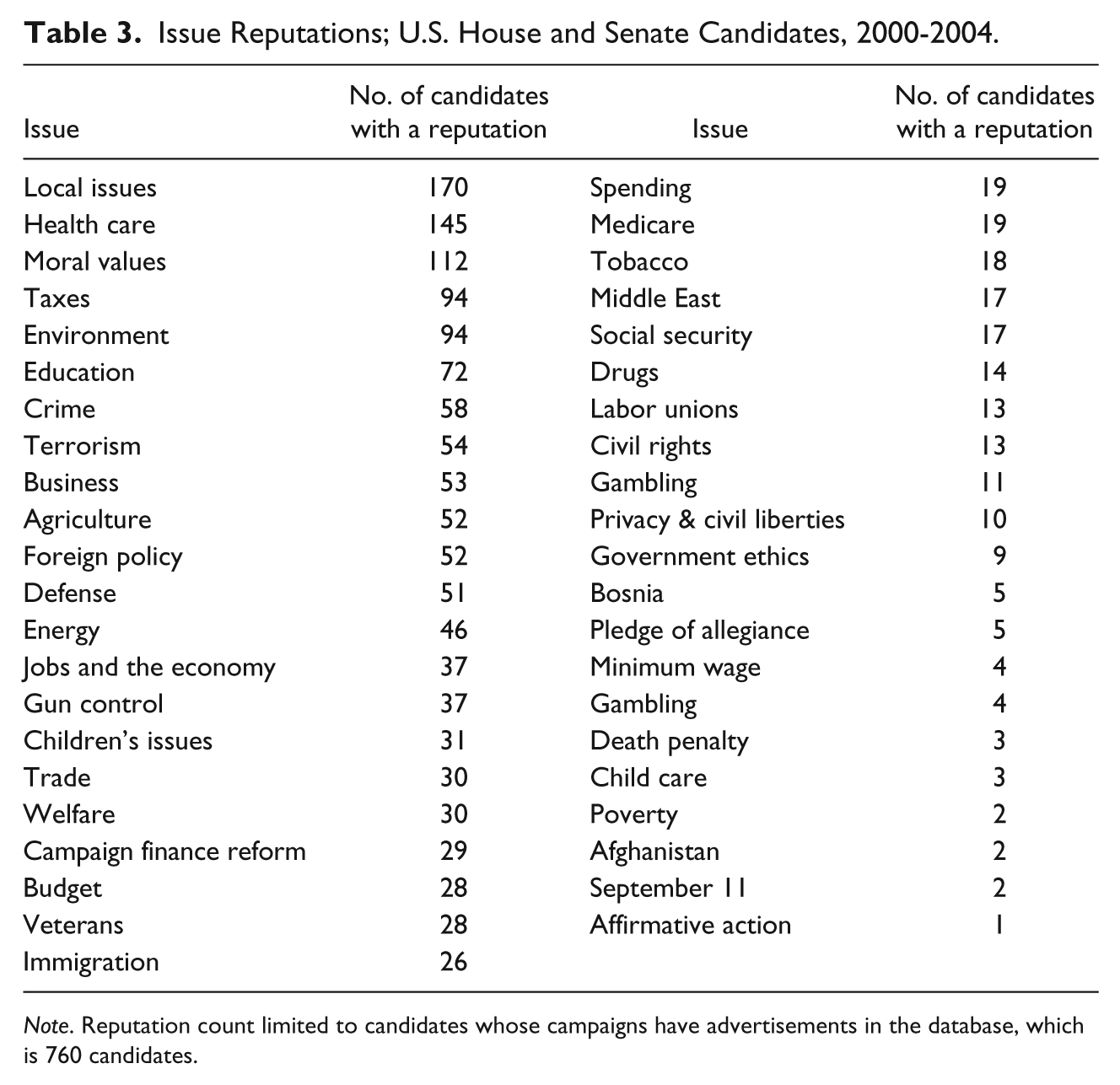
Note. Reputation count limited to candidates whose campaigns have advertisements in the database, which is 760 candidates.
Using the Almanac allows for a data source that covers every House and Senate election in the three elections under study and does so in a relatively similar way for each member of Congress. Each profile discusses each race in a similar way, providing a degree of consistency across all candidates needed for analytical research. Furthermore, the Almanac profiles are conducted by a neutral body.
The coding scheme has some obvious flaws (for instance, incumbents receive much larger and more detailed descriptions than nonincumbents) created by the fact the Almanac is not designed for this particular purpose. In particular, the Almanac, published by the Capitol Hill-centric National Journal, focuses on the actions of members in Washington and those actions that drew the attention of the Washington press corps. So a candidate’s work on issues that received coverage only in the local press may not attract the attention of the profile writers of the Almanac. The profiles of freshmen members focus more on the campaign and less on their actions in previous political office or in the private sector. In addition, Almanac profiles tend to be written in a positive fashion. As a result, the issue discussions of candidates are always positive and thus, the coding is either neutral (0) or positive (1). 11
The alternative to the Almanac is to collect details on candidate biography and record from the campaigns themselves. But campaigns will shape their discussions of their candidate’s biography to meet their issue agenda, which might overstate the connection between a candidate’s reputation and issue agendas.
The Almanac has some clear strengths as a measure of candidate reputation. It does have a number of weaknesses, but each of these weaknesses tends toward identifying fewer issues on which a candidate has developed a reputation. Thus, by limiting the scope of the reputation measurement, using the Almanac profiles creates a more conservative test of this article’s hypothesis.
Issue Agendas in Campaign Advertisements
Having determined the issue agenda, I now examine if a candidate’s reputation increases the likelihood that his or her campaign will highlight that issue. Figure 1 compares issue usage (under the one issue at a time measure) between campaigns whose candidate has a reputation on an issue and those who do not. Across all nine of the issues under study, campaigns are more likely to discuss an issue when their candidate has a reputation on that issue. 12

Issue use percentage, “one ad at a time” measurement; U.S. House and Senate candidates, 2000-2004.
As an example, take the issue of Education. As mentioned previously, this is the third most discussed issue over the course of the three election cycles. Campaigns whose candidate did not have a reputation on the issue of education discussed the issue with great frequency—in 17% of the ads they aired. But the campaigns whose candidates were noted for their work on behalf of schools especially wanted to highlight the issue. These campaigns mentioned Education in 32% of the advertisements they aired. The relationship is similar for other variables. On the two biggest issues (Taxes and Health Care), the effect of reputation on issue usage is modest. But on issues like Medicare, Defense, and Prescription Drugs, campaigns are more than twice as likely to discuss an issue when their candidate has a positive reputation on this issue as when their candidate does not. On issues such as Jobs and the Economy and Social Security, campaigns are substantially more likely to discuss the issue when their candidate has a reputation on that issue. Only on Terrorism is the positive relationship between reputation and issue usage not robust.
Figure 2 shows the bivariate relationship between reputation and issue usage by examining the mean amount of “time” spent on each issue. The results here are quite similar to those of Figure 1. All nine issues under study have a positive relationship—when candidates possess a positive reputation on that particular issue, their campaign will spend more time discussing that issue than campaigns whose candidates have not developed such a reputation. By measuring issue usage by the 760 campaigns under study, I can calculate statistical significance in a substantively meaningful way. Campaigns are significantly more likely to discuss Health Care, Education, Social Security, Medicare, Defense, and Prescription Drugs when their candidate has a positive reputation on these issues.
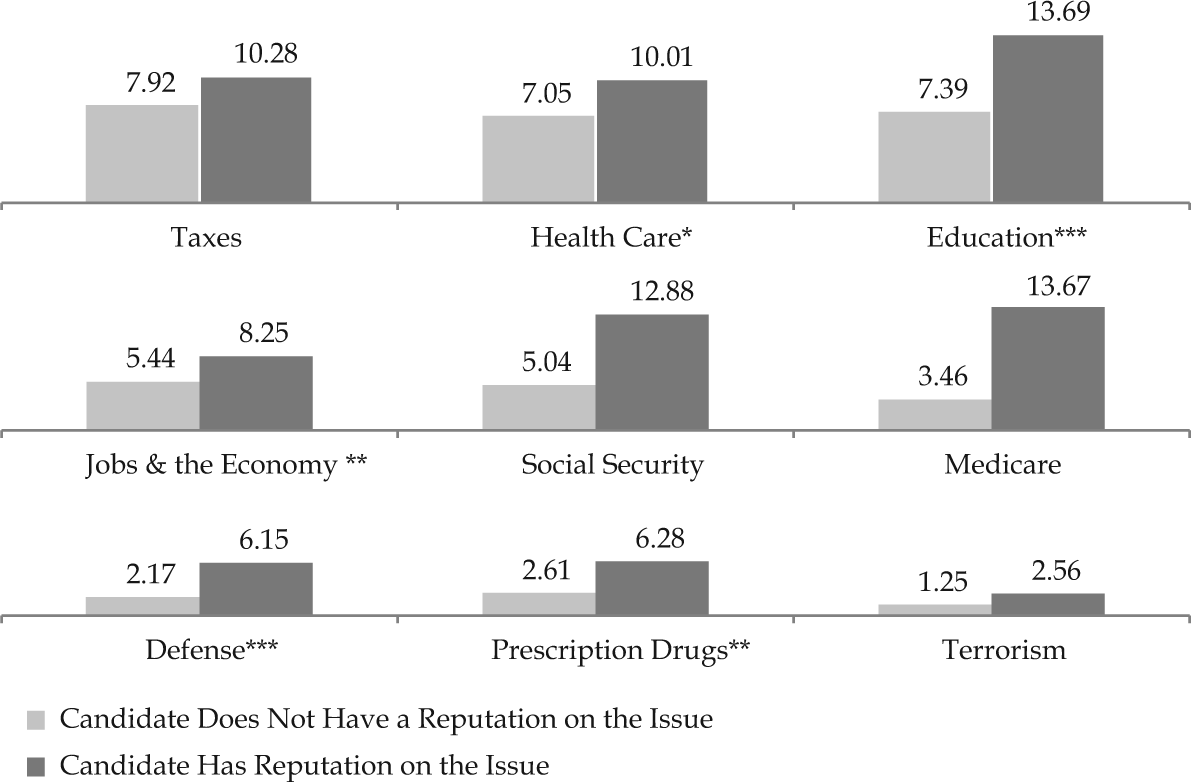
Mean issue use, “campaign time” measurement; U.S. House and Senate candidates, 2000-2004.
The evidence from these two bivariate tests shows that campaigns are more likely to discuss an issue when their candidate has a reputation on this issue. The relationship is consistent across all nine issues under study and is statistically significant in the majority of these issues. Now I test if this conclusion holds in a multivariate context.
Multivariate Results
Candidates do not develop their reputations in a vacuum. They are aware of their party labels and the districts in which they want to run for office. As a result, candidates might work to develop a reputation with an eye to one (or both) of these factors. Candidates in a conservative district might choose to work on issues that appeal to conservatives. Candidates may also choose to develop reputation on issues where their party has an advantage among the electorate to burnish that image. Conversely, candidates may elect to “trespass” on an issue owned by the other side, negating their opponent’s advantage on that issue. Of course, challengers whose reputations are well suited for a particular district might be more likely to enter a race than potential candidates with less suitable reputations. As a result, a candidate’s reputation may just be an artifact of the other factors that affect a campaign’s issue priorities. To determine if a candidate’s reputation has an independent effect on issue agenda, a multivariate test is needed.
My models follow those created by Sides (2006; Table 3). I create a separate logistic regression model for each of the nine issues under study. For this model, the data are each airing of an advertisement. The dependent variable is coded 1 if the advertisement mentioned the particular issue and 0 otherwise. Of course, my key independent variable is Reputation, coded 1 if a candidate has developed a reputation on that issue, and 0 otherwise.
The literature on campaign issue agenda shows that two variables are most critical in determining what issues a campaign highlights for voters. The first is the candidate’s party. As discussed, Petrocik’s theory of issue ownership holds that the two American political parties hold long-standing reputational advantages on particular issues among voters and are advantaged by discussing these issues. Thus Democratic campaigns should highlight Democratic-owned issues, and Republican campaigns should highlight Republican-owned issues. The variable Republican measures the partisan difference in issue usage.
The second is the composition of a district. Campaigns want to focus on issues that will be received favorably by their audience. In liberal districts or states, campaigns (of both parties) want to highlight liberal issues. And in conservative states or districts, campaigns want to highlight conservative issues (Ansolabehere, Snyder, & Stewart, 2001; Sides, 2006; Sulkin & Evans, 2006). To measure the ideology of a district, I use the vote share won by the previous Republican presidential candidate (abbreviated GOP Pres % in the tables).
I also include several control variables. The first is the Competitiveness of a race. Close races compel candidates to focus on the same issue, which would reduce the impact of any of the other key variables (Lipsitz, 2011, pp. 57-59). 13 The House and the Senate have different roles and duties mandated by the Constitution. Thus one might expect Senate candidates to focus more on national security issues and House candidates to focus more on domestic issues. To account for potential differences in the issue agenda of the two houses of Congress, I include Senate as a dichotomous variable.
Scholars have found that voters view female and minority candidates differently from White male candidates, which can affect perceptions of their credibility (cf. Dolan, 2005; Fridkin & Kenney, 2009; Sapiro, Walsh, Strach, & Hennings, 2011, on female candidates; Citrin, Green, & Sears, 1990; Matsubayashi & Ueda, 2011, on Black candidates; Barreto, 2007; McConnaughy, White, Leal, & Casellas, 2010, on Hispanic candidates, and Philpot & Walton, 2007, on Black female candidates). As a result, female candidates possess particular credibility on domestic issues (Herrnson, Lay, & Stokes, 2003; Herrnson & Lucas, 2006) and Black and Hispanic candidates possess their own particular set of advantageous issues. To account for this, I include dichotomous variables for Female, Black, and Hispanic candidates. 14 In addition, there are dichotomous variables for Incumbents and for Open Seat candidates, with challengers as the excluded category. Tables 1 and 2 showed that issue agendas change across different elections. Thus I have included the variables Year 2002 and Year 2004 as dichotomous variables. 15
Table 4 presents the results of the nine separate models. The results for candidate reputation tend to hold up in this multivariate test. Again, eight of the coefficients for Reputation are in the expected positive direction. Where there were large differences in the bivariate data presented in Figure 1, there are statistically significant differences in Table 2. Reputation is significant in seven of the models.
Logit Models of Issue Usage; “One Ad at a Time” Measurement; U.S. House and Senate Candidates, 2000-2004.
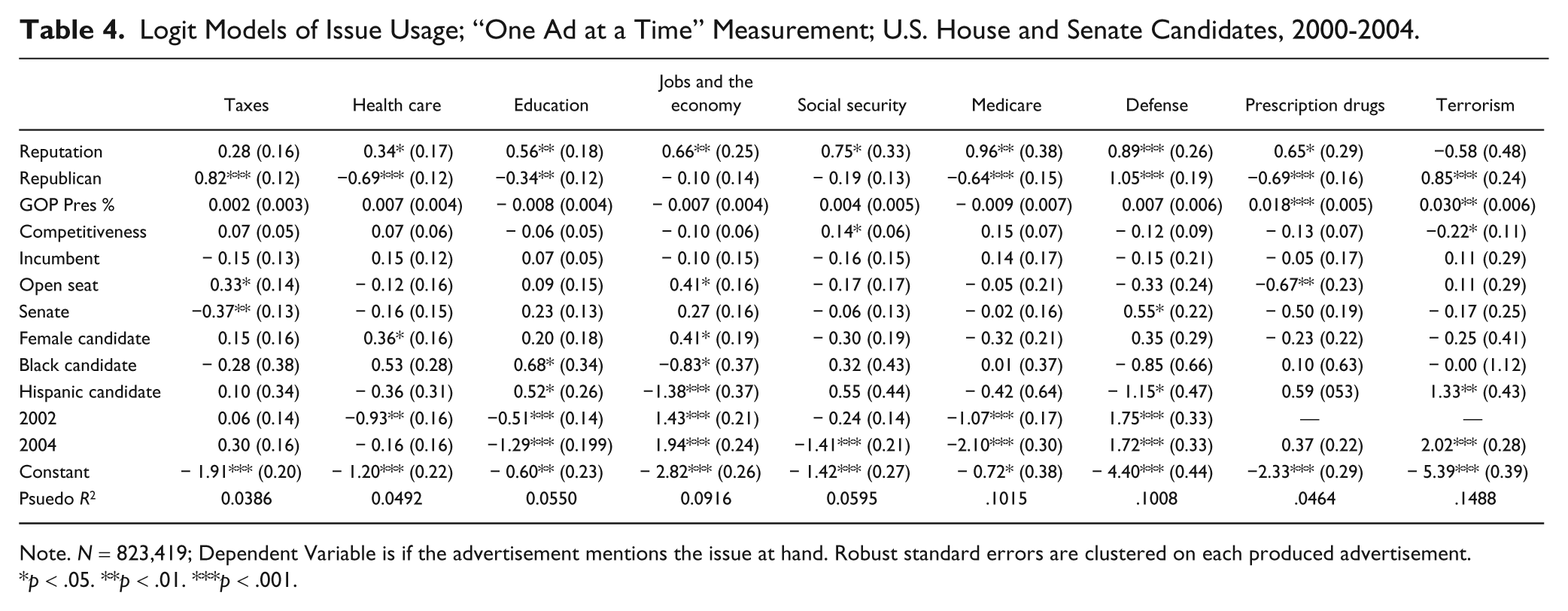
Note. N = 823,419; Dependent Variable is if the advertisement mentions the issue at hand. Robust standard errors are clustered on each produced advertisement.
p < .05. **p < .01. ***p < .001.
The Republican variable is also significant in seven of the models under study, matching expectations. Republican campaigns were more likely to highlight Taxes, Defense, and Terrorism, issues traditionally owned by their party. Democratic campaigns were more likely to highlight several issues that their party owns—Health Care, Education, Medicare, and Prescription Drugs.
The only other variables that have much impact on the issue agendas of congressional campaigns are the year variables, which are significant in the vast majority of the models. Thus campaigns will “ride the wave” of the national issue agenda (Ansolabehere & Iyengar, 1994), shifting their issue focus to the most pressing concerns of the voters. But there are few differences in issue usage based on the competitiveness of the race, the status of the candidate, or the office sought.
Confounding expectations, the ideology of the district plays little role in determining the issue agendas of political campaigns. Campaigns are more likely to talk about Prescription Drugs and Terrorism more as the Democratic vote share of the district increases. But outside of those two issues, the district’s partisanship does not affect the likelihood that a campaign highlights an issue.
Because interpreting coefficients in a maximum likelihood model is difficult, I used the models in Table 4 to calculate the predicted probabilities for issue usage if the candidate has or has not developed a reputation on the issue. 16 The calculations are based on the values for an incumbent Republican Senator in 2004. These are modal values. I set the Competitiveness rating at “Lean” and the previous Republican presidential vote share at 48%; both are mean values. Figure 3 provides substantive and visual evidence that the effect of reputation holds up in a multivariate framework. For example, when it comes to the Education, campaigns for candidates who have developed an issue are more likely to highlight such issues in their advertisements (.15 to .09). Similar significantly significant effects are shown in the Health Care, Jobs & the Economy, Social Security, Medicare, Defense, and Prescription Drugs models.
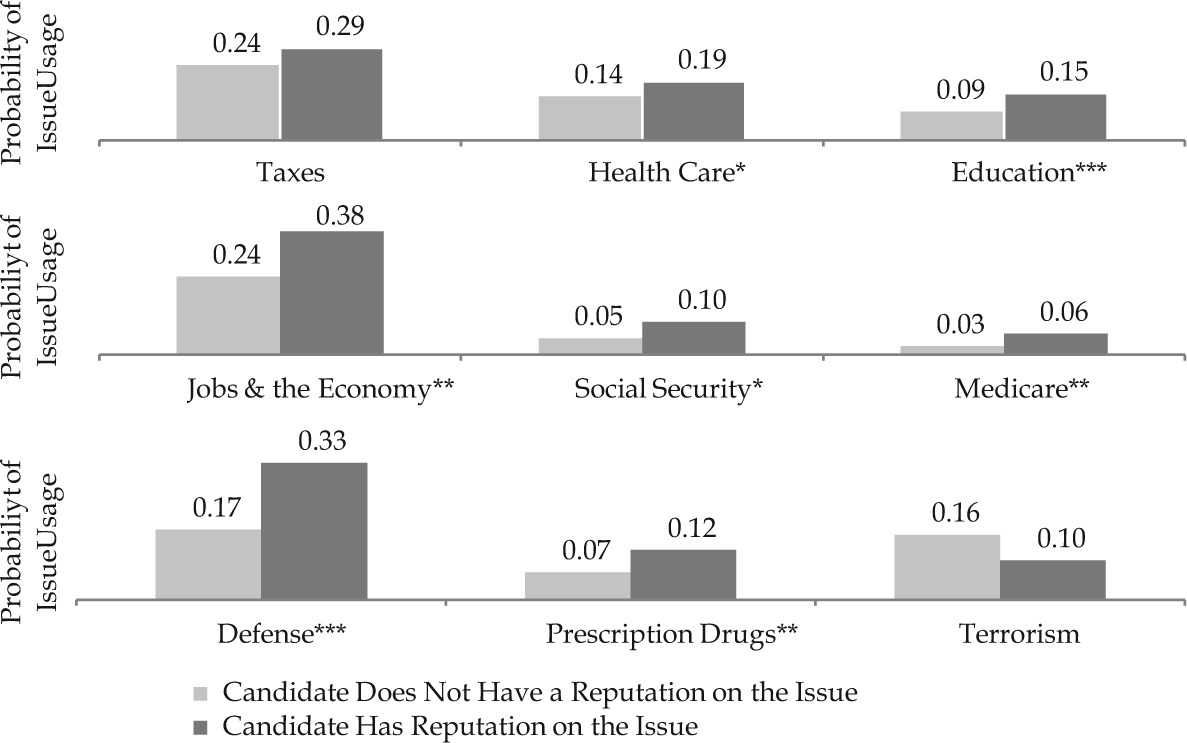
Probability of issue use; “one ad at a time” measurement; U.S. House and Senate candidates, 2000-2004.
I also ran similar models using the issue time variables as the dependent variable. Because the dependent variable is continuous, I conduct an OLS regression. The independent variables are the same as those presented in Table 4.
Table 5 presents the results, which confirm the previous findings. A candidate’s reputation has a positive and significant effect on a campaign’s willingness to address an issue. The Reputation variable is positive in all nine models, and is significant in six of them. Again, the party is a vital influence in issue agendas, as the Republican variable is significant in six of the models. Again, district ideology plays little role in the issue agendas of campaigns; it is significant in none of the models here.
OLS Model of Issue Use; “Issue Time” Measurement; U.S. House and Senate Candidates, 2000-2004.
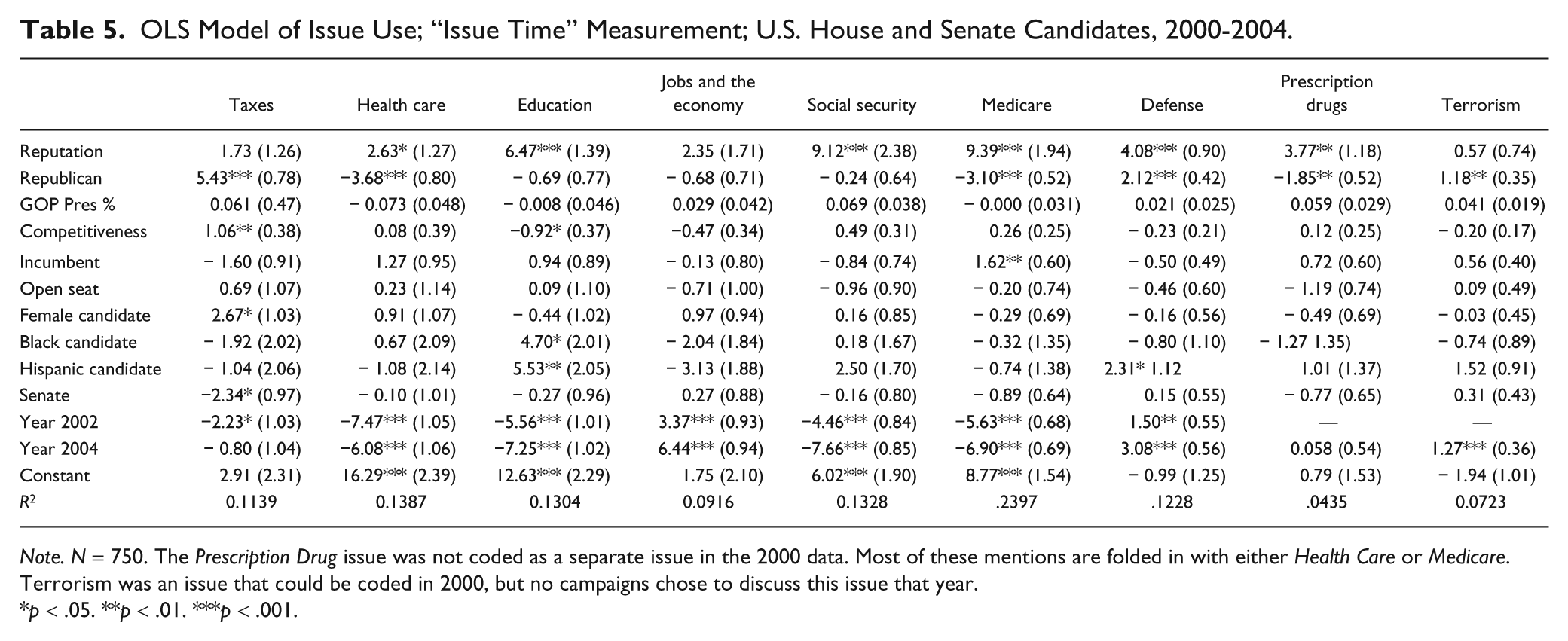
Note. N = 750. The Prescription Drug issue was not coded as a separate issue in the 2000 data. Most of these mentions are folded in with either Health Care or Medicare. Terrorism was an issue that could be coded in 2000, but no campaigns chose to discuss this issue that year.
p < .05. **p < .01. ***p < .001.
To demonstrate the visual impact of the reputation variable on issue time, I calculated the postestimation values for the results. Because OLS values are directly interpretable, simple arithmetic is used. As in Figure 3, the candidate is an incumbent Republican Senator running in 2002, at the mean level for competitiveness and previous Republican presidential vote share. I calculated the values once if the candidate had a reputation on the issue at hand and once if not. Figure 4 shows the results, again showing the increase in usage of an issue if a candidate has a reputation on that issue and increase that occurs in all nine issues under study.
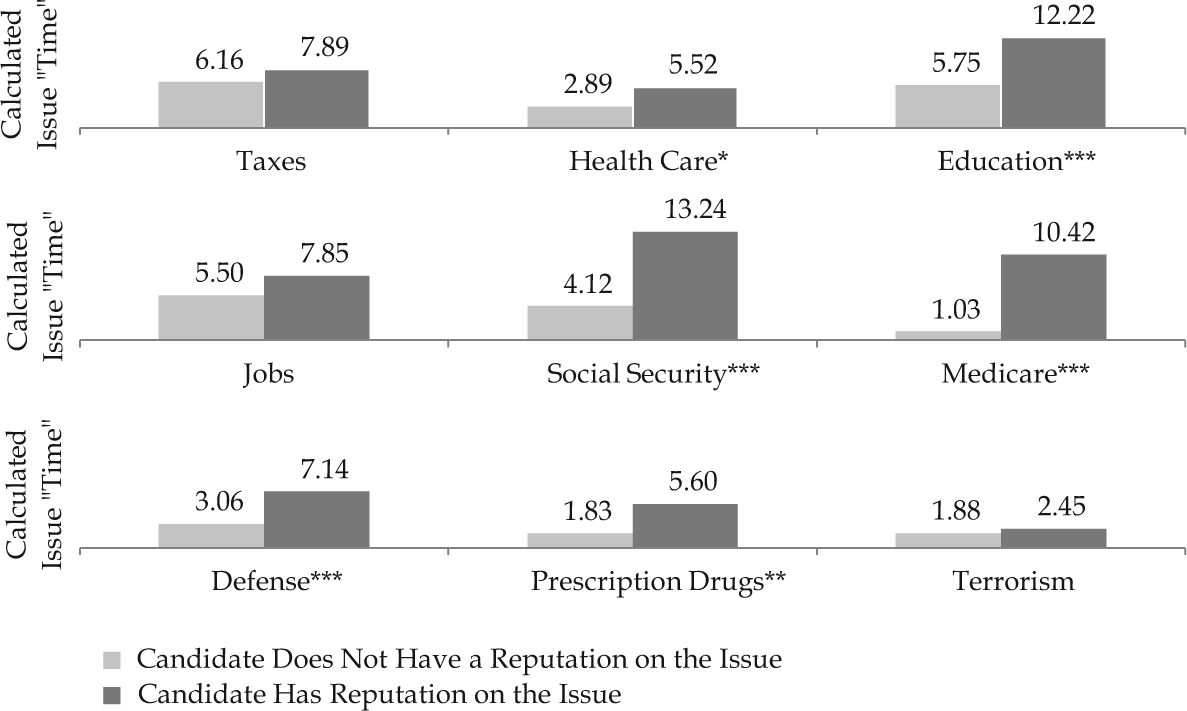
Postestimation campaign “time” on each issue by reputation, House and Senate candidates, 2000-2004.
Across the various measures of the reputation variable, the story is the same. A candidate’s reputation on an issue has a positive effect on their campaign’s willingness to discuss that issue. The effect is consistent across a series of measures. The data are consistent with the idea that candidate reputations are developed independently and are not artifacts of the reputation of the candidate’s party or the ideology of his or her district or state. 17
Implications
In this article I show that the reputation of a candidate influences the issue agenda of their campaign. When a candidate has developed a positive reputation on an issue, his or her campaign is more likely to highlight that issue for voters. These findings show the importance of actual candidates to the content of campaign messages.
Campaign professionals and others who craft campaign messages are sensitive to external forces, particularly the salience of issues and the composition of the district. The craft of setting the issue agenda is balancing the internal with the external. Campaigns take into account external factors such as the national issue agenda and their party’s issue reputation in deciding what to say to voters. Campaigns assess their candidates’ strengths and weaknesses in the context of these external forces, and then try to craft an issue agenda that best highlights both internal and external forces.
The desire to balance internal and external forces means that there will be issues on which candidates develop reputation which are not featured in their messages to voters. Also, there will be issues campaigns emphasize on which their candidate has not developed a reputation. But internal factors still play a vital role in developing an issue agenda. Campaign professionals know that individual candidates are differently able to convey messages on such issues. When a candidate’s own actions make him or her more capable of successfully delivering a message to voters, his or her campaign will utilize that advantage by placing that issue on the agenda.
Because the reputation of candidates is so important to the issue agendas, elections are tilted toward the retrospective and away from the prospective. Voters assess the past actions of candidates, and then pass judgment on whether or not they approve of those actions. Elections that focus on the past actions of candidates enhance the value of accountability, the ability of a democratic populace to blame or credit elected officials for their actions in office. When campaigns highlight what their candidate has done in office, voters give their tacit approval or disapproval to those actions.
But if campaign messages tend to look backwards, they do not tend to look forward. By highlighting issues on which their candidate has developed a reputation in the past, campaigns may not discuss what their candidate will do in the subsequent term in office. By gaining approval for their candidate’s past actions, campaigns reduce the ability of their candidate to win a mandate to enact future policy actions. At the same time, it is worth noting that winning candidates often address the issue agendas of their opponents in their subsequent term in office (Sulkin, 2005). Thus even retrospective campaign issue agendas can have prospective consequences.
Contemporary campaigns are “candidate centered.” This means that campaigns are organized by candidates themselves, who hire their own set of consultants, advisors, and staffers, to guide and manage the campaign (Wattenberg, 1992). Modern day candidates are self-motivated, deciding to run on their own (Ehrenhalt, 1991). Candidates, not parties, are at the center of own campaign organizations, starting such organizations at the beginning of the campaign and keeping them going between elections (Herrnson, 2011). The results here indicate we can add the issue agenda of the campaign to this long list of campaign elements where candidates themselves are influential.
The findings of this article also show that issue agendas can be larger than assumed by previous models of issues agendas. Most models of issue agendas proffered by political scientists focus entirely on factors exogenous to candidates. 18 The logical implication of such models is that the issue agendas of political campaigns are completely a function of external forces. Thus the identity of the candidate matters little, if at all, in determining the issue content of campaigns. From this perspective, issue agendas are rather narrow, constrained by factors beyond the control of any candidate or campaign. My findings provide a useful corrective to the presumption of these models. Issue agendas are more expansive than presumed in previous models. Also, because issue reputations are endogenous, they are not set in stone. Candidates can alter their reputation through their actions before an election campaign. For example, an incumbent can focus his or her attention on different or emerging issue during a legislative session and then highlight that work during his or her subsequent run for reelection. Since candidates can affect their own reputations, their work on less salient issues still matters, electorally speaking. Creating a positive reputation on these issues will allow their campaign to highlight their work on those issues more credibly. Not only are the reputations of candidates not set in stone but neither are the candidates. Candidates who have positive reputations that match either their party’s own issue advantages or the salient issues of a particular election will be more credible messengers. Candidates whose reputations fit less well with the tenor of the times will be less credible messengers. Potential candidates will assess this information when deciding whether to run for office and will be more likely to run when their reputations fits better with the important issues in a particular election year. Candidates whose reputations do not match the tenor of the times would be more likely to delay their run for office.
These findings are initial, focused on one measure of reputation for general elections. Further research could expand the scope of the elections under study, particular to primary elections. With the absence of party issue ownership, one would expect that personal factors, such as issue reputation, have a greater effect on issue agendas in primary elections. Future projects should try to identify more ways to understand and measure a candidate’s reputation in ways that go beyond the dichotomous instrument used in this article—identifying data sources that would determine negative reputations for candidates and the strength of a candidate’s reputation. Such measures should strengthen the findings in this article. Such data sets may address the difficulty of matching across different data sets and the ability (or inability) of coders to differentiate between different issues that are quite similar (e.g., Medicare and health care; defense and terrorism).
Conclusion
In this article I assess the importance of a candidate’s reputation to the creation of campaign issue agendas. Previous research has identified important external factors that influence issue agenda but has not addressed endogenous factors. Campaign professionals identify the strengths and weaknesses of their candidate to identify issues that their candidate can own. I hypothesize that if a candidate has a positive reputation on an issue, his or her campaign will be more likely to discuss that issue.
To test this hypothesis, I develop a measure of a candidate’s reputation and include this measure in a model of campaign issue agendas. When candidates have developed a positive reputation on a particular issue, their campaign will be more likely to mention that issue than campaigns whose candidate has not developed such a reputation. The effect of reputation is modest; the differences in issue usage between campaigns whose candidate has a reputation and those who do not are only a few percentage points. But the positive relationship is consistent, observed across a broad array of issues, and is robust to two different measurements of a campaign’s issue agenda. Despite these modest findings, candidate reputation performs much better than partisanship as an explanation of campaign issue agendas.
The results presented here show that political campaigns are more likely to put an issue on the agenda when their candidate has earned a positive reputation on that issue. This finding is consistent in both bivariate and multivariate analysis and in two different measurements of a campaign’s issue agenda. A candidate’s reputation on an issue increases mentions of that issue in nearly every issue under study. Campaigns want to shape the issue agenda in a favorable manner, and these attempts include (and may well start with) an assessment of their own candidate’s reputation among voters. Consultants use the candidate’s reputation to help decide what issues to highlight. The findings in this article join others that show the importance of a candidate’s past actions in the messages that campaigns transmit to voters (Sellers, 1998; Shyles, 1984).
Footnotes
Author’s Note
The author would like to thank Erin Ackerman, Danny Hayes, Seth McKee, Jeremy Teigen, Mike Unger, and the Research Foundation of the City University of New York for their assistance with this article. In addition, my thanks to Elien Migallen and Cyann Zoller for their research assistance. As always, I alone am responsible for all errors in the article. The data in this article come from the Wisconsin Advertising Project, and they ask for the following disclaimer: “The data was obtained from a project of the University of Wisconsin Advertising Project and includes media tracking data from TNSMI/Campaign Media Analysis Group in Washington, D.C. The University of Wisconsin Advertising Project was sponsored by a grant from The Pew Charitable Trusts. The opinions expressed in this article are those of the author(s) and do not necessarily reflect the views of the University of Wisconsin Advertising Project or The Pew Charitable Trusts.”
Declaration of Conflicting Interests
The author(s) declared no potential conflicts of interest with respect to the research, authorship, and/or publication of this article.
Funding
The author(s) received no financial support for the research, authorship, and/or publication of this article.