




Abstract
This research examines how severing the electoral connection influences legislative behavior. Unlike previous studies of legislative shirking, we argue for a more nuanced conceptualization that takes account of members’ electoral circumstances (beyond a dichotomous measure of term limited/nonterm limited) as well as the nature of the votes under consideration. This enables us to incorporate expectations of party influence into our model of legislative shirking. Our research demonstrates shirking among legislators leaving public office as they are no longer susceptible to party pressure, while those who face term limits and are seeking another public office may remain adherent to the party on votes most crucial to the party (i.e., procedural votes). Moreover, we find evidence that legislators who are no longer constrained by elections also exhibit a greater level of roll call abstention, although only those leaving public office demonstrate significant increases in abstentions on procedural votes. Thus, we may find very different shirking patterns among term-limited members depending on their future political ambition (or lack thereof) and also depending on the nature of the votes that we are examining.
Representation is a fundamental tenet of democratic governance. Elections provide an avenue for citizens to exercise popular control over their representatives and consequently affect public policy. Assessing the extent to which elections constrain legislators has been a core focus of political science research (Erikson, MacKuen, & Stimson, 2002; Erikson, Wright, & McIver, 1993; Kousser, Lewis, & Masket, 2007). Although seminal research often assumes that electoral considerations play a major role in legislative decision making (Fenno, 1978; Mayhew, 1974), empirical studies of representation have produced mixed results concerning how elections enhance the quality of representation (Lax & Phillips, 2012; Miller & Stokes, 1963; Page & Shapiro, 1983). In this research, we investigate how legislators respond when the electoral connection is severed. To what extent does the electoral connection limit legislative shirking and enhance democratic representation? Moreover, does severing the electoral connection constrain parties’ ability to exercise discipline over members and limit their ability to pass their policy agendas?
At the federal level, scholarship has utilized congressional retirements to investigate the extent to which removal of electoral incentives promotes legislative shirking (Kalt & Zupan, 1990; Lott, 1990; Rothenberg & Sanders, 2000; Zupan, 1990). One of the limitations of utilizing congressional retirements is the fact that the strategic nature of legislators’ decision to retire may be related to the very outcome that we wish to assess. We seize upon the unique opportunity provided by state legislative term limits to investigate how an exogenously imposed constitutional or statutory electoral provision that severs the electoral connection influences legislative behavior.
We present a more nuanced conceptualization that takes account of members’ electoral circumstances (beyond a dichotomous measure of term limited/nonterm limited) as well as the nature of the votes under consideration. This allows us to incorporate expectations of party influence into our model of legislative shirking. We argue that although legislators who are no longer running for public office have incentives to shirk, members with an interest in pursuing another public office are still susceptible to party pressure, and therefore may remain adherent to the party on votes most crucial to the party leadership (i.e., procedural votes). Thus, we may find very different shirking patterns among term-limited members as well as those voluntarily leaving the chamber depending on their future political ambition (or lack thereof) and also depending on the nature of the votes that we are investigating.
Theoretical Motivation
A fundamental question of democratic governance concerns the extent to which the public holds its elected officials accountable for their actions while in office. In Federalist #52, Madison, Hamilton, and Jay (1788/1987) note that “[a]s it is essential to liberty that the government in general should have a common interest with the people, so it is particularly essential that the branch of it under consideration should have an immediate dependence on, and intimate sympathy with, the people.” Madison et al. continue by stating that “[f]requent elections are unquestionably the only policy by which this dependence and sympathy can be effectively secured.” The centrality of elections in congressional politics has been an enduring theme in the literature. Indeed, Mayhew (1974) challenges us to consider how members might organize Congress if their sole purpose was to maximize their chances of reelection. He argues that the system in place skillfully reflects an institution that fosters opportunities for members to meet their electoral needs to engage in advertising, position-taking, and credit-claiming. Subsequent work (Katz & Sala, 1996; Shepsle & Weingast, 1987) has demonstrated that incentives for incumbents to cultivate personal votes explain the emergence of the strong standing committee system in the modern Congress.
Despite the general belief that elections have an important place in legislative politics, the precise mechanism by which elections serve to translate mass preferences into public policy (and the degree to which accountability and representation are achieved through the electoral process) is the subject of considerable debate. The predominant theory of legislative elections suggests that legislators must adhere to their constituents’ wishes or they will risk losing the next election. From this Downsian perspective, legislators strategically craft their positions with the explicit goal of maximizing votes and winning reelection (Downs, 1957). The key to resolving this principal-agent problem lies in voters’ abilities to structure the incentives faced by officeholders to induce them to act on their behalf. Thus, elections serve as a mechanism to sanction wayward legislators and induce responsiveness. This suggests that legislators will modify behavior in response to upcoming elections in order to maximize votes. There is empirical support for this theory of elections. Kousser et al. (2007) rely upon the natural experiment provided by California’s 2003 gubernatorial recall election to investigate whether state legislators responded to this strong signal of Republican support midway in their term. They find strategic moderation on the part of Democratic legislators who were in some cases facing much more competitive (i.e., higher quality) Republican challengers in an environment much more favorable to Republican candidates.
In contrast to the “sanctions model” of elections, the “selection theory” maintains that elections are primarily about policy and the selection of alternative sets of policymakers to carry out the wishes of constituents. Although there is an expansive literature detailing the general lack of sophisticated political knowledge of the masses (see, e.g., Delli Carpini & Keeter, 1993), studies finding strong congruence between district ideology and legislative ideology(Erikson, 1971; Erikson & Wright, 1980) as well as a robust relationship between the economy and congressional vote totals for incumbents (Hibbing & Alford, 1982) suggest some degree of policy linkage between voters and elected officials. Prior research has demonstrated that congressional candidates typically represent clear, distinct policy alternatives (Ansolabehere, Snyder, & Stewart, 2001; Poole & Rosenthal, 1997) and who controls government influences the kinds of policies enacted (Brady & Sinclair, 1984; Erikson et al., 2002; Erikson et al., 1993; Wright & Berkman, 1986). Elections provide an opportunity for legislators to present alternative policy visions to the public and for voters to select the candidate who they believe will best act on their behalf.
Severing the Electoral Connection and Representation
How does the elimination of electoral incentives (i.e., severing the electoral connection) influence legislative behavior? The sanction and selection theories offer distinct expectations for how legislators will behave once the “constraints” imposed by elections are removed. The sanctions theory assumes that elections constrain legislators who otherwise are predisposed to shirk their duties to their constituents. Therefore, we would expect that severing the electoral connection removes constraints and results in legislators acting as “free agents,” shirking their duties to constituents. The selection theory suggests that legislators are chosen by the electorate precisely because of the positions they take and once in office, members adhere to their personal preferences which are a reflection of the constituents’ preferences. Thus, we would not expect the removal of electoral incentives or constraints to significantly affect a member’s behavior. Scholars have investigated this question using evidence from congressional retirements (Lott, 1987; Lott & Bronars, 1993; Snyder & Ting, 2003; Van Beek, 1991), career movement (Grofman, Griffin, & Berry, 1995; Hibbing, 1986), lame-duck sessions (Jenkins & Nokken, 2008), and term limits (Wright, 2007). From an extensive survey of state legislators conducted in 1995, Carey (1996) and Carey, Niemi, & Powell (2000) find evidence of a “Burkean shift” among state legislators facing term limits and therefore no longer constrained by voters. Hibbing (1986) finds that House members seeking Senate seats strategically modify their behavior, while Snyder and Ting (2003) also find evidence of shirking by retiring members of Congress.
Other studies find little evidence of shirking. Poole (1998) examines legislative behavior among members who experience district change arising from redistricting and maintains that members do not change their behavior rather they “die in their ideological boots.” Grofman, Griffin, and Berry (1995) investigate members’ behavior when they switch offices and do not witness significant changes in behavior when members move from the U.S. House to the U.S. Senate. There is a large literature examining the incidence of “shirking” among retiring members that finds little support that retiring members shirk their duties to their constituents (Lott, 1987; Lott & Bronars, 1993; Van Beek, 1991). Finally, research has also exploited the unique opportunity that lame-duck sessions offer to analyze last-term effects (Jenkins & Nokken, 2008), finding no evidence of substantial shifts among legislators.
Wright (2007) points out the inconsistencies of these studies’ findings concerning when and how this shift occurs. 1 We argue that greater conceptual clarity regarding the nature of votes and electoral circumstances of members is necessary. Like Wright (2007), we seize upon the opportunity that term limits in U.S. state legislative elections creates for distinguishing among party, ideology, and constituency effects on legislative behavior. Thus, we assume that legislative behavior is primarily a function of members’ personal preferences (“ideology”), their constituents’ preferences, and party. 2 Each legislature may be comprised of five types of members:
Term-limited members who are not seeking another public office
Term-limited members who are seeking another public (elective or appointed) office
Continuing members who are not subject to term limits yet
Members who are not subject to term limits but are seeking another office
Retiring members who are not facing term limits
There is heterogeneity among legislators’ utility functions conditional on their electoral circumstances. Thus, members who are facing term limits and not seeking another office as well as members voluntarily retiring should be influenced by their own personal preferences (but not constituency preferences since the electoral connection is severed and not the party’s since they no longer hold control over the member). Members exiting the chamber (voluntarily or involuntarily) who are seeking another office whether elected or appointed may not be as strictly bound by their current constituency. Although one motivation behind term limits is the idea of ending careerist politicians, term limits may not completely eliminate the vote-seeking incentives of members as proponents had hoped since ambitious politicians will seek positions in other offices once they are termed out. Therefore, we must begin to think about how ambitious politicians may think about their futures.
We believe that political parties hold an important role in members’ pursuit of another office once they exit their position. Cox and McCubbins (1993, 2005) argue that political parties organize legislatures to ultimately seek the collective goal of building and protecting the party reputation. Party reputations can provide an important basis for voters to make choices (Schaffner & Streb, 2002; Woon & Pope, 2008); however, to be most useful, the party must develop a coherent record of behavior (Kiewiet & McCubbins, 1991). Individual members may have incentives to “buck” the party brand when party voting becomes electorally costly to them. The heterogeneity in electoral conditions and institutions of the states has provided researchers with a unique opportunity to assess the conditions which produce stronger party leadership. Research has demonstrated variability in the strength of parties across the states (Aldrich & Battista, 2002; Battista & Richman, 2007; Clucas, 2001, 2007; Wright & Schaffner, 2002). Carroll and Eichorst (2013), for example, find that in competitive legislatures, members are more willing to delegate authority to their party leaders, and this, in turn, produces greater predictability in state legislative roll call voting behavior. Other work demonstrates that leadership strength is enhanced when legislatures are professionalized (Clucas, 2001, 2007).
Although earlier work speculated that term limits could diminish the strength of parties due to greater leadership turnover and shorter tenure (Carey et al., 2000), case studies have shown that legislative leaders remain strong despite the implementation of term limits (Cain & Kousser, 2004; Sarbaugh-Thompson, Elder, Thompson, Elling, & Strate, 2006). Moreover, political parties seeking policy success in the legislative arena must also be concerned with the electoral environment and how best to increase their seat share in the legislature. As a consequence of term limits, political parties and candidates know years in advance which seats will be open because the incumbent is term-limited; hence, targeted recruitments can begin much earlier (Moncrief, Squire, & Jewell, 2000). A Center for American Women in Politics Center report cites one insider discussing the party’s candidate recruitment strategy in term limited states
3
: The recruitment that is happening now is the designation of successors by some of the most powerful, long-time reps who are going to be term-limited out, who have . . . obtained pledges from lobbyists for their successors. It is a very orchestrated and calculated role . . . They have already lined up tremendous amounts of money, and none of this has to do with women being recruited to run, of course.
Similarly, Masket (n.d.) finds that term limits in Nebraska, which began removing incumbents from office in 2006, created opportunities for the state’s political parties to recruit and finance candidates, and he finds that they have done so in an increasingly partisan fashion even though Nebraska operates in a nonpartisan fashion. Masket’s research parallels other studies showing that state parties have enhanced their role in state legislative elections (Bibby, 2002; Herrnson, 2002). A number of scholars have noted the increasing influence of state parties in financing state legislative elections (Gierzynski & Breaux, 1998; La Raja, 2008). Examining independent spending in state legislative elections pre- and post-Citizens United, Hamm, Malbin, Kettler, and Glavin (n.d.) note the expanded role of formal party organizations, party-affiliated groups, and party-allied groups in campaigns. Thus, we would expect for parties to maintain some control over office-seeking individuals (even among those termed out of the particular legislative seat), and this may vary according to the electoral and institutional context of the state. Continuing members not subject to term limits at this point and not retiring should continue being influenced by party, constituency, and personal preferences. However, retiring members, like term-limited members leaving public office, should no longer be subject to the pull of party or constituents.
Members who have been termed out yet are pursuing another elective office will remain influenced by the party as those members may continue to seek funding and support by the party to improve their chances of winning election to a new office, but the connection to their specific geographic constituency has been severed. 4 Finally, members who are not subject to term limits yet have decided to pursue another public office may also still be influenced by the party as well for the same reasons as those legislators who have been termed out.
In addition, we argue that members’ voting patterns will also reflect the nature of the votes under consideration. There is an expansive literature on party effects in Congress that demonstrates that party leadership is most likely to exert influence over members on procedural votes compared to final-passage votes (Cox & McCubbins, 1993, 2005; Jenkins, Crespin, & Carson, 2005). This stems from the fact that procedural votes are fairly obscure yet crucial for party leadership to maintain control over policy. Because of their obscure nature, constituents are less likely to pay attention to procedural votes so members and leaders associate much less electoral costs to procedural votes. Votes on final passage are much more visible to constituents, and therefore may have more associated costs to members whose constituency diverges from the party.
We hypothesize that members who no longer face reelection (i.e., those retiring and those facing term limits and no longer seeking public office) will be less susceptible to party pressure compared to those seeking elective or appointed office. Members who are facing term limits and not seeking another public office will rely upon their own preferences primarily to determine their voting behavior across all types of votes. Continuing members (i.e., those who are not facing term limits but who seek reelection to the chamber) will be susceptible to partisan pressure (in addition to constituency opinion and their own personal policy preferences). Members who are not facing term limits yet are pursuing another office would also still be influenced by the party although this may vary according to the strength of party leadership in the state.
Research Design and Data
We utilize the implementation of term limits in state legislative elections to gain leverage on the question of how the electoral connection shapes legislative behavior. Specifically, we assess whether severing the electoral connection leads legislators to shirk. Although there are a variety of ways in which legislative shirking may be examined, we follow previous studies (Lott, 1987; Wright, 2007) and examine participation rates in roll call voting and ideological consistency among legislators. Unlike previous studies of shirking, we seek to understand how the party structure differentially affects legislative voting across different types of votes.
To examine these questions, we compiled data from 26 state legislative chambers during the period from 1996 to 2008. 5 We obtained roll call voting data by using a script to pull votes and bill descriptions from each of the state legislative websites. 6 We then separated the roll call voting records into two categories of votes: procedural and policy. Prior scholarship demonstrates important differences in party voting on procedural matters compared to votes of final passage on policy (Cox & McCubbins, 2005; Jenkins et al., 2005). The final passage votes include the final actions taken on bills, resolutions, and conference reports. Procedural votes include, among other things, motions to end debate, recommit, table, and instruct conferees. The National Conference on State Legislatures (NCSL) provided data on which legislators were affected by term limits over this time period, and we supplemented these data in some instances with information from the state legislative websites (e.g., in cases where NCSL data were incomplete). The number of legislators termed out in each state from 1996 to 2008 is shown in Table 1. Blank cells indicate years in which state legislators were not subject to term limits. Over this time period, a total of 1,901 legislators were subject to term limits (15% of our data set), and 47% of those members pursued another elective office. Among those members who were not facing term limits, 17% retired from public office and 28% ran for another elective position.
Legislators Termed Out (1996-2008).
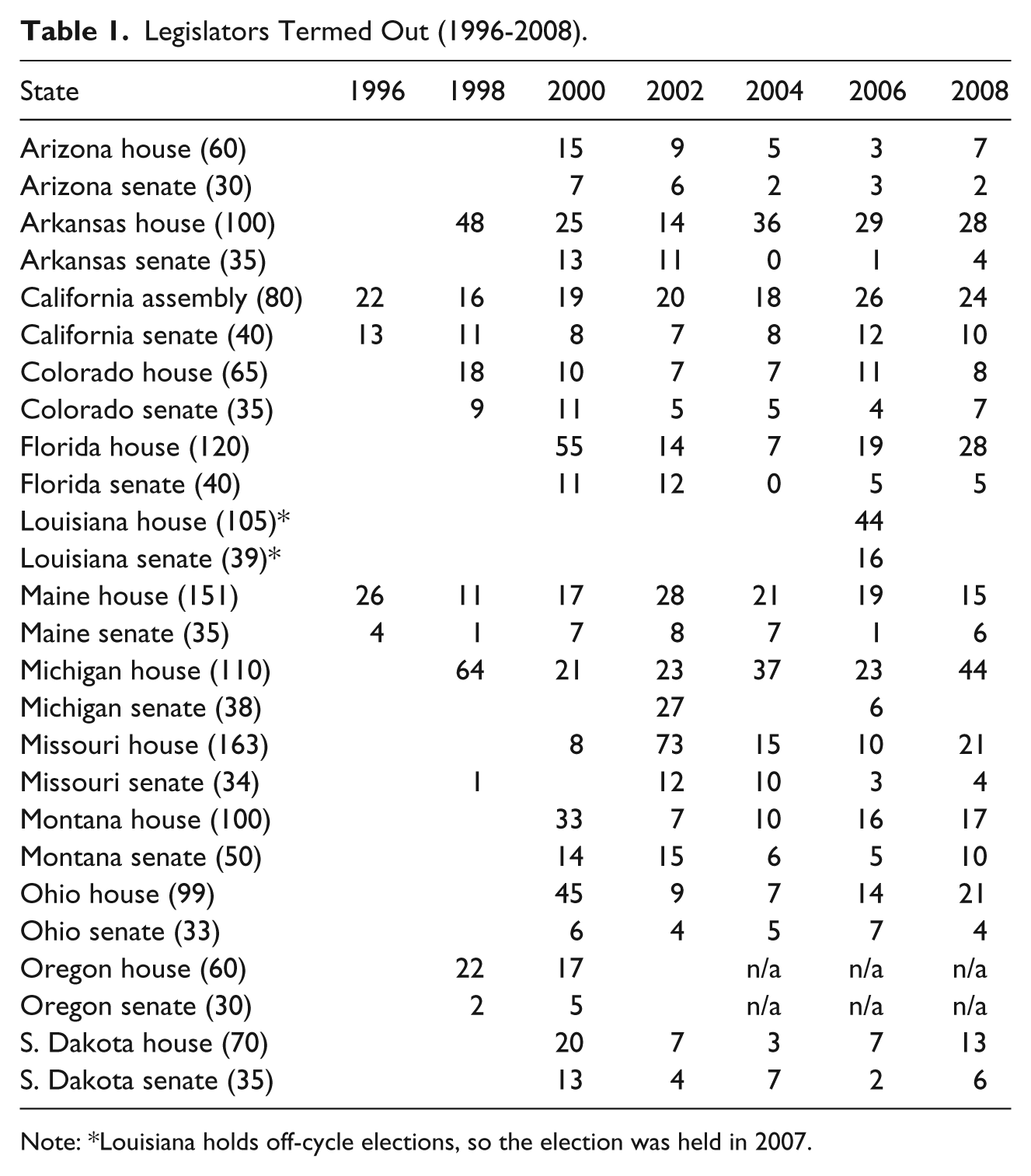
Note: *Louisiana holds off-cycle elections, so the election was held in 2007.
We define legislative shirking as the practice of legislators acting upon their own interests (either by following their own preferences or nonparticipation on roll call votes) despite the fact that it may be inconsistent with the best interest or wishes of constituents. Consistent with prior literature (Rothenberg & Sanders, 2000; Wright, 2007), we operationalize shirking in two ways: legislators’ ideological consistency across sessions and legislators’ participation rates on roll call votes. We measure ideological consistency of individual legislators by scaling legislators’ votes cast over the time period of 1996 to 2008. Rothenberg and Sanders (2000) utilized W-NOMINATE scores to assess ideological change; however, we estimate dynamic scores which rely upon bridge actors (i.e., legislators who cast votes during both sessions) to create comparability of measures from different legislative sessions.
To identify our model, we assume that legislators unaffected by term limits (i.e., the baseline legislators) exhibit ideological consistency over the course of a 4-year time period, which is consistent with Poole’s (1998) “ideological boots” thesis. We then estimated a single NOMINATE model in which separate ideal points are generated for the “unconstrained” members and a single ideal point is estimated for the “constrained” (or bridge) members. Because the constrained members pin down the scale and rotation of the issue space across the two periods, the ideal point estimates will be comparable over time, and thus, we argue that fluctuations in the ideal point estimates for the unconstrained members over time reflect changes in legislative behavior and are likely not attributable to a shifting or stretching of the scale due to changes in the legislative agenda for example (Bailey, 2007; Poole & Rosenthal, 1997).
Using these estimated legislative ideal points, we can then calculate an ideological change score for the “unconstrained” members equivalent to the absolute difference of individual members’ NOMINATE scores from one session to the next session. Consistent with Rothenberg & Sanders (2000), we take the absolute difference of the measures because we lack directional predictions about changes in voting behavior (because observed data cannot reveal members’ “true ideology” and “electorally induced ideology”). A larger absolute difference for a member signifies that the legislator has experienced a large degree of ideological change over the course of the sessions, which is consistent with the theory of elections as sanctions. A small change suggests that the members tend to die in their ideological boots, maintaining their ideology over the course of their career, which is more consistent with the selection theory of elections. Legislators’ ideological scores may range from −1 to 1. The mean ideological change of legislators is 0.026 with a standard deviation of 0.089.
How does the party structure fit into this argument? We believe that investigating behavior across different types of votes will allow us to gain leverage on the role of parties in shaping legislative behavior and representation. We expect to see substantial levels of consistency and ideological constraint on the procedural roll call votes if parties are indeed exerting influence over legislative behavior. We believe that there is heterogeneity among members, however. We hypothesize that term-limited legislators who are not seeking higher office are not susceptible to party pressure in the same way (or to the same extent) as those seeking higher office or seeking to maintain their seats are. Thus, we predict a positive coefficient for term-limited legislators not seeking other elective office.
In addition to these predictors, we include a number of other controls that we believe could influence legislative behavior. In particular, we control for district competition, which is measured as the winning candidate’s vote margin in the prior election. Electoral margin is measured as the percentage of votes the member received in her last election. The State Legislative Election Return project contains these data, and the measure ranges from 0.5 to 1. 7 This variable allows us to control for the short-term effect of electoral security on legislative behavior. Electoral margin has a mean value of 56% with a standard deviation of 17%. We also include indicators for the percentage of seats held by the majority party and the percentage of seats held by the majority party squared. District Ideology represents the percentage of the two-party vote received by the Democratic presidential candidate. The mean district ideology (Democratic Presidential Vote) is 49.18% with a standard deviation of 14.77%. These data were compiled from precinct-level presidential returns and aggregated to the state legislative district level. The measures represent pre- and post-reappointment state legislative districts. Finally, previous research on shirking in state legislatures finds a significant relationship between legislative professionalism and shirking (Wright, 2007). Therefore, we also included measures of legislative professionalism (Squire, 1992). We also include indicators for the Democratic seat share in the legislature and the squared value of the Democratic seat share, since roll call voting participation and ideological change may be higher in more competitive chambers (Wright, 2007).
The model also includes controls for legislators’ membership in the majority party, leadership positions, gender, race, and ethnicity. We acquired the data on partisanship, race (0 = non-White, 1 = White), ethnicity (0 = non-Hispanic, 1 = Hispanic), and gender (0 = male, 1 = female) from Project Vote Smart candidate profiles as well as the state legislative websites. We compiled data on leadership positions from the state legislative websites and include chamber leadership positions, such as Speaker, Majority Leader, Whip, and so forth, as well as committee chairmanships (coded as 1 = leadership, 0 = rank-and-file).
Results
We estimate models of legislative shirking assessing the ideological continuity of legislators’ voting and legislators’ participation in roll call voting on different types of votes using OLS (Ordinary Least Squares) regression and clustering by state-year. 8 The first model uses the roll call voting data described above to assess change and continuity in legislators’ ideological positioning to assess whether legislators exhibit a “Burkean shift.” Unlike previous research examining legislative shirking, we separate the roll call record to allow more systematic analysis of legislative voting on final-passage votes and procedural votes. This allows us to more fully examine how political parties may wield influence over legislative voting behavior. In particular, the party cartel theory (Cox & McCubbins, 2005) suggests that party leaders will exert influence over procedural matters since control of the legislative agenda hinges upon procedural control. In the theoretical section above, we argue that legislators will have different incentives to adhere to the party leadership’s wishes conditional on their electoral circumstance (i.e., whether the member is retiring, termed out and retiring, termed out yet seeking another office, or a continuing member).
Ideological Shirking
The results of our analysis of ideological continuity are presented in Table 2. The first model that we have estimated examines legislators’ ideological continuity on final-passage votes. The key independent variables of the model take into account the different electoral incentives facing members. We do not find significant shifts in voting for members who are termed out from the legislature yet not running for other elective office. Among legislators who were termed out and sought another elective position, we also failed to find any apparent shift in ideological position over the period examined. Similarly, legislators who are not facing term limits yet are retiring demonstrated no significant shifts in their ideological positions. Moreover, legislators not facing term limits yet pursuing another elective office experienced no significant shifts in their ideological positions. Legislators facing different electoral circumstances do not appear to be modifying their behavior on final-passage votes. These findings demonstrate some initial support for the “elections as selection” model, in which voters select like-minded members who then act in accordance to their ideology over the course of their careers.
Ideological Change in Voting Behavior (1996-2008).
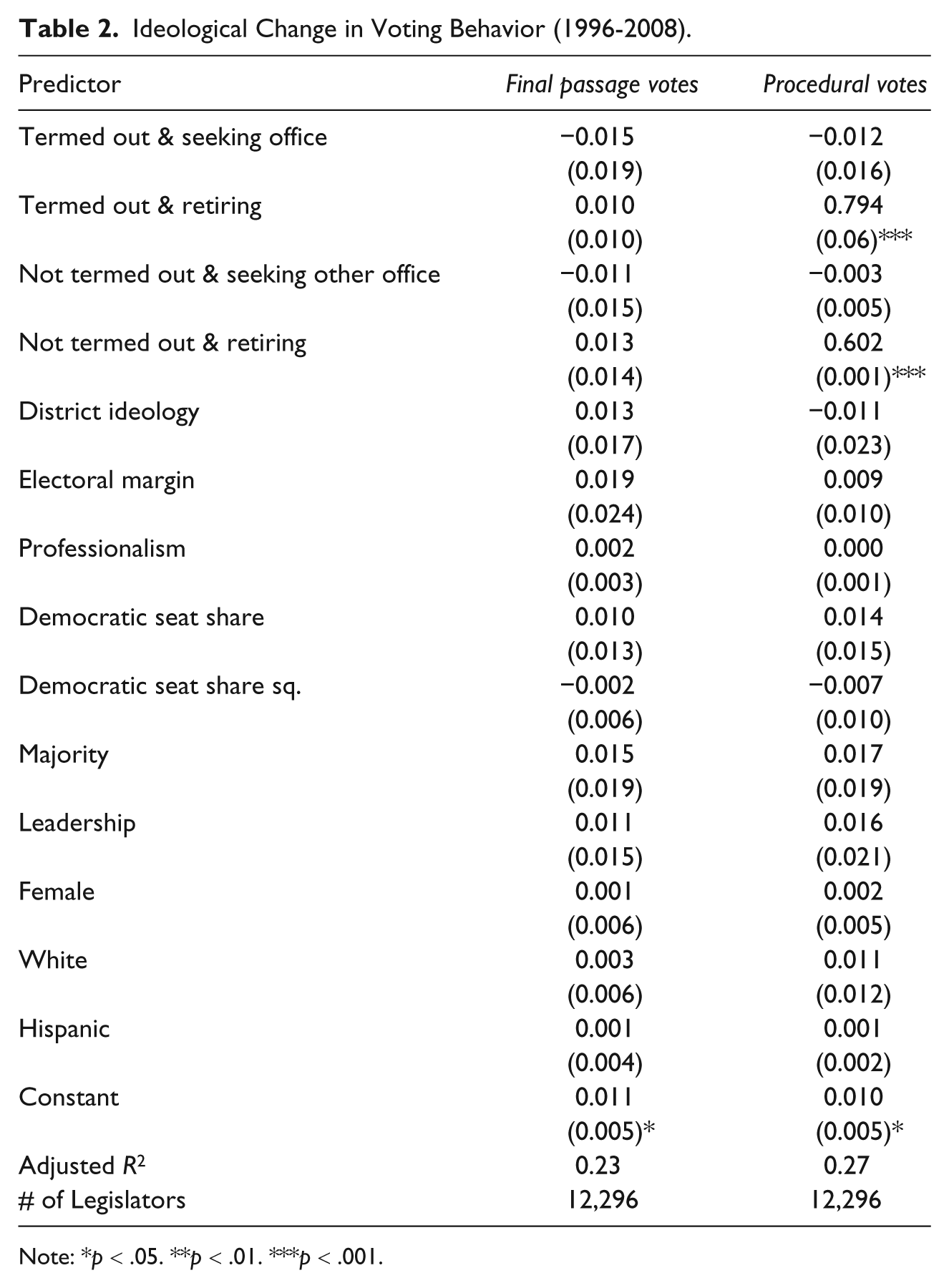
Note: *p < .05. **p < .01. ***p < .001.
We control for factors related to the electoral environment and institutional context. Specifically, we include measures for the electoral margin in the previous election and district ideology. None of these variables reach conventional levels of statistical significance in the model, however. We also include demographic and partisan controls but do not find that any of these variables significantly affect ideological consistency of members on final-passage votes.
Next, we investigate ideological consistency on procedural votes. The general expectation is that procedural votes elicit much more partisan behavior since they are less visible to constituents yet are absolutely crucial for the parties to maintain control over the chamber (Sinclair, 2000). The results of the model are displayed in the last column of Table 2. In line with our expectations, we find that term-limited legislators who will not to seek another elective office exhibit significant ideological change on procedural votes, and we also find that legislators who are not termed out but nonetheless are retiring also exhibit ideological shifts on procedural votes. Term-limited legislators who choose to run for another elective office (or who are appointed to public office during the next term) did not exhibit any significant shifts in their voting behavior on procedural votes.
Legislators who were not termed out yet were pursuing another office also experienced no substantial shifts in their voting behavior on procedural votes. Thus, the act of seeking another elective office (even removing the possibility of being elected to one’s own legislative seat) still provides an incentive for legislators to remain consistent in their support of the party leadership on procedural issues. 9 Legislators who were facing term limits and who decided not to run for another elective office saw significant ideological shifts in roll call voting behavior on procedural issues. Legislators who were not termed out yet were retiring from office also significantly shifted their voting on procedural issues. We have estimated alternative models to examine the robustness of this model and find results consistent with these (see online Appendix A).
The results of these models suggest an important role for political parties in legislative voting. The majority party appears to exert more control over procedural matters; yet, when the electoral connection is severed and legislators are not dependent upon the party organization (since they are not seeking another elective office), parties lack the capacity to impose discipline on members on both policy and procedural matters. These results highlight the importance of party leadership in maintaining procedural control of the chamber. Moreover, the fact that final-passage votes witnessed a much lower degree of ideological change among members (and only in one chamber did we see the relationship reach conventional levels of statistical significance) indicates that members tend to remain ideologically consistent and less beholden to party pressures. To be sure, there are particular instances in which party leaders may need to exert influence over members who are “on the fence” over final passage of policies. Despite the anecdotal evidence of party pressure on final passage, this does not appear to be a widespread phenomenon according to the data. Neither electoral margins nor district ideology reached conventional levels of statistical significance.
Legislative Participatory Shirking
We next turn to our analysis of participatory shirking, which focuses on changes in members’ abstention rates on floor votes. We again have divided the legislative votes to allow for separate analysis of final-passage votes and procedural votes. Legislative abstention rates were calculated as the number of roll calls for which a legislator abstained (i.e., did not cast a vote) divided by the total number of roll call votes taken. We then calculated the absolute difference in the abstention rates for each individual i from one session to the next legislative session. If indeed legislators shirk, then we would expect to see an increase in abstention for members who are termed out and not seeking another public office. This will be true especially for procedural votes which are much less salient to the public. We expect that termed out legislators who are seeking another office will experience an increased abstention rate. In addition to the severing of the electoral connection, legislators pursuing another office may have incentives to avoid position-taking on roll call votes that may increase their vulnerability (Jones, 2003; Rothenberg & Sanders, 2000).
We estimated a model of legislators’ change in abstention rates using OLS with standard errors clustered by chamber-year. 10 The dependent variable is measured as the absolute difference in an individual legislator’s abstention rate for time t minus his/her abstention rate at time t-1 on roll call votes. We include the same predictors used in the previous models. The results of the model of participatory shirking are presented in Table 3.
Abstention Rate Change (1996-2008).

Note: *p < .05. **p < .01. ***p < .001.
The shirking theory argues that legislators who are no longer constrained by constituents (i.e., those termed out) will shirk their legislative duties and thus term limits will lead to greater abstention rates among legislators. In our model of abstention rate changes on final-passage votes, we find evidence of shirking when legislators will not be continuing service in the chamber whether voluntarily or involuntarily leaving. We find that termed out legislators who are not seeking another elected or appointed office do experience much higher abstention rates. Specifically, their abstention rate increases by about 12% on final-passage votes (4% for those voluntarily leaving). We also find that members who are affected by term limits yet running for another office experience much higher abstention rates. We find that these members’ abstention rates increase by about 16% (about 7% for those not termed out but seeking another office). The high abstention rates among members pursuing another office may come from the increased demands associated with running for another office, or they could stem from legislators’ reluctance to engage in position-taking for fear that visible votes on controversial policies could be used against them in their next election. Examining abstention rates for procedural votes, which are less salient to the public, may help distinguish between these competing explanations. If the increased demands associated with pursuing higher office leads to greater abstention rates, then we would expect a similar pattern for procedural votes. If legislators pursuing another office are concerned with taking controversial positions then we may not see similar patterns of abstention on procedural votes since they are more obscure. The demographic control variables included in the model failed to reach conventional levels of statistical significance. Electoral margin and party competition within the chamber were also insignificant.
Finally, we estimated a model of abstention rate changes for procedural votes. Previously, we argued that procedural votes are much less visible and salient to the public, and therefore we would expect members who are no longer susceptible to party pressure (i.e., legislators facing term limits and no longer seeking public office) to shirk. We expect members who are termed out but pursuing another public office to remain susceptible to party pressure, and therefore we expect no significant change in abstention on procedural votes. Similarly, we expect that members who are not termed out but are seeking another public office will remain susceptible to party pressure, and therefore, they will not see significant increases in their abstention rates on procedural votes. The results of the model of abstention rate changes on procedural votes are presented in the last column of Table 3.
The results of the model are consistent with our expectations. When examining changing abstention rates on procedural votes, members who experienced significant changes are those members who termed out and did not seeking another public office as well as those not subject to term limits but retiring from office. Among those termed out and not pursuing another office, the abstention rates increased by about 18%. Members who voluntarily left the chamber and did not do so to pursue another public office had about a 5% increase in their abstention rates on procedural votes. Members who were termed out and were seeking another office did not experience any significant changes in their abstention rates on procedural votes. Likewise, members who voluntarily left the chamber to pursue another office did not experience significant shifts in their abstention rates. We believe that the influence of political parties on legislative behavior remains strong for those members seeking another public office, and since procedural votes are a key mechanism by which parties maintain control over the floor, we would expect that shirking on procedural votes could have negative ramifications for their bid to win another office.
We also included a number of controls in our model of legislative shirking on procedural votes. The standard demographic variables included in the model did not significant influence abstention rates on procedural votes. Electoral margin and party competition within the chamber were also insignificant.
Conclusion
This research utilizes the advent of term limits for state legislators to assess whether severing the electoral connection leads members to engage in ideological and participatory shirking. Our research advances a model of shirking that incorporates political parties; and in doing so, we argue that parties may still wield influence over termed out members who are seeking another public office. Furthermore, parties may have a greater incentive to exert influence over procedural matters (rather than final-passage votes). We find mixed support for this theory. Our model of ideological change fails to demonstrate significant shifts in legislative behavior for final-passage votes among term-limited legislators (regardless of whether they are pursuing another public office). We do find significant ideological change on procedural votes for members who are leaving public office whether due to term limits or voluntarily retiring. This is precisely where we might detect party influence since procedural votes are much less visible to the public yet very important for party leaders.
We also find some support for our theory of shirking when we examine participatory shirking on roll calls. Legislators who are facing term limits—regardless whether they are pursuing another public office—exhibited significantly higher abstention rates on final-passage votes; while only those who are termed out and not seeking another public office saw higher abstention rates on procedural votes. Those legislators seeking another office have incentives to participate in procedural votes since these are crucial to party leadership. However, members pursuing another public office may very well have incentives to avoid taking positions on final passage of bills if they believe these votes could be used against them.
This research has broader implications for scholars interested in representation and the role of parties in legislative politics. Prior research has argued that elections play a central role in legislative politics; however, there are a variety of ways in which elections may influence legislative behavior (see, e.g., the elections as selection theory and the elections as sanctions theory cited above). The model of ideological shirking provides support for a selection theory of elections wherein the electorate selects members who on average represent their collective views and carry those on in their vote behavior. In terms of legislative effort, our work suggests that legislators do respond to the incentives that elections provide, and moreover party leadership plays an important role in legislative politics. Our findings suggest that term limits do have the capacity to influence legislative behavior as well. Most notably, term limits may decrease the level of participation of members on floor votes and this raises further questions concerning whether legislators’ efforts in other stages of the legislative process also decline when term limits take effect. Future research may examine other forms of behavior, such as bill initiation, committee debate and markup, and floor debate, in order to assess whether these patterns are solely confined to roll call votes or extend more broadly to other forms of participation in the legislative process.
Footnotes
Acknowledgements
We would like to express our gratitude to Jennie Bowser at NCSL for providing data on term limits, and Gerald C. Wright for data on district ideology. We would also like to thank the three anonymous reviewers and the journal editor for helpful comments that enabled us to improve the manuscript. Any errors are solely the responsibility of the authors.
Declaration of Conflicting Interests
The authors declared no potential conflicts of interest with respect to the research, authorship, and/or publication of this article.
Funding
The authors received no financial support for the research, authorship, and/or publication of this article.