




Abstract
Past research demonstrates that free time is an important resource for political participation. We investigate whether two central drains on citizens’ daily time—working and commuting—impact their level of political participation. The prevailing “resources” model offers a quantity-focused view where additional time spent working or commuting reduces free time and should each separately decrease participation. We contrast this view to a “commuter’s strain” hypothesis, which emphasizes time spent in transit as a psychologically onerous burden over and above the workday. Using national survey data, we find that time spent working has no effect on participation, while commuting significantly decreases participation. We incorporate this finding into a comprehensive model of the “daily grind,” which factors in both socioeconomic status and political interest. Our analysis demonstrates that commuting leads to the greatest loss in political interest for low-income Americans, and that this loss serves as a main mechanism through which commuting erodes political participation.
In general, Americans are busy earning their livings and raising their families. They are not very well informed about politics and public affairs, do not care a great deal about politics, do not hold many of their views strongly, and are not ideological. Politics is the sideshow to the great circus of life.
For most Americans, the “daily grind” refers to the constant stream of obligatory daily activities that consume the greater part of one’s awake life. Over the past quarter century, the daily grind is expanding beyond the time spent at one’s job to include the precious and ever-increasing minutes a day spent by Americans getting to and from work. In 2010, the average hours per day spent on work and work-related activities for working Americans was 8.23 hr on weekdays and 5.23 on weekends. 1 While it is a matter of debate whether Americans are working longer hours now than in the mid 20th century (Putnam, 2000), Americans are undeniably spending more time commuting to work. In 1990, of Americans who did not work from home, about 30% had commutes of 30 min or longer; in 2009, this figure rose to 35%, representing an increase in time spent commuting for above 12 million Americans. Indeed, Americans spent a total of 55.6 million hours commuting to work in 2009 compared with 41.6 million in 1990. 2 The general question of this article is what effect, if any, does the time spent working and commuting have on citizens’ level of political participation? Furthermore, with more Americans engaging in longer commutes, a question of central importance is whether the time spent getting to and from work affects political engagement.
In this article, we engage these questions by contrasting a dominant theoretical framework in the political participation literature to an alternative approach derived from literature in psychology and behavioral economics. The former is a resources-centered model, which focuses on concrete assets, such as free time, money, and skills, that enable and foster political engagement. This model would suggest that by their common consumption of the quantity of free time usable for performing one’s role as citizen, increased time spent working and commuting should each contribute to a decrease in engagement in political activities. In contrast to the quantity-focus of the resources model, we offer an alternative approach that emphasizes impacts associated with specific qualities of time-consuming daily activities, such as their differential depletion of psychological resources and/or induction of negative emotions. This alternative approach leads to a “commuter’s strain” hypothesis, which argues that an increase in time spent commuting will more strongly dampen political engagement than additional time spent working. This alternative prediction is based on the presumption—supported by research in behavioral economics and industrial/organizational psychology—that time spent commuting involves a higher degree of depletion of psychological resources and incurrence of negative emotions than time spent on the job.
Drawing upon national survey data, this article analyzes the independent effects of time spent working and commuting on political participation. Our results indicate that, even after controlling for a variety of relevant individual and contextual factors, time spent working exerts no impact on one’s level of participation. An increase in time spent commuting, however, is found to lead to a significant decrease in participation. In unpacking this main effect, we offer and empirically validate a comprehensive theoretical model for the impact of the daily grind on citizen participation. This model integrates leading “SES” and “resources” models of participation (Brady, Verba, & Schlozman, 1995) into a comprehensive framework that situates individual income and interest in politics as key factors serving to condition and channel the effect of commuting on the level of participation of working Americans. We find that political interest serves as a significant mediator between commuting and political participation, but that this mediated effect is itself moderated by individual income. Among lower income Americans, a longer commute leads to a significant erosion of interest in politics, and this in turn leads to significant decreases in participation. Among higher income Americans however, the relationship is reversed; increased time spent commuting among those with the highest income is found to significantly enhance interest, which in turn, increases levels of participation.
Our theory and findings make several contributions to the study of political participation and have important implications for citizenship and democracy in the United States. First, our research moves beyond past work by directly engaging the issue of the impact of the daily grind on citizen engagement and analyzing the effects of work and commuting separately. We find that while work consumes much more of the average Americans’ daily time relative to commuting, it is the latter component of the daily grind that impacts political interest and engagement. As the process of urban and suburban sprawl continue, and the trend of more commuters and increased commuting times persists, activists and mobilizers will have to contend with a powerful societal-level process depleting citizens’ psychological resources and thus undermining mass participation in the nations’ political life. Second, our theory and analyses bring money into the equation in a new manner by showing that income moderates the effect of the daily grind, such that low-income individuals are the ones most “ground down” by long daily commutes, as manifest in reductions in their level of psychological engagement with politics. In finding that the negative impacts of commuting are mostly concentrated among those at the lower end of the income distribution, our results suggest that the societal processes increasingly forcing commuting on individuals, and leading to longer commuting times, are working to further distance an already weakly active and often marginalized segment of the populace from the democratic process.
Daily Demands and Political Participation
In asking why citizens fail to participate in politics, the standing wisdom in the political participation literature is “because they can’t, because they don’t want to, or because nobody asked” (Brady et al., 1995). These three factors allude to resources, interest, and mobilization, and collectively comprise the “resources” model of mass political participation in America. One of the key resources in this model is time, with a principle finding being that citizens with more free time are more likely to participate in politics (Brady et al., 1995; Schlozman, Burns, & Verba, 1994). This finding forms a conventional wisdom, namely that for most Americans, performing one’s role as citizen competes with work and family, and more often than not, loses out to these daily demands. In short, the standing belief is that the “daily grind” consumes the majority of Americans’ daily time and attention and leaves little left over to be invested in performing one’s role of citizen in political life. This standing wisdom, however, relies on data collected in 1989 and the use of an “omnibus” measure of free time that fails to analyze the independent effects of time spent on different obligatory daily activities. These characteristics of the evidence in support of the resources model are of interest because society has undergone significant changes since the late 1980s with respect to obligatory daily-time use. To be sure, one prominent and persisting change in daily life for Americans is the need to commute to work and increasing time spent in transit. Several questions loom large: What effect does commuting have on political engagement, and how do these effects, if any, compare with those of the other primary consumer of citizens’ daily time–work.
The answer provided by the resources model is relatively clear: Free time is an essential resource for political participation; thus any activity that consumes this time should consequently decrease participation. Given their common consumption of free time, the resources model would predict that longer hours at work and more time in transit should each have a negative effect on engagement. Furthermore, one could even conclude from the logic of the resources model that work, by consuming a far greater share of time in the day than even a long commute, should exert a more pronounced negative effect on participation than commuting. These predictions regarding the effect of the daily grind on participation as offered by a resources model have not been subjected to much direct empirical testing. As noted, Brady et al. (1995) rely on an omnibus measure of free time that does not analyze the separate effects of different time-consuming activities; further, their measure, while accounting for time spent working, doing chores, studying and/or going to school, and sleeping does not account for the time spent commuting. Thus, while we do know that less free time decreases participation, we do not know whether some consumers of free time matter more than others in driving this effect.
At present, the scant existing research analyzing the effects of work hours and commuting on participation either produce results seemingly inconsistent with the resources model or render mixed results. In the case of work, one of the most prominent findings in the participation literature is the positive correlation between work hours and civic engagement (Putnam, 2000). More specifically, Putnam (2000) finds that employed people are more active civically and socially than those outside the paid labor force, and that among paid workers, longer hours are often associated with more civic engagement, not less. This finding—which has yet to be subjected to much further replication by other participation scholars—clearly contradicts the resources model’s prediction with respect to free time. Turning to commuting, however, the effects are more inconclusive. Leading research in the United States finds that longer individual commutes unequivocally erode social ties and local civic engagement (Putnam, 2000; Williamson, 2002). This effect, however, does not appear to extend to participation in the broader political arena, as several studies find that individual commuting has no effect on general forms of political participation (e.g., voting, attending a political rally, contacting one’s Congressperson, discussing politics) in the United States (Hopkins & Williamson, 2012; Humphries, 2001; Oliver, 2001; Williamson, 2002) or in Sweden (Lidström, 2006). To add further complexity to the small body of work on commuting, several studies—some of which find no effect for individual commuting—find that residing in suburban contexts with more long-distance and single-occupant vehicle commuters decreases civic engagement and political participation (Freeman, 2001; Hopkins & Williamson, 2012; Humphries, 2001; Williamson, 2002).
In short, when it comes to understanding the impact of citizens’ daily grind of work and commuting on their level of political participation, we come away from the small body of existing research with an uncomfortable degree of uncertainty. In the case of Brady et al. (1995), the results are based on decades old data and the analysis does not include commuting or analyze the effects of various obligatory activities separately. In the case of the handful of studies directly addressing commuting, the amount of time spent at work is not included in any of the analyses and the results tend to vary depending on whether the focus is on explaining neighborhood civic engagement versus broader political participation, and whether the predictor is individual-level versus aggregate commuting. In the end, the existing research provides an inadequate answer to the question of whether the persistent routine of work and commuting impacts citizens’ level of political engagement.
Beyond a Quantity-Focus: Time-Use, Negative Emotions, and Psychological Resources
Beyond these core shortcomings in the literature, one problem we find in the current research that is more foundational and theoretical in nature pertains to the resources framework itself. One inherently problematic feature of the resources model is that it presumes that any activity that consumes free time should, by virtue of this property, decrease political participation. In other words, the model presumes an equivalence in impact on political engagement of an additional unit of time spent working, commuting, or doing any obligatory activity that consumes the finite hours in one’s day. Thus, this model possesses a strong quantity-focus coupled with agnosticism with respect to the qualitative impacts of different obligatory activities. This can be summarized by the prediction that any activity that consumes one’s finite free time should decrease participation, and the greater quantity of time you spend on this activity, the more it should decrease engagement with politics. This framework ignores the possibility that it is not just the amount of time spent performing some obligatory activity that matters, but also variation in the qualities of these activities, such as experienced differences in the psychological impact of the activity.
In contrast to the resources model, the theory of ego depletion (Baumeister, Bratslavsky, Muraven, & Tice, 1998) argues that general acts of volition (making decisions, taking responsibility, planning actions, initiating planned behavior, etc.) draw upon and deplete a limited “will power”–type of psychological resource that is akin to one’s finite stores of physical strength or energy. The core prediction of ego depletion theory is that engaging in one act of volition will, by its consumption of limited ego resources, have a detrimental impact on engagement in subsequent acts of volition. While ego depletion theory has been used to study a wide range of behaviors, it has yet to be firmly applied to explaining any type of standard political behavior, such as political participation. A key feature of the ego depletion framework, that pits it against the resources model with respect to the predicted effects of work and commute on participation, is its recognition that activities may vary in terms of their depletion of ego resources. For example, deliberating over a decision of minor importance may not have the same depleting effect as engaging in major acts of self-restraint, such as resisting the urge to smoke a cigarette. This characteristic of the depletion framework serves as the major contrast point to the resources model by suggesting the possibility that some features of the daily grind, by differentially depleting ego resources, may erode political engagement more than others.
In the present case, we translate this feature of the ego depletion framework into the prediction that time spent commuting, on average, will have a more pronounced negative effect on political engagement than time spent working. We label this the commuter’s strain hypothesis. This opposing prediction to the resources model is grounded in the presumption that a unit increase in time spent commuting, on average, leads to a greater consumption of ego resources rather than a unit increase in time spent working. This presumption is strongly supported by various veins of research across multiple disciplines that converge upon the conclusion that commuting is an onerous burden over and above the workday, and one which is experienced, on average, more negatively than the burden of being at one’s job. Put succinctly, while many Americans do experience some degree of dissatisfaction with their job, the majority of those who commute, especially above 45 min each way, strongly dislike commuting and report high levels of experienced frustration from commuting. 3
First and foremost, while burnout and stress are documented psychological phenomena associated with work and commuting (Koslowsky, Kluger, & Reich, 1995; Maslach & Jackson, 1981), behavioral economics research on subjective well-being suggests a nonequivalence in the psychological impact of an additional unit of time spent commuting versus working. For example, relative to all other daily activities, including work, commuting has been reported as the daily activity producing the absolute lowest level of positive affect and high relative levels of negative affect (Kahneman et al., 2004a). Moreover, Kahneman et al. (2004b) find that the net affect rating (i.e., positive affect minus negative affect) for commuting is significantly lower than that for work, and Kahneman and Krueger (2006) demonstrate that the proportion of time spent engaged in an activity where the dominant emotion is negative is much higher for commuting than for working.
This research strongly comports with clinical and industrial psychology research documenting the presence of a range of stressors experienced from commuting that are typically absent in the workplace (e.g., noise, crowds, uncomfortable temperature, pollution, traffic congestion, earlier wake times, fear of tardiness) that can produce negative effects on personal physical and mental health and family life (Costa, Pickup, & DiMartino, 1988; Koslowsky et al., 1995; Novaco & Collier, 1994). Given the range of stressors introduced into one’s day from commuting, it is not surprising that commuters, on average, report lower levels of life satisfaction than noncommuters (Bunker, Zubek, Vanderslice, & Rice, 1992; Stutzer & Frey, 2008). Taken together, this research strongly suggests that commuting involves a weightier “withdrawal” from citizens’ daily “bank” of psychological resources than time at the job. Beyond the effect of stressors during commuting not present during time at the job, time commuting could be experienced more negatively because citizens’ subjective well-being may be anchored at an equilibrium point on the day-to-day that automatically accounts for time on the job, whereas commuting is experienced as a burdensome intrusion into the precious few nonworking hours in the day.
In short, we find ourselves with two competing hypotheses with respect to the expected effect of the daily grind on citizen participation. Leading past research in the participation literature offers a resources hypothesis, which argues that an increase in time spent at work or commuting should both exert negative effects on participation in political life. This prediction is based in the logic that free time is an essential resource for participation, and increased time at the job and commuting to and from work mutually consumes limited free time. In contrast, the commuter’s strain hypothesis, grounded in the ego depletion framework, suggests that commuting should strongly decrease participation, and that the effects of commuting should dwarf the effects—if any—of time spent working. This prediction is based on psychological literature suggesting that different performed activities can be qualitatively distinct from one another with respect to the negative emotions they produce and their consumption of self-resources. To solidify the strain hypothesis, we matched our underlying ego depletion framework with abundant evidence regarding the negativity with which individuals experience commuting absolutely and relative to work. We now move directly to a test of these competing perspectives, and follow our discussion of the results from this initial test with the explication of a comprehensive model of the daily grind that synthesizes the SES and resources models with the ego depletion framework to generate a model of the effects of the daily grind that accounts for psychological resources, income, and political interest.
Data and Method
To test these competing hypotheses concerning the effect of the daily grind of working and commuting on Americans’ level of participation in politics, we draw upon the 2005 Citizenship, Involvement, Democracy Survey (CID) conducted by the Center for Democracy and Civil Society at Georgetown University (Howard, Gibson, & Stolle, 2005). This survey comprises 1,001 face-to-face interviews of adult Americans throughout the contiguous United States. The survey was conducted between May 16 and July 19, 2005, and used a cluster-sample design, achieving an overall response rate of 40%. To test our hypotheses regarding the effects of work and commuting, our analyses are necessarily restricted to the 590 respondents reporting engaging in paid work. 4
We rely on straightforward measures of working and commuting. The CID contains an item asking respondents to report the number of hours in the average week that they engage in paid work in office and home workplaces. From this item, we created a variable labeled Time at Job, which is the average reported hours per week spent working divided by 5, thus yielding a measure of the average hours per day spent working in the typical 5 day work week (
Despite the relatively modest size of the sample of working adults from the CID, we find that the estimated time spent working and commuting from this sample compare very well with those of larger samples of Americans. For example, the 2005 American Time-Use Survey conducted by the Bureau of Labor Statistics (BLS)—which draws upon a sample of roughly 13,000 individuals—finds that the average hours per weekday spent working in 2005 was 8.36, which is identical to the estimated mean hours per day spent working among the 590 CID respondents. In terms of commuting, 33.2% of working respondents in the CID reported commuting 30 min or more to work daily, which is comparable, though slightly lower, than the figure of 37.4% estimated from the 2006 American Community Survey (ACS) of the U.S. Census Bureau. Furthermore, despite being conducted in the mid-2000s, the estimated averages of working and commuting from the CID are within reasonable bounds of recent figures. The BLS estimated that the average hours per weekday spent working in 2011 was 7.95, which represents a slight decrease from 2005, likely due to increased part-time employment in the wake of the 2008 financial crisis. In addition, the 2011 ACS estimated that roughly 38.6% of American workers commute 30 min or more per day to work. The closeness of the figures for working and commuting from the CID to those from the BLS and ACS—in 2005 and more recently—make it a desirable sample for making inferences about the general population of working Americans.
To gauge variation in respondents’ level of political participation, we relied on eight dichotomous items and one ordinal item in the CID tapping whether, or the degree to which, the respondent engaged in a particular form of participation. The eight dichotomous items included whether the respondent voted in the 2004 Presidential Election (70.3%), and whether in the last 12 months the respondent contacted a politician/local government official (20.9%), worked in a political party/action group (8%), worked for the campaign of a candidate for political office (8.2%), worked for another political organization/association (4.8%), wore or displayed a campaign badge/sticker (22.4%), signed a petition (34.3%), and donated money to a political organization or group (20.2%). The ordinal item asked respondents to report how often they discuss politics/public affairs, ranging from (1) “never” (11.5%) to (7) “every day” (15%). Rather than creating a summative scale from these items, given their categorical nature, we created a Bartlett factor score from these items derived from the first factor of a factor analysis utilizing the polychoric correlations between these 10 items.
6
The combination of these items into an overall measure of political participation is in line with leading past research (Brady et al., 1995; Humphries, 2001). This measure was recoded to range from 0 to 1 (
All of our analyses controlled for education, income, age, gender (1 = male), race (dummy variables for Blacks and Hispanics), homeownership, tenure in one’s community, marital status, church attendance, political ideology, and strength of party identification. The inclusion of this set of controls is based on their established relevance as predictors of political participation (Brady et al., 1995; Conway, 1991; Lewis-Beck, Jacoby, Norpoth, & Weisberg, 2008; Rosenstone & Hansen, 1993; Timpone, 1998; Verba & Nie, 1972). For more information about the question wording and coding of these controls, see the appendix. As a first cut in analyzing our data, we performed an ordinary least squares (OLS) regression of political participation scores on time per day spent working and commuting and this set of control variables. Extant research has uncovered that contextual measures of residential mobility and aggregate commuting behavior—as indicators of neighborhood design and social capital—influence individual political participation (Hopkins & Williamson, 2012; Humphries, 2001). Furthermore, these studies measuring contextual commuting behavior tend to find null results for individual commuting on participation. Given this, we sought to assess the robustness of the results from our initial OLS regression by reestimating our model using a random-intercept multilevel model adding a series of relevant contextual controls. The CID provides information on the zip code of residence for each respondent; using this information, we drew upon the 2000 Decennial Census to obtain zip-level estimates for each respondent for the percentage of workers commuting to work via driving alone, the percentage of residents who lived in a different house in 1995, median household income, the unemployment rate, the percentage of Hispanic, and total population size. These contextual variables have either been found in past research to be relevant in shaping political engagement or have been included as theoretically relevant controls in such analyses (Hopkins & Williamson, 2012; Humphries, 2001). For ease of interpretation, all variables were recoded to range from 0 to 1.
Results
The results from our OLS and random-intercept regression model are presented in Table 1. Starting with the OLS regression, the results reveal that time at work exerted no effect on one’s level of political participation. Thus, an individual who works part days (4 hr per day), for example, is no more likely to engage in a higher level of political activity than an individual who works over a full shift per day (above 8 hr). This null finding contradicts those of Putnam (2000) and Brady et al. (1995). In the case of Putnam, however, the analysis focuses on community level engagement rather than broader political and electoral participation, which could be one basis for the discrepancy. In the case of Brady and colleagues, this finding clearly conflicts with their finding that an in increase in free time promotes participation, as work is the single highest consumer of the average American’s free time, and the results presented here reveal that those who have protracted workdays, and thus have minimal free time, are not less likely to participate in politics than their more leisured counterparts.
The Effect of Daily Work and Commute on Political Participation.
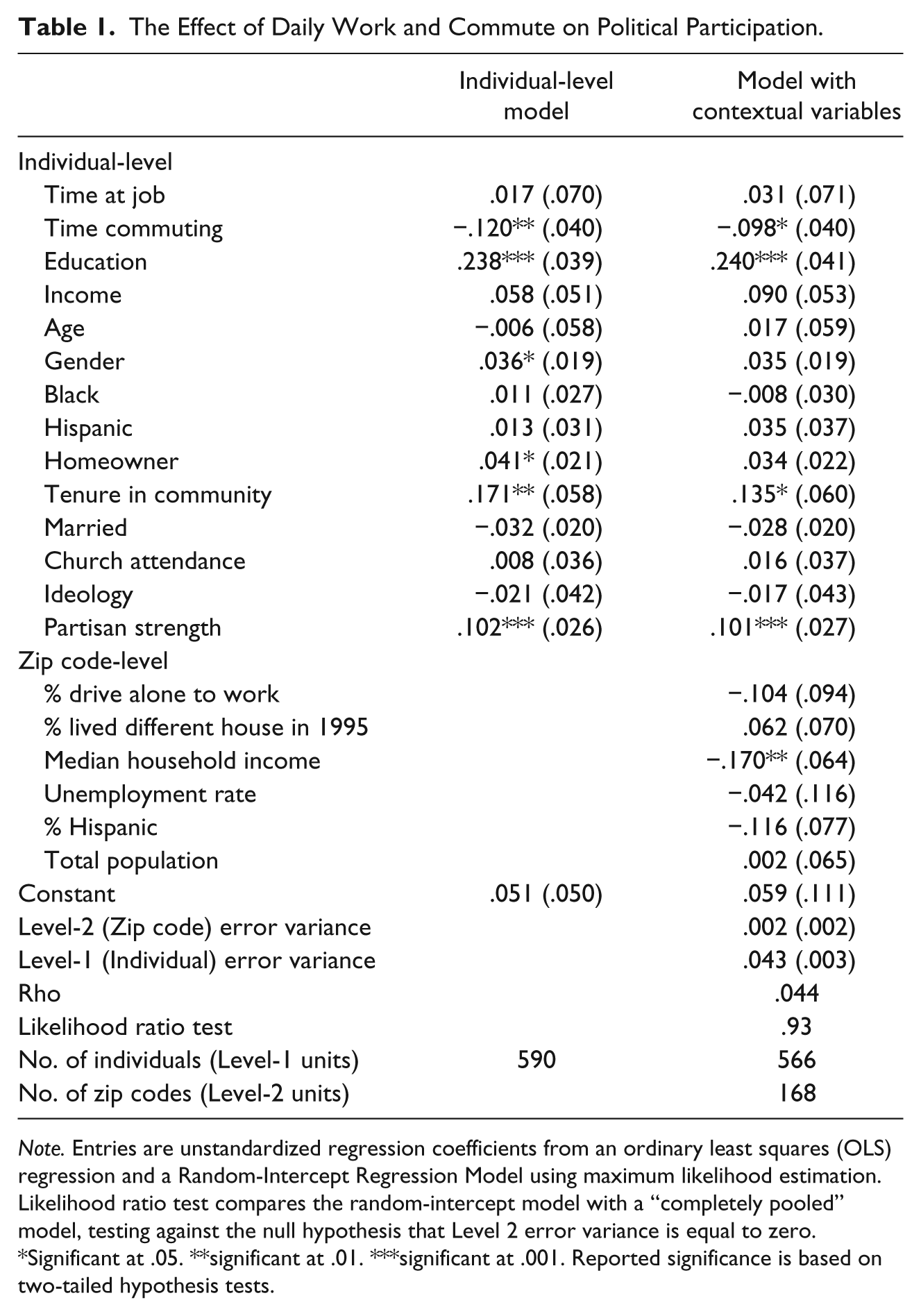
Note. Entries are unstandardized regression coefficients from an ordinary least squares (OLS) regression and a Random-Intercept Regression Model using maximum likelihood estimation. Likelihood ratio test compares the random-intercept model with a “completely pooled” model, testing against the null hypothesis that Level 2 error variance is equal to zero.
Significant at .05. **significant at .01. ***significant at .001. Reported significance is based on two-tailed hypothesis tests.
In contrast to the finding for time spent working, the results in Table 1 reveal that an increase in time spent commuting significantly decreases participation in politics. Indeed, going from those who work from home, and thus do not commute at all, to those who commute 60 min or more per day, we observe above a 12% drop in participation scores (based on a 0 to 1 scale). One possibility that needs to be explored is that the effect observed for individual commuting on participation is spurious, and that our measure of individual commuting is capturing other relevant factors that are actually responsible for driving the effect. For example, our measure of commuting may be capturing residence in a social capital-impoverished, suburban “bedroom community,” which is characterized by higher levels of residential mobility and single-occupancy vehicle commuting.
Extant research has identified residence in such communities as an environmental factor decreasing political participation (Hopkins & Williamson, 2012). To assess this possibility, as well as control for the potential effects of economic and ethnic context, we estimated a multilevel model containing a series of key contextual measures. The results in column 2 of Table 1 reveal that the basic dynamics between work, commuting, and participation hold after controlling for a series of contextual factors, specifically after controlling for residential mobility and the percentage of commuters who drive alone. To be sure, while residing in a zip with more single-occupancy vehicle commuters was found to decrease individual participation, this effect failed to attain even a marginal level of statistical significance. This finding contradicts those of Hopkins and Williamson (2012), though it should be noted that our analysis relied on zip-level measures rather than the tract-level estimates used in this prior work. Despite this, zip codes are a reasonable measure of respondents’ proximate residential context, and our general purpose is to account for these contextual variables and demonstrate that our results for individual-level commuting are robust across multiple specifications of our participation model.
Turning to the effects of the individual-level control variables in our models, we find results consistent and inconsistent with prior research. Consistent with past research, we find that political participation significantly increases with education and strength of partisanship, that men are more likely to participate than women, and that participation increases with home ownership and tenure in one’s community. Inconsistent with prior research, however, are the null effects observed for age, race, and church attendance. In attempting to account for these inconsistent results, we should first reiterate that our sample is restricted to working citizens only, and not the general public, which is the sample on which most prior participation research is based. This aside, the major culprit for the lack of significance of age, race, and church attendance in our analysis is our use of a combined measure of political participation as our dependent variable. Thus, our results may differ from those established by prior work in the field whose analyses tend to focus on voting and a more limited set of campaign-related participatory behaviors. While the constituent items in our analysis strongly load on a single factor, prior research has argued that different types of participation behaviors are associated with different constellations of predictors (e.g., Dalton, 2008). Thus, within the confines of our analysis, the controls emerging as significant are those that exert consistent and strong effects across constituent items, and thus strongly increase general political participation as a latent construct indicated by various behavioral measures.
The results thus far provide support for the commuter’s strain hypothesis and evidence against the resources model. Indeed, when it comes to the daily grind of work and commuting, our results indicate that it is primarily the daily hassle of spending long times in transit to and from work that erodes engagement in the political arena. The finding that long hours spent at work exerts no effect on participation—while long commutes do—strongly suggests the insufficiency of the simple quantity-based approach offered by the resources model. Despite consuming much more of one’s total free time per day than even the longest commute, long work hours had no effect on participation, suggesting that it may not be the quantity of time spent engaging in some obligatory daily activity, but the quality of this time. For the majority of citizens, the obligatory economic role of income earner supersedes the mostly voluntary political role of citizen, and our findings thus far provide some suggestive evidence in favor of a more psychological approach toward theorizing the nature of the relationship between these role domains. Rather than just focusing on how time spent performing one role leaves less time for the other, our results suggest the importance of the experience of negative emotions and the depletion of psychological resources associated with specific obligatory activities that erode the resources needed to engage in acts of volition—such as voluntary participation in politics.
Explaining the Effect of Commuting on Political Engagement
Having found that individual commuting significantly decreases engagement in political activities, the remaining task is to illuminate why this is the case. What is the causal process translating spending more time commuting, and presumably a greater depletion of ego resources, into decreased political engagement? In the following sections we aim to unpack this finding and incrementally construct a comprehensive model of the impact of the daily grind on political participation. We synthesize the resources, SES, and ego depletion framework into one mediated–moderated effects model (Baron & Kenny, 1986; Muller, Judd, & Yzerbyt, 2005), where, in theory, those of low income are the most “ground down” by longer commutes, and the impact of commuting on behavioral participation is theorized to occur via its erosion of one’s level of psychological engagement in politics—as captured by political interest.
Interest as a Mediating Variable
One long-standing axiom from the political participation literature is that being interested in politics and public affairs represents a central psychological involvement with politics that strongly motivates participatory behavior (Brady et al., 1995; Campbell, Converse, Miller, & Stokes, 1960; Conway, 1991; Lewis-Beck et al., 2008). While interest in politics is known to be promoted by factors such as education and age, we believe that an additional and essential basis for psychological involvement with politics is the possession of the actual psychological resources necessary to fuel mental and emotional involvement in extraobligatory activities. Drawing upon the ego depletion framework, one well-grounded prediction is that routine engagement in externally imposed, disliked, and thus depleting activities, such as commuting, should undermine interest in politics by depleting the stock of “residual” psychological resources leftover at the end of the workday for one to invest in engaging with politics. While not ruling out apathy as intrinsic to some citizens, the ego depletion framework does lend itself toward viewing political apathy as an indicator of being in “conservation mode,” whereby high levels of ego depletion and cognitive and emotional exhaustion render nonobligatory activities superfluous as a necessary means for the restoration of psychological resources (Baumeister et al., 1998). Thus, we hypothesize that one key mechanism through which the daily grind of long commuting times diminishes political participation is by the whittling down of interest in politics. In addition to being grounded in ego depletion theory, past research has found that interest in politics serves as a key intervening variable between aggregate-level commuting and political participation (Humphries, 2001).
Income as a Moderating Variable
Having argued for the importance of interest in politics as a primary intervening variable between commuting and participation, we now make an argument for the role of income in conditioning the impact of commuting on political interest. We offer several reasons for why we believe that income should moderate the effect of commuting on interest. First and foremost, we believe that the financial compensation an individual earns from working represents a benefit that offsets the costs associated with work. Commuting without a doubt represents a crucial transaction cost associated with work and earning an income, and the higher the level of one’s compensation for their work, the more likely it is that the incurrence of such costs will be psychologically and materially justified. Thus, we principally view one’s earned income as an “offsetting factor,” whereby the strain of commuting—and thus the depletion of ego resources—is offset by the acquisition of monetary resources that confer a host of countervailing effects.
Within the ego depletion literature, a handful of work has emerged that explore the factors conditioning the degree of depletion experienced by engaging in acts of volition, as well as the general means by which the resources of the self are replenished following depletion. For example, existing research demonstrates that experiencing positive events after work offsets ego depletion and fatigue induced by the workday (Gross et al., 2011). Furthermore, extant research demonstrates that the experience of positive emotions (Tice, Baumeister, Shmueli, & Muraven, 2007) and, most importantly, self-affirmation (Schmeichel & Vohs, 2009), each possess the capacity of offsetting the amount of depletion experienced from engaging in various ego depleting acts. Applied to the present case, we view income as a key factor capable of offsetting the strain of commuting by facilitating positive events and emotions via enhancing one’s capacity for discretionary utility maximization (i.e., acquiring desired goods and services). Beyond this, however, we also view income as an offsetting factor to the strain of a long commute by facilitating self-affirmation—defined as “behavioral or cognitive events that bolster the perceived integrity of the self and one’s overall moral and adaptive adequacy” (Schmeichel & Vohs, 2009; Steele, 1988). Thus, for lower income commuters, the cost of a long commute is not only associated with lower material compensation, but may also be associated—because of lower compensation—with a diminished basis or capacity for self-affirmation relative to those commuting to higher paying jobs.
In short, we hypothesize that income, by offsetting the degree of depletion experienced by the strain of commuting, should moderate the degree to which commuting erodes interest in politics. Among lower income commuters, we hypothesize that the strain of commuting should be maximized, and thus the amount of self-resources necessary for psychological involvement with politics should be at a minimum. This effect, however, should be attenuated among higher income commuters, who, according to our framework, should be better able to offset or justify the strain of commuting, and thus should be more likely to have greater psychological resources available for investing in extraobligatory cognitive exertions, such as attending to public affairs.
Beyond grounding this hypothesis within the ego depletion framework, we should note the theoretical possibility that income may moderate the effect of commuting on interest for reasons other than shaping the amount of depletion offset. Two possibilities stand out: First, income may shape the type of commuting one engages in, and second, income may shape how one spends their time during their commute. In the former case, the stressors associated with commuting, such as noise, vibration, overcrowding, or pollution, maybe associated with certain types of commuting (i.e., mass transit vs. single car driver) that themselves are correlated with income. This first alternative possibility, however, could be ruled out given evidence that, variation in modes of commuting aside, higher income commuters are no less dissatisfied or frustrated with their commuting than low-income commuters. 7 In addition to the absence of a relationship between income and satisfaction with commute, we should also note that, within the confines of the CID data, there is no correlation between income level and time spent commuting in the first place (r = .037). In the latter case, higher income individuals may use the time during their commute in a way that promotes interest in politics. For example, those with higher incomes are significantly more likely than those with lower incomes to listen to political talk radio 8 and read the news during their commutes. 9 Given that we know that income tends to be associated with political interest in the first place, it is also possible that, the strain from commuting withstanding, a relationship of reciprocal causation sets in among higher income commuters. This reciprocal causation can be characterized by income heightening political interest, which increases the likelihood of engaging with politics as a method of spending time during their commute, which in turn reinforces and magnifies interest. Taken together, the remaining theoretical possibilities—depletion offset and time-use during commute—each point toward the same hypothesis: namely that income should moderate the effect of commuting on political interest.
The Daily Grind: A Comprehensive Mediated-Moderated Effects Model
In the prior two sections we argue that political interest should mediate the effect of the daily grind of commuting on political participation, and that individual income should moderate the effect of commuting on political interest. In short, we have explicated a comprehensive model where the effect of commuting on political interest is moderated by income, and the moderated effect of commuting on political participation is mediated by political interest. In essence, this model reflects an attempt to synthesize the SES and resources models with the ego depletion framework. We provide a graphical depiction of our full theoretical model in Panel A of Figure 1. In Panel A, we begin the causal process with obligatory daily activities, with a present focus on commuting. From this box, we see an arrow pointing toward “intervening factors,” with interest in politics serving as the variable of main interest hypothesized to mediate the impact of commuting on political participation. Situated in the center above obligatory daily activities and intervening factors is a box labeled “Offsetting Factors”; the position of this box and its downward pointing arrow is intended to indicate its status as a factor moderating the effect of obligatory activities on our intervening variable. Last, at the end of the causal process, we our have our outcome variable of interest—political participation—and an arrow pointing from the intervening factor of political interest toward participation. Accompanying this graphical depiction of the main components of our theoretical model, we explicitly list the three hypotheses we intend to test along their relevant path arrows within the model.
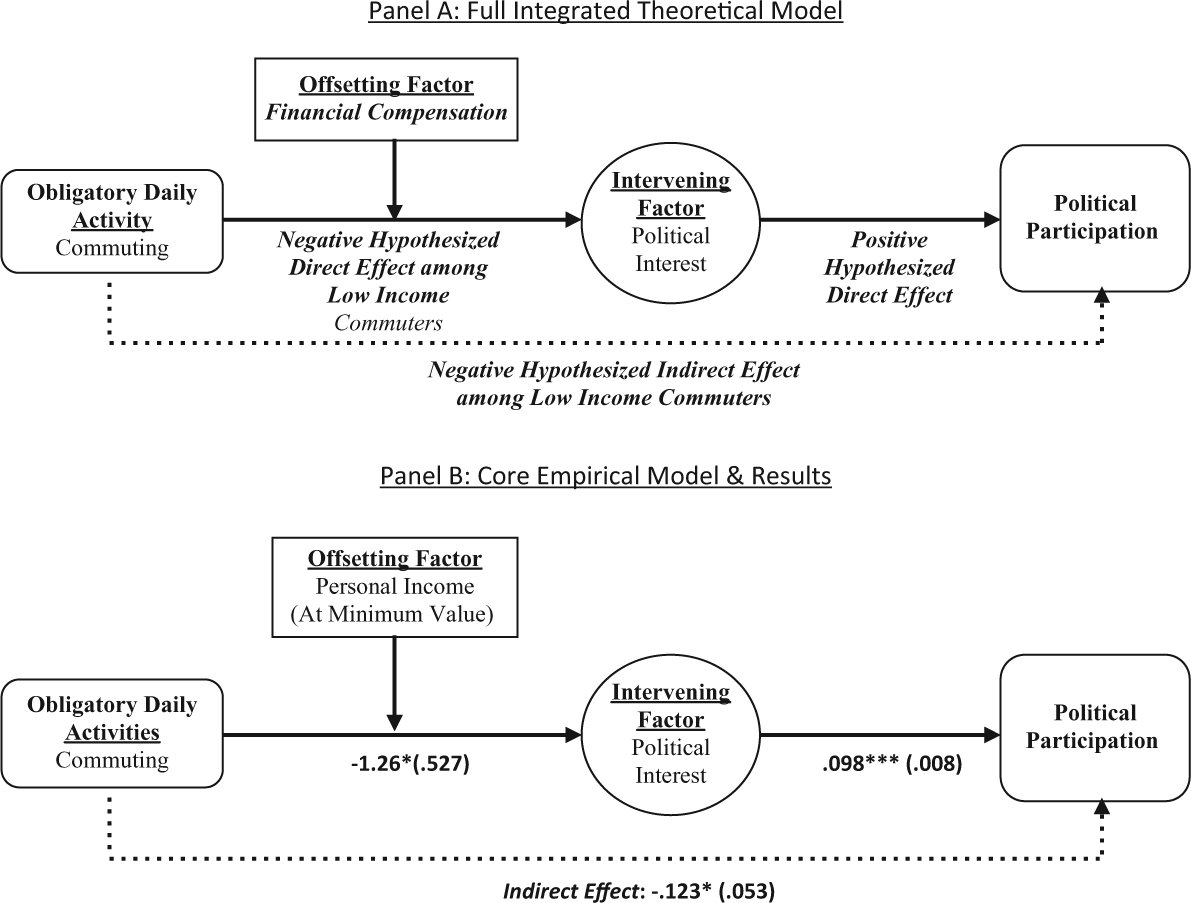
Comprehensive model of the effect of the daily grind on political participation.
Analysis
To test our comprehensive daily grind model, we estimated a mediated–moderated effects (see Baron & Kenny, 1986; Muller et al., 2005) structural equation model (SEM). This type of SEM allows us to represent our theoretical model in empirical form, where income is modeled to moderate the impact of commuting on political interest, and political interest is modeled to mediate the impact of commuting on political participation. Furthermore, estimation of a SEM allows us to obtain the indirect effect of commuting on political participation through its effect on interest in politics.
Our SEM included three mediating variables. First, we included a measure of political interest based on an item in the CID asking respondents to report their level of interest in politics. This four-ordered category item ranges from (1) “not at all interested” to (4) “very interested.” To properly specify our mediation model, we included two indicators of social capital and neighborhood involvement, as both have been demonstrated in prior research to mediate the relationship between commuting and participation. The first variable measures how frequently a respondent talks to their neighbors; this variable ranges from (1) “never” to (7) “just about every day,” and is labeled Talk to Neighbors. Second, we include an item tapping whether respondents have ever tried to work together with their neighbors to fix or improve something in their neighborhood. This variable has three ordered categories—ranging from (1) “no” to (3) “yes, tried more than once”—and is labeled Fix Neighborhood Problem.
Our SEM simultaneously estimated four regression equations. Three of these equations involved the separate regression of each of the three mediating variables on working, commuting, income, multiplicative terms between income and working and commuting, and controls. The fourth equation involved the regression of political participation on working, commuting, income, multiplicative terms between income and working and commuting, the three mediating variables, and controls. This SEM allows us to estimate the direct effects of commuting on our mediating variables conditional on levels of income and the indirect effects of commuting on political participation through the effect of commuting on our mediating variables conditional upon levels of income and the effect of our mediating variables on political participation. Due to the categorical nature of our mediating variables, we used ordered probit link functions for these models and estimated the parameters using mean and variance adjusted weighted least squares in the software package Mplus® (Muthén & Muthén, 1998-2007).
Results
The results from our SEM are presented in Table 2. We begin with the moderated effects of time spent working and commuting on our mediating variables. Starting with time on the job, the insignificant constituent and interaction terms reveal that time spent working—regardless of income level—exerted no significant effects on any of the mediating variables. Turning to commuting, the constituent terms for time spent commuting are negative and significant for all three mediating variables. Of principal interest for us is the effect of commuting on interest in politics; the results indicate that among those at the lowest end of the income distribution, an increase in time spent commuting significantly decreases interest in politics (B = −1.26, SE = .527). In substantive terms, moving from no commute to a commute of 60 min or more among workers at the lowest income level was associated with a decrease of .23 in the probability of being “very interested” in politics and a .25 decrease in the probability of being only “somewhat interested.” 10 The positive and statistically significant interaction between commuting and income (B = 2.33, SE = .917) indicates that the marginal effect of commuting, as income increases from its minimum, returns to zero and turns positive, such that among those at the highest income category, an increase in commuting is found to increase political interest. 11 The effects of commuting on knowing one’s neighbors and working with them to solve some problem are consistent with those for interest in politics. Indeed, while low-income long-distance commuters are less likely to know their neighbors or work with them to solve some problem, higher income long-distance commuters are more likely to know and work with their neighbors.
The Mediated-Moderated Effect of the “Daily Grind” on Political Participation.
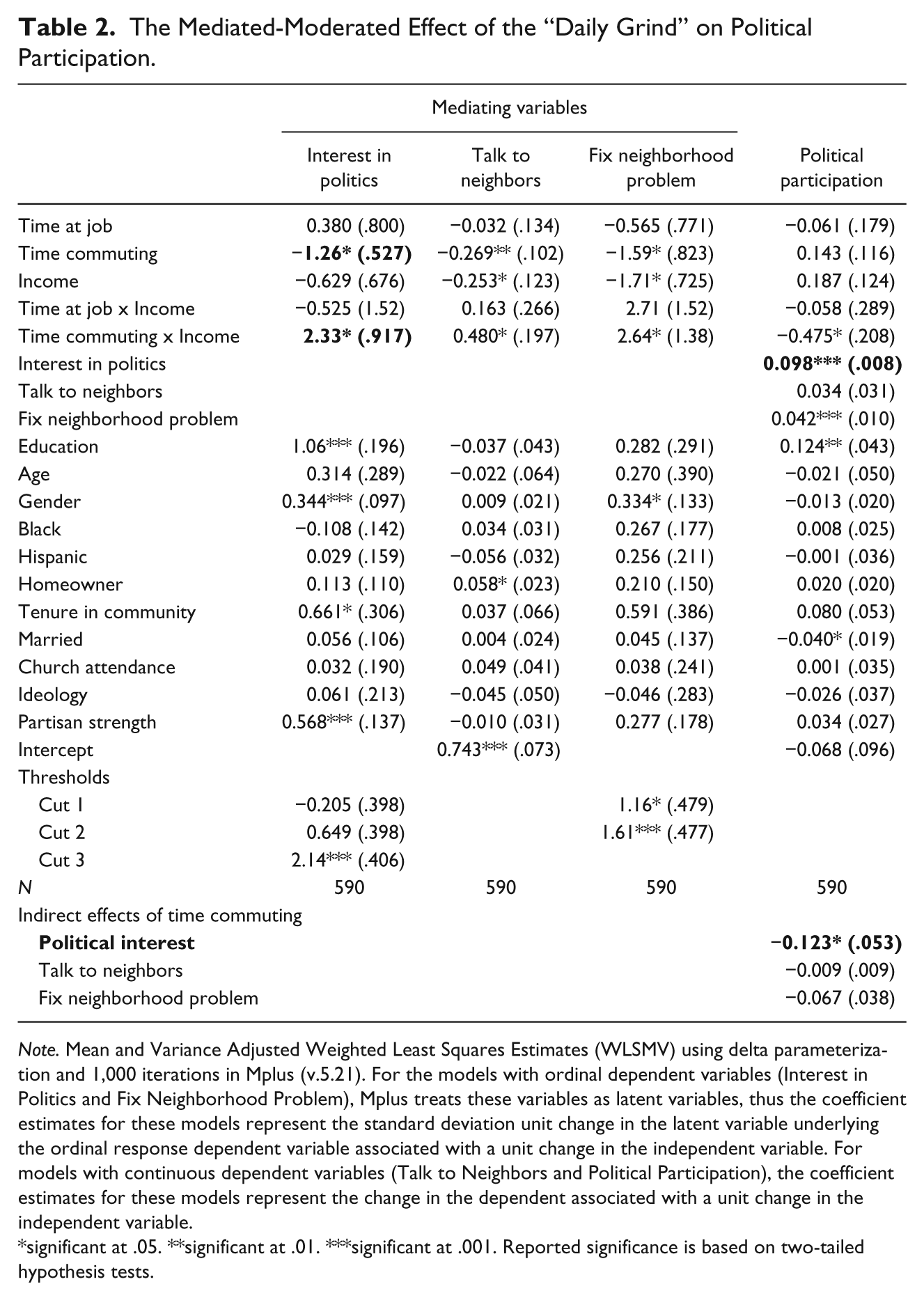
Note. Mean and Variance Adjusted Weighted Least Squares Estimates (WLSMV) using delta parameterization and 1,000 iterations in Mplus (v.5.21). For the models with ordinal dependent variables (Interest in Politics and Fix Neighborhood Problem), Mplus treats these variables as latent variables, thus the coefficient estimates for these models represent the standard deviation unit change in the latent variable underlying the ordinal response dependent variable associated with a unit change in the independent variable. For models with continuous dependent variables (Talk to Neighbors and Political Participation), the coefficient estimates for these models represent the change in the dependent associated with a unit change in the independent variable.
significant at .05. **significant at .01. ***significant at .001. Reported significance is based on two-tailed hypothesis tests.
Turning to income, the results for the mediating variables reveal that, among those working the least and not commuting, an increase in income is associated with a significant decrease in talking to one’s neighbors and working with them to fix some neighborhood problem. The significant interactions between income and commuting for these latter two mediating variables indicate that an increase in income among long-distance commuters reverses the social isolation seemingly found among wealthy noncommuters. Among long-distance commuters, an increase in income is associated with a significant increase in knowing ones neighbors and working with them to solve some neighborhood problem. This finding clearly conflicts with findings by Putnam (2000), who finds that commuting unequivocally decreases civic engagement, at least as measured by various forms of membership and participation in community and civic organizations.
Up to this point, we find strong evidence in support for our expectation that lower income individuals will be the most “ground down” by longer time spent commuting on the day-to-day. Next, we turn to the results for the political participation equation in our SEM, which are presented in the final results column of Table 2. We specifically turn our attention to the results for the three mediating variables. As the results reveal, interest in politics is associated with a highly significant increase in political participation. Moreover, the effect of interest is moderately large in size, as a unit increase in interest is associated with above a 9% increase in participation and movement from minimum to maximum levels of interest rendered a .29 increase in participation. In addition to interest, working with one’s neighbors to solve some problem was associated with a significant increase in participation in politics and talking to one’s neighbors exerted a marginally significant positive effect on participation. Of the three mediators, interest in politics has the largest effect on participation. At present, then, we have observed that commuting among low-income individuals is associated with a significant decrease in political interest, and that political interest is as associated with a significant increase in participation. All that is left to determine is whether longer commutes, by eroding interest among low-income commuters, indirectly decreases political participation.
The answer to this question is provided in the bottom row of Table 3, which lists the indirect effects for time spent commuting on political participation through the effects of commuting on each of the three mediating variables. The results reveal that the indirect effect for commuting on participation via political interest (B = −0.123, SE = .053) is the largest and only statistically significant effect of the three indirect effects. 12 The negative sign of this path coefficient indicates that the daily grind of long commuting times indirectly decreases political participation among low-income commuters by eroding their interest in politics and public affairs. For further illustration, these core results are graphically portrayed in Panel B of Figure 1. Panel B lists the direct effect of an increase in commuting among those with the lowest incomes on political interest, the direct effect of interest on participation, and the indirect effect of commuting among poor Americans on participation as mediated through political interest. Despite the fact that the nine items in our participation measure strongly load on a single factor, analysis of the effects of commuting on this combined measure may conceal potential heterogeneity in the effect of commuting across the separate forms of participation. In Table 3, we disaggregate the findings presented in Table 2 (and Panel B of Figure 1) into the effects of commuting among lower income citizens on the nine participation items separately. As can be seen, political interest significantly increases the probability of engaging in each type of behavior, and commuting in turn (among those with the lowest incomes) indirectly decreases engagement in each type of participatory behavior via its diminution of political interest. Taken together, these findings strongly support our hypotheses, and paint a comprehensive picture of the causal process linking the daily grind to participation in ways that incorporate resources and psychological engagement, and thus build theoretical bridges between our ego depletion framework and the SES and resources models of participation.
Indirect Effects of Commuting Among Lower Income Commuters on Specific Forms of Political Participation.
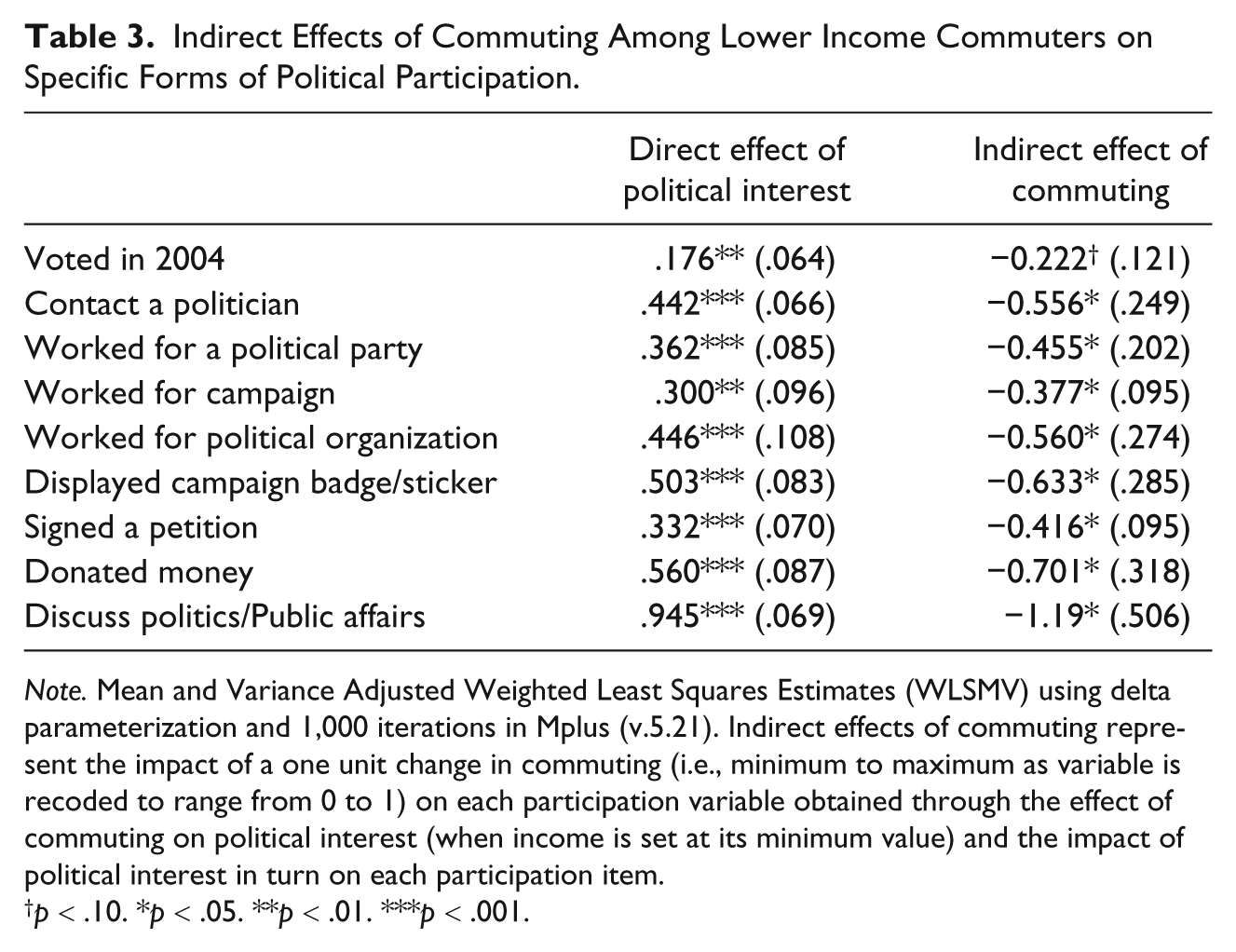
Note. Mean and Variance Adjusted Weighted Least Squares Estimates (WLSMV) using delta parameterization and 1,000 iterations in Mplus (v.5.21). Indirect effects of commuting represent the impact of a one unit change in commuting (i.e., minimum to maximum as variable is recoded to range from 0 to 1) on each participation variable obtained through the effect of commuting on political interest (when income is set at its minimum value) and the impact of political interest in turn on each participation item.
p < .10. *p < .05. **p < .01. ***p < .001.
Conclusion
In this article, we explored the relationship between the obligatory daily endeavors carried out by individuals and their performance as citizen participants in the political process. Of specific importance, given the spread of commuting and increases in commuting times over the past quarter century, was the analysis of whether the hassle of individual commuting decreases political engagement. We offered the commuter’s strain hypothesis, and cast this as opposing predictions based from the resources model. While our strain hypothesis contests the quantity-focus and agnosticism of the resources model with respect to the psychological and emotional impacts of different consumers of one’s free time, we ultimately do not view these two frameworks as necessarily opposing one another. Indeed, our daily grind framework seeks to expand the resources model to include ego resources as one of the most vital resources for participation, alongside time and money. Our daily grind model situating ego resources as antecedent to engagement reveals that ego depleting activities—such as commuting long distances on a daily basis—can erode interest in politics and ultimately diminish participation through their erosion of psychological engagement with public affairs.
The findings presented in this article have several implications for democratic citizenship and representation. First, the findings illustrate the interdependence of our lives as workers, the design of our built environments, and mass participation. While work itself exerted no effect on participation, the amount of time spent getting to and from work does. The way we design our environment is intimately related to the geography of local and regional job markets and these together strongly induce commuting. In areas lacking efficient and cost-effective mass transit—which encompasses the majority of nonurban areas in the United States—this requires single car driver commuting, which has been particularly tied to stress and social isolation (Lidström, 2006; Novaco & Collier, 1994). Campaigns, political parties, and other organizations in the United States invest large sums of resources encouraging citizens to participate in the democratic process; a major take home point of our findings is that large-scale efforts to mobilize American citizens should consider addressing the day-to-day forces at work in contemporary American life that erode political interest and engagement. While the accessibility of voting places and presence of logistical obstacles are apparent variables shaping mass participation, our findings, and those of others, suggest that local policies shaping the design of communities and the amount of commuting play an important, though less obvious, role in influencing the amount of public engagement in the political sphere. In short, if we are serious about enabling citizens to be more participatory in politics, then we should also discuss what can be done to lessen the day-to-day burdens on citizens that erode the resources necessary for habitual political participation.
Our most striking finding is that lower income citizens are the ones most depoliticized by the resource depleting demands of daily life. As it is, lower income citizens tend to be considerably less represented by government policies than their higher income counterparts (e.g., Bartels, 2008; Gilens, 2012), and this has been linked to their tendency to not participate in the political process. As we know, participation in the political arena is not without its costs, and involves both barriers to entry and sustained involvement. Higher income individuals, by definition endowed with more money and typically more education, civic skills, and free time, are more likely to be able overcome these barriers than lower income citizens. This article argues that an additional barrier for lower income citizens may be the mental and emotional self-resources necessary to engage in acts of volition above and beyond those required for basic daily subsistence. While higher income individuals are not immune from having to commute, this article reveals that the negative effect of commuting with respect to political interest and participation is entirely concentrated among the lower working class.
Thus, in the end, our research suggests that the societal forces thrusting commuting on American citizens is working to further marginalize an already politically marginal and underrepresented social stratum from the democratic process. The findings from this article suggest that lower income commuters, while perhaps in high need of upping their level of interest advocacy on matters of labor and wages, taxation, redistribution, social welfare, and planning and transportation, will be less likely to do so because their current situation has left them depleted of key resources needed for such action. This dynamic points to the importance of mobilization for the participation of lower income Americans, particularly those dealing with the daily grind of commuting long distances to presumably low paying jobs. Indeed, while lower income commuters would undeniably benefit from policies aimed at improving their wages and reorganizing built landscapes and job markets to reduce commuting, their ability to insert this interest as an input into formal decision-making processes may require facilitation from third-party advocacy organizations that either provide the representation for them or subsidize the costs of their participation in various ways.
Footnotes
Appendix
Declaration of Conflicting Interests
The author(s) declared no potential conflicts of interest with respect to the research, authorship, and/or publication of this article.
Funding
The author(s) received no financial support for the research, authorship, and/or publication of this article.
Notes
Author Biographies
References
Supplementary Material
Please find the following supplemental material available below.
For Open Access articles published under a Creative Commons License, all supplemental material carries the same license as the article it is associated with.
For non-Open Access articles published, all supplemental material carries a non-exclusive license, and permission requests for re-use of supplemental material or any part of supplemental material shall be sent directly to the copyright owner as specified in the copyright notice associated with the article.
