




Abstract
Focusing on litigators or amicus curiae, a significant amount of scholarship has examined the impact of information on Supreme Court decision making. Taking into account that justices have varying degrees of substantive expertise across issues, we model the interaction of justice expertise with these external sources of information. Specifically, we test whether justices are more likely to be influenced by attorney capability in cases where they have less substantive legal expertise. We also explore whether justices’ reliance on amici is conditional on their own expertise, as well as the overall quality of the litigants’ attorneys. As anticipated, this research finds that as the justice’s legal expertise increases, the influence of attorney capability tends to decrease. Moreover, as the expertise of the judge and/or the quality of the attorneys increase, the impact of amici tends to decrease.
Introduction
Judges need information. This axiom is implied in all three of the prominent theories of judicial behavior—the Legal, Attitudinal, and Strategic models. The Legal model presumes that a judge’s decisions are a function of the relevant legal provisions and case facts. The Attitudinal model posits that the judge’s decisions are a partial function of judicial preferences, the policy implications of the alternative outcomes, and case facts. In addition to the information assumed under the Attitudinal model, the Strategic model assumes that judges are influenced by the preferences of certain internal (e.g., their Brethren) and external (e.g., Congress, the president, the attentive public, and interest groups) actors. 1
A significant amount of contemporary scholarship has examined the impact of information on the decisions of Supreme Court justices (e.g., Collins, 2008b; Corley, 2008; Johnson, Wahlbeck, & Spriggs, 2006; McAtee & McGuire, 2007) as well as judges on other courts (e.g., Haire, Lindquist, & Hartley, 1999; Haynie & Sill, 2007; Szmer, Johnson, & Sarver, 2007). These studies typically focused either on the litigators (Corley, 2008; Haynie & Sill, 2007; Johnson et al., 2006; McAtee & McGuire, 2007; Szmer et al., 2007) or on amicus curiae briefs (Collins, 2004, 2008b). Among the litigator studies, Corley (2008) suggested that expertly written briefs are more likely to influence the justices, while Johnson et al. (2006) concluded that the justices are influenced by oral argument quality. In addition, McAtee and McGuire (2007) found a conditional relationship between case issue salience and both oral argument and attorney quality. Among the studies of amicus curiae, the most recent scholarship suggests that parties with more amicus curiae brief support than their opponents are more likely to win (see Collins, 2004), though the amici appear to affect ideological moderates more than extremists (Collins, 2008b).
Recent attorney (e.g., Wrightsman, 2010) and amicus (e.g., Collins, 2008b) studies have incorporated persuasion theory, developed primarily by social psychologists, to explain these findings. For example, more credible attorneys are presumably more persuasive (e.g., McGuire, 1995), and therefore more likely to influence the justices. With respect to amicus curiae, Collins (2008b) posited that amicus curiae briefs are opportunities to convey additional arguments beyond those presented by the parties. Given that persuasion studies find that, at least in some circumstances, we are more likely to be influenced by the side that presents more alternative arguments (see McAuliff, Ellis, & Phillips, 2011), Collins (2008b) theorizes that Supreme Court justices are more likely to side with the party with more supporting amicus curiae briefs.
Building on these studies, we further incorporate persuasion theory to explain the conditions in which U.S. Supreme Court justices are more or less likely to be persuaded by attorneys and/or amici curiae. In doing so, we posit a hierarchy of information in which the justices will first rely on their own substantive expertise, and look to other sources when they lack expertise. We anticipate justices will look first to the litigants’ attorneys as a source of information. If neither of the litigants’ attorneys is persuasive, we anticipate the justices will then turn to the amici for necessary information. By looking at the role of information and its sources hierarchically, we are able to connect several lines of existing scholarship in a meaningful way.
In sum, the study contributes to our understanding of judicial behavior generally by enhancing our understanding of several salient research areas. In particular, we test some of the micro-foundations of the theories underlying attorney and amicus research. In addition, we examine a fairly novel but potentially important topic: judicial expertise (Baum, 2009). To accomplish these goals, we begin with a review of the literature on attorney capability, laying out the potential causal mechanisms by which attorneys can influence judicial decision making. We follow that discussion with a similar synthesis of the amicus curiae literature. Next, we build on persuasion theories to develop our theory and hypotheses. Then we proceed with a research design, followed by a series of empirical tests of our hypotheses.
Attorney Capability
Prior studies suggest that the quality of legal representation matters. In general, U.S. Supreme Court litigants represented by more capable attorneys are more likely to win (e.g., McGuire, 1995, 1998). Studies examining the influence of legal counsel have used a variety of proxy measures of lawyer capability, including prior litigation experience (Black & Owens, 2012; Corley, 2008; Johnson et al., 2006; McAtee & McGuire, 2007; McGuire, 1995, 1998; Szmer, Kaheny, & Sarver, 2010; Wahlbeck, 1997), prior Supreme Court clerkships (Johnson et al., 2006; McGuire, 2000; Szmer, 2005; Szmer et al., 2010), office proximity to the Court (Corley, 2008), working in the Office of the Solicitor General (OSG; Black & Owens, 2012; Corley, 2008; Johnson et al., 2006; Szmer et al., 2010), law professorship (Johnson et al., 2006; Szmer, 2005), as well as law school alma mater reputation (Johnson et al., 2006; Szmer, 2005; Szmer et al., 2010) and performance (Szmer, 2005; Szmer et al., 2010).
While legal representation appears to matter, we know little about the specific causal mechanisms. Specifically, how does lawyer capability influence judicial behavior? As noted above, regardless of the model of judicial decision making, judges need information, and attorneys provide information to the judges through written briefs and oral arguments. Recent studies have found evidence that the justices tend to rely on information from more capable litigators. For example, justices are more likely to incorporate language from briefs authored by higher quality counsel (e.g., those with prior litigation experience; attorneys in the OSG) into their majority opinions (Corley, 2008). Similarly, Johnson et al. (2006) find that more capable lawyers deliver better and more persuasive oral arguments.
Why do justices rely on information presented by certain attorneys? The literature focuses primarily on the credibility of the attorney (e.g., McGuire, 1995; Johnson et al., 2006). Presumably, judges are more likely to rely on information if it is deemed credible, and credibility is presumably a function of attorney quality. For example, McGuire (1995) notes that judges tend to trust repeat players. These lawyers are constrained because they view their relationship with the Court as a continuing one, and therefore have the incentive to present accurate information to the Court, or fear sanctions in later cases. The justices then are more likely to trust the information presented by repeat players because they have proven truthful in the past. Perhaps the most obvious and powerful repeat player litigators are the attorneys in the Solicitor General’s Office (Salokar, 1992). Finally, Johnson et al. (2006) posit that other measures of attorney expertise also enhance attorney credibility, including the quality of the attorney’s law school alma mater, prior clerkships with the Court, and law professorships.
In addition, several scholars suggest that more capable attorneys may craft more persuasive arguments (e.g., Haire et al., 1999; Szmer et al., 2007; Wahlbeck, 1997). Wahlbeck notes that attorneys with prior litigation experience are more likely to present clear and persuasive arguments, while Szmer et al. contend that prior clerks can utilize their process expertise to craft arguments tailored to the judges. Similarly, Haire et al. suggest that the process expert might have a more sophisticated understanding of the factors that affect the judge’s decisions, such as ideology, and can use that knowledge to craft more persuasive arguments.
Amicus Curiae
Consistent with the overall point—that justices need information—several studies have examined the role of information from amicus curiae in Supreme Court decision making. As one might expect, scholars disagree over the types of information that the justices seek out when reading an amicus brief. According to Epstein and Knight (1999), amicus curiae provide the Court with information regarding the preferences of other institutional actors that might constrain the justices from voting in accordance with their sincere policy preferences. Lindquist and Solberg (2007) suggest that amicus briefs filed by interest groups may function as source of information for justices regarding the public’s potential reaction to court rulings.
Others posit that amicus briefs can provide influential legal arguments not otherwise contained in the parties’ legal briefs on the merits. For example, some scholars contend that Justice Kennedy’s majority opinion in Romer v. Evans (1996) was substantially influenced by the amicus brief authored by Laurence Tribe and several other prominent law professors (Hasian & Parry-Giles, 1997). Citing Epstein and Walker (1995), Ivers and O’Connor (1987), and McGuire and Palmer (1995), among others, Spriggs and Wahlbeck (1997) state that scholars have made similar arguments regarding the influence of amici in other landmark cases, including Mapp v. Ohio (1961) and Webster v. Reproductive Health Services (1989). Although there is anecdotal support of the informational hypotheses, the empirical results of systematic tests are mixed. While Epstein and Knight (1999) find evidence supporting the informational hypotheses, Spriggs and Wahlbeck (1997) generally conclude that the justices tend to ignore the legal arguments contained in amicus briefs. Moreover, they find that the information that is found in the Court’s opinions is generally also contained in the parties’ briefs on the merits.
Furthermore, the studies empirically testing the influence of amici curiae on the voting behavior of the justices have mixed results. For example, McGuire (1990, 1995) and Collins (2004, 2008b) find a relationship between amicus support and voting, while Songer and Sheehan (1993) do not. 2 However, given the breadth of the Collins studies, 3 the weight of the evidence does suggest that the justices are more likely to side with litigants that are supported by more amicus briefs.
Persuasion and the Influence of Lawyers and Amicus Curiae
Much of the theories underlying the role of lawyers and amicus curiae, and in many instances, the empirical tests of the theories, dovetail with existing social psychological theories of persuasion. In this section, we summarize this theory before applying it to the existing lawyer and amicus literatures.
Myers (2008) defines persuasion as the process in which a message brings about changes in beliefs, attitudes, or behaviors. Senders (also known as agents or sources) try to persuade receivers (or targets) through some form of communication (Friestad & Wright, 1994; Miller & Mauet, 2011). Generally, the targets are cognitive misers (Fiske & Taylor, 1991); all things being equal, they will formulate decisions using heuristics to save cognitive energy. 4 When the targets are highly motivated and substantive experts in the relevant topics, they are more likely to generate opinions after systematically processing the information received from outside sources (McAuliff et al., 2011). Otherwise, as cognitive misers, the receivers will look to the senders for cues. Overall, targets are more likely to be persuaded by senders who are perceived to be more credible (Lupia, 2002; Miller & Mauet, 2011). Credibility is a function of a variety of factors, including trustworthiness, source status, field expertise, and presentation style (Miller & Mauet, 2011). 5 In addition, when a number of senders make similar arguments, the target is more likely to follow suit (McAuliff et al., 2011).
Much of the research examining the effects of lawyers/amicus on judge/jury decision making merges well with persuasion theory. For example, many of the lawyer capability characteristics that are correlated with judicial decision making reflect one or more of the sender characteristics that are correlated with persuasiveness in general. Prior litigation experience (McGuire, 1995), Supreme Court clerkships (McGuire, 2000), and affiliation with the OSG are said to build a trust relationship with the Court. Similarly, working in a private D.C. law firm (Corley, 2008; McGuire, 1993) or the OSG (Black & Owens, 2012; Salokar, 1992), or attending a prestigious law school (Johnson et al., 2006), project a higher status. In addition, experienced Supreme Court litigators are more likely to hone their presentation styles, while former clerks potentially have greater insights into the types of styles that are more effective (Szmer, 2005).
Several jury decision making studies also find a correlation between the presentation style of the attorney and the perceptions of their competence and credibility (e.g., Hahn & Clayton, 1996; Sparks & Areni, 2008). Finally, a handful of studies find evidence that subject matter expertise (field expertise 6 ) influences certain aspects of judicial behavior (e.g., George & Epstein, 1992; Haire et al., 1999; McGuire & Caldeira, 1993). For example, George and Epstein (1992) find that, in Supreme Court death penalty cases, justices tended to side with the party that presumably had more death penalty experience (i.e., lawyers representing states that frequently implemented the death penalty or worked for defense counsel for public interest firms or groups). Similarly, McGuire and Caldeira (1993) conclude that justices are more likely to grant writs of certiorari in obscenity cases when an attorney with prior experience in Supreme Court obscenity cases represents the petitioner.
As previously noted, some studies of amicus curiae influence are consistent with persuasion theory. Specifically, according to Collins (2004, 2008b) and McGuire (1995), U.S. Supreme Court justices are more likely to side with the position that is supported by the most amicus briefs. This reflects the tendency of the message receiver to attach more weight to arguments that are repeated by more sources (McAuliff et al., 2011). Finally, the sender’s message is more influential when the receiver is less motivated (McAuliff et al., 2011). To the extent that justices are more motivated to decide salient cases, this is consistent with at least one prior study, which found that lawyer capability and relative amicus curiae support influence Supreme Court justices in nonsalient cases, but not in salient cases (McAtee & McGuire, 2007).
Research on persuasion also undergirds our hierarchical theory of information where the justices will first rely on their own substantive expertise, and then look to other sources in an organized pattern when they lack expertise. Wrightsman (2010) argues that justices behave differently in ideological cases because they are aware of them earlier and typically have more experience with the issue in the case. He predicts that in ideological cases, justices will not only form their initial opinions more quickly but will be less likely to respond to outside influences and to change their opinions. Our theory builds on this idea by looking beyond just the type of case, but at justices’ individual experiences with the issues in the case. We assert that as justices increase in their own expertise on the issue, they will be less susceptible to persuasion. Work on source credibility by Kumkale, Albarracín, and Seignourel (2010) supports this assertion in finding that recipients relied on the credibility of the source more when they had no prior attitude or knowledge about the issue.
In our hierarchical theory of information, we assert that justices will look first to the litigants’ attorneys and then to amicus briefs if the attorneys are not perceived as credible, which we measure by expertise. We argue this is the case because unlike most amicus curiae, litigant attorneys typically have multiple opportunities to present arguments. In addition to submitting written merits briefs (one by the respondent, two by the petitioner), they also present a 30-min oral argument. Typically, when arguments are repeated and reinforced, they are more persuasive (Ratneshwar & Chaiken, 1991). Similarly, beyond the benefits of repetition, well presented oral arguments should be more persuasive than briefs because they provide the justices with opportunities to seek out the information that may be most relevant to their decisions (see Johnson, 2004).
Furthermore, a recent survey of federal judges, including two justices, suggests that amicus briefs are more influential when the parties are not adequately represented (Simard, 2008). In addition, works on source credibility find that sources with high credibility are more persuasive than those with low source credibility (Tormala, Brinol, & Petty, 2007; Tormala & Petty, 2004), which implies that if justices do not perceive the attorneys are credible, but they are still in need of information, they will seek out information from the amicus briefs. Finally, Hansford (2004) suggests that amicus curiae perceive that they are more likely to influence outcomes when the parties are represented by less capable counsel. As the prior litigation experience of the litigants’ counsel increases, less amicus curiae briefs are likely to be filed.
Theory and Hypotheses
According to persuasion theory, the greater the expertise of the target, the less likely they will be persuaded by the source. This is true because the individual is more familiar with the argument and is able to more effectively dismantle arguments that run counter to their preferred preferences (Nelson, Oxley, & Clawson, 1997). Conversely, when the target is not a substantive expert, they are more likely to be persuaded by more sources that are more credible.
Applying this theory, we assert that as justice expertise increases, they are less likely to be influenced by the persuasive arguments of external actors. In other words, they will not be persuaded because they have already made their minds up based on their own knowledge of the issue area. However, when they have less expertise, they are more likely to defer to the attorney that is more persuasive. Finally, attorney persuasiveness is a function of a variety of factors, including credibility, status and presentations styles, which we lump together into one concept—attorney capability. This leads us to the following hypothesis:
Persuasion theory also suggests that arguments are more persuasive when they are echoed by multiple sources. 7 This is consistent with amicus curiae studies that find justices are more likely to side with parties that are supported by more amicus curiae briefs (Collins, 2004, 2008b). As with attorney persuasiveness, this effect should be conditioned by the substantive expertise of the justice. As such, we hypothesize the following:
The first two hypotheses suggest a tentative hierarchy of information: that the justices will first rely on their own substantive expertise, and look to other sources only when they are unclear about the relative legal principles. However, when the justices do not have significant substantive expertise, we would expect that they would look first to the litigants’ attorneys for information and then to amicus curiae if the attorneys are not seen as credible. This leads to our final two hypotheses:
Research Design
To test our hypotheses, we use a data set including all orally argued decisions by the U.S. Supreme Court during the 1993-2001 terms. The cases were identified from The Original U.S. Supreme Court Judicial Database (Spaeth, 2002). 8 The unit of analysis is the justice’s vote in a case, which is appropriate given that we are interested in testing whether the impact of attorney capability is conditional on the individual justice’s substantive expertise. The dependent variable is the justice’s vote for (1) or against (0) the petitioner. As it is dichotomous, we utilized logistic regression to estimate the model coefficients. Following Johnson et al. (2006) and other studies of attorney influence on justice decision making, we cluster the standard errors by justice to control for spatial autocorrelation. 9
Main Independent Variables
Given our hypothesis that the impact of attorney capability is conditional on the expertise of the justices, we need to operationalize both measures. To create the Attorney Capability variable, we first ran a factor analysis of six separate indicators of the corresponding orally arguing attorney’s capability: (a) prior litigation experience, (b) law school quality, (c) prior U.S. Supreme Court clerkships, (d) law school honors, (e) membership on the law review while in law school, and (f) whether the attorney worked in the OSG. These proxy measures tap into several aspects of the potential persuasiveness of an attorney, including credibility, status, and presentation styles. 10 The attorney’s background information was primarily identified using Martindale-Hubble, and supplemented using law firm web sites. Prior litigation experience is the natural log (to account for the diminishing marginal effects of higher levels of experience; see Johnson et al., 2006) of the total number of prior oral arguments delivered by the attorney in the previous 14 terms. 11 Law school quality is a dichotomous variable coded 1 if the law school was considered elite according to Slotnick (1983) and 0 if not. 12 The prior clerkship component was coded 1 if the orally arguing attorney was a former U.S. Supreme Court clerk (as identified using a list of clerks provided by the Court’s Public Information Office), 0 if not. The law school honors variable is also binary, coded 1 if the attorney either received Latin honors or was a member of the Order of the Coif. 13 Similarly, the law review variable is coded 1 if the attorney served on a law review, 0 if not. 14 The OSG component was also a dummy variable, coded 1 if the attorney worked in the Office. We constructed two separate indices for the petitioner and respondent orally arguing attorneys. 15 We then calculated the difference between the indices for the petitioner and respondent. 16 Therefore, positive values indicate that the petitioner’s attorney has more capability while negative values indicate that the respondent’s attorney is the more capable litigator. As the dependent variable is coded 1 for a vote for the petitioner, we anticipate the coefficient for attorney capability to be positive.
We also hypothesize that the impacts of attorney capability and amicus participation are conditioned by justice expertise. As such, we incorporated a measure of Justice Expertise, based on prior measures developed by Maltzman and Wahlbeck (2004) and Klein (2002). 17 The measure is a special opinion ratio specific to the particular issue area of the case. The numerator is the total number of special opinions (dissenting and concurring) authored by the justice in that particular issue area 18 in all prior terms. The denominator is the total number of cases decided by the Court in that issue area in all prior terms because the justice was appointed. 19 Presumably, justices are more likely to author special opinions in areas of expertise. 20 As the Justice Expertise measure is merely a moderator variable that should condition the impact of Attorney Expertise, and we have no a priori theoretical reasons to expect that it will influence the justice’s decisions to affirm or reverse, we expect that the coefficient will not be statistically significant. To test the conditional relationship, we included a multiplicative term, Justice Expertise × Attorney Capability, which is the product of the justice and attorney expertise variables. Our hypothesis is that as the justice’s expertise increases, the need for legal information from the attorney will decrease.
The Amicus Participation variable is the difference between the numbers of amicus briefs submitted for the petitioner and respondent, 21 as identified using Lexis, Westlaw, and the U.S. Reports. 22 Furthermore, we are interested in exploring the conditional relationship between Justice Expertise and Amicus Participation, so we included a multiplicative term with these two variables. Our hypothesis is that as the justice’s expertise increases, the influence of amicus curiae briefs will decrease.
Our third and fourth hypotheses explore the posited hierarchy of information. Specifically, justices will look inward first for information, then to the attorneys, and finally to the amicus groups. Implicit in this theory is the idea that justices will look to the attorneys generally before seeking information from the amici. Therefore, we do not need to distinguish between attorneys for the petitioner and respondent here, or calculate the difference score between the two. Instead, we will take the highest value of capability for the attorney on either side. This score is reflected in our Maximum Attorney Capability measure. 23 We then created a simple multiplicative term, with Maximum Attorney Capability × Amicus Participation. We anticipate that as the Maximum Attorney Capability increases, the influence of Amicus Participation should decrease.
Ultimately, we are interested in the more complicated relationship between the Justice Expertise, Attorney Capability, and Amicus Participation variables. To model this relationship, we created a three-way multiplicative term with Justice Expertise × Maximum Attorney Capability × Amicus Participation. Given that three-way interaction terms are difficult to interpret, we will explore this relationship graphically in our analysis section. In addition, to insure the correct specification, we included an additional multiplicative term, Justice Expertise × Maximum Attorney Capability.
Control Independent Variables
Given the importance of attitudinal explanations of Supreme Court behavior (Segal & Spaeth, 1993, 2002), we include a measure of justice policy preferences, using the Martin and Quinn (2002) posterior mean scores. 24 Given the coding of our dependent variable, we used the ideology scores to construct a measure of policy/ideological congruence between the justice and the petitioner. The Ideological Congruence variable was constructed using a combination of the Spaeth database lower court direction variable (LCTDIR) and the Martin and Quinn scores. If the lower court decision was liberal, then the presumed preferred outcome of the petitioner is conservative; if the lower court direction was conservative, the presumed preferred outcome is liberal. Therefore, the Ideological Congruence variable is coded as the Martin and Quinn score if the petitioner preferred a conservative outcome, and is coded as the negative of the Martin and Quinn score if the preferred outcome is liberal. As higher values indicate more congruence between the preferences of the justice and the petitioner, we anticipate a positive and significant coefficient for the Ideological Congruence variable.
Besides ideology, perhaps no other concept in judicial behavior has received more attention than party capability, which assumes that litigants with certain characteristics (e.g., prior litigation experience and substantial financial resources) have several advantages over less capable litigants. Almost universally, party capability studies utilize the taxonomy derived by Galanter (1974, p. 107), and assign parties to one of several categories based on organizational characteristics (Songer & Sheehan, 1992; Songer, Sheehan, & Haire, 1999). Following this methodology, our Party Capability variable is based on the following typology 25 :
1 = Individual persons
2 = Non-Fortune 500 corporations
3 = Interest groups
4 = Local Governments
5 = State Governments
6 = Fortune 500 corporations 26
7 = United States
We include two party capability variables in our model, one each for the petitioner and respondent. We expect to find a positive coefficient for the Petitioner Party Capability and a negative coefficient for Respondent Party Capability.
We also included the control variables U.S. Petitioner Amicus Support (a dummy variable coded “1” if the United States submitted an amicus brief in support of the petitioner) and U.S. Respondent Amicus Support (a dummy variable coded “1” if the United States submitted an amicus brief supporting the respondent’s position) to account for the special role of the United States as an amicus. Scholars have found that the support or opposition of the United States as amicus curiae has a significant impact on Supreme Court decision making on the merits (e.g., Segal, 1990; Segal & Reedy, 1988). We expect to find positive coefficients for U.S. Petitioner Amicus Support, and a negative coefficient for the U.S. Respondent Amicus Support.
Analysis
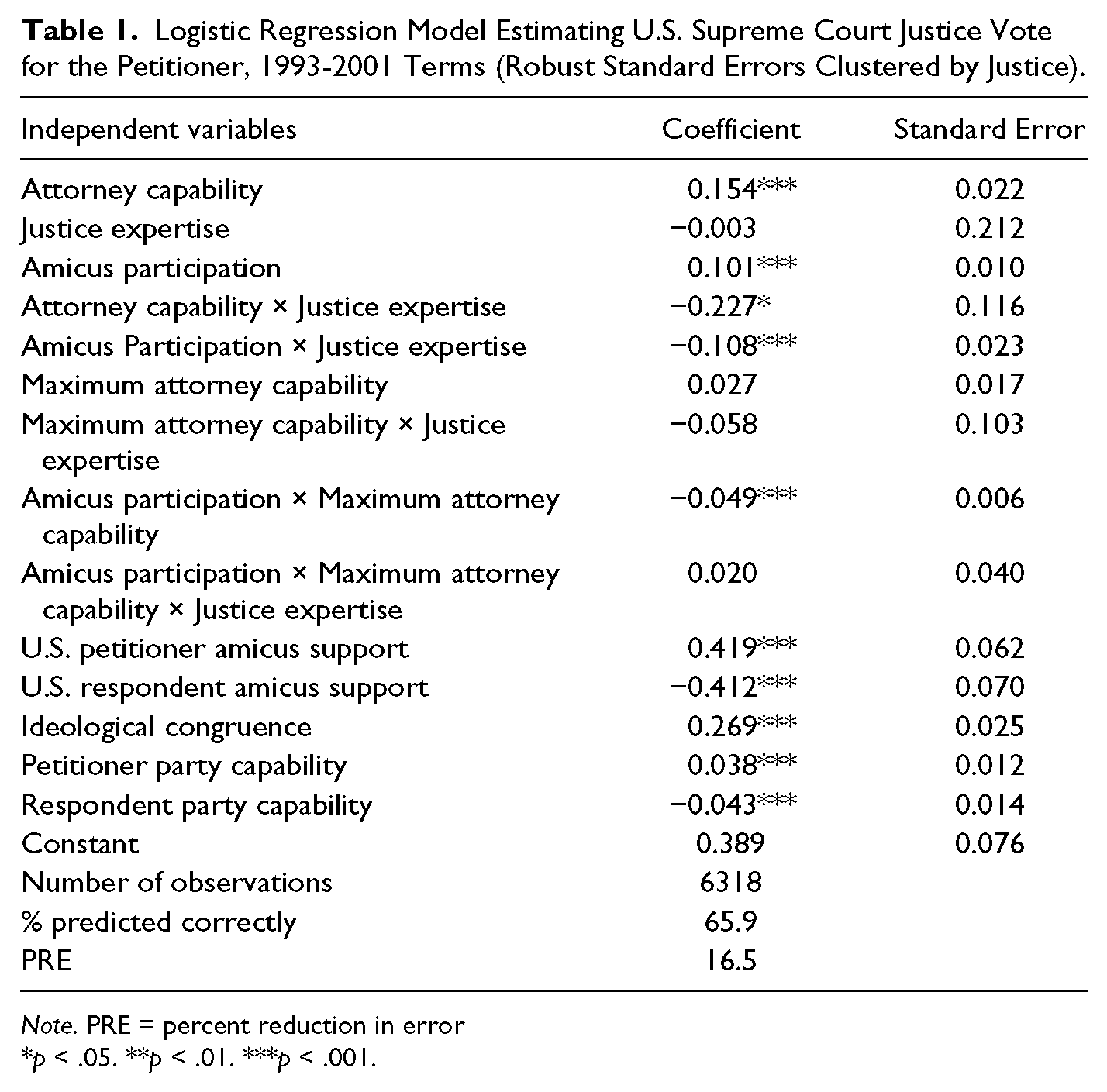
We estimated our full model and the results for this model appear on Table 1. The model overall has a 16.5 PRE (percent reduction in error). The coefficients for Attorney Capability and Amicus Participation are positive and statistically significant, though this tells us fairly little given that both variables are included in multiplicative terms (Brambor, Clark, & Golder, 2006). The effects of Attorney Capability are significant when Justice Expertise is equal to zero (the justice has no expertise). The coefficient for the Amicus Participation variable reflects the effects when the justice is not an expert and the most capable litigant attorney has a value of zero (approximately the mean of the value). The coefficients for the two-way multiplicative terms (Attorney Capability × Justice Expertise, Amicus Participation × Maximum Attorney Capability, and Amicus Participation × Justice Expertise) are negative and statistically significant, as expected. However, to really test and interpret interaction effects, we need to examine their effects on the justices for various values of the moderators (see Brambor et al., 2006), which we do below.
Logistic Regression Model Estimating U.S. Supreme Court Justice Vote for the Petitioner, 1993-2001 Terms (Robust Standard Errors Clustered by Justice).
Note. PRE = percent reduction in error
p < .05. **p < .01. ***p < .001.
We would first like to note that all control variables are signed appropriately and are statistically significant. As we expected, the U.S. Petitioner Amicus coefficient is positive, while the U.S. Respondent Amicus Support variable is negative coefficient. As Ideological Congruence between the justice and the petitioner increases, the likelihood of a vote in favor of the petitioner increases. Similarly, the justices are more likely to side with a more capable petitioner, but less likely to side with the petitioner when the respondent is more capable. Finally, as one might expect given the absence of theoretical causal relationships, the two moderator variables—Justice Expertise and Maximum Attorney Capability—are not statistically significant.
As noted above, our analysis must look beyond the coefficients for the main independent variables and the multiplicative term, particularly when using a nonlinear estimator like logistic regression. Ai and Norton (2003) state that multiplicative terms estimated using nonlinear models (e.g., logistic regression) are themselves conditional on the values of other independent variables. Therefore, they are of little value by themselves when trying to test a hypothesis about an interaction effect. For nonlinear (and linear) models, Brambor et al. (2006) suggest graphing a particular estimate of the main effects of the main independent variable, and the conditional (or marginal) effects (with confidence intervals) for each value of the moderator variable (in this case, Justice Expertise). 27
To facilitate the interpretation of the conditional effects, we estimate what Long and Freese (2006) call discrete changes: the differences in the predicted probability that the dependent variable equals one when the main independent variable is set to two different important values (typically one and zero for dummy variables, and one standard deviation above and below the mean for continuous measures), and the covariates are held constant, usually at the appropriate measure of central tendency. Following Brambor et al. (2006), we estimate these discrete changes, our estimates of the conditional effects, for each value of the appropriate moderator(s).
Figure 1 illustrates the conditional effects of attorney capability across substantively meaningful values of justice expertise. The Y axis is the discrete change for attorney capability, or the difference in the probability the justice will vote to reverse when the attorney capability variable value is a standard deviation above and below the mean. Higher values indicate stronger effects. The horizontal axis is the moderator variable, Justice Expertise. The slanted solid line reflects the point estimate of the conditional effects, whereas the dashes reflect 95% confidence intervals. The horizontal solid line represents a discrete change of zero. The downward slope indicates the impact of Attorney Capability is highest when the justices have no expertise (in other words, they never wrote a special opinion on the issue); thus, as their experience increases, the impact of Attorney Capability decreases. In fact, the effects decrease by over 20% as the moderator Justice Expertise increases from the minimum to the mean. In addition, note that the point when the lower bound of the confidence interval crosses zero indicates that the conditional impact of Attorney Capability is no longer significantly different from zero. In the graph, that is right around a 0.4 value for the Justice Expertise measure. 28 Overall, the graph clearly exhibits the negative interaction effect posited in the first hypothesis.
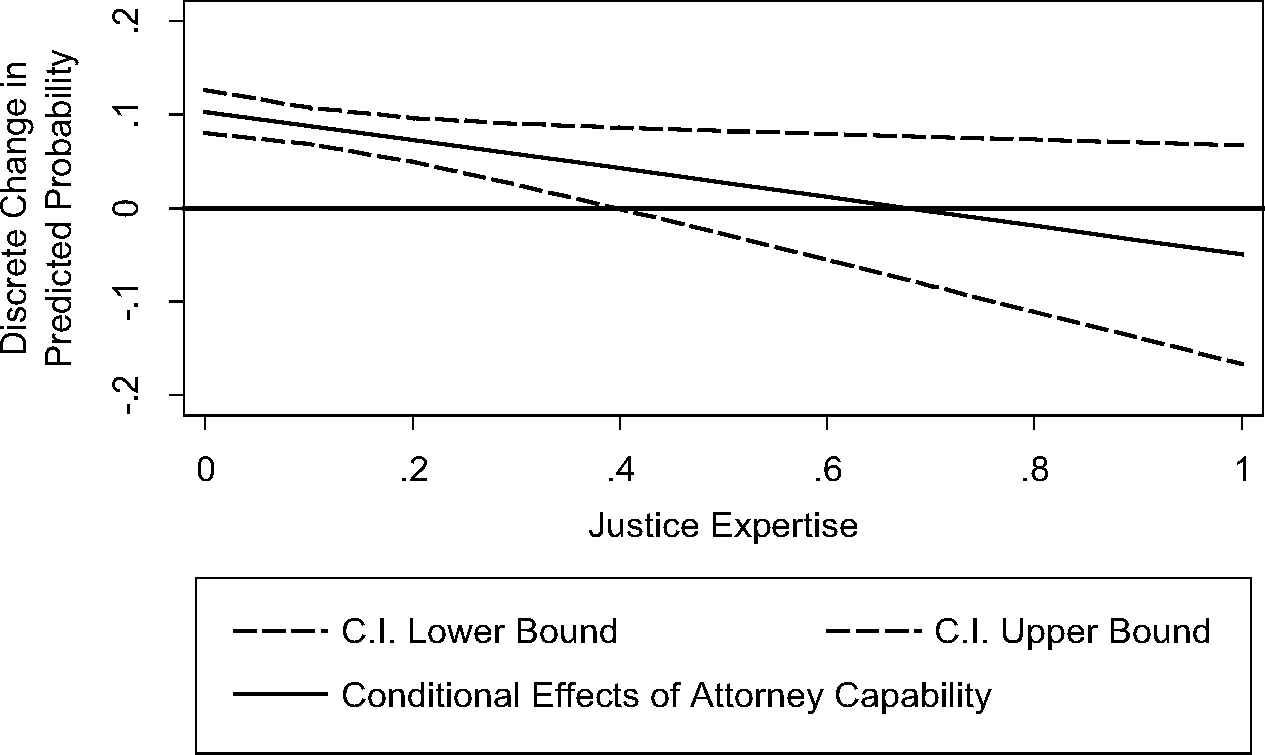
Conditional effects of attorney capability: Moderated by justice expertise.
The model also tested the second hypothesis, positing an interaction effect of Justice Expertise on the impact of Amicus Participation. Specifically, as Justice Expertise increases, we expect to find diminishing effects of Amicus Participation. We also graphed the conditional effects of Amicus Participation, estimated as discrete changes, for each value of Justice Expertise in Figure 2. The other moderator, Maximum Attorney Capability, and the covariates are held constant at the appropriate measure of central tendency. Once again, the slope of the conditional effects line is negative, providing evidence of the posited interaction effect—that Amicus Participation has a greater influence on justices with low levels of substantive expertise. As the moderator Justice Expertise increases from the minimum to the mean, the effects of amicus participation drop by almost 19%. Moreover, the effects of amicus curiae are no longer statistically significant for values of Justice Expertise around 0.48, which includes approximately 5% of all observations. In other words, justices with very high levels of substantive expertise are not influenced by Amicus Participation.
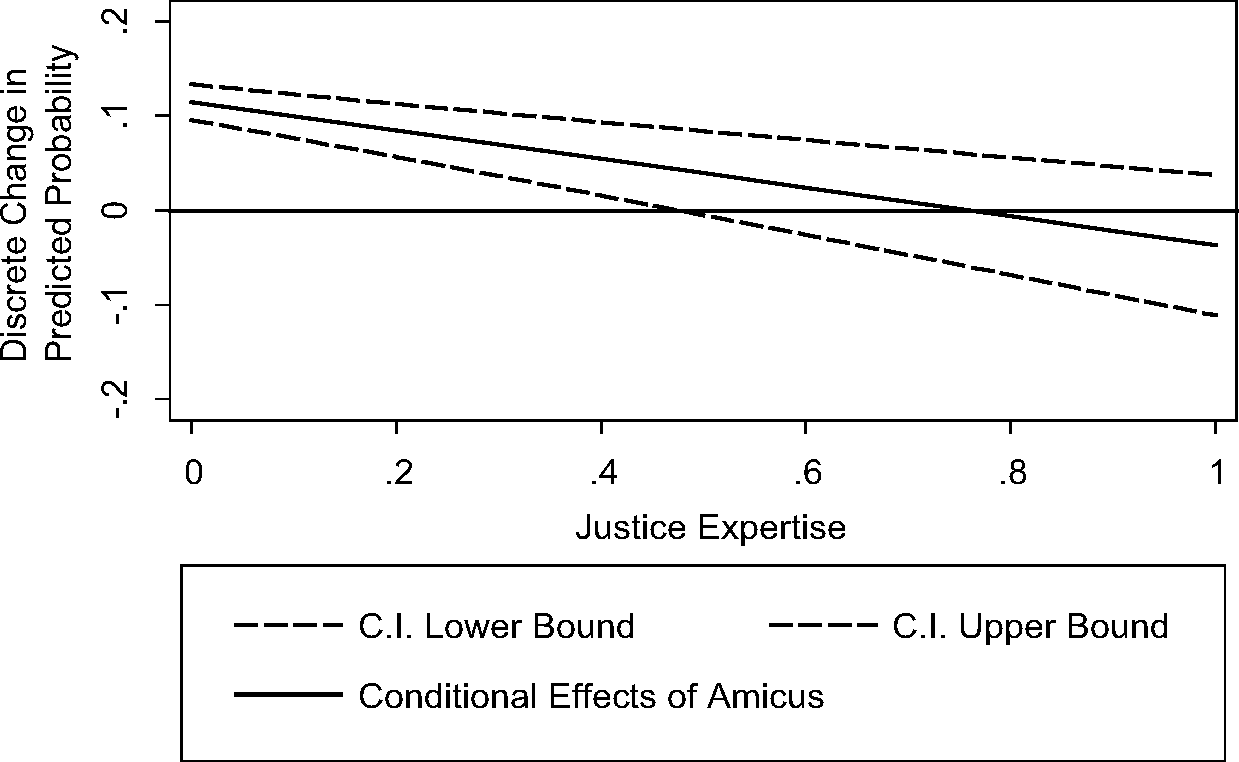
Conditional effects of amicus participation: Moderated by justice expertise.
The third hypothesis explored whether the influence of Amicus Participation was conditional on Attorney Capability and the analysis clearly supports this hypothesis. Remember that Attorney Capability here is modeled using the maximum expertise value variable rather than our general attorney capability because we theorize that justices will look to amici for information only after they assessed the contributions of the litigants’ attorneys. If neither attorney is highly capable (which would be reflected in a low value for the Maximum Attorney Capability variable), then the amici should be more influential. Alternatively, as the capability of the attorneys increase, the impact of amici should decrease. The negative, significant multiplicative term, Maximum Attorney Capability × Amicus Participation, provides evidence of this posited relationship. As hypothesized, as Maximum Attorney Capability increases, the impact of Amicus Participation goes down. Moreover, as in the previous models, Figure 3 depicts a sharply negative slope of the conditional effects (estimated when Justice Expertise and the covariates are set to the appropriate measure of central tendency), which is significant for most values of Maximum Attorney Capability. Indeed, the slope is strikingly steep. As the moderator variable increases from the minimum to the mean, the effects of Amicus Participation decrease by over 65%.
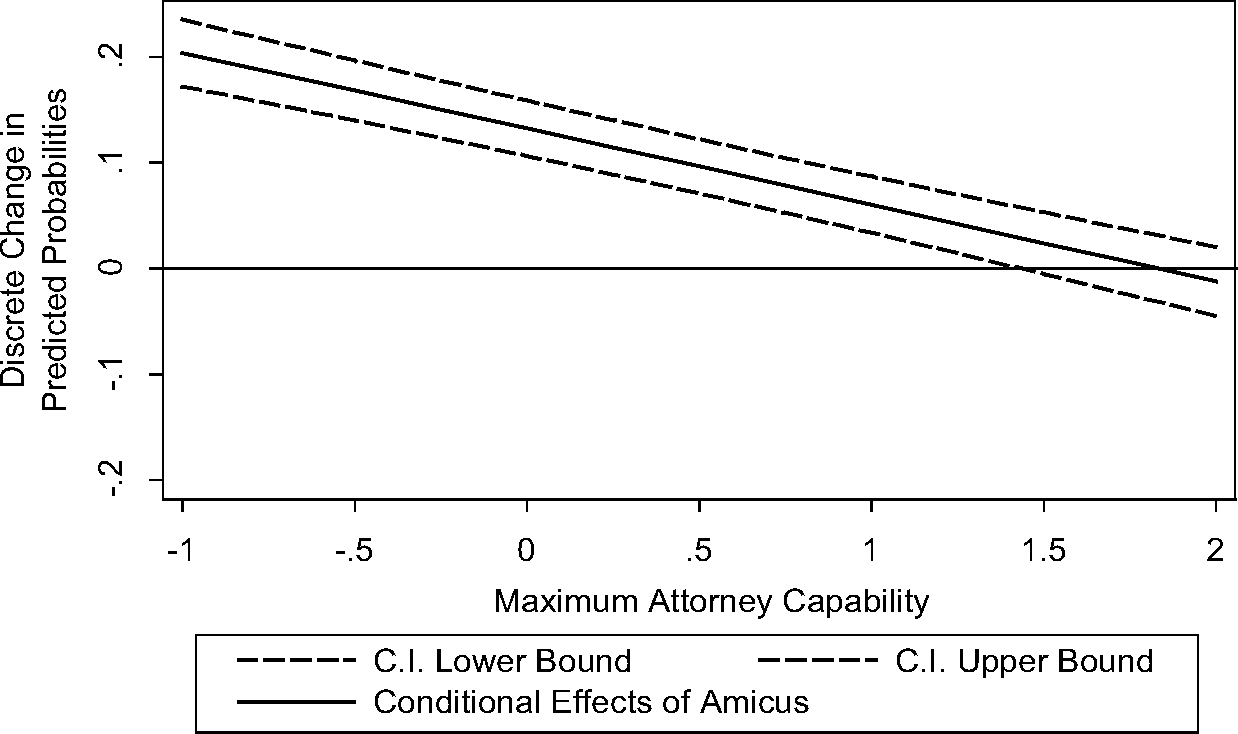
Conditional effects of amicus participation: Moderated by maximum attorney capability.
Figures 2 and 3 communicate the two-way interactions between Amicus Participation and Justice Expertise and Maximum Attorney Capability, respectively. To explicate the complicated relationship between all three variables, we present a series of graphs in Figure 4. In each graph, the Y axis represents the impact of amici (the discrete changes) and the horizontal axis represents Maximum Attorney Capability. Each graph shows the conditional effects of Amicus Participation on justice votes for the petitioner across each level of Maximum Attorney Capability for a particular level of Justice Expertise. The graphs vary from minimum justice expertise (upper left corner) to maximum justice expertise (bottom left corner), with the Justice Expertise values noted at the top of each graph. In other words, the first graph presents the conditional effects of Amicus Participation for each value of Maximum Attorney Capability, when Justice Expertise is equal to the minimum (zero). The second graph holds Justice Expertise constant at the mean, and the next three graphs reflect the conditional effects of Amicus Participation for the observed values of Maximum Attorney Capability as Justice Expertise is increased by standard deviations. 29
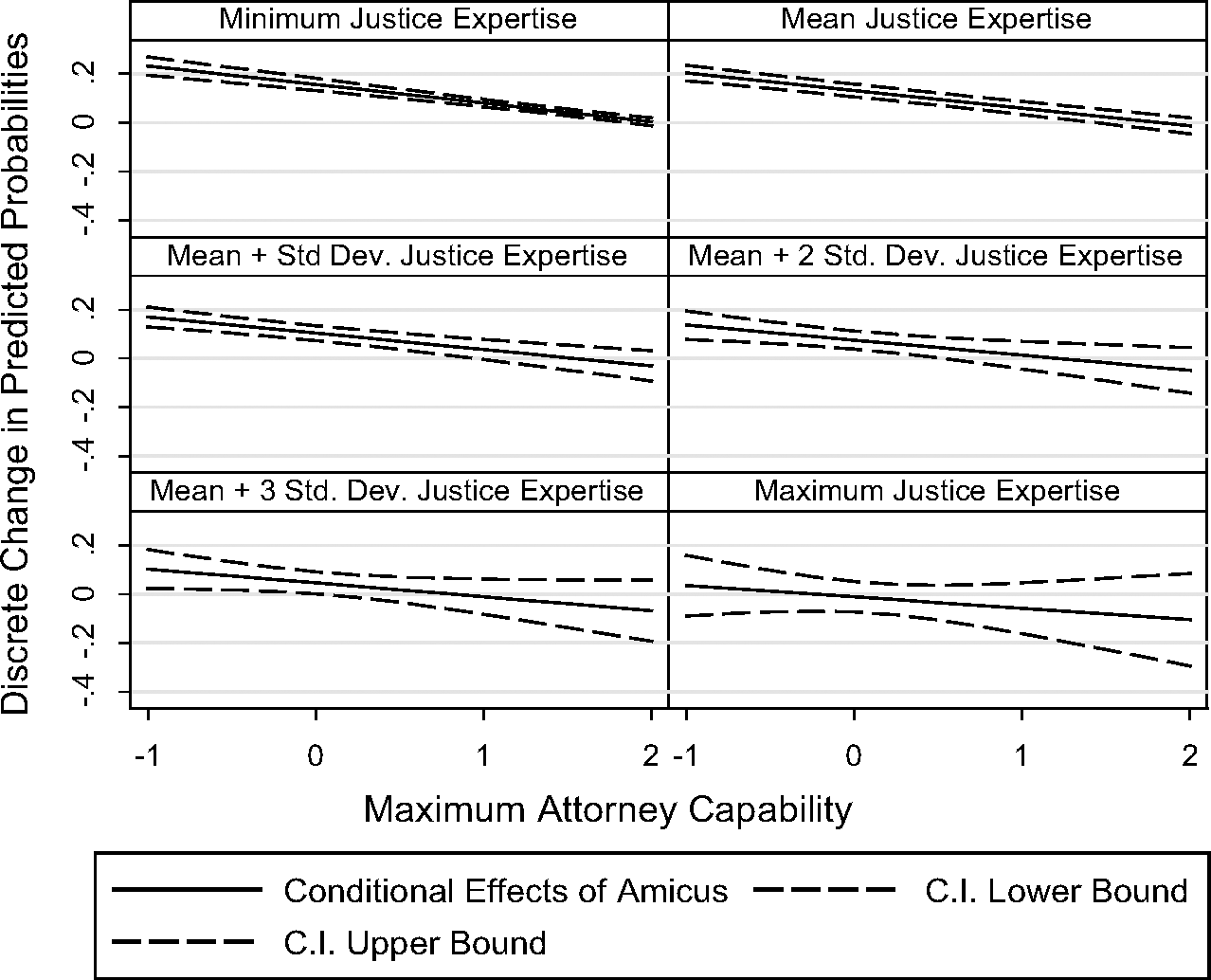
Conditional effects of amicus participation: Moderated by maximum attorney capability and justice expertise.
When Justice Expertise is set to the minimum (the upper left corner), the slope is the most pronounced and negative, and the discrete changes are significant for most values of maximum attorney capability. In substantive terms, when the justices know less about an issue, amicus participation matters the most, but it matters less and less as the expertise of the litigants’ attorneys increase. Conversely, as Justice Expertise increases, the impact of Amicus Participation and the moderating effects of Attorney Capability decrease. The slope of the conditional effects begins to flatten, and the effects are not statistically significant for more and more values of Maximum Attorney Capability. By the last graphs (where Justice Expertise is set to its maximum), the effects of Amicus Participation are never significant, regardless of Attorney Capability.
Of course, while the graphs provide pictures of the conditional effects of the moderating variables, they do not help us see the relative substantive effects of the different independent variables. Again following Long and Freese (2006), we estimated discrete changes for each independent variable (except for the moderators, which should have no relationship to the dependent variable). For the main independent variables—Attorney Capability and Amicus Participation—we set the moderator variables, like the control variables, to their means to facilitate comparison. Overall, Ideological Congruence has the highest discrete change by far—0.258. This is consistent with the expectations of Segal and Spaeth (2002) and other proponents of the Attitudinal model. While small in comparison with the substantive effects of ideology, several variables had moderately large discrete changes. The effects of the main independent variables, Attorney Capability and Amicus Participation, were 0.081 and 0.093, respectively. The controls for U.S. Amicus Participation were slightly larger in magnitude—0.096 when the OSG filed an amicus brief in support of the petitioner and −0.102 when the OSG’s amicus brief supported the respondent.
Discussion
Taken together, the models paint a clear picture of the conditions under which the Court relies on information from the two primary classes of external actors: litigant attorneys and amicus curiae. Attorney Capability and Amicus Participation influence the justices more when the justices have lower levels of substantive expertise. When Justice Expertise reaches a certain point, the capability of counsel and the relative participation of amicus curiae do not appear to influence the justices. Thus, our results appear to support our theory that sources are more persuasive when the target has lower levels of substantive expertise. In other words, when the justices are well informed of the substantive aspects of the legal issues raised by the litigants, they do not need to rely on either class of external actors for information.
The results suggest that the justices are more likely to look to the amicus curiae when they need to compensate for deficient litigants’ attorneys. This striking relationship is also consistent with our theory. Sources with higher status are more persuasive, all things being equal. Therefore, the justices look first to the litigants’ attorneys for information. However, when the source credibility of the litigants’ counsel is low, the justices will then look to alternative sources of information like amicus briefs.
What do the results suggest regarding the types of information the justice’s rely on to make decisions? Nothing directly, however, to the extent that the justice expertise measure reflects an understanding of the relevant legal principles, the study provides indirect evidence that the justices use legal information to decide cases. Specifically, justices are more influenced by information providers when they know little about the substance of the law, implying that they are looking to the attorneys and amicus briefs for legal information—and that this information affects the outcome of the case. If the justices were merely using the law to provide rationalizations for their ideologically driven decisions (Segal & Spaeth, 2002), then the information providers should not affect the outcome of the case, but they do.
Conclusion
The focus of this analysis was to determine when, and under what conditions, justices rely on other actors for information in their decision making calculus. By integrating persuasion theory with prior studies of amicus and lawyer effects on high court decision making, we developed a set of expectations. Consistent with previous scholarship, we find that attorney capability is important in understanding judicial behavior, but that is not the whole story. When you take into account the expertise of justices, attorneys are more influential when the justice needs supplementary legal information and they are less influential when the justice has personal expertise in the issue area. We find this same relationship holds with regard to the amicus curiae briefs. Justices will look to amici for information, but this is conditional on the justices’ expertise in a given area of law.
Finally, we tested a hierarchical theory of information and found that when justices needed information, they looked first to the attorneys. However, if the attorneys were not credible sources of information, the justices would look to the amici. We assert that this finding is consistent with previous scholarship that suggests that amicus groups play a supplemental role in the process. Our findings do not contradict the secondary role played by the amicus groups; however, it does identify a set of circumstances where the amici can be more influential. Moreover, the empirical evidence suggests that this conditional relationship is striking.
Overall, the study contributes both to our understanding of the way in which Supreme Court justices use legal information, as well as the specific effect of amicus curiae participation, and justice and lawyer capability. However, the study is not without limitations. For example, our main independent variables and moderators are all proxy measures. Moreover, the attorney capability measure does not directly tap into one important dimension of the concept: substantive expertise. Indeed, as noted above, the persuasion literature suggests that substantive experts are more persuasive when the targets have lower levels of expertise (Miller & Mauet, 2011). Of course, we do not consider this a fatal flaw. The persuasion theories we rely on point to other source characteristics like status and credibility, which we do measure. In other words, our measure still enables us to test persuasion theory in this context.
In addition, while we know that salience moderates the effects of attorney capability (see McAtee & McGuire, 2007), we do not present a test of this finding. However, in the Online Appendix, we do provide several tests of the moderating effects of salience. Generally, we find that justice expertise only moderates attorney effects in nonsalient cases, which is consistent with McAtee and McGuire (2007). However, we find little evidence that the effects of amicus participation are similarly moderated by salience. Future research can build on these two studies by testing whether the effects of attorneys and amicus, as well as the interactive effects, are further conditioned by case complexity. 30
Similarly, it is possible that the persuasive effects of amicus curiae are moderated by the overall frequency of amicus curiae, which has generally increased over time. Presumably, as amicus participation becomes more common, the effects of the briefs diminish—suggesting a time bounded relationship. While this is an interesting question for future research, we do not think it diminishes our findings. As we noted earlier, ancillary analyses seeking to account for this supported all of our hypotheses. Moreover, if anything, this relationship would be stronger than what we have observed, as amicus participation is relatively quite high in the time period we examined.
There are a variety of other interesting topics that we leave for future research. For example, instead of explaining judge votes, do the same relationships apply to opinion content? In addition, future studies might move beyond the difference of amicus briefs measures, and explore more refined measures that examine the resources of the amici, their experience, and perhaps the capability of their counsel.
Finally, future research can move beyond yet another limitation of our study: the failure to fully account for the two-stage nature of attorney effects. For example, do more capable attorneys garner more support from the justices because they choose to take cases with a higher probability of success? Or is the success a function of the agenda setting stage, where more capable attorneys are more likely to successfully petition the Court for a writ of certiorari? 31
Footnotes
Acknowledgements
We thank Susan Haire, Paul Collins and Martha Kropf, as well as the editor and the anonymous reviewers for their helpful comments and suggestions which helped shape and improve the article significantly. In addition, we thank Kirsten Fitzgerald for her able assistance in proofreading the manuscript.
Declaration of Conflicting Interests
The author(s) declared no potential conflicts of interest with respect to the research, authorship, and/or publication of this article.
Funding
The author(s) received no financial support for the research, authorship, and/or publication of this article.
Notes
Author Biographies
References
Supplementary Material
Please find the following supplemental material available below.
For Open Access articles published under a Creative Commons License, all supplemental material carries the same license as the article it is associated with.
For non-Open Access articles published, all supplemental material carries a non-exclusive license, and permission requests for re-use of supplemental material or any part of supplemental material shall be sent directly to the copyright owner as specified in the copyright notice associated with the article.
