




Abstract
Building on evidence that Latino voters participate at higher rates when co-ethnic candidates appear on the ballot, we report the results from a field experiment examining whether co-ethnic policy leadership can produce similar mobilization in direct democracy elections. The study features a direct-mail campaign conducted during California’s 2010 statewide primary election aimed at mobilizing Latino voters. The experiment included variation in the language of the message sent to voters and the extent to it emphasized the pivotal role played by a prominent Latino official in placing the policy on the ballot. We find that mobilization messages are most effective when they target voters using their preferred language, at least for English-dominant Latinos. By contrast, our experiment yielded no evidence that co-ethnic policy leadership increased voter turnout, although we do show that female voters participate at higher rates when the mobilization campaign prominently features a high-profile female official. These divergent effects provide lessons for the study of ethnic political participation and for the design of effective mobilization campaigns aimed at boosting Latino turnout.
As the fastest-growing demographic subgroup in the United States, Latinos have begun to exercise increasing political clout over the past decade and, partly as a result, have attracted mounting attention from candidates and their campaigns. Exit polls suggest that Latino voters made up 10% of the national electorate in November 2012, significantly up from just 8 years earlier. The Republican Party’s strategic manifesto released shortly after the election—the Growth & Opportunity Project—identified Latino outreach as vital weakness in the party’s future political prospects and encouraged substantial new efforts to connect to this emerging bloc of voters.
Despite the recent attention given to Latino political participation, however, the group continues to punch below its weight in elections, with Latino political influence still falling well short of the group’s share of the population. While much of this gap can be explained by lower rates of citizenship and younger age distribution among Latinos, it is also partly due to historically lower rates of participation among otherwise qualified voters (Barreto, 2005; Cassel, 2002; Highton & Burris, 2002; Shaw, de la Garza, & Lee, 2000; Uhlaner, Cain, & Kiewiet, 1989). Many studies have argued that lower participation rates among Latinos are simply the result of largely fixed demographic and socioeconomic factors (Hero & Campbell, 1996; Verba, Schlozman, Brady, & Nie, 1993; Wolfinger & Rosenstone, 1980) that fall beyond the control of political campaigns or mobilization efforts. However, Wolfinger, Highton, and Mullin (2005) show that political reforms to reduce the information cost associated with elections, such as ballot pamphlets and postcards with polling station information, can disproportionately affect Latinos and boost their turnout. Cho (1999) similarly found that political socialization can mediate how socioeconomic attributes ultimately affect Latino participation.
More recent research has identified a number of specific factors that influence Latino turnout and that can vary between elections or be directly manipulated by political campaigns. First, these studies find that co-ethnicity can play an important mobilizing role, with Latinos more likely to turnout when they see the name of a co-ethnic on a ballot (Barreto, 2007), when they reside in majority-Latino political districts (Barreto, Segura, & Woods, 2004), and when they are contacted by co-ethnic canvassers (Barreto, Merolla, & Soto, 2011; Michelson, 2005b; Shaw et al., 2000). Second, scholars have also examined the importance of the language that campaigns use to deliver their messages to voters (e.g., de la Garza & Abrajano, 2008; Panagopoulos & Green, 2011), although they have come to conflicting conclusions. Observational studies focusing on variation in exposure to campaign advertising have found evidence that such ads are most likely to mobilize Latinos when they emphasize positive messages and are delivered in Spanish (Barreto et al., 2011). One experimental study, by contrast, concludes that appeals are most successful when they are delivered in the language voters speak at home and emphasizes how linguistic context can condition the effect of different messages (Abrajano & Panagopoulos, 2011).
Our study, which reports the results of a field experiment carried out during the June 2010 primary election in California, contributes to the growing research on the comparative effectiveness of mobilization strategies targeting Latino voters. During the election, we designed a direct-mail campaign aimed at increasing turnout among registered Latino voters, with variations in the language of the message and the extent to which it featured a prominent co-ethnic elected official supporting the policy. Unlike much of the existing literature, we focus in particular on Latino participation in direct democracy—rather than candidate—elections. Drawing on the extent research on the mobilizing effects of co-ethnic candidacy, our experiment examines the extent to which Latino political participation can be encouraged by highlighting Latino policy leadership in the context of a ballot initiative election.
As in the large-scale field experiments on Latino mobilization conducted by Abrajano and Panagopoulos (2011), Panagopoulos and Green (2011), Michelson (2006b) and Michelson, Bedolla, and Green (2010), we find that some mobilization strategies work, while others do not appear to increase turnout. These divergent effects provide lessons for the study of ethnic political participation—especially with respect to Latinos—and for the design of effective mobilization campaigns aimed at boosting Latino political participation.
First, we test whether Latino voters are more likely to turn out when they learn that policy proposal appearing on their ballot has been sponsored by a prominent Latino elected official. This attempts to extend the logic of Barreto (2007), who shows that the presence of co-ethnic candidates on the ballot appear to have a mobilizing effect on Latino voters, to contests involving policy proposals rather than candidate elections. We examine if voters respond in the same way to a message linking a high-profile Latino leader to a ballot proposition he championed. Our design helps distinguish whether the mobilizing effects observed in prior studies is driven by the prospects of electing a fellow Latino or by broader co-ethnic solidarity.
Second, we ask whether Latinos are more responsive to political messages that are communicated in the language that they prefer to speak at home. When campaigns broadcast messages—either with broad appeals sent via English-language media outlets or through Latino-targeted appeals made in Spanish-language media—they miss the opportunity to match a message to a voter’s preferred language. Abrajano and Panagopoulos’ (2011) field experiment suggests that in low-salience elections (such as the June 2010 California Primary that we examine) Latinos are most likely to be driven to the polls by English-language messages, with only limited positive effects for Spanish-speaking Latinos, although some observational studies point to the opposite conclusion (e.g., Barreto et al., 2011). We build on these findings by including variation in the elite sponsorship cue together with differences in the language of message delivered in our field experiment. We take advantage of a micro-targeting database that includes information about voters’ language preferences to examine whether Latinos are more likely to be responsive when campaigns use their preferred language—regardless of whether that language is Spanish or English.
Our findings show that mobilization efforts can be successful in increasing the participation rates of Latino voters, but only under some of the specific conditions suggested by past scholarship. A message encouraging turnout can be effective, although it does not increase the turnout homogeneously for Latino voters across the board in our study. We find that matching the language of the message to the language that a voter speaks at home boosts the impact of mobilization, but in an asymmetric way. English-speaking Latinos who received a mobilization message in English turned out at a rate that was 2.5 percentage points higher than those in the control group, while Spanish-speaking Latinos who received a Spanish-language message saw no such boost in turnout. This is consistent with Abrajano and Panagopoulos’ (2011) asymmetric findings. Among English-speaking Latinos, we find that messages emphasizing prominent female leaders prove most effective, but only among female voters. 1
Overall, our findings suggest that well-crafted and targeted GOTV communications can yield increases in Latino voter turnout that are as strong as the average mobilization effects found in Green and Gerber’s (2008) meta-analysis of similar field experiments. But many of our communications, while showing intriguing patterns, yielded null effects. This may be because our tests lack the statistical power to uncover small effects, or the null findings may simply highlight the importance of taking into account individual voter attributes to design outreach efforts that can successfully increase the political participation of Latino voters.
The Role of Language and Co-Ethnicity in Mobilizing Latino Voters
There is little doubt that historically low rates of participation among Latinos can be explained in part by the group’s social, political, and economic characteristics. On average, Latinos have lower incomes and levels of educational attainment, and Latino voters tend to be younger than their White counterparts, two factors that strongly predict the propensity to participate in elections (see, for example, Verba, Schlozman, & Brady, 1995; Wolfinger & Rosenstone, 1980). In addition, until recent years, Latinos have generally not adopted strong partisan identities (Hajnal & Lee, 2011), further reducing their incentives to vote (Riker & Ordeshook, 1968). However, individual and resource-based explanations do not tell the whole story. One reason for why Latino turnout may lag behind that of other ethnic groups is because Latinos are simply less likely to be contacted by a campaign or nonpartisan organization to be mobilized to participate (Brady, Verba, & Schlozman 1994; Panagopoulos & Francia, 2009; Rosenstone & Hansen, 1993). Stevens and Bishin (2011) have shown that, even among campaigns and independent groups that successfully reach out to Latino voters, these efforts tend to be the least personal, and thus less effective. In randomized field experiments, in-person canvassing tends to produce similar-sized boosts in Latino turnout as those found in studies of mostly White voters (Michelson, 2003; Ramirez, 2005). 2
A related and growing literature has documented that the Latino electorate is most effectively mobilized through interaction with other Latinos—whether candidates or campaign workers (Barreto, 2007; Nuño, 2007; Shaw et al., 2000; Barreto & Nuño 2011; Garza et al 2007)). What factors account for the efficacy of co-ethnic candidacy and outreach and explain why both appear to outperform generic mobilization tactics pursued by other organizations? Barreto (2007) argues that co-ethnic candidates can heighten group-consciousness among Latino voters, increasing the salience of their identity and the expected benefit from voting. 3 He also suggests that Latino candidates may invest greater campaign effort and resources in the mobilization of co-ethnic voters, or do so more effectively than is the case among White campaigners. Research on majority–minority districts, by contrasts, suggests that Latino candidates—particularly credible candidates—can affect the extent to which voters perceive the political system to be legitimate and their sense of political efficacy, encouraging participation (Barreto et al., 2004).
Experimental Design and Hypotheses
Although existing research has focused primarily on candidate elections, there are few theoretical reasons to expect that the hypothesized mechanisms thought to explain the mobilizing effects of co-ethnicity are limited to these political contexts. In this study, we examine whether political messages emphasizing Latino policy leadership can similarly increase co-ethnic solidarity in the context of an initiative campaign and lead to greater participation among Latino voters. Our argument is that, just as seeing the name of a Latino candidate on the ballot can increase the sense of political empowerment among Latino voters in a regular candidate election, learning about the pivotal role played by a Latino policy maker in crafting the proposal on the ballot can change voters’ perceptions about both the stakes involved in the election and their beliefs about the expressive and instrumental value of their vote.
To examine the mobilizing potential of co-ethnicity in direct democracy contests, we designed and deployed a field experiment during the 2010 California primary election. In addition to varying whether voters were told about the role played by a prominent Latino official in crafting one of the proposals that appeared on the statewide ballot, we also assessed the importance of the language used to convey the message. As we discussed hereinbefore, existing research has produced mixed findings on whether Spanish or English messages are most effective in Latino outreach. Thus, we deployed a two-by-two factorial design that allowed us to measure the relative effectiveness of our treatments and to identify which exerted the strongest impact on turnout.
In the experiment, we mailed 6,000 postcards to registered Latino voters in San Bernardino County, California. Each postcard described Proposition 14, a top-two primary reform initiative authored by Latino Lieutenant Governor Abel Maldonado while he was still serving in the State Senate. Crucially, only some postcards described Maldonado’s role in crafting the measure, while others stressed the influence of co-author Lois Wolk, a White state senator. A third set of postcards omitted all references to the measure’s authors. Half of the postcards delivered the messages in English, while the other half were in Spanish.
Proposition 14 appeared on the 2010 June primary ballot, an election that featured no federal candidates and only one competitive statewide race. 4 As in other midterm primary elections, overall turnout proved to be low. Overall, only 33% of registered voters (and 24% of eligible voters) cast a ballot (California Secretary of State, 2010). While previous experimental work has found that sending postcards is less effective in mobilizing voters than in-person canvassing, postcards have been shown to increase turnout, especially in low-salience elections that feature minimal campaigning and outreach by campaigns and outside parties (see Abrajano & Panagopoulos, 2011; Matland & Murray, 2012). 5 This made the June 2010 primary an ideal choice for our experiment.
In addition to the candidate primaries, the June ballot included five statewide ballot measures on subjects ranging from seismic retrofitting of buildings and regulation of local electricity providers to several measures dealing with political reform. Our experiment focused on Proposition 14, which proposed eliminating the state’s party nominating primary and replacing it with a nonpartisan top-two primary. Under the proposed system, the top-two vote-getters in each primary contest would face off against each other in the general election, regardless of their partisan affiliations. Proposition 14 was described by its proponents as cure for the partisan polarization in state government. Recent research has shown that the degree of ideological polarization between Democratic and Republican legislators to be greater in the California legislature than in any other state (Shor, Berry, & McCarty, 2010).
Proposition 14 was a legislative constitutional amendment authored by Lieutenant Governor Maldonado, a Latino, while he served in the State Senate. Maldonado represented Central California and was one of the few remaining moderate Republicans in the Legislature. The measure had been placed on the 2010 ballot by a voting coalition of mostly Democratic legislators as a condition for securing Maldonado’s vote on the state budget the year before. Maldonado, who had announced his intention to run for the office of lieutenant governor, made no secret of his desire for higher office. Worried about his chances of winning the nomination among a primary electorate made up of conservative Republicans, he believed that the top-two primary would increase his chances of securing a spot on the ballot in future elections. He was appointed to the lieutenant governor’s office in early 2010 by Governor Arnold Schwarzenegger, another moderate, to fill a vacancy that was created when the sitting lieutenant governor was elected to Congress.
Maldonado’s nomination to finish the remaining term proved controversial, bringing about significant public attention. Because Maldonado would go on to become only the second Latino to occupy the high-profile statewide office, his ethnicity was mentioned frequently in the media coverage. This publicity, combined with his simultaneous 2010 primary campaign for re-nomination to the lieutenant governor post along with Maldonado’s authorship of Proposition 14, provided us with a unique opportunity to examine the effects of co-ethnicity in direct democracy elections. 6
Our experiment manipulated two key treatments: the language used to deliver the message on the postcards and the identity of the author of the ballot measure. Drawing on the full list of 40,315 registered Latino voters living in households without any other registrants, we randomly assigned each to 1 of 6 treatment conditions or to the control group. We mailed postcards to 1,000 registered voters in each of the 6 treatment groups. All postcards provided encouragement to vote in the election and included statements in favor and against Proposition 14, both drawn from the official ballot pamphlet. One version of the postcard, mailed to 2,000 voters (1,000 in English and 1,000 in Spanish), indicated that Proposition 14 had been authored by Lt. Governor Abel Maldonado. Another variant of the postcards, also sent to 1,000 voters in both English and Spanish, was identical except that it omitted the discussion of the measure’s authorship. To separate the effects of co-ethnic policy leadership from that of simply personalizing the message by identifying a specific legislator, a final treatment was identical to the first, but indicated that Proposition 14 had been written by state Senator Lois Wolk, a White female legislator and one of Maldonado’s co-authors. To ensure that Latinos would clearly identify Maldonado as a co-ethnic for Latinos, we ran a pilot survey with a group of undergraduate students. The survey showed clearly that self-identified Latino respondents overwhelmingly knew that Maldonado was Latino (88.9%) and that Wolk was not (none of the Latino and Latina students misidentified Wolk as a Latina). 7 Samples of the postcard noting the key elements that were randomly manipulated in the experiment can be found in Appendix A.
The experiment was conducted in San Bernardino County, a suburban county east of Los Angeles with a heavy Latino presence. We chose San Bernardino because it is one of the few counties in California with a large number of registered Latino voters but relatively few Filipino voters, increasing our ability to use surname analysis to identify the ethnicity of our subjects. We procured a micro-targeting database containing the names of all Latino voters in the county from a nationally reputable commercial vendor. 8 The database contained voters’ prior vote history and other relevant information, including language preferences.
Our design allowed us to test the following hypotheses:
Hypothesis 1: Messages emphasizing co-ethnic policy leadership increase Latino turnout to a greater extent than messages that do not feature co-ethnic cues.
The hypothesis is an extension of Barreto’s (2007) finding that Latino turnout is higher when a co-ethnic candidate appears on the ballot and related studies showing that co-ethnic contact is particularly effective in mobilizing Latino voters. We hypothesize that a similar mechanisms—increased group consciousness and heightened sense of political empowerment—could boost minority voter turnout in an election featuring ballot propositions if campaigns or the civic debate focuses on the proposition’s author and highlight the pivotal role played by prominent minority leaders. If a co-ethnic sponsorship cue produces a mobilizing effect in direct democracy elections, then minority voters who receive information about a co-ethnic leader’s authorship of a proposition will be more likely to turn out.
We test this hypothesis by informing a random sample of Latino voters via postcard about Maldonado’s authorship of Proposition 14. Marginally higher turnout among this group compared with other treatment conditions would provide evidence that the mobilizing effects of ethnic solidarity can extend to direct democracy elections.
Hypothesis 2: Latino voters are most responsive to messages received in their dominant language.
Barreto et al. (2011) provide observational findings to show that campaign messages delivered in Spanish appear to produce larger mobilizing effects among Latino voters than English advertising. By contrast, experimental evidence by Abrajano and Panagopoulos (2011) instead suggests that English-language outreach is most effective in boosting participation, although they find smaller Spanish-language effects among some Spanish speakers. Our design, which randomizes the language used on the postcards, allows us to test these competing expectations. First, we examine whether Latino voters are more effectively mobilized by campaign material that is delivered in Spanish rather than in English. 9
Our primary expectation, however, most closely follows Abrajano and Panagopoulos (2011), in that we expect that individual voters’ language preferences will condition the effects of our treatments, with the biggest increase in turnout among respondents who receive a message in the language that matches the one they use most. That is, we predict that English-dominant Latinos are more likely to be mobilized by English, rather than Spanish postcards, and vice versa. We test this expectation by combining our randomized treatment assignment with information from a commercial micro-targeting database, which includes information on the voters’ primary language.
Experimental Results
Random assignment of treatments to study participants helps ensure that all of the experimental groups are balanced on observable and unobservable characteristics that may be correlated with the outcome variable of interest—turnout. For our study, Table 1 confirms the randomization procedures we used yielded experimental groups in which relevant traits were evenly distributed. Table 1 shows that prior voting (in the 2006 and 2008 general elections) and language preferences were balanced across the experimental conditions. Having confirmed the randomization was successful, we can proceed to analyze the experimental results.
Relationships Between Treatment Group Assignment and Select Covariates (Mean Levels).
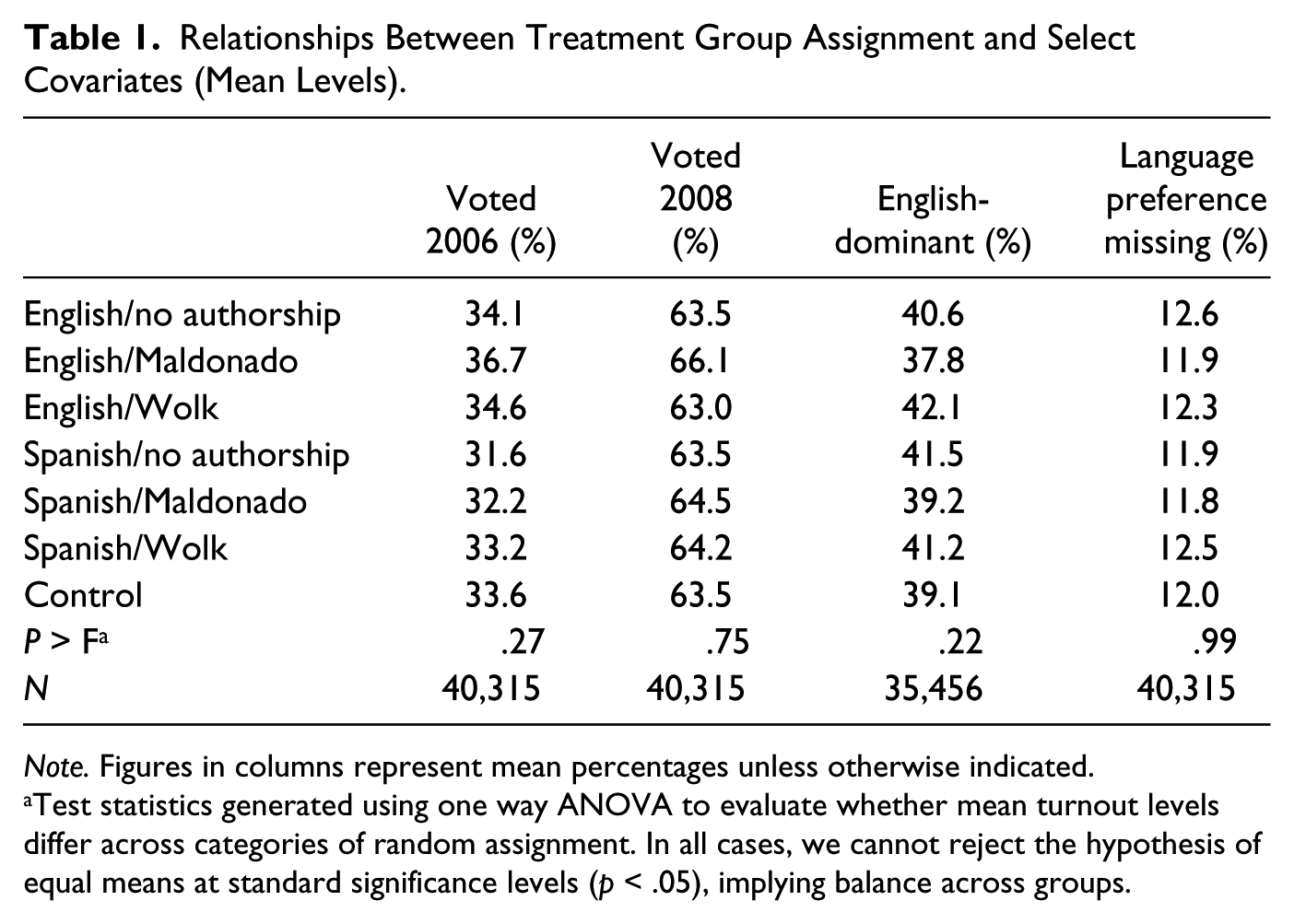
Note. Figures in columns represent mean percentages unless otherwise indicated.
Test statistics generated using one way ANOVA to evaluate whether mean turnout levels differ across categories of random assignment. In all cases, we cannot reject the hypothesis of equal means at standard significance levels (p < .05), implying balance across groups.
Following the June 2010 election, we obtained validated voter turnout data from the official San Bernardino County voter file. At the individual level, the voting records report only whether each voter cast a ballot in the election, but do not separately record whether voters completed the portion of the ballot corresponding to specific candidate contests or initiatives. Given the nature of the voter records, our dependent variable is necessarily a dichotomous indicator for whether each voter participated in the June primary election. Table 2 reports the turnout rates for subjects assigned to each treatment condition. The control group in the experiment voted at a rate of 15.2%.
Experimental Results.

Note. ITT = Intent-to-treat; ATT = average treatment-on-treated.
Turnout among voters assigned to receive the English-language postcard with no authorship cue was only slightly higher (16.0%), suggesting a modest turnout boost of 0.8 percentage points (SE = 1.2). Subjects assigned to receive the English-language Maldonado treatment voted at a rate of 15.3%, implying a negligible intent-to-treat (ITT) effect of 0.1 percentage points (SE = 1.2). The largest boost in turnout we observe is among those assigned to receive the English-language Wolk treatment, who voted at a rate 16.3 (SE = 1.2), implying a bump of 1.0 percentage points relative to the control group.
Among subjects assigned to receive postcards in Spanish, the authorless treatment failed to elevate turnout; the voting rate for this group was 13.2%, fully 2.0 percentage points (SE = 1.2) lower than that control group. Similarly, subjects assigned to receive the Spanish-language Wolk treatment voted a rate of 14.7%, 0.5 percentage points lower than the control (SE = 1.2). The Spanish-language, Maldonado treatment produced a modest turnout boost of 0.2 percentage points (SE = 1.2). When we focus on language alone, regardless of sponsorship cues, turnout among subjects assigned to receive postcards in Spanish was 0.8 percentage points lower than for the control group (SE = 0.7), while turnout for those assigned to receive postcards in English was 0.7 percentage points higher than that in the control group (SE = 0.7). When we examine the impact of the message cues regardless of language use, we find turnout among those received no authorship cue was 0.6 percentage points (SE = 0.8) lower, relative to the control group, while those assigned to receive the Maldonado treatment voted at a rate that was 0.1 percentage points higher (SE = 0.8), and those assigned to be treated with the Wolk treatment 0.3 percentage points higher (SE = 0.8), compared with the control group. Overall, these initial results, none of which reach conventional levels of statistical significance, show that the postcards did not appear to affect voting rates when their impacts are averaged across all groups of voters.
Randomized field experiments can allay concerns about external validity, because they are conducted under natural conditions. In such a scenario, however, successful contact with subjects assigned to treatment groups is not guaranteed. Notwithstanding our efforts to expose all subjects assigned to the treatment conditions to the stimulus, some subjects were not successfully contacted because their postcards were returned as undeliverable. The contact rates for each of our six treatment conditions are presented in Table 2. On average, we succeeded in contacting 92.3% of our targeted subjects. We find no significant differences in the contact rates across our treatment conditions. To obtain an accurate estimate of the direct effect of contact, it is necessary to divide the intent-to-treat effects described hereinbefore by the contact rate. Table 2 therefore also reports the average treatment-on-treated effects (ATT), which adjust the initial estimates to take into account the actual contact rate.
This is essentially equivalent to performing a two-stage least squares regression of vote on actual contact using the treatment assignment variables as instrumentals (Angrist, Imbens, & Rubin, 1996; Green & Gerber 2005). Assignment to treatment conditions is a perfect instrument for contact, because assignment causes contact but is independent of other causes of voting behavior. This estimator also permits the additional inclusion of control variables to correct for potential imbalances between experimental groups due to chance.
Table 3 reports the results of a series of two-stage least squares regression analyses in which individual turnout is regressed on actual contact and random assignment is the instrumental variable. 10 We estimate two separate models for each set of analyses. The first model expresses individual voter turnout as a linear function of each voters’ receipt of each postcard, instrumented by their assignment to the treatment conditions. The results from models, in which turnout for each voter is regressed on dummy variables corresponding to the various treatments (the reference category is the control group), are presented in columns 1, 3, and 5. Note that each treatment variable represents actual contact instrumented by random assignment. The second model is augmented to include covariates for prior voting described hereinbefore. The inclusion of covariates is not necessary, but it may reduce the disturbance variance and improve the statistical precision of the estimated treatment effects. We present results of our models with covariates in columns 2, 4, and 6 in Table 3.
Estimates of the Effects of Six Mail Treatments on Voter Turnout in the June 2010 California Primary Election.

Note. Estimates derived from 2SLS using treatment assignment as an instrument for successful treatment. Dependent variable is voter turnout in the 2010 primary election. Robust cluster standard errors in parentheses.
Covariates: Voting in the 2006 and 2008 general elections.
The regression results parallel our initial findings. The estimations reveal no significant average treatment effects (using one-tailed tests) that are consistent with our hypotheses. The inclusion of covariates changes the estimates of the treatment effects only trivially, as expected. One possible explanation for these results is that the treatments affected various voters differently. Such heterogeneity could mask effects for specific subgroups of voters. As we outlined hereinbefore, there are clear theoretical reasons to expect that language preference may have conditioned the impact of our treatments. We explore this possibility next.
Heterogeneous Treatment Effects Among Key Subgroups
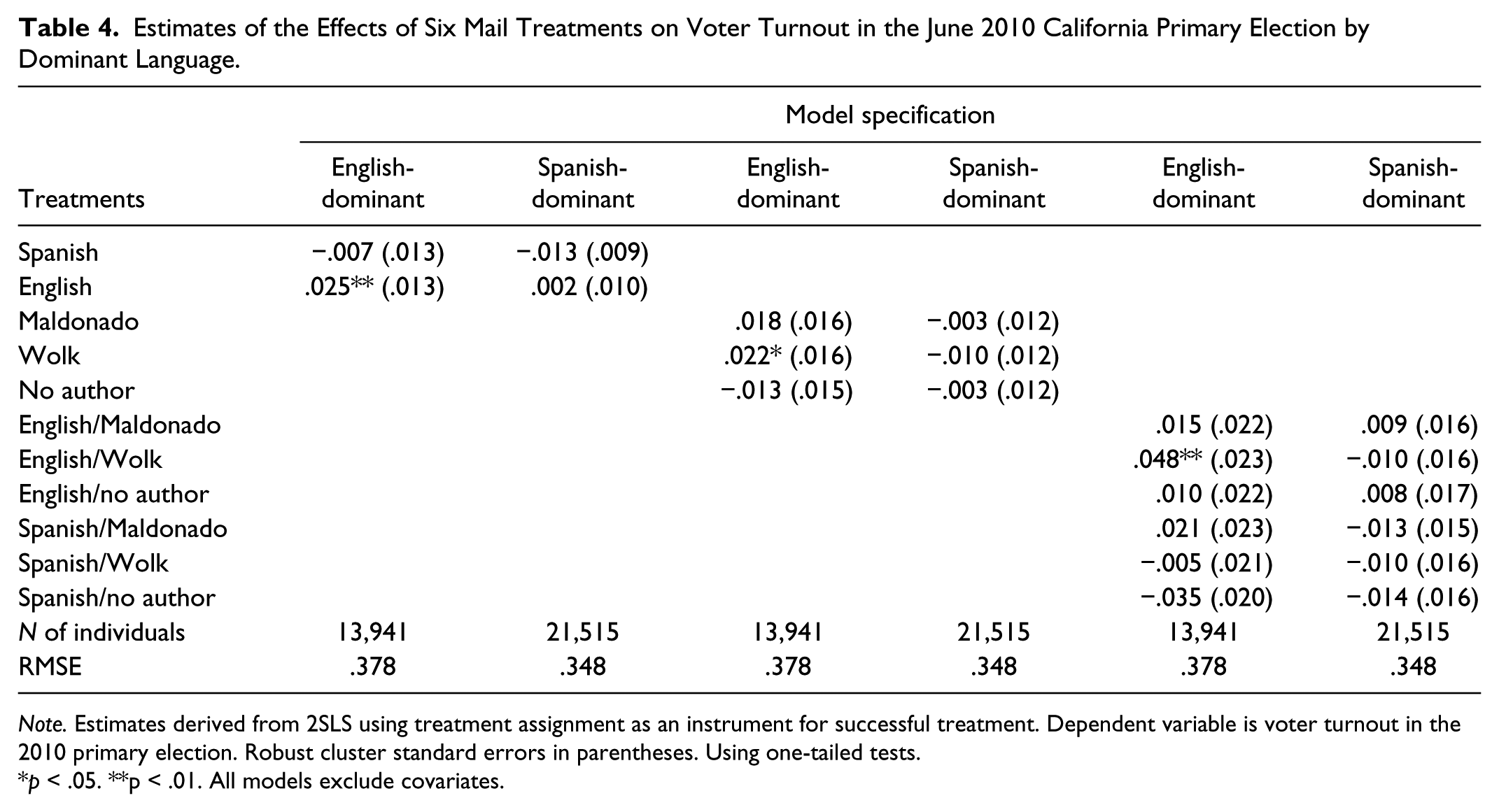
It is reasonable to expect that specific voter attributes may have mediated the impact of our interventions, resulting in heterogeneous treatment effects across key subgroups. We therefore investigated a series of interactions to examine these possibilities. We focus on interactions between the treatments and subjects’ primary language in the following. 11 We present these findings in Table 4. For the sake of space, we do not report models with the covariates described hereinbefore in Table 4, although the results are virtually identical when covariates are included (data available on request).
Estimates of the Effects of Six Mail Treatments on Voter Turnout in the June 2010 California Primary Election by Dominant Language.
Note. Estimates derived from 2SLS using treatment assignment as an instrument for successful treatment. Dependent variable is voter turnout in the 2010 primary election. Robust cluster standard errors in parentheses. Using one-tailed tests.
p < .05. **p < .01. All models exclude covariates.
We turn first to the question of language preference. Using data obtained from a commercial vendor about subjects’ primary language, we examine whether the impact of our treatments is conditional on whether subjects are English- or Spanish-dominant. 12 We expect that the English-language treatment will exert a stronger impact on voters who are English-dominant, compared with the Spanish-language treatment and vice versa. 13 The results suggest there is some heterogeneity in the impact of the treatments. The English-language treatments overall elevated turnout among English-dominant Latinos by 2.5 percentage points (SE = 1.3). This effect is statistically significant at the p < .05 level using a one-tailed test and consistent with previous studies (Abrajano & Panagopoulos, 2011). The Spanish-language treatments, however, failed to increase turnout. These results provide some support for our prediction, taken from Hypothesis 2, that mobilization methods are more effective when delivered in a voter’s preferred language, at least with respect to English-dominant Latinos, but we also detect the same puzzling asymmetry between the language effects that is generally consistent with patterns reported in Abrajano and Panagopoulos (2011).
Turning next to the prediction in Hypothesis 1 that co-ethnic elite cues should mobilize Latino voters, we focus attention on the different messages featured on the postcards mailed to voters. We find that the postcards containing the Wolk sponsorship message raised turnout by 2.2 percentage points among English-dominant Latinos (SE = 1.6; significant at the p < .05 level using a one-tailed test), compared with the control condition but none of the other cues exerted significant effects for either subgroup of voters. The estimates also reveal the English-language Wolk treatment effectively boosted turnout among English-dominant Latinos by 4.8 percentage points (SE = 2.3), an effect that is not only statistically significant at the p < .01 level, but also substantively meaningful. Typical postcard mailings of this sort boosts turnout by 0.5 percentage points on average (Green & Gerber, 2008); the magnitude of the effect we detect for the English/Wolk treatment among English-dominant Latinos is nearly 10 times greater than the average effect for mailings like these. Contrary to Hypothesis 1, however, we fail to detect any effects for the Maldonado message corresponding to the predicted mobilization produced by co-ethnic policy sponsorship, regardless of subjects’ language preferences.
One possible explanation for the surprising efficacy of the Wolk treatment is the gender composition of our sample: Women outnumbered men by more than 10 percentage points. To understand if the Wolk treatment is being driven by the behavior of female respondents—who may be differentially mobilized by a message emphasizing the leadership role played by a prominent female legislator in placing Proposition 14 on the ballot—we examined whether there is a significant interaction effect between assignment to this treatment group and voter gender. The results from these models are reported in Appendix B. Consistent with the gender leadership explanation, we found that the English Wolk effect was large and significant only for English-dominant female voters. It was substantively small and insignificant among male voters. We found no gender subgroup effects among Spanish-dominant voters.
Discussion
This study asks how Latino voters respond to GOTV direct-democracy campaigns that emphasize policy leadership exercised by prominent co-ethnic leaders and mobilization messages delivered in different languages. We also examine whether effectiveness of such outreach is mediated by the type of voter targeted by campaigns. Answering these questions can yield important lessons for the study of minority voting behavior and for mobilization campaigns aimed at increasing voter turnout among specific demographic subgroups. The familiar advantages of field experiments, in which voters are randomly assigned to receive contact and through which messages can be finely tuned, can help to supplement the lessons of past observational studies. Because we directly manipulate the delivery of co-ethnic sponsorship cues and the language in which the message is delivered, we can make clear causal inferences about the presence and magnitude of these effects. Using a rich, individual-level micro-targeting database gives us the chance to see which types of voters are more responsive to particular appeals. Randomized GOTV experiments targeted at groups that traditionally participate in elections at low rates not only sharpen our social science inferences about minority voting behavior; they also help to identify the comparative effectiveness of alternative mobilization methods, information that is of interest to political operatives and others interested in reducing longstanding inequities in political participation (Michelson et al., 2010; Michelson, Bedolla, & McConnell, 2009; Ramirez, 2005).
In the end, this experiment leaves us with somewhat of a mixed picture regarding the main hypotheses we advance in this paper. We find little evidence that Latino registered voters responded to the co-ethnic cue informing them that Latino Lt. Governor Abel Maldonado had authored one of the propositions up for a vote in the June, 2010 primary. This mobilization message was not more effective than postcards listing a White co-author or omitting all authorship information. While our results suggest that the findings from candidate elections may not translate to direct democracy—providing evidence that policy leadership does not produce the same sense of in-group solidarity or political efficacy as the candidacy of co-ethnics—it is important to recognize several alternative explanations for this null finding. First, information about Abel Maldonado’s role in crafting Proposition 14 may not have provided the strongest possible co-ethnic policy leadership message. As a Republican, Maldonado does not share the party affiliation of most California Latino voters. Indeed, in the November 2010 general election, when Maldonado faced off against his Democratic opponent Gavin Newsom, slightly more Latinos backed Newsom for the lieutenant governor’s post (DiCamillo & Field, 2010). 14 To explore the potential importance of partisanship, we analyzed the results separately for registered Democrats, independents, and (a much smaller subset) of Republican participants. We did not, however, find stronger evidence of co-ethnic mobilization among the latter subgroup.
Second, any potential treatment effect might have been so small that it went undetected by a test that relied on 2,000 postcards—which have weaker mobilizing effects than other GOTV treatments—for its statistical power. We suspect, however, that these difficult-to-detect effects would be of much smaller practical and substantive importance to campaign professionals and democratic theorists.
However, we do find evidence that the language used to deliver mobilization messages matters. We show that English outreach can effectively mobilize English-dominant Latinos, but that neither these nor Spanish-language appeals generally boosted participation among Spanish-dominant Latinos. The fact that the Wolk treatment effectively motivated English-dominant Latino females but not others suggests that the level of Latinos’ acculturation and gender cues play important roles in shaping political behavior and can mediate Latino voters’ responsiveness to campaign communications. The results highlight the challenges campaigns and nonpartisan groups face in mobilizing Spanish-dominant Latinos, suggesting that simply varying the language of their outreach efforts will not be sufficient to increase political participation for this difficult-to-reach group. Thus, successfully mobilizing Spanish-speaking voters will likely require more time-intensive and context-specific efforts—perhaps by taking advantage of these voters’ social networks and existing community organizations active in these communities.
Another consideration is the nature of message we conveyed to voters. Abrajano and Panagopoulos (2011) used a social pressure message, shown by Gerber, Green, and Larimer (2008) to be an effective method to stimulate turnout. Our postcards simply provided information to potential voters. The absence of consistent mobilization effects across all languages may suggest that information-based appeals simply do not work as effectively as social pressure messages. What is most important is, however, our findings about the relative effectiveness of English messages compared with the Spanish treatments challenge existing observational findings on the mobilizing impact of campaign advertising, documenting the importance of turning to randomized field experiments make credible causal inferences.
In all, our study tests two strategies for mobilizing Latino voters, and finds that one of them proved effective. Our experiment shows that matching the language of the GOTV message with the language preferred by the voter who received it is critical, at least for Latinos whose primary language is English. First, this heterogeneous effect emphasizes important differences within the Latino community—differences that are easily overlooked by campaigns making bulk ad buys and scholars of political behavior who study aggregate outcomes. It is conceivable that some Latinos in some circumstances may respond to Spanish-language appeals, but in other conditions, others may be more responsive to English-language messages. Campaigns that ignore this dynamic and treat Latino voters as a monolith do so at their peril. Second, from a practical vantage point, our findings point to the potential importance of new “microtargetting” data sets which, because they contain voters’ language preferences and other demographic information, including gender, can be an effective part of any mobilization campaigning. In sum, this experiment lends support for some of our expectations but fails to provide support for other contentions we advance. Nonetheless, the intriguing possibilities raised by this work beg further exploration and identify one potentially fruitful route toward mobilizing Latino voters and suggest that both scholars campaign professionals will be well served in designing interventions that account for important individual differences in targeted population groups.
Footnotes
Authors’ Note
The authors are listed alphabetically and each contributed equally to this project.
Declaration of Conflicting Interest
The author(s) declared no potential conflicts of interest with respect to the research, authorship, and/or publication of this article.
Funding
The author(s) disclosed receipt of the following financial support for the research, authorship, and/or publication of this article: We gratefully acknowledge the funding provided by Stanford University’s Bill Lane Center for the American West to support this project, which was approved by Stanford’s IRB as Protocol 18884.