



Abstract
This research examines the impact of gender on gubernatorial and senate candidates’ issue prioritization. I argue that women running for statewide office prefer to play against gender stereotypes in their issue priorities at the outset of their campaigns, so they do not appear as a strictly “female” candidate. Instead, women will only run a “gendered campaign” in response to male candidates doing so first. I put forth a dynamic theory of gendered interaction that asserts that male candidates facing female opponents will attempt to force women to campaign on stereotypical “feminine issues.” The campaign interaction between male and female candidates for office puts women in a precarious situation in which they must decide whether to respond to their male opponent or continue their “masculine” campaign strategy. I demonstrate that the gender of candidates directly influences the types of issues and strategies that each candidate pursues on the campaign trail.
Introduction
Candidates running for public office are faced with unique challenges regarding their political campaigns due to gender stereotypes and expectations that are part of American culture. In general, the electorate assumes that women are more competent in policy areas such as education, health, environment, and social welfare, while men are more competent at military policy, foreign relations, and economics (Sapiro, 1981-1982). These gender stereotypes shape voters’ expectations and provide low information cues regarding the policy preferences, ideological positions, and leadership styles of both male and female candidates. Scholars continue to debate the impact that gender stereotypes have on campaign behavior, with mixed results. Some scholars suggest that female candidates reinforce gender stereotypes and “run as women” when devising campaign strategies (Carroll, 1994; Dabelko & Hernson, 1997; Dolan, 2005; Hernson, Lay, & Stokes, 2003; Larson, 2001), while others argue that women campaign against these stereotypes by emphasizing what are perceived as traditionally “masculine” issues in their efforts to assume office (Huddy & Terkildsen, 1993; Kahn, 1993, 1996).
I attribute these mixed findings to (a) variation in the types and levels of offices under examination, with most scholars exploring legislative offices and (b) the lack of temporal considerations in the empirical testing. First, candidates may be successful when running for lower level legislative offices with issue priorities that line up with their respective gender stereotypes, but scholars have persuasively demonstrated that gender stereotypes hurt women as the level of office increases, particularly for executive offices, as voters largely associate executive officers with “masculine” traits, such as aggressiveness and toughness (Huddy & Terkildsen, 1993). Second, most analyses focus on the final outcome of a campaign, or the average behavior of candidates during the campaign, thereby glossing over unfolding campaign behavior. Yet, a candidate’s strategies can change over the course of a campaign in response to their opponent’s shifting behavior and changes in the electorate’s evaluation of them. Thus, analyses of gendered campaign behavior should focus on dynamic interactions over time. This article examines the issue prioritization of both male and female candidates running for governor and senate, and the ensuing analysis focuses specifically on the interaction between the two candidates over the course of the campaign.
The analysis builds off of the premise that candidates behave strategically when deciding how to navigate gender stereotypes and prioritize issues. Due to an underlying gender affinity effect (Box-Steffensmeier, De Boef, & Min Lin, 2004; Brians, 2005), female candidates might anticipate starting with an advantage over their male opponents among issues stereotypically perceived as “feminine.” However, voters’ expectations for statewide office holders will lead female candidates to attempt to show the electorate that they are not strictly “female candidates” who only care about “women’s issues,” and they will subsequently want to avoid being labeled as the “female candidate for office.” Instead, they prefer to appear as the “candidate for office” to avoid negative responses from the electorate (Larson, 2001; Witt, Paget, & Matthews, 1994). As a result, I assume that all female candidates for statewide offices, especially the governorship, begin their campaigns preferring to emphasize more traditionally “masculine” issue themes, rather than more traditional “feminine” issue themes.
At the same time, I predict that male candidates also behave strategically in their campaign behavior. A male candidate may realize that his female opponent does not want to campaign on feminine issues to avoid being cast as a single issue candidate, which gives him an incentive to campaign on feminine issues. If the female opponent does not respond, the male candidate may cut into the female candidate’s support among women. If the female opponent does respond, he would likely abandon his attempt to gain ground among female voters, but he will have succeeded in getting her to potentially characterize herself as a “female candidate” in exactly the way she would have preferred not to. Thus, male candidates running against female opponents are more likely to move first on stressing feminine issues during the campaign in a direct effort to attract female voters (Fox, 1997, 2000), and if their female opponent responds, male candidates may be first to move away from those issues.
I test this theory by utilizing Panel Vector Autoregression (VAR), analyzing television advertisements in 124 gubernatorial and senate campaigns in the 2000, 2002, and 2004 election cycles. This analysis finds considerable evidence that male candidates, particularly gubernatorial candidates, strategically attempt to bait their female opponents into campaigning on feminine issues to prime gender stereotypes in the eyes of the electorate.
Gender Differences in Campaign Strategies
Among other concerns, candidates must determine which issues to emphasize when choosing a campaign strategy. A candidate must attempt to predict the response of the electorate when they frame their campaign, and also anticipate the behavior of their opponent (Carsey, 2000; Carsey, Jackson, Stewart, & Nelson, 2011). Gender further influences the way in which a candidate chooses to prioritize issues. Because voters use gender as a low information cue when evaluating areas of policy expertise, candidates must navigate a gendered political landscape. Scholars have consistently shown that voters evaluate women as more qualified on “compassion” or “feminine” issues, such as education and social welfare, and less qualified on “masculine” issues, such as the economy and foreign policy (Brown, Heighberger, & Shocket, 1993; Huddy & Terkildsen, 1993; Sanbonmatsu, 2002). Men, however, are viewed as better leaders and decision-makers, and are assumed to be more qualified on “hard” political issues (Koch, 1999). Hence, to fully grasp campaign behavior and issue prioritization, one must be attentive to the way in which gender stereotypes and expectations structure the political context.
Kahn (1996) argues that women have two options when framing their issue priorities in campaign advertisements. She argues that female candidates can either play to gender stereotypes in issue preference by highlighting their expertise in areas that are perceived to be strengths for female candidates, or they can play against these stereotypes and focus on the masculine political issues. In a similar vein, Williams (1998) observes, Women seeking office end up speaking in two distinct voices. On the one hand, they speak in a woman’s voice that focuses on an “ethic of care,” which emphasizes nurturant symbols and stresses social welfare issues. On the other hand, they must also speak in a more masculine voice that emphasizes strength and competence. (p. 50)
Research exploring gender differences in campaign strategies has focused primarily on the first notion, which is centered on issue ownership and priming (Petrocik, 1996; Druckman, Jacobs, & Ostermeier, 2004). Petrocik (1996) argues that candidates should emphasize issues in which their party exhibits expertise and avoid issues for which their opponents have policy expertise. This idea has been the focal point in examining issue ownership for feminine issues for female candidates. Early research on female candidates’ issue priorities supports the issue ownership hypothesis and concludes that women are more likely to play to gender stereotypes and focus on issues they are seen as more adept at handling, such as education and social welfare. Kahn (1996) affirmed the issue ownership hypothesis, finding differences in U.S. Senate candidates’ issue priorities across gender lines. Women mentioned social programs at much higher rates than men, while men focused more heavily on foreign policy and economic issues. Hernson et al. (2003) further support these findings, concluding that “women running as women” in contests for the U.S. House of Representatives increase their vote share and probability of winning elections. Likewise, Schneider (2013b) demonstrates that women Senators utilize issue strategies that align with gender stereotypes on their campaign web pages. Moreover, other scholars have extended this area of research beyond races for U.S. Congress, as Larson (2001) and Iyengar, Valentino, Ansolabehere, and Simon (1997) report similar conclusions in state legislative races.
Several scholars, however, have demonstrated that women’s styles and issue priorities converge to those of male candidates. Kahn (1996) demonstrates that female gubernatorial candidates are much more likely to focus on areas where they need to prove their competence on the issue. Bystrom (2006) provides an overview of the video styles of female and male candidates over time, and argues that female candidates’ political ads in the 1980s were more likely to focus on education and health care, while men primarily emphasized tax policies. By the 1990s, however, Bystrom shows that female and male candidates were “strikingly similar” in their issue emphases, trait emphases, and overall use of campaign advertisements. Dolan (2005) also finds that male and female Congressional candidates’ issue emphases converged in 2000 and 2002.
Scholars have also considered the impact of female candidacies on the behavior of their male opponents (Dolan, 2005; Fox, 1997). Fox (1997) argues that men cannot operate in the same manner when faced with female opponents, and that they are constrained in the types of issues they can prioritize. Contrarily, however, Dolan (2008) provides evidence that male Congressional candidates do not alter their issue preferences based on the sex of their opponent. Despite these contradictory findings, I also think that it is important to similarly emphasize that male candidates also have a gender identity, so it is necessary to examine how their gender, the gender of their opponent, and the dominant gender stereotypes in their states impact their behavior as well.
Campaigns as a Dynamic Process
Despite the important insights generated from the literature on gender and campaign behavior, there have been mixed results. These mixed findings can be attributed to the fact that scholars are looking at women running for different levels and types of offices, as I will explain later. In addition, scholars have utilized various methodological approaches to understand gender differences in campaign behavior. To date, most of the research examines the total count of issues put forth by female candidates, in comparison with their male opponents, over the course of a campaign cycle (Dolan, 2005; Kahn, 1993; Hernson et al., 2003). Yet, by aggregating ads at the end of the electoral cycle, we lose valuable information about how candidates’ strategies evolve over the course of the campaign. Campaigns are not conducted in a vacuum, and when new information becomes available candidates change their behavior accordingly. Therefore, because the issue priorities put forth by candidates are not constant, and candidates’ voice and intensity can fluctuate, we need to examine the dynamic nature of campaigns by modeling candidates’ strategic behavior within the contextual environment of the electoral contest. Put simply, looking at the end result, or “box score,” cannot adequately determine the true impact of gender on issue ownership (Granato & Wong, 2004).
Several scholars have furthered our understanding of campaign behavior by focusing on the dynamic nature of elections (Box-Steffensmeier, Darmofal, & Farrell, 2009; Carsey, 2000; Carsey et al., 2011; Johnston, Hagen, & Jamieson, 2004). Among them, Riker (1990) offers what he terms a “heresthetic theory” of candidate behavior. He argues that candidates attempt to change the issues being primed within a particular campaign space. According to Riker, candidates do not necessarily change their issue positions to cultivate favor in the eyes of the electorate. Instead, they will attempt to change the salience of issue dimensions. Candidates attempt to change the context of the election by offering new issue dimensions to emphasize areas of their expertise. If the candidate is successful in making the new issue dimension the most salient in an electoral setting, he or she may be able to overcome the gap in voter preference. Ultimately, Riker’s work is important insofar as it draws our attention to the way in which candidates, acting as strategic actors, modify their behavior to emphasize issues that will increase their vote share.
Expanding our understanding of the dynamics of electoral behavior, Carsey et al. (2011) provide three theories of campaign strategies. First, candidates can choose a campaign strategy and stick to it regardless of the information flow or context of the campaign. In this theory, candidates may simply “talk past” their opponents. Second, candidates can react to the behavior of their opponents, either in issue space or tone of the advertisements. Finally, candidates may anticipate the campaign strategies of their opponents and preemptively respond to how they frame their campaign. In sum, Carsey et al. (2011) offer a theoretical foundation to consider how candidates interact and conduct their strategies over the course of the campaign. That said, despite Riker (1990) and Carsey et al.’s attention to campaigns as dynamic processes, their analyses neglect to consider how gender shapes issue prioritization.
Strategic Actors in a Gendered Political Landscape
In an effort to combine these bodies of literature, I put forward a theory of campaign behavior that positions male and female candidates as strategic actors in a dynamic campaign process by applying Riker’s (1990) heresthetic argument to statewide campaigns featuring female candidates. As Riker argues, “heresthetic has to do with changing the space or the constraints on the voters in a way that they are encouraged, even driven to move themselves to the advantaged heresthetician” (p. 47). Applied to mixed-gender races, this heresthetic argument examines how male and female candidates for the senate and governorship strategically change the issue dimensionality of the race in response to their opponent’s behavior and the electorate’s stereotypical perceptions of their competency.
Specifically, I predict that women running for higher level offices, especially executive office like the governorship, do not want to be labeled as the “female candidate for office,” regardless of their party affiliation. Instead, they prefer to be seen as the “candidate for office.” Gubernatorial and senate candidates need to display the breadth of experience necessary to effectively manage or represent an entire state. This is in sharp contrast to women running for lower levels of office, who are more readily accepted because of the small size of their area of representation. Therefore, campaign considerations vary based on the level and type of office. Playing to gender stereotypes in statewide elections undermines a female candidate’s ability to showcase a full range of expertise. To avoid being typecast as the “female candidate,” or a single issue candidate, women do not focus their campaign on traditionally feminine issues from the outset of their campaign. 1
The campaign tactics of female candidates are driven by their understanding of persistent patterns of voting behavior in the electorate. As Box-Steffensmeier et al. (2004) argue, the gender gap in voting is “not an exclusive product of the election itself” and represents the “givens” of electoral behavior (p. 527). These “givens” will allow female candidates to have a relatively strong base of support from female voters. Similarly, Brians (2005) concludes that there is a conditional gender affinity effect in the American electorate, particularly with Republican women voters crossing party lines to vote for Democratic women candidates. Due to the gender affinity effect, female candidates do not necessarily need to work as hard to campaign to the base of women voters, but will instead need to work diligently to appeal to male voters to win the election. In other words, they will not be able to garner support among male voters by running feminine issue ads at the outset of their campaign.
In response, male candidates will view their opponent’s neglect of their base support group as an opportunity to chip away at the edges of the female bloc of voters. Schneider (2013a) explains that male candidates might strategically improve their position by campaigning on traditionally feminine issues to be perceived as “more versatile and competent all around” (p. 21). More importantly, however, this is an opportunity to force their female opponents to campaign on feminine issues. With this in mind, strategic male candidates should prime gender in an attempt to cue the electorate to negatively evaluate female candidates, while at the same time improving their image in policy areas where women are stereotypically advantaged. Much like theories on race priming (Gilens, 1996; Jamieson, 1992; Mendelberg, 1997, 2001; Valentino, Hutchings, & White, 2002), male candidates can invoke gender stereotypes to their advantage and also force their female opponents into changing their campaign strategy to focus on “feminine” issues.
This campaign tactic by male candidates places female candidates in a precarious situation. On one hand, if they do not respond to their opponents’ use of feminine issue priorities, they risk losing portions of their base group of support-women voters. On the other hand, if they respond to their opponents by stressing feminine issues, they risk losing their credibility in the eyes of male voters. If their male opponents shift the issue dimensionality to feminine issues, therefore, female candidates will respond with a feminine ad to reenergize their base of women voters. Yet, they will quickly return to masculine issues to avoid the pitfalls of being perceived as the “woman candidate.”
When the issue dimensionality of the campaign changes to feminine issues, male candidates have two options for their own campaigns. They can continue to campaign on feminine issues, or they change their issue presentation to more “masculine” issues. Just as female candidates adjust their tactics in light of their male opponents’ behavior, male candidates will need to reassess their campaign approach when female candidates change their message. A male candidate should be afraid of campaigning on feminine issues simultaneously with their female opponent. If they continue this campaign strategy, the issue ownership of feminine ads could potentially hurt their election prospects, so male candidates will therefore need to pivot and campaign on issues they will be viewed as more qualified to handle.
In the end, this theory comes down to the preferences of the campaign dialogues for male and female candidates. Male candidates prefer issue divergence, meaning they would prefer to focus on more masculine issues while female candidates focus on feminine issues. From their perspective, they would like gender stereotypes to define the landscape and outcome of the election. Female candidates, however, prefer issue convergence. Female candidates would ideally like to campaign on masculine issues to directly challenge their male opponents and subvert stereotypical gender assumptions about their political strengths. However, if their male opponents move to feminine issues, then female candidates have the incentive to move with them to (a) shore up their base of support and (b) keep the overall contest focused on issues where they have the advantage. Once female candidates for senate and the governorship campaign on feminine issues, they may have a difficult time convincing male voters that they have the qualifications and breadth of expertise necessary to represent an entire state.
Data and Method
Candidates and Campaign Commercials
This research seeks to explain the strategic tactics and interaction of candidates based on their gender identity as well as that of their opponents. Previous analyses have used websites (Dolan, 2005; Niven & Zilber, 2001), interviews with candidates and campaign staff (Dabelko & Hernson, 1997; Fox, 1997), and newspaper coverage (Fowler & Lawless, 2009; Kahn, 1994; Kahn & Goldenberg, 1991), but each approach faces shortcomings when analyzing actual campaign behavior. As Dolan (2005) notes, analyses using websites have the potential for selection bias, as certain candidates may be more likely to use websites than others. 2 Although Druckman, Kifer, and Parkin (2009) argue that campaign websites offer a “holistic or complete a portrait of campaign strategy as is available . . . ” (p. 345), this can also take away from the actual priorities of candidates. It is difficult to discern the prioritization of issues when so much information is placed on a website. Also, interviewing candidates and campaign staffs allow subjects to craft stories of their strategies that may not reflect reality (Niven & Zilber, 2001). Newspaper coverage has also been shown to be widely biased against female candidates when covering campaigns, focusing primarily on appearance, personality traits, and their viability as candidates—and not on actual policy positions (Fowler & Lawless, 2009; Kahn, 1994).
In contrast, television advertisements offer an opportunity to analyze the actual campaign tactics of the candidates themselves and appeals to voters. Schaffner (2005) argues that “campaign advertising provides a good measure of the issue focus of campaigns because campaign advertisements are expensive to produce and air, so candidates want to focus their ads on issues that are central to their campaign” (p. 807). Not only is the content controlled by the candidates, the voice and intensity of airing is also at the discretion of the candidates. Candidates for governorship and the senate generally have the funds to run comprehensive advertising campaigns. As an unfiltered media outlet, television ads best capture the true issue priorities put forth by the candidate. Unlike campaign websites, campaign advertisements provide a clearer understanding and ordering of issue priority as we can measure the amount of airtime a specific issue receives.
The data used in this study focus on gubernatorial and senate campaign contests in 2000, 2002, and 2004. 3 I utilize campaign advertisements from the Wisconsin Advertising Project (WiscAds) and analyze the television advertisements of candidates in 124 races. Included in this data set are 11 gubernatorial races and 22 senate races in which female candidates were present. These data include 3 races in which a Republican female candidate ran for the Senate, as well as 3 races featuring female candidates for both major parties. I report the races featuring female candidates in Table 1.
Female Candidates Included in This Analysis Along With Their Vote Shares Received.
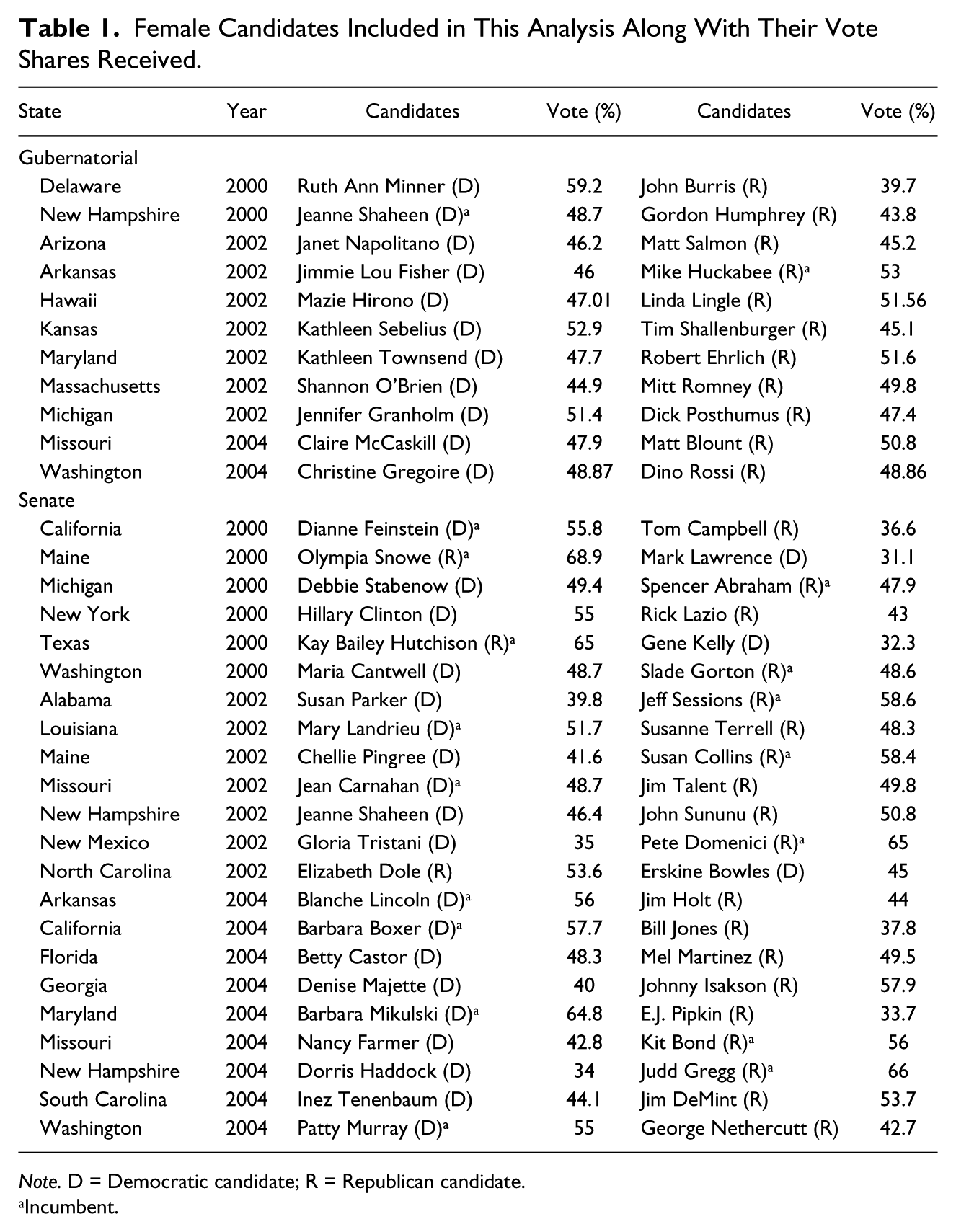
Note. D = Democratic candidate; R = Republican candidate.
Incumbent.
The WiscAds Project identifies and codes the universe of television advertisements aired by candidates in the 100 largest media markets throughout the entirety of the campaign process. In these data sets, each advertisement is coded for the issue content with up to 4 issues coded based on a schema of more than 50 issues. The WiscAds data set includes each airing of an advertisement as a single observation. Because most advertisements are aired multiple times, the total airing of specific issues is available, thereby measuring the intensity and issue priority of each candidate.
Because I am primarily interested in the broad perspective of candidates and their use of “feminine issues,” I use a coding scheme to organize the issues put forth by candidates in the advertisements into broad categories. The basis for the coding scheme is to situate individual issue areas that are stereotypically perceived to benefit women or men into broad categories of “feminine” or “masculine.” Expanding the coding schemes of Swers (2002) and Stokes-Brown and Neal (2008), I recode these issues into categories based on feminine issues, masculine issues, candidate qualification, 9/11 and Iraq, and government reform. A detailed explanation of the coding scheme is included in the online appendix. For the purpose of this research, only feminine and masculine issue ads are included in the analyses. 4
In this analysis, I control for the relative standing of the two major party candidates in public opinion polls over the course of the campaign. This will capture the impact of the electoral environment changing over the course of the election cycle. Polling data were collected from the National Journal’s Daily Hotline report. This is a collection of most polls conducted during the election cycle. Additional polling data were collected from the Polling Report. 5 Combining these two data sources has led to a nearly complete population of polling data made publicly available. To avoid the potential for the polling data to be skewed due to voter uncertainty in the early stages, as well as to account for weeks of missing polling data, Stimson’s (1999) polling algorithm was utilized to provide a smoothed estimate of candidate polling position. This algorithm accounts for present and past values of the series to calculate a better estimate of the position of the candidates. Where there is little variation in the polling position, the impact of the smoothing process is minimal. Where there is high variance, however, the smoothing effect is much greater. Both the campaign issue ads and the polling data are aggregated to weekly measures to capture the long-term campaign behavior of candidates. This allows the random fluctuations in both the polls and candidate responses to get canceled out in this aggregation process.
Modeling Campaign Dynamics
To capture the dynamic nature of campaign strategies over time, I utilize a five-equation VAR model. 6 This five-equation model allows me to test the claim that candidates respond to each other, as well as polling position, when considering which type of issues to campaign on. The VAR model estimates current values of each dependent variable of interest as a function of its own past value, as well as the past values of the other variables of interest, and an error term. In these models, I also include dummy variables for each state-year-office to capture any fixed effects that are contest specific. The following equation is an example of one of the VARs I estimate:





The abbreviated text represents the gender of the candidate and the type of issue in the advertisement. For each of the variables in the above equation, the first capital letter (W or M) represents the gender of the candidate (Woman or Man), and the second letter refers to the stereotypical view of the issue as either feminine or masculine (F or M). The subscript it refers to the given time point for each individual candidate, which in this case is a given week during the campaign. For example,
In Equation 1 of this model, I examine the campaign strategy of female candidates using feminine issue ads against their male opponents. The previous week’s strategy for feminine issues aired by the female candidate is captured in
Equations 1 to 4 allow me to estimate the strategic interaction of candidates, controlling for their standing in the polls. Though not central to this particular article, Equation 5 also permits me to explore whether the candidate’s relative standing in the polls responds to the issue themes they stress during their campaigns. If the coefficients in Equation 5 for the lagged values of men and women’s advertising are statistically significant, the advertising campaigns are affecting polling positions.
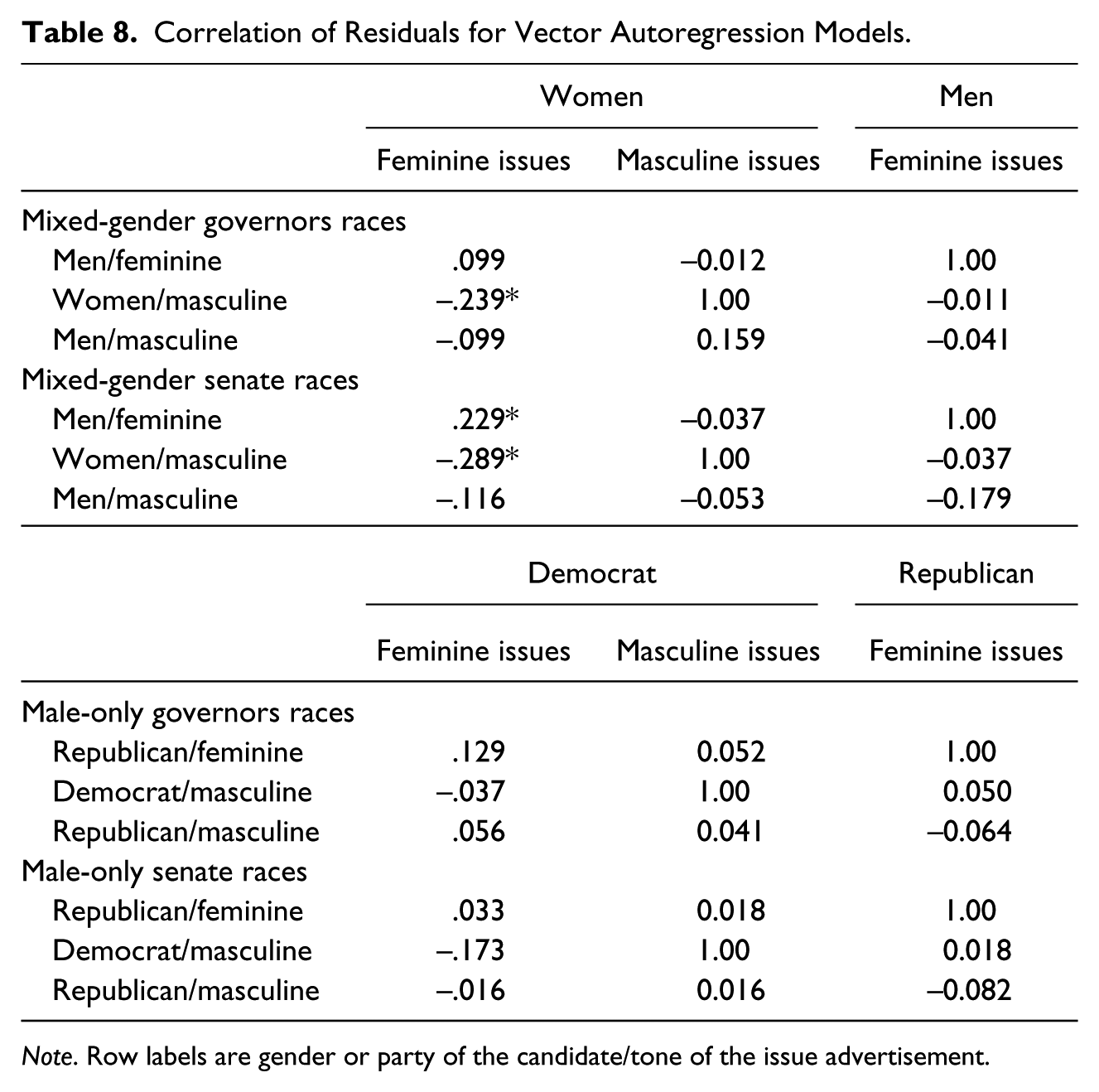
In VAR models, the two potential contemporaneous relationships are captured in the correlation of the residuals of each equation (Brandt & Williams, 2006; Carsey et al., 2011). First, these residuals will capture the potential trade-off of airing either masculine or feminine ads for individual candidates. Second, these residuals will capture candidate’s strategic changing based on their prediction of what their opponent will do at the current time period. For example, in Equations 1 and 3, the correlation of the residuals will show the consideration of airing a higher proportion of feminine or masculine issue ads for female candidates. If there is a negative correlation between the feminine and masculine issues aired, female candidates are making a trade-off between the type of ads that they air. If there is no correlation, they are airing feminine ads without considering the masculine ads they are simultaneously airing. Moreover, if there is a correlation between the residuals in Equations 1 and 2, female candidates are attempting to predict the behavior of their male opponent’s use of feminine issue ads. If the correlation is positive between these two residuals, female candidates are predicting an increase in their male opponent’s use of feminine ads, and are increasing their feminine ad usage. If there is no correlation of the residuals, the candidates are basing their current behavior without a prediction of what their opponent is airing.
Results
Prior to reporting the results from the VAR model, I replicate results of earlier studies based on aggregate issue presentations and come away with the same mixed results as previous analyses. Table 2 puts forth a statistical test of differing campaign issue strategies. For the difference in means tests reported in Table 2, the campaign advertisements are aggregated to the two major issue themes previously outlined. Results are reported separately for senate and gubernatorial elections. The proportion of these ads are also calculated at a weekly level, not the total campaign proportion. This allows for a more detailed analysis of the campaign strategies at a more nuanced level.
t Test of the Proportion of Aggregate Campaign Themes.
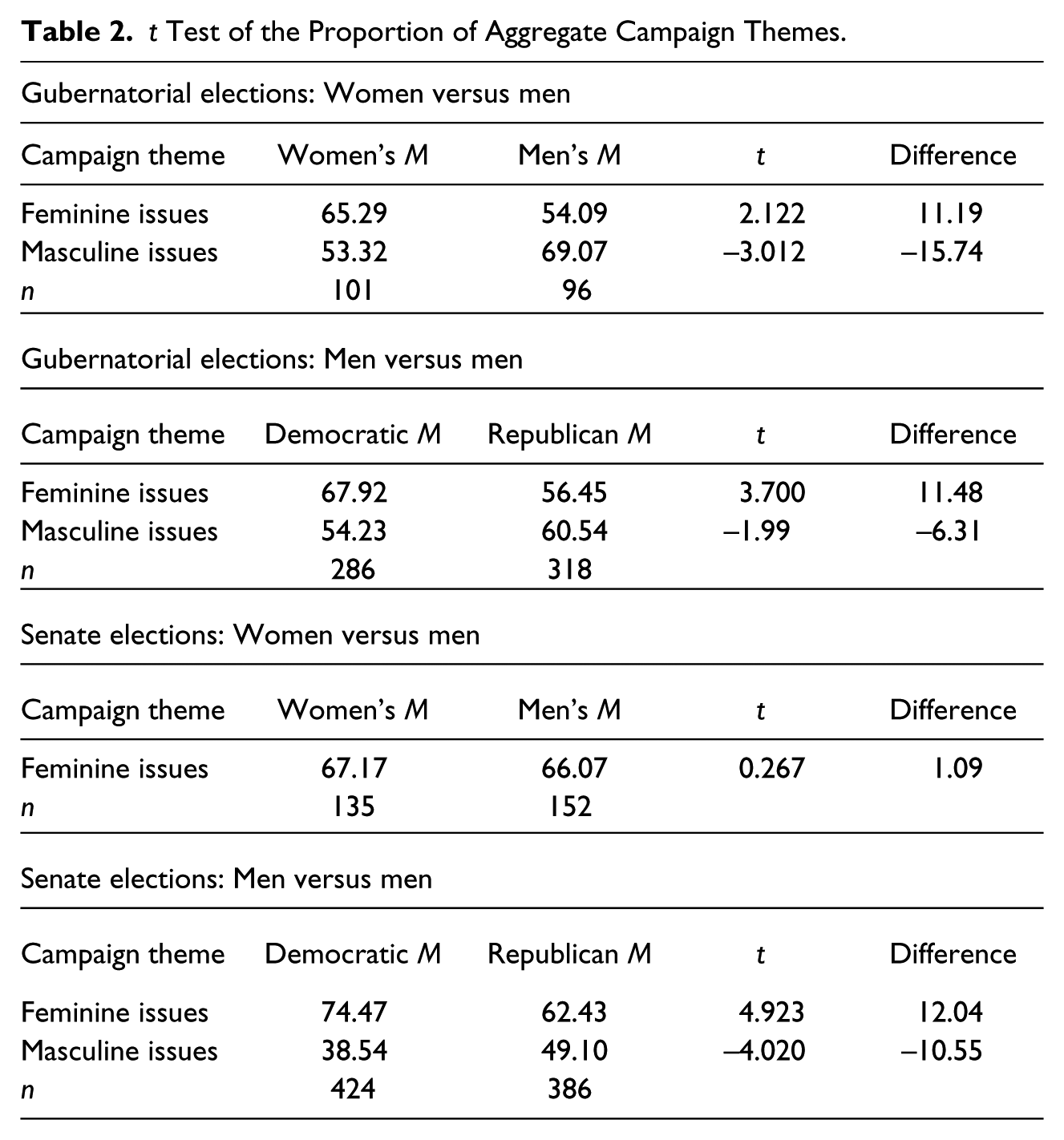
At first glance, there are differing results for the campaign behavior of female senate and gubernatorial candidates in 2000, 2002, and 2004. There is a statistically significant difference in the behavior of female and male candidates for governor. Female candidates focus on feminine issues in 65% of their advertisements, compared with only 54% of male candidates. Moreover, men included masculine issues in nearly 16 percentage points more of their campaign advertisements compared with women. Male-only gubernatorial races also show a party difference in issue priorities, with Democratic candidates relying on feminine issues at higher rates than Republicans, and masculine issues at lower rates than their Republican counterparts.
In intergender competitions, there are no statistically significant differences in the behavior and issue prioritization of female and male senate candidates. Female candidates use feminine issue ads 67% of the time, while male candidates use them 66% of the time. Female candidates also use masculine issues 4% more than their male opponents, yet this result does not meet traditional levels of statistical significance. These findings contrast with male-only races in which Democratic men and Republican men have a clear divide on both feminine and masculine issues, with Democratic men focusing more heavily on feminine issues and Republican men on masculine issues.
In addition, I have conducted an analysis to test the differences in the behavior of male candidates running against women compared with running against men. I hypothesized that men will behave differently when they face a female opponent. Reported below in Table 3 are the results of difference in differences tests for Republican candidates. Because all but three of the women in this analysis are Democrats, this test is essentially an analysis of campaign issue priorities controlling for gender differences, and not party differences. Table 3 shows no meaningful difference in the issue priorities of Republican candidates when stressing feminine or masculine issues in senate campaigns, and feminine issues in gubernatorial campaigns. The only statistically significant difference in the proportions of ads is for masculine issue ads in gubernatorial campaigns. Male Republicans use ads that mention masculine issues when running against women 69% of the time, compared with only 60% when faced with male opponents.
Difference in Differences Test of Aggregate Campaign Themes of Male Republican Candidates by Gender of Democratic Opponents.
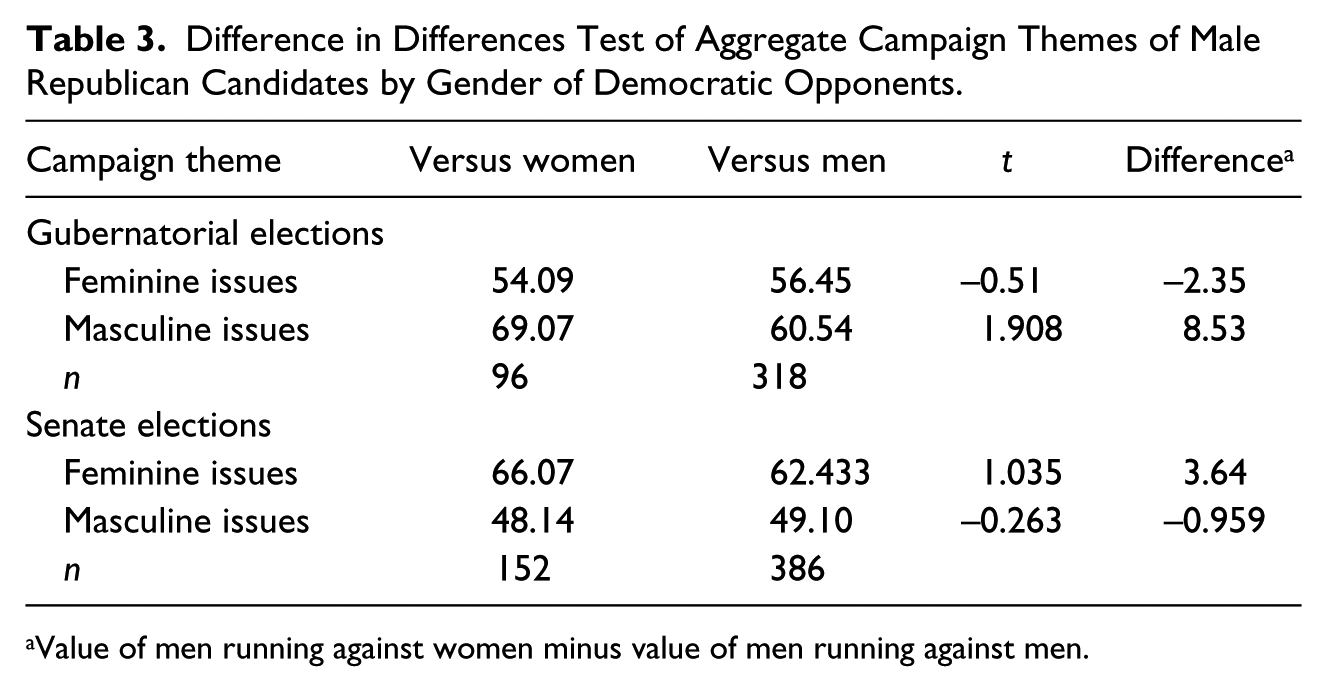
Value of men running against women minus value of men running against men.
These data support and contradict the notion that there are true differences in the aggregate campaign strategies between men and women. That said, campaigns are dynamic processes that are influenced by changes in the campaign context. Figures 1 and 2 offer the first evidence that advertising strategies of candidates change over the course of the election. Figure 1 supports my claim that female candidates tend to avoid feminine issue ads at the outset of their campaign, while their male opponents stress feminine issues from the start. Female candidates respond to their male opponent’s use of these ads. The cyclical nature of gendered campaign strategies is apparent in these figures. Female candidates begin their campaigns with a focus on other issue areas, but as election day nears, female candidates will center their issue advertisements on feminine issues—mainly in response to their male opponents initial use of feminine issue ads. In senate campaigns, female candidates then move back toward more masculine issue advertisements, while their male candidates again increase their feminine issue ads.
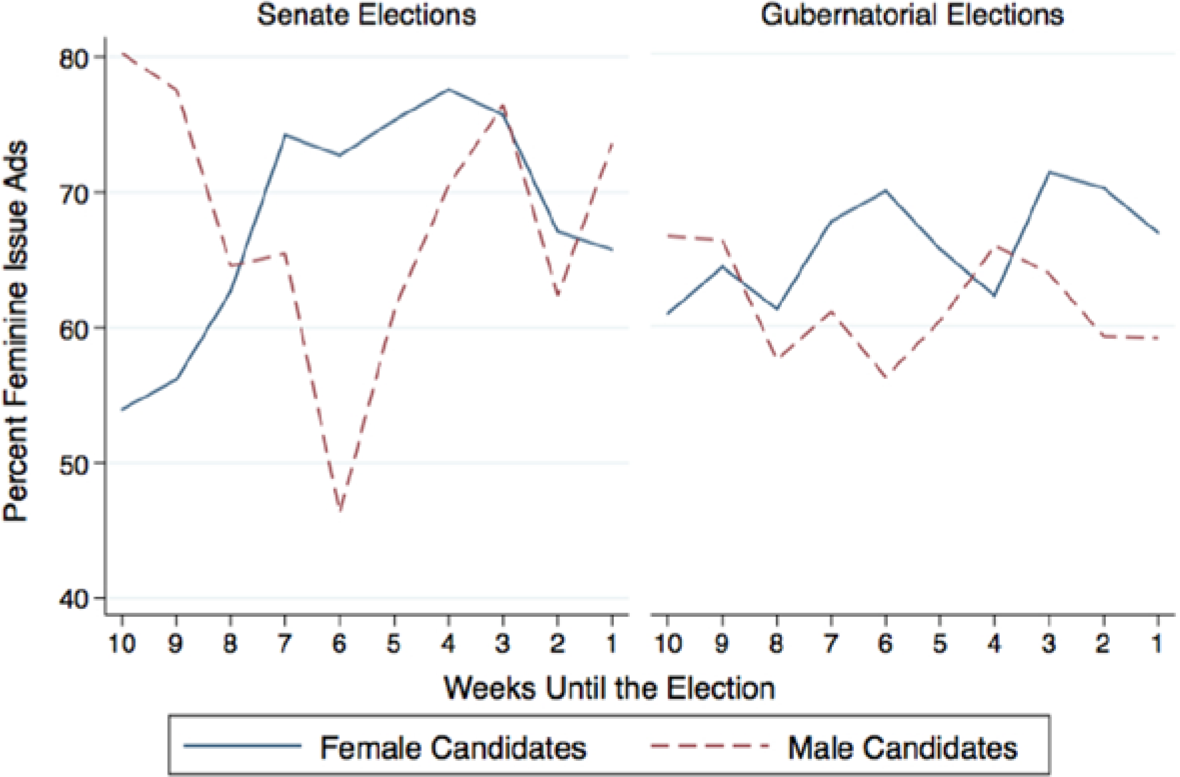
Weekly proportion of feminine issue ads in mixed-gender races.
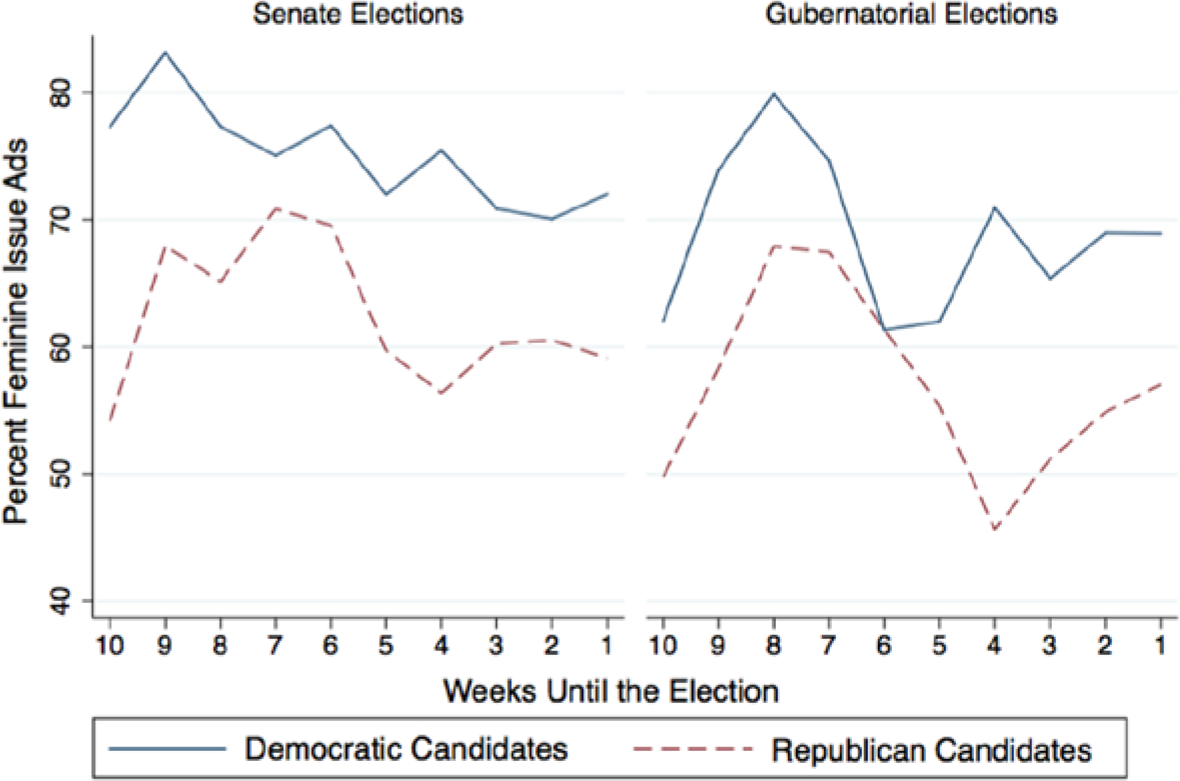
Weekly proportion of feminine issue ads in male-only races.
In gubernatorial elections, female candidates are more cyclical in their use of feminine issue ads, generally in 3-week time periods. The female candidates increase their use of feminine ads in weeks 9, 6, and 3, followed by a retreat to masculine ads, which provides female candidates 3 weeks out from the election to return to masculine issue ads. These movements coincide with changes in their male opponents’ campaign strategies as well. The second figure represents the average feminine issue ads used in male-only races. Unlike the mixed-gender contests, there is little evidence of a back and forth exchange between opponents, there is a clear difference in the level of feminine issue ads being used by Democratic and Republican candidates. Moreover, in these single-gender races there are no points in the male-only races in which the parties flip in terms of who is utilizing more feminine issue ads.
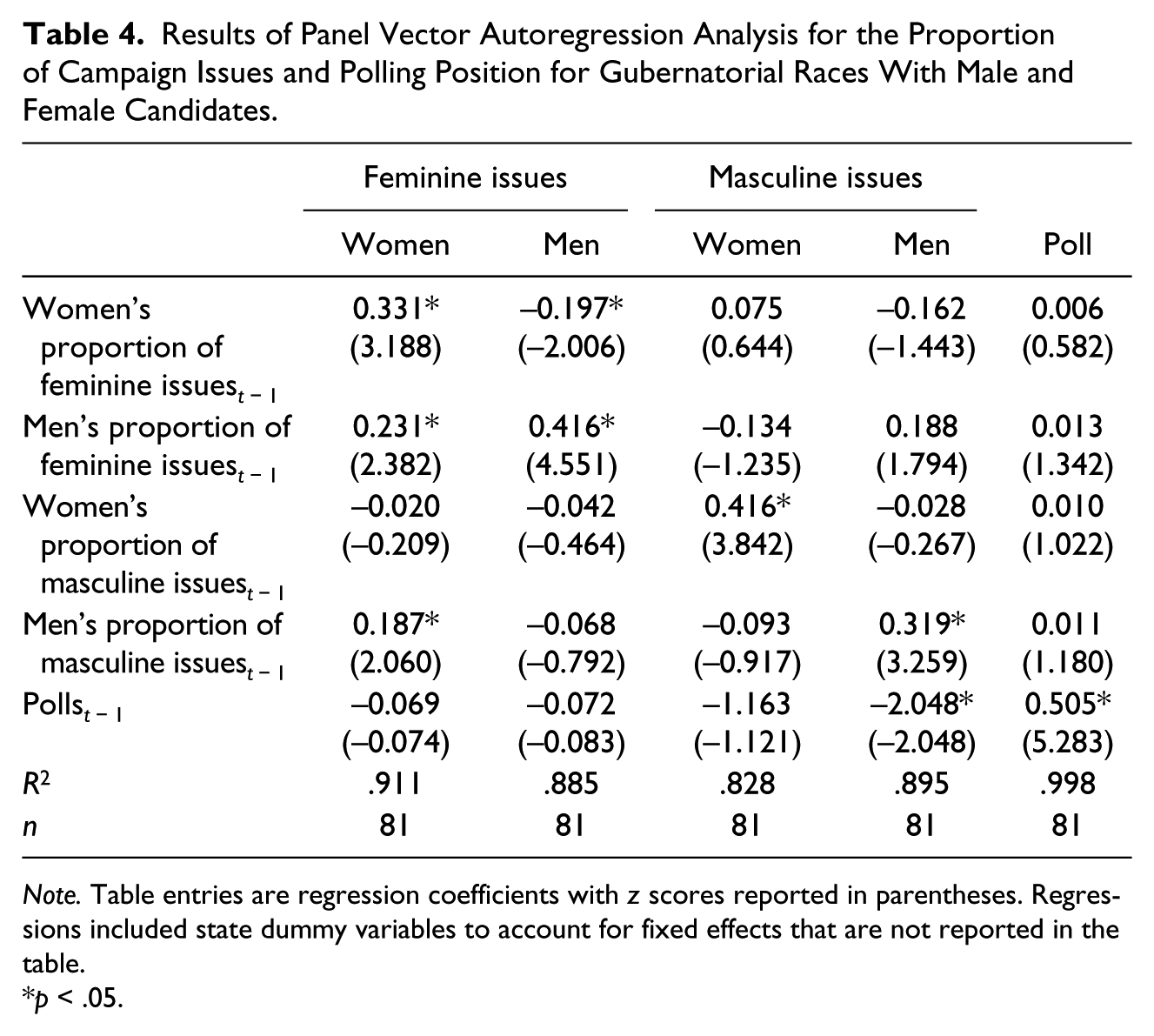
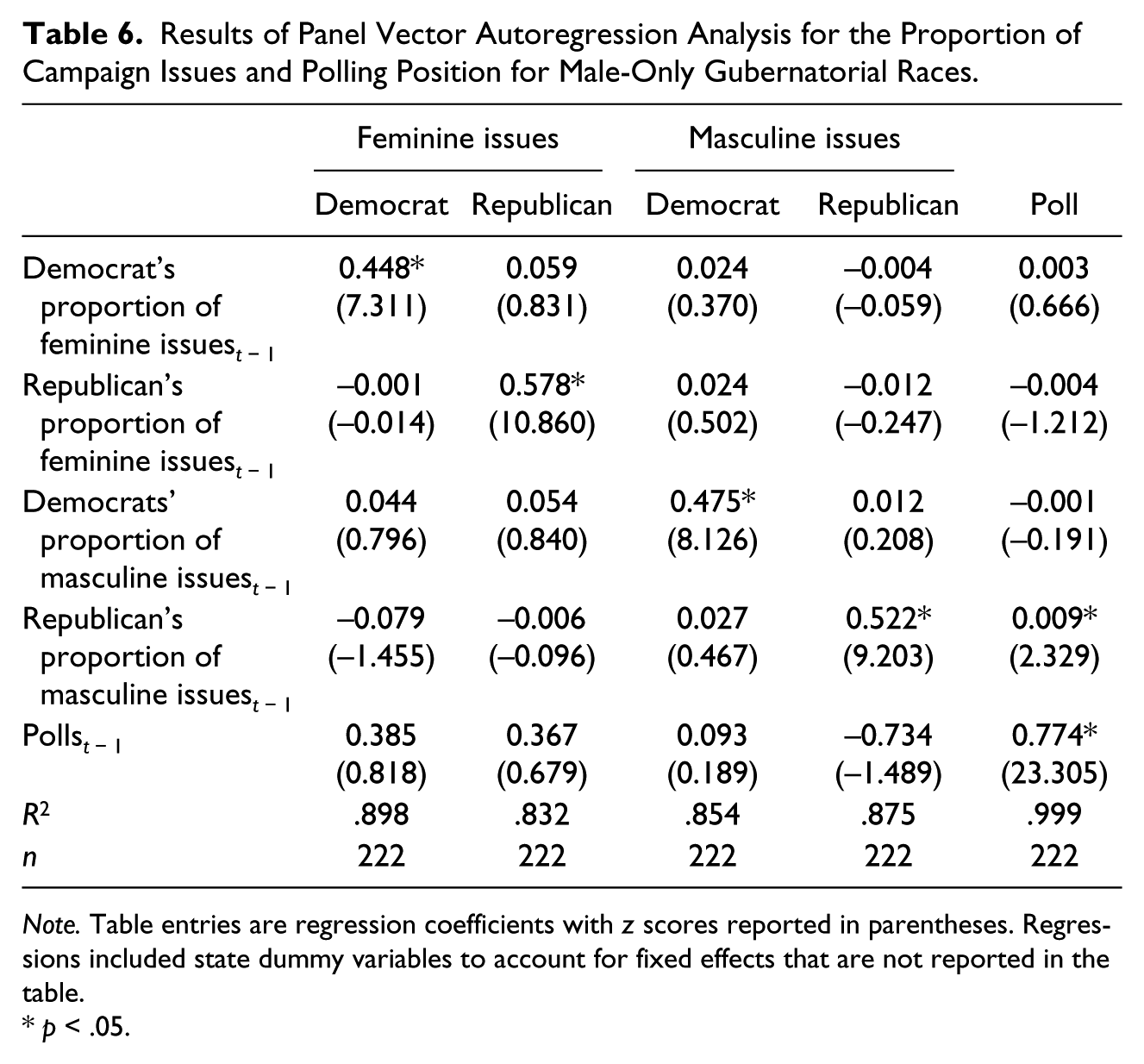
While Figure 1 offers visual evidence of a dynamic interaction between candidates on the campaign trail, it is necessary to test the significance of these campaign dynamics to discern what driving force is behind these changing campaign strategies. Tables 4 to 7 report the results of the Panel VAR models and Table 8 reports the correlations of the residuals. This five-variable equation includes a lagged value of the candidates’ proportion of feminine and masculine issue ads, the lagged value of their opponents’ feminine and masculine issue ads, and the Democratic proportion of the two-party poll share. These models are split between senate and gubernatorial elections to control for variation that may be caused by office.
Results of Panel Vector Autoregression Analysis for the Proportion of Campaign Issues and Polling Position for Gubernatorial Races With Male and Female Candidates.
Note. Table entries are regression coefficients with z scores reported in parentheses. Regressions included state dummy variables to account for fixed effects that are not reported in the table.
p < .05.
Results of Panel Vector Autoregression Analysis for the Proportion of Campaign Issues and Polling Position for Senate Races With Male and Female Candidates.

Note. Table entries are regression coefficients with z scores reported in parentheses. Regressions included state dummy variables to account for fixed effects that are not reported in the table.
p < .05.
Results of Panel Vector Autoregression Analysis for the Proportion of Campaign Issues and Polling Position for Male-Only Gubernatorial Races.
Note. Table entries are regression coefficients with z scores reported in parentheses. Regressions included state dummy variables to account for fixed effects that are not reported in the table.
p < .05.
Results of Panel Vector Autoregression Analysis for the Proportion of Campaign Issues and Polling Position for Male-Only Senate Races.

Note. Table entries are regression coefficients with z scores reported in parentheses. Regressions included state dummy variables to account for fixed effects that are not reported in the table.
p < .05.
Correlation of Residuals for Vector Autoregression Models.
Note. Row labels are gender or party of the candidate/tone of the issue advertisement.
Table 4 examines the dynamic interaction of male and female gubernatorial candidates when airing feminine and masculine issue ads. The most important significant finding pertains to the response female candidates have when their male opponents increase their use of feminine issues. Once men decide to enter a dialogue on feminine issues, women respond with a positive increase in their use of gendered issue advertising. More specifically, women increase their proportion of feminine ads by 0.231 percentage points with a 1 percentage point increase in their male opponents’ use of feminine ads. In addition, the proportion of female candidates’ feminine issue ads are a direct result of the previous proportion of feminine issue ads women are airing. It is clear that the proportion of ads that candidates run of a given type depends on what proportion they were running of that type previously. In other words, advertising strategy has some “stickiness” to it over time—candidates do not completely reinvent their advertising strategy from one week to the next.
Table 4 also shows an interesting pattern of male gubernatorial candidates’ behavior. Male candidates decrease their use of feminine ads by 0.197 percentage points when women increase their proportion of feminine issue ads by 1 percentage point. This reveals a clear indication of the role of gender in issue strategies of gubernatorial candidate. Candidates are both responding to one another, as they attempt to sort out the issue dimensionality of feminine issues. These results are consistent with the gender priming theory, as male candidates clearly retreat when challenged by their female opponents on gendered issues.
Unlike the use of feminine issue ads, there is no significant relationship between the behavior of male and female candidates when airing masculine political issues. As evident in columns 3 and 4, male and female candidates both only respond to their previous campaign strategies when focusing on masculine issues. Moreover, male candidates change their campaign strategies based on polling numbers, whereas female candidates do not. Male candidates show a decrease in their proportion of masculine ads by 2.05 percentage points when their polling position increases.
Table 5 reports the VAR results for mixed-gender senate campaigns. 8 Unlike gubernatorial campaigns, there is no strategic interaction based on prior campaign strategies across candidates regardless of issue area. In senate elections, the only significant predictor of campaign strategies for both male and female candidates is their prior behavior. There is little evidence of a dynamic interaction between candidates. These results illuminate the differences between gubernatorial and senate campaigns, and they suggest that the incumbency advantage enjoyed by senators allows them to “talk past” their opponents. In a noncompetitive election, a candidate has little incentive to engage in a dialogue with her or his opponent.
Tables 6 and 7 demonstrate similar behavior in male-only races showing that the prior behavior of male candidates for both governorship and senate is the best predictor of their current behavior, regardless of issue type. Male Democratic candidates for senate also respond to changes in polling position. These candidates increase their use of masculine issue ads by 1.32 percentage points with a 1 percentage point increase in polling average. The overall lack of campaign interaction is expected in male-only races as gender stereotypes do not impact campaign behavior. These candidates appear to stick with their chosen strategy throughout the course of the campaign, which causes them to “talk past” one another.
Table 8 provides an analysis of the residual correlations for each of the equations in Tables 4 to 7. As previously outlined, a correlation between the residuals in the VAR models would show a contemporaneous aspect of the campaign strategies not directly captured by the models, meaning candidates are predicting what their opponent will be doing rather than responding to what their opponent has previously done. In Table 8, there are three statistically significant correlations of residuals for the four VAR models. In mixed-gender gubernatorial races, women make a trade-off between running feminine and masculine issue advertisements. Unlike their male opponents, women decrease their feminine issue ads while increasing their masculine issue advertisements. It appears as though women will not send conflicting messages on their issue priorities, but instead make a clear distinction on what types of issues they will air in a given week.
In mixed-gender senate races, there are statistically significant correlations for female candidates running feminine issue ads. Similarly to female gubernatorial candidates, female senate candidates also make a strategic consideration when airing feminine versus masculine issue advertisements. These women are also decreasing their feminine issue ads when they increase their masculine ad usage. More interestingly, however is the positive and significant correlation of feminine issues utilized by male and female candidates. These correlations indicate that female candidates are predicting their male opponent’s use of feminine issue ads and increasing their use of these ads before for their opponents are able to do so. It is as if they are predicting that their opponent will increase his feminine issue ads, and beating them to the punch. This is a very interesting use of the “rational expectations” and campaign dynamics not picked up in the lagged values of advertising, but in the residuals.
In each of the other residual correlations, there is not a significant correlation that would lead to the conclusion that candidates are successfully predicting the behavior of their opponent and altering their campaign message. Male-only races have little indication that the candidates are engaging one another at all. Both the lagged values in the VAR model and the contemporaneous effects show that male candidates will stay on message and not divert their strategy when facing another male.
Conclusion
This research examines the role of gender in determining gubernatorial candidates’ campaign behavior and issue priorities. I offer a dynamic theory of campaign strategies, one that considers the impact of contextual factors of the electoral cycle and stereotypical views of female candidates. I argue that women running for governor will not play to gender stereotypes in their issue priorities at the outset of their campaigns, and that they will only run a “gendered campaign” if they are forced to reclaim an issue area from their male opponents. I also put forth a gender priming theory which hypothesizes that male candidates behave differently when faced with a female opponent. Male candidates attempt to force women to campaign on stereotypical “feminine” issues to label them as single issue and/or shortsighted candidates. This dynamic interaction across gender lines puts women in a precarious situation in which they must decide whether to respond to their male opponents, or continue their “masculine” campaign strategy.
This research ultimately suggests that scholarship on campaign behavior cannot overlook the profound effect that gender has on issue prioritization and presentation. Male candidates behave differently when faced with female opponents. Conversely, female candidates behave differently when running for the senate and state governorships. To fully capture dynamic campaign behavior, analyses must continue to examine how gender stereotypes create a context that female candidates, as strategic actors, must learn to navigate in ways that will maximize their appeal to the electorate.
My findings also have broader implications pertaining to how scholars analyze campaign dynamics. While most previous analyses only measure the aggregate summation of issue priorities, such approaches gloss over the ways in which candidates change their issue prioritization over the course of an election cycle in response to, or anticipation of, their opponent’s strategies. It is important to pay attention to these dynamics and how they develop over time to have a more nuanced understanding of candidates as strategic actors.
The fundamental conclusion is not a surprising one—gender and context matter. The exact mechanism by which gender stereotypes shape the behavior of both candidates and the electorate is complex. Future research is necessary to expand on these conclusions, and ideally conduct interviews and case studies to determine how context shapes the behavior of individuals as they navigate a gendered political landscape. Continued research in this area should also explore the electoral process from a dynamic perspective, focusing on candidate interaction and responsiveness to contextual cues, as well as campaign events.
Footnotes
Acknowledgements
The author would like to thank Tom Carsey, Amber Knight, Virginia Gray, Sally Kenney, Justin Kirkland, Jeffrey Harden, Kevin Banda, James Stimson, George Rabinowitz, Pam Conover, Janine Parry, Chris Clark, Chris Witko, the three anonymous reviewers, and editor of American Politics Research for their helpful comments and suggestions on earlier versions of this article.
Declaration of Conflicting Interests
The author(s) declared no potential conflicts of interest with respect to the research, authorship, and/or publication of this article.
Funding
The author(s) received no financial support for the research, authorship, and/or publication of this article.