




Abstract
The vast majority of states use elections to select at least some of their judges. The chief institutional variation in these contests is whether the candidates’ partisanship appears on the ballot. This article expands on the extant literature with new data to examine how providing a party label influences voters’ decisions. Using a survey experiment involving a low-visibility state appellate court, we find that affixing party labels to judicial candidates often helps our subjects select the candidate who is most aligned with their own party attachment and with their policy interests—an outcome that is especially notable for self-identified independents. We also show that the presence of party labels reduces the effect of another cue, gender. The results add context to the debate over the merits and drawbacks of partisan versus nonpartisan elections.
Scholars and policymakers rigorously debate whether voters should elect state judges and, if so, whether partisan or nonpartisan elections better serve voters’ interests. Voter choice in judicial elections is a particularly pressing issue because selecting judges at the ballot box has become increasingly common across the states. Furthermore, campaign expenditures have risen in recent years, with about US$30 million spent on judicial races during the 2012 election cycle according to the Brennan Center for Justice (2012). Indeed, some judicial elections are beginning to mirror other candidate contests in terms of competitiveness and dollars spent (Bonneau & Hall, 2009), but judicial elections, and especially their effect on independent voters, have yet to receive the scholarly attention they warrant.
We expand on the existing literature concerning voter choice by testing whether information in the form of party labels enhances voters’—and, in particular, independent voters’—ability to choose judicial candidates who best match their own preferences. This analysis is novel in both its approach and inclusion of new data on the subject. First, our research uses experimental survey data on a nonpartisan judicial race for the low-visibility intermediate Appellate Court of North Carolina. Second, we provide insight into how self-identified independent voters make decisions in partisan and nonpartisan judicial elections—a topic of study largely ignored in the judicial campaigns literature, despite the fact that independent voters may be decisive in determining election outcomes. Third, we test whether individuals use party labels to align their decisions with the policy preferences of candidates. That is, unlike previous studies, we ask respondents not only their party preferences but also their policy stance on a controversial issue. Our findings demonstrate that party labels help individuals select the candidate who matches their political party and their preferred position on a salient social policy, holding partisanship constant. Fourth, we demonstrate that the presence of party cues can mute the effect of other cues, such as gender.
Judicial Elections and Reform
Selection methods vary not only by state but also by court level within a state (for a history of the various state selection methods, see Hanssen, 2004). In fact, the vast majority of states now use some form of election for at least one level of their court system. As of 2012, 22 states elected all of their judges. 1 While reforms are ongoing, there has been a clear shift toward replacing partisan elections with nonpartisan elections or other forms of selection. The success of these policy initiatives favoring nonpartisan elections often focus on the accountability that elections afford while “insulating judges from the vagaries and vicissitudes of partisan tides” (Bonneau & Hall, 2009, p. 8).
State judiciaries in North Carolina have not been immune to the various reform waves. North Carolina switched from partisan judicial elections to nonpartisan elections in 2002 after many failed efforts to replace partisan elections with the merit plan (Bonneau & Hall, 2009, p. 108). The decision to change from partisan to nonpartisan elections was in part due to growing concerns of bias among judges who had to raise money for elections (Bonneau & Hall, 2009; Goldberg, Samis, Bender, & Weiss, 2004). 2
Subsequent studies examining North Carolina’s Supreme Court elections indicate that reforms have increased competition for open seats but have reduced competition for races where there is an incumbent, thereby strengthening incumbency advantage (Bonneau & Hall, 2009). Bonneau and Hall also show (using data through 2006) that ballot rolloff in North Carolina’s Supreme Court elections has increased since the reforms. They conclude that nonpartisan elections will hurt voters, as they no longer have low-cost information shortcuts. Adding to this, Reid and Moog (2011) find that the majority of North Carolina’s voters—surveyed after North Carolina’s Supreme Court election in November 2008—prefer having candidates’ party affiliations on the ballots.
Voter Choice in Low-Information Judicial Elections
Judicial elections tend to be low-information affairs in which voters consider several judicial positions with little knowledge about the candidates running. With such low information, scholars of judicial and other low-information elections have focused on whether cues can act as an information shortcut for voters, helping them make informed choices. Examples of useful cues include party labels, gender, occupation, party of appointer, endorsements, and incumbency.
Party labels remain the most prominent cue that scholars have studied for both high- (see Converse, 1962; Karp, 1998; Zaller, 1989, 1992) and low-visibility elections (see Schaffner & Streb, 2002; Schaffner, Streb, & Wright, 2001). A substantial literature on judicial elections focuses on comparing partisan to nonpartisan elections with regard to their relative differences in voter preferences, turnout, and rolloff for state supreme courts (Bonneau, 2007; Bonneau & Cann, 2011, 2013; Bonneau, Hall, & Streb, 2011; Bonneau & Loepp, 2014; Dubois, 1979, 1984; Hall, 2001, 2014; Hall & Bonneau, 2006) and lower appellate courts (Streb & Frederick, 2009; Streb, Fredrick, & LaFrance, 2007). Others examine how party labels influence name-recognition (Dubois, 1979), correct candidate identification (Lovrich & Sheldon, 1983), and the ability to voice opinions about judicial candidates (Squire & Smith, 1988).
With respect to party labels and voter choice in judicial elections, Bonneau and Cann (2013) note that “[e]mpirical results on the effect of the nonpartisan ballot format on vote choice in judicial elections are both more scant than on local elections and also less consistent” (p. 4). Further complicating matters, the findings in this limited literature comparing nonpartisan and partisan ballot formats rely on either post-election surveys—which are subject to misreporting by respondents (see Ansolabehere, Iyengar, & Simon, 1999)—or aggregate data—which limits the conclusions that a researcher can draw from the analysis (for additional commentary on this problem, see Streb, 2009). Of the studies that examine judicial elections and employ individual-level data (Dubois, 1979, 1984; Klein & Baum, 2001; Lovrich & Sheldon, 1983; Rock & Baum, 2010; Streb & Frederick, 2009), the primary focus has been on issues unrelated to voter choice.
Experimental evidence regarding voter choice and party labels has largely examined state supreme courts. Klein and Baum (2001) provide the most direct test of whether party cues influence voter choice, finding that “party affiliations on the ballot increased the probability of party-line voting” (p. 723). Using a survey experiment for the highly visible Ohio Supreme Court election in 1998, Klein and Baum show that voters who were more likely to identify with Republicans were less likely to vote for the Democratic candidate when provided with the candidates’ party affiliations. These results, however, were not always consistent across samples, which calls into question which result is more common (Klein & Baum, 2001, p. 720). Importantly, Klein and Baum focus on self-identified partisans, overlooking how party labels affect self-identified independent voters.
Similarly, Rock and Baum (2010)—using post-election surveys that also examine races for the Ohio Supreme Court—find that the party affiliation of candidates altered voters’ choices in a high-visibility partisan primary election. They also show that these effects are stronger among self-identified Republicans. They discover the opposite result in the low-visibility nonpartisan general elections for the same court. Indeed, it is worth emphasizing that Ohio may not be the best case to study voters in judicial elections since the primary election is partisan, but the general election is nonpartisan. Such an institutional configuration muddies the waters with regard to how much information contamination occurs from the primary to the general election, as the primary election clearly identifies the partisan affiliations of each candidate.
In other experimental work, Kam (2007) shows that party cues in California judicial retention elections limit Latino voters’ propensity to support a Latino candidate. Mondak (1993), also using California judicial retention elections, finds that knowing the name of the governor who first appointed the judge running for retention is a helpful cue. Bonneau and Cann (2013) find that voters are able to infer partisanship of judicial candidates in races involving state supreme courts even when the election is nonpartisan.
While the above literature indicates that party labels may provide useful cues to voters, in nonpartisan elections, voters have very limited information and therefore must rely on their existing knowledge of the candidates or other cues. For example, scholars find that a candidate’s occupation (McDermott, 1997, 2005), race (Kam, 2007), gender (Streb & Frederick, 2009; Matson & Fine, 2006; McDermott, 1997), and third-party endorsements (Boudreau, 2009) influence voter choice in low-information elections. Schaffner et al. (2001) also demonstrate that voters rely on incumbency in making choices in nonpartisan elections (see also Bonneau & Hall, 2009). For nonpartisan judicial elections, there are but a few studies that explore similar kinds of nonparty cues that influence voter choice. Notably, Dubois (1984) finds that occupation, sex, ethnicity, and incumbency influence voter choice in nonpartisan primary elections (though incumbency had a negative effect in runoff elections).
Our study contributes to the existing research in several ways. First, we add experimental data to a topic of inquiry where there have been some conflicting results (Klein & Baum, 2001; Rock & Baum, 2010; see also Bonneau & Cann, 2013). Unlike the previous experimental research (Klein & Baum, 2001; Rock & Baum, 2010) that uses the Ohio Supreme Court races that have partisan primaries and nonpartisan general elections that could potentially bias their results, the North Carolina race that we study is in a state where primary and general elections for judges are both nonpartisan. Second, we examine a little-known election of a judicial candidate and her challenger to the North Carolina Court of Appeals. In contrast to the majority of research on judicial elections that deal predominantly with state supreme courts, we focus on an intermediate appellate court—a woefully understudied level of the judiciary with little experimental work (Streb & Frederick, 2009) for which most voters are unaware of the candidates. As such, our study adds a significant amount of data to an area of political science where almost none exists. Third, and arguably most important, none of the existing studies on judicial elections explore how party labels affect self-identified independent voters. Here, we examine whether party labels help these unattached voters select judicial candidates who best represent their policy preferences. While scholars understand how party labels help self-identified partisans make decisions, generally speaking, understanding how independent voters make decisions in judicial elections has remained a virtually unstudied question.
Data and Hypotheses
We use experimental survey data from a North Carolina Court of Appeals’ election to test three hypotheses regarding how party labels affect voter choice in nonpartisan elections. We embedded our experiments within a survey we fielded just before the North Carolina presidential primary on May 8, 2012. We chose North Carolina because (a) it represents a case where nonpartisan elections occur in both the primary and general elections for judicial offices and (b) the race is for a little studied intermediate appellate court, allowing us to examine our hypotheses in a low-information environment. Ideally, we would have been able to conduct a survey on more than one election in more than one state. We lack this variation, however, because collecting survey responses is quite costly, and this study was a part of a larger, unrelated research project that examined, among other topics, North Carolina’s amendment concerning same-sex marriage.
Our North Carolina survey sample consisted of voting-eligible residents of the state. Thus, we recruited individuals who were over the age of 18 and residents of North Carolina. We gathered survey responses online by contracting our sample requirements to Marketing Systems Group (MSG). MSG recruited a nonprobability sample 3 of North Carolina residents by incentivizing the individuals with a small reward. We collected responses from April 27, 2012, to May 3, 2012, just before the primary election. Over the 6-day survey, we collected responses from 1,066 individuals. The participation rate 4 for this survey was 7%, a number that matches the participation rate of other opt-in online samples. 5 While we acknowledge this is a convenience sample and not a random sample, the use of random assignment in an experiment should achieve parity between groups. Indeed, a logit regression (available from the authors) where the dependent variable is group assignment and the independent variables include standard predictors of political behavior (partisanship, ideology, age, income, education, and gender) produces no significant results.
Unlike other surveys that aim to examine public opinion, an experiment focuses on identifying whether a treatment is effective. Here, we argue that the use of voting-eligible respondents in a state constitutes a relatively high-quality sample for an experiment (compared with, for example, student and Mechanical Turk samples). Yet, we recognize that the generalizability of our study is limited as we examine just a single case with a nonrandom sample. We provide the comparison of our sample’s demographics to the relevant Census estimates in Appendix A.
On the 2012 primary ballot in North Carolina, we surveyed respondents about one of the races for the North Carolina Court of Appeals. In particular, our experiment focused on the Court of Appeals 6 seat that incumbent Judge Wanda Bryant currently occupied and was seeking an additional 8-year term. Wanda Bryant, an African American and registered Democrat, received her appointment to the Court of Appeals in 2001 from then-Governor Mike Easley, also a Democrat. After losing the election to retain her appointed post in 2002, she won a full term on the Court of Appeals in 2004.
Marty McGee, Wanda Bryant’s challenger, had considerable experience as a trial judge in Cabarrus County—a county just northeast of Charlotte. He served as a North Carolina district court judge for Cabarrus County since being appointed in 2000. In 2002, he won the seat outright and ran unopposed for reelection in 2004 and 2010. McGee—who is White and a registered Republican—touted that his experience as a trial judge far surpassed anyone’s experience currently on the Court of Appeals.
In general, our expectation is that knowledge of a judicial candidate’s party affiliations will increase the propensity for individuals to choose the candidate who is most likely to share their partisan and policy preferences. We examine these expectations in two ways. First, we hypothesize that individuals will be more likely to vote with their fellow partisans when we provide them with the candidates’ party attachments. As Downs (1957) and others have theorized, party labels provide a cognitively cheap and information-rich shortcut that individuals can use to discern whether a candidate shares a similar set of policy preferences. In North Carolina, we predict that respondents who identify with the Democratic Party will be more likely to vote for Wanda Bryant, and Republican identifiers will support Marty McGee. As for independents in North Carolina, we do not make strong predictions, as independent voters are an ideologically heterogeneous group. If we were to predict any relationship, however, we would expect the average independent voter to be slightly conservative—as North Carolina is a conservative-leaning state (Christensen, 2008; Lax & Phillips, 2009) 7 —and as such will tend to favor the Republican candidate Marty McGee when subjects learn the candidates’ partisanship.
Second, we predict that applying party labels to judicial candidates will help individuals select candidates who are generally supportive of his or her own specific policy preferences. Political parties spend valuable resources constructing party platforms, which include several specific policy positions. The effect of such an effort is to allow the party to broadcast their beliefs and, in many cases, help voters predict what policies the party will pursue should they control the majority. While individual political figures within the party may not subscribe to every policy on the platform—for example, a Republican from Santa Cruz, California, is likely to be more pro-environment than many of his Republican counterparts in other states—parties generally subscribe to policy positions that voters can often understand (see, for example, Petrocik, 1996).
Self-identified partisans are likely to agree with the policy positions of their party. Thus, providing a cue creates a shortcut for those self-identified partisans to find the candidate who agrees with their beliefs. In other words, the outcome of voting party line and voting policy preference is often observationally equivalent for self-identified partisans. Independent voters, however, are a heterogeneous group who are less likely to subscribe to one party’s policy platform and may have differing positions on specific issues. As we expect that independent voters understand which parties are more likely to support and oppose an issue of concern, knowing a candidate’s party identification will, on balance, help independent voters select the candidate most closely aligned with their own preferences.
Here, we estimate whether party labels help individuals select the judicial candidate who agrees with them on a salient social policy: civil liberties for same-sex couples. We choose this policy area for three reasons. First, civil liberties for same-sex couples are some of the most salient issues facing voters across the nation. Second, issues concerning same-sex couples are quintessential “easy” issues (Carmines & Stimson, 1980) for which individuals often have well-developed preferences. Third, and most important, we aim to capitalize on the fact that Wanda Bryant, the incumbent, had already taken a public position in a written legal opinion on the issue we consider. 8
The issue we examined for this election was whether same-sex couples could legally adopt children. We focused on this policy position because, in 2009, incumbent Court of Appeals Judge Wanda Bryant wrote a majority opinion that interpreted North Carolina law to support the ability of same-sex couples to adopt children. In the opinion, Bryant argued that although North Carolina’s adoption law “does not specifically address same-sex adoptions, these statutes do make clear that a wide range of adoptions is contemplated and permitted, so long as they protect the minor’s ‘needs, interests, and rights.’” 9 We anticipate that individuals who support same-sex couples being allowed to adopt children will be more likely to support the Democratic candidate, holding our respondents’ party identification constant. Likewise, we expect that individuals who oppose same-sex couples being allowed to adopt children will be more likely to support the Republican candidate, holding our respondents’ party identification constant. Not only has Wanda Bryant (the Democratic candidate hoping to retain her seat) supported same-sex adoptions in a previous decision, Democrats are also more likely to support same-sex adoption, generally speaking. Therefore, we expect that partisanship will be a good predictor of candidates’ stances on gay rights.
We expect self-identified independents in the treatment group who support same-sex couples being allowed to adopt children will be more likely to support Wanda Bryant upon learning that she is the Democratic candidate. We base this prediction on our previous argument that independent voters will, generally speaking, know the ideological positions of both parties. Armed with this knowledge, we expect that independents will be more capable in selecting the candidate who best matches their own beliefs when party labels are present. Overall, we anticipate that providing party labels will help all respondents choose candidates who best match their own beliefs. 10 More formally, our second hypothesis is as follows:
In addition, we are able to capitalize on the difference in gender of the candidates who appear on the North Carolina ballot. Specifically, we seek to understand how party cues interact with other available cues. In this case, we examine whether candidates’ gender affects our respondents’ choice by comparing voting behavior when party labels are present to when the labels are absent. One male candidate and one female candidate competed for the seat we studied in North Carolina. Our expectation is that female respondents will be more likely to support the female candidate as McDermott (1997) has shown, arguing that gender can be a powerful cue for voters when party labels are absent. Accordingly, we expect that gender will have no significant effect on vote choice when party labels are present. In other words, we argue that knowledge of the candidates’ party will be a much more influential cue than gender. As such, we expect that individuals in the treatment group will not use gender as a cue. 11 Formally, our third hypothesis is as follows:
Research Design and Methods
We employ a two-group (treatment and control) posttest-only experimental design. When respondents began our survey, unbeknownst to them, the survey software randomly assigned the respondents into either the treatment or control group. Respondents in the treatment group received information about the party affiliations of the candidates for the North Carolina Court of Appeals; the control group did not receive information regarding the candidates’ party attachments. Respondents in the treatment group learned that Wanda Bryant was the Democrat and Marty McGee the Republican. The control group read an identical prompt but did not receive information about the candidates’ party attachments. The information we present to the control group, then, is identical to what actual voters see in North Carolina: candidate names without party labels.
As we employ an experimental design, we examine the differences in vote choice between the treatment and control groups. To accomplish this, we calculate cross-tabulations of our variables of interest across treatment and control groups and conduct tests for differences in proportion. 12 We rely on cross-tabulations and difference in proportion tests as this method allows us to capitalize on our experimental format and uncover the average treatment effect for several subgroups. This analytical approach captures the core effect of interest and, importantly, presents the results in a straightforward fashion. At each stage of our analysis, our dependent variable is the percentage of respondents who vote in favor of Wanda Bryant, the registered Democrat.
For our first hypothesis, we examine whether introducing party cues influences individuals’ vote choice. We predict that voters who receive party labels will be more likely to vote along partisan lines according to their own self-identified parties. In other words, we predict that Democrats will be more likely to support the Democratic candidate (Wanda Bryant). Our expectation for Republicans is the opposite, as we expect that Republican identifiers will be less likely to support the Democratic candidate. For self-identified independents, we make a soft prediction that identifying the party of the candidates will lead to a decrease in support for the Democratic candidate, as North Carolina is a conservative-leaning state (Christensen, 2008; Lax & Phillips, 2009).
Next, for policy position, we examine the differences between respondents who believe same-sex couples should be allowed to adopt children and individuals who do not think it should be legal. While it is possible that some voters will be aware of Wanda Bryant’s position on these issues, we expect that this possibility is remote because the decision in which Judge Bryant disclosed her position on same-sex adoption occurred almost 3 years prior to our survey, was from a lower appeals court, and was not well publicized. We expect that knowing the candidates’ partisanship will help our respondents make choices that are more in line with their own policy positions. Indeed, in this case, we suspect that support for same-sex adoption is a meaningful proxy for whether respondents are socially liberal.
Accordingly, we have several predictions about how partisanship will interact with policy preference. For Democrats, we expect higher support for Wanda Bryant when party labels are present for individuals who approve of same-sex adoption compared with Democrats who receive the party cues but oppose same-sex adoption. We also predict higher support for Wanda Bryant among respondents who approve same-sex adoption in the treatment group compared with the control group. For Republicans, we have slightly different predictions. As Republicans are often opposed to rights for gays and lesbians, we expect that support for Wanda Bryant will be relatively higher among subgroups of Republicans who support same-sex adoption. We do not predict, however, that support for Wanda Bryant will increase in the treatment group as support for same-sex adoption runs counter to the position of most Republicans. We do predict, however, support for Wanda Bryant will be relatively higher among Republicans in the treatment group who support same-sex adoptions compared with Republicans in the treatment group who do not support same-sex adoptions. Finally, we expect that independents who support same-sex adoption will be more likely to vote for Wanda Bryant, the Democrat, as Democrats are more closely associated with championing gay rights. We predict there will be a significant difference between the treatment and control conditions among independents of whom approve of same-sex adoption; we also expect a significant difference among independents in the treatment condition based on their policy position.
With regard to gender, we predict that females will be more likely to support the female candidate when party cues are not present (and, consequently, male respondents will be more likely to support the male candidate; McDermott, 1997). In other words, when no party cues are present, we expect that gender will act as a powerful cue for individuals. When party cues are present, however, we do not expect significant differences in vote choice based on gender. We list the questions we use to capture these variables in Appendix B.
Results
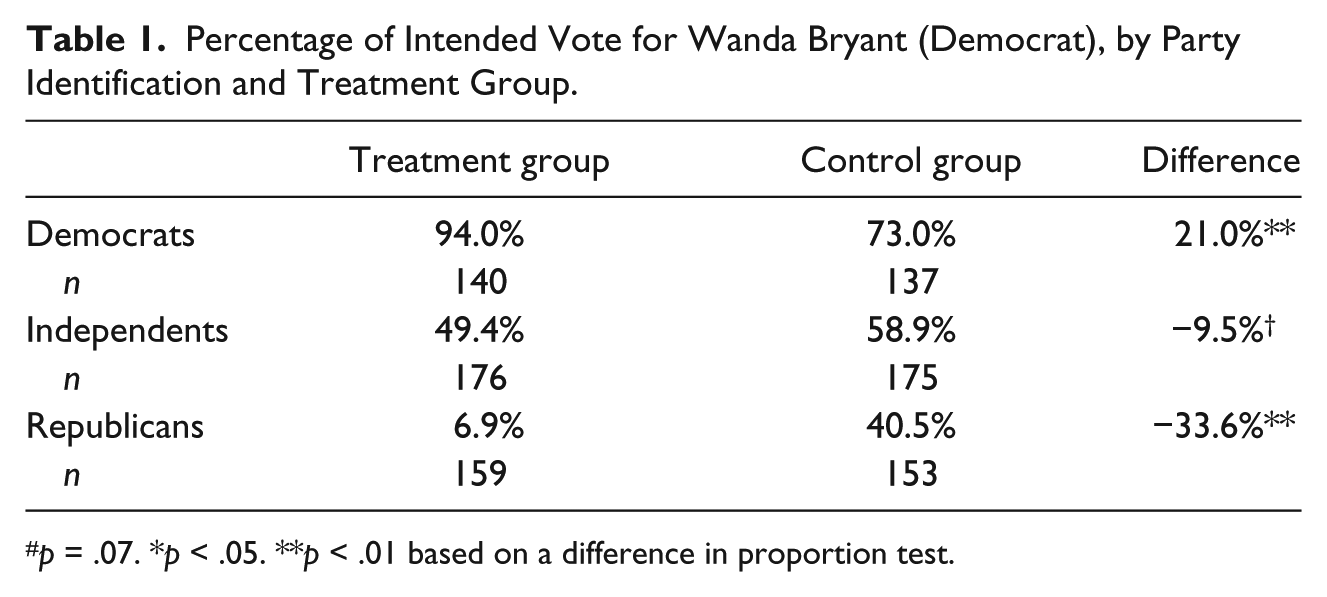
We begin our results by presenting the simple average treatment effect of our party cue based on partisanship by estimating whether the presence or absence of party cues has an effect on vote choice. To calculate the average treatment effect, we examine the differences in vote choice across subgroups of our respondents in the treatment and control groups, which we make available in Table 1.
Percentage of Intended Vote for Wanda Bryant (Democrat), by Party Identification and Treatment Group.
p = .07. *p < .05. **p < .01 based on a difference in proportion test.
Several interesting results emerge from Table 1. As our first hypothesis predicts, partisans (i.e., self-identified Republicans and Democrats) are significantly more likely to support their fellow partisan when we provide the party labels in our treatment group. In fact, support among Democrats for Wanda Bryant increases by 21 percentage points. Likewise, support for Wanda Bryant among Republicans declines by a striking 33.6 percentage points. Both changes are significant well beyond the conventional 95% confidence interval. Next, as we predict, there is a drop in support for Wanda Bryant of about 9.5 percentage points among independents, a result we attribute to North Carolina being a conservative-leaning state (Christensen, 2008; for a specific analysis on gay rights, see Lax & Phillips, 2009). It is worth noting, however, that this effect falls just short of the traditional 95% significance threshold, which is perhaps an echo of the fact that self-identified independents are a heterogeneous mix of individuals who fall at many points on the ideological spectrum. Finally, it is worth noting that Democrats appear to prefer the female candidate (Wanda Bryant) even when party labels are not present. Indeed, the difference between Democrats and independents is 14.1 percentage points, and the difference between Democrats and Republicans is 32.5 percentage points. Such differences may reflect the gender gap between political parties.
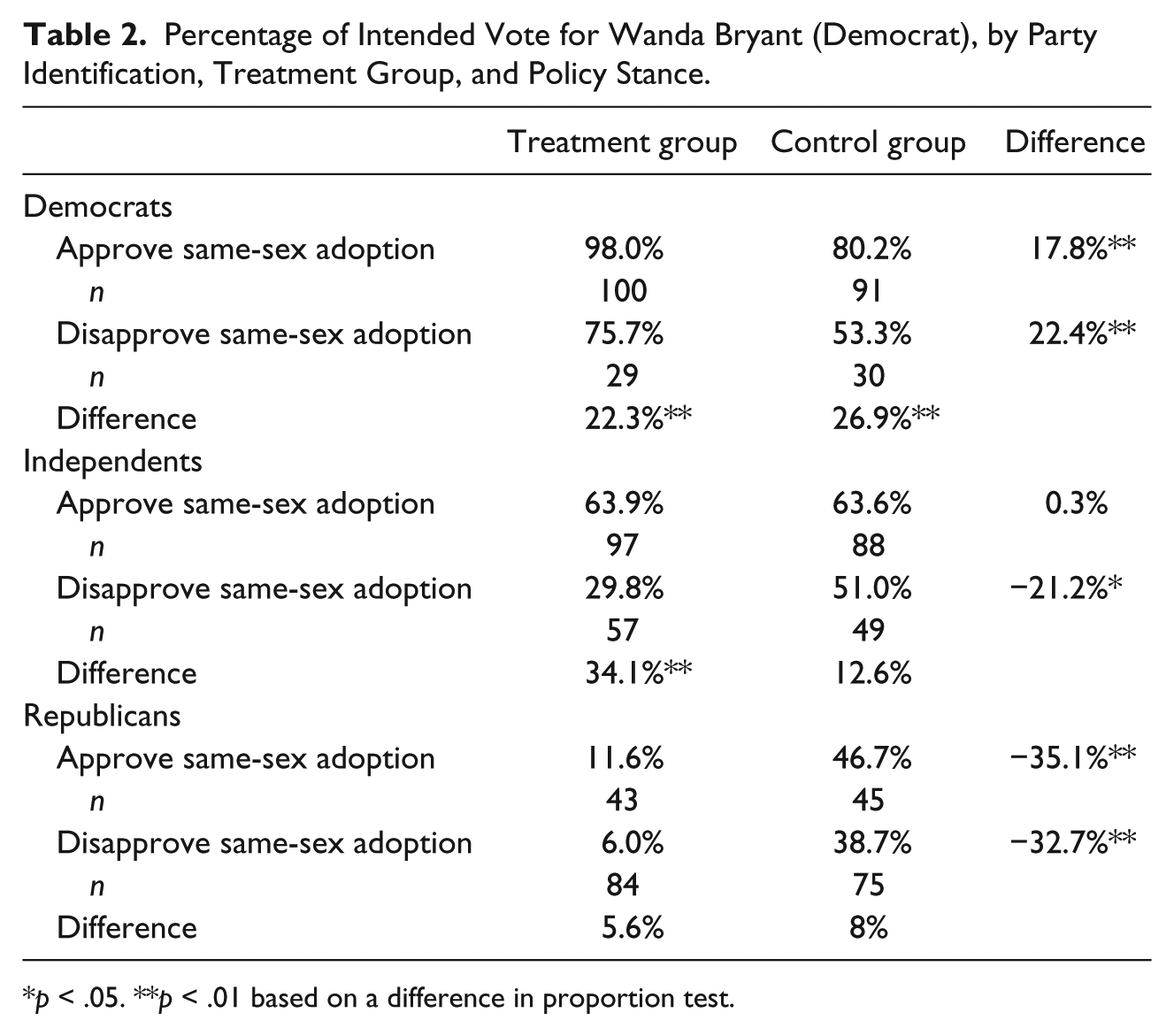
In Table 2, we examine the treatment effect related to our second hypothesis: whether party cues have an effect on helping respondents select the candidate who shares their beliefs on same-sex couples’ adoption rights. For self-identified Democrats who support same-sex adoption, receiving the party cue leads to a 17.8 percentage point increase in support for Wanda Bryant. Democrats who do not support same-sex adoption and receive the cue are also 22.4 percentage points more likely than their control group counterparts to support Wanda Bryant. Interestingly, support among Democrats in the treatment group also varies by policy position: Democrats who support same-sex adoption are significantly more likely to support Wanda Bryant by 22.3 percentage points.
Percentage of Intended Vote for Wanda Bryant (Democrat), by Party Identification, Treatment Group, and Policy Stance.
p < .05. **p < .01 based on a difference in proportion test.
We see somewhat mixed results for self-identified independents in Table 2. Among independents who support same-sex adoption, we see no difference between the treatment and control groups. By contrast, independents who disapprove of same-sex adoption are significantly less likely to support Wanda Bryant when party cues are available. Indeed, the strong and significant difference between independents in the treatment group based on policy position support our prediction that party labels help independents select the candidate who is more likely to share their policy beliefs. Party labels, then, allow those individuals to translate those preferences into votes.
Republicans also see major and significant differences in support for Wanda Bryant when comparing the treatment and control groups. For self-identified Republicans who approve of same-sex adoption, the drop in support for Wanda Bryant when party labels are present is 35.1 percentage points. Self-identified Republicans who disapprove of same-sex adoption are 32.7 percentage points less likely to support Wanda Bryant when she has the Democrat label. We do not see, however, differences within the treatment and control group. While Republicans who support same-sex adoption are always more likely to support Wanda Bryant—a result that is consistent with our predictions—these differences are not significant.
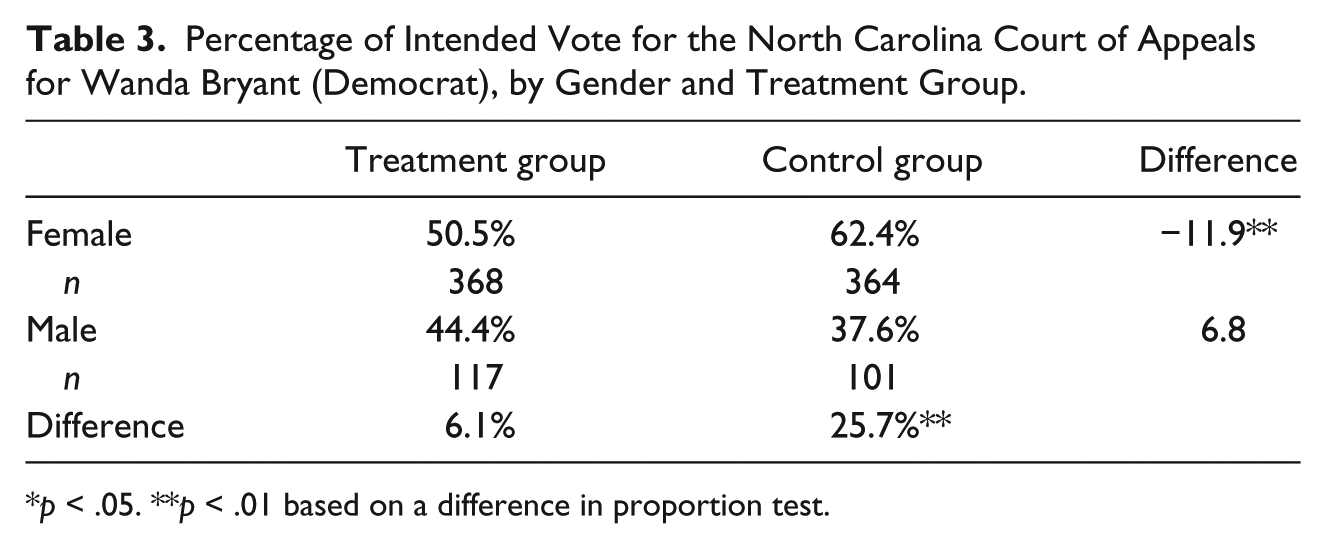
We turn to examine whether gender acts as a significant cue and whether this result holds when party cues are present. Table 3 presents the average treatment effect for gender. The results match our expectations in our third hypothesis. For females, we see significant differences between the treatment and control groups: The presence of the partisan cue leads to an 11.9 percentage point decline in support for Wanda Bryant. While males in the treatment group are more likely to support Wanda Bryant (6.8 percentage point increase), the difference is not statistically significant. Differences within the treatment and control groups also match our expectations: We see no significant difference between females and males in the treatment group (difference of 6.1 percentage points), but the difference in the control group is significant and large (females are 25.7 percentage points more likely to support Wanda Bryant). 13
Percentage of Intended Vote for the North Carolina Court of Appeals for Wanda Bryant (Democrat), by Gender and Treatment Group.
p < .05. **p < .01 based on a difference in proportion test.
Discussion
What do our results tell us about party labels and voter choice in judicial elections? In general, our findings showed that party labels often help respondents choose candidates who share their political preferences. We also found that the presence of party labels helped individuals select the candidate who was most likely to share their preferences regarding same-sex couples adopting children—which we view as a proxy measure of policy preferences regarding social issues. This finding had significant consequences for independents. We demonstrated that party labels on the ballot in judicial elections allowed self-identified independent respondents to select the candidate who matched their own preferences on the social policy we measured. This result is especially important as it showed independents can use party labels to discern the positions of candidates on at least one issue. Independents are able to use the information-rich party cue as a compass to guide their own decisions despite not having an overt political attachment (see Lupia & McCubbins, 1998). In other words, while independents may not wear a partisan jersey themselves, they know which team to root for when candidates are wearing one.
Using new data, our results also confirm and expand on Klein and Baum’s findings that party labels helped voters make informed choices in nonpartisan judicial elections for a low-visibility state appellate court. This latter finding contradicted Rock and Baum’s results that showed party labels are less useful for voters in low-visibility judicial elections. Our results also provided support for McDermott’s (1997) findings that voters can use other cues besides party labels, namely, gender, when party labels are absent. When party labels are present, however, we found that the candidate’s gender did little to influence vote choice.
Taken at face value, our data suggest that—if a state chooses to elect judges—including party labels on the ballot may provide individuals with a valuable cognitive shortcut for an otherwise low-information decision. While including party labels may cause self-identified partisans to select their fellow partisan for the position, our findings also indicate that the benefit to independent voters is substantial. Policymakers should weigh these potential benefits and costs when crafting judicial election rules.
Our research has some limitations. First, our experiment does not add to the discussion about the potential benefits and drawbacks of judicial elections. At best, our results offer evidence of the strengths and weaknesses of partisan versus nonpartisan elections and the value of party cues and their effect alongside gender cues. Second, our data cannot provide guidance on whether nonpartisan judicial elections increase the impartiality of judges—perhaps the most persuasive argument in support of implementing nonpartisan elections. Third, we have a single case (North Carolina) in our analysis. While other studies (Klein & Baum, 2001; Rock & Baum, 2010) also focus on one case, future research should gather multiple cases over many elections to increase the generalizability of the research. We also understand, however, that such studies are costly. Fourth, our data do not allow us to estimate whether nonpartisan judicial elections inspire voters to evaluate the candidates more carefully when compared with voters in partisan elections. Although the primary goal of nonpartisan judicial elections is to encourage vigilant consideration of the candidates on the ballot while minimizing the effect of existing party attachments, it seems unlikely that all (or many) voters actually give careful consideration to any political decision (Delli Carpini & Keeter, 1996; Downs, 1957). Some highly motivated voters, however, may carefully weigh the positions of the two candidates and arrive at a well-informed decision.
The issue at the heart of our research is, do voters make competent decisions when there is limited information? We found that the introduction of a party cue had a substantial effect on both self-identified partisans and independents. While the conventional wisdom is that party cues help self-identified partisans pick the candidate of their own party, the fact that party cues can help independents select the candidate who aligns with their policy preferences is a notable finding.
Such a result suggests that providing additional information to voters has the potential to help improve their decisions. In lieu of party labels, policymakers may consider allowing judicial candidates to make statements about their policy positions and print that information on the ballot. In the post Republican Party of Minnesota v. White (2002) era, it is likely that more judicial candidates will be taking public positions on policies. Including these statements on the ballot would simply institutionalize the judicial candidates’ right to broadcast them. Such a policy, however, would be a significant departure from what other candidate contests allow. While Gibson (2012) has shown that citizens do not necessarily question the impartiality of judges who take positions, we know of no research that examines whether institutionalizing these positions on the ballot will have negative consequences for voters or the institution of judicial elections.
In the effort to improve decisions, policymakers could also allow endorsements of prominent interest groups and politicians to appear on the ballot itself (for the usefulness of statements of endorsers, see Boudreau, 2009) under each judicial candidate’s name. Individuals, such as the governor, could be very informative for many voters. Likewise, listing a state bar association’s qualification ratings for the candidates may also be useful. Including such information introduces a set of new concerns, as judges will need to seek the endorsements of influential cue-givers. Indeed, policy statements and endorsements are policy quagmires. Each institutional change requires a discussion of which statements or endorsements should appear on the ballot, a debate that is unlikely to achieve widespread consensus. Whether these policy innovations are preferable to party labels, we leave to future research.
Footnotes
Appendix A
Appendix B
Appendix C
Acknowledgements
The authors thank Cheryl Boudreau, Todd Curry, Brian Gaines, Vladimir Kogan, Banks Miller, and several anonymous reviewers for helpful comments. In addition, the authors wish to acknowledge support from the Department of Government and Justice Studies at Appalachian State University.
Declaration of Conflicting Interests
The author(s) declared no potential conflicts of interest with respect to the research, authorship, and/or publication of this article.
Funding
The author(s) received no financial support for the research, authorship, and/or publication of this article.