




Abstract
Issue convergence theory suggests that candidates should respond to their opponents by discussing the same issues whereas issue divergence theory posits that candidates should instead ignore each other and discuss different issues. Recent studies tend to find evidence in favor of issue convergence, but these results may be inaccurate because the analyses that generated them tested dynamic campaign behavior using cross-sectional methods. Using a dynamic modeling strategy along with television advertising data drawn from 93 U.S. Senate campaigns in 44 states, 5 election years, and on 51 issues, I show that candidates increase the attention they devote to issues as their opponents’ emphasis of these same issues increases and that candidates do so to a greater extent in competitive than in noncompetitive elections. This analysis is the first to account for the dynamic nature of issue emphasis and provides support for issue convergence theory.
Elections are important characteristics of democratic systems for two reasons. First, elections allow citizens to hold politicians accountable for their behavior while in office. Second, elections provide citizens with the opportunity to choose between competing visions of the proper role of government on a number of different issues. For citizens to select the candidate whose preferences best match their own, citizens must learn about candidates’ issue positions so that they may make comparisons among the candidates. Citizens can more easily make these kinds of comparisons when candidates discuss the same issues. Many scholars, chief among them proponents of issue divergence theory (e.g., Simon, 2002; Spiliotes & Vavreck, 2002), argue that candidates should only discuss the issues on which they are advantaged, which suggests that they should rarely discuss the same issues as their opponents. Other scholars argue in favor of issue convergence theory and report evidence showing that candidates routinely discuss the same issues as one another during campaigns (e.g., Kaplan, Park, & Ridout, 2006; Sides, 2006, 2007; Sigelman & Buell, 2004).
What drives candidates to discuss the same issues during campaigns? I argue that candidates’ issue emphases are affected by two key factors over the course of their campaigns: the issue emphases of their opponents and the competitiveness of the campaign. Candidates should alter the degree to which they emphasize an issue in part due to their opponent’s strategy for a number of reasons. They may do so to (a) contrast their positions with those of their opponent, (b) respond to their opponents’ attacks, (c) signal that they are moderate in an attempt to appeal to the median voter, and (d) avoid criticism from the news media for ignoring an issue. More generally, candidates should converge to negate their opponents’ actions. These factors should exert a more powerful influence on candidates’ strategies when elections are competitive than when they are noncompetitive because the electoral stakes are higher for candidates. Thus, candidates and their campaign staffs may perceive that mistakes may be more costly in competitive elections than in noncompetitive elections.
The extant literature on issue convergence and divergence suffers from an important methodological limitation in that scholars have used cross-sectional techniques to model dynamic behavior. These tests cannot show evidence of responsive behavior because of the nature of cross-sectional analyses. I remedy this limitation by treating campaign behavior as dynamic rather than static and test my theory using data on U.S. Senate television advertisements collected by the Wisconsin Advertising Project for 51 issues discussed in 93 general election campaigns spread across 44 states in 5 years. I use a dynamic modeling technique and find strong support for issue convergence theory. Candidates respond to the issue emphases of their opponents by converging and do so to a greater extent in competitive campaigns than they do in noncompetitive campaigns.
Issues and Campaigns
Much of the extant campaigns and elections literature suggests that campaigns can fundamentally shape election outcomes (e.g., Hillygus & Shields, 2008; Vavreck, 2009; Wlezien & Erikson, 2002). Candidates use campaigns in large part to gain the support of citizens. Candidates may try to do so by using their campaigns to stimulate citizens’ underlying predispositions (Berelson, Lazarsfeld, & McPhee, 1954) or to produce a sense of “enlightenment” about the state of the country among citizens (Gelman & King, 1993). In addition, campaigns may act as priming mechanisms (Bartels, 2006, but see Lenz, 2009) and may alter the degree to which citizens feel uncertain about political candidates (Alvarez, 1997; Franklin, 1991; Peterson, 2004, 2009). Candidates may be more likely to discuss issues that are salient among citizens (Damore, 2004, 2005; Kaplan et al., 2006, but see Sides, 2007) and may also attempt to change citizens’ perceptions of the salience of various issues (Carsey, 2000). Finally, coverage of campaigns by the news media can also affect the perceived importance of issues (Iyengar & Simon, 2000; Kinder, 1998a, 1998b).
How can candidates gain the support of potential voters during election campaigns? First, candidates may change their positions on issues such that their stated preferences line up with those held by the median voter. This is a straightforward strategy, but it leads to several potential problems. Candidates who choose this route may inadvertently upset their party’s activists by trying to appeal to more moderate voters. Doing so may be risky because activists tend to hold more extreme views than other citizens and may be willing to sit out an election cycle if they do not feel as if their interests are being represented (Erikson, Wright, & McIver, 1993; Miller & Jennings, 1986; Wittman, 1983). Another problem is that many candidates, especially incumbents, have established records that may be difficult to avoid because the news media and candidates’ opponents have incentives to point out these kinds of inconsistencies. Established candidates may also find it difficult to alter citizens’ views of them because people are motivated reasoners and may respond to information that is incongruent with their prior beliefs by discarding it (Kunda, 1990). Although candidates would like to win the votes of as many of their opponents’ supporters as possible, they may find it difficult to do so because these people already hold negative views of them and may therefore ignore messages that suggest they share some common ground with their nonpreffered candidate (but see Hillygus & Shields, 2008).
The second strategy available to candidates is to persuade citizens to change their minds about issues such that citizens’ views become aligned with those of candidates. This can be difficult to achieve. Candidates have little incentive to persuade their own supporters and as outlined above, citizens who support candidates’ opponents are difficult to persuade because they process information in a biased fashion as a function of their partisan filters. More generally, candidates must first convince citizens that the beliefs they hold are incorrect before candidates can hope to persuade them. This is an especially difficult task faced by candidates who choose to engage in this strategy (Riker, 1990).
Due to the difficulty inherent in changing their own positions and in changing citizens’ minds, candidates may instead engage in a third strategy in which they alter their campaign messages to attempt to induce heresthetic change, the process by which candidates alter the considerations citizens use when evaluating candidates (Riker, 1990). Because candidates may find it difficult to persuade large numbers of citizens, they may instead attempt to affect the conditions under which citizens make their choices by altering the salience of issues in the election environment. Carsey (2000) argues that candidates focus on the issues that advantage them the most relative to their opponents while avoiding those for which their positions are less advantageous. Candidates, then, should focus their attention on the issues on which they hold the greatest comparative advantage relative to their opponents. If one candidate is better able than their opponent to implement this strategy, she should be advantaged on election day because citizens should be more likely to think about their choice in a way that favors the successful candidate.
Issue Advantage, Convergence, and Divergence
Most of the extant campaigns literature suggests that candidates should focus on the issues that advantage them. There are several sources of candidate issue advantage. Candidates’ personal characteristics and records can affect the degree to which they are advantaged on issues (Brasher, 2003; Sellers, 1998). Furthermore, those who hold popular positions on issues also tend to be advantaged relative to their opponents (Damore, 2004). Candidates may also be more likely to spend time discussing issues that citizens view as salient, though Sides (2007) finds little evidence favoring this notion. Issue ownership theory represents an additional source of candidate issue advantage. This theory suggests that parties “own” sets of issues in the sense that they are advantaged on them because citizens tend to view the owning party as better able to handle problems related to these issues than the opposing party (Ansolabehere & Iyengar, 1994; Budge & Farlie, 1983; Egan, 2013; Petrocik, 1996; Petrocik, Benoit, & Hansen, 2003). 1
More generally, Schattschneider’s (1960) conflict displacement theory suggests that political actors should seek to emphasize the types of conflicts that benefit them the most; doing otherwise would be a suboptimal communication strategy. Carsey (2000) extends this idea to the context of campaigns and argues that candidates should focus on different sets of issues and should avoid engaging the same issues that their opponents discuss. 2 Simon (2002) further argues that candidates should never discuss the same issues as their opponents. Doing so might remind citizens that candidates’ opponents are better at some issues, meaning that candidates have little incentive to partake in dialogue or issue convergence. Candidates can only do themselves harm by discussing the issues on which their opponents are advantaged. These studies suggest that candidates should avoid discussing the same issues. In other words, candidates’ issue emphases should diverge from one another to avoid discussing issues on which their opponent is advantaged.
A second strain of the literature leads to a different set of expectations for candidate behavior. Research on issue convergence suggests that candidates often discuss the same issues as their opponents during campaigns (Kaplan et al., 2006; Sides, 2006, 2007; Sigelman & Buell, 2004). 3 In addition, there is evidence that candidates respond to their opponents based on the latter’s (a) degree of attention to party-owned issues in primary (Banda & Carsey, 2012) and general elections (Banda, 2013), (b) level of attention to gendered issues (Windett, 2014), and (c) number of negative advertisement airings (Carsey, Jackson, Stewart, & Nelson, 2011). There are several reasons to expect candidates’ issue emphases to converge during campaigns. First, extending the logic of Downs (1957) from parties to candidates suggests that candidates should attempt to appeal to members of their opponents’ coalitions to reduce their opponents’ levels of support and to appeal to the median voter. Hillygus and Shields (2008), for example, show that presidential candidates can appeal to cross-pressured partisans by discussing positions they share on wedge issues with these citizens. This strategy may allow candidates to appeal to the median voter and to otherwise unfriendly citizens by generating a more moderate ideological profile through the strategic communication of shared positions (see also Miller & Schofield, 2003). For example, a Republican candidate may spend time discussing her position on abortion to appeal to culturally conservative Democratic voters.
Second, candidates may feel that they need to respond when their opponents attack them. Negative campaigns may encourage candidates to talk about the issues that their opponents discuss while attacking them because they wish to defend their records and positions (Lau & Pomper, 2004; Skaperdas & Grofman, 1995; Theilmann & Wilhite, 1998). Candidates engage in dialogue when they respond to each other’s attacks. This kind of behavior should lead candidates’ issue emphases to converge.
Third, candidates may try to reframe issues on which they are disadvantaged to portray themselves in a more sympathetic manner (Chong & Druckman, 2007; Kinder, 1998a). Despite the fact that the Republican Party has long owned the issue of crime, Democratic presidential candidate Bill Clinton spent a lot of time discussing it during the 1992 campaign. While Republicans traditionally focused on punishment, Clinton instead focused on the prevention of crime. This kind of strategy might allow candidates to portray themselves more favorably even if they are unable to affect the salience of issues.
In addition, Jerit (2008) shows that providing a counterargument may be more persuasive for citizens than reframing an argument or issue. Jerit’s research focuses on a political debate that occurred between rather than during an election campaign, but the logic of this argument also fits into a campaigns framework. Candidate A could, for example, discuss her support of additional expenditures on education in terms of leveling the playing field for children in less wealthy areas. Rather than ignoring or reframing the issue to focus on the costs of the additional spending, Candidate B may be better off arguing that additional expenditures will not improve educational outcomes.
A final reason to expect to observe some degree of issue convergence during campaigns is related to the ambivalence citizens tend to feel toward parties and candidates. Basinger and Lavine (2005), for example, show that citizens tend to use party cues when deciding which candidate to support in low salience elections in large part due to their lack of knowledge about the candidates’ positions. Citizens who lack positional information cannot make decisions on the basis of issues and instead rely on partisan heuristics. A very different kind of decision-making process occurs in high salience elections. Partisanship is still important in these kinds of elections, but citizens also choose a candidate on the basis of issues or ideology. The election environments during salient campaigns tend to be saturated with much more information than in low salience campaigns. The availability of this kind of information is what allows citizens to learn more about the candidates and their positions and thus make decisions on the basis of more than just partisan cues (Franklin, 1991; Kahn & Kenney, 1999). Because candidates know that salient elections generate larger volumes of information that citizens consider when choosing which candidate to support, they should not only converge on similar sets of issues to make clear the ways in which they differ from their opponents, they should also discuss a wider range of issues more generally to provide citizens with more information about their candidacies (Franz & Ridout, 2007; Geer, 2006).
Issue convergence, then, can be viewed as a defensive campaign strategy; candidates respond to each others’ issue agendas to negate—or at least moderate—the electoral benefits their opponents may receive due to their strategies. This kind of responsive strategy may be especially useful when citizens are skeptical about the claims made by candidates. Ultimately, candidates may be able to take advantage of this skepticism by challenging the claims made by their opponents. Candidates who diverge from the issue agendas of their opponents, however, may find it more difficult to counter the strategies employed by their opponents. If a candidate fails to respond to her opponent, citizens may eventually come to view the claims her opponent makes as true. Candidates, then, may be able to define both themselves and their opponents in the minds of citizens when their messages are not countered. Because candidates want to maximize their chances of winning elections, they should respond to their opponents to counter their opponents’ strategies rather than avoiding them.
Issue divergence theory predicts that candidates will focus on different issues to reinforce their preexisting strengths on various issues. Candidates should avoid issues on which their opponents are advantaged lest they remind citizens of their relatively weak reputations on those issues. Issue convergence theory, however, predicts the opposite; candidates should increase the attention they devote to issues that their opponents discuss more because failing to do so will leave them unable to counter the claims made about them and the more general strategies employed by their opponents. While diverging allows candidates to focus only on the issues that advantage them, it does not allow candidates call into question the statements of their opponents. We should therefore observe issue convergence rather than divergence in candidates’ campaign behavior as competing candidates scramble to respond to one another’s claims. I use two examples from recent campaigns to illustrate the potential consequences of failing to adequately respond below.
The 2004 presidential election offers a useful example of the potential consequences of failing to adequately respond to a charge, though only one of the key actors was a candidate. A 527 group called Swift Boat Veterans for Truth began running television advertisements in early August of 2004 attacking Democratic presidential candidate John Kerry’s military service record. The Kerry campaign did not respond to the ads with their own advertisements for 2 weeks. Their response was generally viewed by campaign professionals and members of the news media as being both slow and inept. The conventional wisdom after the election suggested that Kerry’s candidacy suffered from his lack of responsiveness, as many citizens began to take the claims made in the Swift Boat ads seriously when they were not adequately countered.
The 2008 U.S. Senate election in North Carolina provides a useful example of the potential benefits of responding through convergence. Republican incumbent Elizabeth Dole was initially favored to win the contest over Democratic challenger Kay Hagan. Dole’s prospects for victory began to slip late in the campaign season, perhaps partly in response to Democratic presidential candidate Barack Obama’s decision to begin contesting the state. As Dole’s electoral prospects declined, the campaign began airing a television advertisement designed to undermine support for Hagan by questioning her religious beliefs. The so-called “Godless” ad accused Hagan of accepting campaign contributions from an atheist group and implicitly attributed the statement “there is no God” to her. The advertisement was poorly received and the Hagan campaign quickly responded with commercials of its own in which Hagan defended her religious beliefs. Thus, Hagan responded to Dole’s decision to air more advertisements mentioning religion as an issue by airing additional ads of her own that also discussed religion. This exchange was widely viewed by campaign professionals and members of the news media as contributing to Hagan’s eventual victory over Senator Dole.
Contrary to the expectations laid out by strict proponents of issue ownership and heresthetic change, I argue that candidates should respond to one another’s issue priorities by converging on the same issues. In other words, candidates should alter the degree to which they emphasize an issue in response to the level of attention their opponents devote to that same issue. For example, when a Republican candidate increases the amount of time she spends discussing taxes, I expect her Democratic opponent to respond by talking about taxes more. Stated more formally:
Competition and Campaigns
Several characteristics of campaigns and candidates may affect the degree to which candidates respond to one another’s issue emphases. Candidates may be more likely to converge on the issues owned by their party to reinforce citizens’ preexisting beliefs that they are better suited to solve problems related to those issues, though it may instead be the case that candidates feel less pressure to defend themselves on the issues on which they are most advantaged. They may similarly be less inclined to converge on issues owned by the opposing party, as doing so may serve as a reminder that their opponent is considered strong on those issues. If an issue is particularly salient and especially if it is connected to a major political event, candidates may be encouraged to converge at greater rates to avoid being criticized by the news media for being unresponsive on an important issue. Incumbency status may also condition the way candidates respond to each other. Incumbents may, for example, prefer to avoid giving attention to their opponents through a responsive advertising strategy. Finally, some research suggests that candidates’ issue emphases will reflect those of their opponents to a greater extent in competitive campaigns than they will in noncompetitive campaigns (e.g., Kaplan et al., 2006). This observation may be driven in large part by three factors: the strategic behavior of candidates, the behavior of the news media, and the behavior of potential voters. This research focuses on the conditional effect of competition on candidates’ proclivities to respond to their opponents’ issue emphases.
First, candidates may choose different kinds of strategies in competitive campaigns. These kinds of campaigns tend to be more negative than noncompetitive campaigns (Goldstein & Freedman, 2002), in large part because incumbents will attack rather than ignore their challengers (Kahn & Kenney, 2004). Candidates who are attacked may feel as if they need to defend themselves. They could do so by discussing the same issue in an attempt to “set the record straight” or they could attack their opponents on the same issue to decrease their opponents’ advantage on that issue. Competition is key here because front-running candidates have little incentive to respond to their challengers unless they feel electorally threatened. Candidates also tend to air more advertisements in more competitive campaigns (Goldstein & Freedman, 2002), which allows for greater responsiveness. Because campaigns purchase more airtime in more competitive elections, it allows candidates to address a larger number of issues if they choose to do so. Candidates involved in noncompetitive elections may air fewer ads, which could lead them to focus on fewer issues and thus be less responsive to the issue agendas of their opponents. In addition, candidates facing competitive elections may choose to hire a more professional campaign staff rather than filling these positions with friends and family members. Professional campaign staffers may be less likely to allow candidates’ own preferences to dictate the issues on which the campaign focuses. Instead, a more professionalized campaign staff may encourage candidates to focus on salient issues and those that the opposing candidate discusses. Last, electoral competition may lead candidates to be more fearful that any errors that they make in setting their campaign strategy could lead them to lose. They may therefore pay greater attention and be more responsive to their opponents’ strategies.
Second, the news media should devote greater attention to competitive campaigns. Competitive campaigns generally produce more information that can be framed in interesting and easy to follow narratives about important political conflicts. These kinds of narratives can then be explicated to citizens who should be more interested in consuming these kinds of stories than those that are produced by noncompetitive elections in which there is little to no drama. In addition, journalists may not view noncompetitive elections as being very newsworthy and thus may be less willing to devote scarce resources to covering them. Kahn and Kenney (1999), for example, find that the news media devotes greater attention to competitive elections than it does to noncompetitive elections. 4 Candidates should be aware of the conditional behavior of the news media and may feel greater pressure to respond to their opponents to avoid being criticized by the news media for failing to do so when they face the additional news coverage brought about by competitive campaigns. 5 Such criticism may drive down citizens’ evaluations of a candidate, which may in turn reduce that candidate’s likelihood of victory.
Last, competitive campaigns lead to more candidate-sponsored advertisement airings and more frequent coverage of campaigns by the news media. Citizens may be exposed to more political information due to the richer information environments they experience during competitive campaigns, which may lead them to learn more about the candidates and to become more attentive to the campaigns. When citizens are more attentive to campaigns, candidates may be compelled to respond to their opponents’ issue emphases to define both themselves and their opponents in the minds of potential voters. If they fail to do so, they will be unable to counter any advantages enjoyed by their opponents due to their strategies. Candidates who diverge from each other will fail to counter these advantages and may suffer electorally. Thus, candidates should converge on the issues emphasized by their opponents.
Candidates should be more responsive to their opponents in competitive campaigns than in noncompetitive campaigns. Their issue emphases, then, should converge more in competitive elections than in noncompetitive elections. This conditional relationship is summed up in the following hypothesis:
Research Design
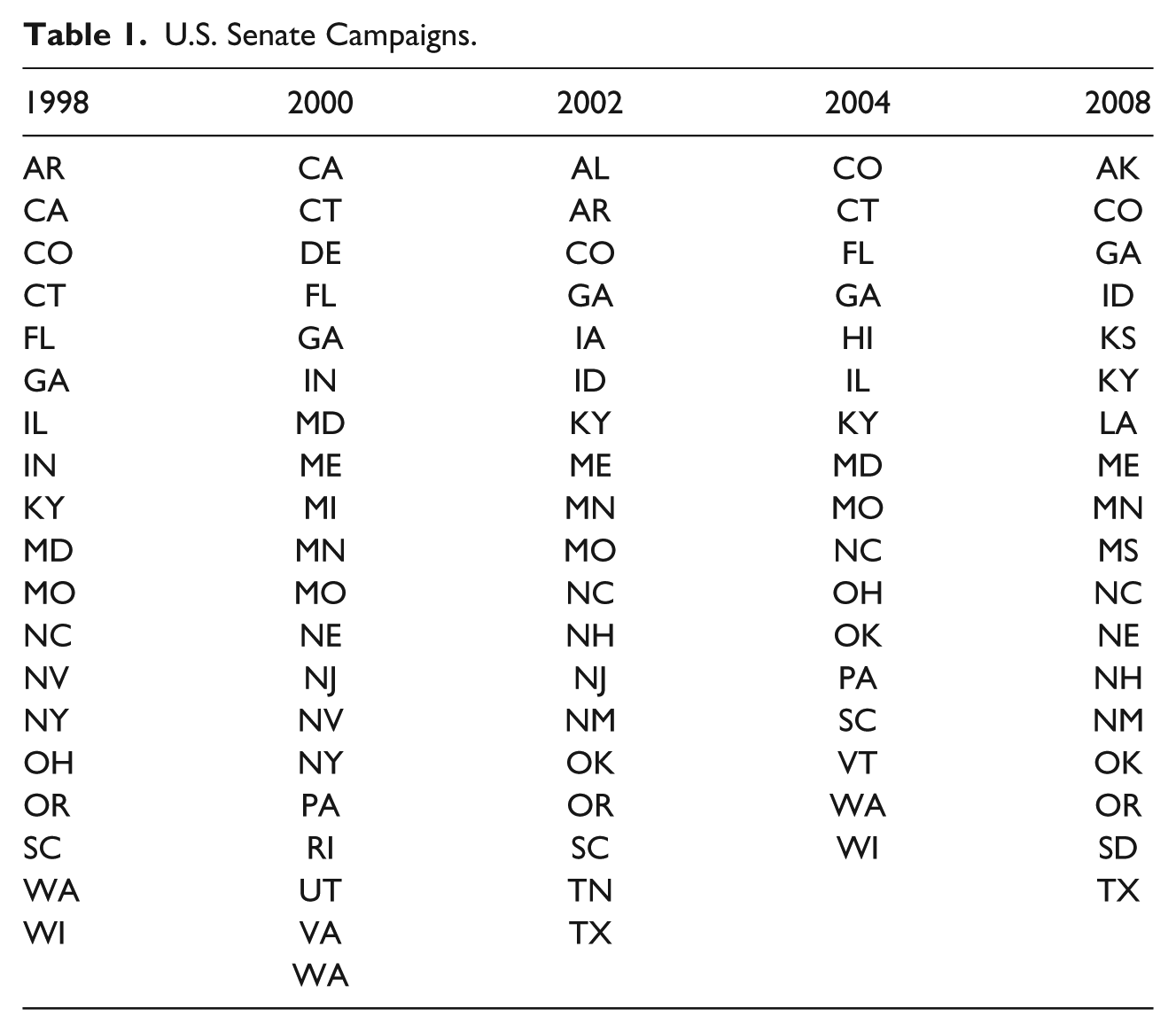
I use data collected by the Wisconsin Advertising Project for Senate advertisements from the 1998 through 2004 as well as the 2008 election cycles to test my theory. 6 These data include information about the dates, times, and television stations on which each individual advertisement aired. Advertisements from all media markets are included in the 2008 data, but the data from previous years only include ads aired in some media markets. The 1998 data include ads aired in the 75 largest media markets whereas the 2000-2004 data cover the 100 largest media markets. I included all Senate contests in which both major parties were represented and in which both candidates aired advertisements. 7 In all, I analyze data from 93 campaigns spread across 44 states and 5 election years. I report the contests used in my analysis in Table 1.
U.S. Senate Campaigns.
Key for my study is that the Wisconsin Advertising data contain information on the issues that candidates discussed in each advertisement airing. Up to 4 issues were coded for each advertisement airing, though most mentioned only a single issue. My operationalization of issues requires that the topic be policy-centric and positional in nature. Because of this, I do not include the discussion of personal characteristics in my analysis. On average, the Senate contests I analyze involved discussions of just under 12 issues. The number of issues discussed in these races ranged from 2 to 22. There are 51 issues in these data, all of which are listed in Table 2.
Issues in U.S. Senate Campaigns, 1998-2008.
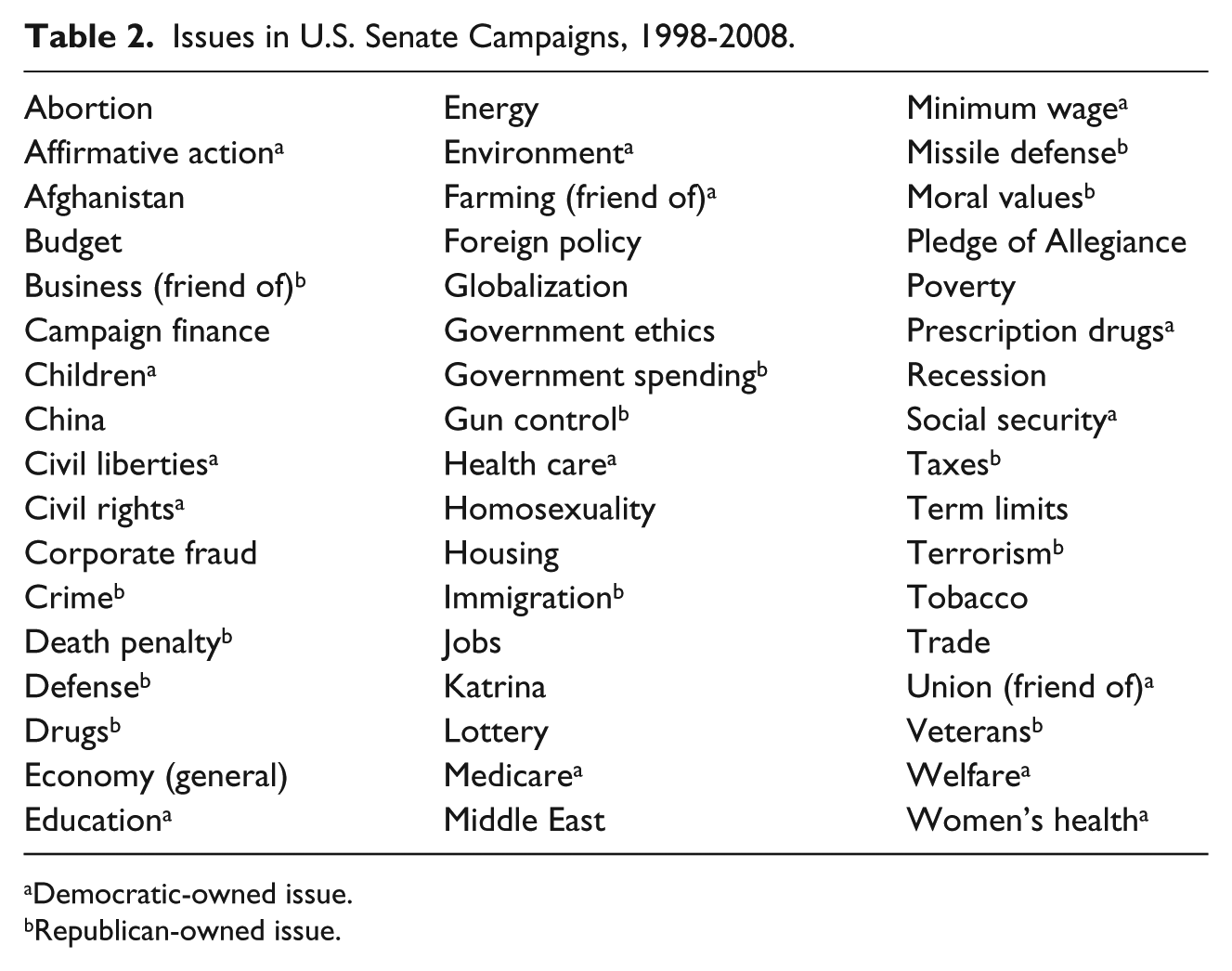
Democratic-owned issue.
Republican-owned issue.
Measurement and Modeling
I collapsed these data by contest, issue, and week to create time series. 8 Each observation represents the number of candidate i’s advertisements that mentioned issue j in that week. This operationalization allows me to observe the degree to which candidates are responsive to individual ad airings that mention a given issue. In other words, how close do candidates come to responding one to one to their opponents’ advertising strategies? 9 The weekly number of ads mentioning issue j serve as both my dependent variable and one of my key independent variables. 10 In other words, the dependent variable is the number of ads aired in a given week by a candidate that mentioned a given issue. The independent variable is the number of ads aired in a week by that candidate’s opponent mentioning the same issue.
As for competition, scholars tend to use measures of competition like the margins of victory in previous elections (e.g., Shaw, 1999) and levels of spending by individual candidates. These approaches are both problematic, the former because vote shares from previous elections may not be representative of current political conditions and the latter because it is endogenous to candidate advertising. 11 I use the Cook Political Report’s race ratings as my indicator of electoral competition to avoid these problems. In its raw form, the ratings are a 7-point measure for which competitiveness is strongest in the middle categories. Its seven values are “solid Democratic,” “likely Democratic,” “lean Democratic,” “toss up,” “lean Republican,” “likely Republican,” and “solid Republican.” I collapsed this scale down to a simple dichotomous indicator of competition; contests coded as “leaning” or “toss up” were coded as being competitive (1), whereas the rest were coded as noncompetitive races (0). 12 About 58% of the contests in my data were competitive. 13
I included dummy variables in my model indicating whether or not a campaign occurred in a given year to control for differences brought about by the year in which the contest took place. I also included dummy variables coded one if the issue was owned by the Democratic or Republican Party and zero if it was not to account for the proclivity of candidates to focus greater attention on their own party’s issues. 14 I report the summary statistics for these variables in Table 3.
Summary Statistics.

I use pooled time-series cross-sectional data to capture campaign dynamics. My theory predicts interaction between candidates and the behavior I want to model occurs simultaneously, so I must control for possible simultaneous and unmodeled correlation in the behavior of the candidates. I do so using a seemingly unrelated regression framework, which allows for multiple equations and for the error terms of each equation to be contemporaneously correlated with one another (see Banda, 2013; Carsey et al., 2011, for similar applications). To a certain extent, this design allows me to work around problems involving omitted variable bias. 15
I use a general error correction modeling framework, which allows me to calculate the short- and long-run effects of my time serial covariates on my dependent variables (DeBoef & Keele, 2008). The dependent variable of an error correction model is the first difference of a temporal variable rather than its value at time t. Using the first difference of the variable in question as our dependent variable effectively removes any unit effects that might exist across contests and issues. This framework also requires the inclusion of a lagged dependent variable and both first differences and lagged levels of the remaining time serial covariates.
I estimate two equations simultaneously, one for Democratic candidates and the other for their Republican opponents. The equations follow:


In these equations, D and R stand, respectively, for Democratic and Republican Senate candidates’ issue emphases. “Dijt,” for example, refers to Democratic candidate i’s emphasis of issue j in week t. The coefficients generated for the differenced covariates represent the average short term—that is, contemporaneous—change in the dependent variable that results from a one unit increase in the covariate. In other words, these represent the immediate effect of an additional advertisement airing sponsored by a candidate’s opponent that mentions a given issue on the number of ads the candidate herself sponsors mentioning the same issue. This contemporaneous effect occurs at time t. The coefficients of the lagged covariates correspond to a second short-term effect, this time at time t + 1. These effects at time t + 1 are not theoretically interesting on their own, but when they are divided by the absolute value of the coefficient generated for the lagged dependent variable, they generate the long-run multiplier, which represents the average total change in the dependent variable over future time periods given a one unit increase of the associated covariate. 16 I will therefore focus on the long-run multipliers when interpreting the effects of the issue emphasis of a candidate’s opponent on the candidate’s own issue emphasis.
“Comp” refers to the dichotomous competition indicator. Because of the conditional nature of my expectations, I interact this variable with the first difference and lagged indicators of a candidate’s opponent’s issue emphasis in addition to estimating a coefficient for the competition dummy itself (see Brambor, Clark, & Golder, 2006). Finally, “Controls” is a matrix of indicators for the party ownership of the issue and the year in which the contest took place.
Expectations
I expect candidates to alter their issue emphases in response to those of their opponents. If a candidate devotes additional attention to an issue, I expect that candidate’s opponent to respond by increasing her own attention to that same issue. Furthermore, I expect these effects to be larger in competitive environments relative to noncompetitive environments. In other words, I expect that coefficients generated for the endogenous variables and their associated long-run multipliers will be positive and significantly (p ≤ .05) different from zero. Should these expectations be met, these results would offer support for issue convergence theory rather than the issue divergence perspective.
Results
Before moving on to my statistical results, I first present some of my data graphically. I plot Democratic and Republican Senate candidates’ emphasis of taxes during four campaigns in Figure 1. Taxation is useful for this illustration because it is discussed in most campaigns and there is a good deal of variance in the degree to which it is emphasized across contests. 17 Candidates appear to respond to their opponents’ emphasis of taxes by altering their own attention to the issue. These data do not show a perfect one-to-one convergence, but on the whole suggest that candidates increase the number of ads they air mentioning taxes at nearly the same time as do their opponents. As my statistical results below show, I observe similar patterns across issues.
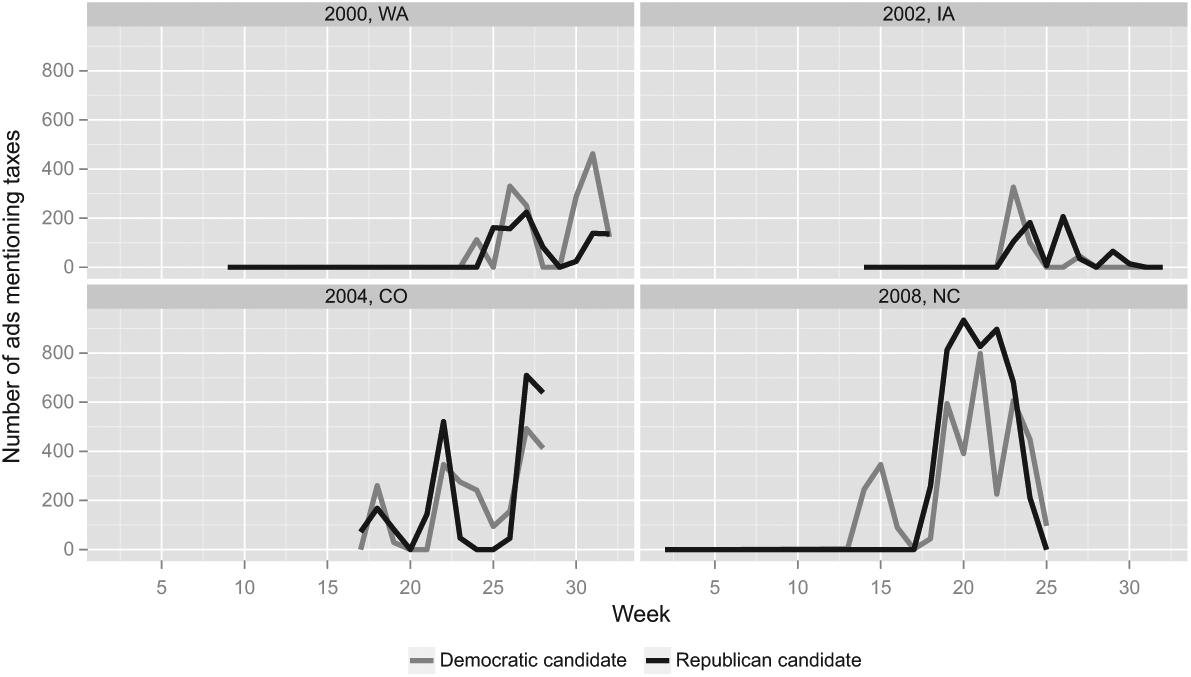
Emphasis of taxes in four campaigns.
Table 4 contains the results of my seemingly unrelated regression. 18 The first column contains the results for Democratic candidates whereas the second contains those for their Republican opponents. The table also contains the correlation of the residuals generated by each equation; at −0.12, this relationship is negligible.
Issue Convergence in U.S. Senate Campaigns.
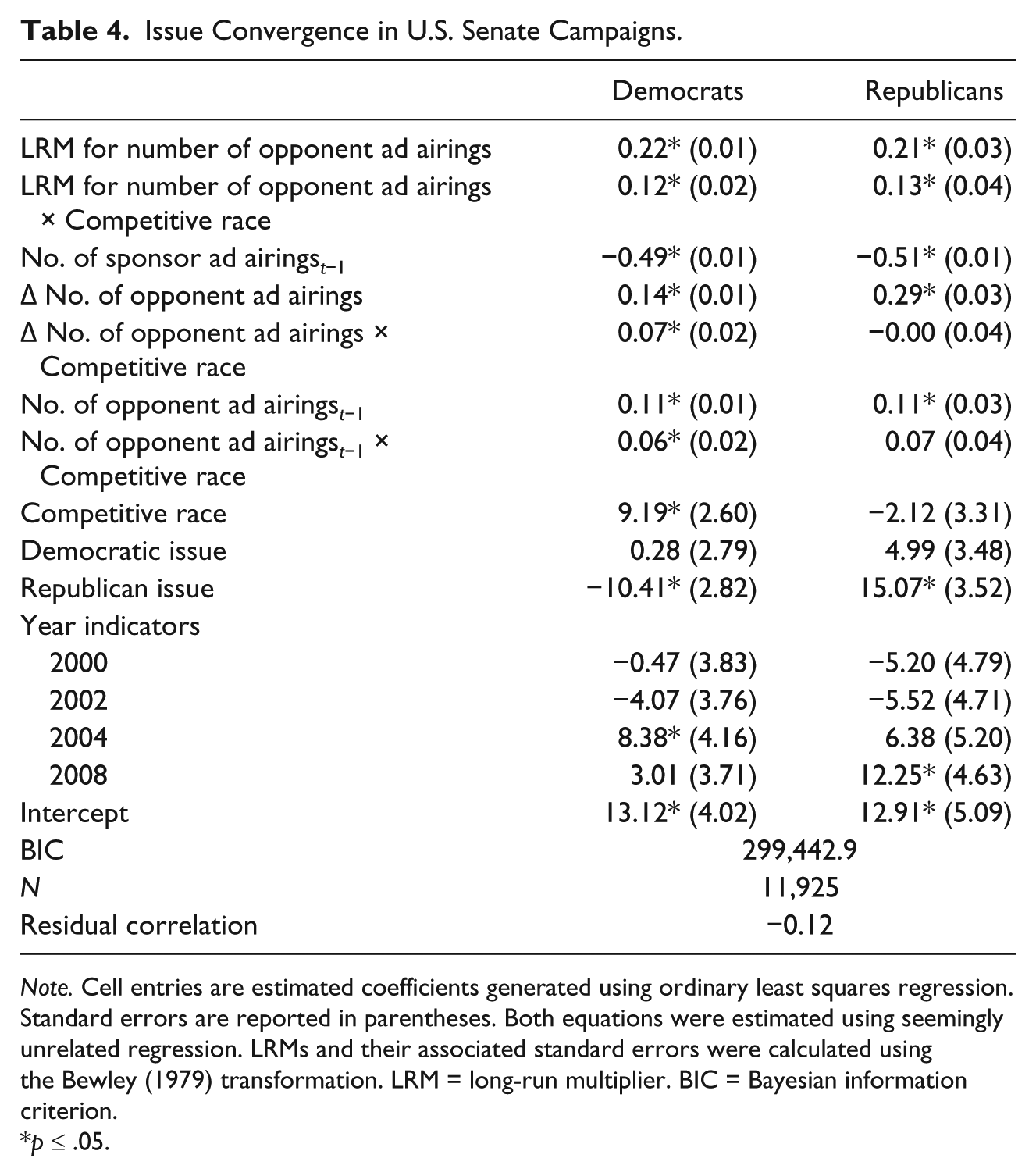
Note. Cell entries are estimated coefficients generated using ordinary least squares regression. Standard errors are reported in parentheses. Both equations were estimated using seemingly unrelated regression. LRMs and their associated standard errors were calculated using the Bewley (1979) transformation. LRM = long-run multiplier. BIC = Bayesian information criterion.
p ≤ .05.
The quantities of interest in Table 4 are the long-run multipliers. These again capture the total long- and short-run effects of an additional ad airing mentioning an issue sponsored by one candidate on the opposing candidate’s volume of ads mentioning the same issue. Note that all four long-run multipliers presented in the first two rows of the table are positive and differ significantly (p ≤ .05) from zero, thus suggesting that candidates on average respond to increases in the number of ads mentioning an issue aired by their opponents by airing more ads of their own that discuss the same issue.
The first row of long-run multipliers captures candidates’ responsive advertising behavior in noncompetitive campaigns. Both Democrats and Republicans respond to their opponents’ advertising strategy by airing more ads—0.22 more for Democratic candidates and 0.21 more for Republican candidates per additional opponent-sponsored advertisement—that mention the same issue. The second row of long-run multipliers captures the responsive behavior of candidates in competitive campaigns. Democrats on average respond to their opponents’ issue-ads by airing 0.12 more advertisements per opponent-sponsored airing in competitive campaigns than they do in noncompetitive campaigns that mention the same issues. Republican candidates are similarly more responsive in competitive elections, airing an additional 0.13 ads over the current and future time periods in response to their opponents’ advertising strategies.
Figure 2 shows the effects of a one standard deviation increase in a candidate’s opponent’s issue emphasis on the candidate’s own emphasis of the issue for both Democratic and Republican candidates in competitive and noncompetitive elections. 19 The standard deviation of the number of Democratic-sponsored ad airings is about 134. For Republican airings, this quantity is approximately 164. The estimated total long- and short-term effects plotted in Figure 2 reaffirm the effects I described above. A one standard deviation increase in the number of Republican-sponsored ad airings leads, on average, to increases of approximately 22 and 43 additional advertisement airings sponsored by the Democratic candidate in noncompetitive and competitive campaigns, respectively. Among Republican candidates, a one standard deviation increase in the number of issue-ads aired by their Democratic opponents lead on average to about 21 and 32 additional ad airings mentioning the same issue. In other words, I observe issue convergence in candidates’ advertising strategies and this tendency toward convergence tends to be stronger in competitive elections than in noncompetitive elections.
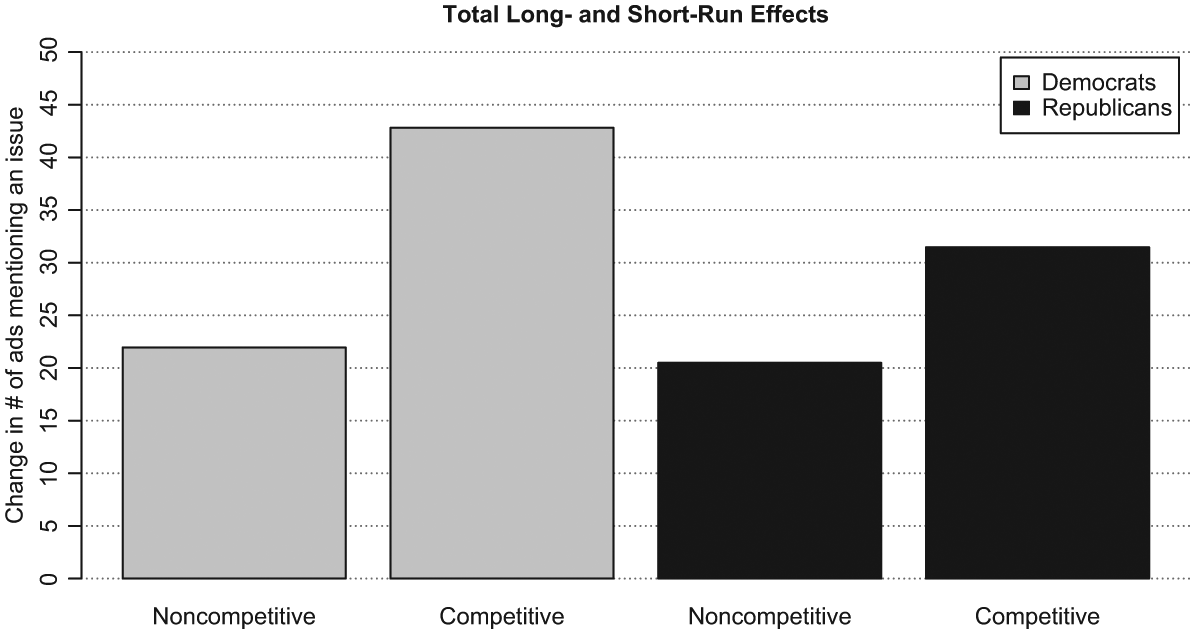
The contemporaneous and over time effects of opponents’ issue emphasis.
Conclusion
These results suggest that candidates respond to their opponents strategically over the course of campaigns and that this response takes the form of issue convergence. The analysis further suggests that the degree to which candidates respond to one another is conditioned by competition; in more competitive environments, candidates converge at higher rates. In other words, candidates respond over time to one another’s issue priorities as expressed in their television advertisements by increasing the number of advertisements they air mentioning the issues their opponents discuss in their own television advertisements. The evidence presented in this research favors issue convergence theory and, importantly, suggests that this process unfolds over the course of campaigns.
These results lead to three related implications. First, it appears that substantive debate in U.S. campaigns may not be as rare as critics in the news media believe it to be. Candidates often address the same issues as one another and appear to do so in direct response to the strategies employed by their opponents. Issue convergence may be useful for citizens because when candidates discuss the same issues, citizens can learn about candidates’ competing views. This issue convergence may allow citizens to assess candidates on the same issues when they otherwise might be forced to do so on the basis of different issues. The knowledge stemming from this convergence-based discourse might allow citizens to more easily identify the “correct” candidate to support. That said, candidates have limited resources, which means that if they focus additional attention on issues that their opponents discuss, they may be unable to talk about another set of issues that may be important to citizens.
Second, if competitive environments encourage more issue convergence, then more competitive elections may produce a healthier democratic system. Richer information environments should allow citizens to draw more comparisons between candidates across a range of issues than should the lower levels of information brought about by noncompetitive election environments. The kinds of information environments fostered by competitive campaigns should also improve citizens’ abilities and proclivities to make well-informed decisions.
The final implication centers on the potential importance of negativity in determining candidate responsiveness. Given that candidates want to define both themselves and their opponents in the minds of voters (e.g., Banda, 2014), it is possible that they may be more inclined to respond to their opponents’ messages when they are attacked than they would when their opponents air positive advertisements. Candidates sometimes run ads that explicitly reference other advertisements in which they were attacked. Such ads represent direct responses, but candidates might also respond to their opponents’ attacks without explicitly mentioning other commercials. Instead, they could produce ads that either attack their opponents on the same issue or that focus on candidates’ own views on the issue on which they were attacked. Future research could focus on the question of what political conditions encourage each type of response.
It is possible that negativity also stimulates candidates to respond to their opponents’ campaign strategies and thus encourages issue convergence. This may occur due to candidates’ desires to respond to their opponents’ critiques of their candidacies. While the analysis in this research does not allow me to directly observe the degree to which negativity affects candidates’ proclivities to engage in issue convergence, there is some indirect evidence that suggests that negativity may play a role in candidates’ selection of strategies.
An important caveat is that the findings presented in this research are directly applicable only to candidate behavior in campaigns involving a large volume television advertising. Even in the campaigns coded as noncompetitive in these data, candidates still aired a large number of advertisements. It is possible that candidates involved in extremely noncompetitive elections may be less responsive to their opponents either because they are winning by a large margin and thus have no incentive to pay attention to their weak opponents or because they lack the resources to adequately respond. In other words, although candidates appear to respond to one another’s television advertisements and are more responsive in more competitive election environments, they may behave very differently in the kinds of very low salience contests that do not appear in these data.
Future research might explore why Republican candidates appear to converge at lower levels than their Democratic opponents. The differences I observe may, for example, be explained in part by institutional factors at the state level or in the Republican Party. Researchers should also examine the degree to which the characteristics of candidates and issues influence convergence dynamics. Learning about the logic underlying candidates’ campaign strategies would improve our understanding of candidate behavior generally and dialogue in U.S. campaigns specifically.
Footnotes
Acknowledgements
I would like to thank Tom Carsey, Virginia Gray, John Petrocik, Jay Dow, Marvin Overby, James Endersby, Laron Williams, Jeff Harden, Justin Kirkland, Jason Windett, Chris Clark, Hans Noel, Arthur Spirling, Monica Moore, three anonymous reviewers, and Brian Gaines for their helpful comments and suggestions about earlier versions of this article.
Declaration of Conflicting Interests
The author(s) declared no potential conflicts of interest with respect to the research, authorship, and/or publication of this article.
Funding
The author(s) received no financial support for the research, authorship, and/or publication of this article.