




Abstract
Primaries frequently exacerbate ideological divisions within a party. When parties select more moderate candidates whom they believe will appeal to a broader audience, the nominee must find a way to win over their party’s base. We investigate the potential rewards of using the vice presidential nominee to increase voter turnout among those ideologically alienated by a party’s moderate nominee. We also examine the risks of a more extreme vice presidential nominee costing a president the support of moderate voters. To perform this analysis, we examine how voters’ ideologies and attitudes toward Sarah Palin affected their voter turnout and their vote choice. By doing this, we are able to assess the effectiveness of the attempt to activate the base and find that while vice presidential nominees may provide the opportunity to effectively target ideological groups, they may also contribute to a loss of support from moderately inclined voters.
It’s a risk. No matter how great the candidate, it’s a significant risk to put someone on the ticket. They obviously felt it was worth the risk to rev up the base . . . .
Introduction
During the presidential primary season, political parties vet prospective presidential nominees and select a candidate to represent their party’s ticket in the general election. After a candidate secures the nomination, the party must begin the task of uniting the party behind that candidate. It can be difficult for the party’s nominee to win the support of various party factions, especially those factions that strongly supported candidates who failed to garner the nomination. While party divisions may be indicative of a variety of factional preferences resting on characteristics such as gender, age, race, and regional preferences, unifying the party can be especially difficult when party factions are defined by ideological differences.
Primaries frequently exacerbate ideological divisions within a party: divisions that must be bridged if a nominee is to be successful in the coming general election. When more moderate candidates end up winning primaries, they must find a way to win over their party’s base. Ideological differences between a moderate nominee and the party base can make this difficult, especially if members of the party base have recently invested their time, money, and energy in the support of a candidate that the moderate nominee defeated in the primary.
The need for more moderate candidates to reach out to their party base runs counter to the conventional wisdom on effective campaigning strategies. Political scientists have long recognized the importance of the courting the median voter in U.S. elections (Black, 1948; Downs, 1957). The median voter theorem posits that the candidate that can win the support of the median voter should be able to win the election. However, appealing to the median voter is not without its risks. More extreme voters may decide to not vote at all if a candidate’s attempt to win the median moves them too far away from the base of their party. Election models that allow for abstention due to alienation or indifference show that candidates seeking the support of the middle are likely to reduce turnout among more extreme voters (Adams & Merrill, 2003; Adams et al., 2006; Brody & Page, 1973; Peress, 2011).
While courting moderate voters or securing the base of a party is often seen as mutually exclusive strategies, additional political science literature implies that both strategies could be pursued simultaneously. Political scientists have argued that candidates are able to appeal to different groups through the use of different messages, if those messages reinforce voters’ predispositions (Finkel, 1993; Lazarsfeld, Berelson, & Gaudet, 1944). We argue that politicians may be able to successfully use differentiated messages, such as the selection of a vice presidential nominee, that appeal to one group of the electorate but are largely ignored by another part of the electorate when it comes to altering their behavior.
To test the ability of politicians to successfully activate one group of voters, without arousing the ire of another group of voters, we examine McCain’s selection of Sarah Palin as his 2008 running mate. Using 2008 American National Election Study (ANES) data, we assess how voters’ perceptions of Palin influenced their decision to turn out and vote for McCain. Specifically, we analyze the level of affect toward Sarah Palin for conservatives and moderates. Then, we examine the influence these levels of affect for Palin had on voters’ decision to turn out and their decision to support McCain. We find that conservatives’ perceptions of Palin had a strong effect on turnout and vote choice, while Palin seemed to have less influence on moderates’ decisions to turn out and vote.
Differentiated Campaign Messages
Presidential candidates use various techniques, including advertisements, personal appearances, and get-out-the-vote efforts, to encourage support. However, campaigns must also consider whom they will target with these gestures. Once a campaign determines which states are likely to be critical in their quest to win the Electoral College, they must then decide how they will approach the campaign within these critical areas. They can either choose to target members of the electorate in their party’s base, who are likely predisposed to the campaign’s message, or they can target members of the electorate who are considered undecided swing voters. Both tactics have potential risks and rewards.
Employing particular campaign tactics designed to secure the party base runs counter to what many theorists claim is in the typical politician’s best electoral interests. Black (1948) and Downs (1957) advocated economic spatial models of candidate and voter behavior. According to these models, it should be in the best interests of political candidates to gravitate toward the median voter. This should have been especially true in the 2008 election, since the median voter in the presidential election has been estimated to be located in the middle of the traditional liberal/conservative ideological scale, with an ideology much closer to that of self-reported independents than to either Republicans or Democrats (Jessee, 2010). To win the support of this moderate median voter, candidates should focus their campaigning around a more moderate message.
In theory, voters near the median will rationally vote for the candidate whose message is closest to their own beliefs. Although candidates may need to expend more resources to gain the support of the median voter, as they will need to both persuade and mobilize these moderate voters (Holbrook & McClurg, 2005), the electoral benefits of gaining median support is potentially considerable (Hillygus & Shields, 2008). The voters located at the extremes will then vote for the viable candidate located closest to them on the ideological spectrum because, as Downs (1957) states, “It is always rational ex definition to select a greater good before a lesser, or a lesser evil before a greater; consequently abstention would be irrational because it increases the chances of the worse party for victory” (p. 119). Campaigns operating under these tactics are referred to as risk-seeking candidates because they are willing to diverge from their party’s base supporters (Chen & Reeves, 2011; Cox & McCubbins, 1986).
Conversely, risk-adverse candidates focus their campaign’s attention on their own party’s base (Chen & Reeves, 2011; Cox & McCubbins, 1986). Candidates seeking such a strategy worry about same-party voters becoming disenchanted with a candidate espousing moderate positions in an attempt to gain the support of the median voter. Converse (1966) refers to voters sitting out an election because they do not closely identify with a same-party candidate as “abstention due to alienation.” Peress (2011) argues that, while some candidates do choose to engage in strategies centered on securing the base rather than the median, economic models of voting suggest that such base-oriented strategies can be electorally costly. As candidates work to secure their party’s base, they risk alienating voters located near the center.
Peress’s concerns about alienating moderate voters may not be as vital as once thought, if we consider the decision-making characteristics of both partisans and independents. Research suggests that partisans process campaign information differently than independents, giving campaigns a chance to target partisans and independents through differentiated campaign strategies. Partisans seek, process, and retain political information differently than independents (Delli Carpini & Keeter, 1996; Zaller, 1992). They are less likely to abstain due to alienation in part because they are more likely to reject information they find in disagreement with their political beliefs (Fischle, 2000; Zaller, 1992). If a candidate pursues a more moderate message, partisan voters are more likely to reject this information if it is in conflict with their previously held beliefs about the candidate (Lodge, McGraw, & Stroh, 1989). This is less likely to be true for independents. For a campaign to mobilize independents, they must first find a way to persuade them (Holbrook & McClurg, 2005). Therefore, mobilizing independents consumes more resources than focusing on the party base and potentially involves more risk.
In addition, Jessee (2010) contends that finding ways to reinforce and activate extreme voters can be electorally beneficial because “campaign donations, volunteering, or other sources of assistance tend to come from more ideologically extreme voters,” therefore providing candidates with incentives to polarize and activate their base (p. 206). These resource incentives, both in the sense that campaigns may be able to conserve resources and also bring in more as a result of targeting partisans, may lead candidates toward a more ideologically extreme campaign message. Is it possible to appeal to more extreme voters in the base through one set of campaign messages, while still pursuing votes near the middle? An examination of the existing literature on message receptivity signifies that this indeed could be possible.
Evidence suggests that the challenge in appealing to and maintaining both moderate voters and party loyalists may be reduced if a candidate’s message is perceived differently by divergent subsets of the electorate. While campaigns may not easily produce a change of perception among voters toward candidates, they can serve to “activate partisanship and mobilize core supporters” (Finkel, 1993; Holbrook & McClurg, 2005, p. 689; Lazarsfeld et al., 1944). Earlier studies showed that campaigns reinforced voters existing views, especially during an era when people associated more strongly with social groups. Building on these early studies, Finkel examined both individual and aggregate level data to compare two models, one designed to test for campaign activation effects and one to examine whether conversion is likely. Finkel (1993) agrees campaigns do not likely change voters’ intentions, but instead they “activate existing political predispositions and make them electorally relevant” (p. 3). In sum, campaign tactics may not change voters’ political opinions, but they could impact voter turnout if the right predispositions are triggered. This, in turn, can alter electoral results. This means campaigns may be able to have their messages positively received by some groups predisposed to the message, while leaving those less inclined toward the rhetoric largely unaffected. Now, it is imperative that we understand how campaigns send messages to these groups to better comprehend their targeted impact.
Existing research on the effects of partisan cues, including campaign visits and television advertisements, focuses mostly on the persuasive power of the messages and fails to differentiate between persuasion and mobilization effects (West, 2001). While this allows us to better understand opinion formation, it does not necessarily indicate changes in electoral behavior. Holbrook and McClurg (2005) begin to fill this void in the literature, showing that campaign activities designed to target partisans, including transfers of national party money to state and local party organizations, positively affected partisan mobilization. More general campaign advertisements had little influence on partisans, but they did find independents more likely to turn out based on these ads. This lends support to the idea that it is possible for campaigns to differentiate campaign messages.
We contend that the selection of a vice presidential running mate can be used by a campaign to explicitly appeal to a subset of the electorate. Rosenstone and Hansen (1993) provide justification for this strategy and argue “people who identify closely with political contenders are more likely to participate in politics than people whose psychological identifications are weaker” (p. 19). 2 Under this reasoning, if the presidential candidate struggles with gaining the support of a subgroup within his party, one way he could potentially secure them is through providing a running mate with whom they can more closely identify.
The Selection of Palin
When considering spatial theories of voting, McCain’s moderate reputation should have been electorally beneficial for him. However, shifts within the electoral climate over time suggest that this may not reflect political reality. Abramowitz (2011) demonstrates that since the 1980s, the conservative wing of the Republican Party has become more conservative. In the past three decades, Republican identifiers’ self-reported average conservatism scores have increased from an average score of 5 up to 5.6 on a 7-point scale. The activist base of the Republican Party has also grown, from 11% of the party in the 1980s to 19% in the current period. 3 This evidence implies that the growing Republican base should be difficult to secure for a candidate with a moderate reputation. These findings also suggest that if the current trends persist, the pressure to appeal to ideological extremes will continue to be an objective for the parties, especially Republicans.
McCain was aware of the pressure to mobilize the party base and this was apparent in his campaign’s actions. Jessee (2010) compared 2008 voters’ ideological distribution with that of the presidential candidates’ campaign stances and showed that McCain was pulled toward a more conservative message when compared with the placement of a majority of voters. McCain’s well-known moderate political activities hindered him from activating and reinforcing the party base solely on his own. McCain’s history of moderate political moves, such as sponsoring campaign-finance reform and joining the “Gang of 14,” had alienated many of the most conservative voters in the Republican Party. His campaign realized they needed to find others ways, such as the vice presidential selection, to appeal to the party’s base. Steve Schmidt, a senior strategist for the 2008 McCain campaign, argued that the most important goal for a running mate was that, “the nominee had to excite the base of the Republican Party” (quoted in Brox & Cassels, 1998, p. 352). 4 It is imperative to examine how the targeted population, specifically conservative voters, viewed this selection.
McCain announced his selection of Sarah Palin as his running mate on August 29, 2008. This announcement did not go unnoticed by the American public, with Democrats and Republicans reacting quite differently to her selection. In a CBS News and New York Times poll conducted on September 12 to 16, 2008, 75% of respondents indicated they felt McCain choose Palin to “help him win the election” instead of attributing the selection to her qualifications. This is compared with only 31% of respondents indicating Obama chose Biden as his running mate for electoral gain. While 33% of Republicans indicated she was chosen because she was “well qualified for the job,” only 7% of Democrats and 13% of Independents felt she was well qualified. These poll results indicate that the selection of Sarah Palin as a running mate resonated differently among different groups within the electorate. We examine whether these initial partisan differences toward Palin led to conservatives being more likely to have their assessment of Palin influence their participation and vote choice in the presidential election.
Our distinctive focus on turnout effects builds upon a growing body of research concerning the “Palin Effect,” in which there is much disagreement. Kenski (2010) uses rolling cross-sectional surveys to analyze how potential voters’ feelings toward Palin influenced their vote choice. In the aggregate, Kenski shows that Palin’s favorability ratings trended downward throughout the electoral cycle. However, for those who did not like McCain but liked Palin, those numbers held reasonably steady over time, ranging from 17.6% 1 to 2 months prior to the election to 16.2% leading into the election. These findings indicate that, over time, feelings toward Palin held steady among those who McCain’s campaign hoped to target, those who did not care for John McCain but were drawn to Sarah Palin.
Knuckey (2012), using ANES data, argues that respondents’ evaluations of Palin were a strong predictor of vote choice and that Palin had a larger influence on the election than any other vice presidential candidate going back to 1980. Knuckey also finds that while Palin likely helped McCain among conservatives, her addition to the ticket likely eroded support from “swing voters,” leading to a net negative impact on McCain’s vote share. In response to this piece, Burmila and Ryan (2013) critique Knuckey’s use of predicted probabilities to assess Palin’s effect on vote choice in the 2008 election. By focusing on marginal effects, instead of predicted probabilities, they do not find evidence that Palin hurt McCain’s vote share. They further find that Palin’s effect on the 2008 election is statistically distinguishable from most other vice presidential candidates.
Taking a slightly different approach to analyzing the 2008 election, Elis, Hillygus, and Nie (2010) use a 10-wave panel survey conducted by the Associated Press and Yahoo News. This allowed the researchers to analyze the influence of both retrospective and prospective factors throughout the election season. They contend that among the respondents, approximately one quarter of all voters switched their preferences throughout the electoral cycle and that the prospective factors, like Palin’s favorability, were more influential than retrospective factors, such as favorability toward President George W. Bush. In conjunction with Knuckey’s findings, they conclude that Palin’s influence on voters was significant but find that Palin’s aggregate influence on the election could have cost McCain around 1.6% points of the popular vote. While the simulations used to calculate this figure are a more direct effort to assess the electoral impact of Palin than those used by the other articles discussed, these simulations do not assess whether Palin’s addition to the ticket affected voters’ likelihood of turning out to vote.
While the current literature on the “Palin Effect” has not reached a consensus on the aggregate influence of Palin on McCain’s vote share, all of these articles demonstrate that what people thought of Palin influenced their vote choice decision in the 2008 election. We hope to add to this literature by exploring Palin’s influence on voter turnout within the context of ideological groups. Palin was selected by the McCain ticket at least in part to increase conservative support of his ticket and to get conservatives to turn out in his favor. While existing studies add to our understanding of Palin’s potential influence in an aggregate two-party vote choice model, our study seeks to better grasp Palin’s ability to mobilize and turn out the right while not costing the support of moderates. Through this approach we not only contribute to our understanding of Palin’s influence in 2008 but to the influence on turnout of targeted appeals to subsets within the party.
Modeling the Decision to Vote
As an initial step to determine whether the McCain campaign’s attempt to use Palin as a direct appeal to conservatives was effective in getting them to turn out, we examine candidate affect data from the 2008 ANES. Table 1 reports the distribution of 2008 voters’ postelection affect toward both McCain and Palin and report the feeling score differential between the two Republican candidates separated by ideology. 5 The findings suggest conservatives view Palin more positively than McCain with her scores approximately 3.5 points higher than the presidential candidate. However, moderates, those more likely to be considered undecided swing voters, scored McCain higher than Palin by just over 4 percentage points, although moderates scored both individuals lower than did conservatives. Perhaps not surprisingly, a majority of liberals scored both Republican candidates unfavorably, but nonetheless scored McCain roughly 10 points higher than Palin. If we consider the campaign reinforcement literature, this distribution could indicate that there is potential for McCain’s vice presidential selection to add conservative support to his ticket. Alternatively, this distribution also shows that both moderates and liberals liked McCain more than Palin. Moderates’ negative feelings about Palin could decrease their likelihood of supporting McCain, meaning his vice presidential selection could have harmful effects for the ticket among these median positioned voters.
Mean Differences Between McCain and Palin Feeling Scores.
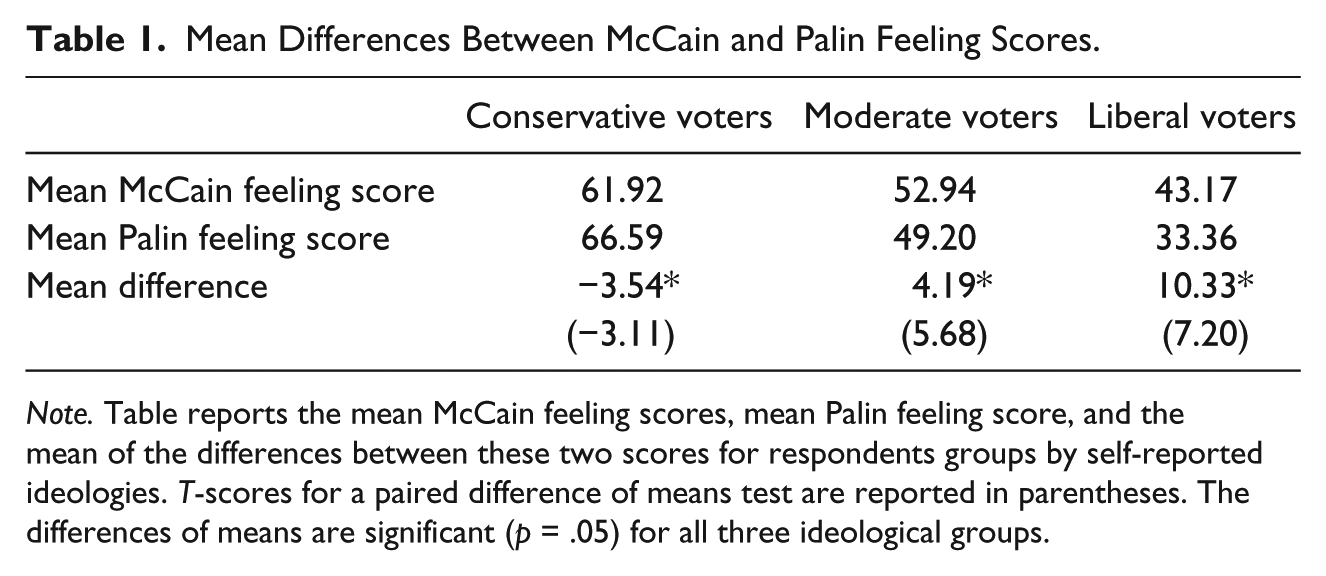
Note. Table reports the mean McCain feeling scores, mean Palin feeling score, and the mean of the differences between these two scores for respondents groups by self-reported ideologies. T-scores for a paired difference of means test are reported in parentheses. The differences of means are significant (p = .05) for all three ideological groups.
We investigate Palin’s concurrent influence on voters’ presidential vote choice and on their decision to turn out. We use 2008 ANES postelection data to test the following expectations: (a) We expect Sarah Palin should have a significant influence on conservative voters’ choice of presidential tickets, (b) we expect McCain’s explicit selection of a strong conservative should positively influence voter turnout among conservatives, and (c) the targeted appeal of Palin should not alienate moderate voters, such that moderate voters’ affect toward Palin should not significantly affect either their vote choice or turnout. The campaign strategy literature indicates that pointed explicit strategies, such as selecting Palin as a running mate, should provide McCain with the differentiated support of conservatives without costing him support among moderates who are expected to be largely unaffected by this selection.
Our expectations about the data consider both how Palin affected vote choice and turnout decisions. We therefore use a multinomial choice model first proposed by Lacy and Burden (1999). 6 In this study, the authors introduce a unified model considering voter choice and abstention simultaneously in their examination of Perot’s effect on the 1992 presidential election. The choice to abstain is a highly relevant choice in presidential voting and must be included in a complete examination of presidential voting. In their seminal piece, Campbell, Converse, Miller, and Stokes (1960) argue, “[T]he act of voting requires the citizen to make not a single choice but two. He must choose between rival parties or candidates. He must also decide whether to vote at all” (p. 89). The multinomial logit electoral choice model takes this critical point into consideration.
Through the inclusion of abstention, in addition to the choice of voting for Obama or McCain, and the use of postestimation techniques, we are able to determine the substantive impact of Palin’s nomination on voter turnout. We consider whether respondents voted for Obama (a), McCain (b), or chose to not vote (c) in the 2008 election. 7 Our key independent variable is voters’ affect toward Sarah Palin. We measure this using the ANES Palin feeling thermometer score, which ranges from 0 (indicating no affect toward Palin) to 100 (indicating high affect toward Palin). To consider the anticipated difference in effects for conservative, moderate and liberal voters, we identify conservative voters (voters self-reporting scores of 6 or 7 on the 7-point ideology scale used by the ANES), moderate voters (scores of 3, 4, or 5), and liberal voters (scores of 1 and 2). As we are interested in whether the effect Palin had on turnout and vote choice was conditional on the ideology of the respondent, we include variables that interact Palin affect and conservatives and Palin affect and liberals. As a robustness check, we also estimate a second model where party ID is used in place of ideological group. Interactive variables for Palin affect and Republican and Palin affect and liberals are used in that model.
We control for voters’ levels of affect toward John McCain, by including a similar feeling thermometer score that ranges from 0 to 100. In addition, we control for a number of variables considered in previous voting studies. We include a control variable measuring respondents’ level of education, with respondents completing some college or more education coded as 1 and all others coded as 0. We included controls for gender (female = 1, male = 0), income, 8 race (White = 0, non-White = 1), and age. We also include a variable measuring whether a respondent voted in the previous presidential election in 2004 (1) or whether they choose to abstain from voting in the 2004 election (0).
Analysis and Findings
Table 2 reports the results of the multinomial logit models. The columns labeled Obama compare the decision to vote for Obama with the baseline of abstaining. Similarly, the columns labeled McCain compare the decision to vote for McCain with the baseline of abstaining. Both Palin and McCain feeling scores have a significant impact on respondents’ decision to turn out and vote. Figure 1 reports predicted probabilities for conservatives, moderates, and liberals interacted with varying level of Palin affect. 9 We predict the behavior of respondents who are ambivalent toward McCain (McCain feeling score = 50).
Multinomial Logit Estimates of 2008 Reported Presidential Vote Choice and Abstention.

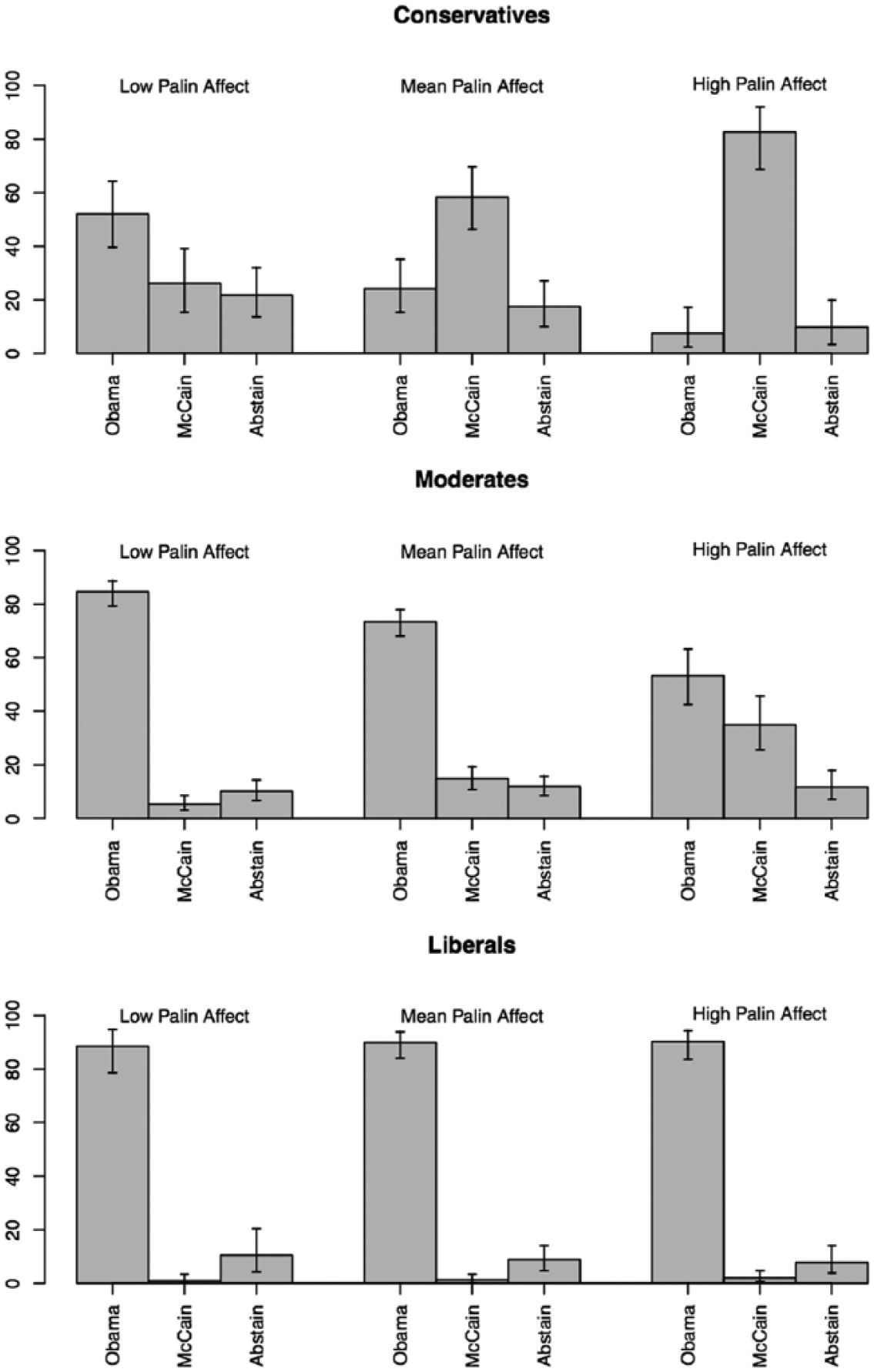
Effect of Palin on reported vote choice/abstention.
As Palin affect increases, conservatives become both more likely to vote for McCain and less likely to abstain. A conservative with mean affect toward Palin (69.40) is predicted to vote for McCain 57.92% and abstain 18.09%. As Palin affect increases by one standard deviation (92.804), a conservative respondent is predicted to vote for McCain 82.75% and abstain 9.71%. Conservatives with Palin affect one standard below the mean (46.00) are only predicted to vote for McCain 26.80% and abstain 21.65%.
Palin has a similar but more muted effect on moderate voters’ decision to support McCain, but no measurable effect on turnout. Moderates with average affect toward Palin (48.20), are predicted to vote for McCain 14.79% and abstain 11.85%. As Palin affect increases by one standard deviation (73.17), a moderate is predicted to vote for McCain 35.14% and abstain 11.78%. Moderates with Palin feeling scores one standard deviation below the mean (23.23) are predicted to support McCain 5.34% and abstain 10.01%.
Palin has virtually no impact on liberals’ decisions to turn out or vote. Liberals predicted support for McCain ranges from 2.05% for respondents with one standard deviation above normal levels of Palin affect (54.33) to 1.00% for respondents with below average Palin affect (3.54). Similarly, there is no evidence that Palin caused countermobilization among liberals. Liberals with above average Palin feeling scores were predicted to abstain at 7.67%, while those liberals who liked Palin least were even less likely to vote (10.66%).
The results using party groups in place of ideology produce somewhat similar results. Republicans’ predicted support for McCain increases from 68.37% to 77.27% when their affect for Palin increases one standard deviation from the mean. Their abstention rates fall from 18.42% to 17.39%, a lesser decline than in the ideology group models. Independents also show evidence of a significant Palin effect. As independents’ assessment of Palin moves from the mean to one standard deviation above the mean, their predicted support for McCain goes from 13.17% to 32.29%, and their turnout goes from 17.49% to 14.61%. As with the previous model, liberals’ assessments of Palin do not have a significant effect on turnout and vote choice.
Consistent with our expectations, conservatives who like Palin are more likely to support McCain and are less likely to abstain. Counter to our expectations, affect for Palin show similar effects for moderates. We now present analysis to compare the magnitude of the Palin effect for conservatives and moderates by considering the marginal effect of Palin on both conservatives and moderates. We consider how McCain support and turnout numbers change with a conservative and moderate when McCain affect is ambivalent (50) and Palin affect is set at each groups’ mean and is increased by 10-points. For conservatives, the probability of voting for McCain increases 12.38%, and abstention rates fall 3.45%. For moderates, the probability of voting for McCain increase 6.80%, and abstention falls 0.28%. The magnitude of the Palin effect is clearly larger for conservatives than moderates both in terms of McCain support and turnout; however, these differences are not statistically distinct. 10
Control variables in the models perform somewhat as expected. If respondents voted in 2004, they were much less likely to abstain in 2008. Increases in education and income increased voting for McCain relative to abstention. Non-Whites were less likely to vote for McCain relative to abstention. Age and gender differences all failed to show significant effects in either the ideological group or party identification models.
These results call into question the idea that Palin was a strict electoral liability for McCain. Palin’s addition to the ticket prevented conservatives from sitting the election out and conservatives that liked Palin were much more likely to vote for McCain. This is particularly of interest when we consider that, on average, conservatives viewed Palin quite positively, giving her a 67% favorability rating. Gaining the support of the conservative base may have been a particularly important campaign strategy for McCain’s campaign, as party activists play such a key role in providing campaigns with the financial and volunteer support they need to operate.
This is not to say that Palin had a net positive effect on McCain presidential bid. Moderates were significantly influenced by Palin, contrary to our initial expectations, and, given moderates markedly lower assessment of Palin, this indicates that Palin surely cost McCain votes among moderate voters. While we do not attempt to use our analysis to predict the aggregate vote share impact of Palin, we can reference other authors that have estimated this net Palin effect. 11 Elis, Hillygus, and Nie use a 10-wave panel of polls to analyze Palin’s impact on the 2008 election. As the election season progressed, affect for Palin become generally more negative. The authors take advantage of this fact to simulate predicted vote shares for McCain and Obama assuming that Palin’s more positive September levels of affect remained constant until the November election. This simulation generates a counterfactual election where respondents had generally more positive views of Palin. By comparing these simulated predicted probabilities with predicted probabilities using Palin actual levels of affect, the authors are able to estimate that Palin cost McCain 1.6% of the final vote share. So while Palin did help rev up the base, this strategy did not come without cost. Negative assessments by moderates likely led to a net negative Palin effect.
To illustrate the potential rewards to selecting a base activating candidate, it is useful to compare these results to the 2012 electoral strategies employed by the Romney campaign. As Table 3 indicates, conservatives already favored Romney placing him on average at just under 70 points on the favorability scale and he then went on to select a running mate, Paul Ryan, who was not rated significantly differently in the eyes of conservative or moderate voters. Although both polled higher among conservatives than their 2008 counterparts, voters across all categories failed to see Ryan as different from Romney. According to our theory, we should anticipate little electoral impact across the ideological groups as a result of maintaining the ideological slant of the ticket. In other words, as voters did not view Ryan differently than Romney, diverging from what we experienced in the 2008 election, one would anticipate that voters would not behave differently as a result of Ryan’s addition to the ticket. This is precisely what we find when examining turnout rates from 2012 and comparing them with our 2008 results (see Table 4).
Mean Differences Between Romney and Ryan Feeling Scores.
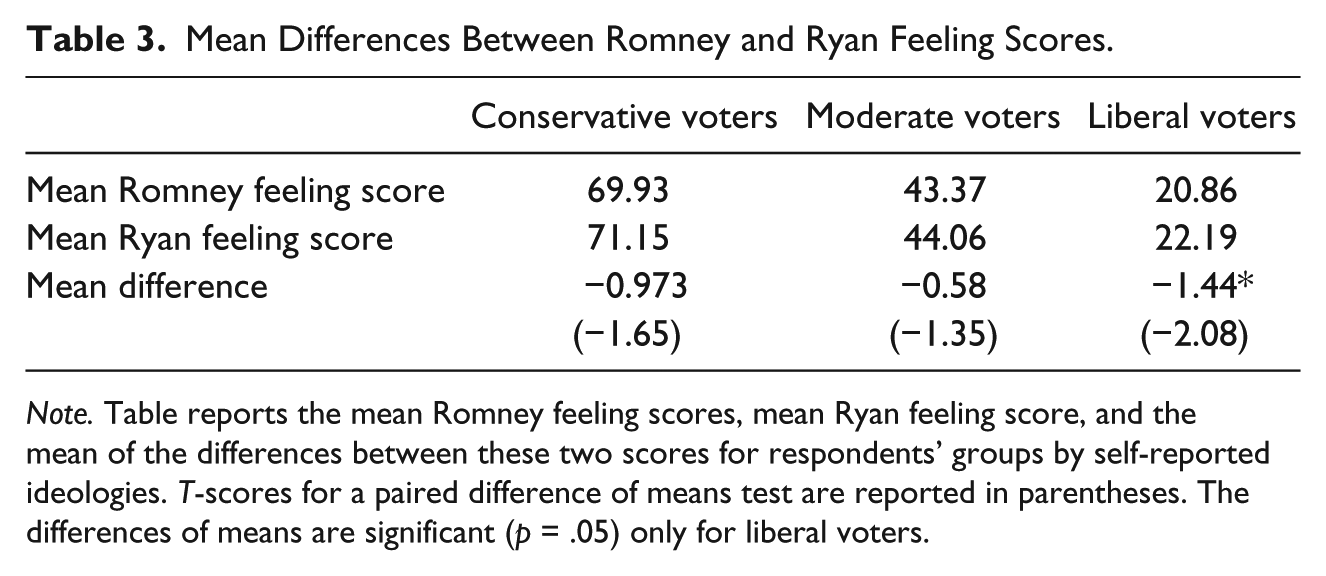
Note. Table reports the mean Romney feeling scores, mean Ryan feeling score, and the mean of the differences between these two scores for respondents’ groups by self-reported ideologies. T-scores for a paired difference of means test are reported in parentheses. The differences of means are significant (p = .05) only for liberal voters.
Multinomial Logit Estimates of 2012 Reported Presidential Vote Choice and Abstention.
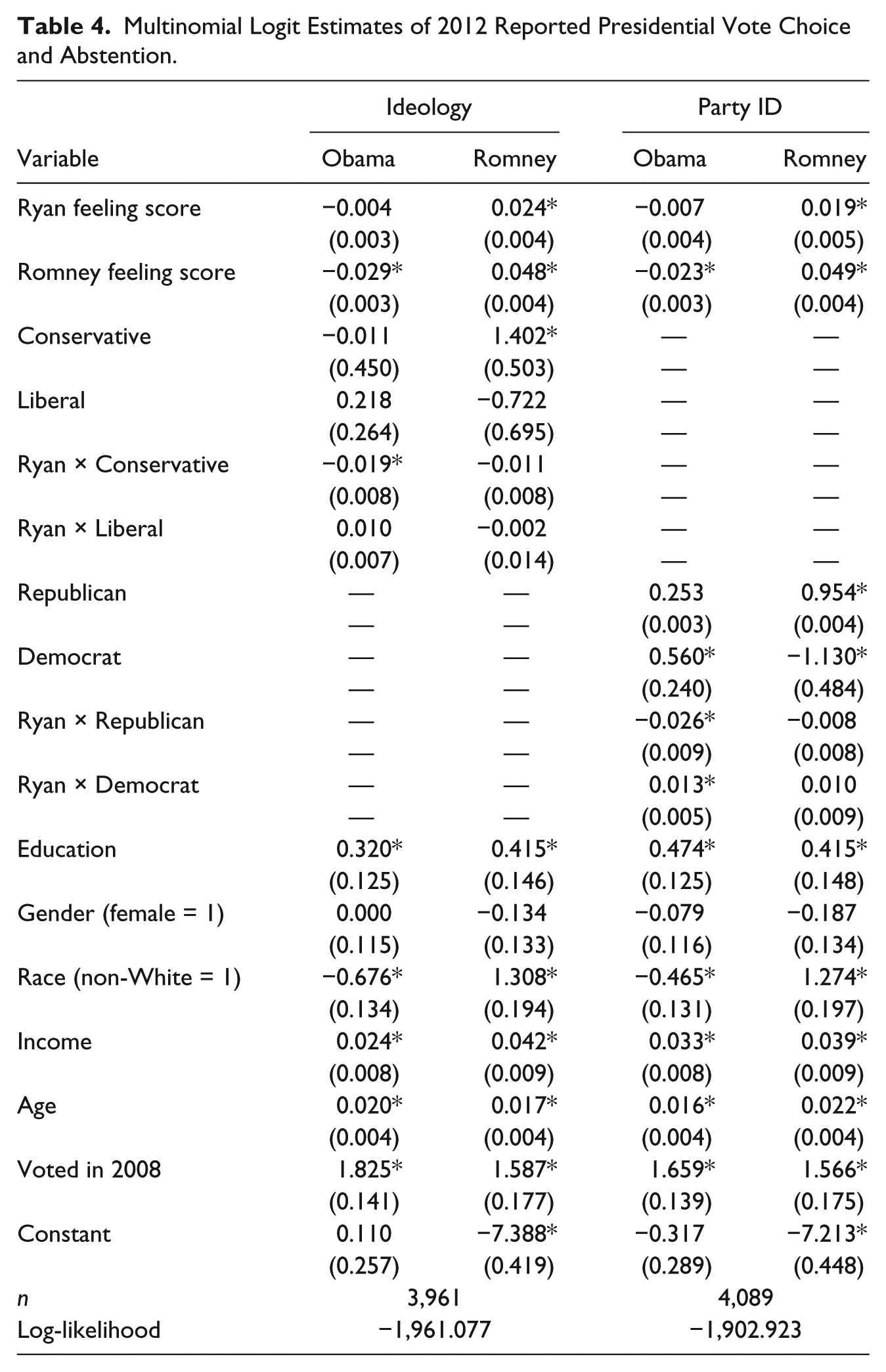
While the selection of Palin in 2008 provided McCain with an electoral turnout advantage among conservatives, Ryan’s addition made no significant difference across these same categories for conservatives or moderates. Conservatives who liked Palin were 11.94% more likely to turn out than conservatives who rated her low, and Ryan only increased turnout among these same conservative groups by a mere 4.02%. As expected, considering his similarities to Romney and our initial expectation that moderates should not be influenced by hopeful base-securing vice presidential selections, Ryan had an even lesser influence on moderates. A meager 2.52% increase in turnout from moderates ranking him low to high indicates that Romney’s selection of Ryan led to no real countermobilization turnout effect across moderates. These findings suggest that while Ryan did not cost the Romney ticket votes among moderates, the ideologically aligned ticket also failed to differentiate itself and create a broader ideological appeal.
Discussion and Concluding Remarks
Following contentious primaries, parties are tasked with having to reunite their members to push their candidate toward a win in the general election. This can especially be challenging when attempting to bridge ideological divides. We see this challenge at the presidential level as a two-step process. First, potential voters must be convinced that they should turn out to the polls instead of abstaining on the grounds that they do not connect with the nominee. Second, if they do choose to vote, they must be persuaded to vote for the party’s candidate. Research that solely focuses on the later aspect of this process misses the opportunity to analyze voters’ decision to turn out. Our intention in this research is to better understand the turnout effects of targeting subsets of the electorate, specifically ideological partisans unsatisfied with a more moderate presidential candidate.
The evidence presented here suggests that campaigns have strategies at their disposal that will allow them to reach out to these more extreme voters and bring them to the polls. This is especially critical to understand considering the more ideologically extreme segments of the electorate continue to grow. A 2014 survey conducted by the Pew Research Center indicates that people identifying as more moderate has declined from 49% in 1994 to 39% in 2014. In turn, those placing themselves on the very extreme ends of the ideological spectrum have grown from only 10% in 1994 to 21% in 2014. Both parties have experienced this growing ideological base and this is also the segment of the party where the most resources, from time to money, likely reside (Jessee, 2010; Pew Research Center, 2014). In the case of the 2008 presidential election, adding a vice presidential candidate that conservatives liked more than the nominee bolstered the candidacy of a nominee perceived to be too moderate by many in his party and helped prevent “abstention through alienation.” In 2012, when Mitt Romney selected a vice presidential nominee that voter’s perceived to be very similar to him, this boost was nearly nonexistent. While these tactics show promise in gaining the support of a party’s base, there does appear to be a risk that appeals focusing on more extreme members of a party may prevent more moderate voters, both within a party and independents, from supporting the ticket. McCain’s wish that Sarah Palin would provide his ticket with much-needed support from the conservative base of the Republican Party was fulfilled, even if his presidential ambitions were not.
Our research also speaks to broader influence of vice presidential candidates on voters. The importance of vice presidential candidates is often debated by both the media and by political scientists. Unfortunately, much of what is reported is more rooted in speculation than in empirical evidence. We believe this makes it critical that we understand who the vice presidential selections were designed to target and whether or not this subelectorate targeting strategy is an effective way to improve a presidential nominee’s electoral fortunes. Sarah Palin’s addition to the Republican ticket was widely reported to have been an attempt to bolster McCain within his own party. Consistent with our expectations, Palin was successful in influencing conservatives to turn out and vote for McCain. The McCain campaign’s ability to use the vice presidential nomination as a messaging tool not only shows a successful path to future campaigns to secure the base of their parties but also highlights the risk of pursuing this strategy.
More generally, this research shows us that differentiated campaign messages can be effectively employed to increase voter participation and candidate support among those targeted. Differentiated strategies could prove beneficial for a campaign but may have the potential to have electoral risks. Campaigns may find that differentiating their campaign messages in mailings and Internet advertising, developing varied television or radio campaign commercials depending on the stations’ viewership, or catering a campaign message based on the audience at a rally or fundraising event could lead to targeted electoral benefits. This research also supports the idea that these electoral benefits may be countered with causing some voters who are not predisposed to the targeted messages to abandon their support for the ticket. This analysis serves to explain why Elis, Hillygus, and Nie’s research showed a 1.6% aggregate loss in support with the Palin selection.
It is our hope that this research, which includes an examination of the decision of potential voters to turn out and focuses on the ideological divides within the electorate, sheds new light on our understanding of how vice presidential nominees influence voters and on the effectiveness of differentiated campaign messages. These results, combined with our understanding of growing ideological factions within the electorate, encourage the need for more examination of vice presidential candidates’ ability to influence subsets of the electorate. We do not believe that Palin is historically unique in her ability to appeal to targeted parts of the electorate. For example, were Kennedy’s struggles to appeal to conservative Southern Democrats alleviated when he begrudgingly selected Lyndon B. Johnson as his running mate in 1960? Current trends instead point to a growing need for understanding base appeals (Pew Center for Research, 2014). Future research should look beyond aggregate electoral effects by vice presidential candidates and instead take a more nuanced view of which groups are most likely to be influenced by a vice presidential candidate. Only a careful examination of vice presidential candidates’ varying influences across different groups will help us to better understand why vice presidential nominees are selected and how they affect elections.
Footnotes
Acknowledgements
The authors would like to thank Robert Greer, Mark R. Joslyn, Jeff Kamakahi, Jonathan Knuckey, James E. Monogan, John Sides, Lynn Vavreck, and our anonymous reviewers for their helpful comments.
Declaration of Conflicting Interests
The author(s) declared no potential conflicts of interest with respect to the research, authorship, and/or publication of this article.
Funding
The author(s) disclosed receipt of the following financial support for the research, authorship, and/or publication of this article: Court thanks the University of Kansas Thompson Endowment for providing financial support for this research.