




Abstract
Despite a robust history of studies examining legislative outputs, little is known about how divided government affects the policymaking process. This article examines these dynamics by analyzing the relationship between divided government and delay in the consideration of important legislation. We also introduce a more nuanced measure of divided government—the strength of the president’s party in Congress—that measures both the presence and magnitude of inter-branch conflict. Using a Cox proportional hazards model to analyze delay of important legislation from 1949 to 2010, the results indicate both divided government and the strength of the president’s party in Congress are significantly related to legislative delay. Moreover, presidential party strength significantly interacts with partisan polarization. When the parties are moderately or highly polarized, there is a significant relationship between the strength of the president’s party and legislative delay; this relationship is insignificant at lower levels of polarization. Taken together, these findings enhance our understanding of how inter-branch conflict affects the policymaking process in Congress.
Introduction
On August 2, 2011, President Obama signed the Budget Control Act of 2011—universally considered an important piece of legislation—into law. This legislation passed through both a Republican-controlled House of Representatives and a Democratic-controlled Senate and, on the surface, could reasonably be viewed as little more than the latest in a long line of important legislative outputs from a divided government context. Such a view, however, fails to recognize the considerable acrimony and rancor that preceded the passage of the Budget Control Act. Indeed, congressional leaders negotiated with the president for months on the issue, and numerous competing bills were introduced, debated, and voted on in the two chambers of Congress. The political spectacle surrounding the Budget Control Act made it difficult for legislators to focus on other aspects of the legislative agenda, and the divisive political environment—coupled with the perceived inefficiency of the federal government—drove public approval of Congress to a historic low of 13%, according to Gallup.
A long line of prior studies analyzed the effects of divided government, but existing work focuses almost exclusively on how partisan control of our governing institutions affects legislative outputs (e.g., Binder, 1999, 2003; Coleman, 1999; Edwards, Barrett, & Peake, 1997; C. O. Jones, 1994; Krutz, 2001; Mayhew, 1991, 2005). The case of the Budget Control Act of 2011 demonstrates that, even if important legislation is ultimately passed, divided government also has the potential to affect the legislative process. In light of this demonstration, this article aims to shift the focus from the effects of divided government on legislative outputs to its effects on the legislative process. Drawing on a data set containing the universe of important legislation from 1949 to 2010—defined as bills in the top 25% of coverage in the CQ Almanac—we analyze the relationship between divided government and legislative delay. Delay is measured as the number of days from initial introduction of a piece of legislation to its final passage or to the end of the 2-year congressional session if the bill does not become a public law. Moreover, we examine this relationship using a new, more nuanced measure of divided government—a continuous measure of the strength of the president’s party (or lack thereof) in Congress. Together, these advances provide significant insights into the relationship between divided government and the legislative process.
This article proceeds in three parts. First, we present a brief overview of existing studies on the effects of divided government, focusing most heavily on the theoretical implications of these studies for our analysis of legislative delay. This overview of the literature provides valuable context for the second stage of our study, where we develop our measures of legislative delay and divided government. Finally, using the measures we develop in the second section of the article, we estimate a series of survival models to examine the relationship between divided government and legislative delay. The results demonstrate important legislation encounters more delay in a divided government context than under unified government. The results further indicate divided government interacts with party polarization in a meaningful way. Specifically, the interaction demonstrates divided government only has a significant effect on delay at moderate and high levels of partisan polarization—This interaction is masked in analyses using the traditional dichotomous measure of divided government.
These findings have implications for several important issues, including the legislative agenda and productivity of Congress, the content of legislation, and public trust of government. For example, lengthy consideration of a particular piece of legislation—as occurred with the Budget Control Act of 2011—can result in that topic monopolizing the legislative agenda, and may ultimately result in enactment of a smaller proportion of the congressional or presidential policy agenda over the course of the legislative session. Similarly, delay in the legislative process may be symptomatic of inter-party or inter-branch negotiation over the substance of the bill in question. If this is the case, then the content of delayed legislation is unlikely to reflect the preferences of any single actor or group in the process—The legislation is the product of compromise. In contrast, the content of legislation that passed with relative expediency may be likely to adhere closely to the preferences of a single stakeholder, most likely the president or the majority party in Congress. Overall, this article illustrates the utility of efforts to further understand institutional and political influences on congressional performance, and highlights how inter-branch conflict affects the policymaking process even when we look beyond legislative outputs.
Divided Government and Legislative Delay
Analysis of the effects of divided government began in earnest with Mayhew’s (1991, 2005) seminal work testing the hypothesis that divided government affected legislative productivity within Congress. Drawing on a data set of significant legislation passed by each Congress since 1946, Mayhew found no significant differences in the amount of significant legislation passed in divided versus unified government contexts. Mayhew’s work sparked a series of studies on the topic, a number of which reached the same general conclusion that divided government had little effect on legislative productivity (e.g., Fiorina, 1996; C. O. Jones, 1994; Thorson, 1998). However, other studies—critiquing Mayhew’s approach on both conceptual (Binder, 1999, 2003; Edwards et al., 1997) and methodological (Howell et al., 2000) grounds—reached starkly different conclusions.
Conceptually, several studies noted Mayhew’s analysis overlooked failed legislation. These studies argued the best test for the effects of divided government on legislative productivity was not the amount of important legislation passed into law but rather the proportion of the legislative agenda that was enacted (Binder, 1999, 2003; Edwards et al., 1997). Conceptualized in this manner, these studies concluded divided government inhibits legislative productivity (e.g., Binder, 1999, 2003; Edwards et al., 1997). Similar findings emerged from studies using models accounting for a wider range of factors than Mayhew considered, such as party responsiveness and intra-party conflict (Coleman, 1999), although there is some evidence that controlling for polarization results in findings that mirror Mayhew’s (D. R. Jones, 2001). 1 Methodologically, Mayhew’s study was critiqued for presenting the data as an aggregated time series, which compressed important variation, and Howell et al. (2000) demonstrate how the application of appropriate time-series techniques results in the conclusion that divided government has a substantial negative effect on the enactment of landmark legislation. Considered as a whole, the preponderance of evidence from previous studies suggests divided government has at least some negative effect on legislative productivity.
To this point, existing work on divided government focused almost exclusively on its effect on some variant of legislative output, typically the number of pieces of legislation passed or the proportion of the legislative agenda enacted. As such, prior work provides little information on how divided government might affect the legislative process. To the extent previous studies provide any relevant information on this issue, the evidence indicating divided government inhibits legislative productivity (e.g., Binder, 1999, 2003; Edwards et al., 1997) could reasonably support an expectation that divided partisan control of our governing institutions also affects the legislative process. However, such a hypothesis has never been the subject of a direct empirical test. In an effort to better understand the effects of divided government on the legislative process—and not just outputs—we explore its relationship with legislative delay.
Although largely overlooked in the literature, legislative delay is an important phenomenon because it has the potential to produce a variety of negative consequences for a democratic government. For example, long delays in the passage of legislation may represent an inefficiency of government. Such delays have the potential to usurp the congressional agenda and monopolize the time and energies of lawmakers. These implications are especially important considering the scarcity of time and attention as policymaking resources (B. D. Jones & Baumgartner, 2005) and the limited agenda space available in legislative institutions, such as Congress (Adler & Wilkerson, 2012). Delay in the creation of public laws can also affect public trust of government institutions, as long, drawn-out political battles over important legislation can cause the public to become jaded with the democratic process, which further complicates matters of efficacy and legitimacy (Hibbing & Theiss-Morse, 1995).
A small body of work has analyzed the effect of divided government on delay in other political processes, including the confirmation of judges (Binder & Maltzmann, 2002; Shipan & Shannon, 2003) and executive branch nominations (Bond, Fleisher, & Krutz, 2009), the budget process (Binder, 2003; Woon & Anderson, 2012), and treaty-making (Krutz & Peake, 2009; Peake, Krutz, & Hughes, 2012). Although each of these studies analyzes delay only among a very specific piece of congressional action—each process takes place within a single chamber in Congress—together, they contribute evidence that divided government has implications for the legislative process, particularly with respect to delay in that process. Indeed, almost without exception, these studies conclude—relative to unified partisan control—divided government introduces delay into the actions of Congress. Considered as a whole, previous studies examining the effect of divided government on both legislative productivity and delay in specific legislative processes provide a basis for the expectation of divided government causing delay in the consideration of important legislation—an aspect of congressional policymaking yet to be explicitly considered. In the following sections, we describe the approach used to test this expectation empirically.
Measuring Delay in the Legislative Process
The data set underlying our analysis of the relationship between divided government and legislative delay contains information on 2,207 separate pieces of important legislation considered by Congress between 1949 and 2010—Importantly, our data contain both bills that were signed into law and bills that failed to pass. We use the CQ Almanac, which contains an article on every major piece of legislation lawmakers considered throughout a Congressional session, as the basis for identifying the pieces legislation included in our data. More specifically, we draw on the Policy Agenda Project’s 2 (PAP) compilation of all CQ Almanac articles from 1949 and 2010 and then—using the PAP’s measure of article length—identify all bills in the top 25% of coverage over this time period for inclusion in our data (see Krutz, 2001 for a similar procedure for identifying important legislation from CQ Almanac articles). We restrict our sample to bills in the top 25% of coverage in the CQ Almanac because it is these bills for which the potential consequences of delay—for example, monopolization of Congress’ policy agenda, effects on public trust and efficacy, and others—are most pronounced. Our approach to identifying important legislation results in our data containing observations across the full-time period.
Most policy ideas undergo several iterations prior to reaching a final legislative form—even within a given session of Congress. We account for this reality in our data by taking advantage of the fact that each article in the CQ Almanac lists the full slate of bills pertaining to the legislation covered in the article. The introduction date of the legislation in our data is that of the bill with the earliest introduction among the slate of related bills listed in the Almanac. After identifying the 2,207 pieces of important legislation for inclusion in our data and specifying their introduction date, we drew on multiple sources of information—including the PAP, the Congressional Bills Project, 3 the CQ Almanac, and Poole and Rosenthal’s (1997) work—to attach several characteristics to the legislation in our data. We describe the specific characteristics attached to the bills later in the article.
For the pieces of legislation in our data that became law, we operationalize the concept of legislative delay by calculating—within a given session of Congress—the number of days between the date a bill was introduced and the date the bill was signed into law. For legislation that did not become law, we measure delay as the number of days between the bill’s introduction and the final day on the legislative calendar in that congressional session. We acknowledge many—perhaps most—policy ideas are first introduced several congresses prior to enactment (or ultimate failure) and our measure of delay is constrained to a maximum of 2 years. However, we believe this approach to measuring delay is most appropriate, given the institutional structure of Congress. Specifically, our approach to measuring delay is consistent with the institutional rules requiring the work of Congress to begin de novo every 2 years—Policy ideas from previous congresses may be reintroduced in a new session, but this reintroduction requires a new draft of legislation with a new bill number.
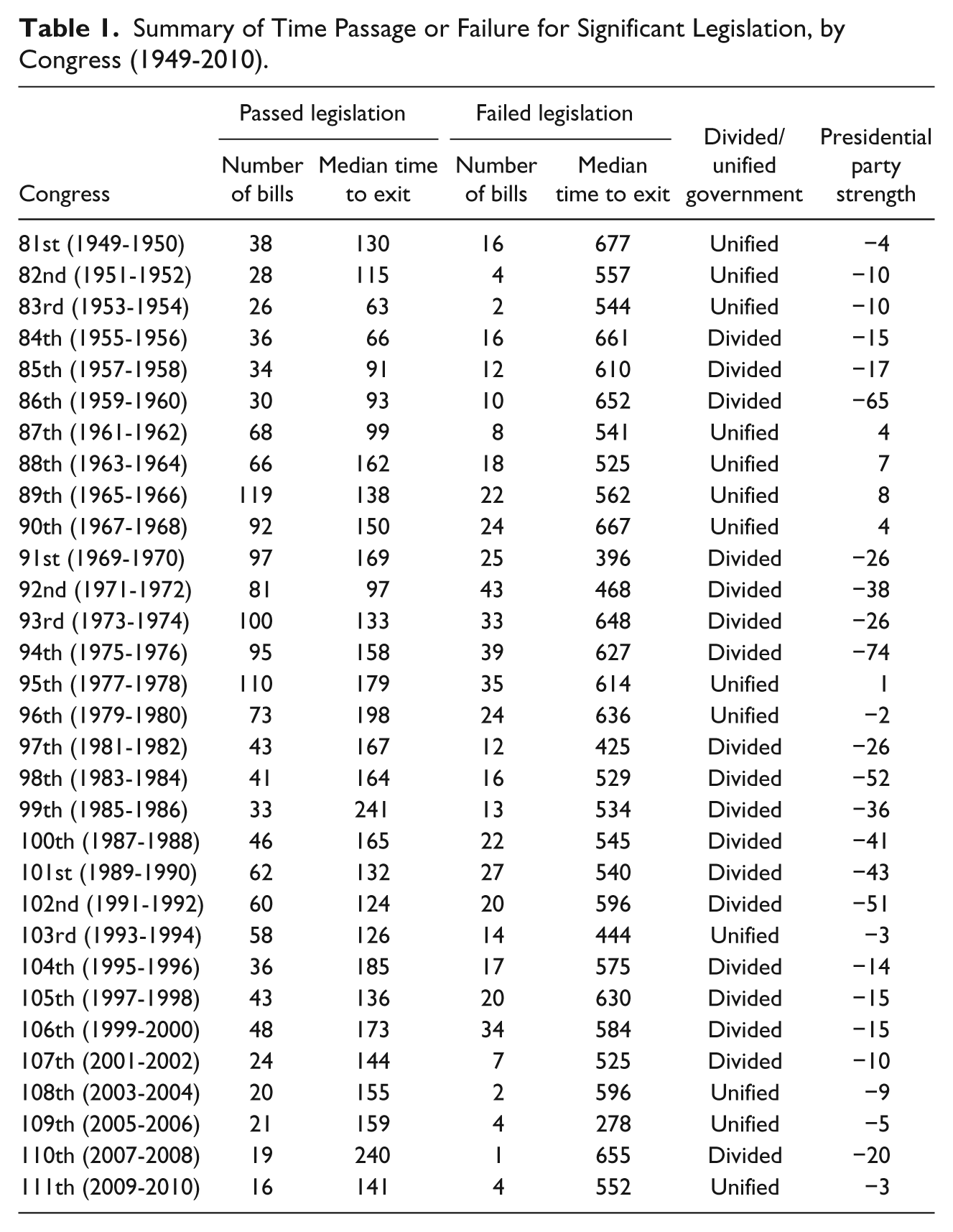
Table 1 summarizes the legislation in our data by Congressional session and passage status. Specifically—for both passed and failed legislation—the table presents the number of bills in our data in each session of Congress, as well as the median number of days to exit from our data—either final passage or failure induced by the end of the legislative session. The table makes clear our data contain 1,663 pieces of passed legislation and 544 pieces of failed legislation. 4 It is also clear a substantial proportion of the legislation in our data—about 41% of observations—are from the 1960s and 1970s. Such a result is consistent with other efforts to identify important legislation over time. For example, approximately 32% of Mayhew’s (2005) list of important enactments came from this time period. The fact that this time period disproportionately contributes to our data is not surprising, as the late 1960s and early 1970s saw Congress debating (and passing) a number of large, significant pieces of legislation. Finally, Table 1 demonstrates considerable heterogeneity in time to enactment (or failure) across the years our data span. While there are relatively short median times to enactment in earlier periods of the data, there does not seem to be a clear pattern throughout the entirety of the data.
Summary of Time Passage or Failure for Significant Legislation, by Congress (1949-2010).
Determinants of Delay
As reviewed above, a number of studies focused on how inter-branch conflict—in the form of divided government—affects legislative outputs. Although these studies reach competing substantive conclusions, each study measures inter-branch conflict using a simple dichotomous variable indicating divided government. Following this work, we also use a dichotomous measure of divided government in our analysis. However, we also develop an additional measure of divided government, one that accounts for not only the presence of inter-branch conflict but also the magnitude.
To measure the magnitude of the legislative barriers the president’s party must overcome to pass a piece of legislation through Congress, we subtract the number of presidential partisans in each chamber from the voting threshold required to pass legislation in that chamber—a simple majority in the House and the three fifths required for cloture in the Senate. 5 The larger of these differences is the largest barrier to the passage of legislation and represents the strength of the president’s party in a given Congress. This measure builds on the traditional measure of divided government by not only capturing partisan control but also identifying the magnitude of the largest partisan hurdle—in either the House or the Senate—the president’s party must overcome to pass legislation. We multiply the measure by negative one to make the direction of the variable intuitively match its label. Consequently, negative values of our measure indicate substantial legislative barriers for the president’s party; any value above zero indicates a Congress in which the president’s party holds both a majority in the House and a supermajority in the Senate.
Table 1 displays both the traditional measure of divided government as well as our new measure of presidential party strength over time. Presidential party strength clearly captures the presence of divided government and allows for an assessment of the magnitude of this inter-branch conflict. Table 1 also indicates presidents typically deal with substantial legislative barriers—even during times of unified government because of the supermajority requirement of the Senate. For example, President Truman enjoyed unified government during the 83rd and 84th Congresses (1951-1954), but the party strength variable remains well below zero because the Democrats only held a very slim majority in the Senate that did not come close to the two thirds required to invoke cloture at the time. Table 1 also suggests a weak relationship between median time to enactment and the presidential party strength variable—There is considerable variation across political environments. A similarly weak relationship exists between divided government and time to enactment. Despite the weak relationship between divided government and median time to enactment in Table 1, the extant literature on divided government leads to an expectation that legislative delay should decrease as presidential party strength increases. Similarly, the presence of divided government should increase legislative delay.
Other Variables
In addition to divided government and party strength, there are several additional political and institutional factors that may contribute to legislative delay; we include these factors as control variables in our analysis. The first such factor is the level of ideological polarization between the two major parties. Some studies suggest party polarization slows down the legislative process by increasing conflict and decreasing the likelihood of compromise (Binder, 1999, 2003; Gilmour, 1995). These ideological gaps can also affect inter-branch conflict indirectly—Larger ideological gaps may make it more difficult for the two parties to reach a compromise. Using Poole and Rosenthal’s (1997) common-space DW-NOMINATE scores, which allow for the comparison of ideologies across chambers (Chiou & Rothenberg, 2007; Lewis & Poole, 2004), we measure party polarization as the distance between the median members of each party in Congress.
Some scholars present a more nuanced argument regarding the effects of polarization on the legislative process. These arguments note polarization is a necessary condition for conditional party government and thus may serve to actually overcome legislative conflicts (Aldrich, 1995; Aldrich & Rohde, 2001; Rohde, 1991). This line of thinking holds that polarization induces individual legislators to follow the party line, which should increase the ability of the majority party to push legislation through Congress. Similarly, scholars note rank-and-file legislators ceded significant power to party leaders during the contemporary period of a polarized Congress and contend this increased power—coupled with more homogeneous party caucuses—allowed majority party leaders to better control floor debate through the use of special rules and thus achieve their desired legislative outcomes (Lee, 2009; Aldrich & Rohde, 2001; Theriault, 2008).
Given this information, the effects of party polarization on legislative delay may be conditional on the partisan make-up of Congress. Under periods of unified government and high polarization, the majority party has extensive control over the congressional agenda and floor activity, so legislation should move through Congress with relative expediency. However, legislation should encounter more delay during times of divided government and high polarization when either a single party is unable to control the entirety of the congressional agenda or the president may threaten to veto legislation pushed through Congress by the opposition party. There is no expectation about how this relationship plays out at lower levels of polarization when there is a great deal of ideological overlap between the parties. We include an interaction term between our measure of presidential party strength and polarization in the analysis to capture the potentially conditional effects of party polarization. 6
Beyond party dynamics, there are a number of potential institutional hurdles to the passage of legislation. For instance, substantial conflict between the House and Senate may result in a bill passing in one chamber but failing in the other (Binder, 1999, 2003). To measure the level of conflict between the two chambers, we use DW-NOMINATE scores as the basis for a variable measuring the absolute value of the difference between the median legislator in the House and Senate. The overall health of the budget represents another possible hurdle to the passage of new policy programs; it is often difficult to pass legislation that increases spending or decreases revenue in times of high budget deficits. Consistent with previous research, budgetary health is measured as the size of the federal surplus or deficit as a percentage of federal outlays—Positive values represent budgetary surpluses and negative values represent deficits (Binder, 1999; Edwards et al., 1997; Mayhew, 1991, 2005). 7 The workload of Congress may also affect legislative productivity. It is possible increased workload in Congress slows down the legislative process, as a greater number of agenda items require a larger time commitment for the institution. To capture this potential dynamic, we use the raw number of hearings held in a session of Congress to measure the congressional agenda. 8 This measure of the agenda is not the same as the “systematic agenda” described by Cobb and Elder (1983), but Baumgartner and Jones (1993, 2009) successfully demonstrated the use of congressional hearings to capture the political agenda. The final institutional variable included in the model accounts for the institutional reforms of the mid-1970s, which caused dramatic changes to lawmaking in Congress with the implementation of multiple referral, committee sunshine laws, and the decentralization of the committee system (Sinclair, 2011). A dichotomous variable indicating the post-reform Congress—beginning in 1975—is included to account for these changes.
We also include a number of bill-specific variables in the model. Some of the important bills in our data were passed as smaller pieces of a larger omnibus package. Such packages are indicative of strategies leaders use when faced with contentious congressional policy making (Krutz, 2001). Consequently, we include a variable in our analysis indicating whether the bill was passed as part of an omnibus package. 9 We measure delay for these bills as the amount of time between the introduction of the initial piece of legislation and passage of the omnibus package, rather than as the number of days between introduction and passage of the omnibus legislation.
Salience and the number of legislative actions on a bill also potentially affect legislative delay. We include a measure of the number of lines dedicated to each bill in the CQ Almanac to account for these dynamics—More article space is inherently dedicated to bills with multiple legislative actions and bills garnering more attention from the general public. Finally, we take into account the policy content of each bill using the 20 major-topic policy categories detailed in the Policy Agendas Project’s coding scheme. The measure appears in the model as a series of dichotomous variables, with “economic policy” being the excluded category. 10
Given the nature of our dependent variable—a variable measuring the time until a piece of legislation exits the data set—we use a series of Cox proportional hazards models to test the article’s expectations (Box-Steffensmeier & Jones, 2004). 11 In this case, the “survival” of a bill refers to the length of time between the bill’s introduction and the bill’s subsequent exit from the data set (when we stop observing the survival-time of an observation). A “failure” in the model refers to the date on which a bill is passed into a law. Bills not passed into law exit the data set on the final day of the 2-year congressional session in which the bill was introduced—These bills are “censored.” For this reason, the models assess risk as it relates to a bill passing into law; positive coefficients represent decreases in delay, and negative coefficients represent increases in delay. 12
With the independent variables described in this section, we estimate three Cox proportional hazards models to examine the relationship between inter-branch conflict and legislative delay. The first of these models regresses our measure of delay on the standard, dichotomous measure of divided government and the set of control variables described above. Our second model is similar in structure to the first but replaces the standard measure of divided government with our measure of party strength—The set of control variables remains identical. The final model contains both our measure of party strength and an interaction between party strength and party polarization to assess the conditional nature of the relationship between polarization and legislative delay. The third model also contains the same set of control variables present in the first two.
Results
In addition to displaying the expected relationship between legislative delay and the variables in our model (other than policy topic), Table 2 presents the results from estimating each of the three Cox proportional hazards models described above. Results from the first model—containing the standard, dichotomous measure of divided government—indicate split partisan control of the presidency and at least one chamber of Congress decreases the hazard rate of important legislation. Put differently, the results indicate the presence of divided government slows the legislative process for important legislation.
Cox Proportional Hazards Models Predicting Survival Time of Important Legislation (1949-2010).

Note. Numbers in parentheses are standard errors. BIC = Bayesian information criterion; AIC = Akaike information criterion.
p < .05 (one-tailed).
As described above, the second model in Table 2 replaces the standard, dichotomous measure of divided government with our continuous measure of presidential party strength—The remaining contents of the second model are identical to those of the first. The results from estimating this model are presented in the third column of Table 2. As expected, the strength of the president’s party in Congress has a statistically significant, positive effect on the hazard rate of important legislation. As the party strength variable measures the magnitude of the largest legislative hurdle the president’s party must overcome to pass legislation, the results clearly demonstrate larger hurdles—a greater number of legislators of the opposite party—result in significantly greater levels of delay in the legislative process.
The results for control variables are similar across models, and largely adhere to expectations. For example, the results indicate chamber distance has a statistically significant, negative relationship with legislative delay—Greater ideological distance between the median legislator in each chamber increases the likelihood a bill encounters delay. Likewise, the results suggest bills introduced in the post-reform Congress are more likely to encounter delay than bills introduced prior to 1975. This finding lends further evidence to the idea of the reforms of the 1970s ushering in a new era of lawmaking in Congress, one that slowed the process of legislating (Sinclair, 2011). Budgetary health also has a statistically significant effect in the models, but not in the expected direction. According to the results, important bills are more likely to encounter legislative delay in eras of budgetary health, relative to years with larger budget deficits. Finally, the workload of Congress—measured as the number of annual hearings—does not appear to be related to delay in the legislative process.
Turning to the bill-specific measures in Table 2, the results indicate bills included in an omnibus package encounter significantly more delay than non-omnibus legislation. This finding may seem unintuitive—and it is at odds with our a priori expectation—but the results are consistent with a scenario where bills are introduced and sit in committee for a long period of time before being attached to an omnibus bill in an effort to strategically move the bill toward passage. As described earlier, we measure delay for bills passed as part of an omnibus package as the amount of time between the introduction of the initial piece of legislation and passage of the omnibus package, rather than as the number of days between introduction and passage of the omnibus legislation. At least some bills ultimately included in omnibus packages languished in committee without advancement through the legislative process. Such bills likely contribute to the negative coefficient estimates on the omnibus variable in Table 2.
The results in Table 2 also make clear our measure of salience—the number of lines dedicated to a bill in the CQ Almanac—is not significantly related to legislative delay. Finally, with respect to substantive policy area, the findings suggest bills addressing issues of macroeconomic policy—the excluded category in the policy issue factor variable—encounter less delay than bills within nearly every other policy domain. Defense policy is a notable exception to this pattern—Bills in this domain experience even less delay than macroeconomic legislation.
Table 3 displays the predicted change in the hazard rate across the full range of the significant covariates in Models 1 and 2. 13 According to the predictions, the hazard rate of important legislation considered under periods of divided government is 15.4% lower than that of important legislation considered under unified government. Similarly, the hazard rate for important legislation increases by 11.6% when moving from the minimum to the maximum values of the party strength variable. These findings make it clear the substantive impacts of a dichotomous divided government variable and the continuous measure of presidential party strength are very similar. Moreover, the substantive impact of the ideological distance between the two chambers is similar to that of the measures capturing inter-branch conflict; the hazard rate of important legislation decreases by 13.5% across the range of the chamber distance variable. The variables capturing legislation introduced in the post-reform Congress and bills included as part of an omnibus package also have sizable substantive relationships with legislative delay. The hazard rate of post-reform important legislation is 31.0% lower than that of pre-reform important legislation. Similarly, the hazard rate of bills included as part of an omnibus package is 35.7% lower than non-omnibus legislation.
Predicted Change in Hazard Rates for Significant Covariates.

Note. Change in hazards rates are calculated over the full range of significant covariates. Predictions are based on the mean values of other independent variables in the model.
The final model in Table 2 retains our measure of party strength but also includes an interaction between the measure of party strength and party polarization. Although the coefficient on the interaction between these variables is not statistically significant, a simple interpretation of the coefficient does not tell the whole story—The significance of the marginal effect of party strength on delay may vary across different values of party polarization (Brambor et al., 2006). Figure 1 presents the plot of the interaction between party strength and polarization. Importantly, Figure 1 demonstrates the relationship between party strength and legislative delay is statistically significant across a segment of the full range of party polarization. 14 Specifically, at lower levels of polarization, the relationship between party strength and legislative delay is insignificant. At medium to high level of polarization, however, the relationship between party strength and legislative delay becomes significant before returning to insignificance at the highest levels of polarization. Even at this point, though, the point estimate is large and positive, but the relatively small number of observations at these values result in less precision and correspondingly large confidence intervals. In other words, the strength of the president’s party in Congress has a statistically significant relationship with legislative delay when the parties are moderately to highly polarized, but no discernible relationship exists when levels of party polarization are lower.
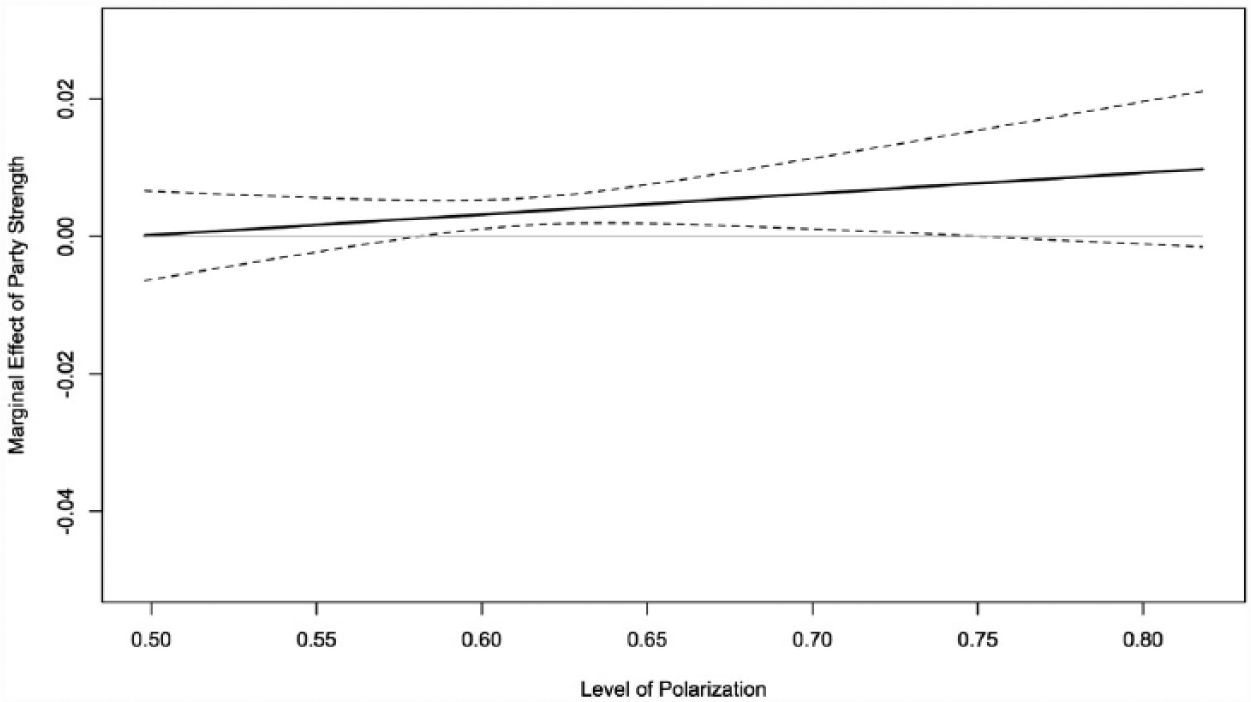
Simulated effects of the interaction between presidential party strength and party polarization on survival time of important legislation.
It is difficult, perhaps even impossible, to completely disentangle the effects of time and polarization when examining the contemporary Congress. Party polarization shows a linear increase starting in the mid-1970s (Theriault, 2008). For this reason, the interactive effect in Figure 1 may simply be an artifact of delay increasing over the same time period. 15 The inclusion of the post-reform Congress variable helps account for this potentially confounding problem because the reforms took effect at the same time the parties began moving away from one another. Regardless, the defining characteristic of the contemporary Congress is partisan polarization, so it may not be possible to entirely separate time and polarization.
The interactive effect is intuitively appealing because low levels of polarization imply substantial ideological overlap between the parties, making legislative voting barriers easier to overcome, in theory. However, greater levels of polarization between the parties create a contentious legislative environment, which is likely to make compromise far more difficult. This relationship is relevant to the concept of “conditional party government” (Aldrich, 1995; Aldrich & Rohde, 2001; Rohde, 1991) wherein party loyalty votes become far more likely as inter-party differences are increased and intra-party conflict is decreased. Under such conditions, greater levels of polarization result in fewer party defections on roll call votes, making it far more difficult for the president’s party to overcome voting deficits when attempting to pass legislation. It is important to note we also estimated a model where we interacted the traditional, dichotomous divided government variable with polarization, but the interaction was insignificant. 16 Taken together, these findings further suggest the party strength variable adds a level of nuance overlooked by a dichotomous divided government variable.
Discussion
There is a robust history of studies examining the relationship between divided government and congressional productivity (Binder, 1999, 2003; Coleman, 1999; Edwards et al., 1997; C. O. Jones, 1994; Krutz, 2001; Mayhew, 1991, 2005). Although these studies are inconsistent with respect to their conclusions about the nature of this relationship, they are fully consistent in their focus on analyzing legislative output. In doing so, these studies provide valuable insight into how institutional context shapes the final product of policy making, but they provide less information on how contextual factors might shape the legislative process more generally—especially issues of legislative delay. Although delayed legislation may ultimately be passed into law in some cases, a drawn-out and acrimonious policy debate may provide the ultimate undoing of legislation in other cases. Regardless of whether important legislation ultimately becomes law, delay in the legislative process can have very real consequences for democratic governance. Specifically, delay in the legislative process can constrict the working agenda of Congress, and such constraints can render the institution unable to address pressing public problems. Moreover, contentious politics has been shown to draw the ire of the public, which can undermine the efficacy and legitimacy of Congress (Hibbing & Theiss-Morse, 1995). Motivated by these implications, this article sought to provide evidence on the relationship between divided government and delay in the legislative process.
In addition to shifting the focus from legislative outputs to legislative processes—specifically legislative delay—we also developed a more refined measure of divided government in this article. This new measure calculates the strength of the president’s party in Congress, and although highly correlated with the traditional measure of divided government, this “party strength” variable represents a valuable innovation measuring both the presence and magnitude of inter-branch conflict. Together, these advances facilitate a more comprehensive understanding of the effects of divided government on the legislative process.
At a basic level, our analysis demonstrates divided government—measured both traditionally as well as by our new measure of party strength—increases the amount of time important bills are immersed in the legislative process. However, we take advantage of the nuanced nature of the party strength variable to further demonstrate an interactive effect of presidential party strength and partisan polarization on legislative delay. Specifically, we demonstrate presidential party strength in Congress has no effect on delay at low levels of party polarization. However, the effect becomes significant as party polarization reaches moderate levels. In other words, voting deficits for the president’s party are easier to overcome when the parties are ideologically similar; the president’s party has greater difficulty reaching compromise with the opposition as the parties begin to polarize. This interaction between presidential party strength and partisan polarization is just one of a number of possible insights our more nuanced measure of divided government can reveal. Our ability to uncover this effect underscores the benefits of using a measure that captures both the presence and magnitude of inter-branch conflict.
Considered as a whole, this article adds to our understanding of the effects of divided government on the legislative process by analyzing how divided partisan control of government—and the magnitude of that division—affects the amount of time important legislation is immersed in the legislative process. The insights generated by this analysis are important given their implications for congressional productivity, the efficacy of policymaking institutions, public trust in government, and others. For example, lengthy consideration of a particular piece of legislation can result in the issue monopolizing the legislative agenda, and may ultimately lead to enactment of a smaller proportion of the congressional or presidential policy agenda over the course of the legislative session. Future work could examine whether this theoretical relationship is corroborated empirically. Similarly, delay in the legislative process may reflect the occurrence of inter-party and/or inter-branch negotiation over the substance of the bill in question. In such cases, it seems likely the content of delayed legislation will not reflect the preferences of any single actor or group in the process—It typically takes time to develop a bill deemed acceptable to legislators with a broad range of policy preferences and views. In contrast, the content of legislation passed with relative expediency seems likely to adhere more closely to the preferences of a single stakeholder, most likely the president or the majority party in Congress. Of course, the relationship between legislative delay and alignment of legislative content with the preferences of various actors in the policymaking process is ultimately an empirical question, the investigation of which would serve as a valuable extension to the results presented in this article.
Finally, future work could usefully build on our investigation of the relationship between party control, polarization, and legislative delay by analyzing whether we observe heterogeneity in this relationship across policy topics. For example, it seems likely some policy topics are inherently more conflictual than others, and divided government would result in substantially more delay for legislation in these areas, relative to bills addressing less conflictual topics. Similarly, it is possible legislation on a particular topic experiences more or less delay depending on partisan control. For example, legislation on a topic may experience less delay when party in power “owns” the issue. Empirical investigation of these and other similar issues would further improve our understanding of the interrelationships between party control, polarization, and legislative delay.
Footnotes
Acknowledgements
This article would not have been possible without the generous support of the faculty and staff of the Carl Albert Congressional Research and Studies Center at the University of Oklahoma.
Declaration of Conflicting Interests
The author(s) declared no potential conflicts of interest with respect to the research, authorship, and/or publication of this article.
Funding
The author(s) received no financial support for the research, authorship, and/or publication of this article.