



Abstract
Aggregate, survey, and experimental research into political scandal teaches us how the public reacts to revelations of misdeeds on behalf of its elected representatives. One common scenario, however, has been largely overlooked in scandal studies: the effects of hypocrisy in scandal. Examples abound of politicians who campaign on values that they then directly betray with their actions in office. Conventional wisdom, however, holds that such hypocrisy is an unpardonable transgression. We examine whether and how hypocrisy affects public reactions to political scandal and its perpetrators. Using a Quinnipiac University survey experiment, we demonstrate that negative judgments of a hypothetical politician caught in an adulterous relationship not only vary by degree depending on the presence or absence of hypocrisy but that they also vary by type of judgment. Individuals generally react more negatively to politicians in hypocritical scandal situations than nonhypocritical ones. In addition, a hypocritical situation affects public judgments of a politician’s competence in office, above and beyond other judgments, demonstrating an added professional aspect to judgments of scandals when they involve hypocrisy.
Where I come from we’re not afraid of a hard day’s work, and the values we live by are faith, family and country.
Vance McAllister campaigned on faith and family, as this quote from his campaign ad indicates, and won a 2013 special election for Congress in Louisiana’s fifth district. His swearing in was followed a mere 5 months later by his announcement that he would not run for reelection.
2
A videotape leaked in April 2014 showed the married Congressman passionately kissing a member of his staff. The self-described “business owner, family man, and proud son of this community” was not only caught up in scandal but he was also caught up in evident hypocrisy. As the New York Times colorfully put it, After winning an election pledging to “defend our Christian way of life,” Mr. McAllister now faces accusations of hypocrisy as thick as spring mosquitoes on the bayou. (Trip, 2014)
There was much media speculation following the exposure of McAllister’s affair that his campaign promise of morality made his subsequent behavior worse and presumably more damaging to his career than adulterous behavior alone would have been (e.g., Roig-Franzia, 2014). But is that actually the case? Political scientists have spent time analyzing political scandals, but we still have much to learn, including whether or not hypocritical behavior has any effect on public opinion of misbehaving politicians above and beyond the scandal itself. Like the media, researchers theorize that hypocritical acts are worse in the public’s eyes than nonhypocritical actions. Empirical evidence, however, remains elusive.
This article addresses the issue of political hypocrisy by testing differences in the public’s reactions to scandal depending on whether or not the scandal is directly hypocritical to a candidate’s professed values in office. We look not only at whether hypocrisy matters but also how it matters. To do so, we analyze a national telephone survey experiment in which American adults were presented with one of three possible scenarios about a hypothetical member of Congress. The two test scenarios include the description of a male member of Congress along with a revelation of marital infidelity. The hypocritical condition adds the information that the politician had campaigned on promoting moral values. The Quinnipiac University Poll conducted the national telephone survey among 1,083 adults in March 2014. 3
The results of our analysis demonstrate that not only does the public judge a hypocritical wrongdoer more harshly than a nonhypocritical one when all else is equal but they also judge said politician differently on a variety of traits depending on the presence or absence of hypocrisy. The public rates an adulterous member of Congress significantly lower on integrity than they rate a control candidate. Once hypocrisy is added to the picture, however, judgments are not only about the politician’s personal qualities but they also are about professional abilities. The public views a politician who commits a hypocritical misdeed in office as a less competent representative. These findings demonstrate that politicians caught in a hypocritical scandalous act face a significantly tougher road with voters than those whose conduct is “merely” scandalous.
This article proceeds in four parts. We first discuss the existing literature on political scandals as it relates to our main test of the effects of scandal and hypocrisy. Second, we discuss the very limited psychological and political science literature on individuals’ reactions to hypocrisy, laying out our definition of hypocrisy and our hypotheses as to why, and how, hypocrisy should affect public views of political scandal. In the third section, we analyze the Quinnipiac survey data to test multiple hypotheses about the effects of scandal generally, and the specific effects of hypocrisy. And finally, we conclude with a discussion of how these tests add to the field’s collective knowledge of political scandal, how the public views scandal, and how voters may respond to it electorally.
Scandal Research
There are two primary avenues of research into political scandals in America. The most prolific are studies that analyze actual scandals and their effects on political life, including governing institutions, public opinion, and electoral outcomes. The second avenue consists of experimental studies examining how voters react to hypothetical scandal scenarios. The former studies provide external, if isolated, validity by examining actual events in the real and complicated world of politics. The latter line of research provides experimental and thereby causal evidence of a direct link between political transgression and individuals’ reactions to it, albeit in a nonrealistic environment. In an area as context-dependent as political wrongdoing, both lines of research are vital to our understanding of the political ramifications of politicians’ misbehavior.
Existing aggregate-level research into actual political scandals shows that misdeeds affect politicians’ actions as well as candidates’ and parties’ vote shares. Studies of elections and political scandal demonstrate how participation in a scandal decreases a politician’s likelihood of running for reelection. Both the House banking scandal (Groseclose & Krehbiel, 1994; Jacobson & Dimock, 1994) and the House Post Office scandal (Banducci & Karp, 1994)—each breaking in the early 1990s—resulted in increased retirements from the House before the 1992 elections. For those House members who were involved in scandal but chose to run for reelection in 1992 despite it, vote shares were significantly lower, hurting their reelection chances (Banducci & Karp, 1994; Jacobson & Dimock, 1994). Studies of multiple scandals over time provide additional evidence that scandal-tainted officeholders can be punished at the polls (Basinger, 2013; Hibbing & Welch, 1997). And even before an election, misdeeds are punished through reduced fundraising ability and fewer endorsements (Rottinghaus, 2014). In addition, scandals that are successfully attributed to one major party by the other—shown specifically in the Abramoff lobbying scandal (Best, Ladewig, & Wong, 2013) and for aggregated scandals over time (Basinger, 2013)—can lower the vote shares for the affected party’s candidates.
Individual-level analyses of actual scandals, via public opinion surveys, demonstrate the effects politicians’ transgressions have on voters in terms of both their opinions and their votes. Research into the Watergate scandal of the 1970s (Dunlap & Wisniewski, 1978) and the Foley congressional page scandal of 2006 (Cobb & Taylor, 2014) show how scandals can hurt a party by lowering both the number of people who affiliate with it, and the number who vote for it, respectively.
Revelations of scandal also influence support for individual politicians although effects are also conditioned by real-world considerations such as party and media coverage. For example, although managing, unlike Nixon, to retain office and even rebound strongly, President Bill Clinton initially suffered a loss of support as a result of his extramarital affair with Monica Lewinsky. This loss was, however, primarily based along existing lines of support: Supporters of Clinton who were in denial of the truth of the allegation were less likely to think Clinton should step down as a result (Fischle, 2000). Herman Cain, a candidate for the Grand Old Party (GOP) presidential nomination in 2012 experienced a similar loss of support after multiple women stepped forward to allege that he had made inappropriate sexual advances to them (Peterson & Vonnahme, 2014). In this case, individuals’ postscandal reactions to Cain were significantly influenced by the ideological leanings of their news source.
The studies discussed to this point all indicate that scandals have real-world political backlash. Studies of actual scandals, however, do have some limitations. Aggregate studies cannot speak to individuals’ reactions; while neither aggregate nor cross-sectional surveys can isolate scandal effects sufficiently to make causal connections. The exceptions come from the Watergate research by Dunlap and Wisniewski (1978) and Fischle’s (2000) Clinton–Lewinsky study, both of which use panel surveys that can measure opinion change with a large degree of confidence, if limited control. For this reason, as mentioned above, experimental surveys provide a necessary addition to the scandal literature.
Experimental studies of scandal have typically tested two different varieties of political misdeeds—sexual and financial—comparing individuals’ reactions to hypothetical politicians mired in one or the other. For example, in a head-to-head comparison of adultery with embezzlement, in terms of how damaging each is to a candidate’s image, Carlson, Ganiel, and Hyde (2000) find that while both types of scandal are damaging, the financial embezzlement is significantly more so. Testing adultery versus tax evasion and each offense’s effects on a host of candidate traits, Funk (1996) finds similar results—financial transgression is worse than personal. In her study, experimental subjects rate scandal candidates lower on both warmth and competence, but the tax scandal has the greater impact. Doherty, Dowling, and Miller (2011) also take the sex versus financial scandal approach, but they add in the twist of an abuse of power in each situation. They find that the public views financial scandal more harshly than a sex scandal, similarly to other studies, and that a financial scandal that involves an official attempt at cover-up is the most damaging. Their official financial misdeed condition reduced the candidate’s support, favorability, and job approval more than any other condition tested. In addition, and most important for our hypotheses here, they find that a purely personal scandal—such as a sex scandal—affects the personal ratings of a politician but does not affect evaluations of the politician’s professional performance. Only once abuse of power is added does such a scandal affect ratings of on-the-job competence. In sum, the public judges politicians caught up in financial scandals more harshly than those in personal scandals, and when one adds an element of official corruption to the mix, the public reacts still more negatively and professionally.
The collective wisdom of the research discussed to this point is that scandals matter to individuals’ political judgments and behavior, and subsequently to politicians’ ratings and vote shares. Scandals affect not only how people view involved politicians but also whether or not they are subsequently willing to vote for them. The experimental literature adds, among other things, the element of scandal type, demonstrating that financial scandals are more damaging than sex scandals on a host of measures. What we do not yet know, however, is what role hypocrisy may play in individuals’ reactions to political scandal. Hypocrisy is a common element of scandal and as such calls for study and understanding.
Hypocrisy
The only vice that cannot be forgiven is hypocrisy.
Hypocrisy is an important concept in our culture, and a very negative one. Its importance is exemplified by the multitude of idioms we have for the act, such as “saying one thing while doing another,” “talking the talk” but not “walking the walk,” and the expectation that one needs to “practice what you preach.” This behavior, under all its labels, is commonly judged as unethical or worse. In his exposition on the historical treatment of hypocrisy in political theory, Runciman (2010) points out that “on a basic human level, there is something repulsive about hypocrisy encountered at first hand” because it always involves some form of deception (p. 2). No doubt this strongly negative reaction to such behavior contributed to William Hazlitt’s 18th-century declaration of hypocrisy as the unforgivable vice.
Before proceeding, two definitions are necessary for our research into the role of hypocrisy in political scandal: first, what a political scandal is and, second, what hypocrisy is, specifically in terms of political scandal. Concepts such as these are never clear-cut, making their precise delineation difficult and sometimes controversial (e.g., Furia, 2009). For our research purposes, we use relatively broad and basic definitions for these terms to encompass common conceptions of scandal and hypocrisy in both existing research and popular opinion. At the same time, our classifications make important and relevant distinctions among types of political action.
When it comes to defining political scandal, two important qualifications are that a scandal involves an action that violates one or more social norms or moral standards and that the action must receive public attention (usually via the media) and reaction (Thompson, 2000). This definition allows for the great bulk of political scandals defined in the existing literature (discussed above), including both personal and professional misdeeds. At the same time, it makes an important distinction between scandal and political corruption. Scholars typically define political corruption as some type of extralegal action done for the purpose of personal gain (e.g., Heidenheimer & Johnston, 2011). This means that while scandal and corruption can describe the same event if it is done for personal gain and garners public attention—such as the House banking scandal of the 1990s—they can also be distinct. For instance, former Congressman Anthony Weiner’s repeated “sexting” to women other than his wife broke no laws, and certainly gained him nothing financially or politically. As a result, the actions did not qualify as corruption, but they were indisputably a scandal. At the same time, technically corrupt acts, even some that stir up governmental ethics investigations, do not always receive public attention and as such do not qualify as scandals (Basinger, 2013).
We also define hypocrisy at a very basic level, borrowing the definition offered by Furia (2009) in his normative analysis of hypocrisy and democracy: “‘ordinary’ hypocrisy may be defined as an incongruity between an individual’s personal behaviors and her publicly expressed beliefs” (p. 115). There are two necessary components to Furia’s definition that make it appropriate for our examination of political scandal. First, hypocrisy requires an action. Second, above and beyond a scandalous action, hypocrisy requires a previously and explicitly stated belief or value for an action to transgress.
The importance of requiring action for hypocrisy is that in addition to fitting the above definition of scandal as an act it also excludes inaction. We consider the absence of upholding values as distinct from the active violation of those values. The former does not qualify as hypocrisy in our definition, whereas the latter clearly does. Campaign promises in general fall into a gray area when it comes to hypocrisy, but this clarification helps distinguish among types of broken promises. For example, a failed campaign promise to pass a certain type of legislation is not hypocritical action; it is a failure to accomplish something. However, voting against a piece of legislation of the kind one vowed to support would qualify as hypocritical. Defining hypocrisy as action also allows it to conform to our common social conceptions of hypocrisy, as represented idiomatically (discussed above) by not walking the walk, not practicing what is preached, and doing other than what one said.
The second requirement of our definition of hypocrisy is that the act violates a previously expressed value or belief (Grover & Hasel, 2014; Runciman, 2010). Beyond being the central element of hypocrisy—saying one thing while doing another—this requirement helps to provide a relatively independent judgment of what constitutes hypocrisy in political scandal. Specifically, by requiring that a hypocritical act is one that runs contrary to a leader’s personally expressed values, we can separate hypocrisy from mere scandal. Scandal is, as discussed above, the violation of commonly accepted standards of behavior. Hypocrisy, on the other hand, means an actor violates a personally advocated standard of behavior. We are scandalized when the standards we assume our representatives should follow—such as honesty and good governance—are violated. These violations only rise to the level of hypocrisy, however, when a representative has expressly promoted or promised to uphold such values.
In sum, we define a hypocritical scandal as one in which a politician acts in a way that violates both social norms and an explicitly stated value of his or her own, and the action captures the public’s attention. Practically speaking, this means that some common forms of transgressions, such as abuse of power and political corruption (examined in Doherty et al., 2011) are not, by their nature, hypocritical acts. They would qualify as hypocritical only if a transgressor had also made a point of advocating clean government and honesty.
In one of the only studies of its kind, Alicke, Gordon, and Rose (2013) demonstrate how the hypocrisy definition we use here conforms to what the public views as hypocritical, a necessary qualification for our goal of measuring potential hypocrisy effects. Specifically, in an experimental study, the researchers find that the public also requires a public declaration of values as necessary for an act to be considered hypocritical. In fact, respondents nearly uniformly—more than 90% in each scenario—rate behavior that runs counter to a hypothetical actor’s publicly expressed values as a hypocritical act. By comparison, acts that violate an individual’s personally held, but not stated, values are 30 to 40 points less likely to be classified as hypocrisy by experimental subjects. Similarly, assumed or related values do not count as hypocrisy—an individual who rails against gambling is not viewed as a hypocrite if he or she is an active viewer of pornography, another moral issue (only 6% call this hypocrisy). If that same antigambling proselytizer is found to be a gambler, however, 86% of respondents view such behavior as hypocritical. This research demonstrates that not only do individuals make connections between actors’ stated values and contradictory acts but also that their qualifications of what hypocrisy is coincides with the definition we use here.
We contend that the reactions to, and judgments of, hypocrisy in the social world also apply to hypocrisy in the political world. Research into the extent to which public officials can misbehave before being turned out of office demonstrates repeatedly that although the public judges misdeeds harshly, such deeds frequently go electorally unpunished. Constituents and voters can forgive, or at least overlook scandalous behavior. At the same time, however, many assume that with politics, as Hazlitt does with life in general, hypocrisy is an unpardonable transgression, making it far worse than simple scandal. According to Zelizer (2009), in a New York Times debate on scandal, hypocrisy may make the difference in whether a transgressing politician survives or not: Another factor is hypocrisy. The American public is often forgiving of personal mistakes. There have been many instances when voters re-elect politicians who have suffered through damaging events. But voters don’t like it when a politician does something that directly contradicts the core arguments that they or their party have been making in the public arena.
Although empirical research into hypocritical behavior by political leaders is severely limited (a single study, discussed below), existing research on related topics, including nonhypocritical scandals provides evidence for at least the idea that hypocrisy makes a difference. First, research demonstrates that the American public remembers messages and promises from electoral campaigns and that it holds politicians accountable for them (Claibourn, 2011). We also know that the public can and does distinguish between types and levels of actions when making judgments about a scandal, and that they apply appropriate evaluations to different types of wrongdoing (e.g., Doherty et al., 2011), and further that they recognize hypocritical action when they see it (Alicke et al., 2013). And given the idea that hypocrisy may be an unpardonable transgression, it seems very likely that the public would distinguish hypocritical actions from nonhypocritical ones when forming evaluative judgments of misbehaving politicians. The collective findings of this research provide reasonable evidence that the public can and does connect politicians’ expressed values with their subsequent actions, and that hypocritical actions may be judged more harshly than nonhypocritical ones. The following sections examine existing research into hypocrisy to lay the foundation for our hypotheses about how and why hypocrisy matters in political scandal.
Judgments of Political Hypocrisy
According to the political theory literature, Americans are not accepting of hypocrisy on the part of their elected leaders (e.g., Furia, 2009; Runciman, 2010). Taking this one step further, theorists also argue that Americans judge scandalous behavior more harshly when it involves hypocrisy than when it does not (Grover & Hasel, 2014). Although logically sensible, empirically there is little or no evidence that these two contentions are true. Research in fields other than political science, however, lends indirect support to the ideas.
Limited psychological research demonstrates that hypocritical behavior leads to harsh (and in some cases harsher than otherwise) public judgments. In a basic test of whether people react similarly to someone who says something and then does another, rather than someone who does something and then says another, researchers find that the first combination is judged harshly, whereas the latter receives no special response (Barden, Rucker, & Petty, 2005). Violating a value one previously expressed is deemed hypocritical and thereby judged as unacceptable; but expressing a value after the violation of it could simply be a change of heart or mending of one’s ways, and is more easily tolerated. When it comes to punishing misdeeds, specifically criminal acts, hypocritical conduct also leads to more negative public reactions than does nonhypocritical (Laurent, Clark, Walker, & Wiseman, 2013). Individuals not only view crimes involving hypocrisy more negatively than the same crimes when not hypocritical, they also prescribe harsher punishment for them. At least in terms of social and legal wrongdoing, individuals view hypocrisy as a confounding negative factor. In political wrongdoing, one could expect the same.
In the only (that we could find) empirical study of political behavior approaching hypocrisy, 4 Bhatti, Hansen, and Olsen (2013) test what they classify as “ideological hypocrisy” with an Internet survey experiment conducted among adults in Denmark. They find that when politicians commit a personal misdeed that contradicts their party’s stated issue positions or presumed expertise (issue ownership), the public is more likely to lose trust in them than in politicians from a different party who commit the same misdeed. For example, the public’s level of trust in a hypothetical member of the fiscally responsible Liberal Party decreases by a comparatively large amount when that member does not properly take care of his own personal finances. One of the limitations of this study for our purposes here is that Bhatti and his colleagues’ definition of hypocrisy does not fit ours. Their test of hypocrisy relies on presumed values—that a party member automatically stands for what the party does—rather than expressed values. Because they are testing the effects in a parliamentary system, this is a reasonable assumption for their work. Two factors make it an inappropriate assumption for our research here, however. First, as discussed above the American public defines hypocrisy as a direct contradiction between an individual’s own professed, rather than assumed, values and subsequent behavior (Alicke et al., 2013); and second, the American system of government and elections is one in which candidates personally offer their own values and policies (which may or may not match their party’s) in electoral campaigns. The Danish study nevertheless has relevance to our question in that it adds a professional element to personal scandal (similar to Doherty, Dowling, and Miller’s abuse of office study [2011]), one which we argue applies to hypocrisy as well. We address this further in the next section.
Hypocrisy and job performance
Existing theoretical considerations of hypocrisy provide some evidence that hypocrisy should make a difference to individuals’ responses to scandal, supporting our expectation that hypocritical scandalous actions are judged more harshly than merely scandalous actions. What this literature does not provide, however, is an explanation of why, exactly, this would be the case, especially in political circumstances. Is it simply that hypocrisy is worse than other misdeeds and therefore results in harsher judgments, or is there a substantive aspect to hypocrisy that results in more negative evaluations? It is obvious that hypocritical behavior is viewed as unethical behavior, but all politically scandalous actions, if they are worthy of public attention and condemnation, are viewed as unethical. Thus, it is possible that ethics alone cannot account for differential judgments of hypocritical and nonhypocritical scandal.
We contend that the difference between regular political scandal and hypocritical scandal lies in the nature of both hypocrisy—violating previously stated values with behavior—and politics—the democratic process of making campaign promises to get elected. Because hypocrisy is saying one thing while doing another, it undermines the expectations Americans may have of a democratic representative. When a politician bases his or her election on a value, or set of values, and then directly violates that value, they are betraying the confidence of the voters. This is a professional misstep. Whereas personal missteps have been pardoned in politics, as in Bill Clinton’s case, for example, professional missteps are potentially less likely to be. If politicians are in office to do a job, violating the terms of their employment contract would be grounds for termination or at least harsh disapproval. As a result, we reason that the public will judge hypocritical politicians more harshly because they judge hypocrisy to be relevant to a politician’s job rather than merely a personal or moral failing.
Support for this distinction between private judgments and professional ones comes from Dobel (1998) in his examination of politicians’ rights to privacy. He argues that when private actions take on a hypocritical cast, they become matters of professional competence rather than merely personal failings.
[T]he moral structure of office can best be seen as obligations held together by a web of promises and oaths. When persons take on public responsibilities, they promise to abide by the standards, laws, rules, and procedures that constitute and bound their positions. They pledge a good-faith effort to perform conscientiously the tasks of their position and act with the competence required by office. Personal honesty in making promises and being accountable is basic to their legitimacy. (p. 121, emphasis added)
The key distinction here is that making promises and keeping them are acts central to a politician’s professional legitimacy. We know from the existing scandal literature that the public judges scandalous politicians personally. The public views adulterous politicians who do not abuse their office as personally suspect. We also know that when politicians make a professional misstep by abusing their office in the process of scandal, they become professionally suspect (Doherty, Dowling, & Miller, 2011). If Dobel (1998) is correct about hypocrisy as a professional misdeed, then politicians caught up in hypocritical scandals should be judged more negatively on their professional performance.
Hypotheses
Existing research on hypocrisy, though mostly theoretical as discussed above, provides the foundation for our hypothesis that individuals will react more negatively to a scandal that involves hypocrisy than to one that does not. This leads to our first two hypotheses. The first confirms those empirical studies that have come before this—in part to validate this study’s design and tell a more complete story—and as such is not a novel hypothesis. The second hypothesis, however, breaks new ground by addressing the effects of adding hypocrisy.
What existing theoretical and anecdotal consideration of hypocrisy does not provide, however, is a reason why this would be the case. Beyond the obvious fact that hypocrisy is viewed as unethical behavior, questions as to what makes it different from regular scandal and what causes the public to potentially disproportionately reduce its support for a politician remain. Our third hypothesis tests the possibility that hypocrisy adds a professional performance aspect to scandal, as argued above.
We now turn to our operationalization of these concepts and the analysis of these three hypotheses.
Method and Analysis
Our survey experiment uses what is one of the more common scandals in American politics—the adulterous affair. Not only is this the typical scenario in experimental research into political scandal, it is also, as discussed above, a very realistic one. Actual cases of both adulterous politicians whose prior moralizing landed them in hypocrisy, and leaders who were caught cheating but were not seen as hypocritical are plentiful. We chose this scenario exactly because of its relatively commonplace nature, providing both hypocritical and nonhypocritical situations that would be believable to the average American.
All of the typical caveats to survey experiments apply here (e.g., Barabas & Jerit, 2010). While experimental design allows for internal validity and causal inferences, an experiment within a survey lacks external validity. In addition, the use of a hypothetical candidate with little information given—specifically party affiliation—other than the scandal provides an admittedly generous test for our hypotheses. As a result, although our analysis speaks to the effects of hypocrisy in political scandal, it is not necessarily representative of any single scandal in the real world, either in context or effect size. Survey experiments are nevertheless useful for establishing a potential causal effect that can then be further explored using alternative methods.
Method
In the survey, interviewers read respondents one of three scenarios involving a hypothetical sitting congressman, James Miller: a control scenario, a neutral (nonhypocritical) scandal scenario, and the same scandal scenario with hypocrisy—the politician having campaigned on moral values—added. The wording for the three scenarios was (the first two sentences were the same in each condition): James Miller is 53 years old and is a member of Congress running for re-election this year. He is married and has two children . . . Control: . . . His main concern in office is developing policies to help middle-class, working families. Neutral scandal: . . . His main concern in office is developing policies to help middle-class working families. Recently it was discovered that Mr. Miller has been unfaithful to his wife with another woman. Hypocritical scandal: . . . His main concerns in office are promoting moral values, and developing policies to help middle-class, working families. Recently it was discovered that Mr. Miller has been unfaithful to his wife with another woman.
Following administration of the randomly assigned scenario, 5 respondents answered a series of questions about James Miller, the hypothetical member of Congress. The key variables in this analysis are respondents’ willingness to vote for this representative for reelection, 6 their perceptions of him on two personal traits—his integrity and how much he cares about people like the respondent—and a prospective evaluation of the likely quality of Miller’s performance should he be reelected.
We chose the three latter measurements—integrity, caring, and professional competence—for two primary reasons. First, they capture the distinction between private and public judgments of a politician and thereby allow us to test our third hypothesis. In addition, these three elements are typically considered to be key considerations for voters when evaluating candidates. According to Funk (1999), Americans evaluate politicians and candidates based on a combination of traits, including competence, integrity, and warmth (Miller, Wattenberg, & Malanchuk, 1986, similarly cite competence and integrity). Voters’ judgments of these traits in a candidate help determine whether or not they will support that candidate for office. As a result, if we find differences in these trait ratings by scenario, we can be relatively confident that they are at least partially responsible for the drop in individuals’ support—measured by the vote variable—for the two scandal Millers versus the control Miller, as well as potential differences between the two scandal scenarios.
The key independent variable for our analysis is the relevant scandal scenario, comparing the effects of one or both scandal conditions against the control condition and/or each other. The independent variables are measured on 5-point ordinal scales with higher values for each variable indicating higher ratings for Miller. The vote scale varies from 1 (definitely would not vote for Miller) to 5 (definitely would vote for Miller). Undecided voters are coded as 3. The trait and job performance questions ask how well three statements describe Miller: “has personal integrity,” “cares about the needs and problems of working families,” and “would do a good job in office if reelected.” Each scale, designed to capture integrity, warmth, and competence, respectively, ranges from 1 (does not at all describe Miller) to 5 (describes him a great deal).
Analysis
To test our first hypothesis—that scandal causes individuals to lower their potential support for a politician’s reelection—we compare individuals’ reported likelihood of voting for James Miller in the control condition and the neutral scandal—scandal without hypocrisy—condition. Figure 1 contains this comparison in the first two bars. As expected from previous research, an officeholder caught in an adulterous affair suffers at the hands of the voters, both substantially and statistically, significantly.

Willingness to vote for a hypothetical officeholder in nonscandal, scandal, and hypocritical scandal experimental conditions.
The data show how a hypothetical officeholder receives a large benefit of the doubt from potential voters when no scandal is present; but when the same officeholder has committed adultery, his chances for reelection decrease dramatically. Sixty-three percent of respondents in the control condition would either probably or definitely vote for James Miller for reelection, given the chance. In stark contrast, only 38% of respondents in the neutral scandal condition would consider voting for Miller, while 48% probably or definitely would not.
H2 adds the element of hypocrisy, the main subject of this article, to the scandal scenario. We expect that adding hypocrisy to a scandal scenario will result in even fewer voters considering supporting the affected officeholder than in both the neutral scandal condition and the control condition. The third bar in Figure 1 contains the hypocritical scenario—in which Miller campaigned on promoting moral values—for comparison.
The cross-tabulations represented in the figure demonstrate significant support for the untested, yet conventional wisdom that hypocrisy is a worse transgression than scandal alone. Not only are respondents in the hypocritical scenario less supportive of Miller than are those in the control condition, they are also significantly and substantially less supportive of him than they are when he merely committed adultery. Likely opposition to a hypocritical adulterous Miller is at 58%, 39 points higher than the control scenario Miller, and 9 points higher than the nonhypocritical Miller, both statistically significant differences.
As a proportional reduction in error measure, the gamma statistic also presents a sense of the magnitude of the difference between the conditions in terms of how well the conditions predict the dependent variable. For the comparison of the control condition with the nonhypocritical scandal condition, the gamma is −0.44, indicating that the treatment accounts for 44% of the difference in the dependent variable based on the independent—a substantial improvement over predictions without considering the scandal condition. The comparison between the control and hypocritical treatments accounts for 57% of the variance in predicting vote share. And finally, the hypocritical versus neutral adultery comparison accounts for 14% of the variation between the two conditions. Given these results, we can be confident that the differences between the scenarios are responsible for a substantial proportion of the variance in the vote share overall.
The data strongly support the expectations of H1 and H2 that scandal and hypocritical scandal can be damaging to a politician. We now turn to why this might be the case. Our third hypothesis is that hypocrisy takes a personal scandal from a personal level judgment to a professional level one, reflecting on the officeholder’s ability to properly represent his or her constituents. Constituents should lower their evaluations of Miller’s job performance when he is hypocritical, relative to when he is not. As discussed above in the method section, the survey included measures of Miller’s integrity and warmth as personal judgments, and his likely future performance in office as the professional judgment.
If respondents judge Miller personally when he is an adulterer, then their ratings of his integrity and caring should be significantly different in both adultery conditions compared with the control condition. At the same time, prospective ratings of his job performance should be unaffected by adultery alone as it is a personal rather than professional transgression. We expect that in the hypocritical adultery condition, however, Miller’s job performance ratings will be lower than in both of the other conditions as the hypocrisy provides respondents with a cue toward his professional performance. At the same time, while we expect integrity and warmth to be affected by the hypocritical scenario relative to the control condition, we expect no differences between those effects and the neutral scandal effects. It is the adultery itself that should move personal ratings, not hypocrisy alone. As a result, the hypocritical scenario should demonstrate no differences relative to the other scandal scenario on personal ratings, but should demonstrate significantly lower ratings than the control condition. Table 1 presents our expectations of the relationships between independent and dependent variables in the form of the direction and significance we expect to find in the gammas for each cross-tab comparison.
Predicted Effects of Scandal Conditions on Officeholder Ratings.
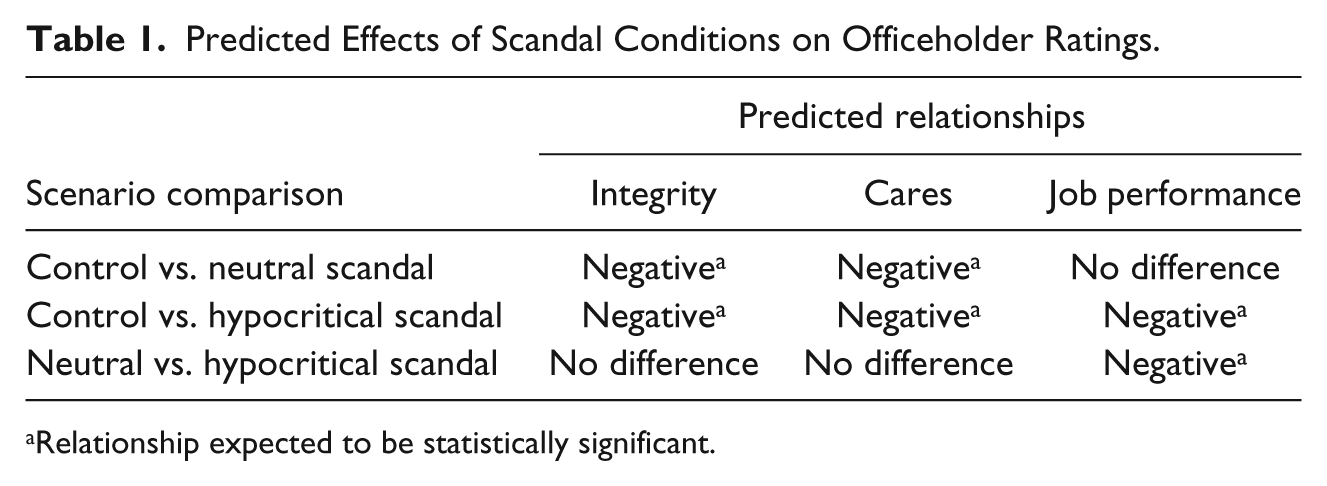
Relationship expected to be statistically significant.
Reading the table horizontally, we expect that the gamma for the cross-tabs of the control and scandal scenarios will be negative and sizable—substantially lower ratings for the scandal scenario relative to the control scenario—on both integrity and caring but not on job performance. The next row demonstrates our expectation that the hypocritical scenario will be significantly lower on all ratings relative to the control scenario because hypocrisy retains the personal judgments while also bringing in the professional considerations that adultery alone does not do. Finally, we expect that there will be no difference between the two scandal scenarios on integrity or caring as both involve the personal misdeed of adultery. But we expect, here again, that job performance ratings will be lower for the hypocritical Miller than for the adulterous but not hypocritical Miller because the professional aspect constitutes the difference between hypocrisy and not.
Table 2 presents the gammas from the cross-tabulations, which conform precisely to the expectations of H3. 7 Respondents react to a nonhypocritical adultery scandal by giving the involved officeholder lower ratings on the personal traits of caring and integrity, but not on the professional rating of job performance. Once hypocrisy is added to the mix, however, respondents significantly reduce their job performance ratings of the officeholder as well, while retaining their lower—relative to the nonscandal condition—ratings of his personal traits. As expected, adultery in and of itself affects personal ratings. Here again, the gammas demonstrate a substantial reduction in error in predicting the trait ratings based on the differences in scenarios. The percentage differences (not shown) also demonstrate the strength of the relationships. For example, when it comes to Miller’s professional rating, 48% of respondents in the hypocritical condition say that the phrase “would do a good job in office if reelected” does not describe Miller well, compared with only 35% of those in the nonhypocritical scandal condition who say the same, and 30% of those in the control condition. Hypocrisy adds a professional element to a scandal that would otherwise be judged merely on a personal level.
Effects of Scandal Conditions on Officeholder Ratings.

p < .05 (two-tailed).
Conclusion
This article has addressed an important, as yet unanswered question: What role does hypocrisy play in the public’s judgments of political scandals? History, both recent and not, is rife with examples of politicians caught doing something against which they have formerly railed. Most frequently this involves moralizing officeholders entangled in sexual improprieties, but it is certainly not limited to such situations. Despite the prevalence of hypocrisy in politics, however, research has overlooked its effects, accepting the conventional wisdom that hypocrisy is simply bad.
The data and analysis in this article demonstrate the effects that adding hypocrisy to a scandal—specifically an adultery scandal—has on the public’s views of the entangled politician. We find that the conventional wisdom is correct, that hypocrisy does make individuals view a politician more negatively and thereby also makes them less likely to support him for reelection than scandal alone does. We also add to the existing literature by analyzing why hypocrisy is a greater transgression. Our analysis demonstrates that hypocrisy serves to make a personal transgression into a professional one. Our hypothesis was that the public views direct hypocrisy by a representative as a violation of his responsibilities as an elected official, calling into question his ability to do a good job. The analysis demonstrates precisely this effect—When Miller engages in adultery plus hypocrisy, respondents rate his likely future job performance significantly more negatively than they do in either of the other two conditions. When Miller is a nonhypocritical adulterer, however, only the personal ratings of his integrity and warmth are affected, not evaluations of his competence in office.
These findings present a relatively extensive examination of hypocrisy effects in political scandal from an experimental angle. The valid criticism of a lack of external validity in experiments nevertheless applies here. As a result, these findings come with the caveat that hypocrisy has these effects when all else is equal. Real-world examination of hypocrisy in scandals is necessary to demonstrate the full range of effects in the real world.
One limitation of our work here is that it does not control for contextual effects that may have real-world consequences. For example, two recent cases, each involving prostitution, had very different outcomes, no doubt as a result of contextual factors. First, In 1997 U.S. Senator David Vitter admitted to using the services of a Washington, D.C., escort service in the early 1990s. Vitter had campaigned as a family values conservative in his election to the Senate, creating a hypocritical scenario. The second example is that of former New York Governor Elliot Spitzer who was caught using the services of a prostitute. Spitzer’s hypocrisy was, perhaps, more direct. He had made a career as Attorney General of New York in part by very publicly prosecuting sex tourism, or prostitution, rings. The outcomes of the two cases were distinct: Vitter held his Senate seat, winning reelection in 2010; Spitzer resigned almost immediately, and was then rejected by New York City voters in a comeback attempt for elective office 5 years later. It is possible that the different types of hypocrisy may have mattered, but it is probable that other factors did as well. For example, research demonstrates that the amount of time that passes between a transgression and its revelation matters (Doherty, Dowling, & Miller, 2014). A better understanding of how environmental factors can amplify or mitigate hypocrisy could help us better understand disparate outcomes.
A further restriction on the findings in this article is that we only tested one type of hypocrisy. Although a moralizing politician caught in adultery fits neatly into our definition of scandal hypocrisy, it is far from the only type of scandalous hypocrisy. For example, government corruption could matter more to the public when committed by a politician claiming to support cleaning up government. Former Governor John Rowland of Connecticut provides such a case. Rowland was a politician who “proudly invoked his family’s reputation as defenders of clean government” (McIntire, 2004) but retired in scandal during his third term and was subsequently sent to jail for fraud. Financial hypocrisy could have similar implications. Democrat Charles Rangel, former chairman of the powerful U.S. House Ways and Means committee has long advocated and worked for raising taxes on the wealthy to help those less fortunate. His private actions have belied the sentiment, however, as he was officially rebuked by the House in 2010 for, among other things, tax evasion. In both of these cases, we would expect the public reaction to be harsher than they would be if these scandals were the product of politicians who had not publicly championed clean government and a more progressive tax system, respectively. Further research is still necessary, however, to test alternate hypocrisies and their potential impact.
A final (though certainly not exhaustive) contextual limitation of this study is that it involves heterosexual scandals alone, limiting its application to relatively recent, noteworthy scandals involving potential homosexual behavior and hypocrisy. Two such examples are U.S. Senator Larry Craig of Idaho and Representative Mark Foley of Florida who were both known for their promotion of family values as well as their opposition to homosexuality. In the mid-2000s however, each was caught up in a scandal involving potential homosexual behavior—Foley by sexually harassing young male congressional pages and Craig by allegedly looking for gay sex in a Minneapolis airport bathroom known for such activity. Foley resigned his seat once the scandal broke while Craig chose to serve the remainder of his term but not seek reelection. Neither has reemerged in elective politics. Here again, different types of behavior and different contexts may condition the effects we found in our analysis.
Despite real-world limitations, our experimental findings present strong evidence that hypocrisy matters to the public’s judgments of politicians embroiled in scandal. Having established these baseline effects using the internally valid but externally limited method of a survey experiment we have at least set the stage for further research on the role of hypocrisy in political scandal, a common occurrence in American politics and as such one deserving of study and understanding.
Footnotes
Acknowledgements
We would like to thank Mark Bouchard and April Radocchio for their input and assistance.
Authors’ Note
An earlier version of this article was presented at the 2014 annual meeting of the International Society for Political Psychology, Rome.
Declaration of Conflicting Interests
The author(s) declared no potential conflicts of interest with respect to the research, authorship, and/or publication of this article.
Funding
The author(s) received no financial support for the research, authorship, and/or publication of this article.