




Abstract
Many Americans think campaign money has a corrupting influence on Congress. Yet how they think about money in politics is a relatively unexplored topic. This article investigates how the public reasons about campaign money and corruption. Our survey experiments demonstrate that attitudes about campaign money are structured by partisan interest and are also driven by information about sources of campaign money and the amount spent (particularly for large independent expenditures made possible by Citizens United), the method of delivery, and about what the money is spent on. Mass perceptions about corruption of Congress, furthermore, may reflect aversion to negative campaigns as well as attitudes about campaign financiers having undue influence over representatives. These findings not only provide a more nuanced picture of attitudes about campaign money but also have consequences for how we assess reform proposals relating to money and politics.
Introduction
This study uses survey experiments to examine linkages between perceptions of campaign money and cynicism about Congress. We know a great deal about factors affecting voting in congressional races (e.g., Abramowitz, 1988; Tufte, 1974; Welch & Hibbing, 1997) and a good deal about the effects of money on outcomes in congressional contests (e.g., Gerber, 1998, 2004; Green & Krasno, 1988; Jacobson, 1978, 1990). Additional literature is expanding our understanding of actors who finance campaigns (e.g., Francia, Green, Herrnson, Powell, & Wilcox, 1983; La Raja, 2008; Magleby & Nelson, 1990), and about how different sources of money—outside expenditures, political action committee (PAC) funds, and self-financed campaigns—might correlate with candidate vote share (e.g., Alexander, 2005; Brown, 2013).
We know less, however, about how perceptions of campaign money condition attitudes about representation in the U.S. Congress (but see Dowling & Miller, 2014). We suggest it is crucial that we expand upon our knowledge of how people reason about campaign money to better understand cynicism about representation in the United States. Political science has built robust, cumulative knowledge about voting in congressional elections and about money and outcomes in congressional elections. However, it is quite possible that we understand the process of electing Congress better than we understand widespread, cynical attitudes about Congress itself that are associated with that process.
Indeed, several surveys have found that large proportions of Americans think their Congress is “corrupt.” 1 If we consider these perceptions in terms of a standard, academic definition of public corruption—the illegal use of public office for private (or personal) gain (Treisman, 2000)—many Americans would seem to have a different sense of corruption. After all, the United States does rank as one of the least corrupt nations in the world in terms of public sector corruption. Widespread perceptions that Congress is corrupt, then, suggest that many people view corruption as something that extends beyond illegal acts or the sort of criteria used by groups like Transparency International. Warren (2006b) notes that the dominant academic conceptions of corruption are “not political enough” because they fail to capture views of corruption used in public conversations about elections and representation. A more expansive definition of corruption would recognize that citizens may come to perceive their representatives’ decisions as “the result of the whispered voices of those who have bought access through their campaign contributions” (Warren, 2006b, p. 806) and include “practices that some consider legalized bribery” (Etzioni, 2014, p. 141; also see Peters & Welch, 1978).
Alternatively, perceptions of corruption could reflect episodic personal scandals involving illegal and legal, illicit acts—infidelity, sexting, earmarks, plagiarism, tax evasion, and the House Bank scandal; these have been shown to have negative effects on perceptions of Congress and Members of Congress (Bassinger, 2013; Bowler & Karp, 2004). Presumptions of corruption in Congress might thus be explained by people generalizing, inaccurately, to the whole of Congress from highly publicized but relatively rare instances of personal scandals. But they may also reflect something more enduring and systematic about Congress. It is unavoidable that candidates for Congress require money to fund their campaigns, and this money receives substantial media attention. This is our concern here. In this article, we assess attitudes about corruption in terms of information about campaign money in congressional elections. Hibbing and Thiess-Morse (1995) note that distain for Congress reflects, in part, a misunderstanding of interest group influence and a corresponding cynicism about the role interests play in representation. We make no attempt to assess the accuracy of such attitudes, but use this cynicism as a point of departure for understanding the psychology of presumptions that Congress is corrupt. We manipulate information about money in congressional campaigns to test how people view sources and uses of campaign money as honest or corrupt, and test how such perceptions of corruption may be moderated by information about how and why campaign money is used.
Reasoning About Money in Politics
One cause of cynicism about Congress may be the role of money in elections. Democratic theory (Warren, 2006a) proposes that institutions of representation require that representatives maintain the “integrity of appearances” (p. 161) because this provides the means by which citizens judge whether they can trust their representatives. If representatives are seen as benefiting from campaign money, citizens may perceive corruption and question the kinds of influence representatives respond to, the actors who exert influence, and the manner that influence is exerted (Warren, 2006a). A study that was ultimately critical of the strength of a tie between public perceptions of corruption and money in politics nevertheless concluded, “We must admit that large shares of the American population distrust their government and believe the campaign finance system is a source of undue influence” (Persily & Lammie, 2004, pp. 173-174; also see vanHeerde-Hudson & Fisher, 2013).
Public opinion polls on money in U.S. elections find high cynicism about the influence of campaign financiers generally, so it will come as little surprise that we find this too. But this begs questions about how (and if) people reason systematically about campaign money. At one level, we are interested in whether or not people perceive campaign finance in terms of partisan self-interest, that is, in an instrumental manner similar to how elites view political institutions generally (Bowler, Donovan, & Karp, 2006). Partisanship colors information processing about myriad political phenomena (Bartels, 2002; Campbell, Converse, Miller, & Stokes, 1960; Gerber, Huber, & Washington, 2010; Lupia, 1992), with partisans having more positive attitudes about “in-group members” than “out-group members” (Brewer, 1979; Miller & Wlezien, 1993; Weisberg & Greene, 2003). Party, then, may condition perceptions of which groups have a legitimate or illegitimate role in financing campaigns. Along these lines, we examine whether cynicism about campaign money is affected by information about groups that partisan respondents may see as more or less friendly to their party.
Given that campaign money buys TV ads, most of which were negative in 2012 (Fowler & Ridout, 2012), it is important that we examine how perceptions of corruption might extend beyond attitudes about the undue influence actors who fund campaigns. For many Americans, negative campaigns are one of the primary ways they experience Congress. Perceptions of corruption, as measured in survey responses, may reflect public hostility toward the presumed effects that campaign money has on amplifying negativity in political discourse. Regardless of the potential effects of negative advertising on politics (see Ansolabehere & Iyengar, 1995; Jackson, Mondak, & Huckfeldt, 2009; Kahn & Kenny, 1999), most Americans claim they dislike television advertising (Alwitt & Prabhaker, 1994). Most believe TV ads inflate the costs of the product being advertised and that television ads cannot be trusted (Shavitt, Lowrey, & Haefner, 1998). Exposure to negative political ads, moreover, can increase the likelihood that people perceived a campaign as negative (Ridout & Fowler, 2012). We expect as much as people dislike television ads in general, they may have even greater distain for negative television ads that air during congressional elections. Although attitudes about money in congressional elections may be associated with cynicism about improper influence, they may also reflect some measure of cynicism about negativity in congressional discourse. We manipulate information about how campaign money is spent, and about the modes of advertising used, to test if cynicism about money and Congress reflects distaste for the negative TV ads that dominate congressional elections. We also manipulate information about the costs of advertising and need for campaign ads to test how cynicism might be moderated.
In survey experiments, we manipulate these factors to test how attitudes shift in response to information that describes different campaign finance scenarios. Evidence that public cynicism changes in response to such information, or that it is structured by instrumental reasoning, would suggest that pessimism about the corrupting role of campaign money may not be as threatening to democratic legitimacy as some poll results might imply.
In the end, we find that there is much more to public attitudes about campaign money than unmovable cynicism about corruption and quid pro quo arrangements. We find evidence of systematic reasoning: One person’s view of a corrupt finance arrangement may be seen by another as honest, for reasons that make some (instrumental) sense. Moreover, we find that some portion of mass perceptions about the influence of money in politics may reflect hostility to negativity in campaigns rather than purely being an appraisal of how money corrupts the behavior of elected officials.
Public Opinion and Campaign Finance
Assumptions about campaign money being associated with perceptions of congressional corruption have played a substantial role in debates about campaign finance laws (Buckley v. Valeo, 1976; Persily & Lammie, 2004; Samaha, 2011), but few academic surveys have been designed to systematically test how people perceive different modes of campaign finance as honest or corrupt. Furthermore, although a handful of studies have used experiments to examine how information about campaign money affects support for candidates (e.g., Dowling & Miller, 2014; Roberts, Shaw, Huang, & Baek, 2010), no published studies have included survey experiments where information about different sources of funds (Republican-friendly vs. Democratic-friendly), different amounts of funds, and different modes of delivery of funds were manipulated to test how that information specifically affects perceptions of corruption. 2
Opinions about the role of money in politics are not formed in a vacuum, but likely reflect, at least in part, the information a person has been exposed to. Media coverage of elections regularly features attention to the strategy, tactics, and horserace aspects of campaigns (Gulati, Just, & Crigler, 2004; Sigleman & Bullock, 1991). Part of this coverage emphasizes the size of contributions and expenditures, as well as the sources of campaign funds. Modern investigative reporting places substantial emphasis on assessing the veracity of claims in, and the funding sources of, campaign ads. Journalists also track campaign finance records to handicap which candidates may be front-runners (Dowling & Miller, 2014; Redlawsk, Tolbert, & Donovan, 2011).
Media coverage of elections can highlight information about the sources of funding for campaigns and may be biased toward reporting that campaign contributions influence elected officials (Sorauf, 1987). Stories on campaign finance, moreover, have been found to be biased in the direction of overstating the actual amounts spent, and media reports of campaign finance in the United States focus almost exclusively on corporate and indirect spending, rather than on more common direct contributions by individuals (Ansolabehere, Snowberg, & Snyder, 2005). Perhaps as a result, survey respondents were likely to believe that campaign expenditures were higher than they actually were (Ansolabehere et al., 2005, on the United States; vanHeerde-Hudson, 2011; and vanHeerde-Hudson & Fisher, 2013, on Britain). 3
It may be no surprise then that public attitudes about campaign finance in the United States reflect substantial disaffection. Reviews of American public opinion polls (Mayer, 2001; Persily & Lammie, 2004) illustrate widespread cynicism and dissatisfaction with the process of financing congressional campaigns—regardless of the sources of funds, the modes by which funds were spent, or the amounts that were raised and spent. Research strongly suggests that opinions about campaign finance are characterized by a low level of public understanding about what is and is not legal (Blass, Roberts, & Shaw, 2012; Mayer, 2001; Persily & Lammie, 2004). Yet, polls can suggest near consensus on the influence money: Nearly four in five American survey respondents perceived that contributions to a political party, independent spending on behalf of a Member of Congress, or direct contributions generally were likely to earn the contributor special consideration by the Member of Congress. 4
The apparent uniformity of this cynicism may reflect that financiers and sources of funds are often described in surveys with generic (or near pejorative) terms: “special interests,” “political parties,” “outside money,” “Super PACs,” and “PACs.” Perspectives on the role and influence of campaign money may be more refined than this: Democrats may be deeply suspicious of the influence of Koch brothers’ or corporate money in the GOP, whereas Republicans may be suspicious of Hollywood and union money with Democrats. Cynicism about the potential for quid pro quo arrangements may be boosted or moderated by partisanship, depending on which group’s money is in question. If this is the case, surveys may overstate perceptions of corruption if respondents are asked about the influence of nonspecific “interest groups” rather than specific groups that respondents may have some affinity for. Put differently, there is room for more complex relationships in public opinions about who is giving the money to whom, how, and for what purpose. The fact that opinion surveys find extensive perceptions that campaign money corrupts Congress may need not mean those perceptions are based solely on diffuse cynicism about campaign money.
Hypotheses
We propose several testable hypotheses regarding how citizens might reason about the relationship between campaign money and representation. Beyond simply describing a public’s aggregate level of cynicism about the influence of campaign financiers, our primary interest is in how and why people perceive certain campaign finance arrangements as being honest or corrupt.
Reasoning About Sources of Funds
As noted above, we except to see a partisan component to views on campaign finance. Many campaign financers are self-interested actors who direct funds to a party or set of candidates who have reputations that are aligned with the donor (Kroszner & Stratmann, 2005). Given this, candidates from right-of-center parties may be more likely to receive funds from corporate/business interests, whereas candidates from left-of-center parties will be more likely to receive funds from labor (union) interests (Grier & Munger, 1986). If citizens with party affiliations are aware of these patterns and, like elites (Bowler et al., 2006), they view electoral arrangements through a partisan lens, they may be more likely to see funding sources that benefit their party (in-groups) as legitimate, and they may be less likely to see sources that benefit rival parties (out-groups) as legitimate. We expect, then, that Democrats will see union money as more honest than Republicans do. Conversely, Republicans are expected to find money from corporations as more honest than Democrats would. In effect, many partisan voters may reason that “my party’s money is clean while your party takes dirty money.”
But we also anticipate that citizens make distinctions between organized interests donating money and individuals. Citizens, then, may reason like Congress (as in the 1925 Corrupt Practices Act and the 1940 Hatch Act) and the U.S. Supreme Court (as in Buckley v. Valeo) have and assume that individual donors are less powerful (and thus less able to translate money into corrupt influence) than corporations and unions.
Reasoning About the Method of Delivery
Prior to Citizens United, corporations could not use funds from their general treasury to pay for independent campaign ads directly, but corporate affiliated money (in numerous limited increments) could fund PACs that ran ads. One assumption underlying the ban on direct independent expenditures was a concern about the appearance of corrupt influence. Another was about “a different type of corruption” where corporations had the ability to amass “immense aggregations of wealth” that gave them “unfair” influence in elections (Austin v. Michigan Chamber of Commerce, 1990). Citizens United made the role of corporate money more direct: Funds could be used directly from corporate treasuries, regardless of the amount spent, if spent directly on independent ads. Before Citizens United corporate money arrived in elections more indirectly, via corporate affiliated committees. If citizens reason that corporate money has less undue influence if it is spent indirectly (channeled via PACs), we might expect them to view money from a corporate actor as less corrupt if it flowed through a political committee.
Reasoning About Amounts of Money Contributed
Smaller contributions could be perceived as having less corrupting influence over representatives than larger contributions. This logic was adopted by the U.S. Supreme Court when it upheld limits on direct contributions to candidates. Larger amounts were assumed (by the Court) to be more likely to generate the appearance of corruption (Buckley v. Valeo). Indeed, many nations (including Britain, Canada, and the United States) have laws that either ban direct contributions to candidates (e.g., Canada) or prohibit contributions that exceed some relatively low threshold (not more than £50 in the United Kingdom, or US$5,000 in U.S. federal races). With the source of funds held constant, we expect that smaller contributions are seen as less corrupt than large ones.
Reasoning About Types of Expenditures
As noted above, many people dislike television ads. By extension, we suggest that people may dislike one of the primary tools that campaigns spend money on: negative advertising. We expect, then, that public cynicism about the legitimacy of campaign contributions are sensitive to whether or not the money is used to finance TV ads, particularly negative TV ads. In that sense, public concern over the corrupting nature of money may not simply reflect a concern about corruption in terms of improper influence but may also reflect a popular distaste for how money affects the campaign discourse that people are exposed to.
Reasoning About the Need for Expenditures
Although people may not like the role of money in politics, they are not always mindful of the actual costs of campaigns nor might they consider that democracy could be enhanced by campaign advertising. That is, news media accounts of ‘the cost of campaigns’ generally refer to the money spent—often millions of dollars on negative TV ads—typically with little explanation of how much it costs to run campaigns or what TV stations charge for advertising. As noted, studies of how the news media portrays campaign finance suggest reports may discuss amounts that are raised and spent. Such stories may have little time or space to explain the actual costs that parties and candidates face when purchasing advertising. Without such information, people may form perceptions about campaign finance without having any context to evaluate why it is that candidates and parties raise campaign funds. When people are informed about political advertising costs, we expect their cynicism about campaign finance may be partly attenuated.
Nor does media coverage likely explain that one broader purpose of campaign spending is for candidates to communicate with voters. We expect that information about both of these factors, that is, the purpose of campaigns and the kinds of economic costs campaigns need to bear, could affect voters’ negative assessments of relations between campaign financiers and candidates.
Data and Method
Testing these hypotheses will provide us a more refined understanding of the relationships between popular perceptions of campaign money and corruption. Our hypotheses were tested with survey experiments that we placed on the 2012 Cooperative Congressional Election Study (CCES) and with experiments conducted in 2014 and 2015 via opt-in, online surveys where subjects were recruited with Mechanical Turk (MTurk; see Berinsky et al 2011, for details on MTurk sample properties). 5
On both platforms, respondents were randomly assigned to scenarios where a particular feature of a campaign finance arrangement was manipulated. Our experiments were designed to assess how people distinguished between sources of funds (e.g., from individuals, corporations, or unions), how they perceived the legitimacy of different amounts of funds, and how (or if) respondents perceived differences in how money was spent. Full descriptions of the scenarios are contained in Online Appendix A.
Experiments and Results
Sources of Funds
Respondents were asked questions about how honest or corrupt various campaign finance scenarios were. One experiment we placed on the 2012 CCES randomly assigned respondents to one of three conditions where they were asked about US$5,000 being given “to a candidate running for Congress, and the candidate used the money to buy TV ads criticizing his opponent.” 6 One group of respondents was told the money came from an individual (a legal scenario), a second group was told the US$5,000 was from a corporation (an illegal scenario), and the third group was told the US$5,000 was from a union (also illegal). A second experiment on the same 2012 CCES platform randomly assigned three source conditions, but specified that “a(n) [individual/corporation/union] spent $1,000,000 paying for their own, independent TV ads criticizing a candidate running for Congress” (a legal practice, post Citizens United). In each experiment, respondents were asked whether they thought the scenario was honest, somewhat honest, somewhat corrupt, or corrupt. In no experiments in this article were respondents told that a scenario was legal or illegal.
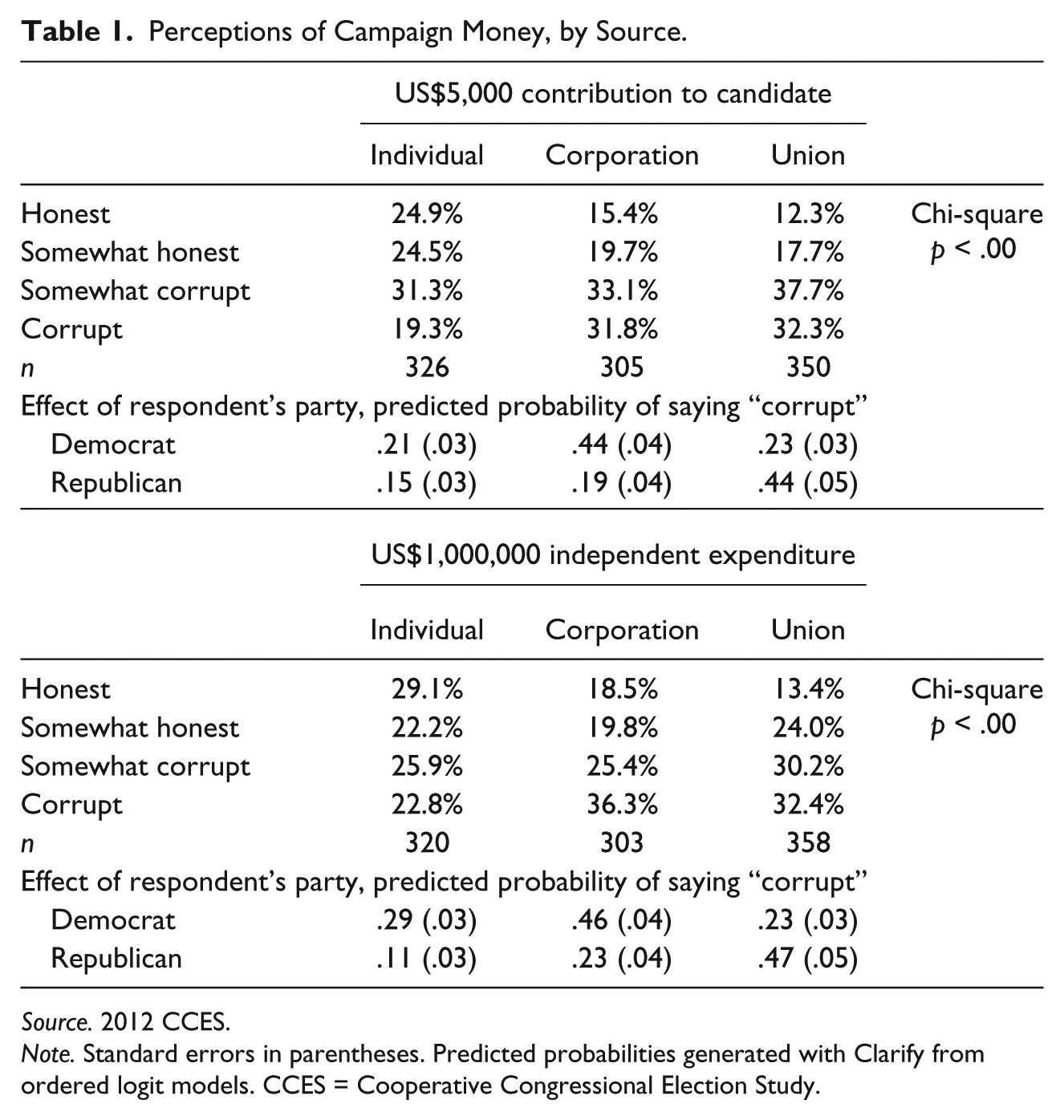
Table 1 reports cross-tabulations of responses by the three different sources of money for each experiment. We also report the predicted probability that a Democrat or Republican rated the contribution as “corrupt.” 7 In all but one scenario presented, most CCES respondents viewed the arrangement as “somewhat corrupt” or “corrupt.” The top panel of Table 1 demonstrates that most CCES respondents viewed any US$5,000 contribution to a candidate to pay for ads as somewhat corrupt or corrupt, regardless of whom the money originated from. A narrow majority of respondents (50.6%) found (legal) contributions to candidates by individuals as being somewhat corrupt or corrupt, and perceptions of corruption were significantly higher if the source was specified as a corporation (64.9%) or a union (70.0%). The difference across the treatment conditions is significant (p < .00).
Perceptions of Campaign Money, by Source.
Source. 2012 CCES.
Note. Standard errors in parentheses. Predicted probabilities generated with Clarify from ordered logit models. CCES = Cooperative Congressional Election Study.
This could reflect that respondents viewed money from organized interests as more corrupt than money from individuals, or respondents knew that direct corporate and union contributions were illegal. 8 However, two separate experiments (see Online Appendix B) conducted on a 2015 MTurk sample suggest this is not the case. In one, respondents were randomly assigned one of two scenarios about contributions to candidates described either in illegal or legal terms, without specifying that the practices was legal or not: US$2,500 from “a corporation” or US$2,500 from “the owner of a corporation.” In a second, the scenarios were US$2,500 from a union or US$2,500 from “a union official.” Both experiments used the same response options shown in Table 1, and neither found any significant differences in perceptions of corruption when the source was framed as legal (owner of a corporation/union member) or illegal (corporation/union).
The second panel of Table 1 displays results from the experiment where the scenario is a (legal) US$1,000,000 expenditure by a [individual/corporation/union] in a congressional election. Interestingly, this is the only case where most CCES respondents did not view a scenario as somewhat corrupt or corrupt. A narrow minority (48.7) replied that a US$1,000,000 expenditure by an individual was somewhat corrupt or corrupt, compared with 61.7% when told it was from a corporation and 62.6% when told it was from a union. The difference is significant (p < .00). Overall, then, we do find evidence suggesting that people view money from organized interests as more corrupt than money from individuals—particularly with large independent expenditures of the sort made possible after Citizens United.
Table 1 also provides evidence that behind general levels of cynicism, many people viewed campaign finance arrangements instrumentally. We find substantial effects of the respondent’s partisanship. A Republican had a relatively low probability (.19) of viewing an (illegal) US$5,000 corporate contribution to a candidate as corrupt, whereas a Democrat was significantly more likely (.44) to see this as corrupt. Conversely, a Democrat had a relatively low (.23) probability of seeing an (illegal) US$5,000 contribution from a union as corrupt compared with a Republican (.44). Likewise, a Democrat (.46) was twice as likely as a Republican (.23) to see a US$1,000,000 corporate independent expenditure on campaign ads as corrupt, and a Republican (.47) was twice as likely as a Democrat (.23) to see US$1,000,000 in union spending as corrupt.
Method of Delivery
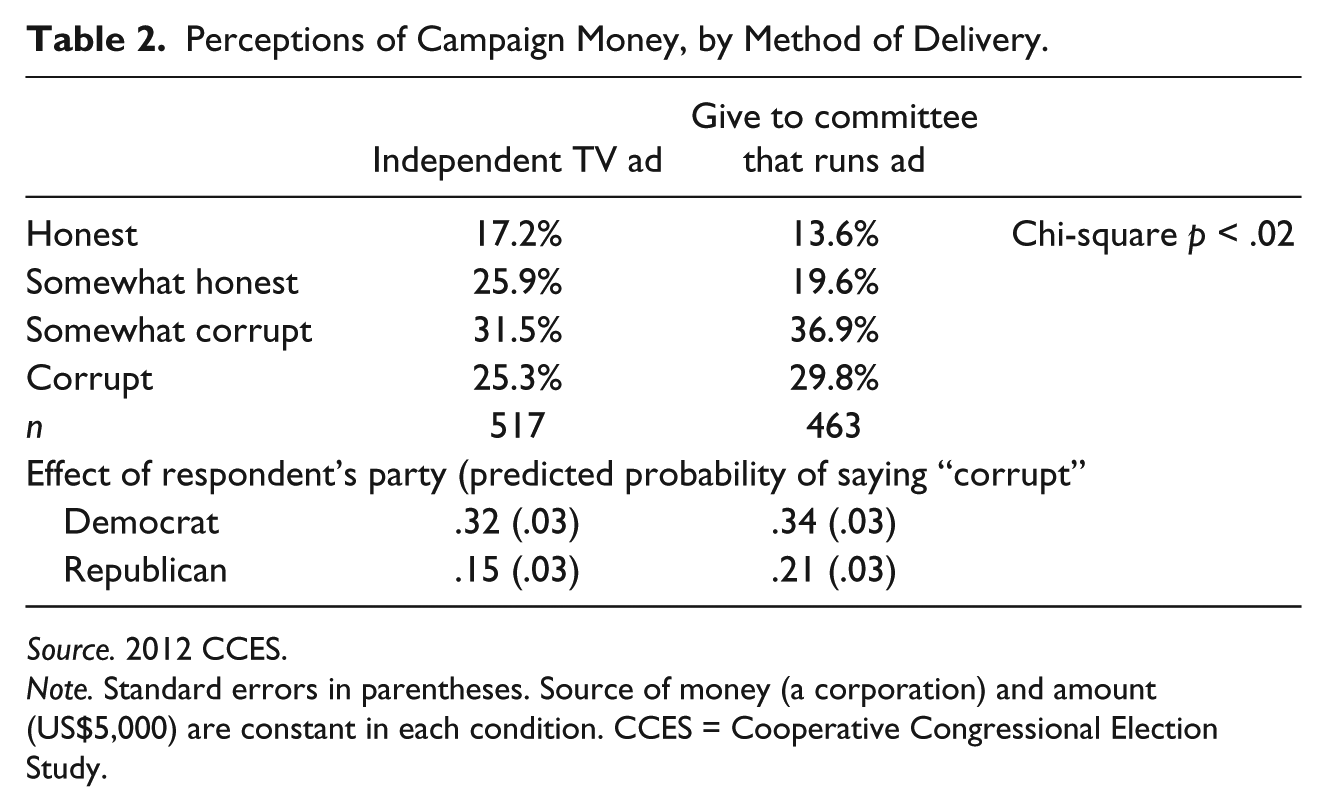
A third CCES experiment randomly assigned people to one of two conditions that manipulated information about how corporate money funded congressional campaign ads. The first asked about an indirect method, where US$5,000 in corporate money was given to a “political committee” that then ran TV ads benefiting a candidate’s campaign. The second condition asked about a corporation spending US$5,000 directly on independent TV ads that benefited a candidate’s campaign.
Results in Table 2 illustrate that most respondents perceived either situation as somewhat corrupt or corrupt. Nonetheless, a (limited) direct independent expenditure by corporations was seen as significantly less corrupt (56.8% responded somewhat corrupt or corrupt) than the same amount of corporate money going to a campaign indirectly, through a political committee (66.7%; chi-square p < .02). This runs counter to the direction of our second hypothesis, but it does reflect that respondents may reason about the method by which corporate money ends up in a congressional campaign. Some people may view independent expenditures by corporations less cynically than corporate money that flows to PACs. 9 We also suspect this result might be an artifact of the question wording. A corporation giving to a “political committee” may appear less transparent than a corporation paying for “independent” ads. As for partisan effects, Table 3 illustrates, again, that Democrats were more cynical about the potential corrupting influence of corporate campaign money than Republicans, regardless of how the money arrived in the campaign.
Perceptions of Campaign Money, by Method of Delivery.
Source. 2012 CCES.
Note. Standard errors in parentheses. Source of money (a corporation) and amount (US$5,000) are constant in each condition. CCES = Cooperative Congressional Election Study.
Perceptions of Campaign Money, by Amount (n = 644).

Source. Respondents recruited via Mechanical Turk and directed to authors’ survey on Qualtrics (January 2015).
Note. Source of funds (“someone”) is constant in each condition.
Amount of Money
Comparing results from the US$5,000 CCES experiment with the US$1,000,000 CCES experiment (Table 1) might suggest that respondents were equally (or less) cynical about US$5,000 contributions given to candidates as they were about US$1,000,000 independent expenditures made on a candidate’s behalf. However, tests in Table 1 and Table 2 did not randomly assign subjects to treatments where the amounts of spending were manipulated. We did this in two 2015 MTurk experiments where the source of money was constant and unspecified (from “someone”), while information about the amounts of money was manipulated. In one test, respondents were randomly assigned information about a US$50, US$500, or US$5,000 contribution to a candidate to fund the candidate’s TV ads. In a second test, respondents were randomly assigned information about US$500, US$50,000, or US$1,000,000 independent expenditure on TV ads.
The top panel of Table 3 displays results of the experiment varying the size of a (legal) contribution to a candidate. When information about a range of candidate contributions is varied, we find no evidence that respondents made distinctions about how much money was involved. Given the upper bound near US$5,000, we are constrained by how much we can manipulate information about legal contributions to candidates. However, the second test here changes the scenario to independent spending on TV ads, where there is no upper legal limit. Here, we find 52.5% of MTurk respondents viewed a US$1,000,000 independent expenditure on TV ads as somewhat corrupt or corrupt, compared with 41.7% who viewed a US$50,000 expenditure and 34.7% who viewed a US$500 expenditure this way. 10 This supports our third hypothesis, but only in the context of large independent expenditures. 11
Types of Expenditures (Negative Ads)
Up to this point, all of our experiments specified that campaign money was spent on “TV ads” that “criticized” a candidate, a relatively soft prompt in terms of negativity. Given that cynical perceptions of Congress may be intertwined with distain for TV ads and negativity in congressional campaigns, we designed survey experiments to test how perceptions of a contribution were conditioned by information about the types of campaign advertising that was being financed. Respondents recruited in 2014 via MTurk were randomly assigned one of three versions of a question about a US$5,000 contribution from a generic “someone”: One condition specified the money would “pay for campaign ads,” a second that it would “pay for TV ads,” and the third that it would “pay for negative TV ads criticizing an opponent.”
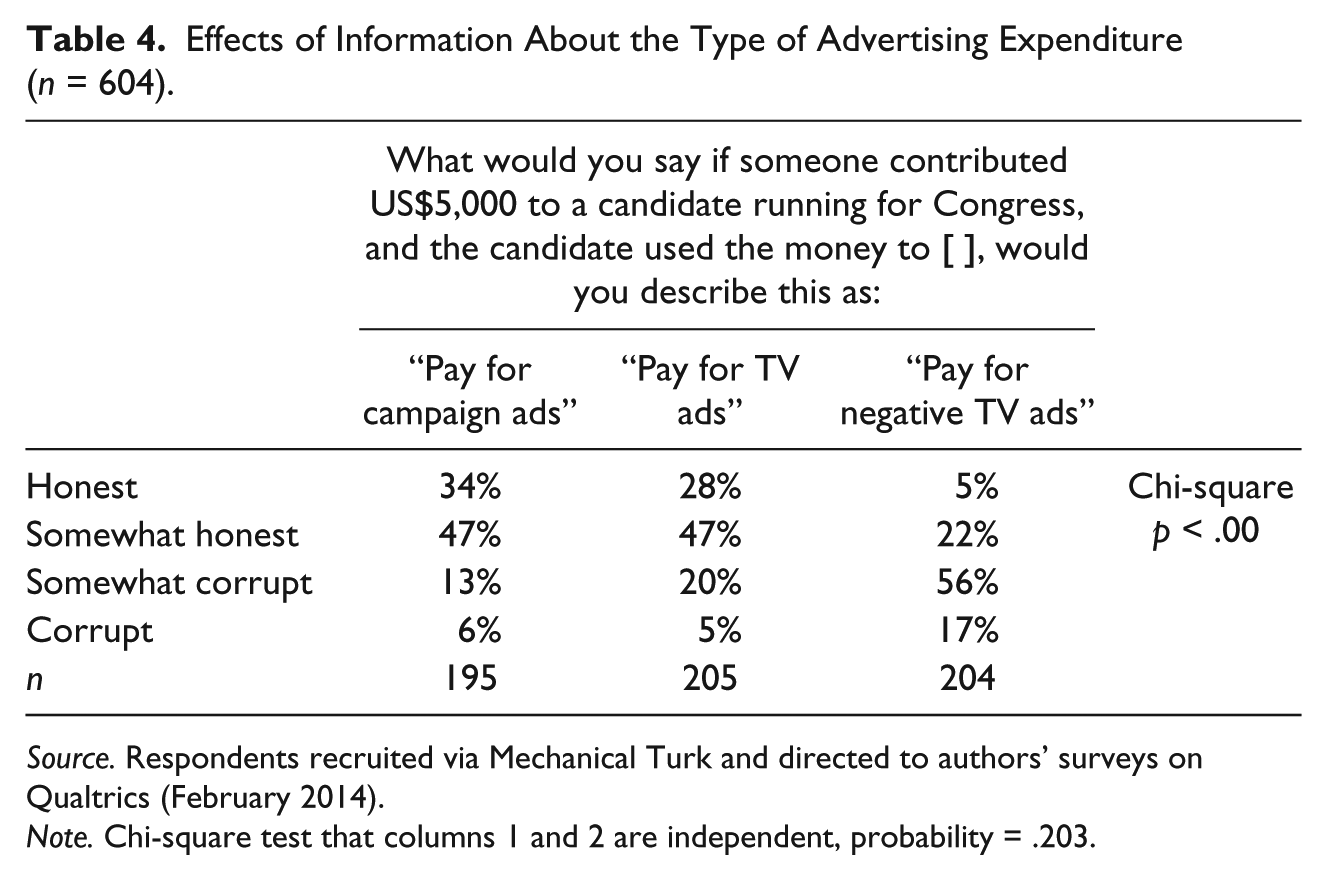
Table 4 displays support for our fourth hypothesis: Respondents were far more likely to see a contribution that financed negative TV ads as “corrupt” than a contribution paying for TV ads where negativity is not specified. Nineteen percent of MTurk respondents found a contribution financing generic “campaign ads” as somewhat corrupt or corrupt, and 25% responded this way about money for “TV ads.” Yet, 73% said the contribution was somewhat corrupt or corrupt if it financed “negative TV ads.” This suggests that popular concerns about the corrupting role of money in Congress may not only reflect assumptions about quid pro quo corruption, but that people may also be cynical about how money adversely affects (or corrupts) campaign discourse. Similarly sized large majorities in this MTurk sample viewed a US$5,000 contribution to “pay for campaign ads” or “pay for TV ads” as “somewhat honest” or “honest.” However, only 27% of those given the “negative TV ads” prompt said that a US$5,000 contribution was “somewhat honest” or “honest.” 10
Effects of Information About the Type of Advertising Expenditure (n = 604).
Source. Respondents recruited via Mechanical Turk and directed to authors’ surveys on Qualtrics (February 2014).
Note. Chi-square test that columns 1 and 2 are independent, probability = .203.
Need for Expenditures
Our final hypotheses proposed that perceptions about campaign finance could be affected by information about why a candidate needs money for advertising. Two framing experiments were used to test how perceptions of contributions to candidates for U.S. Congress might be affected by information about why campaigns need to pay for advertising or by information about the costs of paid advertising (via mail or TV). Respondents to a 2014 MTurk Survey were randomly assigned to one of three conditions where they read information about electing the U.S. Congress. In one condition, people were informed that candidates need to “give people information about what they stand for” when they run for Congress and added that “one way candidates get their message out is with TV ads.” This prompt then explained that a single TV ad could cost US$30,000 12 and that “since most voters won’t see one TV ad, candidates might have to run their TV ads several times.” A second condition presented a very similar script but changed the mode of advertising to mailing. Note that in this experiment, ads were not specified as being negative. A control group was presented a generic script of similar length about the length of congressional terms, with information about how often members stand for election, but no mention of advertising or costs. 13
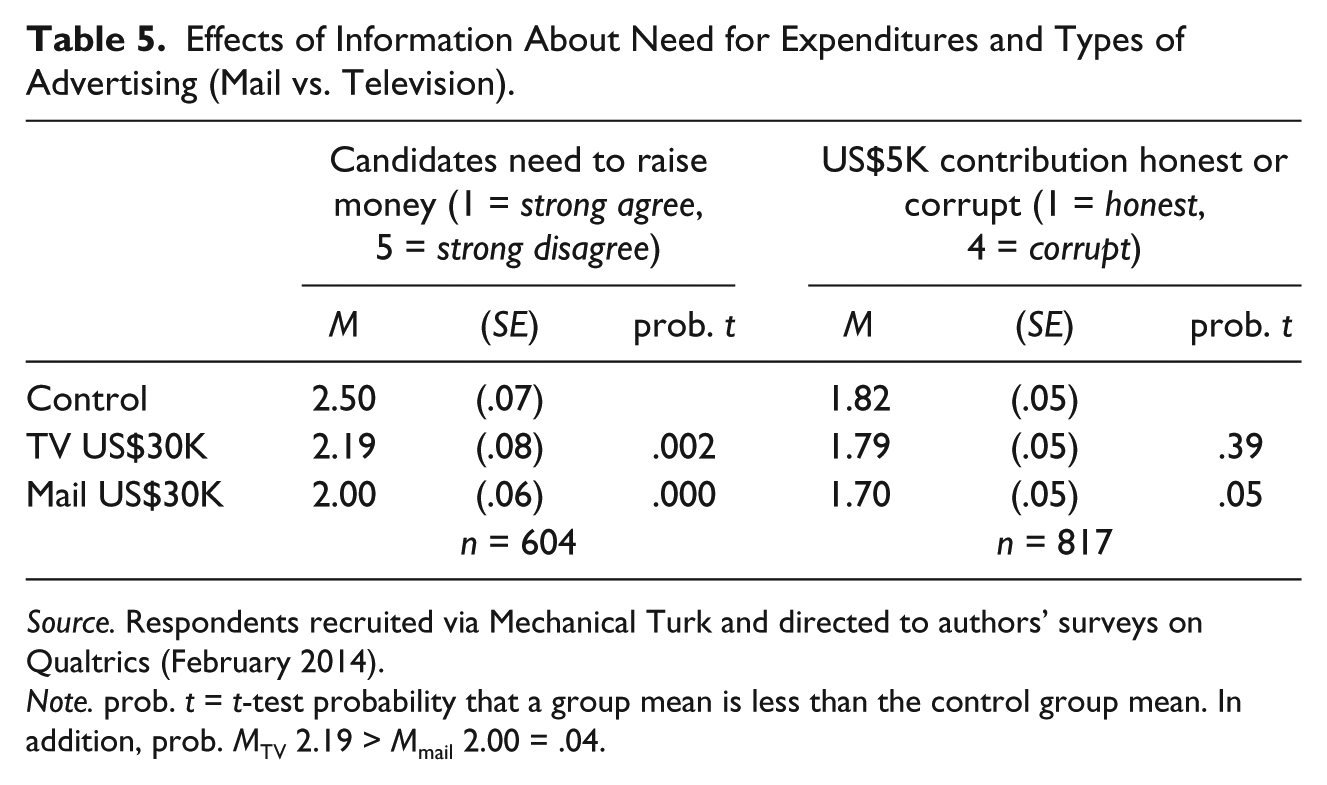
All subjects were then asked if they agreed or disagreed (strongly or not) “that congressional candidates need to raise money so they can get their message out to the voters.” 14 Results in the left side of Table 5 demonstrate that information about advertising costs may affect whether or not people agreed with the proposition that candidates for Congress needed “to raise campaign money.” These results also suggest there may be a bias against money raised for TV ads. Among respondents who read about TV costs, the mean response to the question asking if candidates needed to raise money was significantly more toward “agree” than the control group was on the 5-point scale (1 = strong agree, 5 = strong disagree) measuring attitudes about fundraising (MTV = 2.19 < Mcontrol = 2.50; t = 2.91 p < .002). As for a possible bias against TV ads, the mean response for people reading about mailing costs tilted even more strongly toward “agree” than the mean response for the control group (Mmail = 2.00 < Mcontrol = 2.50; t = 5.01 p < .000); with the difference between the TV group and the mail group also significant (at p = .04).
Effects of Information About Need for Expenditures and Types of Advertising (Mail vs. Television).
Source. Respondents recruited via Mechanical Turk and directed to authors’ surveys on Qualtrics (February 2014).
Note. prob. t = t-test probability that a group mean is less than the control group mean. In addition, prob. MTV 2.19 > Mmail 2.00 = .04.
We conducted a similar experiment on another 2014 survey with respondents recruited via MTurk. These respondents were assigned to the same three conditions (reading about TV costs, mail costs, or the control) and then asked what they would think “if someone contributed $5,000 to a candidate running for Congress, and the candidate used the money to pay for campaign ads” criticizing an opponent. Response options were the same 4 items used in most of our other experiments (1 = honest, 2 = somewhat honest, 3 = somewhat corrupt, 4 = corrupt). Compared with the control group, people who read about mailing costs were slightly (yet significantly) less likely to think that a contribution was corrupt (Mmail = 1.70 < Mcontrol = 1.82; t = 1.67 p = .05), while people reading about TV advertising costs were not. These experiments suggest that people made distinctions between spending on TV ads and another mode of advertising (mail), and also suggest that some cynicism about campaign money and Congress might be mitigated with information about the need for advertising and the costs of such advertising.
Conclusion and Discussion
What does it mean when surveys find that many Americans believe that Members of Congress are corrupt? We suggest such attitudes reflect something other than popular assumptions that most Members break the law. Widely held perceptions of corruption applied to Congress may reflect, at least in part, cynicism about how money influences representatives and cynicism about money that funds negative campaigns—money that comes from a relatively small set of actors who are different from most of the public (Brady, Verba & Schlozman, 1995; Gimple, Lee, & Pearson-Merkowitz, 2008; Lowry, 2015). Lawbreaking by representatives, then, is not a prerequisite for widespread cynicism about representatives if citizens expect that campaign money begets undue influence or that it fuels negativity in political discourse. This study has unpacked some of the relationships between attitudes about campaign money and perceptions of a corrupt Congress. We leave it to others to assess the veracity of perceptions that campaign money can “buy” congressional votes, but note that there is no systematic evidence in the political science literature demonstrating such a link (but see Stratmann, 2002, 1995). Still, the public may perceive something that Warren (2006a) notes: Candidates rely on a relatively wealthy class of people and interest groups for campaign funds. As these actors have interests that differ from the less wealthy, “the public is justified in inferring improper influences.” Regardless of whether these attitudes are justified, majorities of respondents surveyed for this study found a number of legal (and illegal) arrangements that financed congressional campaign ads to be somewhat corrupt or corrupt—whether it be contributed to a candidate or spent as an independent expenditure.
But there was much more beneath the surface of this. This study expands upon our understanding of such attitudes in at least three ways. First, we have demonstrated that people made distinctions about sources and amounts of campaign money when judging something as being honest or corrupt. Large independent expenditures by corporations and unions (as made possible by Citizens United) were seen as more corrupt than large expenditures by individuals, and large independent expenditures were seen as more corrupt than smaller ones. Second, we have shown that partisanship conditioned how information about campaign money affected perceptions of corruption. We find that partisans reasoned about campaign finance in a distinctly instrumental manner: Democrats were far more likely to see arrangements that might be assumed to advantage their party as honest (even if the practice was illegal), and they were much more likely to see arrangements that potentially benefited Republicans as corrupt. The same was true of Republicans, in reverse. Third, we have demonstrated that attitudes about the corrupting role of campaign money are sensitive to how the money is used. Many people do not like TV ads, and campaign money is more likely to be seen as corrupt when people were prompted that it was spent on negative TV ads. We also find that people may be more receptive to the idea that candidates have a legitimate need for campaign money, and that they see it as less corrupt, when they have information about how much advertising might actually cost.
These distinctions are important in that they reveal that many in the public reason about political institutions in the same manner as elites do. They are also important because they reflect that cynicism about campaign money is not monolithic; people appear to make distinctions about how corrupting campaign money is depending on how much is raised and spent, by whom, and how is it spent. This suggests that there may be some space in American politics not only for discussions about reforming (regulating) campaign finance but that there may also be space for promoting information about why campaign money is raised, about how expensive campaigns can be, and about how campaign money may be needed in democracies that do not provide state support for campaigns. We see another broad point to takeaway from this study. The manner in which the public reasons about money in politics may be more complex than a generalized suspicion of a quid pro quo relationship where any forms of money are seen as equally corrupt.
The evidence presented here, and our interpretation of it, must be considered in the light of some caveats. Our MTurk experiments, while illustrative, were conducted on an opt-in platform that is not broadly representative of the American public. We urge scholars to include these tests, and others that follow from it, on random sample opinion polls. Furthermore, additional work is needed to establish the most precise measures of perceptions of corruption. Our results could be affected by the fact that we required respondents to commit to naming a practice as (somewhat) corrupt or honest, with no room for a neutral or indifferent response. These things considered, our evidence does shows that public attitudes about campaign finance are shaped by who gives to whom and for what purpose, and perhaps by how campaign money corrodes political discourse.
Footnotes
Acknowledgements
The authors also thank Caroline Tolbert and the University of Iowa Department of Political Science for including items on their Cooperative Congressional Election Study (CCES) module. The authors thank the editor and the reviewers for helping us improve the paper.
Authors’ Note
Part of the work on this project was conducted while Donovan was a visiting fellow in the Research School of Social Sciences at the Australian National University.
Declaration of Conflicting Interests
The author(s) declared no potential conflicts of interest with respect to the research, authorship, and/or publication of this article.
Funding
The author(s) disclosed receipt of the following financial support for the research, authorship, and/or publication of this article: Partial funding for this research was provided by the Western Washington University Office of Research and Sponsored Programs.
Supplementary Material

Notes
Author Biographies
References
Supplementary Material
Please find the following supplemental material available below.
For Open Access articles published under a Creative Commons License, all supplemental material carries the same license as the article it is associated with.
For non-Open Access articles published, all supplemental material carries a non-exclusive license, and permission requests for re-use of supplemental material or any part of supplemental material shall be sent directly to the copyright owner as specified in the copyright notice associated with the article.
