



Abstract
Over the last several decades, scholars have noted a strengthening link between ideology and party identification among the public, but the causal direction of this phenomenon remains contested. The ideological realignment thesis holds that ideology now strongly influences party identification, but this position conflicts with literature suggesting that party identification remains the primary causal force behind most important political attitudes. This study examines the causal forces at work between ideology and party identification by focusing on the distinction between symbolic and operational ideology. The methodology involves the use of panel data that span several decades, and structural equation modeling. The findings indicate that between 1982 and 1997, symbolic ideology had a strong influence party identification, but operational ideology had little effect on party identification. The results suggest an important revision to the ideological realignment thesis, as the evidence indicates that symbolic ideology has been the primary force driving realignment.
Keywords
One of the most important facets of mass political behavior over the last several decades has been the increasingly strong connection between ideology and party identification. Although there is general consensus in the extant literature that this link has become more pronounced, there is less agreement about its significance. Generally speaking, proponents of the ideological realignment thesis contend that this increasingly strong association has been driven by individuals changing their partisan affiliations to correspond to their ideological beliefs. That is, there has been a partisan realignment driven by ideology. However, others claim that it is much more likely that individuals have changed their ideological leanings in response to messages provided by party elites. In this scenario, the party identification of individuals has remained fairly stable, whereas their ideologies have changed to fit their partisan attachments.
Sorting out the causal direction of this strengthened link between ideology and party identification is important for several reasons. First, absent knowledge of the causal forces at work, it is impossible to know whether an ideological realignment has in fact occurred. Second, if there is evidence of such a realignment, what are the particular circumstances and conditions of its occurrence? Third, an ideological realignment raises the possibility that the nature and meaning of party identification has dramatically changed. This is significant because party identification has long been viewed by scholars of mass political behavior as the bedrock upon which most other political views and decisions are based.
The Ideological Realignment Thesis
The earliest research to explore the growing connection between ideology and party identification among the mass public appears in the 1990s, and contends that the link between the two has grown stronger than the historical connection between social groups and party identification (Carmines & Stanley, 1992; Levine, Carmines, & Huckfeldt, 1997). Although these studies do not explicitly test the causal direction of this link, the clear implication is that ideology shapes party identification. Both studies use the National Election Studies 7-point Ideological Self-Identification scale ranging from 1 (extremely liberal) to 7 (extremely conservative) to measure ideology.
A fully formed theory of ideological realignment first appears in Abramowitz and Saunders (1998). Taking their cue from Key’s seminal work on secular realignments (Key, 1959), Abramowitz and Saunders (1998) argue that the party identification of individuals has realigned based on their ideological beliefs, “Clearer differences between parties’ ideological positions made it easier for citizens to choose party identification based on their policy preferences. The result has been a secular realignment of party loyalties along ideological lines” (p. 636). Abramowitz and Saunders further contend that this ideological realignment began with the Reagan presidency, which sent strong and clear ideological messages about its policy preferences, and continued through the Clinton presidency, as the Republican Party in the House of Representatives became dominated by ideological conservatives. They argue that party elites during this time became more ideologically distinctive, thereby making it easier for the public to choose a party identification based upon ideological beliefs.
Abramowitz and Saunders recognize the possibility that individuals have altered their ideological views to correspond with their party identification, as opposed to bringing their party identification in line with their ideology, so they specifically test their proposition using NES panel data from 1992 to 1994. For this analysis, they construct a 14-item measure of ideology that includes questions about the proper level of government spending on certain domestic programs, several specific issue attitude questions, plus the ideological self-identification question. They find that not only is ideology more stable than party identification across this period, but that ideology has a much greater effect on party identification than vice versa, and that this relationship is even stronger among those who clearly understand the ideological differences between the parties. Thus, they conclude that there is strong evidence for the ideological realignment thesis.
Subsequent research confirms the increasing link between ideology and party identification, and demonstrates a growing degree of ideological sophistication among the public (Abramowitz, 2010; MacKuen, Erikson, Stimson, & Knight, 2003). There is also evidence that ideological realignment has been particularly strong among southern Whites (Abramowitz & Knotts, 2006; Schreckhise & Shields, 2003). In addition, it has been shown that over the last several decades, macro-level changes in party identification have been much greater than macro-level changes in ideology, providing further support for the contention that party identification has moved in response to ideology (Abramowitz & Knotts, 2006; Abramowitz & Saunders, 2006). Moreover, ideology now appears to be a much better predictor of party identification than the social group characteristics that have long been thought to be associated with it (Abramowitz & Saunders, 2006).
Symbolic Versus Operational Ideology
Although there is a wealth of literature devoted to the ideological realignment thesis, little of it addresses the conceptualization of ideology. Some of the research that addresses the connection between ideology and party identification focuses exclusively on the 7-point Ideological Self-Identification scale present in the NES surveys since 1972 (Abramowitz & Saunders, 2006; Carmines & Stanley, 1992; Levine et al., 1997; MacKuen et al., 2003). Other studies measure ideology by combining this self-identification scale with issue attitude items (Abramowitz & Saunders, 1998; Levendusky, 2009; Putz, 2002). Other scholars specifically interested in the association between issue attitudes and party identification do not employ this self-identification measure at all (Carsey & Layman, 2006; Highton & Kam, 2011; Layman & Carsey, 2002).
The nature of the relationship between ideological self-identification and issue attitudes is important for scholars studying the connection between ideology and party identification because it is possible that ideological self-identification and issue attitudes do not represent the same type of ideological thinking. For example, there is evidence that many individuals have difficulty correctly defining the words “liberal” and “conservative” (Luttbeg & Gant, 1985). Moreover, other research has indicated that throughout the 1970s and into the 1980s, there were significant numbers of individuals who would not claim an ideological self-identification at all (Fleishman, 1986). Indeed, ideological self-identification and issue attitudes appear to be connected only for the highly educated (Jacoby, 1991; Wood & Oliver, 2012). Some research shows a growing connection between ideological self-identification and issue attitudes (Abramowitz & Saunders, 2006), and even such self-identification and underlying psychological traits (Jost, 2006). But the most thorough examination of this connection finds that ideological self-identification is actually related to both an economic and a social dimension of issue attitudes, and that many individuals identify as liberal on one dimension but conservative on the other dimension, thus calling into question the utility of a single-dimension Ideological Self-Identification scale (Treier & Hillygus, 2009).
The foregoing research raises doubts about a straightforward connection between ideological self-identification and issue attitudes. However, there is another line of research that suggests that the Ideological Self-Identification scale found in the NES and other surveys is both conceptually and empirically distinct from survey items about specific issue attitudes and positions. Free and Cantril (1967) were the first to observe this distinction, noting that it is quite common for self-identified conservatives to assume liberal positions on specific issues. The seminal work of Conover and Feldman (1981) directly explores the meaning of liberal/conservative self-identification, and concludes that such self-identification has a largely symbolic, rather than issue-oriented, meaning to the public. Specifically, they contend that this self-identification represents a certain psychological attachment to particular groups. Stimson (2004) also argues that ideological self-identification represents symbolic ideology, whereas specific issue positions represent operational ideology, and shows that there is often an empirical distinction between these two concepts. For example, there appears to be a significant number of individuals who are symbolic conservatives but operational liberals.
The idea of “liberalism” and “conservatism” as representations of competing political symbols, groups, and philosophies stems from the events of the 1930s. Rotunda (1986) argues that the word “liberal” was first introduced into mainstream U.S. political discourse by Franklin Roosevelt, who appropriated the term to describe his New Deal policies. A popular label at the time, its meaning was vociferously contested by Herbert Hoover and other conservatives, who claimed they were the “true” liberals, in the classic sense. Roosevelt eventually won this battle of linguistics, and Young (1996) notes of this “rhetorical coup” that Hoover’s position, “is not historically incorrect, but it does suggest the extent of Roosevelt’s triumph. He redefined the basic ideological vocabulary through which Americans conducted politics” (Young, 1996, p. 171).
Ellis and Stimson (2012) have provided the most thorough examination to date of ideology in the United Stated since the 1930s, and the distinction between symbolic and operational ideology. They note that the unpopularity of the “liberal” label began in the late 1960s, when the number of self-identified liberals dropped significantly. Their evidence suggests that support for symbolic liberalism began to decline due its association with the race riots and anti-Vietnam War movement of this era. That is, the symbols and groups connected to the word “liberal” changed, “ . . . from the white working-class American of FDR to the largely non-white urban underclass—as well as the counterculture movement—of the 1960s and beyond” (Ellis & Stimson, 2012, p. 88). Indeed, Nixon’s Vice-President, Spiro Agnew, consciously attempted to link the words “liberal” and “radical” (Rotunda, 1986). However, Ellis and Stimson also demonstrate that operational liberalism has had a far different fate, as many Americans continue to hold operationally liberal issue attitudes despite the unpopularity of symbolic liberalism. Rather than being indicative of an irrational contradiction, Ellis and Stimson argue this phenomenon shows that symbolic ideology and operational ideology are quite different concepts. Consistent with this thinking is research demonstrating that the persistence of self-identified conservative Democrats among the public is due largely to an elite discourse that has negatively branded the word “liberal” and positively branded the word “conservative” (Schiffer, 2000).
Ellis and Stimson further highlight the importance of symbolic ideology in their examination of two groups of individuals: first, those who are symbolic conservatives and operational conservatives on cultural issues, but operational liberals on economic issues (“populists”); and second, those who are symbolic conservatives but operational liberals on both economic and cultural issues (“conflicted conservatives”). The symbolic conservatism of the populists appears driven by their affinity for a traditional family lifestyle and religious traditionalism, both of which they associate with the word “conservative.” Interestingly, the effect of religious traditionalism in this context is distinct from conservative positions on specific cultural issues. The symbolic conservatism of the conflicted conservatives appears driven by a more general positive connotation of the word, “conservative.” As Ellis and Stimson note, the commonality for both groups (and the U.S. public generally) is an affinity for conservatism that stems primarily from non-political factors:
We approve conservative hypotheses, approve of banks that take a conservative approach to handling our money, and like our contractors to give us conservative estimates. Even well outside the realm of politics, “conservative” has come to mean conventional, safe, mainstream, comfortable. (p. 157)
This evidence indicates that, especially for symbolic conservatives, symbolic ideology has deep roots that go beyond politics.
Although symbolic ideology appears to reflect reactions to symbols and groups that are distinct from specific issue attitudes, the evidence suggests that symbolic ideology is an important component of political behavior in its own right. Levitin and Miller (1979) find ideological self-identification to have an effect on presidential vote choice independent of specific issue positions, “ . . . when people describe themselves as having an ideological position, they also seem to be saying something about their positions on the parties (and presidential candidates) quite apart from their issue or policy stands” (p. 768). These results are echoed by Sears, Lau, Tyler, and Allen (1980), who specifically categorize ideological self-identification as a symbolic attitude separate from policy attitudes, and find that it carries more weight than policy attitudes in predicting presidential vote choice. Moreover, Ansolabehere, Rodden, and Snyder (2008), whose primary interest is the importance of issue attitudes, provide evidence that even with issue attitudes properly measured, ideological self-identification has an independent effect on presidential vote choice. Popp and Rudolph (2011) have demonstrated that the importance of symbolic ideology extends to specific policy preferences as well, as it exerts an effect on these preferences that is independent and approximately equal to the effect of operational ideology.
The literature examining the connection between ideology and party identification clearly suggests an increasingly strong link between symbolic ideology and party identification (Abramowitz, 2010; Abramowitz & Saunders, 2008; Carmines & Stanley, 1992; Levine et al., 1997; MacKuen et al., 2003). Although symbolic ideology as represented by ideological self-identification was the focus of early research studying the link between ideology and party identification (Carmines & Stanley, 1992; Levine et al., 1997), examinations of the ideological realignment thesis have often treated this self-identification as just another indicator of operational ideology (e.g., Abramowitz & Saunders, 1998). Moreover, researchers concerned with the connection between issue attitudes and party identification have not analyzed the connection between symbolic ideology and party identification (Carsey & Layman, 2006; Highton & Kam, 2011; Layman & Carsey, 2002).
The Centrality of Party Identification
The ideological realignment thesis would seem to represent a straightforward explanation for partisan change over the last several decades. Yet it also stands at odds with the idea that party identification is the basic foundation and precursor for most political attitudes and behaviors, an idea that traces its history to the classic work on U.S. political behavior, The American Voter (Campbell, Converse, Miller, & Stokes, 1960). The extant literature has shown that the party identification of individuals remains an important social identity largely unmoved by short-term political forces (Green & Palmquist, 1990; Green, Palmquist, & Schickler, 2002). A crucial aspect of this argument is that the stability of individual party identification over time can be obscured by a failure to account for the measurement error present in the standard survey question about this concept.
Some research also indicates that individual party identification is often insensitive to individual preferences about issues. This evidence suggests that only individuals who are aware of partisan differences on an issue and find that issue to be particularly salient will respond by altering their party identification, whereas others will alter their issue positions based on their party identification (Carsey & Layman, 2006; Layman & Carsey, 2002). The results of this research call into question the ideological realignment thesis, because these findings are derived from structural equation models, which control for measurement error of both the party identification and issue attitude survey items. Another study using similar controls for measurement error finds that individual party identification also appears to shape, rather than be shaped, by core political values such as equal opportunity, limited government, traditional family values, and moral tolerance (Goren, 2005). Moreover, all this research employs the same NES panel data (1992-1996) used by the original proponents of the ideological realignment thesis.
Although the foregoing research is not primarily concerned with testing the ideological realignment thesis, other research more directly focused on the relationship between ideology and party identification has been no more supportive of this thesis. Levendusky (2009) acknowledges the growing link between ideology and party identification, but his examination of the same 1992-1996 NES panel data as Abramowitz and Saunders shows that individuals are much more likely to change their ideological self-identification and issue attitude positions to reflect their party identification rather than the other way around. However, Putz (2002) provides perhaps the most direct and critical test of the ideological realignment thesis by replicating the work of Abramowitz and Saunders (1998), but using a structural equation model to correct for measurement error in both party identification and ideology. His findings not only indicate that party identification is generally more stable than ideology but also that the ideological realignment unearthed by Abramowitz and Saunders appears to be a short-term phenomenon, associated only with the 1992-1994 period. With measurement error corrections in place, party identification clearly drives ideology between 1994 and 1996.
The Theoretical and Methodological Considerations of Ideological Realignment
The foregoing literature makes clear that a thorough examination of the ideological realignment thesis needs to account for several theoretical and methodological considerations. First, any such examination must analyze the distinct effects of both symbolic and operational ideology. Moreover, the relevant literature provides some guidance as to which one of these two is likely to have the greater effect, if any, on party identification. Symbolic ideology (especially the word conservative) appears to be deeply rooted in the U.S. consciousness, and thus seems better positioned to move party identification in a way that operational ideology does not. The latter is based on specific political issue positions, which much of the literature suggests are driven by, rather than drive, party identification.
Second, much of the criticism of the ideological realignment thesis stems from the argument that when measurement error is sufficiently accounted for, party identification appears to be quite stable and largely unmoved by ideology, regardless of how it is measured. Whereas this research typically employs structural equation modeling, there is another method that can be added to this that has been shown to reduce the measurement error inherent in the use of single-item survey questions. Ansolabehere et al. (2008) have demonstrated that multiple-item measures can substantially reduce the measurement error present among survey questions. Because some of the literature focused on the relationship between issue attitudes and party identification uses only single-item indicators of these attitudes, it is possible that their explanatory power has been underestimated. Although their primary interest is issue attitudes measures (operational ideology), Ansolabehere, Rodden, and Snyder also note that a three-item measure of (symbolic) ideology constructed from the standard 7-point self-identification scale in addition to feeling thermometer scores for liberals and conservatives shows considerably more stability than the Ideological Self-Identification scale on its own. Therefore, it would seem that structural equation modeling and multiple-item indicators provide the best methodological approach to testing the ideological realignment thesis.
There are several other theoretical aspects of the ideological realignment thesis to consider that are not readily apparent from the preceding literature. First, if ideological realignment has truly occurred, then it most likely has done so as a secular realignment that has taken place over at least several election cycles, and perhaps even decades. This was the view of V.O. Key (1959), who wrote the seminal piece on realignment. Thus, a thorough consideration of the ideological realignment thesis should examine political behavior over a relatively long period of time.
But over what time period should we expect to see ideological realignment? Fortunately, the literature on partisan change (even if not directly concerned with realignment) is fairly clear on this issue, as it suggests that ideological realignment, if is taking place, should not be apparent until the 1980s and beyond. One objection to this contention might be that a fairly clear realignment based on racial and civil rights issues happened well before the 1980s (Carmines & Stimson, 1989). However, evidence also suggests that by the 1980s, attitudes on racial issues had become so highly associated with attitudes on economic issues as to make them indistinguishable as their own dimension (Poole & Rosenthal, 1997; Stimson, 2004). But the political importance of civil rights issues in the 1960s were the harbinger of other similar issues that would soon follow, brought on by the women’s rights movement, the gay rights movement, and the Supreme Court’s Roe v. Wade decision that legalized abortion, among others. Together, these have become known as moral or cultural issues, and although they originate in the 1960s and 1970s, their impact on the parties was not truly apparent until the 1980s (Adams, 1997; Layman, 2001; Stimson, 2004). However, although the evidence is clear that the parties are now distinguished by these moral and cultural issues, there is not a consensus on whether party identifiers choose their party based on these issues, or whether they alter their issue stances to conform to their party identification. Regardless, it is clear that these moral and cultural issues began to split party identifiers in the early 1980s, which also coincides with two other related developments. The first development is the drastic increase in overall party polarization in Congress that began around this time (McCarty, Poole, & Rosenthal, 2006). The second development is the strong message sent by the Reagan administration about its conservative ideology, thus cementing the Republican Party as the party of both operational and symbolic conservatives.
Finally, it must be considered whether ideological realignment is a general phenomenon, or one restricted to a particular group or groups. There is little doubt that since the 1960s, White southerners have moved from being almost exclusively Democratic Party identifiers to being solid Republican Party identifiers. This realignment is not disputed even by those who argue that changes in party identification are largely immune from short-term factors, such as presidential approval ratings and the state of the economy (Green et al., 2002). 1 Although scholars of southern politics continue to explore the precise cause of this movement, there is little debate about its actual occurrence. The question here is whether ideological realignment is an occurrence unique to White southerners.
There is one study that employs sufficiently long-term panel data plus multiple-item indicators of issue attitudes such that it represents a good blueprint for a thorough examination of the ideological realignment thesis. Highton and Kam (2011) use a panel study ranging from 1973 to 1997 and structural equation modeling to study the relationship between party identification and both a racial/economic issue orientation and cultural issue orientation, using multiple-item indicators for both issue orientation variables. Their findings indicate that party identification exhibits much more stability during the 1973-1982 period than it does during the 1982-1997 period. Furthermore, they find that both sets of issue orientations are driven by party identification during the 1973-1982 period, but that the situation reverses itself during the 1982-1997 period, when issue orientations drive party identification. These results provide some support for the ideological realignment thesis, and the approach of this study provides a good starting point for a more explicit test of this thesis.
Modeling the Relationship Between Ideology and Party Identification
A thorough test of the ideological realignment thesis requires longitudinal data that span a lengthy time period, and this time period should preferably extend back prior to 1980 and extend forward well past it, so that it corresponds to the era during which it is thought realignment has occurred. Such data must also include indicators on party identification, operational ideology, and symbolic ideology. Fortunately, such a data set is available in the form of the Youth–Parent Socialization panel, which is the same data used by Highton and Kam (2011) in their examination of the relationship between issue orientations and party identification. This panel begins in 1965, when a group of high school seniors and their parents were first interviewed. Both groups were interviewed again in 1973 and 1982, and the children were re-interviewed in 1997. For several reasons, the focus of the following analysis will be on the student interviews of 1973, 1982, and 1997. The 1965 interviews do not contain an ideological self-identification item, and therefore must be excluded. This circumstance results in only two waves of usable panel data for the parents (1973 and 1982), making controls for measurement error difficult (Finkel, 1995). Moreover, the parent interviews do not extend beyond 1982, meaning they end right at the time that ideological realignment is thought to have begun. Yet, there remain for the student group the 1973, 1982, and 1997 interviews, which contain data about both ideological self-identification and party identification. 2
The panel waves, although not equally spaced, set up perfectly for a test of the ideological realignment thesis. The first time period, from 1973 to 1982, serves as a baseline era during which the literature suggests there should be little ideological realignment. The results from this period can then be compared with the results of the 1982-1997 time period, an era during which ideological realignment, if it exists, should be apparent. In addition, this creates a strong test of the ideological realignment thesis, as the panel participants were well past their formative years by the 1980s and 1990s, and therefore, less likely to have changed their political attitudes.
The Youth–Parent Socialization panel contains two indicators for party identification. The first is the basic three-category question asking respondents whether they consider themselves a Democrat, Republican, or Independent. A follow-up question then asks Independents if they lean toward one of the parties, and if so, how strongly. This information is then used to create the standard seven-category Party Identification scale that ranges from strong Democrat to strong Republican. The data also include feeling thermometer questions on both Democrats and Republicans. In addition, the data contain the standard seven-category ideological self-identification item, which ranges from extremely liberal to extremely conservative, plus feeling thermometer questions on both liberals and conservatives, although the liberal feeling thermometer is available only in the 1982 and 1997 waves. 3 The seven-category party identification indicator and the ideological identification indicator along with their corresponding feeling thermometer items are used to create multiple-item measures for both symbolic ideology and party identification. 4
The Youth–Parent Socialization panel contains seven issue items asked of the youth respondents in an identical manner in all three panel waves and these are used to construct a measure of operational ideology. The questions are about the government’s role in guaranteeing jobs and a good standard of living, the rights of criminal defendants, governmental aid to Blacks and other minority groups, the legalization of marijuana, women’s role in society, school prayer, and school integration. Highton and Kam (2011) not only use these same items to construct their measures of economic/racial and cultural issue orientations but also include group feeling thermometers and feelings about the influence of certain groups. However, the measure of operational ideology constructed here contains only the issue items, as the group feeling items are very likely related to symbolic ideology (Conover & Feldman, 1981). Due to the fact that the issue items are measured on different scales, all the scales are rescaled to range from 0 to 10, and coded so that they range from liberal to conservative. 5 The indicator of operational ideology is simply the average of these rescaled items, constructed for every respondent who answered at least five of the items in each wave of the panel. 6
The aforementioned items can be employed to construct multiple-item measures of party identification, symbolic ideology, and operational ideology. However, the use of structural equation modeling can also be used to combat the random error often present in survey items. This error stems from the fact that the variance of an observed indicator actually contains both “true” variance and random error variance (Finkel, 1995). This measurement error can pose significant problem for analyses with panel data, as it could lead to the underestimation or overestimation of the effects of lagged variables. But structural equation models using panel data with at least three waves can be used to essentially separate latent or “true” variables from observed variables, and thus better control random measurement error.
Figure 1 depicts the three-wave, cross-lagged structural equation model used to test the causal relationship between ideology and party identification. The ovals represent the “true” or latent variables, whereas the rectangles represent observed variables. The Es represent the random measurement error associated with each observed variable, whereas the Ds represent the structural disturbance terms. The model is set up such that party identification at time T is a function of both its value at time T − 1, and a function of both symbolic and operational ideology at time T − 1. Both symbolic and operational ideology at time T are each functions of their respective values at time T − 1 and party identification at time T − 1. The cross-lagged nature of the model means that the coefficients represented by the diagonal lines actually indicate the impact that one variable has on changes in the other variable between time T − 1 and T, controlling for the previous value of the affected variable (Finkel, 1995). In other words, this model allows for an examination of the effect that both types of ideology have on changes in party identification over time, and the effect that party identification has on changes in both types of ideology over time, while controlling for measurement error.
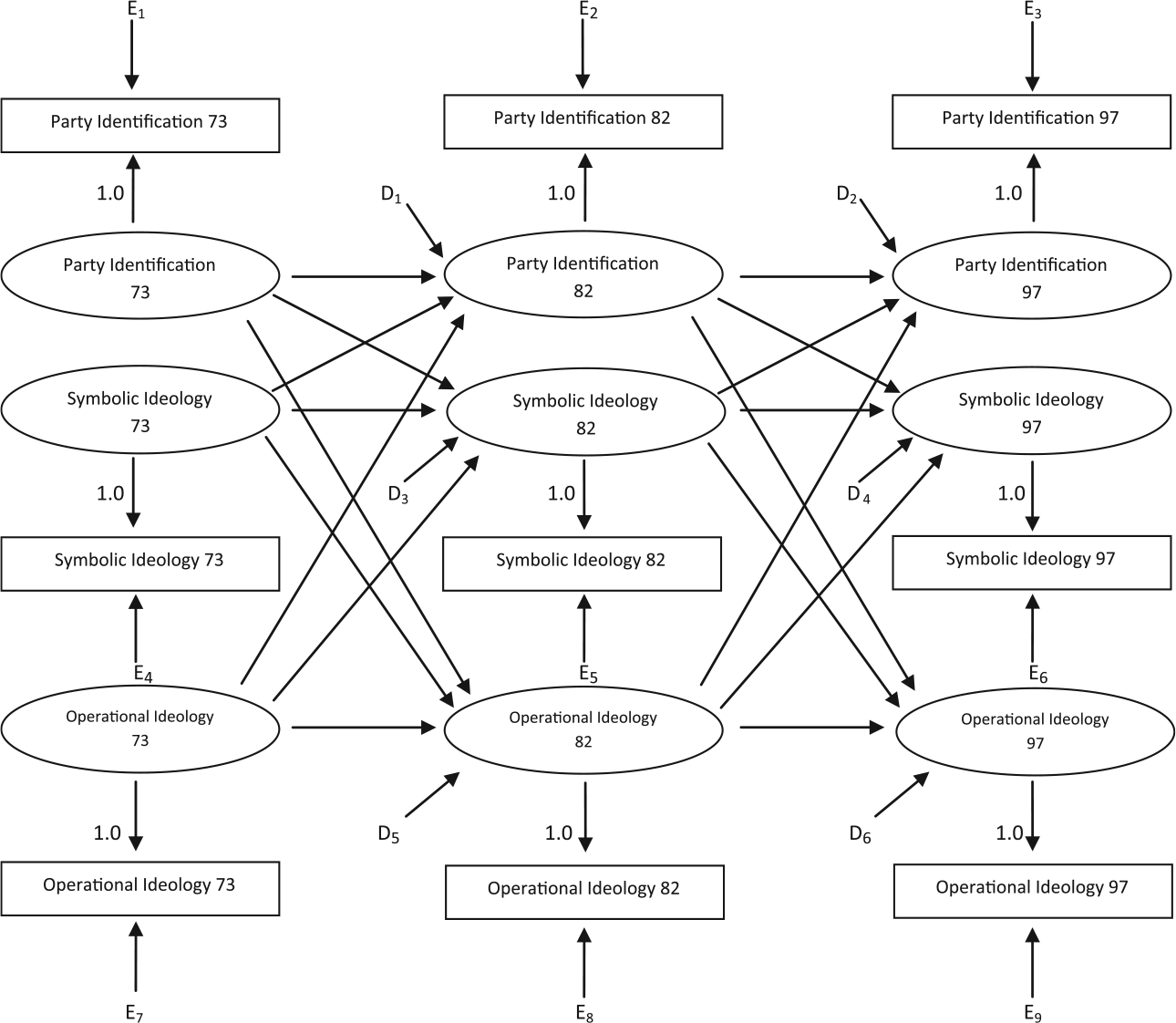
Structural equation model of symbolic ideology, operational ideology, and party identification.
The model depicted in Figure 1 estimates the cross-lagged rather than the synchronous effects of ideology on party identification and party identification on ideology. This is because the substantive interest here is the effect of ideology on changes in party identification and the effect of party identification on changes in ideology, similar to other research in this vein (e.g., Carsey & Layman, 2006; Layman & Carsey, 2002). The cross-lagged model is also appropriate for models in which the reciprocal effects of two variables on one another are thought to take place continuously over time (Finkel, 1995). Dwyer (1983) notes that under such a circumstance, the cross-lagged model provides accurate information about the direction of causation between the variables. Moreover, he argues that a continuous process of influence is more realistic than one which assumes that variables affect one another at discrete points in time, and that in most instances, truly synchronous effects between two variables are unlikely.
The model shown in Figure 1 is not identified, and therefore some assumptions must be made, consistent with both the statistical literature on the subject (Finkel, 1995; Wiley & Wiley, 1970) and the work of previous researchers using similar, single-indicator cross-lagged models (Carsey & Layman, 2006; Green & Palmquist, 1990; Layman & Carsey, 2002). It is assumed that both the error terms and the structural disturbance terms are serially uncorrelated and that the variances of both are constant over time. 7 It is also assumed that the covariances between the measurement errors and the latent variables and between the measurement errors and the disturbance terms are all zero. 8 Finally, the coefficients linking the latent variables to the observed variables are set equal to one to insure that the variables have identical scales.
The relationships, between both types of ideology and party identification, are represented by the equations:



Of particular interest are the cross-lagged coefficients demonstrating the causal effects of ideology and party identification on one another over time. These coefficients provide evidence of the degree to which symbolic ideology drives party identification (controlling for the effects of operational ideology), whether operational ideology drives party identification (controlling for the effects of symbolic ideology), or whether party identification drives either one or both types of ideology. However, the model also allows the two types of ideology to affect each other, for although they are conceptually distinct, they cannot be assumed to be completely empirically distinct. Constructing the model in this manner also allows for an examination of any changes in the relationship between these two ideologies over time, and whether one type of ideology might indirectly affect party identification through its influence on the other type of ideology.
Table 1 shows the results of the three-wave model depicted in Figure 1 using the seven-category scales for both party identification and symbolic ideology. All coefficients are significant at the .05 level or higher unless otherwise indicated. The first thing to note is that the stability coefficient for party identification decreases somewhat between the first period and the second (1.08 to 0.81), whereas the stability coefficient for operational ideology exhibits a large increase (0.56 to 0.84). The stability coefficient for symbolic ideology remains relatively small during both periods.
The Relationships Between Symbolic Ideology, Operational Ideology, and Party Identification Using Seven-Category Scales of Party Identification and Symbolic Ideology.
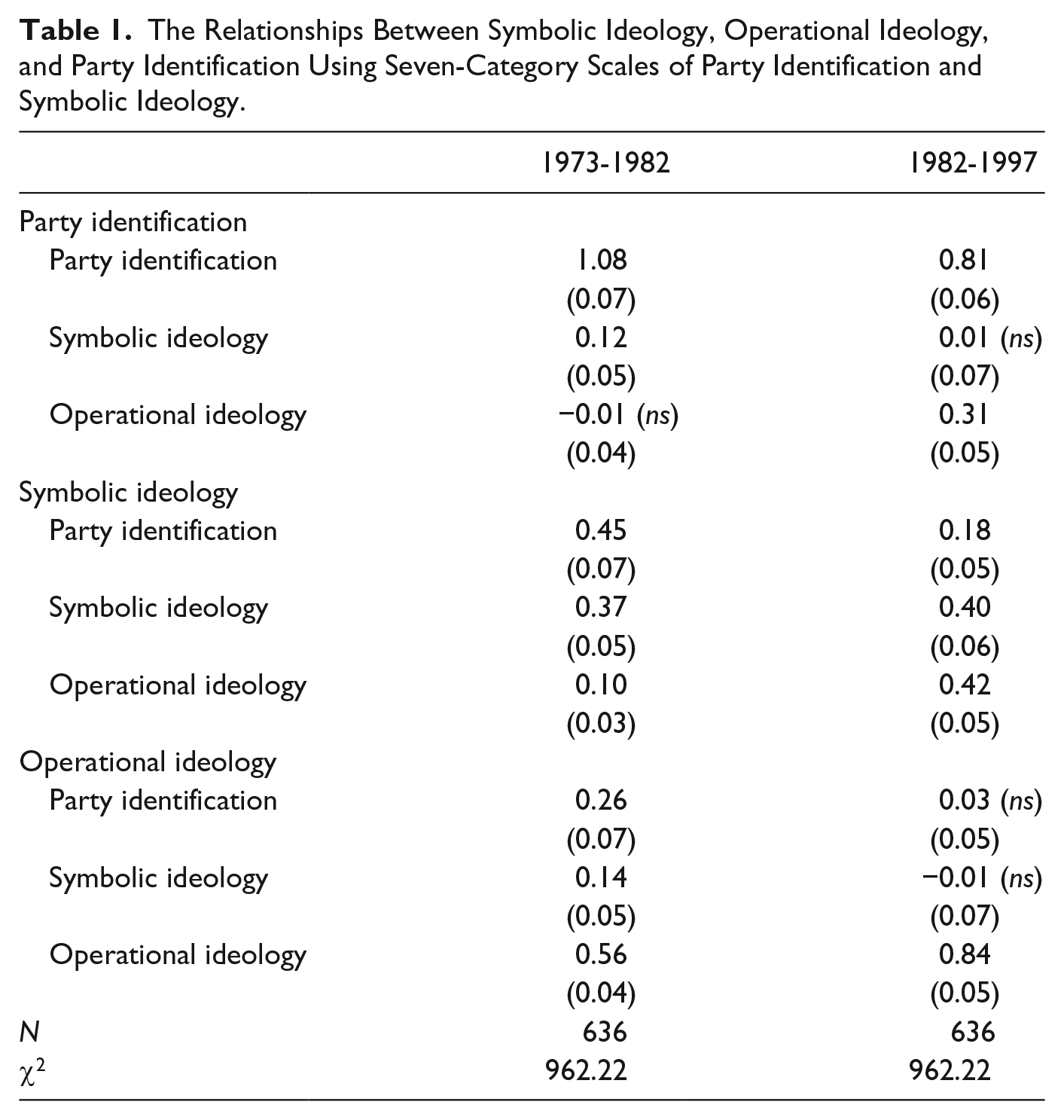
The cross-lagged coefficients provide a direct test for ideological realignment. For there to be evidence of such realignment, the effect of ideology on party identification needs to be significantly greater than the effect of party identification on ideology. In addition, this model allows for an examination of the independent effects of both symbolic and operational ideology on party identification and each other. As expected, there is little evidence of realignment during the 1973-1982 period. Symbolic ideology has a statistically significant effect of party identification, but the effect of party identification on symbolic ideology is much greater (.12 vs. .45). There is no significant effect of operational ideology on party identification. However, the results of the analysis of the 1982-1997 period are quite different. The coefficient representing the effect of operational ideology on party identification is statistically significant (.31), whereas there is no significant effect of symbolic ideology on party identification or of party identification on operational ideology. Operational ideology has a significant effect on symbolic ideology, but because symbolic ideology has no effect on party identification, there is little evidence of an additional indirect effect of operational ideology on party identification through symbolic ideology.
The preceding results show evidence of an ideological realignment based on operational ideology, but not symbolic ideology. These findings remain substantively unchanged when White southerners are removed from the model, indicating that the results are not merely being driven by this group. 9 However, a separate analysis of only White southerners provides one reason for further analysis. A definitive examination of the behavior of this group is problematic because of the small number of respondents with complete data (108). But such an examination shows strong evidence for an ideological realignment based on symbolic, rather than operational, ideology.
Another reason for further analysis is provided by the ideological realignment thesis itself. This thesis suggests that ideological realignment will take place over a relatively long period of time, and that it will result in significant changes in the party identification of individuals. However, the results reported in Table 1 are produced using a Party Identification scale based on the seven-category measure of party identification, which can be constructed only after initial “Independents” are pushed to choose a party. This measure contains adjacent categories such as weak Democrat and Independent-Democrat that in reality may not be that much different from one another. But realignment is about significant changes in party identification, and use of the seven-category scale may be obscuring these changes. 10 The same argument might be made about the ideological self-identification measure, with its adjacent categories such as liberal, slightly liberal, and so forth. Therefore, the models were further analyzed by substituting the three-category party identification measure for the seven-category measure. In addition, the seven-category ideological self-identification measure was collapsed into three categories, representing all liberals, moderates, and all conservatives. 11
Table 2 shows the results using the three-category measures of both party identification and ideological self-identification, and some dramatic departures from the results shown in Table 1 are evident. First, party identification is much less stable during the 1982-1997 period using the three-category measure. In Table 1, the stability coefficient for party identification during this period is 0.81, but using the three-category measure drops this coefficient to 0.48. But the change to the stability coefficient for symbolic ideology during the 1982-1997 period is even more astounding. Using the three-category ideological self-identification measure increases this coefficient from 0.40 to 1.18, which is all the more impressive considering that this coefficient is actually less stable during the 1973-1982 period using the three-category measure than it is when using the seven-category measure (0.24 vs. 0.37). Moreover, the second time period is lengthier than the first time period, making these large stability coefficients even more remarkable. This suggests that during the 1982-1997 period, although there may be some drift within the liberal and conservative categories, there is very little movement between them. The stability coefficient for party identification during this period indicates that the opposite type of movement is at work. The seven-category stability coefficient is fairly high, but its three-category counterpart is much lower, suggesting that the movement that does exist is taking place across the categories of “Republican,” “Independent,” and “Democrat.”
The Relationships Between Symbolic Ideology, Operational Ideology, and Party Identification Using Three-Category Scales of Party Identification and Symbolic Ideology.
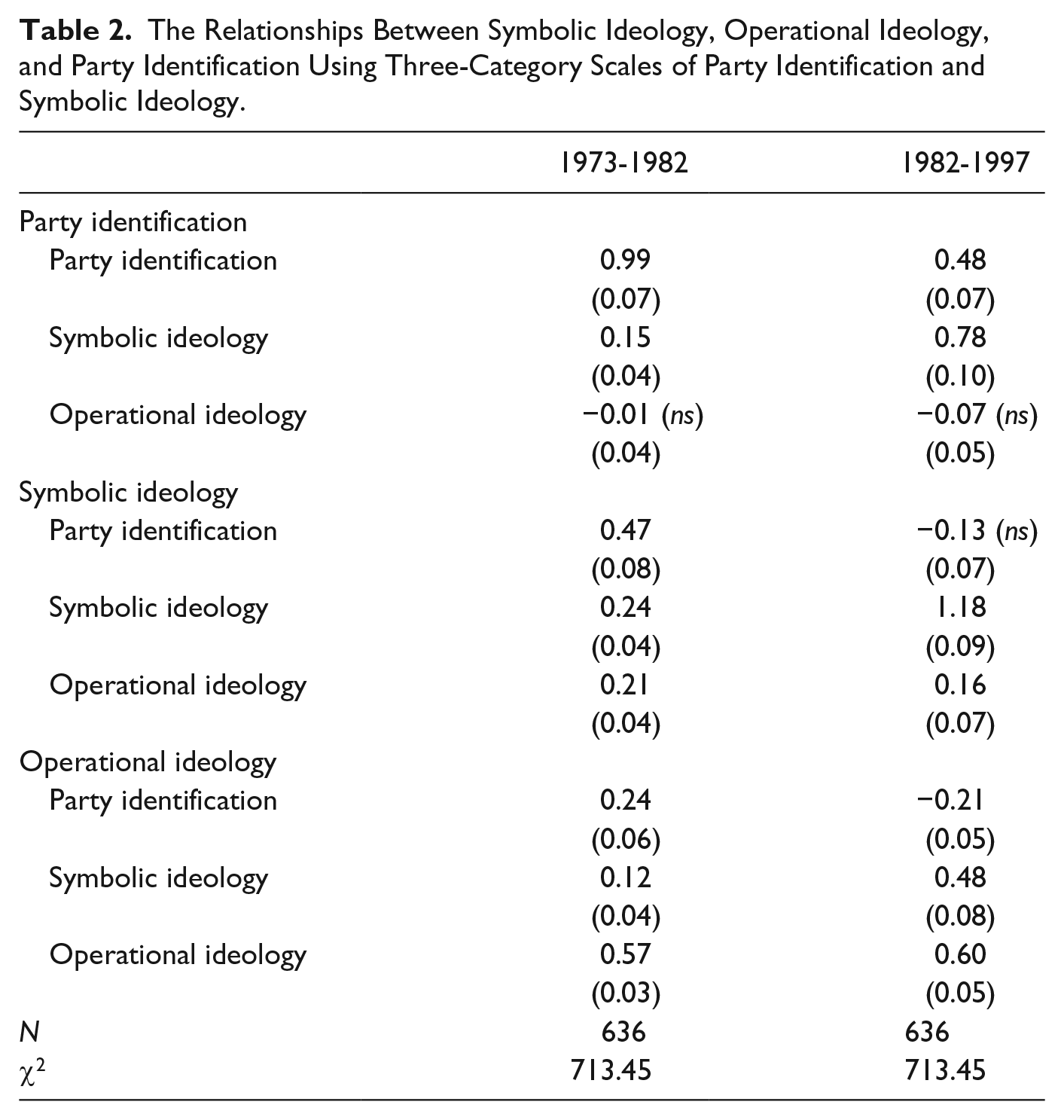
The cross-lagged coefficients using the three-category measures of both party identification and symbolic ideology indicate that, similar to the results shown in Table 1, there is little evidence of ideological realignment during the 1973-1982 period. However, the results of the 1982-1997 period show strong evidence of an ideological realignment based on symbolic ideology. The coefficient representing the effect of symbolic ideology on party identification is quite large, but the coefficient representing the effect of party identification on symbolic ideology does not even reach statistical significance. Moreover, there is little evidence of any realignment based on operational ideology, as the coefficient representing the effect of operational ideology on party identification also fails to reach statistical significance. There is some evidence that operational ideology has an indirect effect on party identification during this period, through its significant effect on symbolic ideology. But even this indirect effect is quite small compared with the huge direct effect that symbolic ideology has on party identification. 12 One final result of note is the statistically significant, yet negatively signed, coefficient representing the effect of party identification on operational ideology during the 1982-1997 period. There is no ready explanation for this finding, but calls into question the relationship between operational ideology and party identification. 13 Finally, it is noteworthy that the chi-square value of this model is lower than its counterpart in the previous model. In the context of structural equation modeling, lower chi-square values indicate a better goodness of fit. 14
The results shown in Table 2 are not substantively changed by removing White southerners from the analysis. But unlike the results shown in Table 1, the exact same pattern of realignment based on symbolic ideology is found among the White southerners group during the 1982-1997 period. Therefore, it is essentially only in the seven-category party identification/symbolic ideology model for non-southerners/Black southerners in which there is evidence of an ideological realignment based on operational ideology. To further explore this anomaly, the seven-category non-southerners/Black southerners model was reanalyzed using only a three-item scale of cultural issues for the measure of operational ideology (legalization of marijuana, women’s role in society, school prayer). This was done for two reasons. First, use of a three-item scale puts the operational ideology measure on equal footing with the three-item symbolic ideology scale. Second, the literature suggests that realignment is largely centered around the ascendancy of cultural issues, so it might be expected that such a scale would have a particularly strong effect on party identification. Instead, in this model the coefficient representing the effect of operational ideology on party identification between 1982 and 1997 is greatly reduced (from 0.34 to 0.14), and the coefficient representing the effect of party identification on operational ideology, which is not statistically significant in Table 2, rises to 0.39 (not shown). Thus, a focus on cultural issues provides little evidence of a realignment based on operational ideology.
Summary and Discussion
One of the most important developments in U.S. party politics over the last several decades has been the increasingly strong connection between ideology and party identification among the public. Supporters of the ideological realignment thesis contend that this transformation is the result of individuals adjusting their partisan attachments to correspond to their ideological beliefs. However, others have argued that it is more likely that people have merely adopted ideological labels consistent with their partisan attachments. Moreover, the evidence suggests that short-term partisan attachments are quite stable, and individuals are more likely to adjust their issue attitudes to correspond to their party identification than vice versa. Yet, this literature has also largely focused only on the connection between operational ideology and party identification.
The results presented here provide a long-term view of the relationship between ideology and party identification, and by focusing on the distinction between symbolic and operational ideology give a comprehensive view of this relationship during the last several decades. Between 1973 and 1982, there is little evidence of realignment, as party identification is fairly stable and has a larger effect on both types of ideology than vice versa. But between 1982 and 1997, there is evidence of ideological realignment in both models examined here. The model produced using the seven-category measures of party identification and symbolic ideology shows that operational ideology is responsible for this realignment, at least among non-southerners and Black southerners. However, the model produced using the three-category measures of both party identification and symbolic ideology shows strong evidence of an ideological realignment based solely on symbolic ideology, and these results do not change when non-southerners/Black southerners and White southerners are examined separately. The stability of symbolic ideology during the 1982-1997 period is also extremely high, whereas the stability of party identification declines considerably. This decline, along with symbolic ideology’s strong effect on party identification, occur as these respondents are growing older and in theory already have well-established political attitudes. Such occurrences are additional evidence of the importance and strength of symbolic ideology during this time period.
These findings suggest a revision to the ideological realignment thesis. Symbolic ideology has a strong effect on party identification between 1982 and 1997 when both variables are measured on three-category scales, which are arguably better equipped to reveal evidence of realignment. The strength of the effect of symbolic ideology on party identification compared with the effect of operational ideology on party identification in this model is especially noteworthy given that the indicator for operational ideology contains more items than the indicator for symbolic ideology. Moreover, the operational ideology indicator includes both economic and cultural issue items. Thus, ideological realignment seems to be driven primarily by symbolic ideology, and its significance in the presence of a multiple-item indicator of operational ideology lends support to the argument that symbolic ideology is both conceptually and empirically distinct from operational ideology, with very important independent effects.
Why has symbolic ideology become so important for party identification during the post-1980s period, and what are the implications of it being more influential than operational ideology? Answering these questions requires a more thorough examination of the determinants of symbolic ideology, but Ellis and Stimson (2012) have made some promising strides along this path in their examination of symbolic conservatives who are operationally liberal on economic issues, or on both economic and cultural issues. Their findings point to the importance of religious traditionalism for the “conservative” label, an importance that goes beyond cultural issue attitudes. If indeed symbolic ideology represents in part a connection to deeply rooted cultural and/or group attachments, then scholars need to rethink the whole idea of an ideological realignment based on the parties’ issue positions, be they economic or cultural. For practitioners of politics, the bond between symbolic ideology and party identification points to the importance of language and symbolism to the electorate, even in an era when the public has generally become more aware of the parties’ issue positions.
Another question raised by the findings regards the stability of party identification, and whether the decline of this stability portends an era of weaker party attachments. However, secular realignment by definition is a long-term phenomenon, and as such the results presented here do not suggest that party identification now exhibits higher levels of short-term instability than in the past. That is, the findings provide no reason to reject the evidence that party identification remains largely impervious to temporary forces such as economic growth and/or decline, presidential approval ratings, and so forth. Indeed, the association between symbolic ideology and party identification is consistent with the literature showing party identification to be a generally enduring trait, tied to the social imagery of the parties. Further research is required on this point, but symbolic ideology, when explicitly tied to the parties, might serve as a simple branding mechanism for each party. In this scenario, a realignment based on symbolic ideology would represent a shift in party identification based on changing party social images, rather than being based on the parties’ changing issue positions. Given the significance of symbolic ideology demonstrated here, future research should delve deeper into an exploration of this important concept.
Footnotes
Acknowledgements
Many thanks to Paul Goren and three anonymous reviewers for their helpful comments and suggestions.
Author’s Note
An earlier version of this article was presented at the Annual Meeting of the Midwest Political Science Association, April 2013, Chicago, IL.
Declaration of Conflicting Interests
The author(s) declared no potential conflicts of interest with respect to the research, authorship, and/or publication of this article.
Funding
The author(s) received no financial support for the research, authorship, and/or publication of this article.