



Abstract
Scholars interested in bargaining over political appointments typically analyze the duration between the candidate’s nomination and eventual disposition, ignoring the prior period between vacancy and nomination. Using a dataset of vacancies reported to the Government Accountability Office, we instead examine the nomination stage. We uncover both commonalities and differences between the dynamics of nomination and those of confirmation. Ideological divergence between the President and the Senate filibuster pivot tends to delay nominations but only under divided government. Presidents not only move more quickly on more important positions, but are also influenced by the ideological leanings of the agencies.
Introduction
While the Obama administration has done reasonably well in pushing nominees through the process once they have been announced, there have been long delays in finding nominees in the first place. The head of the Drug Enforcement Administration was vacant for almost two years, for example, as was the second in command at the Justice Department. (Light, 2011)
Scholars and policymakers alike have expressed consternation over the slowness of the advise and consent process for Presidential appointments, wherein Presidents nominate and the Senate approves candidates for various executive and judicial positions. For example, courts and executive agencies are often said to lack sufficient leadership to execute their responsibilities (e.g., Farber & O’Connell, 2014). Not surprisingly, empirical scholars of both judicial and executive appointments have exerted considerable energy trying to ascertain the determinants of delay. Typically, this involves analyzing the time span between initial nomination and Senate decision. Some of the apparent determinants of delay are intuitive. For example, when the President and the Senate are at ideological or partisan odds, both executive and judicial nominees tend to endure longer confirmation periods and are more likely to be rejected (Asmussen, 2011; Bailey, 2007; Bell, 2002; Hartley & Holmes, 2002; Hollibaugh, 2015c; Jo, Forthcoming; McCarty & Razaghian, 1999; Shipan & Shannon, 2003). 1
Additionally, both the executive and judicial literatures have found that competent nominees experience greater confirmation probabilities and shorter delays (Basinger & Mak, 2010; Cameron, Cover, & Segal, 1990; Epstein, Lindstädt, Segal, & Westerland, 2006; Hollibaugh, 2015b, 2015c; Shipan & Shannon, 2003; but see Lott, 2005, for a contrary claim). The importance of executive positions is also relevant, as nominees to the most important offices tend to be confirmed more quickly (Aberbach & Rockman, 2009; Chiou & Rothenberg, 2014; Krutz, Fleisher, & Bond, 1998; McCarty & Razaghian, 1999).
However, per Light (2011), the appointment process has two stages, either of which can be quick or slow. The initial period is between when a vacancy arises and nomination occurs. Subsequent is the interval scholars have emphasized, during which the Senate reacts to the nomination. For at least two reasons, studying the latter while ignoring the former cannot produce a full understanding of the bargaining process in play. First, the President’s nomination speed may be conditioned by expectations about Senatorial response, making it endogenous to the confirmation process. For example, the President may be in no hurry if he believes that the Senate will sit on a nomination until its session expires. Alternatively, if he feels the Senate will either insist on delaying a nomination for some time—perhaps appeasing interest groups or other audiences—or respond expeditiously, he may be incentivized to move quickly. Second, understanding the full impacts of potential determinants requires focusing on the initial decision. Doing this, we might discover that certain factors are more or less influential for the entire process than is typically thought.
In the following, we concentrate on developing an understanding of the period from vacancy to nomination. We view our analysis as a step in the process of developing a comprehensive grasp of the appointment process, which represents a significant contribution, given the previous emphasis on the post-nomination duration. We admit that, just as studying confirmations without considering nominations is problematic in that confirmations are inherently conditional on a nomination being put forth, our analysis will be potentially affected by expectations about confirmations. Executive decisions about how quickly to nominate, or even whether to nominate at all, are potentially predicated upon beliefs about how the Senate will react. While we believe the precedence of nominations to confirmations likely makes not integrating the confirmation stage of the process directly into our analysis less of a detriment than the corresponding problem created by studying confirmations while ignoring nominations —though we try to capture Presidential expectations of Senatorial activity in our specifications—in the longer run we would like to move on to the more complicated task of simultaneously examining nominations and confirmations. But, for now, we will focus on exploring the period up to nomination.
This is by no means easy. While measuring post-nomination legislative action is not problematic, collecting data on vacancy-nomination time has been more difficult historically. We address this by drawing on a dataset of executive (i.e., nonjudicial) vacancies reported to the Government Accountability Office (GAO) pursuant to the Federal Vacancies Reform Act of 1998 (FVRA); here, we focus on vacancies beginning in the 106th through 112th Congresses (January 1999-January 2013), tracing their progressions until the end of the latter Congress. 2 This allows us to estimate models of the nomination process.
Our results suggest that many of the same factors that influence the confirmation process also affect the nomination process, though seemingly in more nuanced ways. Ideology is important—particularly the ideological divergence between the President and the filibuster pivot—but its influence can be mitigated or enhanced by whether the President and the Majority Leader are on the same team. Intriguingly, partisan discord can speed up nominations in certain cases, contrary to its typical effect in the confirmation stage. Position importance is also relevant, as is the ideological correspondence between the President and the agency receiving the nomination, though the effects of these covariates vary over when in a President’s term the vacancies occur.
Theory and Hypotheses
We develop our theoretical expectations for when we should observe nominations by starting with a series of related assumptions. First, we assume the President wants to implement his desired policies as quickly as possible and will therefore want to appoint those best able to do so. Second, the President will act more quickly the more important the resulting change in policy, all else equal (e.g., knowledge of potential candidates and likely Senate receptions). Third, the more expertise the President has about who is best to nominate, the greater his potential policy returns from doing so. Finally, the President will receive fewer returns from an ideologically divergent Senate and/or a Senate controlled by the opposite party.
Given these assumptions, the principal features of relevance are ideological divergence between the President and the agency, ideological and partisan discrepancies between the President and the Senate, the possibility of a new nominee changing policy outcomes to the President’s liking, and when in a President’s term a vacancy occurs (and how, indirectly, this affects the President’s ability to pick the “right” nominee).
As the President will be able to derive the greatest relative policy returns by appointing individuals to ideologically out-of-step agencies/departments, it follows that agency/department ideology should influence nomination speed. This dynamic is also in the spirit of research on the post-nomination process and politicization—that is, on efforts by Presidents to control bureaucracies not sharing their policy goals (Gailmard & Patty, 2007; Hollibaugh, 2015a, 2015b; Hollibaugh, Horton, & Lewis, 2014; Lewis, 2005, 2008; Lewis & Waterman, 2013; Moe, 1985; Moynihan & Roberts, 2010; Parsneau, 2013; Weko, 1995). 3 Thus, incentives to shift oppositional agencies result in our first hypothesis.
Relatedly, as filling high-ranking vacancies enhances executive ability to induce policy change, the President will have an incentive to nominate individuals to these positions more quickly than lower ones. In addition, Chiou and Rothenberg (2014) note that, as high-ranking positions are the most high profile, confirmation delay comes with potential audience costs for legislators; conceivably, Presidential delay when nominating might risk the same backlash for the most high-profile and high-ranking positions. 4 Therefore, the incentive to affect policy by quickly replacing higher-ups leads to a second hypothesis.
While our first two hypotheses are straightforward, others involve the joint impact of a variety of factors. For starters, the timing of a vacancy within a President’s term may influence the effect of agency ideology on nomination speed. To illustrate, consider a new administration taking office with partisan control changing hands (as for all administrations in our data). Consistent with the first two hypotheses, the President’s prioritization of policy effects should lead him to try and quickly influence ideologically divergent departments and agencies (C. Johnson, 2008; Lewis, 2008; Weko, 1995). However, this effect may be mitigated by the possibility the executive knows more about whom to appoint for allied agencies (assuming lack of expertise about whom to pick delay nominations). This is likely the case as Presidents and their personnel offices are typically inundated with job seekers at the administration’s onset; when these individuals have relevant expertise, it usually involves policy areas overseen by allied agencies, thus enhancing these agencies’ pools of qualified potential nominees (Krause & O’Connell, Forthcoming; Lewis, 2008; Weko, 1995).
There are other reasons to believe that late-occurring vacancies will induce Presidents to focus more on ideologically distant agencies. The expertise gap about whom to select will have narrowed, the Senate will likely have both a variety of pending nominations and other legislative matters to consider, and the President will have less political capital than earlier in his term (T. R. Johnson & Roberts, 2004, 2005). In other words, at later points in his term, the President will have more pressure to determine which possible vacancies to fill. As such, his strategic calculations—conditioned by his incentive to move quickest on vacancies that provide the highest policy returns—will have changed. Appointees departing agencies whose missions are ideologically aligned with the President’s preferences will leave behind bureaucracies that, while perhaps slightly less well-functioning due to the new vacancy, are still fundamentally aligned with the President’s preferences, while those exiting agencies whose missions run counter to the President’s preferences will present greater net opportunities. This will provide the President incentive to move quickly to fill vacancies in out-of-step agencies.
Given the different strategic conditions and changes in information that occur over time, we expect a nonlinear relationship between an agency’s ideological alignment with the administration and nomination speed. While early nominations to both allied and oppositional agencies should be speedier than those to neutral agencies, the former because of knowledge about whom to nominate and the latter due to the urgency of changing agency policy direction, later nominations to allied agencies should proceed more slowly given the lesser returns and those for antagonistic agencies should proceed more quickly due to the greater policy gains. This leads to two additional hypotheses.
Finally, we examine the roles of ideological and partisan divergence between the President and Senate. As mentioned, several studies of the confirmation process point to ideological and partisan conflicts between the President and the Senate as important explanators of confirmation delay and success (Asmussen, 2011; Bailey, 2007; Bell, 2002; Hartley & Holmes, 2002; Hollibaugh, 2015c; Jo, Forthcoming; McCarty & Razaghian, 1999; Shipan & Shannon, 2003). These factors should play roles here as well. All else equal, we expect longer delays when ideological divergence between the President and the relevant Senate pivot is high. In line with the theory posited by Hollibaugh (2015c), the executive branch will engage in more due diligence in these cases to ensure that its nominee is confirmable. We therefore derive Hypothesis 5.
As for partisan differences, we assume that divided government and high levels of ideological disagreement between the President and the relevant Senate pivot both lead to longer, drawn-out confirmation processes, and the President will take this into account when making his nomination decision. As we will elaborate, whether the effects of partisan differences are conditioned by ideological forces is key to determining their potential impacts.
Most of the time, divided (unified) government will correlate with high (low) levels of ideological divergence between the Senate and the relevant pivot. Here, partisan and ideological dynamics will both point in the same direction, either jointly shortening or elongating the confirmation process. In these instances, due to its “team” aspect (e.g., Lee, 2008), partisanship should only exacerbate the effects of ideology (consistent with the logic in Hollibaugh, 2015c). With divided government, time until confirmation should increase due to the increased need for internal vetting to ensure confirmability relative to what is required under unified government.
However, there may be cases when the partisan and ideological dynamics do not align so neatly. For example, there may be instances when ideological polarization is high, shifting the filibuster pivot far away from the President, under unified government. Conversely, low polarization could produce a filibuster pivot reasonably near the President with divided government. Under such conditions, partisan and ideological forces may work at cross-purposes, with partisanship not necessarily buttressing the impact of ideology.
When there is ideological hostility from the Senate pivot under unified government, it is still conceivable that the nomination will proceed more quickly than it would under divided government, as the President’s party will still control confirmation hearings and need to do less work to ensure confirmability than under divided government, at least at the margins. When the relevant Senate pivot is ideologically friendly yet the Senate is controlled by the opposite party, forming a priori expectations is particularly problematic. On one hand, the President might move more slowly than he would when facing an ideologically friendly Senate pivot under unified government due to the need to vet nominees to ensure that they are confirmable and able to withstand the machinations of the opposing party. On the other hand, an ideologically friendly filibuster pivot in the presence of divided government could be a symptom of weak party discipline (e.g., Chiou & Rothenberg, 2009), giving the President less need to worry about partisan efforts damaging confirmability and providing incentives to make nominations more quickly relative to an ideologically similar Senate controlled by the same party. The rush to make a quick nomination with such ideological conditions and divided government may be especially great if there is a worry that, at some point, the “team” mind-set will set in and party leaders will begin to enforce discipline, undermining the ease of confirmation.
Our discussion implies that the potential impacts of partisan control may be unconditional or conditional. If the first possibility is true, then divided government increases the length of time until nomination. If the second possibility holds, then divided government’s effects are exacerbated by ideology, with nominations being made more quickly when ideological divergence is low and more slowly when high. We thus propose two hypotheses regarding the effects of partisanship—one unconditional and one conditional—only one of which should hold:
With a set of testable hypotheses in hand, we turn to our empirical analysis.
Data, Methods, and Results
We examine our hypotheses using our data on when vacancies begin and end (or whether they are ongoing at the 112th Congress’ conclusion). We supplement this with Library of Congress data to incorporate dates for intervening events (i.e., nominations, withdrawals, and Senate rejections) to compute the lengths of salient features of the process (e.g., times from a vacancy’s creation to nomination, from nomination to confirmation, from Senate rejection to new nomination, etc.). As such, we code each vacancy’s status for three states: (a) unfilled and without a Presidential nomination (the President either not acting or a nomination being withdrawn or defeated), (b) under Senate consideration, and (c) filled. 5 Thus, we compute the time a vacancy is in a state and the type of transition between states (e.g., Did control revert from the Senate to the President because of a returned or a withdrawn nomination?). Using this framework, our depiction of how positions requiring Senatorial approval are or are not filled is more accurate—and richer analytically—than prior analyses.
Figure 1 presents Aalen– Johansen (1978) probabilities with 90% confidence intervals for each state given time after vacancy onsets. 6 There is considerable variation in how quickly vacancies move between states, with Presidents filling some openings quickly and delaying others. About 55% of vacancies are either filled or have nominees under Senate consideration within 6 months of vacancy onset, and about 80% are filled or have nominees under consideration within 1 year. 7 In addition, about 55% of vacancies ending in confirmation are filled within 1 year, 75% within 18 months, and 85% within 2 years. These results show that, while Presidents move to fill most vacancies fairly quickly, there is also considerable variation in the length of time before a nomination is made.
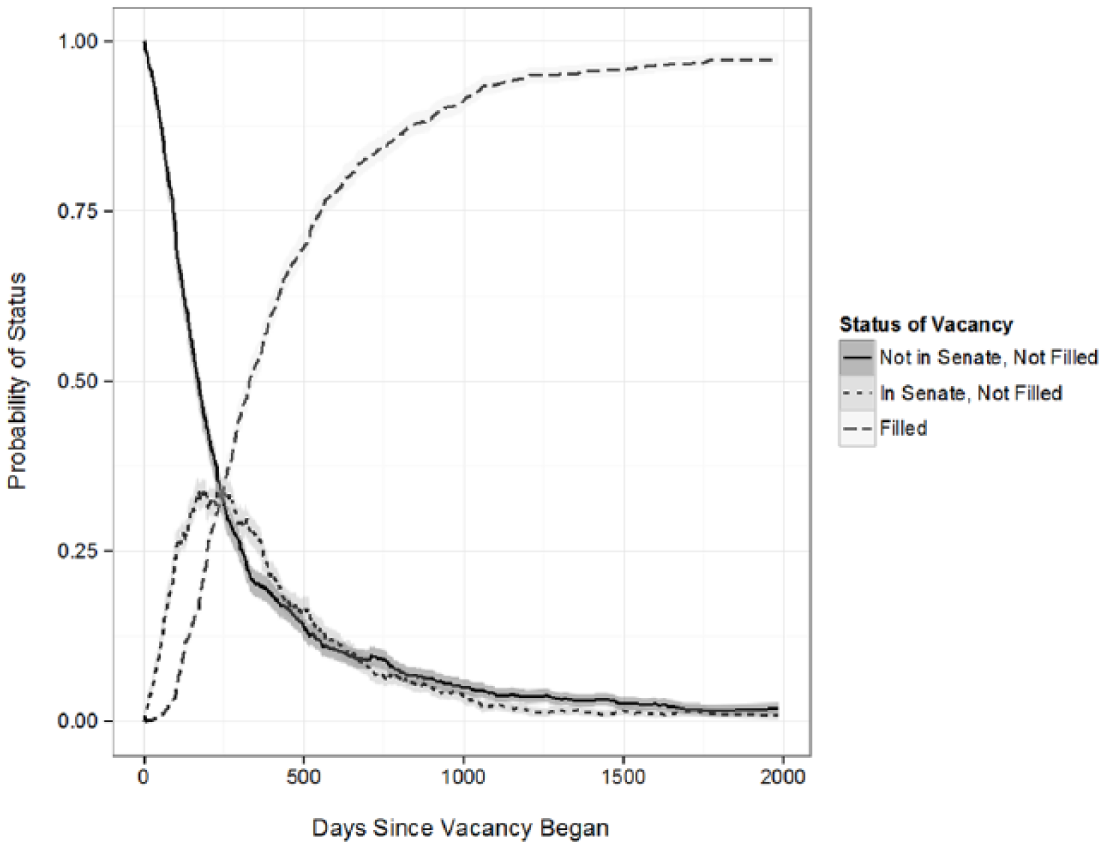
Aalen–Johansen probabilities of vacancy status.
To better understand how different factors influence the length of time until nomination, we use nonparametric Kaplan– Meier (1958) survival curves. Each curve shows the relationship between one of our independent variables but without covariates, and the proportion of vacancies with nominations sent to the Senate over time. Our dependent variable in all instances is Vacancy Length, measured by the number of days between a vacancy’s onset and a nomination. 8 Figure 2 displays three such plots (90% confidence intervals are included).
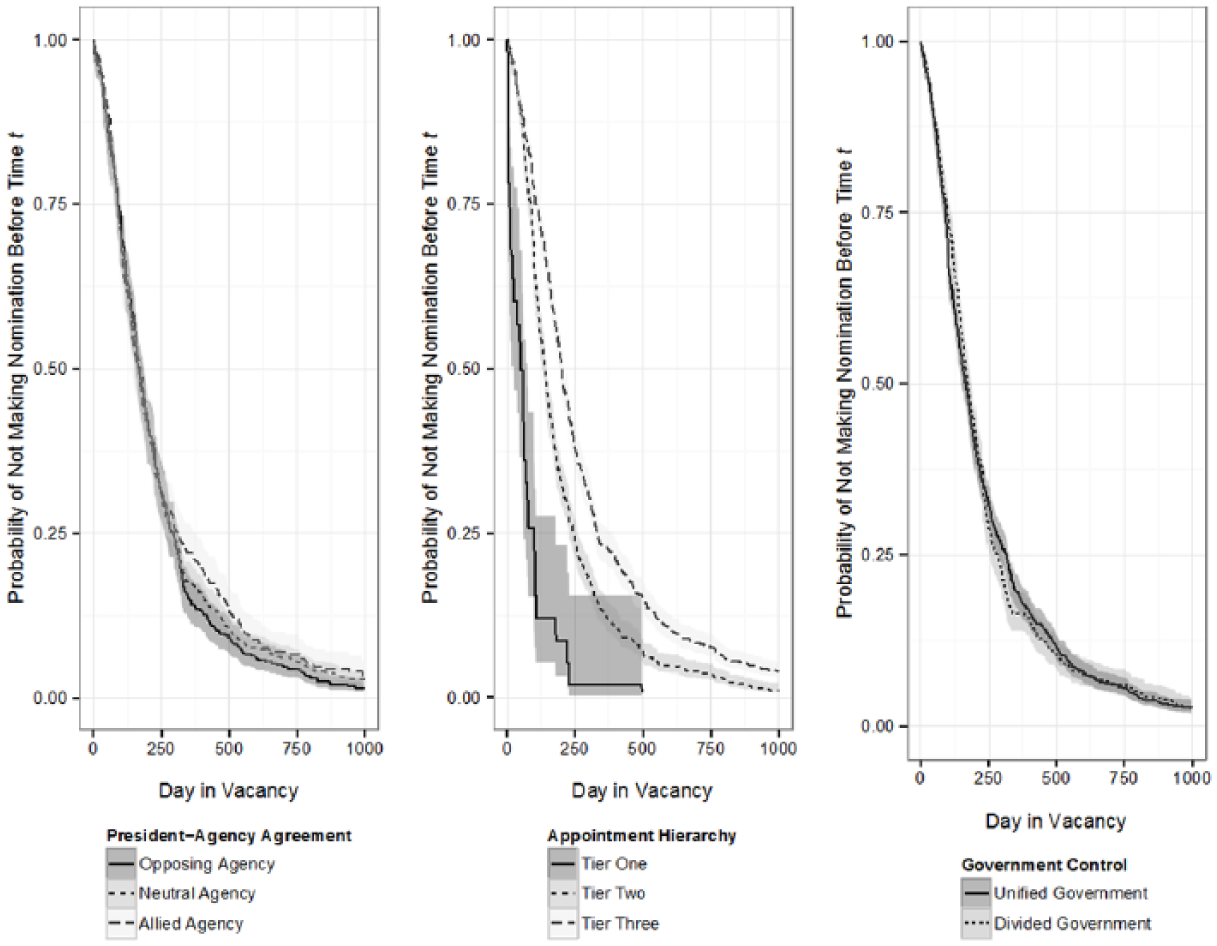
Kaplan–Meier probabilities of not making nomination, stratified on President–agency ideological agreement, position hierarchy, and partisan control.
The left pane of Figure 2 shows the association between nomination rates and the degree to which the President is not ideologically aligned with an agency, as measured by levels of President–Agency Agreement. Nominations to friendlier agencies are slower than to more hostile ones. This indicates that Presidents focus their efforts on minimizing resistance to their policies, in support of Hypothesis 1.
The middle pane displays the relationship between the probability of nomination and position importance. Position importance is stratified into three categories. Tier 1 includes secretaries, attorneys general, and the administrator of the Environmental Protection Agency; Tier 2 includes under, deputy, and assistant secretaries as well as the associate, deputy, and assistant attorneys general; and Tier 3 consists of the rest. Nominations to higher-ranked positions are made more quickly, at least within the first year, in support of Hypothesis 2. Statistically indistinguishable results between Tier 1 and Tier 2 positions after Year 1 are likely due to nominations for all Tier 1 vacancies being sent to the Senate within 500 days.
Finally, the right pane of Figure 2 plots the predicted probability of nomination over time, stratified on government control. Surprisingly, partisan control has a minimal effect on nomination rates, in contrast to the prediction in Hypothesis 6a. However, to foreshadow the next step in our analysis, we should reiterate that the Kaplan–Meier model excludes covariates and does not account for the underlying ideological variation across government types (and, therefore, Hypothesis 6b cannot be assessed). Nonetheless, this preliminary result is somewhat surprising, as it contrasts with findings for the confirmation state that partisan conflict exacerbates confirmation delay unconditionally.
We now move to incorporating covariates and the interaction between ideology and government type by estimating duration models, which have been utilized to great effect in past work on confirmation. In particular, we estimate a Cox (1972) proportional hazards model and include factors suggested by our theoretical discussion as well as those used in prior research. 9
Per our theoretical discussion, we measure ideological and partisan gaps between the two relevant branches (Krehbiel, 1998) by including President–Filibuster Distance, the absolute value of the difference in common space (Poole, 1998) scores between the President and the filibuster pivot; Divided Government, a dichotomous variable equaling 1 if the President and Senate majority leader are from opposing political parties and 0 otherwise; and an interaction between the two. 10 We capture a position’s importance by including Tier 1 and Tier 2, as previously defined, with Tier 3 being the omitted category. We account for agency-level ideology by incorporating President–Agency Agreement, which is based on Clinton and Lewis (2008) agency ideology estimates. 11 President–Agency Agreement is coded 0 if the Clinton–Lewis score is in the interquartile range (suggesting a moderate agency), 1 if it is in the lowest (highest) quartile (indicating a more liberal [conservative] agency) and the President is a Democrat (Republican) and, conversely, −1 if the score is in the highest (lowest) quartile and the President is a Democrat (Republican). 12 Furthermore, due to Hypotheses 3 and 4’s expectations of the effects of ideology being conditional over time, we interact this measure with Month in Administration. Finally, as the President might condition his strategy on how the Senate views the agency in question, we create Senate–Agency Agreement using the Majority Leader’s partisanship and also include an interaction with Month in Administration.
As indicated, we incorporate covariates that may influence the resolution of vacancies but for which we lack theoretical expectations. As there may be department- or area-specific influences we do not otherwise capture (e.g., Presidents may deem some agencies/departments higher priorities than others), we include dummy variables for the Departments of Agriculture, Commerce, Justice, and Labor. In addition, given sample size limits, we group the Departments of Education, Health and Human Services, and Housing and Urban Development as Social Welfare, Energy, Interior, and Transportation as Infrastructure, and Defense and Homeland Security as National Security. Agencies that either lie within the Executive Office of the President or outside of a cabinet department’s purview are defined as Nondepartmental. 13
We capture intangibles that could affect the difficulty of Senate rejection, as well as to account for Presidential behavior perhaps being driven by such forces, by including Presidential Approval, operationalized by the daily Gallup tracking poll. 14 As workload may affect the process, though the exact mechanism is unclear, 15 we define Daily Workload as the number of daily roll-call votes, Pending Nominations as the number of nominations awaiting final action, Months Left in Congress as the number of months remaining in Congress (as workload may be relative to time available), and In Recess as a variable equaling 1 if the Senate is in recess and 0 otherwise (as workload cannot be reduced if the Senate is not in session). Finally, we include Nomination Attempt, which equals 1 plus the previous number of nominations made to fill a particular vacancy. This accounts for the possibility that the President and/or Senate may be incentivized to resolve certain “problematic” vacancies (i.e., those with previous failed nominations) differently, or that the positions themselves are somehow different from others.
To justify the Cox approach, we must ensure that the proportional hazards assumption that estimated effects are constant regardless of vacancy length is met. We follow standard practice by estimating the model and examining Schoenfeld residuals. 16 We then interact those covariates displaying nonproportionality with the natural log of 1 plus the square root of the number of days the vacancy has existed (Box-Steffensmeier, Reiter, & Zorn, 2003; Box-Steffensmeier & Zorn, 2001). After doing this, the resulting global test statistic is insignificant (p ≈ .931, with the lowest coefficient-level p value of .137), indicating that the null hypothesis of proportionality cannot be rejected once we make the appropriate corrections. We also cluster by vacancy, so that the standard errors utilized are appropriate.
Table 1 displays results of our Cox model. 17 Signs of our coefficients and their statistical significance are largely in line with our theoretical expectations. 18 As typical with generalized linear models, the magnitudes of effects are difficult to discern from coefficients, especially given interactive or higher-order effects, the former of which we have in large quantity due to our nonproportionality corrections. Therefore, we present predicted percentage changes in hazard ratios for covariates of interest. 19
Cox Proportional Hazards Model of Nominations.
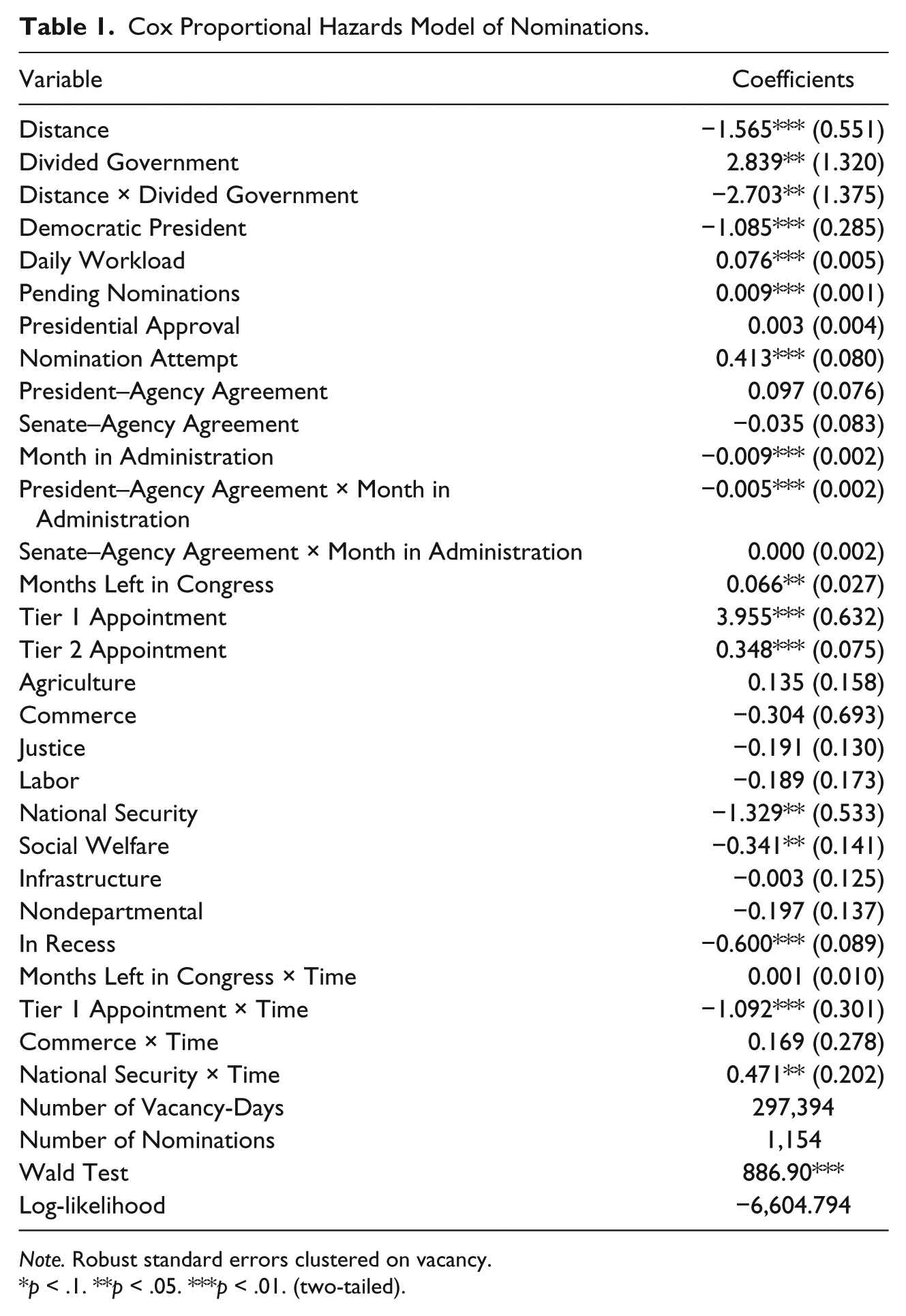
Note. Robust standard errors clustered on vacancy.
p < .1. **p < .05. ***p < .01. (two-tailed).
Figure 3 displays relative hazard ratios, conditional on agency ideology, and provides an additional context to the results shown in Figure 2. While the latter suggested that nominations to less ideologically aligned agencies occur more quickly, at least after the initial months of a vacancy, Figure 3 indicates the same is true if the month within an administration is taken as the time frame of interest. These results support Hypotheses 1 and 4. Beyond an administration’s first 3 years, appointments are made more quickly to more ideologically opposed agencies, as indicated by the percentage change in the hazard ratio being greater than zero. In addition, we find some support for Hypothesis 3; while the speeds of nominations to allied versus neutral agencies are comparable at the beginning of a term, nominations to allied agencies move more slowly over time, as indicated by the significant decrease in the hazard ratio. Collectively, these results suggest that, at the beginning of a term, Presidents quickly move to staff all agencies similarly (with the major sources of heterogeneity being position hierarchy and disagreement with the Senate). However, as their terms progress, Presidents nominate most quickly to opposing agencies and most slowly to allied agencies. This implies sitting Presidents desire to maintain politicization in oppositional (and, to a lesser extent, in neutral) agencies via new appointments and are willing to let acting officials and those in the civil service manage agencies whose missions inherently direct them to act in ways congruent with Presidential preferences.

Predicted effects of President–agency agreement on hazard ratio of nomination.
Figure 4 displays the relationship between vacancy length and position importance. 20 Here, the results of the Cox model broadly comport with those from the Kaplan–Meier plot, in that nominations to more important positions are made more quickly. However, the Cox model provides some nuance to the findings presented in Figure 2, in that it indicates the effects of position importance are largely conditional on how long a position has remained vacant. At the beginning of a vacancy, position importance—at least for Tier 1 positions—is of prime importance; however, after about 250 days, the rates at which nominations to vacant Tier 1 positions are made are essentially indistinguishable from those to less important positions. That said, it should be noted that the same dynamic does not hold for Tier 2 versus Tier 3 positions, in that the relative quickness to which nominations to the former positions are made is not dependent on how long a vacancy has remained open. However, as before, we need to recognize that some of these results are due to Tier 1 positions being filled very quickly, with very few vacancies remaining after 300 to 400 days, and all nominations sent to the Senate within 500 days. Overall, the results from the Cox model provide further support for Hypothesis 2.
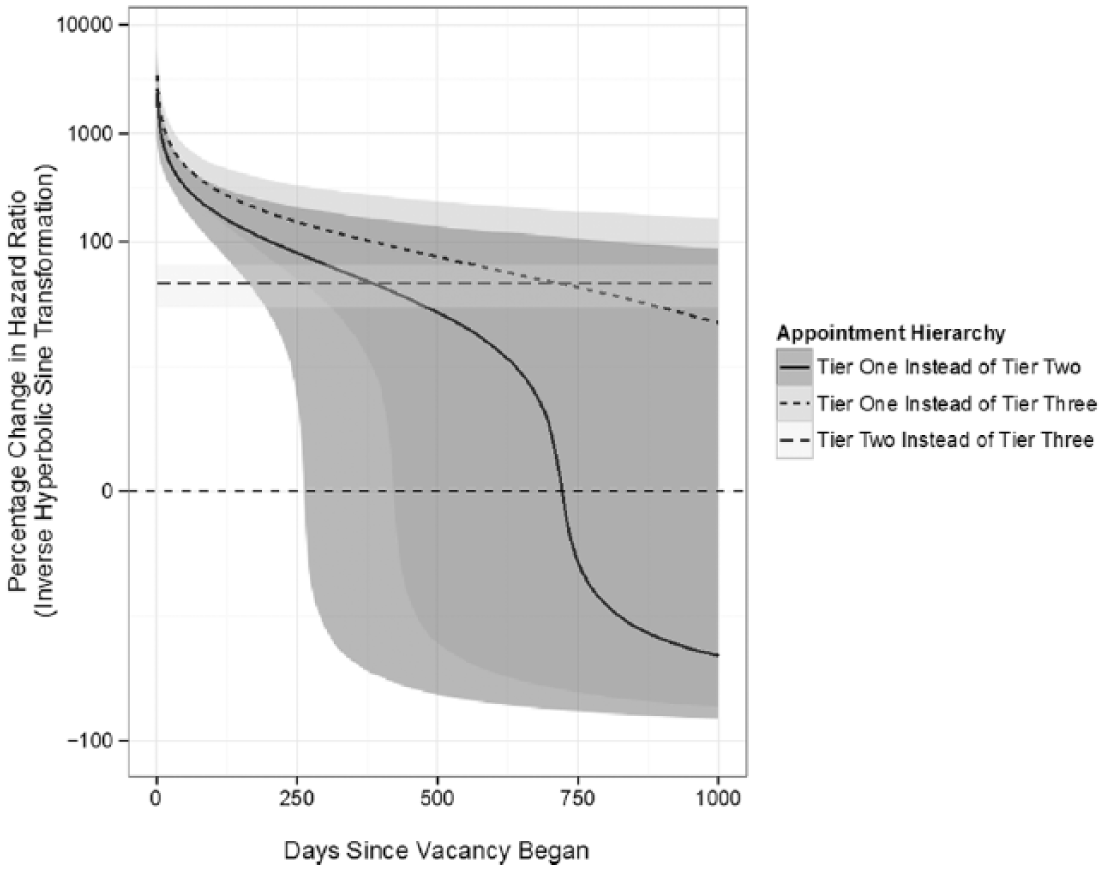
Predicted effect of position hierarchy on the hazard ratio of nomination.
Figure 5 depicts the relationship between hazard ratios and President–Senate ideological divergence and divided government, varying President–Filibuster Distance, and Figure 6 presents predicted percentage change in hazard ratios that would occur under a switch from unified to divided government, conditional on President–Filibuster Distance. Collectively, these results expand on our results shown in Figure 2. Although Figure 2 suggested that there was little difference in nomination rates across government types, Figures 5 and 6 indicate that this conclusion is inaccurate, as the effects of government type are conditioned by ideological divergence. While Figure 5 shows the same pattern of faster nominations when ideological divergence is low regardless of whether government is divided or unified, in support of Hypothesis 5, Figure 6 finds stark differences between the patterns across government types while holding ideology constant. When ideological distance between the President and the filibuster pivot is relatively low, then nominations occur more quickly under divided government. This is consistent with a Presidential desire to “strike while the iron is hot” by taking advantage of potential opportunities to secure quick confirmations, in support of Hypothesis 6b (conditional partisan effects) and contrary to Hypothesis 6a (unconditional partisan effects). However, when ideological divergence is high, then nominations proceed at a similar slow pace regardless of governmental control, suggesting that Presidents might exert their efforts elsewhere if they foresee a potential filibuster (or, alternatively, they spend more time searching for someone as amenable as possible to a hostile Senate). Without accounting for ideological differences and other covariates, as was the case in Figure 2, these dynamics might cancel each other out and lead one to conclude erroneously that there is no difference in nomination rates across government types.
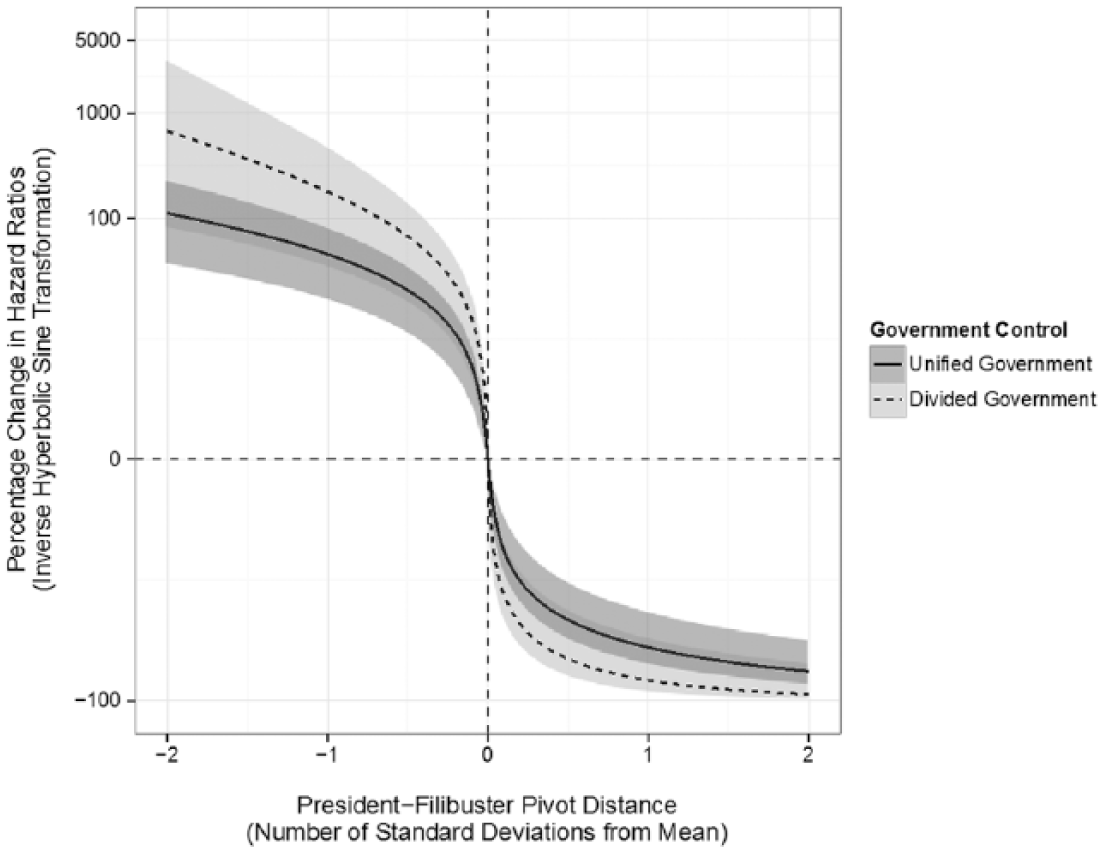
Predicted effect of President–filibuster pivot distance and divided government on the hazard ratio of nomination.

Predicted change in the hazard ratio of nomination under divided government.
In summary, nominations largely work as we expect. Hypotheses 1, 2, 4, 5, and 6(b) all receive strong support, whereas Hypothesis 3 receives partial support.
Discussion and Conclusion
Confirmation delay has long drawn the ire of partisans and journalists and the interest of scholars, though the abilities of the latter to study nomination delay have been stymied, largely due to a lack of data. Here, using a dataset of executive vacancies, we have provided one of the first attempts to analyze this process and have found almost all of our expectations met. In doing so, we have demonstrated both commonalities and differences between the dynamics governing the nomination and the confirmation stages of the appointments process.
Some features traditionally considered germane for confirmation appear in a different light when the nomination stage is examined. For instance, while ideological and partisan gaps between the President and the Senate are found to elongate the period between nomination and confirmation, they have different effects on the time needed to generate a candidate. Most strikingly, for nominations the effects of ideological and partisan divergence are conditional on one another. All else equal, nominations are made more quickly when ideological divergence is low, and more slowly when ideological divergence is high (possibly because of the additional efforts needed to generate a candidate confirmable by an ideologically hostile Senate, or a candidate willing to face one). However, the effects of low ideological divergence are enhanced when the Senate is controlled by the other party, and nominations are made more quickly when Presidents face friendly Senates controlled by the opposing party (presumably because of a desire to seize these rare opportunities); interestingly, divided government has a negligible effect when the Senate is ideologically hostile (the effect of Divided Government is insignificant), suggesting that ideology is of prime importance to the President and partisan considerations are conditional. These findings set nominations apart from confirmations.
Other features do affect the nomination stage in similar ways as they do the confirmation stage. In this vein, we find evidence that nominations to more high-ranking positions are made more quickly, as these positions are most important to the implementation of the President’s program. In addition, Presidents seemingly use nominations to influence agencies not deemed political allies, especially in the later part of administrations, a result consistent with a desire to maintain politicization via the appointments process. Conversely, the rate at which nominations are made to agencies deemed political allies decreases over the courses of administrations.
In the future, we see two directions for research. First, as foreshadowed, is incorporating the nomination stage into existing theories of the appointment process. While we have shown that the first stage of the overall process is important and some factors influencing confirmations affect nominations in different ways, we have examined the nomination stage in isolation rather than as part of a larger process. Second is integrating nominee ideology. For reasons of ease of data acquisition, we have only examined Presidential, Senatorial, and agency ideology. Including nominee ideology will better enable us to examine how the individual traits of the nominees—as opposed to the institutional contexts in which they are active—affect the dynamics of the process and the eventual outcomes witnessed.
Footnotes
Declaration of Conflicting Interests
The author(s) declared no potential conflicts of interest with respect to the research, authorship, and/or publication of this article.
Funding
The author(s) received no financial support for the research, authorship, and/or publication of this article.