



Abstract
Affective Intelligence Theory (AIT) posits that individuals, when feeling anxious, abandon dispositions and activate their surveillance system to attend to available political information about the focus of their anxiety. However, it is not clear whether, and to what degree, people exercise discernment about the reliability of the information they seek and find—especially when partisan cues and related information are not available in the information environment. We use this article to extend understanding of anxiety’s effect on assessing information reliability about an issue outside the standard partisan framework. Our assessment is based on a lab experiment where 330 non-student subjects were randomly assigned exposure to television ads referencing an impending nuclear terror threat to the United States. The ads included varying degrees of production vividness and either a positively or negatively framed message about the government’s ability to respond to the threat. Results show that the negative and vivid threat ads—when mediated by a subject’s relative level of anxiety—substantially raise the probability of surveying information related to the nuclear threat. However, the anxiety mediator has no effect on subjects checking the reliability of the surveyed information. These findings broaden our understanding of media ad effects by providing greater nuance on the motive for information use and anxiety’s mediating role.
Emotion, and anxiety in particular, is a well-documented catalyst for political behavior (Lewis & Granic, 1999; Lyons, 1999). Affective Intelligence Theory (AIT) is central in the emotion in politics literature, and posits that individuals, when feeling anxious, abandon their dispositions to undertake surveillance of available political information with the goal of culling data about an anxiety-producing object or event (Baum, 2002; Conover & Feldman, 1986; Druckman, 2005; Iyengar & Kinder, 1987; Lodge & Taber, 2000; Marcus, Neuman, & MacKuen, 2000). For its part, media content can stimulate viewer anxiety by shaping threat perception (Iyengar, 1991; McCombs, 2004). Political campaigns, interest groups, and related organizations realize the impact of media stimuli in this regard, and have a vested interest in using media-based appeals to trigger emotional reactions as part of messaging strategies (see Mendelberg, 2001).
Yet, much to the chagrin of campaign consultants, audience reaction to threatening stimuli may vary, even when anxiety is activated. The question we address in this article is whether, in addition to activating surveillance behavior, heightened anxiety draws increased attention to the information that one encounters in the information search process. In the era of political ad fact checking (see Amazeen, 2014), assessment of what motivates audiences to more critically evaluate the information they encounter has particular relevance and consequences. Other things equal, campaigns might not want increased scrutiny of information related to their activities and issue positions, despite the desire for a nominal level of audience attention and response. This makes greater understanding of the role emotion plays in garnering audience interest and information use a relevant topic for both political and media scholars.
Our assessment also relates to other information use puzzles, including biased attribution (Ross, Lepper, & Hubbard, 1975), motivated reasoning (Jost, Glaser, Kruglanski, & Sulloway, 2003), and misperception negation (Mayo, Schul, & Burnstein, 2004)—each of which would benefit from a more precise understanding of anxiety’s effect on information evaluation beyond surveillance (as it has been characterized in the AIT literature). Using an experimental design in a lab setting, we assess whether randomly assigned television ads alternating vivid visual and aural cues with positive and negative messages about the federal government’s response to a terrorism threat induces surveillance, reliability checking, or both. Our results indicate that anxiety, when used as a mediating variable, motivates surveillance as AIT expects, but does not encourage follow-on reliability checking of information. Implications for media ad effects on audiences and future research are then discussed.
Ads, Anxiety, and Reliability Checks
Political advertisements (e.g., sponsored ads and commercials) may trigger emotions, owing in great measure to the production values used in the ad (Ansolabehere & Iyenger, 1995; Iyengar & Kinder, 1987; Just, Crigler, & Wallach, 1990). As Brader (2005) found, the more vivid the ad the more likely it is to induce an emotional response from an audience. Specifically, positive ads containing vivid production values—which are generally intended to be uplifting—may reinforce prior beliefs or dispositions by activating a sense of enthusiasm, whereas negative ads featuring vivid techniques may increase anxiety when threatening information is conveyed (Garramone, 1986; Geiger & Reeves, 1991; Kahn & Geer, 1994). But, in addition to spurring information surveillance—or perhaps in place of it—anxiety may actually obstruct cognitive attention to information (Druckman & McDermott, 2008; Huddy, Feldman, Taber, & Lahav, 2005; Lerner & Keltner, 2000, 2001; MacLeod & Matthews, 1988; Yiend & Matthews, 2001). Indeed, while AIT and related theories associate anxiety with increased brain activity (Lang, 1985; Newhagen & Reeves, 1992; Valentino, Hutchings, Banks, & Davis, 2008), anxiety and fear have been found to contribute to a “freezing or immobility response”—depending on how the brain’s amygdala processes stimuli (LeDoux & Gorman, 2001, p. 1955; LeDoux, 1996).
Anxiety’s countervailing impacts on cognitive functions have ramifications for understanding information use in that vivid media stimuli carrying negative, anxiety-inducing messages may actually reduce the extent to which audiences evaluate threat-related information. And, the audience in this case may be vast. Depending on how much a sponsor has invested in a media buy, the ad may receive significant airtime across a variety of programming genres and formats and in hundreds of markets, perhaps reaching a larger audience than “hard” news content from traditional news platforms (Lodge, 1995; Lodge & Taber, 2000).
The cognitive immobility response that LeDoux (1996) described may manifest in audience behaviors after the surveillance activity (or perhaps in place of it). In keeping with the political “fact checking” premise popular in contemporary politics, a logical follow-on or second-order behavior after information surveillance is checking for information accuracy or reliability (see Gottfried, Hardy, Winneg, & Jamieson, 2013). Though AIT expects a diminished level of reflection on new information (surveillance) in response to positive, enthusiasm-generating messages or other media content, the AIT literature does not anticipate suppression on reliability checking when anxiety increases. Yet if anxiety spurs information surveillance while driving down reliability checking—or even a reduction in surveillance itself—the characterization of anxiety’s impact on political outcomes and audience reaction would require some revision.
Our assessment is premised on four central studies. The first is the aforementioned Marcus et al. (2000) work on AIT (see also MacKuen, Keele, & Marcus, 2005; Druckman & McDermott, 2008; Valentino et al., 2008). The second is Huddy et al.’s (2005) assessment of anxiety related to terrorism. Huddy et al. showed that experiencing anxiety about future terror attacks in the United States lowered public knowledge relevant to the contemporary terror threat. This finding reflects anxiety’s potential role as a depressor of cognitive functioning and information use. Given our focus on media stimuli, we incorporate key aspects of Brader’s (2005) research as our design’s third major premise. Brader used mock video campaign ads that varied the vividness of the visual and aural sensory cues available to subjects along “positive” (upbeat and enthusiastic) and “negative” (fear-driven) lines, tapping a research stream that has long associated the presentation of negative information with cognitive arousal (Bushman, 1988; Lang, Newhagen, & Reeves, 1996). In a general extension of Brader’s research design, we assess the impact of video-based stimuli in the form of mock television issue ads discussing the potential for nuclear terrorism on U.S. soil.
This leads to the contribution of the fourth study on which we draw—Geva, Mayhar, and Skorick’s (2000) Cognitive Calculus Model. The model’s premise is that people are considered to have certain payoffs for assessing information reliability, with negative emotions (such as fear and anxiety) reducing the likelihood of reliability checks because these emotions inhibit cognitive function per LeDoux (1996). Note that the anxiety/fear-driven inhibition is quite different from the general lack of interest in novel information fostered by upbeat or positive ad messages (as seen in Brader, Valentino, & Suhay, 2008). Per AIT, the positive vivid ad might decrease surveillance (and, by extension, reliability checking) by increasing enthusiasm and reliance on the disposition system. Meanwhile, and following LeDoux (1996) and Huddy et al. (2005), the negative vivid message may stunt surveillance and reliability checking when anxiety is present (even as AIT expects anxiety to increase information use). Taken together then, the literature suggests that vivid ads may take one of several paths toward affecting information use in countervailing ways.
In reconciling AIT’s expectation of surveillance with the notion that anxiety decreases reliability checking (and perhaps surveillance itself), we suggest that a type of cognitive satisficing occurs whereby the initial anxiety-driven motive is addressed through surveying available information about a topic, but that the continued action of checking information for reliability is deemed too costly (or perhaps too upsetting), and is abandoned. The result is a curvilinear relationship between anxiety and overall information use—one in which surveillance is undertaken but reliability checks are not. We are also sensitive to the possibility that vivid ads featuring either positive or negative messages increases subject interest in ad-related information without going through an emotion-based path. In these cases, we expect ad vividness to attract enough attention to spur surveillance independent of an emotional response. To test for each of these possibilities, it is necessary to include vivid and neutral ads referencing both positive and negative messages in our research design. Based on the discussion of the literature, we posit that
The Study
Subjects were recruited via local ads at our university’s metropolitan area asking for non-student volunteers, 18 and older, to participate in a study of personal media use in November 2011. A total of 330 adults consented to participate in the experiment, which took place in a campus computer lab during a nine-day period over two consecutive weeks. Though more representative than a convenience sample of undergraduate students, our subject pool does not reflect the American adult population writ large (average subject age: 44, 50% female, 98% Caucasian), leading us to feature certain non-parametric tests in our analysis. Prior to participation in the experiment, subjects who indicated an interest in participating were mailed a name card and the requisite informed consent documents to sign and return. The name card list was then augmented with a computer-derived random number vector, with the name list then sorted in descending order by random number.
From this random ordering, subjects were assigned to one of five conditions—negative vivid (67), negative neutral (67), positive vivid (67), positive neutral (64), and control group (65). The treatments refer to the type of issue ad to which subjects were exposed, and follow Brader’s (2005) basic design approach. The treatment ads varied according to (a) the valence of their assessment of U.S. government response to a nuclear attack by terrorists (positive vs. negative), and (b) the vividness with which images and music were used. The negative ads emphasized the daunting task facing the U.S. government in response to the nuclear terror threat, whereas the positive ads played up the government’s existing and planned future efforts to interdict nuclear materials and terrorists.
As with Brader’s (2005) design, the narrator’s copy for the two negative ads was the same, as was the copy for the positive ads (see the online appendix). Though what constitutes “vividness” is certainly subjective, the most basic difference between the vivid and neutral ads in our design was the use of moving images and more “dramatic” music in the vivid versions versus still photos and more subdued music in the neutral ads. 1 The neutral ads were also in black and white, whereas the vivid ads were color (see the online appendix). These design choices were deliberate: music is intimately tied to affective response (Gerardi & Gerken, 1995), and scholars have found that different emotional affects are associated with colors (Kaya & Epps, 2004). At the same time, color images have been shown to trigger emotional affect, whereas black and white images have failed to demonstrate emotional activation in psychology experiments (Cano, Class, & Polich, 2009). Therefore, we can assume that the black and white images of plain scenery or buildings in our neutral ads are unlikely to trigger an emotional response.
Prior to viewing the video, all subjects were given the same paper-based pre-test questionnaire containing items measuring standard demographic items, partisanship, and media use habits (subject-specific identification numbers were assigned to match responses between the questionnaire and data from the computer-based exercise). Similar to Brader’s (2005) design—and once seated at their computer terminals with the pre-experiment questionnaire completed—subjects were left alone by our research assistants to watch the video containing the assigned treatment. The video includeda 12-min segment of NBC Nightly News With Brian Williams from late November 2010 that contained two commercial breaks. The nuclear terror ad, which was attributed to a fictitious interest group named the “Nuclear Defense Initiative,” was inserted as the third of four commercials during the first commercial break for all four treatments. There was 6 min and 32 s of video following the treatments, which was designed to give subjects a more realistic feel of watching an actual newscast containing issue ad commercials. Control group subjects watched the same Nightly News video presentation but without a nuclear ad included.
We did not experience subject attrition following exposure to the assigned treatment (and before outcome-level measures were recorded). With the number of subjects in each group, our experiment has a Cohen’s d of .90 at .99 alpha—indicating the design has enough power to detect mean differences between the assigned groups. Given that we are deliberately avoiding focus on partisan cues in testing anxiety’s impact, we did not include selective exposure aspects of media information (e.g., Stroud, 2010). In addition, our experiment does not include reference to partisan, ideological, and/or familiar media source cues (i.e., Republicans, liberals, Fox News Channel, CNN, etc.). This prevents subjects from engaging in an information search based on these familiar heuristics.
After viewing the news video, subjects were instructed to begin the computer-based portion of the experiment. Following the entering of responses to several administrative questions, subjects were asked to indicate what topics they remembered being mentioned in the video they just watched. Subjects were then presented with a choice of seven items, one of which was “nuclear terrorism.” Control group subjects, who were not exposed to a nuclear ad, but who did watch the rest of the video content as the other groups, were not asked the topic recall question. 2 Of the 266 subjects across the four ad treatment groups, 85 failed to recall the nuclear ad. The number of subjects failing to recall the ad were distributed relatively evenly—negative vivid (25), negative neutral (18), positive vivid (24), positive neutral (18)—resulting in no statistical relationship between treatment assignment and failure to recall.
All subjects were then asked a battery of questions through the Internet software about their emotions, including a modified version of an anxiety indicator used in related studies (see Best & Krueger, 2010): “When you think about a nuclear terrorist attack in the U.S., how anxious does it make you feel?” Response categories were “very anxious” (4), “somewhat anxious” (3), “a little anxious” (2), and “not anxious at all” (1). Subjects were also asked the same question about their relative levels of anger and enthusiasm, the latter being a key component of AIT. This was the first time that control group subjects were exposed to the nuclear terrorism topic as part of the experiment.
Subjects in all five groups were then instructed to begin a computer-based information search project that used media content skip patterns similar to those pioneered by Geva, Mayhar, and Redd (1997), and executed by Geva and Mosher (2005). The software used was an Internet survey program with skip protocols programmed to alter content based on subject instructions. The importance of the work by Geva and colleagues is that it introduces the notion of subject response to informational items—allowing them to determine whether, once exposed to a particular stimulus, they wished to view additional information articles relevant to the story and whether they elected to check the reliability of the information contained in each article. The reliability search option expands on Brader’s (2005) assessment of whether subjects were generally interested in receiving more information about the content presented in the ads he used.
After indicating their level of anxiety (and other emotions) as described above, subjects were informed via a computer screen message that they could access additional information about nuclear terrorism, or they could end the study after reading through the current screen. At this point, subjects were only told that they would be able to see information about nuclear terrorism, but no mention was made about assessing the reliability of the information. Fifty-three subjects elected to end their session at this point rather than proceed to access the information. 3
The distribution of the 53 subjects not seeking additional information was uneven across the assigned groups: negative vivid (3), negative neutral (22), positive vivid (3), positive neutral (10), control (15). Subjects exposed to either of the vivid ads (compared with the non-vivid and control group subjects) were statistically less likely to end their session without perusing at least one of the information screens (Wilcoxon rank sum p < .01). The frequency across the four levels of the anxiety measure was also uneven across the 53 subjects (recall that higher scale values represents increased anxiety): Anxiety Level 1 (37 subjects), Level 2 (eight subjects), Level 3 (four subjects), and Level 4 (four subjects), although the difference across anxiety levels was only marginally significant using a Bonferroni correction for the number of assigned groups (Kruskal-Wallis p < .04). Still, it appears that subjects with low levels of anxiety were less convinced of the need for additional information about the nuclear terror threat, which lends some initial support to the notion that higher anxiety levels spur increased information use of some type per AIT (although not necessarily a reliability check).
The 278 subjects electing to conduct an information search were able to select graphic buttons in the lower third of each information screen that offered the following choices: (a) “check the reliability of the information provided on the current screen”; (b) “move to an additional piece of information about the nuclear terror threat”; (c) “end my information search.” The software was programmed with a total of 10 “additional piece of information” screens from which subjects could select. We label these the “surveillance” screens. Each of the 10 “surveillance” screens were linked to an optional “reliability check” screen providing a story with information about the “surveillance” story subjects had just viewed. We label these the “reliability” screens, which added another 10 screens to the software programming. Each “reliability” screen related to its assigned “surveillance” screen’s message by providing the credentials of experts assessing the likelihood of a nuclear terror attack’s consequences on the United States, and speculating as to the probability of additional attacks using nuclear weapons (see the online appendix for examples).
Because this is an exercise measuring the nature of one’s information search, the information presented over the 10 “reliability” screens featured five of the articles corroborating and five refuting the information in their corresponding surveillance story. Seven of the 10 “reliability” stories featured material sourced to mainstream news outlets (e.g., CNN, USA Today, CBS News [two items], The Associated Press [two items], and The Chicago Tribune), with the remaining three reliability items sourced as congressional testimony about the nuclear terror threat. All 10 of the “surveillance” screens were sourced to the same five mainstream news outlets just listed, with each outlet having two stories in the mix. All subject choices in the information and reliability searches were voluntary. 4
In scoring the information search actions, we gave a “1” to each screen view after subjects received the search instructions described above. The 53 subjects who ended their search after viewing the information access invitation—meaning that they viewed none of the “surveillance” or “reliability” screens—received a score of 0. If a subject elected to view all 10 “surveillance” screens but none of the “reliability” screens offered, she/he would have an information search score of 10. Conversely, a subject would score a 20 if she/he viewed all “reliability” screens offered across the 10 “surveillance” screens. Note that subjects could only access a “reliability” screen from one of the “surveillance” screens, making reliability checking a truly second-order behavior after surveillance. We coded separate 0 to 10 counts for each screen type—“surveillance” or “reliability”—per subject (with those 53 subjects not engaging in the information exercise receiving a 0 score).
An important caveat to the use of separate surveillance and reliability scores is that high scores on both might be better described as simply an increased level of surveillance more generally. This is, in part, why we report results for the two component counts as well as an overall score for the number of stories viewed. We contend that, despite any conceptual similarities in the measures, there is a distinction between information surveillance and reliability checking of that information. We return to this point in the discussion section.
Anxiety Mediating Information Use
Since we did not randomly assign anxiety levels to subjects, modeling approaches using multiplicative interactions between the assigned treatment groups and the self-reported anxiety levels (or other emotion measures for that matter) are not appropriate (see Note 6). Instead, our causal expectations depicted in Figure 1 show that, while the assigned vivid ads are anticipated to have direct effects on subject information use apart from anxiety, the premise behind AIT and related theories is that anxiety follows initial exposure to a threatening stimuli, thereby making the emotion part of a reaction process that mediates ad effects.
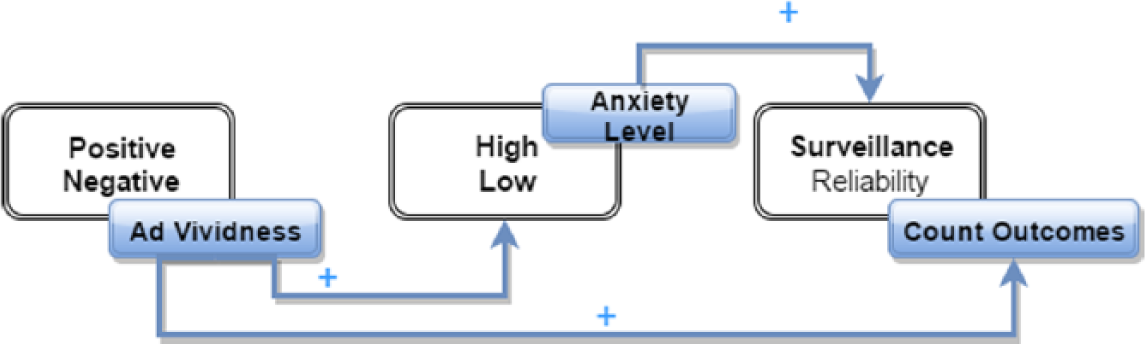
Expected mediated relationship between treatment, anxiety, and outcome.
Casting our anxiety measure as a mediating variable M presents certain challenges, however. Though social scientists have reported scores of mediated effects based on Baron and Kenny’s (1986) seminal article, the reality of mediation modeling, as Bullock, Green, and Ha (2010) argue, is that the random assignment of treatment T (i.e., the ads in our design) only provides certainty in detecting an unbiased estimate of T’s direct effect on Y. The mediated relationship from T → M→ Y still suffers from the possibility of bias due to the confounding effects from other potential mediators in violation of sequential ignorability (a key assumption in linear modeling). In addition, because of the relative recentness of the literature on improving mediation analysis, our design did not include modifications such as the use of parallel encouragement (as recommended by Imai, Keele, Tingley, & Yamamoto, 2011) when using a self-reported anxiety measure as a mediator.
Though it does not entirely rule out violations of sequential ignorability, and given the structure of our mediator variable, Imai and Yamamoto (2013) suggest assessing whether a selected mediator M is not independent of other mediators W by regressing M on W, T, and X (the latter being a vector of pretreatment confounders). Of course, the constituting of W and X is based largely on available data, so the test of mediator independence is not without limitations. With the number of pretreatment measures collected on our paper surveys, we were able to include subject gender, partisanship, age, media use habits, education level, income, and race/ethnicity as Xs in the regression. Given our theory, data, and research design, the best candidate for competing mediators (W) are the measures of other subject-reported emotions collected following exposure to the treatment ads: anger and enthusiasm (both of which were measured on the same 1-4 scale as anxiety). F tests between our selected M (anxiety) and the Ws (anger and enthusiasm, modeled both individually and together)—conditioned on the four treatment groups and pretreatment confounders—fail to reject the null hypotheses of no conditional association between the three emotions (results not shown).
Though the literature is mixed on the underlying association between anger and anxiety (Valentino et al., 2008), we interpret the lack of association between the emotional measures as indication that anxiety’s mediating influence likely does not violate sequential ignorability relative to other possible emotion mediators in our data, and without wading into the larger (and generally unrelated) question of how the three emotions are interrelated. Note that the lack of association between the three emotions does not rule out the possibility of another confounding mediator affecting subject information use. It only means that, given our available data, it is unlikely (though not impossible) that the other mediator candidates (i.e., anger and enthusiasm) are related to anxiety in its mediating role. At the same time, and given the central role anxiety plays in AIT, use of anxiety as a mediator is well grounded theoretically, and reflects Bullock et al.’s (2010) contention that the identification of mediated relationships should build on a series of replications and extensions of a causal mechanism. Still, we interpret the mediation results reported below with the caveat that future research should make use of newly recommended design options aimed at inducing different levels of subject emotions following treatment exposure (e.g., Imai et al., 2011).
Anxiety and Information Use
With five randomly assigned groups in our design, we report statistical significance in our analysis using the Bonferroni-corrected threshold of .01 in two-tailed tests across all 330 subjects (including those who did not recall the nuclear ad and those who elected not to engage in the information search). Our first assessment is to determine the difference in means between the four ad groups (with the control group functioning as the excluded category). With the exception of the anxiety measure (which used a 1-4 Likert scale), the three outcome measures of subjects’ information use are count variables. Table 1 includes the means and standard deviations for each outcome. None exhibited overdispersion, enabling us to use a Poisson estimator within the generalized linear model framework for structural equations (Agresti, 2015).
ANOVA Results for Count Outcomes and Anxiety Mediator.
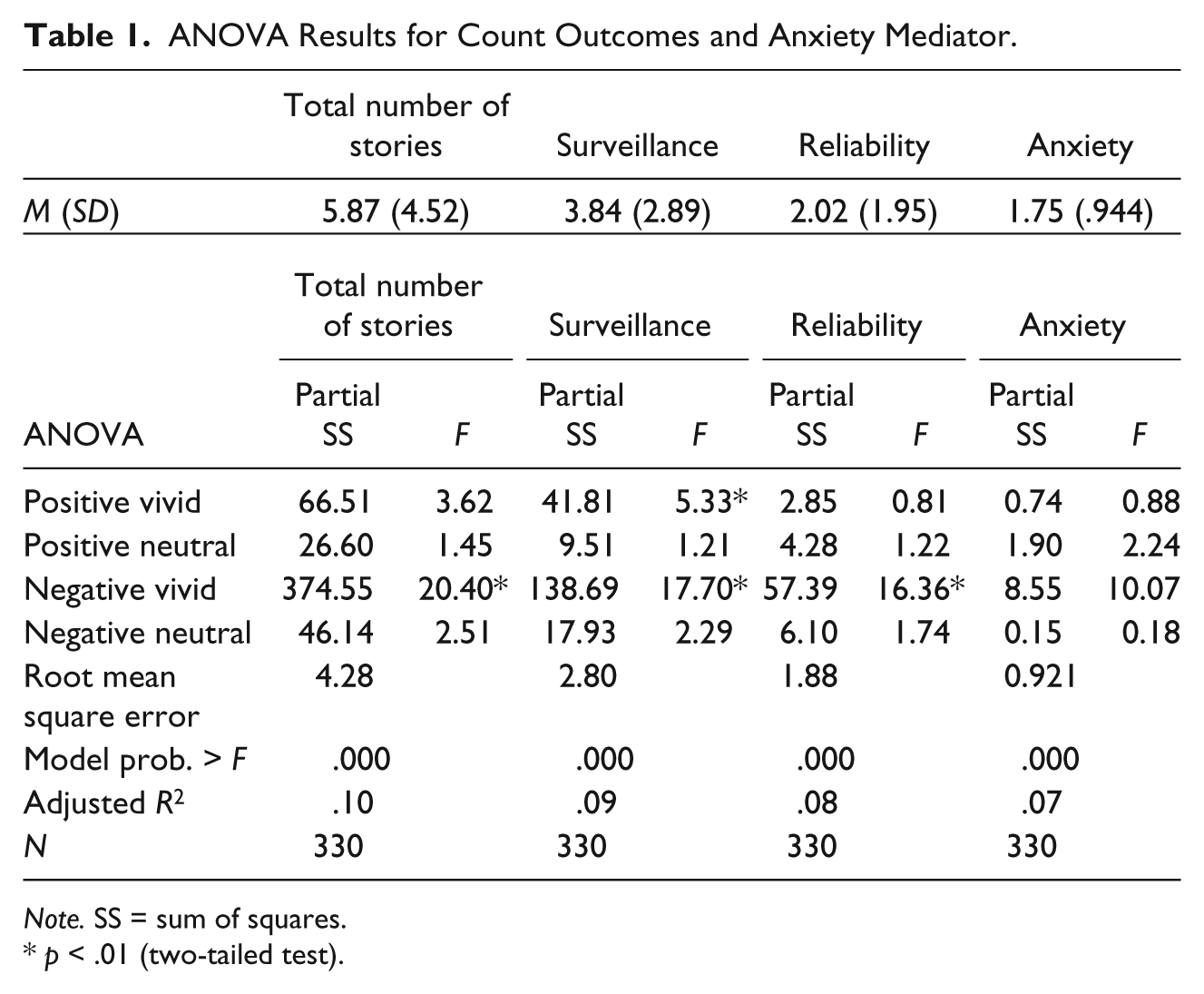
Note. SS = sum of squares.
p < .01 (two-tailed test).
Table 1 reports a one-way ANOVA of group means across our four variables of interest, which include subject self-reported anxiety levels. Consistent with Brader (2005), F scores show that the negative vivid ad is consistent in driving group mean differences for the three information use outcome measures, while just falling short of our corrected significance threshold on the self-reported anxiety scale.
We expand assessment of the group differences in Figure 2 by comparing values for the statistically significant group pairings using Tukey’s honest significant difference (HSD) for post-hoc comparison of means and plotting the upper and lower confidence intervals. The Tukey scores enable tests of Hypotheses 1 to 3. Before turning to the count outcomes, we assess the means for self-reported anxiety. The mean anxiety score for subjects assigned to the negative vivid ad (2.25) is significantly different from subject scores for each of the other four groups: positive vivid (1.6), positive neutral (1.51), negative neutral (1.67), and the control group (1.73). In confirmation of Hypothesis 1, the negative vivid ad subjects had the highest self-reported anxiety across groups, while, reflecting various aspects of Brader (2005) and AIT, neither the positive vivid nor the positive neutral ads spurred anxiety to an appreciable extent. Somewhat unexpected, however, is that the control subjects (who encountered information about the nuclear terror threat as part of the anxiety question or through the computer-based story search) had the second-highest anxiety average (even edging out the negative neutral group). None of the other inter-group anxiety comparisons were significant. Meanwhile, the expected effect of the positive vivid ad on self-reported subject enthusiasm per Hypothesis 2 was not confirmed (results not shown). This suggests that vivid ad effects may be found to exist as direct influences on subject information use—independent of emotional mediators.
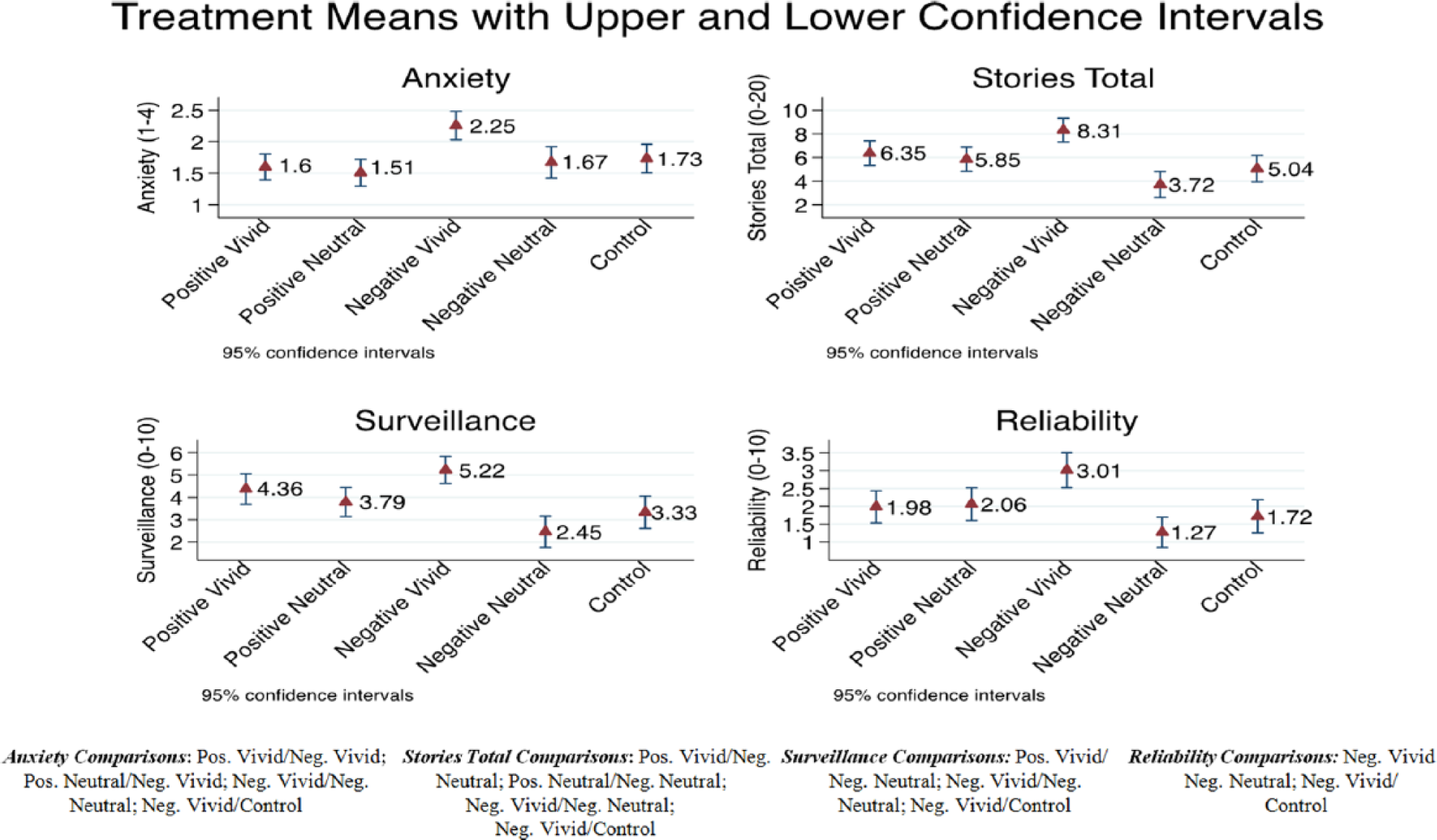
Treatment means with upper and lower confidence intervals.
Turning to the count outcomes, Hypothesis 3 was generally confirmed in that even though the negative vivid ad has the most consistent effect across tests, the positive vivid treatment also managed to significantly increase subject use of information about the nuclear threat. This finding supports our decision to include a full range of ad treatments spanning positive and negative versions of the nuclear terror issue. In terms of the total number of stories viewed (scaled 0-20), the mean count for subjects paired between the negative vivid (8.31), negative neutral (3.72), and control group (5.04) exceed the Tukey critical value. At the same time, and consistent with the expectation of an effect for the vivid ads more generally, the positive vivid ad group mean (6.35) is statistically different from the negative neutral ad group. But it is interesting that the positive neutral group mean (5.85) is also significantly different from the negative neutral group. This may indicate that, at least in terms of the overall number of stories perused, positive ad messages spur greater interest in information about a threatening event, even when production values are limited (and not controlling for anxiety or other factors). To better evaluate this possibility, we focus next on the group mean pairings for the component information use scores—“surveillance” and “reliability.”
Turning first to the 0 to 10 surveillance count, the significant mean differences are again between the vivid ads and their neutral or control counterparts. The positive vivid mean (4.36) contrasts significantly with the negative neutral group (2.45), whereas the negative vivid mean (5.22) differs significantly from negative neutral (2.45) and the control group mean (3.33). As such, there is support for the notion that vivid ad production values may directly spur interest in ad-related information when either negative or positive messages are used. In terms of the 0 to 10 reliability count, however, the positive ad means are not significant; instead, the negative vivid group mean (3.01) is significantly different from the negative neutral (1.27) and control group means (1.72). Overall then, and in support of Brader’s (2005) findings, there is a clear difference in effect between the positive and negative vivid ad types and the non-vivid ads on information use (although the negative vivid ad is more consistently influential than its positive vivid counterpart). The question now is whether these ad-based effects on surveillance and reliability are mediated through anxiety.
We model the direct and mediated effects of the assigned ads and subject anxiety 5 using generalized structural equation models for Poisson estimation. This provides the direct test of AIT’s expected effect for anxiety on surveillance, while also allowing for assessment of anxiety’s potential effect on reliability checking. Given the non-parametric nature of our subject pool, we report bootstrap standard errors using 100,000 replications with replacement. In evaluating the random assignment of subjects to the treatment groups, we found no correlation between the assignments and any of the pretreatment confounding variables. Two of these variables recommend inclusion in our models, however. Because of the rather consistent finding that women experience higher levels of anxiety than men (see Seeman, 1999), we include a dummy variable for female subjects. We also use a dummy variable for subjects identifying as Republican. This is done for two reasons. First, Republicans have used terrorism as a political issue more so than Democrats (Kam & Kinder, 2007). Second, the vivid ads include a quick snippet of an appearance by former Republican Senator Jim Talent at a press conference (Talent supervised bipartisan studies upon leaving office on the nuclear terror threat). Though the ad did not identify Talent as a Republican, to the extent that subjects knew of Talent’s partisan identity, it is worth including in the model. 6
We treat all variables as observed, but, in keeping with our use of anxiety of a mediator, consider the anxiety variable as endogenous (while the treatments and two covariates are exogenous). Figure 3 shows our expectations for the treatment, mediated, and covariate effects on all three count scores. Recall that anxiety’s mediated influence, in keeping with Hypotheses 4 and 5, is expected to increase the surveillance count while decreasing the reliability count. At the same time, the anticipated direct effect of the positive and negative neutral ads are that they will suppress anxiety, while the negative vivid ad will have the opposite effect. Finally, and reflecting Hypotheses 3, we expect that the vivid ads (both positive and negative) will have a significant, direct, and increasing effect across count outcomes.
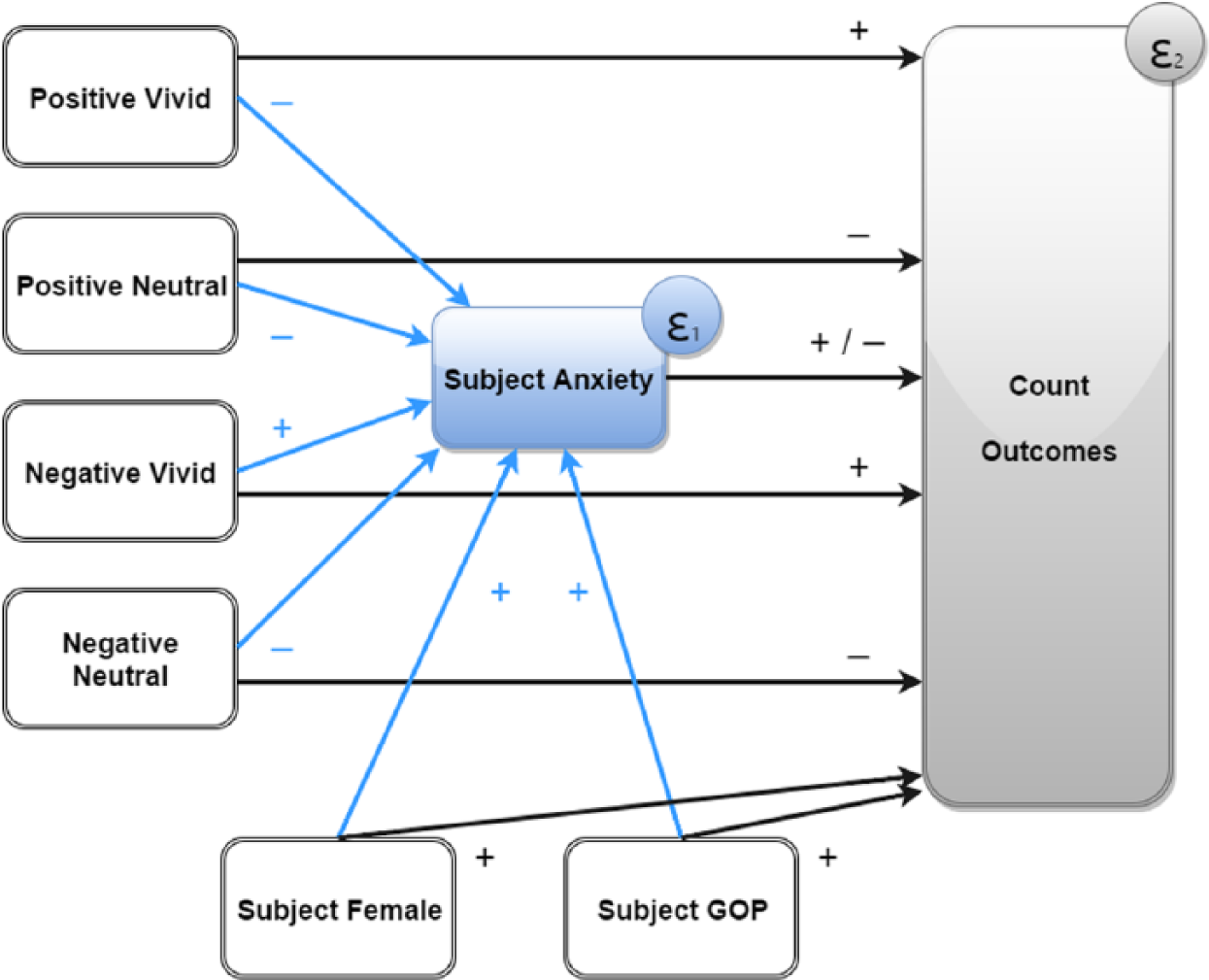
Hypothesized effects of treatments, mediator, and covariates.
The total effects listed in the right-hand column of Table 2 are the effects that would be found if the models contained no mediating variable. Figures 4 and 5 show the statistically significant structural equation coefficients for the total number of stories and surveillance count outcomes (we did not include a figure for the reliability count given the lack of significant coefficients). Overall, the results show that, in terms of direct effects, and in-line with Hypotheses 3, the vivid ads are consistent in their direct and increasing influence on the count outcomes. At the same time, and in support of Hypotheses 1, it is only the negative vivid ad that directly increases self-reported anxiety levels, while anxiety levels show a direct effect on increasing the overall count and surveillance scores, though not reliability checking (reflecting expectations from the Cognitive Calculus Model).
Poisson Structural Equation Results for Count Outcomes and Anxiety Mediator.
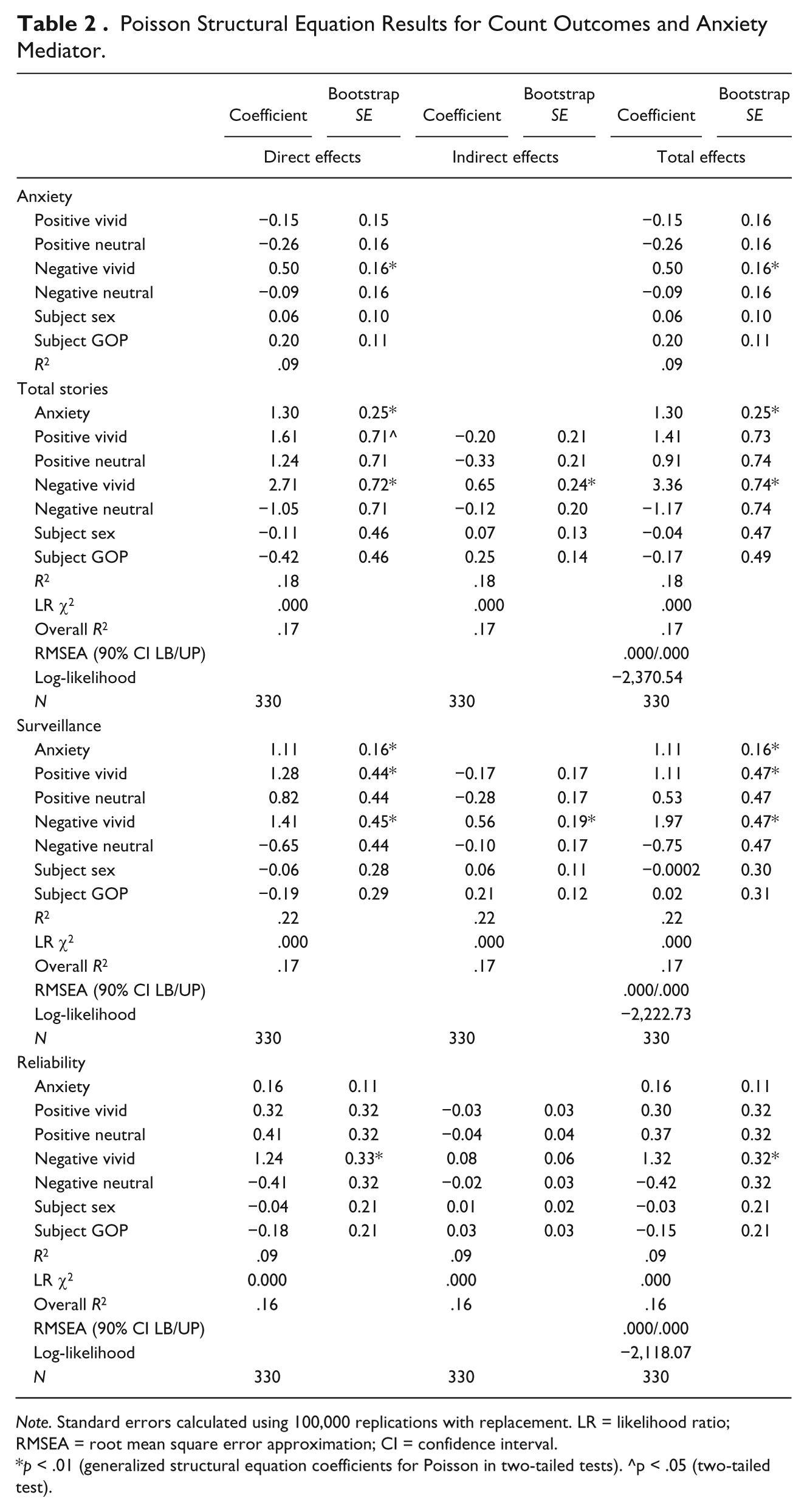
Note. Standard errors calculated using 100,000 replications with replacement. LR = likelihood ratio; RMSEA = root mean square error approximation; CI = confidence interval.
p < .01 (generalized structural equation coefficients for Poisson in two-tailed tests). ^p < .05 (two-tailed test).

Statistically significant effects on total story count.
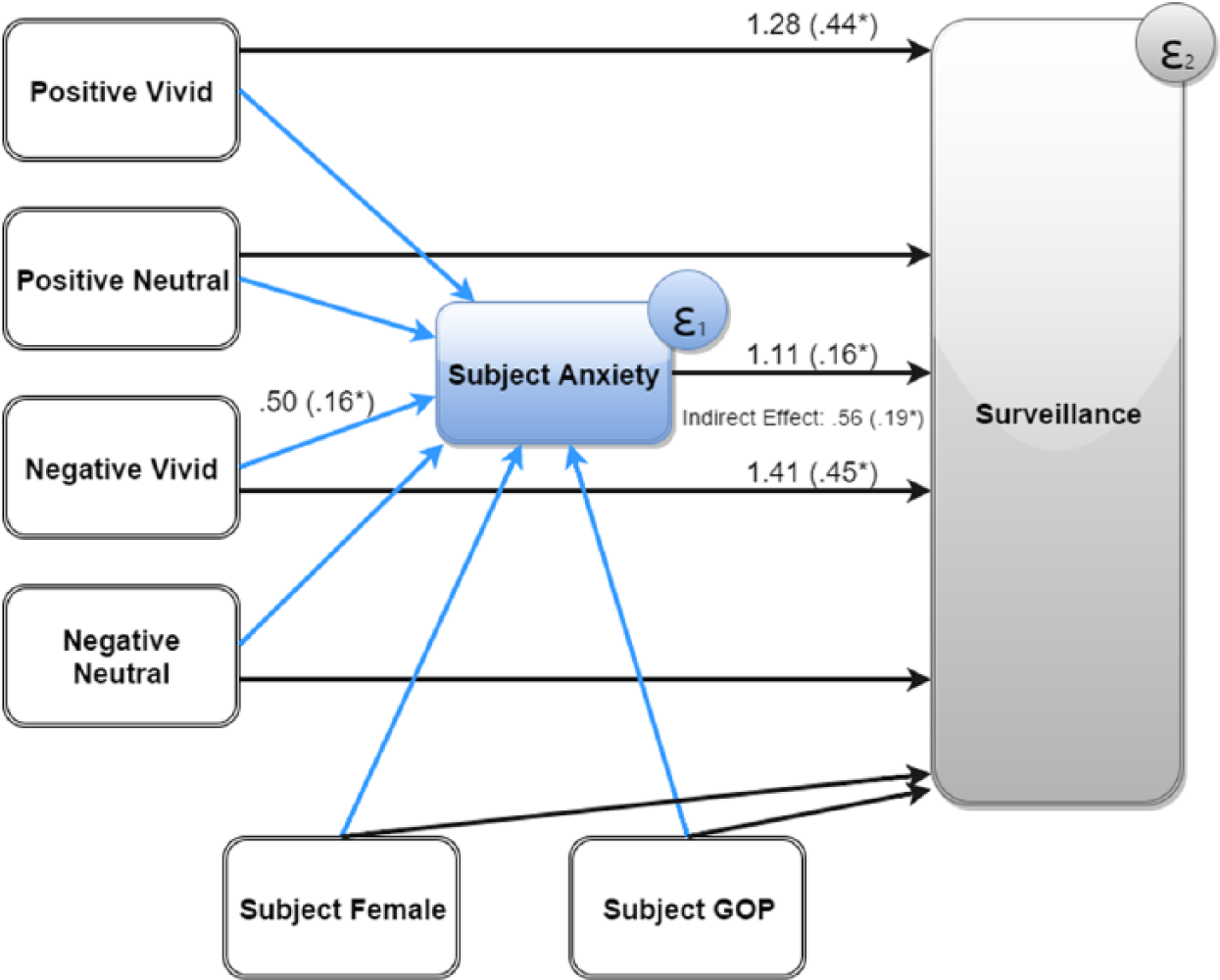
Statistically significant effects on surveillance count.
Looking at direct effects from the assigned ads on the total number of stories viewed in Figure 4, the negative vivid ad subjects show a 2.71 increase in the count of total stories viewed (be they “surveillance” or “reliability,” 0-20 scale). Meanwhile, subjects in the positive vivid ad group show a 1.61 increase in the count of total stories viewed, but this effect is just outside of the corrected significance level (and is not shown). Switching to the positive vivid ad’s effect in the 0 to 10 surveillance count model in Figure 5, that ad increases the number of surveillance screens viewed by 1.28. The negative vivid ad also has a direct effect on surveillance, increasing the count among subjects assigned to it by 1.41. Finally, and reflecting its robust influence versus the other ad types, the negative vivid ad also directly increases the reliability count among subjects assigned to it by 1.24 (this direct effect seen in Table 2).
Turning to the assigned ads’ effect on subject anxiety levels, and in-line with AIT, it is only the negative vivid ad that has a significant impact—increasing anxiety self-reports by .50 (or half a point) on the 1 to 4 scale. Meanwhile, in terms of its direct effect on the three count outcomes, subject anxiety spurred a significant increase of 1.30 in the total number of stories viewed (Figure 4) and an increase of 1.11 in the surveillance stories viewed (0-10 scale; Figure 5). However, anxiety did not have a significant, direct effect on the reliability stories viewed.
Of course, subject anxiety did not occur in a vacuum. Keeping in mind the caveats about the role of mediators in causal mechanisms and the nature of our data in particular, it is noteworthy that anxiety is found to be (as we hypothesized) a statistically significant and positive mediating influence in two of the three models. In both cases, it is the negative vivid ad’s influence that is mediated through the self-reported anxiety measure. As seen in Figure 4, and in terms of the total number of stories viewed, the indirect or mediated effect of the negative vivid ad that passes through subject anxiety is .65, whereas the mediated effect of the negative vivid ad passing through anxiety is .56 for the number of surveillance stories viewed (Figure 5).
Perhaps the most notable finding, however, is the decided lack of mediating influence that anxiety has on information reliability checking among subjects. Though it is not the same as finding a negative mediating influence, this null finding, coupled with the null finding for the direct effect of anxiety on reliability checking, goes far in supporting the notion that anxiety does not motivate follow-on checks of the information encountered about threatening events. Taken in total, then, there is considerable confirmatory evidence for Hypotheses 1, 3, and 4 but not Hypotheses 2 and 5. Specifically, ad vividness spurs interest in information, anxiety is encouraged by (negative) vivid ads, and anxiety mediates ad-induced information surveillance. Yet this emotionally motivated information use does not extend to reliability checking, lending support to the Cognitive Calculus Model’s expectation that anxiety stunts cognitive functioning or, perhaps as an alternative explanation, that increased anxiety leads to a form of satisficing in which people seek out some information about a threat, but with a definitive upper limit in terms of cognitive resource investment in the endeavor.
Discussion
These results move the AIT literature into a new area by both coupling the theory with the subjective tenor of “vivid” visual and aural cues used in media ads and assessing anxiety as a mediating influence on different types of information use. In keeping with the literature’s mixed expectations about anxiety’s influence on cognition, we find that anxiety drives one type of information use but not another, even when anxiety is incorporated into the causal assessment.
The possibility raised earlier concerning surveillance and reliability checking being two sides of the same behavioral coin also deserves comment. Though we conceptualized the checking of information reliability as a follow-on behavior to surveillance in AIT, and found that reliability was not as interesting to subjects as perusing additional surveillance, it is arguable that those subjects who performed well on both measures were actually just being more diligent in their surveillance of available information about a threat. Indeed, those with high surveillance scores may have been engaging in what they considered to be a type of reliability checking by exposing themselves to a higher number stories about the nuclear threat. That said, the clear statistical differences for the treatment and mediating variables on the individual surveillance and reliability outcomes suggest that there is an underlying difference between the action of surveillance and following-up to check on the information that one has surveyed.
In an era where motivated reasoning and selective exposure are becoming more common as part of the continued fragmentation of media sources (Iyengar & Hahn, 2009), the question of how information use can be reduced into distinct behavioral categories will remain important, as will alternate possibilities in operationalizing the act of reliability checking versus general information surveillance. One obvious line of inquiry from our experiment regards whether the term “reliability”—which was used in the software search design—has a particular effect on subjects versus a similar term (or even the absence of offering instructions when presenting information search options). The real world use of the term “fact check” calls for further investigation of how subjects respond when offered the chance to verify information encountered.
Then there is the question of external validity. One might certainly argue that the extreme threat of nuclear terrorism is one of a small number of topics that could compel increased information use in the form of both surveillance and reliability checks. If this is true, the act of reliability checking may be somewhat rare, particularly for the scores of more mundane issues that people encounter on a regular basis. Next, and from a political campaigning perspective, it is not necessarily the case that campaigns or interest groups—the two most likely perpetrators of negative vivid issue ads—want people to undertake an information reliability evaluation in the first place. After all, it is possible that such a check could result in locating contradictory information to what campaign ads present.
Finally, we again reference the caveats about our findings regarding subject anxiety on information use. Additional research using alternate ways of measuring this emotion’s impact will be important in providing greater clarity on whether and how emotion influences the search and evaluation of information. It might just be that surveillance subsumes the act of reliability checking on information encountered, or, perhaps akin to the act of satisficing, reliability assessment exists as a much rarer form of information use.
Footnotes
Acknowledgements
We would like to thank Professor Joel Paddock of Missouri State University for his work as narrator in the treatment ads.
Declaration of Conflicting Interests
The author(s) declared no potential conflicts of interest with respect to the research, authorship, and/or publication of this article.
Funding
The author(s) received no financial support for the research, authorship, and/or publication of this article.
Notes
Author Biographies
References
Supplementary Material
Please find the following supplemental material available below.
For Open Access articles published under a Creative Commons License, all supplemental material carries the same license as the article it is associated with.
For non-Open Access articles published, all supplemental material carries a non-exclusive license, and permission requests for re-use of supplemental material or any part of supplemental material shall be sent directly to the copyright owner as specified in the copyright notice associated with the article.
