




Abstract
How do members of racial groups explain the large disparity in the way Blacks and Whites are treated by the criminal justice system in the United States? And how do such explanations (attributions) influence support for punitive crime control policies in America, as well as arguments against such policies? Our study of the structure, sources, and consequences of racial attributions in the justice system, using original survey data in Washington state, contributes to the literature in several ways. First, unlike traditional measures of racial prejudice—that is, racial resentment and stereotypes—our measure of racial attributions distinguishes cleanly between dispositional explanations (e.g., Blacks’ aggressive nature) and discrimination. Second, we examine the attributions of three pivotal groups with different experiences with legal authorities: Latinos, Blacks, and Whites. Third, an issue framing experiment demonstrates the power of both attributions for shaping support for the death penalty and arguments against the policy based on racial justice.
Introduction
Michael Tonry (2011) begins Punishing Race, with a sweeping—and wholly accurate—assessment of what makes American crime control policies stand out: the world’s highest imprisonment rate, the Western world’s only use of capital punishment, the Western world’s most severe punishments short of death, and the devastating effects of those policies on black Americans. Black men for a quarter century have been five to seven times more likely than white men to be in prison, are much more likely to receive decades-long sentences or life without the possibility of parole, and are much more likely to be on death row. (p. 1)
Tonry, along with a distinguished group of social scientists (e.g., Bucerius & Tonry, 2014), points out that while the huge racial disparities in punishment result partly from racial differences in offending, they also result from a pattern of discriminatory treatment found, in some measure, in almost every nook and cranny of the criminal justice system (see also Ghandnoosh, 2014).
Unsurprisingly, given such stark differences between the races in their experiences with the justice system, research finds that Blacks and Whites inhabit “separate realities” in the way they evaluate the fundamental fairness of the justice system in America (e.g., Bobo & Johnson, 2004; Peffley & Hurwitz, 2010). Most Blacks view the system as categorically unfair and discriminatory, while most Whites view the system as fair and “color blind.” In fact, the racial divide in evaluations of the fairness of the justice system is as large today as it was in the early 1990s, with more than two thirds of African Americans but only a quarter to one third of Whites agreeing that the “American justice system is biased against Black people.” Even after the rash of highly publicized police shootings of unarmed African Americans since the killing of Trayvon Martin in 2012, Michael Brown in 2014, and countless others, a majority of Whites still denies that racial bias exists in the justice system. 1
In light of these and similar findings, our study takes aim at two limitations in a large literature that has produced important substantive and theoretical insights. One is fairly obvious, the other less so. First, with few exceptions, extant research examines a narrow spectrum of public opinion on criminal justice issues because the focus is largely on the attitudes of Whites and sometimes Blacks, but with very little attention to Latinos (cf. Weitzer & Tuch, 2006). Today, however, not only is Whites’ majority status diminishing, but Blacks are no longer the largest minority group, due largely to the increasing Latino population. As we argue below, the numerous negative encounters between Latinos and legal authorities make it essential to gauge Latinos’ perceptions of discrimination in the justice system, as well as their views of African Americans, to determine whether their views align more closely with Blacks or Whites.
A second problem with the literature is less obvious. One of the primary goals of research investigating the association between Whites’ racial attitudes and their policy attitudes is to document the degree to which policy preferences are driven by racial prejudice. While most assuredly a worthy goal, as we argue below, the dominant measures of anti-Black prejudice employed in this research—racial stereotypes and racial resentment—shift the focus away from a major determinant of support for punitive crime policies among Whites and other groups: the denial of racial discrimination. While racial resentment measures arguably conflate dispositional judgments of Blacks with perceptions of racial discrimination in a single scale, racial stereotype measures focus on dispositional assessments, thus ignoring perceptions of racial discrimination.
In this study, we address both limitations by employing a more nuanced measurement strategy and focusing on Latino, as well as Black and White, subjects. Specifically, we ask respondents to rate the degree to which various (internal) dispositional and (external) systemic explanations (attributions) account for why Blacks are treated more harshly than Whites in the justice system. After constructing two separate measures of racial attributions, one that focuses on Blacks’ dispositions (i.e., whether Blacks’ exhibit a tendency toward violence and crime) and another focusing on discrimination against Blacks (i.e., whether police and courts are biased against Blacks), we turn to the first portion of our analyses by exploring the structure of these attributions. Here, we consider whether the two types of explanations are empirically distinct, whether they have differing antecedents, and whether Blacks, Whites, and Latinos offer different views regarding the impact of dispositional and systemic factors in explaining racial disparities in punishment.
The second portion of our analyses then explores whether embracing or rejecting dispositional and systemic explanations influences support for the death penalty. Not only is there a large racial disparity in the application of capital punishment (e.g., Baumgartner, De Boef, & Boydstun, 2008; Spohn, 2013), but support for the death penalty is highly predictive of attitudes toward other punitive policies, such as three-strikes laws (e.g., Ramirez, 2015). We consider both whether dispositional and systemic explanations matter in an absolute sense and whether they condition how White, Black, and Latino respondents react to arguments against the death penalty. We find that not only do the three groups have different explanations of racial disparities in punishment, but their explanations strongly influence their support for punitive crime policies in theoretically explicable ways.
The Importance of Studying Latinos
Exactly how Latinos fit into the racial divide on support for punitive policies is an important, yet understudied question in the literature (Weitzer, 2014), especially given that the Latino population is growing in size and influence in the United States. As argued by Bean, Bachmeier, Brown, and Tafoya-Estrada (2011), the changing volume and composition of immigration during [the past 40 years] has converted the United States from a largely biracial society with a sizeable white majority and a small black minority . . . into a multiracial and multiethnic society [where Latinos are now the largest minority group]. (p. 40)
Do Latinos’ racial attitudes and support for crime policies come closer to resembling Whites’ or African Americans’? The answer to this question has important implications for the potential formation of multiracial coalitions favoring reform in the justice system and the amelioration of racial conflict. Unfortunately, prior research provides more questions than answers. On one hand, depending on the location of the study and the measure of racial attitudes used, Latinos are often found to express views of Blacks that are essentially indistinguishable from those of Whites (e.g., McClain et al., 2006; Segura & Valenzuela, 2010; Tesler & Sears, 2010). However, there has been almost no attention paid to the question of whether Latinos’ perceptions of racial discrimination or racial dispositions in the justice domain predict their support for punitive crime policies (for an exception, see Krupnikov & Piston, 2016). Because the collective experiences of Latinos in the justice system is in many ways closer to Blacks than to Whites, there is reason to expect many Latinos to view the treatment of Blacks as overly harsh and unfair. And these individuals should be more receptive to arguments against punitive policies based on appeals to racial justice.
In fact, in the last two decades, Latinos’ exposure to all parts of the criminal justice system—police, courts, and prisons—increased faster than their growing share of the U.S. adult population. 2 By 2009, for example, the percentage of Latinos who said they or an immediate family member had been under some kind of criminal corrections control in the previous 5 years rose accordingly (Lopez & Livingston, 2009). Although it is fair to say that the disparity in treatment between Whites and Blacks is particularly stark, the treatment of Latinos certainly ranks between the two racial groups.
The Structure, Antecedents, and Consequences of Racial Attributions
A large body of research across several policy domains supports the contention that policy preferences are group-centric, “shaped in powerful ways by the attitudes citizens possess toward the social groups they see as the principal beneficiaries (or victims) of the policy” (Nelson & Kinder, 1996, pp. 1055-1056). Arguably, one of the more powerful and politically consequential associations between group attitudes and policy preferences is found in the criminal justice domain. An array of studies shows that Whites’ attitudes toward Blacks, such as racial resentment or their stereotypes of Blacks as violent and aggressive, are key drivers of support for punitive crime policies, such as the death penalty, three-strikes laws, and stricter sentencing (e.g., Bobo & Johnson, 2004; Peffley & Hurwitz, 2010; see Lerman & Weaver, 2014; Unnever, 2014, for reviews).
As noted, however, a limitation of prior research is the tendency to assess racial attitudes with measures that do not properly account for a likely determinant of support for punitive policies: perceptions of racial discrimination. Whites’ denial of discrimination clearly shapes their opposition to economic policies designed to assist Blacks (e.g., Bobo & Kluegel, 1993; Sniderman & Hagen, 1985) as well as policies implicitly associated with Blacks, such as welfare (Gilens, 1999; Goren, 2013). But the two dominant measures used by political scientists to assess racial attitudes—racial stereotypes and racial resentment—make it impossible to determine the extent to which support for policies is influenced by respondents’ perceptions of Blacks’ dispositions apart from perceptions of discrimination. Racial stereotype scales, for example, focus entirely on dispositional assessments, thus ignoring perceptions of racial discrimination. And racial resentment (i.e., symbolic racism) measures conflate negative dispositional judgments of Blacks (e.g., “Most Blacks who receive money from welfare programs could get along without it if they tried.”) with perceptions of racial discrimination (e.g., “Generations of slavery and discrimination have created conditions that make it difficult for Blacks to work their way out of the lower class.”) in a single scale. 3
Structure of Attributions
To assess individuals’ perceptions of discrimination separately from their views of Blacks’ dispositions, we turned to a different measurement strategy that assumes that support for race-related government policies is based on citizens’ intuitive explanations for racial inequality (Huddy & Feldman, 2009; Kluegel & Smith, 1986; Sigelman & Welch, 1994; Sniderman & Hagen, 1985). Policies designed to remedy racial inequalities in the economic domain, for example, are routinely found to be based on citizens’ attributions of why most Blacks are worse off than Whites (Bobo & Kluegel, 1993). Since 1985, the General Social Survey battery has asked respondents whether dispositional explanations (e.g., “Blacks lack the motivation and will power to get ahead”) and those emphasizing racial discrimination help to account for why “Blacks have worse jobs, income, and housing than Whites.” An important finding from this research is that dispositional (internal) and systemic (external) attributions do not lie on opposite ends of a single continuum (Kluegel & Bobo, 1993). Attributions of dispositional and systemic causes tend to be independent because people often judge both (or neither) types of explanations to be an important cause of racial inequalities. This is additional evidence that measures that either force people to choose between the two types of explanations (e.g., Peffley & Hurwitz, 2007) or that conflate the two do not adequately capture the way people make such judgments.
Antecedents
Such findings also suggest that dispositional judgments and perceptions of discrimination may have different antecedents. Several studies find, for example, that perceptions of racial discrimination in the justice system are based on individuals’ experiences, while dispositional assessments tend to reflect group animus. An extensive literature documents that the way people feel they are treated by legal authorities influences their more general perceptions of bias or fairness in the legal system (Tyler, 2012). In their study of citizens’ views of racial bias by the police, for instance, Weitzer and Tuch (2006) found that Whites were much less likely to perceive racially biased policing than Blacks (and to a lesser degree, Latinos) because Blacks and Latinos were far more likely than Whites to say they had been personally discriminated against by the police. And as Peffley and Hurwitz (2010) found in their study, reports of unfair personal treatment by police led individuals to view the wider justice system as discriminatory and unfair.
Dispositional attributions, on the contrary, focus more on the perceived shortcomings of Blacks than of legal authorities, and thus are more likely to reflect group animus and prejudice. Attributing the lower economic status or higher arrest rate of Blacks to stable traits like laziness or violence is a barometer of anti-Black prejudice, similar to endorsing negative racial stereotypes. 4
In the first portion of the analysis to follow, we test three hypotheses concerning the structure and antecedents of dispositional and systemic attributions of racial inequality in the justice system.
Consequences
In the second part of the analysis, we examine the consequences of dispositional and discrimination attributions on support for the death penalty. With the aid of a survey experiment, we vary arguments against capital punishment, only one of which—the racial justice argument—asserts that the policy is unfair because African Americans are more likely to be executed than Whites. We expect both attributional dimensions to influence individuals’ support for the death penalty, but their impact is also expected to vary across argument conditions in ways that reflect the distinct properties of each dimension. Specifically,
Data and Measures
Hypotheses are tested using original survey data from the Justice in Washington State Survey, an Internet survey administered in Washington by YouGov 5 between June 14 and July 2, 2012. The primary purpose of this survey is to examine differing perceptions of, and experiences with, the criminal justice system across Whites, Blacks, and Latinos. 6 As such, it includes several items designed to assess explanations of racial disparities in punishment, personal encounters with law enforcement officers, and attitudes regarding anticrime policies (such as the death penalty). In all, 611 Whites and oversamples of 305 Latinos and 288 African Americans completed the survey, all self-identified. 7
Because our focus is on comparing opinions across the three groups, we weight the three samples within each group based on 2010 Census data in terms of the education, age, and gender of each of the three groups in Washington State in an effort to gain confidence that results reflect the attitudes of members of the respective group in the Washington population. 8
The first three hypotheses address the structure and antecedents of ordinary citizens’ explanations of racial disparity in punitive treatment, which were assessed as follows. Respondents first read the stem of the question, “Statistics show that Blacks are more often arrested and sent to prison than are Whites,” and then were asked to rate several statements in terms of the likelihood they account for the racial difference, using a scale ranging from none at all (1) to a great deal (4). We included two internal or dispositional explanations (e.g., “Blacks are more aggressive by nature” and “Blacks are just more likely to commit crimes”) and two external or systemic explanations emphasizing the discrimination that Blacks face from legal authorities (e.g., “the police are biased against Blacks” and “the courts and justice system are stacked against Blacks and other minorities”). We then formed two additive scales, labeled Blacks’ Negative Dispositions and Discrimination Against Blacks by summing responses to each pair of external and internal attribution items. See the appendix for the complete wording of these, and all other survey items.
Structure of Attributions
Having devised separate measures of respondents’ internal attributions of Blacks’ dispositions and external attributions of Black discrimination in the justice system, our first task is to test H1 by ascertaining whether internal and external attributions are, in fact, empirically distinct. Consistent with the first hypothesis, ratings of the explanations clearly sort into two separate dimensions of internal and external attributions, as evidenced by the high correlations between the two dispositions items (average r = .62) and the two discrimination items (r = .72), as well as the low correlations between the two additive scales (−.27 for Whites, −.05 for Blacks, and .05 for Latinos). 9
Our second hypothesis predicts that African American respondents (and to a lesser degree, Latinos) are more likely to attribute racial disparities in punishment to racial discrimination than Whites and less likely to attribute disparities to Blacks’ negative dispositions (i.e., Blacks more aggressive). The graph on the left-hand side of Figure 1 displays the mean ratings of the two racial attribution scales for the three groups, with 95% confidence intervals. The indices are coded on a 0 to 1 scale so that higher values indicate greater attribution ratings. The average placement of the three groups on the Discrimination scale conforms to expectations: Latinos and (especially) African Americans are much more likely than Whites to attribute disparities in punishment to racial discrimination (i.e., police and court bias), and the differences across all three groups are significant at the .05 level. On the Dispositions scale, once again Blacks and Whites define the extremes with Latinos in between. The differences across groups, however, are smaller than for the Discrimination scale. While African American respondents attach significantly less weight to dispositional explanations than Whites and Latinos, the gap between Latinos and Whites is not significant. 10 Of course, even without large mean differences across groups, the more important question is whether the variation across individuals helps to explain support for policy preferences.
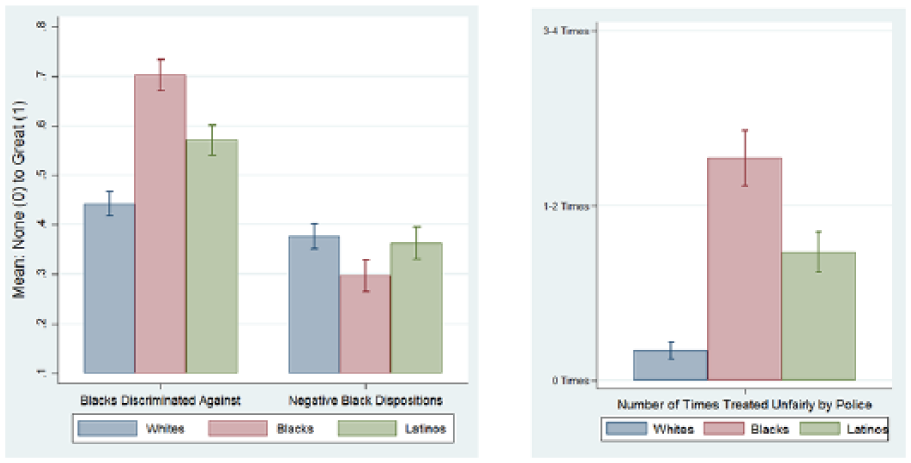
Average rating of racial attributions and reports of unfair police treatment by race.
Predicting Racial Attributions
Our third hypothesis predicts that not only should the two attribution scales be relatively independent, but their antecedents are expected to be different as well. To test these expectations, we regressed the Discrimination and Dispositions scales on reports of Unfair Police Treatment (see Appendix Item 2), thermometer ratings of Blacks (Appendix Item 3), as well as several control variables, including ideological (4) and nominal partisan identification (5), and a set of standard demographic factors (including education, gender, income, age, and news interest).
The means and standard deviations of all the predictors are presented in the online appendix (Table A1). Of particular importance to our claim that Whites, Blacks, and Latinos have very different experiences with legal authorities, we display on the right-hand side of Figure 1 a comparison of the average number of times members of the three groups reported being treated unfairly by police, with Latinos and Blacks being asked whether their treatment was “just because of your race or ethnic background.” As the graph in Figure 1 makes plain, not only do the experiences of unfair treatment vary dramatically across racial groups, but those of Latinos’ are closer to Blacks than to Whites. Only a relative handful of Whites (12%) report unfair police treatment, while most Blacks (62%) and almost half of Latinos (46%) report one or more negative personal encounters with the police.
Table 1 reports the ordinary least squares (OLS) estimates for six equations—that is, internal and external attributions measures estimated for each of the three groups. 11 Generally speaking, the pattern of results in Table 1 conforms to expectations (H3). Across all three groups, particularly Whites and Blacks, reports of Unfair Police Treatment are much more strongly associated with racial discrimination than with dispositional attributions. On the contrary, thermometer ratings of Blacks are moderately associated with dispositional attributions, but hardly at all with attributions of racial discrimination. Overall then, perceptions of racial discrimination (but not dispositions) are much more strongly tied to experiences, while dispositional judgments (but not discrimination) are more strongly tied to racial animus.
Predicting Racial Attributions in Punishment (OLS).
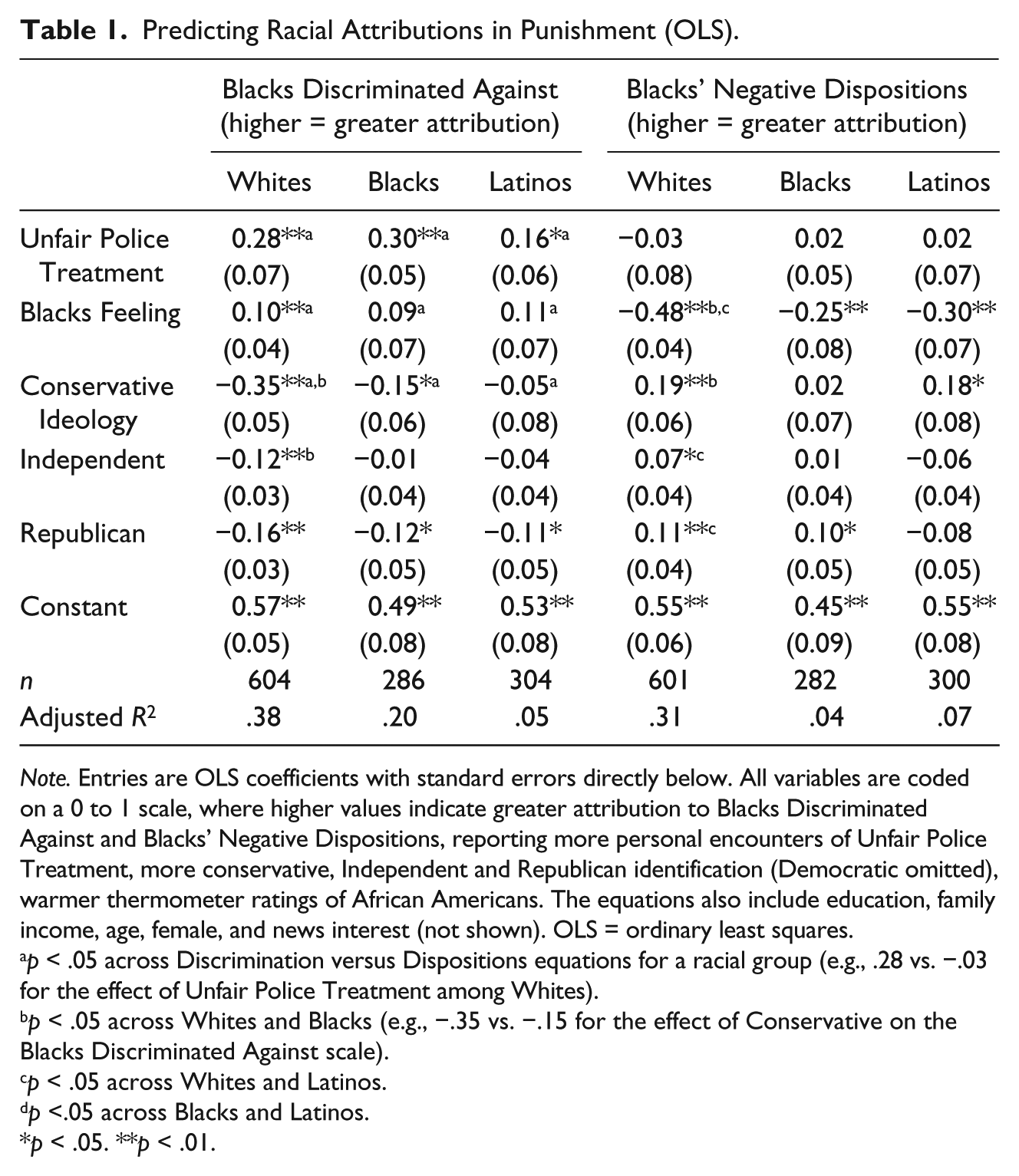
Note. Entries are OLS coefficients with standard errors directly below. All variables are coded on a 0 to 1 scale, where higher values indicate greater attribution to Blacks Discriminated Against and Blacks’ Negative Dispositions, reporting more personal encounters of Unfair Police Treatment, more conservative, Independent and Republican identification (Democratic omitted), warmer thermometer ratings of African Americans. The equations also include education, family income, age, female, and news interest (not shown). OLS = ordinary least squares.
p < .05 across Discrimination versus Dispositions equations for a racial group (e.g., .28 vs. −.03 for the effect of Unfair Police Treatment among Whites).
p < .05 across Whites and Blacks (e.g., −.35 vs. −.15 for the effect of Conservative on the Blacks Discriminated Against scale).
p < .05 across Whites and Latinos.
p <.05 across Blacks and Latinos.
p < .05. **p < .01.
Beyond the main findings of Table 1, two additional results stand out. First, among all three groups, racial attributions are often significantly tied to ideological and partisan identifications. Individuals on the Right (i.e., conservative and Republican identifiers) tend to deny the importance of discrimination as a cause of racial disparities in punishment, relative to those on the Left (i.e., Liberal and Democratic identifiers). And while the coefficients predicting dispositional judgments tend to be smaller than those for discrimination, those on the Right are also more likely to attribute racial disparities to the dispositional shortcomings of Blacks. Second, we note that, consistent with prior studies (e.g., Tesler & Sears, 2010), we do a much better job of predicting dispositional judgments among Whites than we do among African Americans, where only the feeling thermometer and Republican identification achieve significance at conventional levels. For Blacks as well as Whites, we explain a larger portion of the variation in external attributions (i.e., Discrimination Against Blacks) than internal attributions (Blacks’ Negative Dispositions). 12
In summary, the content, structure, and antecedents of our two attribution scales provide consistent support for their construct validity for the three groups in our study. We turn now to our primary objective of assessing the importance of racial attributions for shaping support for punitive crime policies across the three groups.
Predicting Support for Punitive Crime Policies
To examine the power of racial attributions to influence attitudes toward punitive policies, we focus on support for the death penalty, for several reasons. For one, there is a long line of scholarship documenting persistent racial bias in the implementation of capital punishment (e.g., Baumgartner et al., 2008; Spohn, 2013). The most striking disparity is that Blacks are far more likely to be executed for killing Whites than are Whites who have killed Blacks (Baumgartner, Grigg, & Mastro, 2015). 13 Second, support for the death penalty is a strong predictor of support for other punitive policies (e.g., Ramirez, 2015). A final reason for focusing on the death penalty is that in our experiment, described below, it is essential to distinguish between racial and nonracial arguments against the fairness of the policy, and capital punishment is one of the few punitive policies for which plausible nonracial frames (i.e., the death penalty is unfair because innocent people are executed) exist (e.g., Baumgartner et al., 2008; Boydstun, 2013), whereas the same cannot be said for other punitive crime policies, such as three-strikes or stop-and-frisk policies.
In the Death Penalty Experiment (Appendix Item 7), we followed the basic design of Peffley and Hurwitz’s (2010) experiment by randomly assigning respondents to three argument conditions—a baseline (No Argument) condition where the respondent was simply asked the standard Gallup question, “Do you favor or oppose the death penalty for convicted murderers?” (reversed), or one of two argument conditions questioning the fairness of capital punishment, where the baseline question was preceded by either a Racial Argument (“Some people say that the death penalty is unfair because African Americans convicted of the same crimes as Whites are much more likely to be executed. What about you?”) or a nonracial argument termed the Innocent Argument (“Some people say that the death penalty is unfair because too many innocent people are being executed. What about you?”). 14
The additive models (left-hand side of Table 2) include two dummy variables representing the argument conditions (Racial Argument and Innocent Argument), 15 the two attribution variables, ideological and nominal partisan identifications, and the same control variables as in Table 1. The coefficients for Racial Argument and Innocent Argument indicate the difference in death penalty support between the baseline condition and each of the arguments against it, independent of other predictors in the model. Among African American respondents, both arguments questioning the fairness of capital punishment precipitate a drop in support for the death penalty. The same is not true for Whites and Latinos, however, for whom favoring the death penalty is much more strongly tied to their prior attributions of racial discrimination and Blacks’ Negative Dispositions. By contrast, among African Americans, only dispositional judgments significantly affect death penalty support.
Predicting Support for the Death Penalty (Logit).
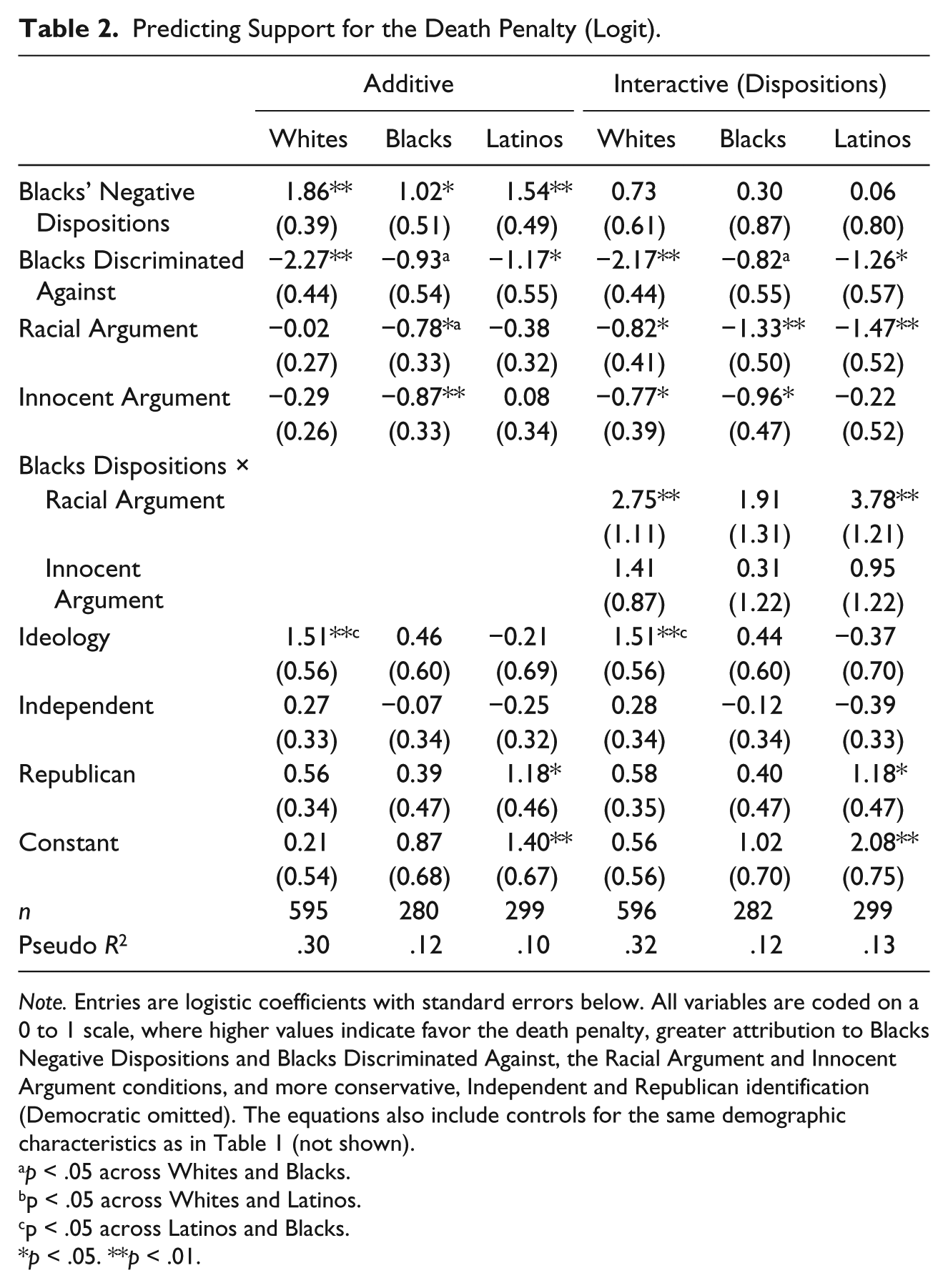
Note. Entries are logistic coefficients with standard errors below. All variables are coded on a 0 to 1 scale, where higher values indicate favor the death penalty, greater attribution to Blacks Negative Dispositions and Blacks Discriminated Against, the Racial Argument and Innocent Argument conditions, and more conservative, Independent and Republican identification (Democratic omitted). The equations also include controls for the same demographic characteristics as in Table 1 (not shown).
p < .05 across Whites and Blacks.
p < .05 across Whites and Latinos.
p < .05 across Latinos and Blacks.
p < .05. **p < .01.
Dispositional Attributions
In the interactive models (right-hand side of Table 2), we test whether the impact of the racial attributions on death penalty support varies significantly across the argument conditions. Initially, we included interactions between the argument dummies and both attribution scales, but because interactions with the Discrimination scale were never close to being significant for any of the three groups, as hypothesized in H4b, they were dropped from the interactive model in Table 2. The interaction between Blacks’ Negative Dispositions and the Racial Argument condition, on the contrary, is highly significant in conditioning death penalty support for Whites and Latinos (but not for Blacks, although see Figures 2a and A1), consistent with H4a.
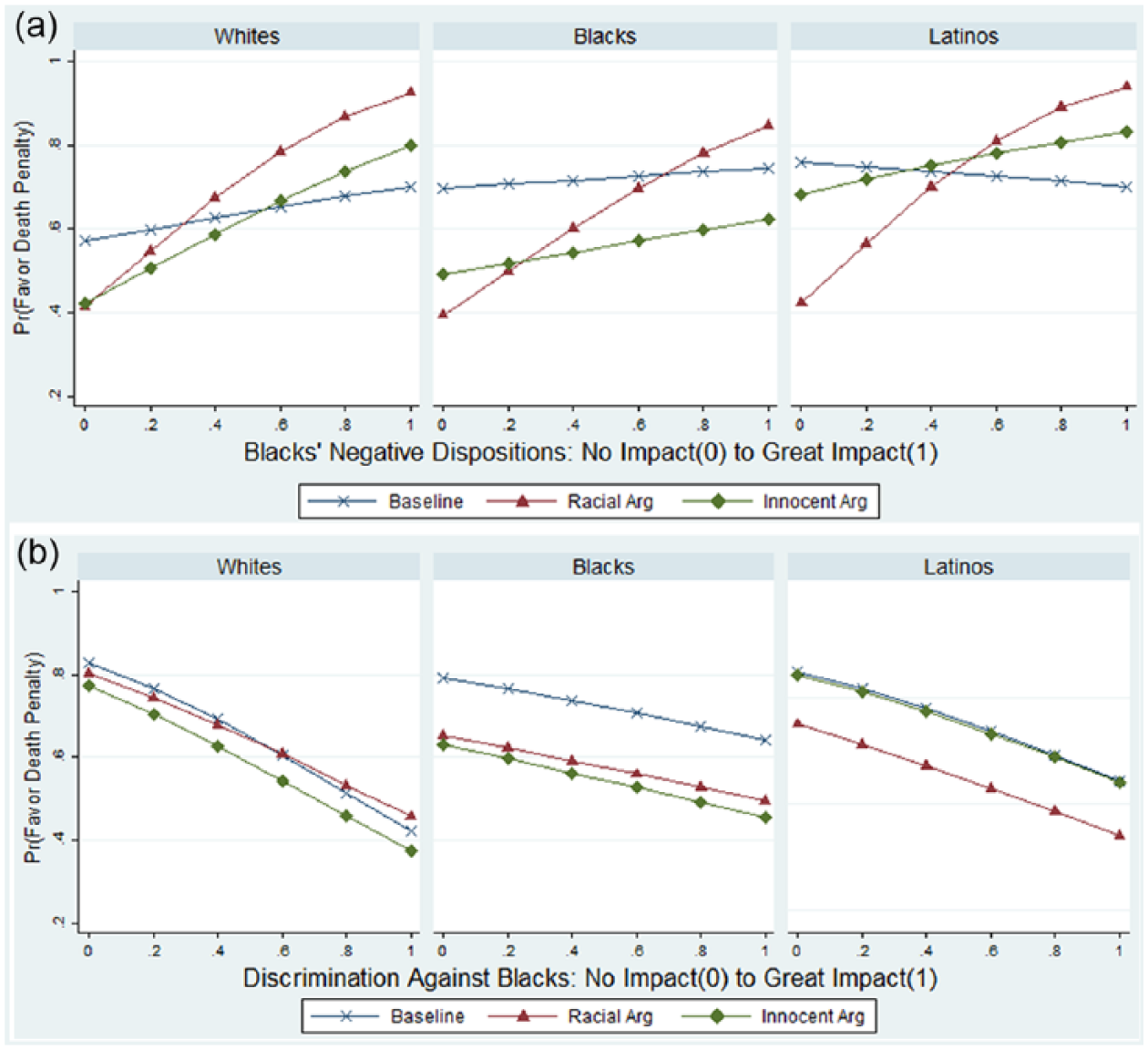
Predicted support for death penalty across attributions, arguments, and groups.
Because logistic coefficients and their interactions are difficult to interpret, we turn to the graph in Figure 2a, where predicted probabilities of favoring the death penalty are plotted for all three argument conditions across the Black Dispositions scale for the three groups, holding other predictors at their mean value. One clear pattern that holds across all groups is the tendency for racial dispositions to have very little effect on death penalty support in the baseline condition; the lines representing support in the baseline (No Argument) condition are essentially flat. Thus, in contrast with earlier research (e.g., Peffley & Hurwitz, 2007; Soss, Langbein, & Metelko, 2003), support for capital punishment in the baseline condition is not automatically tied to individuals’ dispositional judgments of Blacks. These results are in line with more recent studies showing that after a prolonged period of declining crime rates (e.g., Enns, 2016), racial stereotypes are not as strongly associated with support for the death penalty as they were in the past (e.g., Krupnikov & Piston, 2016; Unnever & Cullen, 2012).
However, when individuals from all three groups are presented with the racial argument against the death penalty, Blacks’ Negative Dispositions becomes one of the most powerful determinants of favoring capital punishment. The racial argument tends to sharply polarize support for the death penalty across the Black Dispositions scale. Among racial liberals who attach no weight to Blacks’ dispositional shortcomings (at point 0), support for the death penalty falls to only 40% for all three groups, but among racial conservatives who attach maximum weight (at point 1), support jumps to over 90% for Whites and Latinos and just above 80% among Blacks.
Backlash Effects
One way to assess the difference the racial argument makes in favoring the death penalty is to focus on the gap in support between the baseline (nonracial argument) and racial argument conditions along the Black Dispositions scale. 16 Among Whites, the differences are only statistically significant at the racially conservative end of the Black Dispositions scale (at .7 and above), indicating that the predominant effect of the racial argument is to produce a clear backlash effect among racial conservatives. Thus, when presented with the argument that the death penalty is biased against Blacks, Whites who blame Blacks’ harsh treatment on their dispositional shortcomings actually become more, not less, supportive of the death penalty compared with the baseline condition. By contrast, among African Americans, the predominant effect of the racial argument is to reduce support for capital punishment among individuals at the racially liberal end of the Black Dispositions scale (at .3 and below). Latinos present more of a mixed reaction to the racial argument. Similar to African Americans, the Racial Argument significantly drives support for the death penalty downward among racial liberals (at .2 and below), but among racial conservatives (at .7 and above), we see an offsetting backlash effect similar to Whites. Overall, these results provide strong support for H4a. Dispositional attributions based in racial animus are responsible for a backlash effect among Whites and Latinos when confronted with a racial argument against the death penalty, but have little effect on support for the death penalty in the nonracial argument condition, which also questions the fairness of the death penalty.
Discrimination Attributions
The additive effects of the discrimination scale on death penalty support across arguments and groups are indicated in Table 2 and graphed in Figure 2b. As noted earlier, the interaction between Black Discrimination and the two argument conditions is not significant for any of the three groups. Thus, in contrast to the Black Dispositions scale (Figure 2a), the impact of Black Discrimination on death penalty support is remarkably similar across the three argument conditions (Figure 2b). For African American respondents, the coefficient for Discrimination in Table 2 is in the anticipated direction, but does not achieve significance at conventional levels (p = .13). Among Whites and Latinos, however, attributions of racial discrimination are powerful determinants of favoring the death penalty. Moving from individuals who attach minimum weight to racial discrimination in explaining Blacks’ harsher punishment (i.e., on the extreme left of the x-axis) to those who attach maximum weight (on the extreme right) is associated with a 40% drop in support for the death penalty for Whites and about a 25% drop for Latinos.
Comparing the effects of Black Dispositions and Black Discrimination across Figures 2a and 2b, the largest difference is that Black Dispositions has its greatest impact in polarizing death penalty support in the Racial Argument condition (consistent with H4a), whereas Black Discrimination affects support in all three argument conditions (consistent with H4b). As expected, the differential impact of the two attribution scales can be traced to their distinct properties and antecedents. Attributions of racial discrimination reflect broad, systemic judgments about the perceived fairness of legal authorities and the criminal justice system, whereas dispositional judgments reflect negative beliefs and animus toward African Americans.
Consistent with this conceptualization, when we construct a more generic measure of perceived fairness in the justice system (called System Fairness) that makes no mention of race, we find a much higher association between System Fairness and Black Discrimination than we do for Blacks Negative Dispositions. 17 In other words, people who believe the justice system is riddled with racial discrimination also feel the justice system is generally unfair. And individuals who believe the system is discriminatory and unfair are much less willing to endorse a policy as final as capital punishment, regardless of whether an explicit argument is raised about the fairness of the policy. 18
Overall, our results provide a more complete picture of how racial attitudes affect support for the death penalty. Both dispositional and discrimination explanations influence death penalty support, but in different ways for different groups. Issue frames that raise questions about the racially biased application of capital punishment clearly backfire among Whites and Latinos who blame Blacks’ character flaws for their harsh treatment by the justice system. On the contrary, when confronted with the same issue frame, Whites, Latinos, and Blacks who reject dispositional explanations move in the direction of the argument and lower their support for the death penalty.
Discrimination explanations, however, have about the same impact on death penalty support regardless of the argument condition. Although denial of racial discrimination is more common among Whites, a third of Whites and half of Latinos believe racial discrimination is an important explanation, and their support for the death penalty is much lower as a result.
Conclusion
Noting the usual caveats to generalizing survey results across time and space, 19 our study of the structure, sources, and consequences of people’s explanations of racial disparities in the justice system contributes to the literature in several ways. First, our measure of racial attitudes—that is, people’s explanations (attributions) of why Blacks are treated more harshly than Whites—permits a relatively clean separation of dispositional explanations (e.g., Blacks’ aggressive nature) from those emphasizing racial discrimination. Our analysis of the antecedents of the two measures—the Black Dispositions and Black Discrimination scales—helps to explain their independence from one another. As expected, given the different foci of dispositional and systemic attributions, the two measures are shaped by substantially different factors. Overall, Blacks’ Negative Dispositions (but not discrimination) are strongly tied to racial animus, while perceptions of racial discrimination (but not dispositions) are shaped largely by experiences of discriminatory treatment by the justice system.
Thus, one of the most important reasons Whites are more likely than Blacks or Latinos to deny that racial discrimination exists in the justice system is that very few Whites report experiencing unfair treatment by the police. An equally important factor is the tendency for Whites to base perceptions of discrimination on their ideological and partisan identifications, which tilt more conservative and Republican than Blacks’ and Latinos’. It is worth repeating that the denial of racial discrimination in the justice system was not found to be strongly tied to racial animus, as captured by feeling thermometer ratings of African Americans. At the same time, however, denying discrimination was found to have powerful consequences. Whites and Latinos who perceive little discrimination in the justice system are far more likely to support the death penalty, and they do so regardless of whether arguments are raised about the fairness of the policy.
By contrast, racial animus toward African Americans was found to be far and away the strongest predictor of attributions to Blacks’ Negative Dispositions, particularly among Whites. The roots of dispositional judgments help to explain the distinct impact of Black Dispositions on support for the death penalty across issue frames. Among Whites and Latinos who blame racial disparities in punishment on the dispositional shortcomings of Blacks, we found evidence of a strong backlash effect in the face of the argument that the death penalty is unfairly applied to Blacks. Remarkably, such individuals become more, not less, supportive of capital punishment, presumably because they are hostile to such arguments. So far as we can determine, the backlash effect is primarily rooted in racial animus toward Blacks, not perceptions of discrimination or an ideological rejection of arguments based on racial justice. In this way, our study provides a useful correction to Peffley and Hurwitz’s (2007) earlier study of death penalty attitudes among Blacks and Whites. Because the authors’ measure of racial attitudes forced respondents to choose between dispositional and systemic causes of racial disparities in punishment, they were unable to determine whether Whites’ backlash response to the racial argument was driven more by dispositional or systemic attributions. Our results unequivocally identify racial animus as the culprit among Whites and, to a lesser degree, Latinos.
The ability to pinpoint the source of the backlash effect is but one of several advantages of measuring racial attitudes by assessing both dispositional and systemic judgments (unlike racial stereotypes) and avoiding the conflation of the two types of judgments (unlike racial resentment). Another benefit of our measurement strategy is that we are able to better account for the complexities of racial attitudes by tapping their distinct dimensions. Instead of a single measure of racial prejudice—either racial stereotypes or racial resentment, for example—we found Black Dispositions and Black Discrimination to perform differently in shaping support and opposition to the death penalty. Moreover, their impact varied across issue frames and racial groups in theoretically explicable ways. Finally, a result that deserves special mention is that the predictive powers of the two attribution scales (racial discrimination and dispositions) among Whites and Latinos do not compete with one another. Because dispositional and discrimination attributions are not strongly linked, their impact is not one of piling on, but separately moving support or opposition to the death penalty in the face of arguments against it.
The results of our study also contribute to an understanding of how arguments against punitive policies based on appeals to racial justice are likely to have very different consequences depending on the racial and political makeup of the audience. Appeals to racial justice are distinguished by their relative weakness in American politics because they often precipitate a forceful rejection (i.e., backlash) among many Whites. Thus, in the additive models of Table 2, the racial argument against the death penalty moved African Americans but not Whites or Latinos. In the interactive models of Table 2, we learn why: for the racial argument, among Whites and Latinos who blame Blacks’ punishment on their disposition toward crime and aggressiveness, there is a strong backlash to arguments of racial justice. Collectively, the results suggest why racially conservative Whites are so hard to persuade with arguments based on racial justice. First, they attribute racial disparities to Blacks’ Negative Dispositions. Second, they tend to deny racial discrimination. And third, when given an argument that invokes race, any gains among Whites who reject anti-Black Dispositions are offset by backlash among Whites who embrace them.
Given Blacks’ responsiveness and Whites’ ambivalence to arguments of racial justice, Latinos could play a pivotal role in the formation of a multiracial coalition supporting reform in the justice system. But Latino’s support for reforms is by no means assured. On the one hand, many Latinos report being treated unfairly by the police, an experience that is far more common among Blacks than Whites. And as a result, Latinos in our study are less likely than Whites to deny that racial discrimination exists in the justice system. On the other hand, it is important to keep in mind that Latinos do not experience the same level of harsh treatment in the justice system that African Americans do. Consequently, Latinos are not unified with Blacks in the way they explain racial disparities in punitive treatment. In particular, Latinos were found to be more similar to Whites than African Americans in their tendency to blame Blacks’ dispositions for racial disparities in punishment, and to use these judgments to reject an argument against the death penalty based on racial justice.
An unanswered question in our analysis of Latinos is whether they perceive the distinctive racial discrimination suffered by Blacks in the justice system or whether they are simply extrapolating from their own negative experiences when forming attributions of racial discrimination (i.e., Discrimination Against Blacks). This question is difficult to evaluate with the existing attribution measures that focus on the disparity in punitive treatment between Blacks and Whites. In Figure A3 of the online appendix, however, we show that when respondents are asked in a separate battery to “rate how fairly or unfairly [African Americans, Latinos] are treated by the justice system,” Latino respondents, on average, perceive greater fairness toward their own group than toward Blacks. In addition, we also show in Table A5, that Latinos who rate fairness for Blacks lower than their own group are significantly more likely to attribute greater Discrimination Against Blacks, independent of the predictors used in Table 1. In short, while not all Latinos perceive greater discrimination against Blacks, a majority (about 65%) does, and they also recognize the distinctive racial discrimination suffered by Blacks in the justice system.
Thus, the potential exists for a reform coalition consisting of a majority of African Americans and the minority of racial liberals in the Latino and White populations. Certainly racial liberals in our study show a willingness to respond strongly to arguments against capital punishment based on racial justice (i.e., the Racial Argument), as well as arguments that raise questions about the basic fairness of the death penalty (the Innocent Argument). Although the issue of capital punishment was never as salient or as racialized in the Obama era as, say, health care policy, racial liberals nonetheless are as easily moved to oppose the death penalty as racial conservatives are to support it. And such responsiveness by racial liberals is a new development in the age of Obama (e.g., Tesler 2016).
Footnotes
Appendix
Acknowledgements
The authors would like to thank the following individuals for their comments on earlier drafts: Cindy Kam, Mark Hetherington, Spencer Piston, John Sides, Efren Perez, Frank Baumgartner, Abby Cordova, Ellen Riggle, Tiffany Barnes, and Justin Wedeking.
Declaration of Conflicting Interests
The author(s) declared no potential conflicts of interest with respect to the research, authorship, and/or publication of this article.
Funding
The author(s) disclosed receipt of the following financial support for the research, authorship, and/or publication of this article: Data for this project were gathered under our supervision with the support of The Washington State Supreme Court Minority and Justice Commission, and The State of Washington Administrative Office of the Courts—Washington State Center for Court Research. We thank all involved in this project, and especially Carl McCurley, for their contributions.
Supplementary Material
Supplementary material is available for this article online.
Notes
Author Biographies
References
Supplementary Material
Please find the following supplemental material available below.
For Open Access articles published under a Creative Commons License, all supplemental material carries the same license as the article it is associated with.
For non-Open Access articles published, all supplemental material carries a non-exclusive license, and permission requests for re-use of supplemental material or any part of supplemental material shall be sent directly to the copyright owner as specified in the copyright notice associated with the article.
