



Abstract
In this article, we examine the individual predictors that are responsible for accurate beliefs about the link between vaccinations and autism. We then show how these beliefs affect policy preferences about vaccines. We derive two hypotheses from motivated reasoning theory and test these on national survey data from Gallup and CBS News. Republicans were less likely to report accurate beliefs than Democrats. In addition, educational attainment modified the impact of party identification. The gap between Republicans and Democrats in likelihood of reporting accurate beliefs was largest among the most educated portion of the public. Finally, we show that accurate beliefs about vaccines, independent of statistical controls, are important predictors of policy attitudes about unvaccinated children attending public school and parental choice about the decision to vaccinate. We discuss the theoretical and practical significance of these findings.
In 1998, Andrew Wakefield published research that reported a link between the Measles–Mumps–Rubella (MMR) shot and autism. The study was subsequently retracted by the medical journal that published it, and Wakefield’s medical license was revoked. Yet, a persistent misunderstanding about vaccines and autism remains.
Debate about vaccinations and their alleged side effects appears to intensify during significant outbreaks. In 2014, the Centers for Disease Control and Prevention (CDC) announced a measles outbreak connected to Disneyland resorts in California. Many of the patients were unvaccinated children. Similarly, in May of 2017, a notable outbreak emerged among unvaccinated Somali Americans in Minnesota. Both cases raised legitimate concerns about the causes of plummeting immunization rates and the apparent absence of public knowledge about vaccines.
The infant and childhood immunizations program is one of the most effective health interventions of the 20th century, and is frequently cited as a significant factor for the increase in life expectancy (Gellin, Maibach, & Marcuse, 2000). While coverage of most childhood vaccines is extensive, studies show increasing doubt about vaccines among parents. For example, in a national study that examined anxiety about vaccines, 50% of parents indicated they had “concerns about vaccines” compared with 19% only 9 years before (Gowda & Dempsey, 2013). Similarly, a notable proportion of Americans remain skeptical about vaccines. Fully 12% of 2016 American National Election respondents said that the risks of vaccinations outweigh the benefits, and 17% believed the risks and benefits were equal (Joslyn, 2017). Yet scientific evidence overwhelmingly shows the benefits of vaccines far outweigh the risks (C. Edwards, 2001), and vaccines have no relationship to autism (CDC, 2017).
In this article, we examine the individual-level measures that increase the likelihood of accurate beliefs about vaccines and autism. We argue that knowledge about vaccines, like for other contested issues in politics, is primarily rooted in directionally motivated reasoning, which leads people to seek information that reinforces their partisan beliefs and counterargue contradictory information (Lodge & Taber, 2013). We identify evidence of motivated reasoning from an interaction between party identification and educational attainment. The interaction reveals a notable gap between educated Democrats and educated Republicans in their likelihood of reporting accurate beliefs about vaccines and autism. Finally, we demonstrate that accurate beliefs about vaccines are consequential for policy preferences. Accurate beliefs significantly decrease support for allowing unvaccinated children to attend public schools and support for parents deciding whether or not to vaccinate their children.
Motivated Reasoning
A useful theoretical framework to assess the public’s understanding of political issues generally (Lodge & Taber, 2013), and vaccines specifically (Kraft, Lodge, & Taber, 2015), is motivated reasoning. When people process information, two distinct goals may be activated (Kunda, 1990). First, directional goals, which motivate people to reach a specific conclusion. People may seek out information that reinforces their political preferences—confirmation bias, counterargue information that contradicts their dispositions—disconfirmation bias (Taber & Lodge, 2006), or rationalize to maintain consistency with partisan beliefs (Lauderdale, 2016). Second, accuracy goals, which motivate people to process and evaluate information objectively, carefully considering relevant evidence so as to reach a correct or best judgment (Baumeister & Newman, 1994). Both motives affect how people search for and integrate information into their judgments. In the context of political beliefs, directionally motivated cognition is the most common way that people process political information (Redlawsk, 2002; Taber & Lodge, 2006).
Directional Goals
Established sources of directional motivated reasoning are partisanship and prior issue opinions (Bolsen, Druckman, & Cook, 2014; Taber & Lodge, 2006). Years of political science research exposed the powerful role of party identification on political judgments (Johnson, 2006).
Campbell, Converse, Miller, and Stokes (1960) conceived party identification as a “perceptual screen through which the individual tends to see what is favorable to his partisan orientation” (p. 133). Similarly, Zaller (1992) summarized a key information processing consequence of party identity; “people tend to accept what is congenial to their partisan values and to reject what is not” (p. 241).
People are thus “often unable to escape the pull of their prior attitudes and beliefs, which guide the processing of information in predictable and sometimes insidious ways” (Taber & Lodge, 2006, p. 767). Research on directional motivated reasoning identified several important information processing biases to help explain belief construction (see Kunda, 1990; Molden & Higgins, 2005, for reviews). First, people are found to process information with a bias toward their predispositions, accepting information consistent with their predispositions and disparaging contradictory information (K. Edwards & Smith, 1996; Lord, Ross, & Lepper, 1979). Second, people actively seek out information that supports and confirms their views and avoid dissonance producing information (Stroud, 2008).
For example, Gaines, Kuklinski, and Quirk (2007) found that Democrats and Republicans construed the same factual information—U.S. troop causalities—in a manner consistent with their support or opposition to the Iraq War. Democrats consistently interpreted given levels of troop causalities as higher than Republicans did. Similarly, Joslyn and Haider-Markel (2014) showed that Democrats and Republicans differed sharply in their beliefs about a host contested political facts concerning the Iraq War, evolution, and global warming. Democrats and Republicans maintained beliefs that supported their partisan attachments, regardless of expert consensus or scientific evidence.
Likewise, opinion polls consistently showed a large segment of the public endorsing the myth that President Obama was not born in this country. In addition, these beliefs were heavily concentrated among Republicans; 28% believed Obama was not born in the United States, and 30% were not sure. Democrats overwhelmingly rejected the claim (cited in Nyhan, 2010). Krosnick, Malhotra, and Mittal (2014) also observed persistent partisan difference about President Obama’s birth place regardless of changes in question wording.
In these instances, Democrats possessed accurate beliefs. Many Republicans did not. However, polls showed Republicans were more likely to hold correct beliefs about a Republican president. In a Scripps Howard/Ohio University survey in July 2006, approximately 80% of Republicans thought it very or somewhat unlikely that “people in the federal government assisted the 9/11 attacks or took no action to stop the attacks because they wanted the United States to go to war in the Middle East.” About half that percentage of Democrats reported similarly (Nyhan, 2010).
Jacobson’s (2010) analyses of people’s memories of their own attitudes before the Iraq War offered comparable conclusions. He discovered selective memory in favor of remembering pre-War attitudes consistent with current attitudes, and misremembering attitudes that were contradictory with present feelings. For example, before the War, approximately 70% of Democrats believed Iraq possessed Weapons of Mass Destruction. After invasion, less than half of Democrats remembered believing in weapons of mass destruction (WMD). Republicans’ memory after invasion more closely approximated their attitudinal state before the War. In sum, Democrats’ memory after invasion fit well with their current opposition to the War, exposing a partisan-motivated memory bias—see also Joslyn (2003).
Additional research shows partisanship influences attitudes toward science as well (Mooney, 2005, 2012). In his book The Republican War on Science, Mooney claims that Republicans are more distrustful of the scientific establishment. Mooney argued there were two cultural shifts in public trust in science. The first occurred with President Reagan’s election in 1980 while the second transpired after the election of President George W. Bush in 2000, which Mooney marked as the start of the conservative “war on science.”
Scientist’s policy recommendations appear increasingly politicized, as do views of the scientific community and government funding of science (Funk & Rainie, 2015; Mooney, 2017). Political differences on government investment in science are consistent with party differences about government spending generally. While a recent study found Republicans were not significantly more skeptical of scientific recommendations, Democrats clearly were more receptive to advice from scientists (Blank & Shaw, 2015).
Climate change is perhaps the most cited issue concerning partisanship and science. A Pew 2016 survey found that 70% of Democrats trusted climate scientists to give full and accurate information about the causes of climate change, compared with just 15% of Republicans (Pew Research Center, 2016). Examining beliefs in climate science, Schuldt, Roh, and Schwarz (2015) demonstrated that the partisan divide on climate change beliefs was in part contingent on questionnaire wording. The phrase global warming as opposed to climate change decreased beliefs among Republicans in climate science, but not among Democrats.
The connection between vaccines and partisanship is less certain. The arrival of prominent Democrat vaccine skeptics, such as Robert F. Kennedy, suggests Democrats are susceptible to inaccurate information about vaccines and autism (Mnookin, 2017). In fact, it is Blue states that were granted the most exemptions from vaccinating kindergarteners (Rabinowitz, Latella, Stern, & Jost, 2016). Hochschild and Einstein (2015) also noted that school districts with highest levels of nonvaccination—Malibu, California; Boulder, Colorado; Ashland, Oregon—are largely Democrat communities.
Alternatively, some Republican members of Congress and President Trump are notable vaccine skeptics (Allen, 2015). And on many issues, Republicans are markedly less trustful of scientific recommendations (Mooney, 2012), and Conservatives’ trust in science declined over the last three decades (Gauchat, 2012). In addition, Republicans are generally less trusting of government. Rabinowitz et al. (2016) found that Liberals were more likely than Conservatives to support pro-vaccine statements. In a 2016 poll of 1,376 U.S. adults administered by The Economist and YouGov, only 22% of Republicans responded “definitely not true” to the statement, “vaccines have been shown to cause autism.” Thirty nine percent of Democrats reported “definitely not true” (The Economist/YouGov Poll, 2016).
In sum, the directional motivated reasoning research shows that people are willing to go to some lengths to defend their partisan dispositions. This defense may reduce the likelihood of retaining accurate information upon which beliefs may form. The cognitive resources spent adopting and maintaining dispositions are valuable and dispositions are possessions to be protected (Abelson & Prentice, 1989). It is perhaps easier to question threatening information and welcome dubious facts if the latter function to protect or rationalize existing political identities (Green, Palmquist, & Schickler, 2004). The weight of evidence on party identification and vaccine does suggest that Republicans may be less likely than Democrats to report accurate beliefs.
Education as Moderator
One of the most important moderators of directionally motivated reasoning is cognitive sophistication, including education. Directionally motivated reasoning appears strongest among people possessing relatively high levels of sophistication and knowledge (Lodge & Taber, 2013). Theoretically, it is likely that the enhanced information processing capacities of sophisticated individuals facilitates the construction of justifications for preferred conclusions. For example, Taber and Lodge (2006) discovered that when exposed to the identical number of pro and con arguments about an issue, less sophisticated respondents selected a balanced profile of pro and con, whereas the sophisticated chose a higher proportion of attitude consistent arguments. The biased selection generated attitudinal polarization in the direction of predispositions among the most sophisticated respondents. Related, Nyhan, Reifler, and Ubel (2013) found that attempts to correct people’s misperceptions about so-called “death panels” linked to the Affordable Care Act backfired among people scoring highest on political knowledge. These people were able to defend their misperceptions and actively challenged information inconsistent with prior beliefs.
The logic of the party-sophisticated interaction centers on the cognitive abilities of the sophisticated (Lodge & Taber, 2013). The sophisticated are well equipped to challenge information that conflicts with their political predispositions. They are also among the most invested in specific partisan views and quickly recognize the patterns of partisan logic and issue positions (Converse, 1964). Recognizing the significance of a given fact for one’s directional goals, for example, may lead people to reject (accept) inconsistent (congruent) information.
On the contrary, the least sophisticated partisans are not as prepared to defend their partisan views, nor may they be as aware of facts that threaten their party identity. They are not impartial, but rather theorized to possess less motivation to engage in defense of their party identification.
The sophisticated are more likely to correctly identify commonplace political facts such as which party controls the House of Representative, the length of a Senator’s term, or the Supreme Court’s responsibility to determine whether a law is Constitutional (Carpini & Keeter, 1996; Galston, 2001; Popkin & Dimock, 1999). In addition, the educated are more likely to correctly identity contested facts such as whether the United States found weapons of mass destruction in Iraq before the war, whether there is general agreement among scientists that humans have evolved over time, and whether humans cause global warming (Joslyn & Haider-Markel, 2014). And, for these types of facts that are politicized, and contested, education amplifies partisan differences. Democrat and Republican beliefs about WMD, evolution and global warming were most divided among those with the highest education levels. Education may then strengthen the influence of directional goals.
Data and Method
To test our hypotheses, we used Gallup and CBS news surveys. Both surveys commenced within 2 months after news of the measles outbreak linked to the Disneyland resorts in California (CDC, 2017).
Gallup Survey
Gallup News surveyed 1,015 adults from February 28 to March 1, 2015, about various aspects of childhood vaccines. A specific question about whether vaccines caused autism offered respondents three response categories: “From what you have read or heard, do you personally think certain vaccines do—or do not—cause autism in children, or are you unsure?” About 6% replied yes—vaccines cause autism, 46% no—vaccines do not cause autism, and 48% were unsure. The quantity of interest here is the percentage of Americans who explicitly state vaccines do not cause autism. We cannot discern the precise source of uncertainty (the unsure response), yet the science regarding the vaccine–autism link is unequivocal. Thus, 46% of respondents reported accurate beliefs, the remaining 54% failed to answer the question correctly. 1
Nearly 35% of the least educated respondents (high school or less, or some college) and approximately 64% of the educated (bachelor’s degree of higher) reported accurately. Fifty four percent of Democrats and 50% of Republicans possessed accurate beliefs. The partisan gap is thus not especially large but does indicate Democrats are slightly more knowledgeable about vaccine science.
Figure 1 depicts the association between accurate beliefs, education, and party identification. Among the less educated, Republicans, by 11%, are more likely to report accurate beliefs. However, that relationship reverses among the most educated. The percentage of Democrats holding accurate beliefs jumped to 79%, a 45% increase attributed to higher levels of education. Education also influenced Republicans’ beliefs, but not to the same degree. The percentage of accurate Republicans increased 13%, from 45% to 58%—an improvement in accuracy that is substantially smaller than that of Democrats. The accuracy gap among the most educated partisans is then 21 points, twice that of the disparity between the less educated. In sum, the descriptive statistics appear to confirm Hypothesis 2. However, a more conclusive analysis involves estimating individual’s accurate beliefs about vaccines with a set of explanatory variables.
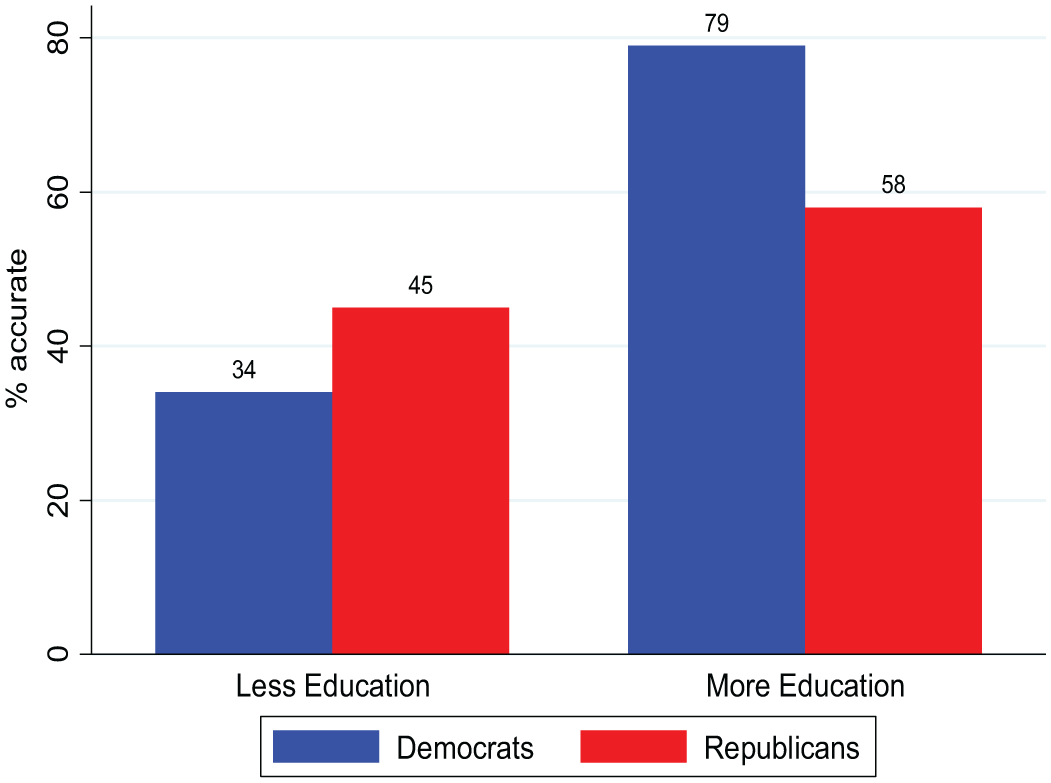
% Accurate beliefs about vaccines by party and education.
Given a dichotomous dependent variable, 1 = accurate beliefs, 0 = otherwise, we employ logistic regression. Party identification was represented by a dummy variable, 1 = Democrats, 0 = Republicans. Those unwilling to report either party affiliation, or Independents, were not used. This ensures a measure of partisanship that includes those most committed and thus likely motivated by a partisan identity. 2 We used the conventional education scale: 1 = high school or less, 2 = some college, 3 = college graduate, and 4 = postgraduate. Several important controls were included—first, gender (1 = female, 0 = male), race (1 = Black, 0 = non-Black), and reported age—continuous 18 to 99 years old. These variables are well-known correlates of political knowledge and attention (Carpini & Keeter, 1996). Finally, as vaccines concern children, we added a dichotomous measure for parents with children below 18 (1= parent, 0 = otherwise). 3
Results and Discussion
Gallup Model Results
Table 1, column 1, displays logistic estimates for the full model. Positive coefficients indicate a greater likelihood of accuracy about vaccines; a negative estimate suggests a lower probability. The four percentage point disparity referred to previously favoring Democrats did not quite survive the multivariate test, though the positive sign is in the expected direction (b = .24, p < .18). We therefore cannot confirm the first hypotheses.
Determinants of Accurate Beliefs About Vaccines and Autism.
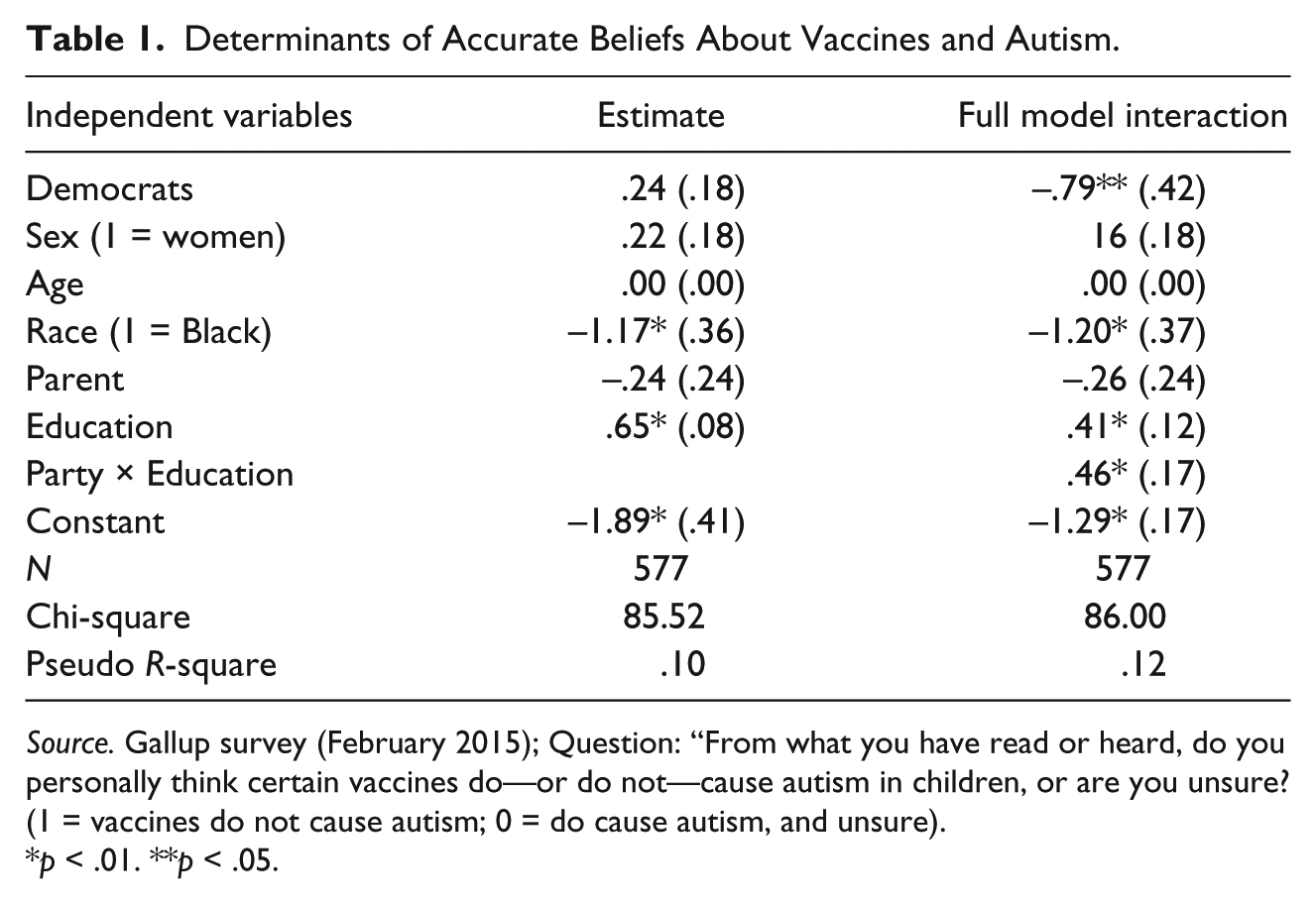
Source. Gallup survey (February 2015); Question: “From what you have read or heard, do you personally think certain vaccines do—or do not—cause autism in children, or are you unsure? (1 = vaccines do not cause autism; 0 = do cause autism, and unsure).
p < .01. **p < .05.
The performance of several other variables, most notably education, increases our confidence in the dependent variable, however. Consistent with the political knowledge literature (Carpini & Keeter, 1996), advancing education produces more accurate judgments (p = .65, p < .000). The impact of education is substantial. Holding other predictors constant, the likelihood that the least educated are accurate is 0.35. This probability increases sharply to 0.81 among the most educated.
To examine the moderating role of education, we reestimated the equation in column 1 but this time added an interaction term between party identification and education. The interaction coefficient is robust (b = .46, p < .007) and indicates partisan differences at the highest levels of educational attainment. Figure 2 makes this clear. We mapped the effects of education on the probability of accuracy for Democrats and Republicans—controlling for the impact of the other predictors. For the first two levels of education, overlapping confidence intervals indicate virtually no partisan differences in the likelihood of accuracy. However, partisan separation emerges at the third level of educational attainment—bachelor’s degree—and continues into postgraduate status. This is important evidence in support of Hypothesis 2.
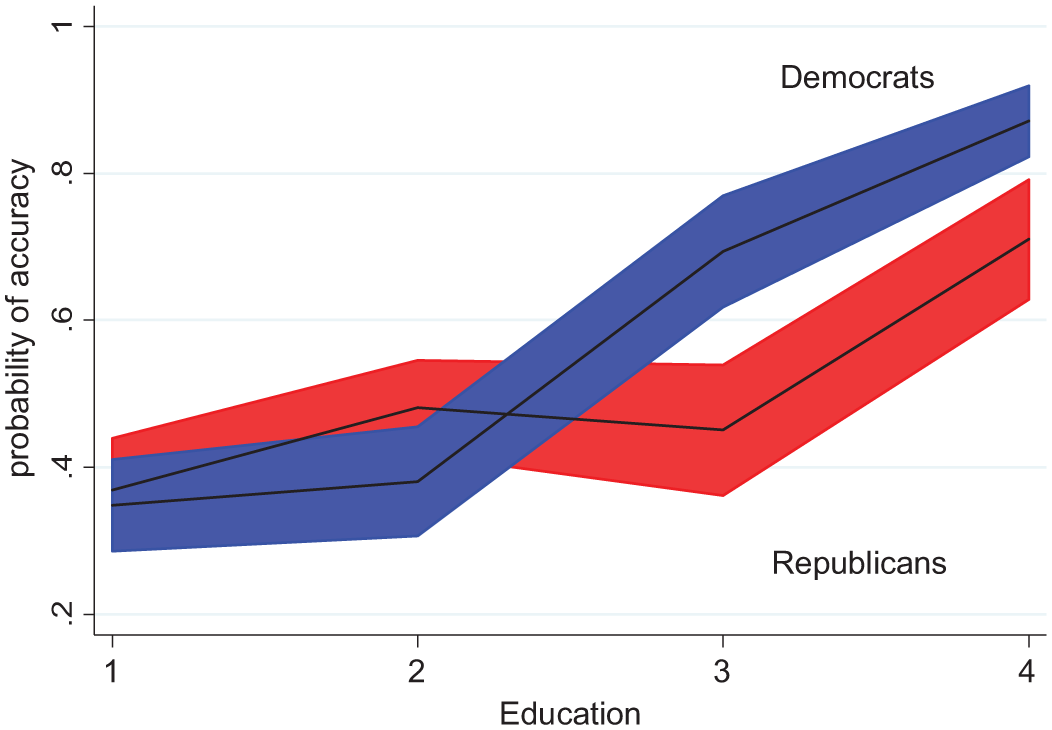
The effects of education by party on accurate beliefs about vaccines and autism - Gallup survey.
Figure 2 also confirms the descriptive data in Figure 1. Education appears to influence Democrats more so than Republicans. Across the educational spectrum, Democrats exhibited the greatest increase in likelihood of accuracy—from 0.34 for those at high school or less to approximately 0.87 for postgraduates—a substantial 0.53 increase in the probability of accuracy. Republicans are also affected, but just not to the same degree. The likelihood of accuracy among Republican high school graduates or less is 0.37 but postgraduates 0.70—a significant increase in probability of 0.33, but 0.20 short of the Democrats’ improvement.
Thus, while Democrats and Republicans did not differ statistically in their likelihood of accuracy, the accuracy of partisan beliefs clearly differs with advancing levels of education. It appears the asymmetric effect of education produced the partisan difference among the most educated. This is an important finding that requires additional consideration. But first we seek to generalize beyond the Gallup poll, examining a CBS survey that included a different question about vaccines and autism.
CBS News Survey
CBS News asked respondents in their February 13-15, 2015 survey of 1,006 adults “How likely do you think it is that vaccines given to children for diseases like measles, mumps, and rubella can cause a neurological disorder like autism?” very likely (3.8%), somewhat likely (16.9%), not very likely (38.9%), not at all likely (35%), and don’t know (5.0%). Thus, about 20% judged the connection somewhat or very likely, and nearly 39% kept the possibility of a connection between vaccines and autism open with a response of “not very likely.” Just over a third of the sample asserted strongly that the likelihood of a link is “not at all.”
As with the Gallup survey, we combined responses that reflected accurate judgments. Respondents judging that it is very likely that vaccines cause autism, somewhat, not very likely, and don’t know did not answer the question accurately. The judgment “not at all likely” that vaccines cause autism represents an accurate belief. 4
For this measure of belief accuracy, a slightly larger split appeared between Democrats and Republicans. Forty three percent of Democrats and 34% of Republicans were accurate. Clearly, given the degree of consensus in the scientific community regarding vaccines, and widespread use for decades, these numbers reflect substantial doubt across both parties. Nevertheless, education does improve accuracy. Twenty-eight percent of the least educated were correct, and this increased to 49% among postgraduates.
For the logistic analyses, control variables were the same as in the Gallup model except CBS added a measure of people’s attention to the recent measles outbreak. 5 Respondents were asked, “How much have you heard or read about the recent outbreak of measles in the United States?” 0 = nothing at all, 1 = not much, 2 = some, and 3 = a lot. We expected those who heard or read more about the outbreak would exhibit a higher probability of accurate beliefs.
Table 2 presents the estimated relationships. Once again positive coefficients indicate a greater likelihood of accuracy. First, partisan differences survived the multivariate test. Democrats exhibited higher likelihood of accuracy than Republicans (b = .52, p < .00). Second, as before, education emerged as a strong predictor (b = .24, p < .00). Attention to the outbreak was also a significant predictor of increasing accuracy (b = .38, p < .00). Finally, as in the Gallup survey, the interaction term between education and party is robust (b = .32, p < .05). The positive sign indicates the estimated slope for Democrats across education levels is significantly greater than that for Republicans. Figure 3 illustrates the interaction and makes plain two central findings across both surveys.
Determinants of Accurate Beliefs About Vaccines and Autism.

Source. CBS survey (February 2015); Question: “How likely do you think it is that vaccines given to children for diseases like measles, mumps, and rubella can cause a neurological disorder like autism? (1 = not at all likely, 0 = very likely, somewhat likely, and not very likely).
p < .01. **p < .05.
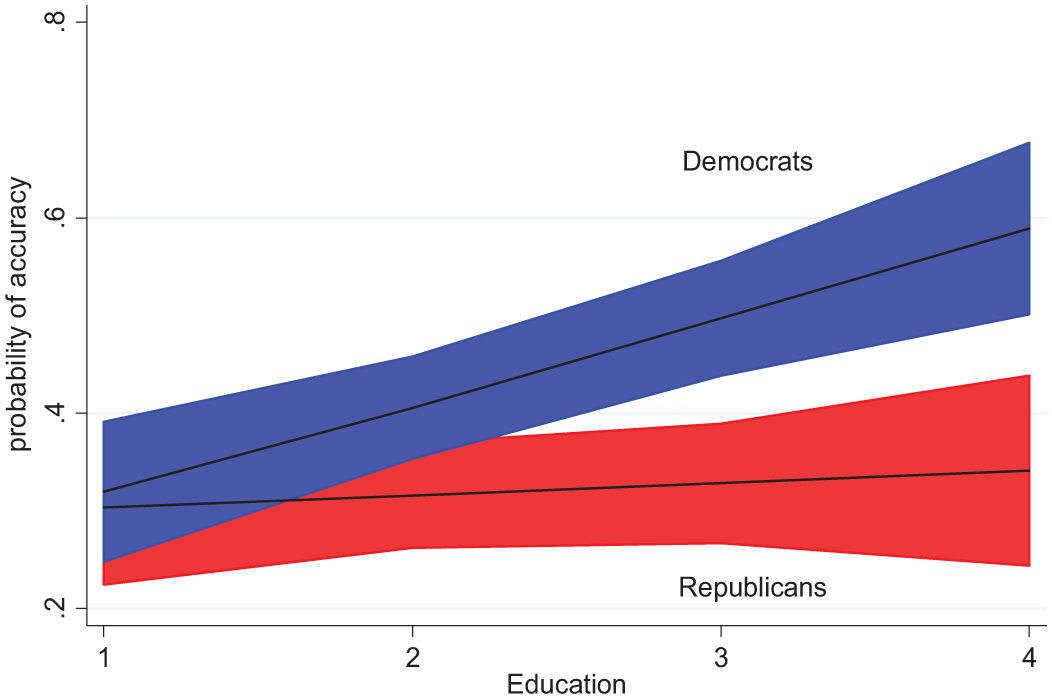
The effects of education by party on accurate beliefs about vaccines and autism - CBS survey.
First, among Republicans, education does not appear to be as effective in producing accuracy. This was true in both surveys, though more evident in the CBS data. For example, in Figure 3, only a slight increase in probability of accuracy occurred between less educated 0.30 and highly educated Republicans 0.35. However, the increase is substantially greater among Democrats, improving from 0.31 among the least educated to 0.59 among the most educated.
Why is education a more robust predictor for Democrats? We first consider the nature of the scientific evidence. Vaccine science is consistent with Democrats’ dispositions, sitting comfortably with Democrats’ support of science and government programs generally. For Democrats, vaccine science is reinforcing. This is especially true for educated Democrats. Party identification and education are in effect working together to produce more accurate beliefs.
But by defending their party identity, educated Republicans are at odds with vaccine science, and in opposition to the powerful impact of educational attainment. Our models both showed education increased accuracy. Among educated Republicans, strong cross-pressures are therefore likely to exist. In this instance, the directional motivation may be tempered by education as opposed to amplified. For Republicans, acceptance of vaccine science may be a more difficult cognitive effort than rejection.
Redlawsk, Givettini, and Emmerson (2010) found that people exposed to disconfirming information may reach a “tipping point” where they become willing to reconsider their views. At some point, the evidence simply overwhelms directional motives. We cannot discern whether educated Republicans approached that tipping point about vaccines. But we can say that educated partisans exposed to strong scientific evidence opposed to their party view do confront disconfirming information and that appears to moderate directional motives—decreasing belief accuracy.
A second and related possibility for the weaker impact of education among Republicans may lie with the issue itself. Vaccines do not appear to be a fully developed partisan issue. Our own evidence suggests as much. Partisan differences were comparatively small, especially considering the more developed partisanship connected to racial and cultural issues (Layman, Carsey, & Horowitz, 2006). Greater politicization of vaccine science would strengthen directional motivations, particularly among the educated. In that case, stronger directional motivations may overcome disconfirming scientific evidence among Republicans and result in even greater partisan divisions among the highly educated.
Finally, the differential impact of education across the two parties does result in polarization among the most educated. Apart from the cognitive mechanisms that generated it, the gap is notable precisely because it exists at the upper categories of education. As considered, we may see still larger gaps between educated partisans if vaccine science develops deeper partisan roots.
The Consequences for Attitudes Toward Vaccination Policy
To this point, the analyses identified important partisan and education effects on accuracy about vaccine science. We now turn to the question of whether accurate beliefs impact attitudes about vaccination policies. There is long-standing evidence that factual knowledge can influence a host of political preferences (Carpini & Keeter, 1996). There is also accumulating evidence that misinformation can influence people’s policy preferences (Howell & West, 2009), electoral decisions (Weeks & Garrett, 2014), and political preferences (Gilens, 2001; Kuklinski, Quirk, Jerit, Schwieder, & Rich, 2000).
In the CBS survey, we identified two policy questions. First, “Do you think parents should be required to vaccinate their children for diseases like measles, mumps, and rubella, or do you think parents should be able to decide whether or not to vaccinate their children?” 1 = parents should be able to decide (30%), 0 = parents should be required to vaccinate their children (70%). Second, “Should children who have not been vaccinated from diseases like measles, mumps, and rubella be allowed to attend public schools, or not?” 1 = should be able to attend schools even if not vaccinated (29.7%), 0 = should not be able to attend if not vaccinated (70.3%).
A multivariate logistic regression allowed us to determine whether a reliable association existed between accuracy and policy preferences. Controls included party identification, whether the respondent was a parent, attention/exposure to measles outbreak, and demographics including gender, age, race and education. Finally, we used the same dichotomous accuracy variable from the previous CBS survey analyses.
The results appear in Table 3. Positive coefficients indicate an increased probability of supporting parents’ decision to vaccinate their children (as opposed to a requirement) and that unvaccinated children can attend public schools. For both policy questions, accurate beliefs decreased the likelihood of supporting parental choice (b = −.96, p < .00) and allowing unvaccinated children to attend school (b = −1.04, p < .00). Controlling for the other independent variables, the effect of accuracy is relatively strong. The probability of supporting parental choice decreases by approximately 0.17 if a respondents’ belief was accurate about vaccine science. To compare, Republicans are about 0.12 more likely than Democrats to support parental choice.
The Impact of Accurate Beliefs on Vaccine-Related Policy Preferences.
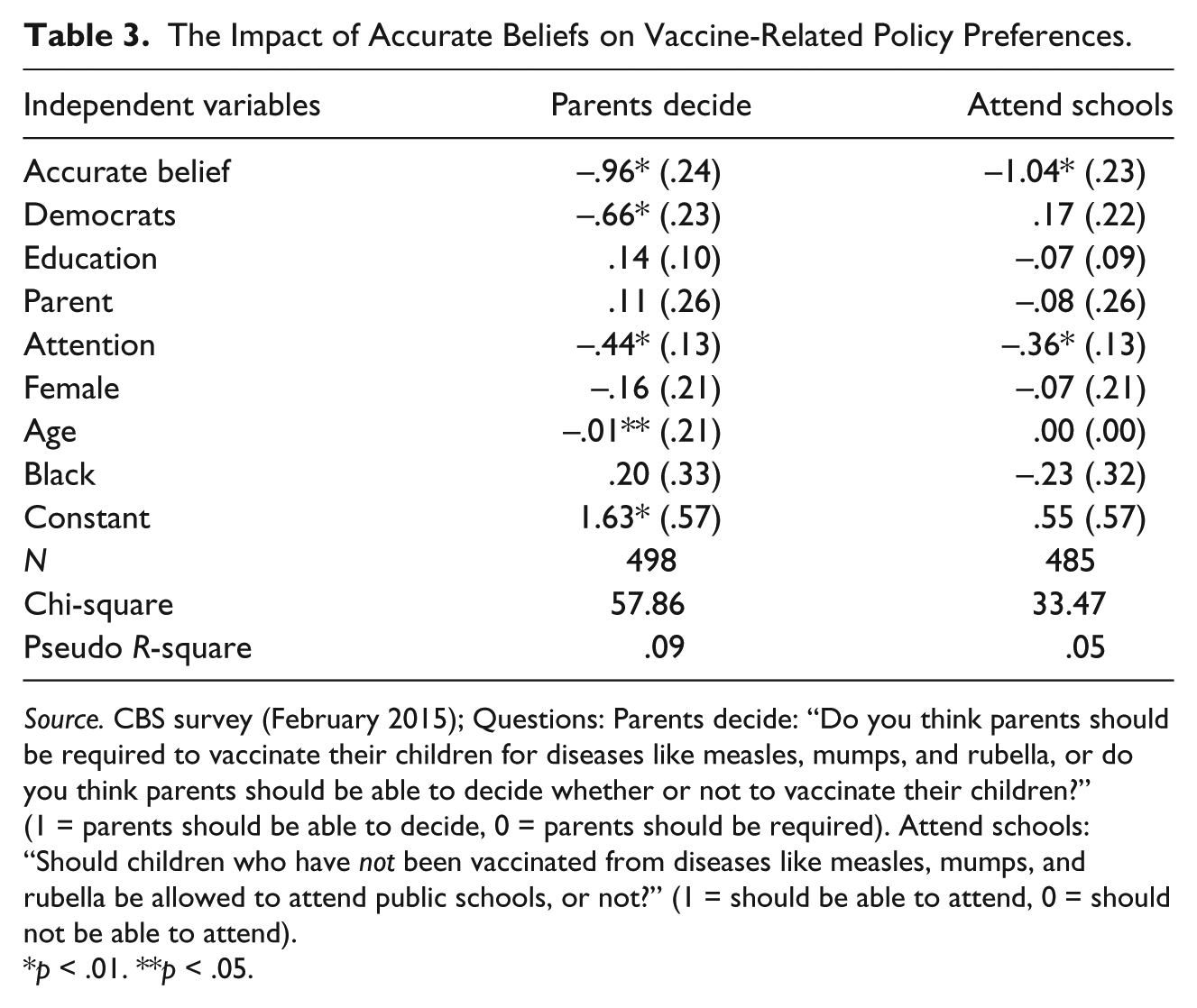
Source. CBS survey (February 2015); Questions: Parents decide: “Do you think parents should be required to vaccinate their children for diseases like measles, mumps, and rubella, or do you think parents should be able to decide whether or not to vaccinate their children?” (1 = parents should be able to decide, 0 = parents should be required). Attend schools: “Should children who have not been vaccinated from diseases like measles, mumps, and rubella be allowed to attend public schools, or not?” (1 = should be able to attend, 0 = should not be able to attend).
p < .01. **p < .05.
In sum, the results in Table 3 show that accurate beliefs about vaccines and autism are a consistent and relatively strong predictor of vaccine-related policy preferences. While public support for parent requirements to vaccinate their children, and for unvaccinated children to not attend school, is strong, our findings suggest accurate beliefs are important in sustaining that support. To the extent that accuracy declines, however, current support of these policies could be expected to drop as well.
Conclusion
As public health policymakers struggle with an increasing number of parents either delaying or exempting their children from required vaccinations, it is important to understand the factors that predict accurate beliefs about vaccine science. Motivated reasoning, in part, provides a window into an individual’s thinking. It offers a reasonable basis for why people would in fact dismiss, or fail to notice, widespread agreement among the scientific community. It also suggests why others would in fact recognize the science and possess accurate beliefs. Once policy-relevant scientific evidence is transformed into symbols of political identity (Kahan, Peters, Dawson, & Slovic, 2017), strong partisan motivations reliably bias information reception and factual understanding. Partisans extract from information that which matters most to them and matches their group identity. Accurate information may or may not match that identity. And, the tendency to process information in this fashion may be strongest among the most educated partisans—those most likely to align the “facts” with their group’s positions. Our analyses allow us to draw several important conclusions.
First, we demonstrated significant partisanship about vaccine science. While differences between Democrats’ and Republicans’ beliefs about a link between vaccines and autism were not especially large, distinctions grew with advancing education levels. These findings confirmed our hypotheses. The data also yielded an intriguing result; the partisan gap increased because education had a greater impact on Democrats than Republicans. We surmised directional motivation could be more easily reinforced by education when the scientific evidence is consistent with partisan dispositions. This was the case for Democrats. Vaccine science fits well with Democrats’ existing views on science and government. However, the facts did not align as well with Republicans’ views. Educated Republicans may have been conflicted, motivated to defend their party identification, but pulled in the opposite direction by their educational attainment. It is that conflict that tempered the directional motivation effects among educated Republicans, and its absence among educated Democrats amplified those motives.
In a recent paper, Joslyn and Haider-Markel (2014) showed that across several contested political facts that align well with Democrats’ worldviews—no evidence of weapons of mass destruction in Iraq, agreement among scientists that humans have evolved over time, earth is warming because of human activity—education was a strong predictor among Democrats but insignificant or weak among Republicans. Yet for the one fact that aligned well with Republicans’ views, the effectiveness of Iraq troop surge in making circumstances on the ground better, education was a potent predictor among Republicans, but not so among Democrats. In that case, it appeared that educated Democrats were conflicted, directionally motivated to perceive the surge as ineffective, but also drawn toward the most accurate answer among the educated public that the surge was successful. Future research should explore this issue. Accumulating evidence (including here) shows that sophistication can amplify directional reasoning. But far less is known about the potential for sophistication to have different effects on partisan knowledge generally and accuracy about scientific evidence specifically.
Second, our analysis showed that accurate beliefs about the vaccine–autism link influenced individual policy preferences. We found accuracy decreased the probability of endorsing parental choice for vaccination decisions—as opposed to making it a requirement—and also dropped support for allowing unvaccinated children to attend public schools. By itself, the causes of accurate beliefs are important to grasp and scrutinize in some detail, but, perhaps as, or more, important is the consequences of accuracy for policy attitudes. A notable portion of respondents were accurate. Accurate beliefs can form the basis for individual decisions and action that could conceivably benefit the individual and society. Conversely, inaccurate beliefs may produce action that run counter to the best interests of individuals and the larger public. Identifying these possibilities, Hochschild and Einstein (2015) observed, “political activity in accord with . . . misinformation can lead to irresponsible governance and bad policies, with at times devastating societal consequences” (p. 14).
The recent outbreak of measles in Minnesota offers a cautionary tale about the relative absence of accurate beliefs and the devastating implications for individuals and communities.
Following misinformation about the link between autism and vaccines, parents decided not to immunize their children (Howard, 2017), which led to marked increases in measles and hospitalizations. The crisis cost the state millions, spending scarce public health resources to manage and counteract the outbreak (Bauman, 2017). Convincing parents to vaccinate their children can be difficult (Nyhan, Reifler, Richey, & Freed, 2014), but the individual and public costs of not doing so can be considerable (Howatt, 2017).
Finally, our findings suggest broader implications for health policies regarding vaccinations and the ability of the government to educate citizens. While the effectiveness of vaccines depends on herd immunity, our empirical results suggest the government and pro-vaccine advocates should tailor pro-vaccine messages to the least educated. Traditional education clearly works, and more of it increased the probability of accurate beliefs.
Yet even while education led to increased accuracy, educated citizens are also partisans. In our polarized political climate, one’s position on science-related issues may often be understood as a sign for membership in and loyalty to political parties (Kahan et al., 2017). In these conditions, educated partisans are astute at aligning the scientific facts with their own party’s position. Our results highlight this dynamic, especially among educated Democrats and to a lesser degree educated Republicans. Education may improve accuracy, but in combination with partisanship, education may thwart accuracy as well. The important element may thus not be more education but rather the timing of pro-vaccine messages. Target populations require timely information long before skepticism creeps in and partisanship develops. This is one lesson from Minnesota. The sources of directional motivations to process science information in an identity-protective fashion need to be preempted, or removed altogether, for public understanding to grow and accuracy to improve. This is of course a very difficult task as politicization of science often arises from electoral incentives of public officials (Bolsen & Druckman, 2015). Vaccine science may just be another in a growing list of politicized scientific issues. Yet it is important to recall the consequences of vaccine beliefs can be immediate and sometimes costly for individuals and society.
Footnotes
Declaration of Conflicting Interests
The author(s) declared no potential conflicts of interest with respect to the research, authorship, and/or publication of this article.
Funding
The author(s) received no financial support for the research, authorship, and/or publication of this article.

Supplementary Material
Supplementary material is available for this article online .
Notes
Author Biographies
References
Supplementary Material
Please find the following supplemental material available below.
For Open Access articles published under a Creative Commons License, all supplemental material carries the same license as the article it is associated with.
For non-Open Access articles published, all supplemental material carries a non-exclusive license, and permission requests for re-use of supplemental material or any part of supplemental material shall be sent directly to the copyright owner as specified in the copyright notice associated with the article.
