




Abstract
Political scientists have demonstrated the importance of lawmakers’ identities, showing that race, gender, socioeconomic status, and sexual orientation affect legislative and representational behavior. Is the same true for age? We argue it is, but the effect is conditioned by the salience of different “senior issues.” Analyzing the bill introductions by members of Congress during the 109th and 110th Congresses, we show that older lawmakers are more likely to introduce legislation addressing lower salience senior issues than their younger colleagues. In contrast, sizeable senior constituencies in a district influence lawmaker attention to higher salience senior issues, regardless of a lawmaker’s age. These findings have implications for our understanding of senior power and personal roots of representation in the United States.
Elected members of Congress are much older than most Americans. In 2015, the average senator was 62 years old, with 40% of senators 65 years of age or older. In the House, the average representative was 58, with 26% at least 65 years of age. By comparison, according to the 2010 Census, among those eligible to run for Congress (25 years of age or older), just 19% are 65 or older. More importantly, almost one third of the older-than-25 population is younger than 40 years, while in recent congresses, less than 5% of members of Congress have been younger than that age. In fact, in 2015, just one senator was younger than 40, with the vast majority of lawmakers at least 50 (78% in the House and 86% in the Senate). In recent decades, Congress has grayed, with the average age of representatives and senators increasing by roughly a decade since the early 1980s.
The age bias among our national lawmakers is well known, but its consequences for the legislative behavior of elected officials have not been closely studied. 1 Many scholars argue that issues important to American seniors receive disproportionate attention because older Americans have strong political interests and vote, donate, and generally participate in politics at higher rates than younger Americans (Binstock, 1997; Bramlett, 2015; Cutler, 1977; Day, 2014; Pratt, 1993; Rix, 1999; Schulz & Binstock, 2008; Street, 1997; Wolfinger & Rosenstone, 1980). We argue the prevalence of seniors in the halls of Congress may also contribute to the attention paid to “senior” issues.
Political scientists have long noted the importance of legislators’ identities and life experiences for their actions in office, finding that race (Bratton & Haynie, 1999; Gamble, 2007; Haynie, 2001; Minta, 2009), gender (Frederick, 2010; Gerrity, Osborn, & Mendez, 2007; Swers, 2002), and socioeconomic class (Carnes, 2013) affect legislative behavior. Drawing on a data set of every bill introduced to the House of Representatives from 2005 to 2008, we find evidence that the same is true for a lawmaker’s age. Specifically, we find that a lawmaker’s age influences his or her attention to “senior issues”—those of importance to American seniors—but that this dynamic is conditioned by the relative salience of each issue. Our analyses show that the characteristics of a lawmaker’s constituency drives his or her efforts to introduce legislation addressing higher salience senior issues, such as Medicare and other health care issues that receive considerable public attention. On these issues, the senior power thesis appears to have explanatory power. However, a lawmaker’s age influences the likelihood he or she will devote time and effort to crafting and introducing legislation on other, lower salience senior issues, such as elder abuse, late-life housing, assisted living needs, and continuing education. On these issues, a lawmaker’s age is highly predictive of such action, irrespective of constituency. These findings suggest the graying of Congress may have important consequences for how it represents Americans of all ages.
The Senior Power Model
It is widely believed American seniors have significant power to influence policymaking on issues and governmental programs important to them, including Medicare, Medicaid, and Social Security. Some scholars have attributed this senior power, or “gray power,” to the numerical size, political cohesion, and high level of political activity found among seniors in the public. This senior power model argues that because seniors comprise a large share of the public, have group-based policy self-interests, and have developed active and influential interest groups (i.e., the American Association of Retired Persons [AARP]), they have outsized influence over the public policy decisions of their representatives (Binstock, 1997; Cutler, 1977; Pratt, 1993; Rix, 1999; Schulz & Binstock, 2008; Street, 1997).
Interest in senior power emerged in the 1970s as scholars predicted that the growing elderly population would become a powerful voting bloc, particularly in the Sunbelt and other states with large retiree populations, and that these seniors would alter the dynamics of both local and national politics and policymaking (e.g., Trela, 1971; Weaver, 1976). Although American seniors have not been quite as cohesive on political issues as these early scholars anticipated (see, Rhodebeck, 1993), older Americans continue to be viewed as a potent, if sometime latent, political force. Indeed, the United States’s large and growing senior population has group interests that unify it and engage it in political action, including preserving and expanding Medicare, Social Security, and other social welfare programs. Social Security provides 61% of elderly beneficiaries with a majority of their income, and 40% of American seniors would be in poverty without the program’s benefits (Center on Budget and Policy Priorities, 2016). The vast majority of seniors also rely on Medicare or Medicaid for all or some of their health care costs. Politically, seniors benefit from a positive image among the broader public, which aids their causes. Compared with other groups, retirees and senior Americans are both easily identifiable and enjoy high levels of public sympathy and political visibility (Pratt, 1976).
Senior citizens also participate in politics at high rates. The likelihood of participating in elections increases with age (Wolfinger & Rosenstone, 1980) and persons aged 65 years and older represent a substantial share of voters. In 2012, 70% of Americans 65 years or older voted, by far the highest rate of participation among any age group (File, 2013). In some states, seniors are a particularly substantial voting bloc. For instance, in Florida, voters aged 60 years and older make up more than one quarter of the state’s electorate. While there is some debate over the actual amount of political power seniors can wield (Sherman, Ward, and LaGory, 1985), Bramlett (2015) shows that large communities of seniors can increase knowledge and awareness of senior issues, and increase seniors’ engagement in politics, amplifying their political power.
This senior power model is often credited for the political influence of seniors, the successes of senior citizen interest groups at blocking policy change on entitlement programs (Day, 2014; Pratt, 1983), and helps explain why the AARP is sometimes praised (and sometimes disparaged) as one of the most powerful lobbies in America (Hornblower, 1988). Nonetheless, the influence of age on American policymaking may extend beyond the influence of seniors in the public. It may also relate to the distribution of ages in Congress.
Age and Representation in Congress
Constituency-based explanations for senior influence largely ignore the age bias among Congress’s membership. Members of Congress and senators are generally older than the adult American population. This has always been true, due in part to age requirements to run for congressional office, but also due to the political and social ladder individuals must climb before they become viable candidates. As shown in Figure 1, the representational age bias of Congress is similar to that of other notable biases in the institution’s membership. During the 110th Congress, members of the House were 67% more likely to be aged older than 65 years than the public, and senators were 350% more likely. These age gaps are similar to those found with gender representation and more dramatic than those for race. These data focus on the 110th Congress, but the age gap is similar in other recent Congresses. Lawmakers older than 65 years typically comprise 20% to 25% of the House and 40% to 50% of the Senate.
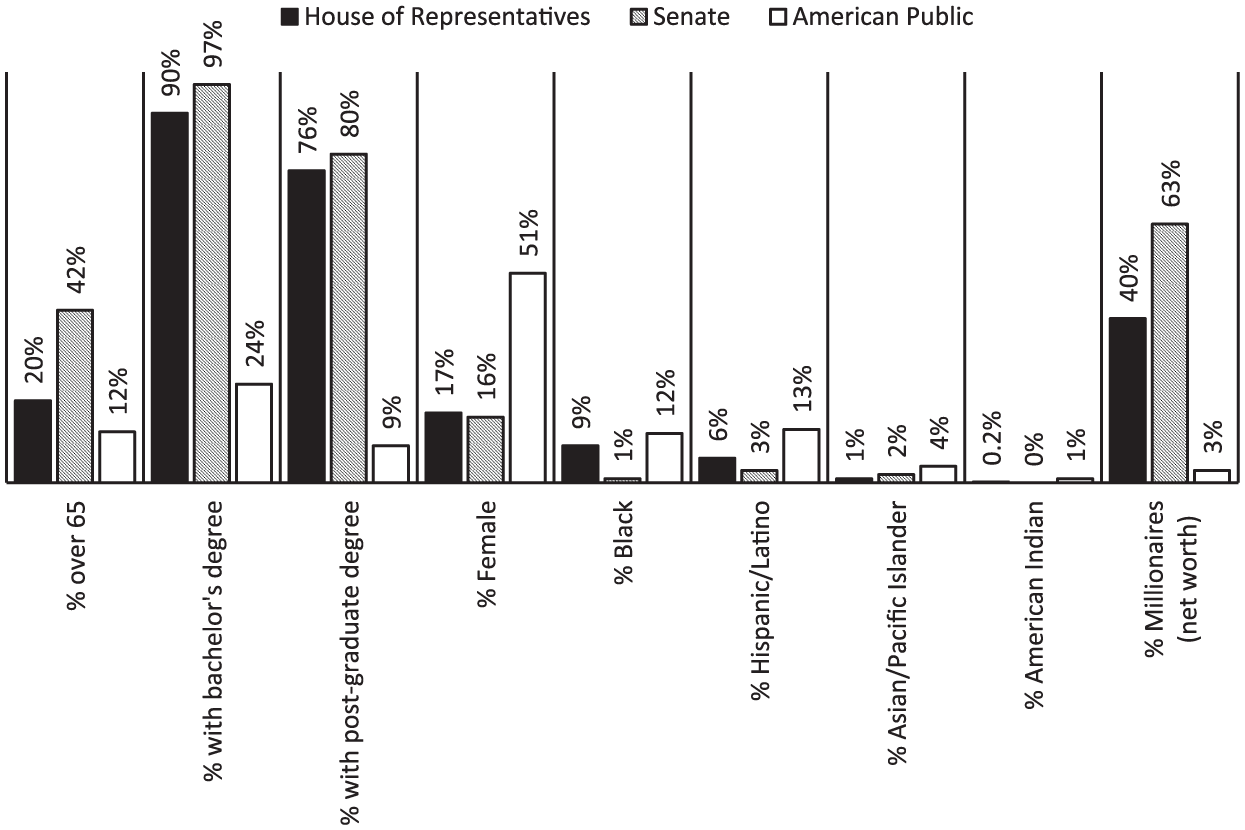
Demographic differences between Congress and the American public, 110th Congress.
The ages of members of Congress may affect their representational behavior in important ways, directing the attention of older lawmakers onto issues of importance and relevance to senior constituencies in ways not experienced by younger lawmakers. Two processes, well established in scholarship on congressional representation, may drive such behavioral patterns. First, older lawmakers have a more personal connection to the experiences of seniors than younger lawmakers, and so may act as descriptive representors. Second, older lawmakers may be more attuned and responsive to the subconstituency demands of seniors in their districts than younger lawmakers.
A rich tradition of research establishes that lawmakers’ identities and life experiences influence their representational behavior. Burden (2007) explains that legislators’ actions in office have “personal roots,” in that their representational behavior and issue focuses are driven in part by their backgrounds and personal experiences. The concept of descriptive representation (see, Pitkin, 1967) suggests a similar influence on legislative behavior, with lawmakers supporting the interest of particular groups because they share a characteristic with the group. Indeed, many lawmakers describe themselves as this kind of surrogate and understand it as their role to represent their descriptive groups’ interests. Interview research, in particular, has found this to be true among women and minority lawmakers (Carroll, 2003; Dodson, 2006; Fenno, 2003; Hawkesworth, 2003; Reingold, 1992; Swain, 1993; Tate, 2003).
Substantial empirical evidence indicates that lawmakers’ behaviors are influenced by their identities and background, including by their race (Bratton, 2006; Bratton & Haynie, 1999; Cameron, Epstein, & O’Halloran, 1996; Ellis & Wilson, 2013; Gamble, 2007; Haynie, 2001; Kerr & Miller, 1997; Minta, 2009; Preuhs, 2005; Rocca, Sanchez, & Uscinski, 2008; Rouse, 2013; Whitby, 1996; Whitby & Gilliam, 1998; Whitby & Krause, 2001; Wilson, 2010), gender (Dodson, 2006; Frederick, 2010; Gerrity et al., 2007; MacDonald & O’Brien, 2010; Norton, 1999; Swers, 1998, 2002; Tatalovich & Schier, 1993), socioeconomic class (Carnes, 2013), and sexual orientation (Haider-Markel, 2007; Herrick, 2009; Mansbridge, 2003). Black, Hispanic, female, rich, poor, and lesbian, gay, bisexual, and transgender (LGBT) lawmakers have been shown to pay more attention to, and work harder on, issues related to these aspects of their identities, cultivate distinct legislative records, promote different policies, and act differently in positions of leadership.
As seniors themselves, older lawmakers have a personal connection to the interests, preferences, and challenges faced by seniors in the public. Of course, there are important differences between older members of Congress and older adult Americans. Members of Congress are typically wealthier than most of the public (Carnes, 2013) and their unique social and economic status may insulate them from some of the problems faced by other American seniors. Nonetheless, they still face many of the same challenges, particularly health and medical challenges, which come with advanced age. They are also likely to have friends and peers who face age-related problems and disabilities that they may not personally face, such as the need for long-term care, or health problems that do not personally affect them, such as Alzheimer’s.
Importantly, the common challenges faced by older Americans may give seniors the kind of group consciousness typically associated with ethnic and racial minorities and the poor (Campbell, 2002; Miller, Gurin, & Gurin, 1980). 2 Moreover, the challenges faced by seniors directly interact with major governmental programs and policies as the largest federal social welfare programs—including Social Security, Medicare, pensions, survivors and disability support, and other long-term medical care policies—were specifically designed to aid the elderly. According to Street (1997), the very existence of these programs aids the formation of political cleavages between the old and the young.
Older lawmakers may also simply share the values, attitudes, and ideologies of senior Americans because of their similar ages, life experiences, and histories. Indeed, age is a predictor of political attitudes. Older Americans today are typically more conservative and Republican than younger Americans. However, the policy preferences and priorities of American seniors are nuanced. Even if seniors are more likely to describe themselves as conservative, they do not consistently support or oppose expanded governmental benefits (Day, 2014). Nonetheless, political action on governmental programs that affect seniors is typically more salient among seniors compared with younger Americans. And, after all, the enactment of programs such as Medicare and Social Security is what spurred older adult Americans into the political spectrum as an influential interest group in the first place (Day, 2014). In other words, seniors can be expected to be more attentive to policies and issues directly relevant to seniors.
Common generational experiences among those in an age group, and differential experiences between generations, further cement age-related differences in political attitudes and concerns. The socialization and life experiences of different generations result in differences in party attachments (Abramson, 1979) and differences in political attitudes on a variety of political issues (Alwin, 1998; Jennings & Niemi, 1981). Again, while lawmakers are elites, they have shared their generational experiences with those in the public. For all these reasons, older lawmakers likely connect with the problems faced by senior citizens and the governmental programs designed to address these problems, at least more so than most younger lawmakers. 3
Even when older lawmakers are not affected by a personal connection, by virtue of their ages they may be more attuned to and responsive to senior subconstituencies in their districts than younger legislators. Members of Congress build support and represent their districts by focusing on subconstituencies rather than the district as a whole (Bishin, 2000, 2009; Fenno, 1978); as Fenno (1978) notes, legislators feel more at home with some constituent groups than others, and so may be more attuned to or favorable toward those groups in their attention and action. These tend to be groups members feel a part of or some affinity for. Ultimately, the subconstituencies lawmakers attend to is influenced in part by which groups contact the lawmaker and donate to the campaign (Miler, 2010). However, lawmakers are also discriminatory in their attention to different subconstituencies and their interests. For instance, Butler and Broockman (2011) find legislators are more responsive to constituents who share their racial background. Subconstituency focuses likely focus the attention of older legislators more on senior constituencies compared with younger legislators. Older lawmakers likely feel more at home with senior constituencies than younger lawmakers, on average. And they may likewise be more responsive to older constituencies because of their shared traits and experiences.
Altogether, we expect that a lawmaker’s representational behavior vis-à-vis issues important to American seniors will be driven in part by a lawmaker’s age, with older lawmakers, on average, more attentive to issues of importance to American seniors than younger lawmakers. We do not discount the traditional senior power model. Senior constituencies undoubtedly also contribute to the attention representatives pay senior issues. However, we expect that both a lawmaker’s age and the composition of his or her constituency play a role in his or her issue attentions and legislative behaviors.
The Conditioning Role of Issue Salience
While both a lawmaker’s constituency and age should affect behavior on senior issues, we expect the impact of each is conditioned by the relative salience of different issues. Specifically, we expect the senior power model will best explain a lawmaker’s behavior on issues important to American seniors that enjoy broad public salience and media attention, such as Medicare and other programs providing benefits directly to seniors. Several studies have found that the influence of seniors in the public and senior interest groups is at its greatest, and the senior power model provides the best explanatory power, when an issue is particularly salient. When programs like Medicare are being threatened with change, or have otherwise become salient on the political agenda, older Americans are likely to mobilize and try to leverage their collective power to influence policy (Andel & Liebig, 2002; W. A. Anderson & Anderson, 1978; Campbell, 2002, 2003, 2005; Jennings & Markus, 1988).
Similarly, there is substantial evidence that lawmakers are most responsive and attentive to subconstituencies when an issue is particularly salient. While lawmakers are generally responsive (e.g., Fenno, 1978; Grimmer, 2013; Kingdon, 1989; Mayhew, 1974), they become more attentive to groups within their district when an issue important to that group becomes politically visible and salient (Bishin, 2009; Hayes & Bishin, 2012) and are more likely to introduce legislation that is particularly salient to their districts (Lazarus, 2013). Generally, on issues that mobilize seniors in the public, it is likely that lawmakers with large senior constituencies will feel pressure to take action, regardless of the lawmaker’s age.
In contrast, we expect lawmakers’ ages will best explain their behavior on other issues that impact seniors, but that are typically less-salient items on the political agenda, such as elder abuse, continuing education, nursing home regulation, and more. While seniors in the public may not be as effectively mobilized on less-salient senior issues, and consequently, while lawmakers may not be as influenced by seniors in their districts on these issues, older lawmakers, by virtue of their identities and connections with other seniors, will still be attentive and sensitive to these issues, and their behaviors will still be affected.
Data and Method
To test these expectations, we employ a data set of every bill introduced by every member of the House of Representatives during the 109th and 110th Congresses (2005-2008) as compiled by the Congressional Bills Project (CBP). 4 We analyze bill introduction because it is one of the few legislative actions a member of Congress can take without any restriction. Members of Congress can introduce legislation on any topic they wish. They can introduce as many or as few bills as they wish. Furthermore, because every bill has just one sponsor, introductions can be solely attributed to the sponsor. The only restrictions on members’ bill introduction activities are time, resources, and creativity.
Every other manner of legislative action is limited or structured by congressional leaders, committee assignments, legislative processes, or the behavior of other political actors. For example, members cannot engage in a committee hearing unless they are on the committee conducting the hearing. Even then, the topics of hearings are typically determined by committee chairs. Members also cannot individually decide which bills or issues will receive recorded votes. They cannot cosponsor a bill unless another lawmaker introduces it. They cannot even freely use the chamber floor for speech giving as opportunities for open floor time are limited, and all other debate must be germane to the bill or subject being considered at the time.
Furthermore, bill introductions are a good measure of lawmakers’ issue priorities (Schiller, 1995; Wawro, 2001), the positions they hold on those issues (Lazarus, 2013; Rocca & Gordon, 2010), and the signals they would like to send to constituent groups (Grimmer, 2013; Mayhew, 1974). Generally, if a lawmaker introduces a bill on an issue, it is a good indicator that the issue is an important part of his or her legislative portfolio and his or her legislative identity. For these reasons, bill introductions are a common way of assessing how descriptive representation influences lawmakers’ legislative priorities (e.g., Bratton, 2006; Bratton & Haynie, 1999; Haynie, 2001; Swers, 2002; Wilson, 2010). 5
The 109th (2005-2006) and 110th (2007-2008) Congresses are suitable for testing our hypotheses. These years include variation in party control of the House (the 109th was Republican-controlled and the 110th was Democratic-controlled) and divided and unified government (the 109th was unified and the 110th was divided). There was also substantial turnover between the 109th and 110th Congresses, allowing us to test our hypotheses on a larger population of lawmakers than would be the case for many other pairs of congresses. Finally, during these years, some “senior” issues were particularly salient, increasing variation in senior issue salience in the data analyzed. For instance, in early 2006, Medicare Part D came into effect, and its pending implementation stirred significant public controversy throughout 2005.
The data set is structured with one observation per lawmaker per Congress (excluding delegates and nonvoting members), and the primary dependent variable is the number of senior issue bills introduced by each member during each Congress. Identifying senior issue bills among the more than 13,000 bills introduced during these congresses was challenging and time consuming. Our operational definition of a senior issue bill was any bill that primarily addressed policies or programs overwhelmingly affecting or relevant to American seniors.
We developed a two-step process to identify senior issue bills. First, using the Policy Agendas Project’s (PAP) 220 issue topics, which are included in the CBP data, we identified topics that were clearly and overwhelmingly focused on issues important to seniors. 6 Three topics stood out: 204 (“Age Discrimination”), 1303 (“Elderly Issues and Elderly Assistance Programs”), and 1408 (“Elderly and Handicapped Housing”). All bills addressing any of these three topics were coded as senior issue bills. Second, we identified 20 additional topics we determined might include issues and bills important to seniors. To determine which bills within these topics should count, we worked as separate coders to read the title and Congressional Research Service summary of each bill (available on Congress.gov) and coded each as a senior issue bill or not. With the coding done separately, we could be confident in the bills both authors identified as senior issue bills, and then discuss and jointly code the discrepancies. In total, 463 of the 13,600 bills were determined to be senior issue bills. 7 Table 1 presents the number of bills coded as senior issue bills within each issue topic. 8
Senior Issue Bills by PAP Issue Topic.
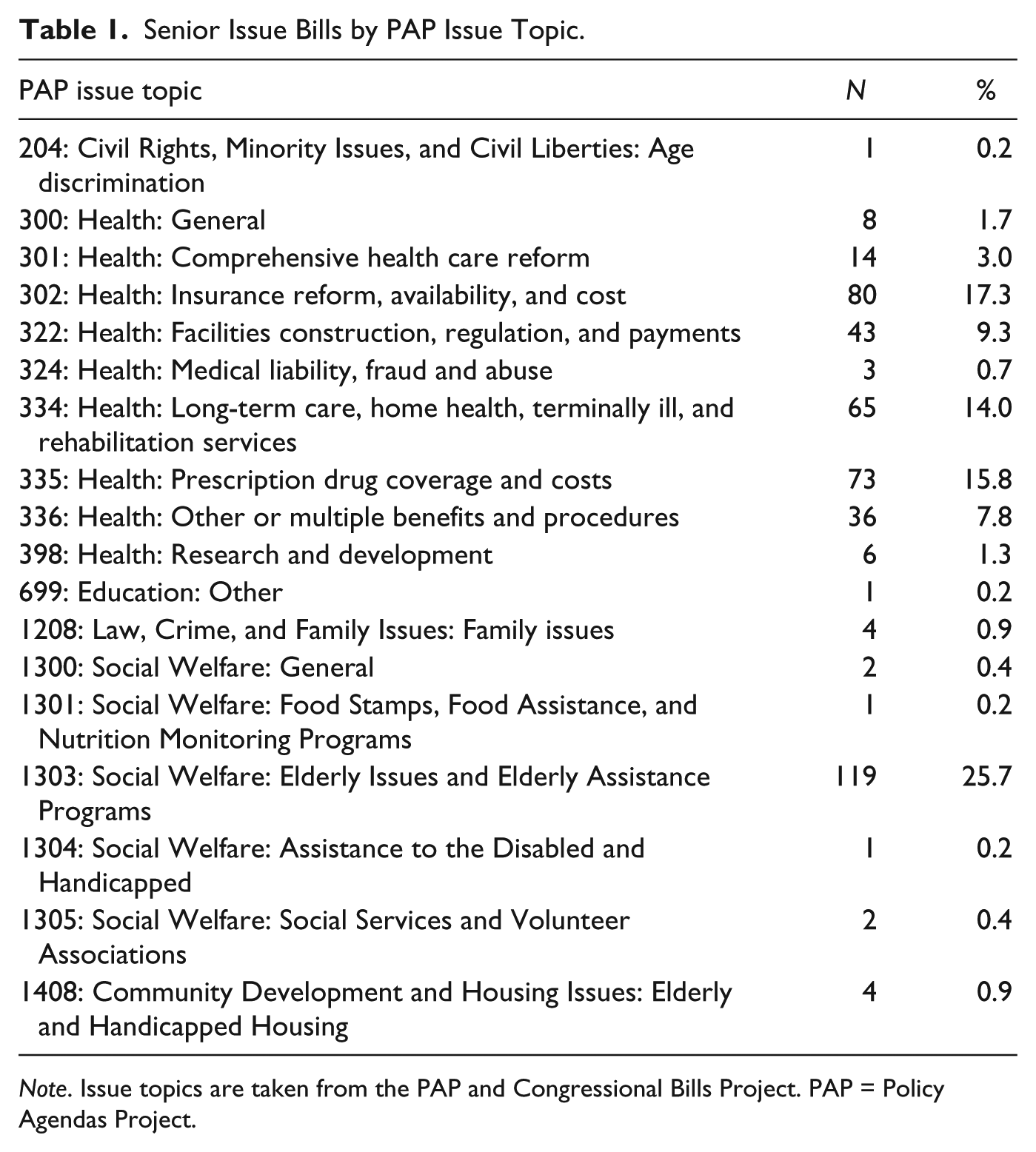
Note. Issue topics are taken from the PAP and Congressional Bills Project. PAP = Policy Agendas Project.
As we expect the salience of different policy issues to play a conditioning role, we also needed a measure of salience for each bill. We use data on the issue content of articles published in the New York Times to construct a measure. The PAP codes a random sample of every article published in the New York Times each year by its 20 issue areas (within which the 220 topics are nested). Our measure is the percentage of these articles during each Congress focused on each bill’s issue area. Using this measure, we construct two additional dependent variables: the number of higher salience senior issue bills each member introduced each Congress (senior issue bills addressing issue areas at or above the median of the salience variable) and the number of lower salience senior issue bills each member introduced (senior issue bills below the median). 9 Table 2 summarizes the senior issue topics coded as higher salience and lower salience for each year using this method. As shown, in both congresses, health policy issues were above the median of salience, as were family issues during the 110th. Senior issue bills on these topics include everything related to Medicare and other health-related programs for seniors. 10
Indicator of Higher Salience Senior Issues by Congress.
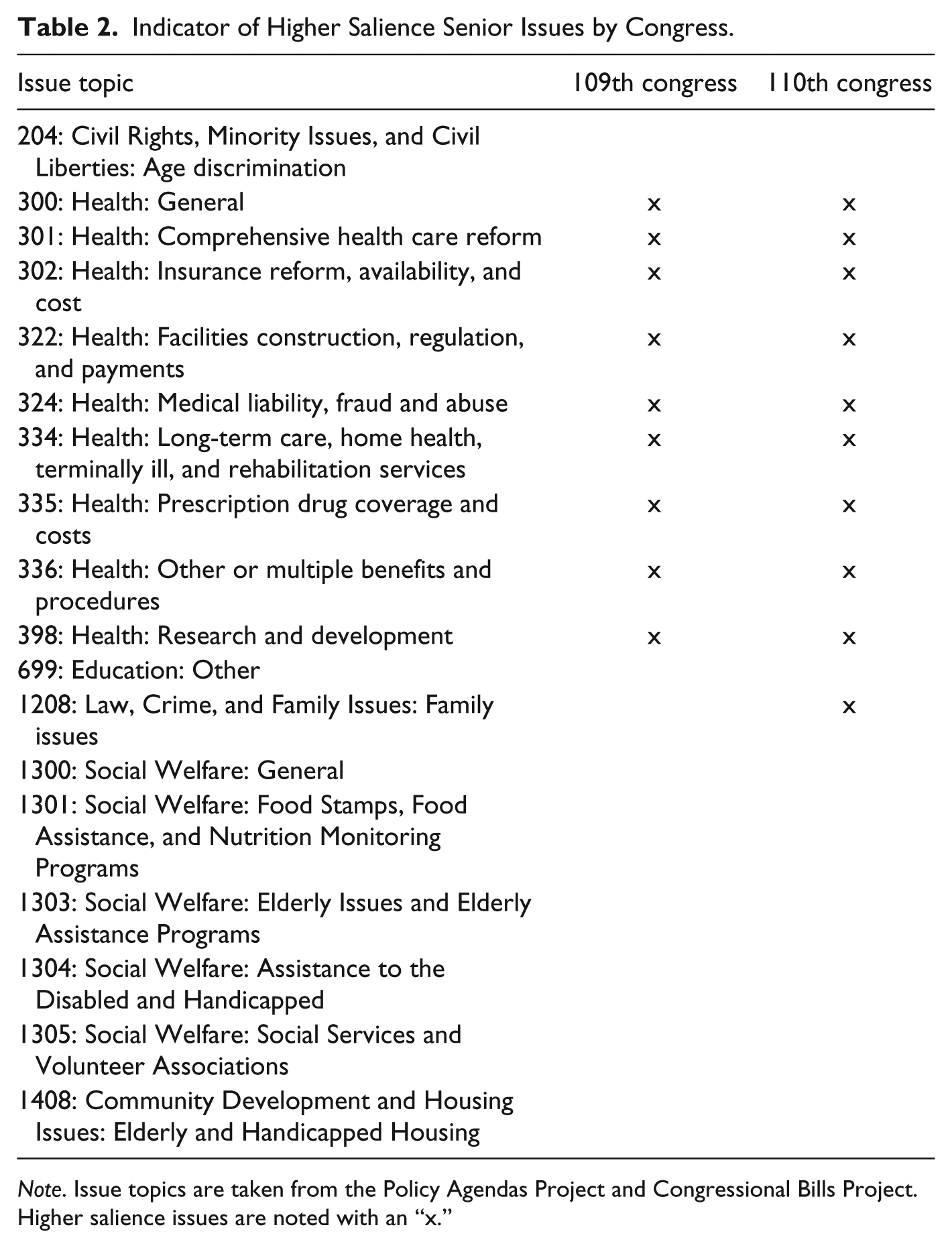
Note. Issue topics are taken from the Policy Agendas Project and Congressional Bills Project. Higher salience issues are noted with an “x.”
The primary independent variable used in each analysis is each lawmaker’s age at the start of each Congress. This measure ranges from 30 to 84. The other key independent variables are measures of the potential influence of seniors in each lawmaker’s district. We use two measures for this purpose as well as an index that combines them. First is the percentage of each member’s district population that is 65 years of age or older during each Congress as estimated by the Census Bureau (this measure ranges from 5.3% to 29.7%). Second is the combined average total monthly Social Security benefits (in thousands of dollars) distributed in each member’s district during each year of each Congress (ranges from US$67 to US$544 million). 11 These two measures capture the size and strength of the elderly population in each district by capturing different aspects of that senior power. Specifically, because individuals earning more during their careers receive more in Social Security benefits postretirement, this latter measure not only reflects the number of elderly people in the district but also the relative socioeconomic status of those individuals, which may relate to their propensities to participate in politics (see Wolfinger & Rosenstone, 1980).
Nonetheless, these two variables are generally correlated (r = .64), so we employ them in separate models. We also calculate models using a standardized, additive district senior power index comprised of both measures (ranging from –4 to 10, though the specific values are meaningless). We expect lawmakers representing places with more seniors and larger disbursements of Social Security benefits will have more constituency-based reasons to focus on senior issues. 12
In each analysis, we also controlled for characteristics of each member of Congress that may affect his or her behavior in office, including his or her party (Democrat), first-dimension DW-NOMINATE score, and chamber seniority, measured as consecutive congresses served in the House. 13 A lawmaker’s gender (female) is also controlled for. Female lawmakers are more likely than men to introduce legislation addressing social welfare programs like the ones benefiting seniors (Swers, 2002, 2013) 14 ; Dummy variables for membership on two committees are included as well: Ways and Means and Energy and Commerce. Committee membership is a strong predictor of which issues lawmakers are likely focus on in office (Deering & Smith, 1997; Fenno, 1973) and about 45% of the senior issues bills in our data set were referred to these committees. 15 As such, lawmakers sponsoring senior issue bills may be likely to sit on these committees. We also include a measure of each lawmaker’s estimated net worth. 16 Wealthier lawmakers, including those who are older, may have a more difficult time connecting with the needs of more typical older adult Americans, and thus may take fewer actions related to senior issues regardless of their age or their constituency. 17
Because each dependent variable is a count of bills introduced by each lawmaker, each of our analyses is a negative binomial regression. As lawmakers who introduce more bills overall are more likely to have introduced more bills on any topic, we include in each analysis a count of the total number of bills each lawmaker introduced during each Congress. 18 We also include a dummy variable for the 110th Congress to account for any differences between the two congresses analyzed.
Results
Table 3 presents the results of our analyses. The analyses in the first three columns have as a dependent variable a count of all senior issue bills introduced by each member during each Congress, including both lower and higher salience senior issue bills. The results show that constituency characteristics drive the overall number of senior issue bills introduced by members of Congress. The district senior power index is positive and statistically significant in column 1. The results in columns 2 and 3 show that both the size of the district’s 65 and older population and the amount of Social Security benefits dispersed have significant effects as well. In contrast, the coefficient for lawmaker age is insignificant. When taking all of the senior issue bills together, there is support for the senior power thesis.
Predicting the Number of Senior Issue Bills Introduced by Members of Congress.
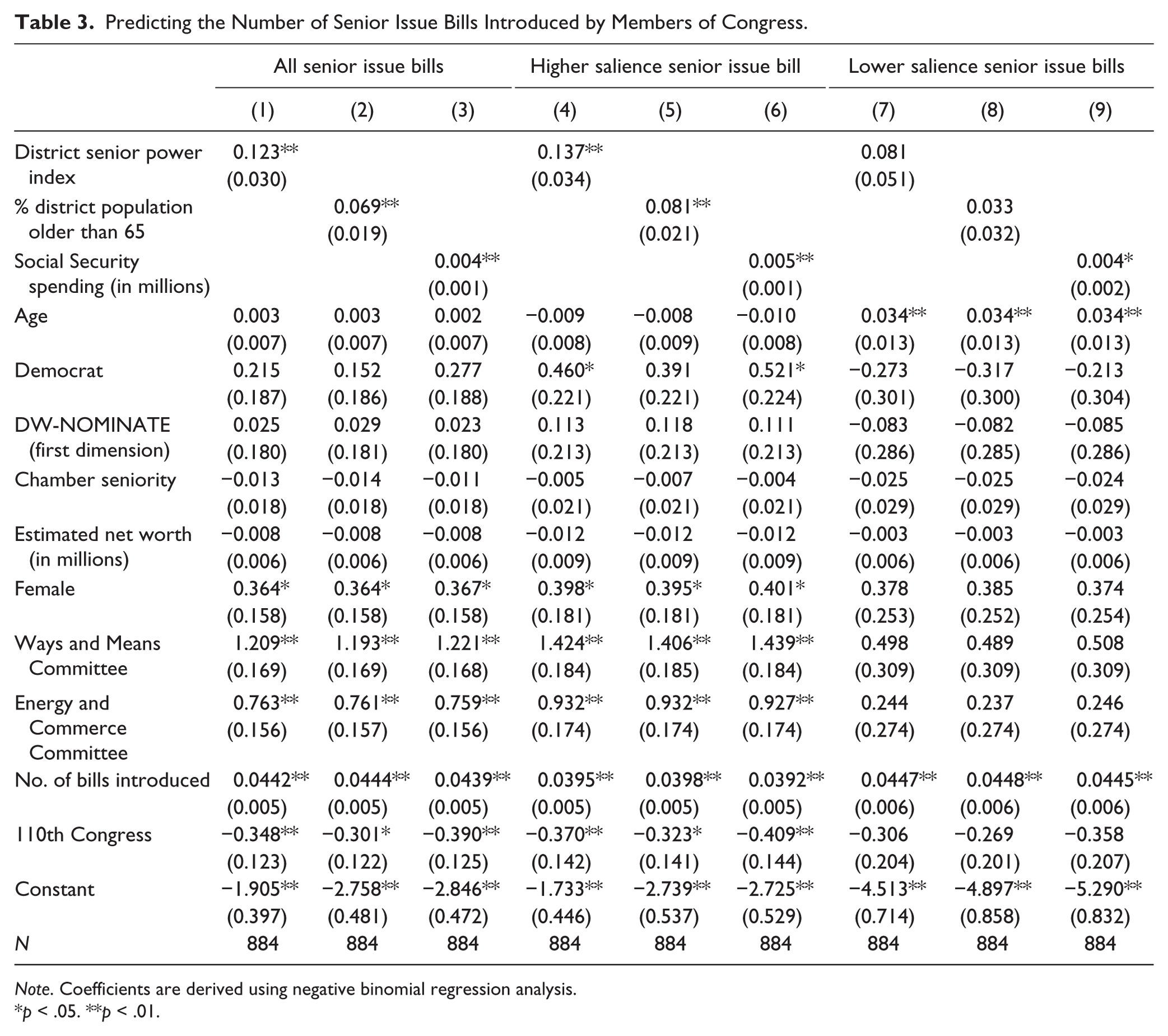
Note. Coefficients are derived using negative binomial regression analysis.
p < .05. **p < .01.
The results are more interesting when analyzing higher and lower salience senior issues separately. The middle three columns of analyses use as a dependent variable the number of higher salience senior issue bills introduced by each member during each Congress. The right-most three columns use as a dependent variable the number of lower salience senior issue bills introduced by each member. Overall, the results indicate that constituency characteristics influence a lawmaker’s propensity to introduce higher salience senior issue bills, while a lawmaker’s age influences propensities to introduce lower salience senior issue bills. In columns 4 to 6 (higher salience bills), the senior constituency variables are all positive and significant, whereas a lawmaker’s age is insignificant. In columns 7 to 9 (lower salience bills), it is a lawmaker’s age that is positive and significant, whereas two of three constituency variables are insignificant.
A look at the substantive predictions of these models provides more context. Figure 2 shows that increases in the district senior power index have a large effect on the number of higher salience senior issue bills a lawmaker introduced each Congress. Specifically, those representing districts at the low end of the index are predicted to introduce just 0.2 higher salience senior issue bills per Congress, compared with 1.5 such bills at the high end of the index. In other words, the oldest lawmakers are expected to introduce one to two higher salience senior issue bills per Congress, whereas the youngest lawmakers are expected to introduce, on average, none. For lower salience senior issue bills, the substantive effect of the index is much smaller and statistically insignificant. Going from the low to high end of the index increases the number of higher salience senior issue bills introduced from 0.11 to just 0.35, on average.
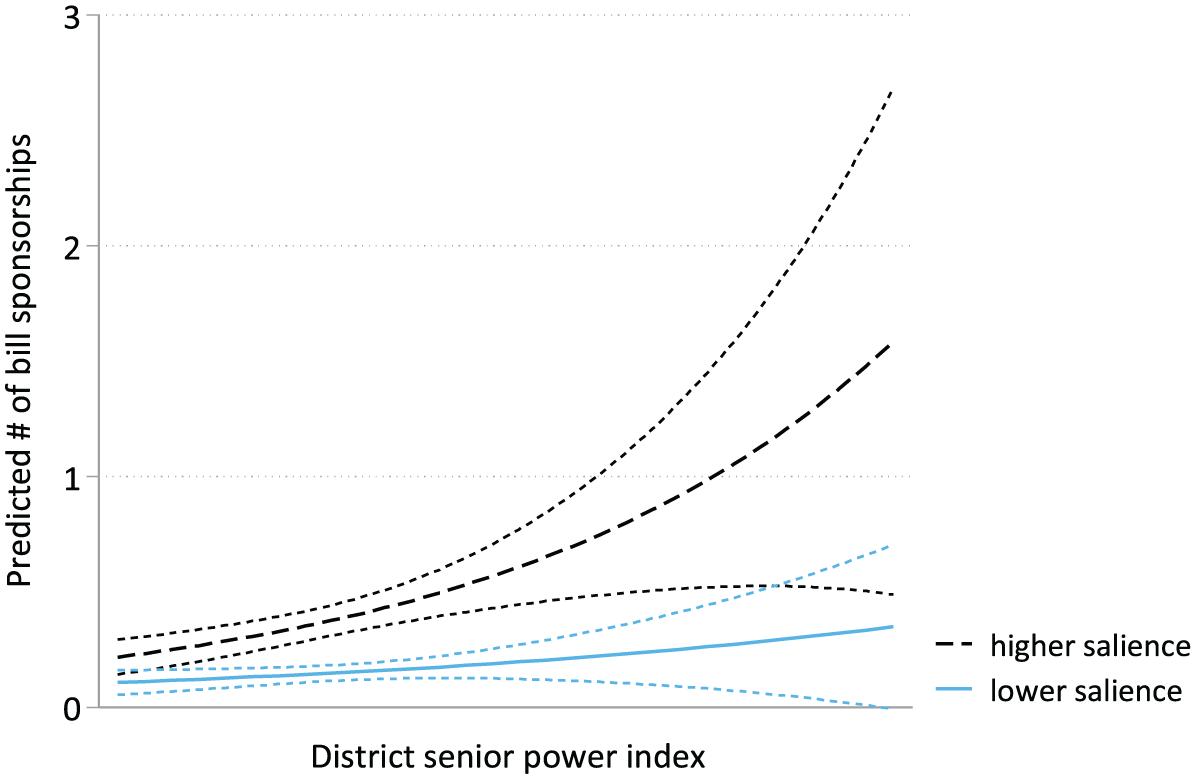
Senior constituency and the predicted number of senior issue bills introduced.
A lawmaker’s age more strongly predicts efforts to introduce lower salience senior issue bills. As shown in Figure 3, a lawmaker’s age actually has a slightly negative effect on introductions of higher salience senior issue bills. The youngest lawmakers are predicted to introduce 0.5 higher salience senior issue bills per Congress, while the oldest lawmakers are predicted to introduce 0.3 bills per Congress. However, with lower salience senior issue bills, the predicted effect is positive and substantial. The youngest lawmakers are predicted to introduce essentially zero lower salience senior issue bill per Congress (0.06 bills), whereas the oldest lawmakers are predicted to introduce almost 0.4 such bills per Congress.
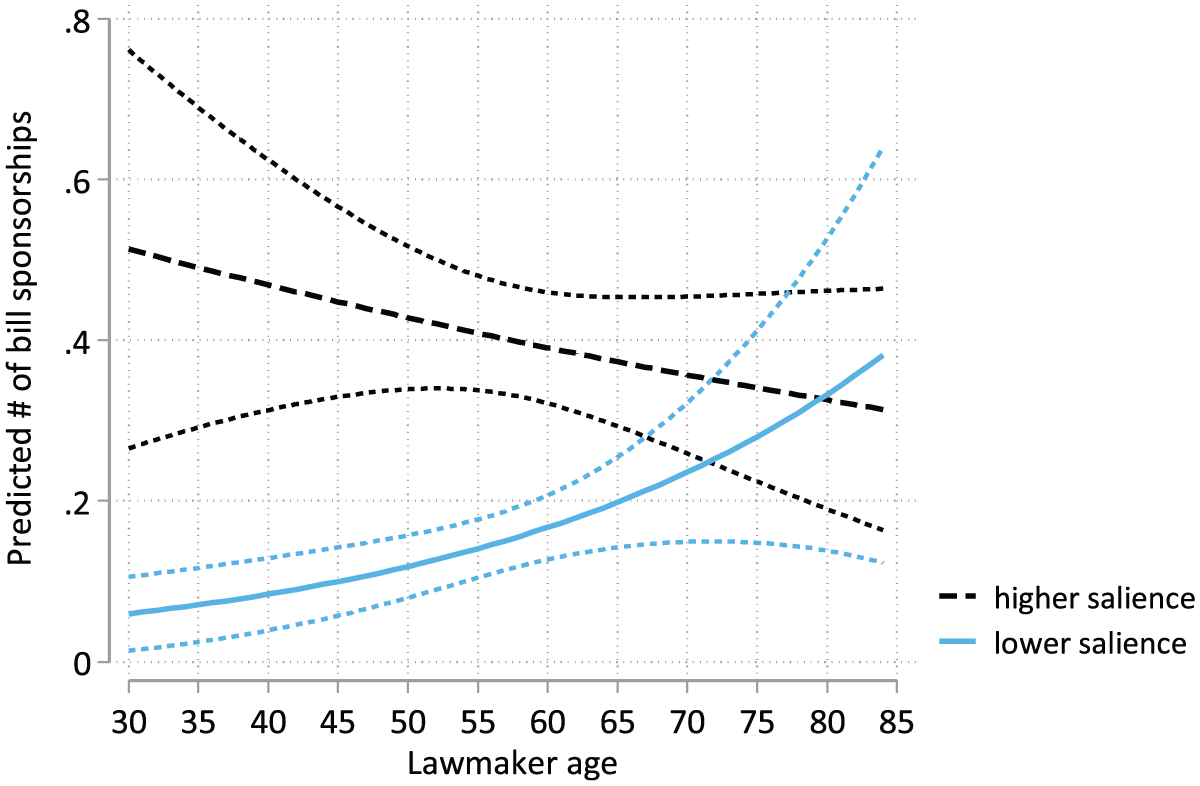
Lawmaker age and the predicted number of senior issue bills introduced.
The overall size of the estimates for lower salience senior issue bills is small, but there are clear substantive implications. The analyses (from column 7) predict that a group of 10 lawmakers 69 years of age (the 90th percentile of age) is predicted to introduce more than two lower salience senior bills per Congress. By contrast, a group of 10 lawmakers 44 years of age (the 10th percentile of age) is expected to introduce less than one lower salience senior bill per Congress. Thus, older lawmakers in Congress are more than twice as active introducing legislation addressing lower salience senior issues than younger lawmakers. Across the entire membership of the House of Representatives, and over time, these differences add up.
A few examples help illustrate these abstract predictions. Rep. Phil English (R-PA), just 49 years of age in 2005, represented Pennsylvania’s third congressional district, which with over 15% of its population 65 or older, was in the 90th percentile for this measure. From 2005 to 2008, English introduced 11 senior issue bills—all of them focused on higher salience senior issues. In contrast is Rep. Sam Johnson (R-TX), who was 75 years old in 2005, but represented the young Texas third congressional district (just 6% of the district population was older than 65, the first percentile of the measure). Johnson introduced four senior issue bills during the 109th and 110th Congresses, three of them were lower salience bills. Johnson’s young constituency unlikely played a role in this behavior, but his advanced age may have.
We can see how constituency and age can reinforce each other with Rep. Nita Lowey (D-NY). Lowey, 68 years of age in 2005, represented New York’s 18th congressional district, which had a fairly large senior population (over 14% of the district was 65 or older, placing it in the 80th percentile on this measure). Lowey actively introduced both higher and lower salience senior issue bills—12 in total—with nine focused on lower salience issues. For Lowey, there were clear electoral reasons to focus on these issues, but her age likely contributed as well.
Finally, on the other end of the spectrum, we have Rep. Devin Nunes (R-CA). Nunes represented California’s 21st congressional district in southern San Joaquin Valley, a district that was quite young, with just 10% of its population older than 65 (20th percentile in senior population). Nunes was also young, turning 32 in 2005. Unsurprisingly, from 2005 to 2008, Nunes did not introduce any bills addressing senior issues.
The primary findings from the models in Table 3 hold controlling for a number of other variables. While most lawmaker characteristics did not significantly affect a lawmaker’s likelihood of introducing senior issue bills of any type, their committee assignments had significant effects. Lawmakers sitting on the Ways and Means and Energy and Commerce committees were significantly more likely to introduce legislation addressing higher salience senior issues. A lawmaker’s gender also affected behavior with female lawmakers introducing more higher salience senior issue bills compared with male lawmakers, reflecting the stronger focus many female legislators have on social welfare programs (see Swers, 2002, 2013).
Some of the insignificant findings among the control variables are worthy of discussion. Notably, a lawmaker’s estimated net worth does not appear to affect his or her propensities to introduce bills addressing senior issues. We ran additional models interacting age with estimated net worth, which can be found in the supplemental appendix. The results confirm those in Table 3—older lawmakers introduce more bills addressing lower salience senior issues—but a lawmaker’s net worth seems to amplify this effect. Older lawmakers with larger estimated net worths are even more likely to introduce lower salience senior issue bills compared with older lawmakers with smaller estimated net worths. At the same time, a lawmaker’s net worth does not significantly affect his or her activity on higher salience senior issues. These results suggest that even the wealthiest older lawmakers can act as descriptive representators.
One possibility the preceding analyses do not consider is that older constituencies may have an indirect influence on lawmaker behavior if districts with older constituencies are more likely to elect older lawmakers. After all, Webster and Pierce (in press) show that older voters prefer to vote for older candidates. There is a lack of initial evidence that this possibility drives our findings as the correlation between district senior power index and lawmaker age is negative (r = –.07). Nevertheless, this is worthy of further analysis.
Table 4 presents the results of two ordinary least squares (OLS) regression analyses predicting the age of each district’s lawmaker in the 109th and 110th Congresses. The analysis in column 1 includes as independent variables just the district senior power index and a dummy for the 110th Congress. The results show that districts with more senior constituency needs are actually significantly less likely to elect an older lawmaker. The second analysis includes the component parts of the district senior power index as independent variables rather than the index. Both coefficients are negative but neither reaches conventional levels of statistical significance. Overall, far from indicating that districts with more potential senior power elect older lawmakers, the results indicate that if anything these districts are more likely to elect younger lawmakers. These results suggest that a lawmaker’s age is not just a proxy for constituent’s interests in senior issues.
Predicting the Age of a District’s Representative.
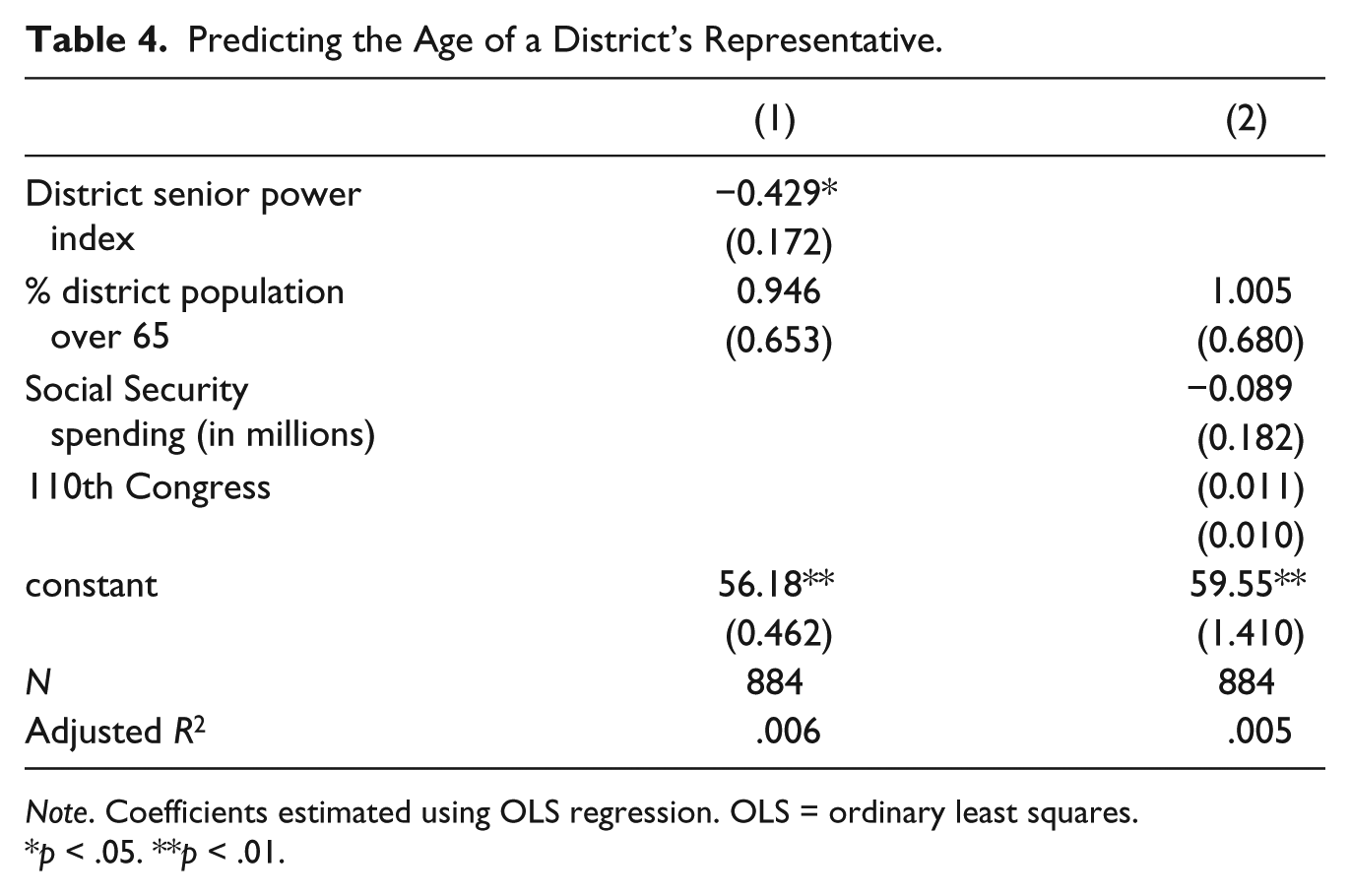
Note. Coefficients estimated using OLS regression. OLS = ordinary least squares.
p < .05. **p < .01.
Altogether, these findings compellingly demonstrate not only the importance of a lawmaker’s age on legislative behavior, but also the importance of issue contexts for the relationship among lawmaker’s age, constituencies, and behavior on senior issues. It appears the senior power thesis holds. On issues like Medicare, senior citizens are motivated and mobilized to put pressure on their representatives. In these instances, the campaigns organized by groups like the AARP pressure on lawmakers to act, regardless of their age. However, on less-salient issues, the identities of lawmakers play an important role. On these issues, older lawmakers are attentive and active where younger lawmakers are not, even when significant constituency pressure does not exist. Their age-identities appears to drive their behavior.
Conclusion
Previous research demonstrates lawmakers’ identities matter for their representational behavior, especially regarding their race, gender, socioeconomic class, and sexual orientation. In this article, we begin to demonstrate that a lawmaker’s age is also important in this regard. Older lawmakers are more likely to focus their bill sponsorship behavior on certain senior issues, primarily those that are less publicly salient. On highly salient senior issue bills, it is lawmakers’ constituencies, rather than their identities, that drive their attention.
These findings regarding issue salience add a new wrinkle to our understanding of descriptive representation, broadly conceived. Beyond seniors, issues of importance to women, minorities, the working class, and other descriptive groups vary in their general public salience. Studies of descriptive representation among these facets of identity should also take issue salience into consideration. It is possible that Black legislators, for instance, are more attentive to Black issues that receive less attention than White lawmakers representing heavily Black districts. Generally, looking at such issue contexts may help scholars better untangle the influence of identity and constituency on a lawmaker’s actions.
Returning to age, these findings may suggest something important about the broader representativeness of the U.S. Congress. As noted above, the memberships of both the House and Senate are heavily skewed. For several reasons, including age requirements to run for congressional office, the life experiences generally needed to be recruited to run and win elections, and the disposable income needed to leave a career to pursue elected office, it is easier for older Americans to run for and win a congressional seat. The benefits of incumbency that help keep lawmakers in office also promote an aging Congress, as members elected young remain in office as they age. The results here suggest that the age bias among elected representatives may affect the attentiveness of the chamber at-large to different issues. With more older lawmakers, Congress will be more attentive to issues of importance to seniors. This is not necessarily a bad thing. But the attention paid to those issues may come at the cost of attention to issues of importance to younger Americans. Ultimately, having substantial variation in the ages and generations represented on Capitol Hill is probably ideal. As Mayhew (2000) notes, each age group and generation brings unique perspectives and ideas to the table. The synergy of these perspectives is probably best for public policymaking.
Further research on age and descriptive representation is needed to fully understand how lawmakers’ ages affect their behavior in office. Future research could analyze the behavior of older lawmakers in other respects, including differences in how they interact with constituents when compared with younger lawmakers or the issues they choose to talk about on the campaign trail. In addition, the seniority norm in Congress might be reexamined in light of these findings. Most institutional leadership positions are held by older lawmakers as time in office is usually a precondition for obtaining institutional power. The sway these powerful lawmakers have over the congressional agenda may further benefit the interests of American seniors. Altogether, our findings here suggest this is an area of research in need of more scrutiny.
Supplemental Material
CurryHaydon-AgeRepresentation-Nov2017-Supplemental – Supplemental material for Lawmaker Age, Issue Salience, and Senior Representation in Congress
Supplemental material, CurryHaydon-AgeRepresentation-Nov2017-Supplemental for Lawmaker Age, Issue Salience, and Senior Representation in Congress by James M. Curry and Matthew R. Haydon in American Politics Research
Footnotes
Acknowledgements
Thanks to Brittany Bramlett, Irwin Morris, and the participants in the Utah Political Research Colloquium for their helpful comments and feedback.
Authors’ Note
A previous version of this article was presented at the 2015 Annual Meeting of the Western Political Science Association in Las Vegas, NV, April 4, 2015.
Declaration of Conflicting Interests
The author(s) declared no potential conflicts of interest with respect to the research, authorship, and/or publication of this article.
Funding
The author(s) received no financial support for the research, authorship, and/or publication of this article.
Supplemental Material
Supplementary material is available for this article online.
Notes
Author Biographies
References
Supplementary Material
Please find the following supplemental material available below.
For Open Access articles published under a Creative Commons License, all supplemental material carries the same license as the article it is associated with.
For non-Open Access articles published, all supplemental material carries a non-exclusive license, and permission requests for re-use of supplemental material or any part of supplemental material shall be sent directly to the copyright owner as specified in the copyright notice associated with the article.
