




Abstract
This study explores how variation in voters’ personality traits, as represented by the Big Five framework, corresponded with variation in judgments regarding the leading presidential candidates during the 2016 nomination campaign. We argue that the context of a crowded field and an atypical candidate in the Republican nomination campaign activated personalistic criteria for candidate evaluation—voters’ own personality traits plausibly gave direction to their candidate assessments, and personality was a useful basis on which to differentiate between eventual winner Donald Trump and the other leading Republican competitors early in the primary process. Analyses make use of data from a large national survey fielded at the time of the Iowa caucuses. Results show that voters with a particular constellation of personality traits—high conscientiousness and extraversion, and low openness, agreeableness, and neuroticism—favored Donald Trump as compared with Ted Cruz, John Kasich, Marco Rubio, Jeb Bush, Ben Carson, and the remainder of the Republican field.
Donald Trump’s victory in the 2016 U.S. presidential election has sparked considerable interest in identifying factors that may have contributed to the outcome. As a complement to research regarding the bases of Trump’s win in November, the focus of the present study is on how Trump first secured the Republican nomination. Although many factors likely influenced Trump’s success, the central question we pursue is whether personality traits were consequential in luring early adopters. More specifically, we test whether Donald Trump was able to differentiate himself from the other Republican candidates partly on the basis of personality, and, in doing so, was able to attract support from voters with a particular personality profile.
Presidential primary vote choice has been studied extensively, typically with focus on the competing interests of candidate affinity and candidate viability (Abramowitz, 1989; Culbert, 2015). Several recent studies have focused on the correlates of candidate affinity, examining the effects of race (Tesler & Sears, 2010), gender (Ditonto, Hamilton, & Redlawsk, 2014), or even the negativity of the campaign environment (Makse & Sokhey, 2010). Attention to personality builds on this research, offering a new perspective on the bases of candidate affinity.
There are several reasons to study Trump’s early success. First, uncovering the factors leading to the election of any U.S. president is inherently important. Trump’s November win was surprising, but his success in the primaries was arguably a greater blow to conventional wisdom (Cohen, Carol, Noel, & Zaller, 2009). Collectively, the other Republican candidates possessed considerable political experience. Many had advanced numerous detailed policy proposals. Several had exhibited thoughtful, level-headed approaches while amassing achievements as governors and U.S. Senators. How Donald Trump could best such a field warrants investigation. Second, if personality helps explain how Trump was able to rise to the top of a crowded primary field, corresponding attention to personality may be fruitful in analyses of other multicandidate races, and especially other presidential primaries. Where partisanship is held constant and variation in ideology is truncated, nonpolitical factors such as personality may gain prominence. Third, although Donald Trump is on the opposite end of the ideological spectrum from other charismatic populist figures such as Hugo Chavez in Venezuela and Rafael Correa in Ecuador, similarities exist in their rhetoric and demeanor. If personality undergirds this similarity, then lessons learned from research on Donald Trump may pave the way for a broader understanding of the psychological foundations of mass support for populist leaders.
Our focus is on the personality traits of voters. Analyses make use of data on the Big Five traits gathered as part of a national survey fielded at the time of the Iowa caucuses. We consider whether individual differences in personality help explain why some voters were drawn to Donald Trump rather than to other leading candidates. Our reasoning for why and how personality may have been consequential in 2016 hinges on a three-part discussion of the activation of voters’ personality traits, the likelihood that personality traits gave systematic direction to voters’ preferences, and the prospect that variation in personality contributed to perceived differentiation among candidates.
We develop this framework in the next section. Following that, we go on to provide information about the national survey we fielded and about our key measures. Analyses then are reported in stages. We first explore whether voters’ demographic and psychological attributes mattered for their appraisals of Trump. We then determine whether these same attributes influenced their relative appraisals of Trump as compared with his major competitors. Lastly, we explore whether personality effects are discernible in analyses of vote intention. Across these analyses, we find that Trump’s early adopters have a distinct personality profile, displaying low levels of openness, agreeableness, and neuroticism, and high levels of extraversion and conscientiousness. All these traits predict support for Trump in general and over at least part of the Republican field, whereas low openness and high extraversion and conscientiousness predict support for Trump over the entirety of the field.
Personality Effects in the 2016 Republican Presidential Nomination Campaign
The theoretical framework outlined below provides an account of how the personality traits of prospective voters influenced candidate assessments, and ultimately the vote choice, early in the 2016 Republican primary campaign. Personality can be operationalized in numerous manners. Here, we make use of the Big Five framework, a typology that focuses on the broad trait dimensions of openness to experience, conscientiousness, extraversion, agreeableness, and neuroticism. The Big Five approach has seen wide use in political science since its multifaceted introduction to the discipline in 2008 (Mondak & Halperin, 2008), particularly in research regarding the psychological antecedents of political attitudes and dispositions, patterns of participation, and information acquisition (for overviews of Big Five research in political science, see Caprara & Vecchione, 2013; Gerber, Huber, Doherty, & Dowling, 2011; Mondak, 2010; Mondak & Hibbing, 2012; for introductions to the Big Five by psychologists, see John, Naumann & Soto, 2008; McAdams & Pals, 2006; McCrae & Costa, 2003). We build on past applications in political science by extending research to the realm of candidate evaluation, and, more specifically, by delineating and testing possible processes by which voter personality connects with candidate preference.
A three-part account explains why voters’ personality traits may have shaped candidate preferences in the 2016 Republican nomination campaign, and may have done so in a manner beneficial to the Trump candidacy. First, personality effects require activation. Personality is highly stable within individuals, particularly core dispositions such as the Big Five. However, the influence of personality will be stronger or weaker depending on features of the situation, and the 2016 primary gave reason to expect strong effects. This is, in part, because Donald Trump’s personality was on bold display during the campaign. Furthermore, the muted role of factors such as partisanship, ideology, policy stances, and political experience created a vacuum that personality helped to fill. Second, for systematic personality effects to be observed, personality must give direction to judgments. Donald Trump may have benefitted from a sympathy or resemblance effect, where similarities in personality profiles induce interpersonal affinity. Extraverts are drawn to fellow extraverts, the agreeable to the agreeable, and so on. By extension, it is plausible that personality also matters for candidate choice. Lastly, we posit that personality may have aided voters in the process of differentiation among candidates. With focus on the Big Five, our claim is that Donald Trump was drawing from a different pool of voters than were competitors such as Ted Cruz and John Kasich. We expand on each of these rationales below.
Activation: The Relevance of Personality in 2016
The behavioral effects of personality traits are not constant across all situations; instead, they are conditioned by aspects of the context (Funder, 2008; Mondak, Hibbing, Canache, Seligson, & Anderson, 2010). Tett and his colleagues (e.g., Tett & Burnett, 2003; Tett & Guterman, 2000) offer trait–activation theory to help understand the interplay between traits and situations. They argue that strong personality effects are most likely in situations with two features. First, the situation must not constrain trait expression. As an example, we can contrast the impact of variation in personality on the actions of individuals marching in a Halloween parade or social protest versus those marching in a military formation. The first two situations allow room for individuality, whereas the latter does not. Critically, a person’s actual personality does not change from one context to another; what varies is the opportunity for expression of that personality. Second, personality effects are most likely when something in the context expressly cues, or activates, people’s traits. Continuing with the example of marching, personality would matter more when protestors are encouraged to design and bring their own signs than when mass-produced signs are provided by organizers.
The 2016 Republican nomination phase did not constrain trait effects. To the contrary, the context created something of a decision-making vacuum with respect to other bases of judgment, thereby bringing an opportunity for voters’ psychological differences to play meaningful roles. Partisanship and ideology are inherently muted as forces in primary elections between copartisans, and the 2016 campaign was no exception. Even if this were not the case, partisanship and ideology likely would not have worked to Donald Trump’s favor given that he was neither the most Republican Republican nor the most conservative conservative in the field. In addition, Trump lacked political experience and he advanced little in the way of detailed policy proposals, making it unlikely that voters were attracted to him on those bases. 1
The 2016 context not only paved the way for voter personality to matter but also encouraged voters to make personality-based connections with the eventual winner. Donald Trump’s campaign was about Donald Trump. Trump did not set out to sell voters on an ideological vision or a coherent menu of policies. He set out to sell voters on the Trump brand, depicting himself as bold, brash, decisive, and cantankerous, and he bet that voters would buy what he was selling. This goal was largely facilitated by media coverage that shifted focus from one Trump invective to the next, while minimizing substantive discussion of experience or policy proposals. We believe that this had the consequence of increasing the salience of personality effects in the choices of Republican primary voters, and our study is premised on the assumption that psychological dispositions would incline some voters to be attracted to the Trump persona, and others repelled. In other words, by interjecting his own personality into the campaign, Trump also brought the personalities of voters into play.
We are hardly the first observers to note that Donald Trump anchored his campaign in Trump the person, and especially in Trump the personality. Trump put his personality front and center, and he did so in a manner designed to connect with voters on a personalistic, emotional level. Analysts have employed the framework of a “charismatic leader” to help in dissecting the Trump candidacy, and have utilized the related frame of a “cult of personality.” 2 The campaign was about Trump’s personality, the voter’s personality, and the forging of a connection between the two. Trump diverted attention from conventional political criteria for candidate evaluation, and steered attention toward personality. Moreover, patterns in media coverage of the Trump candidacy magnified this focus on personality. In line with the tenets of trait–activation theory, the context is decidedly one in which personality effects can be expected.
Direction: Personality, Interpersonal Affinity, and Candidate Preference
The personality traits of voters will matter for candidate preference only if there is something systematic, whereby voters with high values on a personality trait consistently differ from voters with low values on that trait in how favorably they assess a candidate. In short, personality effects presuppose that individuals’ traits offer direction to their preferences. In the case of Donald Trump in 2016, we argue that any impact of personality traced largely to a dynamic whereby congruence fostered affinity. Voters who, in terms of personality, saw something of themselves in Trump would have been more likely to support him. Conversely, voters with a different personality profile would have been more prone to opt against him.
Homophily is the notion that individuals with shared attributes tend to be drawn toward one another; in short, likes associate with like. Congruence in personality appears to be one factor that brings people together. Evidence for this claim was first generated in the 1960s (Byrne, Griffitt, & Stefaniak, 1967; Izard, 1960, 1963). Subsequent research focused on the Big Five has found that people tend to select as friends individuals who are similar to themselves with respect to openness to experience, extraversion, and agreeableness (Selfhout et al., 2010), and that, at least for extraversion, this pattern extends to broader social networks (Feiler & Kleinbaum, 2015). Research regarding why personality-based homophily may exist has considered the matter from the perspective of evolutionary biology. The logic is that personality similarity in nonkin relationships may foster greater reliability and cooperation. In a key test of this, personality similarity was observed in chimpanzee friendships (Massen & Koski, 2014).
That personality similarity is seen in friendships does not assure that it will be observed in other relationships. People who view themselves as low in conscientiousness still likely prefer conscientious surgeons and pilots. Disagreeable managers presumably know to hire agreeable sales personnel. Neurotics may be disinclined to surround themselves with fellow neurotics. Hence, it is uncertain whether to expect voters to gravitate toward candidates with personality traits similar to their own, and especially whether to expect affinity effects for all traits. At the macro level, congruence exists between the personality profiles of party leaders and partisans in the mass public (e.g., Caprara, Barbaranelli, Consiglio, Picconi, & Zimbardo, 2003; Dietrich, Lasley, Mondak, Remmel, & Turner, 2012). However, unpacking why this congruence exists is no easy task (Caprara & Zimbardo, 2004), and it may be that personality is coincidental to party and candidate preferences. Citizens and elites who identify with a liberal party both may be high in openness to experience, but be drawn together due to their shared values and policy stances rather than their shared psychological dispositions.
Although we make no claim that the present study’s analyses will be definitive, we do see evaluations of Donald Trump during the nomination campaign as an excellent test case. Given, as argued above, that situational factors muted nonpersonality criteria and cued Trump’s personality, the context is conducive to personality effects. Our contention is that voters’ personality traits positioned some in the electorate to favor Trump and some to oppose him, and did so in a manner that had little or no overlap with conventional political and demographic predictors of candidate preference.
Differentiation: Voter Personality and Relative Assessments of Candidates
For voter personality to have mattered to the outcome of the 2016 Republican nomination campaign, it is not enough for voters to have seen a personality connection between themselves and Donald Trump. Instead, such connections also must have served to help voters differentiate between Trump and the remainder of the field. At face value, such differentiation seems possible. The other Republicans perhaps were not cut from the exact same psychological cloth as one another, but nor were they a patchwork of cotton, silk, hemp, and yarn. Voters’ psychological dispositions may not have taken them very far toward choosing among the likes of Carson, Cruz, Kasich, and Rubio, but those same dispositions may have helped tremendously in choosing between any of those candidates and Donald Trump. At question is whether voter personality as represented by the Big Five corresponds with the perceived favorability of Donald Trump relative to his major opponents, and whether personality influenced vote preferences across the entire Republican field. Hence, in crafting expectations, our task is to gauge whether and how scoring high or low on each of the Big Five traits would incline a voter to view Trump as compared with the others.
As noted above, research on personality congruence has identified affinity effects for openness to experience, extraversion, and agreeableness. Drawing on that research, we see a clear rationale for expectations with respect to those traits. Similar reasoning supports expectations for a conscientiousness effect. Neuroticism stands apart from the other Big Five traits, and requires a separate rationale for a possible impact on candidate preference.
People who are high in openness to experience are inquisitive, reflective, and engaged by ideas. They exhibit a strong thirst for information. In our measurement below, they are analytical.
3
On this trait, we see grounds for clear differentiation between Donald Trump and his main opponents. Trump made it quite apparent in the campaign that he was not interested in wading through lengthy policy appraisals or compilations of facts and data. He placed his trust in his own instincts. In Trump’s view, more time on homework does not make for a better president. As others have observed, “the persona [Trump] has adopted for his political career is a textbook example of low Openness. Trump’s communication during the campaign has been consistently simple, concrete, and straightforward” (Owens, 2016).
4
Empirical evidence supports this conjecture. Owens (2016) notes, Back in 2008, YouGov asked people a number of questions that identified their preferences on the Big Five personality inventory. Three years later, it asked those same people what they thought about Donald Trump . . . People who scored lower on Openness rated Mr. Trump more than 20 percentage points higher than those who scored higher on Openness.
In sharp contrast, Cruz, Kasich, Rubio, and Bush are, to varying extents, detail-oriented policy wonks. Cruz’s self-confidence emanated from his belief that he possessed a superior intellect. Kasich and Bush seemingly reveled in the discussion of policy detail, and exhibited self-assurance that, case by case, they could think and work their way through to policy success. Rubio expressed ideological coherence and reasoned policy positions. Carson was not as detailed on policy as the others, but he projected a thoughtful and pragmatic demeanor, and his experience in neuroscience signaled a respect for analytical rigor. Looking at this choice set, voters who rated themselves as analytical should have gravitated toward any or all of Trump’s opponents, and found Trump’s disdain for information to be unsettling. Conversely, voters scoring low in openness (by our measure, individuals who were self-rated as unanalytical) should have appreciated Trump’s action-oriented, bottom-line persona. 5
Our strongest expectation pertains to extraversion. Extraverted voters will see Trump, a man routinely described as possessing “sky-high levels of Extroversion” (Owens, 2016), as being very much one of their own, and perhaps as their ideal for the modern political leader. Even by the standards of Washington, New York, and Hollywood, Donald Trump is bold and brash. Cruz, Kasich, Rubio, Bush, and Carson simply dull in comparison. Differentiating between them and Trump on this trait is an easy task. If congruence between voters and candidates with respect to extraversion prompts affinity, voters scoring high in extraversion should report more favorable assessments of Donald Trump than any of his top opponents.
We also see a strong case for an agreeableness effect. Donald Trump was unapologetically caustic throughout his candidacy, repeatedly boasting that he would speak what was on his mind, tell it like it is, and reject political correctness. Terms such as “kind,” “polite,” and “sympathetic” do not describe him. As psychologist Dan McAdams observed, “Across his lifetime, Donald Trump has exhibited a trait profile that you would not expect of a U.S. president: sky-high extroversion combined with off-the-chart low agreeableness” (McAdams, 2016). Trump’s disagreeableness most likely differentiated him more from some of his Republican competitors than from others. Kasich, Bush, and Carson genuinely seemed to be fundamentally agreeable. In contrast, many of Ted Cruz’s colleagues in the U.S. Senate reportedly view him as abrasive, and people who knew Cruz during his college years have expressed similar sentiments. Rubio occasionally spoke in strong tones, and he briefly attempted to match Trump insult-for-insult. But even at their worst, Cruz and Rubio maintained at least hints of decorum and civility, distinguishing them from Trump. The bottom line is that voters who rate themselves high in agreeableness should have warmed to the others, even if to varying degrees, while distancing themselves from Donald Trump. Hence, our expectation is that individuals scoring high in agreeableness will report more negative assessments of Trump than of his major competitors, and especially of Trump relative to Kasich, Bush, and Carson.
Prior research on personality congruence has not focused on conscientiousness, but we see grounds for a conscientiousness effect in the political realm. This trait dimension includes the facets of competence, order, dutifulness, achievement striving, self-discipline, and deliberation. Retrospective assessment of Donald Trump on conscientiousness is not a straightforward task, particularly for analysts who may not, themselves, have been part of Trump’s potential base back in early 2016, and who are contemplating Trump years after our data were gathered, and years after much more about Trump has been learned. For such critics, many of President Donald Trump’s behaviors while in office reasonably might be seen as near-perfect exemplars of the seven deadly sins, and certainly as indicators of a relative lack of conscientiousness. While acknowledging the validity of such appraisals of President Trump, we argue that a starkly different depiction is more appropriate for candidate Trump, especially very early in the 2016 nomination phase.
Our contention is that, particularly in the months leading up to the 2016 primary campaign, Donald Trump persistently endeavored to portray himself as high in conscientiousness, and, further, that he wrapped himself in the trappings of near every subsidiary facet associated with this trait dimension. Our corresponding hypothesis is that this depiction resonated with the Republican primary electorate, and, due to an affinity effect, that it resonated especially strongly with those voters who viewed themselves as high in conscientiousness.
What actions support our claim that Donald Trump depicted himself as being high in conscientiousness? Trump expressed unflinching confidence in his competence, repeatedly asserting not only that he would succeed in all policy domains but also that only he could solve the nation’s problems. Furthermore, Trump defined himself in terms of law and order. He railed against illegal immigration, and promised to round up and deport 11 million undocumented immigrants. He assured voters he would stop violent crime in Chicago within 1 week. He vowed to lock up “crooked Hillary.” He said that, as an outsider, he would not be corrupted the way conventional politicians are, and that he would “drain the swamp.” At the Republican convention, Trump reiterated a common theme from his primary campaign, promising that the morning after his inauguration, “Americans will finally wake up in a country where the laws of the United States are enforced.” Trump also characterized himself positively in terms of achievement striving and self-discipline. Trump boasted of how, through hard work and unparalleled skill and intellect, he had become a self-made billionaire. Trump bashed “low-energy” Jeb Bush, and said, as president, he himself would not leave the White House, would not take time off, and would not take vacations, all because there was too much work to be done. We argue that every bit of this speaks to conscientiousness. Donald Trump expressly and consistently portrayed himself to his possible supporters as an individual who, facet by facet, epitomized conscientiousness.
For readers who may be hesitant to accept the possibility that the most conscientious members of the Republican electorate in early 2016 were drawn to Donald Trump partly because they believed his self-depiction, we suggest that any final judgment be suspended until the results are in. There are, of course, three basic possibilities: that conscientious voters disproportionately supported Trump (our hypothesis); that conscientious voters disproportionately rejected Trump (which might occur if the voters evaluated Trump not on the basis of his self-depiction, but instead on the basis of his track record in matters such as bankruptcies); or that conscientiousness is unrelated to Trump support. If our hypothesis is supported, we see an affinity effect as the most plausible mechanism. In contrast, it would seem nonsensical that conscientious voters would throw strong relative support to Trump while viewing him as an irresponsible and incompetent charlatan who falsely depicted himself as conscientious. Conscientious voters should not have an affinity for candidates they view to be lacking in conscientiousness.
Of the Big Five, neuroticism is the most challenging when it comes to crafting expectations for candidate preference. Research on affinity does not identify effects for neuroticism. This is unsurprising, given that it is hard to envision that many individuals prefer to surround themselves with emotional chaos rather than emotional stability. A further complication is what to make of Donald Trump on this trait dimension. Although Trump is not a worrier, we would be hard-pressed to label him as emotionally stable. To the contrary, there is something of a cottage industry surrounding efforts to diagnose Trump’s various purported psychoses. Moreover, much of the anti-Trump messaging in both the primaries and the general election surrounded the notion that Trump was a cause for worry: that he was erratic, unpredictable, inexperienced, too risky to be trusted as commander-in-chief, and so on. That framing offers the basis for a possible Trump effect: If Trump, unique among the Republican field, should have caused nervousness among voters, then voters who themselves are most prone to worry should have assessed Trump relatively unfavorably. Thus, Trump’s supporters should be drawn from the ranks of the emotionally stable—people who never worry would not worry about Trump. Like the other Big Five traits, we see a basis for differentiation with respect to neuroticism. What differs about this trait is that, unlike the other four, the expected personality connection is not rooted in affinity.
It is when seen in its totality that the case we have articulated here takes on its full significance. If our expectations gain empirical support, the implication would be that Donald Trump secured the Republican presidential nomination partly because nomination campaigns provide opportunities for personality to matter, partly because Trump himself put his persona front and center, and, critically, partly because he was the only Donald Trump in the race. Our argument is that Trump was essentially alone in speaking to the less open, more conscientious, more extraverted, less agreeable, and less neurotic portion of the Republican electorate, whereas Cruz, Kasich, Rubio, Bush, Carson, and the rest were left to divide the flip side.
Data and Method
Data are from an original Internet survey conducted on our behalf by Survey Sampling International (SSI). The nationally representative survey was fielded at the time of the Iowa caucuses (January 28 to February 5). 6 Analyses featuring all respondents include up to 2,539 cases; additional analyses focused on Republicans include data from a maximum of 1,132 respondents.
The initial dependent variables are formed with data from 101-point (0-100) feeling thermometers for Republicans Donald Trump, Ted Cruz, John Kasich, Marco Rubio, Jeb Bush, and Ben Carson. In the first portion of our analysis, the Trump feeling thermometer is the dependent variable. In the second portion, relative Trump support is operationalized as the difference between the feeling thermometer scores for Trump and each opponent (i.e., Trump – Cruz, Trump – Kasich, etc.). Our final empirical tests consider vote intentions, with choice options limited to the 10 Republicans in the field at the time of our survey. The question used to produce the vote choice measure was worded as follows: “Let’s say you have a vote in the Republican primary, which candidate would you vote for?”
With the exception of openness, for which only one item is used, the Big Five trait dimensions each are measured with data from two 7-point bipolar items. Agreeableness, for example, is represented with self-ratings anchored with the terms “kind” and “unkind,” and “unsympathetic” and “sympathetic.” 7 Dependent variables are regressed on the Big Five measures, along with gender, education, race, age, income, ideology, ideology squared, interest in politics, and, when all respondents are included, party identification. 8 Descriptive statistics for all variables are displayed in this study’s online appendix. Standardized ordinary least squares (OLS) regression coefficients will be reported for all models using feeling thermometer data. Multinomial logistic regression is used for the vote-choice models, with Jeb Bush serving as the omitted category.
Results
Initial analyses focus on evaluations of Donald Trump in isolation. At question is whether variation in respondents’ personality traits corresponds with higher or lower appraisals of Trump. This assessment is prefatory to our central analyses, which focus on whether personality is linked to relative judgments of Trump as compared with his main competitors.
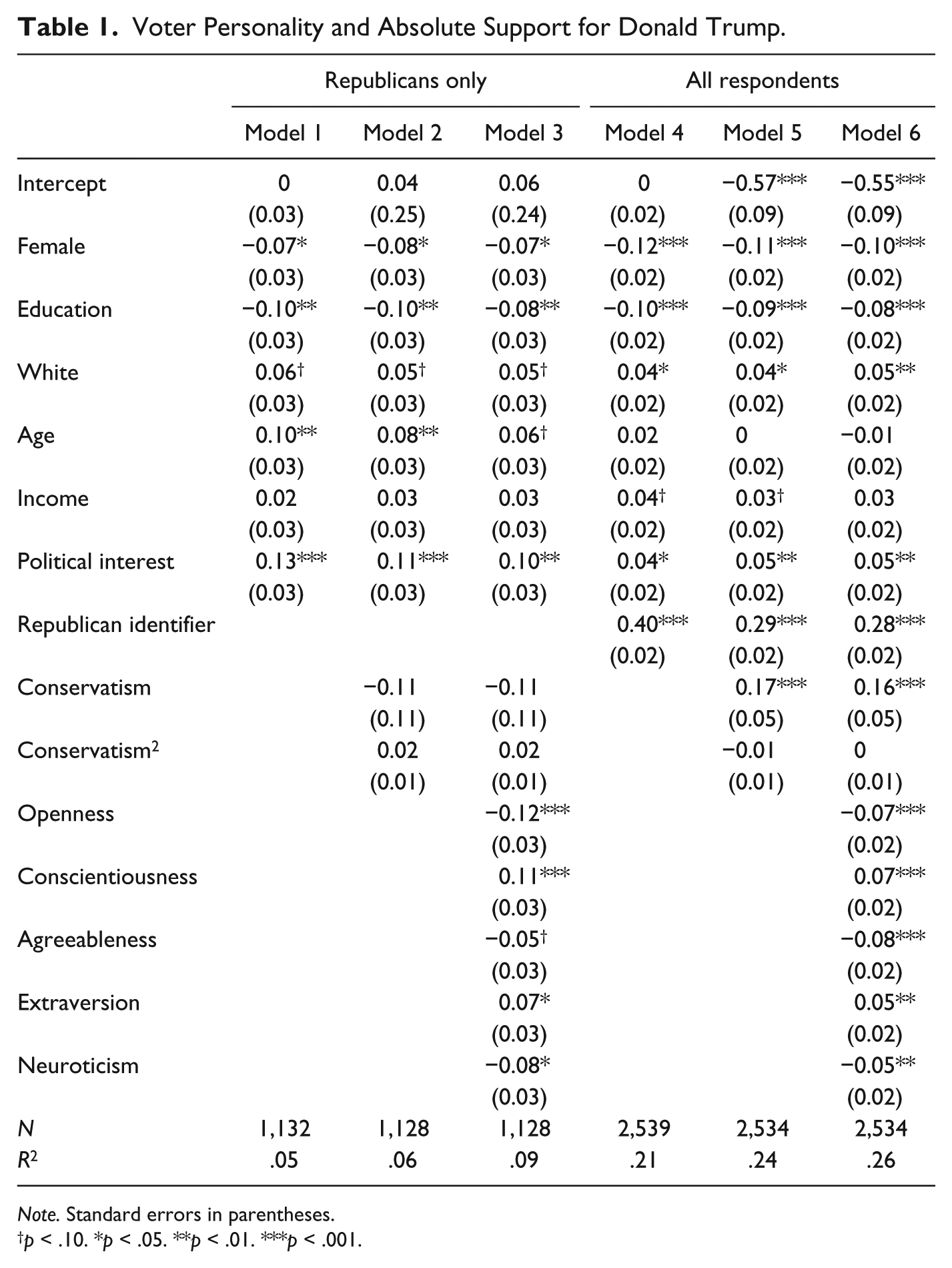
Standardized coefficient estimates from six OLS regression models are reported in Table 1. The first three models include only Republican respondents, whereas the second three include all respondents. In each set, the first model includes only demographics as predictors, the second model adds political variables, and the third adds personality.
Voter Personality and Absolute Support for Donald Trump.
Note. Standard errors in parentheses.
p < .10. *p < .05. **p < .01. ***p < .001.
Several aspects of the results warrant comment. First, the variables other than personality generally exert stronger effects among all respondents than among Republicans alone. Partisanship and ideology dominate the models that include all respondents, but support for Trump among males also is marginally stronger in these models. Second, the personality variables mostly produce larger coefficients in the first set of models than in the second. The coefficient for agreeableness is larger for all respondents than for Republicans, but each of the other Big Five variables yields stronger relationships among Republicans than among all respondents. Third, all 10 of the personality effects attain at least minimal levels of statistical significance, and all are in the expected direction: Trump’s favorability increases as a function of respondents’ levels of conscientiousness and extraversion, and decreases as a function of their levels of openness, agreeableness, and neuroticism.
Although these initial results indicate that variation in voters’ personality traits is linked to variation in assessments of Donald Trump, these findings do not speak directly to whether personality may have been consequential for candidate choice in Republican primaries. If, in terms of personality effects, voters were equally attracted to Trump and his main competitors, then personality may be predictive of absolute Trump support while being irrelevant to relative Trump support. Hence, further analyses are required, one in which the dependent variables capture how voters felt about Donald Trump as compared with his strongest opponents, and one that directly examines vote intention.
Standardized coefficient estimates for five models regarding the relative judgments of Republicans are reported in Table 2, with Trump contrasted with his main rivals. Looking first at the control variables, we see that Trump’s general advantages among males and voters with lower levels of education paid clear dividends in the nomination phase, although he enjoyed no consistent advantage with respect to race, age, or income.
Voter Personality and Relative Support for Donald Trump.

Note. Standard errors in parentheses.
p < .10. *p < .05. **p < .01. ***p < .001.
Results for the Big Five variables comport strongly with expectations. For 25 of 25 coefficients, the signs are in the expected direction. Across the five candidate pairings, Trump fared consistently well among respondents high in conscientiousness and extraversion, and low in openness and neuroticism. Trump also fared well among voters low in agreeableness, although these effects attained statistical significance only for the Bush and Carson contrasts. Individually, coefficients for the Big Five rival or surpass in magnitude those for the control variables. Collectively, the effects are even more pronounced; no matter with whom Trump is contrasted, four of the Big Five variables produce significant effects. Voter personality mattered not just for Trump support in the abstract but also for voters’ efforts to differentiate between Donald Trump and his main competitors. 9
The advantage of analyses centered on feeling thermometer data is that they provide information on the link between personality and candidate appraisals irrespective of the composition of the choice set. This is important in presidential primaries, where the field can be winnowed rapidly. Nonetheless, it will be useful to ascertain whether our core findings are replicated when analyses involve actual vote intention. Toward this end, we estimated two multinomial logit models, one including only self-identified Republicans and a second including all respondents. Respondents were asked how they would vote in a Republican field that included Trump, Bush, Carson, Christie, Cruz, Fiorina, Huckabee, Kasich, Paul, and Rubio. Coefficient estimates, which are reported in this study’s online appendix, are derived from models in which Bush serves as the contrast option.
Figure 1 reports predicted probabilities associated with each of the Big Five traits, with estimates shown for Trump, Bush, Carson, Cruz, Kasich, and Rubio. All other predictors are held constant. These results are for Republicans only. Figure 2 displays the corresponding effects for all respondents. For four of the Big Five—all but agreeableness—results are highly similar in the two figures. Donald Trump dominated the vote among respondents low in openness to experience and neuroticism, and high in conscientiousness and extraversion. The basic patterns seen with feeling thermometer data carry over to the vote choice. Agreeableness differs from the other traits in that the expected effect is observed only in the model that includes all respondents, not in the model limited to Republicans. A precursor of this was seen in Table 1, where the impact of agreeableness on the Trump feeling thermometer rating was substantially stronger among all respondents than among just Republicans. In outlining the case for personality effects in the 2016 Republican primaries, we hypothesized that Trump was essentially alone in connecting with the less open, more conscientious, more extraverted, less agreeable, and less neurotic segments of the electorate. The estimates in Figure 1 and Figure 2 strongly corroborate this view.
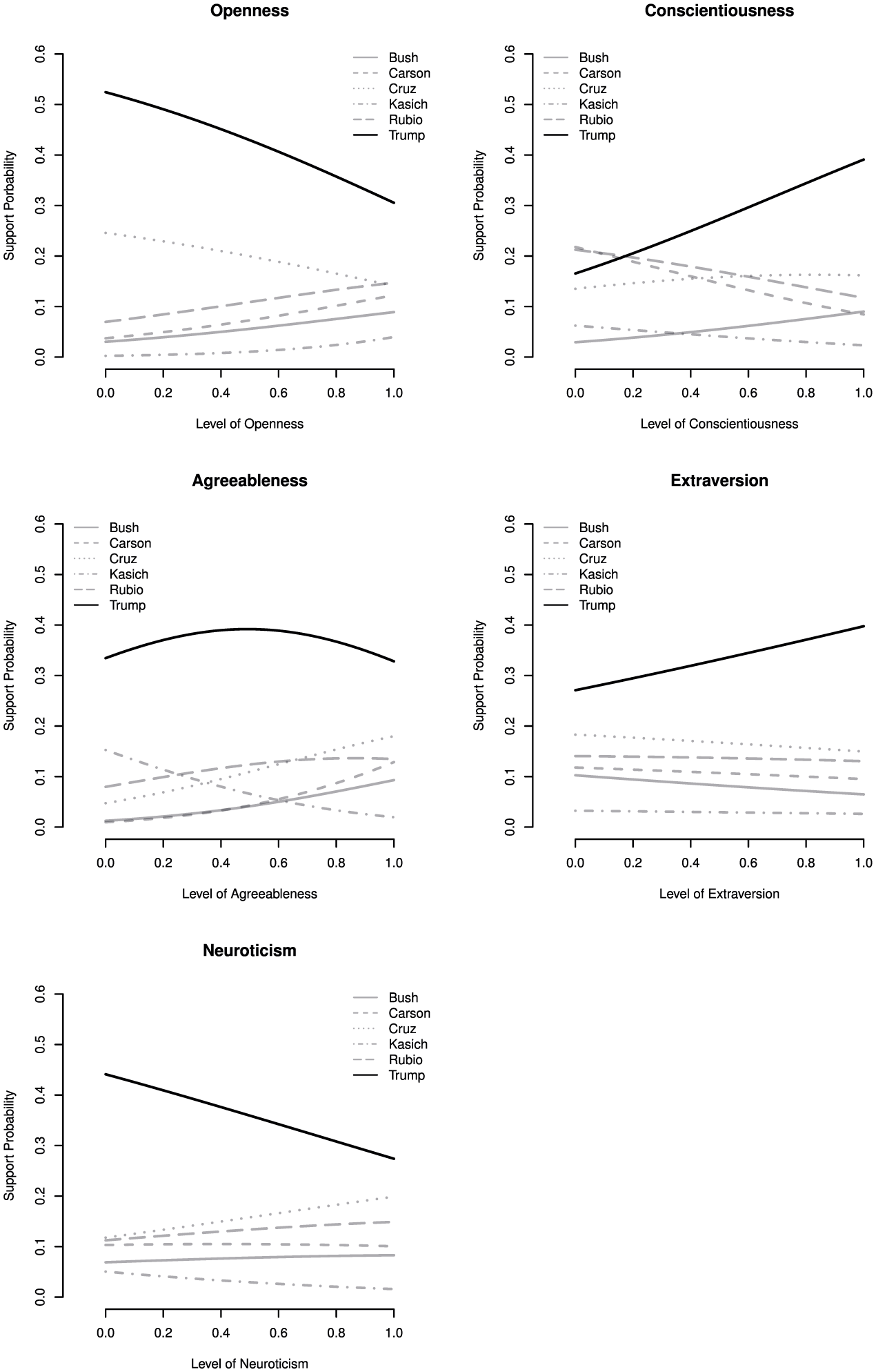
Effect of personality traits on vote choice.
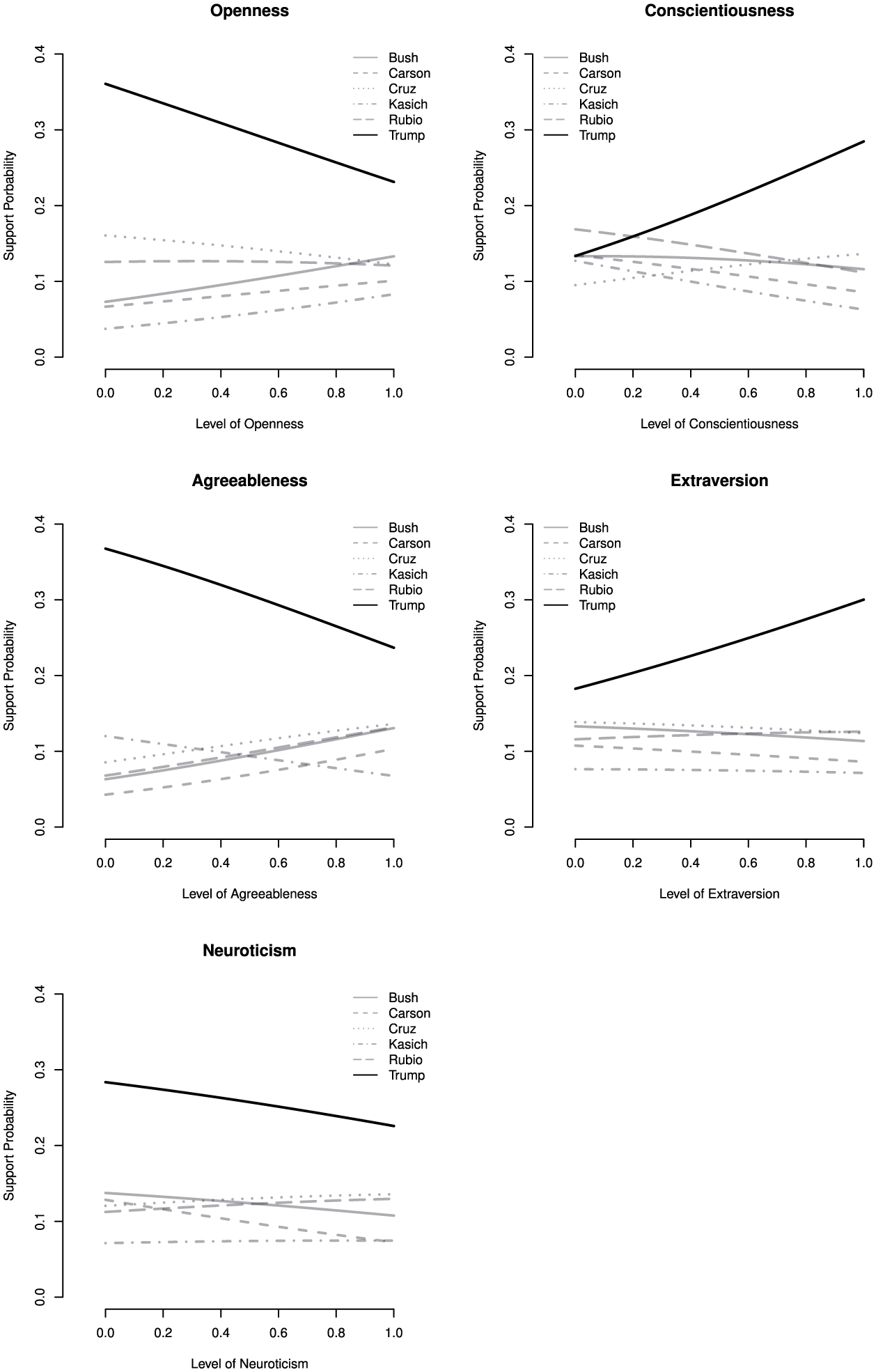
Effect of personality traits on vote choice.
Conclusion
In the early months of 2016, political novice Donald Trump topped a crowded field of Republican presidential candidates, a field that included multiple opponents with years of congressional or gubernatorial experience. Trump’s success was the consequence of neither ideological clarity nor policy precision. Instead, Trump ran a charismatic campaign, one in which he was offered as a curative product, with his personality the active ingredient. In this study, we have argued that Trump’s success stemmed at least in part from the fact that his campaign forged a link between Trump’s personality and the psychological dispositions of many in the electorate.
The framework we have developed posits that Donald Trump’s success in developing this personality connection hinged on three factors. First, with an assist from news media, he placed his own personality front and center, and simultaneously downplayed criteria related to ideology, policy, and political experience. In short, personality was activated as an influence on the vote. Second, Trump’s charismatic campaign cued an affinity effect, one in which the vote choice gained direction when voters implicitly or explicitly perceived themselves to be in alignment with Trump with respect to key personality traits. Third, and ultimately most critical, Trump had an entire swath of personality to himself. The most conscientious, most extraverted, least analytical, least agreeable, and least neurotic voters were drawn to Trump. Conversely, voters with the opposite array of dispositions divided their support among Trump’s major opponents. With multiple competitors in the race, personality traits inherently contributed to Trump’s plurality support by helping to differentiate Trump from the pack. 10
One way we could interpret Donald Trump’s success is that he caught a lucky break. In terms of individual psychological differences, he had one portion of the Republican electorate to himself. Had there been another candidate or two like Trump in the race—another candidate who appealed to voters who were high in conscientiousness and extraversion, and low in openness, agreeableness, and neuroticism—then perhaps Trump’s support would have had a lower ceiling. But we see this situation as being more than just a lucky break. Trump ran as a political outsider, but so, too, did Ben Carson and Carly Fiorina. What was different about Trump is that he ran as a political outsider who was psychologically the polar opposite of the insiders. Carson and Fiorina did not do this. Only Trump expressed disdain for expertise and for collaborative effort. Only Trump mocked political correctness, and, for good measure, mocked even more ruthlessly anyone he perceived to be an opponent. Where others sought to be the voice of reason, Trump sought merely to be the loudest voice. Where others spoke of the need to work through the nation’s most complex and difficult challenges, Trump unflinchingly championed his own personal infallibility. The politicians said what politicians say, and they were what politicians are. And Donald Trump did, and is, the opposite. It is in this context that voter personality mattered.
The rationale outlined and tested in this study should not be seen as offering an exhaustive account of Trump’s success. Our point is not that personality was the sole factor driving his win. However, personality was consequential, and we contend that any account of Trump’s success in the primaries that ignores personality will be inherently incomplete. Furthermore, the framework presented here may have applicability beyond the case of Donald Trump in 2016. As noted at the outset of this article, two obvious extensions are to other large multicandidate presidential primaries and to the rise of other charismatic, populist leaders.
Although our purpose has been to explore the psychological bases of Donald Trump’s success in the Republican nomination campaign, we would be remiss if we neglected to comment on the possible significance of this psychological foundation for governance. We see cause for both broad and specific concerns. Viewed historically, there is a reason most successful political candidates are, even if to varying degrees, analytical, willing to work through differences, as willing to listen as to talk, empathetic, and attentive to the views of others. These are the attributes that help mature, responsible adults work together to tackle complex issues. It is disconcerting both that a substantial portion of the Republican primary electorate rejected these attributes and that the nation has elected as president a person who, if he is to succeed, must do so while working from a radically different personal psychology than is typically seen in accomplished public officials. It could be that temperament is irrelevant to leadership, and it also could be that temperament matters, but it took voters until 2016 to select a president with the ideal temperament. We can hope that one of these latter two takes is correct. Unfortunately, it seems more plausible that the winning alignment of voter and candidate personality in 2016 has opened the door to governance marked by such features as antagonism to facts, refusal to consider compromise, and rhetoric dominated by self-aggrandizement and coarse ad hominem attacks on political opponents.
Our specific concern is with the type of voter and the type of leader that exhibit the particular mix of dispositions highlighted here, and especially low openness, high conscientiousness, and low agreeableness. In a series of studies, Duckitt and Sibley and their collaborators (e.g., Duckitt & Sibley, 2010; Perry, 2013; Perry & Sibley, 2012; Sibley & Duckitt, 2010; for more recent evidence on this connection, see Chen & Palmer, 2018) have explored links between the Big Five and right-wing authoritarianism (RWA) and social dominance orientation (SDO). Their core findings, which they interpret as reflecting the causal influence of personality on authoritarian attitudes, include a correspondence between RWA and both low openness and high conscientiousness, and between SDO and low agreeableness. If our results can be taken to suggest that voters with authoritarian predispositions elevated to the presidency an individual who shares that orientation, then the unique personality psychology we have identified may bring not only disarray to democratic governance in the United States, but also peril. Such implications are, of course, beyond the scope of the present study’s analyses. What we can note definitively is that a particular constellation of personality traits helped Donald Trump bond with many of the supporters who carried him to the Republican presidential nomination. We can hope that, in the case of Donald Trump, it is nothing more than a coincidence 11 that a portion of this constellation is a psychological precursor of an authoritarian predisposition.
Supplemental Material
appendix – Supplemental material for The Trump Draw: Voter Personality and Support for Donald Trump in the 2016 Republican Nomination Campaign
Supplemental material, appendix for The Trump Draw: Voter Personality and Support for Donald Trump in the 2016 Republican Nomination Campaign by David Fortunato, Matthew V. Hibbing, and Jeffery Mondak in American Politics Research
Footnotes
Declaration of Conflicting Interests
The author(s) declared no potential conflicts of interest with respect to the research, authorship, and/or publication of this article.
Funding
The author(s) received no financial support for the research, authorship, and/or publication of this article.
Notes
Supplemental Material
Supplemental material for this article is available online.
Author Biographies
References
Supplementary Material
Please find the following supplemental material available below.
For Open Access articles published under a Creative Commons License, all supplemental material carries the same license as the article it is associated with.
For non-Open Access articles published, all supplemental material carries a non-exclusive license, and permission requests for re-use of supplemental material or any part of supplemental material shall be sent directly to the copyright owner as specified in the copyright notice associated with the article.
