



Abstract
Donald Trump won the American presidency in 2016 by overperforming expectations in upper Midwest states, surprising even Republican political elites. We argue that attitudes toward social change were an underappreciated dividing line between supporters of Trump and Hillary Clinton as well as between Republicans at the mass and elite levels. We introduce a concept and measure of aversion to (or acceptance of) social diversification and value change, assess the prevalence of these attitudes in the mass public and among political elites, and demonstrate its effects on support for Trump. Our research uses paired surveys of Michigan’s adult population and community of political elites in the Fall of 2016. Aversion to social change is strongly predictive of support for Trump at the mass level, even among racial minorities. But attitudes are far more accepting of social change among elites than the public and aversion to social change is not a factor explaining elite Trump support. If elites were as averse to social change as the electorate—and if that attitude mattered to their vote choice—they might have been as supportive of Trump. Views of social change were not as strongly related to congressional voting choices.
Donald Trump’s 2016 presidential election victory relied on unexpected success in Michigan, Pennsylvania, and Wisconsin. The victories caught political observers in each state off guard, as even Republican elected officials were not confident of victory. Postelection explanations focused on the relative influence of racial and economic attitudes in driving Trump support, especially among White working-class voters in the upper Midwest. Trump’s victory also raised questions about increasing divides between mass and elite opinion, as he defeated far more experienced challengers in the Republican primary and in the general election, despite high-profile defections from conservative intellectuals and elected officials.
We introduce an important dividing line between supporters of Trump and Hillary Clinton as well as between elites and the mass public: Their attitudes toward social change. American society is quickly diversifying and publicly accommodating a broadening array of ethnic groups and familial lifestyles. Some citizens, and most elites, see diversification and value change as signs of progress. But others see social change as undermining American cultural traditions and values. The 2016 presidential race highlighted these differences. Clinton announced her campaign with a video celebrating diverse faces and experiences. She selected a campaign theme, “Stronger Together,” that endorsed unity through diversity and critiqued Trump’s campaign as divisive. Trump’s theme, “Make America Great Again,” emphasized a return to an earlier era, when the country was less diverse and (thought to be) more proudly patriotic, criticizing immigration and global openness. We measure attitudes toward social change with a new survey question scale tapping aversion to (or acceptance of) social diversification and value change. We assess the distribution of these attitudes in the mass public and among political elites and analyze their effects on support for Trump.
Our research uses paired surveys of Michigan’s adult population and its community of state government insiders in the Fall of 2016. Michigan was a major site of Trump’s unexpected strength, moving from a nine percentage point victory for Barack Obama in 2012 to a narrow victory for Trump. It is home to a sizable population of White working-class voters and has endured economic challenges alongside social diversification. The state’s community of political elites, which we define as state government insiders around Lansing, including state legislative and administrative staff and policy advocates, has been shaped by union and corporate influence, a moralistic political culture, and a series of relatively moderate and technocratic governors.
We find that aversion to social change is strongly predictive of support for Trump at the mass level, but not among political elites. If elites were as averse to social change as their base in the mass public—and if those attitudes similarly determined their candidate support—they might have been just as supportive of Trump.
Aversion to social change is related to but distinguishable from racial resentment (which invokes specific attitudes toward African American advancement), authoritarianism (measured as parenting attitudes), and ethnocentrism (including attitudes toward Latinos and Muslims). It constitutes views of the perceived high-pace movement from traditional values to more diverse ideas and groups. We find that aversion to social change predicts Trump support independently of any of these factors (as well as independently of party identification, ideology, religiosity, and economic attitudes). But it may also offer a broader category that encapsulates but extends racial resentment beyond specific views on African Americans—even providing a mechanism for Trump support among racial minorities and Whites without ethnocentric views. Unlike related attitudes, aversion to change can help predict vote choice even among minority voters—among whom Trump performed better than the previous Republican nominee (Griffin, Teixeira, & Halpin, 2017). Whereas racial resentment and ethnocentrism may tap into attitudes toward specific groups, considerations about those groups in particular are not the only views American voters bring to mind when making political decisions. By treating attitudes toward diversity and social change in general as a broader construct that transcends specific groups, we are able to capture voters’ orientations toward the diversifying effects of increasing racial, religious, and sexual minorities as well as other ongoing challenges to social hierarchies.
Attitudes toward social change also provide a key mechanism for understanding elite–mass divides within the Republican Party as well as the potential for lost Democratic votes in the upper Midwest. Republican Party elites in Michigan do not share the attitudes of their base on social change. Conservative ideological symbols are often able to paper over differences in issue attitudes, providing a broader tent to hold together disparate views—but that can leave Republican elites blindsided by the virulent social concerns of their base. Democrats, on the other hand, were caught off guard this year by defections from White working-class supporters. If aversion to social change drew voters to Trump, Clinton’s diversity-themed campaign and attacks on Trump for offensive comments toward minorities may have even helped raise the salience of these issues, making them more important in voter defections.
Understanding Support for Donald Trump
How did a gaffe-prone and scandal-plagued inexperienced politician win the American presidency? The question has already provoked a cottage industry of books, commentary, and scholarship. Although it is important to understand Trump’s specific strengths and weaknesses, universal election models may still offer straightforward answers. Political science prediction models based on factors like economic growth and presidential approval performed well, especially in predicting Clinton’s popular vote victory margin. 1 The party in the presidency faced its normal disadvantage after two consecutive victories (Abramowitz, 2016). Errors in polling were limited to a few states and were less dramatic than in prior elections. 2
Despite a historically unique Republican candidate, many of the same factors that matter in every election also explained 2016 vote choices. More than 90% of Republican and Democratic identifiers ended up supporting their party’s candidate. 3 Supermajorities of 2012 Mitt Romney and Barack Obama supporters continued to vote for the same party’s nominee in 2016. 4 Traditional demographic divides between the parties continued or accelerated, with more support for Clinton among racial minorities, women, and youth and more support for Trump among frequent church attenders. 5
Yet the overwhelmingly regional nature of Trump’s gains over Romney’s level of support underscore the importance of some 2016-specific factors. Election commentary has focused on economic and racial concerns, with most evidence finding racial attitudes mattered more than economic views (Sides, Tesler, & Vavreck, 2017). More starkly, some commentators point to the role of ethnocentrism, including feeling more warmly toward Whites than racial minorities or Muslims (Kteily & Bruneau, 2016). Other scholars have explained Trump support as a product of authoritarian parenting attitudes, such as preferring obedience from children over self-reliance (Morgan & Shanahan, 2017).
Quantitative studies of Trump support have most consistently shown the effects of racial resentment. 6 The racial resentment scale measures attitudes regarding African American progress, however, leading commentators to question how it can explain the choices of voters moving from supporting the first African American president to voting for Trump. In fact, Trump’s campaign rhetoric was actually quite positive about African Americans; his negative messages were focused on recent Latino immigrants and Muslims (Lamont, Park, & Ayala-Hurtado, 2017).
Qualitative commentary on Trump support has emphasized White working-class grievances, drawing from prior studies of rural Wisconsin (Cramer, 2016), Youngstown, Ohio (Gest, 2016), and Louisiana (Hochschild, 2016) as well as worldwide studies of the rise of right-wing populism (Judis, 2016). These studies emphasize a blend of racial resentment, economic pressure, nationalism, nostalgia, antielitism, and feelings of “being left behind” in driving right-wing attitudes and voting.
Our introduction of aversion to change as an important variable is meant to draw from these qualitative accounts and from the messages developed by each presidential campaign (presumably using information about what would likely appeal to swing voters). Aversion to a diversifying country might be seen as a broader encapsulation of resentment that is less specific to African Americans and more consistent with European party divisions. The two American parties appear to be polarizing on a “national identity” dimension used in studies of international parties, where one party advocates “toleration and social and political equality” for minorities over assimilation and the other favors “defense and promotion of the majority national identity and culture” (from the Democratic Accountability and Linkages Project, 2014; for American party placement, see Grossmann & Hopkins, 2016).
The concept of aversion to change encapsulates a voter’s defensive response to forces perceived as threatening the values, hierarchies, and shared cultural ties that have traditionally held powerful roles in society. Studies in American voting behavior have identified value orientations and group loyalties as stable, long-term predispositions shaped by socialization during preadulthood within the context of particular historical cleavages (Berelson, Lazarsfeld, & McPhee, 1954; Campbell, Converse, Miller, & Stokes, 1960; Jennings & Niemi, 1968). In the symbolic politics tradition, racial group attachments and affect toward minorities have been shown to influence issue preferences and voting behavior, even where no tangible consequence for a voter’s own personal life is at stake (Kinder & Sears, 1981; Sears, Lau, Tyler, & Allen, 1980). Voters’ responses on the basis of such predispositions are emotional, habitual, and symbolic (Sears, Hensler, & Speer, 1979). Scholars have shown that many core political orientations have become increasingly “racialized,” or correlated with symbolic racial attitudes, especially when there is “a natural associative link between policy substance and feelings toward the groups who benefit from them” (Tesler, 2012, p. 30). As social groups and associated ideas about identity and society gain and lose status over time, we can expect gut-level reactions from individuals depending on their symbolic orientations. Whereas the traditional literature has extensively examined the role of specific racial attitudes, these same processes should also be at work for a broader range of political symbols and value orientations. When voters perceive that preferred groups or values are losing ground, they may feel averse to the evolution of the existing social order.
Aversion to change may also be tied to prior concepts of patriotism or collective narcissism (Federico & Golec de Zavala, 2018) or views of American identity (Feldman & Stenner, 1997). It could be one manifestation of the broader “core political values” of Americans (Goren, 2005), including values like “blind patriotism” or “traditional morality,” or to the cross-national “moral foundations” (Haidt, 2012) of political attitudes, such as “loyalty” to a national in-group or “authority” and respect for tradition.
But aversion to social change should also be seen as a long-standing and fundamental aspect of American conservatism. In the founding mission statement of conservative movement periodical National Review, William F. Buckley argued that conservatism “stands athwart history, yelling Stop” at a time of “radical social experimentation” (Buckley, 1955). Social traditionalism was long seen as one of the three legs of the conservative movement stool. Granted, a thrice-married and crude reality-television star seems like an odd standard bearer for a movement associated with religious orthodoxy. But social traditionalism has long mixed moral values and racial attitudes; recent exemplars of these mixed opponents of social diversification include Patrick Buchanan and the paleoconservatives (Hawley, 2016) and Tea Party supporters (Parker & Barreto, 2013).
These past combinations of social and racial conservatism were reactions against diversification and value change, motivated by perceptions that a culture war was being lost to liberals and newcomers. Prior research shows that perceived threats can activate underlying emotions like anxiety (Albertson & Gadarian, 2015) or views of the social hierarchy (Levin, Federico, Sidanius, & Rabinowitz, 2002). When Whites are reminded that they will soon be a racial minority, those high in ethnic identification become more supportive of Trump (Major, Blodorn, & Blascovich, 2016) and perceive more discrimination against Whites and less against racial minorities (Craig & Richeson, 2017). The 2016 election context likely linked these concerns. Trump’s nostalgic message and open hostility to immigration gave aversion to social change greater political importance, especially when compared to Clinton’s message of celebrating diversity and pluralism.
Aversion to change could also be a reflection of personality dimensions related to open or closed viewpoints (Johnston, Lavine, & Federico, 2017), such as openness to new experience (Gosling, Rentfrow, & Swann, 2003), openness versus conservation (Schwartz, 1992), the need for cognitive closure (Mannetti et al., 2002), risk aversion (Kam, 2012), or cosmopolitanism (Jackman & Vavreck, 2011). Our concept can be placed in the same category as these underlying psychological dimensions, but it is specified as a more proximate political attitude combining traditional conservative predispositions with the current political context of social diversification.
Understanding Mass–Elite Divides
In addition to investigating the determinants of vote choice in a single presidential election, our aim is to further understand divides between voters in the American mass public and political elites. Trump won despite overwhelming opposition from Republican elites in the primary, even though high-profile political science research suggested that was unlikely (Cohen, Karol, Noel, & Zaller, 2008) and faced unprecedented elite dissention in the general election, losing support from sitting Republican Members of Congress and leading conservative intellectuals and obtaining only two endorsements from the nation’s 100 largest newspapers.
These mass–elite divides could be partially a product of demographics. Political elites are much more highly educated, on average, than members of the mass public—important in an election where education divides were amplified. Political elites also may be less religious or better off financially than the mass public. It is important to understand where political elites differ and whether or not these political attitude differences are rooted in demographics.
We argue that aversion to social change is an important factor explaining mass–elite political divides. There are strong theoretical reasons to expect differences between political elites and the mass public in the impact of social and racial variables including aversion to change—as well. First, formal education and cognitive sophistication, of which we would expect to find higher-than-typical levels among political elites, have been shown to enhance tolerance toward nonconformist groups (Bobo & Licari, 1989). Second, political elites who work in and around government, building coalitions and serving broad constituencies, may be more likely to have regular positive interpersonal contact with members of diverse groups—another factor that reduces prejudice toward outgroups (Pettigrew & Tropp, 2006). Third, by working in and around government political elites possess the ability to exercise far more control over social changes than a typical voter, and individuals who have greater control over an aversive or painful event—in this case, shifting values and balances of power—frequently experience less anxiety about it (Miller, 1979). Fourth, there is a long history of elites leading first in the liberalization of racial attitudes (Schickler, 2016). The 2016 election may be another example of a mass public that has not caught up with elite views on diversity.
There are also historical reasons to expect social views to differ in impact between political elites and the mass public. The Republican Party has long had activists and elected officials who prize economic policy more than social issues, even though its popular base often has the reverse issue prioritization (Grossmann & Hopkins, 2016). The Party has successfully integrated prior right-wing populist constituencies, such as those surrounding the John Birch Society and the Christian Right, even as its elected officials have tried to temper their social views. Most recently, the Tea Party was divided between financial and party leadership backers that were concerned about economic policy and government overreach (Skocpol & Williamson, 2016) and a popular base more concerned with ethnic diversification and immigration (Parker & Barreto, 2013). We thus expect substantial differences in the level of aversion to social change among Republican elites and those in the public, matching their differences on racial attitudes. Political elites are also directly engaged in policymaking, where the agenda is overwhelmingly economic, so they may be less inclined to support candidates on the basis of their racial and social views. Republican elites have long been far more focused on tax and budget issues than their base. If government officials do not share the aversion to social change of the mass public, it may explain why they were less supportive of Trump’s message and ill-equipped to see Trump’s victory coming.
Method
Our data for mass public attitudes come from Redacted’s Redacted, a quarterly telephone survey that uses a stratified random sample of active landline and cellular phones in the state of Michigan. The Redacted included a total of 1,010 interviews conducted between September 1 and November 13, 2016, with 985 of these taking place on or before Election Day (November 8). We use data weighted by phone type, education, age, race, sex, and region. Complete methodological details of the survey, including instruments and documentation, can be found at Redacted.
The corresponding data for political elites were gathered as part of the Redacted, a regular panel survey of the state policy community conducted electronically by Redacted in conjunction with the Redacted. Members of the target population—legislative and administrative staff, interest group leaders, and lobbyists—were recruited by email to join the panel, and a total of 533 insiders participated in at least one round of the online survey between September 1 and November 1, 2016. Methodological details can be found at Redacted.
We sought to assess the relationship between attitudes toward social change and vote preference. Our measure of aversion to change is an additive scale made up of two components—respondents’ level of agreement with a pair of statements about changing cultural values:
“Our country is changing too fast, undermining traditional American values.”
“By accepting diverse cultures and lifestyles, our country is steadily improving.”
Respondents to the two surveys were presented with these statements and asked to indicate whether they strongly agree, agree, disagree, or strongly disagree. The online survey of political insiders included a “neither agree nor disagree” option, whereas the telephone survey of the general population permitted participants to volunteer this option. We reverse the direction of the second question, so that higher values indicate more aversion to social change (less acceptance). Combining these two items, aversion to change is a 9-point scale coded to range from 0 to 1, with higher values corresponding to more unfavorable attitudes toward social change.
Our major dependent variable of interest, vote preference, is a three-category ordinal variable created from a survey item asking respondents which of the two major candidates they most support for the presidency in 2016. Each of these variables takes on a value of 0 if the respondent preferred Clinton, a value of 1 if the respondent preferred Trump, and a value of 0.5 if the respondent preferred another candidate or could not decide. A similar variable records the respondent’s preference between the major party candidates in their local congressional election.
Our measure of authoritarian attitudes is based on a measure used by Feldman and Stenner (1997). We constructed a 3-point scale from 0 to 1 from two binary items that asked respondents to choose which of a given pair of personal qualities is more important for a child to have: obedience versus self-reliance, and independence versus respect for elders. Preference for obedience and respect for elders were considered the more authoritarian choices.
Our measure of racial resentment is a 9-point scale from 0 to 1 constructed from respondents’ reported level of agreement or disagreement with two statements about race—one positing that African Americans should overcome prejudice and work their way up without any special favors like some other minority groups did, and one (coded in the opposite direction) positing that generations of slavery and discrimination make it difficult for African Americans to work their way up financially. Higher values indicate higher levels of resentment.
Ethnocentrism is measured using a set of “feeling thermometer” questions for particular racial and religious groups, comparing the respondent’s rating of Whites to their rating of Blacks, Hispanics and Latinos, and Muslims. In particular, the variable is coded as the average difference between the score given by the respondent to “Whites” and the score the respondent gave to each of the three minority groups (rescaled from 0 to 1). Minority respondents are coded as having values of 0 on this ethnocentrism scale. Calculating the ethnocentrism of non-White respondents the same way does not change our conclusions in any significant way.
As a result of data availability, economic optimism is measured differently for political insiders and the mass public. Among insiders, optimism is measured by averaging the respondent’s subjective assessment of the United States economy and the respondent’s subjective assessment of Michigan’s economy, each on a 5-point scale from “very bad” to “very good.” Among the general population, economic optimism was measured with a scale combining six subjective economic assessments: changes to the respondent’s personal financial situation in the past year, an evaluation of the respondent’s current financial situation, and anticipated changes to the respondent’s personal financial situation, the unemployment situation in the country, the rate of inflation in the country, and business conditions in the community. Both scales range from 0 to 1. Removing this variable does not significantly change any results.
Our demographic control variables included party and ideology (coded as 7-point scales where 0 = strong Republican or very Conservative and 1 = strong Democrat or very Liberal), age (a three-category variable where 0 = less than 25 years old, 0.5 = 25 to 59 years old, and 1 = 60 years old or more), and binary variables for self-identified Black respondents, White respondents, education (1 = college degree or more, 0 = otherwise), and sex (1 = female).
Aversion to Social Change as an Important Political Division
Table 1 reports descriptive statistics for each of the two aversion to change components, along with their association. The items represent a reasonable scale; the correlation between them is somewhat low, in part because the statements which respondents were asked to evaluate intentionally endorsed opposite positions on social change, to avoid categorizing people who are just likely to agree with survey items generally as being on one side of the scale or the other (a phenomenon known as “acquiescence bias”—see Wright, 1975). Respondents who were merely acquiescing to these items would have reported seemingly contradictory attitudes, thereby driving down the correlation between the two components. 7
Summary of Aversion to Change Components.

Both components are coded such that higher values correspond to greater aversion to change.
Figure 1 depicts the distribution of elite and mass opinion on the combined aversion to change scale for different partisan groups, and reveals some stark differences between the general population and political elites in terms of their orientation toward social change. In particular, most—roughly 70%—of the political insiders fall to the left of the middle point (toward the “openness to change” end of the scale), whereas the general population is dispersed much more broadly across the full spectrum. About 44% of the full general population is rated as more averse than open to social change, compared to just 11% of political insiders. That is a stark divide, and it is especially pronounced within the Republican party. The median positions staked out by elites and nonelites in the Party are on opposite sides of the issue.

Distribution of aversion to change variable, by population and party.
Table 2 outlines the demographic-based differences in aversion to change in each of the two surveys. The subgroups likely to be more averse to social change are Trump supporters, Republicans, conservatives, older people, and those with no college degree or lower incomes. Blacks were, on average, even more averse to social change than Whites, consistent with research highlighting their conservative political attitudes on many traditional social issues (Newport, 2008; Pew Research Center, 2017). Besides the differences among particular subgroups, one of the most glaring divides shown in Table 2 is the one between elites and the general population. Within every demographic group shown, members of the mass public reported more aversion to change, on average, than political elites. Moreover, the magnitude of the mass–elite divide is substantial in comparison to differences between other groups. Social change attitudes among Republican insiders, for example, are far more similar to those of Democratic insiders than even those of their fellow Republicans in the general population.
Aversion to Change Variable by Subgroup.
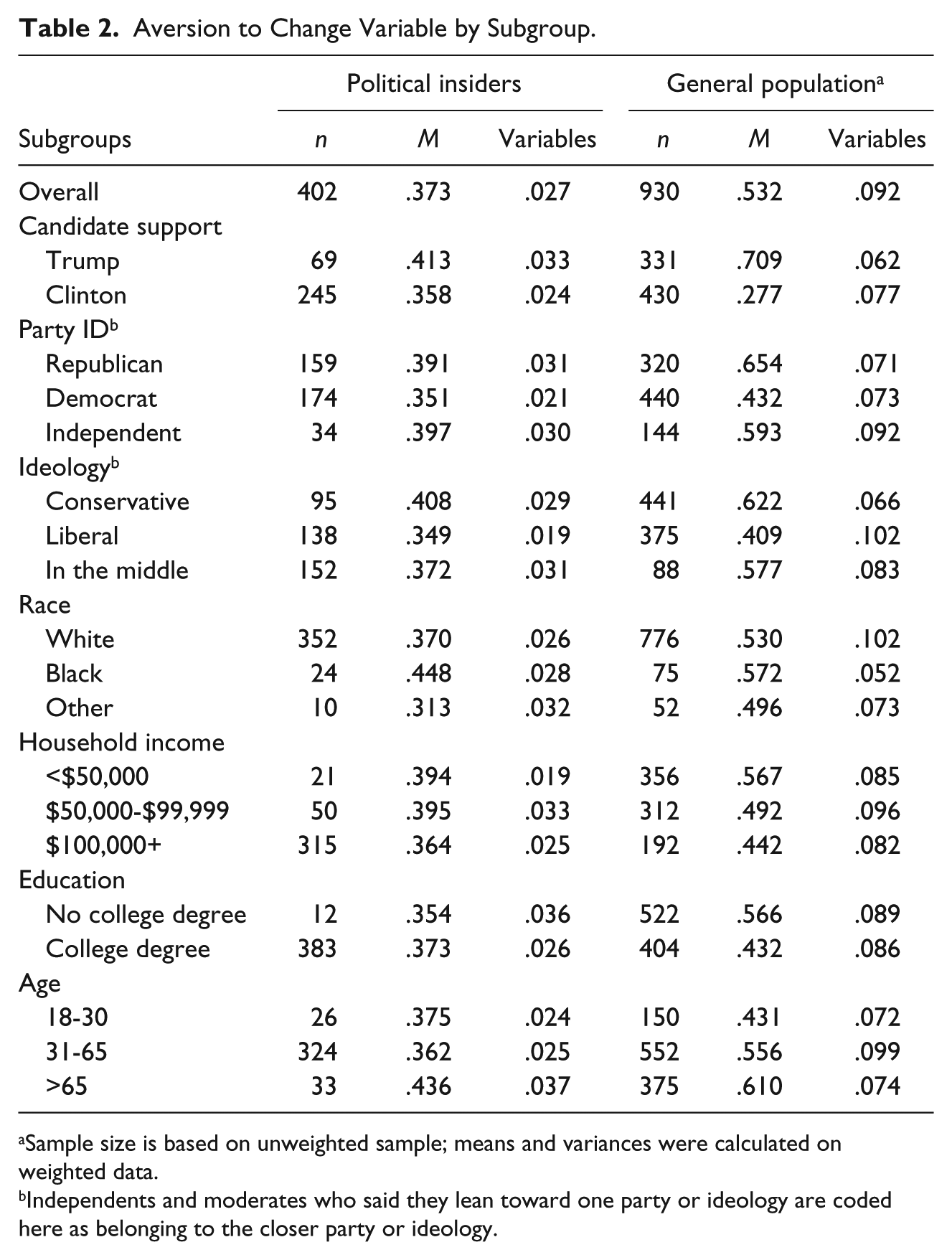
Sample size is based on unweighted sample; means and variances were calculated on weighted data.
Independents and moderates who said they lean toward one party or ideology are coded here as belonging to the closer party or ideology.
The difference in aversion to change among insiders and the general population is large, relative to mass–elite divides on other attitudes. This is evident in Table 3, which reports comparative statistics for aversion to change and several other attitudinal items that appeared on both surveys. The variables in the table are listed in descending order by the size of the difference between the insiders’ mean and the general population mean. The mass–elite divide on aversion to change is approximately as large as the mass–elite divide in racial resentment and even larger than the corresponding divides on attitudes about Muslims, Barack Obama, Blacks, and the police, but it is less than the divide on authoritarian parenting attitudes. 8 Thus, orientations toward cultural changes and traditional values comprise a substantial source of disagreement between the elite political establishment that largely resisted Donald Trump’s candidacy and the mass public that was far more willing to embrace it.
Mass–Elite Divides on Aversion to Change and Other Attitudinal Variables.

Note. CI = confidence interval.
All variables were rescaled to range from 0 to 1 to facilitate direct comparisons.
|∆| =
Explaining Vote Choice With Aversion to Change
Michigan political insiders were far less likely than members of the Michigan public to support Trump in the general election, as shown in Figure 2. The side-by-side histograms show the contrasting distribution of vote choice between the two groups, with over a third (36%) of respondents in the general population supporting Trump—double his level of support (18%) among our panel of insiders. Both populations contained a sizable proportion of uncommitted voters who refused to choose between the two main candidates. These distributions, of course, contain less support for Trump than materialized on Election Day in Michigan. Reanalysis of our data set and other state surveys suggested that undecided voters moved toward Trump, especially in the campaign’s closing week. 9
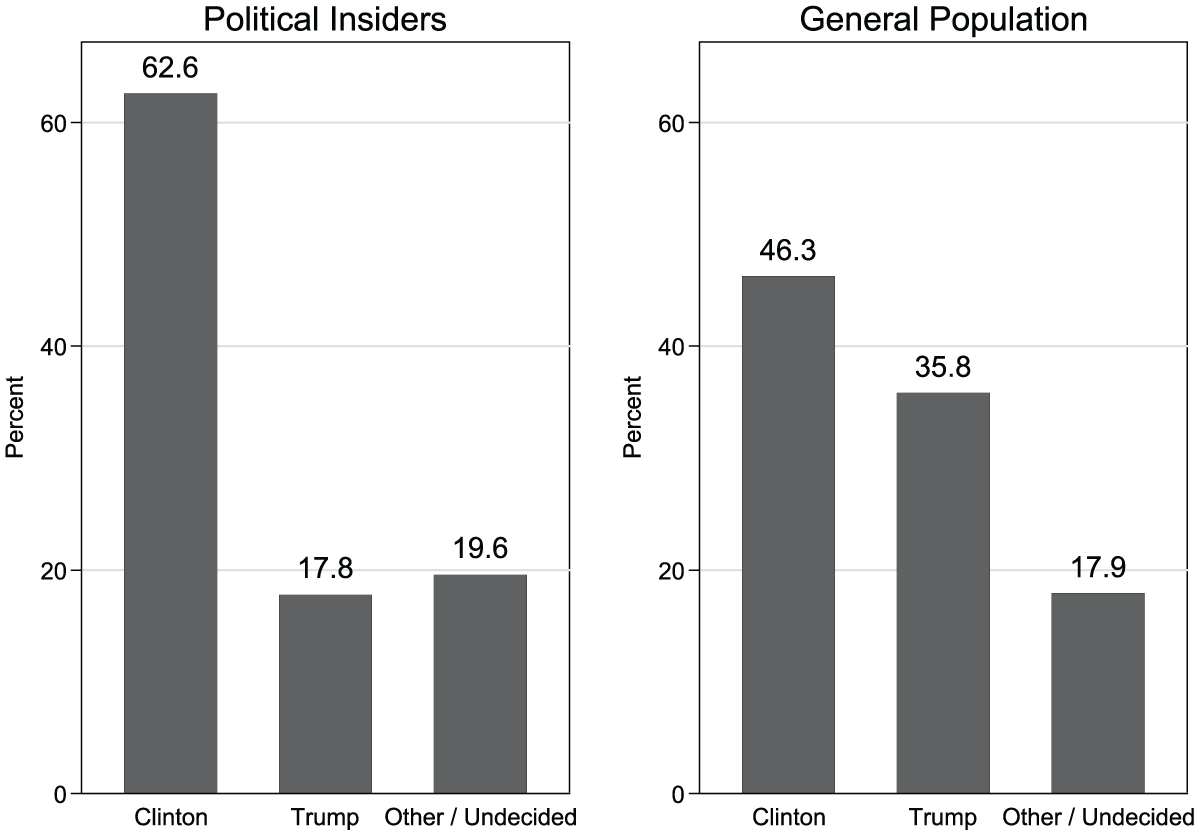
Distribution of presidential election vote choice, by sample.
Both insiders and the public expected a Clinton victory. Figure 3 shows that an overwhelming majority of each population predicted Clinton would win the state and the Electoral College, but the general population was approximately four times more likely to predict Trump’s victory. Respondents’ expectations about the outcome were highly predicted by their preference between the candidates, except that Clinton supporters were more optimistic about her chances of victory than Trump supporters were of his.
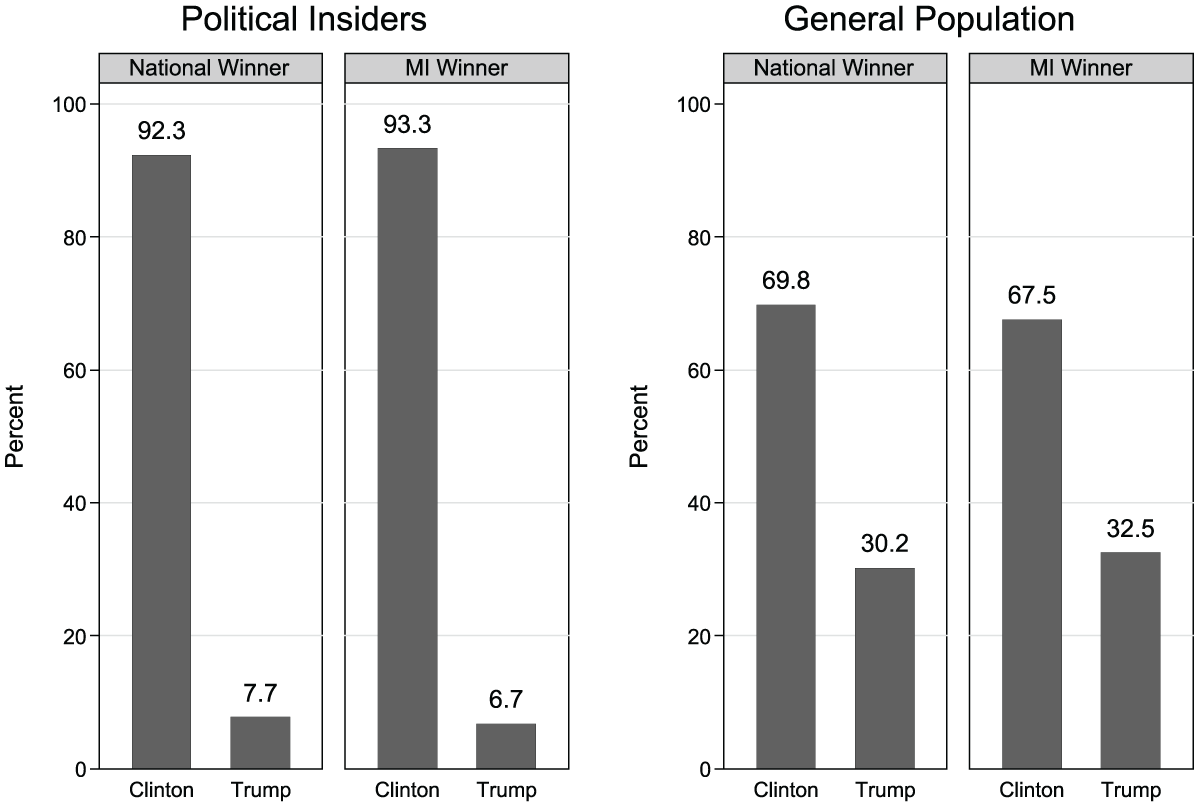
Distribution of presidential election expectations, by sample.
We argued that attitudes toward social change may have influenced vote choice in the 2016 elections, by increasing Trump’s support among those who held change-averse attitudes. Figure 4 illustrates the bivariate relationships between the individual aversion to change components and self-reported vote preference among the mass public. Responses to each of the two items display a strong near-linear relationship with the probability of supporting Trump and Clinton. In each case, those who gave more change-averse responses were increasingly likely to prefer Trump and decreasingly likely to prefer Clinton.
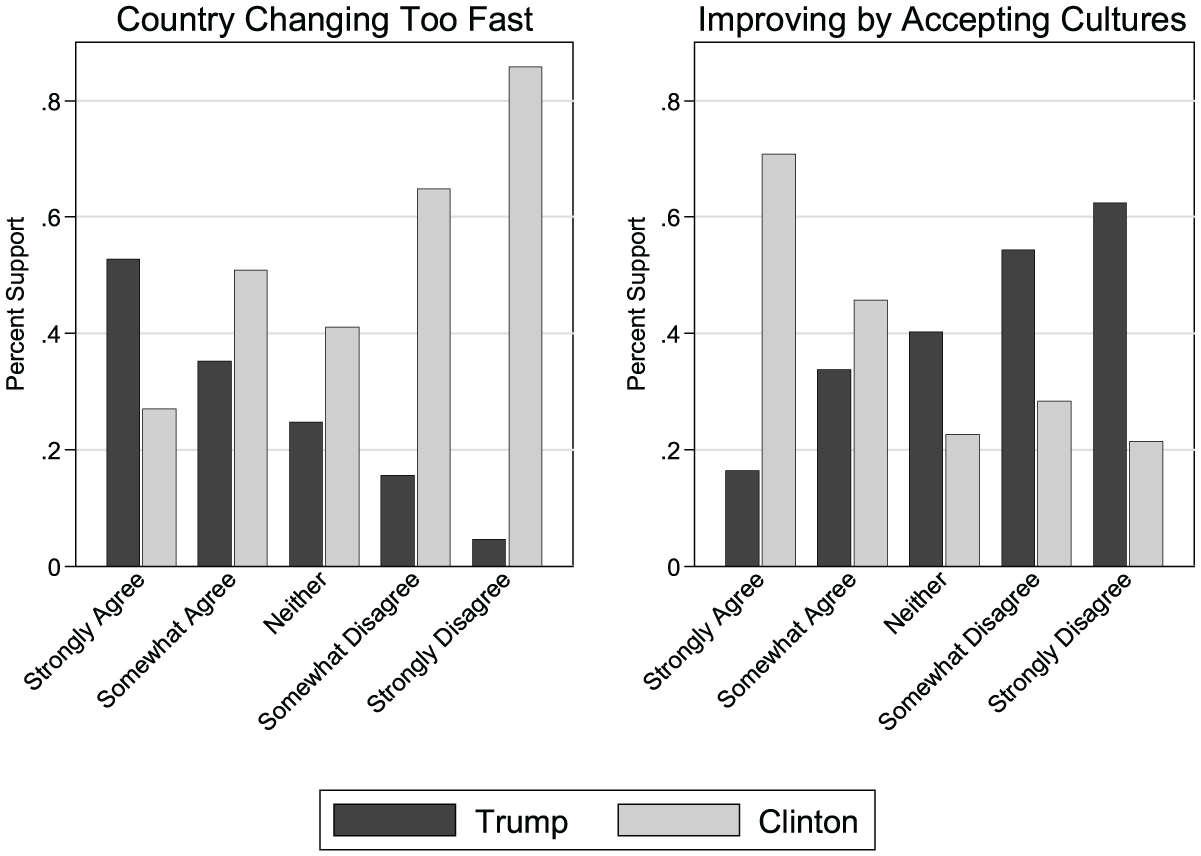
General population vote choice, across range of aversion to change components.
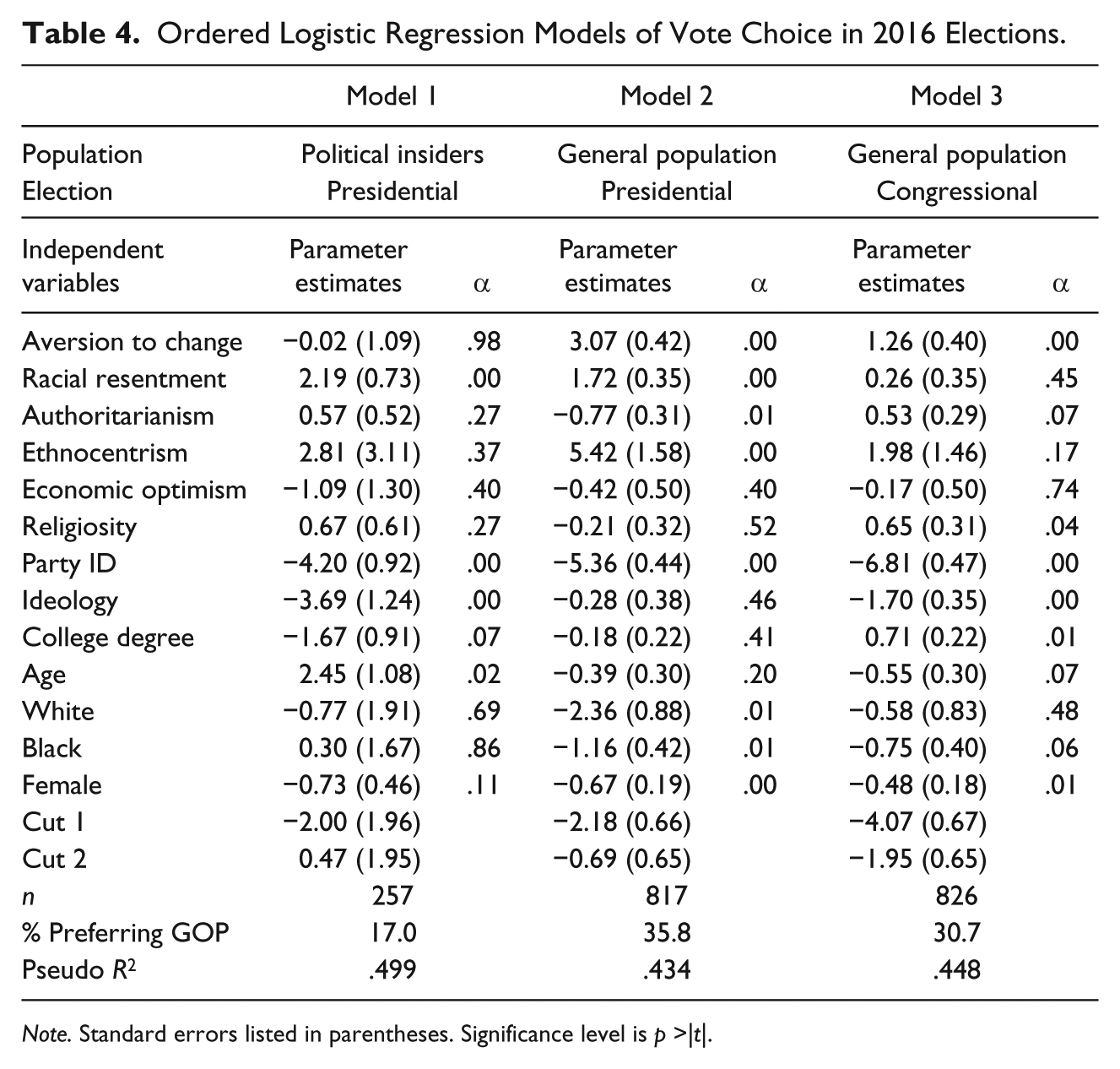
Table 4 reports three multivariate models predicting vote preferences in 2016. Model 1 reports the ordered logistic regression for presidential vote among political insiders, Model 2 reports the same model for the general population, and Model 3 uses the same independent variables to predict the general population’s support for the Republican or Democratic candidate in a respondent’s congressional race. Even after controlling for other factors thought to influence voting behavior, greater aversion to change significantly predicts the likelihood of supporting Trump. 10 It is also a (less strong) predictor of support for the Republican candidate in a respondent’s House election but is not a significant predictor of insider opinion in the presidential race. The mass–elite divide seems to extend not only to change-averse attitudes themselves, but also to the linkage between those attitudes and vote choice. But, the lack of a statistically significant effect among elites may be an artifact of the very small proportion of insider respondents who scored highly on the aversion to change scale. In either case, the evidence suggests that aversion to change can help explain Trump’s support with the masses better than his support with political elites. 11 Ethnocentrism, however, also has a stronger effect in predicting public support for Trump than in predicting political elite support.
Ordered Logistic Regression Models of Vote Choice in 2016 Elections.
Note. Standard errors listed in parentheses. Significance level is p >|t|.
Results for the other variables mostly conform to traditional expectations. Support for Republican candidates is associated with stronger identification with the Republican Party and conservative ideology, being male, higher levels of racial resentment and ethnocentrism, and less economic optimism (although these relationships were not all statistically significant). One counterintuitive result is the significant and negative relationship between Trump support and authoritarian attitudes. We suspect this shows that any positive effects of authoritarianism among Trump voters were rooted specifically in the racial and social attitudes that are captured separately in these models. Many of the ideas Donald Trump promoted that have sometimes been categorized as “authoritarian”—such as building a wall along the Mexican border (Pierce, 2016) and a travel ban for people from predominantly Muslim countries (Taub, 2017)—pertained to asserting control over racial and religious outgroups. Respondents’ orientation toward this particular brand of purported authoritarian views would be captured by the aversion to change, ethnocentrism, and racial resentment variables. Indeed, when these three variables are removed from the model, authoritarianism has a significant and positive relationship with Trump support.
Likewise, the negative coefficients for the White dummy variable in all three models (compared to the excluded category of not White or Black) depend on whether the racial attitude variables are included. When the effects of aversion to change, racial resentment, and ethnocentrism are not included, White has a positive coefficient. This suggests that the positive effects of being White on Trump support may be fully explained by the distinct racial and social views of Whites and minorities. Religiosity also does not have a significant effect and the sign is negative for the public model predicting Trump support; any positive effects are likely already incorporated in partisanship.
Because all variables were scaled to range from 0 to 1, comparing the magnitudes of the coefficients in Table 4 can help assess the relative substantive significance of particular variables. Among the general population, the relationship between aversion to change and presidential vote choice is among the largest in the model, behind only partisan identification and ethnocentrism. Its coefficient is markedly larger than many variables which are commonly mentioned in popular explanations Trump support—including economic attitudes, racial resentment, authoritarianism, and college education. In Model 3, the aversion to change coefficient is again among the largest, behind only party, ideology, and ethnocentrism.
Importantly, we found no difference in the impact of aversion to change on vote choice across racial groups in the mass public. Our findings are robust across racial groups. Table 5 reports the results of the presidential vote preference model separately for White and non-White respondents in the general population. Aversion to change remains a large and significant predictor of vote preference among both White and non-White voters (with a larger coefficient for racial minorities). Among African Americans specifically, racial resentment does not predict vote choice or aversion to change, yet aversion to change does help predict vote choice.
Presidential Vote Choice Models for Mass Public, by Race.
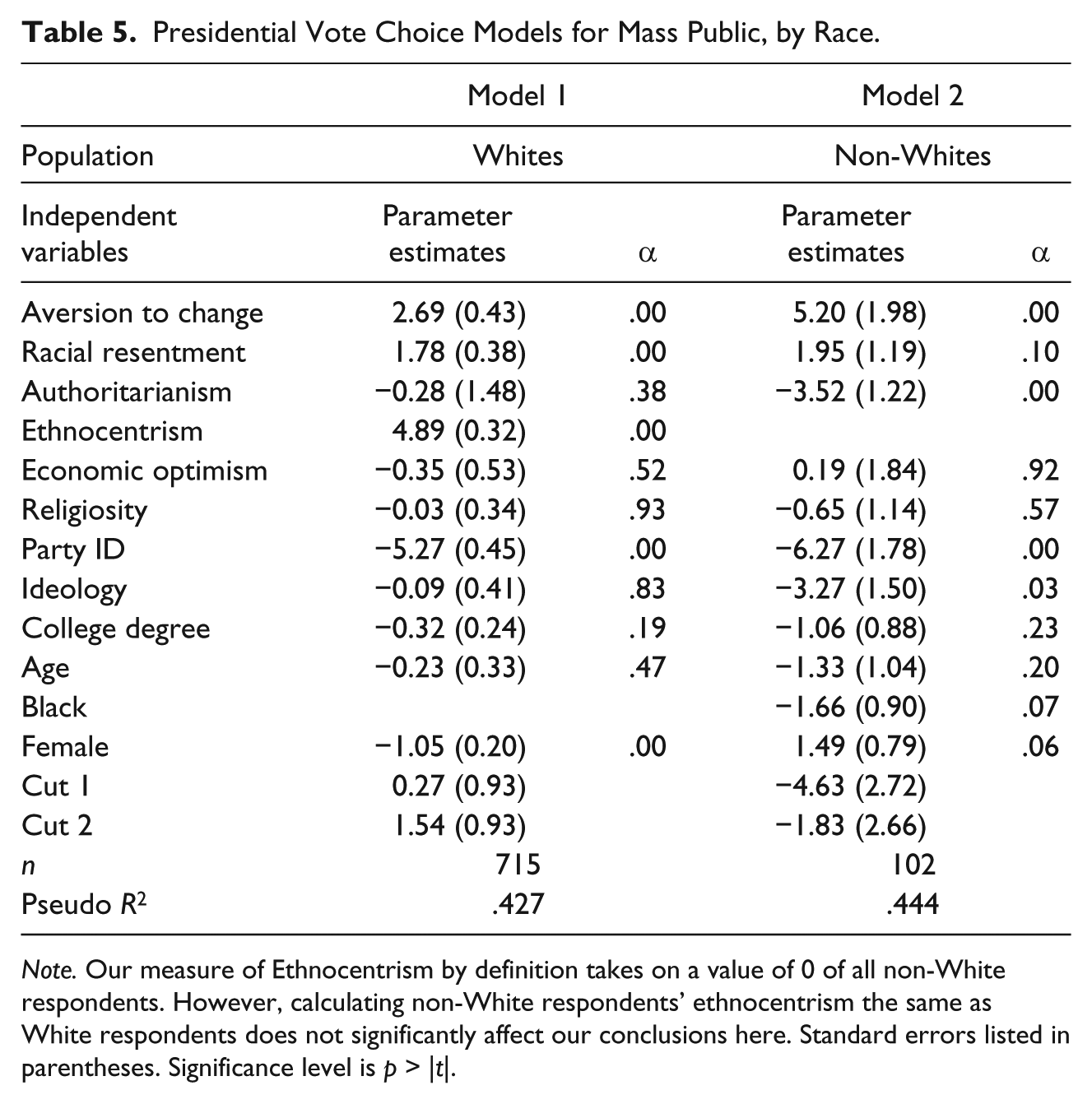
Note. Our measure of Ethnocentrism by definition takes on a value of 0 of all non-White respondents. However, calculating non-White respondents’ ethnocentrism the same as White respondents does not significantly affect our conclusions here. Standard errors listed in parentheses. Significance level is p > |t|.
We also tested these relationships in a series of simplified models that included aversion to change, racial resentment, authoritarianism, ethnocentrism, and ideology while omitting the other control variables. As the results in Table 6 show, our conclusions do not rely on particular demographic controls—aversion to change remains a statistically significant and comparatively large predictor of Trump support (and of support for Republican Congressional candidates) among the general population, but is not statistically related to vote choice among insiders. Insiders and the mass public starkly differed not only in the extent to which they expressed change-averse attitudes, but also in the extent to which those attitudes entered their decision calculus when choosing between Trump and Clinton.
Ordered Logistic Regression Models of Vote Choice in 2016 Elections, Simplified.
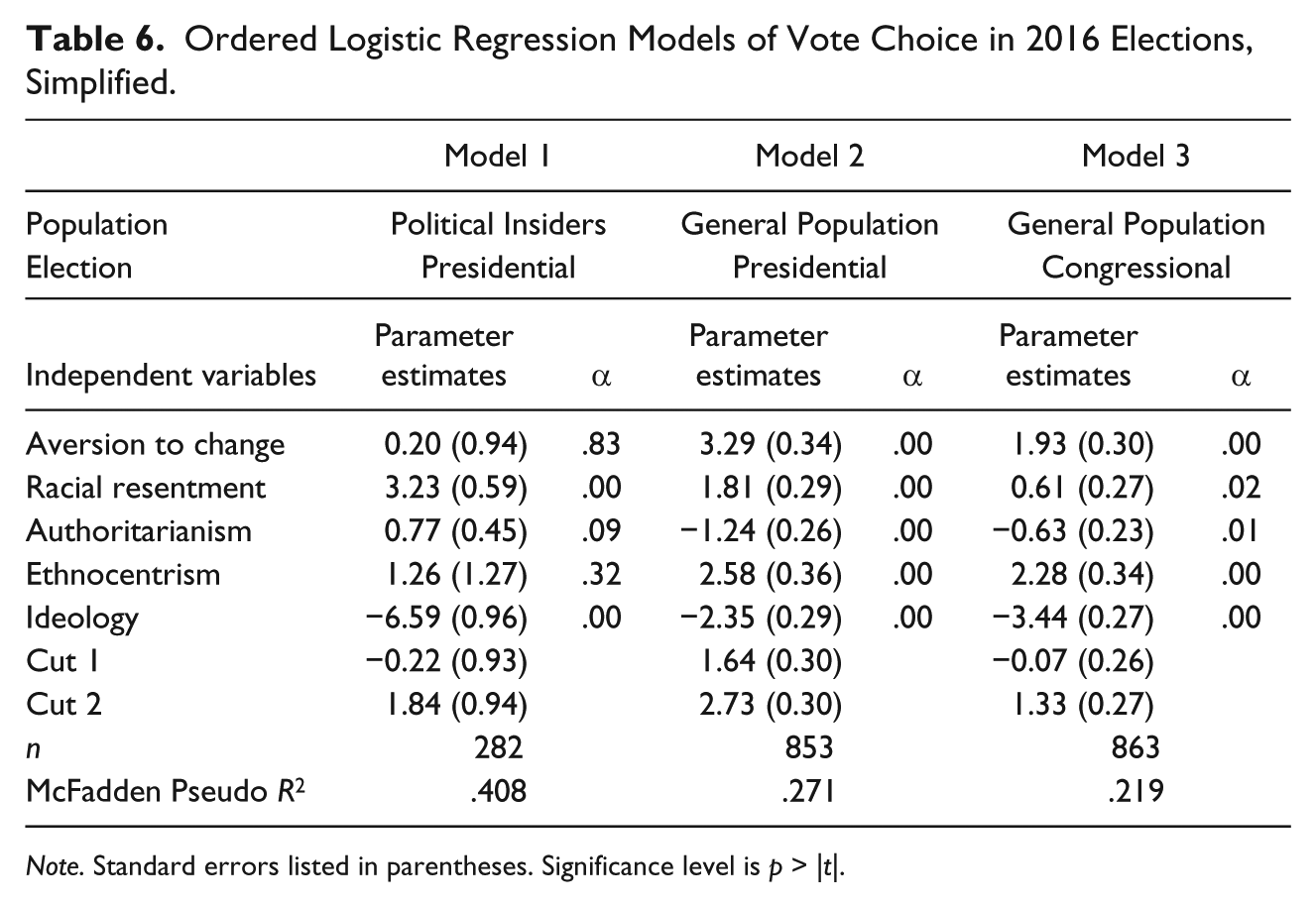
Note. Standard errors listed in parentheses. Significance level is p > |t|.
This is particularly apparent when the relationships are quantified as a predicted probability of voting for Trump. Using the equations from Models 1 and 2 in Table 4, Figure 5 reports the simulated predicted probabilities of hypothetical Republican, Independent, and Democrat voters from each population supporting Trump, at different levels of aversion to change (with all other variables held at their means). The shaded regions represent 95% confidence bands. Among the general population, the substantive effect of change-averse attitudes is quite large—for a pure Independent it is associated with an increased chance of voting for Trump from less than 10% to more than 60%, over the full range of the variable. Even for a strong Republican, aversion to change alone can independently account for a roughly 40 percentage point increase in the simulated probability of voting for Trump. Among political elites, however, none of the confidence bands exclude the possibility of a horizontal line—that is, a constant probability of supporting Trump at all values of aversion to change.
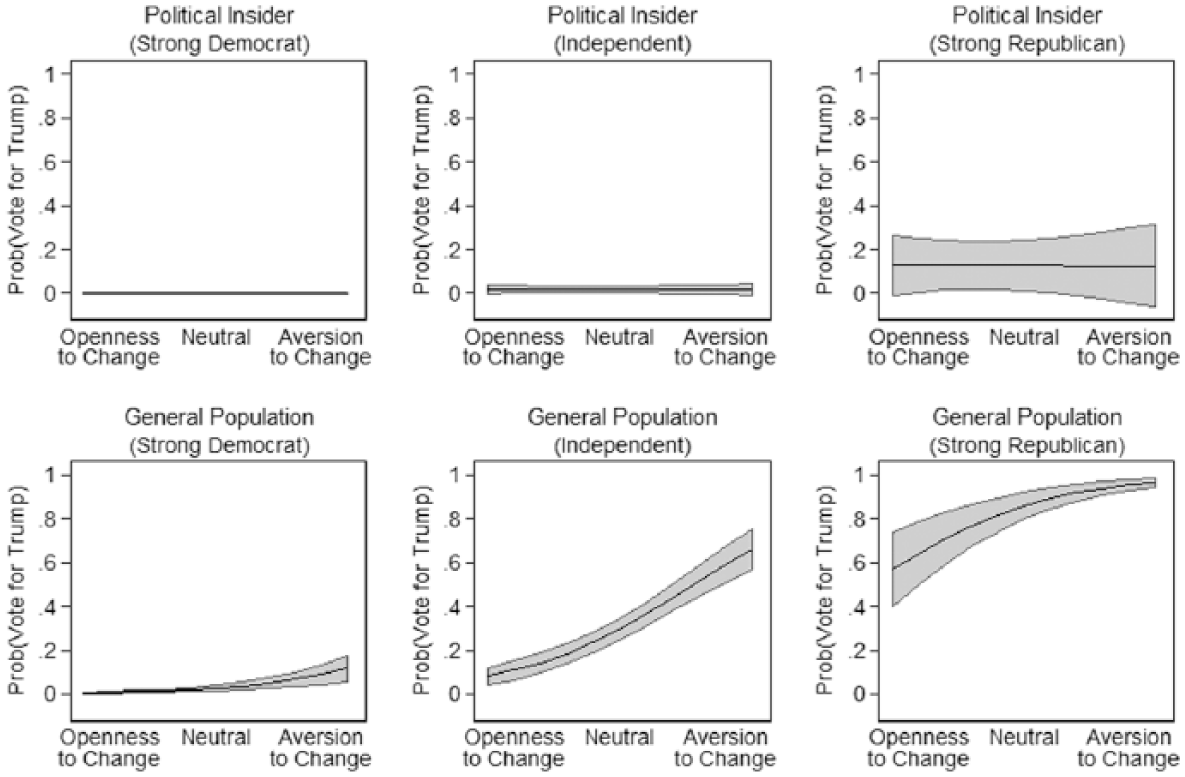
Predicted probability of supporting Trump, by aversion to social change.
Determinants of Aversion to Change and Impact of Mass Attitudes
Even if aversion to change helps explain vote choice, change-averse attitudes may be partially a product of demographic and attitudinal differences. Table 7 reports the results of ordinary least squares (OLS) models predicting aversion to change among political insiders and within the general population. The model explains little variation among insiders (R2 = .153), but substantial variation within the public (R2 = .435). Among the general population, we find that aversion to change is significantly predicted by stronger Republican Party identification as well as higher levels of authoritarianism, ethnocentrism, racial resentment, and age. Among insiders, it is only predicted by more conservative ideology.
OLS Models of Aversion to Change Among Political Insiders and the General Public.
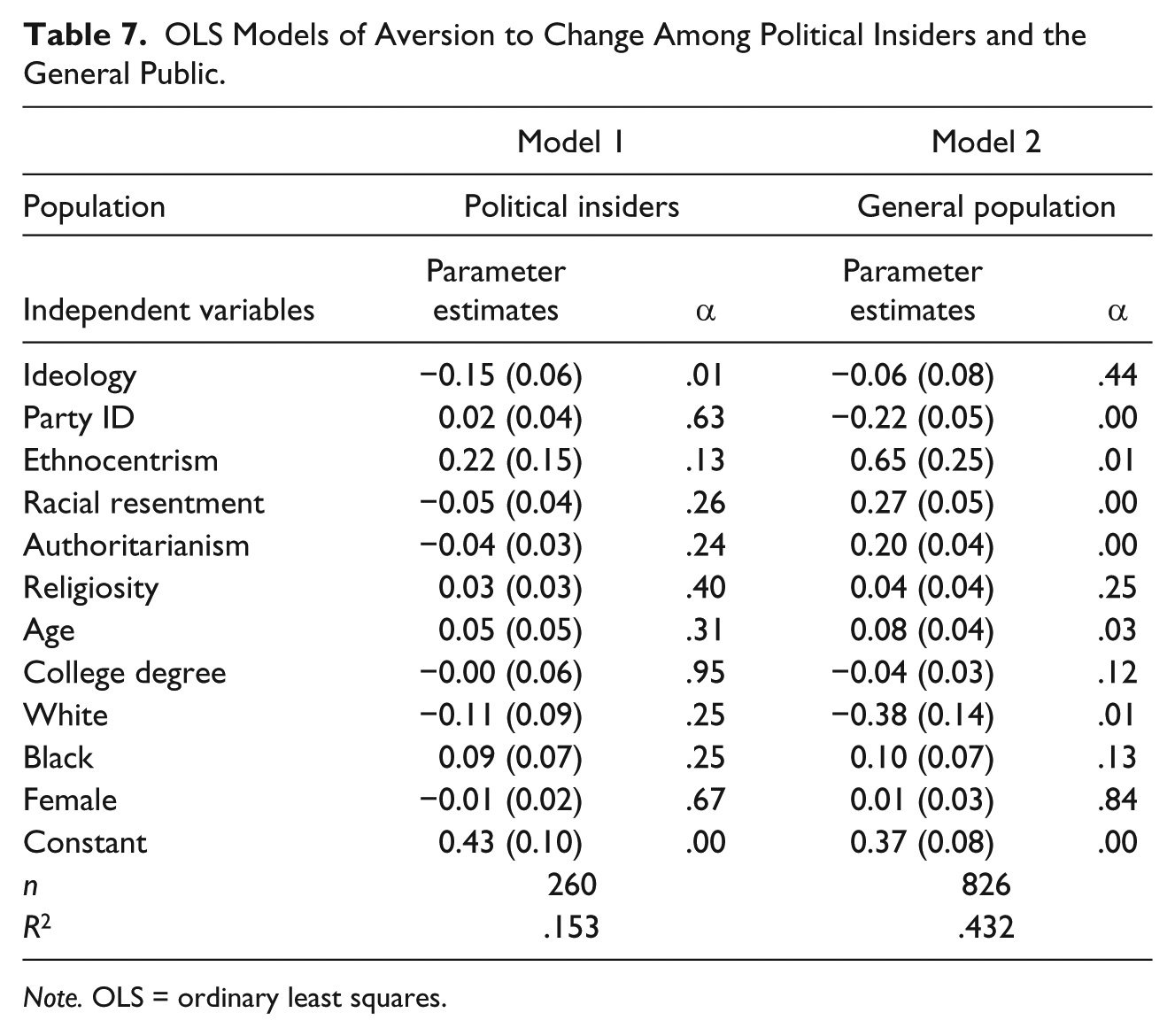
Note. OLS = ordinary least squares.
By leveraging these findings, we can flesh out the potential role of aversion to change if political insiders were subject to the same mechanisms as the public in determining these attitudes and their impact. We simulated the expected distribution of vote choice among insiders if the same factors that drove the general population also moved elites by the same magnitudes and directions. Specifically, we first used the equation from Table 7 Model 2, along with the observed values of the independent variables among political elites, to generate a simulated aversion to change variable that predicts each insider respondent’s attitude toward social change if it was determined the same way as for a member of the general population. Next, we plugged the simulated aversion to change variable into Model 2 from Table 4, along with the observed values of the rest of the independent variables among political elites, to generate simulated values of the dependent variable (vote preference). Table 8 reports the results of this simulation, along with the observed distribution of candidate support for insiders and the general population.
Simulated Distribution of Insider Trump Support With General Aversion to Change.
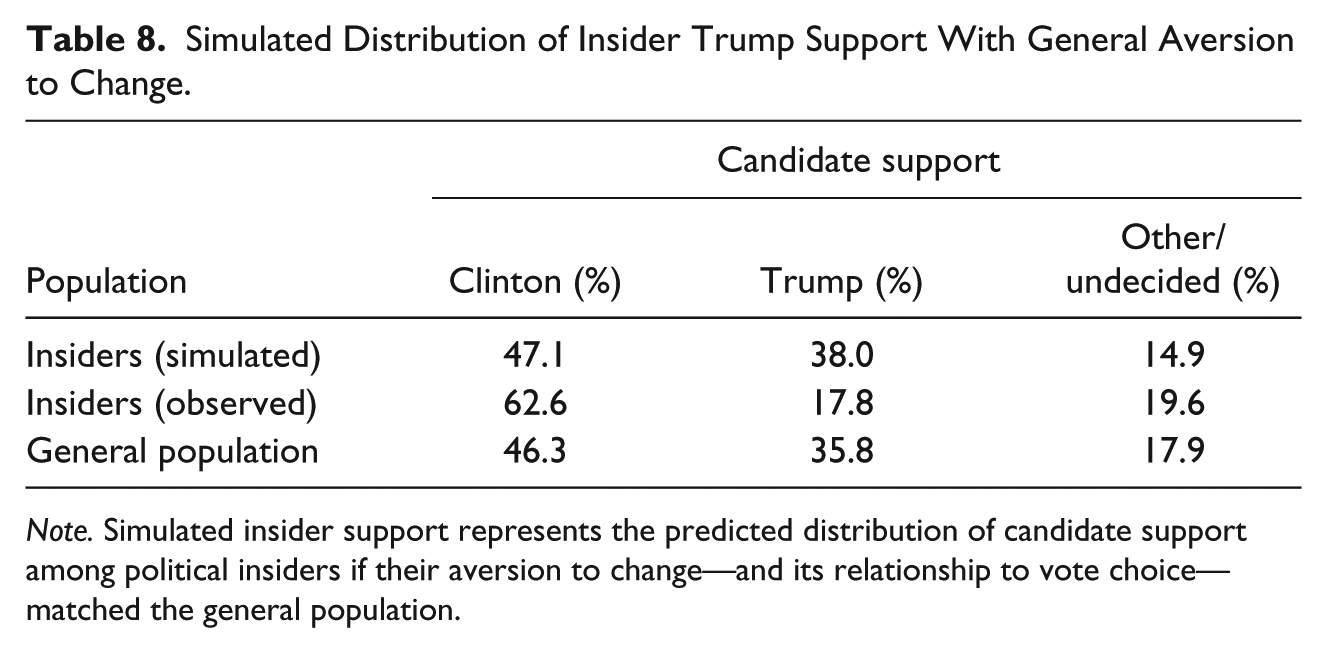
Note. Simulated insider support represents the predicted distribution of candidate support among political insiders if their aversion to change—and its relationship to vote choice—matched the general population.
The results show that mass–elite differences in the determinants and consequences of change-averse attitudes can help explain much of the difference in support for Trump between elites and the public. The observed insider population originally favored Clinton over Trump by a margin of 62.6%-17.8%. Simulating their predicted support using the determinants and impact of aversion to change apparent in the general population, the predicted margin drops to 47.1%-38.0%, which comes close to the observed margin of support among the general population (46.3%-35.8%). Aversion to change appears to be a key part of the explanation for mass–elite divides on views toward Trump.
Aversion to Change and Racial Resentment
Of course, aversion to change is related to other important attitudes that affect Trump support. In particular, it may be productively conceived of as a new component of the same underlying attitudes that produce racial resentment. Table 9 compares the Cronbach’s alpha scores for each of the two separate scales, along with one that combines the two into a single social–racial scale. The combined scale exhibits high consistency, and diagnostics show that aversion to change and racial resentment could indeed be modeled as the same underlying variable or dimension, even though they each predict vote preferences independently.
Reliability of Aversion to Change and Racial Resentment Scales.
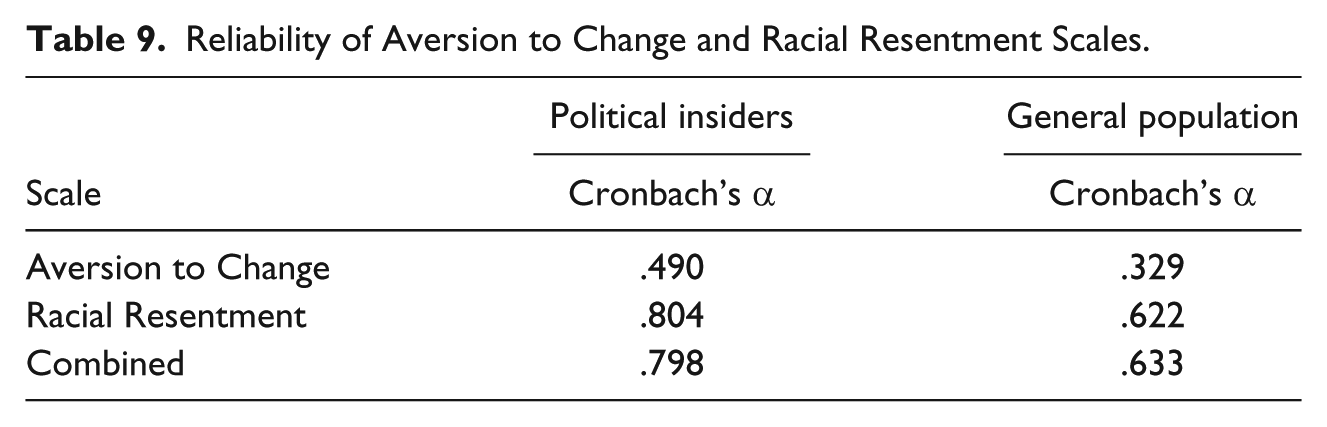
Table 10 returns to the vote choice models, but substitutes this combined scale of racial resentment and aversion to change in place of the two separate measures. The results confirm again that such attitudes have a significant effect on support for Trump versus Clinton. The combined scale shows more similarity in impact across the mass public and elites, suggesting that elites holding racially resentful views (though less numerous than those in the general population) might be similar to those holding change-averse views in the public. The versions of the model with the combined scale also show weaker relationships between voter preferences and ethnocentrism, partisanship, and ideology. The combined scale of social and racial views may thus better pick up some of the indirect effects of these variables.
Models of Vote Choice With Combined Racial Resentment/Aversion to Change Scale.
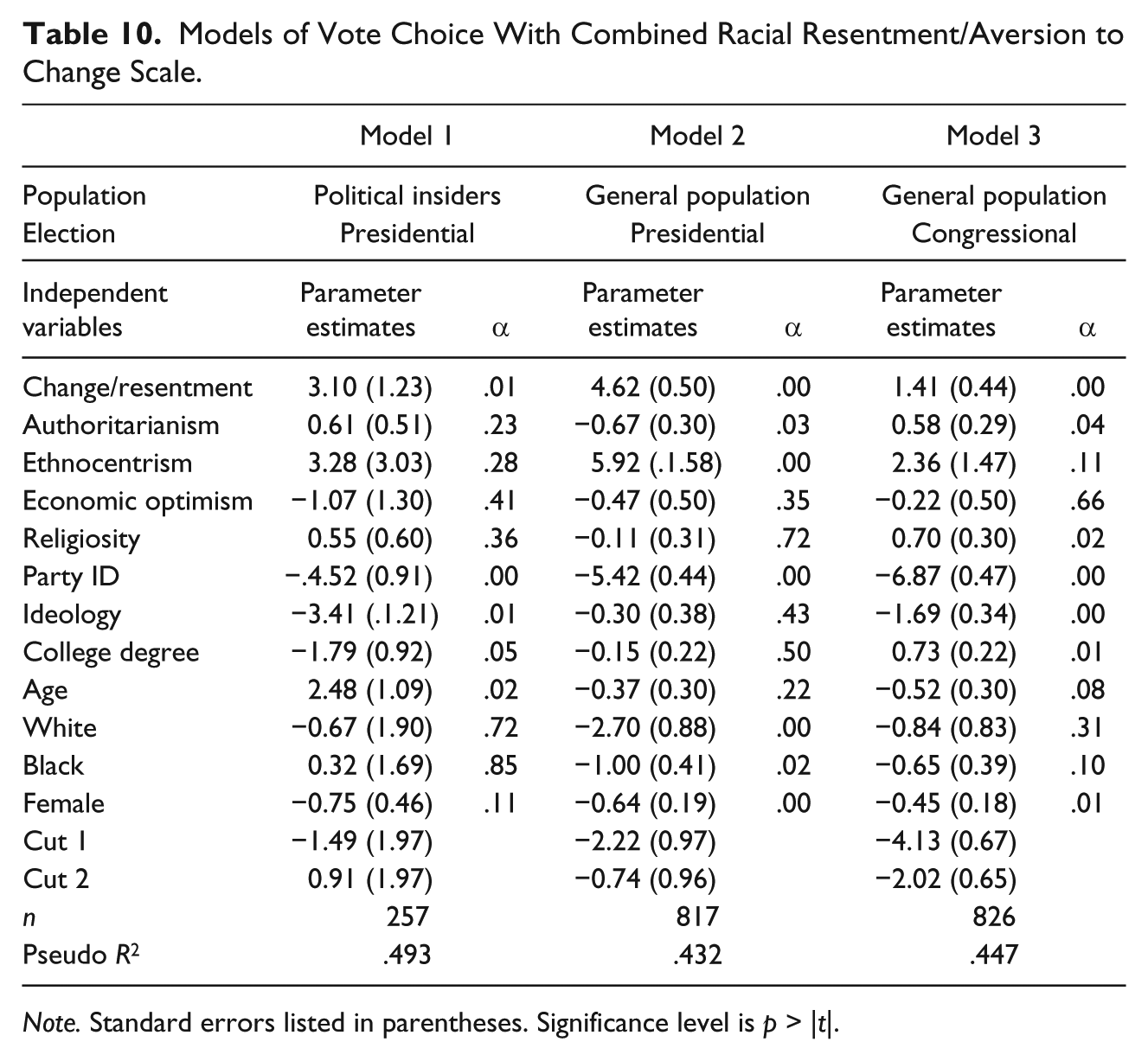
Note. Standard errors listed in parentheses. Significance level is p > |t|.
One plausible reading of our evidence is that aversion to change is part of a broader set of attitudes toward diversity that includes both African American–specific resentment and an uneasiness about social diversification more broadly. But each scale remains a strong and significant predictor of Trump support individually. Attitudes related to diversification and social change matter for vote choice, whether they are best conceived as a component of racial and social attitudes or as a distinct factor that can influence even those who lack negative attitudes about African American advancement.
There remain several theoretical reasons to treat aversion to change as a distinct concept: (a) It has long been part of the traditional composition of conservative values, (b) it is consistent with international left-right divides, and (c) it was specifically selected by both 2016 presidential campaigns as an important part of their messaging. Including aversion to change as a separate influence on vote choice can also help explain how Trump gained some racial minority support. A powerful advantage of our broader conceptualization is that it can explain the high levels of aversion to diversification even among racial minorities, including African Americans.
Understanding Partisan and Mass–Elite Divides in Support for Donald Trump
American society is quickly diversifying, with White Christians becoming a minority after a long period of demographic and cultural dominance (Jones, 2016). Technological and social change is also diversifying our lifestyles and values—along with our attitudes toward minority behaviors. These trends are important sources of political attitude change, with clear potential consequences for party polarization (McCarty, Poole, & Rosenthal 2006) and racial and social attitudes (Craig & Richeson, 2017; Major et al., 2016). Globalization, economic dislocation, and increasing cross-country migration is affecting politics worldwide, possibly causing a rise in right-wing populist backlash (Judis, 2016). Yet American social traditionalism has always had a unique character, with strong support and associations with conservative values despite no European feudal tradition. From the beginning, American social traditionalism has also been tied to racial attitudes, often associated with the South and sometimes used as a cover for cruder racial views.
Despite being widely seen as important context for the rise of Trump and the increasing racial and geographic polarization of the American party system, aversion to social change and diversification has not been a key factor investigated in models of Trump support. We are hopeful that the concept and measure we introduced here can be further developed and tested to see if it helps to explain both changes in voter support for the parties and the particular constituency that backed Trump in 2016 and remains key to his coalition.
The shock associated with the 2016 election’s results is hardly that a Republican won—or even that the parties are increasingly dividing based on attitudes toward diversity, further shifting the White working class in the upper Midwest toward Republicans. The unique aspect is that Trump won with so little elite support, with many Republican elected officials and party activists harboring doubts about him. Trump’s election is hardly the first manifestation of a deep divide between Republican supporters in the mass public and their governing leadership, but it highlighted the gulf in their views—especially on the importance of accepting the increasing minority population in the United States and continuing social upheaval. In many ways, the political elites want to accept and adjust to social change, whereas the Republican base wants to continue to fight it.
Our evidence, though hardly the final word on the determinants of Trump support or mass–elite divides, does codify some new and important lessons. First, the public is much more averse to social change and diversification than political elites, with an especially stark Republican divide (at least in one pivotal state). Second, aversion to social change is associated with support for Trump in 2016 and its low levels among political elites help explain Republican elite defections. The mass–elite differences are so large that simulating an elite population with the public’s same determinants of aversion to change and its same impact on voting explains most of the divide in support for Trump between elites and the public. Third, although these attitudes are related to racial resentment, ethnocentrism, ideology, partisanship, and authoritarianism, they have an independent role in driving political attitudes.
Of course, we were unable to measure and distinguish among all views that might correlate with aversion to social change and support for Trump. Future tests may want to include immigration attitudes (Abrajano & Hajnal, 2015), self-perception as moral standard bearer (Skitka & Mullen, 2002), or patriotism. Aversion to social change should also be distinguished from “core political values” like equal opportunity, traditional family values, and moral tolerance (Goren, 2005) and “moral foundations” such as values placed on individual harm and fairness over binding loyalty, authority, and sanctity (Haidt, 2012). Researchers could simultaneously measure notions of what it means to be an American (Feldman & Stenner, 1997), “collective narcissism” about the nation’s superiority and international threats to it (Federico & Golec de Zavala, 2018), or “cosmopolitanism,” such as willingness to try new foods and travel (Jackman & Vavreck, 2011). Aversion to social change could also be seen as part of a spectrum of personality types from “open” to “closed” (Johnston et al., 2017) that incorporates variables like “openness to new experience” (Gosling et al., 2003), openness to change versus conservation (Schwartz, 1992), general risk aversion (Kam, 2012), or need for cognitive closure (Pierro et al., 2002). The 2016 campaign context could also be compared against other perceived threats, which can enhance the impact of anxiety (Albertson & Gadarian, 2015) or social dominance orientation (Levin et al., 2002).
Like all models of vote choice conducted in the heat of an election campaign, we cannot be sure that any of these variables—including the aversion to change measure we introduce—are causally prior to other factors in determining the vote. Just as it could be that Trump fans adopted more racially resentful or ethnocentric views after their support for Trump was assured (even possibly by hearing it directly from Trump), it is possible that citizens learned that they perceived America as changing too fast or becoming too diverse as they adopted the views of politicians they already supported. But it is unlikely that the candidates were only shaping voter views, rather than responding to them. Many prior viewpoints related to attitudes toward social change, such as core political values, have been shown to be quite stable and “largely, though not entirely, immune to the influence of short-term political forces” like the rhetoric of particular candidates (Goren, 2005). Our findings suggest that several of these underlying views have crystalized into a broader set of attitudes toward social change and diversification, with their effects amplified by the current political context.
The Trump campaign began as a rebuttal to increasing immigration and the perceived evolution of “politically correct” values, melding the international positions and rhetoric of right-wing nativist parties with traditional American paleoconservatism (see Green, 2017; Hawley, 2016). The Clinton campaign likewise saw its best opening in a forthright championing of racial, religious, and sexual diversity well beyond any tried by presidential candidates heretofore—accompanied by a blistering ad campaign highlighting Trump’s insults against all kinds of minority groups (Allen & Parnes, 2017; Fowler, Ridout, & Franz, 2017). The candidates surely helped Americans along in their increasing divide on attitudes toward social change and diversity, but they were also reflecting the concerns of their supporters and the best perceived opportunities to persuade swing voters.
The qualitative literature on the political evolution of the White working class—the key pivotal constituency in 2016—suggests that these attitudes were there to exploit before Trump’s rise and are important in the evolution of the parties (Cramer, 2016; Gest, 2016; Hochschild, 2016). An enlarged role for attitudes toward social change also helps explain how Trump could consolidate mass Republican support alongside his smaller unique constituency, even while losing support from hundreds of elected officials in his own party and conservative movement regulars. The mass base of the Republican Party is conservative in self-identification and broad values but does not uniformly support the (mostly economic) policy positions of its congressional leadership (Grossmann & Hopkins, 2016). Trump won over religious, nationalistic, and small government conservatives in the public without touting many of the elite positions often assumed to be their priorities. He did so by “yelling Stop” at the increasingly diversifying society they are encountering and the threats to traditions they perceive, promising to return us to a “great” American yesteryear.
Footnotes
Declaration of Conflicting Interests
The author(s) declared no potential conflicts of interest with respect to the research, authorship, and/or publication of this article.
Funding
The author(s) received no financial support for the research, authorship, and/or publication of this article.