



Abstract
When presented the choice between a male and female candidate, it is commonly assumed that women prefer a female candidate. But as more policy and ideologically diverse women run for office, this assumption may not hold true. Using an experimental design embedded in a nationally representative survey, I test how voters respond to female candidates with ideologies and abortion positions similar and contrary to their own preferences. I find that women, generally, prefer a female candidate, but support for a female candidate among women decreases significantly when she has a contrary ideology or policy position. Whether women prefer descriptive or substantive representation also is conditioned on individual-level characteristics. This study advances our understanding of voters’ responses to female candidates’ varying ideological and issue positions, which is increasingly important as more women run for office. Although women are more likely than men to give female candidates the benefit of the doubt, not just any female candidate will do—she needs to appeal to women on issue and ideological grounds too.
Disparaging Hillary Clinton as a presidential candidate, Donald Trump declared, “The only thing she’s got going is the woman’s card,” backhandedly assuming that running as a woman benefits her as a candidate. In response, Clinton’s campaign began selling woman cards, calling attention to Clinton’s advocacy of women’s issues. Throughout the 2016 presidential campaign, Clinton highlighted her experiences as a woman in the workplace and politics, and focused on issues particularly relevant to women, including paid family leave, health care, and equal pay. Indeed, headlines claimed, “Hillary Clinton 2016 strategy revealed: I’m a woman, vote for me” (Schow, 2015), which beg the following question: Is it a winning strategy and are women more likely to vote for female candidates? Political pundits presumed female voters would inevitably support Hillary Clinton in the 2016 presidential election (Walsh, 2015), and when polls revealed that women did not uniformly support Clinton, much ink was spilled asking why women did not support a female candidate for president.
1
By asking why women would not support a female candidate, researchers, the media, and political pundits perpetuate the common assumption that women prefer a female candidate. Yet, this assumption is that all women voters employ a similar decision calculus in making their vote choice, and that all women candidates would be similar representatives. As Campbell and Heath (2017) conclude, Women do not react in a homogeneous way to the sex of the candidate, and the assumption that women are more likely to vote for women candidates is therefore too simplistic and assumes a uniformity of motivations for doing so that are not present in practice. (p. 228)
Moreover, not all women candidates are homogeneous in experience, quality, issue positions, or ideology, and there may be conflict for voters prioritizing between descriptive and substantive representation. What if the female candidate has an opposing ideology or issue position, making the female candidate a good choice for a woman in terms of descriptive representation but a poor choice in terms of substantive representation? Will women give the female candidate the benefit of the doubt and support her for non-policy reasons? Furthermore, many voters assume female candidates hold certain stereotypical issue positions and generally are more liberal and likely to be a Democrat (Herrnson, Lay, & Stokes, 2003; Huddy & Terkildsen, 1993; Koch, 2002; McDermott, 1997, 1998). But if a woman candidate holds a non-stereotypical policy position or ideology—as increasingly will be the case as more women run for office—sex no longer serves as a useful cue for voters. If sex is an inaccurate heuristic to determine a candidate’s policy preferences, will female voters nevertheless vote for a descriptive representative?
Thus, my research question is as follows:
In low-information environments, I expect women support female candidates at a higher rate than men—an expectation consistent with theories of descriptive representation. When presented with a female candidate with policy positions or ideologies contrary to their own, I hypothesize that women’s support for the female candidate will decrease but will remain higher than support among men, indicating that women weigh both descriptive and substantive representation. Furthermore, I show that women’s responses to a female with contrary ideology and issue positions vary based on individual-level characteristics. I use a nationally representative survey experiment during the 2014 congressional elections to test these expectations. The experimental design presents participants with a female candidate whose position on abortion and ideology vary based on participants’ reported abortion opinion, ideology, and to which treatment group participants are randomized. I find that relative to men, women are more likely to discount contrary ideology and issue positions by expressing support for a female candidate. However, although women’s support for a female candidate is higher compared with men, women’s support for a female candidate with contrary policy preferences is lower than support for a female candidate with similar policy preferences. These results imply that although women often give female candidates the benefit of the doubt with support, female candidates may not automatically win women’s vote.
Descriptive Representation and Gender Affinity
There are multiple reasons to expect women prefer a female candidate, including gender identity voting, women’s issues representation, and general preference for descriptive representation. First, the alignment of a voter’s and a candidate’s sex influences vote choice among women, perhaps because gender identity creates a sense of group solidarity among women (Plutzer & Zipp, 1996). Second, certain political issues, such as abortion, education, health care, and welfare, frequently are referred to as “women’s issues,” and voters assume women are more likely—and best suited—to address these issues (e.g., Herrnson et al., 2003; Huddy & Terkildsen, 1993; Paolino, 1995). Furthermore, voters typically assume female candidates are more liberal compared with their male counterparts and may use gender as an informational cue, particularly in low-information elections (McDermott, 1997). If women voters believe women’s issues are important, women may support a female candidate who they assume is more likely and better suited to address women’s issues.
Classic theories of descriptive representation assume that women, as a historically disadvantaged group, would be best represented by a woman because female representatives are more likely to better represent women as a group in terms of policy priorities and activities (e.g., Mansbridge, 1999; Pitkin, 1967). Better representation of women as a group would include providing group solidarity, having shared experiences, and prioritizing and addressing issues particularly important to women. Descriptive representation of women may be considered important and normatively desirable for multiple reasons including, but not limited to, female representatives increasing political empowerment and participation among women, addressing and prioritizing policy issues male representatives may attend to less, and bringing new perspectives and interests to the political arena (Phillips, 1998). Indeed, analysis of legislative activity shows (a) women legislators are more likely to sponsor or cosponsor legislation on women’s issues, for example, children and family, women’s health, reproductive health, and education (Swers, 2005), (b) women legislators use their gender to influence debate on women’s issues (Swers, 2013), (c) women legislators with more power within legislatures (e.g., committee chairs and party leaders) are more active on women’s issues (Swers, 2005), although they have a difficult time leading on men’s issues such as defense (Swers, 2013), (d) gender influences votes specifically related to women’s issues (Swers, 1998, 2002), and (e) female legislators and high levels of female cosponsorship yield more state investment in women’s issues (Wittmer & Bouche, 2013). Furthermore, evidence from the U.S. congress and state legislatures points to a link between descriptive and substantive representation. Using an experimental design, Mendelberg, Karpowitz, and Goedert (2014) demonstrate the importance of women representatives in majority rule systems, finding that under majority rule systems women are more likely to discuss women-specific issues only when they are in the gender majority, and discuss women’s issues less when they are in the minority gender-wise. Mendelberg et al. (2014) conclude that when women are in the minority in majority rule systems—a gender ratio and decision rule that characterize many U.S. governmental bodies—women’s issues may not be discussed. Looking at the question of descriptive representation accountability, Jones (2014) demonstrates that female constituents hold women representatives accountable for their activities in office, implying that descriptive representation increases electoral accountability. Despite these normatively desirable benefits of women representatives, women are underrepresented at all levels of U.S. government: women comprise only 19.8% of the U.S. Congress, 22.8% of statewide executive seats, 25.3% of state legislatures, and 20% of mayoral seats in the nation’s 100 largest cities (Center for American Women and Politics, 2018a). Underrepresentation of women may manifest itself, for example, as male representatives—or too few female representatives—unwilling to prioritize women’s issues, representatives unfamiliar with, or unsympathetic to, women’s shared experiences, and/or representatives unable to address women’s issues in ways friendly to women’s needs and priorities. Given the lack of female representation relative to the general female population, women concerned with this lack of representation likely prefer a female candidate over a male candidate.
What If Descriptive and Substantive Representation Conflict?
There are multiple reasons why women may prefer female candidates, and there is evidence showing that women are more likely than men to support female candidates. 2 For example, Sanbonmatsu (2002) shows that women have a general baseline preference for female candidates over male candidates. Dolan (2008) finds that women have higher affect toward women candidates, and this affect for women candidates influences vote choice. Looking at U.S. congressional and state legislative female candidates’ success rates, Herrnson et al. (2003) conclude that female candidates are more successful when they emphasize women’s issues and target women voters, implying that voters desire representation of women’s issues and that female candidates appeal to women. Brians (2005) concludes that women candidates gain more support from women, and that Republican women voters are more likely to cross party lines and vote for a Democratic female candidate. Therefore, assuming a gender affinity effect, I expect that compared with men, a higher percentage of women support a female candidate in low-information elections.
However, support for a female candidate among women is not blind and does not occur in a vacuum—women consider other factors in addition to a candidate’s sex, and female candidates run in the context of a political campaign where there are many other dynamics at play. Indeed, using evidence from the 1992 Senate elections, Paolino (1995) concludes, “women did not vote for female Senate candidates simply because of their gender” (p. 300). Rather, Paolino (1995) contends that women voted for female Senate candidates because of issues related to women’s interests and the perception that female candidates are better suited to address women’s issues. Consistent with Paolino’s (1995) finding related to female candidates, more generally, we know that candidate’s issue positions and ideologies matter in voters’ decision-making processes (e.g., Abramowitz, 1995; Carmines & Stimson, 1980; Goren, 1997; Herrnson & Curry, 2011; Wright, 1978). If a female voter sees a female candidate with an ideology and issue positions similar to her own preferences, this female candidate will be electorally appealing. Regardless of whether she supports the candidate for her shared gender identity, a desire for descriptive representation, or her issue and ideological preferences, voting for this female candidate will have high rewards and I expect women’s support for this female candidate to be high.
But what if a female candidate does not share a woman voter’s ideology or policy positions? If women desire descriptive representation but also choose candidates based on candidates’ policy positions, would a woman voter support a female candidate with issue positions or ideology contrary to her preferences? In other words, would a woman voter support a female candidate based on her sex or oppose a female candidate based on her issue position or ideology? This conundrum may become especially acute if the issue in question is a stereotypical women’s issue, such as abortion. If a female voter considers a female candidate with a position on abortion contrary to her own, she may think twice about whether supporting this female candidate provides the descriptive representation she seeks. Given that voters typically consider abortion a women’s issue (e.g., Herrnson et al., 2003; Huddy & Terkildsen, 1993; Paolino, 1995), seeing a female candidate with an abortion opinion different from her own may cause her to question whether the female candidate would advance her own interests as a woman. I hypothesize as folllows:
Beyond ideology or issue position, Hypothesis 1 speaks to research examining the salience of gender stereotypes (related to descriptive representation) and party identification (related to substantive representation). While gender stereotypes may not be as influential as party cues (e.g., Hayes, 2011) and may not significantly prevent women candidates’ electoral success (e.g., Dolan, 2014b), gender stereotypes influence voting for female Democratic and Republican candidates differently. For example, Dolan and Lynch (2014) find gender stereotypes are related to voting for Republican female candidates, but not Democratic female candidates. A female Republican candidate may provide conflicting gender stereotypes and party stereotypes, and in this conflict between descriptive representation (gender stereotypes) and substantive representation (party stereotypes), sex of both the candidate and voter likely play a role. Although gender stereotypes are present within both major parties (e.g., Sanbonmatsu & Dolan, 2009), stereotypes of women being more liberal and competent on women’s issues benefits Democratic female candidates while hindering Republican female candidates (e.g., Sanbonmatsu & Dolan, 2009)—a finding consistent with Hypothesis 1. While women may be stereotyped as more liberal and pro-choice, not all female candidates fit this stereotype. If a female candidate does not “fit” preconceived notions of women in terms of ideology or issue positions, I expect women respond as expected by Hypothesis 1. In evaluating a conservative female candidate, liberal women will not support her (lower support for female candidate with contrary ideology), yet conservative women will (higher support for female candidate with similar ideology).
While I do not expect women to give a female candidate with an ideology or issue position contrary to her own the benefit of the doubt with high support, I do expect her support for a female candidate to be higher than men’s support. Comparing support for a female candidate among men versus women, I expect support for a female candidate with contrary ideology or issue positions to be higher among women voters than men voters. Without receiving the benefits of either descriptive or substantive representation, I expect support for the female candidate who has contrary issue and ideology opinions to be very low among men. Although they may not receive the benefit of substantive representation, women voters still receive the benefits from descriptive representation, and therefore still may support the female candidate at a higher rate than men.
Thinking of our previous question of whether women would support a female candidate with issue positions or ideology contrary to her preferences, even though women may desire a female representative, I expect the answer is no—women will not support a female candidate if she does not provide substantive representation. However, I qualify this answer by pointing out women’s support for a female candidate, regardless of the candidate’s ideology or issue position, may be higher than men’s support for the female candidate. Thus, I expect to see support for both substantive and descriptive representation among women, although more evidence leaning toward substantive representation preferences. Furthermore, as with support for any political candidate, I expect support for a female candidate will vary based on voter’s individual characteristics.
Survey Experiment Design and Analysis
To test this hypothesis, I need to vary the issue position and ideology of a female candidate. Given that these variations would be practically impossible with real candidates, I employ an online survey experiment presenting participants with a fictional female candidate whose issue position and ideology vary based on to which treatment group participants are randomly assigned. The survey experiment was run through the 2014 Cooperative Congressional Election Study (CCES), administered by YouGov/Polimetrix. The CCES includes common content asked of all participants and modules designed by individual researchers. This survey experiment was contained in one of the modules and includes 1,000 participants. 3 The survey was administered online in the fall of 2014 and consists of two waves: one pre- and one post-2014 midterm elections.
In the common content, participants were asked their ideology, their opinion on abortion, and demographic questions. For ideology, respondents placed themselves on a 7-point scale ranging from 1 = “very liberal” to 7 = “very conservative.” Respondents were asked five questions related to their abortion opinion. My survey experiment uses respondents’ reported opinion on the following policy: “Always allow a woman to obtain an abortion as a matter of choice.” Respondents were presented a dichotomous option, either “for” or “against” this proposed policy. I use participants’ abortion position for both substantive and logistical reasons. Substantively, issues of reproductive rights typically are considered women’s issues (e.g., Herrnson et al., 2003; Huddy & Terkildsen, 1993), and female politicians of both parties are generally perceived as more likely to oppose abortion restrictions (e.g., Sanbonmatsu & Dolan, 2009). Participants likely have stereotypical views of where a female candidate stands on abortion, and females are perceived as more competent in handling reproductive policies, regardless of a candidate’s party affiliation (e.g., Sanbonmatsu & Dolan, 2009). 4 Logistically, knowing participants’ dichotomous view of an issue from the common content—which is previous to, and separate from, the experimental treatment—is key for my experimental design. Identifying participants’ abortion opinion and ideology well before the treatment, and separate from the treatment, is important for assessing how issue positions and ideology affect candidate evaluations. The common content also provides information on respondents’ sex, partisanship, and education, which I use in this analysis.
Survey experiment participants were presented with a fictional female candidate running for the U.S. House. 5 The candidate is presented as running in a competitive open district near the participant. Participants were told they were randomly selected to see information on one of the two candidates in the race, and that the information was randomly assigned to be the candidate’s ideology and/or the candidate’s position on one of seven randomly selected issues (see Appendix for exact experimental prompt wording). Depending on the treatment group to which the participant was randomly assigned, participants saw the candidate’s position on abortion, ideology, or both. The candidate is identified as “Candidate A,” and the candidate’s sex is identified by referring to the candidate as “she.”
Based on a participant’s reported ideology and opinion on abortion, I vary the fictional female candidate’s abortion position and ideology to be the same or opposite as the participant’s, depending on the treatment group. Participants were randomized into one of six groups. Each group varied whether the participant saw the female candidate with the same ideology, different ideology, same abortion opinion, different abortion opinion, or a combination of ideology and abortion opinion. Here, “same” indicates the same ideology or abortion opinion as reported by the participant; “different” indicates an opposite ideology or abortion opinion from what the participant reported. 6
Experimental Treatment Groups
Group 1: Same ideology, same abortion opinion,
Group 2: Same ideology, different abortion opinion,
Group 3: Same ideology, no abortion opinion,
Group 4: Different ideology, no abortion opinion,
Group 5: Different ideology, different abortion opinion,
Group 6: Different ideology, same abortion opinion.
After seeing information on the candidate, participants were asked whether they would support or oppose the candidate’s bid for a U.S. House seat, and they were asked to rate their support or opposition on a 6-point scale ranging from “support very strongly” to “oppose very strongly” with an “unsure” option available. Post-treatment questions asked participants why they supported or opposed the candidate, their baseline gender preference for elected officials, how important descriptive representation is for a healthy democracy, whether female underrepresentation is problematic, and how important the issue of abortion is to them personally. Participants also were asked several questions to construct a gender ideology scale. 7 In the post-election survey, participants were asked whether males or females would do a better job handling a variety of issues and which abortion position they would expect a woman in congress to have.
My hypothesis, experimental design, and analysis focus specifically on individuals’ tradeoffs between sex (descriptive representation) and issue or ideology considerations (substantive representation). Party identification certainly plays a role in female candidate evaluation (e.g., Dolan, 2014a), and literature related to women in politics has addressed the role of party extensively. This research design contributes to our current body of knowledge by focusing specifically on the impact of ideology and issue positions without confusing or complicating results by explicitly introducing partisanship, and allowing a more full understanding of the influence of ideology and policy. Even studies including measures of both partisanship and ideology find ideology plays a role in vote choice and candidate evaluation (e.g., Brians, 2005, Table 3; Dolan, 2008, Table 5; McDermott, 1997), and it is worth exploring this role of ideology more thoroughly. Most importantly, understanding the impact of ideology and issue positions is particularly important in races where partisanship is constant: primary elections, nonpartisan elections, and places with top-two primary elections (such as in California and Washington state) where both candidates may have the same party affiliation. This design helps answer questions of how voters choose when they do not have a party identification cue, and how voters respond when they see conflicting cues. Granted, by omitting partisanship from the decision calculus in this experiment, results presented here may be ceiling effects. Nevertheless, these results have implications for candidate strategy (which messaging may work best among women, which items a campaign should focus more or less on) and for races where partisanship is not an available or useful heuristic.
The experimental design allows for several important comparisons:
Between groups that have the same ideology but different issue positions to estimate the effect of abortion opinion (comparing Groups 1, 2, and 3; comparing Groups 4, 5, and 6),
Between groups that have the same issue position but different ideologies to estimate the effect of ideology (comparing Groups 1 and 6; comparing Groups 2 and 5; comparing Groups 3 and 4),
Between male and female participants.
These comparisons allow me to test Hypothesis 1 using difference in means of t tests. I employ logistic regression analysis to further test my expectations, including control variables for individual characteristics. The dependent variables in my logistic regressions are dichotomous indicators for whether a participant’s support for the candidate is consistent with his or her reported ideology or reported abortion opinion. Ideologically consistent support is coded 1 if the participant’s support is consistent with his or her ideology, and 0 otherwise. If a respondent is in a same ideology group (Groups 1, 2, or 3) and supports the candidate, or in a different ideology group (Groups 4, 5, or 6) and opposes the candidate, they are coded 1 on the ideologically consistent variable. Similarly, issue consistent support is coded 1 if the participant’s support is consistent with his or her opinion on abortion, and 0 otherwise. Participants are coded 1 on the issue consistent variable if they are in a same abortion opinion group (Groups 1 and 6) and support the candidate or if they are in a different abortion opinion group (Groups 2 and 5) and oppose the candidate.
Independent variables in the logistic regression models include ideology extremity, abortion opinion, importance of abortion issue, baseline preference for female elected officials, gender ideology, party identification, and education. I control for these items because I expect support for a female candidate varies by these individual-level characteristics. Furthermore, I expect these individual-level characteristics condition candidate support among women differently than men, so I use separate logistic regression models for males and females. 8 Contrary to women, men who see a female candidate with opposing ideology or policy positions would receive neither substantive nor descriptive representation benefits for supporting the female candidate. For men, there is no conundrum over whether to support the female candidate or not—I expect they will vote based on ideology and issue positions because a female representative offers no explicit benefit for men as a group (granted, there may be men who see benefits of a female representative and may consider gender in their vote choice). Unlike women, I do not expect men’s support for the female candidate to be conditioned on individual characteristics such as gender ideology, baseline preference for female candidates, or ideological extremity.
I anticipate individual characteristics play a larger role in women’s support for female candidates than men’s support. First, women with more ideologically extreme positions will be more likely to express support consistent with their ideological preferences. Women with more extreme ideological leanings likely weigh ideology as important in their vote choice decision, and therefore are less likely to see the benefits of a descriptive representative outweighing the detriments of a candidate with a contrary ideology. Ideological extremity is a dichotomous variable coded 1 for respondents who identified their ideology as either “very conservative” or “very liberal,” and 0 otherwise. 9
Similarly, women who rate abortion as an important issue are more likely to vote consistent with their abortion opinion preference. Thus, when presented with a female candidate whose abortion opinion is contrary to their own, women who rate abortion as very important are more likely to oppose the female candidate—they see more disadvantages of no substantive representation outweighing advantages of descriptive representation. Importance of the abortion issue is coded 1 for participants who think abortion is a very or extremely important issue, and 0 for those who think abortion is a somewhat or less important issue. 10 Abortion opinion is coded 1 for participants who favor always allowing a woman to obtain an abortion as a matter of choice, and 0 for those who oppose this policy. 11
Next, women who express a baseline support for women representatives are more likely to weigh a female candidate’s sex more heavily and support the candidate even if she holds contrary ideological or abortion positions. Women who explicitly express a preference for descriptive representation may discount a female candidate’s contrary ideological or issue positions, supporting the female candidate unconditionally. This expectation is consistent with Campbell and Heath (2017), who find that descriptive representation supporting women were more likely to vote for the party with a female candidate in the 2010 British election—although they note that this effect is small because relatively few women voted solely based on candidate sex rather than party. Baseline preference for female elected officials is coded 1 for respondents who reported they would be more inclined to vote for a woman than a man if both were equally qualified candidates, and 0 for those preferring a man. 12
Gender ideology refers to how an individual views the division of labor between men and women inside and outside the home. Seven questions, including those asking about the effects on children if mothers work outside the home, how to split up household tasks between husbands and wives, and how much independence to encourage in daughters, are used to construct a gender ideology scale. 13 The scale’s Cronbach’s alpha is .789 and scale reliability is .808, indicating an acceptable level of scale reliability. The scale is recoded to range from 0 to 1, with 1 indicating an individual having a less traditional gender ideology and believing in more gender equality. 14
Finally, I include controls for party affiliation and education. Party identification is a 7-point scale ranging from 1 = “strong democrat” to 7 = “strong republican.” I include a control for education to account for individuals with higher levels of education being more likely to use ideology and issue positions to evaluate the candidate (e.g., Goren, 1997; Shor & Rogowski, 2018; Sniderman, Brody, & Tetlock, 1993; Sniderman, Glaser, & Griffin, 1990). Education is measured on a 6-point scale ranging from 1 = “no high school” to 6 = “post-graduate education.”
Results
First, I present descriptive statistics comparing men’s and women’s opinions on descriptive representation issues, establishing significant variation by sex in responses to survey questions related to descriptive representation and women in office. Then, I analyze the experimental data to test my hypothesis, first with difference of means t tests and then with logistic regression. I find that women’s support for a female candidate with contrary ideology or issue position is lower than support for a female candidate with similar ideology or issue position. Yet, compared with men, women support female candidates at a higher rate, even if the female candidate has an ideology or abortion position opposite her own. When the candidate’s ideology or position is in conflict with women’s ideology or abortion opinion, however, which women vote contrary to their ideology or issue position varies by individual characteristics such as abortion opinion, abortion issue importance, baseline female candidate preference, and gender ideology.
When it comes to descriptive representation and opinions on women in office, there are significant differences of opinion between men and women in this survey. Figure 1 displays three key variations between men and women when it comes to questions of descriptive representation. First, after information that women are underrepresented in government is presented (see Appendix for exact question wording), a significantly higher percentage of women (52.6%) compared with men (30.3%) reported that this underrepresentation was a major problem or the most important problem for democratic institutions. Second, when asked how important descriptive representation is for a healthy democracy, 50.6% of women compared with just 44.5% of men reported that descriptive representation was somewhat, very, or extremely important (see Appendix for exact question wording). Finally, an overwhelming majority of women (71.6%) are inclined to vote for a female candidate if equally qualified male and female candidates are running for office (see Appendix for exact question wording). 15 In contrast, only 33.4% of men prefer a female candidate to a male candidate. Each of these differences between men and women is statistically significant (p < .05 for a one-tailed test). 16 This baseline preference for female candidates among women is positive support for descriptive representation. Taken together, it is clear that compared with men, a higher percentage of women believe a lack of female representation in government is a major problem, think descriptive representation is important, and have a baseline preference for female candidates. Opinion on abortion and the importance of the abortion issue also is key for this analysis. Opinions related to abortion, again, vary by sex with a significantly higher percentage of women than men favoring abortion as a matter of choice and reporting the issue of abortion as important to them. 17
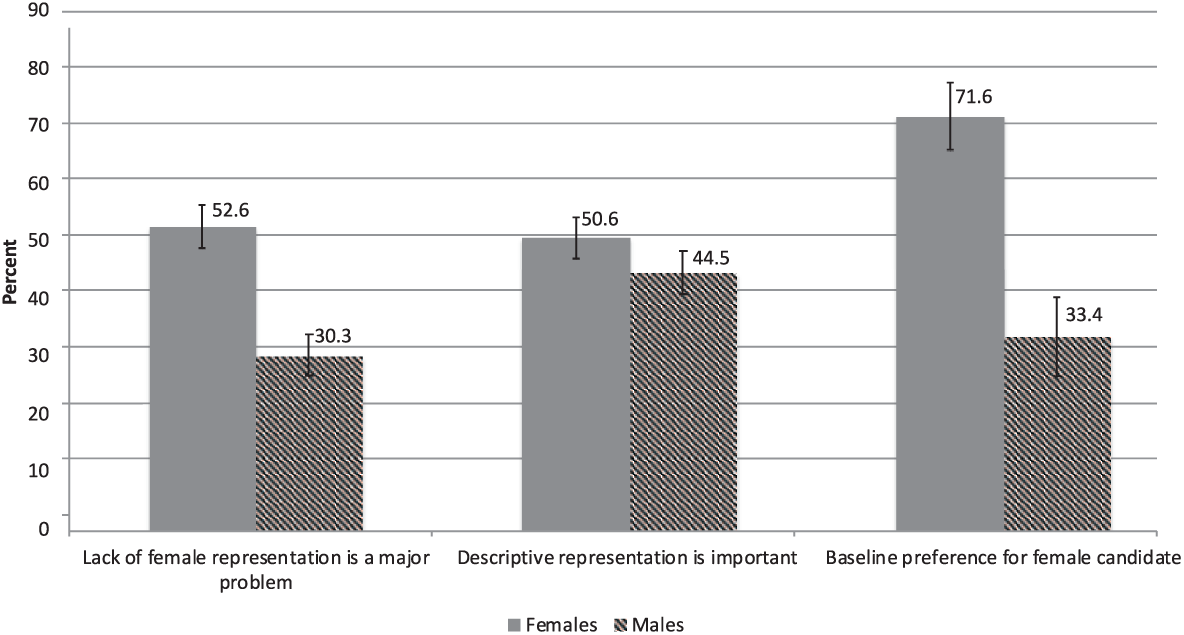
Figure plots opinions on descriptive representation and women in office as reported by males and females in the sample.
Turning to results from the experimental design, Figure 2 plots the percent of males and females in each treatment group who report supporting the female candidate’s bid for a U.S. House seat. As expected, support for the female candidate varies systematically by treatment group. Support is high when the candidate has an ideology and/or abortion opinion similar to participants’ (Groups 1, 3, and 6), and it is highest (more than 90%) when the candidate has the same ideology and abortion opinion as participants’ (Group 1). Support is significantly lower when the candidate has an ideology and/or issue position contrary to participants’ (Groups 2, 4, and 5), and it is lowest when the candidate’s and participants’ ideologies and abortion opinions conflict (Group 5 on far right of Figure 2). Looking specifically at women’s support for the female candidate, it is clear that both ideology and position on abortion matter. Support for the candidate among women is high when the candidate has the same or no issue position (92.9% in Group 1 and 89.8% in Group 3), but support drops to just 43.4% (Group 2) when the candidate has a contrary position on abortion, even though the candidate’s ideology is similar to participants’. Support for the candidate also is low when the candidate has an opposite ideology with no position or an opposite issue position (29.6% and 16.7% in Groups 4 and 5, respectively), but jumps to well over a majority (79.4% in Group 6) when the candidate has the same position on abortion, even though she still has a different ideology from participants. These differences across treatment groups are statistically significant and point to the importance of a female candidate having a similar position on abortion for female participants.
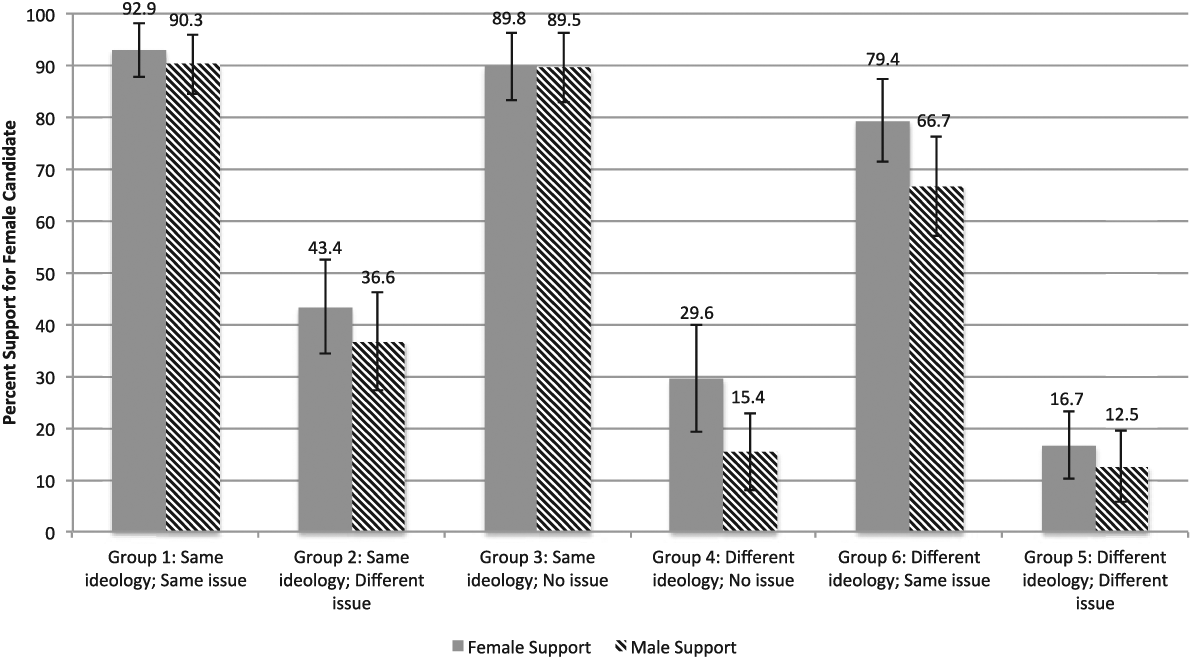
Figure plots support for the female candidate by treatment group for males and females in the sample.
We see a similarly dramatic change in support based on the candidate’s ideology. Among females, support for the candidate with a similar ideology is very high when the candidate has the same ideological leaning as the participant and no abortion position (89.8% in Group 3) but drops to just 29.6% (Group 4) when the candidate has an opposing ideology. Holding issue position constant with a contrary issue position, support for the candidate with the same ideology is significantly higher (43.4% in Group 2) among females than support for the candidate with different ideology (16.7% in Group 5). Comparing groups presented with a candidate with a similar abortion opinion, the effect of ideology is smaller (92.9% in Group 1 compared with 79.4% in Group 6) but still statistically significant. Each of these comparisons points to the importance of candidate’s ideology and abortion opinion relative to female participants’ ideology and abortion opinion—female participants used the candidate’s ideology and issue position in their decision to support the candidate or not.
Aggregating all groups together, support for the female candidate is significantly higher among females than males: 56.4% of females support the female candidate while 51.6% of males support the female candidate (p = .09 for a one-tailed test; see first columns in Figure 3). In the aggregate, there is evidence for descriptive representation: women support the female candidate at a higher rate than men. However, as seen in Figure 2, this difference by sex only holds when the female candidate’s ideology is contrary to participants’ ideology (Groups 4 and 6). When the female candidate has a different ideology from participants but no issue position presented (Group 4), a significantly higher percentage of females support the candidate compared with males (29.6% of females and 15.4% of males; p < .01 for a one-tailed test). While this very low percentage of support will not win an election for the female candidate, it is worth noting that support among females is higher than males. Even though the candidate has an ideology contrary to participants’ ideology, the female candidate receives a 14% boost of support from female participants compared with male participants. Female participants may give the female candidate the benefit of the doubt, assuming (given the very limited amount of information) that the female candidate may represent her in other non-ideological ways. Similarly, when the female candidate has a different ideology but the same opinion on abortion as participants (Group 6), 79.4% of female participants compared with 66.7% of male participants support the female candidate. Even though they see a candidate with an opposing ideology, a majority of participants support the female candidate—potentially a reflection of the importance of the abortion issue. Again, the difference between male and female participants is statistically significant (p < .01 for a one-tailed test), demonstrating that a higher percentage of females give the female candidate the benefit of the doubt, even when she has a contrary ideology. These differences between men and women provides some support for the expectation that compared with men, a higher rate of women support a female candidate with an opposing ideology. However, this effect is limited to ideology—the lack of statistically different percentages of support between men and women in groups with opposing issue positions indicates that women’s support for the female candidate is the same as male support when the candidate has an opposing issue position.
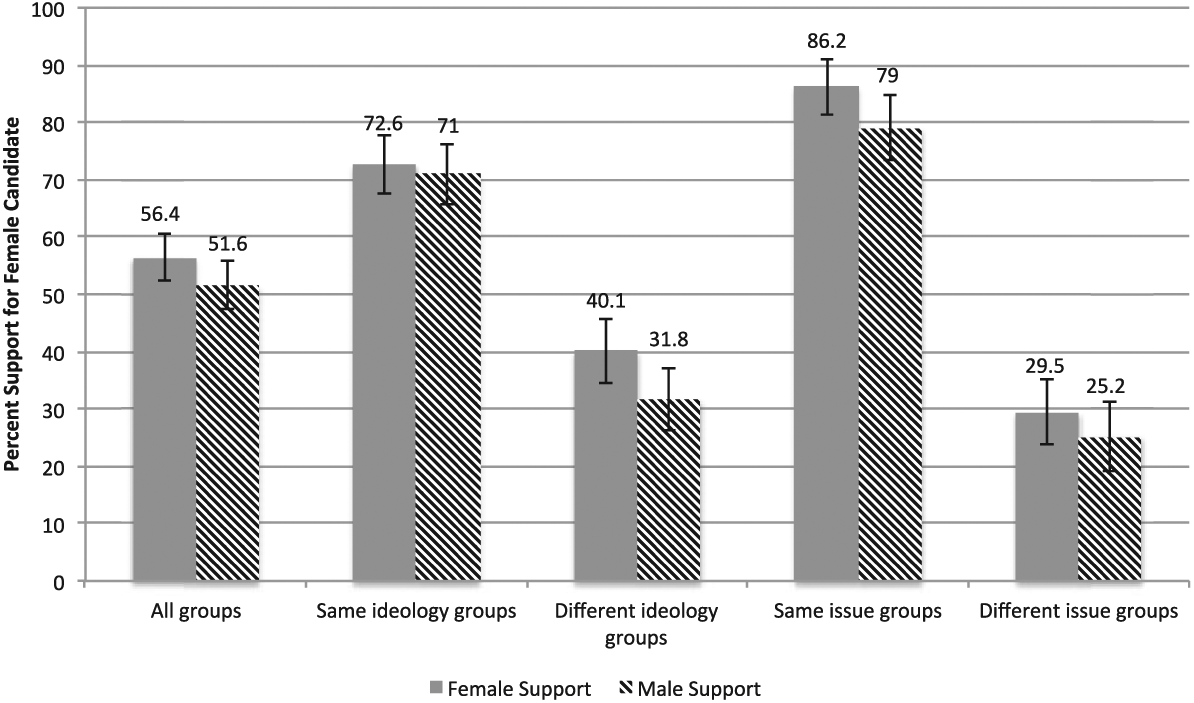
Figure plots support for the female candidate by treatment group for males and females in the sample.
Next, displayed in Figure 3, I combine treatment groups by whether the candidate has the same or different ideology or issue position as participants. Figure 3 again shows that support for the female candidate varies in predictable ways based on issue opinion and ideology. In groups where the candidate has the same ideology or same issue position as participants, support for the female candidate is above 70%. In contrast, in groups where the candidate has opposing ideology or issue positions compared with participants, support for the candidate is 40% or less. Clearly, the candidate is rewarded or punished for her ideology and position on abortion. Figure 3 provides clear support for Hypothesis 1: women’s support for a female candidate with contrary ideology or issue position is lower than women’s support for a female candidate with a similar ideology or issue position. Women’s support for a female candidate is 72.6% when they share ideological preferences, but support drops to just 40.1% when the female candidate has an opposing ideological position (p < .05 for a one-tailed test). Similarly, 86.2% of women support a female candidate who shares her opinion on abortion, but only 29.5% of women support a female candidate with a contrary abortion opinion (p < .05 for a one-tailed test). Although next we will see that support for a female candidate with contrary positions is higher among woman compared with men, a high percentage of women oppose a female candidate with a contrary ideology or abortion opinion. Women express more support for a female candidate providing descriptive and substantive representation, and significantly less support for a female candidate only providing descriptive representation.
Comparing men with women, only the different ideology groups and same issue groups have statistically significant variations across sex. Figure 3 shows that a statistically significant higher percentage of women (86.2%) compared with men (79%) support the female candidate when she has a similar abortion opinion, even if she has a contrary ideology (as she did for some participants in these aggregated groups). While a majority of both sexes support the female candidate with a similar abortion opinion, a significantly higher percentage of women (p = .06 for a one-tailed test) reward the candidate with support. Compared with men, women give the female candidate more of a boost in support when her position on abortion is similar to participants’. More interestingly, a significantly higher percentage of women (40.1%) than men (31.8%) give the female candidate support when the female candidate has a contrary ideology (p < .05 for a one-tailed test). Even though the female candidate has an ideology opposite to participants’, 9% more women than men report supporting her. When participants’ and the candidate’s ideologies conflict, women give the female candidate the benefit of the doubt with continued support. Women punish the female candidate less than men for holding an opposing ideology. This higher percentage support among women indicates women may support female candidates for reasons other than—or even regardless of—ideology.
One of the advantages of this experimental design is that the candidate’s ideology and position on abortion are catered to individual participants’ ideology and abortion opinion. Thus, an opposing abortion opinion or same ideology, depending on which treatment group a participant is randomized, is specific and unique to each participant. Thus, results are not specific to candidates of certain ideologies or abortion positions and instead are applicable to many types of female candidates. Nevertheless, we may be particularly interested in evaluations of “non-stereotypical” female candidates: a conservative female candidate and a pro-life female candidate, assuming women candidates are perceived as more liberal and more likely to hold pro-choice positions (e.g., Herrnson et al., 2003; Huddy & Terkildsen, 1993). Rather than compare across experimental groups or groups aggregated by ideology or issue position as in Figures 2 and 3, I can aggregate by whether participants saw a stereotypical or non-stereotypical female candidate. A female candidate who does not “fit” ideological stereotypes of female candidates (a conservative candidate) was presented to liberal participants in Groups 4, 5, and 6 (different ideology groups) and conservative participants in Groups 1, 2, and 3 (same ideology groups). A candidate who does not “fit” issue position assumptions of female candidates (a pro-life candidate) was presented to pro-choice candidates in Groups 2 and 5 (different issue groups) and pro-life candidates in Groups 1 and 6 (same issue groups).
Support for a female candidate who does not conform to assumptions of female candidates’ ideology or abortion positions are statistically significantly lower than female candidate aggregate support (54.1%) across all groups and types of candidates seen by participants. Percent support for a conservative female candidate is 48.7% (p = .06 for one-tailed test) and percent support for a pro-life female candidate is 42.9% (p = .00 for one-tailed test). As would be expected, a high percent of conservative participants support the conservative female candidate (68.6%), and a low percent of liberals (28.8%) support the conservative female candidate. Similarly, percent support for a pro-life female candidate is 68.3% among pro-life participants, and only 28.9% among pro-choice participants. Female candidates with non-stereotypical ideologies or abortion positions are punished by participants with opposing positions but rewarded by participants with similar positions. Both conservative and pro-life female candidates receive higher support from women relative to men, but the difference across sex is not statistically significant. Overall, examining support for candidates who do not fit stereotypes of female candidates, evidence supports Hypothesis 1. Consistent with results presented in Figures 2 and 3, support for female candidates with contrary ideology or issue positions are lower than support for candidates with similar ideology or issue positions, even if the female candidate presents conservative or pro-life (non-stereotypical) positions.
Returning to results based on differences across experimental treatment groups, Figure 4 changes the y-axis from percent support for the candidate to percent whose support is ideologically consistent and issue consistent. I consider candidate support ideologically consistent when a participant expresses support for the female candidate who has a similar ideological leanings as the participant and when a participant expresses opposition to the female candidate who has an opposing ideological leaning—participants in Groups 1, 2, and 3 who support the candidate and participants in Groups 4, 5, and 6 who oppose the candidate. Support is issue consistent when participants express support for the female candidate who has a similar position on abortion or express opposition to the female candidate who has a contrary abortion opinion—participants in Groups 1 and 6 who support the female candidate and participants in Groups 2 and 5 who oppose the candidate. I expect women in different ideology (issue) groups to have a lower rate of ideology (issue) consistent support than men. If women discount the female candidate’s opposing ideology (issue position) and support her for other reasons, then ideologically (issue) consistent support will be lower in groups where the female candidate has a contrary ideology (issue position).
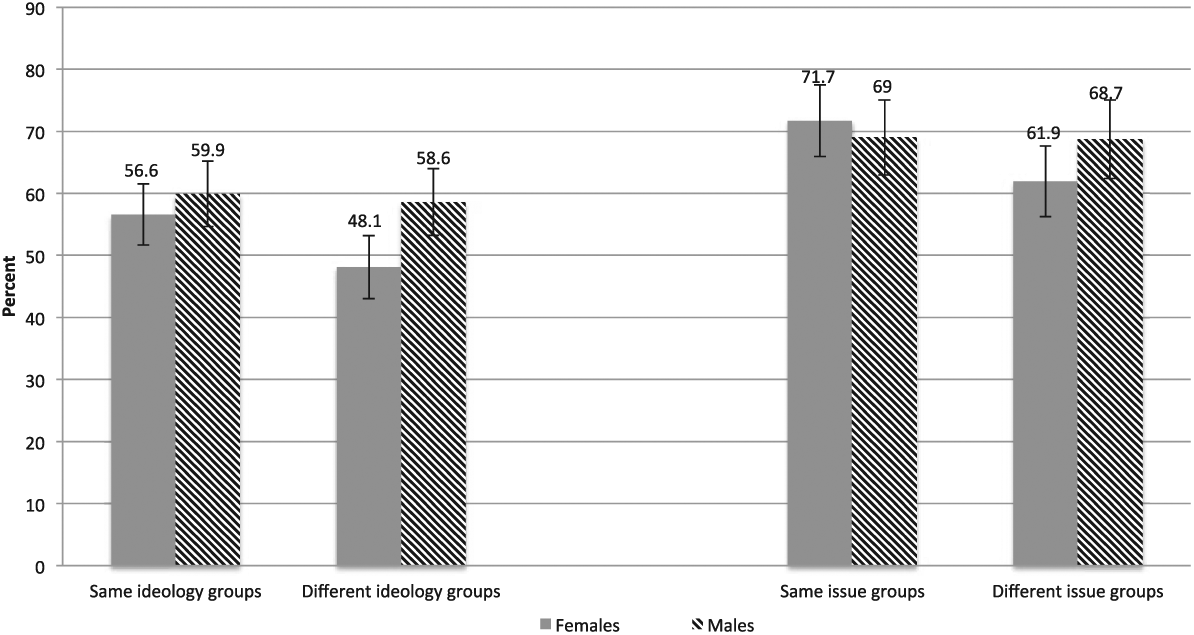
Figure plots percent ideologically consistent support (on left) and percent issue consistent support (on right) by treatment group for males and females in the sample.
As seen in Figure 4, compared with men, a significantly lower percentage of women express ideologically consistent support in different ideology groups (p < .05 for a one-tailed test). 18 Similarly, a significantly lower percentage of women express issue consistent support in different issue groups relative to men (p < .10 for a one-tailed test). When women see a female candidate with a contrary ideology or abortion opinion, they are more likely than men to support the female candidate, despite their issue or ideological differences. This evidence provides support for the expectation that compared with men, a higher rate of women support the female candidate, even when she holds an opposing ideology or issue position.
Comparing women in the same ideology groups to women in different ideology groups (Figure 4), a majority (56.6%) of women who see a female candidate with the same ideology express support consistent with their ideological preferences. But ideological support drops to 48.1% when women see a female candidate with contrary ideological preferences—a statistically significant decrease in ideologically consistent support (p < .05 for a one-tailed test). There is a similar pattern with issue consistent support: 71.7% of women in same issue groups express issue consistent support, while 61.9% of women in different issue groups express issue consistent support (a statistically significant decrease at p < .10 for a one-tailed test). These comparisons show that women do not blindly support female candidates. Rather, substantive representation matters too: support for a female candidate with contrary ideologies and issue positions is lower among women than support for a female candidate with similar ideologies and issue positions (evidence supporting Hypothesis 1).
To test whether individual-level characteristics moderate the extent to which participants support a female candidate, I employ logistic regression run separately for women and men with ideologically consistent support and issue consistent support as the dependent variables. For the ideologically consistent support models, the analysis is limited to groups presented with a female candidate whose ideology is contrary to the participants’ reported ideology (Groups 4, 5, and 6). For the issue consistent support models, the analysis is limited to groups presented with a female candidate whose issue position is contrary to participants’ reported abortion opinion (Groups 2 and 5). Table 1 presents results for each model. Looking at ideologically consistent support, only party identification is a significant predictor for both men and women, and education has a significant effect for men. Compared with Democratic identifiers, Republican men and women are more likely to express support consistent with their ideology. Given that the Republican party is typically understood as highlighting and prioritizing their conservative ideology while the Democratic party is best understood as a coalition of social groups (Grossmann & Hopkins, 2015), it is not surprising that Republican identifiers behave more consistent with their ideology. Education has a significant effect for men: the more education men have, the more likely they are to express ideologically consistent support for the candidate. This result is consistent with evidence showing individuals with more political expertise, education, awareness, and interest are more likely to vote consistent with a proximity rule or engage in issue voting (e.g., Goren, 1997; Shor & Rogowski, 2018; Sniderman et al., 1993; Sniderman et al., 1990).
Ideology and Issue Consistent Support When Ideology or Issue Position Contrary to Participants’, by Sex.
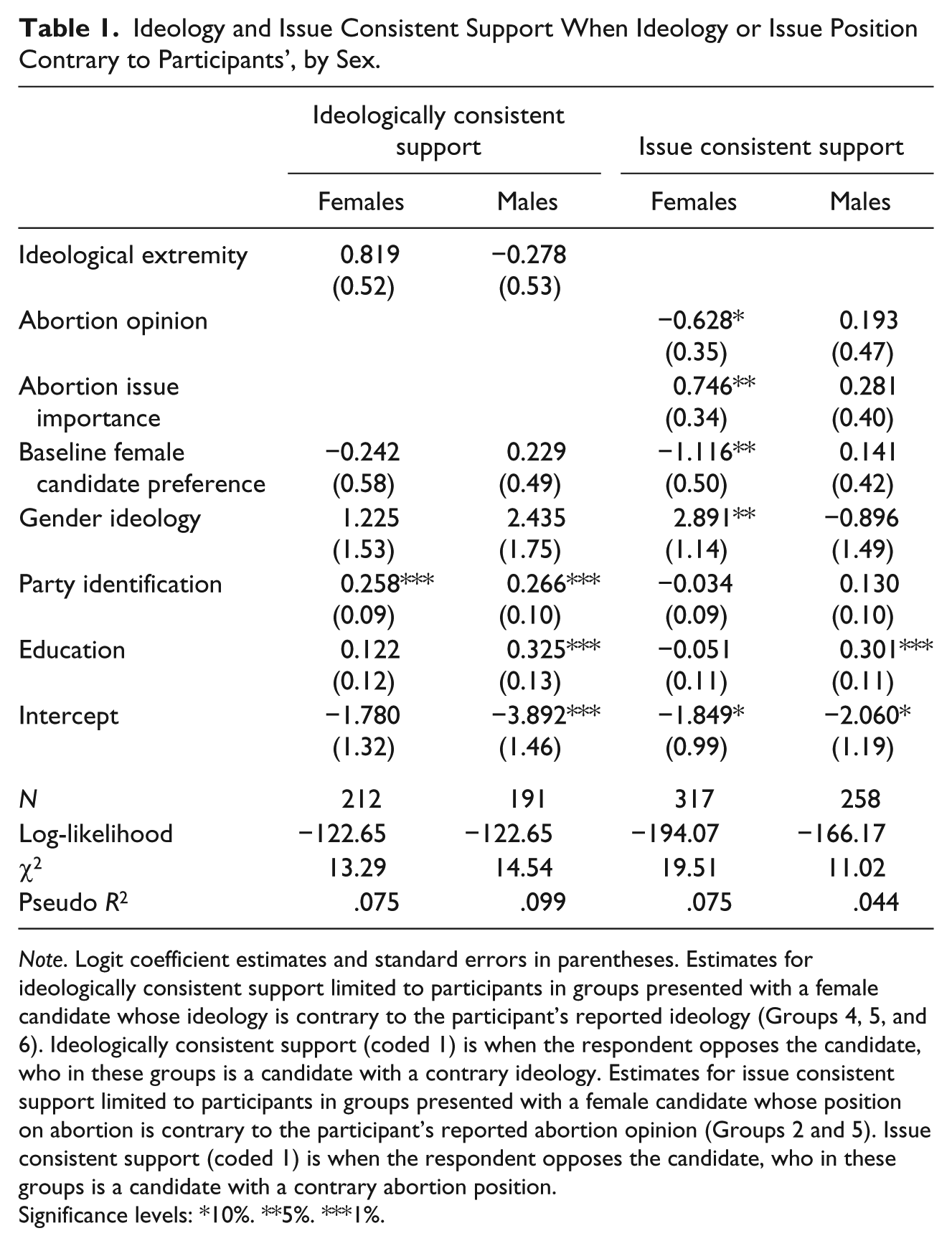
Note. Logit coefficient estimates and standard errors in parentheses. Estimates for ideologically consistent support limited to participants in groups presented with a female candidate whose ideology is contrary to the participant’s reported ideology (Groups 4, 5, and 6). Ideologically consistent support (coded 1) is when the respondent opposes the candidate, who in these groups is a candidate with a contrary ideology. Estimates for issue consistent support limited to participants in groups presented with a female candidate whose position on abortion is contrary to the participant’s reported abortion opinion (Groups 2 and 5). Issue consistent support (coded 1) is when the respondent opposes the candidate, who in these groups is a candidate with a contrary abortion position.
Significance levels: *10%. **5%. ***1%.
Examining the issue consistent support models, we see multiple factors influence whether women express issue consistent support, but only education is a significant factor for men. Women who favor allowing abortion at any time as a matter of choice (abortion opinion coded 1) are less likely to express issue consistent support for the female candidate, but women who think abortion is a very important or extremely important issue (abortion issue importance coded 1) are more likely to express issue consistent support. Women who believe abortion is an important issue are more likely to oppose a female candidate who has a position on abortion opposite her own. Compared with a woman who does not think abortion is an important issue, for a woman who thinks abortion is a very or extremely important issue, the probability of expressing issue consistent support increases by .15, all else equal. In contrast, women who have a baseline preference for females in office are less likely to express issue consistent support—women who prefer a female in office are more likely to ignore the female candidate’s contrary position on abortion, instead expressing support for the female candidate. Compared with a woman who has a baseline preference for males in office, for a woman who prefers females in elected positions, the probability of expressing issue consistent support decreases by .24, all else equal. Gender ideology also plays a role in whether women express issue consistent support: women with more liberal gender ideologies are more likely to express issue consistent support. There are multiple individual-level factors influencing whether women express ideologically and issue consistent support for the female candidate, but only education affects men’s support. Taken together, this analysis provides support for the expectation that individual characteristics, such as abortion opinion, importance of abortion issue, baseline female candidate preference, gender ideology, and education influence women’s support for the female candidate. In contrast, only education influences men’s support for the female candidate. Since men evaluating a female candidate receive neither substantive nor descriptive representation, their evaluation of a female candidate may be straightforward. But for women evaluating a female candidate with an ideology or abortion position contrary to her own, the decision between substantive and descriptive representation means that individual-level characteristics, such as baseline female candidate preference and gender ideology, play a role.
Discussion
Overall, these results show that women generally support female candidates at a higher rate than men, but this support among women is not automatic. Support for a female candidate who shares participants’ ideology or issue position is significantly higher than support for a female candidate who does not share participants’ ideology or issue position. Although women’s support for a female candidate who provides descriptive and substantive representation is high, support for a female candidate providing no substantive representation is in the minority—below 45%. However, compared with male support for a female candidate with opposing ideology or issue positions, women’s support for the female candidate is consistently higher, indicating women weigh the possible benefits of descriptive representation. 19 Finally, results show that when presented with the conundrum of whether to support or oppose a female candidate based on descriptive or substantive representation, women’s support for a female candidate depends on a woman’s individual characteristics such as partisanship, gender ideology, how important the issue of abortion is to her, and her baseline preference for women in office. Among women, support for a female candidate with contrary ideological or issue positions is conditioned on individual characteristics.
While a survey experiment offers many benefits, there are several limitations to this study. First, this study only presents participants with one candidate and one issue. Seeing one candidate and one issue in isolation is not realistic when thinking about a campaign with multiple candidates (potentially several candidates in a primary election and two candidates in a general election) and information on multiple issues. Indeed, the presence of female candidates in elections may influence women voters differently depending on electoral factors such as the election year or which issues are discussed most (Dolan, 2004), and vote choice may depend more on traditional political factors such as incumbency, political party, and competitiveness (Dolan, 2014b), particularly when presented in a more realistic electoral context. Second, it is possible that the abortion issue is unique relative to other issues discussed during campaigns, and that in conjunction with candidates’ other issue positions, participants may evaluate candidates’ abortion positions differently. Third, the outcome variable measured in this study is support for the candidate, not vote choice. Compared with vote choice, expressing support or opposition for a candidate may be a lower stakes response and therefore may not be taken as seriously by participants. Fourth, the female candidate was presented without priming participants to pay attention to her sex. It is possible that in the context of a campaign where a female candidate runs “as a woman” and highlights her gender, descriptive representation considerations may be larger. Finally, as Dolan and Lynch (2014) argue, an experimental design with a hypothetical candidate and restricted information may overestimate the influence of gender—with limited information, participants will be forced to rely on sex as a cue more so than when more information is available in a real-world electoral environment. While I agree with Dolan and Lynch’s (2014) advocacy of using observational data, this experimental design contributes to our understanding of the minimum and maximum limits of the influence of gender. Using a discreet gender cue (referring to the candidate as “she” rather than explicitly highlighting the candidate’s sex), reliance on the candidate’s sex over other considerations may have been minimized relative to an alternative of priming participants to think of the candidate as a woman. In addition, an experiment allows us to test the effect of gender in conjunction with ideology and policy positions without the influence of party identification—a test practically impossible with real-world partisan candidates. Although there are limitations, this study advances our understanding of voters’ responses to female candidates’ varying ideological and issues positions, which is increasingly important as more ideologically diverse women run for office, and particularly relevant in elections where partisanship cues are constant across candidates (such as in primary elections, nonpartisan races, or in states with top-two primary elections).
In general, this study shows that women consider both descriptive and substantive representation in their evaluation of female candidates. As more women run for office in the United States, the diversity of women candidates’ positions and ideologies will grow, and assumptions about a female candidate’s party affiliation, ideology, and issue positions are less likely to hold true. Thus, it is important to examine how women voters respond to female candidates who hold ideologies and policy positions contrary to their own. This survey experiment shows that even if participants assume female candidates are more liberal or pro-choice, they update their assumptions and express support according to alignment between the candidate’s and their own ideology and abortion position. When faced with information inconsistent with their own biases or assumptions, participants updated assumptions and electoral responses in light of new information—a heartening, positive implication in an electoral landscape increasingly characterized by voters’ unwillingness to listen to the other side.
Understanding how women weigh descriptive representation versus substantive representation is significant for female candidates, particularly as more women run for office. 20 Although it may be safe to assume more women than men will support female candidates, the assumption that women will automatically support female candidates may not hold true. For women who oppose a female candidate’s policy positions or ideology, descriptive representation advantages may not outweigh substantive representation disadvantages.
Footnotes
Appendix
Declaration of Conflicting Interests
The author(s) declared no potential conflicts of interest with respect to the research, authorship, and/or publication of this article.
Funding
The author(s) disclosed receipt of the following financial support for the research, authorship, and/or publication of this article: The authors received funding for the CCES survey module from the College of Social Sciences and Interdisciplanary Studies at California State University, Sacramento.