




Abstract
Many scholars expect that the “party decides” on presidential nominees who are both electable and willing to pursue an agenda acceptable to the supporting coalition. By most accounts, the nomination of Donald Trump does not fit these expectations. Did most party insiders view Trump as unelectable and unacceptable? If so, how did the Republican Party coalition react to his unlikely nomination? To address these questions, we content analyze endorsements of Trump and construct an endorsement network of the coalition behind Trump’s candidacy. We show that Trump received little support from party insiders prior to his nomination, and that policy considerations were relatively unimportant to Trump supporters throughout the election. Instead, when faced with an undesirable nominee, party insiders reacted by supporting Trump for electoral reasons. Our results suggest that party insiders are not immutable arbiters in presidential primaries and that most will prioritize partisan ambitions over policy goals.
Introduction
Political scientists have long examined the extent to which American political parties, for better or for worse, wield influence over which candidate wins their presidential nomination. In perspectives viewing parties as extended coalitions of actors (e.g., Cohen, Karol, Noel, & Zaller, 2008; Key, 1947; McClosky, Hoffmann, & O’Hara, 1960), party insiders are expected to exert a moderating influence on the field of candidates, screening and selectively aiding preferred candidates to produce a nominee that is both perceived as electable, among formal party actors, and ideologically satisfying, among informal party elites (Bawn et al., 2012; La Raja & Schaffner, 2015). These twin mandates often explain the success of “establishment” candidates who appeal to moderates while also catering to more extreme elite policy goals. Recent cycles have seen both Democratic and Republican nominees with relatively consensual support from party elites, outside groups, and party voters (Cohen et al., 2008). But the ascent of Donald Trump from a long-shot outsider to the Republican nominee seemingly defies these expectations about the role of parties. Trump’s unconventional and often inconsistent policy stances, combined with the widespread perception that he was not satisfying to the median voter and would likely lose in a general election contest, casts doubt on the view that he was the Republican Party’s preferred candidate.
With the role of Republican Party elites left ambiguous, an intuitive accounting might instead consider the 2016 nomination process as candidate centric (e.g., Aldrich, 1995). Perhaps, as Nelson Polsby (1983) predicted, the reformed presidential nominating process encouraged Trump to simply “differentiate himself from the others in the race” and built up a loyal personal constituency rather than appeal to a variety of factions within the diverse Republican Party coalition (p. 67). But although unique personal factors surely underpinned the rise of Trump, the role of the Republican Party in supporting or opposing his nomination remains less clear. Did party insiders actually view Trump as unelectable and unacceptable? And, if so, how did the Republican Party network respond to the nomination of an undesirable candidate, and what do these responses reveal about the nature of partisan coalitions? Given that parties, as coalitions, have exercised considerable power over candidate emergence and success in recent elections (e.g., Cohen et al., 2008; Desmarais, La Raja, & Kowal, 2015; Hassell, 2016), a full accounting of Trump’s victory requires closer consideration of the intraparty dynamics of candidate support in the 2016 election.
To this end, extant research has identified factional cleavages within the Republican Party as facilitating Trump’s nomination. Noel (2016) notes that Trump capitalized on existing cleavages within the Republican Party, catering to elites with extreme policy commitments—such as economic protectionism and social conservatism—that were previously not well-unified within the existing extended coalition. In addition, Cohen, Karol, Noel, and Zaller (2016) highlight that Trump was less inhibited by traditional funding mechanisms than his competitors early in the campaign. Taken together, these perspectives understand Trump’s success as a result of a lopsided relationship with the Republican Party, with Trump’s distance from the party organization as a comparative advantage. To the extent that Trump did require party support, he was able to carve out a novel coalition of support among disparate ideological and policy factions while maintaining some distance from establishment sources of funding.
The above explanations effectively accommodate Trump’s nomination as a “low probability event” within a parties-as-coalitions framework (Cohen et al., 2016, p. 705). But insofar as these studies empirically track Trump’s relationship to the Republican coalition, they provide the broader contours of ideological intraparty conflict through the issue positions and DW-NOMINATE scores of Trump’s supporters. Although comparing the policy preferences and “ideal points” of supporters highlights whether Trump was compatible with his elite supporters, this means of analysis obscures the strategic dimension of candidate support or opposition (Whitby, 2014), especially after Trump secured the nomination. We believe that a more nuanced accounting of Trump’s theoretically unlikely success could further our understanding of the internal dynamics and strategies of the Republican Party network.
To parse out support for Trump within the Republican coalition, we examine candidate endorsements. As highly visible signals of elite support for a candidate, endorsements are often considered indicators of coalition formation within parties during the “invisible primary” (Cohen et al., 2008). 1 Because both party “insiders” and “outsiders” announce their preferred candidates, endorsements provide unique leverage to understand patterns of support in the broader extended party coalition, highlighting the pursuit of both electoral and policy goals (Grossmann & Dominguez, 2009). And, given that endorsements are conditioned by the particular context of an election cycle (Whitby, 2014), they generally offer justification for candidate support. Endorsements are necessarily evaluative of candidates in the context of a campaign, providing insights into either the sincere or strategic nature of elite candidate support. In sum, consideration of candidate endorsements provides insights into intraparty conflict with more granularity, enabling us to identify not only supporters and opponents but also subcoalitions of actors united by their shared support of particular aspects of the Trump candidacy.
With this orientation, we examine the relationship of the extended Republican network to Donald Trump, paying specific attention to the nature of coalitions that sought to either propel Trump to the nomination, remain at arm’s length from an unfavorable candidate, or force him out of contention altogether. By operationalizing these dynamics through candidate endorsements, we are able to better differentiate between Republican subcoalitions that formed around policy, ideological, personal, or practical aspects of Trump’s candidacy. Our attention to the potentially strategic nature of endorsements allows for a more thoughtful consideration of coalition building within the Republican Party in light of Trump’s successful nomination.
In the remainder of this article, we investigate support for Trump among the Republican coalition in three different ways. All our analyses are conducted on an original data set—constructed through a content analysis (Krippendorff, 2012) of news articles covering endorsements of Trump—that contains detailed information on who endorsed Trump as well as when and why they did so. First, we examine the overall contours of support and opposition to Trump, highlighting the controversial nature of his candidacy. We then analyze support for Trump in the “invisible primary” and compare patterns of support for and opposition to Trump with the expectations laid out by coalitional theories. We find that a very limited number of party outsiders supported his candidacy before the Iowa caucus while the vast majority abstained from endorsing. In short, the Republican network did not align behind the eventual nominee, suggesting that coalitional theories of candidate emergence are of limited value in explaining Trump’s success.
This finding raises an additional question that has not been addressed in the existing literature: If the party did not decide—resulting in an undesirable candidate—how does the party react? To answer this question, we disaggregate the coalition of Trump supporters, based on their expressed reasons for their endorsements, using community detection methods. We find that some supporters endorsed Trump due to his preexisting policy positions—though it does not seem that these supporters coerced many new policy concessions from the nominee—although a large number of eventual supporters endorsed Trump for pragmatic, partisan reasons.
Data Collection and Method
Given our goal of mapping the contours of the Republican Party’s response to Trump, our task requires an exhaustive collection of Trump endorsements occurring from the announcement of his candidacy to his general election victory. We discuss our data collection process in greater detail in the supplementary information, but briefly outline our coding decisions here. We used a keyword search of local and national newspaper articles on LexisNexis, an electronic media database used by scholars studying topics such as event frequencies (e.g., Woolley, 2000) and media framing (e.g., Wu, 2006). We queried LexisNexis for articles containing Donald Trump’s name in close proximity to variations of the word “endorse.” We limited the search to articles published between June 15, 2015 (the day before Trump announced his candidacy), and November 7, 2016 (the day before Election Day). In total, the initial list included 2,353 unique articles.
From this full list, coders assessed each text for its substantive relevance, removing any articles that did not mention a particular individual or group assessment of Trump. The coders then read each relevant article and identified each unique actor, his or her occupation or background, the date on which the actor made an assessment of Trump, and the type of assessment that was made. Specifically, endorsements—which we use to refer to both positive and negative assessments—can fall into one of five mutually exclusive categories. Most simply, an endorsement refers to affirmative support for Trump and his candidacy, whereas opposition refers to any explicit statement denouncing Trump and withholding support for his candidacy. The indifference category captures statements that normatively consider Trump without an explicit statement of endorsement or opposition.
Two additional categories capture statements made by actors who already endorsed Trump but subsequently offered a negative assessment of him. In some cases, previous endorsers offered a criticism of Trump without formally revoking their endorsement. In other instances, however, previous endorsers explicitly mentioned a withdrawal of their earlier endorsement. Thus, it is possible that a single actor could be included in our data multiple times, with each observation representing a unique actor/endorsement type combination. For this reason, the unit of observation in our analysis is each actor/endorsement dyad. In total, we collected data on 474 unique assessments made by 289 different actors, with an average of 1.6 assessments per actor. We compared these data with other published lists and found strong overlap (see the supplementary information). The modal category in our sample is positive endorsements of Trump (166), which is unsurprising given our search parameters. Opposition to his candidacy (138) and indifferent evaluations (107) are also common, whereas criticisms (42) and withdrawn endorsements (21) are relatively rare phenomenon.
Assessing the Substantive Content of Evaluations
Again, the primary task in this study is to move beyond simple endorsement counts by identifying and grouping candidate supporters based on their stated reasons for endorsing a candidate. To accomplish this task, coders read the article(s) associated with each endorser/endorsement dyad and searched these texts for stated justifications. 2 Only reasoning that is clearly attributable to the endorser—rather than, for instance, interpretation by the article’s author—was coded.
Our coding scheme categorizes reasons for assessments into four nonexclusive categories, meaning that any single actor can have multiple reasons for their evaluations of Trump. First, pragmatic reasons represent instances when electoral or policy victory is explicitly prioritized over other concerns. Policy reasons refer to endorsements based on explicit policies supported or opposed by Trump, which can range from narrow (e.g., opposition to the Trans-Pacific Partnership) to entirely abstract (e.g., support for Trump’s policies generally). Ideological reasons, unlike policy justifications, are based on broader normative considerations of how society “ought to be” and the proper role of government in accomplishing this normative vision. Finally, personal reasons for assessments draw on Trump’s individual characteristics, including his personality, background, experience, rhetoric, or behavior. To validate this content analysis, we conducted intercoder reliability tests on a subset of 54 articles that were shared by two coders. The Krippendorff’s alpha coefficients for the four categories were as follows: pragmatic = .709, policy = .782, ideology = .757, personal = .768. We manually adjudicated any disagreements in coding and spot-checked all remaining coding that did not overlap between research assistants.
For each unique actor/endorsement dyad, these four justifications are binary variables coded as 1 if the actor offered such a reason and 0 otherwise. The reason(s) provided by each actor represents the main variable used to connect supporters and group them into clusters based on similar motivations for their endorsement. To gain further insight into Trump’s coalition of supporters, coders also recorded open-ended text to describe, in greater detail, the specific reason provided for each assessment. 3 After data collection was completed, we standardized these text reasons into broad categories inductively identified by the authors, detailed in Table SI.1 in the supplementary information. This standardization attempts to simplify the analysis of reasons for Trump support while retaining valuable information that distinguishes different types of supporters.
Constructing an Endorsement Network
Because the extended party is thought to operate as a coalition—with actors coalescing around “electable” candidates with preferable policy positions—we leverage our original data set to construct endorsement networks. Other scholars have conducted social network analysis on campaign finance records and endorsements as a means of identifying partisan coalitions in Congressional elections and policymaking (e.g., Desmarais et al., 2015; Grossmann & Dominguez, 2009), with the understanding that revealed connections between outside actors, candidates, and politicians from a particular party are representative of the extended party network. In many of these studies—as in ours—ties in the network do not represent explicit connections between actors. Rather, similar revealed behavior is used to map out the Republican Party network in relation to Trump. As such, the “communities” we identify are more akin to subsets of supporters than real-world groups. Our assumption is that by grouping actors according to their reasons for supporting Trump, we can operationalize the subgroups of actors who supported him, and analyze the internal dynamics of the Republican Party network. Our data cannot provide evidence that these actors were directly coordinating as a support coalition, but their reasoned support for Trump’s nomination sheds significant light on coalition building and intraparty conflict. This methodology is an important improvement over raw counts of candidate endorsements, allowing for the identification and clustering of distinct segments of the party and their various incentives and goals.
We construct bipartite endorsement networks, where actors are connected to their endorsement types through the reasons they offer. 4 We construct two separate networks. The first network includes all evaluations of Trump with actors linked to the broad reasons for their assessment. The second network includes all actors who made a positive endorsement at some point during the campaign, with actors tied to the standardized textual reasons they provided for their support and, if applicable, their other evaluations of Trump. In the first network, we are able to operationalize the overall response to Trump’s candidacy and assess early support for, or opposition to, his primary run. In the second network, we are able to identify distinct clusters of Trump supporters and use their stated reasons for support to better understand the ideas, demands, and trends that defined the Republican Party’s response to Trump.
The analysis proceeds as follows. First, we introduce the full endorsement network and provide an overview of assessments of Trump. We also present preliminary evidence that personal considerations, rather than policy concerns, were the stated justifications behind many endorsements and most opposition. Next, we measure the extent of party support for Trump during the “invisible primary,” when party insiders are said to screen candidates for their electability and acceptability and converge behind the eventual nominee. Our analysis shows that Trump broke sharply from this model. Finally, we use community detection methods to group supporters with similar reasons for their support, thereby identifying distinct factions within the Republican-extended party coalition. This analysis reveals a stark divide between true Trump supporters and individuals who reluctantly supported the nominee for more practical reasons.
The Trump Endorsement Network
We begin our analysis with an investigation of the full Trump endorsement network (see the supplementary information for network visualizations), resulting in a network that clusters together actors with similar endorsement types and reasons. This initial network highlights important differences in the reasoning of Trump supporters and those who opposed him. Table 1 displays the percentage of actors who drew on each of the broad reasons outlined above, given their assessment of Trump. Those who endorsed Trump drew on each of the four reasons about equally, with a slight plurality (27%) of reasons referencing personal factors and roughly 24% referencing each of the remaining factors. Importantly, as we detail below, those who supported Trump due to pragmatic reasons—which could include both electoral and policy goals—overwhelmingly supported him because they would “support any Republican” and because he was “not Clinton.” The heterogeneity of reasoning for positive endorsements stands in stark contrast to those who opposed Trump: 55% of the reasons offered by Trump opponents drew on personal reasons, with only 17% referencing opposition to Trump’s policy positions. 5
Frequency of Stated Reasons for Evaluations of Trump, by Endorsement Type.

The same emphasis on Trump’s negative personal characteristics is found among those who were indifferent and those who endorsed him but later criticized him or withdrew their support. Those who were indifferent, in particular, tended to express support for Trump’s ideological and policy stances but were apprehensive to endorse the candidate because of his abrasive rhetoric and, later in the campaign, his sexist comments. A separate category of indifferent actors said that they would support any Republican nominee, though among these actors, there was certainly a preference for someone—or perhaps anyone—other than Trump. Almost all criticisms and withdrawn endorsements were similarly based on Trump’s personal characteristics and behavior.
These findings provide some initial evidence that policy considerations played a secondary role in evaluations of Trump. Further evidence can be seen in the fact that only nine interest groups and political organizations—who would conceivably place policy demands on their preferred candidate (e.g., Bawn et al., 2012)—endorsed Trump. This finding presents a puzzle for coalitional theories that predict successful nominees will have broad support based on electoral and policy considerations. For observers of the 2016 election, though, it is perhaps unsurprising that Trump’s character was more frequently discussed than his policy positions. Indeed, the preponderance of personal considerations in evaluations of Trump likely reflects the fact that the Trump campaign was light on policy discussion and detail, suggesting that the Trump coalition might be understood as a “personal constituency” (Polsby, 1983). Who, then, were the early supporters of Trump’s candidacy, and why did these endorsers back the controversial candidate?
Endorsements During the Invisible Primary
The fact that policy rationales played a relatively minor role in evaluations of Trump runs counter to the “Party Decides” (2008) framework of presidential candidate emergence. In short, Cohen et al. (2008) predict that early party insider support for a candidate and his or her policy stances manifests in endorsements and predicts whether a candidate will emerge as the party nominee well before party caucuses and primaries. This preprimary period is often referred to as the “invisible primary,” when candidates attempt to display their viability by accumulating endorsements, developing campaign infrastructure, and building up financial war chests (e.g., Aldrich, 2009; Cohen et al., 2008; Steger, 2000). By most popular accounts, Trump did not operate in this postreform model.
For this reason, in this section, we quantitatively examine the extent of early support for Trump and compare the policy demands of early supporters with theoretical expectations. To begin, Figure 1 tracks the “net affect” toward Trump among formal and informal party members. Our definition of formal party members (roughly 61% of the sample) is straightforward, including any current or former elected officials (e.g., governors or members of Congress), candidates for office, and partisan employees (e.g., staffers). All other actors in the sample were coded as informal party members, including public figures (e.g., actors or athletes), nonparty organizations, media outlets, and business elites. Net affect is calculated by assigning numeric values to each endorsement type and tracking the sum of these values across every week of the campaign. Specifically, endorsements are valued at +1, opposition or withdrawn endorsements at −1, and criticisms at −0.25. Thus, higher positive values in Figure 1 indicate greater overall support for Trump, at least among the actors in this sample. 6 An additional line tracks the total number of endorsements (minus withdrawn endorsements) over time. The figure also marks five key events during the 2016 cycle.

Net affect toward Trump.
The most striking finding from this figure is the fact that Trump’s net approval was close to zero leading up to and following the earliest Republican caucuses and primaries. Although we do not compare this early support with preprimary support for other Republican candidates, the figure, nevertheless, reveals that Trump did not emerge from the invisible primary with strong, diverse party support. This is true for both formal and informal party members, though the net affect among informal party members was somewhat higher than formal party members throughout the time period. 7 Indeed, for both types of actors, Trump did not build substantial support until he had amassed a significant number of caucus and primary victories. Roughly half of his endorsements came after he secured the delegates needed to win, and his highest net favorability similarly occurred between the time when he had secured the nomination and his victory at the Republican convention. After this point, net affect toward Trump plummeted following several political stumbles during and after the convention, with growing numbers opposing his candidacy. The exposure of his lewd comments in the Access Hollywood tape accelerated this trend, and by Election Day 2016 Trump was, on average, opposed by the party establishment.
Who, then, supported Trump’s early candidacy? Although very few actors offered assessments of any kind prior to primary voting—suggesting that the usual suspects were largely inactive during the invisible primary—it is possible that a limited number of influential party insiders aligned behind Trump. Further qualitative analysis, however, suggests that this was not the case. Only 12 actors had positively endorsed Trump prior to the Iowa caucus, and this group—which includes Sarah Palin, Carl Icahn, and Dennis Rodman—is far from the notion of party insiders referenced by Cohen et al. (2008). 8 In fact, in the Party Decides analysis (1980-2004), the average eventual nominee received 328 endorsements prior to the Iowa caucus. 9 Even relative outsider Ronald Reagan received 117 endorsements in his successful 1980 bid, or nearly 20 times as many preprimary endorsements as Trump.
The members of the early Trump support coalition offered a variety of reasons for their endorsements (see Table 2), with several citing his rhetoric and temperament, his business experience, and his policy positions on national security. A related strand of reasons drew on his populist message, citing the fact that Trump, as an antiestablishment populist, would “Make America Great Again.” It is fair to say, then, that Trump drew his preprimary support not from the typical party establishment insiders but rather from like-minded political outsiders and nationalists. Importantly, none of these early supporters named Trump’s electoral prospects as a reason for his or her endorsement, and the few policy reasons offered are far from the wide ranging list we would expect if Trump had assembled a “big tent” coalition of various segments of the Republican Party.
Specific Reasoning Offered for Endorsements During the Invisible Primary (Prior to the Iowa Caucus).
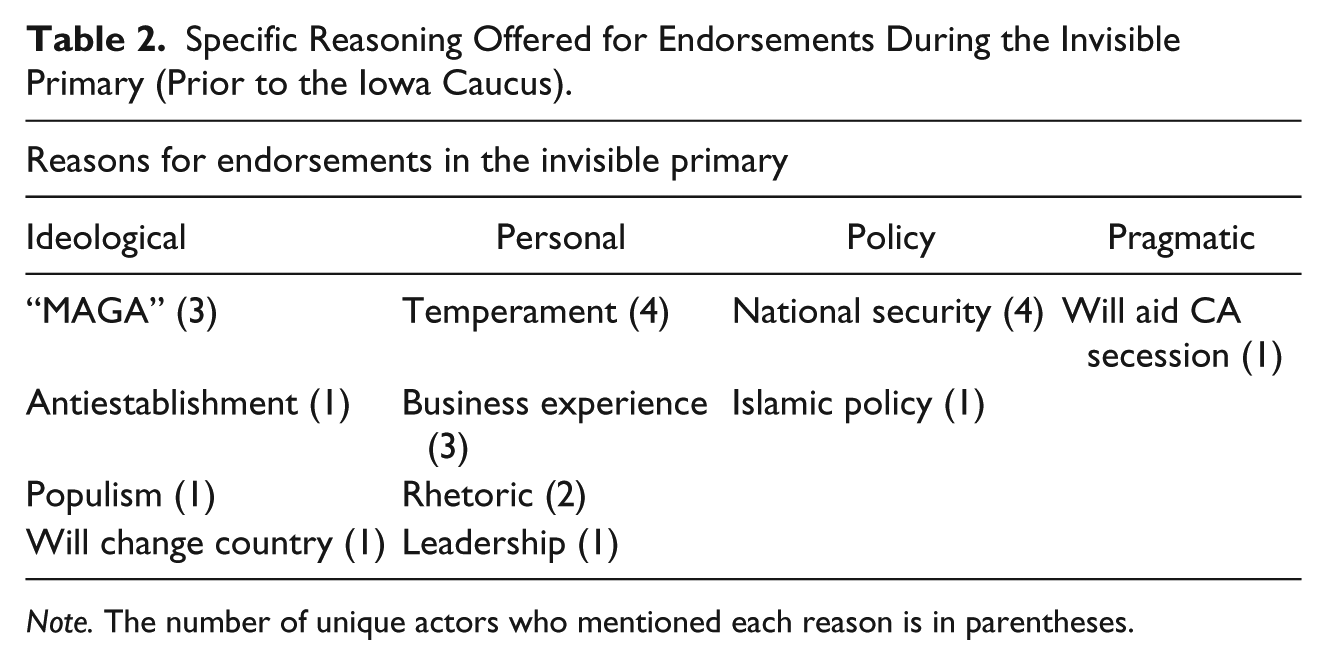
Note. The number of unique actors who mentioned each reason is in parentheses.
Only 10 other actors made assessments of any kind regarding Trump’s early candidacy. Four of these actors were indifferent toward Trump and, like later actors who offered indifferent assessments, these people were often supportive of Trump’s business experience and the fact that he broke from politics as usual. Still, these actors were apprehensive about Trump’s electoral prospects, particularly due to rhetoric that they perceived as racist and sexist. Surprisingly, only five actors in our sample opposed Trump before the first caucus, and two of these critics (Bobby Jindal and Lindsay Graham) were Trump’s direct primary opponents. Once again, we see that party insiders simply abstained from making assessments of Trump early in the campaign. His later success, then, cannot be attributed to early insider or establishment support. Rather, Trump operated outside of the traditional avenues of political success, perhaps by exploiting free media to stand out among a crowded primary field and appeal to dissatisfied voters (Francia, 2018; MacWilliams, 2016; Wells et al., 2016). Regardless of the cause, Trump’s victory seems to upend theoretical expectations. We do not believe this fact invalidates coalitional theories of candidate emergence, but it does raise an important question that the theory and data in existing studies do not address: In the face of an undesirable, yet victorious, party nominee, how does the party react?
The Party in the Postnomination Period
Despite Trump’s lack of early party support, he ultimately ended his campaign with positive endorsements from 117 actors. Did this convergence behind the Trump candidacy represent true support—perhaps due to Trump policy concessions that appealed to a new segment of the Republican Party—or simply reluctant acceptance of the nominee? In this section, we address this question by focusing on the positive Trump endorsement network, including all actors who endorsed the candidate at some point during the election. To understand the shifting nature of this coalition, we also include any other types of assessments that these endorsers made.
This positive endorsement network connects actors to the standardized textual reasons they stated for their assessment. Thus, this network provides far more information on potential variation in the justifications and policy demands of actors in the support coalition. These more nuanced ties also allow for the use of community detection methods to uncover meaningful subgroups in the network. Specifically, we use the Spin-Glass community detection algorithm (Reichardt & Bornholdt, 2006) to identify clusters of actors with dense internal connections and sparse ties across subgroups. 10 Again, these groups are not communities in the traditional sense, but rather, clusters of actors with similar reasons for their support of Trump. This analysis resulted in 12 unique clusters; the various types of endorsements and reasons provided by actors in each community can be found in Table SI.2 in the supplementary information.
Broadly, these support clusters can be classified into three distinct types. First, several can be described as policy-demanding coalitions (26% of actors), consisting of supporters who mainly drew on specific policy reasons to justify their endorsements. The most homogeneous policy demanding subgroup, which we call the Islamic policy wonk cluster, is relatively small but consists entirely of actors who supported Trump’s approach to Islamic extremism. A second group (immigration policy wonks) drew on a more heterogeneous list of typically conservative policy demands—including guns, health care, national security, and taxes—though a large majority of members (72%) share an emphasis on immigration policy. Similarly, actors in the third policy-based community (conservative policy wonks) referenced a mix of hot-button conservative issues, including the economy, energy policy, gun control, and health care and immigration reform.
Importantly, the median dates of endorsements in these policy-based communities are relatively late in the cycle. Only the immigration-focused cluster had a median endorsement date before Trump secured the delegates needed to win the nomination, making it unlikely that the support of these policy-demanding groups and individuals was responsible for Trump’s eventual success. Still, Trump could have conceded to other policy demands from these actors as the campaign progressed. On immigration and Islamic extremism policy, this seems unlikely, as Trump’s public statements on these topics began well before these endorsers had announced their support. It is possible that Trump adjusted his positions on gun policy, health care, or the economy to accommodate the demands of his elite supporters, though these issues are only mentioned by a handful of policy-focused endorsers (between 7% and 22%). Regardless, these policy emphases—limited as they are—are representative of the priorities of both the Trump campaign and the early Trump administration and, thus, have implications for our understanding of the Republican Party’s response to Trump and his governing priorities and capacity as President.
Besides this limited number of policy-based endorsements, the majority of the network can be broadly classified into two other camps: candidate-based endorsers (45% of actors) and reluctant supporters (29%). Candidate-based supporters tended to draw on Trump’s personal characteristics and style as well as the general antiestablishment, protectionist rhetoric of his campaign. For example, members in one cluster frequently referenced Trump’s business and leadership skills, with several suggesting that these traits provided Trump with relevant experience to improve the economy and manage the executive branch. Importantly, some of these endorsers, like Representative Chris Collins (NY-27), disagreed with Trump on key policy issues—especially immigration and terrorism—but, nevertheless, expressed the belief that Trump’s background made him the best candidate. Once again, this support seems to be based not on existing policy commitments or the expectation of future concessions, as coalitional theories might suggest.
Other candidate-based support came from antiestablishment populists and nationalists who sought a “new direction” for the country. Some simply implored Trump to “please make America great again.” Similarly, most actors in these communities sought “change” in the abstract, whether that meant a different culture in the capital, a move away from establishment “politics as usual,” or simply working “to defeat anyone who promises to finish what President Obama started.” Importantly, these endorsers viewed Trump as the best catalyst for such change, not because of the policies he advocated (though some did reference the odd policy in their endorsements), but rather, because of Trump’s style, temperament, and message. Indeed, many of these actors endorsed Trump despite their criticism of his sexist remarks or particular policies they deemed ineffective or even impossible. In these candidate-centric endorsement communities, then, we find some evidence of Polsby’s (1983) hypothesis that the reformed presidential nominating system would lead to the nomination of candidates with strong personal followings but who lacked consensual support from a majority of the party. By campaigning on his past business success and as the champion of populist, nationalist causes, Trump was able to garner support from actors who otherwise might have opposed his candidacy in a contest based around policy positions and “electability.”
Not all endorsers, however, were willing to ignore the more politically toxic aspects of the Trump candidacy. Rather, the Republican establishment was decidedly opposed to Trump in early months. The fact that many of these actors eventually supported the nominee suggests that party insiders—faced with an undesirable nominee—did not strongly assert themselves but rather reluctantly supported the candidate. What, then, led these reluctant supporters to fall in line behind the eventual Republican nominee? The answer, in short, is political pragmatism and partisan electoral goals. The reasoning of these reluctant supporters reveals that, in some cases, a party establishment that fails to proactively select its nominee is willing to adapt in the name of party unity.
Importantly, the vast majority of these reluctant supporters (approximately 75%) can be considered “political insiders” (i.e., current or former politicians and party leadership or staff), including prominent names like Reince Priebus, Paul Ryan, and Mitch McConnell. It is unsurprising, then, that many of the actors found in the reluctant supporter communities were initially indifferent about Trump’s candidacy. The reasons for this indifference were varied, including Trump’s rhetoric, temperament, and dishonesty; his sexist remarks; and his atypical ideological and policy stances. Generally, then, party insiders viewed Trump as unelectable and unconventional in his policy platform. At the same time, some indifferent endorsers paired these criticisms with vows “to support the Republican nominee” or claims that “Clinton is not the answer,” however unpalatable Trump might be. Combined, these statements reveal the profoundly difficult choice faced by many party insiders in 2016: to oppose Trump and risk alienating his populist base and losing the election, or else, support a candidate who most believed to be a danger to the Republican brand.
Our sample of endorsements provides insight into actors who chose the latter option. Among reluctant endorsers, the two most cited reasons for their eventual support were the facts that Trump was “not Clinton” and that they would ultimately support any Republican, highlighting a strategic pursuit of electoral goals but not necessarily a set of policy demands. For these supporters, then, party unity played a crucial role in their decision. Trump’s character and campaign, however, did not: Examining the reasons offered by these communities, most notably what we call the post hoc rationalizers community, reveals that many insiders were searching for some legitimate reason other than pure party politics to justify their endorsements. These reasons varied, with some even pointing to vice presidential candidate Mike Pence as their only reason for support, but in almost every case, the errant policy or ideological justification was paired with a pragmatic statement about the need to win and the need to prevent a Clinton presidency. A significant faction of the Trump endorsement network, then, consisted of unwilling party insiders who pragmatically supported the nominee, often after vociferously criticizing him earlier in the cycle.
A small number of these reluctant supporters, however, proved to be fair-weather friends. All five of the actors who eventually withdrew their endorsements—each one in response to Trump’s comments in the Access Hollywood tape—are classified as reluctant supporters, suggesting that there are limits to the willingness of party actors to overlook major transgressions. Similarly, the vast majority of postendorsement criticism came from insiders who were hesitant to endorse Trump in the first place. Taken together, these findings suggest that the Republican Party apparatus was largely a passive player in Trump’s victory, at least as we have operationalized influence. To the end, many party elites were lukewarm at best toward Trump and his chances of victory, whereas those who fully supported the candidate were often “outsiders” in traditional Republican politics.
Discussion
In this article, we examined the relationship between Donald Trump and the extended Republican coalition throughout the 2016 campaign to assess the reaction of the party to Trump’s candidacy and eventual nomination. Our systematic analysis of candidate endorsements—an indicator that provides unique purchase on this question—highlights prenomination dynamics that do not neatly conform to the expectations of coalitional theories of parties (e.g., Cohen et al., 2008). In addition, our focus on postnomination evaluations helps shed light on the dynamics of party coalitions under such conditions. In particular, we find that inactivity within the institutional Republican Party during the “invisible primary” was coupled with the construction of a narrow antiestablishment coalition of elites supporting the Trump campaign. Once it became clear that Trump would be the nominee, the institutional Republican Party only supported him insofar as it was strategically beneficial for maintaining party unity and competition.
On the whole, it seems that Trump’s successful nomination should be understood within the context of an idle Republican Party whose inactivity during the “invisible primary” changed to lukewarm support for an undesirable copartisan. This finding highlights a crucial trade-off inherent in the modern presidential nominating system: Although citizens value the open and democratic nature of the reformed nomination process, this expectation of accessibility might limit the willingness of party insiders to screen out fringe candidates and align behind someone with strong coalitional support and the ability to govern effectively. This trade-off was on full display in the 2016 election, with the Democratic Party tending toward a heavier hand—and facing strong criticism during and after the election for this decision—and the Republican Party preferring a lighter touch, with important implications for the outcome of the presidential election and subsequent governing.
By focusing on the Republican Party’s reaction to an unlikely nominee, we show that party coalitions are, ultimately, comprised of partisan actors with the goal first and foremost of contrasting themselves with the opposing party and perhaps only secondary concerns for policy outcomes. These dynamics by no means necessitate that the Republican Party is now a candidate-centric institution or that party insiders will not play a role in selecting future nominees with acceptable policy positions. Rather, this outcome demonstrates the potential for the fears expressed by Polsby (1983): that presidential candidates in the postreform period—absent the type of partisan constraints outlined by Cohen et al. (2008)—could win their party’s nomination by appealing to a relatively small faction of supporters. In such a case, it is by no means assured that party actors will prioritize policy goals—or even the maintenance of the conventional party policy brand—over partisan electoral considerations.
Again, we do not expect Trump’s path to victory to become the new norm in politics. Rather, it seems that several distinct factors converged and created exactly the type of environment Polsby (1983) feared. First, the tremendously crowded field of Republican candidates meant that the convergence of party insiders behind a single candidate was especially difficult. In such a field, Trump was uniquely situated to mobilize a faction of Republican voters significant enough to win the nomination. His brash rhetoric, simplistic but effective messaging, and dominance of media coverage surely aided him in this endeavor. Furthermore, his independent wealth allowed Trump to eschew the traditional approach of building a coalition of wealthy donors and party insiders. Without the need to appeal to a broad pool of party donors, Trump was able to engage in coalition building that kept many party actors at arm’s length until he received the Republican nomination. In sum, Trump seems to have effectively removed the main determinants of victory—party endorsements, media coverage, and funding (Cohen et al., 2008)—from the hands of party insiders. Thus, it would likely take a similar candidate to replicate our findings in the future.
Our study offers a number of benefits in explaining Trump’s successful nomination through an institutional lens, most notably our attention to the strategic dimensions of individuals within the Republican coalition. By turning to candidate endorsements, rather than other indicators of support, we are able to situate the Republican Party’s relationship to an atypical candidate as the campaign unfurled, identifying patterns of sincere and strategic support that were largely devoid of traditional policy concerns. Certainly, there are limitations to our study—other mechanisms of institutional support or opposition are less visible than endorsements, and publicly articulated support is likely to be motivated by multiple considerations at once. Still, the findings presented here suggest that party coalitions can—under the right conditions—be pragmatic, reactionary forces rather than proactive guardians of the party brand.
Supplemental Material
APR-SI-Anon – Supplemental material for The Party Reacts: The Strategic Nature of Endorsements of Donald Trump
Supplemental material, APR-SI-Anon for The Party Reacts: The Strategic Nature of Endorsements of Donald Trump by Zachary Albert and David J. Barney in American Politics Research
Footnotes
Declaration of Conflicting Interests
The author(s) declared no potential conflicts of interest with respect to the research, authorship, and/or publication of this article.
Funding
The author(s) received no financial support for the research, authorship, and/or publication of this article.
Supplemental Material
Supplemental material for this article is available online.
Notes
Author Biographies
References
Supplementary Material
Please find the following supplemental material available below.
For Open Access articles published under a Creative Commons License, all supplemental material carries the same license as the article it is associated with.
For non-Open Access articles published, all supplemental material carries a non-exclusive license, and permission requests for re-use of supplemental material or any part of supplemental material shall be sent directly to the copyright owner as specified in the copyright notice associated with the article.
