



Abstract
Issues and policies pertaining to children and families are often labeled “women’s issues” and assumed to be on the radar of all women, but we argue that they are more salient for mothers, particularly working mothers, than for other women. This study examines the role of motherhood as an identity for women in Congress by looking at the introduction of bills that affect children and families from 1973 through 2013. We define working mothers as women who have children below 18 years of age at home while they are in office, as opposed to those who have adult children or no children. Our findings show that Congressional working mothers are more likely to introduce legislation that address issues specific to parents and children. We also find that legislation specifically dealing with children’s health and welfare is more likely to be introduced by members with children than those without.
In 2013, Representative Jaime Herrera Beutler (R-WA) gave birth to a daughter who was born without either of her kidneys, requiring special medical attention. After going public with this information, Representative Herrera Beutler reported that the experience of having to seek out medical care across state lines for her own child, and hearing from parents going through the same ordeal, helped shape her legislative agenda (Schwartz, 2015). The following year, she proposed legislation making it easier for children on Medicaid to receive treatment across state lines if they had a complex medical condition. In an interview with Marie Claire, she stated, “I probably would have supported (the legislation) before . . . but I wouldn’t be the one who’s selling it” (Schwartz, 2015). Similarly, Representative Cathy McMorris Rodgers (R-WA) is the mother of a young child with Down Syndrome. This experience led her to form the bipartisan Congressional Down Syndrome Caucus and cosponsor a bill called the Achieving a Better Life Experience Act (Sylvester & Swain, 2012). In 2017, McMorris Rodgers (2017) wrote an op-ed for the Washington Post in which she cited her child’s special medical needs as her motivation in voting for the American Health Care Act, again showing that her role as a parent influenced her legislative agenda. These are examples of how motherhood is an identity that shapes the attitudes, workplace experiences, and agenda of even the most elite working mothers, our nation’s leaders.
There are currently 84 women serving in the House, totaling 19.3% of representatives (Center for American Women in Politics, 2018). Although the number of women has increased steadily over time, some have argued that the legislative agenda of congressional women has not changed much since the first woman was elected into the House (Foerstel & Foerstel, 1996). Female members of Congress (MCs) introduce legislation often considered to address “women’s issues”—issues such as equality in the workplace including sexual harassment and the wage gap, women’s health care issues including reproductive rights and insurance coverages, and social issues such as domestic violence. Were it not for women in Congress, many of these issues may never be part of the public discourse or legislative agenda.
Although much of the literature has relied on the concept of “women’s issues,” arguably, several of the issues in that broad category are not necessarily on the radar of all women. Policies regarding topics such as school lunch programs, maternity leave, day care costs, and children’s health insurance are far from the minds of many women; however, mothers with young children deal with these issues on a regular basis. Given that legislators with minor children are more likely to have recent experience with these issues, they may also be more likely to introduce bills addressing policies that directly impact families and working mothers. Our study makes a contribution to the literature in two ways: first, we disentangle a subset of “women’s issues,” which includes issues pertaining to children and families that may be of more interest to mothers, and second, we examine how motherhood plays a role in shaping the legislative agenda of women in Congress.
Previous research has demonstrated that having women in office matters for policy preferences and outcomes (Dovi, 2002; Mansbridge, 1999; Phillips, 1995; Swers, 2001, 2002), regardless of political party (Celis & Childs, 2012; Osborn, 2012; Schreiber, 2002), and that when women are in the majority party they are more likely to work on social welfare issues than male co-partisans (Swers, 2005). Some may argue that having working mothers in Congress is another form of descriptive representation, or that they represent a subset of women’s interests, but we argue that like other groups with descriptive representatives, such as Blacks and Hispanics, having working mothers in Congress has resulted in substantive outcomes for parents with young children and especially for working mothers. Research has shown that personal experience in varying occupations, religion, and race influences policy preferences and legislative activity in areas such as committee selection and bill sponsorship (Burden, 2007; Gooch, 2006; Mansbridge, 1999; Pitkin, 1967), and we expect motherhood to have a similar impact on bill sponsorship.
We begin our examination by exploring motherhood as an identity and how the role of mother influences policy preferences in the electorate. We then present qualitative and normative accounts of how being a parent influences legislative policy preferences and behavior. To test our theory that women with children are producing substantive representation for parents and children, we use a unique data set that includes bills introduced by women between 1973 and 2013 pertaining primarily to children and families. We pair this with information about women in Congress, such as whether or not they have children, the ages of children they have, and political variables such as seniority, total bill sponsorship (Volden & Wiseman, 2014), and their ideology measured by DW-NOMINATE scores (Frederick, 2010; Poole & Rosenthal, 2001). We present our results and discuss the implications of our findings and how we plan to continue this research.
The (Limited) Role of Motherhood in the Literature
The majority of the research on women as legislators has focused on two areas: first, on women legislative behavior and substantive outcomes, and second on gender and political ambition. The first line of research finds that, compared with men, women do behave differently and address different issues than men. Female legislators tend to be more productive than men (Anzia & Berry, 2011) and are more likely to compromise and build coalitions (Volden, Wiseman, & Wittmer, 2013). Although female legislators debate, vote, and cosponsor a wide variety of legislation, they are more likely to be the primary sponsor of legislation in areas such as education, welfare, women’s equality, and health care, especially with issues concerning women’s health such as reproductive rights (Barnello & Bratton, 2007; Berkman & O’Connor, 1993; Bratton & Haynie, 1999; Dolan & Ford, 1995; Reingold, 2000; Saint-Germain, 1989; Swers, 1998, 2002, 2013; S. Thomas, 1994; Vega & Firestone, 1995).
The second area of study has generally focused on political ambition, political campaigns, and how women have historically been disadvantaged in running for political office (Elder, 2004; Fowler & McClure, 1989; Fox, 2000; Fox & Lawless, 2004, 2010; Fulton, Maestas, Maisel, & Stone, 2006; Gertzog, 1984; Palmer & Simon, 2006). Both of these areas of study create a foundation that helps scholars understand how and why having women in office is important, but it is really only in the political ambition literature where we find in-depth analysis of the effect of parenthood on the decision to run (Burrell, 1994; Elder, 2004; Fowler & McClure, 1989; Fox & Lawless, 2004; Fulton et al., 2006; Lawless & Fox, 2010), how parties view women with children as potential candidates for recruitment (Fox & Lawless, 2004, 2010; Stalsburg, 2010), how much of a woman’s campaign focuses on her role as a mother (Dwyer, Stevens, Sullivan, & Allen, 2009; Schreiber, 2012), and how opponents use their family obligations against women in the campaign process (Dolan, 2010; Lawless & Fox, 2010). Although the literature in both of these areas has expanded greatly over the past 20 years, there is very little qualitative or quantitative research examining how elected officials raising young children may act differently than those with no children or adult children in their political activities, including which policies they pursue once in office.
Motherhood as an Identity
Being a mother provides a framework for looking at the world (McMahon, 1995) and research shows that in the process of becoming a mother, women internalize the role of motherhood and it becomes an identity (Nuttbrock & Freudiger, 1991). Women feel the effects of parenthood more intensely than men do in fatherhood, and the transition into motherhood is a major life development for women that is not equivalent to the adoption of fatherhood for men (Greenlee, 2014; Mercer, 2004). According to Stryker’s (1968) identity theory, the more salient an identity, the more likely it is to affect role behavior. Motherhood is a role that many women identify with and may even list as their most important role, however motherhood as an identity is likely more salient for women who still have children at home and are dealing with the day to day responsibilities of motherhood than those who have grown children, and of course, it would not serve as an identity at all for women with no children.
M. Thomas and Bittner (2017) argue that parenthood is a gendered political identity that influences how, why, and to what extent women (and men) engage with politics. Greenlee (2014) finds that motherhood is the most normative and valued role that women adopt, and is a “broad based” identity that is ideologically unconstrained, meaning that women from across the political spectrum identify their role as mothers as an organizing force behind their political beliefs. She also finds that attitudinal shifts occur when women become mothers across the ideological spectrum, but with the exception of the issue of abortion, where fathers become more conservative, there are rarely any differences in attitudes between fathers and nonfathers once controlling for demographics and political characteristics (Greenlee, 2014). Elder and Greene (2012, 2016) find that parenthood has an impact on political attitudes, and similarly find that the effect is more pronounced for mothers than fathers, and that motherhood generally has a liberalizing effect on women. Consistent with Greenlee (2014), they find parenthood has a smaller, but conservative effect on fathers. Greenlee (2014) also finds that in regard to the welfare of children and families, there are differences in the positions between mothers and nonmothers, with mothers more likely to favor child care, schools, food stamps, and government jobs, and less likely to support funding for war. We expect this research on the role of parenthood in the electorate is generalizable to mothers in Congress, and so, we expect that more than shaping their opinions and attitudes, it will shape their agenda.
Motherhood is an identity that forms quickly (Greenlee, 2014; Mercer, 2004), and that changes as children age. Research shows that maternal activities are connected to the child’s age and not the age of the mother (Greene, 2003), whereby it is “socially acceptable for a woman with school-aged children to construct her day around their activities and needs, but this is not acceptable for the mother of a 30-year-old child” (Greenlee, 2014, p. 123). Greenlee (2010, 2014) argues that as the mothering experience progresses, there are implications for changes in political attitudes as well. In her longitudinal study (Greenlee, 2010), she finds that transitioning from nonmother to mother has an immediate effect on attitudes, but also that motherhood is an evolutionary, dynamic experience, not a stable, static state, and that as children age, the activities, concerns, and self-perception of mothers change as well, which correlates with nonuniform attitudinal change over time. We extend that argument into policymaking and expect that as children age, the issues that mothers in Congress are concerned about also change. We refer to this as a recency effect, expecting that mothers with children below 18 are more likely concerned about issues such as child care, public education, and children’s health, while mothers of adult children no longer experience these concerns in their day-to-day lives outside of their role as a representative; thus, policies regarding children and families are not as high on their radar. Consequently, as children age, members of Congress may then be able to shift their agenda to issues that are otherwise salient, which may be a response to their children growing up, or to other social or electoral pressures.
Examining how personal experiences influence legislative behavior, Burden (2007) finds that member-specific personal factors, along with information and values formed from life experiences shape roll call votes and support for legislation, but more importantly, they lead to proactive leadership on a smaller set of issues. Although there are no known studies examining how motherhood shapes female lawmakers behavior or agenda, Washington (2008) finds that fathers of daughters are more likely to vote liberally on reproductive rights issues. Similarly, Glynn and Sen (2015) find that parenthood may shape the decision of fathers in the U.S. Court of Appeals. They find that judges who are fathers of daughters are more likely to rule in favor of women’s issues than judges who only have sons. We hypothesize that motherhood is a personal experience that will lead women to become more active in sponsoring legislation focused on children and families. Because the effects of parenthood are unequal for men and women and parental identity is not adopted in comparable ways, we include only female MCs in this analysis and focus our attention on the effects of motherhood, in particular.
Although there is currently no large-scale empirical evidence that motherhood is an identity that affects legislator’s views on issues or agenda setting, the anecdotal evidence is abundant. Once elected, representatives with children often make appeals to voters referencing their role as a mother. Interviews with Congressional mothers also offer evidence that their role as a mother shapes their legislative agenda and behavior in Congress. In an interview with The Hill (Kitto, 2011a), Kristi Noem (SD-R) stated, I think about them [my children] all the time, but especially when I am on the House floor. I know that each vote I make affects them, and as a mother, I try to make the best possible decisions for my children.
Similarly, Linda Sánchez (D-CA) stated, “I think about my son when drafting legislation and when I’m voting. I try to think of how what we’re working on will affect him and his future” (Kitto, 2011b).
Across issues and parties, women have stated that their role as mothers makes a difference. “Having kids is very relevant for a member of Congress . . . I totally understand the need for child care. It was not a frill as many men thought,” said Representative Pat Schroeder (D-CO), “It was the same thing with the Family and Medical Leave Act . . . When I spoke with women’s groups, I found that a lot of them identified with me” (Cohen, 2007). As Representative Schroeder suggests, the need for job security while out on maternity or emergency leave and issues like child care can seem frivolous to many men, but it is these issues that sometimes drive working mothers in Congress to push for better legislation.
One of the challenges in the literature on women’s policy preferences is the breadth of issues that fall under the “women’s issues” term; theoretically, these policy issues relate to an assumption of a woman’s role as a caregiver (S. Thomas, 1994). Women’s policy as a category, like many other identity-based policy categories is a somewhat incoherent category and includes a variety of policy issues including education, family, health, social welfare, specific women’s issues (like gender discrimination), and children’s issues (May, Sapotichne, & Workman, 2006; Osborn, 2012; S. Thomas, 1994). Although these policies are theoretically tied together based on an assumption that they are more closely related to women than to men, the formation of the category is also based on gender stereotypes that some of those issues, such as those relating to children and families, adhere to women’s “private” domain and her role as a caregiver (S. Thomas, 1994), but also based in empirical findings that women on average, are more likely to prioritize issues in this broad category (Osborn, 2012; Swers, 2001, 2002, 2005, but see Reingold, 2000). The assumptions that have established the “women’s issues” categories warrant dissection, in particular given that several of those issues, specifically here discussing children and family legislation, may actually not be prioritized by women who do not have an identity, motherhood, tied to these policies.
One of the goals is this project is to further examine whether or not issues pertaining to families and children are on the radar of all women and should be broadly categorized as a women’s issue. Although we recognize that there may continue to be a perceived expectation of all women to focus on the breadth of women’s issues, we argue that women who are mothers will be more likely than those who are not to address those issues that pertain specifically to a woman’s identity as a mother, such as children and family legislation. That said, we also acknowledge that motherhood is a complex identity that is inherently shaped by other intersectional identities, including, perhaps most saliently, race or ethnicity.
Mothers in Congress Today
In 1973, Representative Yvonne Braithwaite Burke (D-CA) became the first MC to give birth while in office—and the first to be granted maternity leave (Durocher, 1973). There have since been nine other women who gave birth during their tenure (Keith, 2014; Skiba, 2014). Serving in the House while having children below the age of 18 years is more common than it used to be, and interestingly is not an artifact of younger women running for Congress—the average age of women in Congress before 1993 was 50 years, whereas after 1993 the average age is 59 years—but rather a product of more women running for office overall, but it is still fairly rare (see Figure 1). In the 113th Congress (2013-2014), 16% (13) of women in the House had children below 18 years, 16% (13) never had children, and 69% (57) with adult children. Even though there has been a sizable increase in the number of women serving in the House in the 24 years since the “Year of the Woman” (1992), it is clear that women who have adult children have had significant gains, while those who have no children have seen only a slow, but steady, increase and those with children still at home have been fairly steady in numbers since the 103rd Congress. This is not surprising, given that women often wait until their children are grown to enter the political arena (Fulton et al., 2006), but it could affect the types of policies women pursue when in office.
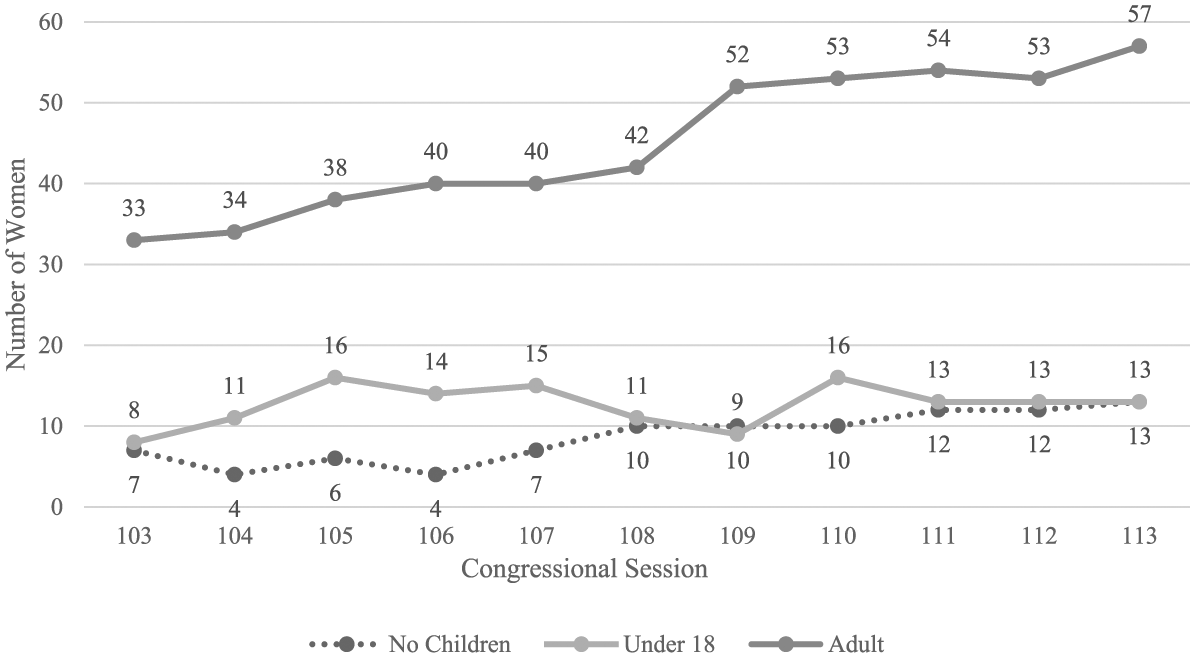
Female representative parental status by session of Congress (103rd-113th).
Hypotheses
Our first hypothesis is that female MCs with children will produce more legislation related to children and families than those without children. This includes bills pertaining to family medical leave, health insurance, and medical issues specifically related to children and family needs, school related issues, and child safety. 1
For our second hypothesis, we theorize that having children at home while serving in Congress matters to the legislative agenda. Members with young children have had to worry about child care, schooling, and even working with health insurance companies across state lines for their own children while serving in office and can more easily relate to the issues other families are facing. Due to recent experiences, their identity as a mother is active, rather than passive as it may be for mothers of adult children, and we hypothesize that women who have children below 18 years while they serve in Congress will produce more child-centered legislation than those members whose children are already adults. Formally stated, our hypotheses are
Data and Method
To test our hypotheses, we utilize three separate data sets: Congressional bill data, data containing personal information about female MCs, including the number and ages of their children by term, and data containing institutional and member legislative behavior information which primarily serve as control variables. Our data include 196 unique female MCs who have served a combined 784 Congress year terms. The unit of analysis for the data is a child and family-centered bill, sponsored by a female MC for a particular term, and covers bills introduced between the 93rd and the 113th Congress (1973-2013). The dependent variable is the count of Children and Family (C&F) bills sponsored in a particular session. We gathered the bill data using Python program code (JSON) which scraped data from GovTrack covering only bills which fell within our parameters of children and families. 2 Using a two-step process, we first selected data from five broad search terms based on categories predefined by the Library of Congress for Congress.gov: Education, Families, Health, Labor and Employment, and Crime and Law Enforcement. We then selected on narrow search terms specifically related to children and families to capture the full spectrum of policies that could directly impact children and families. Our final data include any bill which falls within our narrowly defined 15 subject terms. 3 Because we are interested in examining the role of motherhood, in particular, we further restrict the data to bills whose primary sponsor is a woman, resulting in a total of 3,840 C&F bills. We also present a subset of bills with the narrowest subject term that meets the requirement of our definition of C&F bills, these are bills whose primary subject term and/or bill title indicate a direct relevance to children and families. This subset of bills contains legislation that will have a direct impact on children and families, while bills in our complete data set include bills that have both a direct and indirect impact on children and families. Limiting our analysis to the subset of bills allows us to test our hypotheses on the narrowest definition of the bill subject, while the larger data allow us to test the hypotheses more broadly. 4 To create our dependent variable, we created a count of the bills sponsored by an individual woman MC for each session they were a member using their individual Thomas ID number. The count of bills ranges from zero to 33 bills per member per session.
Our key independent variables include whether a member is a mother and the age of her youngest child. These data were collected by the authors using a multistep process. First, we used the Official Congressional Directories provided by the Government Publishing Office, which includes short biographies and often lists names of member’s children. 5 To test the first hypothesis, we created a simple dichotomous variable comparing mothers with MCs without children. To obtain the ages of the children, we made use of both the History, Art, and Archives of the House of Representatives (Office of History and Preservation, Office of History and Preservation, Office of the Clerk, U.S. House of Representatives, 2006) as well as news articles found through Lexis Nexis and Google News. When news articles were used, we reverse engineered an approximate year of birth and age by subtracting the age of the child from the year the news article was printed. 6 Finally, we created three categories of children—no children, child/children below the age of 18 years, and adult child/children 7 —generating a factor variable. Each of these variables are coded for the particular Congress, such that if a woman became a first-time mother while in Congress she would be coded with zero children (0) up until the Congress when she gave birth and then coded as having one child (1) for subsequent Congresses. Similarly, the age category of the youngest child is also coded by Congress, once the youngest child reaches the age of 18 years the woman is no longer considered a “working mother,” but rather a mother of an adult child. 8 Over our 3,840 bill observations, 12.3% (491) were introduced by members without children, 17.1% (681) by members who had children below 18 years, and 70.6% (2,807) were introduced by members with adult children, similar to their proportions in the legislature.
It is worth noting that the data are dynamic in nature, giving us confidence the results are not being driven by a few select observations. Fourteen percent of the 196 representatives change categories, moving from no child to child or child to adult children, over their average 10-year tenure in Congress. There is also no one parental category that is introducing the majority of bills. Over the 20 sessions of Congress included in our data, women without children introduce the most C&F bills in four sessions, women with children in five sessions, and women with adult children in 11 sessions (see Figure B1 in Online Appendix B). Finally, to confirm the results are robust, we ran the analysis excluding the most productive MCs who introduced more than 150 pieces of C&F legislation and found that the results hold.
We use a series of control variables related to members’ institutional behavior in an attempt to isolate the effects of motherhood and minimize the possibility that policy agendas are related to political environment. These data were gathered from Volden and Wiseman’s (2014) Legislative Effectiveness Data, which includes data on the productivity of MCs along with other institutional variables. We control for seniority, as we expect that MCs with more seniority are likely to write more bills. Seniority is coded as the number of terms served and ranges from one to 16 terms. 9 Similarly, we include controls for the number of bills per session a member has written regardless of subject. We also use Volden and Wiseman’s bill type variables to distinguish between commemorative bills and substantive bills. This allows us to separate lower cost bills which require fewer resources and are often largely symbolic in nature (commemorative bills) from the higher cost bills which require more resources to develop and produce (substantive bills). We ultimately expect that higher the number of total bills a member writes per session across all issue areas, the higher the number of C&F bills. 10 Most Congresswomen do not write a commemorative bill in a typical session and if they do they will likely only write one or two, although a few members have written 15 or 20 in a single term in office. The mean number of substantive bills written in a term is 24.8, very few members in our data had a session when they did not write any legislation. As an additional check on the likelihood for bill sponsorship, we also control for whether the member was a part of the majority party.
We control for ideology, measured by a member’s DW-NOMINATE score (Lewis et al., 2016). It captures the distance from the ideological median chamber member and is thereby a relative measure of ideology based on the chamber median and a member’s entire voting history (Poole & Rosenthal, 1997). The variable theoretically ranges from −1 to 1 with scores closer to 1 indicating a conservative record. In our sample of female MCs, the mean DW-NOMINATE score is –.28, with a minimum score of −0.76 and a maximum score of 0.97. 11 (See Table 1 for summary statistics for all of the independent variables used in our models.) We use ideology rather than party membership because of the higher degree of variation in the ideology variable allowing for control in variation among women partisans. 12
Summary Statistics of Variables of Interest.
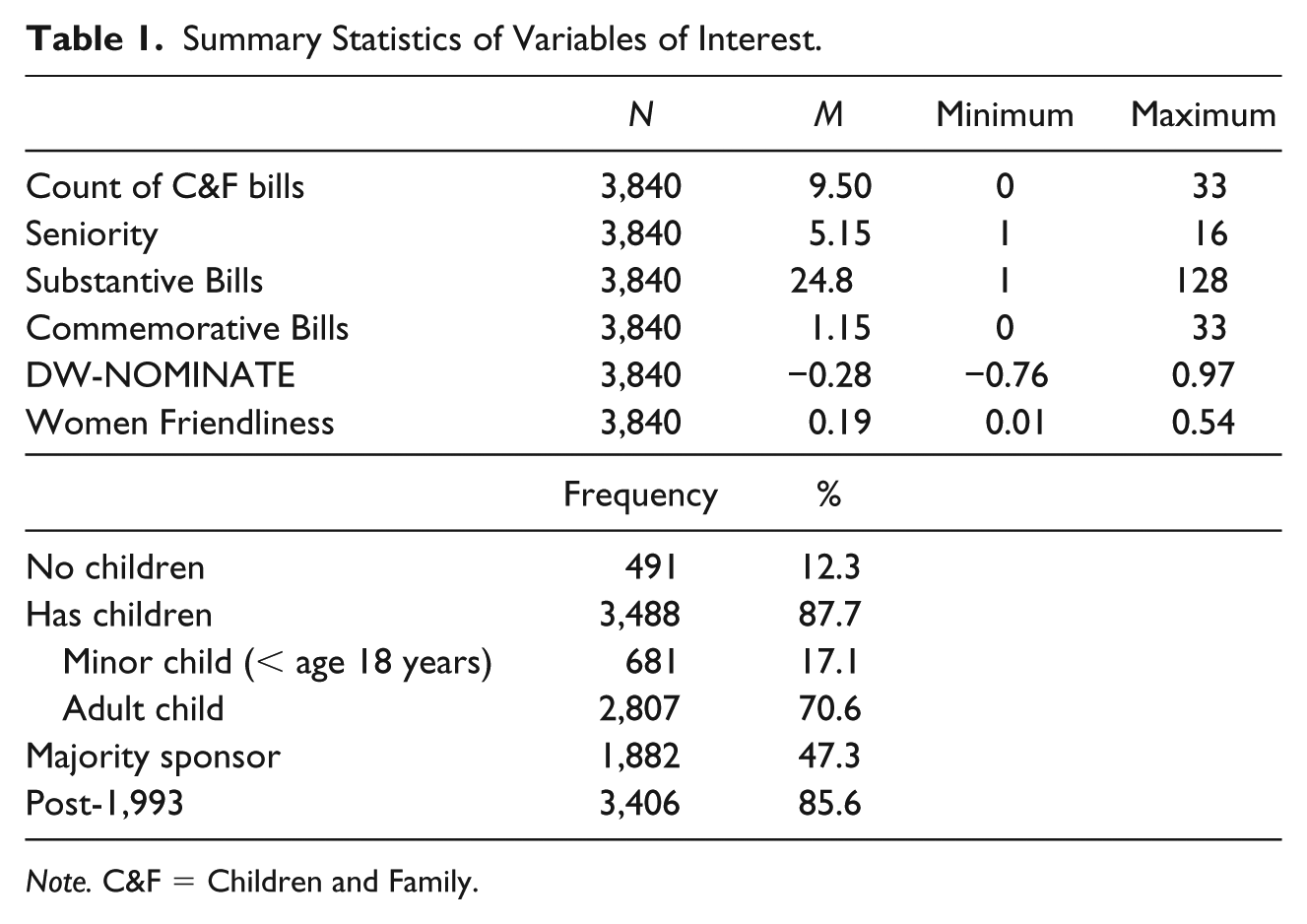
Note. C&F = Children and Family.
Thinking about ideology, it is clear that not all C&F bills are liberal or conservative in nature. We expect that for some issues, such as access to health insurance or protection of children in abusive households, motherhood will trump ideology. In addition, the full set of bills includes bills which are both restrictive and expansive in nature. For example, the data include bills which are both pro-choice and pro-life in terms of the abortion debate, bills that seek to expand S-CHIP and bills that seek to restrict funding for the program. Examining a dependent variable which is not defined by ideology is important because, as Osborn (2012) finds, women on both sides of the aisle place priority on women’s issues but their policy position on the subject are [often] viewed through an ideological or partisan lens.
District preferences may also drive legislator preferences; Palmer and Simon (2012) show that some districts may be friendlier toward women candidates than other districts, this suggesting that these districts may be friendlier toward “women’s issues,” including children and family policy than other districts. We use control for this using Palmer and Simon’s (2012) data on the “women-friendliness” of Congressional districts. This variable is continuous and ranges from 0 to 1, with greater numbers indicating an increased likelihood of the district electing a woman (Palmer & Simon, 2012). It is notable that most districts are not very “woman friendly,” with a mean of 0.19. The same holds among mothers as the correlation between the two variables is only 0.09. We also recognize that, given the long time range, significant differences have been made in the composition of the House along gender lines; as such, we include a dummy variable for the years 1993-2013. 13
We present three models using negative binomial regression (due to the over-disbursed count distribution of the dependent variable, see Long & Freese, 2014) to predict the count of C&F bills. We also estimate predicted counts of bills by session to interpret the substantive results of the models. The first model includes a dummy variable as the key independent variable (child/no child), the second model uses a three-category variable of the age of the youngest child, and the final model includes only the restricted sub sample of bills specifically dealing with children and family subjects. 14 To ensure the independence of each member across the time range, we cluster around the individual member.
Results
The results of the three models are presented in Table 2. The results for Model 1 show that having a child predicts a significantly higher number of sponsored C&F bills than not having any children. These results support Hypothesis 1, which suggested that women who are mothers sponsor more legislation pertaining to children and families than those who are not. Much of the literature on women as legislators and women’s issues suggests that female legislators sponsor these types of bills, in part, because of their particular experiences, including motherhood. This line of argumentation follows an essentialist pattern in failing to recognize the varying experiences of women. Our results show that while women without children do write at least some bills relating to children and family policy, women who are mothers write significantly more bills in these areas.
Count of C&F Centered Bills Sponsored.
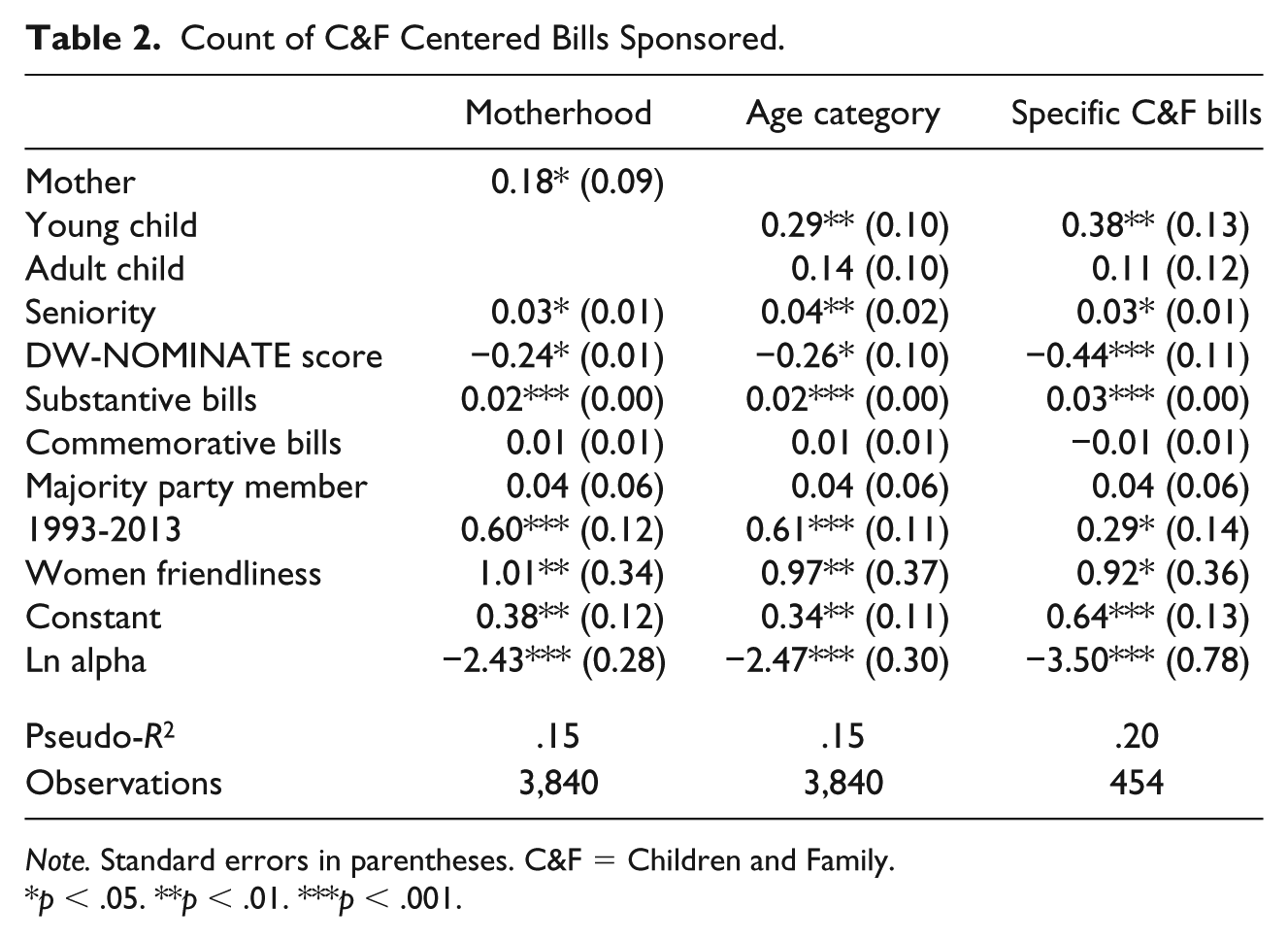
Note. Standard errors in parentheses. C&F = Children and Family.
p < .05. **p < .01. ***p < .001.
Model 2 further disentangles differences between working mothers with children below the age of 18 years, and women who are mothers of adult children. In Hypothesis 2, we presented an expectation that members who have a child below the age of 18 years while in office will introduce more child and family-centered bills than members who have adult children. We expect a recency effect or an increased identity salience for women who are actively balancing their careers as MCs with raising their children, including actively dealing with policy issues pertaining to children and families, and these women are more likely to sponsor such legislation. The results show that while mothers of minor children do produce significantly more C&F bills than women MCs who are not mothers, there is no significant difference between mothers of adult children and female MCs without children. 15
The predicted counts of sponsored C&F bills determined by the age categories of children, presented in Figure 2 (also available in Online Appendix B, Table B2), reveal the substantive differences between women in Congress without children, working mothers, and mothers of adult children. For the first model, the results show that female legislators without children sponsor an average of 6.98 C&F bills during each session, compared with mothers who sponsor an average of 8.35 C&F bills, meaning that mothers sponsor 1.37 more C&F bills than women without children for each session they are in office. For the second model, which disentangles age groups of children, the results show that working mothers of children below the age of 18 years sponsor 9.37 bills each session, an increase of an average 2.34 bills per session over women without children, who sponsor 7.03 bills per session on average. Mothers of adult children sponsor 8.09 bills per session, a 1.28 bill drop per session from working mothers.

Predicted count of sponsored bills by session.
These results suggest that there is a recency effect in that when women are actively dealing with the needs of children and the potential strains of family life (Greenlee, 2014), particularly as working mothers, they are more likely to relate to these issues, more likely to relate to other mothers, and they are likely to sponsor these types of bills. Although women who are mothers of adult children may write more C&F bills than women without children, once the children are grown and the woman becomes an “empty-nester,” the salience of their identity as a mother may be reduced in comparison to the working mothers (Greenlee, 2014). This is especially important when we consider the differences in the women who are running for office, and changes among women who are in office for long terms. Our data reveal something important about the literature’s somewhat essentialist expectations of descriptive representation of women as champions of child and family policy. We suggest that these expectations may be tainted by assumptions that the experience of motherhood as an identity and influencing characteristic on legislative behavior does not change over time. Most women who run for Congress are either childless or are mothers of adult children because of the strains of public life and the intense, long work hours. Our data reveal that the strongest supporters and most prolific sponsors of C&F bills are mothers, and specifically mothers who currently have young children while they serve in the House.
Model 3 is limited to the subset of the specific C&F bills. Again, this subset of bills includes only those with primary categories directly related children and families. This model follows the same pattern as the other models and shows that working mothers of young children write more bills specifically related to children and families than other women. All variables remain significant and in the same direction as in the first two models. According to the predicted counts for the subset model, women without children write the fewest such bills at 7.91 per session. Women with adult children write more bills that specifically relate to children and families, writing 8.86 such bills per session. Finally, working mothers write 11.52 bills per session dealing specifically with children and families.
For each one of our models, several of the control variables are also significant and most are in the expected direction. Women with more seniority write more C&F bills than women who were elected more recently. Not surprisingly, the total number of substantive bills a female MC writes in a session predicts her subset of C&F bills, as this is a measure of how prolific she is in developing legislation. However, the number of commemorative bills sponsored in each session does not impact the number of C&F bills written. More liberal members wrote more children and family legislation, but belonging to the majority party did not affect the number of C&F bills an MC sponsored. Other contextual factors such as the later era (post-1993) of gender composition and the district probability of electing a woman were both significant.
Conclusion
Being a MC is time-consuming, requiring long hours, travel back and forth to Washington, D.C., campaigning, fundraising, and opening your life up to the public. These conditions are not necessarily conducive for attracting mothers of minor children to the job; however, a fair number of women over the years have chosen to work as Congresswomen while raising children and women from both parties have even served in party leadership positions while their children were young: Debbie Wasserman Schultz (D-FL) was the former head of the Democratic National Committee and Cathy McMorris Rodgers (R-WA), who gave birth to all three of her children while serving in the House (Kim, 2013), served as the Vice Chair of the House Republican Conference from 2009 to 2013. There is little doubt that having women serve in the House is good for women overall, but we examined whether or not having working mothers in the House produces more legislation that is aimed at children and families. The majority of women in the House are mothers, but we find that mothers of young children do sponsor more legislation focused on families and children.
We collected information on bills over a 40-year period, limiting analysis to those bills that fit categories directly related to children and families. We then examined bill sponsorship controlling for the ages of members’ children. The results show that working mothers consistently produce the most bills related to children and families. In all of our models, women with children below the age of 18 years at home sponsored more legislation than women who had adult children and women without children, suggesting that being a mother may play a role in shaping a legislative agenda similar to gender and racial or ethnic identities.
It is common to hear the expression that you do not quit being a mother after your children are grown in popular culture; however, our data suggest that, while one may still be a mother, identity might not be as salient for women with grown children as it is for those with younger children and they might not continue to be concerned about parental issues to the extent that they were when their children were young. This is an important point not to overlook. In the past, literature has treated women as a whole as champions of child and family policy, we argue that this is not so and that mothers in general, and mothers of minor children in particular, are the real workhorses of these policies. When it comes to representing parental issues, such as children’s health insurance, child safety, family leave, and reproductive policy, among others, working mothers really are representing more effectively.
These results are promising, but they are not without their limitations. For one, these analyses are limited to working mothers and we make no comparisons to working fathers. It is possible that Congressmen with young children behave in ways similar to Congresswomen with young children, introducing more family-focused legislation than their male counterparts with grown children, and that they are also acting as champions of policy for children and families; the literature should be expanded to include this. Furthermore, we recognize that motherhood is but one layer of a woman’s identity, and that there are other salient identity variables that may interact with motherhood, such as race and ethnicity in particular; however, at this time there is insufficient power to specifically examine the interaction between these variables. Given our interest in examining motherhood as a new explanatory factor, we restrict our analysis to variables that the literature has already related to bill sponsorship and children and family legislation. It is our hope that future scholarship, given the available data and power, will be able to address these additional intersectional explanatory factors. In addition, we did not account for the nature of the bills, only the topic of the content. Future research should also account for whether these bills are expansive or restrictive in nature, including providing more protections for families and children, or limiting the role of government in these arenas, which could reveal ideological differences.
Although there is still work to be done, these results show that having parents of young children in Congress matters. Parents are dealing with issues like children’s health insurance, finding affordable quality child care, changes in school curriculum, vaccinations, and child safety requirements and protections day in and day out. They are in touch with what other parents are going through and are in the best position to craft policies that address these areas of concern, and our findings suggest they are performing as they should, providing substantive representation for parents and children across the country.
Supplemental Material
APR808037_Online_Appendix_CLN – Supplemental material for Working Mothers Represent: How Children Affect the Legislative Agenda of Women in Congress
Supplemental material, APR808037_Online_Appendix_CLN for Working Mothers Represent: How Children Affect the Legislative Agenda of Women in Congress by Lisa A. Bryant and Julia Marin Hellwege in American Politics Research
Footnotes
Declaration of Conflicting Interests
The author(s) declared no potential conflicts of interest with respect to the research, authorship, and/or publication of this article.
Funding
The author(s) received no financial support for the research, authorship, and/or publication of this article.
Supplemental Material
Supplemental material for this article is available online.
Notes

Author Biographies
References
Supplementary Material
Please find the following supplemental material available below.
For Open Access articles published under a Creative Commons License, all supplemental material carries the same license as the article it is associated with.
For non-Open Access articles published, all supplemental material carries a non-exclusive license, and permission requests for re-use of supplemental material or any part of supplemental material shall be sent directly to the copyright owner as specified in the copyright notice associated with the article.
