




Abstract
The ability of American political parties to change issue positions is potentially hindered by problems of coordination. Research on parties since the 1990s has shown what tools party leadership can use to enforce discipline and cohesion among its ranks. We, however, question whether those theories of party control, which explain party stability, can straightforwardly explain party change. Oftentimes we think of parties strategically altering issue positions, but what is “the party?” Rather than a monolithic group, American parties are relatively decentralized, weak, and individualistic compared with other party systems. We present an evolutionary game theoretic example to illustrate the problem of coordination in party change. This theoretical framework suggests an empirical focus on individual-level behaviors to better understand the dynamics of party change. We analyze roll call voting of members of Congress on the environment and abortion to illustrate micro-level behaviors suggested by our theoretical discussion.
Party change is an important aspect of democratic politics with the United States as no exception. The American major parties are under constant pressures to build and sustain their electoral and legislative coalitions, as seen during the contentious 2016 presidential primaries for both major parties as well the continued intra-party conflicts since then. Changes in U.S. politics since the 1960s have spurred extensive research on parties, in particular, their ideological polarization (e.g., McCarty et al., 2008; Theriault, 2006; Thomsen, 2017) and polarization among a wider range of issues (e.g., Carmines & Stimson, 1989; Layman & Carsey, 2002; Lindaman & Haider-Markel, 2002; Shipan & Lowry, 2001).
A significant point to account for when analyzing American parties is how they are relatively weak and decentralized compared with their European counterparts. 1 Considering the incentives of individual politicians is, therefore, important, which has long been recognized in the legislative politics literature. For instance, in his seminal work, Mayhew (1974) analyzes each member of Congress (MC) individually, each maximizing her own chances for re-election with little consideration of parties. Although the political times have changed, particularly the reemergence of partisanship, Mayhew’s initial insight is still instructive. Following in his footsteps, rational choice accounts of parties similarly analyze the strategic calculus of individual party members, which has led scholars to consider in-depth the relevance of collective action problems to establishing and sustaining parties (e.g., Aldrich, 2011; Cox & McCubbins, 1993).
Recent studies of party change, however, have given less theoretical attention to the individual choices of politicians and potential problems of coordination, as an example of a coordination problem, suppose the party wants to adopt a more extreme platform. One might simply use a simple Downsian model to analyze changes to the parties’ platforms, but that approach explains electoral competition at the district/race/individual level, rather than party level. How can the party coerce all of its members and potential new candidates to adopt that new platform? Karol (2009), for example, argues how each party’s issue commitments are a product of coalition management, but this raises the question of exactly who within the party plays the role of manager. Schlozman (2015) likewise stresses the importance of social movements in the transformation of the political parties’ issue commitments, but again the question remains of “who” responds on behalf of the party or how does a large enough set of party members coordinate “the party’s” response (“large enough” to be a meaningful signal of a shift in the party’s issue position)? One might argue that presidential elections with its national constituency drives positioning of the national parties, but the potential impact of presidential politics on the parties’ characteristics is not straightforward or trivial, which motivates our focus on the individual-level and the potential coordination problems that may arise.
Our analysis of party issue change among party elites, specifically among elected officials (i.e., party-in-government), makes two contributions to the literature. The first and primary contribution is theoretical, highlighting an important point that is not fully appreciated in the literature. Similar to the use of the prisoner’s dilemma to describe coordination issues in the maintenance (stability) of party coalitions, we use an evolutionary game theoretic example to emphasize coordination issues in party change. Rather than treat each party as a monolithic group and use a unitary actor assumption when analyzing the strategic elements of party change, we argue that it is beneficial to consider parties as a collection of individual politicians and their choices. Although actors such as party leaders and organized groups could play a role in coordinating change, considering an idealized case of purely individualistic players provides important insights. We highlight how party change is (a) not inevitable, even when a new policy commitment is beneficial for the party, and (b) not straightforward, in which party members pursue new policy positions sincerely without any strategic considerations. Our second contribution is empirical. Following insights from our theoretical discussion, we assess party change in the United States on abortion and the environment, which are two issues that have received significant attention in the literature (Adams, 1997; Lee & Schutte, 2017; Lindaman & Haider-Markel, 2002; Shipan & Lowry, 2001). While previous work has shown how the parties on average shifted their issue positions, we analyze cross-member variation in issue change.
Individual Incentives for Party Change
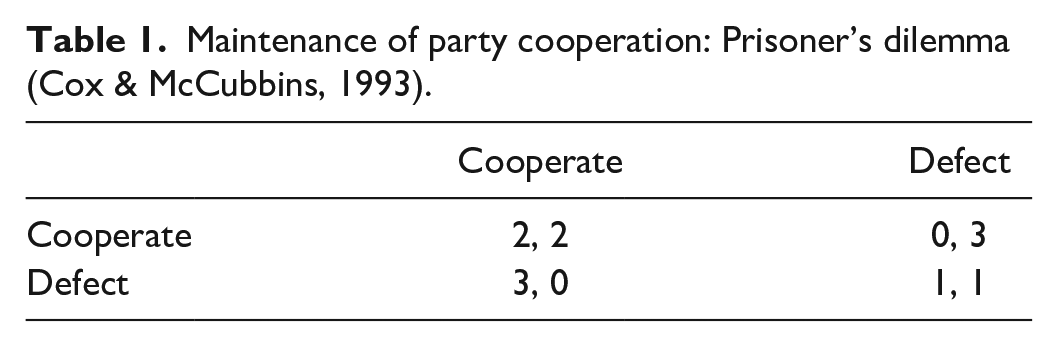
Rational choice theories of parties have considered in detail how collective action problems can impact party maintenance (e.g., Aldrich, 2011; Cox & McCubbins, 1993). If individual MCs each pursue their own interests (e.g., distinct districts and constituencies), then how can parties ensure cooperation among their members to achieve collective party goals, that is, enforce party loyalty? Kiewiet and McCubbins (1991) and Cox and McCubbins (1993) depict this problem as a prisoner’s dilemma (see Table 1), whereby each MC has an individual incentive to defect from pursing partisan goals (developing a party brand name) and instead pursue their own electoral interests., that is, if party members act individually, then the group might only achieve the non-cooperative outcome of all members defecting. The Conditional Party Government and Cartel Theories stress how party leadership uses powers of reward, punishment, and agenda control to overcome collective action problems and enforce party loyalty to successfully pursue the party’s collective goals, that is, achieve the Pareto-optimal outcome (Aldrich, 2011; Aldrich & Lee, 2015; Cox & McCubbins, 1993, 2005; Rohde, 1991). More recent research follows in this vein and argues how costs and benefits can be imposed to coordinate the actions of individuals to develop the party brand name (e.g., Grynaviski, 2010; Snyder & Ting, 2002).
Maintenance of party cooperation: Prisoner’s dilemma (Cox & McCubbins, 1993).
Although previous literature shows that party leadership may be able to enforce party stability, we question whether that is true in the case of party change. 2 In the case of stability, party members already (generally) agree on policy goals and acquiesce enforcement powers to leadership in order to sustain that equilibrium. However, in the case of party change, there likely is disagreement within the party. Some members may prefer keeping the status quo (SQ), while others prefer a shift on policy. When there is disagreement within the party, members are less willing to give powers to leadership to enforce loyalty, which, therefore, hinders party change. There first needs to be coordinated change among rank-and-file members in the party caucus, which is the focus of our article, before powers are given to leadership to enforce that new equilibrium. The Conditional Party Government perspective (Aldrich, 2011; Rohde, 1991) indeed argues that changes in the party caucus precede increased party leadership strength (i.e., intra-party homogeneity is a necessary condition for strong leadership), and indeed looking back at the experience of the Democratic Party during their transformation in the latter half of the 20th century, newer caucus members, such as members of the Democratic Study Group, actively pursued organizational reforms and substantive change, at times in conflict with the Speaker. The desire for change among many in the caucus left many frustrated with Speaker Albert and desiring a quicker transition to O’Neill as the next Speaker (Lawrence, 2018). 3
Studies of party change have given less attention to the incentives of individuals and the problem of coordination. 4 Karol (2009) presents perhaps the most comprehensive analysis of the topic, and he argues how each party’s issue commitments are a product of coalition management. Like other group-centric party theories, Karol stresses the importance of organized interests and views parties as networks of groups of policy demanders (Bawn et al., 2012; Cohen et al., 2008; Schlozman, 2015). An open question from our perspective, however, is exactly how competing demands are resolved to determine which groups will be represented by the party. Karol incorporates strategic choices of politicians by arguing how each party’s issue commitments are a product of coalition management, but this raises the question of exactly who within the party takes part in the role of manager. 5 Similar to our perspective, Schickler (2016) questions party theories that downplay the impact of conflicts within the party, stressing how American parties are decentralized, focusing on the impact of federalism in his account. Although Schickler accounts for intra-party conflict by looking at national party leadership’s response to shifting sub-national party coalitions in his analysis of civil rights, we delve one layer deeper into the dynamics of change by analyzing the incentives of individuals within the party caucus.
Given the individual incentives of members, what might help coordinate action? Observers of U.S. politics often look to the presidency as an important actor in promoting party change—or relatedly, the adoption of the party platform at the party national conventions. Since the presidency is the only office with a national constituency, its focus is justifiable, and perhaps the response of Republican politicians during the Trump presidency is an affirmative example. However, the parties’ presidential nominees do not have any inherent powers that can enact some strategic shift of all party members. Although party platforms can act as a strong signal to party members as to what policy positions are acceptable, which could potentially influence legislative behavior or the candidate entry decisions of new members into Congress, there is not any mechanism to explicitly enforce those policy positions on the parties’ nominees for the various offices (federal or state and local). Grynaviski (2010, pp. 195–197), for instance, tracks President Roosevelt’s efforts to purge conservative Democrats from the party leading up to the 1938 midterm elections. Despite FDR’s efforts to support certain primary candidates, he was ultimately unsuccessful—only 1 out of 10 conservative Democrats he targeted lost their primary election (Grynaviski, 2010, p. 203). Dunn’s (2010) account further details how he did not fully account for the decentralized nature of American parties, such as dealing with local party organizations, the incumbency advantage, and the importance of challenger quality. In addition, research suggests that changes in state party platforms on civil rights and other culture war issues preceded changes in the national party platforms (Carr et al., 2016; Feinstein & Schickler, 2008), that is, the national party platforms do not appear to be a source for coordinated change of the national parties, which is our focus.
As just alluded to, coordinated change is particularly difficult, given the nomination processes used by the political parties in the United States. Rather than under the control of a centralized national party committee, nominations are made by less invested individuals (i.e., primary election voters) in each district separately, that is, even if the party wanted to shift policy commitments of their nominees, it is up to voters to support that change. To be sure, the party establishment and organized groups can still influence the nomination through primary elections (Cohen et al., 2008), but they work within constraints, as seen in the GOP presidential primary in 2016. Primaries also add yet another layer of coordination, that is, coordination both within and across the numerous primaries to ensure preferred candidates win.
Although our analytic approach follows the individual-centric perspective, our goal is not to settle the debate of individual versus group theories of parties. For instance, our treatment is agnostic about exactly how group demands are incorporated into the strategic calculus of politicians, that is, what induces members’ preferences (e.g., interest groups, constituents, personal ideology). 6 We simply take individuals as the analytic units, as a somewhat idealized case, to highlight one aspect of party change—coordination.
Coordination and Party Change
We can depict the problem of coordination by using a simple game theoretic example. 7 As stated earlier, we can think about the problem of party stability (i.e., developing a particular party brand name) as a prisoner’s dilemma. We use a simple two-by-two payoff matrix to give one potential illustration of a collective action problem of coordination for a political party.
Two party members of a party each choose to either keep the SQ or shift their issue position (∆). If one player decides to change while the other player is sticking to the SQ, then both players receive lower utility from intra-party conflict. They lose the electoral benefits of developing a clear brand name from taking a cohesive position on an issue. Conversely players receive some benefit from cooperating in attaining a collective goal, either (SQ, SQ) or (∆, ∆), which gives a payoff of 2 or
Coordination in party change.
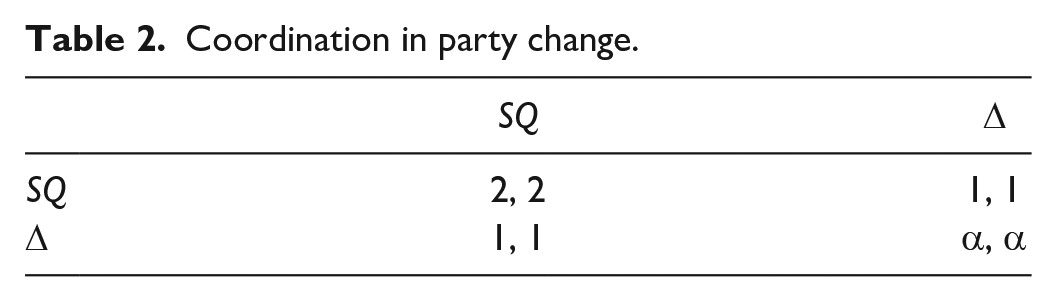
Suppose we begin in an equilibrium SQ state of the party system, in which
This simple two-by-two game illustrates a few points.
9
When
One might argue that party leadership can enforce a shift to a new equilibrium, much like how they enforce the maintenance of a cooperative outcome in the prisoner’s dilemma case. The power of leadership, however, is conditional upon rank-and-file members (i.e., the party caucus) acquiescing enforcement powers (e.g., Aldrich, 2011; Rohde, 1991), but that likely only occurs after rank-and-file members have shifted toward the new equilibrium by the dynamics we discuss below—and indeed, conditional party government stresses intra-party homogeneity and inter-party polarization, that is, if party leadership is to enforce the collective goals of the group, then we first must know what the goals of the group are in the first place. Cox and McCubbins (2005), however, stress that the majority party leadership’s negative, agenda-setting powers are not conditional. Thus perhaps, through agenda control, leadership can dictate the party’s position. In terms of change, however, we believe that positive agenda control, which can then lead to nonmedian outcomes that stress inter-party differences, plays an important role, that is, the Democratic Party was increasingly viewed as the liberal party since the 1970s, not just through blocking conservative bills but in part through voting on and supporting liberal bills. 10 Lawrence’s (2018) historical account of the reform era, retelling of the tensions between liberal Democrats and leadership and the caucus votes for leadership positions, indeed illustrates the interplay between caucus and leadership and how the push for change originated within the caucus rather than from entrepreneurial leadership. 11
Evolutionary game theory can help explain the shift from a Pareto suboptimal to optimal outcome in more detail than simply asserting that players are drawn to the latter outcome as a focal point. Although used initially in evolutionary biology to study changes in animal populations through natural selection, social scientists have also adopted evolutionary models to analyze human behaviors in social settings.
We can interpret the game depicted in Table 2 as one in which a population of many players can be one of two types, SQ type or ∆ type, and we analyze the repeated interactions between random pairs of players within the population. Each cell states the payoffs for any random-pair interaction. As before, party members receive some benefit from cooperating to help achieve a collective goal, either (SQ, SQ) or (∆, ∆). In evolutionary biology, genetic traits define types, whereas for our topic, (induced) preferences of members determine their type. Some members represent interests that are in line with the SQ, while others represent interests that prefer party change. What type a member is (i.e, their preferences, which determines whether they play SQ or ∆) could stem from personal policy preferences or induced by social groups or movements (Karol, 2009; Schlozman, 2015) or constituency (Karol, 2009; Schickler, 2016). Evolutionary games also allow us to relax assumptions about the knowledge of the players, which may be particularly important for our topic. Perhaps players do not know the long-term effects of shifting the party’s issue commitments, that is, the value of
Rather than use the Nash equilibrium solution concept, we can look for evolutionary stable strategies (ESSs) to denote the equilibrium (see Kanthak & Krause, 2012 as another application of ESSs in political science). In an ESS, the strategy is optimal to the introduction of a small number of mutants in repeated play of the game. Both of the NE shown above are also ESSs in this case:
13
Suppose we are under case 1 and the native population is all SQs and suppose we now introduce a small number of ∆ s. They receive lower utility than SQs (1 vs. 2), so they eventually die off. Thus, the SQ is an ESS. In case 2, when
This example demonstrates that coordination problems can preclude the ability for a party to adapt over time, even when doing so would greatly enhance the utility of all party members. The cards are especially stacked against the Pareto-optimal outcome when considering the sequential nature of events, starting at the (SQ, SQ) outcome. The influx of ∆ s into the population is, therefore, not sufficient for a change in equilibrium, since they only attain the Pareto-optimal payoff when interacting with one another, while receiving a payoff of only 1 when interacting with SQs.
Robson (1990), however, defines a strategy that can shift the population to the Pareto-optimal, coordinating outcome (see also Kanthak & Krause, 2012).
15
Suppose
Note that we can interpret the shift to the Pareto-optimal equilibrium over time as occurring from either the replacement of SQs with ∆ s (natural selection) or from SQs adopting ∆’s successful strategy (imitation). The transformation of the party, in terms of the relative balance of these two types in the population, is also predicted to be smooth and continuous, rather than a rapid change as associated with a punctuated equilibrium.
18
One possibility that is outside the scope of this article, however, is that there could be rapid change when ∆ type reach a majority, given the use of majority voting for party leadership positions. Also note that the president, party leaders, or organized groups could still be important actors in shifting the party, even in this individualistic model, but rather than directly impact the decisions of party members, they may focus their energy on influencing
Empirical Questions to Consider
The evolutionary game theoretic model highlights that party change does not occur simply from an influx of new members that prefer change. The infusion of new types who are willing to change policy (replacement) is necessary to instigate a shift in the party, but in the ESS equilibrium shown above, we expect to see hedging behavior among the new members, rather than complete, uncompromising devotion to party change. Member adaptation (imitation) should be expected among the original population, given the increased utility from changing their strategy (higher “fitness” of types playing the new strategy) or otherwise risk dying off given their relative lack of “fitness” in the newly emerging population. We also expect adaption of new members over time, as the mix of types in the population changes over time.
The model suggests that analyzing variation among individual legislators may be important for understanding the dynamics of party change. Previous studies generally track aggregate shifts in issue scores of party members (Carmines & Stimson, 1989; Karol, 2009; Theriault, 2006; Wolbrecht, 2000). Our discussion, however, suggests that analyzing patterns within those trends (i.e., member heterogeity in “type”) will provide further insights on how party change occurs.
In order to make our discussion more concrete, we empirically consider the specific legislative action of roll call voting in the U.S. House to observe whether patterns of voting are consistent with the basic thrust of the evolutionary model. Roll call voting is one example of an action that legislators take part in that either supports the SQ or pushes for change, and it is one observable action that reflects members’ attempts to build coalitions to either keep or change the SQ. We take roll call votes as a measure of legislators’ (revealed) issue preferences and the collection of party members as an indication of the party’s position. There are of course a wide variety of other behaviors we could analyze instead, such as patterns in campaign fundraising, bill cosponsorship, and legislative agenda setting, but given the centrality of roll call voting in previous work on party change and party politics, it is an attractive initial candidate. Since our primary goal is to illustrate the problem of coordination in broad theoretical strokes, the evolutionary model is quite abstract and does not hypothesize specific mechanisms that lead to change, such as the role of primaries. We leave more in-depth analyses of how coordination can impact those mechanisms for future work. The evolutionary model, however, suggests a few empirical patterns.
Observation 1, member replacement (new members): Those with preferences for a shift in issue position (i.e., mutants) initially are playing a compromising strategy, at times pushing for change, while also cooperating with the existing population. The need to cooperate (compromise) early on is necessary to survive in the existing environment (playing SQ with the existing population). Thus, initial cohorts of change will be more moderate in their revealed preferences (roll call votes) compared with later cohorts.
Observation 2, member adaptation: Later cohorts of change are expected to change less over the course of their careers compared with earlier cohorts. Those from earlier cohorts needed to initially cooperate with originating population (see Observation 1). As the population evolves, that need diminishes.
Observation 3, member adaptation and member exit: Members of the originating population (those without a strong preference for party issue change) have increased pressures to adapt (imitate) or otherwise die off (leave office). Thus, cohorts from before or early on in the issue change are expected to polarize on the issue over the course of their careers more than new entrants. We would also expect that those who cannot sufficiently adapt and are out of step with the emerging party position are more likely to leave office compared with other members.
Party Change on Abortion and Environment
The evolutionary model provides a theoretical rationale to explain patterns we might observe in party change. We assess change on the issues of abortion and the environment, which have received significant amounts of attention as central issues that have evolved in the American party system in the contemporary era (Adams, 1997; Karol, 2009; Lee & Schutte, 2017; Lindaman & Haider-Markel, 2002; Shipan & Lowry, 2001). In addition to looking beyond the general trend of ideological polarization (Theriault, 2006; Thomsen, 2017), considering these two specific issues could explain observed differences in our analysis. First, the timing of the parties’ transformations were slightly different. Although measures of polarization show similar over time trends for the two issues, more in-depth analyses show that the parties were becoming especially cohesive on abortion during the 1990s, while the parties were already quite partisan on the environment by that point (Lee & Schutte, 2017). Second, abortion is often seen as the protypical culture war issue and arguably evokes stronger moral and emotional responses from both legislators and voters compared with the environment, which could contribute to a lower propensity of party members to evolve abortion compared with the environment. Our analysis of party issue change utilizes interest group ratings of legislator voting records. We use NARAL and League of Conservation (LCV) vote scores to measure the issue positions on abortion and the environment, respectively. To aid in cross-temporal comparisons of scores, we adjust scores using the method developed by Groseclose et al. (1999). NARAL (formerly the National Abortion and Reproductive Rights Action League) scores are available for the 95th to 111th Congresses (1977-2010). LCV scores included are for the 92nd to 111th Congresses (1971-2010). Figure 1 displays the pattern of increased partisan polarization on the issues of abortion and the environment, as seen in other works (e.g., Adams, 1997; Karol, 2009; Shipan & Lowry, 2001). 19 The aim of our article is to explain how individual-level variation contributes to that pattern.

Issue polarization: an average democrat vs. average republican.
New Members and Member Adaptation
Figures 2 and 3 looks at legislators’ issue preferences on abortion and the environment across cohorts. House members are split by cohort (a year member was first elected into the House): pre-1960, 1960s, 1970s, 1980s, 1990s, and 2000s (split by Census decades, e.g., 1962-1970). We report the average House member’s vote score during their first (available) Congress as well as the average Congress-to-Congress change in the interest group score for a member throughout her career. 20 Average changes above the zero line are shifts toward increased liberalism on the issue, while values below the zero line are shifts toward increased conservatism.
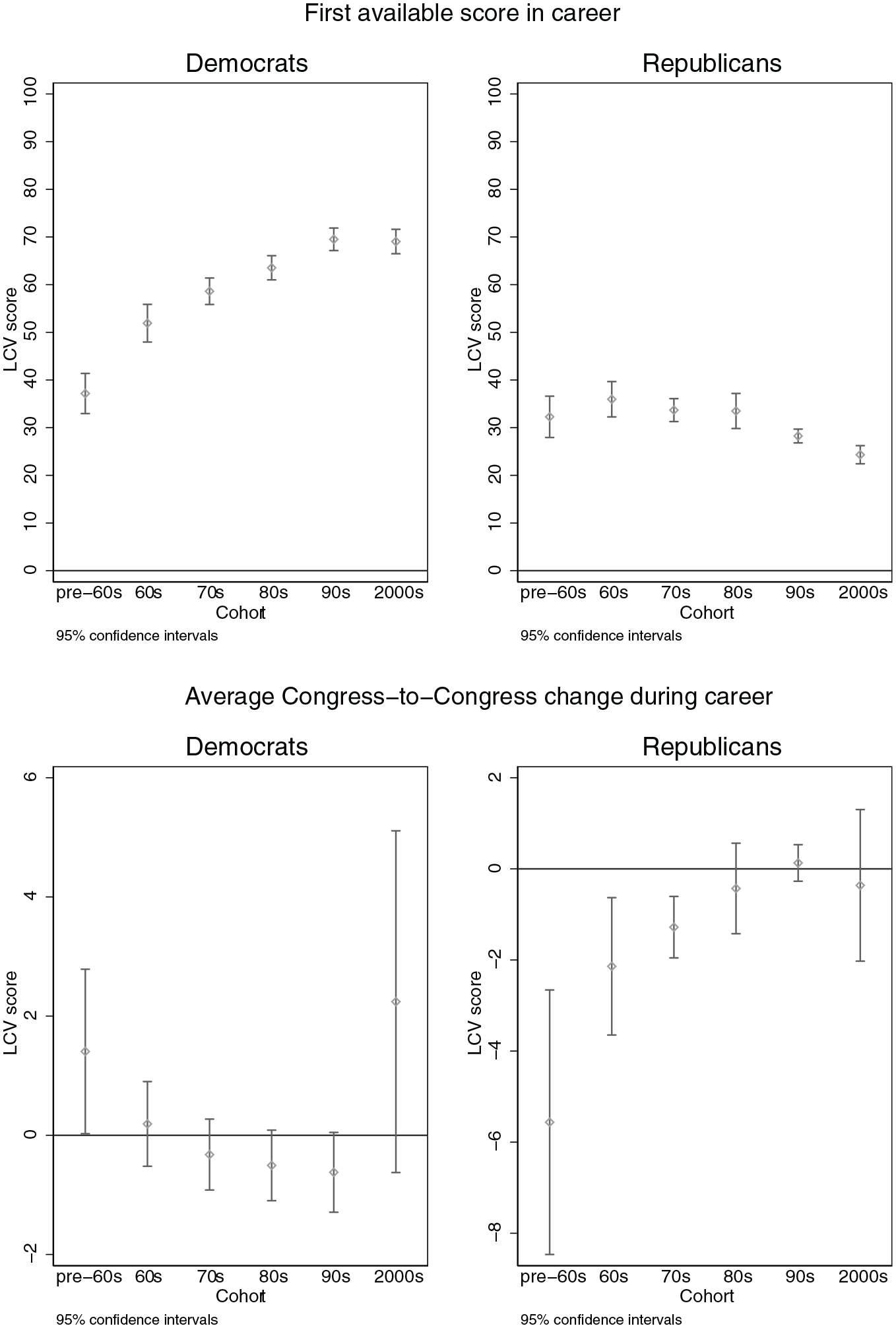
Environment (LCV scores) by cohort.
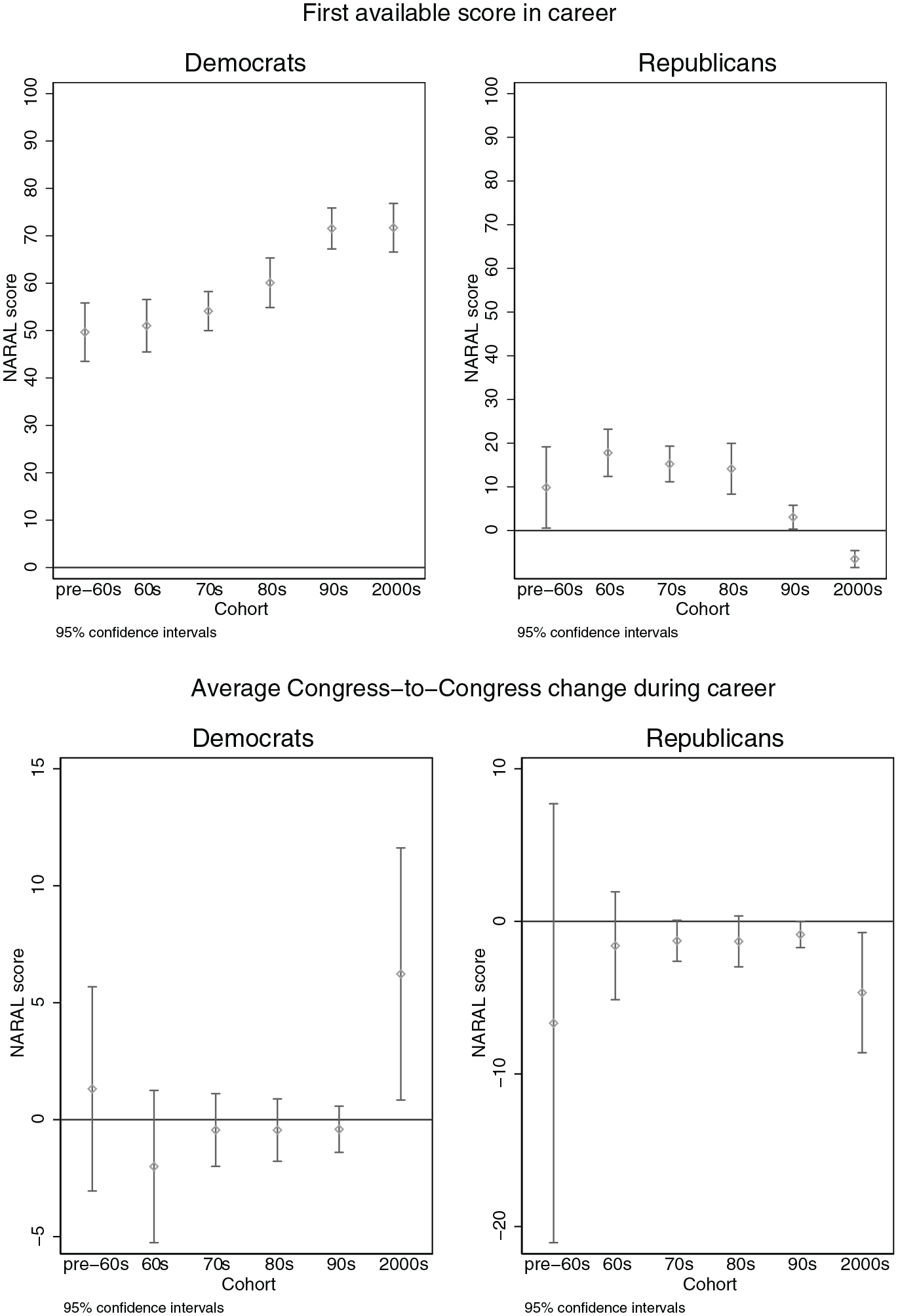
Abortion (NARAL scores) by cohort.
We can first observe patterns consistent with Observation 1. The first panels of Figures 2 and 3, which report members’ first issue scores by cohort, show incrementally more polarized incoming House members on the environment and abortion. Given that these are two different issues with different histories, it is not surprising to see differences between the two issues. For instance, particularly among Democrats, the shift toward extremism of new members followed a later timeline for abortion compared with the environment, which is consistent with research that notes how the environment became more straightforwardly partisan before abortion (Lee & Schutte, 2017), but overall, for both parties and issues, the general pattern is that later cohorts were increasingly extreme.
We can also observe the extent to which members adapted their behavior over the course of their careers by looking at each member’s average Congress-to-Congress change in issue score, which is shown in the second panels of Figures 2 and 3. First looking at the environment, levels of adaptation are higher among earlier cohorts, as expected (Observations 2 and 3). The evolution of Republicans on the environment gives the cleanest illustration of the behavior predicted by the evolutionary model. The average Congress-to-Congress changes are negative and statistically significant for several cohorts, and the magnitude of member adaptation decreases over time. Given the Republican party position, Republicans elected before the 1980s polarized largely through adaptation, as they were constrained to initially fit the existing population. By the 1990s, however, the composition of the party had changed enough, whereby incoming Republicans did not need to compromise and could immediately adopt conservative positions without any need to later adapt. Among Democrats, significant shifts toward increased liberalism is most concentrated among the earliest cohort (pre-1960s). In both cases, members from older cohorts were most out of step with the emerging party positions, who then had to adapt the most (Observation 3). Incoming members in later cohorts, on the other hand, were not as constrained to compromise (play SQ) as the population evolved over time (see Figure 1), so they consequently did not have to adapt as much as members from earlier cohorts (Observation 2). As a last note regarding the environment, Democrats in the 2000s cohort significantly moved toward the extreme but that might reflect the recent surge in polarization due to other factors (c.f., Barber & McCarty, 2015).
On the issue of abortion, there is less evidence of widespread member adaptation. For Democrats among the earlier cohorts, only those from the pre-1960s show signs of increased liberalism, although that average change is not statistically significant. We see similar evidence for Republicans, as the largest shift toward increased conservatism is among the pre-1960s cohort, although it is again not statistically significant. 21 There is stronger evidence of member adaptation among Republicans, as a shift toward increased conservatism reaches or skirts with statistical significance for a couple cohorts. Although there are certainly cases of party members adapting their positions on abortion, this gut-level issue arguably leaves less room for member adaptation. 22 When issue stances are particularly driven by deep moral convictions (of either the member or their constituents), members might be less strategic in roll call voting on those issues, but rather than dismiss their behavior as non-strategic, perhaps those members are instead strategic in how they explain their votes or in other behaviors related to that issue (such other statements made on the floor, to media, or in campaigns) to constituents, which our empirical analysis does not account for. Finally, as for the environment, we see that the 2000s cohort polarized significantly, in this case for both parties, but again that might be due to intensifying partisan politics in the current polarized era, rather than the the dynamics of party change that is our focus.
Although our theoretical discussion did not consider party differences, Grossmann and Hopkins (2016) argue that the Democratic and Republican Parties are fundamentally different in their construction, the former a coalition of groups and the latter an ideological movement, which can have far-reaching implications on their characteristics and how they function. We do not have strong expectations that the evolutionary dynamic would be stronger for one party or the other. Whether in response to increased engagement by environmental groups in the case of Democrats or limited-government, free-market advocates for Republicans, both parties have an incentive to adopt opposing positions (increasing
We can further explore the general pattern of adaptation, in which the more moderate incoming members are the ones who move further toward the extremes over the course of their careers. For both parties, we can calculate the pairwise correlations between the member’s issue score from their first (available) Congress and the her average Congress-to-Congress change in issue score (Table 3). We expect to see a negative correlation—the more moderate Democrats (lower issue scores) are expected to have the largest increases in issue scores (more extreme liberalism), and the more moderate Republicans (higher issue scores) are expected to have the largest decreases in issue scores (more extreme conservatism). Analyzing each party separately, whether pooling members across the entire time-span or analyzing each decade cohort separately, we consistently find statistically significant negative correlations. 24
Correlation Between Member’s First Score and Average Congress-to-Congress Change in Score by Cohort.
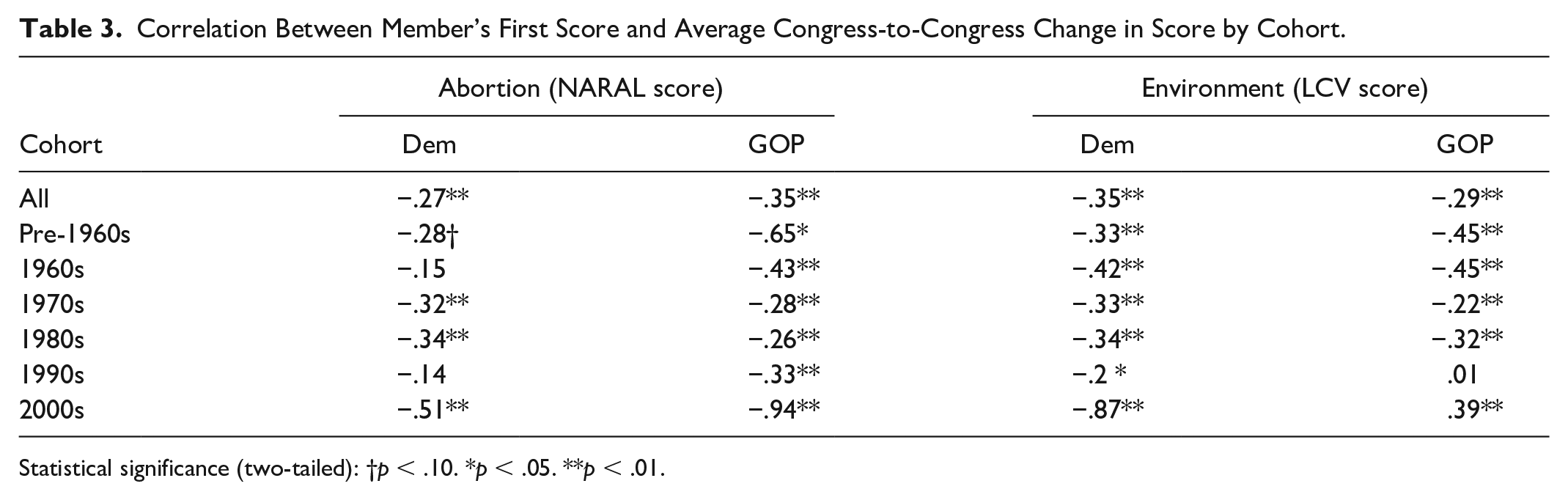
Statistical significance (two-tailed): †p < .10. *p < .05. **p < .01.
Outgoing Members
The exit of out of step members also contributes to party change (Observation 3). We can observe over time the issue positioning of members that leave the House and do not run for higher office (e.g., Senate). The evolutionary model suggests that those who are more out of step with an emerging new equilibrium will more likely drop out of the population (leave office).
To measure the extent to which a member is out of step with her party, we track the IG score difference, which is the difference of a member’s issue score from the party mean during that Congress. Figure 4 presents the average difference score, broken apart by issue and decades. 25 Among Democrats, outgoing members are out of step from the overall party caucus—outgoing Democrats, on average, are consistently more conservative than the overall party mean, as expected. Among Republicans, outgoing members were more moderate than the party mean only during the 2000s (statistically significantly so for abortion and nearly so for the environment), but we also note that beyond looking at whether outgoing members are statistically significantly more moderate than their own party, we can also compare outgoing party members over time. On both issues for outgoing Republicans, they were increasingly moderate from the 1980s to 2000s—notice the divergence score increases as we move through those decades in Figure 4. Although those differences are not necessarily statistically significant, the general pattern is at least consistent with the idea that Republicans who were increasingly moderate on abortion or environment relative to other members in the party were leaving Congress.
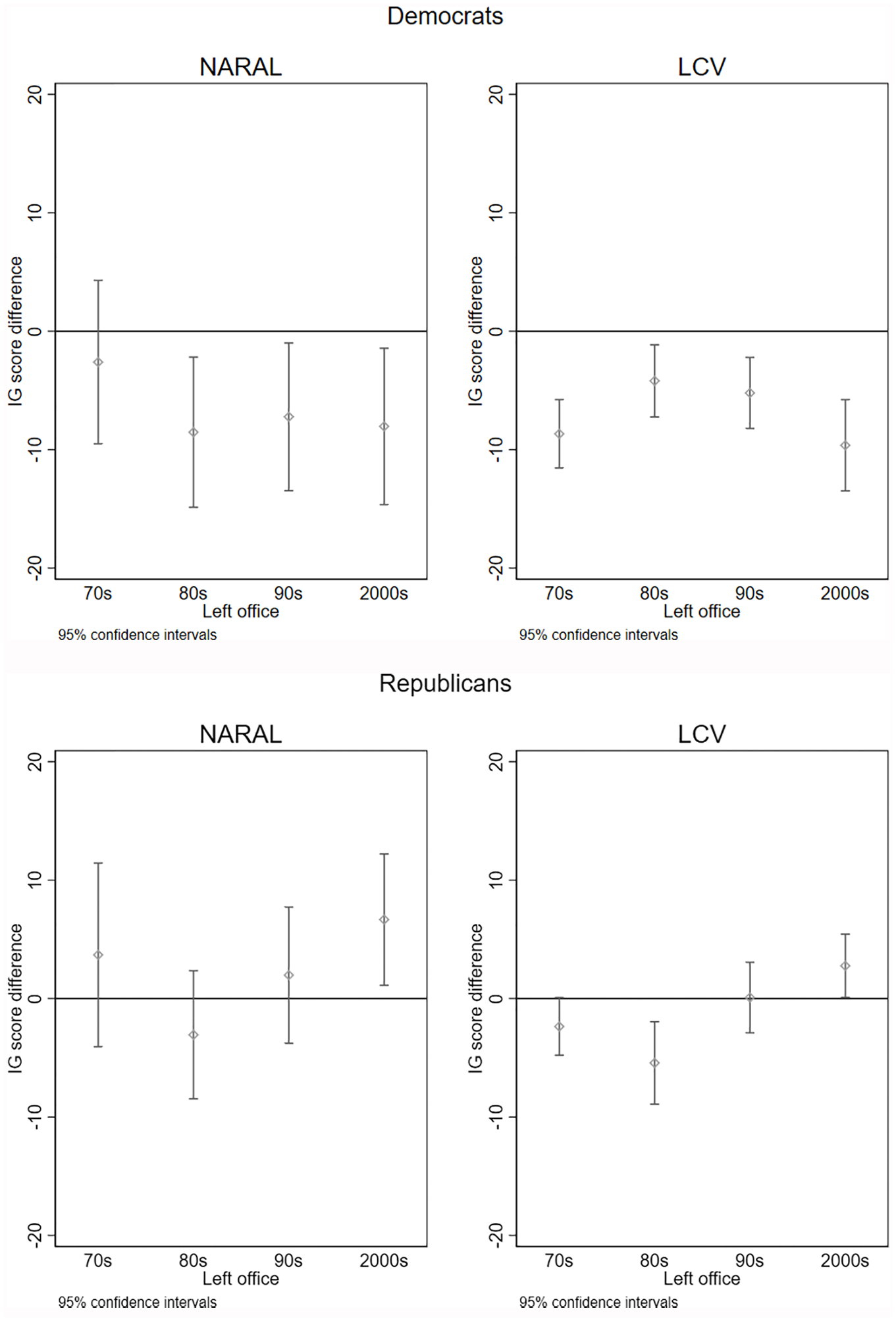
Outgoing House members that do not seek any other elected office: difference between member’s issue score and party House mean.
Discussion and Concluding Remarks
Previous research has gone in great detail describing how party change occurs. However, we have stressed the need to peel back another layer to consider the impact of coordination problems, which are especially pertinent in the American case, which is typified by relatively weak and decentralized parties. Just observing presidential nominations in 2016 highlight the ubiquity of coordination dilemmas. Party elites and activists were divided over the direction of the parties, which hindered their ability to coalesce (i.e., coordinate) around a leading nominee during the invisible primary and the first part of the primary calendar. Similar dynamics are playing out in the 2020 Democratic presidential nomination. If coordinating is difficult for the highest office, then we can imagine it is even more so for the party more broadly, across all congressional offices.
Looking beyond the presidential nominations, there are indeed questions as to whether the parties are in the midst of fundamental change. Trump’s ascent in the Republican Party and his 2016 general election victory may have suggested that a shift in policy commitments, such as increased support for more protectionist trade or increasingly conservative immigration policies, would be electorally beneficial for Republicans (i.e., change in
We highlight the need for theories of party change to account for the incentives of individual party members and the significant hurdles to coordinated issue change. Theoretical insights from an evolutionary game theoretic model suggested empirical avenues to consider, mainly shifting the focus to individual-level variation in an attempt to decipher how micro-level dynamics might aggregate to systematic shifts of the parties on the issues. From this perspective, incremental changes in the parties’ positions are expected, since new members that prefer change have incentives to adopt strategies of compromise.
As an illustration of the dynamics of the model, we looked at roll call voting on abortion and the environment, which are two issues that emerged since the 1970s as increasingly partisan issues. The behavioral (voting) patterns are consistent with the evolutionary game theoretic account of party change. In order for a population to shift to the new equilibrium, there needs to be an introduction of types that support that new equilibrium (our analyses on replacements), as well as a shift in the behavior of the old types (our analyses of adaptation and those leaving the House). The new types, however, must first play a hedging strategy; thus, we should also expect to see adaptation in their voting behavior over time. Eventually enough old types also adapt their behavior or exit the population, and the overall population settles on the new equilibrium.
We should also keep in mind that the two issue changes we analyzed were occurring under a backdrop of increased partisan polarization among a wide range of issues and ideologically. Are the pressures toward party change magnified when the parties are increasingly polarized ideologically (and relatedly, across a wider set of issues)? The answer to that question probably depends upon the specific mechanisms of change. We see that the parties were polarizing on the environment and abortion before the steep uptick in ideological polarization of the 1990s, but perhaps one mechanism for change is more or less likely when partisanship is already high. As suggestive evidence from Figures 2 and 3, member adaption played a larger role during the earlier period in our study (up through the 1980s), while incoming party members were especially polarized on the issues during the later period (since the 1990s).
Answering questions such as the preceding highlight several potential extensions for future work. Our discussion has left unanswered the exact mechanisms of how party change might occur. For instance, do primary challengers contribute to increased member adaptation on an issue or the retirement of out of step members? Or to what extent and under what conditions is change achieved through accountability or the selection of representatives versus responsiveness of representatives? Several scholars are asking such questions (e.g., Boatright, 2013; Canes-Wrone et al., 2002; Griffin, 2006), but our article suggests that researchers should consider how the decisions of incumbents, challengers, and potential candidates may be inter-related, that is, rather than simply model each incumbent’s choice or congressional race as an independent observation, we should consider how decisions are coordinated. Perhaps accounting for that will help clarify why previous scholars have found little impact of primary elections on legislative behavior (Boatright, 2013; Hirano et al., 2010; Hirano & Snyder, 2019). A particularly strong theory is one that accounts for an interdependence across members, institutional features of U.S. politics (like primaries), and explain both which equilibrium (i.e., coalition out of many possibilities) will form and what that process looks like.
Footnotes
Acknowledgements
The authors thank David Karol, Travis Johnston, John Aldrich, David Damore, Jacob Neiheisel, and the anonymous reviewers for their comments and suggestions on various drafts of this manuscript. All remaining errors are our own.
Declaration of Conflicting Interests
The author(s) declared no potential conflicts of interest with respect to the research, authorship, and/or publication of this article.
Funding
The author(s) received no financial support for the research, authorship, and/or publication of this article.
