



Abstract
What are the dynamics of partisan conflict in the mass public in the United States? Has this conflict been driven by Republicans moving to the right across a wide range of issues, or have Democrats contributed to this as well? Have these changes been symmetric, occurring for both sides, or asymmetric, occurring for just one side? Understanding how the partisan gaps have widened may shed light on potential prospects for reversing extreme political conflict in public opinion. This paper examines this question with an analysis of opinion trend data over the last 40 years. It includes an original analysis of these trends among racial and ethnic groups. We find that symmetric partisan changes have only occurred among whites. Overall partisan differences have been less for Blacks and Hispanics than for whites.
Introduction: Partisan Conflict on Steroids
In recent years, political scientists and observers have worried about partisan polarization and conflict that grip American society and government. This conflict is starkly visible among political leaders, hampering representation and governing, and creating gridlock on a number of national problems (see Binder, 2014; Brownstein, 2007; Mann & Ornstein, 2012, 2016; McCarty, 2007; Fiorina & Abrams, 2009). This extends to the level of public opinion: there have been sharp increases in partisan differences in opinions—partisan divergence 1 —on a wide range of political issues. What is stunning is that this has occurred fully across economic, racial, socio-cultural, and national security and foreign policy issues (e.g., see Abramowitz, 2010, 2018; Bafumi & Shapiro, 2009; Layman et al., 2006; Pew Research Center, 2012, 2014, 2016, 2017; Shapiro, 2016). That greater disagreement that has occurred suggests that more Republicans have taken conservative positions on policy issues, while more Democrats have taken liberal positions.
The claim that Republicans are to blame for the increasing gap between the parties on policy issues is testable (on the leadership level, see Grossman & Hopkins, 2016; Mann & Ornstein, 2012, 2016). We examine this empirical claim with respect to public opinion by first, investigating whether partisan divergence in public opinion has occurred symmetrically—with members of both parties moving in opposite directions—or asymmetrically, with one party’s opinion moving, while the other remaining unchanged. In addition, and as intra party ethno-racial diversity has increased, we investigate whether the symmetric and asymmetric patterns in public opinion found at the aggregate level, are also prevalent when looking across specific ethno-racial groups. Specifically, we look at the way partisan conflict has evolved over time within the Hispanic, Black and white partisans, as well as whites with and particularly without a college degree (often referred to as the white working class), Donald Trump’s and the Republican Party’s core base voters, who have been the sources of support as well for their conservative policies, especially as ostensibly related to white identity politics (see Sides et al., 2018).
Is Partisan Conflict Symmetric or Asymmetric?
When exploring the nature of partisan conflict in the public, referred to here as partisan divergence, the image that comes to mind is that of Republican and Democrat opinion moving in opposite directions in a symmetric pattern on any given policy issue. For example, Democratic opinion becoming more liberal on abortion and Republican opinion becoming more conservative by the same magnitude, thus widening the gap. However, other, asymmetric changes may also result in the widening of the gap between partisan opinion, for example when one side is moving while the other’s opinion remains fairly constant (i.e., Republicans becoming more supportive of items related to national security spending while Democrats opinions remain unchanged). Further, beyond patterns of change, in some cases, the partisan gap could remain stable overtime as the result of the unchanging opinions of Democrats and Republicans; in others, the opinions may change in the same direction by roughly the same amount, in parallel over time. Indeed, “parallel publics” has been the dominant pattern in the past (see Page & Shapiro, 1992). The remaining possibility is opinion convergence, in which Democratic and Republican opinion move toward each other, whether at the same rate or not, or one group moves toward the stable opinions of the other.
Identifying some of these patterns of change or stability in the aggregate, as well as within ethno-racial groups is critical, in our view, because they could suggest prospects for less partisan conflict. Convergence, which has been less common than divergence or parallel changes, would indicate movement toward less partisan tension on a number of issues. Cases of divergence in the opinions of Democrats and Republicans when both partisan groups are at least moving in the same direction, might suggest the possibility of convergence as the result of eventual ceiling or floor effects should these trends continue down the road, since there are upper and lower bounds for the measures of opinions and attitudes.
In contrast to this, symmetric divergence—or partisans moving in opposite ideological directions—would reflect deepening conflicts in certain areas. There are theories that lead us to expect this in high partisan conflict contexts. In this case, Zaller’s (1992) “two-message” model would lead us to expect Republicans would be pushed in a conservative direction by messages from Republican leaders, while Democrats would reject these messages and possibly move in the opposite direction. The opposite effects would happen for messages from Democratic leaders, which could push Democrats to a liberal direction, and move Republicans in the opposite direction (see also Lenz, 2012, on the public following leader). Similar expectations would come from theories about “priming” and “motivated reasoning” (see Shapiro & Bloch-Elkon, 2008; cf. Lenz, 2012). However, the findings of these models rely heavily on samples that are overwhelmingly white. As explained in detail in the next section, partisanship is different for Blacks and Hispanics. Partisan elites messaging may not have as strong an effect on these groups as it would on whites. Further, there may also be a difference within whites with and without college education (see Brownstein, 2020; Schaffner et al., 2018; Smith and Doherty, 2016).
Elite, Mass, or Group Driven?
One insight and point of contention has been whether partisan conflict has been elite driven: leaders realigning their parties’ positions on policy issues (e.g., see Carmines & Stimson, 1989; Layman et al., 2006; cf. Schickler, 2016). Though the future of partisan conflict in America hinges largely on elite-level politics, changes in public opinion and the demographic makeup of the population affect politicians’ incentives to compromise or stand on principle. The transformation of the American public that is coming about through immigration and differential birth rates of the main ethno-racial groups is bound to affect the nature of partisan divergence and politicians’ corresponding calculations. As Blacks, Hispanics and other minorities become a larger portion of the electorate and choose to align themselves with either party (Abrajano and Alvarez, 2010; Gay, 2014; Sears et al., 2016) some of their unique set of policy preferences and set of core values (Gay, 2014) will alter the overall patterns of symmetry or asymmetry in partisan divergence at the mass level.
Although Blacks remain overwhelmingly aligned with the Democratic party, they continue to hold more conservative views on social issues such as gay rights and abortion than their white counterparts (Gay, 2014; Hajnal & Lee, 2011). Black partisan alignment remains unaffected by this tension between the more progressive Democratic party agenda on social and religious/cultural values issues, related to Blacks’ lower levels of education or political knowledge (Carpini & Keeter, 1996; Gay, 2014; Nie et al., 1996). Republicans remain hopeful and have tried to woo Black socially conservative voters through various strategies (Gay, 2014; Smith, 2005). Whether the Republican party will succeed at some point is still an open question but given that the racial policy positions of the party continue to drift further away to the opposite side of Blacks’ interests, the chances seem quite slim. Given the Black mass public’s social conservative tendencies we expect them to act as a moderating force within the Democratic party. As Mason (2018) finds, Americans whose social identities do not align with their partisanship have less intense attitudes than those whose other identities do so align. Black voters may not be numerous enough to change the symmetry of polarization on their own, but adding Hispanics to this mix—and their conservative tendencies on these same issues—may result in overall asymmetric polarization on these issues, as they offset liberalization among white Democrats while Republicans overall become more conservative.
The scholarly work on Hispanic partisanship has consistently shown a weaker partisan identity (Hajnal & Lee, 2011; Sears et al., 2016), especially compared to whites and even Blacks (Gay, 2014). Hispanic partisans have also been courted by the Republican party in the hopes of appealing to their conservative values on social issues (Hajnal & Lee, 2011; Sears et al., 2016), but the majority—60% or more since 2008—continue to identify with (or lean toward) the Democratic party and vote Democratic by even larger margins (Pew Research Center, 2016). Hispanics at the mass level are more moderate than fellow white Democrats in the socio-cultural dimension as well as more moderate on social safety such as welfare and health spending than their Black counterparts. Similarly, Hispanic Republicans seem more progressive in their policy preferences regarding policy areas such as race relations, welfare, health and education spending. If Hispanics have been weaker partisans and have more moderate policy preferences in general, we expect them as well to affect the symmetry of partisan opinion changes.
Research on the causes and consequences of partisanship has been dominated by overwhelmingly white survey data samples given smaller samples of the nation’s minority populations. From the above discussion and the accumulating evidence for continued partisan divergence and polarization of public opinion (Shapiro, 2019), whites are likely to be exhibiting as much as or more symmetric patterns of partisan divergences in public opinion than other groups. The reason for this is that overall they have stronger partisan identity and their other social identities are more likely to reinforce their partisan one (Mason, 2018). Unlike Blacks and Hispanics who are not fully aligned with the full agenda of social rights and liberties championed by the Democratic party, socially conservative whites have a strong home in the Republican party and they have increased in numbers making and thereby increasing the proportion of Republicans holding conservative positions on certain issues. At the same time, there may be some issues for which the public opinion as a whole, Democrats and Republicans alike, move in the same direction, so that there are some issues for which a symmetric patterns of partisan opinion changes are less likely to occur.
Hidden in these ethno-race related partisan dynamics are changes that have occurred in the Republicans base of support among whites, which has been referred to as the increase its support among the white “working class.” This became most visible at first with Democrats who came to support Ronald Reagan (“Reagan Democrats”), and it has been visible full force with Donald Trump’s base of support among whites without a college degree, and also with, at the same time, increased opposition among white voters with a college degree, most striking in the 2018 as well as 2016 elections (see Jacobson, 2019, p. 32; Patterson, 2020, p. 41). The difference that education is related to is striking: those without a college degree are more conservative than those with the degree on racial and gender issues (see Schaffner et al., 2018; Valentino & Sears, 2005). White identity politics and status threat is as significant part of this (see Mutz, 2018; Sides et al., 2018).
In our analysis, then, in addition to investigating whether partisan divergence in public opinion has occurred symmetrically or asymmetrically or if it has occurred at all in certain issue areas, we seek to understand whether the patterns found in the aggregate are also prevalent when looking across the main ethno-racial groups in the United States. In this, too, we look separately at whites with and without college degrees to see the possible extent to which increases in partisan differences may be heavily driven by less well-educated whites. Understanding how the partisan gaps have widened can be telling about prospects for reversing this political conflict in American public opinion.
Data and Methodology
To analyze the patterns of change and stability in public opinion in a systematic way, as well as changes in attitudes of minority groups, we assembled and examined survey data on Americans’ policy preferences and partisan identity from 1972 to 2017. We build on existing research from Pew Research Center (2012, 2014, 2017), which has received substantial attention in showcasing the widening partisan divide on important policy issues and provides a frame of reference for looking further at this partisan conflict. For our analyses, we added to the Pew surveys comparable data from flagship, high quality academic surveys that cover an earlier time period as well. Specifically, we examined aggregated survey responses by party identification to opinion questions asked in the American National Elections Studies (ANES) and the NORC General Social Surveys (GSS). The issue areas included in our analysis are: social safety net spending, health care spending, inequality, standard of living, environmental spending, government scope and performance, immigration, racial issues, abortion, gay rights, gay marriage, women’s role, national security spending, foreign aid, diplomacy, and world affairs (see Supplemental Appendix). 2
A key objective was to estimate partisan differences by subgroups (by race/ethnicity) over time. However, small sample sizes could lead to questionable estimates of partisan differences within these subgroups. We dealt with this by aggregating yearly data into longer time periods. The first time period encompasses 1972 to 1986, which was when partisan polarization began at the level of political leaders in Congress. This longer period that the later ones allowed for aggregating more surveys to provide an adequate sample of Hispanics, whose population grew further subsequently. Thereafter we examined periods similar in size. The second time period covered 1987 to 1993 during George H. Bush’s presidency through President Bill Clinton’s first year before major partisan conflict ensued during 1994 to 2000, which is the next period covered, ending with the 2000 election controversy that was decided by the Supreme Court along partisan lines. The fourth time period was chosen to cover the first years of the George W. Bush’s administration 2001 to 2003, which were ostensibly less conflictual as the nation experienced and recovered from the attack of September 11, 2001 We then aggregated 2004 to 2012 with its rising conflict over the outcome of the Iraq invasion, the financial crisis and Great Recession that ensured, and the election of President Barack Obama and the heightened partisan battles that followed over health care reform and the efforts of Republicans in Congress to thwart his presidency. During the final period we examined, 2014 to 2017, partisan conflicted continued and amplified further by the 2016 presidential campaign and the election and first term of Donald Trump as President. This division of periods provided large enough samples for statistical analysis in addition to demarcating periods in which there were changes in partisan conflict, as this conflict overall increased from the first to the last period we examined.
Once the data were aggregated into these six time periods we estimated the partisan differences for every question (see all questions, their wordings and categories in the Supplemental Appendix) by dichotomizing and dummy (0–1) coding each variable, with the 1 category reflecting the liberal opinion on the issue. For example, the question about abortion (should a woman want to end her pregnancy for “any reason,” refer to Table 1 in the Supplemental Appendix under GSS items) we coded as 1 all answers that agreed “Women should be able to get an abortion for any reason.” The percent of Republicans and Democrats who agreed with the liberal opinion in the GSS, ANES, and Pew similar questions about abortion were averaged. The result of this average is what we present in the line graphs as data points for each time period. The determination of the liberal opinion was quite straightforward in all cases, but our decisions for every question can be found in the Supplemental Appendix Table 1.
In total, we examined 38 survey questions, including 15 from the ANES, 13 from the GSS, and 10 from Pew. In some instances, a question was only available for two out of the three surveys in a given time period and that is how we ended up with averages of questions from at least two of these surveys that were grouped into 16 policy issue areas which are the focus of our analysis. These data met two criteria: they included policy areas identified by Pew as potentially highly contentious, partisan ones and survey question responses with sufficiently large sample sizes in each time period for each group to be included in the analysis. 3 To calculate the partisan difference for each group in any given time period and policy area we simply subtracted the average percent of Republicans (including Independents leaning Republican) holding liberal opinions (as shown in the line graphs in Figures 1 and 3–6) from the average percent of self-identified Democrats (including Independents leaning Democratic) with those opinions.
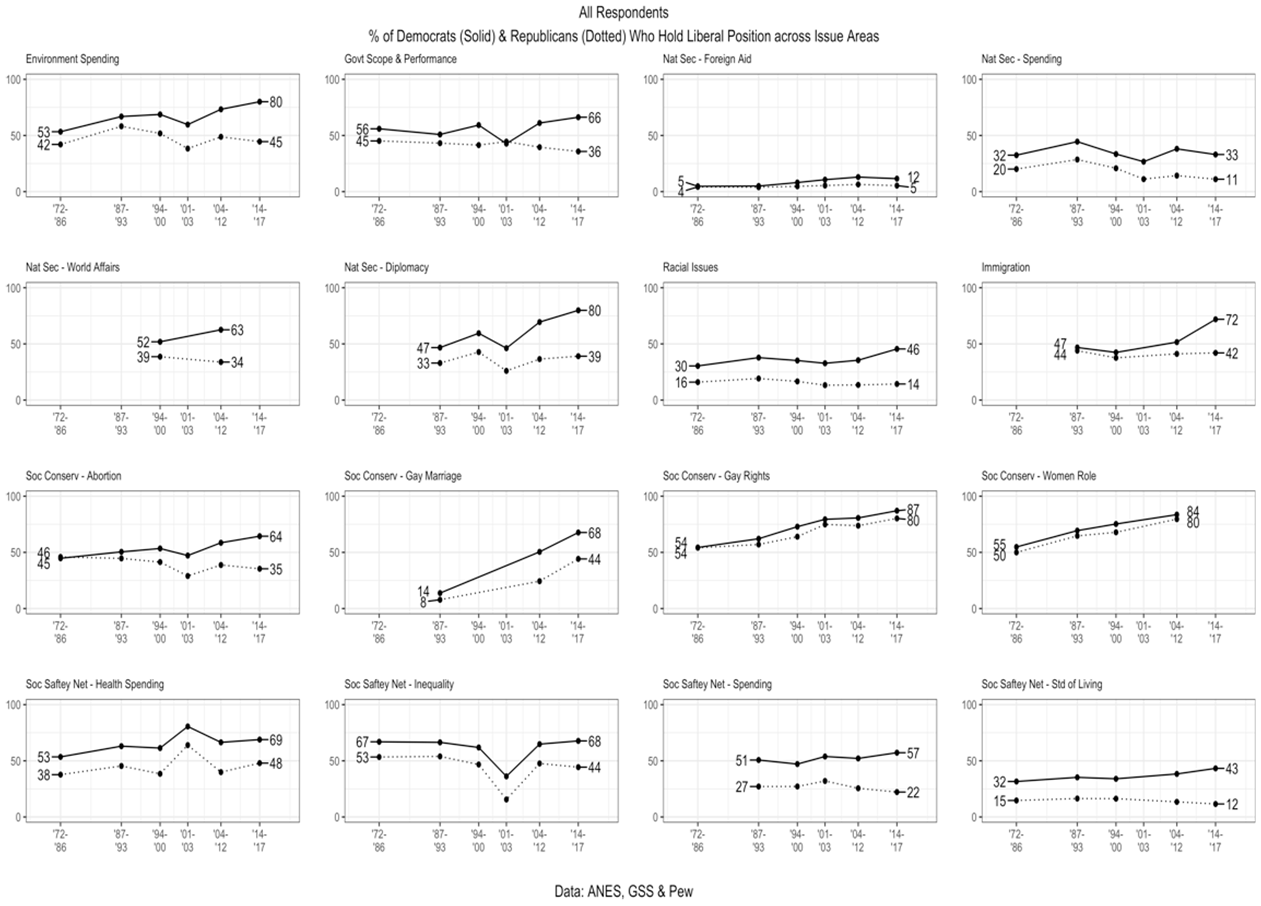
Partisan trend, by issue area: all respondents.
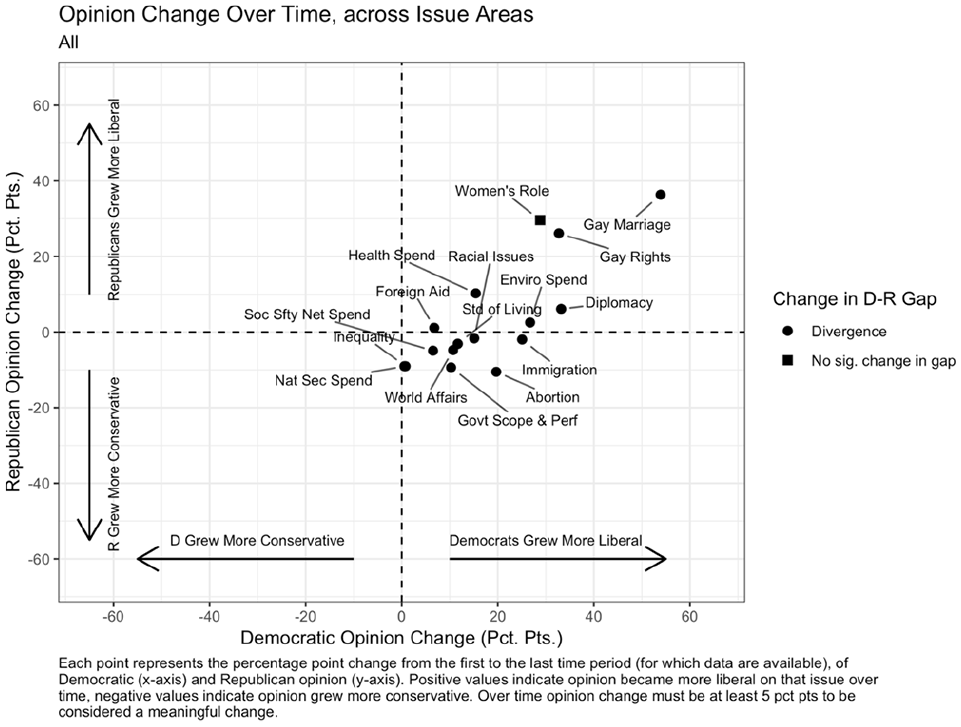
Change in partisan gap: all respondents.
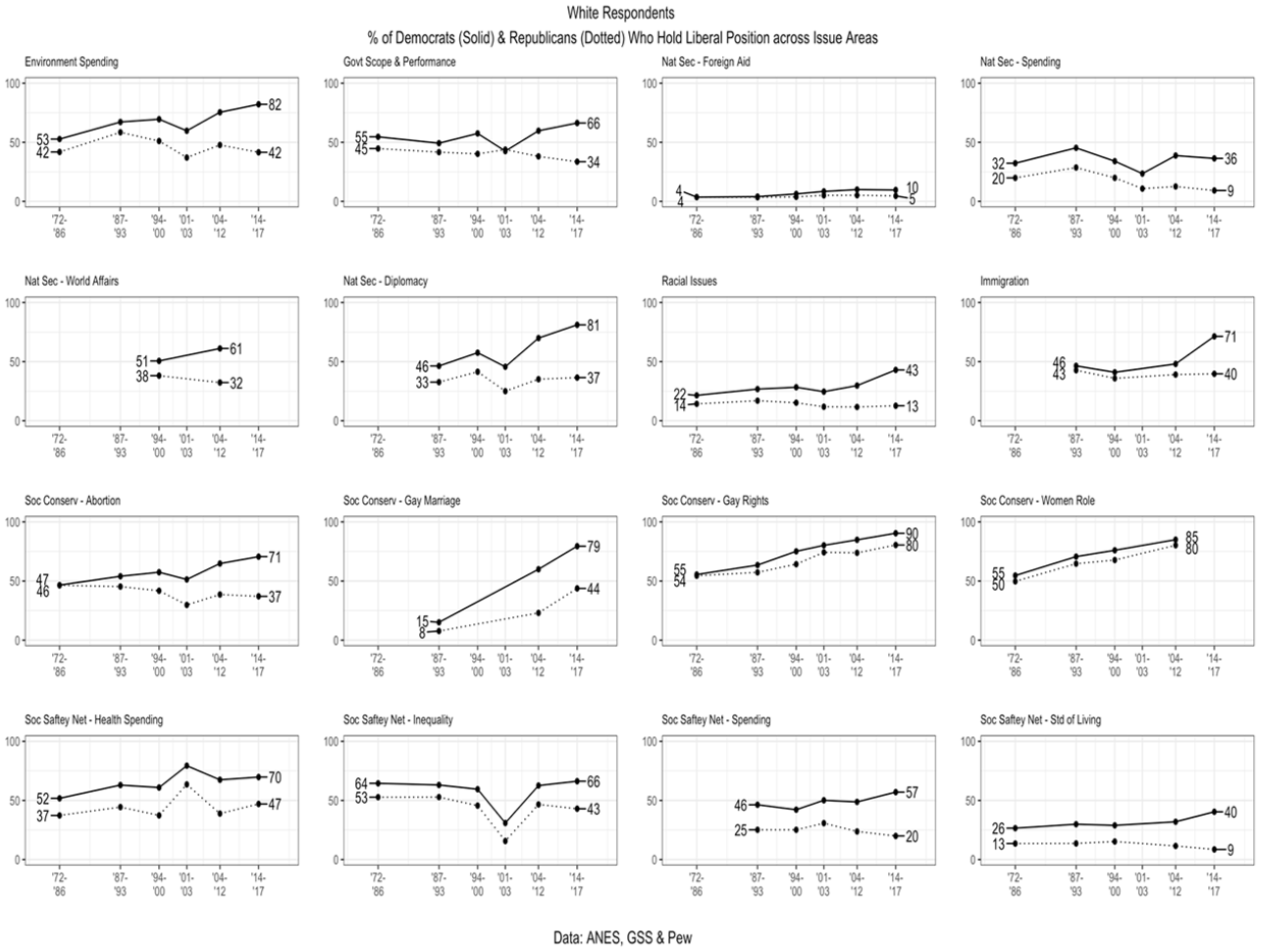
Partisan trend, by issue area: Whites.
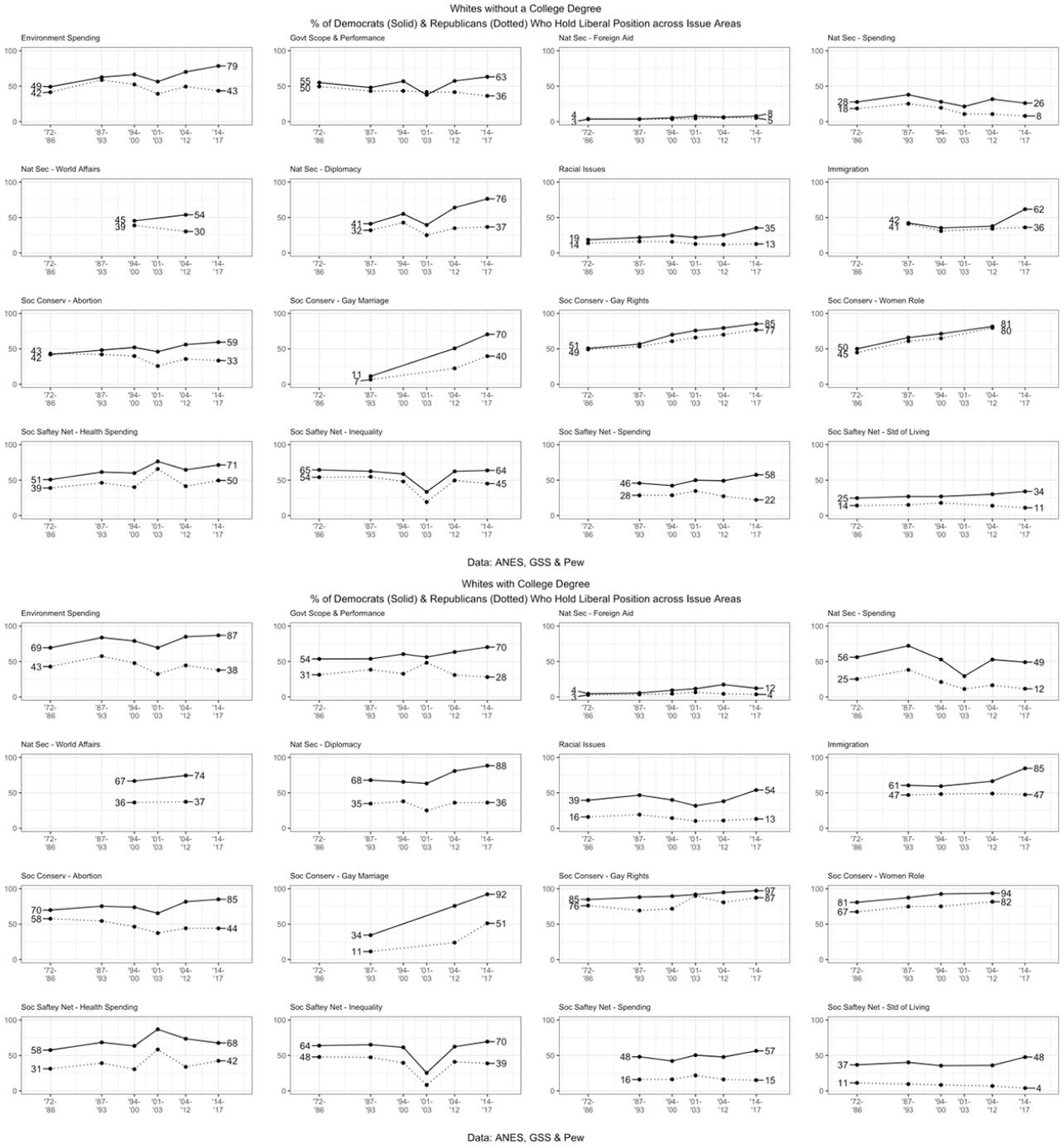
Partisan trend, by issue area: Whites with and without college degree (working class).
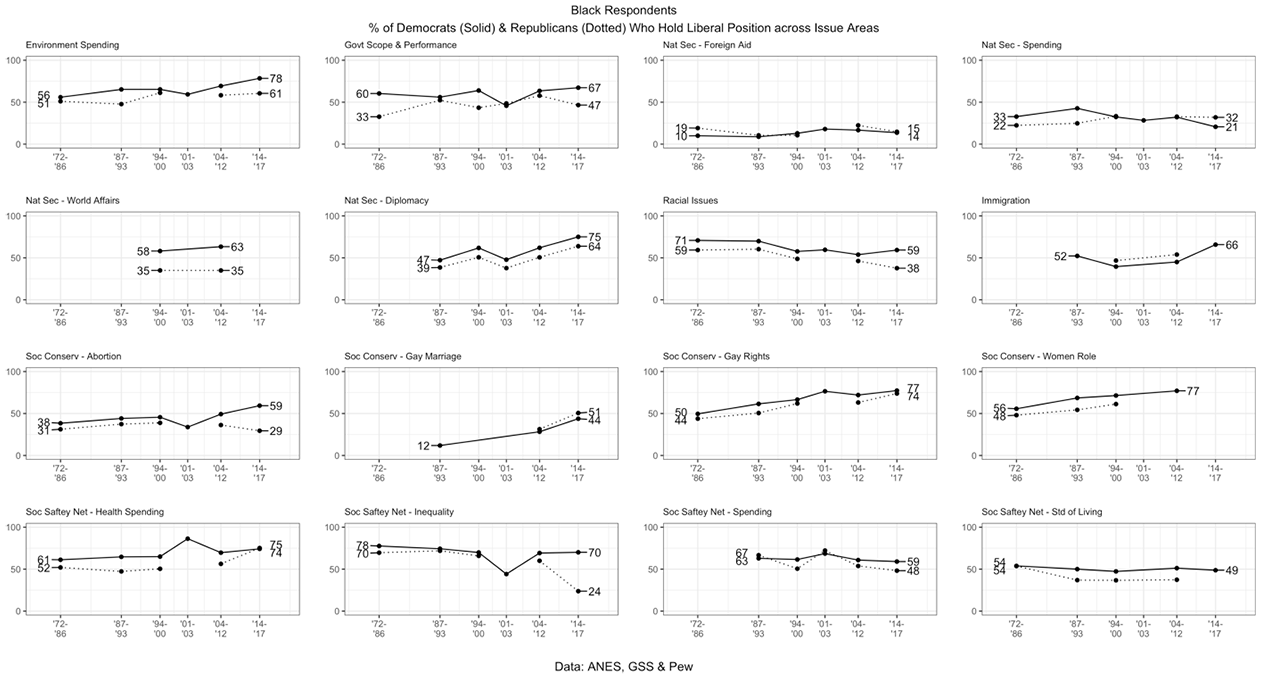
Partisan trend, by issue area: Blacks.
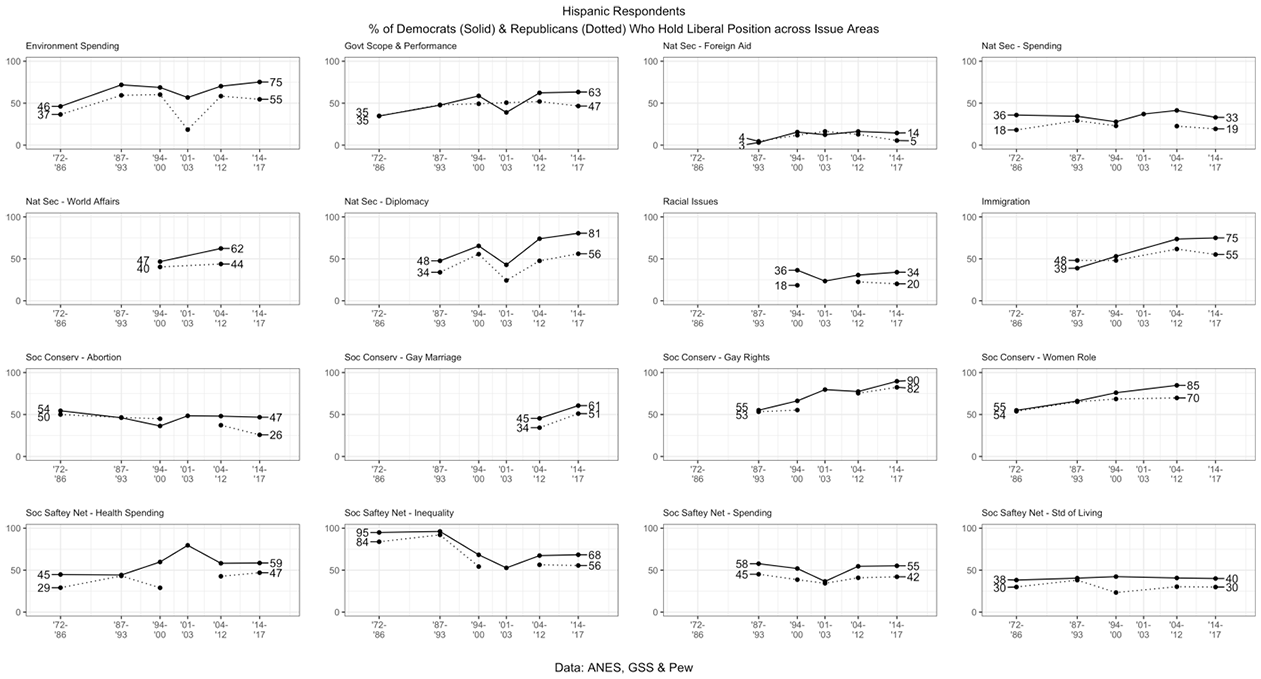
Partisan trend, by issue area: Hispanics.
The trend lines (Figures 1 and 3–6) show the specific trends of partisan difference over time and allow for a direct comparison of partisan opinions across issue areas. Each data point here is the average of the liberal opinion from the survey items (GSS, ANES and Pew) in that specific policy area for Republicans or Democrats during the indicated time period. The scatterplots (Figures 2 and 7 through 10) summarize the information presented in the line graphs and plot the magnitude and direction (liberal or conservative) of the change in Democratic and Republican opinion on any given issue from the first time period to the last.
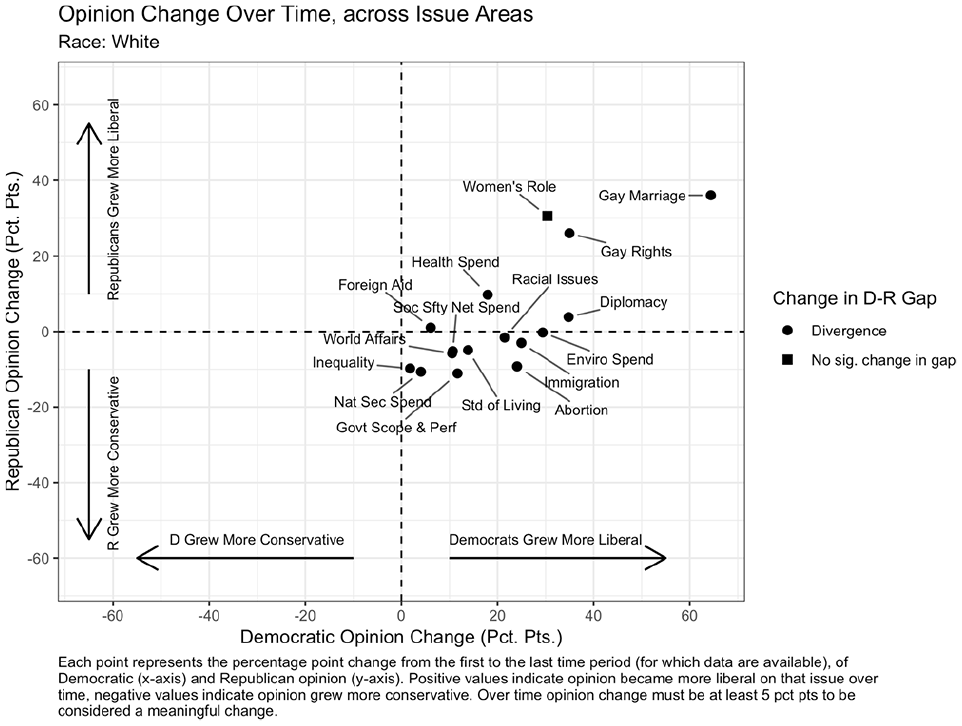
Change in partisan gap: Whites.
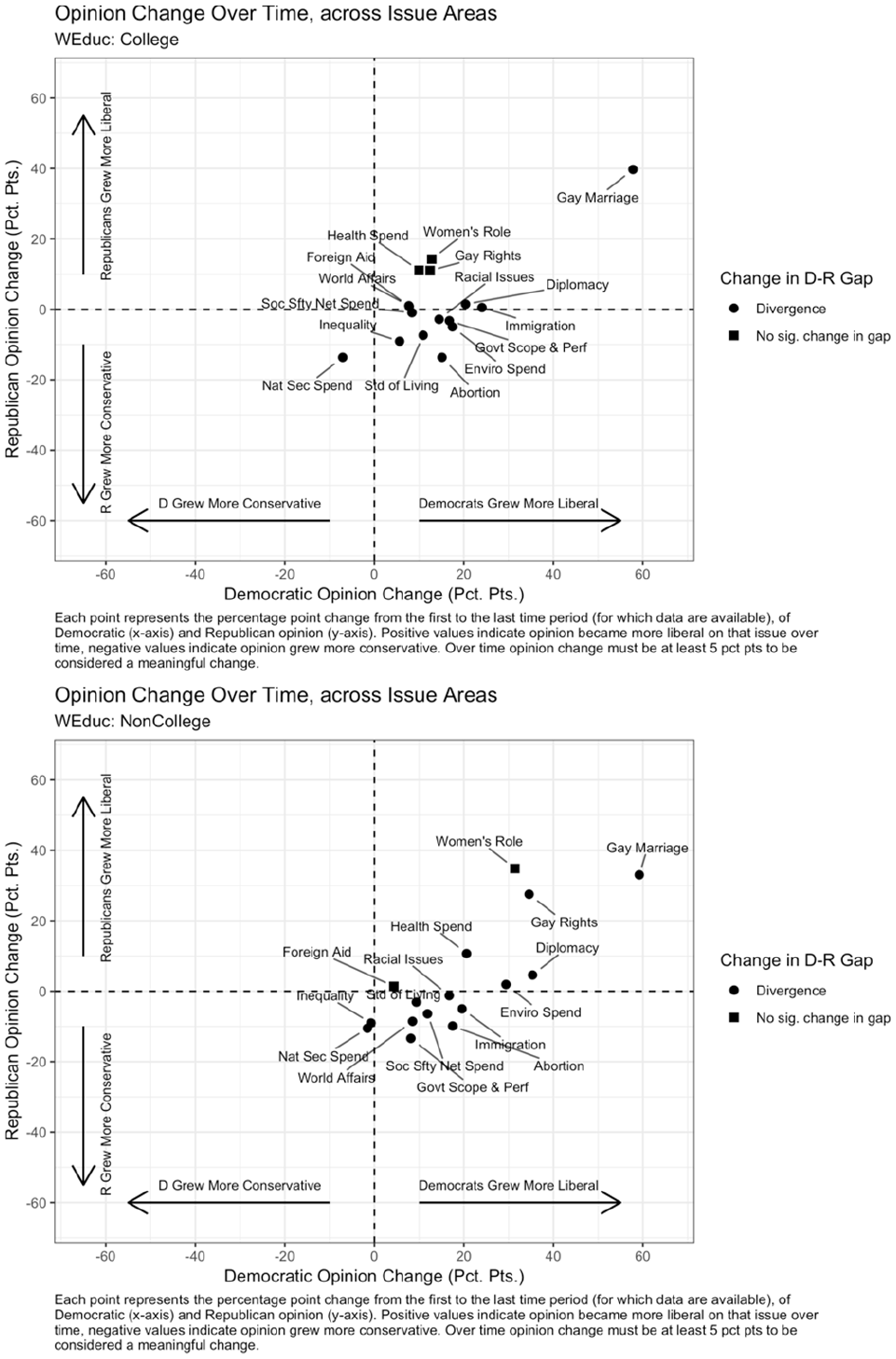
Change in partisan gap: Whites with and without college degree (working class).
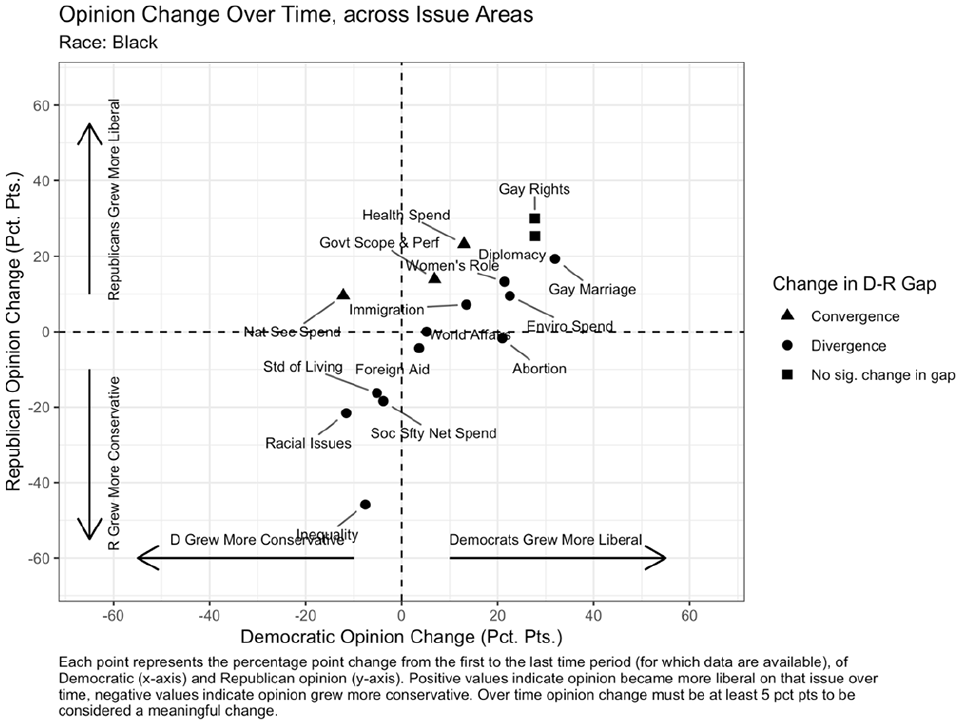
Change in partisan gap: Blacks.
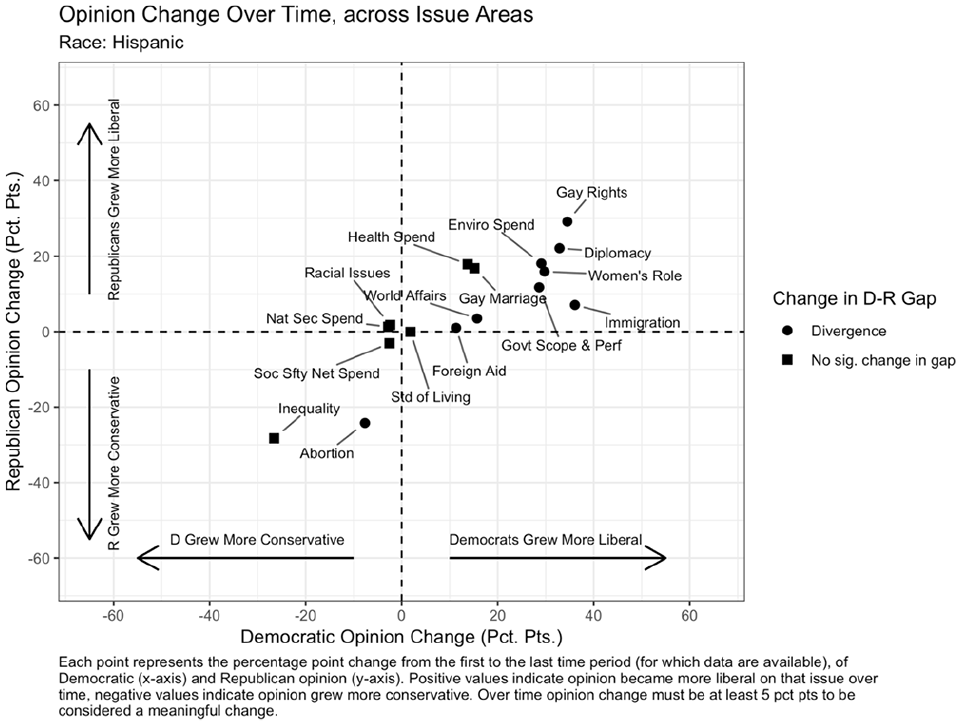
Change in partisan gap: Hispanics.
We use the term divergence to describe issues where the gap in Democratic and Republican opinion has increased over time. Symmetric divergence occurs when partisans are moving in opposite directions. This should be evident from the line graphs as the trend lines for Democrats and Republicans –when they move in opposite directions overtime thus widening the partisan gap. In the scatterplots (Figures 2 and 7–10) points in the bottom right quadrant of the scatterplots are issues on which symmetric divergence of opinion has occurred. Partisan divergence (or an increase of the partisan gap over time) can also be asymmetric, with increasing gaps between Democratic and Republican opinion driven more by change in one party than the other. It is also possible that the partisan gap has increased overtime in some issue, such as gay rights not because parties have moved in opposite directions but actually because Republicans and Democrats moving in the same direction by different amounts. These issues would be situated in the top right and bottom left quadrants of the plots. We describe this as convergence in partisan opinions. To facilitate the identification of these issues we use circles represent an increase in the gap (divergence), and triangles indicate the gap has gotten smaller (convergence). Finally, squares in the scatterplots to indicate that partisan trends for this given issue have been mostly parallel, with no significant change in the partisan gap over time.
Analysis: Symmetric Versus Asymmetric Partisan Divergence in Issue Opinions
How has public opinion changed on the issues we examine over the course of the past several decades? More specifically, has partisan divergence occurred among particular ethno-racial groups to a greater extent than others?
We start with all respondents in our survey data without disaggregating by group. This is shown in Figures 1 and 2—readers should compare each four quadrant graph with its corresponding set of partisan trend graphs. The first finding, not surprisingly given the partisan polarization that has occurred, is that partisan divergence occurs on a great many of the issues. What are central to our analysis are the patterns. Given the well-established finding that the partisan divergence that has occurred symmetrically at the elite level in congressional roll call voting has driven largely by Republican voting more consistently conservatively and to a lesser extent Democrats, especially Southern Democrats, voting more liberally. 4 we looked first for the extent to which this had penetrated to the level of public opinion. While partisan divergence has clearly occurred, the dominant pattern is not one of Republicans and Democrats moving strikingly in opposite directions.
What we find is that a striking pattern of symmetric partisan divergence (Democrats moving toward the liberal and Republican toward a more conservative opinion) appears to be relatively infrequent. These are the issues which would stand out with large opinion changes in the bottom right quadrant of Figure 2. The only issues for which partisan divergence is substantially symmetric overall are abortion and government scope and performance issues. All the other issues in the bottom right quadrant are very close to zero (dotted line) that signifies no change. On abortion, all Democrats became more supportive of abortion rights by 18 percentage points from the first time period when only 46% agreed that “it should be possible for a pregnant woman to obtain a legal abortion if the woman wants it for any reason?” (Figure 1). Republicans became more opposed by 10 points from a similar starting point (45%) in the first time period. This produced a partisan difference that went from 1 point in the 1972 to 1986 time period to almost 29 points in the 2014 to 2017 period. On this particular issue, the increase in partisan differences is symmetric, the result of partisans moving in opposite directions.
Similarly, Democrats and Republicans have moved in opposite directions on the issue of government scope and performance; the partisan gap grew from 11 points in the 1972 to 1986 period, to about 30 points in the 2014 to 2017 period. Yet the overall takeaway from these first two graphs is that, increasing partisan disagreement on political issues is not predominantly due to large opinion changes simultaneously in both parties.
An important contrasting pattern is one that does not, in effect, indicate greater conflict: many increases in the gap between Democrats and Republicans are the result of partisans moving in the same direction but at different rates. For the overall liberalization of opinion toward gay rights and women’s rights, we see strikingly parallel change, but for spending on health care and especially for gay marriage, environmental spending, and support for diplomacy, partisan divergence is driven by Democrats moving in a liberal direction much more quickly than Republicans. In contrast to this broad pattern of opinion liberalization, there are no issue areas in our data for which Democrats and Republicans in the public as a whole move in the same conservative direction.
There is clearer partisan conflict for issues involving immigration, world affairs, race, environmental spending, the economic safety net with regard to employment and standards of living, and, to a lesser extent, foreign aid. Republicans have stayed flat on these issues (not moved by more than one might expect due to sampling error) and Democrats have moved noticeably in a liberal direction. On these issues, changes in Democrats’ opinions have led to increased partisan disagreements in in public opinion. This is a noteworthy finding. In contrast, two areas on which the Republicans are driving the increased partisan differences are: inequality (the partisan gap increased by 10 points, from 14 points to 24 points) and for national defense spending (a 12-point gap grew to a 22-point gap). Only on these two issues have Republicans grown more conservative while there has been no net opinion change among Democrats.
What do we conclude here about the public at large? The overall increase in partisan conflict in public opinion is due to both Democrats and Republicans driving this in ways that vary by issues. It is not the case, that the attitudes of Republicans have been the only force at work in increasing partisan disagreement in public opinion. This is now apparent in the politics of the 2020 election where Democratic leaders and candidates, at this writing (in May 2020) have moving to the left since 2016—at least in part as a response to the Republicans’ ascendancy in Washington 5 .
One other important takeaway from these opinion trend data is that there has been a continued bipartisan trend in the liberalization of public opinion concerning many issues: Americans’ opinions on the role of women, gay rights, gay marriage, and the environment have changed dramatically since the 1970s.
Analysis of Racial/Ethnic Differences
What do we find when we examine the ethno-racial differences in these trends and patterns? Our analysis shows that partisan divergence patterns picked up at the aggregate level are driven by whites. Blacks and Hispanics exhibit different patterns and mute the contribution of whites on the results for the public as a whole. Also, there are some differences among whites. Divergence patterns are somewhat stronger for better educated whites than those without a college degree. Whites without a college degree are, as discussed earlier, more conservative on social and racial issues, as well as immigration.
To get further into the data, we ask, why are there only a few cases of striking symmetric polarization? Part of the answer lies in the trends for non-white partisans and the nature of their differences. Our results are consistent with what has been found before: Blacks and Hispanic somewhat moderate partisan conflict overall. What stands out in Figures 3 to 10 is that we only see symmetric divergence (Democrats becoming more liberal and Republicans more conservative, lower right quadrant for Figures 7–10) among whites regardless of their level of education. Among Blacks and Hispanics we also see partisan divergence for issues in which Black and Hispanic Democrats and Republicans move in the same liberal direction, but was also see a few cases in which this divergence occurs on issues where Republicans move to greater extent than Democrats do in a conservative direction. These common bipartisan conservative changes and bipartisan liberal ones do not contribute to partisan conflict, if at all, and may even serve to lessen it over the long term, compared to symmetric patterns of highly disagreeable partisan change. We summarize the specific subgroup results as follows.
Whites
Among all whites we find (Figures 3 and 7) the somewhat clearer and sharper cases of symmetric divergence in which white Democrats have become more liberal and at the same time white Republicans have become more conservative. Moreover, when looking at the detailed line trends for each issue for whites, we find sharp differences between the first and the last time period for immigration (a 33 point jump, from 3 to 36 points; see second row and last column in Figure 3), world affairs (an increase in the gap from 13 to 29 points; see first item in the second row in Figure 3), and social safety net spending (an already large 21 point difference rising to 37 percentage points; last row, third column in Figure 3).
Recall Figure 1, which includes respondents from all groups combined, partisans displayed symmetric divergence only on two issues: Abortion and Government Scope and Performance. Unsurprisingly, given the fact that national sample sizes are majority white, Government Scope and Performance and Abortion are also in the lower right quadrant in Figure 7 (signaling symmetric divergence) for white partisans. Not only are Republicans and Democrats moving away from each other in these two issue areas, but this change is somewhat similar in magnitude.
The are other data points in the lower right quadrant for whites in Figure 7—Social Safety Net (spending, views about inequality and standard of living), International Affairs (national security spending, and world affairs) and Immigration—represent a “milder” form of asymmetric divergence: while there is movement in opposite directions by partisans, these changes of are not similar in magnitude. The case of immigration, however, is noteworthy for whites (see Figure 3, second row last column), because the 6 percentage point movement of Republicans in a conservative direction pales to the fully 27 point change in the opposite direction among Democrats: white Democrats have become significantly more liberal on immigration, while white Republicans have become slightly more conservative (see Figure 3, second row; fourth column). As was found in the full sample (compare Figures 2 and 7), for the issues of environmental spending, foreign aid, race, and safety net/standard of living, the white Republican opinions remained stable as white Democrats became more liberal. And on gay rights, gay marriage, and health spending, the increase in the proportion of white Democrats who took a liberal position was greater than that for white Republicans.
Whites Without a College Degree
Looking at different subgroups of white, we asked to what extent socioeconomic differences within this group help explain the overall patterns of partisan conflict? As noted above, working-class Republican whites have more conservative attitudes on racial and gender issues than their counterparts with a college degree (Schaffner et al., 2018; Valentino & Sears, 2005). To examine the nature of partisan conflict within whites of different socioeconomic status we examined the trends and patterns for the opinions of whites with or without college (Figures 4 and 8). We find as expected that whites without a degree, irrespective of partisan identification, have a more conservative starting point during the first time period than whites with the diploma. See for example the Abortion issue (third row and first column in Figure 4), whereas the percent of non-college educated white Democrats and Republicans who agreed abortion should be legal was 43% and 42%, respectively in the first time period, it was 70% and 58% for college educated white partisans. A similar trend can be observed in the government scope questions.
The issues of Abortion and Government Scope are the areas where symmetric divergence shows up definitively for both groups. The opinions of both college graduate and those without the degree from both parties have become significantly more liberal (more than 10 percentage points) on Gay Rights, and Gay Marriage. Also noteworthy is the fact that college educated whites of both parties have moved in the conservative direction on National Security spending items over time.
The gap between Democratic and Republican opinion on racial issues has increased less for whites without a college degree, but divergence is more asymmetric than one would expect. This increase in the gap is a function of a very conservative starting viewpoint at the start (19% and 14% for Democrat and Republican opinions) and Republican opinion remaining the same while democrats also moving about the same amount than those with a college degree, about 15 percentage points by 2017. Although there is technically not asymmetric divergence, the fact that only 14% of the Republican opinion for this group agreed with the more liberal opinion in the 1972 to 1987 time period and that this has not changed in five decades is astounding.
Republican and Democratic opinions about immigration moved in parallel for both college and non-college educated whites until the fifth time period (2004–2012). Republican opinion has moved 5 percentage points toward a more conservative direction for whites without college and has remained exactly the same for those with college in the first and the last time period at 47% viewing it favorably. However, Democrats with and without College have moved 24 and 20 percentage points from their original position respectively. We see some signs of symmetric divergence on the issue for whites without college education but only slightly as the movement toward more conservative views is only of about 5 percentage points.
Blacks
The issues that were identified as driving symmetric divergence for whites do not appear in the lower right quadrant for Blacks. Black Republicans have remained stable over time regarding abortion and only have become slightly more liberal on Government Scope and Performance. The lack of symmetric divergence in for Blacks is also evident in Figure 9 where the data point for abortion is almost on the dotted line which signals 0 change from the first time period. In the case of Government Scope and Performance, there is actually convergence over time as shown in Figure 9.
In Figures 5 and 9, we must first note that the partisan differences overall tend to be smaller, there are more parallel trends (Figure 9), and they are based on the smaller proportion of this group who self-identify as Republicans. This is contrary to our expectations about “follow the leader” effects, as Blacks elites seem to be more progressive than the Black public at large (see Dawson, 1995).
There are not any issues for which this group showed symmetric partisan divergence. On abortion, where one would expect more symmetric divergence, (see line graph of Figure 5, first item in the third row) Black Republicans only became 2 percentage points more Conservative on this issue than in the 1970’s and early 1980’s. The increase in partisan divergence is asymmetric and due to took liberal positions in 2014 to 2017 (59%) than in 2004 to 2012 (38%), leading to an asymmetry with no significant change in Black Republicans’ opinions and a 30 point partisan difference in the last time period (59%–29%).
Hispanics
Hispanics (Figures 6 and 10), like Blacks, have also shown smaller partisan differences and more parallel partisan opinion trends. What is most striking is that, among Hispanics, there are no cases of symmetric partisan divergence (no Black dots in the lower right quadrant in Figure 10). On abortion (Figure 6, first item in the third row) compared to other groups and the sample as whole, not only was the opinion change not symmetric but both Hispanic Democrats and Republicans became more conservative; in this case, as would be expected, Republicans more so than Democrats, so that a 4 point difference (54% vs. 50% holding liberal opinions) in the 1972 to 1986 period increased to 21 (47% vs. 26%) points in 2014 to 2017. There was a parallel conservative change among Hispanic Democrats and Republicans on the issue of inequality (with their respective liberal positions dropping 27 to 28 points, see Figure 6, second item in the last row).
For Hispanics too we find many instances of asymmetric partisan divergence, cases liberal trends where Democrats and Republicans became more liberal, but Democrats much more so. This is apparent in Figure 10 where the upper right quadrant is more populated than for the other subgroups. As shown on Figure 6, on the most contentious issues for whites, Hispanics seem less at odds. There was a 9 point partisan gap in the earliest period on environmental spending, rising only to 20 points (first column and row); on immigration, we find an initial 9 point difference in the opposite partisan direction increasing to 20 in the expected direction (second row, last column); gay rights (a 2 point gap increasing to 8 points) both the trend moving toward a more liberal direction. The role of women (virtually no difference increasing to 15 points), diplomacy (a 14 point gap rising gradually to 25 points), and scope of government (a 16 point partisan difference emerging from an earlier time of no difference).
Looking at all these subgroup differences, what stands out is that symmetric divergence is an exception for Blacks and Hispanics compared to whites for the issues we examined. The partisan divergence we find is associated with Democrats moving over time in a liberal direction more so than any movement by Republicans. Overall, partisan differences and any increase in these differences have been less for Blacks and Hispanics than for whites (regardless of the education levels of whites), and with more instances of parallel partisan changes, suggesting less of an increase partisan conflict in the opinions of these ethno-racial groups.
Conclusion
What can we conclude which is new about partisan changes in the public’s political attitudes that have contributed the ongoing political turmoil in the United States? For one, we do not find for the issues we examined any asymmetry of conservative shifts by Republicans driving the conflict as appeared at the political leadership level (cf. Grossman & Hopkins, 2016; Mann & Ornstein, 2012, 2016). This is also what the Pew Research Center (2014) found 5 years ago in 2014, and we have included the Pew data in our analysis plus additional data for more recent years. Further, cases of Republicans and Democrats moving strikingly in the opposite direction over the same time period do not dominate the results, though this could change in the future. What we do find are noteworthy cases of Democrats becoming more liberal on certain major issues, while Republicans’ opinions, especially those of whites, remaining steadily conservative for five decades on issues such as environmental spending, race, and immigration. Most important, symmetric partisan changes have occurred to a much greater extent among whites, whether college educated or not, than Blacks and Hispanics.
What also stands out in our data are cases in which public opinion has been becoming noticeably more liberal on some issues, with this happening more quickly for Democrats than Republicans; and also cases of issues, as noted above, for which Democrats have been moving further to the left as a group while Republicans have remained stable. Republicans, then, have far from been leading the partisan divide on all manner of policy issues. Indeed, Democratic party politics since the 2018 election and moving toward the 2020 elections—with the emergence of several presidential candidates attempting to push the party further to the left and reflecting the support of left moving parts of its base—show all signs of maintaining and even expanding the asymmetry that we found.
Our findings are not without controversy. Ornstein (2014) challenged the 2014 Pew study that emphasized how the leftward movement of Democrats’ opinions had contributed to the increasing partisan divide in public opinion and appeared to let Republicans off the hook for the issue conflicts associated with the today’s vehemence in politics. Ornstein stressed, however, that the more serious conflict occurred in what has been called “affective partisanship”—hating the other side and refusing to engage and possibly compromise with them in dealing with national problems and changing the overall political climate. It is here, Ornstein claimed, where partisan attitude changes have been asymmetric with Republicans raising the level of emotional conflict more so than the Democrats. While there was clear evidence for this in 2014 Pew data, this has changed recently with Democrats becoming as opposed to their leaders seeking compromise with Republicans (see Shapiro, 2019).
One question (of many) we are left with is to what extent will the increasing partisan divide on issues spurred further by Democrats—in reaction to Republican politicking—raise further the emotional heat of political conflict in the United State today? These emotions or “negative partisanship”—also referred to as “affective partisanship”—have become pervasive in American politics and has penetrated to the level of social, workplace, and family interactions and relationships (cf. Abramowitz & Webster, 2018; Druckman & Levendusky, 2019; Edsall, 2019; Iyengar & Westwood, 2015; Mason, 2018; Patterson, 2019). Or might we expect— and hope—that some combination of demographic changes of the sort our analysis has examined, and leadership changes that this could spur, will start to mitigate this conflict?
Supplemental Material
APR_Online_Appendix_JUNE_3rd – Supplemental material for The Nature of Partisan Conflict in Public Opinion: Asymmetric or Symmetric?
Supplemental material, APR_Online_Appendix_JUNE_3rd for The Nature of Partisan Conflict in Public Opinion: Asymmetric or Symmetric? by Maria Narayani Lasala Blanco, Robert Y. Shapiro and Joy Wilke in American Politics Research
Footnotes
Declaration of Conflicting Interests
The author(s) declared no potential conflicts of interest with respect to the research, authorship, and/or publication of this article.
Funding
The author(s) received no financial support for the research, authorship, and/or publication of this article.

Supplemental Material
Supplemental material for this article is available online.
Notes
Author Biographies
References
Supplementary Material
Please find the following supplemental material available below.
For Open Access articles published under a Creative Commons License, all supplemental material carries the same license as the article it is associated with.
For non-Open Access articles published, all supplemental material carries a non-exclusive license, and permission requests for re-use of supplemental material or any part of supplemental material shall be sent directly to the copyright owner as specified in the copyright notice associated with the article.
