



Abstract
Does an individual’s effort to acquire employer-sponsored health insurance through employment affect whether they are deserving of health insurance? Much of the current literature that examines the deservingness of federally-funded health insurance focuses on an individual’s responsibility in becoming ill. However, logic from the welfare literature would suggest the willingness to work for one’s welfare, or reciprocity, is an important determinant of deservingness. The relevance of employment-seeking in Medicaid deservingness comes at a crucial time given recent attempts by state governments to implement work requirements as a part of Medicaid eligibility. Using a series of survey experiments, I compare the importance of responsibility versus reciprocity and find that responsibility, what one does to become ill, is the primary driver of judgments of deservingness. What one does to earn their Medicaid by working plays a negligible role in driving attitudes. These findings have implications for how we understand the determinants of support for Medicaid policy.
What makes someone deserving of federally-funded health insurance? Logic from the welfare literature would suggest that deservingness is partly a function of how much a person has done to earn their aid (Cook & Barrett, 1992). This is often referred to as reciprocity. However, much of the work that has been done looking at the deservingness of health insurance focuses on what an individual has done to incur their health-related illness such that they need to access the health care system in the first place, often referred to as responsibility. One issue encountered in the health deservingness literature is that studies often conflate deservingness of health insurance with deservingness of health care. While the concept of responsibility applies cleanly to the provision of health care, this is less true when we consider provision of health insurance. This paper attempts to answer the question of what makes someone deserving of health insurance by examining the role the dimensions of responsibility and reciprocity play in shaping perceptions of deservingness.
Understanding attitudes toward provision of health insurance using logic from the welfare literature is of particular importance given the current discourse around the American healthcare system. Healthcare in the United States has continually differentiated itself from the rest of the developed world with regard to in its means of provision (Bundorf & Fuchs, 2008; Ellis et al., 2014; Reinhardt, 2019, p. 82). While other developed nations have some form of universal coverage, the United States provides government-funded health insurance through two main programs, Medicare and Medicaid. Though the two programs have similar objectives in providing insurance to the otherwise uninsured, Medicare provides coverage for the elderly, whereas Medicaid provides coverage for low-income individuals. It is not surprising, then, that when respondents are polled for their support for a Medicare-For-All type expansion of government provision, polling results score relatively high (e.g., see Kirzinger et al., 2018). This is concerning because while Medicare-for-All, a point on which many primary candidates have campaigned on in the 2020 election cycle, finds broad support, its support is nonetheless generated on the basis of attitudes toward a different population group than Medicaid. According to a report from the Kaiser Family Foundation, 65% of survey-takers were able to correctly identify Medicaid as being the program for low-income people, while 72% were able to correctly identify Medicare as the program for people over 65 (Kaiser Family Foundation [KFF], 2015). That is to say, people do have some understanding of who Medicare is intended for (and to a lesser extent, Medicaid as well). When campaigns use slogans such as “Medicare-For-All,” they may inadvertently be priming positive attitudes that people associate with Medicare (KFF, 2015). It would thus be erroneous to extrapolate attitudes based on Medicare to predicted attitudes of nationalized healthcare. Framed differently, how would these polls look if instead of a “Medicare-for-all” plan, respondents were presented with a “Medicaid-for-all” plan? Medicaid and Medicare cover relatively different populations and attitudes may not be consistent across recipient populations.
If we were to extend health insurance to the currently uninsured, it is unlikely that the population pool would resemble those currently on Medicare. While there is variation in demographic characteristics, the uninsured population generally tend to be male, low-income, non-Hispanic White, living in the South, and have a high school education or lower (Berchick, 2017; Blumberg et al., 2018). Would individuals from these demographics be perceived as deserving of some form of federal assistance? More importantly, who do people think of as being recipients of Medicaid, a social welfare program, and are they perceived as deserving of federal assistance? These questions are an important precursor to understanding support for expansion of health insurance provision. Research that examines support for welfare programs establishes a positive correlation between perceptions of a recipient group’s deservingness of program benefits and support for that program (e.g., Appelbaum, 2001; Gilens, 1999; Gollust & Lynch, 2011; Petersen, 2012; Skitka & Tetlock, 1993; van Oorschot, 2000). Relevant to this study, we can draw two salient questions from extant work. The first is whether the recipient group is deserving or not. If people do not believe program beneficiaries deserve to receive programmatic aid, then we would expect them to support the program less (Petersen et al., 2012). The second is whether individuals would support the program, even if they believe the recipient population to be deserving. Support for a social program can remain low for reasons related to distrust of federal agencies, an unwillingness to pay into a program from which others may use heavily that they themselves are not are using, disagreement about how the program is implemented, etc. (Bundorf & Fuchs, 2008; DeScioli et al., 2018; Hetherington & Globetti, 2002; Rudolph & Evans, 2005).
This paper focuses on the first question of identifying relevant determinants of recipient deservingness and leaves the second question to the realm of work done on risk-pooling and insurance. Drawing from extant work on program deservingness, I identify two dimensions that are particularly relevant to Medicaid provision and work requirements: reciprocity, what a policy beneficiary does to earn or payback federal assistance, and responsibility, how much control a policy beneficiary had in incurring the need for assistance in the first place. Specifically, I focus on the role of work requirements in affecting an individual’s perceived deservingness of federally funded health insurance. “Community engagement” requirements, as they are officially described, have been introduced in the discussion of restructuring Medicaid eligibility. As of 2019, Arizona, Indiana, Michigan, Ohio, Utah, and Wisconsin have successfully waived regulations against having work requirements as part of Medicaid eligibility. At least seven more states have filed similar waiver requests (Kaiser Family Foundation, 2019). The State Medicaid Director Letter issued to describe the potential introduction of community engagement requirements stipulates that individuals subjected to the work/community engagement requirements are those who are “eligible for Medicaid on a basis other than disability” (CMS, 2018). The range of applicable activities that would satisfy the requirements include career planning, job training, volunteering, and so on. However, these descriptions rely on the premise that a majority of current Medicaid recipients are not already involved in such endeavors, which is empirically not the case. Data from the Kaiser Family Foundation show that in 2016, approximately 60% of Medicaid recipients are working either full time or part-time. Among the remaining 40% of recipients who are not working, only 7% to 8% are not working for reasons related to disability, illness, caregiving, or school attendance. In other words, it is to this 7% to 8% of individuals that work requirements would be targeting. The consequence of augmenting eligibility guidelines to target a relatively small portion of recipients is that current individuals who are on Medicaid for any of the other reasons may find themselves ineligible, should they not meet the new work requirements (Garfield et al., 2019).
In order to test the relevance of work requirements (i.e., reciprocity) as a means of evaluating an individual’s deservingness of federally funded health insurance, I employ a series of survey experiments which ask respondents to evaluate a hypothetical individual who is uninsured and needs health insurance. In addition to varying the individual’s level of reciprocity, I also randomize his level of responsibility. The results from the survey experiment suggest that an individual’s level of responsibility is far more salient in informing people’s judgements of his deservingness, more so than reciprocity. In a second set of survey experiments, I confirm that respondents’ attitudes are driven more by learning what type of person is a recipient, rather than by attitudes toward the program itself. In the following, I describe extant work that has been done on the issues of deservingness and policy program support, both in the general policy arena as well as health policy. I then present the research question and describe the experimental designs implemented to test the relevant hypotheses. I conclude with a discussion of the implications of these results on Medicaid programming and design.
Background
Deservingness and Program Support
Support for social programs can be broken down to two dimensions: program effectiveness and attitudes toward the recipient population. Whether a program is effective in addressing the policy issue it was meant to address and whether it is efficiently implemented naturally has an effect on whether there is support for it. It could be the case that while people support the intention of a policy, they do not support the means by which it is implemented or the agents in charge of its implementation. The converse also holds. This paper sets aside consideration about program effectiveness and institutional efficiency to focus on how attitudes toward recipient populations affect policy support.
Much of the work that studies attitudes toward health policies considers the racialization of policy, focusing on the role of the racial background of the recipient population on explaining policy attitudes. Health care in the U.S. has a long history of being heavily racialized. Targeted insurance programs that used the guise of appropriate employment to exclude agricultural labor—jobs that were mainly held by minorities at the time—from employer-sponsored care contributed to the health disparities between racial groups we see today (Gordon, 2003). Unsurprisingly, this had spillover effects in individual-level attitudes, ranging from general misperception of how certain groups interact with the health system to attitudes toward health policy being affected by attitudes toward the group. For example, Rigby et al. (2009) show that respondents were found to be less supportive of government intervention in improving health disparities if they thought those disparities were driven by factors specific to racial groups (i.e., genetics). Gollust and Lynch (2011) find that, when asked to select explanations for mortality disparities between different types of groups (e.g., whites vs. blacks, low vs. high income, etc.), non-white respondents were more likely than white respondents to attribute group differences to systematic factors, like failure of the economic or health care systems. Additionally, conservatives were more likely than liberals to attribute group differences to differences in personal behavior, suggesting a lack of awareness of causes in health disparities between different groups, as well as a projection of group-based stereotypes on health outcomes that are either driven by genuine beliefs about biological group differences or by outgroup animus.
Race becomes a particularly salient factor when these projections and stereotypes are used in the racialization (when racial attitudes influence political preferences) of attitudes toward federally funded healthcare. Negative group stereotypes can lead to lower support for policies if people believe certain groups are more likely to be beneficiaries (Gilens, 1996; Hurwitz & Peffley, 1997; Kluegel & Smith, 1986; Peffley et al., 1997). Dyck and Hussey (2008) use data from the 1992 to 2004 American National Election Studies surveys to show that people with more negative attitudes toward Black individuals were more likely to decrease support for welfare programs, even though welfare reform in 1996 increased general attitudes toward welfare. In addition to group attitudes, racialization of health policy also occurs around the policy itself. For example, Tesler (2012) provides an in depth analysis of the racialization of support for health policy, depending on whether the policy is framed as being Obama’s policy versus Clinton’s policy. Knowles et al. (2010) provide similar results, showing that implicit prejudice was prognostic of less favorable views of Obama and his policies compared to Clinton. More generally, Bobo and Kluegel (1993) established that race-targeted policies elicit stronger (negative) reactions against support than non-race targeted (e.g., income-targeted) policies.
While race is an undeniably important factor in thinking about how attitudes about program recipients affects program support, many empirical results fail to distinguish whether attitudes are measured solely on the basis of the treatment or mediator or if they also capture racial attitudes. If race is important in motivating attitudes about health provision, it must be identified independently of other factors such as ideology or stereotype. How race is included in an experiment may elicit racial attitudes that are correlated with (conservative) ideology, which makes it difficult to distinguish between whether a change in outcome measures comes from racial animus or ideologically driven views about individual agency (Feldman & Huddy, 2005; Huddy & Feldman, 2009). This is not to say that the conflation of multiple factors, that is, that racial stereotypes are projected in otherwise non-racial areas, is not important to acknowledge, but rather that being specific about what is being identified is crucial, given the potential impact on policy that this line of research often has. To that end, the experimental designs described in later section will attempt to control for racial stereotyping by keeping the racial characteristics constant across the experimental conditions.
More broadly, deservingness itself has enjoyed a thorough treatment in the extant literature and is generally accepted as an important factor in explaining preferences toward social insurance programs (Cook, 1979). Cook and Barrett (1992) offer a theoretical framework, identifying the following as factors of one’s deservingness: source of need and how much control and responsibility one has over their need, individual agency and will to be independent, and gratefulness and reciprocity. Subsequent research has built on this framework, leveraging the relationship between these factors of deservingness and perceptions of group stereotypes to understand support for programs aimed at certain recipient groups. In a recent example, Fang and Huber (2019) offer recent evidence showing that the type of impairment, and whether it is deemed of merit, affect how deserving SSDI beneficiaries are viewed, which has spillover effect on support for SSDI. More canonically, Gilens’ Why Americans Hate Welfare examines the drivers of opposition to welfare assistance. Because the delivered good is a form of income (i.e., cash assistance, food stamps), a recipient’s perceived deservingness is intrinsically tied to employment. Indeed, Gilens shows that being unemployed comports with perceptions of Black Americans as being lazy and thus undeserving of any additional government help. Intersectionality plays an important role in this vein as well. Foster (2008) finds that support for welfare spending is lower among survey respondents who also believe that women are more likely to use and depend on welfare benefits, particularly if they are Black women.
The relevance of work requirements as mentioned in the introduction cannot be understated here with respect to its role in evaluating deservingness of policy benefits. Previous research looking at attitudes for government provision of healthcare have mainly focused on perceptions of responsibility, specifically on behavioral reasons for bad health. Gollust and Lynch (2011) find that support for government provision of health care is much lower when an individual’s ill health is brought on by unhealthy behaviors, such as having a bad diet. An additional line of research in this area suggests that part of what drives support or lack of support for government provision is prior expectations of access to care. For example, Republicans systematically underestimated difficulty of access and comparability of quality of care between the uninsured and insured, which lead to variation in support for government health insurance (Lynch & Gollust, 2010). Democrats are also more likely than Republicans to believe that the uninsured have difficulty gaining access to care. Even if they are made aware of the difficulty of gaining access, Republicans are still less likely to support health care reform (Oakman et al., 2010). A lack of information about structural reasons for why people have difficulty accessing quality care may strengthen one’s belief that someone’s health issues are due to individual responsibility.
Perceived recipient deservingness varies between social insurance programs and welfare programs. These differences have important implications for how we expect perceptions of deservingness to differ based on how federally funded health care programs are viewed. While federally-funded health care is technically a form of welfare, a welfare-based conception of deservingness is not totally sufficient in the context of health insurance. First, health coverage has an added consideration of risk. Jensen and Petersen (2017) show that perceptions of deservingness are higher in the matters of health insurance assistance because individuals are less likely to have control over their illnesses. Second, social insurance in the form of health coverage is complicated by the fact that there are two dimensions of consideration: health status and insurance status. While work in this area has focused on individuals’ personal behaviors that lead to ill health, little has been done to examine the deservingness of insurance status itself, specifically when we consider what it means to earn one’s insurance.
Reciprocity Versus Responsibility: Work Requirements in Medicaid
As described above, the concept of deservingness is well-established in the welfare literature. Notably, what I take from the welfare literature for the purposes of this paper is the notion of reciprocity, the idea that a recipient has earned their aid or will give back to the greater good after having received federal assistance. This notion of reciprocity is distinct from responsibility. It is well-established in the literature that an individual’s responsibility in incurring the need for assistance plays a great role in their perceived deservingness of assistance. The less control an individual has over their situation or the more vulnerable they are (for similar reasons related to control, i.e., the elderly, children, etc.), the more deserving they are perceived to be.
Medicaid locates at the intersection between welfare and health insurance. While the both of the relationships between welfare and deservingness and between health risk and deservingness is relatively well-understood, the combination of the two is less so. While the former is understood through the context of reciprocity and responsibility, the latter has until now been studied through the lens of responsibility. Framed differently, what does it mean to earn one’s health insurance? Focusing the study on the two main factors of reciprocity and responsibility will allow us to differentiate between the two effects. In the experimental design, I operationalize reciprocity in the form of employment: does an individual’s employment status have any bearing on their deservingness of federal health insurance? This implicitly assumes that employment status is an appropriate proxy for earning one’s health care, but the recent focus of some states on embedding work requirements into Medicaid eligibility suggests that this assumption is not unreasonable. Additionally, grounding Medicaid reciprocity in the context of work will allow theoretical connections to the welfare literature itself.
Research Design
This study relies primarily on two survey experiments. Experiment 1 addresses the main question of how an individual’s responsibility and reciprocity affect his perceived deservingness of federal insurance and Medicaid. Survey respondents are presented with a description of a hypothetical individual named Joe who is sick and needs health insurance to help cover the costs of treatment. Joe’s descriptive characteristics are held constant across all treatment conditions to control for additional inferences that may be made based on certain features, such as his race. By holding constant these descriptive characteristics, I can isolate the relevant behaviors (as they relate to responsibility and reciprocity) such that I can identify which behaviors are important in affecting Joe’s perceived deservingness. This makes more salient the substantive discussions around the importance of group stereotypes, particularly if certain groups are viewed to be more or less responsible or reciprocal.
Responsibility is operationalized through the reason for Joe’s illness. He is diagnosed either with Type I diabetes as a result of bad genes (i.e., he is less responsible) or with Type II diabetes as a result of an unhealthy lifestyle (i.e., he is more responsible). Diabetes was chosen due to the general similarity between Type I and Type II (i.e., it is the same illness) and difference in how one becomes diabetic. Arguably, since the illness is diabetes in both cases, these two cases are more comparable than, say, if Joe were to be diagnosed with lung cancer due to smoking versus genetic history.
Reciprocity is operationalized through Joe’s employment status as it relates to his lack of insurance. He is uninsured either because he is working full time at a job that does not offer insurance, because he has been laid off, or because he has been fired. The reciprocity treatments were designed to capture varying levels at which Joe could potentially be working to earn employer-based health insurance. After reading the vignette, respondents are then presented with a series of outcome questions that measure their beliefs about how culpable Joe is for being both sick and uninsured and about how deserving Joe is of receiving federally funded health insurance to address his lack of insurance.
One issue that arises with the design of Experiment 1 is that the post-treatment outcome measures are not designed to differentiate between respondents’ attitudes toward Medicaid itself and respondents’ attitudes toward Medicaid as a function of attitudes toward the recipient group. For example, if respondents viewed Joe as more deserving of being on Medicaid when he is employed compared to when he is fired, then we can infer that the decrease in perceived deservingness is due to Joe being fired. What we cannot infer is whether the decrease in perceived deservingness is due to respondents disliking that Joe (who is fired) may be receiving government and taxpayer support or if it is due to respondents learning that Medicaid may be a government program that supports people like Joe (whom they dislike because he has been fired). The former is an effect driven by attitudes toward the beneficiary whereas the latter is an effect driven by an updating of how the program works. This is not an issue with identifying treatment effects between conditions, but rather, a question of how to interpret the treatment effects.
To this end, Experiment 2 is designed to address this question of what mechanisms are potentially driving the treatment effects from Experiment 1. Experiment 2’s design relies on comparing conditions in which respondents are either provided information or no information about how Medicaid (or Medicare, in a secondary analysis) works and different “types” of potential program recipients. In the latter condition, respondents either learn about a hypothetical individual, who is either a “good” or “bad” type of program beneficiary, or they do not learn about any program beneficiary. The difference in outcomes across treatment conditions will capture how much of respondents’ changes attitudes is due to attitudes toward Joe (i.e., program recipients) versus attitudes toward the program itself.
Experiment 1: Identifying Responsibility and Reciprocity
There are two main questions Experiment 1 attempts to address. The first is whether an individual’s employment status actually affects respondents’ perceptions of their deservingess. The second is whether this effect is greater than the effect from the individual’s level of responsibility for being sick. If the concept of work requirements has any support in public opinion—which seems to be the case, according to a 2017 Kaiser Health Tracking Poll—we would expect that respondents to be more supportive of an individual if they are working for their health insurance (Kaiser Family Foundation [KFF], 2017). 1 If the individual is sick but has tried to obtain health insurance through employment, would respondents still fault him for not being insured? To answer this, I disentangle considerations of one’s responsibility for being sick with one’s reciprocating and earning of program benefits through work. Doing so will help answer the overarching question of whether one’s efforts to work have any bearing on their perceived deservingness of receiving federally-funded health insurance.
Experiment 1 consists of two surveys. The main survey, which I will refer to as “Employment-Health,” aims to address the first question about reciprocity. Respondents will be presented with a vignette about a hypothetical individual named Joe. Joe has recently been diagnosed with diabetes (either Type 1 or Type 2) and will eventually incur costs due to treatment. Unfortunately for Joe, he is also uninsured, which makes paying those costs financially burdensome. The main manipulation of interest is the Employment treatment (presented below), in which Joe has varying degrees of responsibility for not having insurance through employment. Additionally, the degree to which Joe is responsible for being diagnosed with diabetes is manipulated through the Health Treatment (also presented below). Combined, there are six possible treatment conditions a respondent can be assigned to. The vignette takes the following form:
Joe is a 30-year-old man who is married and has two kids (a 5-year-old daughter and a 6-year-old-son). He [Health Treatment]. He [Employment Treatment]. While Joe would like to have coverage, he cannot afford to purchase health insurance for himself to cover the cost of treatment because the costs are too expensive in his state. Additionally, Joe lives in a state with strict eligibility requirements and would not qualify for Medicaid.
Health Treatments:
At Fault: has an unhealthy diet, consisting mainly of fast food and processed snacks and was recently diagnosed with Type II diabetes
Not at Fault: has a family history of Type I diabetes and was recently diagnosed with Type I diabetes
Employment Treatments:
Employed: works full-time (earning about $32,000 a year), but his employer recently eliminated health insurance benefits. As a result, Joe no longer has health insurance.
Laid Off: is recently unemployed (he was earning about $32,000 a year), having been let go after his company relocated out of state. As a result, he has also lost his employer-sponsored health coverage
Fired: is recently unemployed (he was earning about $32,000 a year), having been fired from his job. As a result, he has also lost his employer-sponsored health coverage
The contribution to existing literature lies with the Employment Treatment, which explicitly tests whether employment status affects Joe’s perceived deservingness and blame for his situation. Since previous research has focused on health-specific reasons for needing health support, the inclusion of the Health Treatment will allow me to compare the saliency of the employment effect benchmarked against health-behavior factors.
After seeing the vignette, respondents are questioned on five main outcome variables. The first set of outcomes, Blame of Illness and Blame of Insurance, ask respondents how much Joe is to blame for being sick and for being uninsured, respectively, and is measured on a Likert scale from 1 to 7 (with 1 = Joe is not at all to blame and 7 = Joe is completely to blame). These measures follow similar survey items found in Gollust and Lynch (2011). Results from previous work suggest we should expect that Joe is more to blame for being sick in the At Fault condition compared to the Not at Fault condition (Gollust & Lynch, 2011). To my knowledge, there has yet to be a study that measures judgments about an individual’s lack of insurance and whether they are to blame for being uninsured. Thus, an outcome capturing the level of blame for being uninsured is constructed with similar wording with the aim of differentiating attitudes toward Joe’s health status and insurance status. While little has been done studying public opinion around work requirements and health insurance provision, that there is general support for work requirements as part of Medicaid eligibility (see KFF, 2017, fig. 17) suggests that we should expect the level of blame placed on Joe for being uninsured should be higher in the Fired and Laid Off conditions, relative to the Employed condition. These expectations are formalized in the following hypotheses:
H1. Joe will be perceived as more to blame for being sick if he is at fault for his diagnosis.
H2. Joe will be perceived as more to blame for being uninsured if he is unemployed. Additionally, he will be more to blame if he is fired than if he is laid off.
One outcome on which we remain theoretically agnostic is whether the level of blame for being uninsured is higher in the At Fault condition compared to the Not at Fault condition (or similarly, if the level of blame for illness in the Fired and Laid Off conditions relative to Employed condition). While Joe’s health and insurance statuses are separate characteristics, it is plausible that survey respondents use cues from one context to update attitudes in another. For example, even though having Type II diabetes does not have any bearing on Joe’s employment status (as far as vignette construction is concerned), Joe may nonetheless be viewed as being more to blame for being uninsured in the At Fault condition if respondents’ negative judgments from the health dimension are carried over into judgment about insurance status. If there are indeed such spillovers, for example, respondents blame Joe for not having insurance because he is at fault, even though he is reciprocal, it would suggest that respondents are using unrelated characteristics as cues for determining judgment in domains we would not expect. This has important implications for how would we subsequently understand the foundations of policy attitudes and is addressed in an subsequent experiment.
The second set of outcomes, Deservingness of Government Support and Deservingness of Medicaid focus on Joe’s perceived deservingness of federal assistance with paying his health costs and of receiving Medicaid benefits. Specifically, respondents are asked, “How much do you think Joe deserves to receive health insurance coverage from the government” and “How much do you think Joe deserves to be eligible for health insurance coverage through Medicaid?” Responses are recorded on a Likert scale of 1 to 7, with 1 = Not deserving at all and 7 = Very deserving. The relevant hypotheses here are:
H3. Respondents will perceive Joe as being more deserving if he is employed. If Joe is unemployed, he will be perceived as more deserving if his unemployment status was due to being laid off rather than being fired.
H4. Respondents will perceive Joe as being more deserving if he is not at fault for his illness.
Intuition for H4 follows from extant work on deservingness in the health domain. Intuition for H3 is based on the supposition that reciprocity matters in increasing one’s perceived deservingness. If work requirements are indeed a salient factor in driving support for Medicaid, evidence of this should be seen when comparing the deservingness measures across the Employment conditions.
The fifth outcome measure, Burden of Costs follows measures used in prior work and asks respondents who bears more burden for paying Joe’s health care costs (see the Supplemental Appendix for question wording). 2 The outcome is coded from 1 to 7 with 1 = Joe should pay all costs and 7 = Citizens in society should pay all costs. We should expect Joe to bear more of the burden of paying costs in the At Fault condition relative being Not at Fault (e.g., see Gollust & Lynch, 2011). The literature offers little guidance with regards to how respondents are expected to respond across the Employment conditions. Nonetheless, what we do know based on work on deservingness—that the less control one has over one’s circumstances the more deserving they are perceived to be of help (e.g., see Jensen & Petersen, 2017) —suggests that the burden of costs on Joe should be higher in the Fired condition relative to Laid Off and Employed. While the question wording permits measurement error—for example, the interpretation of what a 3 on this scale means is unclear and potentially varies across respondents—it nonetheless allows us to benchmark results from this study to prior work. Substantively, this question wording abstracts away from more program-oriented attitudes that are embedded in the deservingness measures and provides a more basic intuition for how respondents feel about helping Joe.
Results
Data were collected from a sample 2,448 respondents on Lucid. Of these, 1,650 respondents were randomized into the Employment-Health survey. The remaining 798 were allocated to a supplementary survey discussed below. A breakdown of the demographics of the sample is provided in Supplemental Appendix Table 1.
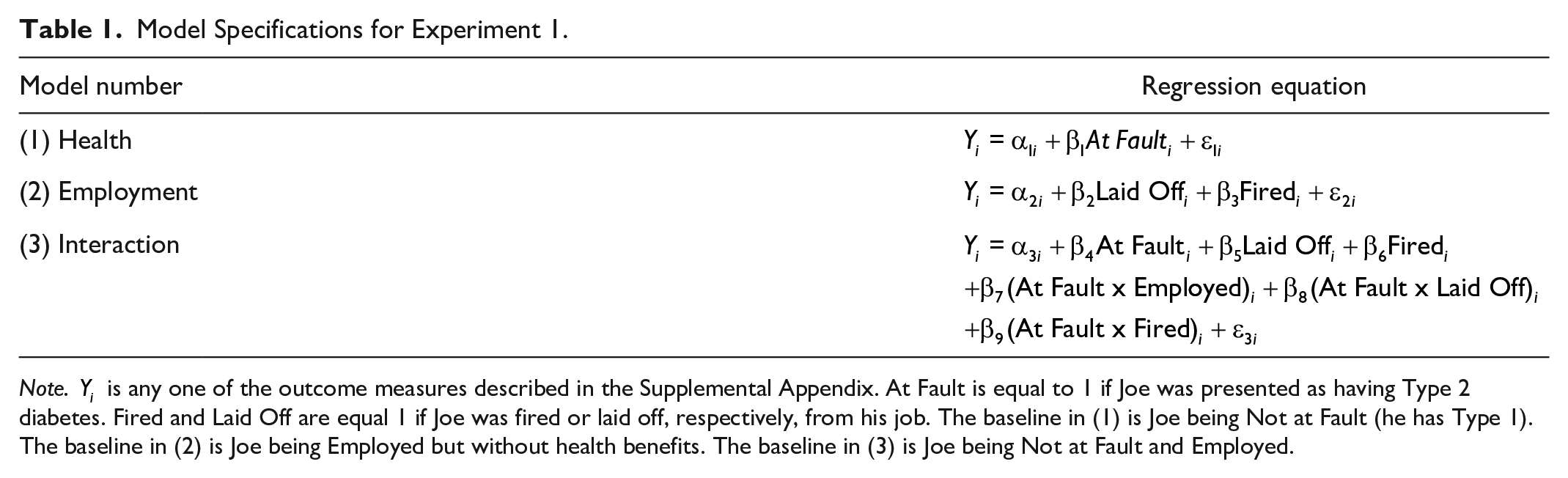
The initial analysis of the data includes three main OLS specifications which are provided in Table 1. Because respondents were randomized into one of the six treatment conditions with equal probability, estimates from a linear model should be equivalent to calculating group means, once the constant is accounted for (Gerber & Green, 2012, p. 103). Because the dependent variables are measured on scales from 1 to 7, interpretation of what the coefficients from a linear model mean realistically can be complicated. Nonetheless, the outcome of interest is whether there is a difference between treatment conditions on the dependent variables. While OLS provides advantages in estimation in experimental settings (e.g., see Angrist & Pischke, 2009, Ch. 3), an alternative specification using ordered logistic regression has been provided in the Supplemental Appendix and confirms that differences between outcomes across treatment conditions remain significant. 3
Model Specifications for Experiment 1.
Note.
The first specification (Model 1) compares being At Fault (Joe has Type 2 diabetes) to being Not at Fault (Joe has Type 1 diabetes); that is, the pooled effect of the health treatment. I marginalize over the Employment conditions to get a general sense of how being responsible (At Fault) for his own illness affects attitudes toward Joe. Similarly, the second specification (Model 2) marginalizes over the Health conditions and compares Joe being Fired or Laid Off to being Employed; that is, the pooled effect of the Employment treatment. This specification will provide intuition for what the Employment conditions are generally doing. For example, I expect that if Joe is laid off or fired, then respondents will be more likely to blame him for being uninsured.
Finally, the third specification (Model 3) compares the effect of each treatment condition to being Not at Fault and Employed. This specification will identify whether considerations of reciprocity are greater than those of responsibility when it comes to perceived deservingness. If the results show that Joe is less deserving when he is At Fault, regardless of what his employment status is, then that would suggest that deservingness of health insurance, and not just health care, is a function of one’s health-related behaviors. If the results show that Joe’s deservingness tracks with his level of reciprocity (e.g., least deserving when he is Fired), and these are comparable across Health conditions, then that suggests that respondents can appropriately differentiate between the domains in which to evaluate Joe’s deservingness of insurance receipt. If the results show something in between the two, for example, deservingness of insurance tracks with reciprocity but Joe is less deserving when he is At Fault than Not at Fault, then we can infer some interaction between the reciprocity and responsibility dimensions in how people think about one’s deservingness.
Table 2 reports results for the overall effect of Joe either being at fault for his diabetes diagnosis (having bad health behaviors) or not being at fault (being genetically predisposed to diabetes). First and most intuitive, I look at how much respondents blame Joe for being diagnosed with diabetes. Unsurprisingly, Column 1 suggests that being at fault for his diagnosis near doubles the amount of blame respondents put on Joe. The more interesting result comes from looking at how much blame respondents put on Joe for lacking insurance, which is presented in Column 2. Theoretically, we would expect that Joe’s lack of insurance is attributed to characteristics related to his attempt to procure insurance, that is, employment, and not necessarily related to health-specific behaviors. While the effect is half of that for blame attribution of illness, that health-related behaviors can move respondents to blame Joe for non-health related circumstances is in itself interesting. This suggests that health-related behaviors themselves have a significant effect on blame attribution on a non-health-related dimension. What is difficult to identify from the data is exactly what explains this effect. An intuitive explanation is that Joe’s unhealthy behaviors lead respondents to update about other facets of his character, such that he is nevertheless to blame for any unfortunate state he finds himself in.
Experiment 1—Effect of Responsibility on Deservingness.

Note. Coefficients are from an OLS regression. Robust standard errors in parentheses: ***p < .01, **p < .05, *p < .1. The constant reports the mean value of the outcome measure under the Not at Fault condition. The outcome measures are all on a scale from 1 (least agreement) to 7 (most agreement).
Columns 3 and 4 capture Joe’s perceived deservingness of federal help with paying for his health costs. When asked whether Joe is deserving of federal assistance, either in general or specifically through the Medicaid program, respondents report Joe as being more deserving when he is not at fault for his illness. In particular, while Joe is generally more deserving when he is not at fault, it is not necessarily the case that he should be insured through Medicaid. While both estimates are highly precise and in the same direction, it is unclear whether the difference in magnitude, while slight, motivates any meaningful further interpretation. Column 5 reports results for the outcome measure asking who bears the burden of paying for Joe’s medical care. This outcome differs from the two deservingness measures in specifically framing the provider of the costs for medical care as a choice between Joe on his own or citizens in society. The ambiguity of what it means for the federal government to provide support (i.e., through citizens’ taxes) is excluded. While respondents are less inclined to put the burden of costs on society, the effect size from Joe being at fault for his illness is nevertheless approximate to that in either of the deservingness measures. Overall, it would appear that respondents react strongly to whether Joe is personally at fault for his diabetes diagnoses.
I conduct a similar analysis of the employment treatments, the results of which are presented in Table 3. First looking at whether respondents blame Joe for his illness (Column 1), we see that Joe is blamed for being sick primarily when he is fired. This suggests some level of spillover from his responsibility, that is, respondents are potentially making inferences about who Joe is on the basis that he was fired. This is less so the case when Joe is laid off. Column 2 reports results for the measure of how much respondents blame Joe for lacking insurance. While the results here are intuitive—Joe is more to blame for being uninsured if he is fired—it is worth noting that the baseline mean is 2.8 on a scale from 1 to 7. This suggests that respondents are generally not overly inclined to ascribe blame for being uninsured. Additionally, I cannot yet identify from this data what the underlying mechanism is, whether Joe is blameful because respondents believe his being fired is what led him to be in a state of not having insurance or if Joe being fired signals some unfavorable characteristic that makes him inherently more blameful for being uninsured.
Experiment 1—Effect of Reciprocity on Deservingness.

Note. Coefficients are from an OLS regression. Robust standard errors in parentheses: ***p < .01, **p < .05, *p < .1. The constant reports the mean value of the outcome measure under the Employed condition. The outcome measures are all on a scale from 1 (least agreement) to 7 (most agreement).
Column 3 to 5 report the measures for Joe’s deservingness of federal or societal assistance in paying for his health costs. There are no significant effects across the three treatment conditions. This suggests that respondents are not necessarily updating negatively about Joe’s character (in as far as he should be helped by society and the government) based on whether he was fired or laid off from his job.
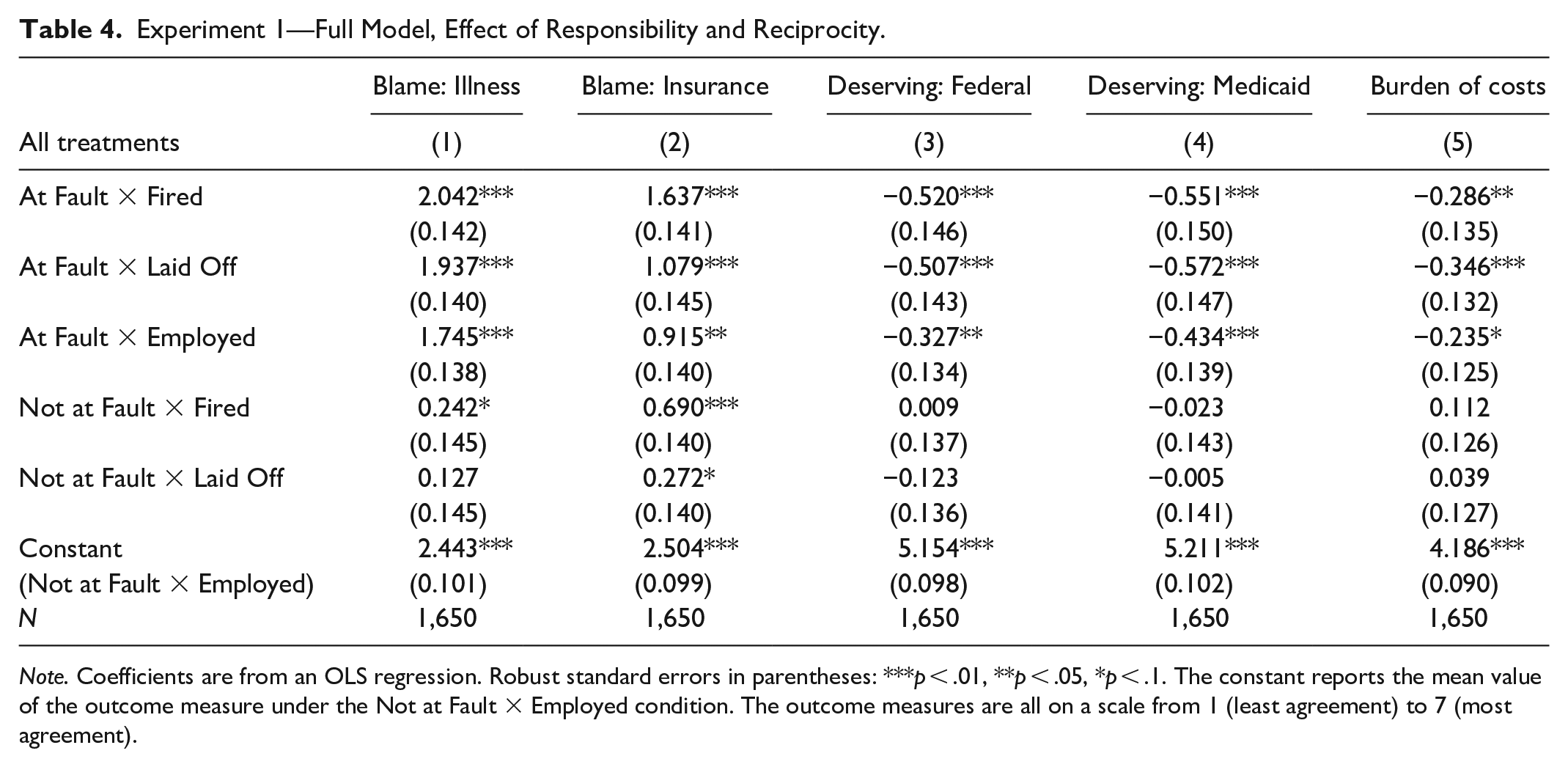
Comparing the specific treatment conditions, that is, the interaction between the pooled health and employment treatments, allows us to understand what is driving the effects from the individual treatments. For example, the effects in the employment treatment could be entirely driven by Joe being At Fault, rather than the actual employment condition itself. Indeed, the first three rows in Table 4 suggest that much of the effects we saw in the Table 3 were driven by Joe’s being at fault for his diabetes diagnosis. In Column (2), we see that respondents are more likely to rate Joe as being more to blame for not having insurance when he is both Fired and At Fault than when he is just Fired (and Not at Fault). In Column (1), we still see that respondents blame Joe for his illness when he is fired, even though he is not a fault for his illness. This supports the previous conjecture that respondents are using Joe’s negative characteristics to make judgments against him, regardless of the domain in which those judgments are meant to take place.
Experiment 1—Full Model, Effect of Responsibility and Reciprocity.
Note. Coefficients are from an OLS regression. Robust standard errors in parentheses: ***p < .01, **p < .05, *p < .1. The constant reports the mean value of the outcome measure under the Not at Fault × Employed condition. The outcome measures are all on a scale from 1 (least agreement) to 7 (most agreement).
In Columns (3)–(5), we see that respondents view Joe as less deserving and more on the hook for his costs when he is At Fault, regardless of his employment status (the first three coefficients in each column are negative and precisely estimated compared to the bottom three). An interesting result is that Joe is still undeservingness when he is employed, but nonetheless at fault for his illness (given by the negative coefficients in the third row of Columns 3 and 4). While the coefficient is slightly more positive than the other two employment conditions, the difference is marginal. At risk of over interpreting the results, one could posit that if Joe is At Fault and Fired then he is definitely to blame for his situation, so he should be paying his own costs. However, if Joe is At Fault and Employed, then he is still to blame for incurring health costs, but he is also in a position of earning income with which he can allocate toward his health costs; so, Joe is still undeserving of federal health insurance. The underlying mechanism in this case cannot be identified without further testing.
More generally, one way to interpret the negative coefficients in the At Fault conditions is that Joe’s level of responsibility is doing most of the work in how respondents’ attitudes are generated. Respondents do not care so much about what Joe is doing to earn his health insurance, but rather, what Joe has done to incur the need for health care in the first place. While receipt of health insurance and of health care are technically different considerations, this seems to be less so the case in the court of public opinion.
Comparison to Employment-Only survey
How much work is the Health treatment doing in moving respondent attitudes? It is demonstrated in the preceding analysis that responsibility (i.e., how much Joe is at fault for his illness) plays a more salient role in moving respondents’ attitudes than does reciprocity. But, as mentioned above, we may worry that there are spillover effects coming from Type II diabetes being highly stigamatizing, thus overpowering variation we would otherwise hope to see from within the two responsibility conditions. Respondents could be updating about Joe’s type (as a person) based on him being responsible in a way that informs their responses on the other insurance-specific measures.
To provide some intuition, I run a second survey as part of Experiment 1 that is a pared down version of the Employment-Health survey. The second survey, which I refer to as “Employment-Only,” compares the results from the Employment-Health to a simplified experiment which holds constant Joe’s health responsibility and randomizes his employment status. Respondents will be presented a similar vignette about Joe but will not see a description about his responsibility in incurring diabetes (i.e., the vignette mirrors what is shown in “Employment-Health” with the Health Treatment omitted). While I am not estimating the differences between the two surveys, comparing the results from Employment-Health to Employment-Only will give us a sense of how much more of the respondents’ attitudes are driven by Joe’s health status, compared to just his employment status.
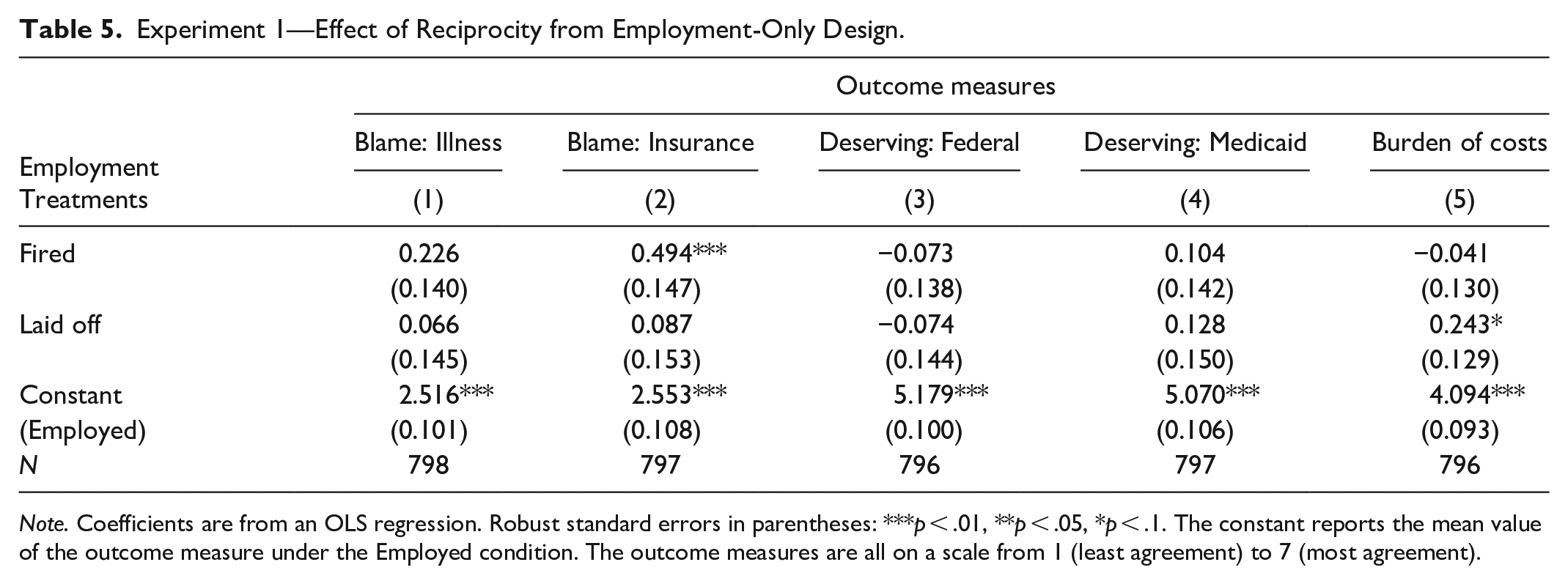
The results from this survey are presented in Table 5 and are somewhat comparable (at least in magnitude and direction) to those in Table 3 and the bottom half of Table 4. Looking at the treatment arm from Employment-Health in which Joe has Type I rather than Type II diabetes (i.e., Not at Fault) is also a useful benchmark for how to think about the effect sizes in Table 5, since one could think of Type I as a less stigmatizing illness than Type II. The results in 5 shows that respondents are most likely to attribute blame for lacking insurance to Joe when he has been fired from his job. Moreover, we no longer see precise estimation of blame for illness (Column 1) when Joe is fired, as we did in the Employment-Health survey. We also no longer see precise estimation of the deservingness measures. Comparing these results to those from the full design suggests that much of the negative judgement of Joe is being driven by his health-related responsibilty, more so than what Joe is doing to reciprocate getting health insurance.
Experiment 1—Effect of Reciprocity from Employment-Only Design.
Note. Coefficients are from an OLS regression. Robust standard errors in parentheses: ***p < .01, **p < .05, *p < .1. The constant reports the mean value of the outcome measure under the Employed condition. The outcome measures are all on a scale from 1 (least agreement) to 7 (most agreement).
This supports the previous results that Joe’s responsibility for incurring illness plays a much greater role in informing attitudes about his deservingness than does his effort in working for his insurance. Ultimately what Experiment 1 suggests is that reciprocity, to the extent that it is captured by Joe earning insurance through employer-sponsorship, does not matter all that much in people’s evaluations of how deserving he is of federal health insurance. Two intuitions follow: (1) People generally do not care about reciprocity efforts when it comes to welfare in the form of health insurance, and/or (2) People consider the question of whether someone deserves health care and the question of whether someone deserves health insurance as relatively similar issues.
Limitations
One main limitation of the current analysis is its ability to speak to underlying mechanisms. While conclusions can be drawn about whether Joe is more to blame or more deserving as a result of any one of the six treatments, I cannot identify why respondents react in the way they do. Whether Joe is less deserving of Medicaid when he is at fault could be because respondents want to punish Joe for bad health behaviors and lifestyle. It could also be due to concerns about how burdensome Joe, who is unhealthy, will be on Medicaid, which is funded by taxpayer dollars. If Joe is going to access Medicaid more because he is demonstrably unhealthy (and perhaps, consequently, unlikely to change his behaviors), his deservingness to be on Medicaid has less to do with his responsibility for his predicament and more about respondents’ concerns about how Medicaid is run.
To this end, I run a second experiment (“Experiment 2”) which aims to capture baseline attitudes toward the Medicaid program itself. While the results from this design cannot address all of the mechanism bundling described, it nonetheless sheds some light as to how respondents differentiate between (1) the learning how the policy works/who it services and (2) recipients on the policy.
Experiment 2: Identifying Sources of Program Attitudes
Experiment 2 addresses the issue in Experiment 1 that respondents’ attitudes are bundled and we cannot distinguish between baseline affect toward the recipient from affect toward Medicaid as a result of learning about a potential recipient on the program. Respondents may view Joe as undeserving of Medicaid either because they dislike Joe or because they dislike Joe and they just learned that Medicaid is a program that provides benefits to people like Joe. Experiment 2 is designed to measure the effects of learning about program recipients on program attitudes. This is particularly important in the context of understanding what drives perceptions of deservingness toward Medicaid recipients because we would ideally be able to differentiate between attitudes based on what the recipient is doing and attitudes based on Medicaid itself.
There are two main randomizations that occur in Experiment 2. The first is the amount of policy-relevant information respondents provided about Medicaid programming (“Policy Treatment”). 4 If they are in the more informative treatment, “Medicaid+Info,” they see the italicized text (below) in addition to the base treatment. This allows me to address the question of why respondents may have negative attitudes toward Medicaid as a program; is it because of ex ante feelings toward program itself (i.e., in name only) or because of how the program actually works (i.e., eligibility criteria and funding sources)?
The second randomization is on the recipient type (“Recipient Treatment”). To be consistent with Experiment 1, if respondents learn about a program recipient, they are given a profile of Joe, who has either Type I or Type II diabetes. 5 The main question this randomization is addressing is whether respondents will update (negatively) about Medicare or Medicaid when they learn about a person who is receiving benefits from it. The control condition in which respondents do not learn about any recipient will allow me to identify how respondents’ attitudes toward a program change as a function of the recipients who are on the program. The vignette is organized such that respondents first see the text presented in the Policy Treatment and then the text presented in the Recipient Treatment:
Policy Treatment:
The United State is one of the few developed countries without guaranteed federally funded health care.
Medicaid/Medicaid+Info: As a result, some Americans rely on Medicaid, which is a jointly state and federal funded health insurance program that generally covers low-income individuals. [Individuals and their families are eligible for Medicaid if they are US citizens earning less than 133% of the federal poverty level.] Around 19% of Americans currently get their insurance through Medicaid.
Recipient Treatment:
Irresponsible/Responsible: Recall that 19% of Americans rely on Medicaid for their health insurance. We will now describe an individual who falls into that 19% and ask some questions about your attitudes toward him: Joe is a single, white man who works a full time job and has a high school diploma. [He has an unhealthy diet, consisting mainly of fast food and processed snacks and has been diagnosed with Type II diabetes/He has a family history of Type I diabetes and has been diagnosed with Type I.] In order to cover the costs of treatment, Joe relies on Medicaid.
Joe is a single, white man who works a full time job and has a high school diploma. [He has an unhealthy diet, consisting mainly of fast food and processed snacks and has been diagnosed with Type II diabetes/He has a family history of Type I diabetes and has been diagnosed with Type I.] In order to cover the costs of treatment, Joe relies on Medicaid.
No Joe: (no text)
There are two main predictions that are tested in this design. First, respondents will have more negative attitudes toward the program after learning about Joe (more so if he has Type 2 than Type 1) being a recipient. Negative attitudes here are measured as support for expanding program benefits to people currently uninsured and willingness to pay slightly more in taxes. Second, respondents will be less supportive of Medicaid when they learn more about how Medicaid is funded and its eligibility requirements than otherwise.
The main outcomes of interest are concerned with policy support. Policy support is captured by three measures that capture different aspects of support: (1) support for expansion, (2) support for the program itself, and (3) willingness to pay more in taxes. As the results will show, the type of support plays a nontrivial role. Respondents may be generally supportive of policy, but what that support looks like, that is, program expansion versus general support versus paying more in taxes, will itself vary. Respondents are also asked about their attitudes toward work requirements (see Supplemental Appendix for wording). 6 This measure was included to capture how respondents felt about work requirements specifically in the context of Medicaid eligibility, which was not done in Experiment 1, primarily due to concerns about priming effects.
Results
Data were collected from a sample of 1,075 respondents from a survey run on Amazon’s Mechanical Turk. The assignment mechanism allocated each respondent into the treatment conditions with equal probability.
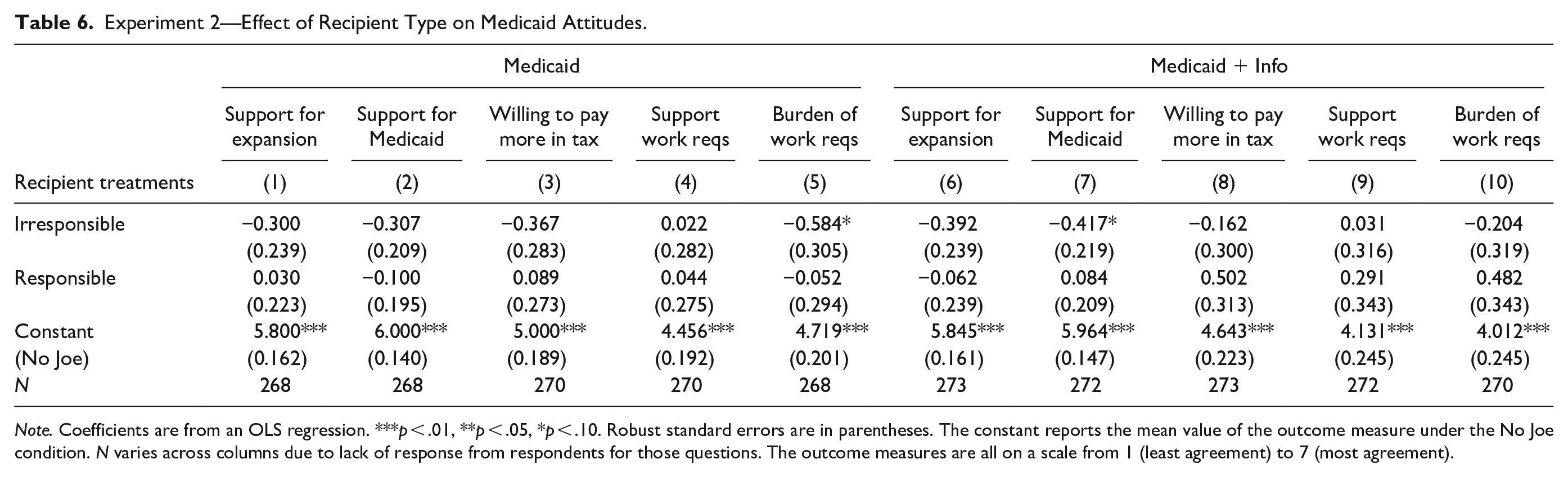
In general, the results from Experiment 2 suggest that programmatic support is contingent on both how the policy works (i.e., eligibility requirements and how its funded) as well as who is benefiting from the program. That said, there is a lack of evidence that this support would translate into policy expansion to currently unemployed individuals. Table 6 looks at the effect of learning about a type of recipient on the policy attitude. There is suggestive evidence that learning about an irresponsible recipient on Medicaid negatively effects attitudes toward Medicaid. In the Medicaid with no additional info treatment (the left half of Table 6), learning about an irresponsible Joe decreases respondents’ average attitude against work requirements (i.e., they do not think work requirements are as much of a burden if they are presented with an irresponsible Joe). In the Medicaid+Info treatment, general support for Medicaid decreases by about half a point if they learn about an irresponsible Joe.
Experiment 2—Effect of Recipient Type on Medicaid Attitudes.
Note. Coefficients are from an OLS regression. ***p < .01, **p < .05, *p < .10. Robust standard errors are in parentheses. The constant reports the mean value of the outcome measure under the No Joe condition. N varies across columns due to lack of response from respondents for those questions. The outcome measures are all on a scale from 1 (least agreement) to 7 (most agreement).
Table 7 estimates the interaction of the policy information treatment with the recipient treatment to address the question of how much of program attitudes are driven by programmatic features, that is, who is eligible and how it is funded. It could be that support for Medicaid is more of an issue knowing (or not knowing) how the program works rather than one of distaste for the program or recipient. Framed differently, if respondents are dissatisfied with how Medicaid operates and not with the targeted recipient population, then being primed about programmatic features of Medicaid should not vary expressed support. On the other hand, we might expect that learning about how Medicaid actually works would decrease support because of its similarity to other welfare programs (i.e., you don’t pay into Medicaid whereas you do pay into Medicare). Supplemental Appendix Table A8 runs a pooled comparison of policy with and without additional information. We see that respondents are more likely to view work requirements as less burdensome when they are more informed about how Medicaid is run. That is to say, learning about eligibility requirements for Medicaid makes respondents view work requirements as marginally more appropriate for eligibility.
Experiment 2—Effect of Additional Info & Recipient Type on Attitudes Toward Medicaid.
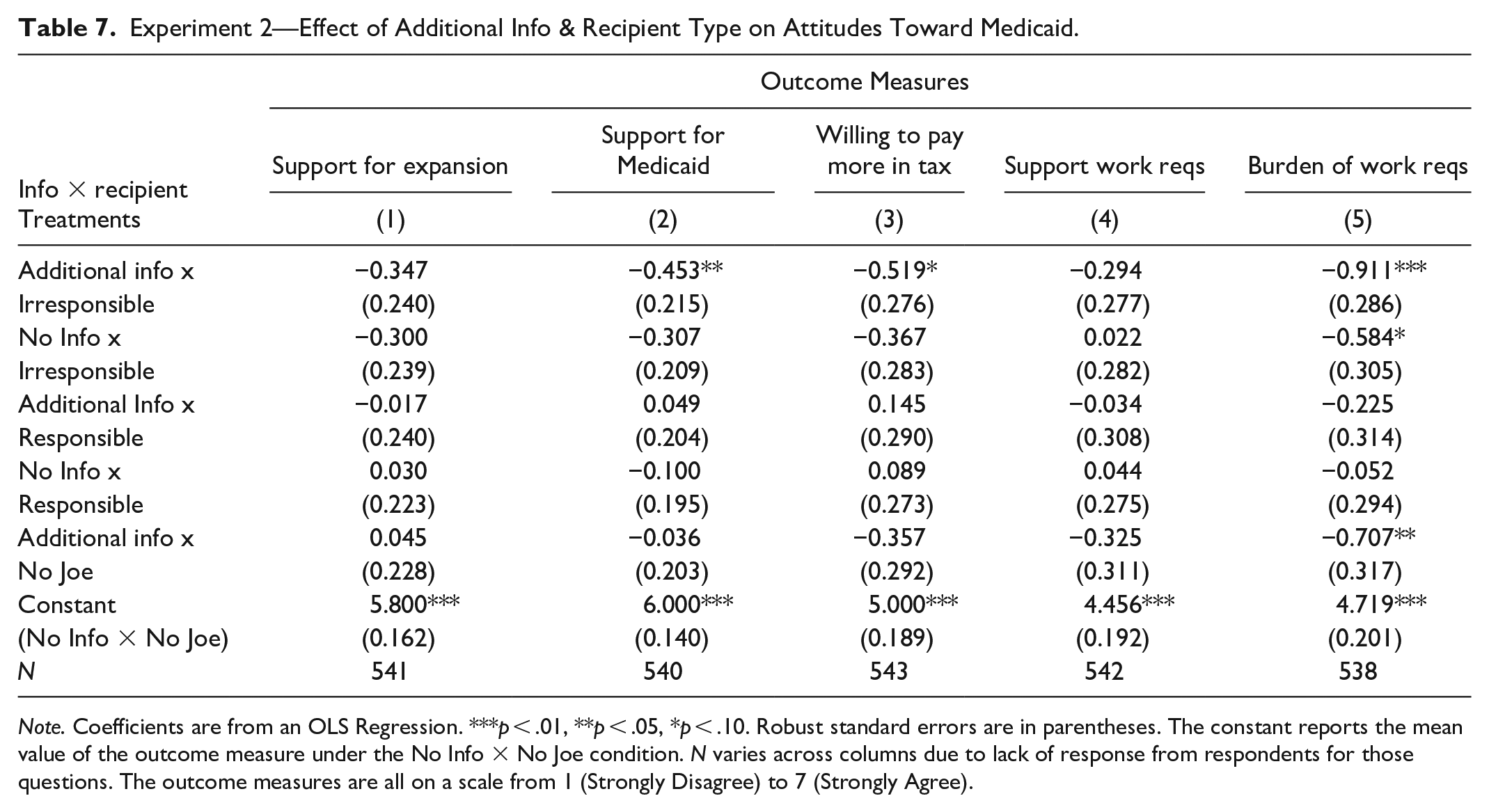
Note. Coefficients are from an OLS Regression. ***p < .01, **p < .05, *p < .10. Robust standard errors are in parentheses. The constant reports the mean value of the outcome measure under the No Info × No Joe condition. N varies across columns due to lack of response from respondents for those questions. The outcome measures are all on a scale from 1 (Strongly Disagree) to 7 (Strongly Agree).
More specifically, Table 7 present a full analysis of the interactive effect of learning about a recipient type and learning about how a policy works. Table 7 shows that support for Medicaid decreases when respondents learn that an irresponsible type is receiving benefits from Medicaid, particularly when they are primed to think about how Medicaid is run. While we cannot reject the argument that people take no issue with the programmatic features of Medicaid (i.e., we cannot accept the null that there’s no effect of learning additional information), the results suggests that learning about recipients on Medicaid plays a salient role in informing attitudes toward Medicaid.
We can compare these results to additional treatments focusing on Medicare (a description is provided in the Supplemental Appendix) in Table A9, where the effects are non-negative (albeit non-significant). This points to some variation in how respondents view Medicaid relative to Medicare, suggesting that learning about potential recipients of a policy program is important for program evaluation, beyond the baseline attitudes toward the program itself.
It is worth connecting the estimate on the work requirement outcome (Column 4 and 9 in Table 6) to the previous results from Experiment 1, where the notion of work requirements is operationalized through Joe’s employment status. We see in the results for Experiment 2 that when respondents are in the condition with an irresponsible Joe, they are somewhat more supportive of work requirements. While estimates are not significant, it is nonetheless useful to discuss the possible counterintuitiveness that arises, given that the results from Experiment 1 suggest that respondents do not care that much about Joe’s reciprocity and employment.
One way to interpret these results is that Experiment 2 directly asks respondents about their attitudes to work requirements while Experiment 1 asks respondents about the underlying intent of work requirements (i.e., the notion of reciprocity). Work requirements are generally discussed as a means for states to assess Medicaid recipients and much of the rhetoric around them is an issue of framing. However, as discussed in previous sections, this does not actually comport with the empirical reality of the non-working Medicaid population nor necessarily with how people understand the role of work requirements once we strip away some of the framing rhetoric. This may have consequences when thinking about the foundations of support for welfare and the framing of pros and cons of programmatic features by proponents and opponents. 7 Reframing the question of deservingness of Medicaid benefits from “Has this person done enough to earn benefits?” to “Recipients should work to earn benefits” changes the underlying question that judgments are based on. People may be more supportive of benefit provision when asked to think about what certain requirements entail, as demonstrated in Experiment 1, but they may also agree with the general idea that people should work to earn program benefits. For those who are trying to generate support against welfare programming, the latter framing is arguably an effective way to market the cons of such programming (see also Chong & Druckman, 2007 on framing theory).
Conclusion
Whether an individual deserves federally-funded health insurance is based on a number of considerations. While extant work has established the importance of health-related behaviors in changing perceptions of deservingness, something that remains unclear is whether individuals can differentiate between desert of health care and desert of health insurance. This distinction is important given what we know about program deservingness from the literature on welfare. While reciprocity, what one does to earn or return program benefits, is an important factor in welfare recipiency, most of the work on deservingness of health insurance has focused on an alternative factor, responsibility. This focus is not unwarranted, since what an individual does to incur need of health care does often affect how we evaluate their deservingness of said health care. However, by conflating the provision of health care with health insurance, we cannot tell from extant research whether attitudes toward provision of health insurance (e.g., in the form of Medicaid) are driven by health-related considerations (i.e., what they did to become sick) or by work-related considerations, which would align more with the work on attitudes toward welfare.
Through a series of survey experiments, I find that people rely on health-related behaviors in evaluating recipients of Medicaid, more so than on behaviors related to whether one has earned their health insurance. This suggests that respondents either do not care much about an individual’s reciprocity when it comes to health insurance receipt or that the questions of deservingness of health care and of health insurance are in fact the same question. Additionally, a supplementary experiment confirms that it is indeed the profile of the recipient that matters in driving these attitudes, and that the results are not due to respondents updating about the programmatic features of Medicaid itself. These results are important in understanding what drives individuals’ support for welfare programs. Using a recipient’s racial identity as a cue and relying on the group stereotypes is problematic when these heuristics are associated with undeserving characteristics. One way to frame these results, that support for redistributive Medicaid benefits and perceived recipient deservingness are affected by health behaviors and not employment, is groups which carry stereotypes of being more unhealthy, more likely to be sick, more obese, etc. (especially of their own accord), will be subjected to negative evaluations regardless of what they do to earn their health insurance. An example of this can be found in the 1996 welfare reform efforts, in which Aid to Families with Dependent Children was replaced with Temporary Assistance for Needy Families (TANF). More than just a change in name, TANF came with changes in programming, including strict work requirements. Despite this change in the nature of the program, research shows that the role of attitudes and perceptions of Black recipients as being lazy and undeserving nonetheless remained a salient factor in explaining welfare support (e.g., see Dyck & Hussey, 2008). 8 The importance of group stereotypes in under girding perceptions of program deservingness has implications for more contemporary issues, such as immigration; recent work has shown that anti-immigration attitudes correlate negatively support for welfare (e.g., see Garand et al., 2017).
What is a real-world relevance of reciprocity in federally-funded health insurance? States are currently engaging in efforts to waive Obama-era restrictions against using work requirements as part of Medicaid eligibility. Not only are a majority of Medicaid recipients either already employed or unable to work (due to chronic illness, schooling, etc.), but the implementation of work requirements may make current Medicaid recipients newly ineligible. The idea of work requirements speaks to an age old American tradition of earning ones keep. While work requirements work (in theory) for a number of policy dimension (i.e., most prominently, welfare), their relevance in the health sphere seems to be relatively negligible. Data from this study suggest that the more relevant factor is how individuals are perceived to be utilizing health insurance. This complicates the introduction and relevance of work requirements in Medicaid eligibility. If reciprocity is not relevant in public opinion, then the relevance of work requirements as part of Medicaid eligibility requires further questioning. In particular, this study suggests that while individuals don’t use employment status as a factor in evaluating deservingness, there is suggestive evidence that they support the concept work requirements when it is described in moral terms of reciprocity and for the betterment of the recipient.
Along these lines, perhaps the most important takeaway is that attitudes toward policy programming are heavily influenced by the recipient population (see Schneider and Ingram, 1993). Given the focus on Medicare-for-All’s viability as a solution to the health care crisis, one point worth bringing into the discussion is how the recipient population of any new health care policy will affect support of the policy. We can generally agree that most people want some improvement to the current health care system, but we have yet to really consider what will happen when the discussion shifts to asking who benefits from these improvements. Policy advocates may need to correct misconceptions of group stereotypes that lead to negative perceptions of health-related responsibility or frame them within a context that diverts responsibility to another source. Alternatively, acknowledging the presence of potential recipients from groups that are positively stereotyped may also serve to increase the perceived deservingness of the overall recipient population. Identifying the role of individual responsibility, independent of the role of reciprocity, in driving attitudes toward programmatic support will help researchers and policymakers better understand the contours of health policy design and support for such policies. While the experiments in this study hold race and gender context in the hypothetical vignettes, future research undoubtedly benefits from examining what assumptions are made based on group stereotypes (i.e., one’s racial or gender identity) and how that subsequently affects one’s perceived deservingness of welfare benefits.
Supplemental Material
Supplement_PDF – Supplemental material for Work Requirements and Perceived Deservingness of Medicaid
Supplemental material, Supplement_PDF for Work Requirements and Perceived Deservingness of Medicaid by Jennifer D. Wu in American Politics Research
Footnotes
Declaration of Conflicting Interests
The author(s) declared no potential conflicts of interest with respect to the research, authorship, and/or publication of this article.
Funding
The author(s) received no financial support for the research, authorship, and/or publication of this article.

Supplemental Material
Supplemental material for this article is available online.
Notes
Author Biography
References
Supplementary Material
Please find the following supplemental material available below.
For Open Access articles published under a Creative Commons License, all supplemental material carries the same license as the article it is associated with.
For non-Open Access articles published, all supplemental material carries a non-exclusive license, and permission requests for re-use of supplemental material or any part of supplemental material shall be sent directly to the copyright owner as specified in the copyright notice associated with the article.
