




Abstract
What has been the response of U.S. governors to the COVID-19 pandemic? In this research note, we explore the determinants of implementing stay-at-home orders, focusing on governors’ characteristics in the early stage of the pandemic. In our most conservative estimate, being a Democratic governor increased the probability of implementing a stay-at-home order by more than 50%. Moreover, we found that the probability of implementing a statewide stay-at-home order was about 40% more likely for governors without term limits than governors with term limits. We also found that Democratic governors and governors without term limits were significantly faster to adopt statewide orders than Republican governors and governors with term limits. There is evidence of politics as usual in these unusual times.
The COVID-19 pandemic is the most serious and severe threat that countries have faced since World War II. The first outbreak of the virus took place at Wuhan City in the Hubei Province of China in December 2019. The virus then spread to Asia, Europe, and North America between January and March 2020. As of March 30, there were more than 700,000 confirmed cases of COVID-19 around the world and more than 34,000 people had died of causes related to the virus (Johns Hopkins University Coronavirus Resource Center, 2020). In addition to human losses, the COVID-19 pandemic has caused massive economic damage, which threatens consequences worse than those created by the 2008 global financial crisis (Ilzetzki, 2020).
In the midst of this unprecedented health crisis, government responses in Asia and Europe were to implement lockdowns of parts of the country or of the entire country. A lockdown implies that all travel into and out the area is prohibited and people’s movements within the area are severely restricted. For instance, the Chinese government locked down Wuhan City on January 23, 2020. The Italian government was the first to lock down the entire country—on March 11—followed by Spain, France, and many other European countries. The evidence has so far suggested that locking down is one of only a few instruments available to halt the spread of COVID-19, absent a vaccine. Indeed, the number of new COVID-19 cases in Wuhan City has been zero over the past few days, and the city has been now reopened as of March 30. However, these measures come with sizeable economic costs and with unusual limitations of civil rights, especially for liberal democracies.
Given this international context, what was the response of U.S. governors in the early stage of the COVID-19 pandemic? This question is particularly important for two reasons. First, the United States is now the country with the largest number of COVID-19 cases, having overtaken China and Italy. Second, different U.S. states responded differently to the outbreak. As of March 30, 28 states had issued a statewide order urging their citizens to stay home, whereas 14 states had issued orders in part of the state. In this research note, we explored the determinants of issuing stay-at-home orders, focusing on governors’characteristics. In particular, we focused on their ideology, on whether they face reelection (i.e., whether the governor is a lame duck), and on their gender and age.
After controlling for deaths related to COVID-19 and other socioeconomic variables, we found that Democratic governors were significantly more likely to implement a statewide order. In our most conservative estimate, being a Democratic governor increased the probability of implementing a stay-at-home order by more than 50%. Furthermore, states with Democratic governors were quicker to implement statewide orders than states with Republican governors. Moreover, we found that the probability of implementing a statewide stay-at-home order was about 40% more likely for governors without term limits and that governors without term limits were faster to implement stay-at-home measures than governors with term limits. However, both effects were significant only when controlling for ideology. Other governors’characteristics bore no effect in explaining the implementation or the speed of the lockdown, a result in line with Ferreira and Gyourko (2014).
Our results seem to indicate that Democratic governors place special emphasis on health and safety, whereas Republican governors are particularly concerned about the economic costs of stay-at-home measures. Our results confirm findings from previous studies on the role of ideology in explaining policy making in the United States (Barrilleaux & Rainey, 2014; Maclean et al., 2018; Potrafke, 2018). Moreover, the results for governors with term limits are in line with previous works in the discipline (Alt et al., 2011; Besley & Case, 1995; Cooper et al., 2016; Ferguson, 2003). When governors do not face reelection, they are less concerned about their reputations and, in turn, this has significant effect on their economic policy choices; for example, governors with limits reduce state spending and the minimum wage. The same seems to apply to policies concerning health and safety. In sum, subnational politics are, and will continue to be, of paramount importance in explaining responses to the COVID-19 pandemic.
Data
Our first outcome variable captured whether a state had issued statewide orders forcing its citizens to stay home as of March 30, 2020. Our second outcome captured how many days had passed since the state implemented the stay-at-home order, starting from March 19, 2020, the day on which California passed the first gubernatorial executive statewide order in the United States. States that had not implemented a statewide order as of March 30, 2020 were right-censored, to use the language of survival analysis. Data came from the New York Times (Mervosh et al., 2020). Figure 1 shows the geographical distribution of our outcome variable as of March 30, 2020.

Statewide orders.
Our main covariates were a series of variables capturing governors’ characteristics. In particular, we measured (1) governor’s ideology, that is, whether the governor is a Democrat (Democratic Governor); (2) whether the governor faces a term limit, that is, she cannot be reelected (Term Limit); (3) governor’s gender, that is, whether the governor is female (Female Governor); and (4) governor’s age (Governor Age). Data came from online personal biographies of governors who are currently in office. Figures 2 and 3 show the geographical distribution of Democratic Governor and Term Limit.

Democratic Governor.

Term limit.
Additionally, we controlled for the number of deaths related to COVID-19 as of the issuing of the stay-at-home orders (COVID-19 Deaths). We manually collected data on COVID-19 cases and deaths from each state’s Department of Public Health (or equivalent) or other governmental sources. For states without publicly available data, we relied on local news reports. Our number of deaths was exactly the same as those shown by the COVID Tracking Project (https://covidtracking.com/). Figure 4 shows the geographical distribution of COVID-19 Deaths.
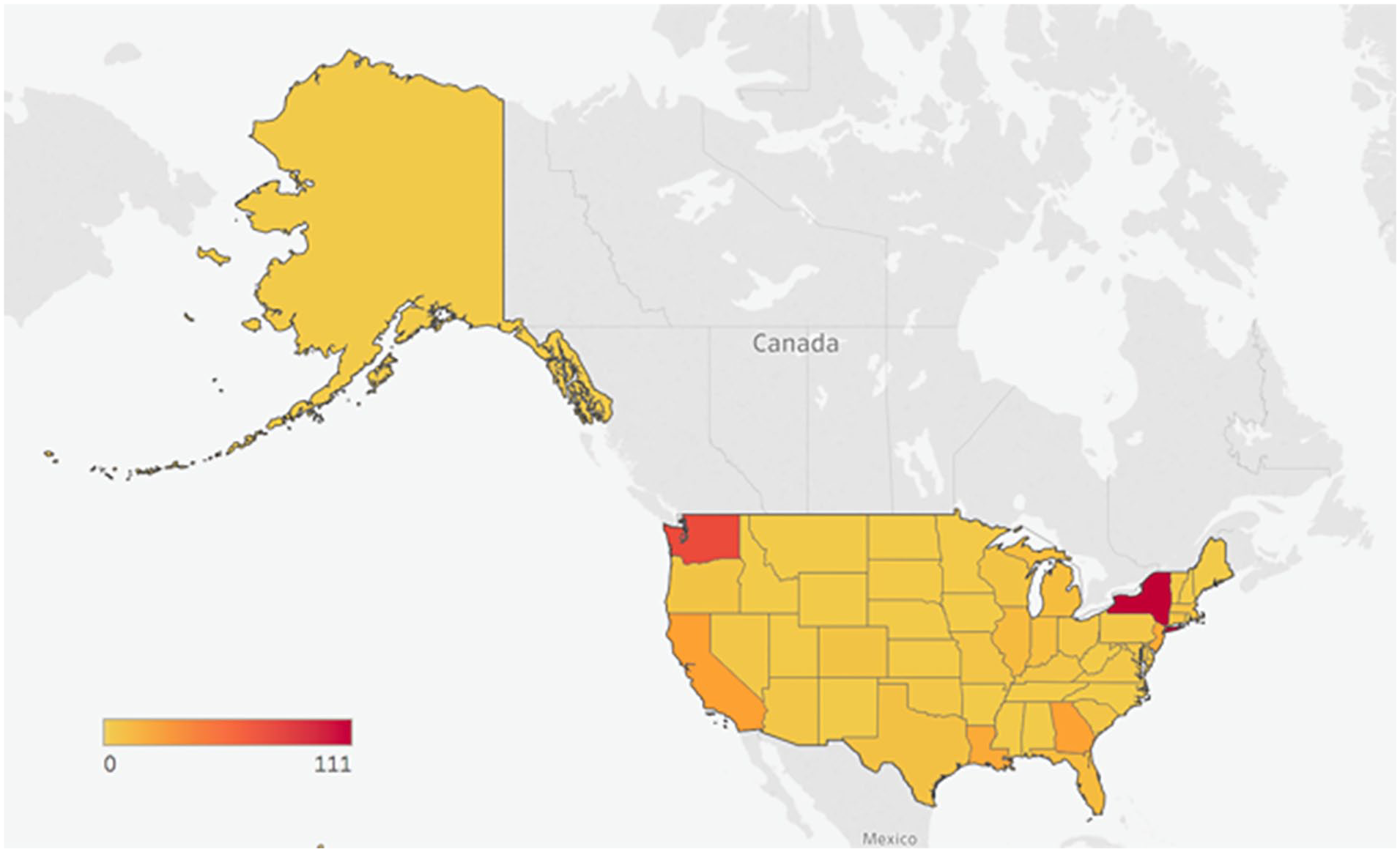
COVID-19 Deaths.
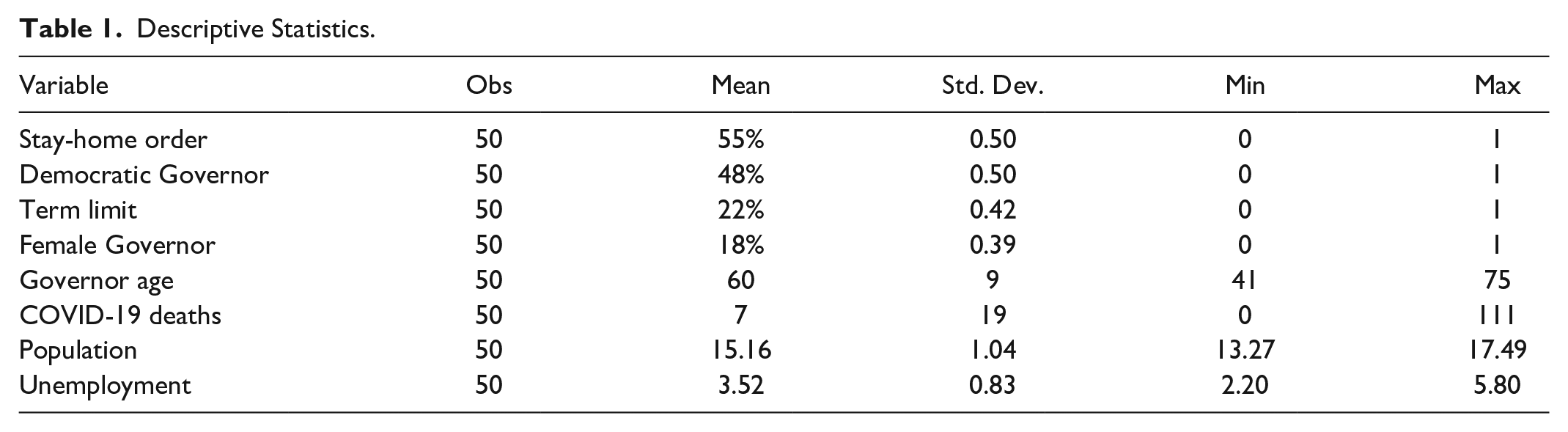
Furthermore, we controlled for (the log of) population of each state and for the level of unemployment in each state for the year 2019. The first variable accounted for concerns about the number of people who could have possibly contracted the virus. The second variable controlled for economic conditions of the state. Population data came from the 2017 American Community Survey and the 2019 state unemployment rate from the Bureau of Labor Statistics. Table 1 shows the descriptive statistics of our variables.
Descriptive Statistics.
Methodology
Our first econometric model for testing the effect of governors’ characteristics on the probability of issuing a stay-at-home order was as follows:

where s was a state, including both states with and without the stay-at-home policy. Xs was a set of variables for state governors’ characteristics (i.e., ideology, age, gender, and term limit). The dependent variable scored 1 if the state had issued a statewide order to stay home as of March 30, 2020; 0 otherwise. Zs was a set of controls (i.e., COVID-19 deaths, population, and unemployment) at the state level, which we included in every estimate. β1, β2, and β3 were the coefficients of the covariates and the constant, whereas ε was the error term. We ran OLS models with robust standard errors. 1
Our second econometric model for testing the duration of non-implementing a statewide order was as follows:

While all the covariates were the same as in equation (1), the dependent variable measured the number of days taken by a state to implement a stay-at-home order since March 19, 2020 (up to March 30). We ran a Cox model with robust standard errors. To ease the interpretation of the results, we report here the coefficients rather than the hazard ratios.
Findings
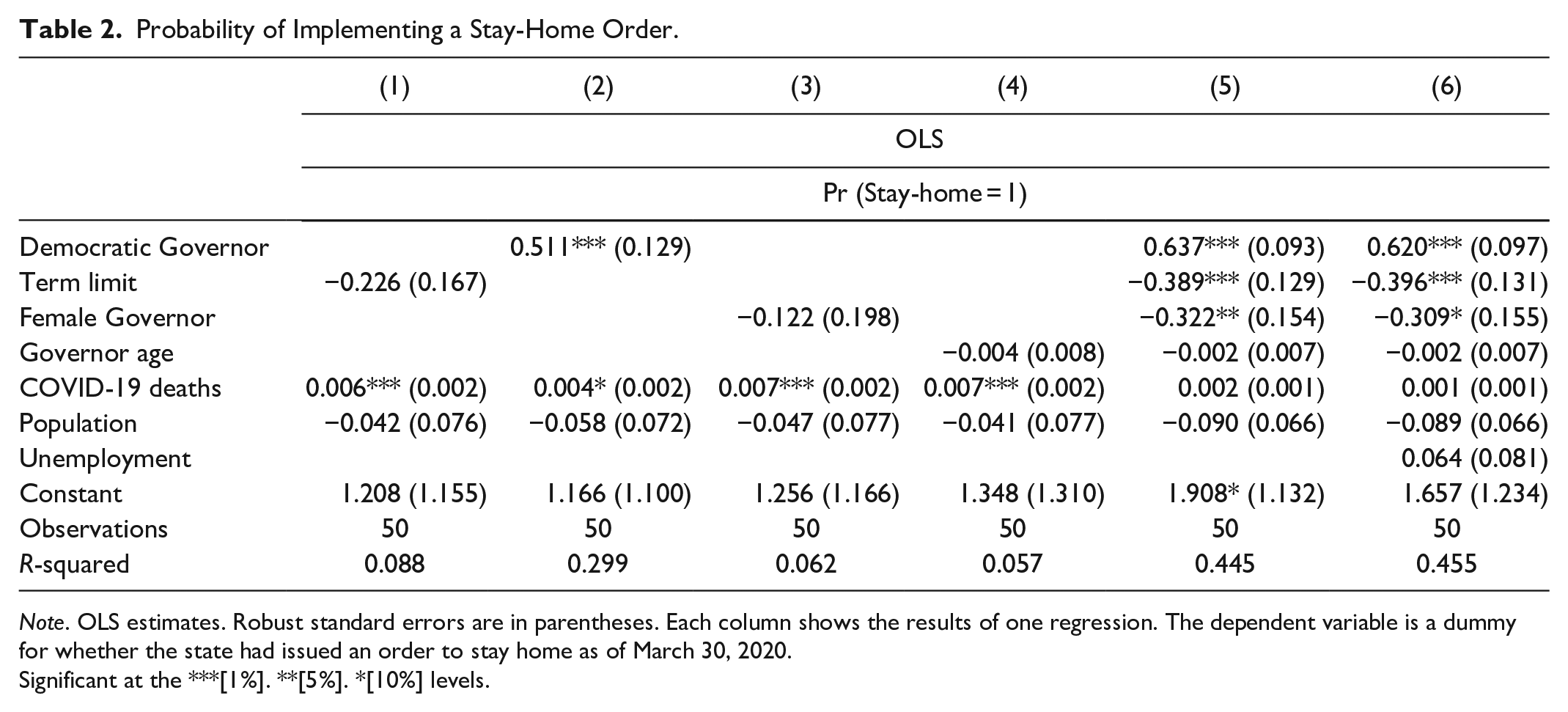
Table 2 reports our main results from the OLS regressions. Since we had only 50 observations, we started including covariates parsimoniously, while still controlling for COVID-19 deaths and population. In particular, we considered governors’ characteristics first alone (Columns 1–4) and then simultaneously (Column 5). Furthermore, in Column 6 we also included unemployment, which accounted for the economic conditions of the state.
Probability of Implementing a Stay-Home Order.
Note. OLS estimates. Robust standard errors are in parentheses. Each column shows the results of one regression. The dependent variable is a dummy for whether the state had issued an order to stay home as of March 30, 2020.
Significant at the ***[1%]. **[5%]. *[10%] levels.
Among governors’ characteristics, Democratic Governor was always significant and with a positive sign. The estimates suggest that Democratic governors were 50 percentage points more likely to have ordered their citizens to stay home in our most conservative model. The estimate climbed to more than 60% in our full model specifications.
Term Limit was statistically significant, but only when we controlled for Democratic Governor. The estimates suggest that governors with term limits were about 40 percentage points less likely to have ordered their citizens to stay home. Governors’ age did not explain much of the decision to issue the stay-at-home order, whereas the estimates for Female Governor are negative and statistically significant in two models out of three. As expected, the coefficient of COVID-19 Deaths was always positive and significant, except in Models 5 and 6.
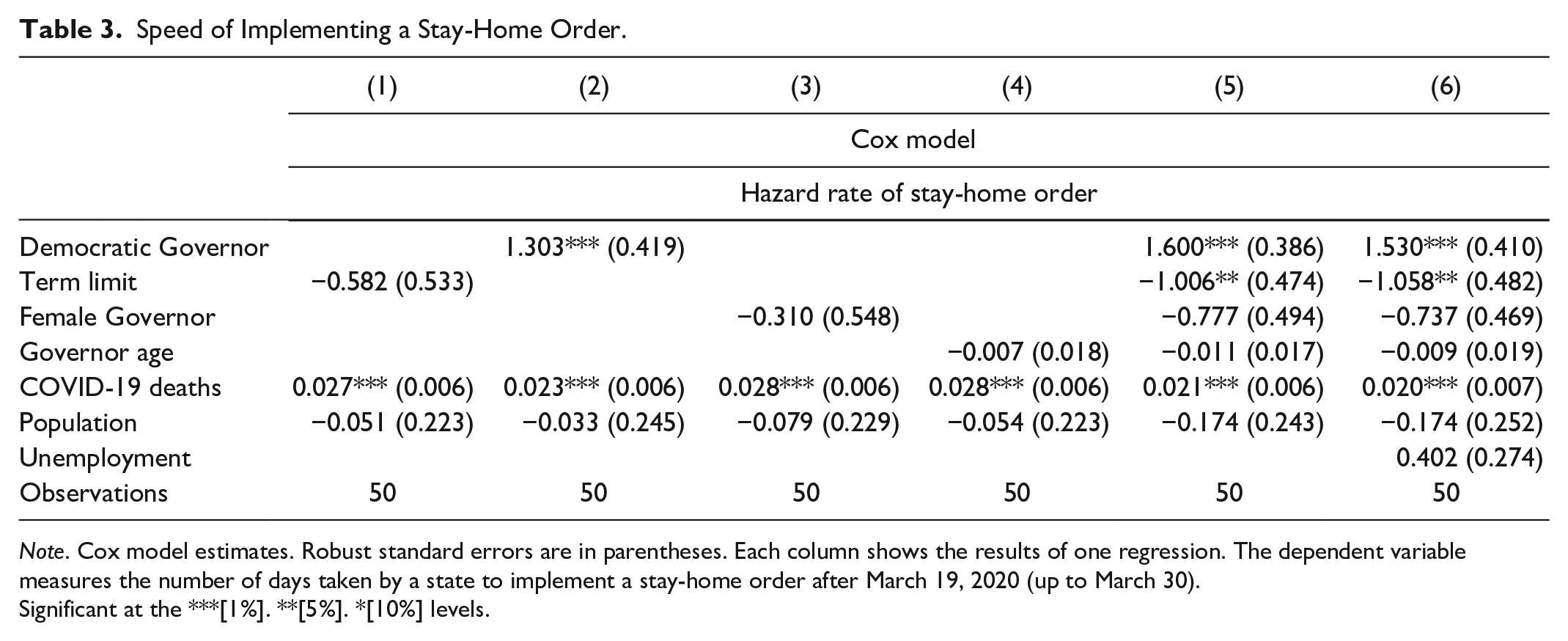
These results were confirmed when we ran Cox models (see Table 3). Democratic governors were more likely to implement stay-at-home orders, and if they did so, they were quicker than Republican governors. The coefficient was always significant and the magnitude of the effect was sizable: Among governors who implemented statewide orders, Democratic governors did so a day and a half quicker than Republican governors. Given that our analysis covered 10 days, the magnitude of the effect is remarkable. Similar to the results in Table 2, Term Limit had a negative sign, but it was only significant when accounting for Democratic Governor (i.e., in Models 5 and 6). 2 The other governors’ characteristics were not significant, whereas the coefficient of COVID-19 Deaths was always positive and significant, as expected.
Speed of Implementing a Stay-Home Order.
Note. Cox model estimates. Robust standard errors are in parentheses. Each column shows the results of one regression. The dependent variable measures the number of days taken by a state to implement a stay-home order after March 19, 2020 (up to March 30).
Significant at the ***[1%]. **[5%]. *[10%] levels.
Conclusion
Our results show that there is evidence of politics as usual in these unusual times. Looking beyond the United States, our findings indicate that, while the pandemic is a global phenomenon, its impact is heavily affected by policies implemented by subnational governments.
Footnotes
Declaration of Conflicting Interests
The author(s) declared no potential conflicts of interest with respect to the research, authorship, and/or publication of this article.
Funding
The author(s) disclosed receipt of the following financial support for the research, authorship, and/or publication of this article: Funding for this research was provided by the Internal McGill COVID-19 Rapid Response for Social Sciences and Humanities Grant.
