




Abstract
As with public opinion on other policy issues, attitudes toward transgender rights are partly driven by “group-centric” reasoning. Those with more positive feelings toward transgender people are more likely to support policies that protect their rights. But linking group affect with policies impacting members of that group requires some knowledge and understanding of politics, which not all citizens possess to the same extent. In this research note, we demonstrate that political awareness moderates the relationship between affect toward transgender people and support for their civil rights. ANES data from 2016 and 2020 show that more politically sophisticated respondents were more likely to connect their views of transgender people with policies that protect their rights. These results suggest that group-centric thinking is most prevalent among the most, not least, politically aware.
In the years since the landmark decision in Obergefell v. Hodges (2015) to legalize same-sex marriage across the U.S., a shift in attention toward transgender rights has come to define the agenda of the broader LGBT movement (Hackl et al., 2016) and opened a “new front” in the culture wars (Castle, 2019; Haider-Markel et al., 2019). A group that has historically been marginalized in the struggle for LGBT rights is now at the forefront of the movement for change (Taylor et al., 2018).
Concurrent with this shift, research has focused on explaining attitudes on transgender issues (see Haider-Markel et al., 2019 for a review). Scholars highlight values like partisanship, religiosity, egalitarianism, and authoritarianism (e.g., Castle, 2019; Jones et al., 2018); views of gender roles and experience with discrimination (e.g., Becker & Jones., 2020; Flores et al., 2020); and interpersonal contact with transgender individuals (e.g., Tadlock et al., 2017).
Alongside these factors, attitudes toward transgender rights follow a pattern of “group-centric” reasoning common to other policy issues (Conover, 1988; Nelson & Kinder., 1996). On this account, citizens’ policy attitudes are derived at least in part from their affect toward “the social groups they see as the principal beneficiaries (or victims) of the policy” (Nelson & Kinder., 1996, p. 1056). In line with this theory, research shows respondents with positive views of transgender people are more supportive of their rights (Lewis et al., 2017; Jones et al., 2018).
Importantly, making the link between views of a group and attitudes on policies that affect their rights takes some understanding of politics, which not all citizens possess to the same degree. In this research note, we show that political awareness strengthens the link between feelings toward transgender people and support for their rights. It is the most, not the least engaged, who are most likely to rely on group affect to determine their policy preferences.
Political Affect and Group-Centric Politics
Affect toward social groups looms large in explanations of American public opinion (e.g., Converse, 1964; Conover, 1988). When policy issues are clearly connected to a particular social group, “how much people like or dislike a group should strongly affect how sympathetic or hostile they are to the group’s cause” (Conover, 1988, p. 64). Those with warm feelings toward a group are likely to support policies that benefit them; those with negative affect prefer policies that do harm (Nelson & Kinder., 1996; Jones et al., 2018; Lewis et al., 2017).
This group-centric reasoning is, we argue, more likely among the more politically sophisticated, for at least two reasons. First, connecting feelings toward a group with policy attitudes requires some understanding of politics. Without knowledge of which groups will be affected by a policy, and in what ways, group-centric thinking is impossible. Given substantial variation in voters’ political engagement, such knowledge should not be taken for granted. Possession of the “interstitial ‘linking’ information indicating why a given party or policy is relevant to the group” (Converse, 1964, p. 237) likely increases with engagement, such that the most informed are best-equipped to engage in group-centric thought.
A second reason is that cues from elites might provide voters with this information—but more engaged voters are more likely to get the message. Group-centric thinking increases when leaders frame issues in terms of affected groups (Nelson & Kinder., 1996; Conover, 1988). But exposure to such messaging depends on a voter’s political awareness, “the extent to which an individual pays attention to politics and understands what he or she has encountered” (Zaller, 1992, p. 21). Less attentive citizens are unlikely to come across elite messages, or to comprehend them fully if they do. Highly aware voters, in contrast, are more likely to receive such information (Zaller, 1992). Thus, as awareness increases, so does the ability to connect general predispositions with policy attitudes in ways that echo elite rhetoric (Jones & Brewer, 2020).
Previous research shows that sophisticated voters are more likely to link their affect toward groups with policy attitudes. For example, more politically aware Whites are more likely to weigh racial prejudice when considering affirmative action policies (Federico & Sidanius, 2002). Similarly, Federico (2004) shows education strengthens the relationship between racial resentment and welfare policy views, since it leads to an “improved ability to connect predispositions with policy attitudes” (p. 387). At least on these issues, it is the most aware who are most likely to link their affective views of social groups to policies that affect those groups.
Although attitudes on transgender rights have polarized (Castle, 2019), they remain a relatively new issue on the agenda and elite cues have been muddled (Jones & Brewer, 2020). As such, linking affect toward transgender people and support for their rights might require greater attention to politics. Given these factors, we hypothesize that: H1: Political awareness moderates the relationship between affect toward transgender people and support for transgender rights, such that the most aware hold the most group-centric views.
Data and Methods
A proper test of H1 requires a survey with measures of respondents’ (1) support for transgender rights, (2) affect toward transgender people, and (3) political awareness. The American National Election Studies (ANES) from 2016 and 2020 provide all three. We analyze each survey year separately, but the coding of variables is largely consistent across years.
Support for Transgender Rights
In both years, the ANES probed attitudes around bathroom usage. Responses are on a 0–1 scale, where 0 represents feeling “very strongly” that transgender people should “have to use the bathroom of the gender they were born as” and 1 represents feeling very strongly they should “be allowed to use the bathrooms of their identified gender.” In 2020, respondents were also asked whether transgender people should be allowed to serve in the US Armed Forces. Responses range from 0 (opposing that policy a great deal) to 1 (supporting it a great deal). In 2016, we use the single bathroom item as a dependent variable. For 2020, we average the two items to create an index of support for transgender rights (r = 0.55, p <.001).
Affect Toward Transgender People
In both years, this is measured by respondents’ placement of transgender people on a “feeling thermometer” scale (see Conover, 1988; Nelson & Kinder., 1996; Lewis et al., 2017 for similar approaches). The original 0–100 scale is recoded to 0–1, with higher values indicating more favorable attitudes toward transgender people.
Political Awareness
Following previous work (e.g., Zaller, 1992; Federico & Sidanius, 2002), we created an index of items capturing factual knowledge of, and interest in, politics. In 2016, this comprised 12 items (Cronbach’s α = 0.76); in 2020, 14 items (α = 0.78). We took each respondent’s average score across these items, and then calculated their percentile ranking within the survey year. These percentile scores were divided by 100, so the variable ranges from 0 (least aware) to 1 (most aware). Full details are in online appendix A1.
Other Covariates
Authoritarianism is the average of four items about preferences for childhood behavior, ranging from 0 (least authoritarian) to 1 (most). Egalitarianism is measured with four items on the 0 (least egalitarian) to 1 (most egalitarian) scale. Party identity ranges from 0 (Strong Democrat) to 1 (Strong Republican). Perceptions of the extent of discrimination against transgender people in the U.S. range from 0 (none at all) to 1 (a great deal). Gender role traditionalism (measured in 2016 only) ranges from believing it is much worse (0) to much better (1) if a man works and a woman stays at home. Knowing a transgender person (measured in 2020 only) is an indicator variable. In both years, we control for race/ethnicity, age, gender, marital status, income, education, lesbian, gay, or bisexual (LGB) identity, and the importance of religion. 1 Details of variable coding are in online appendix A2.
Analytical Plan
Separate linear regression models are fitted for each survey year, with survey weights used throughout. The models interact the feeling thermometer scores for transgender people with political awareness. Results are presented as predicted values: we simulate each model with control variables held at their mean or modal value and calculate predicted support for transgender rights on the 0–1 linear scale, given different levels of awareness and affect toward transgender people. As examples of “less” and “more” aware voters, we discuss estimates for those in the 10th and 90th awareness percentiles, respectively.
Results
Regression models are shown in Table 1, and largely replicate earlier work on support for transgender rights. The less authoritarian, more egalitarian, more Democratic, and less religious a respondent was, the more likely they were to support transgender rights. 2 Feeling thermometer ratings of transgender people also influenced policy attitudes: the more warmly a voter rated the transgender community, the more supportive they were of transgender rights.
Regression Models Predicting Support for Transgender Rights.
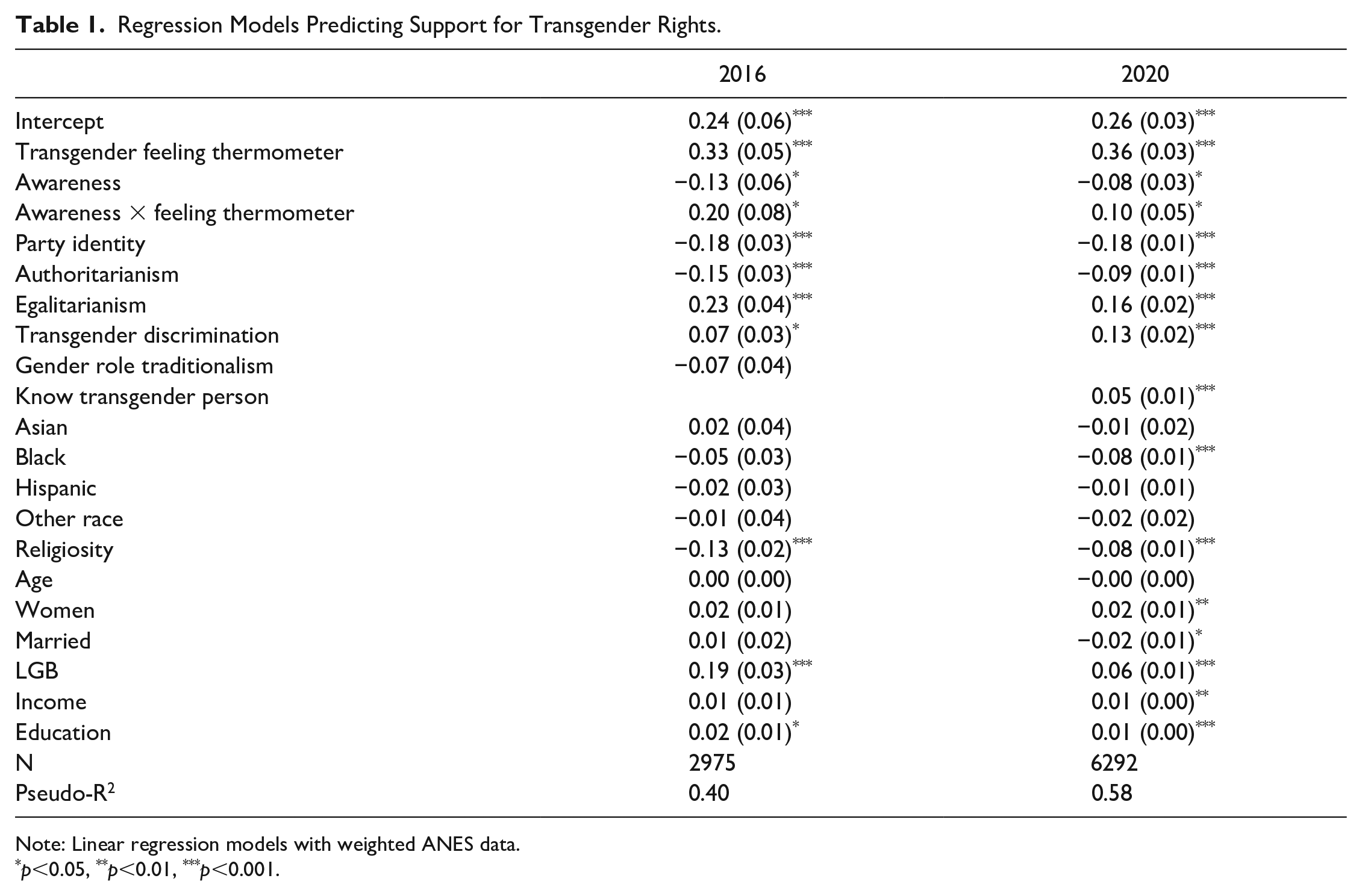
Note: Linear regression models with weighted ANES data.
p<0.05, **p<0.01, ***p<0.001.
The positive coefficient for the interaction of thermometer ratings and political awareness (0.20 [0.08], p <.05 in 2016; 0.10 [0.05], p < 0.05 in 2020) indicates that the impact of these affective evaluations increases with political awareness.
To gauge the substantive impact of this interaction, Figure 1 presents the predicted change in support for transgender rights, given a change in thermometer ratings from coldest to warmest. These are simulated from the models in Table 1 and hold all other variables at their mean or modal values. The first difference in support for transgender rights, given this shift in thermometer ratings, is calculated for those at the 10th, 50th, and 90th percentiles of awareness.

First difference in support for transgender rights, given shift in thermometer rating, at different levels of awareness. Note: First difference in support for transgender rights with 95% confidence intervals, given a shift in thermometer rating of transgender people from 0 to 100 degrees, at different levels of awareness. Simulated from models shown in Table 1, holding all other variables at their mean or modal value.
Affective evaluations of transgender people have substantial impact on support for their rights. For an average respondent at the median level of awareness, shifting thermometer ratings from 0 to 100 degrees is associated with shifts in support for transgender rights of 0.43 [95% confidence intervals =0.40, 0.47] on the 0–1 scale in 2016 and 0.41 [0.39, 0.43] in 2020. More positive evaluations of transgender people are associated with stronger support for transgender rights.
The magnitude of this association increases with political awareness, however. For those in the 10th percentile of awareness, thermometer ratings of transgender people have a smaller impact (0.35 [0.30, 0.41] in 2016; 0.37 [0.34, 0.40] in 2020). For those in the 90th percentile, the same shift in thermometer ratings is associated with a larger change in policy attitudes (0.52 [0.46, 0.57] in 2016; 0.45 [0.42, 0.47] in 2020). Consistent with H1, the impact of affective ratings of transgender people was greatest among the most politically aware.
This is not to say that group ratings are irrelevant for the less aware. Even for those at the 10th percentile, views of transgender people are a strong predictor of support for transgender rights. The conclusion is that these ratings matter more for the politically aware. Notably, awareness appears to have a somewhat greater impact in 2016 than in 2020. It is possible that this reflects the increasingly high-profile debate over transgender rights (Jones & Brewer, 2020) over this time period, such that even less aware voters learned how to connect their attitudes toward transgender people with more abstract policy choices. In both years, a clear pattern emerges however: the more politically aware a respondent was, the more group-centric their policy views.
Discussion
As on other issues, public opinion toward transgender rights is shaped in part by group-centric reasoning: those with warmer views toward transgender people are more supportive of their rights. In this note, we show that the connection between transgender affect and policy views is greatest among the most aware—who are most likely to understand how these policies affect transgender people and to be exposed to elite cues about their impact. Group-centric thinking exists among the less aware as well, but it increases with attention to politics. Overall, the most aware are the most likely to rely on their affective views of transgender people.
As with any study, there are limitations to our research, and at least three remaining questions for future scholars to explore. First, these data show a modest decline in the influence of awareness on group-centric thought from 2016 to 2020. Will this continue in future years as the increasing intensity of elite cues reaches even the least aware? Second, does awareness moderate the impact of other predispositions—religiosity, egalitarianism, authoritarianism, and so on—on support for transgender rights? And third, looking beyond transgender issues, does awareness also moderate the extent of group-centric thinking in other policy domains too?
Although these questions remain open, our conclusion is a straightforward one. Not all voters are equally likely to use their feelings toward transgender people to guide their views on transgender rights. Rather, the most aware citizens are most likely to connect group affect with policy views, resulting in more group-centric public opinion as awareness increases.
Supplemental Material
sj-pdf-1-apr-10.1177_1532673X221090488 – Supplemental material for Affect Toward Transgender People, Political Awareness, and Support for Transgender Rights
Supplemental material, sj-pdf-1-apr-10.1177_1532673X221090488 for Affect Toward Transgender People, Political Awareness, and Support for Transgender Rights by Philip Edward Jones and Amy B. Becker in American Politics Research
Footnotes
Declaration of Conflicting Interests
The author(s) declared no potential conflicts of interest with respect to the research, authorship, and/or publication of this article.
Funding
The author(s) received no financial support for the research, authorship, and/or publication of this article.

Supplemental Material
Supplemental material for this article is available online.
Notes
References
Supplementary Material
Please find the following supplemental material available below.
For Open Access articles published under a Creative Commons License, all supplemental material carries the same license as the article it is associated with.
For non-Open Access articles published, all supplemental material carries a non-exclusive license, and permission requests for re-use of supplemental material or any part of supplemental material shall be sent directly to the copyright owner as specified in the copyright notice associated with the article.
