



Abstract
The two dominant paradigms in the study of white Americans’ racial attitudes—symbolic racism and group position theory—while fundamentally differing with regard to theoretical orientations and causal emphases, concur in their rejection of individual-level economic circumstances—typically operationalized through either conventional measures of class or direct racial threats to whites’ personal lives—as a meaningful determinant of whites’ racial attitudes. This article argues that these existing measures do not sufficiently consider the subjective dimension of individuals’ economic well-being. As such, conclusions drawn from the relative lack of association between these measures and racial attitudes are likely overstated. Utilizing a measure of affective economic insecurity—anxiety concerning one’s economic circumstances—a strong correlative relationship is shown to exist between this dimension of individual-level economic circumstances and whites’ racial attitudes. Specifically, it is shown that affective economic insecurity is related to whites’ level of racial resentment, their perception of racialized labor market competition, and their attitudes toward immigration. A causal relationship between affective economic insecurity and perceptions of racialized labor market competition is established through an original survey experiment.
Keywords
In this article, we illustrate both correlatively and causally that individual-level economic circumstances matter in determining the racial attitudes of white Americans. These findings are particularly important because the two dominant paradigms (see Cramer, 2020) in the study of white Americans’ racial attitudes—symbolic racism and group position theory—while fundamentally differing with regard to theoretical orientations and causal emphases, concur in their rejection of individual-level economic circumstances as a meaningful determinant of whites’ racial attitudes (e.g., Sears & Henry, 2005; 2003; Sears et al., 1997; Tuch & Hughes., 2011; Kinder & Sanders, 1996; Bobo 1998; Bobo & Hutchings, 1996; Jardina, 2019; Hainmueller & Hopkins, 2014). This literature conforms to the broader conclusion in much of the study of American public opinion—some have characterized this as a “consensus”—that individual-level economic circumstances have little to do with attitude formation in general (for a review, see Weeden & Kurzban, 2017; see too Sears & Funk 1991; Mansbridge 1990; Citrin & Green 1990; Mutz, 2018).
Theoretical conclusions based on the supposed lack of relationship between white Americans’ individual-level economic circumstances and their racial attitudes are primarily based on the relatively weak association between both conventional measures of class and direct racial threats to whites’ personal lives with whites’ racial attitudes. While acknowledging that the relationship between these prominent measures of individual-level economic circumstances and whites’ racial attitudes is indeed weak, this article argues that these measures do not sufficiently consider the subjective dimension of individuals’ economic well-being. As others have pointed out, economic well-being is a psychologically mediated disposition (Hacker, 2019; Marx, 2014). As Campbell et al. (1976) put it, “the relationship between objective conditions and psychological states is very imperfect and…in order to know the quality of life experience it will be necessary to go directly to the individual himself for his description of how his life feels to him [sic]” (p. 4). In other words, relying on measures that “objectively” gauge economic well-being (like conventional measures of class) or “objectively” measure the actual occurrence of racialized threats to individuals’ economic well-being ignores the “very imperfect” correlation between objective conditions and individual perceptions of those conditions. Perhaps more importantly, relying solely on these objective measures discounts the possibility that subjective fear or anxiety about one’s economic circumstances may be a more potent driver of attitudes and behavior than one’s actual economic circumstances a priori.
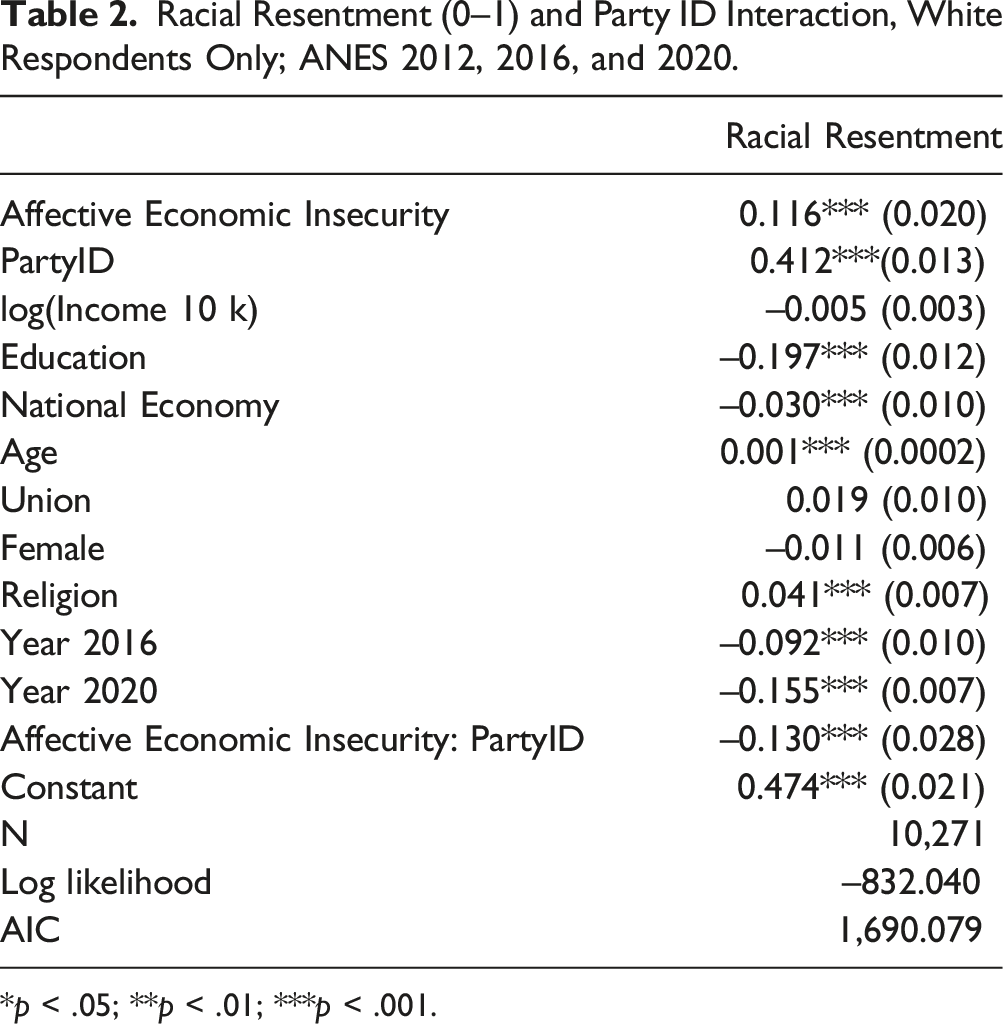
Affective economic insecurity—anxiety concerning one’s economic circumstances—is argued to be a more appropriate operationalization when determining if a relationship between individual-level economic circumstances and white Americans’ racial attitudes do in fact exist. Not only does affective economic insecurity capture the subjective dimension of economic well-being, but it also allows for the possibility that future-looking anxiety may be a strong driver of attitudes and behavior, as others have suggested (e.g., Melcher 2021b). Utilizing a measure of affective economic insecurity included in the 2012, 2016, and 2020 waves of the American National Election Studies survey (ANES), a strong correlative relationship is shown to exist between this dimension of individual-level economic well-being and whites’ racial attitudes. Increased levels of affective economic insecurity among white Americans are associated with higher levels of racial resentment, increased perception of racialized labor market competition, and negative assessments of immigration. It is shown, too, that the effect of affective economic insecurity on whites’ racial attitudes tends to vary over time, increasing when larger political narratives explicitly connect white Americans’ well-being to racialized competition for valued economic, social, political, and cultural goods. When it comes to levels of racial resentment, an interaction effect is shown to exist between political partisanship and affective economic insecurity: the magnitude of the effect of affective economic insecurity is greater among Democrats than Republicans.
In the final substantive section of the article, the results of an original survey experiment are presented. White respondents primed to feel elevated levels of affective economic insecurity are more likely to agree that “many whites are unable to find a job because employers are hiring minorities instead” than a control group. These results offer evidence of a causal relationship between elevated levels of affective economic insecurity and the racial attitudes of white Americans.
Prevailing Accounts of the Determinants of White Americans’ Racial Attitudes
The study of white Americans’ racial attitudes is dominated by two major theoretical orientations: the theory of symbolic racism and group position theory/realistic group threat theory (see Cramer, 2020). The theory of symbolic racism argues, broadly, that racism is a psychological attribute of whites. Racism is a disposition—a worldview—which whites embrace consciously or, perhaps more often than not, subconsciously (e.g., Melamed et al., 2019; Kinder & Ryan., 2017). It is this psychological disposition which, in turn, results in discriminatory behavior, creating and perpetuating racial inequality. The theory of symbolic racism argues, causally, that children are socialized by a racist culture leading to an internalization of “antiblack affect” and the “perception that blacks violate such traditional American values as the work ethic, traditional morality, and respect for traditional authority” (Sears et al., 1997: 22; see too Sears & Henry, 2003). This racist socialization leads to deep-seated prejudice and discriminatory behavior. As Sears et al. (1997) summarize this theoretical position: “ … Socialization leaves individuals with strong, long-standing attitudinal predispositions, which can be evoked by appropriate political symbols. We assume that for centuries white Americans have grown up in a socializing culture marked by widespread negative attitudes toward African Americans, a socializing culture that seems unlikely to have been abruptly overturned within the relatively few years since the end of Jim Crow” (p. 18). In short, psychologically ingrained, non-rational anti-Black prejudice drives the formation of racially exclusionary attitudes and racially discriminatory behavior (see Tuch & Hughes., 2011; Sears & Henry, 2005). Empirically, this symbolic racism has been most commonly operationalized by the racial resentment scale developed in Kinder and Sanders (1996). Tesler (2016), for instance, has characterized the racial resentment scale as having “effectively standardized … Measurement of modern, symbolic, and/or cultural racism” (p. 21). 1 The racial resentment scale—an additive index of four related items consistently included in the ANES since 1986 (full item wording in the Appendix)—is commonly used to either predict racial or seemingly non-racial attitudes/behaviors, or as a control for ideological racism (e.g., Abramowicz & McCoy, 2019; Wallsten et al., 2017; Filindra & Kaplan, 2016; Carter & Corra, 2016). While there is an ongoing debate regarding the precise meaning of the racial resentment scale—i.e., whether it accurately taps ideological racism or is simply a reflection of a non-racial political ideology (see Carmines et al., 2011; Schuman, 2000)—racial resentment consistently predicts a wide variety of white Americans’ social and political attitudes (Tesler, 2016; Kinder & Sanders, 1996).
Rather than emphasizing micro-level psychological processes, the second dominant paradigm emphasizes larger sociological processes. Group position theory (or the related but conceptually distinct realistic group threat theory; see Bobo (1988) p. 466) argues that perceptions of threat to one’s racial in-group leads to out-group hostility. Working within the tradition of Hubert Blumer (1958; see too Bobo & Hutchings, 1996), group position theory claims that whites’ racial animus is derived primarily from perceived threats to their in-group’s superior social status. As Bobo (1988) put it, “Blumer maintained that racial prejudice was best understood as a general attitude or orientation involving normative ideas about where one’s own group should stand in the social order vis-à-vis an outgroup” (p. 449). In short, racial animus is grounded in what one perceives to be as their group’s social interests. Empirically, group threat has commonly been operationalized by measures of perceived zero-sum competition between races. This perception of racialized zero-sum competition is then used to predict policy preferences (see Bobo, 1988, 462–63). More recent contributions in the paradigm utilize measures of in-group favoritism and strength of in-group identification (see, e.g., Jardina, 2019; DiTomaso, 2013; see, too, Glazer & Daniel Patrick Moynihan, 1970 on “positive discrimination” pp. xxxviii-xxxix).
In short, symbolic racism and group position theory posit two very different methods by which white Americans develop their attitudes regarding race. Symbolic racism argues that white Americans develop their racial attitudes early in life through socialization in a racist culture. This socialization results in a calcified racist ideology which remains relatively stable throughout one’s life. Variation in racial attitudes among white Americans occur through more or less racially liberal socialization experiences in childhood. Group position theory, on the other hand, posits that white Americans develop their racial attitudes in reaction to threats to the superior social status to whites as a whole. Threats to this status, such as increased immigration rates, the election of a person of color to a prominent political position, or the potential passage of policies that are designed to challenge racial inequality (e.g., affirmative action), will activate the adoption of racially exclusionary attitudes.
While these two paradigms fundamentally differ with regard to theoretical orientations and causal emphases, they do agree on at least one thing: individual-level economic circumstances have very little to do with whites’ racial attitudes and racial policy preferences. Labelling potential correlations between individual-level economic circumstances and whites’ racial attitudes as the “simple self-interest hypothesis” (e.g., Bobo & Kluegal, 1993: 445), analysts in both paradigms have explicitly positioned themselves in contradistinction to such claims. Whether operationalized as conventional measures of class (e.g., SES status, income, etc.) or as the actual experience of racialized threats to one’s personal well-being, accounts within both paradigms have found very little evidence of a relationship between individual-level economic circumstances and whites’ racial attitudes. Indeed, as Sears and Henry (2005) put it forcefully in their review of the symbolic racism literature, the “simple self-interest hypothesis” has been “subject to the most empirical tests from the beginning of research on symbolical racism. This research has shown that self-interest, as operationalized by racial threats to Whites’ personal lives, is rarely a significant factor in White opposition to racial polices” (p. 129). For instance, measures of symbolic racism have been found to be much better predictors of opposition to attempts to racially integrate school districts through changes in busing policies than measures that gauge the actual experience of the effects of those policies (e.g., Green & Cowden 1992; Sears et al., 1979). Similarly, measures of symbolic racism have been shown to be better predictors of opposition to affirmative action policies than measures that gauge objective threat from affirmative action policies (e.g., Kluegel & Smith 1983; Jacobson 1985). Conventional measures of class, like SES status, income, occupation, and employment status, have also fared poorly as predictors of racial attitudes and policy preferences (e.g., Jardina, 2019; Bobo & Hutchings, 1996; Bobo & Kluegal, 1993).
While it is perhaps easier to see why, at a theoretical level, proponents of the theory of symbolic racism reject the potential influence of individual-level economic circumstances on whites’ racial attitudes—symbolic racism emphasizes the effect of durable, non-rational anti-Black affect socialized during childhood, which, because of its durability, should not be shaped by changes in economic circumstances—group position theory’s theoretical rejection of the effect of individual-level economic circumstances is less straightforward. Bobo and Kluegal (1993) have argued, for instance, that the “distinction between individual and group self-interest should not be overdrawn” (p. 445). If one’s in-group prospers, these benefits should trickle down at the individual level. Nevertheless, accounts within the group position paradigm have rather explicitly positioned themselves in contradistinction to “simple self-interest model,” much like accounts in the symbolic racism paradigm. As Bobo and Hutchings (1996) put it, “This is an important point because it differentiates the group-position model from the simple self-interest model. We do not expect objective personal vulnerability to racial change to strongly drive feelings of threat or to drive judgments about the degree of racial alienation. Feelings of alienation and threat are the product of social and collective processes that derive from the long-term experience and conditions that members of a racial group have faced. These feelings are shaped, as Blumer argued, by an on-going process of collective social definition that cannot be reduced to the current status of individuals” (p. 956-7, emphasis in original).
In other words, whites’ racial ideology, racial policy preferences, and/or their perception of racialized threat are not theorized to be affected by the “current [economic] status of individuals.” Rather, whites’ racial attitudes are determined primarily by what they perceive to be in the interest of whites as a whole. 2 Group position theory theorizes that there should be no in-group variation based on differing perceptions of what is in an individual’s self-interest, itself based on their economic circumstances. Individuals act primarily in terms of their in-group’s interest, not their personal self-interest. To put it differently, group position theory argues that individuals will support racial attitudes and policies that benefit their in-group even if those attitudes and policies would not benefit them individually. Empirically, this is what group position theory purports to be the case (see e.g., Jardina, 2019).
In sum, both dominant paradigms in the study of white Americans’ racial attitudes agree, at a theoretical and empirical level, that individual-level economic circumstances should not and do not substantively affect whites’ racial attitudes. Theories of symbolic racism emphasize the causal effect of non-racial anti-Black affect socialized during childhood, while group position theory causally emphasizes the desire of whites to maintain in-group superiority in the American social hierarchy. Neither of these causal drivers are theorized to be meaningfully affected by differences in individual-level economic circumstances. Empirically, both paradigms have found that the latter—operationalized either through conventional measures of class or measures that gauge the occurrence or susceptibility of racial threats to whites’ economic well-being—are, in fact, poor predictors of white Americans’ racial attitudes. In the next section, I suggest that this lack of a relationship between white Americans’ individual-level economic circumstances and their racial attitudes is due to the exclusive reliance, in much of the existing literature, on “objective” measures of individual-level economic circumstances that do not sufficiently take into account the subjective dimension of economic well-being.
Measuring Individual-Level Economic Circumstances
Analysts that attempt to explain public opinion using economic factors, and, as we have seen, analysts that attempt to explain white Americans’ racial attitudes, tend to instinctively prefer what they characterize as “objective” economic indicators, as opposed to subjective economic indicators (Harris & Rivera-Burgos., 2021). It is better, according to this line of thinking, to measure respondents’ economic circumstances using indicators of their objective position in the economy (e.g., their income, occupation, employment status, their susceptibly or experience of racialized economic threat, etc.) rather than indicators based on the respondent’s subjective assessment of their economic circumstances (for an overview, see Jahedi & Méndez, 2014). There is a good case to be made for preference of objective economic measures. First, objective measures lack the potential ideological and cognitive biases that can plague subjective measures. Second, as a number of critics have pointed out (see especially Rehm, 2016, 13–15; Melcher, 2021a), there is a tendency to use subjective indicators as explanatory variables that are substantively similar to the phenomena being explained. This unfortunate tendency has led some to question the utility of explaining “attitudes with other attitudes” completely (Rehm, 2016, 14). 3
While objective measures of economic circumstances can be suggestive, there is a major shortcoming of relying on them exclusively. Economic well-being is a psychologically mediated disposition: there is not a perfect one-to-one correspondence between one’s objective circumstances and their assessment of those circumstances (Hacker, 2019: 9; Rohde & Tang, 2018). As Campbell et al., 1976 put it, “experience (and behavior) derives from the interaction of the person and his [sic] environment. People live in an objectively defined environment, but they perceive a subjectively defined environment, and it is to this psychological ‘life space’ that they respond” (p. 13). In other words, individuals respond to their objective circumstances differently depending their psychological frame of reference: they have “different ways of evaluating the same objective situations, in no small measure because they bring different standards of comparison to bear upon these evaluations” (ibid: 15). Just because individuals occupy the same objective economic position does not mean that they perceive this position the same way. Relying on objective measures exclusively ignores this important evaluative dimension of economic well-being.
Perhaps more importantly, the fear of economic hardship may be much more prominent than is suggested by objective measures of economic well-being given larger socio-economic structural realities. Put another way, while many Americans may appear to be relatively well-off or secure in their economic well-being according to supposedly objective criteria, they may still perceive themselves to be potentially subject to economic hardship due to the vagaries of the economy and the well-known lack of a robust social safety net in the US. We might expect, too, that individuals in the same income bracket may have greater or less fear of economic hardship due to differing levels of personal safety nets (e.g., personal assets like home equity, savings, etc., more or less access to family and friends that can provide financial assistance, etc.), they may hold (or rely on someone who holds) a job that is more or less subject to changes in the national economy, and/or, perhaps most importantly, their reference group by which they judge their economic well-being may differ. In other words, because frames of reference vary between individuals, objective indicators of economic well-being may not be capturing the same perception of economic well-being across individuals.
As a result, fear of economic hardship may have a very imperfect relationship with objective economic circumstances, as others have argued (Marx 2014; Hacker et al., 2013). This imperfect relationship is illustrated in Figure 1. Figure 1 uses weighted ANES data to compare the prevalence of cognitive economic insecurity—a dispassionate estimate of the probability that one will face economic hardship in the future; a measure that is commonly used to validate objective measures of economic well-being (see, e.g., Rehm, 2016 pp. 49-58)—and affective economic insecurity—one’s worry or anxiety about their current economic situation—over time (on the distinction between cognitive and affective insecurity, see Anderson & Pontusson 2007). Figure 1 illustrates the wide gulf between trends in cognitive and affective economic insecurity.
4
While relatively few Americans—typically less than 20% of the population at any given point in time—actually expect to experience economic hardship in the future, many more Americans—nearly 60% of Americans in two of the three waves the measure was included in the survey—are worried about their economic well-being. In other words, many Americans are concerned about their economic circumstances, and it is possible that this anxiety, which is not captured by objective measures, may be an important driver of their attitudes and behavior. Percent of Americans Experiencing Cognitive and Affective Economic Insecurity Over Time. Points and line represent the percent of Americans reporting cognitive economic insecurity (Those answering 'worse off' to the question 'Now looking ahead, do you think that a year from now [you/you and your family living here] will be better off financially or worse off, or just about the same as now?'). Stars represent the percent of Americans reporting affective economic insecurity (Those answering 'moderately,' 'very,' or 'extremely' worried to the question 'So far as you and your family are concerned, how worried are you about your current financial situation?'). Source: ANES 1956−2020, weighted.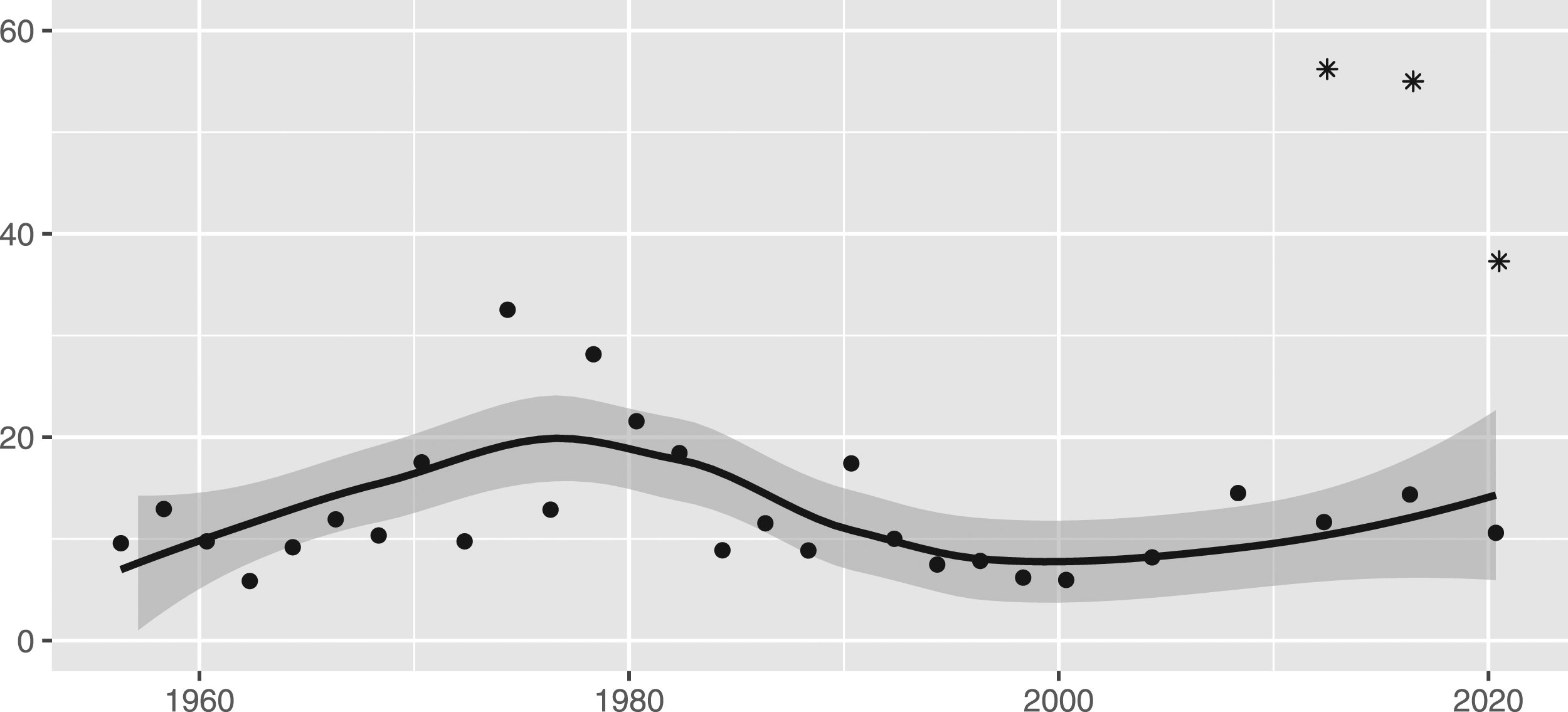
It is clear, then, that relying solely on objective indicators misses an important dimension of economic well-being: how individuals actually feel about their economic circumstances. It is also clear that Americans tend to be more concerned about their economic circumstances than objective measures indicate. However, it has yet to be demonstrated that this subjective dimension of economic well-being is, in fact, an important determinant of white Americans’ racial attitudes. The next several sections test this hypothesis. Specifically, it will be demonstrated that as affective economic insecurity increases—a measure which captures the subjective dimension of economic well-being—among white Americans, racially exclusionary attitudes also increase.
Affective Economic Insecurity, Racial Resentment, Perceptions of Racialized Labor Market Competition, and Immigration Attitudes
Racial Resentment
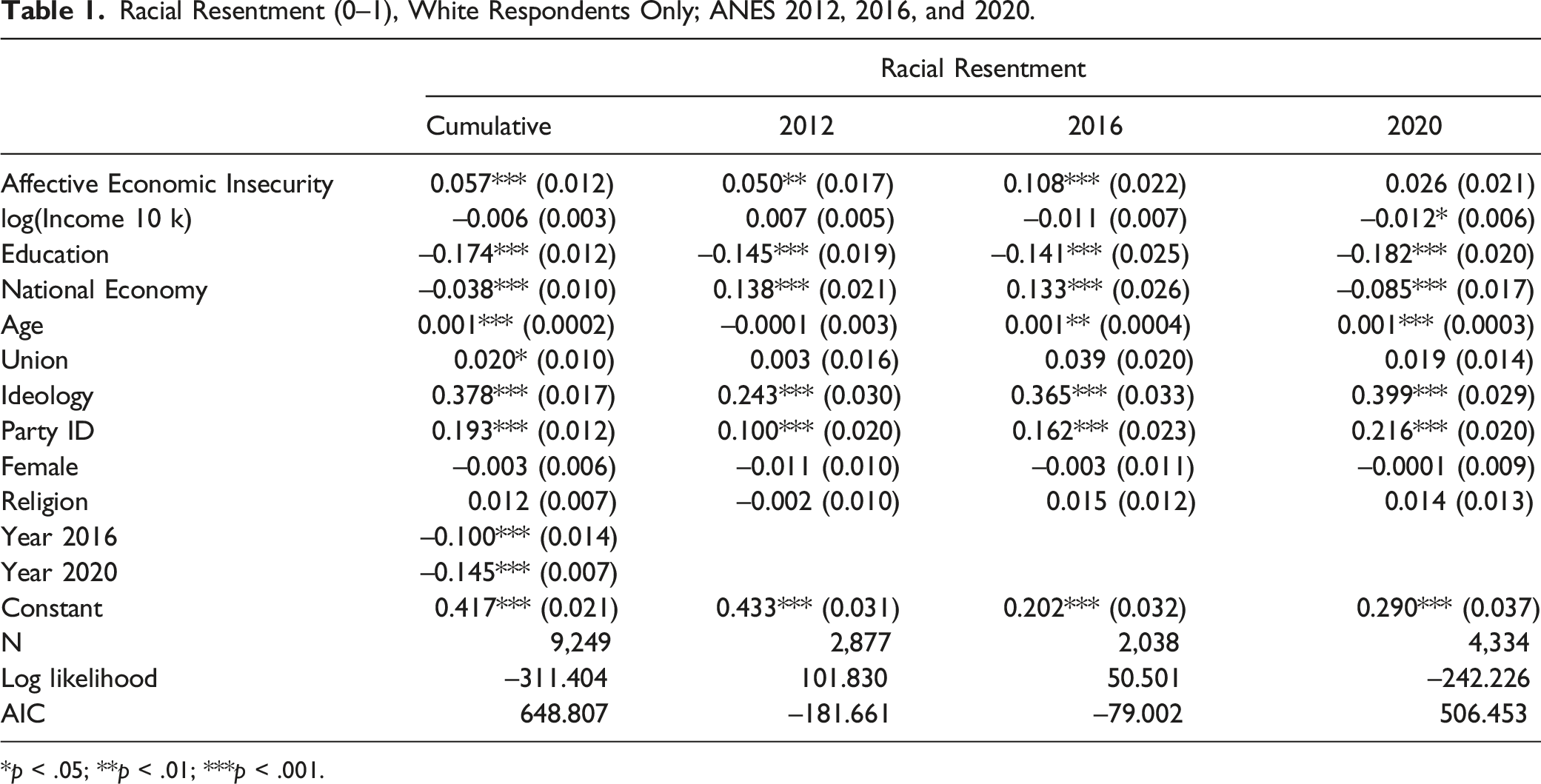
Racial Resentment (0–1), White Respondents Only; ANES 2012, 2016, and 2020.
*p < .05; **p < .01; ***p < .001.
As can be seen in Table 1, income—as an objective indicator of individual-level economic well-being—is not, in conformance with existing accounts in the symbolic racism and group position paradigms, a consistent predictor of racial resentment. However, affective economic insecurity—a subjective indicator of individual-level economic well-being that often afflicts a majority of Americans—is a consistent and substantively large predictor of white Americans’ level of racial resentment. In the cumulative model and in every individual year model, besides 2020 (an exception that will be discussed in what follows), increases in the level of affective economic insecurity are associated with increases in racial resentment. As white Americans become more concerned with their financial situation, they become more racially resentful. In the cumulative model and the 2012 model, the increase in the level of racial resentment associated with a move from being “not at all worried” about ones’ financial situation to being “extremely worried” is roughly equivalent to decreasing one’s educational attainment by two categories (say, from having a college degree to having a high school diploma). 6
However, the effect size of affective economic varies greatly depending on the year of the survey. The effect size is largest in 2016—when a move from least economically insecure to most economically insecure is roughly equivalent decreasing one’s education attainment by roughly four categories 7 —middling in 2012, and not statistically significant in 2020. In short, economic vulnerability has a relatively large effect on racial resentment in 2012 and 2016, but no effect on racial resentment in 2020. I suggest that 2020 is an outlier for the following reasons: first, and perhaps surprisingly given the COVID-19 pandemic, perceptions of affective economic insecurity among white Americans were much lower in 2020 than they were in 2012 or 2016. For instance, 55% of white Americans considered themselves to be moderately, very, or extremely worried about their current financial situation in 2012, compared to 52.2% in 2016, and only 31.9% in 2020. A decline in affective economic insecurity did occur among African Americans and Hispanic Americans, but not to the extent that it did among white Americans (see Appendix for summary statistics). While this is not the place for a full discussion of this racialized trend, it seems to be grounded in the fact that the recession caused by the pandemic was largely occupationally specific, disproportionately affecting industries that disproportionately employed people of color, leaving white Americans relatively unaffected (Long et al., 2020). Perhaps more importantly, though, was the expansion of government aid since the beginning of the pandemic, including direct stimulus payments, expanded unemployment benefits and duration, a moratorium on federal student loan collection, the provision of forgivable loans to businesses, and the various state and local programs that established eviction and foreclosure moratoriums, food relief, and much else. In other words, the meager American welfare state expanded dramatically during 2020; so much so that the percent of Americans living below the poverty line actually decreased from 2019 to 2020 as a direct result of government cash and noncash transfers (Casselman & Smialek, 2021). Subjective perceptions of affective economic insecurity, then, especially among white Americans, were likely assuaged by the racialized effect of pandemic-related layoffs as well as the expansion of government aid during and after 2020.
The second and perhaps more important reason 2020 is an outlier in the analysis is that elite cues regarding the cause and potential solutions to economic insecurity changed over time. Recent work on American political behavior has shown that attitudes that had been presumed to be relatively fixed over the course of one’s life, specifically racial attitudes, actually do change over time in response to elite cues (Engelhardt, 2021). Elite cues among politicians from both major political parties, but especially among Republicans, have long linked the personal or sociotropic interests of white Americans with racial exclusion, culminating, perhaps, in the presidential campaigns of Donald Trump (Enns and Ashley 2021; Winter 2008). Trump was successful in linking the economic anxiety of white voters with racial animus, especially in 2016, when promises of “Making America Great Again” through job growth in traditionally white occupations and industries coupled with calls for (non-white) immigration restriction and violent repression of Black civil rights activism (Green & McElwee, 2019; Morgan & Lee., 2019; Solá, 2018). In 2020, however, this established link between economic insecurity and race became strained. Perceptions of affective economic insecurity among white Americans declined generally, while those who continued to perceive themselves as economically insecure seem much less likely to have attributed their vulnerability (or the solution to their vulnerability) to a racialized cause. As Trump himself rhetorically shifted from racialized solutions to economic insecurity to direct public relief to assuage economic insecurity over the course of the pandemic—Trump, for instance, was wont to retrospectively take credit for the Coronavirus Aid, Relief, and Economic Security (CARES) Act, despite initially criticizing it, unprecedently adding his signature to stimulus checks and having letters mailed to each recipient emphasizing his essential role in the CARES Act’s passage 8 —the link between race and economic vulnerability seems to have been tempered (Rappeport, 2020; Rein & Singletary 2020). In short, in 2012 and 2016, elite cues specifically connected white Americans’ economic insecurity with racialized causes and solutions, while, in 2020, these elite cues shifted toward welfare state-style solutions.
Racial Resentment (0–1) and Party ID Interaction, White Respondents Only; ANES 2012, 2016, and 2020.
*p < .05; **p < .01; ***p < .001.
Perceptions of Racialized Labor Market Competition
Group position theory has often used measures of zero-sum competition between whites and non-whites to predict racial policy preferences (see e.g., Jardina, 2019; Bobo 1999, 462–63). As a measure of group threat, associations between such measures and policy preferences are used to argue that group interests drive racial policy preferences. In this section, affective economic insecurity is used to predict perceptions of racialized zero-sum competition to determine, in contradistinction to group position theory, if such perceptions themselves are at least partially rooted in a perceived threat to whites’ economic well-being. If whites who perceive themselves to be economically insecure are more likely to perceive race relations in zero-sum terms than whites who do not perceive themselves to be economically insecure, then such a measure cannot solely be measuring group interest. If it was, there would be no variation in such perceptions on the basis on individual economic circumstances, as group position theory predicts (Bobo & Hutchings, 1996, 956–57).
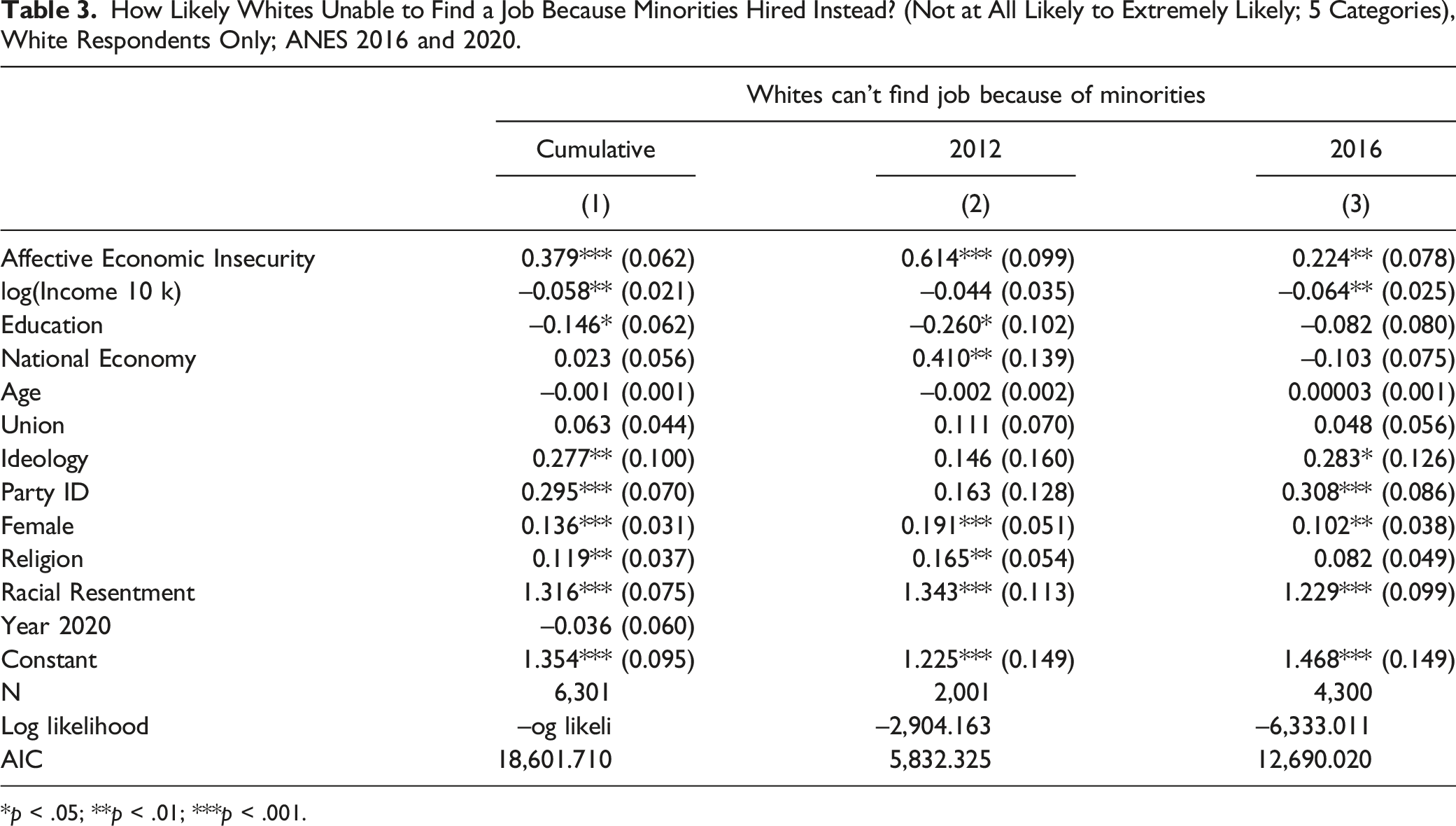
How Likely Whites Unable to Find a Job Because Minorities Hired Instead? (Not at All Likely to Extremely Likely; 5 Categories), White Respondents Only; ANES 2016 and 2020.
*p < .05; **p < .01; ***p < .001.
It seems, then, that perceptions of racialized economic competition do vary based on white Americans’ level of affective economic insecurity. The more affectively insecure a white American perceives themselves as being, the more likely they are to believe that whites are unable to find jobs because employers are hiring racial minorities instead.
Immigration Attitudes
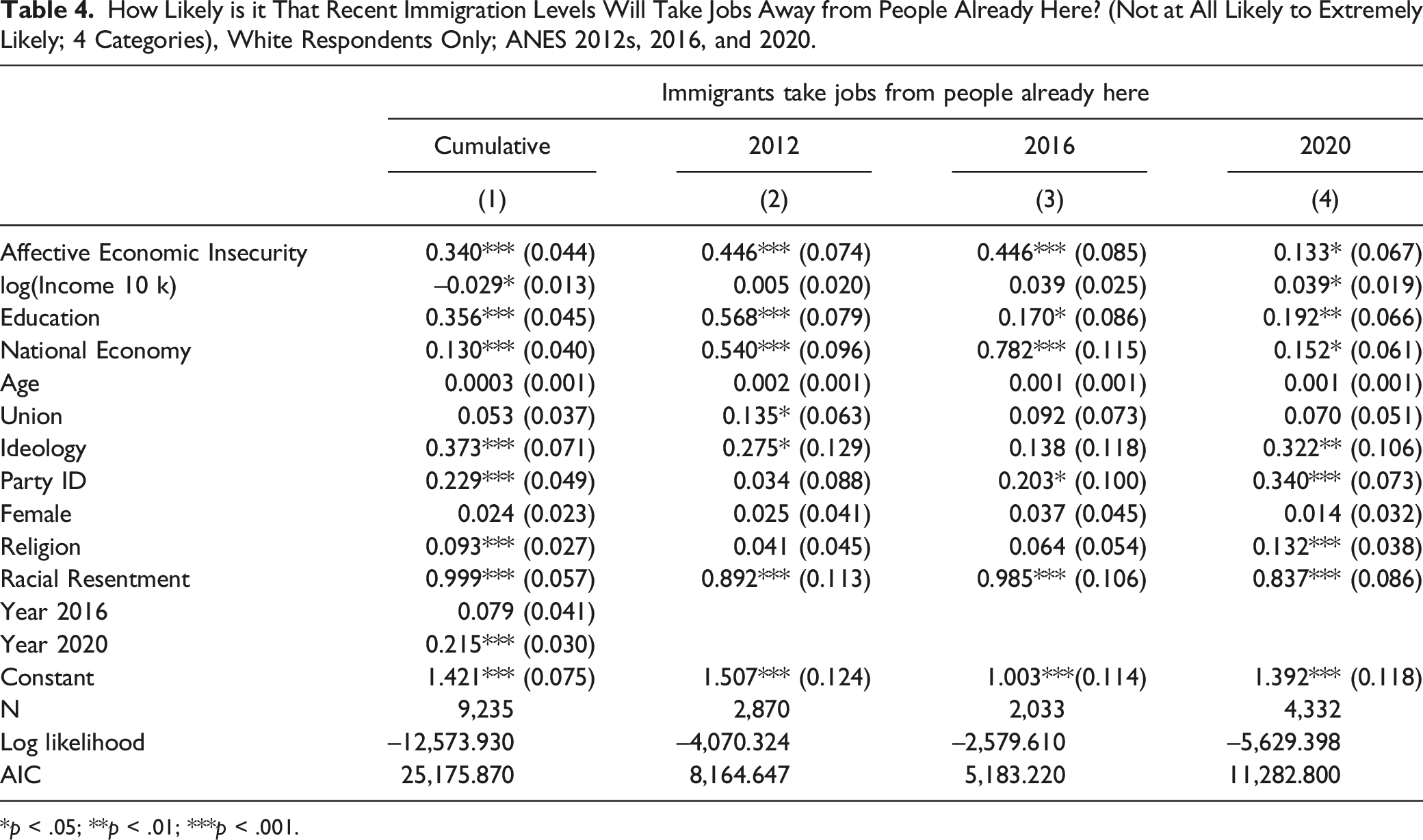
Recent scholarship on immigration has emphasized the need to consider white Americans’ attitudes toward immigrants and immigration as racial attitudes (see, e.g., Sáenz & Douglas 2015; Erel et al., 2016; Nichols & Valdéz 2020). This work sees anti-immigrant attitudes as an extension of racist attitudes, especially since the major sources of immigration to the US are non-European, and, thus, largely considered to be non-white. Echoing the larger literature on racial attitudes in the US, research on white Americans’ attitudes toward immigration has relatively routinely found little relationship between individual-level economic circumstances and anti-immigrant sentiment. Synthesizing the main thrust of much of the literature on anti-immigrant attitudes in the US, Hainmueller and Hopkins (2014) write “[c]onsistently, immigration attitudes show little evidence of being strongly correlated with personal economic circumstances” (p. 225). Unlike the broader literature on racial attitudes, however, a number of nuanced contributions—particularly in the European context—have shown anti-immigrant attitudes to be strongly rooted in perceived economic threat among those most vulnerable to that economic threat. Pardos-Prado and Xena (2019), for instance, use several European samples to show that those with low transferable skills are more likely to embrace anti-immigrant sentiment than those with high transferable skills. In other words, those most vulnerable to actual or potential economic competition with immigrants are more likely to embrace anti-immigrant sentiment than those less vulnerable to such competition. Similarly, Dancygier and Donnelly (2012) show—also in the European context—that those employed in shrinking economic sectors are more likely to embrace anti-immigrant sentiment than those employed in growing economic sectors. Again, those most vulnerable to actual or potential competition with immigrants are those most likely to embrace anti-immigrant sentiment. In the American context, Malhotra et al. (2013) show that those working in the high-tech sector are more likely to oppose immigration on the basis of H-1B visas (i.e., visas typically used by Indian immigrants specifically to work in high-tech fields in the US) than those not working in the high-tech sector. Those most vulnerable to economic competition with H-1B holders—i.e., native high-tech workers—are those most likely to oppose their immigration.
How Likely is it That Recent Immigration Levels Will Take Jobs Away from People Already Here? (Not at All Likely to Extremely Likely; 4 Categories), White Respondents Only; ANES 2012s, 2016, and 2020.
*p < .05; **p < .01; ***p < .001.
Toward a Causal Relationship: Survey Experiment
Up to this point, we have established a strong, consistent, and relatively robust correlative relationship between affective economic insecurity and the racial attitudes of white Americans. Elevated levels of affective economic insecurity are associated with greater propensity to embrace racist attitudes. However, there remains the possibility that this relationship is not causal, and, of course, the possibly that there is a causal relationship, but in the opposite direction: perhaps embracing racist attitudes causes white Americans to feel more economically insecure. In this section, the results of an original survey experiment are presented which illustrate that elevated perceptions of affective economic insecurity do have a causal relationship with the racial attitudes of white Americans and in the hypothesized direction: elevated levels of affective economic insecurity cause elevated levels of racism, not the other way around. White respondents primed to feel economically insecure—and who, in fact, report elevated levels of affective economic insecurity—are more likely to perceive racial minorities as economic competitors compared to white respondents who are not primed to feel economically insecure.
While recent experimental work and analysis of panel data has established a causal relationship between changes in economic well-being and certain aspects of American public opinion (Margalit 2019; Margalit, 2013; Owens & Pedulla, 2014; Kenworthy & Owens, 2011), there has yet to be an established causal link between individual-level economic circumstances and white Americans’ racial attitudes. Establishing this causal link, besides providing additional confirmation of the correlative relationships presented above, seriously challenges the prevailing consensus in the study of white Americans’ racial attitudes. In other words, not only is there a robust correlation between white Americans’ level of affective economic insecurity and their racial attitudes, white Americans can be reliably made to embrace more racist attitudes by having them consider their own economic insecurity.
Building off recent contributions in survey experiment priming, treatment group respondents were asked to read a short, factual article about recent trends in economic insecurity in the US. As these contributions have shown, presenting respondents with factual information about economic conditions can reliably prime respondents to consider their own economic circumstances (e.g., McCall et al., 2017; Dietze et al., 2021). In this case, respondents in the treatment group—those who were asked to read about trends in economic insecurity in the US—are expected to be primed to consider their own economic insecurity, whereas those in the control group would not receive this prime. Further, it is expected that those in the treatment group, because they are primed to consider their economic insecurity, are expected to alter their racial attitudes in ways similar to the correlative relationships presented above. The causal relationship is presented graphically in Figure 2. Expected Causal Relationship Between Economic Vulnerabilty Prime and Attitude Formation.
The full text of the treatment prime can be found in the Appendix. The factual nature of the information in the prompt was emphasized to respondents, and hyperlinks to sources were included. Respondents in the control group were asked to read a factual article of similar length, but on a topic as apolitical as possible so as to not prime the respondent in any way. The full text of the control prompt—which describes coffee bean types—can also be found in the Appendix.
The study was conducted in the fall of 2021 through the survey platform Prolific Academic, and received 1080 responses (see Palan & Schitter, 2018 and Peer et al., 2017 for an overview of the platform). Respondents were randomly sorted into either the treatment or control group. Once sorted, they were asked to read the articles described above. Respondents were then given an attention check, and then a series of questions on their social and political attitudes. Question order was randomized, as were the direction of answer banks. The survey concluded with a short demographic battery (full survey in the Appendix). The sample itself is nationally representative with regard to race, gender, and age. Rake weighting was used to make the sample representative with regard to educational attainment and partisanship. 9
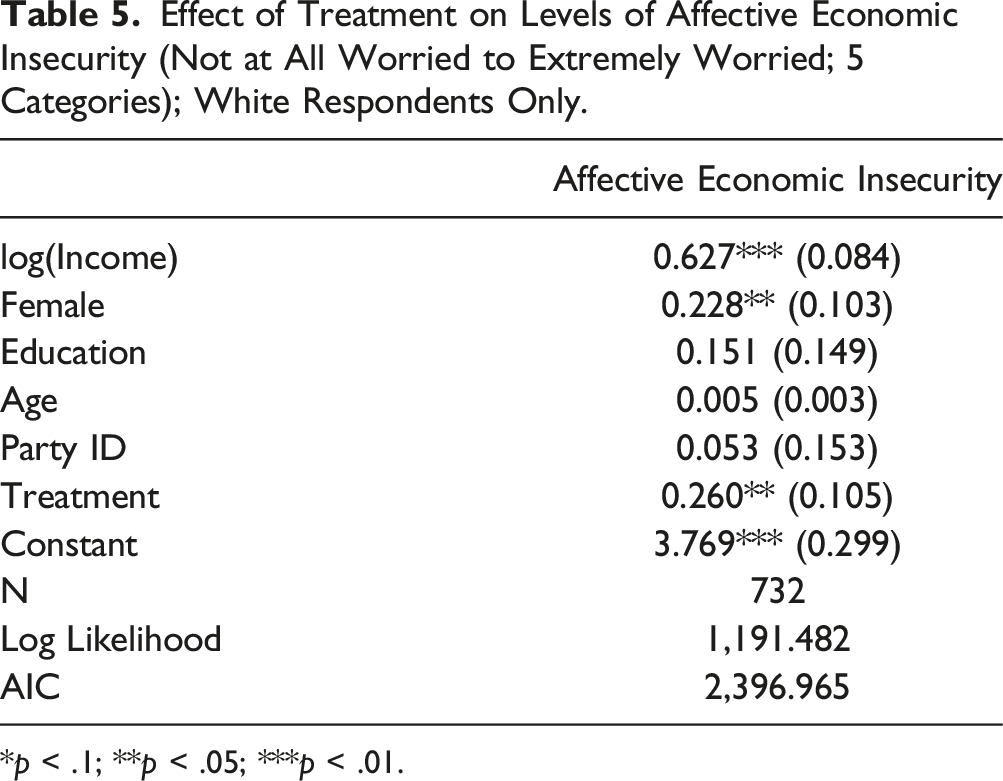
Effect of Treatment on Levels of Affective Economic Insecurity (Not at All Worried to Extremely Worried; 5 Categories); White Respondents Only.
*p < .1; **p < .05; ***p < .01.
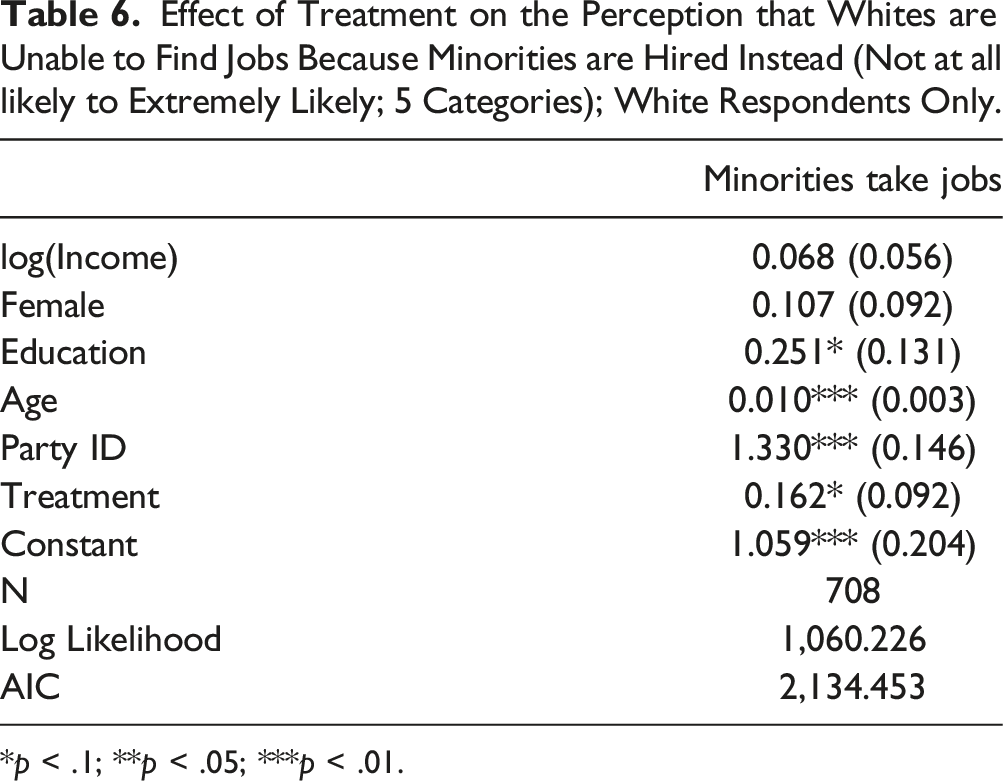
Effect of Treatment on the Perception that Whites are Unable to Find Jobs Because Minorities are Hired Instead (Not at all likely to Extremely Likely; 5 Categories); White Respondents Only.
*p < .1; **p < .05; ***p < .01.
The fact that the prime increased the level of affective economic insecurity and the perception of minorities as job competitors among treatment respondents is extremely important for establishing the causal sequence hypothesized here. If the prime only resulted in an increased perception of racial minorities as job competitors, we would not be able to conclude that elevated levels of affective economic insecurity caused this increase; perhaps reading about the economy in general leads to more racist attitudes. However, the prime does, in fact, increase levels of affective economic insecurity in respondents, and it is this increase in affective economic insecurity that leads to embracing more racist attitudes.
While the treatment prime did not affect levels of racial resentment or immigration attitudes (though the treatment did approach statistical significance when predicting immigration attitudes), the fact that it did affect racial attitudes at all seriously challenges existing paradigms in the study of white Americans’ racial attitudes that have roundly rejected the potential influence of individual-level economic circumstances on whites’ racial attitudes. Not only has a robust correlative relationship between affective economic insecurity and whites’ racial attitudes been described here, but a causal relationship as well.
Conclusion
Kinder and Sanders (1996) argue in their seminal Divided by Color—the work that developed and established the racial resentment scale as the standard measure of ideological racism in the study of American public opinion—that, on the theoretical level, individual-level economic circumstances may constitute one of the “primary ingredients” in the determination of attitudes toward race among white Americans (e.g., p. 36, passim). However, in practice, they find little to no relationship between individual-level economic circumstances and racial attitudes (e.g., 53-68). Work in the two major traditions of American racial attitudes—symbolic racism and group position theory—that preceded and succeeded Kinder and Sanders have largely agreed with this conclusion: there may be theoretical reasons why individual-level economic characteristics should affect racial attitudes, the problem is that there is very little empirical evidence that they actually do.
However, the conclusion that individual-level economic circumstances do not affect white Americans’ racial attitudes has been largely predicated on the fact that “objective” indicators of economic well-being tend to have a small or otherwise inconsistent effect on racial attitudes. We have argued, here, that this reliance on objective indicators does not sufficiently consider the subjective dimension of individuals’ economic well-being. Objective indicators ignore the very imperfect relationship between objective economic conditions and individuals’ perceptions of those conditions. Perhaps more importantly, relying solely on these objective measures discounts the possibility that subjective fear or anxiety about one’s economic circumstances may be a more potent driver of attitudes and behavior than one’s actual economic circumstances a priori.
Using a measure of white Americans’ subjective perception of their economic well-being—specifically, their affective economic insecurity—we have illustrated a strong, consistent, and relatively robust relationship between individual economic circumstances and white American’s racial attitudes. Perhaps most importantly, we have shown that affective economic insecurity is a significant predictor of racial resentment, an indicator of ideological racism extremely prominent in the existing literature, which is often treated as an uncaused and unalterable psychological disposition. Not only have we shown, contrary to the expectations dominant in the existing literature, that individual-level economic circumstances have a correlational relationship with white Americans racial attitudes, we have also illustrated, that this relationship is causal. By fielding a nationally-representative survey experiment, we have shown that white Americans primed to feel more economically insecure—who, in fact, report higher levels of affective economic insecurity—are more likely to perceive of racial minorities as economic competitors.
These findings seriously problematize both of the dominant paradigms in the study of white Americans’ attitudes. While these paradigms differ in theoretical orientations and causal emphases, both concur in their rejection of the relevance of individual-level economic circumstances in the determination of white Americans’ racial attitudes. However, these conclusions need to be reconsidered in the light of alternative conceptualizations of economic well-being; particularly measures of economic well-being that take seriously how individuals perceive of their economic conditions.
Supplemental Material
Supplemental Material - “Economic Insecurity and the Racial Attitudes of White Americans”
Supplemental Material for “Economic Insecurity and the Racial Attitudes of White Americans” by Cody R. Melcher in American Politics Research
Footnotes
Declaration of Conflicting Interests
The author(s) declared no potential conflicts of interest with respect to the research, authorship, and/or publication of this article.
Funding
The author(s) disclosed receipt of the following financial support for the research, authorship, and/or publication of this article: This work was supported by Professional Staff Congress, PSC-CUNY Research Grant 63139-00 51.

Supplemental Material
Supplemental material for this article is available online.
Notes
Author Biography
Dr. Cody R. Melcher is an assistant professor of sociology at Loyola University New Orleans. His work focuses primarily on the intersection of race and class in American public opinion.
References
Supplementary Material
Please find the following supplemental material available below.
For Open Access articles published under a Creative Commons License, all supplemental material carries the same license as the article it is associated with.
For non-Open Access articles published, all supplemental material carries a non-exclusive license, and permission requests for re-use of supplemental material or any part of supplemental material shall be sent directly to the copyright owner as specified in the copyright notice associated with the article.
