




Abstract
The essay uses the theoretical-methodological strategy of notes and listing (following the practices of Susan Sontag and Umberto Eco, among others) to illuminate particular, unique historical and cultural-anthropological aspects of the Jerry Sandusky-Penn State scandal/tragedy. Special attention is devoted in the essay to critique of depictions of the Catholic Church, ancient Greece, the “unsayable,” and social memory in regard to their links to the Penn State tragedy. Tribute is paid to those such as Murray Sperber, Michael Bérubé and Cary Nelson, whose scholarly activism foresaw and attempted 0to prevent such a scandal. Influenced by ideas about ritual forwarded by Seligman, Weller, Piett and Simon, ultimately the essay seeks to forward a distinctive understanding of the nature of sport that goes against common scholarly and popular beliefs.
Michel de Certeau (1970/2000) commences his book, The Possession at Loudin:
Normally, strange things circulate discreetly below our streets. But a crisis will suffice for them to rise up, as if swollen by flood waters, pushing aside manhole covers, invading the cellars, then spreading through the towns. It always comes as a surprise when the nocturnal erupts into broad daylight. What it reveals is an underground existence, an inner resistance that has never been broken. This lurking force infiltrates the lines of tension within the society it threatens. Suddenly it magnifies them; using the means, the circuitry already in place, but reemploying them in the service of an anxiety that comes from afar, unanticipated. It breaks through barriers, flooding the social channels and opening new pathways that, once the flow of its passage has subsided, will leave behind a different landscape and a different order. (p. 1)
As were the events at Loudin, France, it does seem that the unfolding scandal/tragedy involving alleged crimes of sexual assaults and battery on young boys by former Pennsylvania State University assistant football coach Jerry Sandusky will be marked in our ongoing/future historical consciousness. And although de Certeau emphasized the “nocturnal” “underground existence” of a thing that surprises when it surfaces, there are thinkers and performers who have sounded warnings about deceits of sport culture for a long time. Whether we now take heed of such forewarnings and use the Penn State tragedy to actually catalyze a “different landscape and a different order” remains to be seen.
What has mesmerized (sketchy word choice) scholars and the public at large is how—over a period of years—the university, enmeshed with the cultural institution of sport/football itself (sports’ grounds, cultural geography, chiefdom, communitas), covered up these sexual assault crimes and in its complicity aided in the forty or more criminal counts “metastasizing” (the word from Wertheim & Epstein, 2011).
How to begin to deal with this tragedy? In the style of Susan Sontag’s (1964) “Notes on ‘Camp’” and Italo Calvino’s Six Memos for the Next Millennium (1988), I record notes on the subject. In creating these notes, I seek to perform one of Umberto Eco’s (2009) ideas about lists:
The list becomes a way of reshuffling the world, almost putting into practice Tesauro’s invitation to accumulate properties in order to bring out new relationships between distant things, and in any case to cast doubt on those accepted by common sense. (p. 327)
The theoretical–methodological strategy of my notes is meant to highlight issues of critical studies methodologies in the unfolding Penn State scandal. The notes reflect my work in cultural anthropology, history, Greek classics, and interest in issues of “writing culture.” I am a mother, Roman Catholic; and I earned my doctorate degree in Humanities at The Pennsylvania State University in 1988.
1. In and of themselves, celibacy; single/nonmarried status; LGBT identity; physical activity–contest–movement; locker rooms; confessionals; charities/nongovernment organizations; beautiful youthful bodies; liberalism; and more: These are not stimulants/aphrodisiacs causing rape and pillage, that make monsters of humans. There is always free will of individual humans. Free will can be attuned by illness, evil, perversion, the hegemony of football programs, and the military–industrial–academic complex, but still “it is in the moral life that we have one of our primary experiences of persons” (Crosby, 1996, p. 9; see also Bruner, 1993).
2. Henry Giroux:
Penn State, like many of its institutional peers, has become a corporate university caught in the grip of the military-industrial complex rather than existing as a semi-autonomous institution driven by an academic mission, public values and ethical considerations. It is a paradigmatic example of . . . a fundamental shift of the university away from its role as a vital democratic public sphere toward an institutional willingness to subordinate educational values to market values. (Giroux & Giroux, 2012; Seybold, 2008 [as cited by Giroux])
3. “We have never been modern” (Latour, 1993). In all times and places, humans do horrific acts and violence to one another; secular, human-made evil exists. “Evil” can be entered as a critical studies keyword (Matuštík, 2008, pp. 22, 83ff). Seligman, Weller, Piett, and Simon’s (2008) Ritual and It’s Consequences: An Essay on the Limits of Sincerity radically changed my understanding of cultural and historical setting in their argument that the human condition has always been fragmented, incomprehensible, discontinuous, broken, conflicted, tragic (it is not in modernism, postmodernism, postsecularism, premodernism, antiquity, prehistoric—whatever you might have—that we find human fragmentation and/or unity).
4. I cling to the righteous, beautiful—sometimes erotic (i.e., Guttmann, 1996)—notions of these entities “sport,” “United States of America,” and “Roman Catholic Church.” When these powerful awful institutions enable fallen humans shelter to execute shameful gruesome acts on subordinate others, I will not abandon—as many are quick to ask of me—the pure, good utopic dreams of sport, nation, and religion. However, this “beautiful”—the beauty of certain sport performances, for instance—(e.g., C. L. R. James, 1963, pp. 194-203; Sydnor, 2004, pp. 165-176) is philosophically extremely problematic:
[beauty] must simply be met by an earnest and wary ethical vigilance on the part of reflective intellects, beauty . . . mocks the desire for justice . . . the word “beauty” indicates nothing: neither exactly a quality, nor a property, nor a function, not even really a subjective reaction to an object or occurrence, it offers no phenomenological purchase upon aesthetic experience. And yet nothing else impresses itself upon our attention with at once so wonderful a power and so evocative an immediacy. Beauty is there, abroad in the order of things, given again and again in a way that defies description and denial with equal impertinence. (Hart, 2003, p. 16)
5. Note 4 concerning “beauty” is not to say that “America,” “the Catholic Church,” and “sport” are not entangled, indicted culturally in the current tragedy’s ugly “webs of significance” (Geertz, 1973, p. 5).
6. Yolo Akili (2011):
Because same sex desire is an expression of humanity that conforms itself to the structural social hierarchy of the day, it would make sense that . . . white male slave owners, corrupted by racism and bigotry, would use black male bodies, of which they had authority and control, as a site to express their same sex desire. It would also make sense that, like most of the social patterns from that not too long ago period, those patterns persist in dynamics today. . . . patterns of sexual exploitation are not so rapidly dissolved. . .
7. We can use the analogy that Sandusky and his cohorts were enabled and sheltered, and thus could commit ghastly repetitive sex crimes against minors, precisely because Sandusky et al.’s authority are bound up in the hegemonic sport apparatus culture of Penn State that seems exactly akin to the Catholic Church’s institutional structure that allows sexual crimes of minors by priests. And sociologically–historically this analogy is true.
8. Indeed, the “Penn State–Catholic Church” correlation comes easy in popular consciousness; here are quick examples: “What is this, the Catholic Church?” (Pollitt, 2011); “While it may be imperfect, comparisons to the Catholic Church sex scandal are inevitable” (Wertheim & Epstein, 2011); “Is Penn State the Catholic Church?” (Hamilton, 2011); “If the Catholic Church cannot contain the sexual evil of its anointed, certainly no college campus can be expected to do so;” (Reimer, 2011); etc.
9. Consider also this sample of jokes (e.g., Abramovitch, 2011; Ponter, 2011; “Anyone got any Penn State jokes yet?” 2012) that evidence the “Penn State–Catholic Church” correlation:
Where do you go to school? Penn State. I never knew you went to a Catholic school.
Would you like to go to Neverland Ranch, a Catholic Church, or Penn State University?
Will you stop with the Penn State jokes? All you’re doing is taking something topical and revamping old Catholic jokes.
Joe Paterno’s been fired at Penn State. Just in time . . . there is a job opening at the local Catholic parish.
What do Joe Paterno and a Catholic priest have in common? A Catholic priest turns the other cheek while Joe Paterno looks the other way.
Paterno said nothing because he thought they were engaged in a prayer: “Give us this day our daily head.”
10. Cartoons:

Note. ROB ROGERS © 2011 Pittsburgh Post-Gazette. Reprinted by permission of Universal Uclick for UFS. All rights reserved.
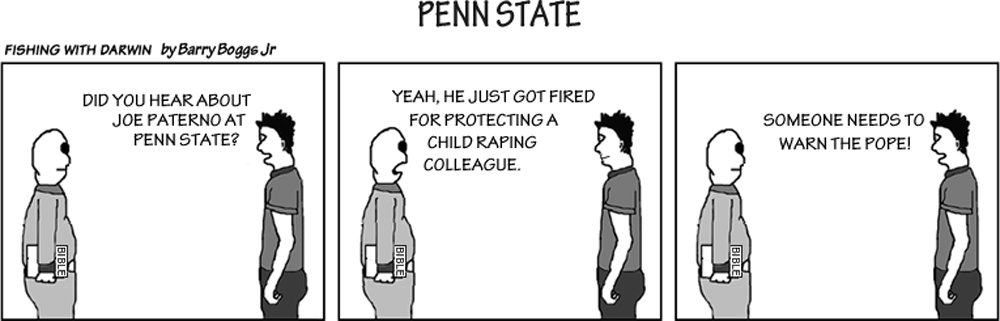
Note. From "Fishing With Darwin," by Barry Boggs, Jr. Retrieved from http://www.fishingwithdarwin.com/comic/penn-state/. Copyright © 2011 by Barry Boggs, Jr. Reprinted with permission.
11. Notes 8, 9, and 10 about the Penn State–Catholic Church correlation should not in the same way be so simplistically echoed in our critical cultural studies. At first glance, my contention with the Penn State–Catholic Church correlation might seem outlying to the topic at hand, but I persevere in order to spotlight a snag I see in critical studies.
12. The formula, even in sophisticated cultural studies, is to depict the Catholic Church as naïve and repressive, an insular institution of White men at odds with modernity, creativity, sex, the body, women, and so on (e.g., Woodhead, 1997, pp. 193-194). As an illustration, since 2001, of 44 articles in Cultural Studies ↔ Critical Methodologies that mention the word “Catholic,” only two treat the topic with any depth/intricacy (Christians, 2009; Dillon, 2001); the others use the term in clichéd, descriptive ways such as “nuns in my Catholic boarding school”; “Catholic guilt”; “unrepentive Catholics”; “my Catholic past”; “Catholic education”; and “failed Catholics.” Granted, such passages semiotically project a universal, singular experience read seamlessly by Western moderns. But I call for continued dense multifaceted troubling of such portrayals of the Catholic Church and/or Catholic experience.
13. Cultural studies scholar Elizabeth Fox-Genovese (2000), in an essay about her adult conversion to the Catholic faith:
Most secular academics seem to receive any profession of Christian faith with a vague sense of embarrassment. Adherence to Judaism or Islam is another matter, although why is not immediately self-evident . . . Perhaps they meet with greater tolerance because they are less familiar, perhaps they do not carry Christianity’s taint of having long figured as the religion of a European male elite that used its faith to cow others into submission. A vague, nondenominational Christianity—or better yet Unitarianism—may be acceptable, but Catholicism lies beyond the pale, not something that people “like us” embrace. (p. 39, paraphrased)
14. Beyond the horrible human failures and terrible historical wrongs of the institution of the Catholic Church, there is in Catholicism and Catholic theology a rich scholarly tradition and literature from which we can begin to ask fresh questions of human culture. See the Routledge Radical Orthodoxy Series (e.g., Milbank, 1990; Milbank & Pickstock, 2001; Milbank, Ward, & Pickstock, 1999; Ward, 1997, 2000, 2009); Catherine Pickstock (1998), After Writing: On the Liturgical Consummation of Philosophy; Glenn Tinker on a rationale for study of Christian assumptions and proposals (quoted in Marty, 2007, p. 73; also Dillard, 2008; Sydnor, 2006, pp. 202-206; 2009, pp. 65-100); Tina Beattie (2006) on modern Catholic theology as “an inexhaustibly rich source for feminist reflection and analysis” (pp. 7-9, 35); Beattie believes that Luce Irigary’s call for new language and symbolism is to be found in Christian theology.
15. Anthropologically, a human community’s fears, beliefs, dreams, and taboos are played out in joking behavior. The culturist is not so concerned with Penn State scandal jokes as “too soon,” “sick,” “twisted,” “offensive,” “over-the-top inappropriate” (e.g., Abramovitch, 2011; Ponter, 2011); instead, ask what does it mean that “you couldn’t help but laugh” (Abramovitch, 2011; see also Gutwirth, 1993; Holt, 2008).
16. Sontag (2004):
“We”—this “we” is everyone who has never experienced anything like what they went through—don’t understand. We don’t get it. We truly can’t imagine what it was like. We can’t imagine how dreadful, how terrifying . . . and how normal it becomes. Can’t understand, can’t imagine. (pp. 125-126)
17. On Sandusky’s crimes and Joe Paterno’s tragic fall: Some bloggers and journalists point to similarities to ancient Greece, Greek drama, and to ancient Greek pederasty and sport (e.g., Tully, 2011: “Sandusky would have fit right in if this was Ancient Greece”; Edmundson, 2012: “Plato would probably approve of the way athletics function in our culture”; Moore, 2011: “Athletics have a part in education—the ancient Greeks . . . knew as much. Penn State is a noble institution for fostering sports. . .”; Thompson, 2011: “The ancient Greeks walked with the Gods, but they have nothing on modern man”; Williams, 2011: “Keeping sodomy of boys by Sports Leaders secret was the sin of the ancient Greeks. . .”; xtab, 2011 (in a comment to Resnick, 2011): “ancient greek [sic] men also took young teenage girls of the same age as their wives”; James, 2011 (in a comment to Resnick, 2011): “Sandusky is an old fashioned pederast in a tradition . . . which goes back to ancient Greece”; Fitzpatrick, 2011:
When the Greeks overran his native Troy, Aeneas had no choice but to build a new life and land elsewhere. JoePa [Joe Paterno, Penn State football coach] is way too old for that. More applicable perhaps is an event late in The Aeneid. Turnus. . . begs for mercy but is killed by an incensed Aeneas, who had noticed his rival was wearing the belt of a slain friend. That sounds like Paterno;
Vitez, 2011: “The events seem lifted from the pages of a Greek tragedy. . . A Greek audience had the luxury of watching the tragedy as a play. But we are experiencing it in real life”; and Paterno himself referenced the ancient Greeks in the years before the scandal erupted (Paterno & Asbell, 1989, p. 211).
18. Can modern concepts of sexuality and crime be applied to ritualized practices of ancient Greeks (e.g., Davidson, 2004, pp. 1-13; Foucault, 1990; Halperin, 2003, pp. 227-242; Hubbard, 2003; Markula-Denison & Pringle, 2006, pp. 24-48; Scanlon, 2002, pp. 64-121; Tzelepis & Athanasiou, 2010; Voss, 2008; Wilson, 1990, p. 85)? When we say that a current event has an ancient Greek residue, what does this mean? “Ancient Greek-ness” can be understood as it lives on in modern culture associated with sport, athletics, Olympic Games, and so on (e.g., Sydnor Slowikowski, 2003, pp. 64-80). This “aftermath” is the “continuing life of a performance. . . . the duration . . .is indefinite” (Schechner, 2002, pp. 246, 249). So when antiquity surfaces in the Penn State scandal, we can behold the history and critique of revivalism, social memory, and invented tradition/heritage (e.g., Bennett, Grossberg, & Morris, 2005, pp. xv, 154-156; Cohen, 2006, pp. 1-5; Connerton, 1989; Hobsbawm & Ranger, 1983, pp. 1-14; Lowenthal, 1985, pp. 74-92; Sydnor Slowikowski, 2004; Sydnor Slowikowski, 1991).
19. Some ancient Greek-like “things” unfolded in 17th- through 21st-century Great Britain and Germany (e.g., Bernal, 1987, pp. 212-215; 281-336; 439-443; Deloria, 1998, pp. 71-94; Segal, 1998, pp. 242-251, 268; F. M. Turner, 1989, pp. 61-81) in which a sense and vision of antiquity was fabricated to aid political and social forces such as anti-Semitism, and then consequently, these forces were “innocently” appropriated in American cultures and communities associated with sport, physical education, kinesiology, athletics, and so on. Present-day active representations of such in sport-related settings (such as the Penn State scandal) include metaphors and images from ancient Greek literature and theater, the Greek pillar/column, vegetation victory leaves, torch-flame ceremonies, white statuary, living statue performances, and the discobolus (Sydnor Slowikowski, 1991, pp. 401-408; 2003, pp. 65-79). Ancient Greece, the “classical” (Settis, 2006), has various hybrid manifestations even in its own past (e.g., Loraux, 2006), the globalized transnational present, and the future; it is a category that compares not only the past and present, but “ourselves” and “others.” This continuing resonance of ancient Greece necessitates persistent study (e.g., Knox, 1983, pp. 11-31; Settis, 2006, pp. 82-111).
20. The Penn State scandal illuminates techniques and principles of the unspeakable/unsayable. The graduate assistant witnessed the sodomy of a 10-year-old boy in a shower and called his father first; Joe Paterno’s testimony to the Grand Jury indicated that he (Paterno) had no words for the case (“fondling or doing something of a sexual nature to a young boy–“Grand jury testimony,” 2011, p. 7); in the months and perhaps years before the scandal broke nationally and internationally into mass public awareness, police and state’s attorney activities and investigations, rumors and news/fact leaks were ignored by local communities, Penn State trustees (Thompson, 2011), and by journalists (Morris, 2011); initially, ESPN did not cover the topic.
When we contemplate acts we consider unspeakable, we call on a civilized society’s imperative to remain silent about physical abuse, rape, incest. . . that protects abusers who hold victims in their thrall. As a matter of conscience we fight to create a climate in which victims are not shamed into silence’s effective complicity. . . what stops us from revealing hurtful and damaging events isn’t (or isn’t only) imposed from without. Before they protect their predators, victims of trauma (defined as any experience “which by its nature is an excess of what we can manage or bear”) protect themselves by not consciously expressing what happened to them. To articulate, or to say, is to put together, to draw fragments of an experience into a coherent narrative, a potentially devastating process if the experience was so overwhelming as to have been. . . “shattering.” Before a thing is consciously (if not audibly) voiced, it has yet to be acknowledged or owned; it has yet to be believed. (Harrison, 2006; see also Hruby, 2011; Lacan, 1997)
Paul Connerton (2008) reminds of “collusive silence brought on by a particular kind of collective shame” (p. 67).
21. What are cultural–sociological–historical “foundations of destructive attitudes toward children?” (Monaghan, 2012). Study of “childism” (e.g., Young-Bruehl in Monaghan, 2012), the “mystery of the child” (e.g., Marty, 2007, pp. 5, 43, 74, 156) and “kinderculture” (e.g., Steinberg, 2011) can initiate understandings, transformations—perchance revolution—of children, sport culture and universities (see also Wilson, 2012).
22. Murray Sperber, professor emeritus of English and American Studies at Indiana University, devoted his life to indicting big-time sports and the culture of college athletics for the very evils that have been exposed in the current Penn State–Sandusky tragedy. In his books, Sperber untangled the history of such scandal and provided explicit recommendations for radical reform of university athletics; his descriptions and calls for action almost perfectly accommodate the current state of affairs at the American university today (e.g., Schiller, 2011; Sperber, 1990, 1998, 2000, 2001). The pioneering work of Sperber embodies Norman Denzin’s (2010) call for a “critical sociological imagination that inspires and empowers persons to act on their utopian impulses” (p. 18).
23. Too, Michael Bérubé, Cary Nelson, and many others have dedicated their lives to battle issues of the idea of a university, freedom, and university faculty governance (e.g., Bérubé, 2011; “The dangers of a sports empire,” 2011; Nelson, 1997, 2011; Wilson, 2012). Now out of the Penn State tragedy, the good for which Bérubé and Nelson have labored hopefully begins to come to fruition:
Every end in history necessarily contains a new beginning; this beginning is the promise, the only “message” which the end can ever produce. Beginning, before it becomes a historical event, is the supreme capacity of man; politically it is identical with man’s freedom. (Arendt, 1951, pp. 479, quoted by Matuštík, 2008, p. 253)
24. The continuing life of the Penn State tragedy is generated in part by sport and all of its peripherals’ (peripherals: anyone, everything connected to sport in any context—real, virtual, historical, imagined, future; see Robert Rinehart, 1998, Players All: Performances in Contemporary Sport) sustained tradition in the West of association with “muscular Christianity”—the invented, sentimentalized idea that sports foster a “sound mind in sound body.” From this muscular Christianity ethos come mythical flawed ideas long engrained in national and pedagogical principles that athletes and coaches should be role models; that fair play (not winning) is what matters; and that sport may have a missionary, colonizing, even peace-building purpose. At the everyday level, it’s not uncommon for communities to understand sport as having the capacity to forge “good citizenship,” “morals,” “solidarity,” and to keep children away from illicit activities (e.g., UNESCO, 2011 [International friendship encounter: Sport for a culture of peace]; UNOSDP,2011 [Sport for development and peace: The UN system in action]; UN Sport for peace and development, 2011; UNESCO, 2011 [Coordinating Committee for International Voluntary Service]; National Drug Abuse Resistance Education, 2011).
25. Paralleling these above optimistic (unfounded, romanticized) renderings of sport’s cultural function and use, there exist expansive analytic schools/traditions of sport criticism. Thinkers and performers hailing from fields and disciplines that range from communication, biology, English, Classics, anthropology, and sociology; journalism and literature, film, art, and more have shown that sport has fluid temporal, cultural contexts. Such works reveal sport in modernity to serve the interests of the maintenance and ongoing consent of particular dominant/powerful visions of race, gender, state, media, nation, economy, technology, and science (e.g., Jarvie, 2006; Giulianotti, 2005; Hargreaves, 1986; Coakley, 2009; Markula-Denison & Pringle, 2006; Hughson, Inglis, & Free, 2005). This theorizing of sporting institutions, moments, and bodies can tell us much about specific conjunctural moments and help solve societal problems. But in all of these capacities sport matters (has meaning) in specific ways—from pure fun, fantasy–virtual play, Olympism, athletic contests, folk and invented traditions, aesthetic creativity, macroeconomic activity, body-culture panoptic systems, and transformative cultural agency to the upholding (and perhaps sometime erasure) of racist, sexist, and fascist regimes.
26. Thus, Western sport studies and popular culture answer the question of sport with ideas about sport as a right (e.g., of all humans to play, have fun, compete, excel, or test physicality); sport as a tool (for peace, development, equality, freedom, and deterrence from illicit drug use or HIV/AIDS); as a mirror of society’s subcultural–exotic–ordinary contexts (e.g., ethnographic research, documentaries, fiction, performances, etc. about varied sports, athlete characters, histories). Sport in these above contexts is often forwarded as an instrument and/or individual or communitarian tool of transformative power.
27. On the nature of sport: Sport does seem to matter in this Penn State tragedy. Yet I work on a treatise that sport, broadly defined, is a ritual that is in our current understanding of ritual, meaningless, but at the same time, sport has universal, organicist, foundational, originary, essential nature(s). How can this be—that sport is meaningless yet essential? Seligman et al. (2008), Boyd (2009), Latour, (1993), Sansone (1988), Williams (1977), and Bateson’s (1972) works undergird the philosophical foundation of my idea (although none of the above except Sansone consider sport). In part, I understand sport as a ritual in the distinctive way that Seligman et al. influenced me to understand ritual. Important to my argument is the fact that my treatise goes against the canonical understandings of ritual, especially in sport studies, that ritual provides human communities temporary order or harmony in order to create culture (e.g., Huizinga, 1955); that ritual operates as a vehicle or communicator of role reversal or collectiveness (e.g., Geertz, 1972). Ritual does involve a “magic circle”/ “sacred sphere”/liminality as illuminated by Huizinga (1955), Caillois (1958/2001), and Arnold Van Gennep (1909/1960), V. Turner (1967), Csikszentmihalyi (1991), Taussig (1993), and Schechner (2006), among others. As described above, Seligman et al.’s ritual thesis is that the human condition has always been “incomprehensible,” “broken,” “tragic”; these are not unique conditions of modernity or postmodernity. Seligman et al. (and also interpretively, Boyd, 2009, and Latour, 1993) have it that utopia cannot be achieved and that it is going to be in the doing of action through ritual—universal to humans in all times and places that we recognize and learn how to live within and between different boundaries rather than seeking to dissolve them. In this specific view, ritual does not function to cure or heal. Sport does not forge world peace or good citizenship; it will not keep gangs from forming, nor will it right/transform cultural wrongs such as sexism, racism, ageism; and importantly, it is not sport as institution/culture/ritual that fostered the Penn State scandal. Like all human ritual, sport (at the least and at the best) places disparate people, communities, and nations next to each other, each forever in their own bounded sad, awful—yet malleable and changing—beautiful, hopeful contexts.
Footnotes
Declaration of Conflicting Interests
The author(s) declared no potential conflicts of interest with respect to the research, authorship, and/or publication of this article.
Funding
The author(s) received no financial support for the research, authorship, and/or publication of this article.