



Abstract
In this performative play without speech, the author demonstrates the various acrobatic negotiations she makes in her everyday life as a transnational feminist educational researcher who was born in India, raised in Canada, and educated and employed in higher education in the U.S. The author uses silence as a space of reflection, resistance, adaptation, retreat, and freedom in order to challenge the duality of silence and voice where silence is seen as the absence of voice. The author presents her negotiations in academia as a set of acrobatic moves in response to her everyday circumstances. She also demonstrates that for her home is always a shifting concept that continues to force her to shuttle between multiple national identities. The author uses the works of Kamala Visweswaran and Inderpal Grewal to theorize nomadic, diasporic, and transnational subject positions and ways in which silence and voice function. Using the form of silence as a performance, the author invites readers to find their own entry points of identification, resistance, and points that transcend both identification with and resistance to the scenes with which she works, works out, and plays.
Keywords
Derek 1 and I sit at a coffee shop in two burgundy plush chairs. Derek takes a sip of his coffee and starts, “You know, I was traveling through Europe this summer, and I was at this airport in Amsterdam. We were in line waiting to get on the plane. There was this Indian couple at the back of the line. The man just didn’t want to wait in line at all. He was very loud, and kept showing his boarding pass to the attendant, insisting he should be let on the plane as soon as possible. I was afraid for him. I thought if he were any more loud or rude, he would have been arrested. I couldn’t understand why he thought he was so special that he didn’t have to wait in line. Is waiting your turn something that Indian people don’t do? Is that how men are trained to behave in India? I mean, what made him think it would be okay to be so rude?” Derek has a puzzled look on his face.
I wonder if Derek thinks that I can speak for this Indian stranger he encountered at the airport? Does he think that Indian people are so much alike [or “so indistinguishable”] that any one of us can speak for anyone else? Does he think that I share a supernatural psychic connection to that man’s mind, or with the minds of all Indian people?
“Am I offending you?,” He asks sincerely.
“No, of course not,” I answer. The words come out almost instinctively, as if I am a programmed robot, but with a broken voice. I get mad at myself for not being truthful. Derek has the potential to yield a powerful influence on my tenure and promotion. Besides, Derek and I are generally in agreement on our progressive politics, the dismal state of education and educational research in the United States, and he has always supported me professionally. I continue, keeping my wild tongue tamed, “Well, you know I can’t tell you what this guy was thinking. I think he could just be a jerk. Jerks can cross all cultural boundaries. Remember my student, David?”
Derek nods.
“He insisted that Charlie’s Angels were true depictions of female empowerment, icons of feminism. Remember how David felt offended when I explained that women who blindly accepted orders to kill people from a disembodied male voice might not come across as icons of empowerment to a lot of women? He acted privileged by deciding to not come to my class anymore, or do any assignments, and still expected he would get a grade of A. Surely, the way he acted doesn’t represent all White people, does it?”
I feel that I’ve satisfactorily made the point that jerks transcend culture, however, Derek remains unconvinced. It seems as if he yearns to understand the Indian traveler’s behavior through my cultural insights.
“Of course. I understand. But I’m just wondering about Indian males. Do they feel like that they have a right to things that others don’t? I mean what made him think that he didn’t have to wait?”
“I don’t know Derek. I can’t tell you. What made David think that he could push his interpretation of feminism onto his professor and then insist that he get an A without doing the rest of his assignments or showing up for classes? Maybe the guy at the airport wanted to get to the overhead compartment before everyone else. I’ve seen people do that at airports. Who knows why people behave how they do.”I had no other explanation left to offer Derek.
“Well okay,” Derek sounds hesitant. After a couple of minutes of pregnant pause, Derek concludes, “I thought maybe it was cultural. It’s always interesting talking to you. Thank you.” He still does not sound convinced.
* * *
I am a brown academic. My brown skin denotes my South Asian heritage. My speech and education represent a mixture of Indian, Canadian, and U.S. training. A shuttling between multiple subject positions and silent and voiced negotiations create the transnational possibilities of connections between various articulations of the global, the local, and the hybrid, cosmopolitan subjects emerged in relation to the specific nationalisms as well as to discourses of universalism. In the United States, the relationship between South Asian, Asian American, and American produce a set of questions that remained at the heart of issues of gender, race, and nation. (Grewal, 2006, p. 37)
These connections allow for multiple hyphenated existences, a mobile diaspora (Visweswaran, 1994, p. 116), with increasing possibilities of contemplation, resistance, acceptance, and dismissal of being thrust into unwelcomed subject positions. Some of the contemplative moments that shaped my activism are grounded in Eastern practices of yoga and meditation, which allowed me to clarify choices, honor performative scholarship as a legitimate site of knowledge, and identify possibilities for erasure of and navigating around social structures of oppression. Specifically in The Bhagavad Gita (Mitchell, 2000), silence is taken up in multiple spaces to identify ways in which one can create a oneness with fear, desire, and wrath to create a harmonious existence as one travels from one life event to another. In this transient sense of self as connected to others, I have reflected on the ways in which silence and voice function for me instead of attempting to create a definition of silence.
In my everyday life as a transnational feminist educational researcher, I carry with me various voices and silences that I negotiate with, surrender to, and/or resist. In order to demonstrate the various ways in which silence and voice function in my life, I have created a performative play, Cirque du Silence (Circus of Silence) presented later in this article. After watching their production of O by Cirque du Soleil at the Bellagio Hotel in Las Vegas, I was inspired to create a play with a utopian imagination of similar resources and production talent. Therefore, for this play, I have imagined the stage to be made of a hydraulic floor that moves up and down a water tank, a talented performer who can swim, swing from trapezes, and can make multiple acrobatic moves while emoting. I have imagined the background score to be primarily of the fusion music Electronica and Sitar by Karsh Kale and Anoushka Shankar. This play has never been performed so it should be read as a “closet drama” (meant to be read but not performed), although I would love to see this play being staged at some point. I encourage the readers to visualize the actions as described as if they are being performed on stage.
The main character of the play is Brownie. She embodies my transnational identity fleeting between multiple cultural homes due to being born in India, raised in Canada, and educated and employed in the United States. The play mostly focuses on Brownie’s experiences as a transnational female academic in the United States. Brownie remains silent throughout the play, performing acrobatic maneuvers to negotiate her role in various academic spaces. Brownie attempts to show the audience that in her silence she is sporadically reflective, peaceful, critical, inquisitive, resistant, and adaptive. Brownie displays a range of emotions, including frustration, puzzlement, disappointment, and exhaustion. Silence, in this play, is not an absence of voice or mere moments of pure retreat but a paradoxical space of contradictions that transcends any pure understanding of oppression and liberation. Given that silence is a fertile ground of inquiry, the ontological and epistemological framework of silence needs to be understood not just within the Western discursive context but also within the transnational context of being where absence and presence of voice are transient, fleeting, negotiated, and contemplated within a terrain where liberatory practices shuttle between being overt and transparent.
Cirque du Silence: Acts Without Speech
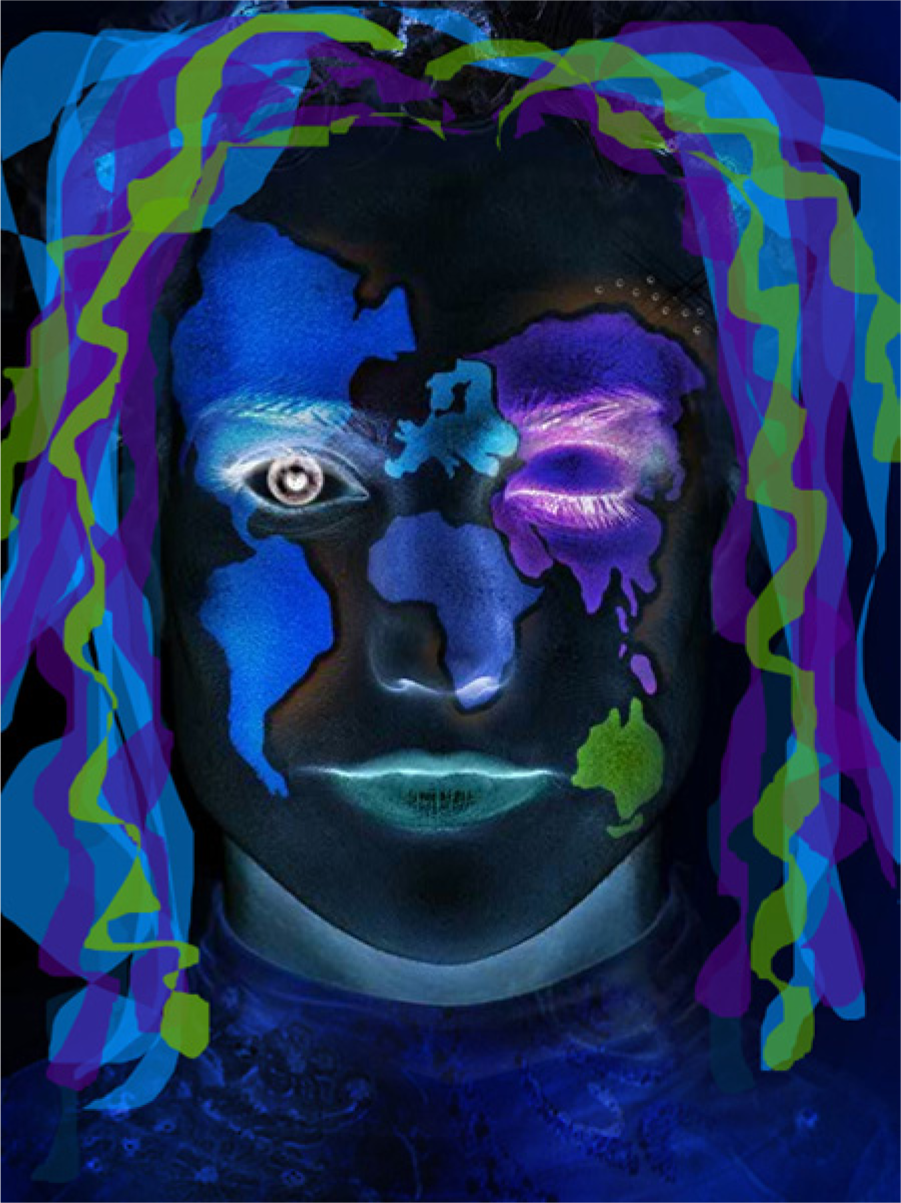
Portrait of Brownie
Lights come up on Brownie standing center stage. She has multicolored hair, and a dark face with a map of the world painted on it, which glows in the dark. The image of Brownie is something I created in Photoshop using my face and various layers to add the map of the world and then using a negative filter to reverse the colors and creating a neon-glow effect. Behind her, there are five faucets colored red, orange, blue, green, and purple with buckets underneath each tap. On the Velcro wall behind the first tap is a sign that says “Nationality.” The signs behind the second, third, fourth, and fifth taps say, “Gender Roles,” “Ethnicity,” “Research Interests,” and “Class,” respectively.
Brownie hears music and starts to sway. Suddenly, there is a loud guitar noise from the right wing of the stage. She is flung to the right of the stage where a hand from the wing gives her a 4’ x 4’ wooden plank. Brownie looks around on the stage and finds a slot on the left side to insert the plank.
Loud guitar from the left wing.
Brownie is flung to the left side of the stage and handed another plank. Brownie puts the wooden plank in a slot on the right parallel to the first.
Loud guitar from the top of the stage.
An unseen force lifts Brownie above. Another visible hand from the top gives her a wooden plank. Brownie is lowered to the stage by an unseen force. She walks over to the previous two planks and places the third one perpendicular, constructing the back of a box.
Loud guitar from the top of the stage again.
The same unseen force as before lifts Brownie above again. She gets another wooden plank from a visible hand from the top of the stage. After being lowered to the stage by an unseen force, Brownie walks over to her box and completes the box by placing the plank in front of her. Brownie is now inside the box. The planks come up to Brownie’s chest. She looks uncomfortable, trying to make herself fit as she is clearly taller than the height of the planks. When that fails, she attempts to find a way out. She inspects the sides of the box, and then pounds on them, finally breaking the planks and escaping.
The tempo of the music increases. A question mark falls from above the stage in front of Brownie. Brownie picks it up and considers it. Another falls, and Brownie picks that one up too, examining it. Question marks begin to rain on the stage from above. Brownie tries to catch the question marks and put them aside in a pile. But the question marks keep raining down. Brownie covers her head to protect herself and runs to the multicolored faucets behind her. She places as many question marks as she can on the Velcro wall behind each tap. She turns on the red tap under the sign “Nationality,” and red water flows in the bucket. The red water does not fill the bucket even though it continues to run. Brownie looks impatient, then disappointed. The pouring of question marks continues.
She turns on the orange tap under the sign, “Gender Roles.” Orange water partially fills the bucket. Brownie tries to turn off and turn on the orange tap again, but no matter how much water comes out of the taps, the buckets never get filled. Brownie looks frustrated. She runs to the third green tap under the sign, “Ethnicity” and turns it on. Green water partially fills the bucket as it continues to run. Brownie speeds up and turns on the last two blue and purple taps titled, “Research Interests,” and “Class,” simultaneously hoping to see the buckets fill up. The colored water from the last two taps do not fill up the bucket as they keep running. The question marks continue to rain down on the stage.
Brownie angrily kicks all the buckets over, spilling water on the stage and letting the colors mix together. As this is happening, the floor of the stage descends and black water is pumped into its place. Brownie splashes around, mixing the colors from the faucets. As she sinks further into the water, she increasingly struggles to keep her head above the water. She grabs one of the planks from the box that she broke earlier and sits on top of it to float on the water. The music softens and almost comes to a silence.
A giant book falls from the ceiling with the words “SCIENTIFIC INQUIRY” written in big block letters on it landing on Brownie’s plank. She is thrown off the board and submerged under the water. There is a sharp increase in the volume and tempo of the music.
Brownie’s hands seem to come up from under water, but the book of “SCIENTIFIC INQUIRY” which floats on top of the water, keeps pushing her down. Brownie overcomes the book, by tearing its binding. The pages of the book float on the dark black water.
A kaleidoscopic crystal ball with jagged edges is lowered from the ceiling to where Brownie is on the stage. The ball seems sensitive to Brownie’s touch and changes color when she touches it. Brownie tries to touch the edges of the ball and sees it change color. Brownie grabs onto two jagged edges of the ball. The ball lifts Brownie from the water and places her on a trapeze swing that hangs overhead.
The water drains from the stage, as the floor returns, revealing three rectangular structures. The fronts of the structures have prison bars with a large pad lock. Signs hanging above the structures label them from left to right as, “Research,” “Teaching,” and “Service.” She investigates each of the three structures in order to find a way to get inside. There is a loud guitar noise from the right wing of the stage. Brownie runs to the right wing of the stage. A visible hand from the right wing offers a crowbar. Brownie takes the crowbar and runs to the “Research” structure. She tries to break the padlock and bend the prison bars of each of the structures, but they do not yield.
Brownie runs around the stage looking for something with which she can break the prison rails or the padlock. There is another loud guitar noise from stage left. She goes to the left wing. A visible hand offers Brownie a hammer and she takes it. Brownie runs to the “Research” structure and pounds down the hammer on the large padlock. The lock does not break or open. Brownie sweats. In frustration, Brownie throws the hammer back at the left wing. She sits down cross-legged in the middle of the stage. She stretches her hands out to her knees with her palms up. Brownie begins to inhale and exhale slowly. She closes her eyes and starts to meditate. The sitar music slows down in tempo.
Brownie stands up, looks at the top of the stage, and summons the crystal ball. The crystal ball is lowered to where Brownie is standing. When the ball is within her reach, Brownie climbs on the ball. She tries to sway the ball back and forth over the “Research” structure. She increases the momentum of her swings. Finally, when she is atop the “Research” structure, she kicks down the ceiling and drops inside the structure. The crystal ball moves up and away.
The audience sees Brownie through the prison rails of the structure. At first she is celebratory and dances around inside the structure. Being confined troubles Brownie. She rattles the prison bars but cannot get out or break the padlock. Brownie looks above for the crystal ball. It descends into the structure. Brownie holds onto the crystal ball and is slowly pulled up out of the structure.
Brownie swings down to the “Teaching” structure on her crystal ball and kicks in the ceiling. She gets inside the structure, but this time she does not allow the crystal ball to get away from her as she holds onto one of the jagged edges of the ball with one hand. With her other hand Brownie inspects inside the structure, celebrates her entry into the structure by dancing, jumping on top of the crystal ball, and by standing on the hand that she was using to hold onto the crystal ball. Using her free hand, Brownie points upwards and is pulled out of the “Teaching” structure. Brownie continues to swing back and forth and reaches atop the “Service” structure. She kicks in the ceiling of that structure as well and then swings up and down to break the remaining sides of the three structures. However, all of the structures had at least one side standing intact despite Brownie’s attempt to kick them down.
Brownie stops swinging and hangs onto the ball, panting and regaining her breath. A flag of India drapes down on left stage. Next, an American flag drapes down in center stage. Then, a flag of Canada drapes down on right stage. As each flag unfurls, Brownie turns to face it. Three trapeze swings are lowered in front of each flag from the top of the stage. Brownie swings from the crystal ball to the trapeze in front of the U.S. flag. The crystal ball then moves up and disappears into the ceiling.
The American national anthem starts. Brownie begins swinging on the center stage in front of the U.S. flag. The Indian national anthem begins concurrently. The Indian national anthem becomes louder than the U.S. national anthem. Brownie swings toward the Indian flag. Once she gains momentum, she jumps up in the air, does a double somersault, and grabs onto the swing in front of the Indian flag. When she lands on the Indian swing, the U.S. national anthem gets louder. Brownie looks back at the U.S. flag. She builds momentum again and then somersaults to the middle to the swing in front of the U.S. flag. The Indian national anthem softens, and the Canadian national anthem begins competing with the U.S anthem. She looks toward the Canadian flag. She swings upside down in front of the U.S. flag, then somersaults again in mid-air and catches onto the Canadian swing. As the volume of the competing anthems fluctuates, Brownie continues to swing back and forth between the three swings. Brownie becomes tired, seen visibly breathing heavily. She slumps over the center swing. The anthems swell together in cacophony. Brownie puts her hands over her ears and drops to the stage.
Silence.
Brownie picks herself up. She turns to each of the flags and then faces out toward the audience. She sits down cross-legged on the stage, with palms facing outwards resting on her knees. Brownie closes her eyes and inhales and exhales slowly. She starts to meditate.
Fade to black.
Footnotes
Declaration of Conflicting Interests
The author declared no potential conflicts of interest with respect to the research, authorship, and/or publication of this article.
Funding
The author received no financial support for the research, authorship, and/or publication of this article.