




Abstract
Through three separate-yet-connected instances of spectatorial re-appropriation of the Western cinematic iconicity, I explore how the genre framed an understanding of a war that is not only geographically but also historically and politically far away from the Western’s American home culture. The war in question is one that broke the country of Yugoslavia apart at the end of the 20th century (a century that is, incidentally, also known as the century of cinema). From prominent Yugoslav artists re-writing iconic Western imagery to refuse troubling divisions haunting their home country, to my own personal experiences with surviving the war—fused with my childhood love of the Western film genre—I explore how the Western mythology was re-appropriated to symbolize something entirely different from what it might have meant in its home context. While this re-appropriation might potentially erase or reconfigure some of the Western’s domestic complexities, it creates many new ones, offering an opportunity to explore the question of how trans-cultural “fantasy echoes” offer sites of creative possibility and of insightful re-readings rather than of reductive limitations.
Keywords
(Looking Between, Around, and Sideways)
On Playing War Games
Picture this:
A girl-child is growing up in a predominantly working class, immigrant, industrial suburb of Croatia’s capital of Zagreb but the subtleties of this positioning are not too obvious to her childhood self, she will only learn to revisit them in those terms much later. The girl-child is an ethnic minority in the state of Croatia, her parents having moved there from Bosnia before she was born.
This growing up takes place in the second half of the 1980s, just as her native country of Yugoslavia is about to disappear in the flames of ethnic wars, bloodshed, and unspeakable violence.
The girl-child growing up during this time is still unaware of all these complexities that situate her life through class, race, ethnicity, nationality, religion, and gender, as she spends her days in a carefree play in which a distant conflict is perpetuated for pleasure’s sake—the mythical one between “cowboys and Indians.”
“Ratatata!” the girl-child yells as she points her wooden gun toward the enemy group.
During this war play, the cowboys were always outnumbered by the Indians, as these working-class immigrant kids all wanted to be the latter. Something about the Indians’ perceived calm and dignity, mystery,since they were shown on silver screen as silent, menacing, larger than life . . . captivating. The Yugoslav youth’s vision of these peoples was formed almost exclusively through the representation of “celluloid Indians” (Kilpatrick, 1999), as the Westerns were a very popular genre often shown on our socialist TV sets, in/forming its audience’s limited worldview on how American history went on, but also its implicit understanding on what it meant to be a silenced, mysterious Other.
Our girl also wanted to be an Indian, until she watched Shane, that is, and decided that riding off into the sunset was the most pleasing way of imagining one’s future. The safest too.
This exotic imaginary of the Westerns that the industrial, immigrant kids re-appropriated though play in socialist Yugoslavia just before their lives went up in flames of war provided a playground that displaced the primacy of the worrying glances that their parents exchanged in silence. Those worrying glances were undecipherable to the children at the time, as the parents tried to shield them from coming to grim reality too soon. This is perhaps one of the reasons why so much TV watching was allowed, and so much “Western” consumed by the children. Escapism is never simply an escape from reality, it is always a displaced negotiation of the anxieties which it attempts to conceal and suppress.
And so, seemingly carefree childhoods over which a war loomed were enacted by re-appropriating mythical conflicts that were far away, non-threatening, and intimate by virtue of being distant, on screen and immaterial. The girl’s mother would later say that she found the children’s cowboy-Indian war play a troublingly ominous sign, as if the children were telling their parents that they knew what was coming even while they did not quite know it consciously.
*
“Ratatata!”
*
We were performing someone else’s fantasy scenario whose primary purpose, in its originating culture, was to mask, but never entirely conceal the hidden history of genocide as national origin. Little did we know that through those games of “ratatata!” wars of archetypal cowboys versus Indians we were indeed foreshadowing the way our own country would disappear in violence too, leaving in its place yet another genocide as a basis for ethno-national allegiances.
*
Nations—however discursively constructed they might be considered— are steeped in trauma at their very origin, and that national trauma inevitably disguises stories of oppression, suffering, and injury. Public cultures that are created on the premise of unified and dignified national mythologies have to work hard to perpetually conceal the hidden transcripts that threaten to shatter the stable frames of normative histories of proud nations. As Ann Cvetkovich (2003) has claimed with respect to national traumas, “This production of a public culture frequently privileges some experiences and excludes others” (p. 37).
The same is true of the Western: it represents one of the most prominent genres of America’s self-mythologization through the exploration of the motif of masculine struggle with the frontier which itself has feminine overtones (Huhndorf, 2001; Namias, 1993). It is at the same time always a dialectical occurrence that articulates, sometimes unintentionally, the deep ambivalence that such constructions of national myths carry underneath the surface. The Indians-as-archenemies thusly constructed onscreen embody the “national uncanny” (Bergland, 2000) by which the White American national mythology writes “itself as haunted” (p. 4).
It is a masculine imaginary by all means, with White manhood invading and conquering the non-White men and their families, and also the land that those Others inhabit. The libidinal overtones of this imaginary cannot be ignored either, as White man is envisioned to be an uber-Mensch who penetrates both the land and the feminized enemy.
Unsurprisingly, women on both ends of the spectrum are often pitted as an afterthought in these imaginaries; mere conduits for larger anxieties they act as metaphors for something entirely else, never truly standing as themselves. It is only when someone comes around and looks at the screen sideways, at a slant, as sees something slightly different that the meaningfulness of the women’s roles (e.g., gendered, politicized, and philosophicalized) are made manifest.
In this essay, I perform a methodology of looking at a slant—between, around, and sideways—to uncover hidden scripts that might circulate between the screen and the spectator and create room for unexpected meanings to take shape, meanings that offset predictability rooted in national, geographical, or contextual singularity.
Searching for Debbie’s Home
“Let’s go home, Debbie,” says uncle Ethan in The Searchers (John Ford, 1956, US), providing a famous line that epitomizes white Western masculinity and its quest to discipline the frontier, intricately intertwined with the quest to overcome its own impulse toward ruthless violence (as Ethan’s statement signals that he changed his mind on wanting to kill Debbie for being made non-human in his eyes by living as a Comanche). Ethan is played by John Wayne, my father’s favorite Hollywood actor by virtue of being the only one he could identify. That’s how popular the Westerns were in Yugoslavia. (I refer to the actor’s name as much as to his character’s in my discussion here because the actor’s star text transgresses any one character he plays to the point where he is, in a way, always playing himself—whatever the character, we are always aware that we are watching John Wayne, the American frontier’s mythical male).
As our lives became increasingly chaotic with wars and displacement, death, and bloodshed, my childhood abruptly ended as I was forced to reconsider everything I thought my child self knew about life. Instead of imagining myself as an Indian girl in a Western, I was suddenly made to identify as a Bosnian Serb born and raised in Croatia, now out of place, foreign, strange, suddenly exposed as an intruder. One’s ethnic belonging became the most rigidly guarded primary form of identifying, and so the girl who loved to enact distant wars and hidden transcripts of someone else’s subjugation and injury, now became a protagonist in her own immediate reconfiguration of subjectivity: not a child anymore, only an ethnic entity.
It made me think of Debbie. A “betweener” (Diversi & Moreira, 2009) if there ever was one. “Identity does not reside neatly inside people until truth can awaken and reveal its original design and plan. Instead, identity is forever mutant and relational, adapting to the contextual pressures of making oneself feel worthwhile . . . ” (p. 20). Born White, raised Indian, forced back into performative whiteness with uncertain outcome, Debbie is an embodiment of an inherent paradox of an ideology which rests on divisive binaries of us-versus-them, since such ideologies do not have a space of articulation for those caught in between, so those betweeners have to stay silenced and hidden from view, simplified. And much of The Searchers is about the confusion about names and naming (Lehman, 2004). What do we call Debbie? What was her adoptive name, one she grew up with? Was it always Debbie or was it changed into something else that she learned to become? No one asked her that, they just assumed she was Debbie all along when it is quite possible that she was something entirely different.
What is this home to which Debbie is being whisked away by John Wayne/uncle Ethan? Certainly not the home she grew up knowing, with her adopted community of Comanche, as she is now being taken away from them, “rescued.” That community had a history of violence hidden from their adopted girl-child, but they were the family she knew, of which she was a member now. And then this strange White man with a funny walk, who speaks a foreign language, comes and takes her away, ushers her into a framed darkness of uncertainty. That framing cannot be coincidental, as ambivalence bursts through the screen’s bubble. The Searchers invites scrutiny of an ambivalent kind, as “the standard White/Indian dichotomies of classic Western acquire subtlety and universality in this film where morality and monstrosity, civility and savagery, partake of each other in dialectical connection rather than diametrical opposition” (Schwartzman, 2012, p. 514). Schwartzman goes on to poignantly conclude that perhaps The Searchers belong to an entirely different cinematic genre from the one we typically associate it with: “More broadly, perhaps the entire film should be read as a horror of the perpetual cycle of fear and violence that can arise from strictly enforced, mutually exclusive identities of Self and Other” (p. 516).
Instead of a happy ending that sees Debbie returned to the familiarity of White Western domesticity, the frame appears to send a different signal when looked at between, around, and sideways.
Suddenly, Debbie is (yet again) plucked away from what she knew, from what she thought was her life, from the identity she thought she had. “You are not this, you are that,” says uncle Ethan’s action. And she has no choice but to obey, step into the darkness with a worried look on her face, too subjugated as a betweener girl-child herself to perform an enduring resistance toward being classified as this-not-that. The only family member she seems to remember from her previous life is her adoptive brother Martin, a “half-breed” himself, and a person who trails Ethan during the search for Debbie for one reason only: to make sure Ethan does not kill Debbie when he finds her. Just like Debbie, Martin is both/and, not either/or. But John Wayne does not understand that, he needs things to remain simple and one-dimensional so that he can walk away into the sunset unburdened, as Debbie can only peek at him through the framed darkness into which she disappears (Figure 1).

The impossibility of in-betweenness: Stepping into darkness.
You cannot be both, niece Debbie and a Comanche, so dissolve into singularity. Step into the frame of darkness, as the embodiment of Western masculinity that is John Wayne slowly walks away into the open space, his inner conflict resolved, his world simple again.
The End.
But wait, what happened to Debbie? Did she accept this shift or did she rebel? Did she perform acceptance but intimately remained unassimilated, unconverted to the White ideology she was now being subsumed (back) into? Did she come to love and understand both sides of the coin, or dismiss divisions altogether? What happened to Debbie? Was she assimilated back into whiteness? Was she rejected as contaminated, not pure enough as a widow of a Comanche chief, since White femininity is often constructed as pure, virginal?
Is Debbie a mere metaphor for the impossibility of standing in-between, a girl-child whose personal fate ultimately does not matter all that much? After all, Ethan is the one we are invited to look at, to identify with, to sympathize with, to worry about. Debbie is a plot device through which Ethan’s dilemmas are channeled but she is not much of a character presence herself—she is a trope that offsets meditations on White masculinity, racial otherness and femininity. And despite all that discouragement by the cinematic frame that limits and sidelines her so, I look at her and think about her, worry, and hope that she is alright. The girl-child in the in-betweenness of being both/and, a hyphen, not a full stop (Conquergood, 1991).
So I watch The Searchers sideways, looking at the margins of the frame, not the center. I look not at the archetypal masculinity that is Ethan/John Wayne, but at the uncertainty and the impossibility that is Debbie, the White/Comanche girl-child.
Just like Raymond Carver watches The Heaven’s Gate (Michael Cimino, 1980, US) by looking to the side of the screen, at the juggler who is in the background of the frame that otherwise centers on White masculinity that is Kris Kristofferson. 1 Who is this juggler, what is his story? That is the story Carver wants to know, and so do I.
Likewise, what happens to Debbie when she enters the darkness, what does she think of the strange White ideology that resolved its own dilemmas by plucking her away from her adoptive community? The White ideology that portrays Debbie’s adoptive community as the sole aggressors in the story, forgetting how it all began and why Debbie’s adoptive people might have been moved to (counter)attack White settlers in the first place. What is Debbie’s story, when it is stripped away of metaphors and stand-ins for the anxieties and dilemmas of White masculinity?
*
There are fantasy echoes, as Joan W. Scott (2001) calls them, in these questions and in the clandestine alignments between the two girl-children and their respective betweener subjectivities. These echoes act as reverberations across time and space, where fantasy acts “as a formal mechanism for the articulation of scenarios that are at once historically specific in their representation and detail and transcendent of historical specificity” (p. 288). An intruder child whose life fell apart under the impossible burden of ethnic wars somewhere in southeastern Europe at the end of the 20th century is watching The Searchers sideways and thinking of, dare I say identifying with, what happened to Debbie, as parallels pile up. “Identification (which produces identity) operates as a fantasy echo, then, replaying in time and over generations the process that forms individuals as social and political actors” (p. 292). By identifying with Debbie, I am able to better grasp and situate my own local struggles caused by the relentless impositions of singularity of identity, but not necessarily resign to them—just as I fantasize Debbie did not resign to them either. Perhaps someone will make a sequel with Debbie as the lead, a female Western revenge flick in which our girl-child takes back her in-betweenness and rides off into the sunset toward borderlands, passing by the outdated John Wayne along the way. That is the story I want to see.
Adopted by a community once, adopted by a community twice, how many times now? Adopted communal identities are perpetually imposed on the girl-child against her will—no one asks her whether she concurs, whether she wants to be this-not-that. No one asks her what she wants to be called.
In this exchange between the girl-children on and off screen, a fantasy echo is circulated, of loss and displacement, of the impossibility to be both/and, to stay a child, to play the games of binaries but not embody them otherwise. Of the imposition of identity that feels like an artificial, reductive mask. The Searchers thus appear to me to mean something entirely different than perhaps intended by the centrality of its archetypal White Western masculinity. The story of Debbie and of double adoption rooted in (the impossibility of) betweenness—that provides for the double bind of race and gender to subjugate Debbie’s story, relegate it to the margins of the screen—gives me a channel to re/interpret my own story, to find a distant, screen counterpart for what took place in my life when I became a vessel for someone else’s power struggle channeled through the imposition of singular identity. Instead of a carefree girl-child who plays “ratatata!” with wooden guns, overnight I became a child of immigrant workers who lived in a polluted industrial suburb overcrowded with people who, like me, suddenly embodied the wrong ethnic origin: both Bosnian and Serbian in the heart of Croatia, the three poles entirely incompatible as war became the girl-child’s reality. I orient my spectatorial affection toward Debbie, as I find familiarity in her fate: Two girl-children caught in someone else’s conflict that they do not quite understand, but that makes them reposition their identity to survive. And, just like Debbie, I entered the frame of darkness, stepping into something others told me was “home,” and that could only ever contain one name, never two or more.
Shane
, or, The Border as Freedom
Hear this:
From a cult song by a great Yugoslav rock band Haustor.
Ja cijeli zivot sanjam kako odlazim uz rijeku starim parobrodom koji vozi sol/I da nosim jednu staru, nikad prezaljenu ljubav, tanku dugacku cigaru I par mamuza od zlata/ da sam Sejn (My whole life I dream that I’m leaving up the river by an old steamboat that transports salt/and that I carry an old, never healed love, a long thin cigar, a couple of spurs made of gold/I dream that I am Shane)—“Sejn/Shane,” Haustor (Jugoton, 1985)
. . . and later, the song declares,
Zivot uz granicu je opasan i tvrd/ al’ moje ime ovdje od sad znaci Pravda
(Life next to the border is dangerous and hard/ but from now on my name signals Justice here)
What border is Shane close to, that masculine embodiment of power and reclusiveness? What vigilante justice is he casting in this land that is hard and dangerous?
What is Darko Rundek, the frontman of Haustor, stating when he aligns himself with such normative Western masculinity, declaring that he dreams of being the mysterious, mythical Shane from the cult Western of the same title? I suspect it is not a mere literal translation, a replacement of one ideology for another, one oppressive imposition of divisions over another. In its culturally non-displaced positioning, Shane (George Stevens, 1953, US) reads as a study in manly inheritance of the American (anti-)hero outlaw. When the titular character advises his young boy admirer at the very end of the film “I want you to grow up strong and straight,” that piece of advice registers differently in this postmodern condition than how it was perhaps originally intended. Straightness might have meant something entirely different when Shane advised it, but it has unmistakable connotations now. Yet, while Shane might not have had the boy’s sexuality overtly in mind when he advised him on the straightness, the merging of postcolonial, feminist, and queer theories has taught us that the constructions of gendered, ethnic, and sexual identities inform one another in inextricable ways (Puar, 2007). So while Shane was, on the surface of things, advising the boy to be a proper American (read: White frontiersman), the very core of that propriety is, after all, rooted in heteronormativity, so the implication of being sexually straight was not that far off in Shane’s advice.
But these local nuances do not translate to the context within which Rundek and his band Haustor re-appropriate Shane. The Yugoslav musicians dream of an alternative to the growing grimness that encapsulates their native country of Yugoslavia by envisioning Shane as a mythical borderland escape figure. To Rundek’s gaze positioned somewhere in late socialist Yugoslavia, Shane is the embodiment of borderland, he is an anonymous outlaw rid of definitions and confinements that Rundek dreams of also being rid. Thus, the figure of the normative, silent, White Western outcast masculinity is translated for a Yugoslav artist into a fantasy echo of escape from one’s own cultural and societal confinement. While in the context of the Western, the outlaw is a privileged figure of both masculinity and whiteness infused with the perk of writing his own law as he goes, with Rundek, Shane is reimagined as an escape from society’s troubled ideologies, not a reiteration of them. The imaginary of Shane is thus re-written into a differently articulated, subversive figure of a man who refuses to accept the growing divisions his society is encapsulating itself into, and instead of it, the Yugoslav artist envisions an escape to the borderland where he can be unburdened of the imposition of the violent classifications into this ethnic group or that.
Border is here, then, an escape, a dream imaginary of unconfined futurity. Border is Shane (Figure 2).
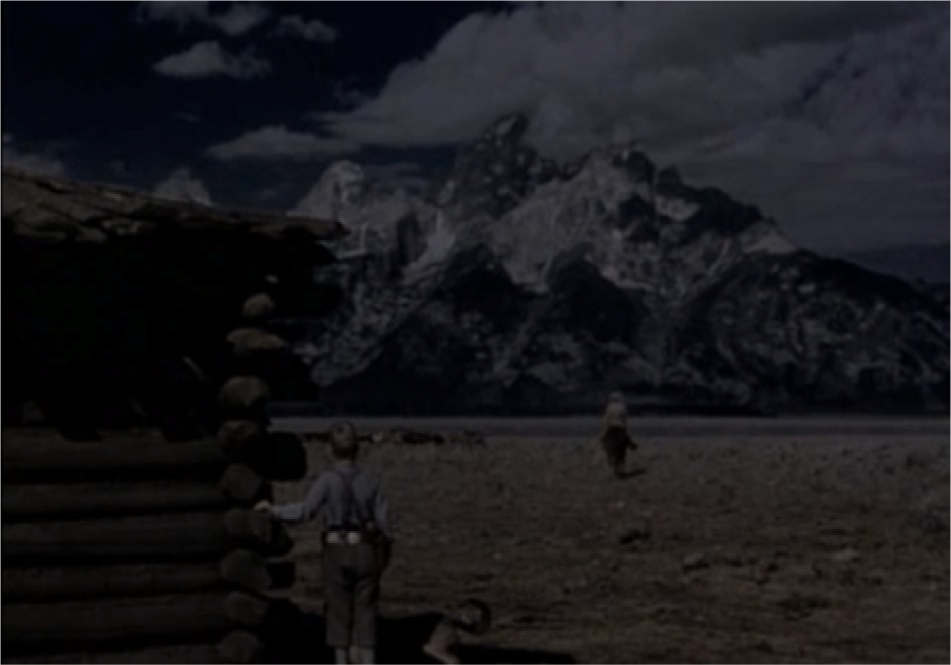
Shane rides off into the borderland of artistic freedom.
An anonymous girl somewhere in cyber-land, on a forum discussing this song says, “Ej, u svima se vjerojatno javlja isti feeling dok ovo slusamo—kaubojski, divlji, slobodan . . .” (“Hey, we all probably get the exact same feeling while we’re listening to this—cowboy-like, wild, free . . .”). 2 I know what she is articulating here, the affective response that Haustor intended us to experience with and thought this song: We are beyond society, beyond laws, beyond confines that drive us into gloomy future, we are cowboys, we are Shane, mysterious, nameless, ethnicity-less, unburdened. We are borderlands, moving ever so slightly out of the reach of definitions that bind. Perhaps the rock musicians were performing the same kind of play that the kids in the immigrant, working-class neighborhoods had been, jointly re-appropriating distant iconicity to alleviate present struggle.
In this instance, then, Shane is re-written into a figure of artistic freedom to be borderless. The man that embodies the unattainable mysticism of the White American male who conquers the frontier and the life that inhabited that frontier before his arrival—and yet a White man whose future is also uncertain, as he rides off into the sunset bleeding—that man now becomes a symbol of resistance in an entirely different cultural, geographical, political, and historical context of an impeding war somewhere in southeastern Europe, in the Balkans, that dark underbelly of Europe (Bjelić, 2003). Shane remains mysterious and iconic just as he is in his home culture, but now that mysticism and iconicity are not used to reiterate the supremacy of White American ideology of inherited manliness and straightness. Rather, now they become fused with the border itself, an escape from a distant society’s pressure to conform to simple identity notions and us-versus-them logic. Shane is thus refashioned into a figure of anti-nationalist movement of the rebellious Yugoslav youth who tried to hold on to non-divisive worldviews on the eve of their country exploding in a bloody war that took away the possibility of being both/and, and of residing at the borders (as borders quite literally became the most dangerous, lethal places to reside at). In their iconic song, Haustor dreams of borders as non-dangerous and freeing, at the same time as those very borders are in reality increasingly becoming points where ethnic divisions get most dramatically policed with guns, and with death.
*
Colorado is Territory, or, The Ghosts of Spirit Injury
Picture this:
There is a Western called Colorado Territory (Veiller & Walsh, 1949), a film seemingly about the same archetypal story that so many of the Westerns are—a story about an irresistible outlaw (and with a suitably archetypal name of Wes McQueen), and a train robbery, and two girls between whom he has to choose, one pious and socially acceptable (and thus unattainable), the other of morally questionable femininity but with a good heart. This story is so archetypal that it has been remade into several different versions of the same film but with different names. First there was High Sierra (Hellinger & Walsh, 1941). Then the same director remade it into Colorado Territory (1949, US). A few years later, it got its third cinematic coming as a film noir with I Died a Thousand Times (Goldbeck & Heisler 1955, US). As only a somewhat side note, the remaking into a film noir seems like a logical step to follow, as these two iconic American cinematic genres share the central preoccupation with a male outlaw/anti-hero who stands alone against all, but mainly against the society and its laws. And this outlaw/anti-hero also typically stands between two women/femme fatales who are not always what they seem to be at first. The difference seems to be the setting: in the Western, it is the mythical frontier; in film noir, it is the mythical modern urban decay.
That is how cinematically and archetypally American the story this is, it had to be remade so many times, always an interpretation, never an original. Yet, as much as these archetypal concerns occupy the center of the Colorado Territory’s premise, there is a creeping feeling throughout that these are not what the film is really about (as is often the case with any film, after all), as invisible, ghostly presence overtakes almost every scene (Figures 3 & 4). In that sense, what is not being heard or seen at the center of the cinematic frame is as important, if not more, as those things that are centrally seen or heard. What is this invisible presence that haunts Colorado Territory, presence that is frequently hinted at sideways, potentially visible only if one looks behind, to the side, and around the frame?
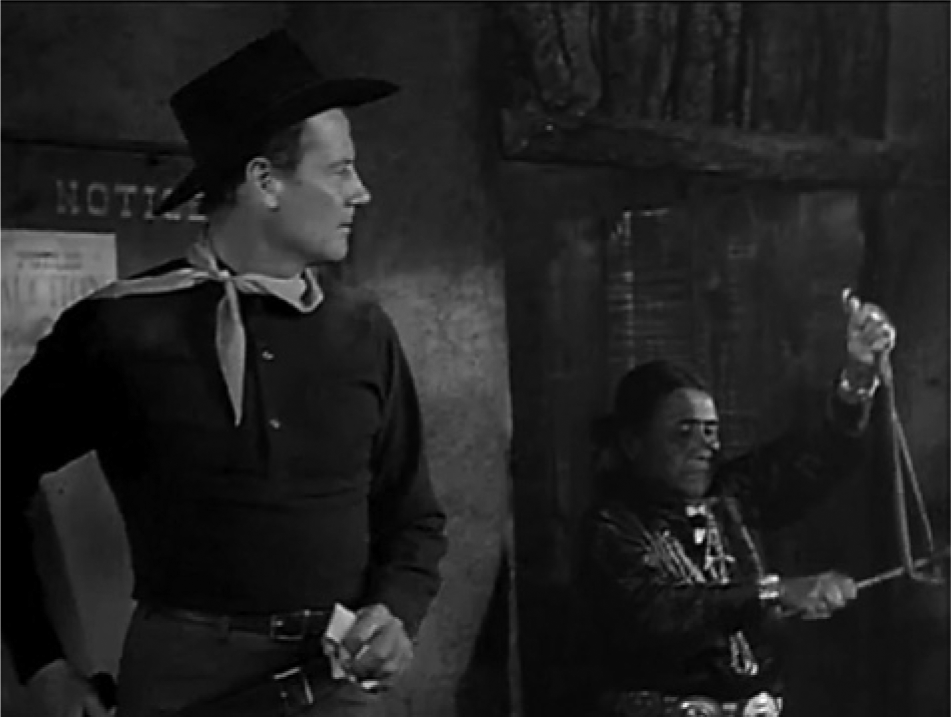
Looking behind, silent presence prevails.
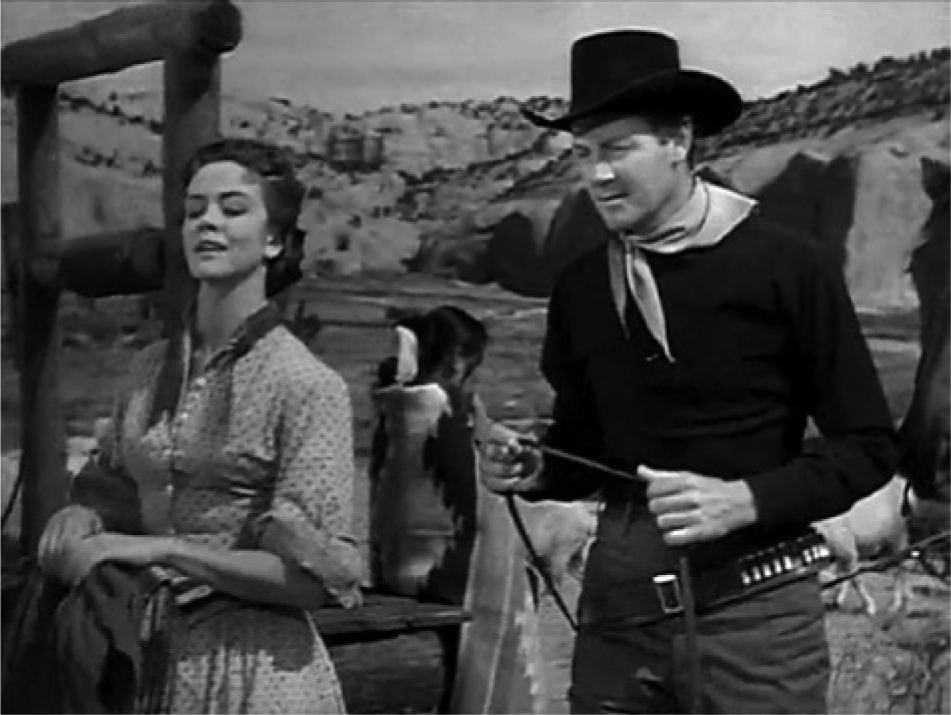
Looking around and to the side, silent presence prevails.
It seems to me that more than the fate of outlaws and their love lives, the question that the film obsesses over is this: How does catastrophe that brings about suffering and injury, death to many, inscribe itself into the landscape and reflect the ghostly presence of those perished so much so that it permeates the lives of those who stay behind? To that end, Colorado Territory is a film about ghosts more so than about those physically present, as these ghosts influence the events on screen in more ways than one.
On arriving to a decrepit ghost town with unmistakable traces of an erased culture (town that now provides a hideout for outlaws), McQueen is given peculiar lodging space.
“We’ve reserved the old Indian kiva for you, if you’re not bothered by ghosts” says Blake, another outlaw, and continues, “The tribal council chamber, Mr. McQueen, gathering place of the medicine men, the seats of the mighty no longer occupied.” McQueen: “You talk kinda fancy.” Blake: “Only philosophizing, Mr. McQueen, on my favorite subject—doom.”
A sense of doom that permeates the landscape is precisely what the film is about. The ghostly presence of a hidden genocidal past cannot be entirely concealed by the film’s surface plot of an outlaw on the run, as the echoes of an erased culture lying beneath slowly overpower both our outlaw and the narrative, giving the film’s atmosphere an eerie quality. If it is about anything, it is about ghosts—the Indians, and also “Martha,” a woman we know nothing about except that she haunts McQueen in his sleep and that she is dead. McQueen meets Julie Ann, a respectable young woman who reminds him of “Martha” and who has set off to start a new life on this volatile frontier with her father.
A Native American woman positioned to the side and behind McQueen sounds off a bell that triggers our hero’s journey into The Canyon of Death where the top of the mountain is called The City of the Moon (also described by an old man as “a dead city, hanging in space”). The land’s ominous undertones are further emphasized when this old man tells McQueen a brief history of death that permeates it: death by human hand (wars, the killing of Indians) or by natural forces (earthquakes). The frontier is always positioned as a land of threat and inevitable doom, and not of mythical possibility of capitalist self-making. The battle is always already lost because there is already too much blood soaking its vast, haunted emptiness.
Amid the devastated ruins of the deserted city Pas de Santos, our outlaw finds a former “dancer” (but more likely a former prostitute) whose name is, it just so happens, Colorado—the same name that the haunted territory on which they stand carries. Thus, the archetypal metaphorical linkage between the woman and the land is made overt through naming. And what of the film’s title—does it refer to the haunted landscape only, or is it hinting that a female body is also a territory ruined by masculinist dominance? And indeed, the ruins of the city where we find Colorado seem to also stand as a metaphor for this seemingly ruined woman of dubious morality who spends her days pleasing the outlaws, and vice versa—the ruined woman stands for the ruined landscape. Colorado is Colorado. But there is more to Colorado-the-woman, as she proves to be a fiercely loyal friend to McQueen—especially when his first choice of love interest, the wholesome Julie Ann, attempts to betray him to the sheriffs. Colorado’s ambiguity as a character extends to her ethnic and racial background: asked about her name, she explains that she was named by her mother “who was part-Pueblo.” Adds Colorado, “Guess she was homesick when she named me.” Colorado herself is then a betweener, a mixed ethnicity/race figure who is pushed to the margins of the colonizing White society, who hints at a history of sexual abuse, and whose story is most tragic because she embodies the impossibility of the betweenness. She comes from a female inheritance that remembers the pain and loss, as she is not only made to negotiate the volatile times but to also embody them in their full contradiction: Colorado is both the colonizer and the colonized, and a woman who carries the name of the land.
“Maybe there is more of my mother in me than I thought,” she says when she is asked why she is drawn to the mountains where the ruined city of an erased culture stands.
Colorado dies at the end, in The Canyon of Death and just outside The Ghost City, as she holds hands with McQueen (Figure 5). They die riddled by bullets before Bonnie and Clyde famously do, and they hold hands in death just like Thelma and Louise famously do later in cinema’s history—all fantasy echoes of outlaw couplings who go to extreme lengths to escape the hand of the law on the (Western) frontier. But before her death, Colorado leaves the money stolen in the train robbery to the church in the deserted Pas de Santos, which brings back life to this wasteland as the missing Indians return at the film’s end. When one of them asks the priest, “Who has brought this new life to Pas de Santos?” the priest answers, “A happy couple who passed this way.” Colorado’s and McQueen’s death, and Colorado’s act of leaving the stolen money in the church, then bring the ghosts back to life, albeit in their already Christian, colonized iteration. This return is reminiscent of the contradiction that is Colorado herself: She is drawn to the land and a descendant of the persecuted people, but she is also a part of the colonizing system which cannot be taken entirely back. The wound stays inscribed in the territory.
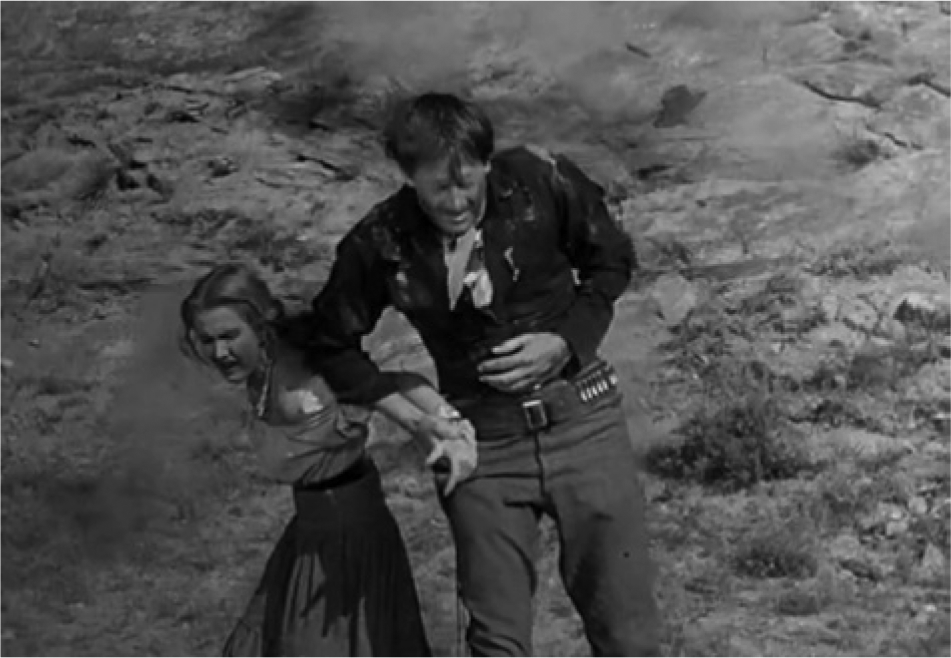
Archetypal couplings: Wes and Colorado find their fantasy echoes in Bonnie and Clyde, Thelma and Louise.
********
What does all this have to do with the distant war? Why is it that I think of the distant war when I remember this film? Is it that I saw it then? Or is it that the woman/land blur reverberates as an expression of something . . . true? The lay of the land (Kolodny, 1975) is such that it remembers injury even when the bodies experiencing it might be long gone. Woman-as-territory became one of the central motifs of the war machinery that raged in Bosnia, as mass rape presented a heinous opportunity to inflict masculinist violence against enemy ethnic groups by invading women’s bodies (Allen, 1996; Stiglmayer, 1994). These injuries often stayed invisible and unspoken of, surrounded by shame, but inscribed in the ever-deepening link in such war machineries of the female body as a stand in for winning territories.
Woman is land. Colorado is territory.
These fantasy echoes reverberate as I think about the injury inflicted on women’s bodies in the name of masculinist war power. Wing and Merchan (1993) have written about the injury of the women raped in the Bosnian war as an instance of “spirit injury,” adopting the influential term introduced by Patricia J. Williams. “Spirit injury on a group level is the cumulative effect of individual spirit injuries, which leads to the devaluation and destruction of a way of life or of an entire culture” (p. 1). Curiously, by constructing the model of spirit injury for Bosnian Muslims, Wing and Merchan draw “on the experience of Black Americans during and after slavery” (p. 2). One of the reasons the authors do so is because “spirit injury in Black America has rarely been addressed in American society” (p. 2). Wing and Merchan draw on fantasy echoes to account for the aftereffects of spirit injury across spatial and temporal divides, not as a way to collapse local differences of such injuries in their own political and historical moments, but as a way to argue that the way spirit injury lodges itself in the collective experiences of pain and loss can become recognizable across those divides as a means to prevent them in the future.
Incidentally, another spirit injury that has rarely been addressed in American society is that of the ghostly presences that permeate Colorado Territory and the Western genre at large, of the Indigenous peoples who can make a return only as always already colonized, and as always already inscribed into the Western-centric projections of the frontier as a space that needs to be conquered and civilized.
Bosnian women victims of mass rape have similarly been frozen in the narrowly defined representational frame, particularly by Western feminist scholarship, which has made the case of mass rape during the Yugoslav wars into a prominent topic of analysis. It has also made the plight of so many Bosnian women into a shorthand for making a point about masculinist war violence by often collapsing the complexities of gender and ethnic identity into one heavily reduced narrative of a distant conflict in which men are guaranteed to behave one way—as aggressors, and women another—as helpless victims frozen in time. This model does not leave a lot of room for in-betweenness in which gendered and ethnic identities might not always align with the behaviors prescribed by this static gender- and ethno-normativity. In-betweenness, that ambiguous space where Colorado resides as a woman/land descendant of both worlds has no room to be accounted for in this version of events around gendered wartime violence and mass rape. There should be room to acknowledge the scenarios in which a woman is not always already a pure ethnical entity devoid of betweenness, and in which the infliction of injury is not always necessarily perpetrated by reductive male conduits of evil, but rather by individuals subsumed under collectivity who, for one reason or another, internalize the ideology which stipulates that inflicting injury onto an entire group of people is a self-reaffirming act of ethno-masculinist empowerment. That is what Colorado Territory, this utterly strange film about ghosts and spirit injury, makes me think of.
And what about Gray Eyes, who appears in the last chapter of Colorado Territory as a sheriff’s helper, and who effortlessly tracks down McQueen in the vast wastelands of the frontier (does Gray Eyes have a sixth sense or what?), and then outsmarts him and Colorado by engaging in some strategic essentialism of calling on his Native knowledge of the city of ghosts—a place that he has never been to before (but his people have)? His is the story I want to know (Figure 6). Who is he, what does he think of the colonizers around him, does he find it entertaining to help them kill each other in the name of some “law”?
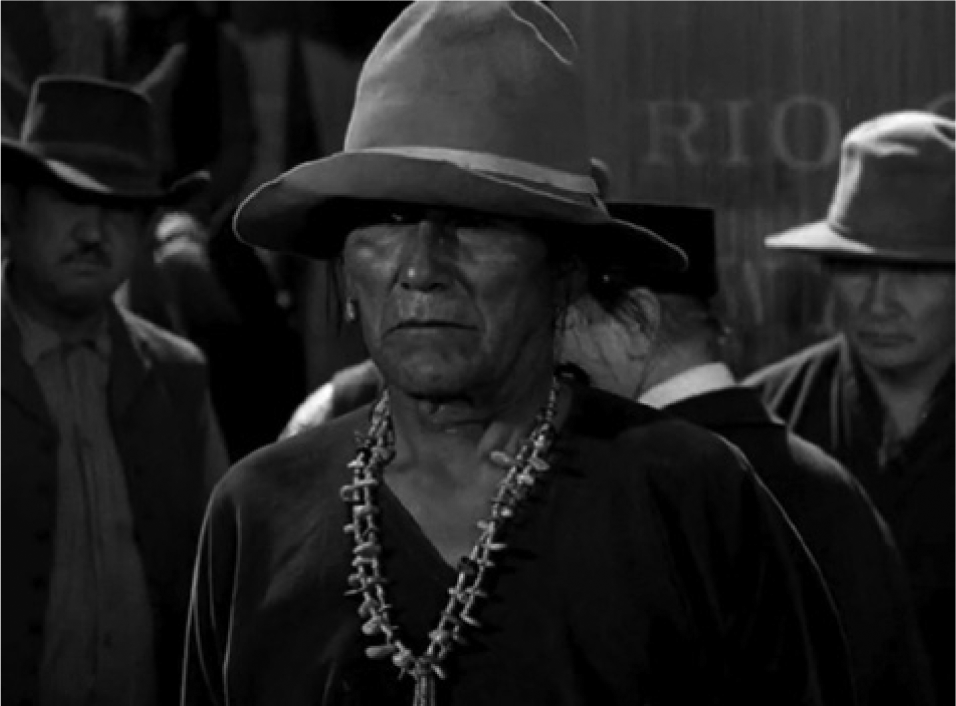
Gray Eyes are looking at you.
Why does Gray Eyes do what he does? What does he think of it all? That’s the story I want to know. He actively contributes to the death of Colorado, as he tricks her into believing that there is a way out of the trap for her and McQueen, that there is a safe passage to a place where they can get married and live happily ever after. Is Gray Eyes ambivalent about helping the law, or does he think Colorado had it coming because her betweenness is an impossibility; a battle lost before it was even waged?
**********
Looking between, around, and sideways, this technique that can fruitfully be applied to the viewing of Westerns, is also a way to approach the personal memories of war. And not only that. It can also show us that the landscape—that background setting for our lives that we rarely pay close attention to—carries traces of our histories and their scars, as they lodge themselves into physical space long after people deliberately or inadvertently forget. Looking between, around, and sideways is also a way to find possibly conflicting truths about catastrophe and its aftermath, truths that do not fit into the mythical plot of the archetypal good guys versus the archetypal bad guys but peck at its edges, not letting it be the only story told. Because that normativized plot excludes a whole lotta people caught in between, both/and, not either/or. Looking between, around, and sideways is a way to destabilize a reductive notion of straightforward accountability and victimhood, not as a means of relativizing them altogether, but to reveal the processes that cement some group identities into one camp, and others into the polar opposite. Such fixed polarities are unproductive at best, and dangerous at the very least.
Isn’t that what war does too: make people assume warring personas and apply fictionalized definitions of otherness over others so that they can point guns at them more easily? “Ratatata!” In other words, it is not the children’s play that mirrored or foreshadowed some hard reality of war, it is that the adult’s war mirrored a performance of a fantasy-play about one mythic group having to destroy another. It is all an enactment of a fantasy script, you see. It is just that in the adult version of it, people die and get hurt. So, it is strange to call it a play, because play should not typically have such dire consequences. When people die in movies, do they really die?
***********
“And yet, what does this spectatorial technique of looking at the Western sideways, between, and around have to do with the distant war?”
That is the scholarly-trained voice in me impatiently asking, pecking at my desire to not explain or over-analyze. Dear scholarly voice, “As much as it may seem like an arbitrary parallel to you, there is this girl-child who keeps going back to it, who grew up at the dawn of the war, who knew some things about warring and about the world from watching John Wayne and the Westerns, and enacted them by playing cowboys-and-Indians, and who then saw firsthand what people are capable of when they hijacked this ‘play’ and made it into something much more sinister and catastrophic. And this girl-child cannot not see a parallel and cannot not appreciate the betweenness of Colorado the woman/land, and the ambivalent complexity of Gray Eyes, and the insistence that the landscape itself is deeply haunted by the ghosts of spirit injury.” Scholarly voice: “Fine, but let’s try and make it more analytic. Let us jointly state, you and I and those betweeners we bring to life here, that we are thinking about complicity and injury as complicated categories that do not neatly divide people into good and bad—wouldn’t that be convenient?—but rather leave ambiguity in their wake. Just as the land/woman Colorado, the girl-child Debbie, the half-breed Martin, the borderless outlaw Shane, and the enigmatic Gray Eyes do. They all have that ambivalence in common. They are not sure they belong in the Western, or that the Western can tell their stories. It can hint at them but not really tell them. It is up to us to make an effort to find them.” Dear Scholarly Voice, “I agree. But let’s not forget that these stories are contained in the Western, and that in order to find them, one just has to remember to look between, around and sideways a little more. If one does, suddenly, a whole other world (or, the world of Others) is discovered. Or, should I say, recovered? A world that makes it possible for the distant war to play a significant role in re/interpreting archetypal Western images and vice versa. That is what the girl-child is used to doing in order to make sense of her story, to understand and remember, but also to forget.”
Fade to Black
Footnotes
Declaration of Conflicting Interests
The author declared no potential conflicts of interest with respect to the research, authorship, and/or publication of this article.
Funding
The author received no financial support for the research, authorship, and/or publication of this article.