




Abstract
Based in an analysis of a writing workshop which explored students’ transition to higher education, this article puts to work theorizations of space by Massey, materiality by Barad, narrative by Cavarero, and ethics by Arendt to propose an innovative conceptualization of collaborative writing practices. The article proposes an understanding of the space of collaborative writing as a multiplicity of relations, negotiations, and practices; it considers what is to be gained from considering collaborative writing in relation to posthumanist concerns about the mattering of matter; and it illuminates how collaborative writing, when understood as the emergence of narratable selves, is a profoundly ethical practice.
Introduction
This article analyzes collaborative writing in relation to spatial events and embodied narrative practices in a writing workshop with undergraduate students in a U.K. university. The writing workshop was the culmination of a project on transition to higher education and its purpose was to create a space for students to produce narratives, poems, and stories about their transition experiences. In theorizing the constitutive role of space within collaborative writing, the article opens up an innovative line of inquiry that takes forward Clandinin and Connelly’s (2000) seminal understanding of narrative as a gathering of information “over time, in a place or a series of places, and in social interaction with milieus” (p. 20), which is then re-told by the researcher. By focusing on the place as a space that enables the construction of these stories at this time and in this way, the article draws new attention to the ways in which space works to produce particular forms of embodiment, narrative practice, and ethical relations. I propose this more nuanced understanding of locale and milieu through a focus on the molecular materiality of the space of/for collaborative writing. In putting to work concepts on space (Massey, 2005), narratable selves (Cavarero, 2000), and ethics (Arendt, 1958)—and by locating these understandings within a “new” materialist conceptualization of collaborative writing (Barad, 2007)—the article proposes an understanding of space and materiality as key forces in embodied, relational narrative practice and emerging subjectivities. The article begins with a collaborative text from the first day of the writing workshop which signals how and why space and material embodiment mattered in the workshop. I then explore these “how and why” matterings further before turning to embodied practices and relational ethics in the collaborative production of texts on transition.
Materializing the Space of/for Writing Transition to Higher Education
Sonnet to Transition
The scruffy books of excitement The confusing lecture rooms of the unknown The hard stairs of regret The beautiful tutors of fear The gigantic café of loneliness The weird people of confusion The massive computer of intelligence The anxious classroom of hope The lonely friends of naivety The surreal essay of anxiety The exciting helpdesk of loss The blue assignment management of space The overwhelming Room 1039 of doubt The lucky catalogue of disbelief.
Five students and I produced this poem collaboratively on the first morning of the writing workshop. As the culmination of the Student Transitions and Experiences Project (STEP)—a six-stage project which used creative, participatory research methods to explore students’ experiences of transition to higher education and enhance student engagement—the writing workshop was a quite rare case of undergraduate student–lecturer writing collaboration. The workshop aimed to open a space for students to engage as peers in creative writing collaborations about their transition to higher education. It was not constrained by any traditional, academic, or “output” agendas nor was it concerned either with “representativeness” or “quality” in writing; it was from the start an open, messy space for writing in the play of collaborative practice. The workshop began with an opening session led by a local poet who introduced a series of practical collaborative writing tasks, for example, an image tree produced through words association and free writing activities. The Sonnet to Transition emerged from an activity in which adjective, noun, and abstract word lists were generated and shuffled, and then individual words were extracted and assembled into the poem. This productive assembling involved all workshop participants and instantiated what the poet presented as three maxims to guide creative writing: focus on the concrete not the abstract, state the particular not the general, and show do not tell.
During the poem’s production, the room was alive with laughter, excitement, energy, anxiety, and joy as phrases and lines took shape from the conjunction of words. The materialization of Sonnet to Transition, its visualization on whiteboard and flipchart like the other collaborative texts produced later in the workshop, was important not only because, as a text, it is a “complex artistic creation” (Hones, 2008, p. 1305) but rather, or also, because of its material emergence as a “thing” we could all see and touch and be seen and touched by. In its physicality, its materially manifest presence on the wall, it possessed what Bennett (2010) calls “thing-power.” Its capacity to intervene in the workshop was immediately evident in how it drew the eye with its “to-be-looked-at” materiality, in how it engaged the senses with its texture, shape, and colorful appearance, and in how its affective capacity generated a purposive optimism that animated our collective commitment to the oncoming writing endeavors. This first instance in writing transition clearly shares aims and purposes articulated in writing as a method of inquiry (Richardson & St. Pierre, 2005), writing as a way of knowing as well as telling (Speedy, 2012), and writing as self-inquiry (Elbaz-Luwisch, 2002). However, what was particularly important about this instance is how the poem’s collaborative creation illuminates not only its other-than-human agency but also how the poem works as a material enactment of the force of the particular, collaborative dynamics of the space of the writing workshop. As this example illuminates, the transitions writing workshop existed at the intersection of a variety of practices, assemblages, and fields, each mapping onto the others in complex ways and each co-constituting and producing “student,” “writer,” “lecturer,” “writing workshop” and, therefore, “workshop space” in specific and multiple ways. Throughout the article, I focus on the various ways in which the workshop’s spatial-material particularities worked in concert with collaborative writing practices that were constitutive of subjectivities and embodied ethical practices. But first, I provide a brief theoretical overview to orient the analyses that follow.
Theoretical Context
It is commonplace to think of space as a neutral backdrop or “container” for the activity of writing of whatever kind. Speedy (2012), for example, notes that “writers . . . rarely mention the environment they are actually writing from” (p. 351). Certainly narrative approaches have usually tended to subsume space into “context,” “background,” “scene,” or “situation” against which the making of meaning is foregrounded and stories told (Clandinin & Connelly, 2000). To oppose this elision of space, I analyze the spatial “logic of living” (Willis cited in Fitzpatrick, 2012, p. 4) of the writing workshop as a way to disclose the creativity interplay between the space, its materialities, and the participants. Such an analysis is unusual in that it surfaces the unacknowledged and mundane matters that make up the “inside” of a writing workshop and which are crucial for an understanding of the dynamics of its inner life.
Massey’s (2005) radical conceptualization of space provides an insightful analytical beginning for a consideration of space and materiality. Space, Massey (2005) argues, is a “practiced place,” which is always “under construction” (p. 9); space is a “sphere of relations, negotiations, practices of engagement, power in all its forms” (Massey, 2005, p. 99); and, in a radical rejection of the traditional geographical distinction between “place” as the local, lived, and every day and “space” as the abstract and “outside,” she proposes space as a sphere of “coexisting heterogeneity . . . of the possibility of the existence of multiplicity in the sense of contemporaneous plurality” (Massey, 2005, p. 9). This way of thinking opens a fruitful line of analysis in thinking of the space of the writing workshop as a relational place of embedded and embodied practices; as mutually co-constitutive of subjectivities, entities, and things; and spatial writing practices as creatively multiple.
However, I have found it useful to supplement Massey’s understanding of space with Barad’s (2007) posthuman account of “spacetimemattering” (p. 234). While Massey urges a focus on the multiplicity of what is happening in a particular space, Barad’s focus on materiality propels her argument that space, time, and matter do not unfold separately but emerge together in an ongoing flow. Spacetimematter, in Barad’s view, always happens in the here-and-now, and unfolds in an iterative dynamic made possible by the ongoing “intra-actions” of its participants. In a posthumanist vein, Barad includes people, objects, materialities, and spaces as agentic participants in the world’s ongoing becoming and figures all participants as always-already ontologically (and therefore ethically) entangled within/in the dynamic of the happening of space, a point I explore later in connection with Barad (2007) and Arendt (1958).
Embodiment is also a crucial aspect of the materiality of the collaborative writing workshop space. As Merleau-Ponty (1962) indicated, our bodies provide material form for the expression of felt experience and subjective perception. Furthermore, “new” materialist conceptions of bodies connect the immaterial and material by illuminating how bodies work as forces, an idea that is central to my consideration of how, alongside the “thing-power” of physical stuff such as material objects and artifacts, the space in which collaborative writing happens enables and constitutes particular embodied practices. Such materialist understandings take their place alongside autoethnographic, autobiographic, and narrative ways of knowing, which insert the body at the center of research practice as a means to contest the disembodied business-as-usual of academic research. Here, Spry’s (2001) “risky” embodied methodology of performance autoethnography, which “provides space for the living, experiencing, and researching body to be seen and felt” (p. 720), is important, as is Pelias’s impassioned “methodological calls,” which produce “writings that mark a different space” and stories that “collect in the body” and “live under the skin” (Pelias, 2004, p. 11), along with the work of feminists, such as Stanley and Wise (1993), who insisted that research practices and products take account of the lived, gendered body. Barad’s (2007) argument that “bodies do not simply take their place in the world . . . rather ‘environments’ and ‘bodies’ are intra-actively constituted” (p. 170) adds further materialist weight to these lines of thinking by foregrounding the co-constitutive emergence of (all) bodies and space, in a move indicative of a broader and growing interest in materiality (Fenwick & Landri, 2012; Taylor, 2013).
This new attention to space, materiality, and embodiment in understanding collaborative writing practices is timely, given the emergence of collaborative writing as a field of empirical and theoretical inquiry in its own right which seeks to challenge orthodox understandings of writing as an expression of individual creativity, of knowing is an interior act of intellection, and of written representation as a transparent process to mediate thought. I propose that attending to space, materiality, and embodiment with/in the dynamic of collaborative writing practices shows how matter and meaning are entangled (not separated), and how joint textual production is an embodied, fluid, and sometimes contradictory process (Davies & Gannon, 2012; Gale & Wyatt, 2010; Wyatt, Gale, Gannon, & Davies, 2011). I consider how space and materiality help us get closer to how narrative and subjectivities unfold as the expressive embodiment of our desire to constitute ourselves as “narratable selves” (Cavarero, 2000), that is, as selves forged though relational narrative practices of listening and telling, which occur with/in a particular and multiple (political, ethical, and material) space. In the article, I put these theories to work to explore the collaborative writing practices of the transitions workshop.
The Spacetime Life of the Project: The Multiplicity of Transition
The Student Transitions and Experiecnes Project (STEP) was an institutionally funded six-stage qualitative research project that ran in two “blocks” of three stages at the end of the second semester in students’ first and second years at university. Its two main purposes were to research new students’ transition experiences and to enhance student engagement. The participants were a self-selected sample of students on a BA (Hons) education studies course. Out of a cohort of 26, 12 students began in Stage 1, with smaller numbers participating at each subsequent stage. Five students participated in Stage 6, the writing workshop, and all 5 had been involved in all previous project stages. The project instantiated a collaborative, participatory methodology that, in practice, meant that after I had set up Stage 1, the subsequent stages emerged from each other through student-staff dialogue and negotiation which reshaped the project aims at each successive stage. The project was framed by a nuanced understanding of student engagement as both a multiple and diverse set of educational practices (Bryson, Cooper, & Hardy, 2010; Taylor, 2012), and as a political practice that works to contest instrumentalist, hierarchical, student-as-consumer models of higher education (Lambert, 2009; Taylor & Robinson, 2009). The relatively long “life” of the project in relation to students’ degree duration—two of their three years—was an important dimension in the identifications, solidarities, and sense of community the project generated.
Throughout the project, students had experimented with a range of research practices, including making videos and storyboards, creative writing, and autoethnography, which provided methods to remember, record, recreate, and present their transitions experiences. While these ongoing self-storying practices affirm Dunne, Pryor, and Yates’s (2005) point that “authorship starts well before the act of writing” (p. 77), more significant perhaps is that the texts produced—and the collaborative practices engaged in throughout the project—contest established views which see transition as a linear trajectory which the individual travels alone toward increasingly greater autonomy while gathering up nuggets of cultural capital along the way. In Katie’s poem, for example, transition is more of a continuing affective blasting than any orderly process of coming to knowledge through an encounter with critical incidents as it is often figured to be:
Transition Is a hug never received, Knocking on a door that can’t be unlocked. Is an unclaimed purse, A thief stalking behind you. Is a disappointing cup of tea, An alarm that cannot be switched off. Is like a falling stone, Getting lost on the darkest of nights. Transition is an ongoing game of tug of war, Water balloons that won’t stop exploding. Is a lonely child, My mum over-protecting me. Transition is my welcoming home, A nurse caring for me.
And Hazel used her storyboard during Stage 2 of the project to present the excruciating ups and down of transition:
This series of photographs . . . look[s] like a comic strip. In one . . . I am pulling my hair out with frustration. One of those photos is of me standing on top of the world. My bed has become my station for work, rest, recreation and sleep. I am not that two-foot child anymore in the wrong classroom. I’m still here.
Like Katie and the other participants, Hazel’s texts produce transition as a variegated, heterogeneous, dynamic process that is navigated rhizomically and with friends, family, peers, and tutors. The enfolding of different spacetimes in experience and text are material articulations of bodies, objects, events, and emotions in which “time, space, mattering and subjectivity are threaded through each other” (Juelskjaer, 2013, p. 761).
And these are materializations which matter in a somewhat different sense, too, as participants sought to reconcile their enthusiastic immersion in the creative writing practices of the workshop with the “baggage” of being “non-traditional” students who had, in the past, accessed study support for help with academic writing development. Study support services are often viewed as an institutional response to the widening participation agenda in post-1992 U.K. universities that has had some relative success in improving access to higher education for hitherto disadvantaged groups. The ‘writing skills and study techniques’ focus of such support is often (but not always) premised on the notion that such groups generally lack the skills attributed to more “traditional” students. Writing support is seen as an effective means to remedy students’ perceived “deficits” and to enable them to develop an “appropriate” academic habitus. This “deficit” model of student writing has been critiqued for failing to attend to the nuanced nature of the relationship between learning, writing, and identity (Hyland, 2013; Lea & Street, 1998) as well as for the implicit social class bias of deficit assumptions (Leathwood & O’Connell, 2003). Nevertheless, the perceived link between accessing support, perception of academic deficit, and an individualized sense of “lack” played out in the workshop in relation to students’ expressions of anxiety about previously having had “help with my writing,” in concerns about the perceived “quality” of their writing, and their “ability” to give “good” peer feedback. These concerns about writing highlight both the processual nature of transition in multiplicitous spacetimes—“Transition” was never accomplished or achieved; according to one project participant, Sue, it could only be known/experienced through “heartfelt moments”—and draw attention to the risks students were prepared to undertake by their participation in the writing workshop in which close scrutiny would of necessity be paid to their writing. I turn now to the space of the workshop.
Claiming the Space
The writing workshop comprised three consecutive “Awaydays” at the end of the students’ second undergraduate year. Held off campus, the “away” location was crucial in establishing the writing workshop in (and as) a spatial elsewhere. Its physical separation from the university meant the regulative force of familiar university spaces could be put to one side, something that was important both to Hadiza, for example, who said “I was scared of that library” and Laura, who in her poem, Transition, refers to a particular teaching room as the “overwhelming [room] of loss.” The spatial separation was also productive in enabling students to discuss their anxieties about writing, their fears of negative public judgment of their writing, and their worries about doing “creative” writing while not yet feeling confident about academic writing. The profound emotions expressed in preliminary discussions about writing had resulted in a collective desire to produce the workshop as an open but safe space for writing transitions as a form of self-exploration. Alongside this, spatial distance from university was instrumental in helping reconfigure power dynamics as the collaborative ethos took hold and reverberated in the workshop. In practice, this was an uneven, “sticky” and continually messy process of repositionings, effected through ongoing discussions about the workshop’s dynamics. Nevertheless, when Katie exclaimed at the end of the first day “we’re not asking you for permission for anything!” it did seem like our “thrown-together-ness” had generated a space of “relations, negotiations, practices of engagement” in which we could discuss and try to contest “power in all its forms” (Massey, 2005, p. 99).
The writing workshop took place in a Victorian city center church that had been converted into a multicultural conference and community center. While only about a quarter of a mile from the university campus, the architecture, driveway, and grounds of the center were redolent with history, heritage, and grandeur, providing a “document of the [particular] culture” (Dant, 2005, p. 2), which lent the writing workshop a certain “significance” and “solidity” as a material and epistemological space. The grounds were large, open, and leafy; there was social buzz in the downstairs café; and people were in and out all day for activities. The workshop took place in a top floor room that, while private, warm, and physically separate, juxtaposed the materialities of a large gothic window with the quiet blandness of a corporate meeting room. This material juxtaposition—now an increasingly prevalent feature of the repurposing of “old” sacred buildings to “new” secular activities in U.K. cities (Rushton & Aiers, 2011)—provoked informal talk early in the workshop about religious and spiritual allegiances, and for some participants the conscious refusal of these. These materialities worked together to set the spatial scene as a “thrown-together-ness” (Massey, 2005) of matter, objects, and people in a here-and-now synthesis of time and space, memory and materiality. In particular, the physical and immaterial instantiated the workshop as a space of possibilities, an “elsewhere” predicted on the interpenetration of human agency and acts by the physical stuff of materialities and objects, both “sacred” and every day. As a space distinct, apart from and unregulated by the university, the workshop fashioned a becoming-heterotopia, a concept Foucault (1984a) uses to describe places that have a “precise and determined function” and that, in their emplacement, contest and invert other real sites; so the workshop space juxtaposed, enfolded, spoke to, and was incompatible with the hegemonic space of the university and the “spiritual” space of the former church. And in its construction of boundaries—physical, in spacetime, epistemological—it was heterotopic: Access was limited to those with permission to participate.
The im/materially felt atmosphere of the room worked agentially to help us claim the space as “our own.” It almost immediately led to intensive forms of reflexivity (as in our discussions of spirituality), opened mutual questioning, and provided trails for creative experimentation with unfamiliar ways of thinking, doing, and writing, as in Sonnet to Transition described above. I referred earlier to the tangible excitement in the room as this text materialized, a text which Laura proudly called “a proper poem.” The spatial event of this text’s happening—and the poem’s affective agency—infused the space with creative possibility. Looking at this event from a posthuman, post-personal, materialist perspective, this moment when thing-power (Bennett, 2010) vitalized bodies, not only illuminates well Massey’s (2005) contention that space is always “under construction,” but it also shows how the space worked as a troublesome and transformative liminal space (Meyer & Land, 2005). Indeed, the workshop’s liminality positioned it within the heterogeneous smooth space (Deleuze & Guattari, 1987) of flows, intensive affects, and lines of flight which sought to escape the hierarchical, disciplinary, and controlled striated spaces of the university and which therefore made space for the emergence of new subjectivities, narratives, and relationalities. As a becoming-heterotopic space, the workshop unsettled boundaries between disclosure/intimacy, student/lecturer, private/social, educational/public, public/private/personal, pedagogy/friendship, all of which were continually undone, re-formed, and reconstituted in its spatial elsewhere-ness.
Occupying the Space
Neither the students nor I had attended a writing workshop before, and this lack of experience influenced how we worked out together how to work together. What emerged was a way of proceeding with writing that was simultaneously a way of occupying the space. I alluded above to the “baggage” about writing some students brought to the workshop. My “baggage” was partly formed by an overly simplistic idea of creative writing as a gateway to the dangerous and unknown territory of the psyche and partly by an embodied sense, a now entirely tacit knowing, that academic writing was a routine, habitual, and familiar part of my institutional and ontological raison d’etre as an academic. I was aware that writing retreats were commonplace for both professional and non-professional writers, but they are still quite rare in academia and those that do happen are often shaped to instrumental ends, such as increasing the number or “quality” of an individual’s “outputs” to meet institutional and national cycles of academic accountability (Murray, 2002; Murray & Newton, 2009), aims which were inimical to the goals of the writing workshop. I stop writing and look up. I am not used to “writing in public” like this. I normally write alone in my study at the top of the house, with my dog sleeping, snoring and sighing in the room, as I churn words, mash sentences together, and footle with paragraphs, in a slow process, making slow progress which I measure at the end of the day with “text highlight,” “tools” and “word count,” a routine which makes me feel good because, even when I’ve only got a short paragraph, at least I’ve “done a bit,” and sometimes I even find I have a whole page or more (later I chop, change and cut). Now, I look down at what I’ve written and surprise myself by seeing an introduction already on screen. I don’t really remember writing it but there it is. It was written in this room just now (although now means the last hour) as I write surrounded by my students. “My students”—what a foolish and wrong possessive—no, they, I mean we, are participants, collaborators, intimates in this weird writing adventure we’ve chosen to go on together (rollercoaster, ghost ride, Alice’s rabbit hole) which led us here and is taking us beyond (beyond what? The course, the university, the usual). I look out at another overcast day in my beloved steel city, heavy trees outside the window, a shady room at the top, sighs, silence, concentration. I look at each one, Hazel, Hadiza, Katy, Sue, Laura, writing, focusing, furrowing. Sue smiles back at me. Magic hour with women and my fingers move back to the keyboard.
I wrote this in my workshop diary toward the end of the second day in a moment of realization that a logic of living had emerged between us, enacted in these close, comfortable silences, and instantiated in an embodied among-ness of doing and sharing writing (I did not share my diary extract although the introduction to an article it refers to was subsequently shared and amended in consultative conjunction). Gale (2010) talks about how “collaborative writing emphasizes the importance of the body [and its] encounter with other bodies that are also undertaking writing,” a comment that takes me to the specificity of these bodies and how they mattered (in both senses of the word) in these particular workshop encounters. These (our) bodies produced and occupied the workshop as a matter of doings and actions in which the practice of writing-with displaced writing up, writing over, and writing for, that is, those “colonialist” modes in which those in power (lecturers) speak authoritatively for and authorially represent or include tokenistically the voices of others (students). Enacting the living logic of workshop space meant an epistemological commitment to embody my engagement in writing alongside-with the students.
Occupying the space for writing figures writing as a material, embodied doing which is at the same time an ontological becoming. Burman and MacLure (2005) say that writing is “the pre-eminent threat to presence. It stands for secondariness, distance, non-identity, absence, exteriority and mediation. Writing seems to . . . come between us and the important stuff” (p. 285). In contrast, in the workshop, the writing was the “important stuff.” It was a block of spacetimemattering (Barad, 2007) for writing in which doing writing was consonant with becoming in much the way that Minh-ha explains:
To write is to become . . . in an ongoing practice which is concerned not with inserting a “me” into language, but with creating an opening where the “me” disappears while “I” endlessly comes and goes. (Minh-ha, 1989, p. 35)
The self-storying practices of the workshop do not situate the “self” as separate entity above, beyond, or separate from the text or the writing process or the body but constitute the self in a writing-text-body entanglement, where text-body-subjectivity together are “emergent events” (Saunders, 2013, p. 2), and writing—the material production of texts and bodies that matter—is the “important stuff” of becoming enacted in the space of the workshop. Nevertheless, while becoming is an “endless process” (Minh-ha, 1989, p. 94), the spacetime of the workshop shaped and limited the texts produced, as the multiplicity of transitions crystallized into a specific number of narrative forms (Tamboukou, 2008, p. 284). Thus, at the end of the workshop, participants had collectively produced:
Laura: seven poems: The Hard Stairs of Regret, Where Am I going?, A New Life in the City, The Past to the Present, Where I Belong, Who am I?, Stranger in the Mirror.
Katie: one narrative: Village Girl, City Girl; five poems: Transition, The Kitchen, I am Alone, Pathfinder, Steps Forward.
Hazel: one narrative: A Walk Through My Story; two poems: My Bed Is My Station, I’m Still Here.
Hadiza: one narrative: Jigsaw; one Poem: Clever Computer.
Sue: four poems: My Mate Charlie, The University, Transition is a Speed Camera on Overdrive, The Rising Sun.
Carol: one poem: Changes; one diary entry; a draft opening paragraph of an academic article based on transition.
Students’ transitions texts are tellings of missing family, living away from home for the first time, the anxieties of entering higher education, the gathering of friends in social safe spaces, and the pain and joy of living with a disability. As the valued outcomes of the collaborative practices of the writing workshop the texts are not literary “objects” to be evaluated or transparent representations to be read for their “truthfulness,” rather they illuminate writing as an “attempt to capture the reader’s attention and engage them in conversation” but which often “leaves much unsaid, uncertain, and incomplete” (Speedy, 2005, p. 64), and their often unfinished, playful, and imaginative experimentalism does not provide explanation but rather provokes questions.
Occupying the space generated a set of messy onto-epistemological material practices for the telling of transitions. I referred earlier to the workshop’s embodied amongnst-ess, and it was these intimate spatial conditions that released the desire for—and the collective material practice of—writing through experimentation, try-outs, cut-ups. Words and phrases solidified on the page as a result of ongoing, informal talk around the table which cued memories or provoked imaginings or, alternately, after a time of solitary thinking and playing with words, collaborative talk enabled refinement, editing, and revision. The “appearance” of texts came from collective dialogue and discussion; they were part of a collaborative imaginary, contingent on and immanent to the particularity of the spacetime and the bodymind/mindbody practices it enabled. Two examples illuminate how these practices worked. The beginning of Hadiza’s poem initially was:
Transition is a clever computer which has so many windows You click on one it leads you to another You go onto the next and it has this gigantic tree The tree that has so many branches You hold onto very tight with your hands that take you to the next like steps
After listening to Hadiza read out her poem, the group suggested changing “branches” to “levels” to sustain the “windows” and “computer” metaphors, and remove the technology/organic image inconsistency. Hadiza played with these ideas and revised these lines to read:
Transition is a clever computer which has so many windows You click on one it leads you to another You go to the next window and it is another level like a game A level which has so many links
Fired by the act of collaborative suggestion, Hadiza then threaded this image through her poem and recast her transition experiences as a “journey like a machine that never gets tired/A machine that needs constant electricity.” Hazel, in contrast, found herself in a stuck place, struggling to expressing the emotions and anxieties she had felt as a mature student returning to university. She talked in an agonizingly humorous way about her experiences but was at a loss about how to write about them. One participant suggested we go round the table and each ask Hazel a question as one person recorded Hazel’s responses. This led to the materialization on the page of a series of striking images which Hazel worked up as separate poems, one of which, My Bed Is My Station, is included here:
My bed is my station I dream of the future as my Uni application is being typed A locked door opened to opportunity My bed is my station for work rest and play I worry about time, but time goes quickly as quick as a fox Anxiety about theory, “Oh my God” I can’t do this A hug from my child comforts me And as sure as a sunset the work gets done. The unknown is here And here is ok Stress is here Love is here Experience is here My bed is my station, I am still Here
These two examples show the “longue durée of creation” (Saunders, 2013, p. 3). More than that, they show creation as a collaborative act, as a posthuman activation of distributed agency (Bennett, 2010), an immanent gathering of bodies, materialities, and spaces through the collaborative practice of writing, which changes what we know and how we narrate. And, unlike the “scrubbing” to which much published academic writing is subjected (Badley, 2011), the narrative practices in the workshop, as well as the texts produced, remained messier. Situated in the in-between space of “scribbling” and “scribing,” the texts were (are) “becoming-texts,” they are texts-in-process, like the becoming-writers who produced them. In their “homemade” (Badley, 2011, p. 260) particularity, these texts emerge from the “coexisting heterogeneity” (Massey, 2005, p. 9) of the workshop and enact its living logic as a heterotopia of entangled multiplicities.
The Space of Appearance
I turn now to how the workshop space materialized as an ethical space for narration which was at the same time a polis, that is, it was constituted in Arendt’s (1958) sense as a plural space in which action derives from interaction. Arendt explains that the relational constitution of “who” we are is “political” because it emerges in and derives from the shared space of appearance, a space which makes an opening for narration but which, first and foremost, is thoroughly material.
The meeting room we used was quiet, bland, and corporate, painted in neutral colors and containing nothing other than a central round table, chairs, and a water cooler. Yet in the three days we had this room, we inhabited it in a sensory dynamic that emerged in an interactive relay between corporate design and materially embodied use. We “borrowed” the space and its tactile materialities and infused them (just as they infused us) with energy, tension, and laughter. As we relaxed, the small space “expanded” with us. We covered the table with our papers, pens, and laptops; the floor with bags and books; and the walls with posters, images, and texts. We were completely undisturbed. Lunch, biscuits, and drinks were delivered to us and we stayed in the room to eat. As the days went on, our senses and imaginings became attuned to the changing atmosphere. Barad’s (2007) notion of “intra-action” proposes that things, people, and bodies do not have prior and separate existence but are constituted in and through their ongoing immanent dynamics, and this concept works well to account for the flow of life as an ongoing intra-active mattering in the workshop’s shared space of appearance.
Ethics were enfolded into the workshop through the collaborative generation of “ground rules” (see Figure 1). Emerging through discussion on the first day, this text, like Sonnet to Transition, materialized as a spatial event as the rules were written on flipchart and pinned to the wall where they remained for the duration of the workshop, and were frequently and explicitly referred to.
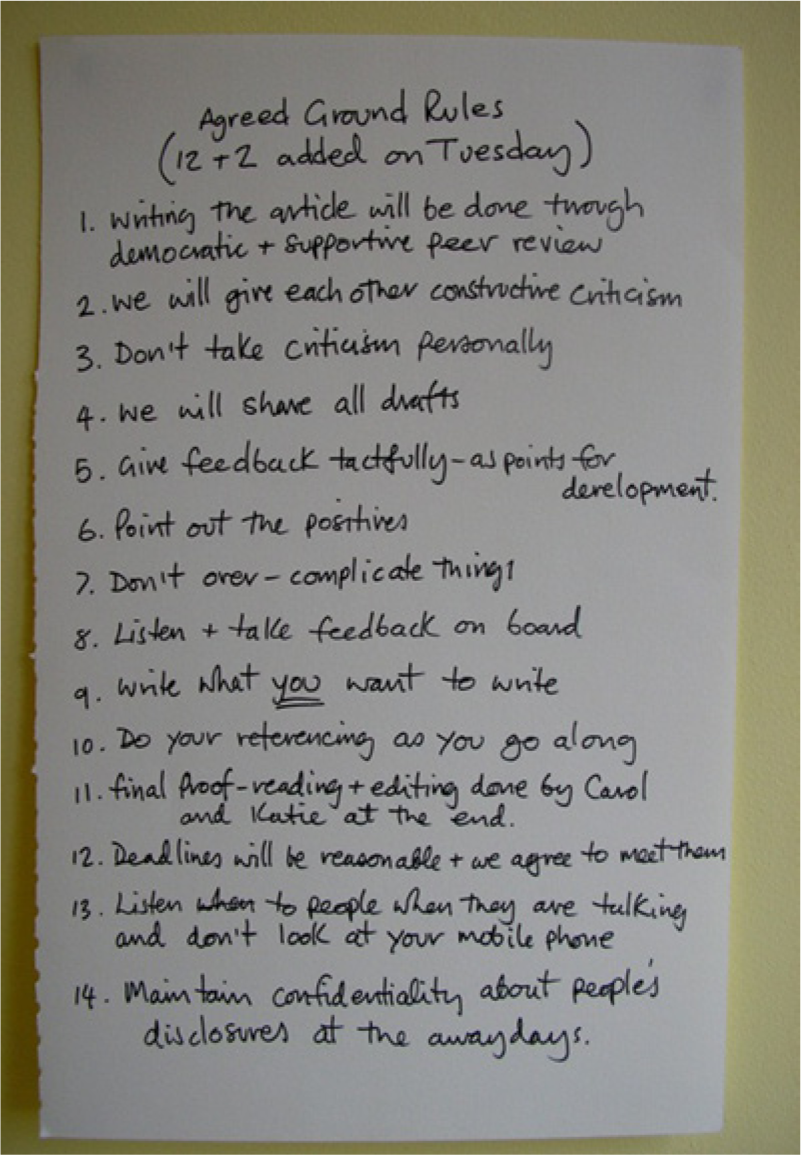
Writing workshop ground rules.
Some rules, such as scheduling in sharing of drafts, and not worrying about spelling and punctuation, became part of the daily routine. In contrast, the force of other rules proliferated as the workshop went on, so, for example, the commitment to “democratic” peer review was transformed from a simple technical operation of equal time allocation for discussion and feedback on each person’s drafts to a practice of freedom and equality, which meant “not asking for permission” (Katy), “going where we want” (Hazel), and “knowing my words are as important as any others” (Sue). Throughout, the Ground Rules materially exhibited a collective commitment to the hard work of collaborative endeavor; as Laura said, the first day was “fun but exhausting.” The Ground Rules did not function simply as a code to condition the daily nitty-gritty of getting on with writing. Rather, they show ethics emerging in the space of appearance, where ethical becoming is a material practice of repeated action enacted in collaborative writing habits which constitute the space as meaningful (Bissell, 2013). The significance of the Ground Rules is that they demonstrate the “shared embodied know-how” of mutual understandings that only becomes possible through practical interaction in a specific place (Schatzki, Knorr-Cetina, & von Savigny, 2001, p. 3).
The Ground Rules were based on the material co-presence of others. While this requirement made the workshop an ethical-political space, a geography of social responsibility, it was also what Cavarero (2000) calls, a “constitutively altruistic” (p. 90) space, that is, a space formed for co-appearance, exhibitive vulnerability, and reciprocity. I talked earlier about looking up and around the table at my writing companions. The practices of sitting still, sitting together, sitting in silence, of bringing our bodies into physical proximity as we positioned chairs closely around the table in the small room, activated intimate sightlines such that each became “an exposed uniqueness that awaits her narration” (Cavarero, 2000, pp. 86-87) within this plural space of appearance. The feedback process, as indicated previously, was structured by the author’s reading, followed first by silent listening to feedback, and then collaborative commenting. The silent listening was particularly difficult for all participants. Based in a collective decision that it was necessary to cut out the “kneejerk noise” of self-justification and self-protection to listen properly, it involved each and all in the repeated risk of reciprocal vulnerability.
The fear of exposure to others initially required some hasty collective negotiation. For example, on the second day, one participant turned directly to me and very quietly asked, “Will you look at what I’ve done and tell me if it is any good?.” Not only did I feel the force of this as a powerful phrase that sought to reposition me as “lecturer,” “assessor,” “arbiter,” and “authority figure” and that implied a desire to return to the striated spaces (Deleuze & Guattari, 1987) of university hierarchies and assessments, but it also disclosed this individual’s discomfort in the exposure attendant on the peer reviewing process. While I attempted to parry with a soothing comment and quelled my gut pedagogic instinct to reassure, another participant gently intervened with “go on, shall we all have a look now, tell us about it if you want, and let’s get comments from everyone together, it might help.” This invitation did not do away with the felt discomfort or need for authoritative reassurance but it did work to re-insert the practice of sharing writing and the relational ethic of collective responsibility, risky as it was. The risk of exposure required by the collaborative practices of the workshop as intimate spatial polis is illuminated by Levinas (1991) who speaks about how the living presence of another provokes a relational responsibility. However, Levinas notes that an ethical relation with the other requires seeing them in their particularity as a unique person, not as a representative, type or class, and that because ethics is always a matter of relation, we are always in the process of becoming-ethical. Ethics remain something to be done. So, ethics happened in each face-to-face encounter in the workshop in which we sought to get to know the other, through a knowing accomplished by a saying, a response to the other that “hold[s] open its openness, without excuses, evasions or alibis” (Levinas, 1991, p. 143). This formulation of relational ethics works well as a description the spontaneous emergence of a spatial polis though the collaborative writing practices in the workshop. I now want to tie this to the practice of narration more specifically.
The Space of Narration
Listening and telling. Vulnerable exposure. Face-to-faceness. Bodies in close orbit. Unique, original encounters. The material and embodied intra-actions and practices enacted through collaborative writing in the workshop constituted a space of narration. This space of narration was particular and unique, formed by a collaborative amongst-ness in an exhibitive space which included each person in their living singularity (as well as being imbued by the agency of materialities). In this exhibitive space of appearance, participants’ “desire for narration” (Cavarero, 2000, p. 15) expressed the impulse to tell who we are as unique existents in the knowledge that others were listening and would tell our story back to us. And it is this process, Cavarero (2000) argues, of hearing our story told back to us by others, that enables us to discover the significance of our story, and in the process constitute ourselves as “narratable.” Sue said it was “funny” to think that your feedback “belongs to that person, it’s not yours, our job is just to help her tell her story,” a comment which illuminates the relationality that was inherent to participants’ emerging subjectivities as narratable selves. My final point returns to the importance of space because it was this constellation of spatialities (physical, material, discursive, ontological, epistemological) that enabled these particular collaborative writing practices to take hold of bodyminds, thus constituting narratable selves through the spatial-relational-ethical practices of telling and listening. Pursuing this line leads to an understanding of collaborative writing as a spatial practice of the self, an understanding which promises to disclose new insights into the materialization of texts, bodies, and subjectivities in spaces co-constituted by a contemporaneous plurality of interrelations and interactions (Massey, 2005).
Conclusion
This article has focused on space, materiality, and ethical practices in a staff–student writing workshop. It has put to work theorizations on space by Massey (2005), materiality by Barad (2007), narrative by Cavarero (2000), and ethics by Arendt (1958) to analyze the spatial particularity of the “logic of living” in the workshop. In doing so, it proposes a nuanced understanding of how space is productive of practices of mattering in the constitution of subjectivities, ethical relationalities, and narratives. The article has argued that space is always “under construction,” and that taking space seriously requires detailed attention both to how embodied practices work in their material-discursive emergence, flow, and specificity, but also to how space is enacted in the here-and-now as a posthuman confederation of im/materialities. In making the case for understanding the writing workshop as a “practiced place”—as a spatial location of reciprocity and vulnerability which enabled an emergent collective ethical altruism to take hold—the article contributes important insights into the complex intersection of space, politics, ethics in the intimate spaces characteristic of collaborative writing workshops. Like Foucault (1984b, p. 252), I propose that “space is fundamental in any form of communal life.” The article is threaded with texts from the workshop. These texts stand as acts of creative experimentation in telling transitions to higher education. Their appearance is a materialization of participants’ commitment to the collaborative practices of telling and listening and the entangled heterogeneous becomings the workshop space made possible.
Footnotes
Acknowledgements
I thank Hadiza, Hazel, Sue, Katy, and Laura for their participation in the Student Transitions and Experiences Project, the poet Elizabeth Barrett for her contribution to the first morning of the workshop, and the Sheffield Hallam University Learning, Teaching and Assessment Fund for funding the project.
Declaration of Conflicting Interests
The author(s) declared no potential conflicts of interest with respect to the research, authorship, and/or publication of this article.
Funding
The author(s) received no financial support for the research, authorship, and/or publication of this article.