



Abstract
We are getting faster, or so we have been led to believe. Planes, trains, and automobiles—alongside the substrates of online modernity—have seemed to suggest to us that the world is a place we are constantly in need of catching up with. In turn, partially in response to institutional demands on productivity, some academics have suggested slow methods in research.1 Yet, what if we were never fast in the first place? What if the things and atmospheres of Western industrial modernity actually produce slow ontologies of feeling as we traverse space and place? Straddling history, literature, and (auto)ethnographic attunements to emotions and society, this article attempts to suggest there is a modernity which is slow—an “endless mastication”—in which we, as both subject and subjects, are chewed-up and spat out amid the endlessly deferring signs of the presence and absence of meaning in social space.
Prelude: Deadwood Fantasies in Scottish Texas 2
He doesn’t want to approach his object too quickly. He, afraid that he might scare it away, might find him receding into the hard Texan soil. Because it does beseech him: a long lost soul wandering back around a path worn out in the gaps between flecks of sand stretched through a molten haze. A fairy tale emerges from “Old Potato Road” like the morning dew in the late summer humidity. Two children play with a worn out potato they find amid the ambers of light bouncing across, with a skip and a jump, the winking blades of browning summer grass. It is soft and bruised, but compels the children with a strange force: to touch, to feel, to taste. They throw it to each other, pounding its soft flesh against their palms over and over, it slowly disintegrating into a mushy pulse which drips to the ground over their feet. Their father calls them into the house for dinner. Wiping their hands on the nearest tree they run the ups of their feet over the grass. Inside, they wash their hands, eat dinner, watch their cartoons, have their nighttime story, fight over the sink to brush their teeth first: the nightly ritual. But, actually do they not indeed take notice of a some thing changing? Some part of the dainty dwelling dancing its pendulum swing away from them? They do, they feel they have been the object of a force, that they are the instructors of their parents; that they, the children, are the elders, the wise ones. In bed, they fall into a profound sleep that sweeps away the fragments of time and suspends their thoughts as particles on a softly layered fog. The fabulous dream which takes them away, removing the limits of the lines and boundaries that emerge fuzzily to them during their waking hours, seeps all around their bodies.
In the morning, the father wakes up, stretches, and goes to his door. It’s a beautiful day: without sun yet, but containing the smell of an endless promise. Yet there cries something on the wind that curses through his veins, prickling his fingers and toes. He was being guided, wound up like a delicate clock, animated to his very core. There was a delirious taste on his ears and a fabulous sound in his mouth. He turned around: To his eyes came the image a folding house; his house, most certainly, but ineluctably strange. He could reach out and touch this image as it moved like a jerking film before him, continuing to fold, impossibly, until it was a fine thread that wound itself around him tight. And now in the distance he saw his proud oak tree, with its broad trunk ridiculously strewn on the ground with its legs embarrassingly flailing in the air. 3 He motioned to it, in a high pitched voice that floated contiguous to him, for it to rise. What had been lush yesterday, however, was affirmative in its gray, deadening now. He moved closer. At the center of the tree was a white cross, beautifully weathered, with fragments of moss and ill-kempt stains emerging from the tangle of the upended oak. Scrawled upon it were the names of his children and where they had lived, on “Old Potato Road.” He felt pulled and distributed by a world not corresponding to the one he thought he knew, by things which were dividing themselves even as he saw them. He lay down next to the tree. The whole apparel of the world, what could be said to be its content, were similar, highly general and completely unfamiliar. Be himself: this he that he usually called “I”: this, well, seemed to be spread like slithers of words in a desert, grotesque and lovely.
To Begin
With a story. Robert Walser died and—slowly and intermittently—an illicit secret discourse he had maintained with his many selves over the space of his life—that is, the space occupied by what we refer to as his life, stretched across the cosmos of a vast stutter between the front and back door stops of 1878 and 1956—emerged as a trapped bubble of air from a submerged town (Sebald, 2002; Shelton, 2013). He had spent the last twenty-six years of his life confined to sanatoria in Switzerland diagnosed—eventually—with schizophrenia (Bernofsky, 2010). The Waldau sanatorium would no doubt be thought to serve the role of bringing air into his soul to unite the voices proclaiming themselves to him, or at least those which he is alleged to have heard, into one unified chorus. The country light of the retreat to the mountains would soak into the walls upon which the patients themselves, alongside the technical objects of scientific modernity, would provide the equipment for an edifice of knowing (Foucault, 2001). 4 In 1933, having been in poverty for much of his life, Walser was transferred to a different sanatorium in Herisau, a pretty little town—if pretty, indeed, remains solely pretty and insistent when you are mad—in the north east of Switzerland. There, in a little non-space of modernity, he wove himself into sackcloth tight enough to wear himself into the signs that held him fast to an unknowable sovereignty (Taussig, 2011). When his friend Carl Seelig visited him in the late 1930s, he inquired as to whether his pencil remained etching the scales of redemption. He replied, simply and curtly: “I’m not here to write, I am here to be mad.” Walser wrote short stories utilizing an unusual writing method that he explained in a letter to a friend in suitably catastrophic terms.
This pencil method has great meaning for me. The writer of these lines experienced a time when he hideously, frightfully hated his pen, I can’t begin to tell you how sick of it he was; he became an outright idiot the moment he made the least use of it; and to free himself from this pen malaise he began to pencil-sketch, to scribble, fiddle about. With the aid of my pencil I was better able to play, to write; it seemed this revived my writerly enthusiasm. I can assure you (This all began in Berlin) I suffered a real breakdown in my hand on account of the pen, a sort of cramp from whose clutches I slowly, laboriously freed myself by means of the pencil. A swoon, a cramp, a stupor—these are always both physical and mental. So I experienced a period of disruption that was mirrored, as it were, in my handwriting and its disintegration, and when I copied out the texts from the pencil assignment, I learned again, like a little boy, to write. (Bernofsky, 2010, p. 12, emphasis in original)
W. G. Sebald (2009) termed him “the clairvoyant of the small” (p. 12). It was as if, by miniaturizing to the extremity of a limit, Walser would bring out a thin trail of writings before the letter on to his page to redeem for the future a past which had no possibility when considered under magnification (Derrida, 1997). It emerged out of the same critical crux of modern knowing as the majority, before tearing off to a limit that touched its outer extremity as a folded page (Deleuze, 1993). 5
By looking at majority figures, that is, those whose voices co-opt in the circulation of power, an even greater proliferation of schizophrenic menace than Walser’s playful internal Others, namely, those whose voice comes to be read for the many, we have brought forth from the nineteenth century not just its whiff of progress in the form of (scientific and technological) modernity but also its post-Enlightenment capitalization of signs and knowledge under the guise of rationality and reason (Nietzsche, 1983). Walser was already in the land of the condemned when he floated across the Styx his little letters—no more than one to two mm in height—penciling pirouetted stories on postage stamps of that half of modernity which eternally returns in the image of the Other (Baudelaire, 1995; Hrabal, 2008). In this indecipherable script, a medieval handwritten form called Kurrent, popular for letter form in Germanic countries until the mid-twentieth century (and in which he would not be read until 1967), he addresses his audience thus: Usually I first put on a prose piece jacket, a sort of writer’s smock, before venturing to begin with composition, but I’m in a rush right now, and besides, this is just a tiny little piece, a silly trifle featuring beer coasters as round as plates. Children were playing with them, and I watched them play. This game was unfolding in front of one of our restaurants, and a little dog had been enlisted in the little game. Oh, how his tail stood erect with pride as he found himself accorded equal rights. The dog appeared to be beside himself with joy, and the children noticed this too, and this silly doggish joy made them laugh. Then I too was made to laugh by the laughter of the children, and the little plates, these silly beer-glass mats, were filled with radiant joyousness at seeing themselves employed to playful end. (Walser, 2010, pp. 59-62)
And what an audience the many selves are as they while away time in the street corner café’s that line the invisible cities of our present (Calvino, 1997).
Coming to Slowness
Robert Walser’s sense of the multiple selves that converse and cut through any coherent sense of identity has also recently found voice within the movement toward “slow radicalism” in response to the neoliberal university’s demand on time. Detailing the clearly felt anxieties of increasing—and often conflicting—demands on academic staff’s time, as well as a culture of professionalized expertise which often embodies (particularly in blind peer review processes) and amplifies alienation among academics themselves, Maggie O’Neill (2014) concludes that we must “slow down” “to create space, spaciousness and mental space, to critically reflect upon the ongoing reification and deepening anxiety” (n.p.) of the marketization and privatization of university demands and their profit inducing markers of measurement. It is difficult not to concur with such a conclusion, particularly when we are all faced with such evanescence’s of this culture on an everyday basis (as I write another advert for what it calls “pump-prime” funding directed toward major research grants descends on my email inbox). While fast approaches to research are not discounted (such critical exemplars as Michel Foucault’s work on Raymond Roussel [Foucault, 1986] or Gilles Deleuze and Félix Guattari’s frantic and haptic composition in Anti-Oedipus [Deleuze & Guattari, 2004a], suggest that slowness should not, as O’Neill expounds, be fetishized), they are generally distanced in favor of a critically endowed pensiveness that “carve[s] a space within current structural and governance arrangements” (O’Neill, 2014, n.p.).
It is important, however, to acknowledge that slowness is a historically shifty and uncertain variable: It is generally agreed that increased management practices within universities suggests an alignment with a culture emphasizing the franticness of work-load management models and the necessities of (re)producibility. In reality, as William Whyte’s (1956) Organization Man suggested in 1956, these concerns over the quality of university work in the increasing bureaucratization of social life are hardly new laments, even if their repetition is fully justifiable. This article, instead of dealing with an “against the grain” (O’Neill, 2014) slowness seemingly bounded in the recent past, suggests that slowness itself is at the heart of modernity (and maybe postmodernity), the other half of that which has insistently been characterized as accelerationary. In doing so, it hopes to contribute to—rather than simply be frictional against—the move to slowness in this recent body of work.
After the Midst
In the confidence of modernity as progress, of technology as primary ontology for a quickening of the world to a full knowledge (for instance, in the civilizing mission gifted to Man), the beginning and end of things were deproblematized in an erotic consummation of the complete (White and Western) male (Spivak, 1988). In tying these two ends together in a binary logic of classification, the world appeared to open itself up to the natural essential written on Man’s heart for him to grasp (Foucault, 2002). The truth came in on the winds of a newly found radically reducible past, if only one craned one’s neck far enough back. Language became the emancipatory tool for an imminent ethics that would moralize the collective being. As Rousseau puts it, The bible is the most sublime of all books, but . . . it is after all a book . . . It is not at all in a few sparse pages that one should look for God’s law, but in the human heart where His hand deigned to write (Lettre à Vernes). (Derrida, 1997, p. 17)
With this new found control—boosted by a Eurocentric imperial consensus—the quickening of the body through the technological eminences of Man’s knowing brought the relation of life into the unity of stately being. As Ernst Renan (1990) suggested, what it represented was not at all simply tradition but a radical spirit of the intertwining of the forces of mattering, and thus of the collapse of the multiple bodies of the state, by a relation of mythic blood, into the singular body of the person. The unworking of the past through the use of language’s reasoning in the present gave what life was, and its possible parameters, clearly definable borders. Those who fell outside of who and what could be defined as a people became like the crack-mule on the border of stately possibility: neither quite animal, but most definitely not a full human citizen like the rest of us. This discipline and its corps extended to the professionalization of knowledge in the capitalizing structure of production. Endless objects of knowing were thrown into Surrealist structures of collecting and display, where the oddly white washed walls demonstrating the lifeness of modern being fell into a dialogic relationship with the dead and their headstones (Clifford, 1998).
This amounted to a discarding of what was considered chaff to human being, not just a physical remainder, but a non-thing in a non-space in the atmosphere of life (Augé, 1995; Stewart, 2011). Dominique Laporte records how the grasp of knowledge reached far beyond the political and legal boundaries of liberal becoming to lodge itself in the very substrates of the symbolic underpinning of the confidence of modernity. Laporte relates two edicts proclaimed in the year 1539: The first pronounced the monumental shift of the legal framework of France into “none other than the maternal French,” thus instituting the sovereignty of the mother tongue—that is, the tongue which the mother gives over in genealogical caress, and, a second, less well-known ordinance, detailing that one’s shit, in this new state in which juridical sovereignty was given under the peculiarity of a tongue, belonged to oneself (Laporte, 2002, pp. 2-8, 26-43; Sayer, 1996). First and foremost, this had to be represented by the word. The second ordinance read in the following manner.
Francois, King of France by the Grace of God, makes known to all present and all to come our displeasure at the considerable deterioration visited upon our good city of Paris and its surroundings, which has in a great many places so degenerated into ruin and destruction that one cannot journey through it either by carriage or on horseback without meeting with great peril and inconvenience. Furthermore, it is so filthy and glutted with mud, animal excrement, rubble and other offals that one and all have seen fit to leave heaped before their doors, against all reason as well as against the ordinances of our predecessors, that it provokes great horror and greater displeasure in all valiant persons of substance. (Laporte, 2002, pp. 3-4)
As Laporte demonstrates, this became the model for juridical control and the discipline of the self. One’s shit was kept one’s own through the simultaneous action of possession and disavowal of the subject’s body into the body of the state. It is a question of who is the master: one which immediately brings the body into relation with language or vice versa (as well as masculinity). “If language is beautiful,” she says, occupying a Paul Éluard poem, “it must be because a master bathes it—a master who cleans shit holes, sweeps offal, and expurgates city and speech to confer upon them order and beauty” (Laporte, 2002, p. 7). The grasp of (the) past helped the social sciences to explicate the truth of its present being by formulating the world into signs, in which a constant extradition ensured that—in the manner of the plaster of baroque facades—there was left a big, dialectical dumping ground whose wind bellowed in the wings of the angel (Benjamin, 2006). As Foucault (and others) identified, madness is but one of these (Foucault, 2001).
Death in an Outcrop of Modernity
Mrs. Edwards, wife of De Witt Edwards, a well-to-do farmer of the town of Honey Creek near Waterford, and her 10 years old daughter were found the other day in terrible pain . . . in the evening the child expired. It appears that Mrs. Edwards placed a quantity of arsenic in a cup of chocolate and that both drank of its contents. For some time Mrs. Edwards has been partially out of her mind . . . she confessed that she preferred to die rather than become an inmate of an asylum. She will recover. (Lesy, 1973, p. up)
Modernity has often been written on the back of the primacy of scientific and technological change, on the felt sense of a quickening collapse of ontology upon the epistemology which might buffer it, in a heritage that leads to the now. This has usually been considered along the lines of the many developments which must have brought a localizable quickening shift in the ontology of perception: for instance, the telegraph or telephone for the nineteenth century, the Internet for the turn of the twenty-first—all symbols of greater possibility (Guha, 1983; Stewart, 2007). 6 Perhaps the most enduring example of this is the case of photography. From the moment of its inception, the camera was turned to gaze, as if by its own volition, on the human form. In Louis Daguerre’s method, the subjects had to arrange themselves as if on an electric chair, with their head planted firmly on a metal head rest, arranging themselves in position for a future both endless and temporary. They were subjects caught between two signs: the apocalypse of the past and the redemption of the future. The air would have hung like a sweet fog on which floated the stench of the mixture of chemicals, from concentrate of lavender to silver nitrate fluid. The window wouldn’t have been open as the silver coated sensitized glass plate could not be exposed to the scrofula of the outside world and the heat would be oppressive clinging to the dark curtain placed behind so as to reduce contrast. For a good exposure, it could be five minutes or more. Many a commentator on early photography would refer to these spaces with a magical resonance; as suction zones for the apparition of the world’s soul (Holmes, 1863/1981). Speaking of the process of making sensitive the negative plate, Holmes (1863/1981) eulogizes: “For this purpose we must quit the warm precincts of the cheerful day, and go into the narrow den where the deeds of darkness are done” (p. 65).
It was as if, in this Wisconsin outcrop of modernity, rendered forth again by Michael Lesy, suicide had become contagious—they were all dying in perfect measurement as the photographer took hold of the guilt of their being (Benjamin, 2004). The archetype of this incubation period in the history of photography, suggests Walter Benjamin, are the photographs of David Octavius-Hill. Benjamin loves what he suggests are its dialectical antipodes, namely, the threat to reveal everything and, at this precise moment, staying silent before the judge: “The first people to be reproduced entered the visual space of photography with their innocence intact—or rather, without inscription” (Benjamin, 2004, pp. 508-509). Octavius Hill’s photograph, David (1843), testifies to the omnipotence of the photograph in the face of art and its histories. To be photographed as a “peasant worker” is, at the same time, to deny the category in its fullness. While art, in its symbolic marking, could create a subject which was at once a worker and all the workers, without the re-insistence of a subject, the camera creates a worker who becomes all workers and then insists on being a worker, this worker, again. The autonomy of the instrument to produce its own histories, and in this very precision, its own magic, is the eruptive feeling Benjamin has at the sight of these photographs. The photograph gives to the world a new relation of presence, as messianic as it is scientific. “Isn’t it the task of the photographer,” he said, “—descendant of the augurs and haruspices—to reveal guilt and point out the guilty in his pictures?” (Benjamin, 2004, p. 527).
Lesy interweaves narratives and photographs from 1890s Wisconsin—the same Wisconsin from which Frederick Jackson Turner hails and where he locates the end of the first American era in 1893—to suggestively create a passageway, overgrown with thick vegetation, between the ecosystem of body and spirit in capitalized renderings of subject and territory. Death collapses around the state; the departed arise through the densely packed layers of sediment to regain the authority Benjamin is concerned might be taken away from them if the victor is successful (Benjamin, 2006). His incomplete (although could it ever have been?) Arcades Project is Lesy’s explicit reference point here. However, Benjamin had already developed this conception of the guilty in the temporal passing of the modern (a queer combination of Marx and Genesis drawn from early work on the philosophy of language) in his concomitant essay, “A Little History of Photography” of 1931. The Arcades Project was composed from 1927 onward and was, in Benjamin’s (1999) words “begun under an open sky of cloudless blue that arched above the foliage,” but folded down under the pressure of its own architecture: “the painted sky of summer that looks down from the arcades in the reading room of the Bibliothéque Nationale in Paris has spread out over them [his notes] its dreamy, unlit ceiling” (p. 884).
This wider technological extension coupled with an Enlightenment sense of the triumph of reason gave us not only the nation-state as a framework for societal organization, but as the unconscious of a series of knowledges which rolled around the tropics of the chronoeroticism of the nation-state itself (Deleuze & Guattari, 2004a; Irigaray, 1985).
7
Like the positive plate of Daguerre’s process could not be exposed to the outside world it sought to bring under its spell, so the triumph of the nineteenth century (and, concomitantly, history) seized the shackles of the past and future propelling them into a dizzying power of endlessly capitalized and haunting archives (Bachelard, 1994; Derrida, 1995). As Michael Taussig (1997) has explained, How naturally we entify and give life to such. Take the case of God, the economy, and the state, abstract entities we credit with Being, species of things awesome with life-force of their own, transcendent over mere mortals. Clearly they are fetishes, invented wholes of material artifice into whose woeful insufficiency of being we have placed soul-stuff . . . It is with this, then, this magical harnessing of the dead for stately purpose, that I wish, on admittedly unsure and naive footing, to begin. (p. 3)
If, as Foucault (2002) suggests, the “threshold” of classicism and modernity had “been definitively crossed when words ceased to intersect with representations and to provide a spontaneous grid for the knowledge of things” (p. 331), to what extent could these developments be seen within the classical construction of Man, whose face, Foucault concludes, was beginning to drift off the surface of the beach? This sense of modern knowing more often than not forgets both the magical and violent emergence of its form; in addition, it also sidelines—in the same sweeping maneuver—the various ways in which human perception does not follow the ordered quickening sentiment it has been purported to gather through the advent of technological innovation in the urbanizing environs of the late nineteenth-century West (Jensen, 2012; Larkin, 2013).
Kafka Amid the Midst
Writing letters . . . means to denude oneself before the ghosts, something for which they greedily wait [Franz Kafka wrote to his lover Milena Jesenská]. Written kisses don’t reach their destination, rather they are drunk on the way by the ghosts. It is on this ample nourishment that they multiply so enormously. Humanity senses this and fights against it and in order to eliminate as far as possible the ghostly element between people and to create a natural communication, the peace of souls, it has invented the railway, the motor car, the aeroplane. But it’s no longer any good, these are evidently interventions being made at the moment of crashing. The opposing side is so much calmer and stronger; after the postal service it has invented the telegraph, the telephone, the radiograph. The ghosts won’t starve, but we will perish. (Kafka, 1953, p. 183)
Kafka was an expert at drawing out modernity’s slow drawl between the signs. A powerful skeptic of the rational framework of being, his characters are often hopeless beings in the midst of processes of external becoming they are helpless in comprehending. Power comes to them modulated through absolutely minor figures (usually bureaucratic) coupled to major machinations of material flows (Deleuze & Guattari, 1986). Kafka (2012) is no luddite, but where he writes of technology he refuses to do so under the imperialism of signs, where the aeroplane is allowed to stand for the never-ending progress of flight and Man’s phallocratic triumph of the skies, and, rather, places them within a fragile humanity in which their meaning is constantly renegotiated: forgotten and exalted, triumphant and pathetic. Kafka’s hauntology of the mediums of exchange in his letters to Milena Jesenská give us leeway to consider the substrates of the human in the moment of its actions through the word. Rather than increasing the possibilities of life by the rapid acceleration of the means of exchange, in the attempt to create an ordered and classifiable world in the contraction of a perfect naturality (in the manner of Rousseau) through new technology, the haunt of the ghosts, where a subject creation could embrace its own mythology, was lost. This tragedy is not one that corresponds to a simple tragedy of modernity, but evokes the potential of a particular desiring in modernity that removes our nomadism in-between the evocation of the world and the possibilities of the self (Gordon, 1997; Lepselter, 2005).
When speaking of the “uncanny,” Freud comes to wondering about the problem of the inequality of the “uncanny” with the “unfamiliar.” He is about to depart into an exploration of the possible alternatives in other languages when, leaking an eruptive-passive clause, he says, “the dictionaries that we consult tell us nothing new, perhaps only because we ourselves speak a language which is foreign.” Freud (1961) is suggesting that the “uncanny” is a return, it “leads back to what is known of old and long familiar” (pp. 219-221). It is precisely this which puts it in the realm of the frightening. For Kafka, the foundness of language does not seem to consist in the usual academic go-tos of signifier-signified: Rather, there is a certain magic return, of language being both homely and unfamiliar all at once. The uncanny is redirected as a lightning storm precipitated by the warm breeze of paradise rolling around the cold winds of contingency. For Benjamin (2006), the storm has gathered all the detritus together and fixed them, like the chemicals on the photograph plate, only in their negative image, their flipped and reversed potency: One can only see them closely by moving away.
The techniques of Man’s knowing—and the drift between the signs of these—consistently come back to haunt the stable ground of his original revelation in Kafka’s words. Only by this curl back upon themselves of distributed signs does Man’s knowledge eventually consummate with itself. Yet, in both The Trial and The Castle, the most profound moments of each characters’ understanding come in intense zones of fatigue and helplessness. In the latter, K. finally succeeds, accidentally, in having a meeting with one of the castle’s secretaries. He is about to hear a truth of the whole site (K. is a surveyor) when an intense sleep, which seems to come from the very architecture of the book itself, sweeps across him, reducing him pathetically before a zone in the stage of becoming. In the former it comes in the parable of the gatekeeper at the bottom of the stairs to heaven and the many faltering paths of the narratives interpretation. His release from the trial does not come in a positive affirmation of his knowing ability, but in a gradual sink between the architectonics of a truth that insists on its forgetting. He does not climb above like the wanderer of the mountains, but sinks into the forest beneath a dark canvas (Nietzsche, 1969). Carrying this truth in to the dense vegetation, it turns out its loci is lost amid the welter of significations endlessly sprouting deferring trails of being. When K. is finally killed in The Trial, a sharp metal blade pierces his skin and forces his heart to do a double step, as an onlooker leans out of the window of a house, overlooking the quarry where his execution is taking place. His arms are spread, but he does not necessarily seem to be offering hope or redemption. K. Wonders, “Was it one person? Was it the whole of mankind?” (Kafka, 1977, pp. 235-254).
Clairvoyance in Unhomely Spaces
When Jacques Austerlitz retires, in W. G. Sebald’s (2002) novel Austerlitz, he finds the substrates of his existence as an architect folding around the plans that his life seem to have enlivened in him. A fit of unexplainable melancholia, of a separation of his body from his narrative, drives him into an increasingly hard and squidgy depth. He evokes Robert Walser’s little philosophlet on the train station, which he wrote on the back of a postcard, around the flowing scripture of unhomely letters: the address of an absent being. “One of the cleverest and most practical technological advances,” suggests Walser, “brought forth by the modern age is, in my opinion, the train station.” It is as if to suggest that until then trains had endlessly circled around the world with no passengers, as a giant set in which the people are played by the objects (Walser, 2010, p. 42). Austerlitz is photographing—for reasons he can’t quite explain—the archaeological excavation of bodies found underneath the closed Liverpool Street Station, then undergoing renovation. He follows a worker into the abandoned non-place of a train station, in which he finds a long disused waiting room (Sebald, 2002). As a damp, vegetative garden in spring miraculates a collapsed series of olfactory resonances, closing an uncanny space between romanticism and biology, his parents—one of whom died in the German concentration camp of Terezin in Czechoslovakia, the other, perhaps, in Paris—emerged through a crossroad of endlessly temporary passages, into what—in French—is called, “la salle des pas-perdus,” or the room of lost steps (Breton, 1996). And hence the dead come to remind us, again, that death is not the opposite of life, but a form in its living, just as beauty and ugliness occupy the same zone in the moments of what we wish to see as the inside and outside of life. They had floated to the surface once more to inform us of their submergence, compressed between layers of composure and decomposure. Austerlitz is propelled to Prague on a pilgrimage to miraculate a something from the thingness of his endlessly deferring life: Finally his parents arrive, but they take no notice of him (Deleuze & Guattari, 2004a). 8
It does not seem to me, Austerlitz added, that we understand the laws governing the return of the past, but I feel more and more as if time did not exist at all, only various spaces interlocking according to the rules of a higher form of stereometry, between which the living and the dead can move back and forth as they like, and the longer I think about it the more it seems to me that we who are still alive are unreal in the eyes of the dead, that only occasionally, in certain lights and atmospheric conditions, do we appear in their field of vision. (Sebald, 2002, p. 261)
That this return of the dead should happen precisely within all the blueprints that make our “quickened” sense of modernity is as pointed as it is powerful. His parents don’t stop for long. We have, after all, left our residue in their world too. They—like history itself—recall us, backward, into them—as much as we recall them. The dead re-member.
Conclusion, (Being) With Maurice Raffin
He had walked back there again. Maurice Raffin is, as far as I can tell, someone who has not graced the history books with his presence (see Figure 1). Indeed, the only Maurice Raffin that a Google search throws up was born a decade earlier and emerges amid a genealogy that is stuttering toward a finish. In a grim echo of identity politics, there is profile page which reads like the geometry of a passport, but whose crucial bios is missing: a photograph is replaced by a blank “male” (one is to assume by sharp features and short, Ken-like doll hair), head in a frame (Deleuze & Guattari, 2004b, p. 261). 9 He belongs to—indeed, has consumed—this cosmology, purely by a set of chance relations, a catastrophically unremarkable set of circumstances. He sees himself, now, arriving—dazed—on a train from Lyon. He had been living in Paris for almost four months the previous year—a year which started to spread like spilt water in both directions of his chronology, as blood in a B-movie horror flick. His world, he can see now, spun around Maurice Raffin. Tired then, he sees himself with two hours between the Gare du Lyon and Gare du Nord, a full rucksack and a box of six bottles of wine from the Château where he had attended a friend wedding, a light drizzle in the air. The trip is no more than twenty minutes on the Métro: the number one (yellow line) east to Vincennes, alighting at Nation, then the number two (dark blue) anti-clockwise around the top of the clock face in the direction of Porte Dauphine.
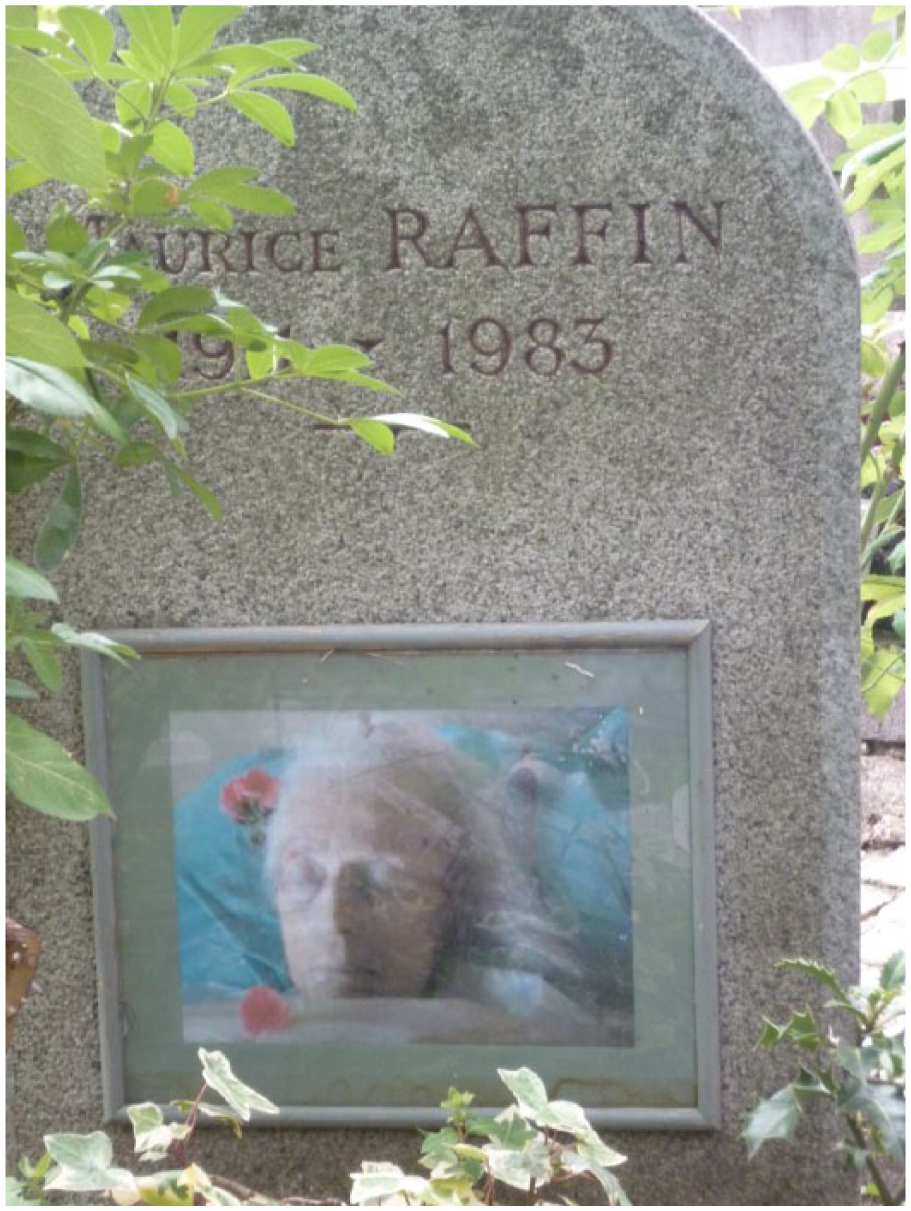
Cimetière de Montmartre, July 2011.
I say these banalities now, because—methodologically speaking—the trip was altogether ridiculous. Even if I wanted to find out who Maurice Raffin was—undoubtedly not radically difficult—it seemed beside the point. I was being dragged and made-up, elongated across time by a modernity apparently contained only within a flash-up image, too quick to be anything other than a known accumulation. I had written in my field notes, on seeing the above grave, the following:
On the gravestone, a photograph. All of a sudden I am death and death is me. I sink to my knees and scramble at the earth by the base of the tree. People walk past as if this is the most natural thing in the world. It goes about three metres down where the ground opens up. I slide my fingers into the belly of Maurice Raffin. It is like pork fat. Where the heart should be, a camera. The root protrudes from here.
Qualitative method emerged here as an encounter, merging itself within the atmospheres of events in-the-making, as they slowly trawl through the signs provoking their evocation (Jacobson, 2014).
And this is the case: Between the far too truthful signs—and the distrustful scramble of their emergence—there is a modernity which is also slow, a “masticating emergency,” as Ripellino (1994, p. 160) said of Prague. This Prague—as we have been reminded on many occasions—does not necessarily stay where we might think it would (Sayer, 2013). It endlessly dislocates itself as if it has taken a stumble, a ninety degree wonder, through one of the pores of the world, and into a different territory, being sucked back into the past, while leaking into the future. It is to this magic Prague that Austerlitz finds his way back to; a Prague like that of Angelo Ripellino’s, suffering from . . . a catatonia from which it at times awakes with a burst of energy that immediately dies down. Visitors have noticed this phlegmatic quality; it effects them as well . . . To this day the grief of finis Bohemiae lies stagnant in the crooked byways, the splendid churches, the old palaces; it is the rancour of a culture constantly interrupted by the brutal meddling of arrogant neighbours. The rare outbursts of violence [of spirit] are followed by day after day of ashes, beery torpor, laceration and mourning. (Ripellino, 1994, p. 160)
Speed equals distance over time: But the formula doesn’t allow for any fuzziness in the reconfiguration of measurement and direction. It assumes that A and B are two points that can be marked on a map, and that the various lines will converge to liberate the equation. But time can eat back and consume distance in its tracks as squidgely as any image world resides in the latent positive image of a photographic plate. Sucked into an alchemical world, the map reforges itself in the endless en-route of bodily variations within the ecosystem of space (De Landa, 2000). It is in this way that the sense of displacement within the significations of its happenstance can slow down, become taught and stretched, not as a rubber band does, storing mechanical tension, but as a wet dough, or Plasticine, in which memories get soaked and spur out the future as the past drifts by to a zone of assemblage.
This is not a deadening of affective possibilities in a web of political distancing, but a distracted efficacy of a decentered political ontology that concerns itself with dwelling and worldling in a fairy-tale patterning rubbing against neoliberal posing (Stewart, 1996). All that is needed is a little heat and pressure, but not necessarily fast ontologies of hyperspace. The endlessness of the continuously passing-past had assured this in the eternity of all modernities.
Postscript
My Dad used to rogue potatoes near Cupar in Fife. A phalanx of schoolboys would stack up over the summer and work the field by hand, sifting through the good and the bad. The latter, I suppose, would get stacked up by the road at the side of the field. In such a way a little desperate portal can open between Fife and Texas, like the miniature portal that opens to Saint Peter for K. at the end of The Trial: an endless circle, in which the headdress of the machine would slowly fall off in the wind until there are no more circles to be run. Dizziness would then set in like the old Fife haar (sea-fog): and with it, a sweet new reckoning of the social, no more utterable than the shibboleth, I guess.
Footnotes
Declaration of Conflicting Interests
The author(s) declared no potential conflicts of interest with respect to the research, authorship, and/or publication of this article.
Funding
The author(s) received no financial support for the research, authorship, and/or publication of this article.
