



Abstract
In this article, I analyze a painting by Modoc/Klamath artist Peggy Ball through a Native feminist reading methodology. The painting, Vanport, is named after a city that disappeared in a flood in 1948. The artist survived that flood, and displacement as did thousands of others. The painting is a rememory map of dislocations and hauntings and disappearances. The painting remaps gentrified dislocations, telling stories that focus on the relationship of the present to the past and the past to the future. The painting itself is a Native feminist practice. The travel to places gone, to places that will reappear again; by people gone as well as by people presently alive; into times that existed, that never existed, that will exist again; to times made contemporaneous by time traveling dogs; with people co-present through desire—at the heart of all this time travel is recognition and survivance.
Introduction
Native people used to live here. White people settled here, they fled. People of color replaced White people, they suffer. Coming up the multicultural cosmopolitan citizen will replace people of color. If I make a map and not a tracing, it is a map of our selfsame land. If I make a tracing and not a map, it is made out of chalk on city cement.
If Peggy Ball makes a map, it is a time travel map. It is acrylic on canvas. Her painting, Vanport, is named after Vanport City, a temporary city that was destroyed in a flood in 1948. Built on a flood plain, Vanport was a wartime housing project meant to accommodate a large population of workers needed to make ships in Henry Kaiser’s 24-hr shipyards in the Portland and Vancouver area. Before Vanport, Portland and indeed the state of Oregon, had a very small non-White population—a reality that was deliberately created through a statewide anti-Black covenant. 1 Before World War II (WWII), the total Black population in the state was fewer than 1,800. Vanport increased the Black population in Oregon by tenfold, from fewer than 2,000 before the war to nearly 20,000 after the war (Maben, 1987). In May 1948, the city, with schools, libraries, groceries, administrative buildings, and three fire stations, was flooded when heavy rains caused the dike to break. Vanport is always talked about in this way, in terms of a naturalized Black/White binary that erases Native presence because it is never acknowledged. According to Grand Ronde anthropologist David Lewis (personal communication, October 25, 2015), the land known as Vanport is Chinookan land, the Clackamas and Multnomah peoples lived there on the Columbia River. Much later like many other urban centers on the North American west coast, it was home to many relocated Native people.
Vanport is a painting of a place that no longer exists but is remembered and revisited. It is a painting of three sisters and their dogs standing in front of an apartment building. One of the girls is a ghost and the dogs are time travelers. The artist, Peggy Ball, lived in Vanport, and the painting of the same name not only recalls her memories but also changes those memories, and so I borrow the term rememory, a concept Toni Morrison creates in Beloved, the classic novel about slavery, haunting, and ghosts. In the book, Sethe describes remembering a place that is gone, but in remembering the place, it continues to exist and exists whether remembered or not. In Oregon, the city of Vanport is gone, but it exists in rememory. In this article, I will describe the ways Native presence is erased and replaced, but actively restored through rememories.
The painting is a rememory map of dislocations and hauntings and disappearances. The painting remaps gentrified dislocations, telling stories that focus on the relationship of the present to the past and the past to the future. The painting itself is a Native feminist practice. The travel to places gone, to places that will reappear again; by people gone as well as by people presently alive; into times that existed, that never existed, that will exist again; to times made contemporaneous by time travelling dogs; with people co-present through desire—at the heart of all this time travel is recognition and survivance.
Theoretical Framework: A Native Feminist Reading Practice
A Native feminist reading practice is reading survivance from a place of survivance. Anishinaabe writer and scholar Gerald Vizenor coined survivance to describe Indigenous creative approaches to life beyond genocide, beyond the bareness of survival. Survivance is “an intergenerational connection to an individual and collective sense of presence and resistance in personal experience . . . and particularly through stories” (Vizenor, 2013, p. 107). Vizenor’s definition is deliberately open, and as a result, survivance is a term used widely in many areas of Native studies, with meaning that changes within different contexts. Survivance existed before the term, and so did a Native feminist reading methodology. For this article, I define Native feminisms as the academic and activist practices and theories of Native women and others working actively against settler colonialism and heteropatriarchy and toward decolonization, recognition and revitalization of Native women and communities. It is a methodology that attends to the transhistorical feminist labor of bearing an Indigenous future into existence out of a genocidal present. It is a methodology that involves reading against disappearance; it involves reading futures yet in store for Native lives. I draw upon the work of many Native feminist scholars including, Lee Maracle (1988), Ines Hernández-Avila (2005), Jennifer Denetdale (2007), Eve Tuck (2009), Michelle Raheja (2010), Chris Finley (2011), Dian Million (2013), Michelle Jacob (2013), Mishuana Goeman (2013), Leanne Simpson (2013), Audra Simpson (2014), Maile Arvin (2015), and so many others, 2 because I understand their writing as practices of reading survivance. I also draw on my ancestors, their lives, their stories, and their refusals. I draw upon my mother’s star quilts and paintings and family photo albums full of pictures of reservation days—proof of survivance post Indian wars and pre-termination policy. I know these quilts, paintings, and photographs to be also already reading and writing survivance; they are Native feminist reading and writing practices, from which I hope to learn in developing my own academic practice. I am trying to articulate a methodology that allows me to engage the desires, the knowledges, and the futurities in cultural productions by Native women even when these same women are overdetermined within settler produced representations.
That these readings are practiced by Indigenous feminists is not meant to make reading a kind of essential magical ability of Indian women, but rather I take the standpoint that the reading practice is something done to bear futures into existence, just as similar practices were done by our predecessors. It is this shared ontological project of bearing the future out of a genocidal present that connects Native feminists now and Native women then; in this respect, it is a survivance practice that recognizes itself within a tradition of survivance. In short, a Native feminist reading methodology is reading as self-recognition.
I begin with a discussion of Dian Million’s (2013) “felt theory” because I define a Native feminist reading practice as something felt, as deep recognition that goes beyond the literal. The affect and emotion in Native women’s narratives, according to Million, simultaneously designate them as incomprehensible in the White academy. Felt theories are profoundly communicative to other Native women “as community knowledge, knowledge that interactively informs our positions as Indigenous scholars, particularly as Indigenous women scholars” (p. 57). In this respect, Native feminist reading is not just about the text being read; it is about the transhistorical community of readers and writers. Therefore, recognition of and by this community is a critical part of the practice.
I find Million’s “felt theory” useful because any writing by and about Native women raises issues of speaking: speaking for one’s self or one’s community, refusing to speak, or speaking and not being heard. Native women writers and historians at some moment have to engage a dilemma of speaking for a non-speaking past. Speaking has material consequences. Million (2013) contends, “Our voices rock the boat and perhaps the world. Our voices are dangerous” (p. 57). The danger lies in unsettling settler innocence, in creating conditions that allow for recognizing one another and presenting alternative histories to “read” the past differently. That is, our voices are dangerous to the settler nation, and thus are dangerous to ourselves as we face the likely violence of being silenced again.
Felt theory, Million (2013) explains specifically around the Truth and Reconciliation Act in Canada, is based on the impact women speaking and writing about their residential school experiences had on their First Nations communities and then the impact those voices had on Canada internationally and on the idea of justice outside the idea of the nation-state. Million argues that these statements by Native women resisted generations of gendered colonization and reasserted traditional respect of women’s power. Million explains Native women’s testimony was spoken but it was also written in books published in the 1970s and 1980s. Truths about colonization, domestic violence, sexual violence, and more were met with resistance, blame, and assumptions of pathology. Their writings, Million explains, participated in creating new language for communities to address the real multilayered facets of their histories and concerns by insisting on the inclusion of our lived experience, rich with emotional knowledges, of what pain and grief and hope meant or mean now in our pasts and futures. (p. 57)
As an act of creating a felt language for articulating past experiences, for present and future Native women, is producing a technology of recognition. The problem, Million (2013) writes, is that this felt scholarship is considered “polemic, or at worst, not as knowledge at all.”
These writings and actions by Native women are recognized and “read” by us, Native women, who recognize—a felt knowledge of what you do that impacts what I do. Million’s felt theory resonates with my work because I write about my family, I write about women’s lives, and I have been warned by academic mentors, that I was going to have to be very careful if I wanted to present family pictures, family stories, quilts, and artwork as scholarship. Much of my scholarship is about locating home, surviving dispossession, claiming space, and listening to ghosts. These are shared Indigenous projects, rather than strictly academic ones. One thing I keep in mind with these family stories is that there is more to it, I cannot tell the all, and I would not want to make that claim. There is always more to the story. Pomo writer Greg Sarris (1993) explains about autobiography, it is “not the life but an account or story of the life” (p. 85). No life can be completely told, and there are reasons why one might choose not to talk about their life, or aspects of it. Sarris makes a distinction between telling your story to a social scientist, trained to be an outside observer, and speaking to family. The social scientist edits the dialogue into the completed text, but Sarris argues, the original speaker edits their words too. Every story is not for everybody. Stories have times and places. Sarris remembers his Pomo elders, Great-Grandma Nettie and Old Auntie Eleanor, warning the children about speaking to outsiders.
“Don’t talk much with outside people,” Nettie and Eleanor admonished. “Careful what you tell.” When the professors visited each summer, Nettie became silent. Eleanor gave short, flat answers and told stories no one in the house had ever heard. (p. 82)
Refusal is a choice and a strategy elaborated by Kahnawake Mohawk scholar Audra Simpson (2007, 2014, see also Tuck & Yang, 2014). As a Native feminist scholar, refusal is an option that is not a question of if it will be used, but when and with whom. If I tell my story, you may recognize yourself; you may tell your own story. You may claim to know me; you may claim my story for yourself, use it as evidence, or produce it as a truth. Even the stories I do not tell have power. I wish to state the stories shared here are not the sum of the all relevant experiences and knowledges associated with the painting Vanport, they are carefully curated because, “You are not always aware of how you can be dangerous to me, and this makes me dangerous to you” (Tuck & Ree, 2013, p. 640). I trust that Native feminists will read between the lines.
Background: Vanport, Quilting, Painting
Peggy Ball grew up in North Portland. She was one of five children, her mother was Cherokee from Adair, Oklahoma, and her father was Modoc and Klamath from Chiloquin, Oregon. Her parents met in the Southwest, married and moved to the Klamath reservation in Chiloquin. During WWII, the young couple and their baby daughter Evelyn moved to Portland, Oregon. They became one of the many families living in Vanport, the largest wartime housing development in the nation and for a time, the second largest city in Oregon, after Portland. Vanport was created in 1942 to house the thousands of workers who were working 24 hr a day to create ships for the war. It was de facto segregated and had a large population of African Americans, estimated at 40% of the total population. Indeed, Vanport is known for being the largest wartime housing project with a significantly large Black population. Peggy Ball was born in July 1943 at the time Vanport was finishing construction. The family lived in Vanport and continued to grow, Evelyn and Peggy’s younger brother Woody was born in 1948. After the war, Vanport remained an active city, with a police and fire station, a hospital, and a school that would eventually become Portland State University.
Vanport became of interest to people in 2005 post Hurricane Katrina, because in May 1948, when Peggy Ball was almost 5 years old, it was destroyed in a flood that historians noted had parallels with the flooding of New Orleans. The flood killed 15 people (although there were rumors that those numbers were higher) and left many African American and working people homeless. Peggy Ball remembers living in Vanport, and her mother waiting almost too long to move her three children to higher ground. North Portland was the only neighborhood where the African American refugees of the flood could rent or own homes, and it is also where the Ball family lived when Vanport was destroyed.
In 2013, when nerve damage caused by diabetes made it impossible for Peggy Ball to continue quilting, she began painting again. She began working on paintings that drew largely from memories, old family photographs, and her childhood.
Vanport, Time Traveling Dogs, Rememory
Vanport is the first painting Peggy Ball did when she stopped quilting: a painting of three small girls in Vanport, Oregon (see Figure 1). In this painting, three sisters are standing at the edge of the street, some distance in front of the distinctive Vanport wooden apartments. 3 The girls are Peggy and her sisters. The oldest sister, Evelyn is standing next to her youngest sister Debbie, who is barefoot. Peggy Ball sits on the sidewalk next to her large yellow dog. The painting plays with time. Three Ball siblings lived in Vanport, but they were Evelyn, Peggy, and Woody. Woody, the youngest at the time, was a baby. Debbie Ball was born in 1951 in Portland and never lived in Vanport. But this painting is not about representing an historical truth. The black dog that sits next to Evelyn is Satch, her beloved companion who died in 1990. The yellow dog that Peggy rests against is Roy Rogers, King of the Cowboys, her yellow Labrador who died in 2006. As an artist and a Native feminist, Peggy Ball gives these children their favorite pets and the company of their favorite sister, Debbie, who passed on too soon in 1980. As time travelers, they can be co-present with one another in a disappeared place “where it happened” (Morrison, 1987, p. 43).
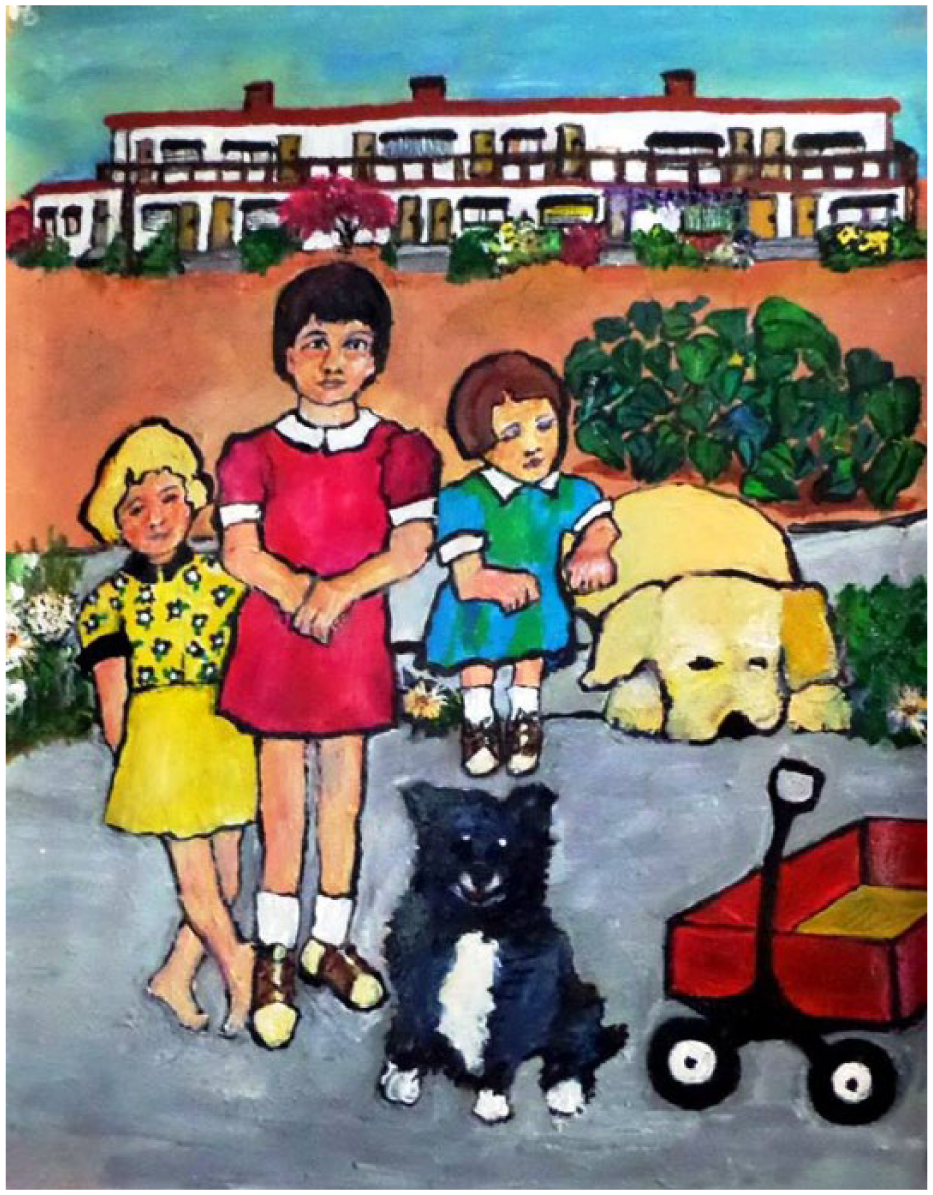
Vanport.
Ball’s paintings not only recall memories but also change those memories, and so I use the term rememory, a concept Toni Morrison (1987) creates in Beloved, the Pulitzer Prize awarded book about slavery, haunting, and ghosts. The character of Sethe describes remembering a place that is gone, but in remembering the place it exists, and it exists whether it is remembered or not. Vanport is gone, but the children were there, their family lived there, and it is a haunting because of the trauma involved in the loss. The home is there, in the rememory and in the world. Sethe explains, I was talking about time. It’s so hard for me to believe in it. Some things go. Pass on. Some things just stay. I used to think it was my rememory. You know. Some things you forget. Other things you never do. But it’s not. Places, places are still there. If a house burns down, it’s gone, but the place—the picture of it—stays, and not just in my rememory, but out there, in the world. What I remember is a picture floating around out there outside my head. I mean, even if I don’t think it, even if I die, the picture of what I did, or knew, or saw is still out there. Right in the place where it happened. (p. 43)
It is there where it happened because it haunts the memory with the violence of the fire for Sethe, or in this case, the violence of the flood for Peggy. For Sethe, the rememory of place includes Black friends and families but all under the shadow of slavery. Both slavery and the relationships vanish together—and that creates the haunting. The Ball family lived there, the children went to school, their parents had friends. Not only did Vanport disappear, but within 7 years, the Klamath tribe is terminated, Peggy’s father leaves the family, and her mother is wheelchair bound with multiple sclerosis. Both the violence of Vanport 4 and the relationships vanish together. In the flood, a segregated Black community in a temporary city vanishes, and an already invisible Native community vanished too. Yet the home is there, in the time travel and in the world.
An Impossible Presence, a Haunting From the Future
In the painting, Vanport is standing, and outside of the frame their mother is whole, their father is with the family, and their tribe is not yet terminated. These children will soon lose their home, their tribe, their father, and their mother’s health. Peggy Ball as a Native feminist artist performs through this painting a restitution, giving the sisters the things they need: a red wagon to carry their things, and a sunny day. The most touching of these gifts is Debbie. The youngest sister with blond hair was not born until 1951, and she died 29 years later in a car accident. Her impossible presence recognizes the longing that the sisters have for her, and how she is always with them. There are visual clues that she is a specter, different from the other girls. While Peggy is sitting and Evelyn standing, both wearing solid saddle shoes, Debbie is bright in yellow, barefoot, her legs crossed, and feet barely on the ground. Peggy and Evelyn have white collars on their dresses, and positioned as if for a photo opportunity. The top of Debbie’s dress is covered in flowers and the trim on her dress is black. She is the only one smiling, standing playfully, and leaning around Evelyn. She is like a photo-bombing ghost. Peggy looks down with one arm supported by her dog Roy, who is sleeping, his upper body, head, and paws resting on the street. The sad, reflective pose of the girl and her dog suggest the losses that are coming, as does the young Peggy’s dress, a mixture of blues and greens—a wetness in contrast to the dry dirt lot behind them.
It is a painting of a ghost and time traveling dogs. But the painting is not haunted. Ghosts haunt the present with demands for justice (Gordon, 2008; Tuck & Ree, 2013). As a methodology of justice, haunting points toward the future through engaging the past through the figure of the ghost. Sociologist Avery Gordon (2008) writes, “To study social life one must confront the ghostly aspects of it. This confrontation requires (or produces) a fundamental change in the way we know and make knowledge” (p. 7). Hauntings require us to acknowledge how cities and academies are built upon disappearance, and thus unsettle settler colonial nations and settler colonial knowledge. The ghost exists here with us, because of violence, and haunting is the result. The ghost may represent a person, or an event. The ghost may haunt an individual or society.
The ghost acts because it desires something. That something may be justice, but it may not. Justice may not be possible. The desires of the ghost are as complex and complicated as the desires of the living. Resolution to haunting may be decolonization or repatriation. Revenge is an option. Violence causes the haunting. It is possible that more violence may resolve haunting but there is no promise. Disruption may be the only resolution. In their “Glossary of Haunting,” Eve Tuck and Ree (2013) explain, “Haunting aims to wrong the wrongs, a confrontation that settler horror hopes to evade” (p. 642). The ghost makes evasion impossible. They continue, “Social life, settler colonialism, and haunting are inextricably bound; each ensures there are always more ghosts to return” (p. 642). Haunting as a methodology recognizes violence and engages the future through the “something to be done” that answers the desire of the ghost.
The painting traces the haunting by revealing the ghost, and although it may not resolve the haunting by answering the ghost’s desire, it offers something to the ghost and gestures toward the future. It offers a time travel map to visit with relations past, present, and future.
Unlike Western maps whose intent is often to represent the “real,” Native narrative maps often conflict, perhaps add to the story, or only tell certain parts. Stories and knowledge of certain places can belong to particular families, clans, or individuals. These maps are not absolute but instead bring present multiple perspectives–as do all maps. While narratives and maps help construct and define worldview, they are not determined and always open for negotiation. (Goeman, 2013, p. 25)
I read Peggy Ball’s paintings as time traveling maps. Creating them is a Native feminist reading/writing practice, whereby Ball reads the desires in memories and in photos. She recognizes and honors the desires of the ghost: for a toy wagon, the warmth of a favorite dog, a sister’s company in a childhood neighborhood. Sisters and two dogs in a place that does not exist. A sister who was not born yet and died too soon, a ghost who graces the painting with a smile in a yellow dress decorated with flowers. The maps are for time travelers: dogs, ghosts, sisters, and oneself.
Indigenous in Black Space on Native Land
This painting puts this Native family in Vanport, where the presence of Native people existed before the flood. For the past 45 years after the flood, there has been a Delta Park Powwow and Encampment every third weekend in June where Vanport used to be. The encampment is a group of tipis that are erected, and the participants live on the campgrounds during the powwow. They return to what is disappeared, destroyed. With the presence of a number of tipis, there is a reclaiming and a declaration that they never really left.
The Native presence is (t)here, but it often goes unrecognized. North Portland and Vanport were both known for their significant African American populations. This history matters because the presence of African Americans in Oregon has been violent and contested. Between 1844 and 1857, several exclusion laws were passed banning African American settlement, and not repealed until 1927. Although ostensibly a “free state,” the State of Oregon was founded as in 1859 as an anti-Black state where by law, slaves had to be set free, then subsequently whiplashed and expelled (McLagan, n.d.). Today, Oregon is imagined as a White space. All of settler colonial United States is presumed as white in whitestream logic, unless it is marked as “ghetto” and thereby Black yet still non-Native.
The sisters in the painting, Vanport, are Natives in what is often imagined as a Black space (and therefore a non-Native space). Their outlines are also traces of the interwoven histories and social experiences of Native and Black people in Vanport, in Oregon, and in the United States. During the time of the Black exclusion laws in Oregon, the vanquished Modoc were forcibly removed to Oklahoma, away from their homelands into what was marked on maps as Indian Territory. Natives can be dislocated from homelands to reservations, and from reservations to ghettos. The destroyed Vanport led to the increased Black population of the Albina neighborhood, and that is where the Ball family moved as well. There, they were displaced again by the building of Interstate 5, and finally, the family moved to Fairport Place, a block west of Albina and south of Lombard Avenue. 5
North Portland recently gained attention for the increase in gentrification of White people displacing other White people. However, the pattern of removing and dislocating poorer darker people in favor of richer, Whiter people is long established in Portland and elsewhere (Wile, 2015). This pattern of displacement follows settler colonial logic La Paperson (2014) describes within the definition of ghetto colonialism.
Settler nations are those where colonial invaders never leave but instead claim to have become the new Native, and to possess absolute sovereignty over all life and land within a territory . . . whiteness emerges as a racial category of entitlements: the right to claim land and sometimes people as property, and conversely, the right not to be bound by borders nor bonded as property. Indian-ness is invented as a form of racial disappearance . . . blackness is invented as enslavability, illegality, murderability . . . Ghetto colonialism takes place at this intersection between Indigenous displacement and black dislocation. (p. 116)
Settlers can claim land, whether Plymouth Rock or North Portland. A neighborhood is undergoing gentrification when more affluent and highly educated homeowners replace the poorer people already residing there. The settler colonial relationship to land is openly acknowledged, people gentrifying North and Northeast Portland have been referred to in media as “urban homesteaders” and “pioneers”; and they refer to themselves that way too (e.g., McCausland, n.d.). They never refer to themselves as “gentrifiers” because gentrification always references White people displacing people of color, even when it is White people displacing other Whites. The gentrifiers are read as “whiter” and the gentrified see themselves as somehow darker even when they are not. Gentrifier always has a racial undertone, and so no one wants to be called that. By contrast, the terms urban homesteaders and pioneers are only possible as self-monikers because Native people are already assumed to be disappeared, and so no one is around to take offense—and self-styled homesteaders can claim a kind of innocence in an urban frontier.
“For settlers seeking new frontiers, the ghetto serves as the interior frontier to be laid waste in order to renew” (Paperson, 2014, p. 116). The stories in the media, when they acknowledge Native people at all, follow this explanation: Native people used to live here. White people settled here, they fled. People of color replaced white people, they suffer. Coming up the multicultural cosmopolitan citizen will replace people of color. (p. 121)
The cosmopolitan citizen is colorful, but not colored. The television show Portlandia mocks the colorful settler citizen, complete with beards, bikes, and urban farming but does not acknowledge the overwhelming Whiteness of that citizen. It does not need to be acknowledged, the settler citizen is White, with a fondness for goats, beards, and food allergies. The settler citizen takes up room on the sidewalk waiting an hour for a table on a weekend morning, or walking a bike down the sidewalk, but there are other stories that are replaced. Longtime residents, Native and non-Native, making efforts toward revitalization get priced out of their greener neighborhoods as urban farms make the streets and parks more attractive (Brooks, n.d.).
In her other paintings, Peggy Ball remaps North Portland to replace absence with presence and bring the past into the future—and indeed, the future into the past—in ways that acknowledge the Native presence that is always. They are there in memories, in pictures, in the yearly encampment and powwow, and people, Indigenous people who will always be present on all our land, forever. Ball’s paintings practice a recognition, and through that recognition, a healing. The presence of Debbie is a visitation. It claims the ghost as family, the presence of our ancestors, and those we love, who are present through difficult times.
Her paintings from these photos are a Native feminist reading/writing practice. Peggy Ball reads the desires in the photos, and writes time traveling maps into her paintings. The photos are already maps. The paintings are remappings of those maps. The maps are for time travelers.
Ball’s paintings are not copies of photographs, but there is a snapshot quality to them in themes and framing. Two people face a camera, a candid picture of dancers at a powwow, children standing in front of their home with their dogs are all pictures Peggy Ball brings from her memory. They are memories that haunt the artist, and the paintings are responses to haunting that bring the ghosts into view. The ghosts are not terrifying. They are friends and family who are loved and missed, missed but never gone because they are often remembered and spoken of with respect and affection. Peggy Ball’s paintings fight dislocations by painting connections between place and people, people and culture. However, this painting is not a portrait of real life. As a remembering, it is a time travel and also a remapping. As a painter and Native feminist, Peggy Ball sees the past differently where presences are always co-present, but there is a Native feminist reading of this portrayal of a complex community, with many stories.
Conclusion
I began with a painting—a time travel of people/place/time and their presence. This is a Native feminist reading, certainly, of desire and survivance. The paintings themselves are a Native feminist practice. These practices are rememories. They are remappings. They provide maps of time traveling and maps for time travelers. All of this travel to places gone, to places that will reappear again; by people gone as well as by people presently alive; into times that existed, that never existed, that will exist again; to times made contemporaneous by time travel; with people co-present through desire—at the heart of all this time travel is recognition. Native feminist practices of recognition defy dislocation, and breed desire. This is what we do.
Footnotes
Acknowledgements
I am grateful to my mentor K. Wayne Yang for the title and much more; and to my late mother Peggy Ball for her paintings and pointing the way toward a Native feminist reading methodology.
Declaration of Conflicting Interests
The author declared no potential conflicts of interest with respect to the research, authorship, and/or publication of this article.
Funding
The author received no financial support for the research, authorship, and/or publication of this article.