




Abstract
In the neoliberal academy, scholars must regularly create multiple texts (e.g., statements about research agendas, CVs, tenure-related research narratives) about themselves and their work to produce themselves as subjects whose research can be described, quantified, and slotted into commonly accepted categories (e.g., fundable, high impact, quality, data driven). In this article, we question what is lost when it becomes natural and desirable to be recognizable as a singular and coherent brand within neoliberalism. Specifically, we make coherence visible as a mechanism of neoliberal audit culture rather than a stable scholarly goal. To do that, we engage with various textual strategies and media that enable us to think of and enact coherence differently again and again. We hope working both within and against coherence as a mechanism of neoliberalism opens a perpetual sensitivity about authorship, ownership, and coherent scholarship and welcomes the unknown and unforeseen in our academic careers.
I shall propose a game: that of the “year without a name.” For a year, books would be published without their authors’ names. The critics would have to cope with a mass of entirely anonymous books. But, now that I come to think of it, it’s possible they would have nothing to do: all the authors would wait until the following year before publishing their books . . .
In proposing the infeasibility of “the year without a name,” Foucault highlighted the importance of being recognizable as a thinking subject who produces both texts and herself as a scholar. That production is particularly necessary within the context of higher education because neoliberal discourses demand scholars produce themselves as valuable commodities (Cannella, 2015; Lorenz, 2012). Bansel, Davies, Gannon, and Linnell (2008), for example, assert that the neoliberal incursion in higher education has resulted in a number of “concerted strategies on the part of government and management” (p. 676). Those strategies, what they call “practices of audit” (p. 676), produce faculty as “subject[s] whose morality is intimately muddled with that of the entrepreneurial institution whose project is a pragmatic one of survival within the terms of government” (Davies & Bansel, 2010, p. 9). In other words, scholars must regularly create multiple texts (e.g., statements about research agendas, CVs, tenure-related research narratives) about themselves and their work, which constitute “a new set of writing practices” that are “created within the university for self-management and self-reporting to management” (Bansel et al., 2008, p. 676). Those texts, then, produce scholars as “stable, uniform entities” (Davies & Bansel, 2010, p. 14; i.e., coherent neoliberal subjects) whose research can be measured, surveilled, and slotted into commonly accepted categories (e.g., fundable, high impact, quality, data driven). Such ongoing surveillance of self, according to Davies (2005), “holds [scholars] neatly packaged within economic and utilitarian discourses” (p. 7) so they are recognizable as branded commodities.
In this article, we question what is lost when it becomes natural and desirable to be a recognizable brand within neoliberalism. In particular, we focus on the widely circulated idea that a scholar must brand herself as a coherent neoliberal subject in any number of conversations and documents (e.g., tenure and promotion documents, annual reviews, meetings with deans and mentors). In those documents, the coherent scholar describes a singular area of focus, sets a clearly defined research trajectory, demonstrates how she has been recognized as an expert in a field or discipline, and so forth—all moves to create herself as a brand with recognizable characteristics, value, and use, so that it is clear how she contributes to the economic survival of the university. We are concerned, along with Bansel and colleagues (2008), however, that the expectation to become recognizable as a neoliberal subject can “induce in academics both insecurity and an insatiable desire to improve” (p. 676), where the insatiability leads to constant and not necessarily positive competition. Questions such as “How do I sell myself? How did I become a product instead of a person? What am I as product?” (Herrmann, 2012, p. 249), or even more to the point, “Am I good enough? . . . Am I productive enough? . . . Am I smart enough?” (Davies & Bansel, 2010, p. 14), become natural and normal in a “productivity-driven, audit culture” (Bansel et al., 2008, p. 673). Rather than focusing on such questions, which can limit how we might imagine ourselves and our work, we engage in play to critique this expectation to become a coherent neoliberal subject. 1
In play, we do not aim to dismiss the expectation of coherence or to reject neoliberalism. Indeed, we suspect the expectation to brand oneself as coherent is too firmly situated in what Caputo (2012), drawing upon Derrida, called the economy—“a rigid system of exchange, with no gaps, no breaks, or openings” (p. 33). As Caputo (2012) said, however, the unforeseeable, unfathomable “future for which we cannot plan” threatens to disrupt the “settled tranquility” of any economy (p. 26). So it is “never a question of simply and unambiguously leaving behind an economy” (Caputo & Dickinson, 2012, p. 43). We can, in fact, still think differently about ourselves as subjects within neoliberalism. Our play, then, becomes a site where strategies of neoliberal audit culture, such as those that produce the expectation of coherence, become available to critique. In other words, through play, coherence becomes visible as a mechanism of neoliberal audit culture that produces a certain kind of thinking subject (e.g., one that is stable, evaluable, striving to meet institutional goals) rather than as a desirable, natural, stable scholarly goal.
Such play complicates scholarly coherence by accentuating the ways in which the self exceeds our ability to describe it (Bansel et al., 2008). It foregrounds “other ways of knowing, doing, and interpreting” that have not yet been invented (Koro-Ljungberg, 2016, p. 127) and holds the promise of enabling something new, different, and more open. At the same time, play holds the risk of “a certain anarchy, an open-endedness of thought—the right to ask any question” (Caputo & Dickinson, 2012, p. 28) that may foreclose the ability to be recognizable as a coherent neoliberal subject.
The writing of this article became an opportunity for us to foreground the “promise/risk” (Caputo, 2012, p. 28) of being recognizable as coherent scholars in neoliberal times. Specifically, we assumed a position of openness to the unforeseeable in relation to the concept coherence, welcoming multiple theorizations and enactments of (in)coherence. We wrote as Collective, for example, taking up Foucault’s game of the year without a name by refusing to name ourselves as hierarchically organized individual authors whose contributions can be labeled and used to quantify our productivity. In that refusal, we risk giving up the ability to quantify our authorship contributions under our individual brands (thus decreasing our standing and value to our universities). At the same time, we risk simply rebranding ourselves because Collective also operates as a compliant neoliberal subject by producing an article for publication in an academic journal. However, writing as Collective also holds the promise of producing a different kind of author—a thinking subject “who can work creatively, imaginatively, politically, and with passion to break open the old where it is faulty and to envisage the new” and whose openness to multiple (in)coherences can make visible “the constitutive work that discourse does” (Davies, 2005, p. 13). In this sense, when we write as Collective, we can imagine and enact different relationships with ourselves. Rather than engaging in ongoing surveillance of the self, for example, we can co-opt surveillance to “catch ourselves and each other in the act of taking up the terms through which dominance and oppression take place” (Davies, 2005, p. 7).
We also appropriated a format that enabled us to draw upon multiple textual structures and media to trouble research as usual, risking disrupting academic conventions to such an extent that some readers may not easily recognize our article as scholarship. Specifically, we created a talk inspired by Shea Hembrey’s (2011) technology, entertainment, design (TED) Talk, 2 “How I Became 100 Artists.” Hembrey describes how he fabricated artists—each with their own backgrounds, philosophies of art, artistic skill sets, and media of choice—which complicates the viewer’s ability to label any of them as a particular kind of contemporary artist. In other words, Hembrey could not be branded as a coherent artist. Following Hembrey’s lead, we created our own TED Talk, “How I Became an (In)coherent Scholar in Neoliberal Times,” by a fictional scholar we call Nel. 3 A faculty member at a research university, Nel, like Hembrey (and Collective), takes on a project of invention. Rather than trying to produce one coherent Nel who can satisfy all the requirements of neoliberal audit culture, for her TED Talk, she creates multiple iterations of herself working, thus taking up the idea of coherence differently as her Nels inquire into the processes and products of neoliberal branding. As an invention then (like Collective), Nel is another branded thinking subject who resists easy alignment with institutional goals and who helps us play with coherence while critiquing it as a mechanism of neoliberal audit culture. 4
What follows is Nel’s TED Talk.
How I Became an (In)Coherent Scholar in Neoliberal Times
My name is Nel, and I am a scholar who works in the academy. If you aren’t familiar with what life is like in the academy, I’ll give you a little peek into that world. The academy makes us do and say and think some strange things. There’s even a Twitter handle and Facebook profile called Shit Academics Say (SAS) that has become wildly popular because of how well Nathan Hall, the McGill University professor behind SAS, is able to distill the challenges, frustrations, and absurdities of the academy into the simplified structure of a Tweet—140 characters or less. “Successful academic writing: 1% inspiration 12.51% perseveration 13% omission 30% citation 50% procrastination 90% nonnegotiable deadlines” (Hall, 2014). And “Deep down, academics want the same thing as everyone else: acceptance, with minor revisions” (Hall, 2015). Yup, that pretty much sums it up.
Lately though, I have been fed up with all the words we produce about ourselves. I have stacks and stacks of words—all about myself—documents such as CVs, research narratives, bios for articles, and grant proposals, not to mention the words I use to introduce myself and my work at the start of every new class I teach or the small talk at conferences with other academics or even what I say when a nonacademic friend asks me what I do. I use words all the time to tell people who I am and what I do. In other words, I am full of the kind of shit academics say. I have been reading and thinking about those words because I have to produce myself as an academic to provide an opportunity for my university to let me know whether I am “on the right track” . . . repeatedly, continuously. As my department chair advised, those words (when organized appropriately into the sorts of forms and narratives we all have to produce), “let you let us know about the coherent scholar you already are.” And when my silence suggested I might not be sure about this coherent scholar, he added, “You’re a qualitative researcher. Do a thematic analysis of your own work to find the strands in your research agenda.” So, I have been reading and remembering all those words about me, looking for that coherent scholar, looking for that coherent scholar’s research agenda, but instead finding a bunch of questions—such as, Who said that? That isn’t me. Or is it? When did I think that? Has that ever been me? What is all this shit I say? What’s going on here?
It’s not that I couldn’t be dutiful, write myself up neatly to cohere, package my research and tie it up with thematic bows. In fact, I am pretty good at that. It’s that the more (or less) I read those words about myself, the more it became evident to me what I would have to give up (goodbye, philosophical critique), give in to (hello, neoliberalism), and give away (please, take my time, effort, and energy) to make myself a coherent scholar. Perhaps, even more so, it’s the fact that if I resist, I risk losing my credibility at my university, or as Davies and Bansel (2010) put it, “the new [neoliberal] university makes it clear that each individual is readily expendable” (p. 8). Each time I say yes to that risk, each time I give up or give in, the more I let neoliberalism do its work on me and the less I am able to recognize that it is, in fact, working on me. Neoliberalism “dismantles [my] will to critique” (Davies and Bansel, 2010, p. 5), and I’m ready to fight back.
My talk today is about what happened when, instead of just giving up and giving in, I opted to play. I played to cope with and mourn. I played to resist, to create a life in the academy that, even if only temporarily, I could live in, maybe live with, or maybe even live for. I created spaces where coherence wasn’t understood as simplistic, categorical, and gotten at through thematic analysis, but rather, where coherence could be theorized and enacted differently. To do that, I created multiple Nels—numerous Nels, alternative Nels, proliferating Nels, each of whom approached the academic task of making herself cohere differently and critically. I read and reread the mountains of words I had written about myself but I also read other words, images, videos, and so forth created by other scholars, philosophers, artists, children’s book authors—no text was off limits—to help me think and make space for what I hadn’t yet thought Nel could be. I also opened up the possibility for Nels to cohere or not or both in something besides words, such as photographs and collages. I’ll introduce to you a sampling of my proliferating Nels, and then, I’ll talk to you a little about what it is getting me, how it is helping me live.
This Is Nel
This is Nel. Nel thinks of coherence as a tin of Magnetic Poetry©—a set of “carefully-chosen words and word fragments designed to take [her] imagination to all kinds of uncharted territories” (magneticpoetry.com). Originally created to ward off the writer’s block of its founder, Dave Kapell, the first magnetic poetry was slips of paper containing “interesting words” that Kapell could reorder for song lyric inspiration. Like with Kapell’s magnetic poetry, the interesting words that Nel collects from the articles she writes, the conversations she has with colleagues, and so on—words such as conduct, conventions, research, and interrupt—are open to a multitude of aesthetic, rhythmic, and prosaic possibilities of English grammar, mechanics, and syntax. Each new possibility has the potential to inspire “all kinds of uncharted” Nels.
Embracing that potential in her latest series of photographs titled Research: Conduct* Interrupt* Conventions*, Nel uses her interesting words, grammar and syntax, magnetic strips, and photography to write the first sentence of a narrative about her research. Her first attempt at that sentence was, “I conduct research that interrupts conventions” because it established a stable and definite agenda that would enable the university to better assess her value. However, as magnetic poetry, that sentence is susceptible to a constant reordering that can introduce something other than an intentional and agentive subject who knows and does, that can blur the boundaries that bind and hold scholars accountable to their agendas, that can disrupt a scholar’s claims to authorship, and that can obscure recognizable categories of research, among others. Each time she reorders and produces a new sentence, she must decide whether or not to spend her time—time that she must account for in monthly workload logs—following the uncharted Nel. Each decision, then, becomes an opportunity to pursue a type of responsibility (e.g., Derrida, 1992) that is beyond the procedural responsibility required by neoliberalism in which “[t]he individualised subject takes up the responsibility for performing themselves within the terms laid out for them” (Davies & Bansel, 2010, p. 17). Being open to using magnetic poetry as both a method of inquiry and a theorization of that inquiry further removes responsibility from the procedural because it disrupts the “terms laid out” for her about what constitutes scholarly inquiry. Here are a few of the images she’s been using to inspire possible research narratives and explore uncharted Nels (See Figure 1).
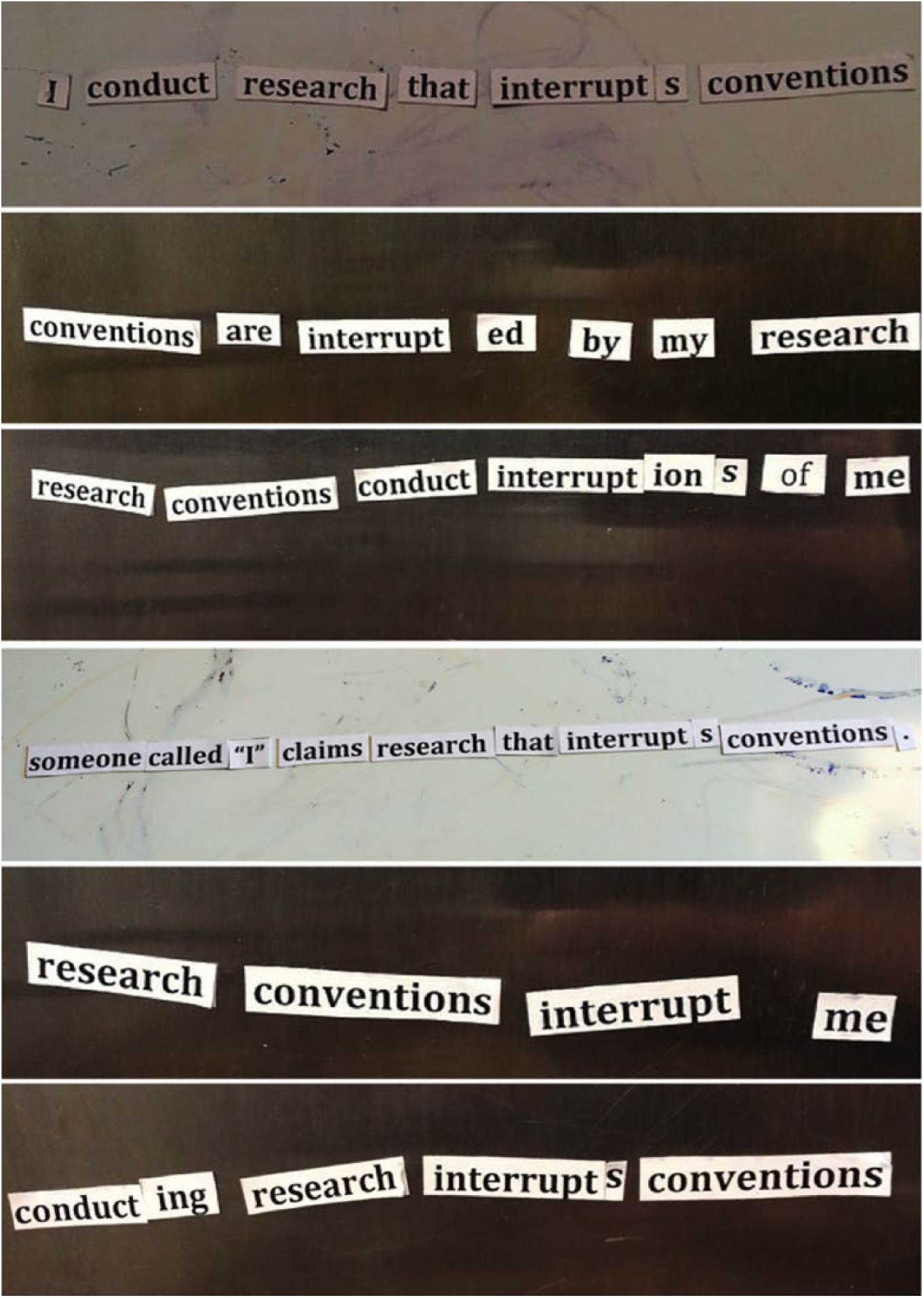
Research*, Conduct*, Interrupt*, Conventions*.
This Is Nel
This is Nel. She sees coherence as an act that forecloses subjective possibility—that the act of rendering the scholar intelligible both produces and devalues the unintelligible scholar (Butler, 2004). She experiences coherence making as getting in the way of the ethical practice of desubjectification, her efforts to resist coherent accounts that constrain her within the academy’s neoliberal bounds of intelligibility (Butler, 1997; Foucault, 2000; Hoy, 2005). Nel’s outlook on coherence is bleak; she has all but lost hope that neoliberalism’s influence will wane during the course of her career. Therefore, she uses dystopian narrative as a tool to cope with her despair; to play in the dark; to illuminate coherence making as part of what Giroux (2002) refers to as the “dystopian culture of neoliberalism” (p. 426). Drawing on the power of dystopian accounts to serve as a warning by depicting worlds in which normative assumptions remain unchanged (Baccolini & Moylan, 2003; Heybach & Sheffield, 2013), she seeks to show how a scholar in the neoliberal academy is perpetually subject to forces of coherence that deny avenues of resistance. Here is Nel’s dystopian narrative called The Elevator Speech: *Ding* The incoherent scholar steps into the elevator. “Tell me about yourself,” says the mounted CCTV camera. I smile. “Hello,” I say, “Of course, and with pleasure.” The camera blinks back friendly pulses of red light. I am Dr. Nel. I am an Assistant Professor in the Department of Lifelong Education, Research Methods, and Counseling at the University of Wistful R1 Status. *Ding* “First floor: Education and Work History,” announces the elevator speaker as the grey doors open. I watch as I exit. It is a bit disorienting, to stand in one place and watch oneself walk away. I wave a quick good-bye to historical versions of me: the non-Ph.D. me, the not ready for tenure-track post-doc me, the visiting Assistant Professor at a Land Grant University (it was a short visit) me, the Assistant Professor working in a liberal arts college no one has ever heard of me, the Assistant Professor who worked in the Research Methods Department before the “reorganization” to improve efficiency and foster accountability me. Also leaving are other possible versions that impossibly detangle from me. Good-bye mother, partner, friend, back packer, runner, gardener, chicken-raiser, 80s music lover. The elevator doors close. Sorry, where was I? Oh, right. I am an Assistant Professor at the University of Wistful R1 Status. My research focuses on the humanities and social sciences. *Ding* “Second floor . . .” but the elevator speaker’s announcement is interrupted by some mes who force their way in. They speak hurriedly in chorus: I earned a Ph.D. in Education and Research from Land Grant University in 2009. My Ph.D. training included coursework in quantitative research design, program evaluation, statistical analysis and meta-analysis. I’ve designed and led randomized controlled trials and quasi-experimental studies. I worked on two U.S. Department of Education funded systematic reviews. I am a certified reviewer for the WHAT WORKS CLEARINGHOUSE! With considerable effort I shove these mes out of the elevator as they shout to be heard through closing doors. The elevator continues its ascent. The camera’s red light blinks in annoyance. “I’m so sorry,” I say in the embarrassed silence. “Please allow me to continue. I am an Assistant Professor at the University of Wistful R1 Status. My research includes multimodal and digital composition, writing pedagogy, arts-infused and digital literacies, and arts-based and poststructural qualitative research methods. As a teacher, author, artist, and literacy scholar, my work spans education, the humanities, and the arts.” *Ding* Third floor: External Funding The doors open onto a seemingly endless white room of grant reviewers sitting at neatly spaced desks. Simultaneously they look up, expectantly. As if commanded, I turn my back to the camera, right my posture, and do my best to appear confident, while the reviewers listen and type. I have the expertise, training, and experience necessary to carry out the proposed research. I have a strong background in educational research, with extensive expertise using qualitative methodologies to examine how educators and researchers can conceptualize and enact writing in ways that generate possibilities for equitable education. I have publications in a number of international and national journals including Journal of Research in Childhood Education, Computers & Education, Qualitative Inquiry, Qualitative Research, and Journal of Adolescent and Adult Literacy. I will lead the research team in data collection, analysis, and dissemination and will work with the evaluators to ensure the grant goals are met. The doors close. I turn sheepishly back to the camera. “I’ve lost my place,” I admit. “I was telling you about me and my research agenda. I engage poststructural (feminist) theories in much of my work. My dissertation used Foucault. I started . . . a theory reading group . . . at my university . . .” My voice trails off. For the first time, I take account of the white walls, the elevator rail, and the floor buttons. I notice they are numbered and named: 1-Education History, 2-Scholarship, 3-External Funding, 4-University Patents, 5-Regional Accreditation . . . to ∝. All buttons depressed, brightly lit. I have to get off this elevator. In desperation I confess, “I’m not sure who I am as a scholar. I worry about the perpetual work to compose myself, to render myself intelligible to you so that I can be packaged, judged, evaluated. Made accountable. I worry that you are not listening. I worry you are listening.” I take a deep breath, “What would happen if that were my next short-author bio?” The camera light blinks. *Ding*
This Is Nel
This is Nel. Nel thinks of coherence as always already collaborative. Disheartened by the myth of the lone scholar (Hood, 1985) that has pervaded the academy for decades and is intensified by the neoliberal emphasis on individual survival and competition with others (Davies, 2005), she is inspired by the work of children’s book author Mo Willems, who writes books with the goal of coauthoring the story with multiple readers. Willems draws characters, for example, such as the pigeon and then erases and simplifies those drawings so that they can be drawn, thought, co-opted, written, and taken up in multiple ways by his 4- and 5-year-old readers. Nel views the character of herself she recently created for a research narrative similarly, as a version of herself that has been erased and simplified so that readers can pick up her character self and create their own stories—preferably ones that end in tenure.
In a Mo Willems-like style, she’s been cocreating an assemblage titled Stack of Simple Pigeon Nels, which draws upon the creative skills of numerous colleagues she “invites” to contribute by arranging time/work/effort exchanges (See Figure 2). In exchange for their contributions, for example, Nel helped colleagues problem solve about tensions in the classroom, transcribed interviews, gave feedback on draft manuscripts, and watched children on Saturday mornings. A contribution consisted of creating one pigeon persona for Nel—a marked up and rewritten version of a draft of Nel’s research narrative that sufficiently erased and simplified Nel for a collection of diverse readers. To ward off potential concerns about author credit for the research narrative because some of her pigeon Nels were almost entirely reworded by colleagues, Nel blinds them all and attaches drawings of Willems’ pigeon, created by her 6-year-old daughter, that she finds lying around the house. Her daughter’s pigeons serve as a constant reminder that any seemingly coherent Nel is collaborative, contextual, manufactured, and has the potential to be the subject of very different stories. The ever-growing stack, then, is quickly becoming a marker of possible Nels rather than a progression toward the best, most true, or right version of her narrative of self. In that way, her assemblage disrupts how neoliberalism has co-opted feedback as a quality assurance mechanism (Davies & Bansel, 2010).
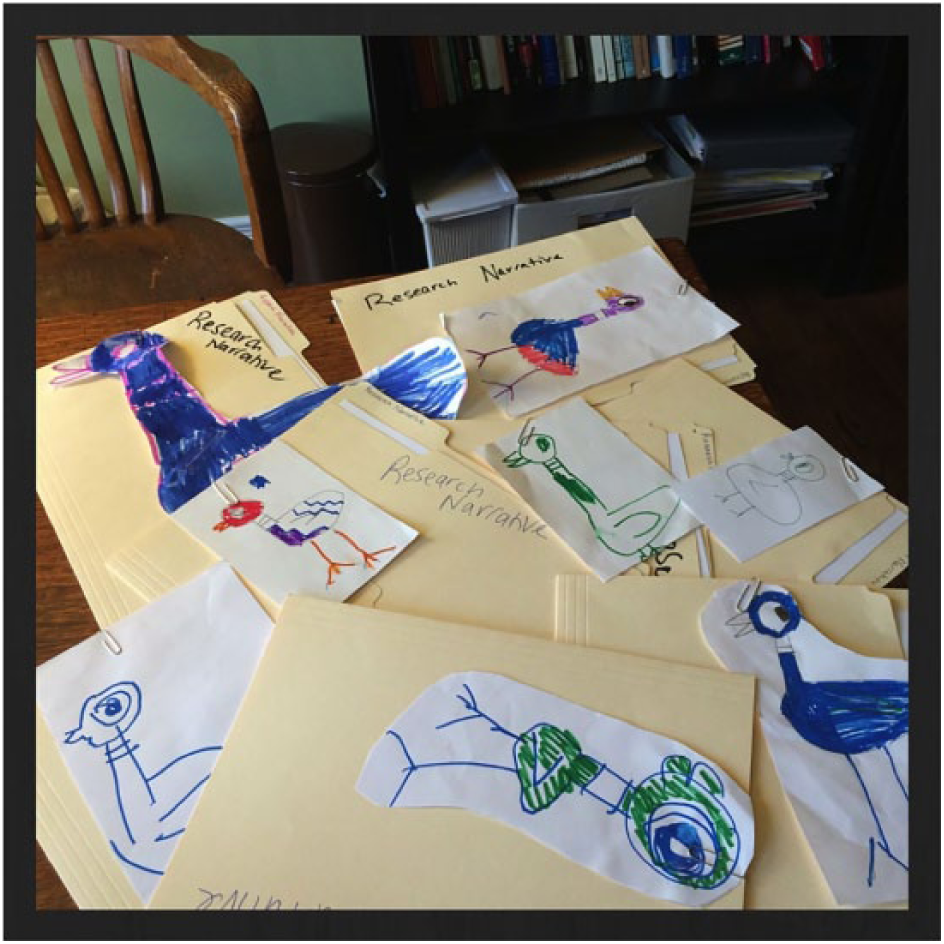
Stack of Simple Pigeon Nels.
This Is Nel
This is Nel. She always took pride in her working class roots and unabashedly acknowledged that she benefited from the mid-20th-century movement in academia to cultivate faculty from what Brown (2015) claimed was the “widest class basis in human history” (p. 180). She was pleased to be among outsider voices that cracked open what could be said and thought in academia. Now, however, she hears resonating arguments that neoliberal universities are 21st-century feudal systems, where faculty are low-level, tribute-paying workers with limited agency (Holligan, 2011). This isn’t the Nel she imagined for herself, and so her coherence crumbles. Desiring the cracks she first admired in academia, she works to make her thinking constantly (re)assemble and fall apart, striving to make coherence a nonsense word: cheenocer. She is intrigued by what Lather (1994), citing Welchman (1989) called “Dada practice,” so like Dadaists, she desires contradiction, paradox, juxtaposition, and imagination, and like them she doesn’t want to be preserved, congealed, nailed down, defined. When she thinks of scholarly coherence, she lasers in on the curriculum vitae, the document that translates poetically as the “course of life” but serves instead as a record to prove solidity and some sense of an internal “Nel” logic. She seeks to dismantle through parody, one of many Dadaist practices intended to subvert stability and rattle performances of scientific rationality.
To produce her parodies, she draws upon her readings of Dadaist texts, her CV, and all the materials of her scholarship that are both evidenced and hidden by the CV. Here is her in-process series The Scholar Laid Bare by Her Work(d)s, Even, where she has created two works (so far) that imagine how Dadaist artists would take up and play with the curriculum vitae.
Figure 3 is a parody of Francis Picabia’s 1915 Ici, c’est ici Stieglitz, in which Picabia raises questions about photography capturing the ideal (Freeman, 1989). The original drawing is Picabia’s satirical portrait of photographer Alfred Stieglitz, shown as a mechanical bellows camera (The Metropolitan Museum of Art, n.d.). Nel wonders about—and bristles at—the kind of ideal and self-portrait her CV produces. Figure 3, then, is a randomization of Nel’s CV, one of a multitude of Nel portraits that could be produced when the carefully circumscribed words of her CV are reformed willy-nilly on the page.
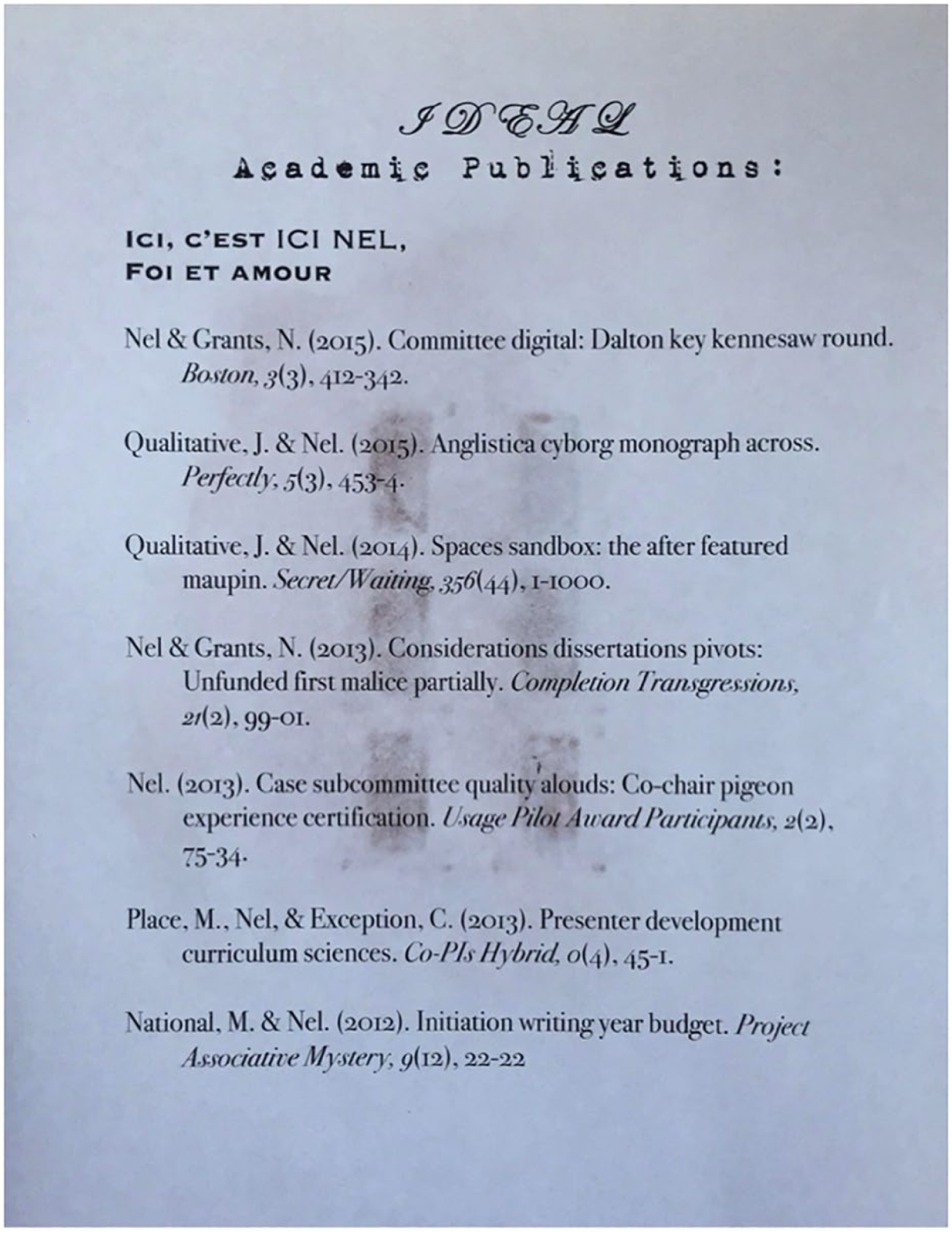
Ici, c’est ici Nel.
The titular piece of her series, The Scholar Laid Bare by Her Work(d)s, Even (The Black Box), contains fragments, diagrams, notes, and so forth of whatever she needed, created, lifted, left behind as she produced herself as a cheenocer. The Scholar Laid Bare by Her Work(d)s, Even (The Black Box) (Figure 4) is Nel’s play on Marcel Duchamp’s 1934 The Bride Stripped Bare by Her Bachelors, Even (The Green Box), which was Duchamp’s own playful but rigorous explication of his visual work The Bride Stripped Bare by Her Bachelors, Even (The Large Glass). Just as The Green Box was a collection of documents associated with the making of Duchamp’s art piece, Nel’s The Black Box is a collection of documents associated with the making of her CV. Duchamp painstakingly created 320 copies of The Green Box; Nel reckons that over the course of her career, the number of iterations of her CV will far outstrip Duchamp’s.
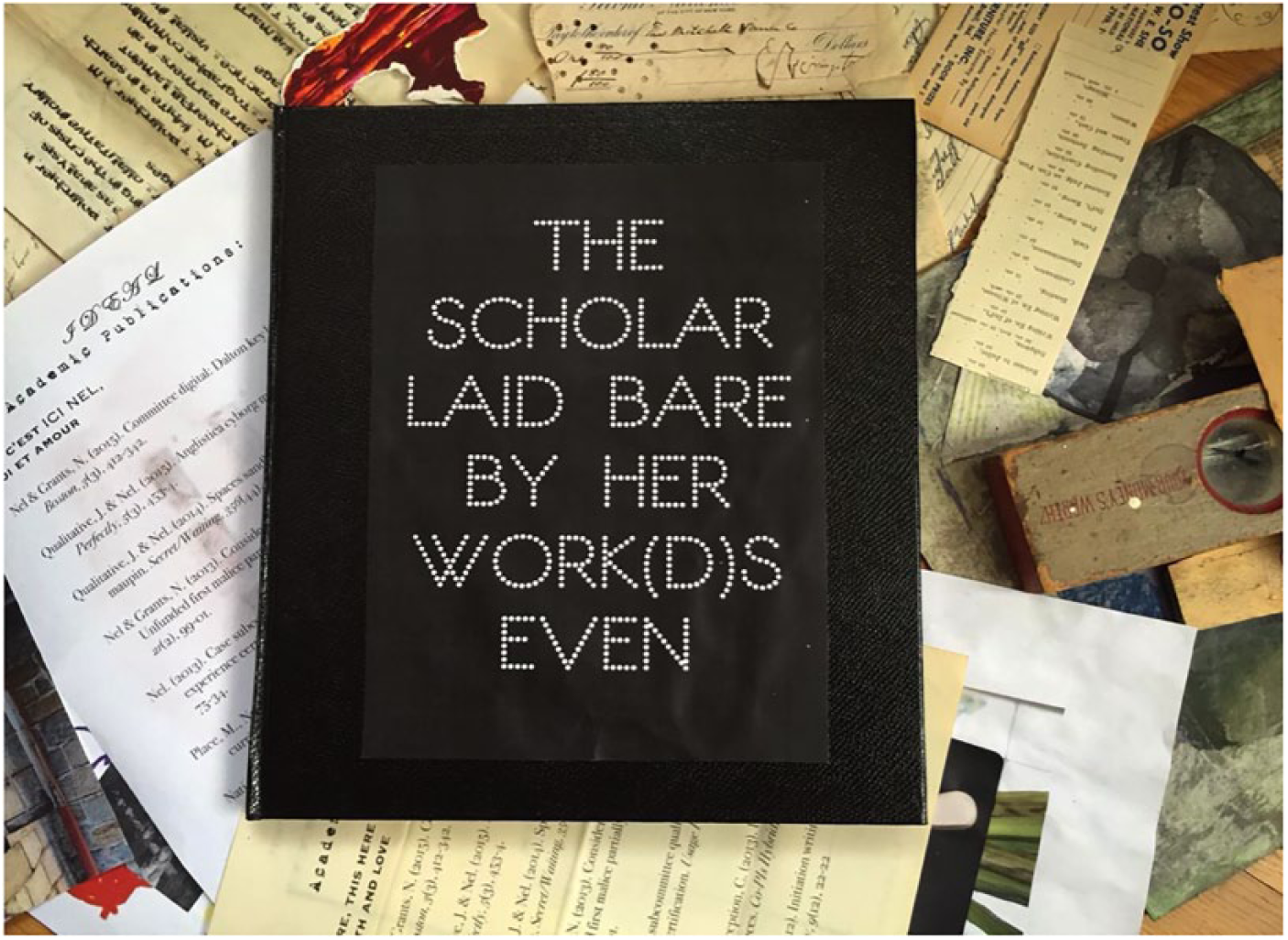
The Scholar Laid Bare by Her Work(d)s, Even (The Black Box).
This Is Nel
This is Nel. Nel is obsessed with how coherence deconstructs in language. She draws on scholars, such as Jacques Derrida, who claim that language is always already undoing itself. As contextually dependent, never neutral, and susceptible to multiple and contradictory meanings, words are just too unstable to transmit fixed ideas about herself and her work. Those words can always be read as “more, less, or something other than what [she] would mean” (Derrida, 1967/1974, p. 158). Consequently, she can always be read as “more, less, or something other” than coherent. That is a dangerous predicament in the neoliberal university, given her need to trust the ability of words to demonstrate her individual strengths both to differentiate herself from others and to prove her value to the institution (Davies & Bansel, 2010).
Nel decided to embrace the ambiguity and uncertainty that continuously disrupt her attempts to locate the right words to describe her work because she wants to think about her value in more than just economic terms. She collaborated with her 1,247 Facebook friends to create a series of photographs titled, Network My Focus. To create the series, she posted a status on Facebook requesting that her friends help label her area of focus. Her friends’ comments, as well as her response posts to those comments, produced an unbelievable amount of information from which to draw—information that constantly expands as her friends use hashtags that link to various other ideas, images, texts, and conversations labeled by that hashtag. The incomprehensible network of hashtagged words and phrases as well as the wealth of suggestions about how to sort, simplify, and make that network coherent highlight the multiple ways Nel is read and understood by others. Here is one photograph (Figure 5) she calls Earlier Today. She wasn’t quite sure what she wanted to do with that tangled network besides just say to herself, “See, I could be read as all of these things . . . earlier today.”
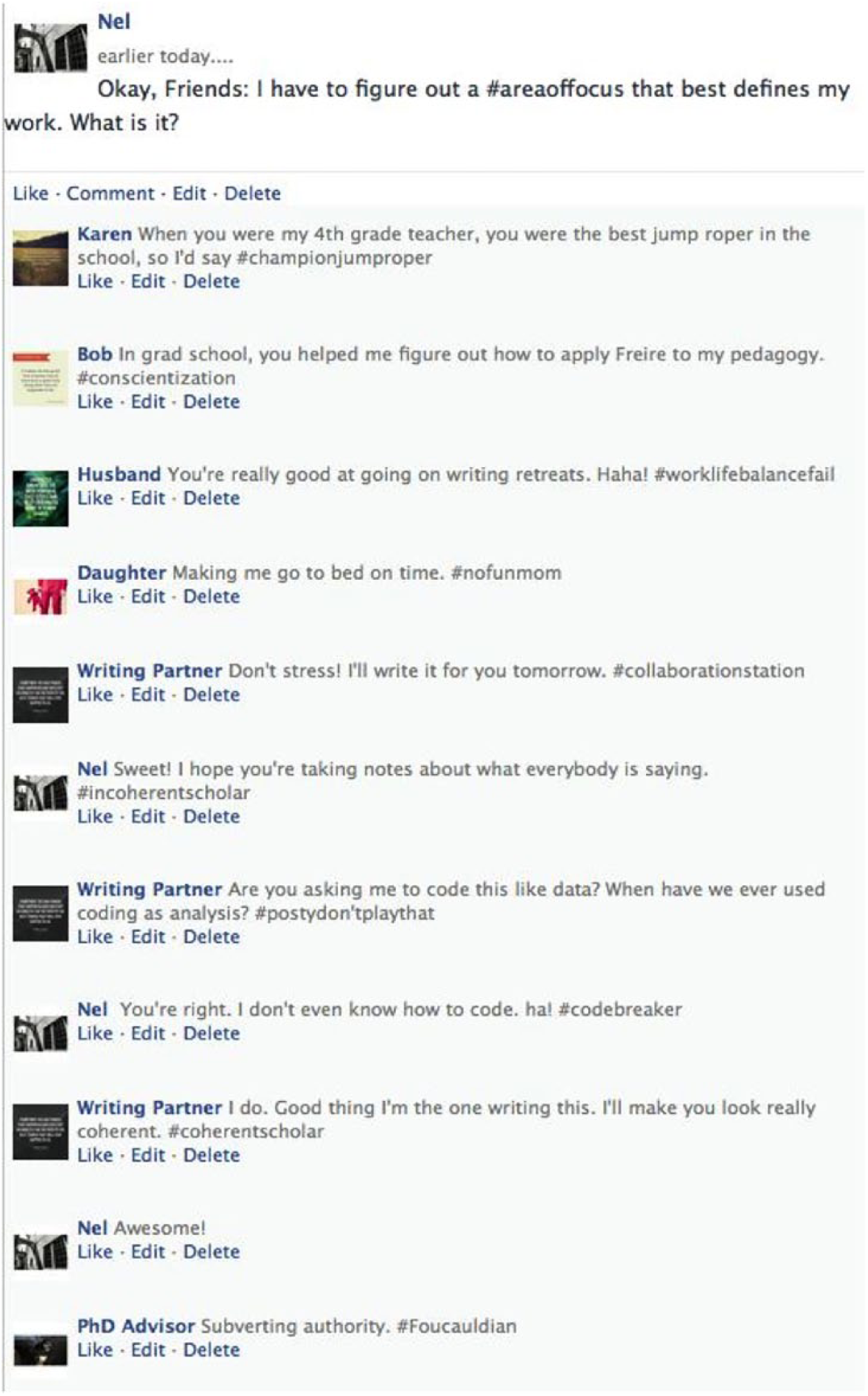
Earlier Today.
So, those are just a few of my Nels. You might be wondering, did I actually give any of this to my university? No, I didn’t give them pigeons or collages as CVs, and I didn’t perform a dystopian narrative. I branded myself. But I didn’t end up doing it all by myself. I recruited colleagues to help me write my final pigeon. I gave myself a deadline for the first sentence. I put different versions of my CV on my faculty page, my ResearchGate, and my personal website so that there are multiple versions in circulation. But more than anything, thinking about the coherent neoliberal subject in all these ways reinvigorated my will to critique. But it wasn’t just about me. Through all these Nels, I learned something about coherence worth sharing.
Now, when my colleagues ask me how to write a research narrative, I invite them to my office and show them my Nels that I’ve displayed around the room. I give doctoral students standing ovations and flowers for performances of coherent scholarship. Basically, I highlight that I made it up, that we all always just make it up. And another thing. I started a tumblr (http://thisisnel.tumblr.com/) where I can continue to play . . . and you can, too. So, go ahead, academics. If you have some shit to say, I suggest you start with This is Nel.
*****
The collective authoring of Nel’s TED Talk serves as an example of possible ways to negotiate the promise/risk we all experience, to varying degrees and in varying contexts, when we attempt to brand ourselves as particular kinds of scholars. Drawing on Derrida’s (1992) conception of responsibility, Koro-Ljungberg (2016) inspires us to question whether simply upholding our duty to institutional and professional traditions, policies, and standards is an ethical practice. She argues, instead, that “the duality of responsibility acknowledges tradition . . . but it also asks researchers to move beyond strict . . . bounded and controlled knowledge” (p. 131). Through such dual duty, scholars can “shift legacy and resituate or re-create tradition from within their discourses and disciplines” (p. 131).
Maybe by writing as Collective and speaking through Nel, who we suggest both stands for and is more than us individually and collectively, we are taking Derrida’s (2002) “absolute risk”—what Koro-Ljungberg (2016) describes as “deviating from the known past, rewarding social expectations, and documented methodological approaches” (p. 131). Perhaps more so than usual in our collaborative projects, we struggled here with our ideas and decisions about representation and authorship. We debated creating Nel instead of (pretending to) speak from our own experiences. We worked with and against our own desires to refer to one another as “lead” and “last” authors. We discussed whether, how, and in what instances to name ourselves as authors. In each instance of listing, citing, and describing this piece, we must justify its critique of coherence and our individual and collective authorship claims anew. We must also acknowledge that in writing as Collective and privileging (in)coherence, our responsibility is not finished because any critique runs the risk of creating a new structure—(in)coherence becomes the new coherence, perhaps—that is equally problematic. However, working with this dual responsibility, both within and against coherence as a mechanism of neoliberalism, helps us maintain a perpetual sensitivity about authorship, ownership, and coherent scholarship as we welcome the unknown and unforeseeable in our careers in neoliberal academies.
Footnotes
Declaration of Conflicting Interests
The authors declared no potential conflicts of interest with respect to the research, authorship, and/or publication of this article.
Funding
The authors received no financial support for the research, authorship, and/or publication of this article.