



Abstract
This co-authored article examines the oldest known treaty between incoming Europeans and Indigenous North Americans to derive five basic principles to guide healthy, productive relationships between Indigenous community-based researchers and university-based ones. Rick Hill, Tuscarora artist and knowledge keeper from the Six Nations of the Grand River, publishes for the first time here the most complete oral history that exists today of that ancient treaty, from the early seventeenth century, known as the Two Row Wampum or the Covenant Chain agreement. Interspersed with Dr. Hill’s reflections, Daniel Coleman, a settler professor of English and Cultural Studies at McMaster University, outlines five principles for research partnerships derived from the discussions of the Two Row Research Partnership seminars that Hill and Coleman have been hosting at Deyohahá:ge: Indigenous Knowledge Centre for the past four years. Formed between the Hodinöhsö:ni’ confederacy and Dutch merchants arriving near Albany, New York in 1609, the Two Row Wampum-Covenant Chain treaty set the precedent for nation-to-nation treaties between European colonial powers and Indigenous peoples with two parallel rows representing the Hodinöhsö:ni’ canoe and the Dutch ship sailing down the shared river. Each party agreed to keep their beliefs and laws in their separate vessels, and on this basis of interdependent autonomy, they established a long-lasting friendship. This article suggests that by renewing our understanding of the Two Row Wampum-Covenant Chain treaty, Indigenous and non-Indigenous researchers alike can rebuild relationships of trust and cooperation that can decolonize Western presumptions and re-establish healthy and productive research partnerships.
Keywords
Our purpose in this article is to outline some basic principles that can guide healthy research partnerships between Indigenous community-based and settler university-based researchers. In so doing, we wish to contribute to the ongoing project to decolonize Western research methodologies 1 that, in the words of Mi’kmaq theorist Marie Battiste (2000), assume “the prevailing authority of Eurocentric discourses” (p. xx), and thereby reinforce what she calls “cognitive imperialism” (p. xvii). Because the long and continuing history of simultaneous exploitation and dismissal of Indigenous knowledges has, in the words of Maori scholar Linda Tuhai Smith (1999), made “‘research’ . . . one of the dirtiest words in the Indigenous world’s vocabulary” (p. 1), there has been an upsurge in scholarly literature over the past two decades of what Creek scholar Craig Womack (2008) has called “new traditionalism,” whereby Indigenous researchers have turned to specific Indigenous traditions, ceremonies, or protocols to outline non-Western conceptual or methodological frameworks for their research. Through developing these alternative frameworks, these Indigenous researchers aim to assert the dignity and value of Indigenous knowledge traditions and insist that healthier relationships between Indigenous communities and Western university-based research institutions will demand recognition of the distinctive contribution Indigenous ways of knowing can make not only to the restoration and regeneration of Indigenous communities but also to a re-assessment and expansion of what the Western academy understands research to be. In this article, we wish to contribute to this new traditionalist project by examining the oldest known treaty between Indigenous North Americans and incoming Europeans, known in English as the Two Row Wampum (Figure 1) or the Covenant Chain of Friendship (Figure 2).
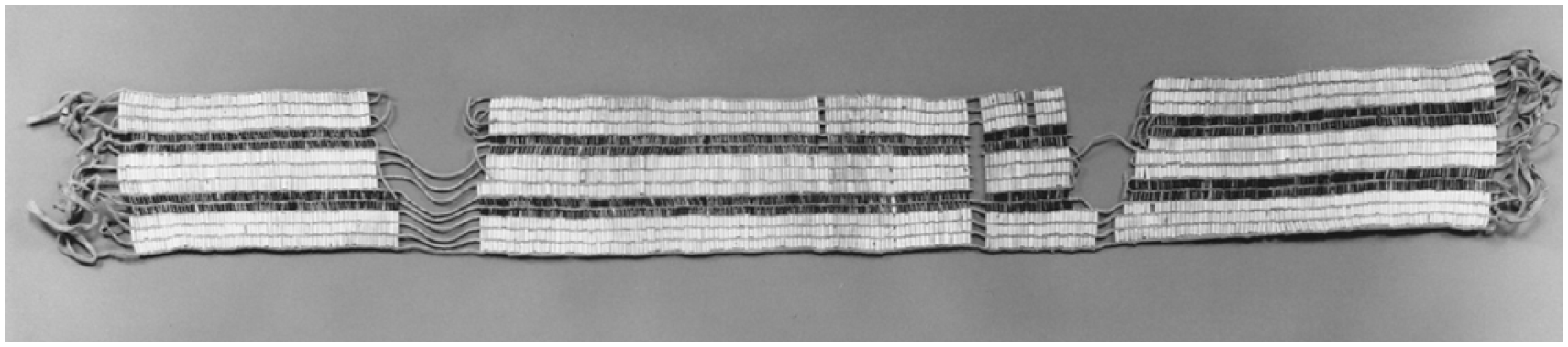
Tekani teyothata’tye kaswenta, two row wampum belt.
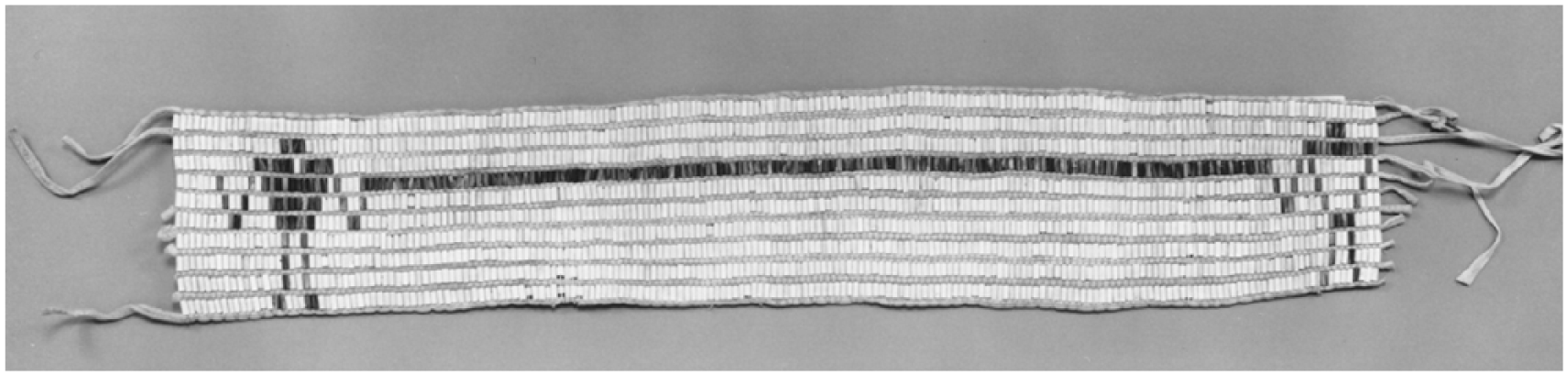
Tehontatenentsonterontahkhwa, “the thing by which they link arms,” covenant chain wampum belt.
Developed collaboratively between members of the Iroquoian (Hodinöhsö:ni’) Confederacy 2 and newly arrived Dutch merchants in the second decade of the seventeenth century near what is today Albany, New York, the Two Row Wampum-Covenant Chain treaty explicitly outlines a dialogical Indigenous-European framework for how healthy relationships between peoples from different “laws and beliefs” can be established. When the British took over governance of the New Netherlands settlements in 1664, the minutes of their many council meetings with the Hodinöhsö:ni’ over the next century reveal that they took up and elaborated the terms of the Two Row Wampum-Covenant Chain treaty in a prolonged effort to ally themselves with the powerful Confederacy. The concepts of reciprocity-between-autonomous-powers conveyed in this treaty, therefore, became precedents for treaty-making with a wide array of Indigenous peoples not just for the British colonial regime but for American and Canadian ones when these nation-states subsequently emerged. As such, our review of the protocols outlined in the Two Row Wampum-Covenant Chain as a guide for cross-cultural, cross-epistemological research relationships constitutes an effort to “shake the dust” from and “repolish” a set of understandings that were foundational to North American political and social relations so we can see their relevance for building better relationships in a wide variety of contexts, including that of scholarly research.
Following the dialogical model laid out in the Two Row Wampum-Covenant Chain agreement, this article is written in two voices: The first combines a recitation of and reflection on the oral history of the four-hundred-year-old treaty conducted by Tuscarora historian and artist Rick Hill, and Rick’s voice alternates with reflections on five principles derived from this oral history offered by writer and professor Daniel Coleman. Over the past four years, the two of us have hosted the “Two Row Research Partnership” monthly seminar series at Deyohahá:ge: Indigenous Knowledge Centre (IKC) at Six Nations Polytechnic (SNP), the Hodinöhsö:ni’-run postsecondary college on the Grand River Territory of the Six Nations in southern Ontario. Deyohahá:ge:, which means “Two Roads” in the Cayuga language, was given its mandate in 2007 by Six Nations elders, who wanted the knowledge center to bring together the best in Hodinöhsö:ni’ and Western knowledge traditions to generate a dynamic research hub on the Six Nations territory for the benefit of the local Hodinöhsö:ni’ community, as well as to create understanding in surrounding communities and beyond. We established the monthly seminars to reflect on and develop Deyohahá:ge:’s two-paths mandate by bringing together Six Nations community-based researchers and settler university-based researchers—including professors, graduate students, Deyohahá:ge: staff researchers, and other community knowledge holders—so that we could consider together how the Two Row Wampum-Covenant Chain treaty protocol might provide guidance for conducting healthy research methods and partnerships between the two paths of the local Indigenous community and settler universities. We provide a quick outline here of five principles we have derived from the monthly seminar discussions so readers can get a brief idea of what we have learned so far, and then we introduce ourselves and describe how Deyohahá:ge: was established in a bit more detail, before we enter into Rick’s recitation of the oral history interspersed with Daniel’s reflections on each of the research principles.
Introductions
Our belief in the value of a Two Row 3 research paradigm does not arise out of mere theory. For one thing, I have been working for forty years in wampum study and repatriation. 4 My aim in this work has been to restore a lively and generative knowledge among Hodinöhsö:ni’ people of the richness of our own forms of record-keeping—our ceremonial, philosophical, political, and artistic “archives”—and, in the process to help Onkwehonwe 5 people and their neighbours develop an understanding of the protocols for productive relationships between sovereign and interdependent peoples. Furthermore, Daniel and I are gathering our thoughts here from ten years of working together to develop the Deyohahá:ge: Indigenous Knowledge Centre as one of the more recent initiatives rising out of a twenty-five-year cooperation between SNP based in Ohsweken on the Grand River territory and McMaster University in nearby Hamilton. The vision for an Indigenous Knowledge research hub had long been promoted by Dr. Dawn Martin-Hill (Mohawk, Wolf clan), who had been instrumental in facilitating discussions in the post-Oka period 6 of the early 1990s between elders from Six Nations reserve and administrators at McMaster University on establishing Indigenous education both on the reserve and on campus. Those discussions formed the groundwork for the founding in the early 1990s of SNP in Ohsweken, which enabled students on the reserve to transfer credits from their first two years of study at SNP to any of five universities in the region. They also laid the foundation for the Indigenous Studies Program at McMaster University. As Director of the Indigenous Studies Program and the only Indigenous faculty member on the university campus during that time, Martin-Hill was concerned to attract Hodinöhsö:ni’ scholars to their traditional territory, not only to increase the number of Indigenous faculty members on McMaster campus but also to regenerate Hodinöhsö:ni’ knowledge on the Grand River Territory. So, in 2007, a steering committee made up of SNP leaders (Rebecca Jamieson, Linda Staats, Tracy Deer), community elders and knowledge holders (Hubert Skye, Lottie Keye, Ima Johnson), and university faculty members (Dawn Martin-Hill, William Coleman, Bonnie Freeman, Karen Hill, Rick Monture, Daniel Coleman) met to lay the groundwork for a new Indigenous Knowledge Centre that would be housed and administered at Polytechnic, guided by traditional knowledge holders, and jointly funded by McMaster and SNP. One of the IKC’s first actions was to hold a ceremony in which community elders fluent in Hodinöhsö:ni’ languages and traditional knowledge were presented with wampum belts that recognized them as Indigenous Knowledge Guardians. Several of these elders functioned as core faculty for the Onkwehonwe Language Diploma program, offering classes in Cayuga and Mohawk at SNP and accredited by McMaster. It was these Knowledge Guardians who suggested that the new Centre be named “Deyohahá:ge:.” The idea was that holding these two paths of Western and Hodinöhsö:ni’ knowledges side by side would enable future generations to preserve and regenerate Six Nations ways of knowing and being, as well as build equitable and healthy relationships with Western ways of knowing and being.
The teaching of the Two Row Wampum-Covenant Chain treaty, therefore, was seen by the elders as fundamental to the operations of the Indigenous Knowledge Centre, and it was, thus, our mandate as its founding members to consider how this seventeenth-century treaty of friendship might inform productive relations between Indigenous community-based researchers and university-based ones. In 2010, Deyohahá:ge: appointed me as its Senior Project Coordinator. My role was to preserve and transfer knowledge from elders, speakers of Indigenous languages, and cultural leaders to younger generations; to identify research priorities through discussions with the Knowledge Guardians and other community leaders; to develop a dialogue between Indigenous and other communities that increases awareness of Indigenous knowledges, research, and ways of living; and to establish an archive and research hub on the Grand River territory at Deyohahá:ge:. I am a practicing artist, art historian, museum curator, writer, and university teacher, and previous to working at Deyohahá:ge:, I had worked at the National Museum of the American Indian at the Smithsonian Institution in Washington, D.C, the Institute of American Indian Arts in Santa Fe, the Haudenosaunee Resource Center at the Tonawanda Seneca Nation in New York, the Indian Art Centre in Ottawa, and the department of Native American Studies at the State University of New York at Buffalo. Since I started work at Deyohahá:ge:, we have been repatriating large digital archives of Six Nations materials from the Smithsonian Institution and from the American Philosophical Society, which are being translated by elders and catalogued by research assistants. Given my lifetime interest in Hodinöhsö:ni’ civilization, expression, and history, I have accumulated a large personal archive of physical materials, which is also being added to the quickly growing collection. Key among my priorities over the past forty years has been the repatriation of thousands of pieces of wampum to their traditional keepers from private and public collections around the world. Over the years, I have published several articles and chapters on the Two Row Wampum-Covenant Chain agreement, in particular. 7
Given the Knowledge Guardians’ naming of the Indigenous Knowledge Centre after the Two Row-Covenant Chain agreement, and given Rick’s lifetime of wampum study and activism, the Deyohahá:ge: group began to hold monthly seminars on developing a Two Row Research Paradigm facilitated by Rick and me. I am a settler scholar, and I am a professor in the Department of English and Cultural Studies at McMaster University. I was born and raised in Ethiopia, the child of Canadian missionaries, and I came to live in Canada when I was college age. As a master’s student in the 1980s, I taught first-year English courses at what was then called the Saskatchewan Indian Federated College (now First Nations University) in Regina, Saskatchewan. Those were years when the cultural appropriation debates were on the rise in the aftermath of Indigenous protests over the exhibition of spiritually sensitive materials in The Spirit Sings travelling show of Indigenous art and artifacts that was exhibited at the Calgary Olympics of 1988. 8 Given the rising concerns over non-Indigenous “experts” appropriating and assimilating Indigenous materials and knowledges into Western paradigms and formats, I felt that respect for Indigenous people and knowledges meant that non-Indigenous scholars like me should step back from developing scholarly careers through research and publication on Indigenous topics, so I studied and wrote on other ones, especially narratives of migration and race relations in Canada. 9 On moving to McMaster University in 1997 and working alongside Hodinöhsö:ni’ colleagues who taught in the Indigenous Studies Program here, and especially after McMaster agreed to serve as the barracks for the Ontario Provincial Police when they raided the Douglas Creek Estates site where they tasered, beat, and arrested Six Nations members who had reclaimed the contested land in 2006, I realized more profoundly than ever before that there is no neutral ground outside of Indigenous and settler relations in North America, and that institutions like the university where I work are already deeply invested in those relations. I was later asked to serve as Academic Co-Chair of McMaster’s President’s Committee on Indigenous Issues, which involved liaison work with surrounding Indigenous communities, and this involvement, in turn, led me to investigate the Two Row Wampum-Covenant Chain tradition as a model for respectful research partnerships between Indigenous communities and universities. 10
Over the past four years, we have hosted a series of monthly seminars at Deyohahá:ge: aimed at both practical and theoretical results. By gathering together community-based and university-based students and researchers in the seminars, we intended to provide people power for Deyohahá:ge:, as participants scanned, filed, and performed data entry with materials in the archives and thereby immersed themselves in the research resources available there. Our second purpose was more reflective: to encourage the participants to step back and meditate on our experiences of working together in and between the “two roads” of Hodinöhsö:ni’ and Western ways of knowing, being, and conducting research. To supplement the hands-on research experiences and our seminar reflections, we also read and discussed recent Hodinöhsö:ni’ contributions to the growing field of Indigenous research methodologies. Rick and I then drafted this article based on the group’s reflections. After receiving the group’s commentary and feedback on the draft, we revised it for publication. Our hope is that the results will provide a guiding document for Deyohahá:ge:’s future research partnerships as well as for other Indigenous-university research collaborations.
History of the Two Row Wampum-Covenant Chain Tradition
In 1678, Onondaga diplomats came to Albany, New York to renew the Covenant Chain agreement that had been made with the British a year previous. The minutes from that encounter echo the oral narrative of the Two Row Wampum, stating that the Hodinöhsö:ni’ diplomats
came to confirm the Ancient Brotherhood, which they would remind their Brethren has subsisted from the first Instance of Navigation being in use here (at the Time of a Govʳ Called Jacques) & hath continued to the Time of Old Corlaer & from Old Corlaer to his Present Excellʸ, for the Continuance of which they much rejoice & now Renew the ancient Covenant & make the Chain Bright. (Richter, 1982, p. 48)
The Onondagas were referring to the first treaty made with the Dutch, which had been led by Jacob Eelckens also known as “Jacques.” Arendt Van Corlaer, one of the Dutch settlers at Renesselaerwyck, near present-day Schenectady, New York in 1630, had cultivated a good relationship with the Mohawks. In honor of Van Corlaer’s integrity, the Mohawks bestowed his name as a title to all subsequent governors of the New York Colony, thus the reference to his name by the Onondagas. By 1678, the primary metaphor for the treaty relationship between the Hodinöhsö:ni’ and Great Britain was the Silver Covenant Chain, which was polished or made bright by renewing the treaty and resolving any matters that might have strained the relationship between the two parties.
However, there was an older treaty that preceded this Covenant Chain. It has become known as the Two Row Wampum treaty, made as early as 1613 with the Dutch. On May 7, 1862, Chief William Jacobs of the Grand River Territory wrote to the Canadian Superintendent General of Indian Affairs regarding the meaning of the Two Row Wampum: You sail your own Boat and we’ll paddle our own canoe Side by Side. I was not to enter in your craft and you was not to enter in my canoe. Gale and calm we must be side by side . . . when the pail [pale] face man saw my laws he says to the read [red] man’s face your laws of the Six Nations is good that your forefathers made for you we will always keep our laws separate from your laws. The pail [pale] face man said to the read [red] fase [face] I don’t understand the way of your cannoe ruls [rules] the Six Nations chief said I don’t understand the ways of your boat ruls the pail fase said to the read man I don’t understand the Birch cannoe ruls if I enter in it it might [up]sett the Read man said to the pail face that is the ruls and laws the great Spirit gave us. (National Archives of Canada, RG 10 Vol. 1862, F.239)
The original Two Row Wampum belt, properly called Teioháte (“Two Paths” in Mohawk language), Kaswenta (“Wampum Belt”), or Tekani teyothata’tye kaswenta (in Cayuga language), was once held by the Confederacy Chiefs at Grand River but disappeared, and only the oral tradition of the narrative of the wampum belt existed for over a century. The actual wampum belt was eventually repatriated to Grand River in 1986, recovered from the Museum of the American Indian in New York City, along with ten other historic wampum belts. On February 26, 1981, Cayuga Snipe Clan Chief Jake Thomas (1922-1998) provided a reading of the Two Row Wampum for Edward Schreyer, Governor General at Rideau Hall in Ottawa. Notes of that presentation were recorded by Canadian Museum of Man 11 linguist Michael Foster, and throughout the following pages, I quote from his notes as the basis for this reflection on the meaning of the Two Row Wampum. I will use italics when I quote from Foster’s translation of Thomas’s spoken Cayuga oration.
The oral memory of the Two Row Wampum was maintained by Chief Thomas. He had learned the translation of the Two Row Wampum from his father, David Thomas, who had learned it from his father. We don’t know how far back in Thomas’s family lineage the knowledge of the Two Row existed. As with other oral traditions, a person with a good memory was taught the meaning contained in the wampum, and on occasion, this wampum keeper would share that knowledge so that its memory would be kept fresh in the minds of subsequent generations.
The exact date of the making of the Two Row Wampum belt is unknown. It has perplexed scholars that no specific mention of this wampum belt can be found in the written records of the Dutch or early British colonial administrations. However, most of our cultural teachings cannot be found in these records either. Instead, our teachings were maintained through story, song, ceremony, and philosophy that were often imparted informally. The historic record does have many references to the symbolic imagery found in the oral narrative of the Two Row, presented by various speakers in over two centuries of treaty-making. These references indicate that the tying of the European ship to the Indigenous canoe was the founding act of treaty-making between the two.
Wampum belts, made from small tubular shell beads woven into symbolic designs, were essential elements in Hodinöhsö:ni’ treaty-making, which was based on the belief that wampum could capture the words and pledges made in its presence. This belief made the use of wampum critical in maintaining the oral memory of treaty-making. Often historians consider what was written in European languages to be the only valid proof of what took place. For the Hodinöhsö:ni’, wampum records their side of the story and was passed on from father to son, as in the case of the Thomas generations.
The Two Row Wampum-Covenant Chain agreement constitutes the oldest known formalization of friendly relations between incoming Europeans and Indigenous North Americans. British treaty meeting minutes such as the one quoted earlier from 1678 indicate that the colonial administrators regularly appealed to the Two Row-Covenant Chain agreement with the Hodinöhsö:ni’ to secure their loyalty as allies in trade and battle, 12 and that it went on to shape the recognition of Indigenous rights to land that appears in the Royal Proclamation of 1763. 13 Thus, the Two Row Wampum-Covenant Chain has become one of the most widely known instruments for depicting the nation-to-nation relationships with Indigenous peoples on which settler states such as Canada and the United States were founded. All the Indigenous speakers at the 1980 Fourth Russell Tribunal on the Rights of Indians of the Americas, for example, held a replica of the Two Row belt in their hands when they spoke at the gathering in Rotterdam, Holland (R. Hill, 1992, p. 159), and thirty-five years later, the same wampum was appealed to in the Truth and Reconciliation Commission of Canada’s (2015) final report, which called for a new “Royal Proclamation and Covenant of Reconciliation” between Canadians and Indigenous peoples (pp. 196-199). On the four hundredth anniversary of the agreement in 2013, the Onondaga Nation and its non-Indigenous neighbors in New York State organized the Two Row Wampum Renewal Campaign, which consisted of a canoe journey of Indigenous and non-Indigenous paddlers bearing a replica of the Two Row Wampum from Syracuse to Albany and then south on the Hudson River to the United Nations in New York City, after which they took the replica to Amsterdam. Along the way, they called for renewal of the principles of friendship and respect that the colonial nation-states have long abandoned (see http://honorthetworow.org and Hallenbeck, 2015). The Two Row is also regularly evoked in recent scholarship on Indigenous research methodologies, 14 which urges scholars to move away from extractive models whereby researchers in the sailing ship raid the culture and laws of the Indigenous canoe and to focus instead on developing new models of sharing the river with Indigenous communities in ways that are relationally respectful and accountable. 15 Mohawk scholar Marlene Brandt-Castellano highlighted the importance of reciprocity and differentiation in Indigenous research during a 2005 keynote address at an Aboriginal research conference in Winnipeg when she observed that
the challenge of and responsibility for Indigenous research lie with all of us . . . Indigenous people must suspend distrust and non-Indigenous people must suspend disbelief. Through the creation of principled ideological space, . . . there is a possibility to move forward with the existing proposition of Indigenous and tribal research frameworks. (Cited in Kovach, 2009, p. 156)
We aim to contribute in this article to these current discussions on Indigenous research methodologies by suggesting that the Two Row Wampum-Covenant Chain treaty provides a unique model for creating this principled ideological space. It is an Indigenous framework based in Hodinöhsö:ni’ political, ecological, and social philosophy that is explicitly aimed at formulating reciprocal and productive relationships with non-Indigenous neighbors without collapsing either party’s distinctiveness or autonomy.
Another wampum belt, not written about very often, sets the stage for the Two Row (see Figure 3). That earlier belt records the first contact between the Hodinöhsö:ni’ and the first newcomers in their territory, who were French. The belt presents three sets of diagonal “rafters” or “braces” that commonly denote an extension of Hodinöhsö:ni’ culture or worldview to shelter new allies in wampum iconography. It was common to speak of welcoming other nations into the Iroquoian longhouse and that to do so was to “add another rafter” to the Confederacy.
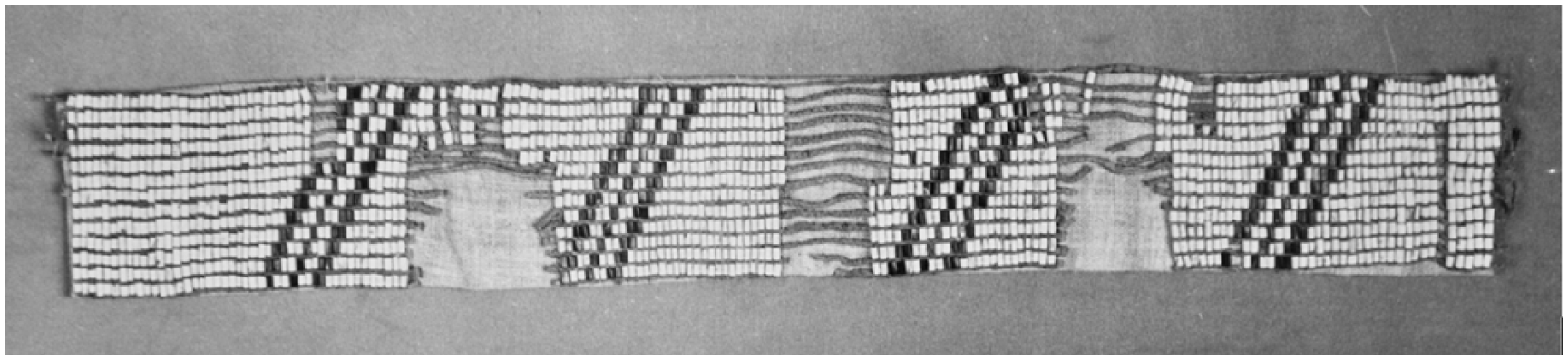
First sighting of the people with pale faces belt.
The oral history suggests that this earlier belt likely refers to the arrival of Jacques Cartier who had encountered the St. Lawrence Iroquoians on his first voyage of 1534 and by 1545 had provided a written record of his experiences in what became known as “Canada.” Both the written French record and the oral memory of the wampum, called the “First Sighting of the People With Pale Faces,” tell of how a devastating illness suffered by the newcomers (likely scurvy) was treated with herbal medicines supplied by the Indigenous hosts. The whites are depicted on the wampum belt as being frail (a thin diagonal row of beads) and supported by their Indigenous allies (two larger diagonals, one on either side of the thin one). When the French returned in 1601 to that region, they reported an ongoing war between some Native nations. We do not know the origin of that war. But turmoil prevailed on the land, at least between the Mohawk Nation and its neighbors.
The date of 1613 has come to be associated with the time when whatever kind of agreement was made and codified by the Two Row Wampum Belt. This date appeared on a parchment that surfaced in the 1970s and was thought to be the Dutch transcription of the Two Row Treaty. This document purports that Jacob Eelckens made an agreement with the Mohawk leaders on April 21, 1613. While a few scholars have labelled the document as a fraud, I’m not sure it is that easy to dismiss. As far as I know, I am one of the few people left who once held that old parchment and lived to write about it.
In 1980 or 1981, Oren Lyons brought this parchment to the Turtle (Native American Centre for the Living Arts) in Niagara Falls, New York where I was the Museum Director. It had been written about by Lawrence Gwyn Van Loon (1903-1985) in 1968 (see Van Loon). Lyons stated that it had been looked at by experts who determined that parchment of this kind was in use in the seventeenth century, as was the ink used to write the terms of the treaty in the Dutch language. I actually photographed the parchment at the time, but those negatives have been long lost, along with much of the collection at the Turtle, which was confiscated by the U.S. Internal Revenue Service and sold off at auction. The Onondaga Nation still holds that parchment as far as I understand.
Prior to 1613, the Mohawks had already had some experience in dealing with the French and the Dutch, who they called Skaghneghtadaronni, meaning “People of the Wooden Shoes.” In 1609, French colonial governor Samuel de Champlain (1567-1635) led an attack upon the Mohawks and used firearms to kill several of them. It is hard for us to appreciate how startling that event was. It was the first time the Mohawks saw the use of guns and their devastating impact. The French chose a tactic of war to attempt to break the unity and strength of the Hodinöhsö:ni’. The Mohawks decided that they needed to make alliances with the newcomers who arrived by ship, and they chose the more friendly Dutch at that time.
Two Row-Covenant Chain Research Principles
Principle 1: Research Relationships Are Dialogical
The oral history of the Two Row Wampum-Covenant Chain treaty provides crucial principles for rethinking research relationships. 16 In this article, we outline five principles, but with unlimited time and space, there are many others that could be discussed. First, the Two Row tradition depicts a relationship that is explicitly dialogical rather than monological, and it emphasizes the sacredness of the living river between the two parties. In its initial stage, the Two Row protocol differentiates, not to create cultural apartheid, but to generate respect between the two groups, so they can share the river that sustains all life. As our seminar participants regularly indicated, we need to remember that the white beads between the two purple rows do not represent a wall but a river. Attending to differences between the parties is not the ultimate goal of the relationship, but beginning with differentiation generates what Cree philosopher Willie Ermine calls an “ethical space of engagement.” 17 This ethical space guards against assimilation, an approach that would breach the sacred spaces between parties and assume control of the other’s vessel, absorbing the distinctions of the other party into those of the first and then heralding the resulting amalgam as one way of thinking, one canon or philosophical tradition, one research paradigm that all must follow. Often, people assume that finding similarities and downplaying differences is the best way to generate understanding between different groups. The problem with this assumption in the context of relations between Indigenous peoples and settlers is that it doesn’t question the Eurocentric “common sense” on which colonial conquest was founded, a common sense that dismissed Indigenous knowledges as “primitive” and “savage” on its way to obliterating the forms of land-based jurisprudence that Indigenous peoples had formed within their homelands. Dr. Bob Antone (2016; Oneida of the Thames River) has emphasized the particular “relational consciousness” highlighted by the Two Row agreement. He notes that awareness of being in relationship has value in itself. The Two Row, he has said, was not meant to divide people but to join them to each other and to Mother Earth. Its formulators wisely foresaw the need to protect what is distinct about Hodinöhsö:ni’ lifeways from being obliterated by assimilation, even as the agreement founded the terms for building a relationship with newcomers. The Two Row paradigm, therefore, alerts us to the importance of each party noting the distinctness of our own epistemological and educational traditions in dialogue with other ways of knowing and learning.
In the Hodinöhsö:ni’ mind, peace is the intention of the Creator. Within the Hodinöhsö:ni’ worldview, it was the Creator who made this beautiful world, not as a place for hostilities but as a place in which people could share the land and its bounty to live peacefully and healthfully. In Hodinöhsö:ni’ philosophy, the Creator provided the mental, emotional, and spiritual reasons for making peace. The Creator was so saddened by the deadly conduct of the warriors that he sent the Peacemaker to bring an end to bloodshed, scalping, cannibalism, and killing. However, it was also the Creator’s intent that we would use our rational minds to make peaceful relations between humans.
In 1609, the same year as Champlain’s attack on the Mohawks, Henry Hudson made his way up the Hudson River, likely the first white man to fly the Dutch flag as he explored the Northwest Passage. Dutch Captains Adriaen Block and Hendrick Christiaensen visited the region in 1611, 1612, and 1613 and produced the first map of the territory in 1614. On that map was recognition of the territory of the Mohawk Nation, who the Dutch called Canoe Makers. These dates make it quite possible that in their travels in 1613, the Dutch captains met with some Mohawks. In the preamble to the Two Row Wampum, the Hodinöhsö:ni’ oral tradition explains the reason why the Mohawks and Dutch met in the first place. The narrative of the belt states, The One who dwells in the sky did not intend people who move about on earth to torment one another.
18
This means that the Creator was saddened by the actions of the French who brought war and death to the Hodinöhsö:ni’, a people guided by the Kanianerenko:wa or the Great Law of Peace. While we don’t know what caused the war between Indigenous people in 1609, the French introduction of guns made it much more deadly. Stories of the power of those guns must have spread quickly within the longhouses of the Mohawk villages.
As the whites and the Ongwehowe began to see each other, they began to talk with one another about not being of one mind, and there was no love between them. People were not happy as they moved about, and often were trying to do away with each other.
The deaths caused by the French guns heightened the fear and trauma. Both the Mohawks and the Dutch did not want to see the use of force become the underpinning of their relationship. The oral narrative explains that, like many sacred messages, the Creator put the inclination toward peace in the minds of the Mohawks and Dutch who met on that fateful day near the confluence of the Mohawk and Hudson Rivers.
The previous reference to whites and Ongwehowe not being of one mind draws from a central metaphor in the Kanianerenko:wa to explain that peace requires people to come to one mind, often referred to as the Ga’nigoi:yoh or the Good Mind, in order for the peace that the Creator has envisioned for us to prevail. He does not magically make peace happen, but he calls upon the power of our reasoning minds to visualize and implement a state of peacefulness. The three principles of the Kanianerenko:wa are Sgënö’ (Peace), Ga’hasdehsäh (Strength through Unity), and Ga’nigoi:yoh (Good Mind and Equal Justice). These principles were applied to the treaty-making process embodied by the Two Row Wampum.
It will put your minds at ease (that we still remember these words).
In the opening sequence of the reading of the Two Row we hear these words. Its recitation was meant to bring peace of mind. The Two Row Wampum preserves the words of those ancestors, documenting for posterity that our ancestors wanted peace to prevail. The agreement made way back then has resonated over the centuries. It was a great moment of diplomacy and common humanity and was meant to provide some certainty that peace would continue.
We are being pressed down upon by our white brother.
Despite the French incursions in 1609, the Hodinöhsö:ni’ decided not to retaliate. Instead, they turned away from warfare, and sought peace with the next party of whites that arrived in a big sailing ship on the Hudson River. Later, the Hodinöhsö:ni’ tried unsuccessfully for almost a century to make peace with the French, but intermittent warfare, diseases, and the disruptive influences of the French Jesuits undermined the prospects of peace. 19
Symbolically, the Mohawk and the Dutch upon first meeting joined their arms together, not only as a way of shaking hands but also as a metaphor for making peace. By grasping each other’s forearm, they made a strong bond.
When our white brothers [the Dutch] first arrived in our lands, we completed the agreements. They made settlements nearby where our ancestors were living. The whites and Ongwehowe began talking for quite some time about how they could make peace, when they joined their arms.
The white man said, “If we do not do something, it will always be this way. Is it possible to form an agreement so we can live in peace?”
The Ongwehowe replied, “What you have in mind is good. The Creator did not intend that we would live in discord, and we should respect one another.”
The white man said, “We will do this right (make it right/legal), so both our people will know what we agreed on . . . we will each make records for ourselves, so the later generations will know this.”
The Ongwehonwe replied, “He who dwells in the sky [The Creator] gave us wampum to keep track of things we want to perpetuate.”
The white man responded, “I will do what is right for me, make it legal by writing it down. Thus people on both sides will know it.”
This exchange shows that two forms of memory were brought into play as both parties agreed to use their own way of remembering what was agreed upon. According to Hodinöhsö:ni’ oral tradition, the use of wampum dates back to the formation of the Confederacy over a thousand years ago. This passage also suggests that some of kind of written document was to be made by the Dutch. This concession to two ways of recording important events feeds directly into the research mandate at Deyohahá:ge:, to explore the best of Hodinöhsö:ni’ and Western thought recorded in the “two paths” of their different knowledge systems.
They began to develop some rules to go by. The next sequence in the oral narrative explains how the rules and symbols of this new alliance were conceived.
The white man asked, “What symbol will we go by?” The Mohawk man replied, “First, we agree to have friendship and love as the Creator intended. In this way, we will have peace. This will be symbolized by the earth, the Creator’s creation, and its happenings.”
At first, this exchange mystified me. I understand the origin of the friendship and love connection. But, what does Creation have to do with a treaty? I was happy to find out that it was explained later in the Thomas narration when the Mohawk man states, We will abide by our agreements as long as . . . the sun always makes it bright on earth. The waters flow in a certain direction. The wild grasses grow at a certain time of year.
In other words, peace was meant to last as long as the natural cycles of the earth last. Peace was to be as natural as the workings of the Creation.
The second symbol of the Two Row is described thusly: Second, we’ll take each other by the hand (take a hold of each other’s arm).
When the Confederacy Chiefs were first installed in their office as Chiefs, they were asked to join their hands together. This actually meant that they were to link their arms together, forming an unbreakable human chain. This linking of arms was meant to represent that they will always be strong because they have one mind on matters. We can see this symbol of linked arms extended in the iconography of the Covenant Chain wampum, which represents the newcomers and the Ongwehonwe each holding an end of the rope or chain. Through this treaty, the Hodinöhsö:ni’ added the newcomers to their circle of strength. It is a symbol of equality and interdependence.
The Ongwehowe stated, “We will smoke the sacred tobacco that the Creator made for us, and pass a pipe around so that smoke will rise and pierce the sky. The Creator will then bear witness to our agreement.
Again, these are significant cultural protocols at work. Originally native tobacco (Nicotina rustica) was given by the Creator to the Ongwehowe as a way to communicate with the unseen forces of the universe. The smoke of the burning tobacco carries the words and thoughts of the humans to the Sky World where the Creator resides. When tobacco is offered, he gives the matter special attention.
When I was younger, I always used to hear from the elders that the treaties were sacred. However, when I read the written versions of them, I did not find any sacredness, just a bunch of words about land, boundaries, and services to be provided. The previous passage finally helped me understand what the old people meant. By kindling the council fire and offering tobacco when agreements were made between human parties, the Creator heard the pledges made to each other and would, therefore, “bear witness” to what was said. If making peace was the Creator’s intent, and we are sacred beings made on purpose to pursue peace, then when peace was made, it was a sacred moment in which the intentions of humanity and the spiritual powers of the universe become one.
Principle 2: The Importance of Place-Conscious Ceremony
This part of the oral history of the Two Row-Covenant Chain treaty ties in to a second important principle, which is that healthy research relationships are established in ceremony informed by consciousness of place. The oral record indicates that the two parties agreed to join hands, to work toward the Good Mind, and to ask the Creator to witness their efforts to establish peace. There are too many elements of Hodinöhsö:ni’ ceremonial symbolism to discuss in detail here, but the reference to living within the intensions and provisions of the Creator alludes to the Ohenten Kariwatekwen, “The Words That Come Before All Else,” also known as the Thanksgiving Address. For Hodinöhsö:ni’ people, this address should open any important gathering where clear thinking is required. The Thanksgiving Address is an extensive expression of gratitude to the Creator and the many beings of Creation—from the water and land to the many plants and animals and onward to the sun and moon—all of whom make it possible for humans to live comfortably in this place and to gather together with a Good Mind. 20 The reference to holding hands alludes to the foundation of the Hodinöhsö:ni’ Confederacy memorialized in the Circle Wampum (Figure 4), which represents the fifty chiefs standing in hand-in-hand unity around the people of the Confederacy, and it connects this image to the new Covenant Chain of Friendship being formed with the Dutch. Finally, the reference to the sacred tobacco refers to prayers for peace that ask the Creator to affirm the solemnity of the agreement being formed. We realize that the topic of ceremony in this second principle for research partnerships can be awkward. While university-based researchers are familiar with certain ceremonies such as university convocations or awards ceremonies, secular culture tends to treat these as rituals representing historical tradition more than spiritually vital acts that influence the course of future events. This secular ethos, plus the fact that many Indigenous peoples have barred outsiders from ceremonies because of ongoing misappropriation, means that ceremony itself is often an awkward topic for university-Indigenous research relationships.
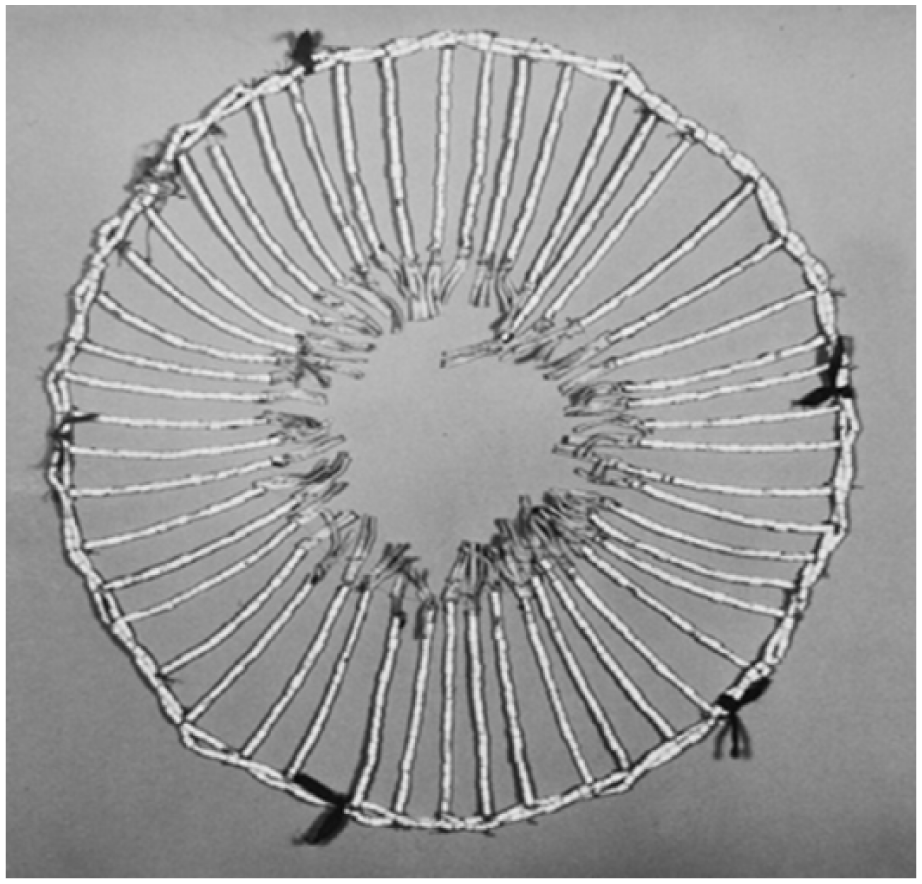
Circle wampum, Rotinonshón:ni Teiotiokwaonháston, “it circles the people.”
We had conducted our Two Row seminars pretty much like any seminar at a secular university campus when Taylor Gibson, a community-based researcher fluent in Hodinöhsö:ni’ languages and traditional culture, quietly asked that we open our gatherings with the Thanksgiving Address. Among the many Hodinöhsö:ni’ ceremonies, the Ohenten Kariwatekwen is one of the more “public” ones, meaning that, although it is fundamental to Six Nations cosmology and spirituality, it is not seen as a ritual to be protected from outsiders. Framing our gatherings with this simple ceremony that recognizes the generosity of the place where we have gathered, however, added another layer to our experiences of what Bob Antone (2016) called the “relational consciousness” generated by the Two Row. Dr. Antone said that the ceremonial element of the Two Row protocol reminds us that there are three parties present in every sacred agreement: the two human parties (in this case, the Hodinöhsö:ni’ and the incoming Europeans) and the Creator and/or Creation. There are two purple (human) rows, but they are embedded in three much larger white (more-than-human) rows of beads. 21
In Research Is Ceremony: Indigenous Research Methods, Shawn Wilson (2008) (Opaskwayak Cree) explains that “In our cultures an integral part of any ceremony is setting the stage properly. When ceremonies take place, everyone who is participating needs to be ready to step beyond the everyday and to accept a raised state of consciousness. You could say that the specific rituals that make up the ceremony are designed to get the participants into a state of mind that will allow for the extraordinary to take place” (p. 69). Taylor’s introduction of the Ohenten Kariwatekwen at the beginning of our gatherings was aimed at setting the proper stage for our discussions, to interrupt the everyday run of seminar proceedings, and to encourage us to anticipate a new state of consciousness so that something more than the ordinary could take place. The levels of distrust between Indigenous and university communities run deep and complex. Ceremony’s deliberate pause is, therefore, important to the conduct of a research relationship because it can open up the “principled ideological space” that Marlene Brandt-Castellano says is necessary for “Indigenous people [to] suspend distrust and non-Indigenous people [to] suspend disbelief.” We have observed that ceremony has the potential to create this interlude; for those who enter into it with openness and intention, ceremonial suspension removes us from operating in the “auto-pilot” of our usual assumptions and conceptions. Wilson quotes one of his research participants saying that in Maori culture, the space between people is sacred. The purpose of ceremony, then, is to approach the borders of other beings’ spaces respectfully, and, by performing rituals of greetings, peace, and thanks, to bridge the space so participants can share the space together. Wilson goes on to explain, “this bringing things together so that they share the same space is what ceremony is about. This is why research itself is a sacred ceremony within an Indigenous research paradigm, as it is all about building relationships and bridging this sacred space” (p. 87).
When the Hodinöhsö:ni’ met the Dutch to generate the treaty of friendship, they would have had two related ceremonies—the Condolence and the Woods’ Edge Ceremonies—in mind. The Condolence traces back to the story of Haiyentwatha, Peacemaker, and the origins of wampum-making. To make a long story short, Haiyentwatha was inconsolable after the deaths of his daughters. He wandered aimlessly through the forest for a long time, his heart thrown to the ground by grief. One day, he found himself at the edge of a lake, stringing shells onto lengths of reed grass. He felt comfort in the concentration required by the simple, orderly act. He longed for someone to hold the strings of shells he had made and count his sorrows with him. Peacemaker heard his wish, and thus, the Condolence Ceremony was born. Ever since, when a clan or community experiences devastating loss, comforters from other villages come through the forest to the edge of the village clearing and use three strings of wampum to wipe the tears from the eyes, the ringing from the ears, and the blockage from the throats of those who mourn. This ceremonial space at the Edge of the Woods is a critical place, since friends or foes may appear at this site, and the trials of the journey through the woods may bring good tidings or bad. So wampum was also used in the Edge of the Woods ceremony to gentle the spirits of those who had experienced difficulties, danger, or sadness, so they could enter the village and join the others with a Good Mind.
Likewise, the Two Row-Covenant Chain agreement was a ceremony for welcoming visitors from far away at the edge of the local place to bless them with the Good Mind so they may share the space peacefully together. To enact such a ceremony, each party has to turn up in person and participate. They need to enter the shared space aware of the human history of grief and distrust, and they must want to restore clear minds and open hearts. A key principle, then, of a Two Row Research Paradigm requires the intentional making of shared ceremonial space, a heightened space of Ga’hasdehsäh or “strength-in-unity” that creates Sgënö’ or peace by suspending business as usual and recognizing the gifts of the land itself along with the sacredness of the spaces between those who have gathered and their intention to bridge those spaces to share Ga’nigoi:yoh, the Good Mind.
The white man then asked, “What term of relationship will we go by? I will call you my “child.”
However, the Ongwehowe replied, “This is not proper, for a father can control the child. What do you think if we addressed each other as ‘brother?’”
They agreed to be as brothers from that day forward, because brothers do not control each other. This concept refers to the political language created by the Kanianerenko:wa (Great Law of Peace). The united nations of the Iroquoian Confederacy view themselves as younger and elder brothers. This concept does not suggest a hierarchical relationship where the elder is superior to the younger, but instead, that the elder brother has the responsibility to protect the younger brothers. It is a form of kinship that endures.
The Dutch man asked, “How will we seal the relationship?”
To which the Mohawk man replied, “We will seal the matter by taking each other by the hand. And we shall remain brothers for as long as the earth lasts.” They then took each other by the hand to confirm love and respect for one another, so that there will always be peace.
Principle 3: Equity Within Distinctiveness
We learn from this exchange a third principle to guide research partnerships: while the Two Row-Covenant Chain protocol differentiates the Indigenous canoe from the European sailing ship, it represents the two rows as equal. The wampum’s iconography of the two purple rows of beads is exactly identical, with no indications of superiority, hierarchy, or preference between them. The equality between the two parties is emphasized in the oral record by the discussion between the Dutch and the Onkwehonwe about whether to use the metaphor of parents-and-children or that of siblings. Here, we have a good instance of the importance of differentiation within the framework of equality. The Dutch would have presumed that calling the Hodinöhsö:ni’ “son” was a way of welcoming them into the family, but their concept of family would have been based on the hierarchical assumptions of the European system of primogeniture, according to which elder sons had priority over younger sons in inheriting the father’s property. Such concepts were foreign to Hodinöhsö:ni’ family structures, which were matrilineal in organization and did not own private property or pass it down a male line. Rather, Confederacy kinship and social systems were founded on the metaphor of sibling relations (usually translated into English as brothers), who had particular responsibilities based on age and experience. Children lived with the mother in her family’s longhouse, and their primary male caregivers were the mother’s brothers, so fathers did not have primary authority over children and women like they did in European traditions. Also relevant here would be the domestic metaphors that informed relationships within the Longhouse that constituted the Confederacy. Since Clanmothers had the responsibility to install and, if necessary, remove chiefs, the Dutch reference to “fathers and sons” would have masculinized the relationship in a way the Mohawk negotiators would have found puzzling. In addition, the member nations of the Confederacy have an old tradition of referring to each other in metaphorical domestic terms, so the Onondagas, Mohawks, and Senecas are often referred to in English translation as “elder brothers” or “uncles,” while the Oneidas, Cayugas, and the later adherents to the Confederacy, the Tuscaroras, Tutelos, Nanticokes, and others are “younger brothers” or “nephews.” 22 Relational terms like this (mother, father, sister, grandparent, aunt, etc.) in the Hodinöhsö:ni’ languages are elaborated from verbs, emphasizing the doing of the relationship rather than presenting it as a fixed identity, so that a brother does “brothering,” while a sister does “sistering,” and so on. The action of these relationships was influenced by age, so that the older brother, who has more experience of the world, is responsible to initiate the actions of brothering, while the younger, who has less experience, is responsible to receive brothering in a respectful way. 23
As members of our seminar group indicated during our discussions over the terms “sons” and “brothers” in the oral history, there are important implications here for research relationships. Like the patronizing Dutch negotiators, university-based researchers can assume the sailing ship has all the material resources and symbolic benefits to offer. They may, therefore, wish to invite Indigenous partners to join the university “family.” Very often, this imbalance can undermine equity within a partnership because budget lines, publishing venues, and systems for quality assessment remain firmly under the control of university, academic, or granting institutions and are rarely accountable to the Indigenous partners in the research. In addition, the structural imbalance reinforces the fatherly assumption of the sailing ship as patron, dispensing benefits to (or withholding them from) Indigenous “sons.”
The Two Row-Covenant Chain accord teaches us to heed the delicacy of the Mohawk elder brothers who carefuly explained why being welcomed as sons was inappropriate and why they preferred to interact as brothers. The relational unconsciousness of Dutch newcomers in a completely unfamiliar environment considering the democratic federation of matrilineally organized Five Nations as “children” at a time when women’s leadership or democracy would have been judged seditious back home in Europe is staggering in its hubris. The embarrassing obliviousness of the Dutch in this instance helps us to reorient common assumptions that remain with us today about leadership and expertise. As elder brothers of the Confederacy and as people who had lived in the Mohawk River Valley region for thousands of years, the Mohawks had the knowledge, resources, and infrastructure the newcomers needed to survive and succeed in the area. Out of their awareness of responsibility for the inexperienced newcomers, they referred to them as “younger brothers.” Likewise, in the domain of Indigenous-oriented research, Indigenous partners often function as elder brothers in the relationship with university partners, since they have the longest experience and often have access to the most extensive environmental knowledge, local resources, and community-based infrastructure necessary to carry out the research. What this requires in practical terms is a deliberate rebalancing of authorities—of what we might call the politics of citation or the economies of credibility—where research groups such as ours need to ground our work in the teachings and scholarship of the elder brother to guide our thinking. This rebalancing means considering carefully which scholars and publishing houses and research institutions we legitimize and credit as authoritative sources for our research. For the economies of citation are not neutral. This priority aims to counter-balance the long history of epistemicide carried out worldwide by the colonial sailing ship. As Boaventura de Sousa Santos, João Arriscado Nunes, and Maria Paula Meneses (2007) put it in their Introduction to Another Knowledge Is Possible, Western knowledge systems have been “instrumental in suppressing other . . . forms of knowledges and, at the same time, the subaltern social groups whose social practices were informed by such knowledges. In the case of the indigenous peoples of the Americas and of the African slaves, this suppression of knowledge, a form of epistemicide, . . . was the other side of genocide” (p. xix). There is, therefore, they write, “no global social justice without global cognitive justice” (p. xix) and the “monoculture of [Western] scientific knowledge” must be replaced with an “ecology of knowledges” (p. xx). The history of colonial epistemicide they refer to is clearly exemplified by the burning of Mayan libraries by Spanish church authorities in the sixteenth century (see Justice, 2014, p. 297) and by the suppression of Indigenous languages and knowledges in the Residential Schools for Indigenous children that operated throughout the United States, Canada, Australia, and other settler colonies from the nineteenth century and into the mid-twentieth. Closest to our theme, this history of epistemicide can be witnessed in the dismissal of wampum as reliable historical documentation by U.S. and Canadian governments at the very time that wampum was being expropriated and confiscated from its original keepers in both Grand River and upstate New York in the late nineteenth and early twentieth centuries. 24 This history of epistemic suppression has meant that both Indigenous and non-Indigenous people have been deprived of ready access to Indigenous knowledges and fed almost exclusively the beliefs and laws of the sailing ship. To restore equity in the relationship means extra effort and attention is needed by both parties, then, to attend to the teachings of the elder brother, whose familiarity with the river and its ecologies extends long before the arrival of the younger Europeans, whose immaturity and inexperience in subsequent years made them abuse both the wampum and the river.
The Two Row-Covenant Chain model indicates that the responsibilities of elder siblings and younger siblings in this relationship are equal and differentiated. By this we mean that their contributions are of equal significance, but that their tasks are not precisely the same. For Indigenous members of the research partnership, responsibilities may include building or renewing relationships with community elders and knowledge holders who can help them learn and reinvigorate languages or traditional knowledges from which colonial imposition has separated them. We might call this the responsibility of regenerating Indigenous knowledge itself by building a renewed relationship with it, by caring for it and its traditional holders. For non-Indigenous members of the research partnership, on the other hand, responsibilities may involve the adjacent, but distinct task of decolonizing Western institutions and the mechanisms of Indigenous epistemicide that remain embedded within their operations. At one of our meetings, our group members discussed the rising campaign to “decolonize the university,” especially after the release of Canada’s Truth and Reconciliation Commission’s Final Report (2015) with its many calls for educational institutions to change practices that disadvantage Indigenous students and knowledges. Given the protocol of the Two Row not to steer each other’s vessels, our group members queried, is it right to think that Indigenous people from the canoe should intervene in the protocols and processes of the university sailing ship? There were differing views among our members on this question, but one suggestion was to consider that different participants in the partnership have different responsibilities as older and younger siblings. Perhaps it is more the role of the university-based members in the partnership to work toward decolonizing the university than it is that of Indigenous community members; by prioritizing the teachings of the elder brother in the partnership, both Indigenous and non-Indigenous participants can become more and more familiar with what has been obscured by the colonial project of epistemicide, and as that familiarity grows, younger brothers can consider how to dismantle the colonial project within the sailing ship. 25
The next sequence highlights the part that has become best known about the ship and canoe metaphors. The parties agree that, “We both have our own authority—strength/power. We have our respective beliefs, from the same Creator. We have our respective laws. We do not have authority over each other or our kind of culture.”
The Ongwehowe stated, “The Creator gave us a canoe and you a boat (ship). We will take our vessels to the water and put them in the water, each in their distinctive way. Our people will follow the vessels in the water. We will place them a certain distance apart, but will line them up so they will always be parallel.”
The White man stated, “This is an excellent way to represent our relationship.”
The Ongwehowe stated, “Now we have laid our vessels out, parallel to each other, so too it is with our beliefs. My beliefs will be in my canoe, yours will be in your boat. I will also put my laws in my canoe, and you will put your laws in your boat.
Our authority, beliefs, and laws will be dropped into our vessels. That is how people will know it, by the likeness to two paths.”
This is where the main metaphor of the Two Row Wampum is born. The ship and canoe travel on two separate paths, parallel and never intersecting. There is an agreement not to impose culture, belief, or laws on each other. This is where the main betrayal of the Two Row has taken place. The settler societies appeared to be all about imposition, despite this treaty. The Dutch remained a colonial presence for about fifty years after this agreement was made. The English, who took over the colonial end of the chain in 1664, had a different strategy. They imported their culture, beliefs, and laws, trying to superimpose them on our canoe. Subsequent Canadian and American nation-states have done the same. If the ship has not kept its end of this stipulation, is the treaty still valid? Or, is it now this generation’s opportunity to pick up those ideals and make them real by knocking the dust off the chain, and restoring peaceful relations with each other? Rather than get depressed over the failures of a negative history, let’s return to the hopefulness expressed in the narrative.
The Mohawk man stated, “We will make a wampum belt of that likeness so people will know what we will go by. The Two Paths (wampum) is our way of keeping records. We both put our beliefs in our respective boats, and our people too.
“Perhaps in the days to come, some of your people would like to get into my canoe. But I don’t think they would like the ways of my canoe.” Moreover, he said that the canoe travels quite fast.
“Perhaps a number of my people would like to get into your large boat, because of its size. They might like being in your boat.
“People who get into your boat will be guided by it. Your people who will get into the canoe will be guided by the ways of the canoe.”
This is an important passage to contemplate. There is no racial requirement for what vessel you can be in. Instead, the passage says that people will be guided by the beliefs and laws of that vessel. To me, this means that anyone can come and live within our communities, provided they abide by our rules and follow our customs. It also means when the Ongwehowe venture into the ship, they will be governed by its rules.
The oral history goes on to address the difficulty of balancing with one foot in each vessel this way; The white man asked, “What will happen in the days to come if a big storm comes up, and someone has a foot in each vessel, and the vessels are driven apart? I believe that person will fall between them.”
The Mohawk man responded, “Yes, this will happen. We cannot take responsibility for this. Only the Creator has the power to save that person.”
You could say this about all things Hodinöhsö:ni’—only the Creator can help us. The Creator plays a big role in our redemption when we mess up. However, this notion of not taking responsibility for people who are caught in the middle has allowed generations of our people to suffer. Our people have developed a sense of fatalism, particularly about tragedy, as if the victim is always responsible for the tragedy. Is this why the parents stood by as the whites took their children to residential schools? Only the Creator could save the children who were victimized at those schools? Is this why we have such a high suicide rate, because we don’t try to help those who have fallen into dark waters? If that be the case, perhaps it is time to rethink the space between the Two Rows. Too many have suffered the trauma of colonization, and we cannot afford to let them drown in the murky waters of life.
Both parties agreed, “People will be bound by what we have agreed upon. We will abide by our agreements as long as . . . the sun always makes it bright on earth; the waters flow in a certain direction; and the wild grasses grow at a certain time of year.”
That is what they did when they made the agreement, and so our minds will continue to be. The white man affirms all that was agreed upon. The Ongwehowe said they have made a wampum record, called the Two Paths, so our people would have the means to know what was agreed upon.
The expression Two Paths, instead of Two Rows, might be a helpful translation. People have to pick the path (or vessel) that will carry them forward, agreeing to abide by the rules of that path. It is about free choice. Humans can decide what society they wish to exist in. Christianity and residential schooling certainly changed that choice for many. Untold thousands of people of Indigenous ancestry are trying to find their way back to the canoe. Ironically, many descendants of the people of the ship are also turning to what the canoe path holds. Nowhere in the oral narrative does it say that we are to push them away. In fact, our culture tells us to embrace all people as if they are members of one family.
Principle 4: Internal Pluralism and Diversity
This point about the potential of crossing between the two paths of the two parties relates to a fourth important Two Row principle for guiding research relationships, which is to note that neither of the two purple rows is internally homogeneous. Each of the purple rows is itself constructed of two rows of purple beads, so the original wampum makers symbolized pluralism and diversity within each of the rows. The iconography of the Two Row reminds us of the danger to the Indigenous canoe of being assimilated into the sailing ship’s assumed universalism, but it also importantly reminds us of the danger of false homogenization within either the European sailing ship or the Indigenous canoe. We need only recall that the Hodinöhsö:ni’ are a confederacy of nations to see why the wampum makers would readily have assumed internal pluralism as they wove the two rows for the two ships. While they valued Ga’hasdehsäh, the strength that is found in unity, they did not conceive of being Hodinöhsö:ni’ in singular terms, and they did not assume singularity among the incoming Europeans either. Their relatives had encountered the French over seventy years earlier on the St. Lawrence River, so they knew about differences among the European newcomers, and they readily transferred the Two Row-Covenant Chain agreement to the British when they replaced the Dutch in the region. Not only were the Hodinöhsö:ni’ themselves internally diverse when they met the Dutch in the early seventeenth century, the four hundred years of interaction with incoming peoples between then and now has meant that many of the Indigenous members of our seminar group have different ancestral connections to the Iroquoian canoe. Two of our members were born and raised in traditional families on the Grand River territory, speaking one or two Six Nations languages, but they are the exception. Several members come from families whose parents or grandparents attended residential schools and did not retain traditions or language, while others grew up in families of mixed heritage with both white and Indigenous parents, so clan affiliations that follow the maternal line were not retained. Several others were raised in urban environments, while still others were adopted and grew up in non-Indigenous families. The point is that singular and exclusive membership in the Indigenous canoe is simply not the norm for many Indigenous people, including members of our research group.
The reality of mixed heritage for many members of the canoe has given rise to controversial racial-cultural policing of identity and authenticity within Indigenous communities.
26
The oral account of the Two Row-Covenant Chain agreement reports that the Dutch asked what would happen to people who have one foot in each vessel. In a previous article, Rick has commented that some people interpret this passage to suggest that those who enter the sailing ship relinquish their Hodinöhsö:ni’ birthright or that they will suffer from a “split mind” and make bad decisions (R. Hill, 1992, p. 158). However, he notes that Chief Thomas did not ascribe to this separatist interpretation. On the basis of the latter interpretation, many Indigenous researchers who live, for various reasons, in the space between the two vessels, have entered into intensive mentorship and training with elders in resurgent Indigenous epistemologies to guide their involvements in the sailing ship of Western academe. Dr. Bonnie Freeman (Algonquian/Mohawk), a member of our seminar group, affirms this process: As a First Nations scholar/researcher, at times I have felt that I have had one foot in each of the two boats. This leaves me to question, am I really straddling two cultures or have I made a choice to step into the White man’s world? . . . I realize that we do not lose ourselves or our identity as Onkwehonwe if we decide to pursue life in the White man’s world. We will always be “Indian” and the cultural guidance from our people to remain “Indian” is always there guiding and supporting us. (2015, p. 30)
The Two Row Wampum makes room for a diverse range of experiences and subjectivities by representing both of the purple rows in the plural. The same principle applies to the sailing ship: The four hundred years since the Hodinöhsö:ni’ formed the Two Row-Covenant Chain agreement with the Dutch have brought many diverse newcomers to North America, not just from Europe but also from Africa and Asia, and they too have brought with them a wide range of epistemological and cultural traditions. The ethical space between the two rows differentiates the two from each other, but it does not impose upon each a uniform homogeneity.
This acknowledgement and awareness of internal diversity guards against the kind of purity discourse that feeds ethnic fundamentalism, the assertion and policing of unalloyed authenticity that can feed an in-group’s efforts to gain absolute control of its own material and symbolic property. Given the long history of exploitation and denigration of Indigenous knowledges, it’s not hard to understand why many Indigenous groups have ascribed to the protocols of OCAP—the research protocol that insists upon ownership, control, access, and possession of Indigenous knowledges by their traditional communities (see Schnarch, 2004). In some ways, the Two Row protocol, with its sharp delineation of the autonomy of the two vessels, would seem to affirm the removal of Indigenous knowledges from the exploitative reach of the Western sailing ship.
Principle 5: Sharing Knowledge, Not Owning It
But when we consider the Two Row-Covenant Chain’s overall project of sharing the river and building sustainable friendship, we are returned to a significant fifth principle our group has derived from the Two Row model for building relationships, and that is the importance of sharing over owning. One of Deyohahá:ge: Indigenous Knowledge Centre’s early tasks was to generate a statement on Hodinohsoni/Rotinonhsyonni Intellectual Rights and Responsibilities. Rick compiled this statement from principles shared by the Indigenous Knowledge Guardians and comments from Deyohahá:ge: Indigenous Knowledge Centre’s steering committee. The document acknowledges that, like other Indigenous peoples, the “Hodinohsoni/Rotinonhsyonni are concerned with protecting our own culturally based ideas, values, and beliefs,” but it goes on to insist that “we do not believe in Western notions of copyright and intellectual property as they go against our philosophy that knowledge and skill are gifted from higher powers that cannot be regulated by secular law” (p. 1). Because knowledge is not human-made or human-owned, then, it is not a private property that can be owned, controlled, accessed, or possessed exclusively by anybody, even insiders. Rather, it is more like a collective inheritance or cultural patrimony
27
: The oral history, sacred objects, traditional practices, as well as the underlying philosophy and beliefs, cannot be protected from exploitation because they represent a worldview and mind-set that can only be understood by its active practice. The IKC will endeavor to assist those who wish to uphold their duty to the knowledge in ways appropriate to the culture, as expressed through our Knowledge Guardians . . . Therefore the best way to “preserve” Hodinohsoni/ Rotinonhsyonni knowledge is . . . to excel at Hodinohsoni/Rotinonhsyonni practice. (p. 1)
The challenge to preserve knowledge by practicing it is aimed at delivering traditional knowledge from being understood as a “frozen artefact” that can be preserved, like a museum exhibit, behind glass. As did the Hodinöhsö:ni’ who treated with the Dutch, Deyohahá:ge: Indigenous Knowledge Centre insists on the value of sharing, but sharing in the context of appropriate protocols: all Hodinohsoni/Rotinonhsyonni people have an equal right to the knowledge of our ancestors. No one individual, group, organization or government can restrict our right to our own culture. In fact, we all have a responsibility to share, teach and mentor others in what we know to be true. Elders, cultural practitioners, artists and language speakers have an obligation to freely share their knowledge. Part of that sharing is learning and respecting the proper protocols for some of the sacred texts and ceremonial language and songs. Much of that kind of sharing belongs best in the social, cultural and spiritual organizations and societies that currently exist in our community. (p. 2)
We are returned, then, to the Indigenous understanding that knowledge circulates in relationships. The appropriate provenance of knowledge is determined by the quality of the relationships. That is to say, knowledge can be shared when relationships are strong and appropriate; if relationships are broken or have not been built, however, then knowledge cannot circulate without harm or distortion. This relational provenance is why, within a Hodinöhsö:ni’ worldview, knowledge cannot be legally copyrighted or patented. Because knowledge is the gift of the Creator and Creation, and because human beings, like all other beings, have particular duties to practice and share their knowledge, the way to knowledge is to participate in the givenness of that gift: to learn, to conduct research, in this way of thinking, is to polish the chain of relationships with the elder brothers who are the custodians of that knowledge.
Repolishing the Chain
Then, the Dutch man suggested another symbol, an iron chain, “I will add iron to this to make a three-link chain. The first link will stand for friendship. The second link will stand for our both having good minds. The third link will mean there will always be peace.”
This part of the oral history has been a point of confusion among both scholars and Hodinöhsö:ni’ historians. The aspirations identified in this part of the oral history are symbolized by the three links in the first iron chain that bound the ship to the canoe. The oral narrative, which was repeated in subsequent treaty councils, tells of first tying the two vessels together with a hemp rope. However, that kind of rope would weaken, wear thin, and possibly break. So it was replaced with an iron chain. The three white rows of beads between the two purple rows of the Two Row Wampum Belt are said to represent these aspirations—to friendship, good minds, and peace.
When a silver chain was used to link the Hodinöhsö:ni’ canoe with the British ship in 1664-1676, those links were said to represent the ideas of respect, trust, and ongoing friendship—clearly derived from the Great Law’s three principles of Ga’nigoi:yoh, Sgënö’, and Ga’hasdehsäh. Thus, the Covenant Chain is also referred to as the Friendship Belt because the original parties agreed, and they joined hands on the matter. The next sequence forecasts the future significance of this treaty.
The agreements will benefit (meaning they belong to) the faces deep underground (the generations to come that the Creator determined will be taking their place on the earth).
We obtain our happiness from what he has planted, and there is no end to new life and to the faces coming from deep underground.
This is a reference to the Hodinöhsö:ni’ philosophy that the faces of the coming generations rest within the earth, with each generation slowly rising to the surface to be born into this earthly world through the female. Our leaders are instructed to think of the future generations when they make their decisions. They are asked to consider the impact of their decisions upon the seventh generation to come. They are asked to respect women and femaleness as the nurturers of future generations. This section shows that such thinking was in play when this treaty was made, and that it was agreed upon so that the future generations of Indigenous and settler societies would mutually benefit.
Then the Ongwehonwe stated, “From time to time, for as long as the earth exists, we shall renew our agreements, so that people will know them.”
This statement links back to the first statement that by hearing the words of this narrative: It will put your minds at ease (that we still remember these words). The treaty was a living document, to be recalled, renewed, and re-confirmed by subsequent generations so that the ideals it holds will never grow old.
The final sequence talks about the future and how the agreements will need to be renewed: It may happen in the days to come that dust will accumulate on our agreements—the symbols of our alliance. If that happens, it will be possible to polish them again, and wipe the dust from the agreements. We will renew our relationship and the agreements we have made. There will always be people to act as interpreters for us. We will appear the way we did when we first met. All of our people shall always know of it. And there will be peace in the days to come.
This section is where the notion of “polishing the chain” comes from. The dust represents the weakening of the chain due to inattention to the relationship. Wounds are left to fester. Justice is ignored. “Wiping the dust” means that due compensation will be delivered to address any transgressions that might have occurred, proper amends will be offered for any offences, and injuries to either party will be made right. We will treat each other respectfully because we are to truly care for each other. The history of broken relationships between settlers and Hodinöhsö:ni’ people shows how difficult that vision has been to manifest.
Our purpose in this article has been to contribute to the upsurge of Indigenous research methodologies by studying the oral history of the oldest treaty between Indigenous North Americans and incoming Europeans as a model for how to conduct healthy and respectful relationships between community-based and university-based researchers. In Indigenous Methodologies, Margaret Kovach (2009) writes that “There have been many proclamations of a ‘new’ relationship between Indigenous and non-Indigenous in various sectors. It is a relationship that must recognize both the distinctive and the common destiny, not as a polarized or conversely assimilative conjecture, but as something different, something more” (p. 177). We would like to suggest that four hundred years ago, the Two Row-Covenant Chain protocol laid the groundwork for something more—a relationship that envisioned distinctive paths toward a shared destiny for Indigenous peoples and incoming Europeans. The failure to respect that vision generated our current polarized common destiny, where Indigenous ways of knowing have been suppressed both by exploitative appropriation and by epistemicide. This does not mean that we must accept our current situation as inevitable. As generations of Hodinöhsö:ni’ have insisted, it is possible to “repolish” the Two Row-Covenant Chain agreement. This repolishing remembers, first, the importance of distinctiveness and relational autonomy, so that Indigenous knowledges and ways of being are engaged from within their own philosophical contexts rather than assimilated into European worldviews. Second, it involves a renewed recognition of the sacredness of space between entities and the power of ceremony to respect and bridge that space. Third, it values equity within distinctiveness, meaning that productive relationships are built upon the understanding that there are “elder” and “younger” siblings involved in any relationship, so equity recalibrates authority and leadership in the context of the parties’ grounded, historical experiences. Fourth, a repolished Two Row relationship resists the assumption of homogeneity within any of the parties involved and values diversity within them. It does not assume all Indigenous partners have the same access to or responsibilities for traditional knowledges, nor does it assume that all non-Indigenous partners bear the same relationship to institutions such as the settler state, the university, or “Western knowledge.” Fifth, this regenerated relationship is mindful that knowledge is the gift of the Creator and Creation for all people and beings on earth. It is, therefore, sacred and demands care from those who receive it. Part of that responsibility is to ensure that certain kinds of knowledge circulate within relationships that are appropriate to that knowledge. And this, ultimately, is what the Two Row-Covenant Chain tradition emphasizes: that Ga’nigoi:yoh, Good Words and the Good Mind, form the knowledge that circulates in Ga’hasdehsäh, relationships that are strong and unified enough to value internal and external differences, and thereby create Sgënö’ or peace within a shared and balanced space.
Today, the government of Canada has refused to acknowledge the Two Row Wampum as a valid treaty protocol. Historians argue over its validity. Most people in the ship or in the canoe have never heard a proper translation of its narrative. Since Chief Thomas passed away, no one has learned the true history of the wampum belt. Linguist Foster recorded several of Thomas’s oral renditions of the narrative of the Two Row, one of which this essay is based on. Foster has worked diligently for almost twenty years to make an accurate translation of the recitation of the Two Row Wampum in the Cayuga language. We need that work now. We need to understand the Two Row in the way it was created. Too many people are using a simplified summary circling the Internet, not contemplating its deeper nuances. The actual narration may contain the very lessons we need to reduce our racial hatred in time for both the ship and the canoe to steer a healthier course under the terms developed in the United Nations Declaration on the Rights of Indigenous Peoples (2008) and the Truth and Reconciliation Commission of Canada’s (2015) calls to action. Despite the two paths identified in the oral narrative, we have one common destiny. As we face the repercussions of climate change, the waters may stop flowing, the grass may not turn green, and the sun may be blotted out by increased carbon emissions. The future generations will look to us, asking, what did you do to keep the ship and the canoe on a healthy course on the River of Life? I hope we will be able to say that we did more than argue over the meaning of the Two Row Wampum-Covenant Chain agreement. The intent of that treaty, perhaps all treaties, was to perpetuate peace between us, so that we can thrive. It created a moral obligation to each other—a sacred relationship—meant to help fulfil our common responsibility to live in harmony with our Mother the Earth.
Footnotes
Declaration of Conflicting Interests
The author(s) declared no potential conflicts of interest with respect to the research, authorship, and/or publication of this article.
Funding
The author(s) received no financial support for the research, authorship, and/or publication of this article.