




Abstract
The rise of the Trump regime has sparked xenophobic sentiments directed toward and heightened fears experienced by mixed-status immigrant families living in the United States. Using the Southern Poverty Law Center’s concept of “The Trump Effect”—how the election of Donald Trump has had a damaging impact on undocumented immigrants—the researchers reveal how the lives of 12 mixed-status families (16 youth and 16 of their parents/guardians) have been transformed. Implications of this investigation are significant given the current social and political landscapes and continual fear mixed-status families undergo in their plight for daily survival.
During the 2016 presidential campaign Donald J. Trump promoted numerous xenophobic positions such as deport all undocumented immigrants, rescind Deferred Action for Childhood Arrivals (DACA), 1 deny birthright citizenship to infants born to undocumented immigrants, build a wall on the U.S.-Mexico border and require Mexico to pay for it, triple the number of U.S. Immigration and Customs Enforcement (ICE) officers, and cut federal grants to sanctuary cities (Sullivan, 2015).
The Trump regime has already made good on some of these promises. A mere five days after his inauguration, Trump issued Executive Order 13768, Enhancing Public Safety in the Interior of the United States (Executive Order No. 13768, 2017), which expanded ICE’s deportation focus (U.S. ICE, 2017b). Not surprisingly, there has been a surge in the rate of interior deportations 2 since the inauguration of Trump. In comparison, data from an ICE report for FY 2016 and FY 2017, 3 highlighted a 37% increase in the interior deportation of undocumented immigrants (U.S. ICE, 2017b). Perhaps most alarming is data from that same report indicating an increase from 5,014 to 13,744 (nearly 175%) in noncriminal interior deportations. Beyond deportations, in September 2017, the Trump administration announced the demise of DACA (Nakamura, 2017). Immediately after this revelation, DACA recipients and their allies decried this action and how termination of this program would be detrimental to this population and their families (Hoyt et al., 2017).
While interior deportations continue to rise and the future of DACA is still unknown, it has been surmised that the termination of DACA would negatively impact DACA recipients’ and their families’ psychological well-being (Almendrala, 2017; Gamboa, 2018; Uwemedimo, Monterrey, & Linton, 2017; Villavicencio, 2017), health outcomes (Castaneda, 2018; Khazan, 2017; Sanchez & Sulek, 2018), and economic stability (Almendrala, 2017; Cole, 2017; Guillcatanda, 2017; Smith, 2016). The peak of the recent family separation crisis generated by the Trump regime continues at the time of this writing. While there are related issues between both crises, we aimed to shed light on the tragedies associated with recent family separations and contribute to the discourse on liminalities associated with a precarious immigration status and challenges that mixed-status families living in the United States confront in their everyday lives.
In 2016, the Southern Poverty Law Center issued two reports—one prior to the election of Trump and one immediately following his election—describing the role of “The Trump Effect” on the lives of populations of color, including those who are undocumented (Costello, 2016; Southern Poverty Law Center, 2016). “The Trump Effect” can be summarized as the impact that the presence of Trump and his antiimmigrant and discriminatory rhetoric during the 2016 presidential election and beyond has had on immigrants. The Southern Poverty Law Center conducted a survey of primarily K-12 educators from across the country to gather their thoughts on their students’ sentiments and on the educators’ overall school climate. According to Southern Poverty Law Center data, “The Trump Effect” has resulted in intensified verbal harassment of immigrant students (including the use of slurs and derogatory language), increased anxiety on the part of immigrant students, and heightened fears related to possible deportation and separation of immigrant students’ family members, it has also emboldened others to new expressions of politicized bullying, and has increased fear and anxiety about the future for immigrant students. In a separate report in the same year, the Southern Poverty Law Center further pronounced “The Trump Effect” as “nothing short of a crisis and should be treated as such” (p. 5). While these reports focused on schools, evidence exists that the Trump regime and its policies have resulted in various detrimental effects on immigrant communities (Capps, Chishti, Gelatt, Bolter, & Ruiz Soto, 2018; Gostin & Cathaoir, 2017).
Liminal Existences and Living Uncertainty
A publication by the Center for Migration Studies estimated there were 3.3 million mixed-status families 4 in the United States in 2014 (Warren & Kerwin, 2017). These families experience multiple challenges in their everyday lives, ranging from feeling uncertainty associated with family members’ precarious immigration status, experiencing discrimination, and economic instability.
Moreover, recent literature has documented issues associated with the well-being and the quality of life of immigrants. Brabeck, Sibley, and Lykes (2016) found that undocumented parents experienced greater challenges, compared to documented parents, in the areas of occupational stress, ethnicity-based discrimination, English language fluency, and immigration status. Vargas, Sanchez, and Juárez (2017) discovered links between poor physical and mental health extending to Latinos who live in states they perceive have unfavorable immigration laws. In addition, Capps et al. (2018) reported that following the 2016 presidential election, the communities where undocumented families reside experienced increased fear of deportation and arrests and the concomitant changes in their daily routines such as increased social isolation, declined use of health and social services, and reduced crime reporting to enforcement officials.
One study found that youth in mixed-status families commonly live in constant fear of being separated from their parents and/or that other family members could be apprehended or deported (Capps, Castañeda, Chaudry, & Santos, 2007). Other studies highlighted that children in mixed-status families experience increased levels of anxiety (Brabeck & Sibley, 2015; Suárez-Orozco, Yoshikawa, Teranishi, & Suárez-Orozco, 2011) and depression (Suárez-Orozco et al., 2011) and lowered self-esteem (Suárez-Orozco et al., 2011). Children from mixed-status families, even if they were born in the United States and are U.S. citizens, are influenced by these stresses. Furthermore, Zayas, Aguilar-Gaxiola, Yoon, and Rey (2015) examined the psychological status of children who were U.S. citizens and members of mixed-status families. Their findings indicated elevated levels of distress in children who had experienced a parent’s detention or deportation, compared to those who had not. Also, Zayas and Gulbas (2017) reported that these children faced existential questions about their identity and sense of belonging when they experienced the loss of a parent through detention or deportation.
Inquiring Into “The Trump Effect”
This investigation is part of a larger study examining various aspects of mixed-status families in Michigan. This particular component of the larger investigation was guided by the following research question: What effect has the Trump presidency had on the everyday lives of mixed-status families?
This research employed a phenomenological research design, focusing on “descriptions of what people experience and how it is that they experience what they experience” (Patton, 1990, p. 71). In other words, the use of a phenomenological research approach allows for the rich description of a phenomenon and for the phenomenon to “speak” for itself (Giorgi, 1985). The perspectives of undocumented/DACAmented young adults and their undocumented parents/guardians in Michigan related to the Trump presidency were elicited.
Michigan
In 2012, it was estimated 120,000 undocumented immigrants resided in Michigan, which was 10,000 more than in 2009 (Passel & Cohn, 2014). These data represent nearly one in five (18%) of all immigrants in the state. The three largest undocumented racial/ethnic groups residing in the state are Mexican (36%), Indian (14%), and Chinese (6%; Passel & Cohn, 2014). The undocumented population comprises 1.6% of the state workforce. In 2012, it was estimated that 1.9% of K-12 school students in the state had at least one undocumented immigrant parent (Passel & Cohn, 2014).
The number of deportations has risen in the Detroit Field Office whose jurisdiction includes Michigan and Ohio. In FY 2016 interior arrests totaled 2,241 and interior removals were 2,056 (U.S. ICE, 2017a). In FY 2017 those figures rose to 3,409 interior arrests (52% increase) and 3,203 interior removals (a 56% increase).
Currently, Michigan does not have any sanctuary cities (MLive, 2017). However, the state does have some cities (e.g., Ann Arbor, Detroit, Ypsilanti) with proimmigration policies, including prohibiting police officers from asking about immigration status in most circumstances. Critical to this context is that the state legislature is considering a bill that would prohibit the presence of sanctuary cities in the state.
Research participants
Youth and their parents/guardians were recruited via community-based organizations whose focus was on assisting immigrant families in the state. Eligible youth were 15 to 21 years old and were either undocumented or DACAmented. Parents/guardians of these youth simply needed to indicate a desire to participate in this investigation. A total of 12 families, or 32 research participants (16 youth and 16 parents/guardians 5 ) were interviewed (see Appendix). Eleven families emigrated from Mexico and one from Guatemala. Thirteen youth had DACA, and three were undocumented. All the parents were undocumented with the exception of one mother who described holding a work visa. Families were from three urban centers: Detroit (six families), Grand Rapids (four families), and Flint (two families). Eight female and eight male youth, and 12 female and four male parents/guardians participated in this study. The average age of youth participants was almost 19 years. The age range for parents/guardians was 34 to 50 years, with an average of 43 years. The age of emigration for the youth spanned from about 6 months to 13 years, with an average of 5 years. For parents, the age of emigration ranged from 17 to 40 for an average of almost 28 years. The average number of years youth had lived in the United States was 13, while the parents’ average time in the United States was close to 15 years.
Interviews
Semistructured interviews of youth and their parents were conducted separately. Questions asked during the interviews addressed the following areas: effect that the election of Trump had on family members, including changes to their everyday lives and effect the election of Trump had on the family members’ future goals.
Parent interviews were conducted individually with one of the researchers, or if two parents agreed to participate, they were interviewed together. All youth interviews were completed individually with one of the researchers. All parent/guardian interviews were conducted in Spanish, and youth interviews were conducted in English. Interviews averaged 80 min. The interviews for 11 out of the 125 families took place in the families’ homes. The audio of each interview was transcribed (i.e., youth) or translated and then transcribed (i.e., parents/guardians).
Data were analyzed using inductive analysis and constant comparison techniques (Glaser & Strauss, 1967; Parry, 2004). Such analysis techniques are often used in phenomenological studies (Parry, 2004). The interview transcripts were analyzed looking for data associated with elements that guided this study such as the research questions, framework, and literature. Once data were identified, the researchers identified categories under which the data fell. After those categories were identified, further analysis was conducted to identify the relationships that existed between categories. After numerous iterations of analysis, a total of six categories (with two of these categories containing either two or three “subcategories”) emerged from the data.
Family and Individual Perspectives
The 2016 presidential campaign and election of Trump has affected the everyday lives of all the families who participated in this study. Six themes emerged from the data in which “The Trump Effect” was evidenced in the lives of these 12 families included trauma experienced during and after election campaign, awakened and elevated discriminatory sentiments, heightened fear of immigration status disclosure and deportation, the adjustment of everyday actions, increased uncertainty about the future, and aroused advocacy for immigrants’ rights.
Trauma Experienced During and After Election Campaign
Twelve participants described the trauma associated with the election of Trump and its impact on their families. This trauma was evident in, family members’ disbelief and their reactions to the election results. They demonstrated distress over what a Trump presidency might mean for their well-being and future. Six youth recounted the shock they felt when the election results became clear. One youth participant stated, “I was shocked. I was honestly shocked [Trump] got it” (Family D, Youth, Male). Furthermore, another youth research participant recounted the sense of disappointment he felt toward the “American people” and the effect a Trump presidency would have on his life. This participant shared details about his feelings: I went to sleep [feeling] kind of safe. I remember saying, “I know the American people won’t let me down.” I went to sleep with a sense of security. They’re going to vote for Hillary. I went to sleep happy, and I woke up, and Trump had won. It was a huge dread and weight on me. . . . I felt sad, like my life here was over. It felt like you’re lost. It’s gone. (Family L, Youth, Male)
Participants from three families described family members crying once election results were confirmed. “My mom was crying and she was like, ‘Oh, we’re going to go to Mexico’” (Family H, Youth, Female). One mother shared how she found her youngest daughter (a U.S. citizen) crying as she proceeded to tell her mother, “They’re going to take you to Mexico” (Family D, Mother). A 15-year-old participant also described her family’s reaction to the election results: [The election results] had a really bad effect on [my family]. It hit us real hard. We had family members crying the next day. Crying a whole week. My youngest sister, she cried. I guess she knew [Trump] was going to win because she had a little suitcase already filled with clothes and she said, “I’m ready to leave.” . . . She was born here. She still has that suitcase under her bed [months after the election]. Every day she goes through it and makes sure she has new clothes in there that fit her. (Family G, Youth, Female)
Similarly, another youth shared how her little brother packed a bag during election night and said he was prepared to move to Mexico with the rest of the family (Family F, Youth, Female).
Awakened and Elevated Discriminatory Sentiments
Over 20 research participants described aroused and/or increased discriminatory episodes or sentiments lashed out against the Latino and/or immigrant communities since the rise of the Trump regime. These discriminatory incidents occasionally involved research participants. Interviewees pointed to Trump as the person responsible for awakening sentiments of hatred: “[Trump] validated racism” (Family D, Mother). “All the people [Trump] empowered and all the hate he empowered” (Family E, Youth, Female). “Mistrust, disregard, something that now, with Trump, he came to revive all of that, wake it up” (Family D, Father). “Trump does not want us, Hispanics, here. He wants all undocumented people out of here” (Family L, Mother).
The discriminatory sentiments directed at the undocumented community, driven by Trump and his followers, affected how interviewees believed they were perceived and treated by society. Family members described their perception of how society viewed and treated them with the following: “Back in November [2016], we started seeing more people being more mean” (Family G, Youth, Male). “Lately anyone has the right to insult us; many people say they will call immigration on us” (Family G, Mother). “There are more people willing to humiliate us” (Family K, Father). A mother characterized it best when she said, “Now there is a lot of racism. You now see colma (intolerance) in people’s eyes. It’s not the same [as it was in the past]” (Family F, Mother).
Youth perception of how society viewed them had profoundly impacted their well-being. A youth participant said, “I feel like now people could expose themselves on how they feel about certain cultures, certain heritages, which brought eagerness to myself of how people see me” (Family K, Youth, Male). Another youth shared how she now felt “apologetic” for being Latina: “I almost felt the need to apologize for being the color I am” (Family E, Youth, Female). Yet another youth shared the following: Now with the Trump administration I feel more a sense that I don’t belong, you’re not one of us. You’re the problem, and it’s alienating . . . I’ve been really feeling it. . . . It just feels bad . . . seeing my people suffer through this and for a simple fact of a citizenship or a birth certificate. (Family L, Youth, Male)
Youth and parents spoke of recent incidents in which they were harassed. Episodes of harassment included the following: stared at while in public, discriminated at school, and hassled at work. Three families described how they felt “looked at” when engaging in routine activities, including shopping at local stores and eating at restaurants. A youth described it this way: “My dad, mom, and I were at Wal-Mart, and this man gives the dirtiest look at my dad, looks him straight up and down. I was just in shock” (Family D, Youth, Female). A youth participant described an interaction she had with a White male in response to a t-shirt she was wearing that stated, “Do I look illegal?”: This dude said, “You totally look illegal. I don’t know what you’re doing in this country.” And I’m like, “I’m sorry?” And he said, “Yeah. I know for sure you’re illegal because you’re brown.” I responded, “Because I’m brown? What about your ancestors? They were White, and they were illegal when they came here. They kidnapped and raped Native Americans who weren’t illegal, but you guys mistreated them because they’re also brown. So, help me understand how my skin color [allows you to] call me illegal. (Family G, Youth, Female)
Some parents also described episodes of discrimination experienced by their younger children, many of them U.S. citizens, in K-12 schools. A mother described how her younger children would come home from school asking when they would return to Mexico: “My children would come home from school and would ask me, ‘When are we going to Mexico because we do not have papers?’” (Family I, Mother). Similarly, another mother stated, My youngest daughter said there is a güerita (White girl) in school and that this girl and her used to get along, but one day she stopped speaking with her. Then this girl told her she supports Trump and that we should go back to our country. I told her not to mind her. (Family G, Mother)
Some participants also described the elevated harassment parents have encountered in the workplace, which included coworkers’ threats to call ICE. For example, a mother described an episode she encountered at work: Recently [a White European immigrant] came to work here who did not like [the Latino immigrant workers]. She is also undocumented. . . . One day she started screaming and insulting me and saying, “Do you know I can call the immigration department? The owner knows you don’t have papers, and people like you shouldn’t be here in the country.” (Family G, Mother)
The children in this family described their mother coming home from work at times and crying over how she was treated.
Heightened Fear
Nearly all research participants had experienced amplified fear since the election of Trump that stemmed from their immigration status perhaps being uncovered and family members possibly being deported. A mother said, “Nowadays, we are living with a lot of fear. We used to live with fear, but now it is much worse” (Family B, Mother). In general, DACAmented youth were more concerned about the deportation of their parents than their own status and well-being since their parents held a more precarious immigration status than them. A youth participant said, “I’m not scared, but I am scared for my parents” (Family I, Youth, Female).
A concern shared by youth and parents was the detrimental impact the deportation of a parent would have on their families. Notably, nearly all the families discussed the presence of children who were U.S. citizens in their mixed-status families and the challenge of managing the possible deportation of one or both parents. A youth described her sentiments: My parents are worried if they get stopped [and deported]; what are they going to do with my brothers? Can [government officials] take them since my brothers are U.S. citizens? Afraid of [my brothers] staying behind, but then who’s going to take care of them? Then property, what’s going to happen with our home and cars? (Family B, Youth, Female)
Since the election, several family members referred to multiple family discussions held and plans solidified in the event of family separation. A DACAmented youth mentioned, “[All family assets were] changed under my name so that was a precaution [my parents] took” (Family E, Youth, Female). Another youth shared her parent’s financial planning decisions in the event her family is deported, “Every check that comes in, half of it are for bills and half is sent to Mexico so they can finish building a house. Just in case we ever get deported, we have a home to go to” (Family G, Youth, Female).
Participants also described challenging conversations about what to do if a family member is deported, especially when parents and/or youth had opposing perspectives. A youth shared his family’s conversation and the disagreement between his parents: [My father] has already started saving and planning for [the possible return to Mexico], but my mom doesn’t want to go back to Mexico. She wants to stay here, and then my younger brother [a U.S. citizen], what’s going to happen [with him]? So there are all these issues that they’re taking one step at a time. (Family C, Youth, Male)
Likewise, many parents shared that their children were worried about parents’ deportation and what would happen to them and/or their younger siblings if one or both parents were deported. A mother, for example, used words such as “fear,” “horror,” and “uncertainty” and expressed the following concern, “We don’t [know] what is going to happen because [Trump] always makes very drastic decisions” (Family E, Mother). Another mother described living with a heightened sense of fear, “These are more difficult times than when we arrived [12 years ago]. There is more fear. We have always lived this way. It’s the same fear as always but more . . . we don’t know what will happen” (Family G, Mother).
Adjusted Everyday Actions
The election of Trump also caused the participating families to change how they engaged in their everyday lives. Participants described that three ways in which their actions were changed included increased parental isolation, reduced likelihood of interacting with police, and increased importance of keeping tabs on family members’ whereabouts.
Increasing isolation
Half of the families described how family members were less engaged socially, which was attributed to parents’ reduction in driving due to possible interactions with law enforcement officials. A youth described his mother and his mother’s boyfriend this way, “They’re scared to drive. They’re scared to go out” (Family L, Youth, Male). A mother stated, “Before [the election] we went everywhere, used to go out a lot. Not now” (Family F, Mother).
As a result, youth with DACA, and thus eligible to obtain a driver’s license, described often needing to take on more responsibilities. For example, some youth were now responsible for driving their parents to and from work and helping them with obligations that required driving such as going to the supermarket and taking siblings to school). A youth shared how her brother who had DACA and a valid driver’s license was often the one responsible for taking her to college, “When [my parents] drive me up to [college], they risk [getting detained]. That’s why they always try to have my brother take me because the possibility of them getting pulled over is pretty high” (Family D, Youth, Female). Another youth, who held the only valid driver’s license in her household, described her additional responsibilities and used the word “trapped” to illustrate her mother’s limited social engagement: My dad stopped driving. My mom, even to go to the supermarket, she’ll ask me, “Can you take me?” If she doesn’t need to leave the house, she won’t. She’s trapped in her own house. . . . If you are scared to even go to the grocery store, then I feel there’s a problem. (Family E, Youth, Female)
Reducing potential interactions with police
Nearly half of the families interviewed reported how, now more than ever, they make every effort to avoid interactions with police officers. Family members were hyper-vigilant about violating any laws, in particular moving violations for which they were more likely to encounter law enforcement officers. Family members shared fears associated with parents being questioned or detained by a police officer, which may result in them being turned over to ICE. A parent stated, “[As undocumented immigrants] we always say we cannot make mistakes” (Family G, Mother). A youth shared how his family deliberately and consistently checked the taillights of their vehicles to make sure they worked to avoid being pulled over for such an infraction (Family K, Youth, Male).
A youth research participant shared family members’ efforts to limit contact with police officers: It is being more aware of the police, like when you’re driving or something. Because we’ve been seeing more and hearing about friends being stopped by police and asking for their identification. Just being a bit more aware or alert. (Family A, Youth, Male)
Similarly, a parent shared thoughts about changes in deportation orders implemented during the Trump era: There is more fear because of what’s happening [now]. Before with Obama’s program, if the police stopped you, you were turned over to immigration [officials]. If you had a good record, they would give you a permit or have you show up in court. Now they do not give you anything. Now they are sending people back to Mexico. It makes you think twice. You need to keep moving forward and not get in trouble. That’s why it scares you; it’s the fear of thinking “what if.” That’s why we must not do anything wrong. We have to endure these times. (Family G, Mother)
The fear of possibly being turned over to ICE has resulted in a mother enduring harassment at work and deliberately not reporting it to the local police. “At my job, [coworkers] tell me why I suffer abuse. I say I do not want to talk to the police because I’m afraid they will discover [my family’s] immigration situation. I don’t want to risk it” (Family G, Mother).
Keeping tabs on family members’ whereabouts
Family members described being extra vigilant of informing other family members of their whereabouts and knowing where family members were at all times. A mother, for example, described the measures she implemented in her family so everyone was aware of her whereabouts: [Family members] have on our phones, I don’t know what it is called, but if the police catch you, you press a button and it informs many people that you were caught. Before [the Trump presidency] we didn’t have it, we didn’t use it, and now we have to have it. Also, I now tell everyone at home, “I am going to work,” and everyone is paying attention to his or her phones, to see if something happens. We don’t talk about it anymore because we already know. When I arrive to my job I inform them, “I arrived okay, thank god,” and ask them if they are okay. (Family B, Mother)
Increased Uncertainty About Future
Every family described experiencing increased uncertainty about their future since the election of Trump. As a parent said, “If we think about the future, we don’t know where we’re headed” (Family D, Father). Similarly, a youth shared, “We don’t know what the future’s going to bring” (Family C, Youth, Male). Research participants described the heightened uncertainty they are living with words and phrases, such as “worried,” “scared,” “anxious,” “sad,” “vulnerable,” “uncertain,” “don’t know,” and “anything can change.” This uncertainty was most associated with their precarious immigration status and the effect that deportation of a family member would have on their family. Also, this increased insecurity was made even more pronounced given the uncertain future of DACA.
Uncertainty about the future
Families discussed their uncertain future in relation to the hostile political climate toward and increased deportations of undocumented immigrants. As a result, families spoke of “living day-to-day.” A parent discussed this insecure status as, “We have to wait to see what happens with our future because it is an uncertain future, with all the problems here, with the politicians, we don’t know what is going to happen” (Family E, Father). The uncertainty associated with a precarious immigration status was in the everyday thoughts of these families. A mother, for example, described this persistent uncertainty, “Very sad, I think what is going to happen to my kids, if they catch me, what is going to happen with them? How can I take them with me? It’s sad and ugly” (Family B, Mother).
This sense of insecurity has made families hesitant to make long-term decisions. For example, Family L questioned whether to acquire assets (e.g., a new home and car) in the event they were deported. The child of this family shared how the onset of the Trump regime has propelled him to rethink his future: When Obama was president my goals were 100% [staying] here—let’s say 80%. It was not thinking about [going to] another country, getting deported. It was about building [my life] here, making better and stronger ties here. Now it’s more of I should build here but always have [in mind] what if I get deported. It’s really changed my goals because before I wanted to start a business here, and start building here, and now it’s just like maybe I should build a business [in Mexico] in case I get deported. . . . I wouldn’t go there empty handed. [It would give me] something to help feed me and my family. (Family L, Youth, Male)
Uncertainty associated with DACA
A DACAmented youth, described her current precarious immigration status as “my future as a DACA person is to be determined” (Family E, Youth, Female). The majority of participants described unsettling feelings with the possible demise of the DACA program, which delivered some important benefits to undocumented youth. As a parent said prior to the Trump regime’s announcement to phase out DACA: We know [Trump] has not changed anything regarding DACA yet, but we do not know what decision he is going to take. Right now, it is okay, but we do not know what is going to happen because he promised [the elimination of DACA] when he campaigned. We do not know what is going to happen. That is a great worry. (Family E, Mother)
Furthermore, some family members described a persistent barrage of mixed messages regarding the continuation or elimination of DACA. A youth research participant accurately predicted the Trump regime’s decision about DACA: I’m not sure what President Trump will do. . . . Some people say he’s going to cut [DACA]. . . . Some people say he’s going to reform it. Some people say he’s just going to leave it as is. . . . I think he’s not going to cut it. He’s just going to let it be, just let it run out. (Family D, Youth, Male)
Given these families’ precarious immigration status, research participants, especially parents, described a sense of powerlessness in the event DACA is eliminated. A parent shared the powerlessness regarding living with a precarious immigration status: [My daughter] is afraid she cannot get her residency because [Trump] is saying all those things. That he would not give them anything and there will not be any amnesty. We feel that they want to close the doors. When you think you will be able to get out, he keeps you trapped inside. He closes the door. And how do you argue? What can you say? (Family H, Mother)
While families described uncertain futures, some also shared their resilience to continue in the hope of a better future. A DACAmented youth, for example, shared, “Literally, [Trump] is holding up the string and we’re trying to hold on, but he’s like, ‘No. Let go.’ We’re like, ‘No, we have to hold on.’” (Family H, Youth, Female).
Aroused Advocacy
Although nearly all participants shared negative effects associated with the rise of Trump, six youth
6
spoke of engagement in advocacy efforts in their communities. A youth, for example, described his political engagement: I started to participate. I started to talk to congressmen. I went to DC. I talked to my congressman from Grand Rapids in DC, directly with him. I’ve been talking to people who are running in 2018 about where I stand and where they should stand with our people—Latino, Caucasians, African Americans, everyone. I’ve been putting myself out there a lot [by sharing my story]. Churches, businesses, radio stations, anything that can help people understand the [undocumented] situation more and let them be more informed of what’s going on so they don’t jump to conclusions. I’m doing marches. I’ve hosted marches in Grand Rapids. I’ve even trained people on how to react in the event of an ICE raid. (Family K, Youth, Male)
Sadly, however, this same participant described how the Trump regime’s recent rescission of DACA disappointed him and resulted in him being less politically engaged.
Yet another youth discussed how he empowered himself and others after the election: Since the inauguration too, I’ve pushed myself to do more. Seeing that we have someone such as President Trump in office makes me think that maybe there is something wrong in society, something that needs to change, so I definitely want to keep educating myself and just informing people. . . . But, I don’t give up hope. The election has made me critically think about my own choices and what I can do to help others out too. So, I’ve just been more involved on campus, off campus, know your rights trainings, just whatever I can do to help people out. (Family C, Youth, Male)
Another youth, who worked at a community-based organization, expressed her continuing strong commitment to her community by saying, “More people need more help. I feel obligated to help my community” (Family F, Youth, Female). Parents of these youth addressed their admiration for their children’s dedication to help others and how strongly these youth were committed to civic engagement.
Discussion
“The Trump Effect” is pervasive and entrenched in the everyday lives of mixed-status families. These families’ day-to-day experiences, especially since the election of Trump, have been plagued with detrimental feelings and encounters with others. Some family members who participated in this study had experienced discriminatory sentiments and harassment in multiple settings—in schools, workplaces, restaurants, stores, or on the streets. These are places where people generally should feel safe but have now been transformed with the upsurge of Trump, his antiimmigrant rhetoric, and followers who feel they can disgrace undocumented immigrants. Even before the recent presidential election campaign, antiimmigrant policies and enforcement strategies and discrimination experienced through microaggressions and discriminations were known to be detrimental to the well-being of immigrant families (Ayón & Becerra, 2013). These experiences negatively influence all mixed-status family members, including those who are U.S. citizens (Zayas, 2015). However, the Trump regime has chosen to increase and accentuate instances of unjust treatment for the undocumented community.
Our research found that the everyday actions of mixed-status families have been deeply compromised since the election of Trump. Some examples of changes in these families’ daily activities include decreased social engagement and increased efforts to avoid interactions with law enforcement officials. Parents have limited social engagements primarily through decreased driving in an attempt to limit possible interactions with local law enforcement officials. Parents feared that local officials might detain them, hand them over to ICE officials, and eventually deport them. A recent Migration Policy Institute report noted how the current “revved up deportation machinery” has impacted undocumented immigrants’ everyday lives in areas such as limiting mobility outside the home, decreasing school enrollment and attendance in K-12 schools (as parents decide to keep children at home during periods of heightened ICE raids), reducing crime and domestic violence reporting, and decreasing health and human services program participation (Capps et al., 2018).
Our study revealed great uncertainty experienced by mixed-status families, as the fear of deportation intensifies. In their studies, Gonzalez, Stein, Prandoni, Eades, and Magalhaes (2015) and Perreira and Spees (2015) have demonstrated that mixed-status family members tend to experience increased uncertainties associated with their futures. Such insecurity can be especially detrimental to youth who encounter challenges with undocumented/DACAmented status during their adolescent and emerging adulthood years (Suárez-Orozco et al., 2011). A precarious immigration status has a negative impact on these indiviudals’ mental and emotional well-being (Siemons, Raymond-Flesh, Auerswald, & Brindis, 2017; Suárez-Orozco et al., 2011). Moreover, the uncertainties associated with the possible elimination of DACA continue to heighten levels of stress in families. DACA has afforded some important tangible (e.g., work authorization, driver’s license) and developmental (e.g., sense of security and belongingness) benefits (Nienhusser & Oshio, 2017). The demise of DACA would be earth shattering for these families; the minor remnants provided by this program would be gone and once again these families would be reminded of their “undeserving” status.
Implications
Immigration reform in the United States—while the subject of much political discourse during the past two decades—has been an unattainable goal. The Trump regime’s xenophobic jabber makes it unlikely this overdue issue will be addressed in the near future. As this study shows, more than ever, there is an urgent need to enact comprehensive immigration reform, which includes a pathway to citizenship for DACAmented and undocumented family members in an effort to bring a sense of normalcy to these families’ everyday lives. Current federal policies (e.g., DACA) privilege a “deserving” immigrant (i.e., “dreamers”) while neglecting those labeled “undeserving” (i.e., parents). It is imperative that federal policies recognize and address mixed-status family requisites, especially creating a pathway to citizenship for those who are DACAmented or undocumented. Given the heightened levels of discrimination and fear encountered by mixed-status family members, public policies must be enacted that protect this population. The enactment of federal and state policies that shield this population may decrease episodes of discrimination and fears of deportation.
For future research, it is crucial to continue to examine the well-being of various mixed-status family members. It would be imperative to conduct studies that further examine their individual and collective psychological well-being needs. As Zayas et al. (2017) suggests, further research is urgently needed on mixed-status families’ resilience, coping, and family processes—especially in relation to family members’ detention and deportation—and examine these families using longitudinal designs.
This study highlights how “The Trump Effect” has compromised many aspects of the everyday lives of mixed-status families. Considering less than 2 years have passed since the election of Trump, his antiimmigrant policies and jabber have had intense and detrimental effects on these families. Family members continue to live with heightened fears, increased instances of encountering discriminatory sentiments, and a decreased sense of well-being in their everyday life. It is imperative that the specific needs of these families be addressed with immigrant-friendly public policies and supportive services that prevent them from continuing to suffer with uncertainty and fear in their everyday lives.
Footnotes
Appendix
Research Participants.
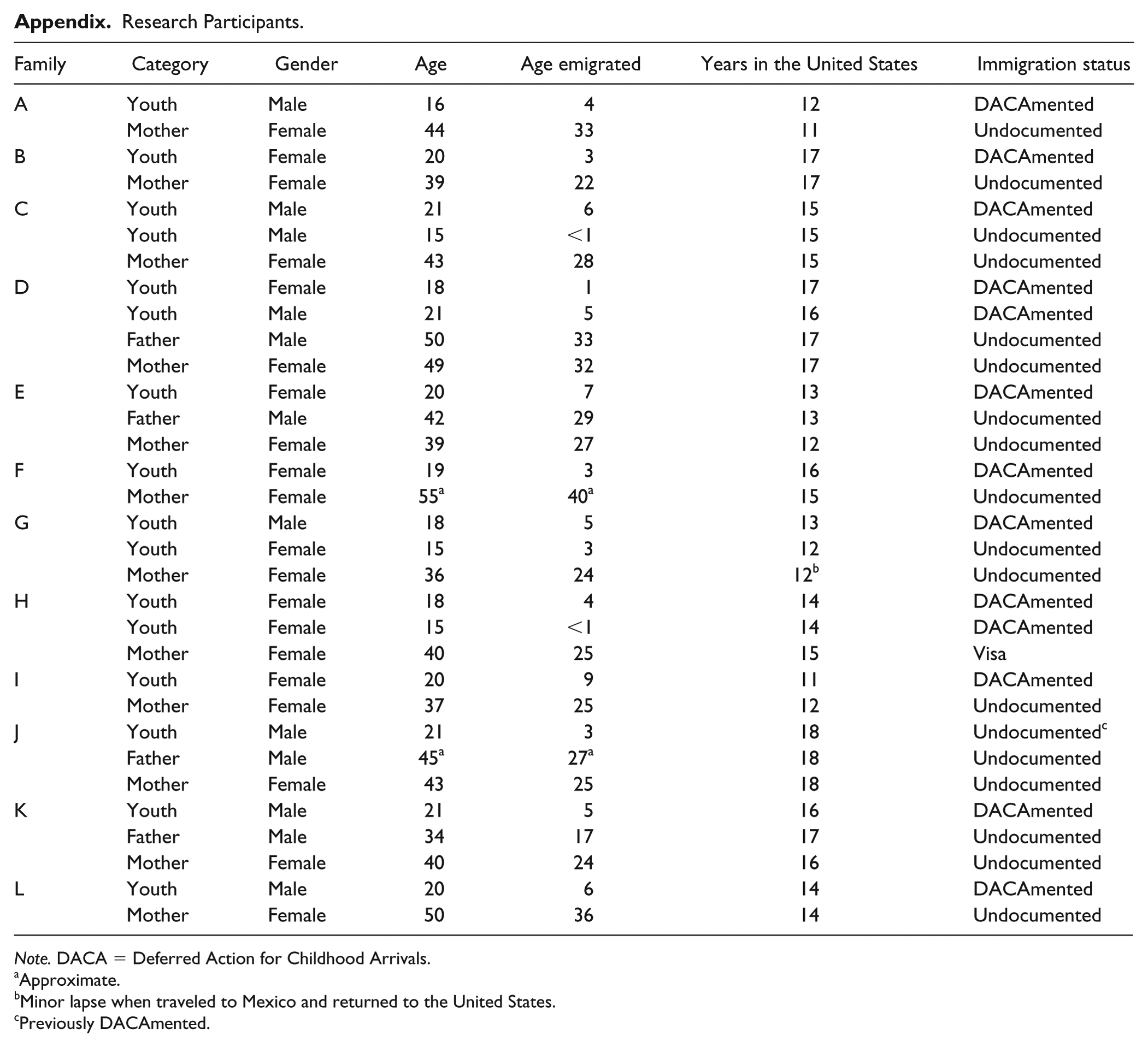
| Family | Category | Gender | Age | Age emigrated | Years in the United States | Immigration status |
|---|---|---|---|---|---|---|
| A | Youth | Male | 16 | 4 | 12 | DACAmented |
| Mother | Female | 44 | 33 | 11 | Undocumented | |
| B | Youth | Female | 20 | 3 | 17 | DACAmented |
| Mother | Female | 39 | 22 | 17 | Undocumented | |
| C | Youth | Male | 21 | 6 | 15 | DACAmented |
| Youth | Male | 15 | <1 | 15 | Undocumented | |
| Mother | Female | 43 | 28 | 15 | Undocumented | |
| D | Youth | Female | 18 | 1 | 17 | DACAmented |
| Youth | Male | 21 | 5 | 16 | DACAmented | |
| Father | Male | 50 | 33 | 17 | Undocumented | |
| Mother | Female | 49 | 32 | 17 | Undocumented | |
| E | Youth | Female | 20 | 7 | 13 | DACAmented |
| Father | Male | 42 | 29 | 13 | Undocumented | |
| Mother | Female | 39 | 27 | 12 | Undocumented | |
| F | Youth | Female | 19 | 3 | 16 | DACAmented |
| Mother | Female | 55 a | 40 a | 15 | Undocumented | |
| G | Youth | Male | 18 | 5 | 13 | DACAmented |
| Youth | Female | 15 | 3 | 12 | Undocumented | |
| Mother | Female | 36 | 24 | 12 b | Undocumented | |
| H | Youth | Female | 18 | 4 | 14 | DACAmented |
| Youth | Female | 15 | <1 | 14 | DACAmented | |
| Mother | Female | 40 | 25 | 15 | Visa | |
| I | Youth | Female | 20 | 9 | 11 | DACAmented |
| Mother | Female | 37 | 25 | 12 | Undocumented | |
| J | Youth | Male | 21 | 3 | 18 | Undocumented c |
| Father | Male | 45 a | 27 a | 18 | Undocumented | |
| Mother | Female | 43 | 25 | 18 | Undocumented | |
| K | Youth | Male | 21 | 5 | 16 | DACAmented |
| Father | Male | 34 | 17 | 17 | Undocumented | |
| Mother | Female | 40 | 24 | 16 | Undocumented | |
| L | Youth | Male | 20 | 6 | 14 | DACAmented |
| Mother | Female | 50 | 36 | 14 | Undocumented |
Note. DACA = Deferred Action for Childhood Arrivals.
Approximate.
Minor lapse when traveled to Mexico and returned to the United States.
Previously DACAmented.
Acknowledgements
We would like to thank all the families who participated in this study for courageously sharing their stories with us. We would also like to thank Nina Vazquez, Nina Quasarano, and Maris Wallag for their research assistance in preparing this article. Finally, we would like to thank the coeditors of this special issue, Drs. Gaile S. Cannella and Mary Esther Huerta, for their feedback on an earlier version of this article and guidance during the review process.
Declaration of Conflicting Interests
The author(s) declared no potential conflicts of interest with respect to the research, authorship, and/or publication of this article.
Funding
The author(s) disclosed receipt of the following financial support for the research, authorship, and/or publication of this article: This investigation was supported by the Research and Creative Activity (RCA) program at the University of Michigan-Flint and the College of Education, Nursing, and Health Professions Institute for Translational Research at the University of Hartford.