




Abstract
This article represents the authors’ place-based songwriting work with youth aged 9 years to 18 years who were participating in two of West Virginia’s 4-H summer camp experiences. Beginning with the simple exercise of having the youth brainstorm and list their likes and dislikes about the communities in which they live, the author adapted an approach for teaching traditional music in West Virginia—the call and response—to create a framework by which the youth could turn their likes/dislike statements into lyrics, ultimately performing their songs for an audience of their peers and the leadership of their respective camps. The goal of the project was to test the methodology and to set the stage for the development of a curriculum module that could be used in schools as a way to engage students in creative and productive conversations about the past, present, and future of their communities. Not only did the youth readily engage in the process, they provided thoughtful and thought-provoking lyrical representations of what they saw as both positive and negative about their communities.
Times are difficult for many in my home state of West Virginia. Although the state is full of wonderful humans who desire the same things from life as most other humans, the King (coal) is not providing for his people as in days past. Oh to be sure, there is still coal being mined, but the operations are highly mechanized and no longer need the human physical labor at the scale of past decades. In 1940, there were 130,457 persons employed in the coal industry in West Virginia. In 2016 that number stood at 11,561 (statistics portal and Appalachian Voices). Once thriving communities now find themselves struggling to fund basic infrastructure services. Buildings that housed hundreds of successful small businesses, schools, faith communities, and civic organizations stand vacant and is disrepair. Politicians from the highest office in the land down to the local city councils continue to vocalize promises of change and a new era of prosperity—often to be attained by looking to rebuild the past industries whose collapse provides the backdrop to the current conditions on the ground in many places across West Virginia.
The purpose of this article is not to write another essay on the problems of West Virginia, but rather to highlight a project I conducted that strived to engage a segment of the population whose voices are not readily apparent in the “what about the future of West Virginia?” conversation—the youth.
The Project
In the summer of 2018, I conducted two songwriting courses with youth in two different 4-H camp settings in West Virginia. Over the course of a week at each camp, we explored the discipline of songwriting and the subtopic of “place-based songwriting.” Place-based songwriting is just what is sounds it would be—writing songs about places. At its simplest, place-based songs describe a location. . . a spot on the map. When the songwriter takes it to a deeper level, she or he is not only focusing on the physicality of the place, but the meaning of the place. The place-based songwriter strives to communicate how the place has, is, and will inform the writer’s own existence. Although there is much left to interpretation in a place-based song, the listener can generally gain a good feel for the importance of the place to the writer. The writer can use the medium of song to communicate in a way that pictures and simple narrative cannot. The descriptions lead to an understanding of the values and belief systems held by the writer. Such was the goal of the songwriting courses—to challenge the youth to bare their souls a bit in terms of the places in which they were raised. To get them thinking about the good and the not so good, the right and the wrong, the things they would change if they could, and to help them see that songwriting is a way to communicate those thoughts to a variety of audiences.
Settings
The place-based songwriting workshops were held at two camps in West Virginia.
Jackson’ Mill State 4-H Camp
The first is known as Jackson’s Mill, and it serves as the state-level 4-H camp. This 74-acre tract in the central part of the state is a remnant of a larger historical parcel that is well known among Civil War buffs in West Virginia and beyond as the boyhood home of the famous Civil War General Thomas “Stonewall” Jackson—a history that some embrace and others eschew. Campers from all of West Virginia’s 55 counties come to this camp and spend a week engaged in age-appropriate activities. The terrain is “river bottom flat and open” and the camp facilities are numerous and modern. This is in stark contrast to many of the other smaller, less funded county-level camps scattered around the state.
Wyoming County Youth Camp
The second location was at the Wyoming County Youth Camp located at Glen Fork, West Virginia. Wyoming County is in the heart of the southern West Virginia coalfields. The camp with its few rustic buildings sits nestled deep in the mountains at the head of a narrow hollow and serves a variety of populations—church work groups, family reunions, weddings and, of course, the local 4-H campers.
The Participants
Jackson’s Mill
The Jackson’s Mill campers engaged in this project were aged 17 years to 21 years and attendees of what is called the Older Member’s Conference (OMC). The OMC campers are typically well-seasoned 4-H members who have been active in the organization since they were young children. The OMC is a time for having fun reconnecting with long-time 4-H friends while developing new connections. I came to find that it is also a time for participants to delve deeply into pressing topics facing them, their state, and their beloved 4-H program. Each morning began with an extended assembly where the campers were engaged in discussion on a key topic of the week. I was pleasantly surprised to attend the first morning session (right before my first class with them) and to hear them already engaged in passionate discussion with that morning’s keynote speaker about topics such as political activism, improving their communities, the struggles facing the state in general—all topics I was planning to broach in the songwriting sessions—they were already a step ahead of me!
My class occupied a 3-hr time slot (most of the other camp sessions were 1 hr), and the participants had self-selected into the class after reviewing all of their options in the camp program. Of the six OMC campers who participated, there were three males and three females. Two were rising college freshmen and the other four were rising juniors or seniors in high school. The campers came from a variety of settings across West Virginia. Three were from very rural parts of the state where extractive industries such as timber, coal, and small-scale farming were the primary historic economic engines. One was from the largest city in West Virginia, where the chemical industry and state government make up a major portion of the economy. One was from a town where steel production had been a major industry, but the area was now teeming with natural gas extraction–related activities. The remaining participant was from a former coal mining center, which is growing in new directions as the result of having a small state university, being in close proximity to the largest state university, and lying in close proximity to a host of Federal facilities. I found it both interesting and encouraging that each of the participants identified as being active in creative writing process already either through poetry or lyrics.
As the 4-H program requires two adults to be with the campers at all times, I was provided an adult counselor to assist me with the group. This person, a 23-year-old male, was studying educational policy in graduate school in Michigan, but had grown up in West Virginia 4-H, including being very active in the OMC. In his case, Jackson’s Mill was his local camp.
Wyoming County
The campers in Wyoming County differed from the Jackson’s Mill campers in three major ways: 1) they were younger; 2) they were from the local area; and 3) they were a more homogeneous group in many ways. The campers ranged in age from 9 years to 15 years, with those attending my class being aged 9 years and 13 years. Two of the kids were from within 10 miles of the camp and the other from a neighboring county about 25 miles away.
As at the Wyoming County camp, I was assisted by an adult counselor. This person was 28 years old, not a 4-H alum, grew up in the area, left the state out of high school, and had returned to try to help rebuild his community. All participants shared the experience of living in a region where the coal industry had once ruled, for better and worse, for decades. Although they could see the remnants of a once thriving industry all around them—environmental scars and decaying mining and mining support infrastructure—they were born a few generations too late to experience the boom days and could scarcely imagine the hustle and bustle of their present-day communities back then.
As the Wyoming County campers were often in one large group in the main dining/activity building, it was only a matter of time before some of the other campers became aware of the songwriting activities. Their inquiries into what we were doing led me to engage them in the activity as well—usually while waiting in line for the meal or in-between workshops. Their contributions were less regular, but important and I indicate their work by using an age range as it was generally a collection of kids chiming in with ideas. I also had one 40 year old counselor who stopped by occasionally and contributed to the work.
The Process
Introductions and Expectations
The first session began with introductions—not a superficial focus on just names and hometowns—but deep introductions. I wanted it to be clear from the start that while I had some semblance of an agenda for the week in mind, my main desire was for this to be a mutually engaging experience. I felt I had some knowledge of the songwriting process to impart, but also felt I had a great deal to learn from them. I was not here as an expert to critique their work, but rather as a fellow human who wished to explore some big questions in song and in collaboration with other individuals.
Ideas for Lyrics
A simple exercise I wanted to try as an icebreaker was to have workshop participants identify and write down 10 things: five things they embrace about where they live and five things they do not necessarily like (or would like to change). Without casting this as a lyrical exercise (removing the pressure of rhyme and meter), I saw it as a way to elicit 10 potential lyrical topics participants could call upon when we got to the actual crafting of the song. Each participant presented their lists to the larger group and in that sharing the combination of words, tone of voice, body language, and facial expressions, all came together to help each member develop a deeper sense about the persons with whom they were going to spend at least 15 hours over the next several days working on songs! There were some “aha” moments when participants realized they had listed the same likes or dislikes. There were some “really?” moments when they questioned each other’s lists—sometimes not understanding how their perceptions of an issue or scenario could be so different. This exercise provided me with a great deal of insight and fodder for the week’s exercises.
The Likes and Dislikes
Tables 1 and 2 represent the condensed results of the “likes” and “dislikes” exercise. Those with an asterisk (*) represent topics that appeared either solely or more heavily in the Wyoming County setting with the younger participants.
Responses to the “What Do You Like About Your Home Places” Exercise.
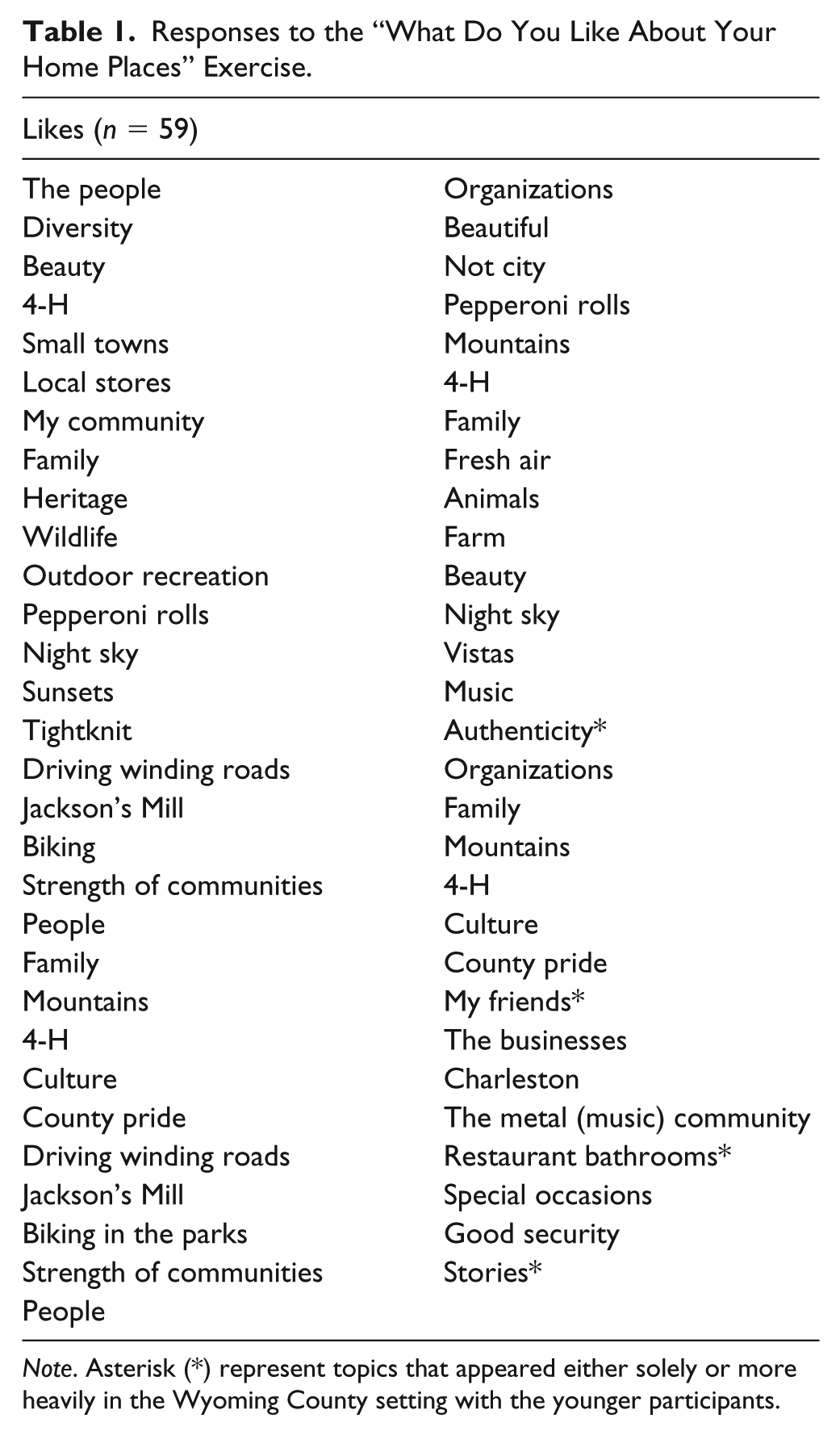
Note. Asterisk (*) represent topics that appeared either solely or more heavily in the Wyoming County setting with the younger participants.
Responses to the “What Do You Dislike About Your Home Places” Exercise.
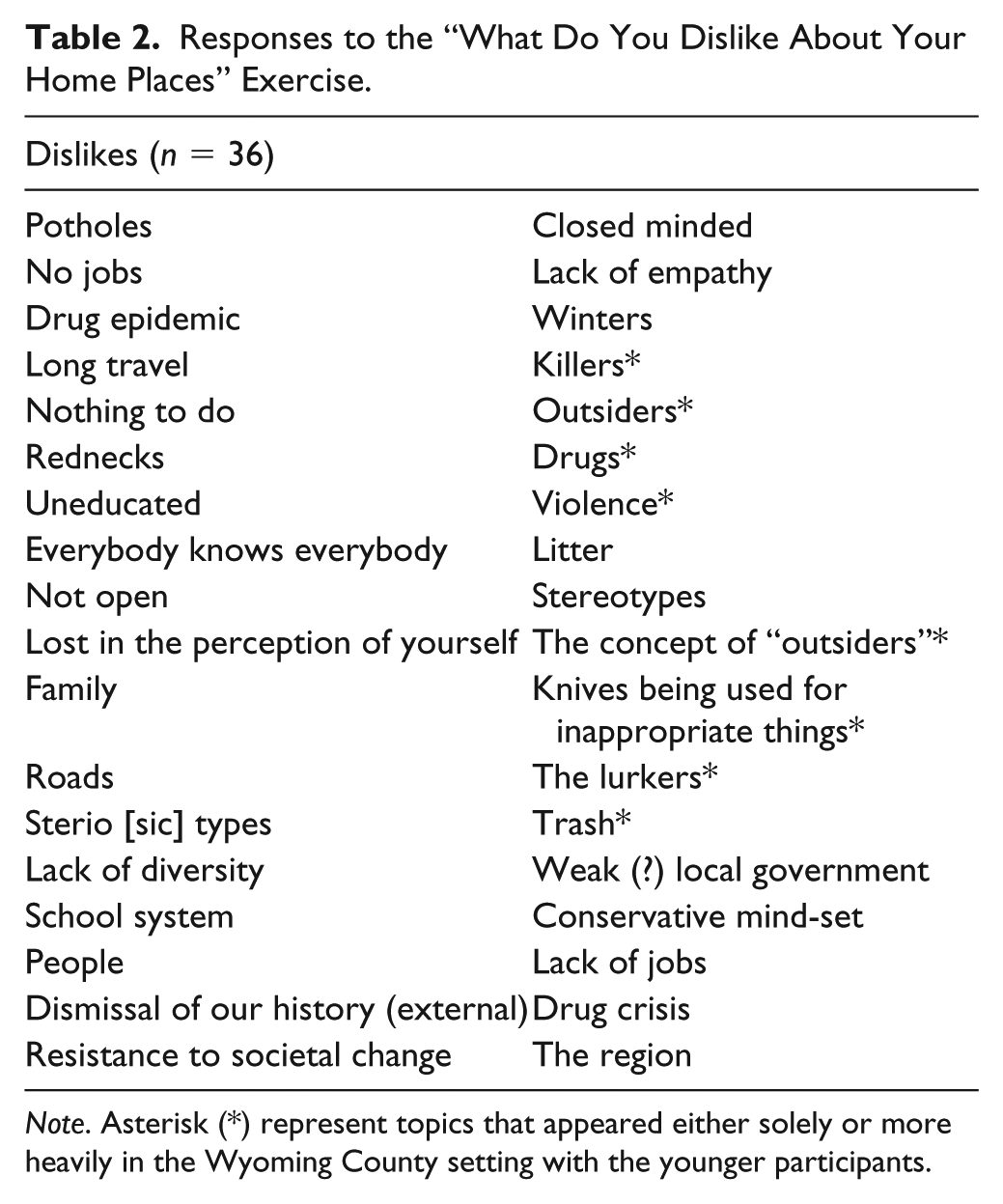
Note. Asterisk (*) represent topics that appeared either solely or more heavily in the Wyoming County setting with the younger participants.
Traditional Call and Response Approach
As a lifelong student of traditional music, I have embraced a process of learning music and songs known as the “call and response.” It is a simple approach whereby the teacher plays or sings a phrase and the student simply repeats it back. If the phrase is simple enough, the student might repeat it quickly. For more difficult passages, however, the call may have to be repeated many times before the student internalizes it and can accurately respond. The goal is for the student to master what the teacher has presented—exactly as presented. Once mastered, the piece may then morph to reflect the students’ own spin on it (especially if it is a tune/melody). If the phrase is from a song, then it is not so likely that the student will make up new words, but they might incorporate other versions of the song that exist in the tradition and thus create a unique version. We traditional musicians like to refer to the act of “sitting knee to knee.” It is a human-to-human interaction sans written music and/or written lyrics to get in the way.
Although the goal of this project was not to pass along songs already written, I felt the “call and response” process would provide a nice framework to introduce newcomers to the craft of songwriting. Songwriting can seem both very natural and overwhelming, especially if starting from scratch. As with any craft, practice tends to produce improved results. Given that I had an unwritten goal of sharing our work with the larger camp at the end of the week, I provided the participants with a framework—a skeleton of a song that begins by asking a question (a call). Rather than requiring a certain answer (the response), I asked the students to use their aforementioned likes/dislikes as the basis for creating their own personalized response as a starting point.
The particular question/call I used was originally created for use with my own children as I was teaching them to write songs. We were doing our bedtime reading one evening and the subject of the children’s book was West Virginia. The author was recollecting some childhood experiences visiting relatives in West Virginia. I asked my son what West Virginia meant to him and he mentioned that it meant fiddle music. The suggestion of fiddle music sparked an idea to turn his ideas into lyrics. I sang (called) to him, “What does West Virginia mean to me, what does West Virginia mean to me?” and then couched his fiddle answer (response) in the context of a well-known traditional festival we attend—the West Virginia State Folk Festival—simply known as Glenville (for the town in which it is held). The lyric became this, What does West Virginia mean to me? (the “Call”) What does West Virginia mean to me? It means old time fiddle tunes down in Glenville every June (the “Response”) That’s what West Virginia means to me That’s what West Virginia means to me
We continued for many verses. . . some remembered and others lost to us by morning. What stuck, however, was this simple structure that has proven very helpful to me in teaching the craft of songwriting.
First Attempt at a Song
Everyone was ready to get into the business of writing, so I sang the call to the participants and asked them to respond with something from their lists. Humans seem to have at least some natural gift for rhyme (perhaps honed in kindergarten and grade school with nursery rhymes), and these youths were no different. The responses were quick in coming and reflected their daily lives and thoughts of the place(s) important to them. Some of the lines came out as non-rhyming ideas and we tweaked those, but for most the rhyme was there. As a group we worked on meter and singability—making sure the lyrics rolled off the tongue with ease—to arrive at the following responses. Table 3 lists the lyrical responses (based on the earlier “likes” and “dislikes” lists) generated by the participants. The reader will notice that the responses are sometimes structured around a single topic, whereas at other times there are multiple topics in a response.
Lyrical Responses Generated by the Participants. Wyoming County represents the Wyoming County camp. All others represent the Jackson’s Mill camp.
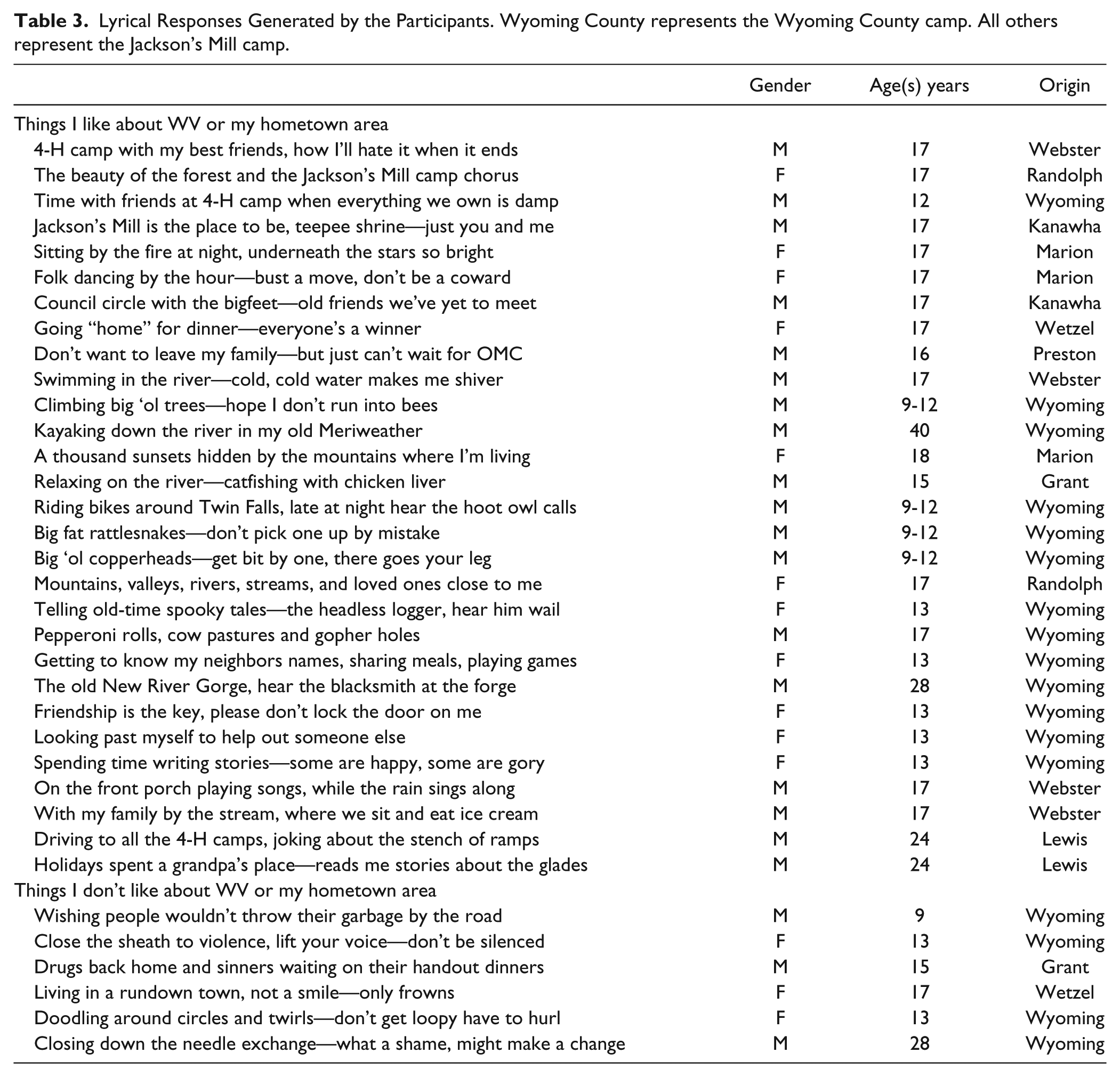
As stated earlier, the first exercise was to generate lyric ideas through the like/dislike lists. Once we completed discussion of the lists, the pens hit the paper and the ideas poured forth. As the youth started formulating their lists into lyrical lines, the first ideas to be tackled came from the “likes” list. For example, the “like” of “night sky” was expressed in the lyric, “sitting by the fire at night underneath he stars so bright.” Another topic on the “like” list—Jackson’s Mill—became the lyric, “4-H camp with my best friends, how I’ll hate it when it ends.”
As I encouraged the youth to consider both their “likes” and “dislikes,” the lyrics took on more depth. For example, the word “violence” and the phrase “knives being used for inappropriate things” appeared on a list of dislikes from one of the participants. Both of those topics were incorporated into the lyric “close the sheath to violence—lift your voice, don’t be silent.” Not only does it highlight a “dislike,” it does so in a way that references the “dislike” (knife) in a more abstract way than just naming it. Furthermore, it demands action on the part of the listener. This is a very complex lyric—especially when coming from a 13-year old.
While my primary goal was to see if I could engage the youths in this activity in a way that encouraged them to reveal thoughtful information about their home places, it does provide fodder for conversation to note a few relationships between the exercises in which they engaged.
As seen in Table 4, the “likes/dislikes” exercise produced 59 responses—62% reflecting the “likes” and 38% “dislikes.” Those 59 responses boiled down into 35 lyrics, reflecting the “likes” 83% of the time and “dislikes” 17% of the time.
Proportion of Comments and Lyrics Related to “Likes” and “Dislikes.
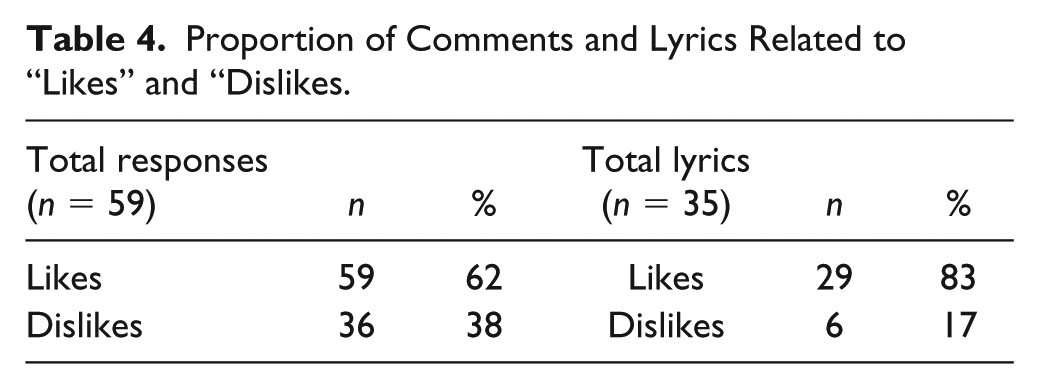
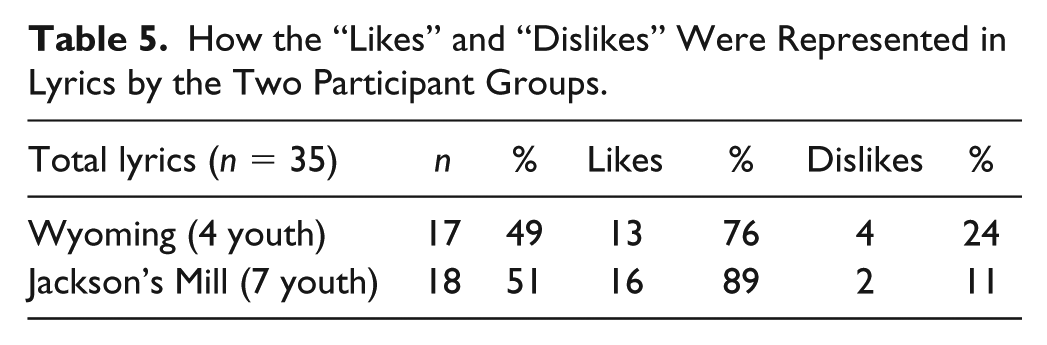
Table 5 indicates the proportions of lyrics that fell into the “likes” and “dislikes” categories by participant group.
How the “Likes” and “Dislikes” Were Represented in Lyrics by the Two Participant Groups.
Reaction and Analysis
Working with teens on anything can present both wonderful opportunities and challenges. To my pleasant surprise, these kids engaged right out of the gate. They readily shared their thoughts on what they liked and disliked with no punches pulled. They enjoyed the challenge of rhyming and we could have easily generated 2 or 3 times the amount of responses had we not moved on to other ideas for songs.
At first glance, the responses generated by the campers seem innocuous enough. . . reflections of good times had a camp, with some other noncamp memories tossed in for good measure. It is interesting to note that what I take to be the heavier lines—the ones that delve into some of the not-so-great aspects of where these kids live—come from the younger participants—those from Wyoming County, whereas the older participants’ lines generally reflected a deep admiration for their 4-H experiences.
Another difference is the type of messages generated between the Jackson’s Mill and Wyoming County groups. The majority of the older youth simply stated what they liked or, in some instances, disliked. For example, “the beauty of the forest and the Jackson’ Mill camp chorus” is pretty straightforward. With the younger Wyoming County youth I was struck by the complexity of their offerings. Lines such as “close the sheath to violence—lift your voice—don’t be silenced,” “getting to know my neighbors names, sharing meals and playing games,” “friendship is the key—please don’t lock the door on me” go beyond merely stating a like or dislike. Instead they do dual duty by highlighting an issue of concern and following up with a call to action. I am not quite sure of the reasons behind the differences, but perhaps it has something to do with the situations in which these younger youths find themselves—they are early in their 4-H experiences and did not seem to play up the positive aspects of 4-H as did their older counterparts at Jackson’s Mill. Perhaps their sense of solidarity within their social networks is not as developed as that of the older youth.
Autoethnographic Aspect of This Project
Last year, I wrote a manuscript that highlighted my work with an older population of a small, but historically significant, coal mining community in north central West Virginia. The editors of the journal encouraged me to dig into how the project changed me and my perspectives. I must admit that I first scoffed at this notion, but putting aside my bias, I thought about the project and realized that it had indeed affected me at a level which was not readily apparent to me. The Songs and Stories of Scotts Run highlights those changes and set the stage for a similar analysis of this current project.
Initial Thoughts on How Things Would Go
There were a few knowns going into this project. In plannign for this project I had engaged in many discussions with the Directors of three 4-H camps in West Virginia and all were enthusiastic about the idea of engaging their campers in the place-based songwriting activity. We agreed that the campers would self-select based upon a written description I provided for the camp information packets. We also agreed that I had the right to dismiss any kids who were not participating or were disrupting the process. We agreed that I would take all the necessary training to be considered camp staff (as opposed to a visitor), and thus would be able to come and go just as any other staff (meaning that I would not have to be escorted around)—this would potentially provide the opportunity to engage with participants outside of class hours should the opportunity present itself.
Other than those assurances, everything else was up in the air. My own extensive camp experiences in the Boy Scouts, church camps, plus my past professional work with youth (substitute teaching, college professor, and significant engagement with young workers on the Habitat for Humanity jobsites I managed) had me thinking of everything that could go right and wrong. This could be either a wonderful experience or a wonderfully bad experience.
With my first group, the Jackson’s Mill campers, my fears were put to rest soon after arriving at camp for registration on Sunday . . . the day before my classes were to begin. I was given my own table in the main assembly room and informed that once kids had completed general registration at other tables, those tagged for class would be directed to me so that I could do the informed consent paperwork as per the institutional review board (IRB) protocol. I sat there for a while and observed a very calm and organized registration of around 200 campers—six of whom were to eventually make their way to my table. As one by one they found me and we went over the necessary paperwork I was struck by the genuine excitement each of the campers displayed for the class that was to begin the next morning. Both parents and kids talked about their musical interests and, more specifically, their writing practices. All but one indicated experience writing lyrics. The outlier did, however, described her passion for poetry.
I had initially planned to stay at the camp, but given the highly structured schedules of the campers, my time to engage with them outside of class would be very limited, so I decided to make the drive from my home to camp and back each day—about an hour’s drive each way. In all honesty, this proved to be a valuable decision as it provided me with critical “alone” time to reflect on the day’s activities and to ponder how I might incorporate lessons learned into the next day’s sessions.
A New Song Idea
As I was driving down to Jackson’s Mill on the second day of the camp, pleased with the progress of the first day and excited to see what this day would offer, my mind was on the national discussion occurring on U.S. immigration policy. I began mulling over the topic—not just U.S. immigration policy—but rather the larger notion of being an alien in a foreign land. How could I address this in song? As I worked through various scenarios in my mind, it occurred to me that there are many ways a person could become an “illegal” by necessity. The news was fraught with stories of people fleeing their homelands because of rampant military and gang-related violence. I could write about these situations, but that has already been covered. What other situations might result in a person seeing no other option but to enter a foreign land illegally—perhaps not even thinking about that aspect of their fleeing in the moment?
The highway signage indicating that I was crossing into another county prompted me to think about how political borders sometimes run right through the middle of towns. . . sometimes one side of a street is in one jurisdiction, whereas the other side is in a different jurisdiction. What if, I imagined, an international border ran through the middle of a populated area and someone’s house sat right near that line. . . close enough that if their house caught on fire and they had to jump out the window, they would jump into another country, thus becoming an illegal alien? How would immigration and border policies come into play in that scenario? Finding this rather comical, I set about to create a funny lyric—sometime comedy is the best way to interpret a tragic event. After a few miles of crafting a lyric, I thought that this topic might be a good exercise for the campers to tackle. Still wanting to stick with the call and response method, I created this call: “Listen up people, I have a question for you. . . if your neighbor’s house was burning down, what would you do?” This call purposefully removes the immigration policy framework and thus allows the respondent an unlimited range of response scenarios.
Armed with this clarity about how to proceed, I promptly pulled over at a gas station and hammered out three simple verses (verses I would later share with the group, but not until I had given them the opportunity to interpret the call and create their own responses). My working title was, “Houses A’ Burning.”
If one were to analyze all the lyrics I have written, they would find that I am a storyteller at heart and favor a narrative type of lyric. I often focus on a lyrical and rhyming communication of the facts in chronological order. Sometimes the focal point is not a story, but the describing of a feeling or thought—these I find more difficult to write in a way that I feel will connect with an audience. The song that asks a question—that poses some ethical scenario and challenges the listener—is not a typical style for me, but it is a style that I have always desired to write. I mean, what songwriter has never wished they could write a Dylan-esque lyric that addresses the great moral questions of their time and in a way that will be remembered for as long as songs are being sung?
I don’t dare compare myself to Bob Dylan, but his great song, “Blowin in the Wind,” is similar in structure to my “ Houses a’ Burning” in that it the “call” is a series of questions (to which there are no concrete answers) and the “response” is an affirmation that there are no clear answers. In “Houses a’ Burning,” however, the “call” is a question and the “response” is also a question that asks the listener which of two possible answers/actions she would choose.
While Houses A’ Burning may not be the strongest lyric I have created, it is powerful in its simplicity and universality—something that definitely pleases me. It is another arrow in my quiver of songs, so to speak. Through it, I was able to connect with the Jackson’s Mill participants in a more thought-provoking way that the more simplistic, “What Does West Virginia Mean to Mean” approach.
What follows is my lyric to the Houses A’ Burnin’ exercise. This was not shared with the youth until after they had responded with their own lyrics to the question, “what would you do?” Houses A’ Burning Copyright © 2018 (John Christopher Haddox) Listen up people, I have a question for you If your neighbor’s house was burning down—what would you do? Would you rush in for certain, smother the flame? Or would you peek through your curtains, mutter God what a shame? There’s houses a’ burning, houses a’ burning, houses a’ burning All over the world (x2) Listen up people, I have a question for you If your brother’s boat was sinking down what would you do Would you bust through the waves, no regard for yourself? Or would you trust that the save would come from somebody else There’s boats a’ sinking, boats a’ sinking, boats a’ sinking All over the world Listen up people, I have a question for you If your sister’s sky was falling, what would you do Would you run away wildly screaming alarm? Or would use your own body to screen her from harm There’s skies a’ falling, skies a’ falling, skies a’ falling All over the world Houses a’ burning, boats a’ sinking, skies a’ falling All over the world
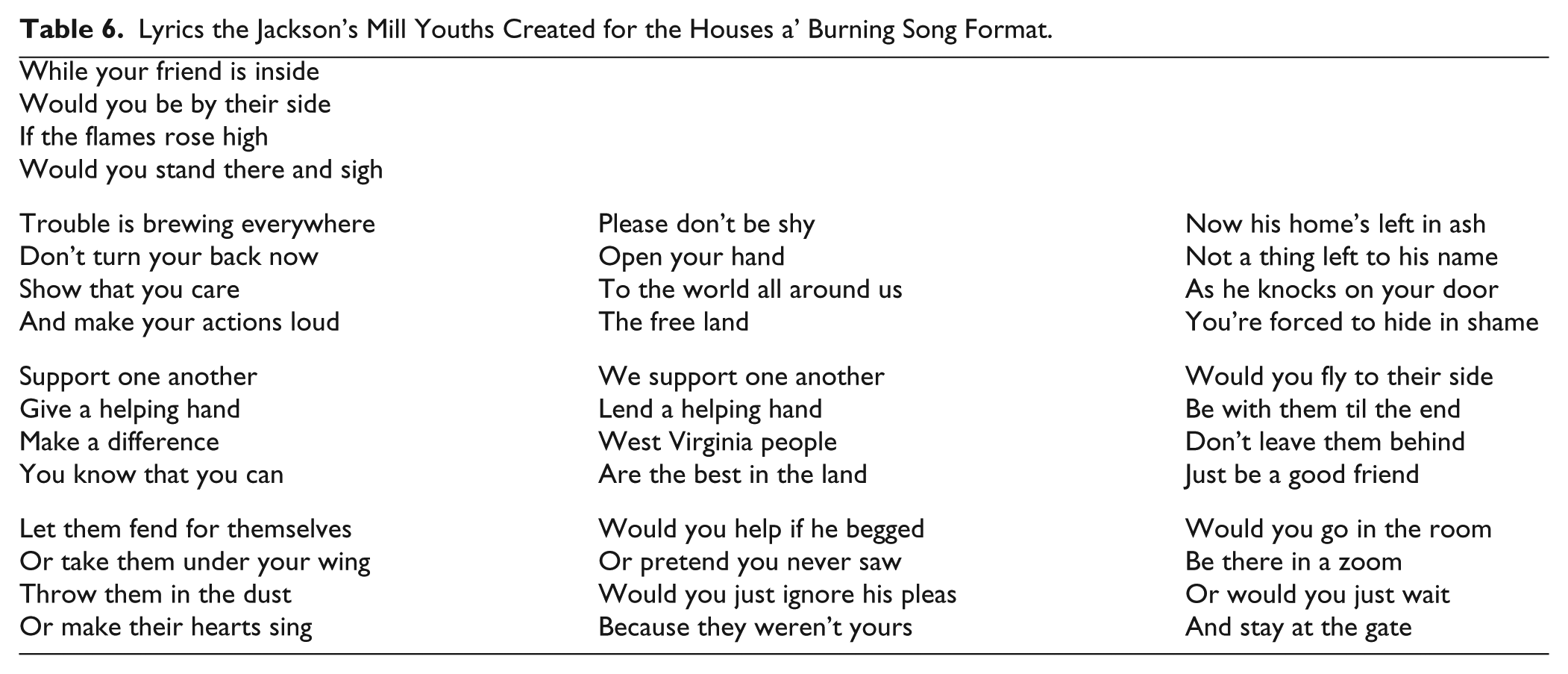
Table 6 represents the various lyrics created by the youth. Some of the responses fit the lyrical format and meter, whereas others represent
Lyrics the Jackson’s Mill Youths Created for the Houses a’ Burning Song Format.
Where to Go From Here
I came away from the 2 intensive weeks of this project with a feeling of hope that there are kids out there who want to engage in conversation—who want to talk about serious stuff right along with their silly stuff—and who enjoy being creative. Having two children of my own, I sometimes wonder about the level of curiosity they have about things other than what is supplied to them in school.
In retrospect, I should have sought input from the Wyoming County youths on this song idea, too, as they tended to provide lyrics that reflected a deep engagement, concern for, and call to action within their own communities. I will incorporate this next summer should I be fortunate enough to work in Wyoming County again with these youths.
My plans for summer 2019 are to build upon the songs developed and, at the least, record and distribute them locally for the larger outside community to digest—providing those outside the 4-H camp setting an opportunity to hear what the youth have to say, meanwhile validating the contributions of these participants.
Footnotes
Author’s Note
Data from this project can be accessed by contacting John Christopher Haddox.
Declaration of Conflicting Interests
The author(s) declared no potential conflicts of interest with respect to the research, authorship, and/or publication of this article.
Funding
The author(s) received no financial support for the research, authorship, and/or publication of this article.