




Abstract
This article proposes the nomenclatural shifting of “evocative” autoethnography (EVAT) from its apparent current position as a co-type of autoethnography to a lead or superordinate type of evocative-like autoethnography, with the suggested name of “critically-oriented evocative autoethnography as a methodology without methods and situated within critical qualitative inquiry” (CEAM-CQI). In this lead position, EVAT as CEAM-CQI could maintain a unified and mediated stance alongside its apparent nemesis, “analytical autoethnography” (ANAT), by way of “disciplinary atomization,” which at first seems undesirable but then proves beneficial if mediated by ego-less critique and polyvocality (Gergen), and as a result, EVAT, now CEAM-CQI, perhaps could more fully achieve its social justice agenda.
Keywords
Nomenclature (2019) refers to the “devising or choosing of names for things,” primarily within science and the academy (p. 1). Consider, for instance, the disciplines or areas known as space exploration, museum science, and qualitative inquiry; this last including autoethnography, which is a written, visual, theatrical, or otherwise “acted out” repertoire whereby the author produces a part-theoretical/part-literary exploration of her or his self within a communal context, and which is the focus of the present article. 1 With regard to the first, space exploration, I draw attention to the Apollo 11 landing site on the moon. The general area of this site, a lunar desert, was assigned the proper noun Mare Tranquillitatis (“Sea of Tranquility”) by Italian astronomer Giovanni Riccioli in 1651 (cf. “Who Put the Names on the Moon?” 2012, p. 1), and three centuries later, the small area where Apollo 11 landed on July 20, 1969, was named “Tranquility Base” by American Neil Armstrong at the moment he and his astronaut-colleagues completed the first touchdown onto the moon (Smithsonian National Air and Space Museum, 2019, p. 1; Westworld, 2015, pp. 144, 145). Second, in museum work, certain “human-made objects” already generally associated with the common noun “artefacts” have been more specifically named “ceremonial artefacts” (Bourcier, Rogers, & the Nomenclature Committee, 2010, pp. xv-xvii), and third, within qualitative inquiry, and as further explained below, a type of autoethnography making use of empirical data such as excerpts from interviews and generally following the format of social science research reports has been named “analytical” (e.g., Chang, 2013, p. 118), while autoethnography opting for literary techniques and emotionality rather than a self-conscious empiricism has been named “evocative” at the initiative of Ellis and Bochner (2000) and Bochner and Ellis (2016).
These phrases “analytical autoethnography” and “evocative autoethnography”—as well as “Tranquility Base” and “ceremonial artifacts,” used here for illustrative purposes—demonstrate that through the assignation of “proper nouns[,] . . . common nouns, titles, signs and acronyms” (Bourdieu, 1947/1991, p. 105), nomenclature prompts the “calling into being of real-world or abstract entities” (Berg & Vuolteenaho, 2009, p. x; referring to Wittgenstein, 1953/1986) so that communication, inquiry, and discourse may proceed in most, if not all, endeavors, areas of study, and disciplines (Nomenclature, 2019, p. 1). Prompted by this nomenclatural perspective, the present article, subscribing to the “evocative” side, proposes that the name “evocative” avoid its apparent tendency to be one of the multiple literary-oriented types of autoethnography and instead assume a position as the main or superordinate category leading these multiple types of autoethnography. As a result, evocative autoethnography (EVAT) could more fully achieve its research agenda of working toward social justice while counterbalancing the apparently firm presence of analytical autoethnography (ANAT) within the general field of autoethnography.
In giving this cautious nod toward the underlying separatist scenario of “either analytic or evocative,” ANAT or EVAT, I realize that I am not in complete tune with the perception that “this distinction operates as a continuum rather than a binary categorization, with specific autoethnographic works falling somewhere along this continuum” (Allen-Collinson, 2013, p. 287). Nonetheless, I hope that my view would be considered and heeded. For the intention is not to antagonize or combat the analytical side, nor to reify divisionism. Rather, as explained below, the intention is for EVAT to maintain a unified, respectful, and mediated position alongside that of ANAT by way of “disciplinary atomization” (K. J. Gergen, 2001, pp. 50-57), which at first seems undesirable but then proves to be a healthy situation if held in check by self- and ego-less critique as well as polyvocality (K. J. Gergen, 2001, pp. 57-62). One main step toward this mediated atomization is the nomenclatural shifting of EVAT from probable co-type of autoethnography to lead type of evocative-like autoethnography, with the suggested name of “critically-oriented evocative autoethnography as a methodology without methods and situated within critical qualitative inquiry” (CEAM-CQI).
In proposing this nomenclatural structure of autoethnography whereby the already extant descriptor “evocative” takes a lead position as CEAM-CQI among similar types of autoethnography, I first justify this study according to its nomenclatural perspective involving atomization as set forth by K. J. Gergen (2001). Second, in two consecutive sections, I describe and reflect on the development of autoethnography so as to show the emergence of EVAT. Third, within the area of “critical qualitative inquiry” (CQI), I arrive at the EVAT category now nomenclaturally transformed as the category titled “critically-oriented evocative autoethnography as a methodology without methods and situated within CQI” (CEAM-CQI). Fourth, I present CEAM-CQI, as superordinate or lead, assembling the multitude of evocative-oriented types of autoethnography (EVAT) into one column or pillar beside that of ANAT. Fifth, returning to the concept of disciplinary atomization while warily involving binarism, 2 I consider the potential of the CEAM-CQI pillar to advance the critical agenda of EVAT. Sixth, I give a brief summation; finally, I pose concluding thoughts. I now turn to the pertinence of the study.
The Significance of Naming in Autoethnography
The “analytic versus evocative . . . debate”—ANAT versus EVAT—seems prevalent within contemporary autoethnography (Hughes & Pennington, 2017, pp. xvii, 28-30). Some may believe this debate “is now being downplayed, citing as evidence” what appears to be “limited attention paid to the debate in the . . . [2013] Handbook of Autoethnography” edited by Holman Jones, Adams, and Ellis (cf. Hughes & Pennington, 2017, p. 30). However, in a key study published the same year as the Handbook, Atkinson (2013) criticizes EVAT for being lazily literary in engaging dramaturgical conventions such as story and place while not positioning itself within historical literary traditions such as modernism, as even some traditional ethnography has done, according to Atkinson. From the other side, Bochner and Ellis (2016) provide a detailed and contrasting description of EVAT and ANAT, concluding that the evocative seems the more congruent with the subjective, personalized, and reflective aims of autoethnography. Based on this 2016 Bochner and Ellis study and the 2013 Atkinson study, both highly influential, the first supportive of EVAT, the second at least indirectly supportive of ANAT, one can conclude that the “‘evocative versus analytic’ argument” (Hughes & Pennington, 2017, p. 30) persists. This is not to say, however, that both sides are in hostile combat. Indeed, as Adams (2018) emphasizes, the autoethnographer’s dual mind-set of author and reviewer allows the autoethnographer to promote her or his variant of autoethnography without demeaning or trashing an opposing variant: “As authors, we should describe which values we use in autoethnography; as reviewers, we should do our best to respect an author’s autoethnographic orientation” (p. 205).
Respecting an opposing variant, though, does not mean ignoring it. For instance, while acknowledging that ANAT provides a needed descriptiveness (Adams, 2018, p. 205), EVAT nonetheless often views the analytical camp as antithetical (Adams, Holman Jones, & Ellis, 2013, p. 676). In particular, evocative-oriented autoethnographers take note of the complaint made by “the analytic autoethnography camp” that “evocative . . . autoethnography . . . mov[es] too far away from traditional empirical scholarship” (Hughes & Pennington, 2017, p. 29). In response, the evocative-inclined camp may clarify its empirical position, explaining that it appropriates analytical-type data by, for example, directly referring to “students’ fieldwork” such as observation formats on the basis that such fieldwork is “experientially located” and “connected through the personal” to the autoethnographer (Tomaselli, 2018, p. 171), hence deliberately engaging an enmeshed EVAT/ANAT (Grant, 2018, p. 115; Tomaselli, 2018, pp. 171, 176). Much less conciliatory are those autoethnographers who remain within “an evocative expression of research understandings” (Colyar, 2013, p. 368) whereby a collection of data in such form as interview transcripts, action-research registers, field notes, or personal diaries go unmentioned in the paper but are assumed to have informed or inspired the autoethnography as to its respective literary/rhetorical genre(s) such as poetry (Faulkner, 2017), a dialogic script (Smith, 2018), fictionalized story (Sughrua, 2012), personalized academic essay (Tamas, 2018), or mixture thereof (Pelias, 2002). So downplayed or ignored is traditional empiricism in these cases that the reader may also assume that “[a]utoethnography uses the researcher’s personal experiences as primary data” (Chang, 2013, p. 108). This view that the act of living, breathing, thinking, and feeling is its own type of data collection highlights the divide between EVAT and ANAT. This distinction, seemingly engraved in the adjectives “analytical” and “evocative” as names or nomenclature categories, seems unstable but eventually proves healthy.
First of all, the instability of the names “analytical” and “evocative”—as well as, for example, “ceremonial artefacts” and “Tranquility Base”—owes to their capacity to be oppressive, liberating, or both, within their respective contexts. For instance, as the designation for the lunar-landing area argued to be a type of American “historical archaeological site . . . composed of a surface scatter of approximately 106 objects deposited over an area the size of a baseball diamond” (Westworld, 2015, p. 144), “Tranquility Base” alludes to a Westernized intent to cosmologically recuperate hegemonic colonization, the machines and NASA (National Aeronautics and Space Administration) debris now as stand-ins for the influenzas and brick architecture of old, albeit now propped up within what seems unfathomable silence rather than anguished civilization as before. To the contrary, however, if one accepts Westworld’s (2015) claim that “Tranquility Base represents a masterpiece of human creative genius in the realm of thought, philosophy, and technology that materialized through the research and development of technology that drew from many nations on earth” (p. 146), and if one believes that these “many nations” who had influenced NASA’s space program acted on behalf of and for all nations so as to share a universal turning point “in human history” (p. 144), then the name “Tranquility Base” would ring not of dominance but of compassion. Similarly, and second, “ceremonial artefacts,” as a superordinate term overseeing its respective ordinates or subtopics such as “holiday objects,” “religious objects,” and “organizational objects” (Bourcier et al., 2010, pp. xv-xvii) could be seen as one of many “hegemonic . . . practices of naming” intentionally or unintentionally set on the “colonial silencing of Indigenous cultures” (Berg & Vuolteenaho, 2009, p. 2). This would be the case if, for instance, certain Native American or First Nation objects used in spiritual ceremonies are not included under the category name “religious objects” or are seemingly miscategorized as “holiday objects.” On the contrary, however, if upon revision the certain object is listed in the “religious” category index or physically displayed in the “religious object” area of the museum, then the ordinate term “religious object” and superordinate classification “ceremonial artefacts” could enact a type of postcolonial revisionist liberation for the particular Indigenous community.
Just as empowerment may be both conjured up and negated by “ceremonial artefacts” in museum studies and “Tranquility Base” in lunar exploration, a sense of agency or identity is both granted and threatened by the adjective “analytical” in autoethnography. For instance, those autoethnographers seeing themselves as “keepers of [the] ethnographic tradition” could perceive the name “analytical autoethnography” (ANAT) as a flag of affirmation in their effort to promote “a form of autoethnography more closely linked to . . . formal research practices” (Hughes & Pennington, 2017, p. 28); whereas, on the contrary, literary-minded autoethnographers “who are champions of a much more evocative, subjective, and emotionally engaging autoethnography” could find the name “analytical autoethnography” (ANAT) a threat, especially when chided by their counterparts, the “ethnography-protection scholars,” for allegedly “devalu[ing] the academy’s standards” by way of insisting on literariness as well as a focus on “the researcher as subject” that supposedly evolves into a “‘domestic guilt episode’” (Hughes & Pennington, 2017, p. 28; including a citation from Delmont, 2009, p. 61). Probably taking in stride this sarcastic mockery for allegedly being self-obsessed, a good-natured jab from the opposition, these anti-analytical autoethnographers hold onto their belief that “feel[ing] the flesh and blood emotions of people coping with life’s contingencies” (Bochner & Ellis, 2016, p. 212) can not only provide a sensorially engaged reading experience but also lead readers to take up action on socially critical matters (Sparkes, 2018, pp. 258-259; referring to Holman Jones, 2005). Some on the sensorial side of this divide in autoethnography, guided by Ellis and Bochner (2000) and Bochner and Ellis (2016), have thus deemed their work “evocative,” a term running counter to “analytical” and connoting for them the freedom to academize a creative writing-like autoethnography that resonates “in the heart and belly as well as . . . head” while “act[ing] out . . . in ways that show . . . what life feels like now and what it can mean” (p. 213). Not surprisingly, however, analytical autoethnographers would probably not subscribe to this “safe house” view of the descriptor “evocative,” instead sensing the illocutionary force of this adjective blocking the advancement of their analytic agenda. Anderson (2006), for instance, feels concerned that the impressive success of advocacy for . . . “evocative or emotional autoethnography” may have the unintended consequence of eclipsing other visions of what autoethnography can be and of obscuring the ways in which it may fit productively in other traditions of social inquiry. (p. 374; quoted in Hughes & Pennington, 2017, p. 29)
As seen here, the “analytic” and “evocative” nomenclature within autoethnography may be both negative and positive, and the same holds for the “ceremonial artefacts” nomenclature in museum science and the “Tranquility Base” nomenclature in lunar exploration. This obviously speaks to different points of convergence and divergence within a given area of study, as Kuhn (1977, 1962/2012) famously asserts with regard to disciplinary paradigms. 3 The presence of both convergent and divergent affiliation within a discipline creates “a tension that . . . is one of the prime requirements for the very best sort of scientific research” (Kuhn, 1962/2012, p. 226), as each particular group becomes “atomized” (K. J. Gergen, 2001, p. 51) around its particular position. Granted, the “atomization of culture” is not necessarily healthy and democratic, for it “does not mean an increase in the range of voices that may be heard, but more often a constriction” whereby “[t]he reality of those in control comprehend only themselves” (K. J. Gergen, 2001, p. 57). That said and forewarned, “atomization” on the level of communities within a discourse group or academic discipline can be beneficial. For it casts the members into constant debate, discussion, and argumentation whereby one camp not only takes issue with the other camp or camps but also ignores the opposition while energetically celebrating its own position through research and product output (K. J. Gergen, 2001), the overall effect of which is to maintain the discipline open to future transformation, whether minor or radical (Kuhn, 1977).
An example of this atomization can be seen in the work of K. J. Gergen (2001). He describes the status quo of social psychology in the mid-1970s as holding the notions of science as “cumulative” and truth as “ahistorical” (K. J. Gergen, 2001, p. 51). The positivist leanings of this discipline-wide atomization were challenged by Gergen in a key 1973 article (cf. K. J. Gergen, 2001). The “enormous amount of debate within the field” in reaction to the 1973 article, now known as the “crisis in social psychology,” resulted in the emergence of the K. J. Gergen-inspired “anti-foundationalists” who became dedicated to “historically embedded and ideologically sensitive forms of inquiry” (2001, pp. 51-52). Over the ensuing years, the anti-positivist and situated research of this alternative group, along with writings on the controversies posed by this then-militant research, were allocated less and less publication space in the “established journals” controlled by the mainstream traditionalists (p. 52). In this manner, the “anti-foundationalist” group became “slowly . . . sealed off” and atomized within the larger field of social psychology (pp. 51-52). However, soon having its “own journals, associations, lines of scholarship and agendas,” this dissident and critical-oriented discourse group belonging to social psychology has flourished within its so-called atomization, transforming into “a large and heterogeneous community” of anti-foundationalists (K. J. Gergen, 2001, p. 52).
Granted, the diversity within a singular atomized group such as the anti-foundational social psychologists may, in the future, break out into power plays, leading to further atomization into subgroups, which could dilute and weaken the critical- and ideological-based knowledge produced by the heretofore unified group. This scenario could be viewed as quite detrimental, especially considering the resultant proliferation of what K. J. Gergen (2001) describes as rhetorical critique. I discuss this matter later on in the present paper. Meanwhile, allow me to state that atomization may not be ideal. However, to the extent that intellectual divisions within an academic discipline or area can focalize and intensify co-existing circles of research (Becher & Trowler, 2001), and to the extent that the respectful tension among such research groupings fuels the “convergence–divergence” energies needed for the continual transformation of disciplinary paradigms (Kuhn, 1977, 1962/2012), one can see value in engaging atomization. This, of course, would involve mediating its potential disadvantages and advantages, such as binarism and identity affirmation, respectively.
With regard to the latter, let me say that EVAT, once atomized, could feel invigorated by its own self-awareness as “a personal narrative in all its emotional and intellectual capacities . . . offer[ing] an intimate knowledge based upon lived experience with others” (Pelias, 2013, p. 387). This identity, for EVAT, is all the more acute and defined when seen in contrast to that of ANAT as well as the mediated “analytical/evocative,” just as the identity of ANAT as a personalized “narration” directly supported by “socio-cultural analyses and interpretations” (Chang, 2013, p. 119) acquires meaning and resonance through its differentiation from that of EVAT. The point here in promoting this “what-it-isn’t” perspective as a type of identity affirmation for EVAT is not to perpetuate positivism nor glorify binarism (cf. Note 2). Rather, my intention is to find value and energy in the seemingly inevitable realization that “presences would not make sense without the absences” (K. J. Gergen, 2001, p. 27). Hence, being energized in terms of atomization (above), both EVAT and ANAT rely on “the symbolically unifying functions that [their] names enjoy as performative catalysts for popular identities” (Berg & Vuolteenaho, 2009, p. x; referring to Laclau, 2005; italics added). A named or nomenclatural identity, consequently, has significance.
It could be likened to the apex of a museum roof, giving cover to the artifacts and their emanate wonders within the multitude of display cases below. Furthermore, “[t]he story of naming of the various features of the lunar surface,” dating from 1651 to the mid-1990s, “is . . . inextricably bound up with the whole subject of lunar imagery and cartography” (Whitaker, 1999/2003, p. xvi, italics added). Similarly, EVAT and ANAT—in their disciplinary divide, a seemingly detrimental but ultimately positive state when mediated (Becher & Trowler, 2001; K. J. Gergen, 2001; Kuhn, 1977, 1962/2012)—have a nomenclatural story. This story can be seen, at least indirectly, in a summative description of autoethnography which includes the categories or names “evocative” and “analytical.” Such is one purpose of the second section to follow below. In this description, aka story, I pull for the evocative side (EVAT). I want to see how it can nomenclaturally shore itself up, so as to effectively mediate and engage its own atomization upon the already-atomized terrain that autoethnography has created within social science research. In other words, it can be safely assumed that both EVAT and ANAT would continue to share the same venues such as book series, journals, and conferences extant within the general atomized circle of autoethnography. Notwithstanding, in terms of purpose, beliefs, or otherwise paradigmatic positioning (cf. Note 3), EVAT appears to partition itself off from ANAT into its own respective space within the circle of autoethnography. This is the story within the larger story; to that larger story, the overall atomization of autoethnography, I now turn.
The Larger Circle
Although not matching the 340-year-long development had by lunar mapping (Whitaker, 1999/2003), at least not in the nomenclatural sense by way of names and categories, autoethnography has steadily evolved throughout the last approximate 45 years. This development can be generally seen as autoethnography undergoing atomization and setting up its own boundaries, though porous, within the larger field of social science research. These boundaries become clearer a little later on this paper, when I more fully describe autoethnography, while providing examples from two representative EVAT-type autoethnographic papers: Schutt (2018) and Kien (2013). For now, though, allow me to remain in broad strokes, focusing on key moments and publications with respect to autoethnography establishing itself, drawing its circle in the sand. This circle provides the general panorama, upon which EVAT and ANAT mark their own circles which, like the larger and host circle or boundary already set by autoethnography, is porous enough for mediation and constrictive enough for a rallying energy. Go EVAT, I would say. First, though, let us consider the stadium: autoethnography.
Having its beginnings during “the rise of identity politics” in the mid-1970s (Adams, Holman Jones, & Ellis, 2015, pp. 1, 15-16) and gaining momentum about halfway through the mid-1980s to mid-1990s “crisis of representation” (Adams et al., 2015, pp. 16-18), autoethnography was famously and meaningfully defined in 2000. This was done by Ellis and Bochner (2000), who at that time referred to autoethnography as “an autobiographical genre of writing and research that displays multiple layers of consciousness, connecting the personal to the cultural” through texts in “a variety of forms such as short stories, poetry, fiction, novels, photographic essays, personal essays, journals, fragmented and layered writing, and social science prose” usually narrated in “first-person voice” (p. 739; quoted in Bochner & Ellis, 2016, p. 65; italics removed). This resonant definition was articulated in Ellis and Bochner’s chapter in the second edition of the Handbook of Qualitative Research (Denzin & Lincoln, 2000). With that “seminal chapter,” and by implication the above definition, “[a]utoethnography can be seen to arrive as an authoritative research methodology for the social sciences” (Gannon, 2017, p. 6), after having had an intermittent presence during the previous 25 to 30 years. Thereafter, autoethnography experienced a 13-year journey from pioneering handbook-chapter in 2000 to handbook in its own right in 2013 (Holman Jones, Adams, & Ellis, 2013a).
By this time, 2013, autoethnography had clearly established its purpose of directing its personal, cultural, aesthetic, and artistic energies (cf. Ellis & Bochner’s, 2000, definition) to “awakening critical consciousness and moving persons to take human, democratic actions in the face of injustice” (Denzin, 2018a, p. 49). In other words, autoethnography had proudly arrived at a social justice orientation. This, according to Sughrua’s (2019) summary of the classic definition set forth by Rawls (1971/2003), can be considered a belief system “that disqualifies . . . differences such as those regarding ideology, religion, race, ethnicity, gender, sexuality, social class, and (dis)ableness” so as to perceive and treat “all people as free and equal and thus deserving of the same distribution of material value such as income and housing, affective considerations such as respect, and opportunities such as education and health care” (also cf. Sughrua, 2016, p. 57). What channels this social justice–oriented attitude on the part of the autoethnographer is not patronization nor exoticization. To the contrary, the objective is “to create a critical relationship with the audience . . . and assist in the struggles of others” (Denzin, 2018a, pp. 44, 49). This is because, as stated by novelist/prose poet Algren (1951/2011), “in times when the levers of power are held by those who have lost the will to act honestly, it is those who have been excluded from the privileges of our society, and left only to its horrors, who forge new levers by which to return honesty to us” (p. 105).
The intensification of this collaborative concern for social justice is part of the “call to action” expressed at the end of the 2013 Handbook of Autoethnography (Holman Jones, Adams, & Ellis). While giving assurance that, by this moment in 2013, autoethnography had become situated “in numerous disciplines and in multiple publication venues,” the Handbook concludes its “call” for autoethnography to be further solidified “as a rich and viable method for social research” through teaching, writing, acquiring project funds, and mediating critiques from opponents (Adams et al., 2013, pp. 673, 676). This “call to action” made by the Handbook (Adams et al., 2013, p. 676) took on resonance from Denzin’s (2010) 3-year-prior publication titled The Qualitative Manifesto: A Call to Arms, while echoing on through the continued “autoethnographic exploration of selves, cultures, and worlds” (Adams et al., 2015, p. 676) over the next 4 years, momentarily pausing, as if catching a breath, in 2017 at the special issue of the International Review of Qualitative Research (IRQR) called “Manifesting the Future of Autoethnography” (Holman Jones, 2017a). This special issue, according to guest editor Holman Jones (2017b), is a “manifesto, from the Latin manu festus, meaning ‘struck by hand,’” a certain “call to move—to strike a pose or position, to strike out on our own,” as summoned in a performed act such as a spoken or written text (p. 1).
That this text or special journal issue has been created and enacted in public and for the public (Holman Jones, 2017b, p. 1) speaks to the antecedents or the firm moorings of a stage already built, which one can assume are all the pre-Handbook chapter (2000), pre-Qualitative Manifesto (2010), pre-Handbook (2013), and pre-IRQR special issue (2017) autoethnographies, all those works like accumulated ripples of a bronzy glow, one to the other and to the other, the many splayed hands willing the old-world Latin speakers’ metaphor of “a striking gesture” (Holman Jones, 2017b, p. 1) to the “solidarity and communion” (Adams et al., 2013, p. 676) found within their and our “still grasses and moving waters” (Algren, 1951/2011, p. 77). It is perhaps because, as Algren says, that “the Pottowattomies mourn in the river weeds once more” (p. 77), as we mourn with them and others who have been lost or marginalized, and they with us, that the IRQR special issue has chorused autoethnography on into the present time. Along the way, in 2018, arrived the second edition of Denzin’s (2018b) Performance Autoethnography: Critical Pedagogy and the Politics of Culture. A year later, in 2019, came the reissue of Denzin’s (2019) The Qualitative Manifesto as a classic edition. In this same year, the newly founded Journal of Autoethnography promoted the call for papers for its 2020 inaugural issue (cf. University of California Press, 2018). This new journal, the new editions of Denzin’s landmark works, and the other publications cited or generally referred to previously and dating back to the mid-1970s have marked off the terrain of autoethnography within the much larger field of social science research. 4 The autoethnographic theoretics and practices of this circle are discussed in the section after the next. Meanwhile, I reiterate that this circle or apparent atomization has been nearly a half-a-century in the making, and it now keeps alive the “manifesto . . . about rethinking . . . autoethnography” and exploring “what this form of writing means for writers who want to perform work that leads to social justice” (Denzin, 2018b, p. vii); this manfesto itself “a striking performance of what the world—and those of us in it—is, alongside what it—and we—might become (Holman Jones, 2017b, p. 1, italics in original).
The Manifesto and Beyond
This liminality as highlighted by the current socially committed autoethnographic manifesto (Holman Jones, 2017b) seems a space between the state-of-the-art of autoethnography and its projected innovation. Just one of many ways to view the former and latter is the apparent common classification of autoethnographic types as a current statis and a minor but significant shift within that classification as possible change. The first, a type of convergence, seems to lend an inertia to the evocative stand within autoethnography, whereas the second, a type of divergence, seems to strengthen evocativeness (based on Kuhn, 1977, 1962/2012; context mine). To contribute to that strengthening, one would wade the middle space or void, generally taking stock of autoethnography and in effect considering the categorization of autoethnographic types, while reshuffling that categorization. This I have attempted, and I recount and document this journey in the following section, where the particular term evocative seems cloaked in Kuhnian tension, first “capture[d] by the competing pressures of tradition and innovation” (Swales, 2004, p. 11), and then held “between a presence and an absence, that which is designated by the word against what is not designated” (K. J. Gergen, 2001, p. 27, italics in original), that is, the “evocative” of EVAT versus the “analytical” of ANAT.
Upon the Pathway Toward CEAM-CQI: Halfway There (CEAM)
The acronym or initialism CEAM-CQI is the complete nomenclatural category to which I arrive in this article. 5 This hyphenated acronym stands for the nomenclaturally transformed version of EVAT. As to be developed in this paper, CEAM-CQI becomes the atomized counterpart to ANAT. Set within this disciplinary atomization, CEAM-CQI (formerly EVAT) structures its own column within the field of autoethnography, remaining at the helm of at least 15 types of critical-oriented EVAT (cf. above listing). This atomized camp becomes mediated by a respectful and tolerant disposition toward making and receiving critiques to and from other atomized groups such as ANAT (following from K. J. Gergen, 2001). This scenario further solidifies critical EVAT and hence its agenda of social justice, as concluded at the end of the paper. Meanwhile, as an initial step, here in this present section, I reconstruct my pathway to the first part of this acronym (CEAM). That is, I arrive at a critical type of EVAT functioning as a methodless methodology in the sense of eschewing conventional empirical data. I now go forward on the pathway to CEAM, beginning with an exemplified description of autoethnography.
Foundation of CEAM: Autoethnography
As mentioned previously, the autoethnographer explores her or his own experiences by relating them to societal issues through an autobiographical-based and usually first-person written, spoken, visual, or “acted out” text developed through dramatic or literary-like “story” along with complimentary academic or scholarly argument; the effect of which is that the audience is required to “interpret” rather than “be informed of” the meanings and implications of the general theme presented at some point(s) during the enactment of the text (Adams et al., 2015, pp. 36-37; Bochner, 2017, pp. 73-75; Bochner & Ellis, 2016, pp. 75-119; Boylorn & Orbe, 2016, pp. 16-17; Spry, 2001, pp. 708-710; cf. Sughrua, 2019). Exemplifying key parts of this definition leads to the construction of what I would term critical-oriented evocative autoethnography (CEA), which can be considered a research methodology (M) under the umbrella of CQI. Certainly, CEAM-CQI is rooted in the above definition of autoethnography.
To unpack this definition, I refer to two autoethnographic papers. The first paper, Schutt (2018), narrates the author’s visit to Tel Aviv where he met for the first time the extended family of his biological father, an Israeli, whom he had discovered several years previously. As mentioned above, autoethnographies such as Schutt’s (2018) paper are primarily story-oriented or dramaturgical and secondarily academic or scholarly. Before taking up the matter of the dependency of the scholarly on the dramaturgical and relating it to Schutt (2018), let us first ponder what is meant by “dramaturgical” and “scholarly.”
“Dramaturgical” refers to a written, oral, acted out, or displayed (e.g., as in a photograph or art exhibition) representation of a “real,” “imagined,” or “combined real and imagined” happening, occurrence, or event which is based on time, place, and action engaged in by a character or characters and/or the narrator and which hence takes the form of a “story” directly utilizing or somehow evoking literary-like conventions such as scene, dialogue, and characterization (Barkhuizen, 2008, p. 232; Sughrua, 2016, p. 14). In contrast, academic or scholarly writing is usually noncontingent in that it does not directly or immediately evoke a specific lived situation. For instance, Swales’s (1990) classic example holds that the phrase “[a] sample of 130 reprint requests” is nonsituational and nonsensorial and hence “academic,” whereas the phrase “[m]y own and Bob’s down the corridor” is more immediately situational, sensorial, or contingent and thus “non-academic” and leaning to the dramaturgical (p. 124). Of course, exceptions abound, such as a personalized anecdote used as a “major support” developing a nonsituational “topic sentence” of a paragraph within an academic article, and some genres such as the “persuasive essay” may seem stuck on the middle ground between the dramaturgical and the scholarly. However, in general terms, scholarly or academic writing can be said to present a nonsituational and nonsensorial account, to utilize a dominantly third-person “abstract nominal style” of writing, and to often rely on bibliographic references (Canagarajah, 2002, pp. 109-112; Richards & Miller, 2005; Swales, 1990).
This academic writing in Schutt’s (2018) autoethnography appears in the third paragraph of the introduction and then throughout the penultimate section that serves as a theoretical-based and referenced “discussion” supported by Levant history, cinematic studies, and narrative theory. The rest of the paper, the bulk of the text, is the story or dramaturgical part as a type of travelogue. This consists of chronologically sequenced journal entries that are interspersed with photographs and that recount Schutt’s visit to Tel Aviv. 6 During his visit, Schutt spends time with his biological father and the father’s family in different places and locales where Schutt senses salient indications of the Palestinian and Israeli conflict. This story or travelogue intersects with the scholarly or academic part in the penultimate section of the paper where the sociopolitical tensions felt by Schutt are reflected upon within a theorized and referenced discussion. As seen here in Schutt (2018), academic writing in autoethnography is subordinate to or dependent upon the dramaturgical dimension of autoethnography. Not only do the scholarly parts occupy much less textual space than the dramatic parts in terms of word count but also the scholarly parts are not able to develop the main theme of the autoethnographic paper on their own. In other words, the scholarly parts introduce, reinforce, or conclude that which is rendered in the story or dramaturgical dimension of the paper, whereas the dramatic part carries the weight of the paper by engaging in performativity. This term, performativity, relates to rhetoric as well as culture. Although both types of performativity overlap, I here look on performativity from the rhetorical perspective, which refers to the dramaturgical or storylike enactment of an academic or social issue or theme that somehow has been made known to the readers during the enactment or performance (Adams et al., 2015, p. 88; Carver & Lawless, 2009, pp. 13-15; Denzin, 2018b, pp. 7-8; Miller & Pelias, 2001, pp. v, xii). 7
When the audience has already been made cognizant of an intended topic such as the hegemonic effects of standardized assessment in elementary education or “receives direct indication of this topic “or infers cues” of it “at the onset or during the moment it reads, hears, observes, or otherwise experiences the story” or dramaturgical event; when the story or event is “purposefully set on demonstrating, rendering, or otherwise acting out (as opposed to directly explaining or expositorily developing)” this topic; when the audience reciprocates by sensorially interpreting (as opposed to being “informed of”) this topic; and when these conditions are met, there occurs rhetorical performativity (Sughrua, 2016, p. 6). This performativity is provided by the dramaturgical dimension of the autoethnographic paper and given accentuation by the academic or scholarly dimension. In Schutt (2018), for example, the dramatic-based travelogue allows the author Schutt, Australian by nationality and part-Israeli by biology, to “expos[e] a vulnerable self that is moved by and may move through, refract, and resist cultural interpretations” (Ellis & Bochner, 2000, p. 739; in Bochner & Ellis, 2016, p. 65) regarding the social and political tensions palpable to him during his visit to Tel Aviv. As Schutt, through his journal entries and photographs, continues to focus “outward on social and cultural aspects” of his “personal experience” and “then . . . look[s] inward” (Ellis & Bochner, 2000, p. 739), he encounters a self-identity clashed between “mostly outsider” and “vaguely insider” as to his immediate surroundings and newly discovered familial connections. This awareness relates to Schutt’s (2018) theme as mentioned at the end of the theoretical discussion section and as regarding the need “to tell the story, to order the fragments into coherent experience” so as to achieve “reinvention and new life,” especially in moments of personalizing the sociopolitical strife of others (p. 76).
This stated theme, however, seems more specific and articulated than does the awareness that has risen from the “drama” or “story” in the form of the Tel Aviv travelogue. Consequently, Schutt momentarily steps out from his journal and photographs to situate his awareness of having an oddly felt and emergent “insider” identity within the penultimate section where he “academically” (so to speak) discusses his identity conflict in historical, cinematic, and narrative terms. This brief foray into the “scholarly” further defines and sharpens Schutt’s identity awareness, at least enough so that Schutt is able to return to the dramaturgical dimension that centers on the two final journal entries covering his last day in Tel Aviv when he goes to a flea market, purchases a musical instrument (an Oud), returns to his place of accommodation to pack his suitcase, reluctantly breaks the slender wooden neck of the Oud so as to fit the instrument into his suitcase, and then leaves for the airport to board his return flight to Australia. In this final part, Schutt (2018) brings the enactment or performance toward its close, whereby the Oud alludes to the act of storytelling as a way to confront one’s often fractured and dichotomous outsider-insider identity as related to the intersectionality of nation, geography, and family within the nuanced atmosphere of prolonged sociopolitical tensions such as that of the Palestinian and Israeli conflict. As if Aristotelian falling action, Schutt’s act of unpacking the Oud from his suitcase upon his return to his home in Australia calmly brings the enactment of his outsider-insider identity into a close congruency with his previously stated theme. Once he unpacks the Oud, Schutt (2018) glues the neck back on the hollowed body, hoping to make the Oud “sing” again, and thus suggesting that one’s identity, when fractured along the line of oppressor and oppressed, can be mended through compassion (pp. 76-77). It is important to note, however, that this rhetorical performance of the intended theme is aided by the scholarly dimension, though the presence of that dimension is downplayed in the paper—as is common in most autoethnography.
Take, for example, Kien’s (2013) autoethnographic paper titled “The Nature of Ephinany.” This paper begins by recounting a graduate seminar in which the author had been enrolled and had learned from the professor, Dr. Norman K. Denzin, “that like James Baldwin, we must go back to that moment of pain, like James Baldwin did, reexamine it, return to it again and again, turning it over, reexamining it, challenging it, understanding it, forging new paths forward from it” (Kien, 2013, p. 578). This recounting of the seminar, comprising the entire first paragraph of the paper, marks the sole presence of the scholarly or academic dimension. Evoking a visual sense of the seminar room while paraphrasing Dr. Denzin’s point about heeding novelist Baldwin’s practice of returning to and confronting painful moments of life, Kien actually engages in the “story” dimension in the anecdotal form of a classroom critical incident. Following the anecdotal nature of this opening paragraph, Kien refers to Denzin, paraphrases from him, but does not academically cite the paraphrase as having been taken from the “APA”-recognized source consisting of a seminar or conference proceeding. Nonetheless, many readers, myself included, would most likely think of the reference citation “(Denzin, 2003; referring to Baldwin, 1956/2001)” (i.e., at least the italicized part) and hence see it as implicit in the anecdote, much like the relative conjunction “that” which is seen or felt to be present in the space between a noun and a contracted adjective clause, as in “The book I read is a novel.”
As a result, a single reference cite half-shrouded in dramaturgy comprises the scholarly dimension of Kien’s (2013) autoethnography—indeed, a quite slight dimension when contrasted with that of Schutt (2018) consisting of a three-page discussion section. Whether brief or extended, whether at the beginning, middle, or end of the text, whether at one or multiple moments in the text, the scholarly or academic writing is at the service of the story or dramatic part of the autoethnography. In Kien (2013), for instance, the above-mentioned academic dimension in the first paragraph stresses the need to confront painful memories and also asserts the presence of this issue in ethnographic studies and literary works vis-à-vis Denzin and Baldwin. This legitimizes the intended theme, as stated in the second paragraph. In this paragraph, a type of neutral or third space that remains held apart from the scholarly and dramaturgical and that resembles the procedural, Kien (2013) directly states that the individual “MUST” reconcile with each painful moment in her or his past because each of those moments “lives on inside its human host, inside the anatomical brain, as its own ‘Being’” and because “[t]o the host,” the painful moment “is immortal” . . . [a]nd sometimes it takes possession of the body” (p. 578, capital letters in original).
This theme now having been introduced and validated by the previous scholarly dimension, Kien (2013) then takes up the dramaturgical dimension and stays within it until the end of the paper, so as to rhetorically perform (cf. above) this theme stressing the mandate to overcome or at least learn to live with painful experiences. The performance in Kien (2013), as described by Sughrua (2016, pp. 33-34), resembles a “Beckett-like one-act play.” At the start and end of the dramatized paper, Kien (2013) is seen lying on his bed at 6:30 a.m., wide awake. As the paper begins, and while he lies on his bed, Kien (2013) remembers three past moments, going back and forth, or down and up in time, narrating each moment, as if speaking out to the theater audience in a one-person monologue while lying prone on his back in the bed that is situated on the stage. In his monologue, Kien (a) returns to a past moment of presenting a paper at an academic conference; (b) goes further back to reliving the experience described in the conference paper, that of sitting at a table in an outdoor café in Seoul, as a Korean woman in the company of an American soldier walk past, while he (Kien) oddly senses that the soldier somehow poses a danger for the woman; (c) goes further back in the past to when he was informed of his sister’s murder at the hands of her domestic partner; (d) moves forward or up in time to, again, his presentation of the paper at the conference; (e) drops back down again to the Seoul scene; and (f) returns again to the paper presentation, which relates how his impression that the Korean woman faced an impending danger and that he himself was unable to prevent it was influenced by the trauma he felt over his sister’s murder (Kien, 2013; also cf. Sughrua, 2016). After recounting the paper presentation, Kien’s monologue returns to the present moment of Kien lying on his back in bed. He tells the audience that he “MUST” dwell in the pain and agony of having lost his sister to death and knowing he was unable to prevent her murder, and that now coming to grips with this imperative of having to live with the pain could be an epiphany or revelatory moment because by “remember[ing], . . . miss[ing], . . . lov[ing], . . . [and] writ[ing] about her,” he at least figuratively will “‘not let her die again’” (Kien, 2013, p. 584, capital letters in original). In other words, embracing the unrelenting pain of the past can offer its own type of liberation, when there is no other alternative, and for that reason, we need to reconcile and channel this pain the best we can, as stated in Kien’s (2013) statement of purpose in the first paragraph.
As implicit here in Kien’s (2013) autoethnography as Beckettesque theater, in Schutt’s (2018) autoethnography as journal- and photograph-based travelogue, and in the multi-referenced definition (above), “autoethnography provides rare discursive space for voices too often muted or forcibly silenced within more traditional forms of research” (Allen-Collinson, 2013, p. 282) such as the traditional empirical-based study reported by way of the research article adhering to the IMRD format (introduction–method–results–conclusion) or its variants such as ILMRD (introduction–literature review–method–discussion; Bennett, 2011; Canagarajah, 2002; Sughrua, 2016; Swales, 1990). As an alternative repertoire of academic research and writing practice, therefore, “[a]utoethnography is an expression of the desire to turn social science inquiry into a nonalienating practice, one in which the researcher is not required to underplay her or his “own subjectivity” and “can become more attuned to the subjectively felt experiences of others” (Bochner, 2013, p. 53). Thus, being both “self and socially conscious” (Holman Jones, Adams, & Ellis, 2013b, p. 23) as well as evoking “the interconnectedness of the human experience” (Boylorn & Orbe, 2016, p. 15), autoethnography is set on “opening up and democratizing the research space to those seeking to contest hegemonic discourses of whatever flavor” (Allen-Collinson, 2013, p. 282).
Autoethnographic Types
As developed in the previous subsection, autoethnography is dramaturgical with a dependence on the scholarly. It is also performative in the rhetorical sense, and often it is social justice–oriented. 8 As such, autoethnography has many different forms. Although the forms may overlap, each is invoked by a particular descriptor. Below seem the most common:
Betweener: Author-researcher focusing on the “spaces in-between Us and Them” and “the lives lived between Us and Them, lives that seem to beg for inclusion in the circle of US, away from the demonizing or invisible or meaningless or untouchable Them,” and as such, resisting “the political systems of oppression in creating and sustaining stories of Us versus Them” (Diversi & Moreira, 2018, p. 17; capital letters in original); enmeshed with “decolonial” (No. 4 below)—example: Diversi and Moreira (2009/2016, 2018).
Blackgirl: Author-researcher exploring the “twoness and oneness” of her raced and gendered identity” as well as “mak[ing] claims about particular, but shared, experiences of women of color,” while, via the interpretive pluralism of autoethnography (No. 7 below), also “troubl[ing] traditional (white, male, heterosexual) ways of knowing and being in the world” and “embrac[ing] the impulse to critique, theorize, and analyse our lives as we live and reflect on them” (Boylorn, 2016, pp. 49-50; parentheses in original)—example: Boylorn (2016, 2017).
Collaborative: Each author-researcher enacting and analyzing her or his story and reacting to and analyzing the story(ies) of the other co-author(s)-coresearcher(s) (Bochner & Ellis, 2016, p. 174; Chang, 2013, pp. 111-112)—example: Gale, Pelias, Russell, Spry, and Wyatt (2013).
Decolonial: Author-researcher evoking affirming identities and nuances heretofore left trapped and silenced within the spaces of the binaries historically established by colonial powers, such as European-originated versus Indigenous and so-called first world versus third world, as well as within the prevalence of hegemonic and repressive domination (Diversi & Moreira, 2009/2016, 2018; cf. Dussel, 1993, 2000; cf. Mignolo, 1995/2003, 2011, 2000/2012; cf. Ritchie, 2015)—examples and theoretics: Chawla and Atay (2018) (a special issue of a journal), also Mackinlay (2018).
Duo: “Several researchers work[ing] together to juxtapose their own autoethnographic accounts about a research question and integrat[ing] their separate findings to provide multiple perspectives on a social finding” (Bochner & Ellis, 2016, p. 174), hence similar to “collaborative” (No. 3), with the exception that the co-authors keep their autoethnographic stories separate and only intervene on the analysis and discussion of the stories—examples and theoretics: Norris and Sawyer (2015) (a special issue of a journal).
Indigenous: Indigenous author-researcher affirming or (re)discovering an Indigenous heritage as liberating and empowering (Whitinui, 2014); some academics maintaining that the non-Indigenous author-researcher can attempt this same type of autoethnography (e.g., Smithers Graeme, 2014)—examples: Chew, Hicks Greendeer, and Keliiaa (2015) and St-Denis and Walsh (2016).
Interpretative: Author-researcher exploring her or his situatedness within the intersection or praxis of history, culture, society, and autobiography (Denzin, 2013, 2014)—example: Faulkner (2018).
Layered: Author-researcher writing about her or his “experience alongside data, abstract analysis, and relevant literature,” while developing “vignettes, reflexivity, multiple voices, and introspection” in order “to ‘invoke’ readers to enter into the ‘emergent experience’ of doing and writing research” (Ellis, Adams, & Bochner, 2011, p. 6)—example: Ronai (2002).
Meta: Author-researcher returning to her or his previously written autoethnographic texts and “add[ing] reflections, narrative vignettes, and analyses” so as to “fast-forward these stories to the present,” to keep the text in motion “akin to a video,” and to thereby resist reification in interpretation and sense-making of experience made at a particular moment of time (Ellis, 2009, pp. 12-14)—example: Ellis (2009).
Mystory: Author-researcher enacting a “simultaneously . . . personal mythology, a public story, a personal narrative and a performance that critiques” those “social structures that have shaped and marked the person through epiphanies” and that in so doing aims to resist “oppression, while imagining utopian ideas” (Denzin, 2018b, p. 40, 2010, pp. 31, 57-58; in part referring to Ulmer, 1989)—examples: Denzin (2010, pp. 62-69, 2016a, 2016b).
Performative: Author-research not only enacting “rhetorical performativity” (cf. above) but also being driven by the desire to move or will one’s actions and desires toward the “moral” and “democratic” center of performativity (Denzin, 2010, 2017, 2018a, 2018b; Spry, 2001, 2016a, 2016b; Sughrua, 2019), including “heightened performative” (Sughrua, 2016)—examples: Denzin (2016b, 2018a), Spry (2001, 2016a), and Sughrua (2016).
Personal: Author-researcher as embodiment of a phenomenon or phenomena such as diaspora or identity structuration within the larger context of her or him as an academic, researcher, or writer (Ellis et al., 2011, p. 7)—examples: Poulos (2016), Tillman (2016), and Zapata-Sepúlveda (2016).
Reflexive: Author-researcher undergoing personal change as a result of the research or writing (Ellis et al., 2011, p. 6)—example: Bibi-Nawaz, Stronach, Grante, and Frankham (2015).
This listing merits four clarifications. The first is that the previous list of autoethnographic types is not exhaustive. Although the 13 types described above seem the most common, there are various other types such as community (Adams et al., 2015, p. 89). Second, each type asserts its own defining features while not being exclusive from the other types. For example, interpretative (No. 7) defines itself by intersectionality and performative (No. 11) by motion, but both share the same sense of temporal cultural situadedness, while being enmeshed in many of the other types. Third, for this reason, an autoethnographic work can be seen as corresponding primarily to one or multiple types although one or two types in particular may lead the way. For instance, in my opinion, Schutt’s (2018) autoethnographic paper is mainly interpretative and secondarily betweener and decolonial with tendencies of layered, and Kien’s (2013) paper is primarily both Mystory and personal and secondarily reflexive. This, of course, is open to interpretation, and the same paper may be seen in different ways from reader to reader, and sometimes regardless of the autoethnographer’s own categorization of her or his paper. This last brings me to the fourth and final clarification, which is that a disconnect between the autoethnographer and her or his readers on the type of autoethnography employed is a common occurrence. For example, in the case of Chew et al. (2015), one of the two examples of Indigenous autoethnography cited in the above list, the co-authors directly categorize their paper as a collaborative autoethnography treating an Indigenous-related theme. I, as reader, however, would differ.
I see the 2015 paper as first and foremost an Indigenous autoethnography and secondarily collaborative. This is not only because the three co-authors directly and proudly refer to themselves as heritage speakers of North American Indigenous languages (Chew: Chickasaw; Hicks Greendeer: Mashpee Wampanoag; and Kkeliia: Yerington Paiute as well as Washoe) but also because the theme calls for Indigenous-background graduate students to use their heritage languages in their study programs such as assumedly in the writing of their dissertations (Chew et al., 2015, p. 75). I have the impression that the timeliness and urgency of this theme, in the face of current Indigenous language endangerment in the Americas (e.g., Coronel-Molina & McCarty, 2016), seems well-served by profiling indigeneity as a primary autoethnographic type in this paper. This, certainly, is not to say that I would even pretend to represent myself as knowledgeable of Indigenous issues. Rather, I simply am trying to account for my reader-impulse to downgrade the descriptor collaborative from main to complementary position and to place Indigenous alone in the main slot, apparently contrary to that intended by co-authors Chew et al. (2015).
This potential for disagreement among the reader and author as to the primary type(s) of a given autoethnographic work is one key characteristic of “naming” or nomenclature in autoethnography. Furthermore, as mentioned above, although the types may overlap within the same work, and although the work may seem describable by a plurality of types or names, most often one name, or perhaps two, will jockey into position to control the work. In addition, nomenclature in autoethnography can be reasonably approximated (e.g., the above list of 13 types); however, this nomenclature process remains fluid and ongoing, with new types continually being named to depict extant as well as emergent autoethnography such as spinstorying/generative (Alexander, Moreira, & Kumar, 2015).
These Autoethnographic Types as a Consensus Addressed by “Analytical” and “Evocative”
Assigning the just-mentioned descriptor spinstorying/generative to Alexander et al.’s (2015) multi-voiced autoethnographic work, and the above 13 descriptors to a large swath of current authoethnography, involves, as Bourdieu (1991) would claim, “the great collective rituals of naming and nomination” bound up with “a certain claim to symbolic authority as the socially recognized power to impose a certain vision of the social world” (p. 106). Indeed, such depths of nomenclature seem quite difficult to explore. For instance, with regard to the above-mentioned autoethnography authored by Chew et al. (2015), what authority do I, a third-generation Irish-American, assert or project by upgrading the descriptor “Indigenous” from the sideline position as “subject matter” to the overriding marquee position as “type,” even though such maneuver is apparently incongruent with the Indigenous authors’ intentions? Who am I to insinuate that the authors’ primary concern with the process or functionability of autoethnography, as perhaps seen in their choice of “collaborative” as a main descriptor, seems frivolous? Who am I, therefore, to imply that the aesthetic quality of autoethnography is less important than getting the message out on socially critical issues? Furthermore, if I were to be seen as a legitimate conveyor of the previous messages, then how would my headlining the autoethnographic category “Indigenous,” as an “act of naming,” do its very small part in “help[ing] to establish the structure of this world” (Bourdieu, 1991, p. 105)?
I would hazard to answer that I am guided by a desire to re-empower or further-empower Indigenous groups, and therefore that my headlining the autoethnographic category “Indigenous” is an act of “legitimate naming” (Bourdieu, 1991, p. 239, italics in original), at least to the extent that it is validated by the ideology of decolonialism (Dussel, 1993, 2000; Mignolo, 1995/2003, 2000/2012) as well as the premise that a non-Indigenous actor such as I can defend Indigeneity (Smithers Graeme, 2014). But I cannot be sure that this intention, having resulted from my nomenclatural elevation of the autoethnographic type “Indigenous,” would necessarily resonate as sincere with the Indigenous authors of the autoethnography in question or other readers. I would hope so, although there is no guarantee. For instance, might I be taken as one mostly concerned with inflating his own savior-complex so as to rid himself of colonial guilt? I would hope not. But who can assure the view of the beholder? For as discussed above, the effects of nomenclature can be oppressive, liberating, or ambivalent, and it seems difficult to predict which. In other words, the act of naming is wildly subjective. What seems given and undeniable, however, is that naming results in divisions which, by virtue of being conjured up, seek to represent an established order or status quo (Bourdieu, 1947/1991), as that seen in the 13 common types of autoethnography (cf. above list). I would hence prefer to direct myself more to the constant than the variable: that is, the looming reification of the fissures created by the naming of categories.
These resultant “divisions,” such as the 13 autoethnographic types (above), give “the objectivity of public discourse and exemplary practice to a way of seeing or of experiencing the social world that was previously regulated to the state of a practical disposition” (Bourdieu, 1947/1991, p. 130). Referring to this pre-divided condition of “practical disposition” as a “tactic and often confused experience” marked by “unease” and “rebellion,” Bourdieu (1947/1991) suggests a state of innovation and disruption (p. 130), such as that had by autoethnography when responding to the crisis of representation in the 1990s (cf. above; below). Transitioning from renegade innovator in the 1990s to an “instituted group” at least by the year 2000 (above), autoethnography has achieved a “consensus, a fundamental agreement concerning the meaning or sense” of itself, “which is based on the agreement concerning the principles of di-vision” (Bourdieu, 1991, p. 131). This is seen in Table 1 (above), which includes the 13 representative types of autoethnography from the previous list as well as the other two types identified in the paragraphs subsequent to the list. Furthermore, the table kicks off the effort of this paper to propose a renewed nomenclature for autoethnography. It is the first of five stages to be presented.
In-Progress Nomenclature of Autoethnography: Divisions: Stage 1 of 5.

Identifying the same named types of autoethnography from above, Table 1 shows an approximation of the divided territory of what can be considered contemporary autoethnography. Although the autoethnographic types or territories may overlap, each territory becomes a “force of orthodoxy” contributing to the general “established order” of autoethnography (following from Bourdieu, 1947/1991, pp. 127, 131). Any new or revisited innovation, therefore, would need to address this already-set mosaic of related “orthodoxies,” perhaps subverting them, or at least enlisting them. Enter “analytical” and “evocative,” names onto themselves, which vie for a place among these already-named autoethnographic types or territories.
The Deciding Factors: Method and Methodology
Both the analytic and evocative camps easily enter the autoethnographic field depicted in Table 1. Whether the camps take up a leadership position by heading up some of the autoethnographic types or a membership position by serving as one more type to be added to the list seems to depend, however, on the manner in which the camps engage method as opposed to methodology. I discuss this below. First, though, allow me to briefly synopsize my previous description of ANAT and EVAT. As explained, both ANAT and EVAT make use of the author-autoethnographer’s life experiences and memories “as primary material” (Chang, 2013, p. 103), as do Kien’s and Schutt’s papers (2013 and 2018, respectively) which depict the autoethnographers on visits to Seoul and Tel Aviv, respectively (cf. above). The difference is that ANAT directly labels this personal material as “data” (Chang, 2013, p. 103), while EVAT considers it a type of deep background source and inspiration to the unfolding drama, much as poetry or fiction would. Furthermore, autoethnographers in the ANAT camp “highlight their obligations as ‘story analysts’” (Bochner & Ellis, 2016, p. 62) and produce papers resembling IMRD in format (above), whereas those in the EVAT camp act as “story performers” in the rhetorically performative sense and maintain their text in its overall dramaturgical form (Bochner & Ellis, 2016, pp. 75-119). Finally, ANAT complements its personal experiential data with other data sets such as “memorabilia, . . . official records, photos, interviews with others, and on-going self-reflective and self-observational memos” (Chang, 2013, p. 108), whereas EVAT, taking the “researcher [’s] own experiences as the source from which to investigate a particular phenomenon” (Méndez, 2013, p. 282), avoids data sets altogether and relies mostly, if not completely, on the dramaturgical story along with its conceptual and theoretical support.
Despite this contrast between the ANAT and EVAT, some autoethnographers use a mixture of the two and thus identify their work as “analytic/evocative.” An example is Tomaselli (2018), who describes his work as a “wandering dramatic and theoretical narrative that includes empirical data such as interviews and fieldwork diaries which, being ‘experientially located in the personal,’ fills in the void between the apparent cognitive and affective tendencies of the analytical and the evocative, respectively” (pp. 170-175). Notwithstanding “analytic/evocative” autoethnography such as that of Tomaselli, there generally pervades a division between the analytic and evocative camps. For example, Hughes and Pennington (2017) refer to “the analytic versus evocative . . . debate” and the “‘evocative versus analytic’ argument” as pertaining to autoethnography (pp. 12, 24), and Chang (2013) refers to the “[i]maginative-creative,” “[c]onfessional-emotive,” “[d]escriptive-realist,” and “[a]naltyic-interpretative” writing styles of autoethnography that slide back and forth and sometimes overlap on a continuum anchored on one end by the “more literary-artistic style” and on the other by the “more analytic-scientific style” (pp. 118-119, italics in original). This difference between the literary or evocative and the scientific or analytical has bearing on the methodology and method distinction.
“Methodology,” according to Hughes and Pennington (2017), “is the established and evolving approach to and foundation of a research study,” while “[m]ethods are the actual techniques, tools, or means used for data collection and analysis” (p. 11). Following from these definitions, one can draw the distinction “between the framing of autoethnography as a methodology and as a method” (Hughes & Pennington, 2017, p. 12). This would be “methodology” and “method” within the qualitative framework. Because autoethnography, as mentioned previously, can be generally considered “a self-narrative that critiques the situatedness of self with others in social contexts” (Spry, 2001, p. 710) and hence largely involves subjectivity, autoethnography as research corresponds to the qualitative tradition which “focuses on human intentions, motivations, emotions, and actions, rather than generating demographic information and general description of interaction” (Adams et al., 2015, pp. 20-21). As a qualitative “method,” first of all, autoethnography can be “analytical” and “evocative.” Both analytical and evocative types of “autoethnography as method” consciously utilize a “means . . . for data collection” (Hughes & Pennington, 2017, p. 11) recognized as such by the academic literature and given a methodological nomenclature such as “semi-structured interviews” and “participant observation.” As well, both types of “autoethnography as method” directly acknowledge and identify the method(s) in the autoethnographic paper, and most always include quoted extracts from the respective data registers such as interview transcripts and observation summaries, while commenting on and interpreting those data extracts. Although this interpretative commentary on the part of the author, in line with an autoethnographic tone, would at least in part be personalized, experiential, and sensorial, this authorial commentary nonetheless exemplifies the standardized process of directly exhibiting and analyzing data, thereby implicitly vouching for and paying homage to the method(s) behind the data.
Up to this point of analysis, I would contend, is as far that the evocative-type “autoethnography as method” would go—that is, method-wise. It would consciously use one or more methods such as “life story interviews,” prepare transcripts of the interviews, quote from those transcripts in the paper, and analyze the quoted extracts. This would be commensurate with the combined “analytical/evocative” type previously described. Another version of “evocative autoethnography as method” may covertly engage “method” and “data” without acknowledging it in the writing up of the paper, as implied by Ellis et al. (2011) who say that “producing aesthetic and evocative thick descriptions of personal and interpersonal experience” can be “accomplish[ed] . . . by first discerning patterns of cultural experience evidenced by field notes, interviews, and/or artefacts, and then describing these patterns using facets of storytelling (e.g., character and plot development), showing and telling, and alterations of authorial voice” (p. 5). However, pursuant to its goal of “literary artfulness and storytelling to place the reader in the action” (Bochner & Ellis, 2016, p. 63), an EVAT paper, whether a mixed analytical one overtly relying on a recognized research method or a singularly evocative one covertly using a method, most likely would not include a section directly “delineating data collection, analysis, and interpretation as distinctive stages of the . . . process” (Chang, 2013, p. 108), so as to not conventionalize or scienticize the paper to the extent of jeopardizing the “story-likeness” of EVAT that “produces its lifelikeness” and “make[s] people feel deep in their guts and in their bones” (Bochner & Ellis, 2016, p. 63). In contrast, ANAT as a “qualitative method” would usually go much further, directly accounting for its empirical process. Although ANAT, like EVAT, would “center the self as subject and then move on to use [one] or a variety of established methods to collect, analyze, and represent data” (Hughes & Pennington, 2017, p. 23), ANAT most often would include an extra section or phase of the paper describing and justifying the employed “strategies of data management, data analysis and interpretation” (Chang, 2008, p. 11). The resultant IMRD-like format of the paper responds to the desire of ANAT or “analytic autoethnography” to eschew “the kind of emotional reactions that inspire readers to reflect critically on their own lives” as promoted by “the genres of evocative autoethnography” and instead to “cling to the traditional goals of generalization, distanced analysis, and theory building” (Bochner & Ellis, 2016, pp. 62-63).
ANAT, in sum, is mostly, if not always, a qualitative method, whereas, EVAT may be a qualitative method or a qualitative methodology. For now focusing on the former of the two options with respect to EVAT which is now referred to as “evocative-oriented” due to its pending state of development in this paper, I transform Table 1 into Table 2 (below).
In-Progress Nomenclature of Autoethnography: As Method: Stage 2 of 5.

Note. ANAT = analytical autoethnography.
As shown in Table 2, both “analytical” and “evocative-oriented” autoethnography make use of data collection techniques recognized as “methods,” such as semi-structured interviews, classroom observation, and field diaries. Because, as mentioned previously, these methods would usually generate subjective data in the form of attitudes, opinions, and beliefs, they would be underwritten by a qualitative methodology. For this reason, in Table 2, the parenthetical phrase “and by implication methodology” qualifies the subheading “method.” Notwithstanding, in this case, the “method” itself such as field diaries would be at the forefront of this autoethnography. The reverse, “methodology” at the forefront, is another scenario to be discussed very shortly. Here, as shown in Table 2 (below), once interfaced with a research method such as those just mentioned, while directly or consciously making this known to the reader, ANAT (column [i] in Table 2) takes a lead or superordinate position in charge of the 15 representative autoethnographic types listed below the divided columns in the table.
The reason lies in the features of “method,” as previously described. As methods such as semi-structured interviews have no agenda of their own, other than being a standardized tool or technique to collect data and hence be of service to a vast multitude of different research projects or papers (Hughes & Pennington, 2017, p. 11), methods are inherently external to a research paper such as an autoethnography. Making their approach from the outside (so to speak), albeit at the invitation of the autoethnographer, methods can freely encompass or seep into any of the 15 representative autoethnographic types (cf. Table 2). As a result, any one or all of these autoethnographic types can become method-influenced or method-controlled (Chang, 2013, pp. 118-119). If one were to imagine stripping away all of the text and energy of such autoethnographies of different persuasions such as “layered” and “personal,” leaving behind only traces of the methods of “classroom observation” and “field diaries,” perhaps in the form of an explanatory “methods section” or only the checkerboard lines of an observation extract with the title “class session two,” these traces would be similar enough from one emptied-out autoethnography to the other so as to identify the autoethnographies as commonly being “method” papers. Although said autoethnographies may be of distinct types (e.g., layered and personal), they share the same allegiance to “method,” which, combined with other previously mentioned factors such as the IMRD format, synonymizes with “analytical.” Consequently, the descriptor “analytical” heads up the 15 types of autoethnography in Table 2, each of those types being one subtype or particular manifestation of ANAT. This marks the final destination for ANAT: It is not a type of autoethnography per se, but rather a category heading whose function is to nomenclaturally house the data-driven and research report–like variants of the common types of autoethnography.
The same umbrella function holds for what I provisionally term “evocative-oriented autoethnography” (column [ii] of Table 2). As described previously, EVAT may eschew the “conventionalized” academic features associated with ANAT such as a clearly delineated “results” section while remaining with a directly acknowledged data collection method such as action research and thereby evolving into the mediated form “analytical/evocative” (column [ii-a] of Table 2), or alternately not acknowledging its data collection method but figuratively representing the findings of that data in literary-like form such as a drama script (column [ii-b]). In the case of both, analytical/evocative and singularly evocative (columns [ii-a] and [ii-b]), it is the outlying method that approaches, invades, and controls; hence, both succumb to a somehow-not-exclusively “evocative” master type (column ii), which, being method-guided, is just as superordinate as “analytical.” Certainly, some slack could be cut for the singularly evocative (column [ii-b] of Table 2). Clandestinely inspired and informed by unmentioned data, it opts to hide its method-ness, which thus can become known only by confession or rumor. This is to be considered a little later on, when the more purely evocative (EVAT) returns to this discussion.
By “more purely,” I mean an evocative-type of authoethnography that looks beyond the traditionally method-oriented, as seems the case with Spry (2001) who states that “[a]utoethnography is both a method and a text of diverse interdisciplinary praxes” (p. 701; referring to Reed-Danahay, 1997). Other authors describe EVAT as simultaneously a qualitative method and methodology, thus suggesting that methodology as the approach and method as the action or technique to carry out the approach are codependent one on the other (e.g., Hamilton, Smith, & Worthington, 2008). I, however, see this scenario as transforming into a “more pure” (if you will) scenario, as described by Hughes and Pennington (2017, pp. 11-15): EVAT as a “methodology” without methods.
This, in general, refers to “the self as the only data source” (Jackson & Bryan, 2015, p. 150). The term data source here seems ironic and dismissive. It suggests (a) that subjectivity can emerge on its own and be explored by the thinking, feeling, desiring, and hoping individual without the contrivance of “[m]ethods” such as interview and field notes as “techniques” or “tools” in gathering data (cf. above definition of method and methodology, Hughes & Pennington, 2017); (b) that “method” and “data” themselves may at times be hollow constructs, having appropriated or thieved natural and organic actions of the self, such as talking with people, observing others, and taking notes; (c) that therefore it is fair play to shatter and discard the artificial shell of “method” and “data” encasing these natural actions; and (d) that consequently the crosswinds of these actions, mingled and mixed, becomes a methodology in itself, an atmospheric front disturbing the meeting ground of albatrosses, though our nice wishes to them as they saunter up and veer off, disappearing into the clouds above the domed roofs of museums. This raises a contentious question: How could a methodology, as the approach or underlying belief system of research, prevail without methods or techniques to bring it into action and keep it on route?
A Methodless Methodology
Before I answer the question posed at the end of the previous section, please permit me to briefly recap the intention of this article and to take stock of the ground covered thus far. As mentioned, the article proposes the nomenclatural transformation of evocative autoethnography (EVAT) from an apparent co-type of autoethnography to a superordinate type with the name “critically-oriented evocative autoethnography as a methodology without methods and situated within critical qualitative inquiry” (CEAM-CQI). In this lead position overseeing at least 15 independent, yet overlapping, variants of EVAT (cf. listing of types, Tables 1 and 2), CEAM-CQI would remain atomized alongside the similarly atomized “analytical autoethnography” (ANAT), a state which through the mediation proposed by Gergen (2001) would become conducive to the fruitful functioning of the EVAT-types within the CEAM-CQI column.
Up to now, I have justified, theorized, and contextualized this purpose, and I also have developed the CEAM construct. Now I continue by tracing the roots of CEAM within critical qualitative inquiry (CQI), thereby arriving at the complete CEAM-CQI acronym. After then moving CEAM-CQI into its scenario of disciplinary atomization, I go on to discuss how the apparently unavoidable threat of binarism (cf. Note 2) seems to make atomization an inevitable refuge, the boundaries of which become flexible and porous through CEAM-CQI’s acts of ego-less critique and polyvocal dialogue (based on Gergen, 2001). I conclude by contending that in this atomized state aided by the nomenclatural designation and positioning of CEAM-CQI, the various types of critical EVAT seem more fully able to pursue their social justice purposes, albeit one possible pitfall that I discuss at the end of the article.
The first step to take is to develop the “CQI” suffix of the CEAM-CQI acronym. Before that, however, I move one notch backward and answer the previously posed question about how CEAM—unlike ANAT and evocative-oriented autoethnography (cf. Table 2)—can be considered a methodless methodology. What does this mean? If “methodology” is the approach to follow in obtaining information, and if “methods” are the techniques or concrete actions that create the approach (Hughes & Pennington, 2017, p. 11), much akin to the items on a food menu creating the approach or stance of a restaurant as in southern barbeque cuisine, then how can a “methodology” subsist without a “method” or “methods” such as semi-structured interviews and classroom observations which generate data in the form of transcriptions and tabulated notes, respectively? A generalized answer is that by considering data as experiential rather than empirical, CEAM is not dependent upon methods in the conventional sense. This, according to Méndez (2013), constitutes an “ease of access to data since the [autoethnographic] researcher calls on his or her own experiences as the source from which to investigate a particular phenomenon” (p. 282). This perception of data being commensurate with life experience is complex and underlain by other contentions.
One such contention is that a methodology like CEAM is free of methods when based on those primordial and elusive notions that cannot be adequately explored within the planned and hence contrived spaces which inevitably seem propped up by any type of method, technique, or deliberated action. An example, within the context of autoethnography, is self-identity. According to Hughes and Pennington (2017), some autoethnographers conceptualize their studies in ways that align with our depiction of autoethnography as a methodology—that is, they understand that the foundation of their work is reliant on their studying themselves. For example, many authors who are seeking to bring previously silenced perspectives to the forefront consciously use their identities as epistemologies, or as ways of knowing. (p. 11)
In this case, if identity is believed to be not only the ends but also the means of understanding the world, then identity as a construct seems far too boundless to be comprehended. That said, identity perhaps could be glimpsed at by way of data registers such as personal diary entries and transcribed extracts from interviews, which may come into view as if within the binocular-like frame of two side-by-side circles. Granted, the black edges of those circles may be fissured, and the viewer may deeply reflect on what she or he views within those circles, but a glimpse, anyway, would be crystallized.
Crystallization, according to Colby and Bodily (2018, p. 163; referring to Richardson, 2000), refers to meaning-making realized by the qualitative researcher. Metaphorically, the researcher interprets through a tight cluster of “[c]rystals,” which, at this moment stuck to the outer side of your binocular lenses, “are prisms that reflect externalities and refract within themselves, creating different colours, patterns, and arrays, casting off in different directions” (Richardson, 2000, p. 934; in Colby and Bodily, 2018, p. 163). This crystallization “enables varying internal refractions and external reflections of meaning” (Colby & Bodily, 2018, p. 163) and thus leads to an “understanding of the topic” that is “deepened, complex, [but] thoroughly partial” (Richardson, 2000, p. 934; in Colby & Bodily, 2018, p. 163); furthermore, this partiality itself “depends upon our angle of repose” (Richardson, 2000, p. 934), and so why not lower the binoculars from your face? Why not give an opportunity to those crystals floating at your naked eye, ringed around your hand, or hovering at the murmur of your heart? What is there to lose? That instrument or tool hanging on the strap from your neck has been neatly crafted, but it can also be an albatross. So why not remove it completely, and let it fly off, if it so could?
Now less one albatross, you can envision “a clear delineation between researchers who utilize autoethnography as a larger ontological and epistemological foundation for their work and others who rely on authoethnography’s focus on the self to bring themselves into research inquiries based on various qualitative methods” (Hughes & Pennington, 2017, p. 12). Opting for the former, one embarks upon “autoethnography as a stand-alone methodology” (Hughes & Pennington, 2017, p. 11). Most of this autoethnography as methodology “utilize[s] first-person narrative descriptions and rationales from introduction to conclusion” (Hughes & Pennington, 2017, p. 23), or, in other words, a personally expressive and literary-like text tangentially including bibliographic references but not extracts from empirical data such as case study (CS) notes, observations, and participant diaries; that is, only the “evocative”-half of Tomaselli’s (2018) “analytic/evocative” mix; the first-person “wandering dramatic and theoretical narrative” being allowed to unroll smoothly and without the speed bumps and creases left by repeated references to “fieldwork”-generated data such as diary extracts (Tomaselli, 2018; above); or, to say it differently, a part-theorized version of Chang’s (2013) “imaginative-creative” narrative. Or, to phrase it yet another way, EVAT in one or a combination of particular types (cf. above list; Table 1) engages personal experience, memory, feeling, reconstructed past, future projection, or otherwise the journey of the self; rhetorically performs this journey; and considers the “doing” of this performance itself as a research approach or methodology (cf. Wilkinson, 2018, p. 153; referring to Madison, 2005).
Hence the name: EVAT as a “methodology without methods.” I would now assert that “evocative” as a singular-word adjective (as distinguished from watered-down double adjectives such as “evocative-oriented” or “evocative-type”) most always functions as a “methodology without methods.” What position, though, would it take among the other names or types of autoethnography? Would it—like “analytical” and “evocative-oriented” with subtypes “analytical/evocative” and “singularly evocative” (cf. Table 2)—head up its own variants of the autoethnographic types? as in Table 3 (below):
In-Progress Nomenclature of Autoethnography: As Methodology: Possible Positioning (a): Stage 3 of 5.

Note. EVAT = evocative autoethnography.
Or, conversely, would EVAT be one more type in a parallel or coordinate position with the other types? as in Table 4 (below):
In-Progress Nomenclature of Autoethnography: As Methodology: Possible Positioning (b): Stage 4 of 5.
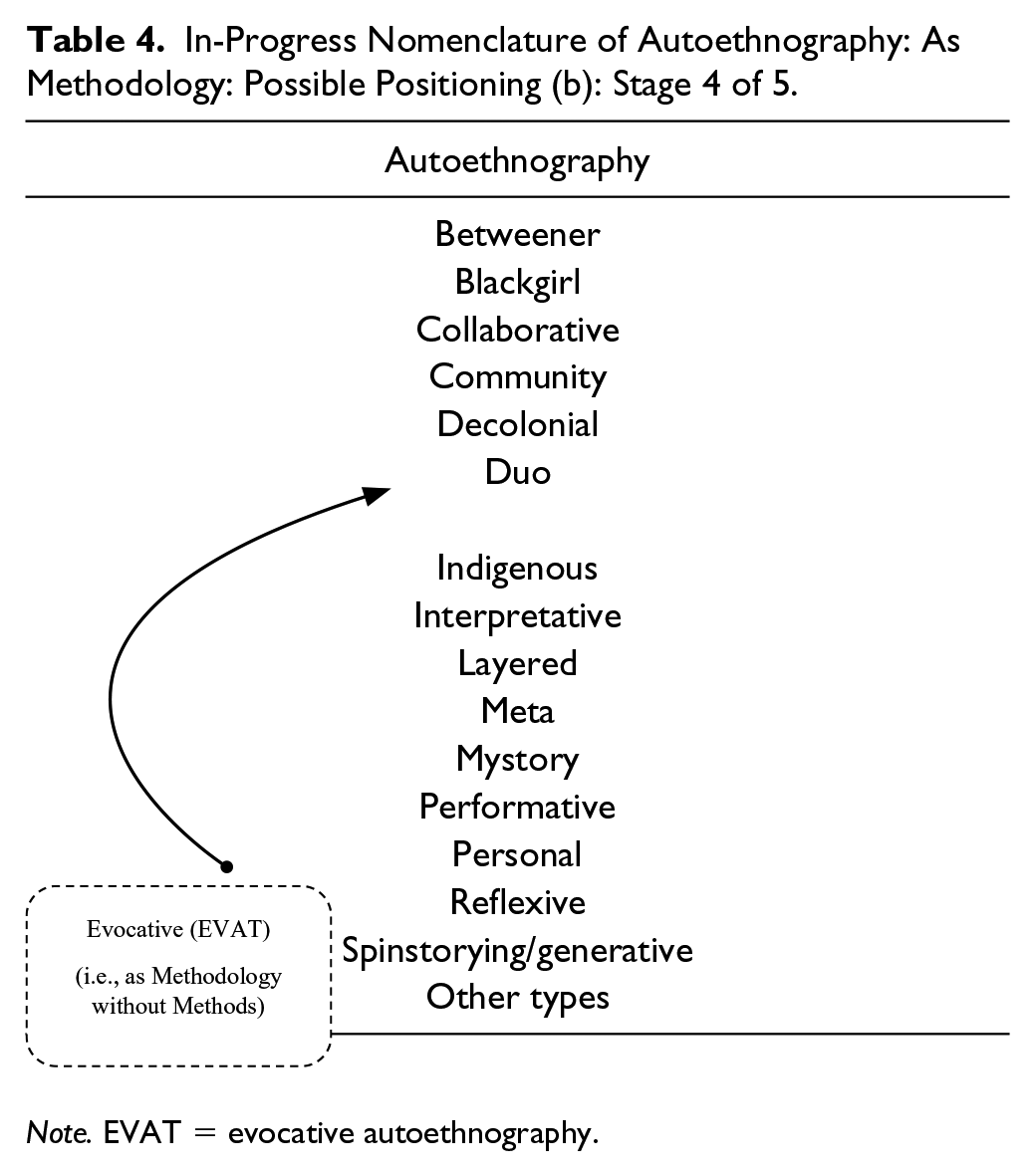
Note. EVAT = evocative autoethnography.
The scenarios of EVAT as a co-type (Table 4) and as lead category (Table 3) seem equally possible. My impression, though, is that the co-type position (Table 4) is more prevalent at the moment. For instance, Sparkes (2018) states, “Art Bochner and Carolyn Ellis (2016),” with “the term ‘evocative’ autoethnography,” have “put forward . . . criteria that include looking for abundant concrete details . . . [and] wanting to feel the flesh and blood emotions of people coping with life’s contingencies” (p. 259). With his strong suggestion that “evocative” stands for a definable type of autoethnography to be added to the list (cf. Table 4) while inspiring literary sensorialness and characterization among other autoethnographic types on the list, Sparkes (2018) stops way short of assigning “evocative” the superordinate lead displayed in Table 3. Indeed, Sparkes’s inclination is borne out by the methodological positioning of EVAT—even though, for the previously described atomization purposes, we could try to push “evocative,” in its methodological cloak, into the superordinate slot as shown in Table 3. Such is the recommendation made by this article, which I go into shortly. For now, I discuss how EVAT as a “methodology without method” embraces the critical and thus seems an independent player or clique leader while exhibiting the capability to take a leadership position within the field of autoethnography.
Critical-Oriented EVAT
An important feature subsumed by the evocative in its apparently current stand-alone position (Table 4 above) as well as its projected superordinate position (Table 3 above) is its social-justice mind-set (cf. Rawls, 1971/2003). This mind-set, as seen in the Schutt (2018) and Kien (2013) autoethnographies (above), seems to make EVAT too expansive to remain situated beneath the umbrella of “qualitative research methodology” (QRM). If EVAT, as a “methodology without method,” were somehow able to wedge itself under that umbrella, perhaps within a line of QRM anomalous manifestations, its parallel companion-ordinate would probably be “methodologies with integrated methods” such as participatory action research (PAR) and CS, both of which include various self-standing methods such as interviews, observation, and field diaries (Hesse-Biber, 2017, pp. 218-245). This ultimately improbable positioning of EVAT within QRM could be imagined as as that shown in Table 5 (below).
Imagined Scenario of EVAT Within the Scheme of QRM: Stage 1 of 2.
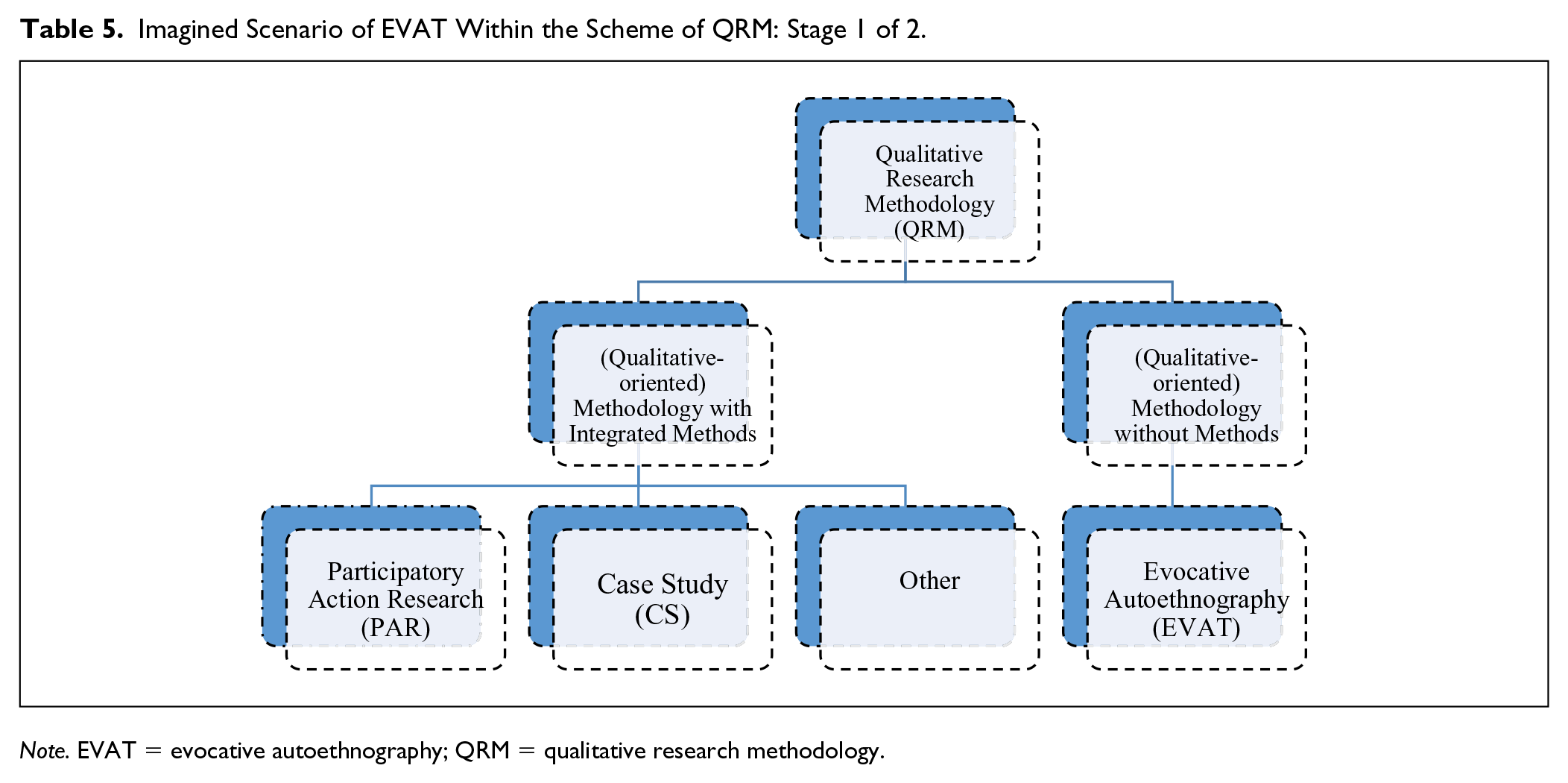
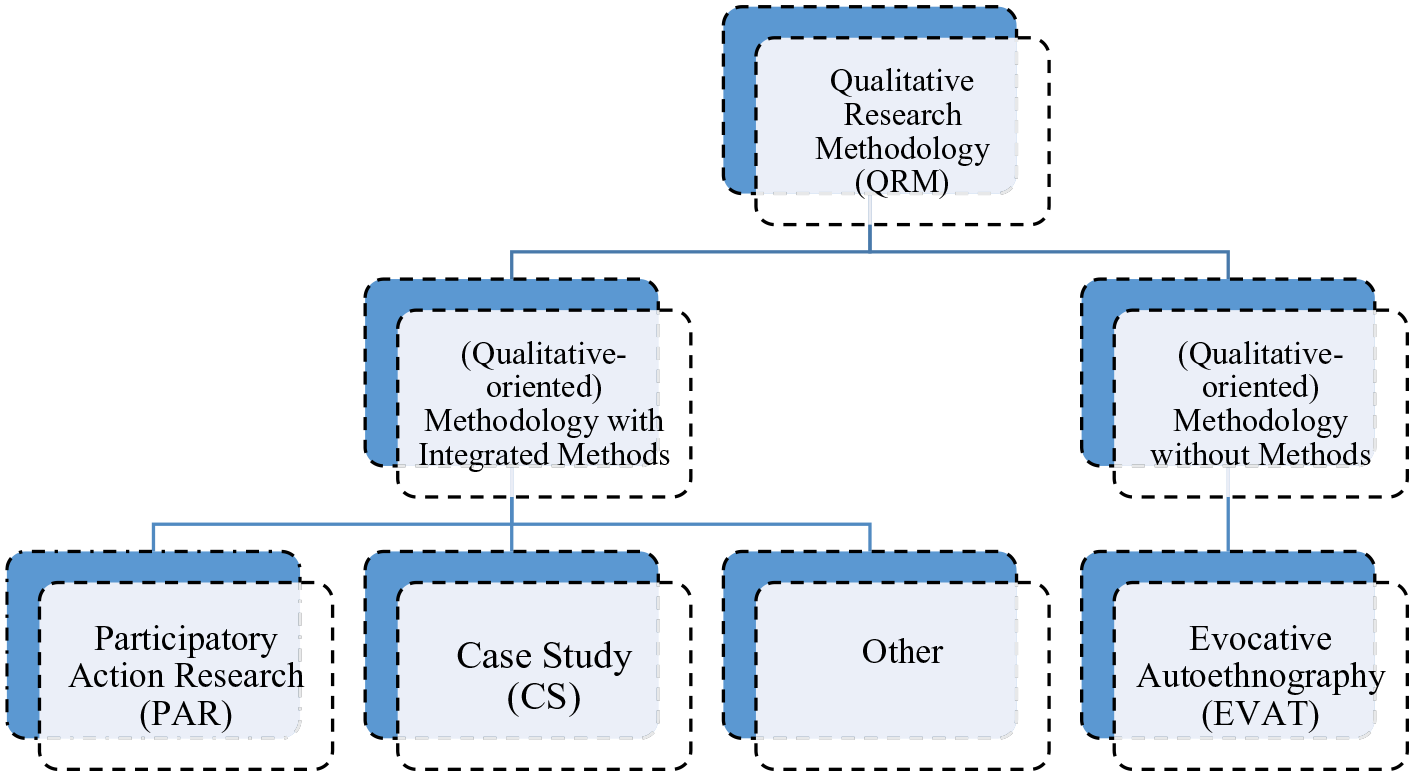
Note. EVAT = evocative autoethnography; QRM = qualitative research methodology.
Although the first coordinate line of Table 5 maintains its balance, the second does not. This is because EVAT, with its critical intention to combat “experiences of exclusion, degradation, and injustice” and thereby make “the case for change” (Adams, Holman Jones, & Ellis, 2013, p. 675), has an inherent social consciousness that seems more weighty than the procedural-toolkit identity had by methodological/method entities such as PAR and CS. The second coordinate line of Table 5 thus becomes askew, as seen in Table 6 (below).
Rather than jeopardizing the apparently needed equilibrium of the second coordinate line of the QRM scheme with the possibility of imbalance (cf. Table 6), and desiring to exercise its criticality, EVAT abandons the QRM scheme and takes up a dwelling in the direct shade of a qualitative enterprise larger than that of QRM. This would be CQI, as shown in Table 7 (below).
Imagined Scenario of EVAT Within the Scheme of QRM: Stage 2 of 2 (cf. Second Coordinate Line of Previous Table 5).
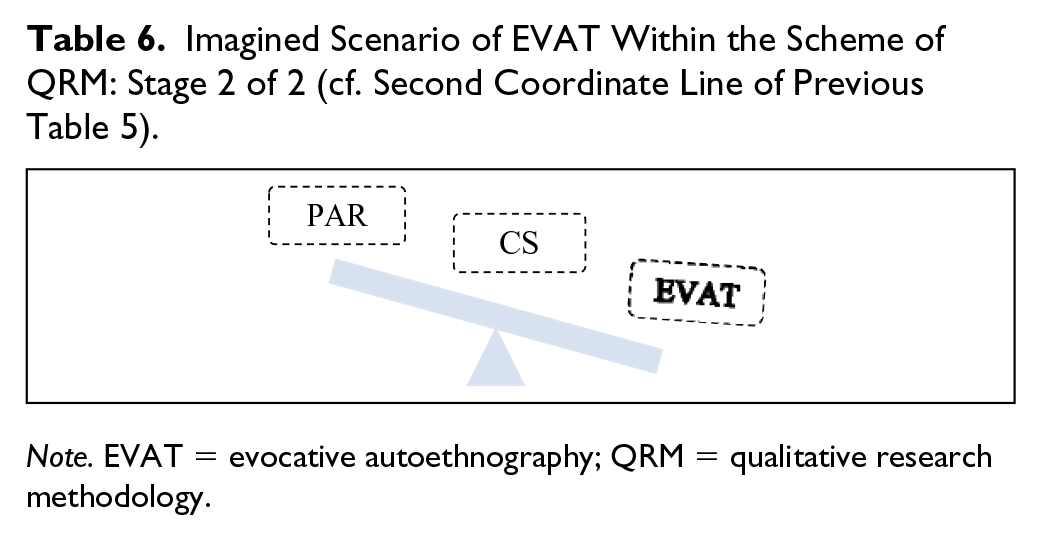
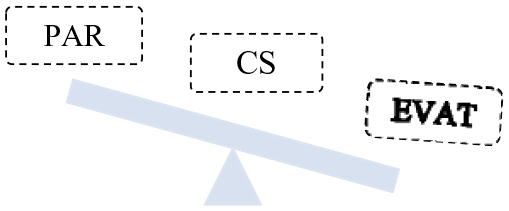
Note. EVAT = evocative autoethnography; QRM = qualitative research methodology.
EVAT as Descendant of CQI With a Tangential Relationship to QRM.
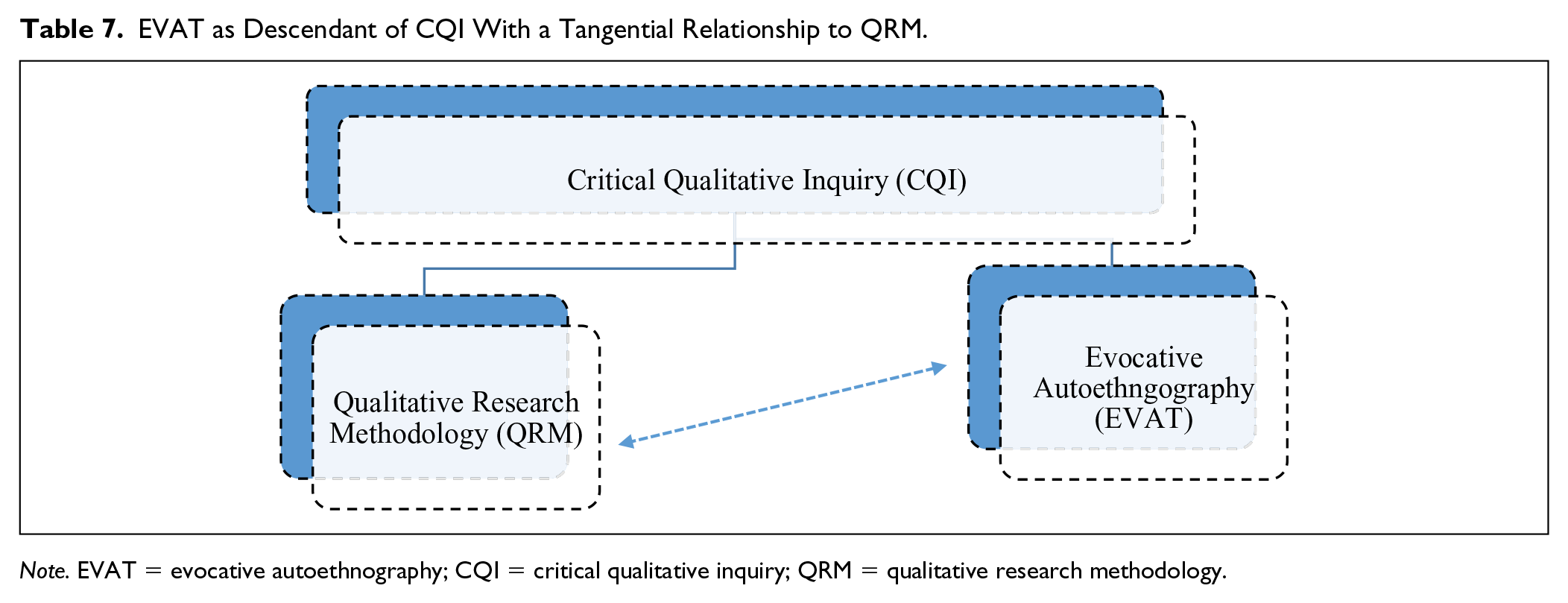
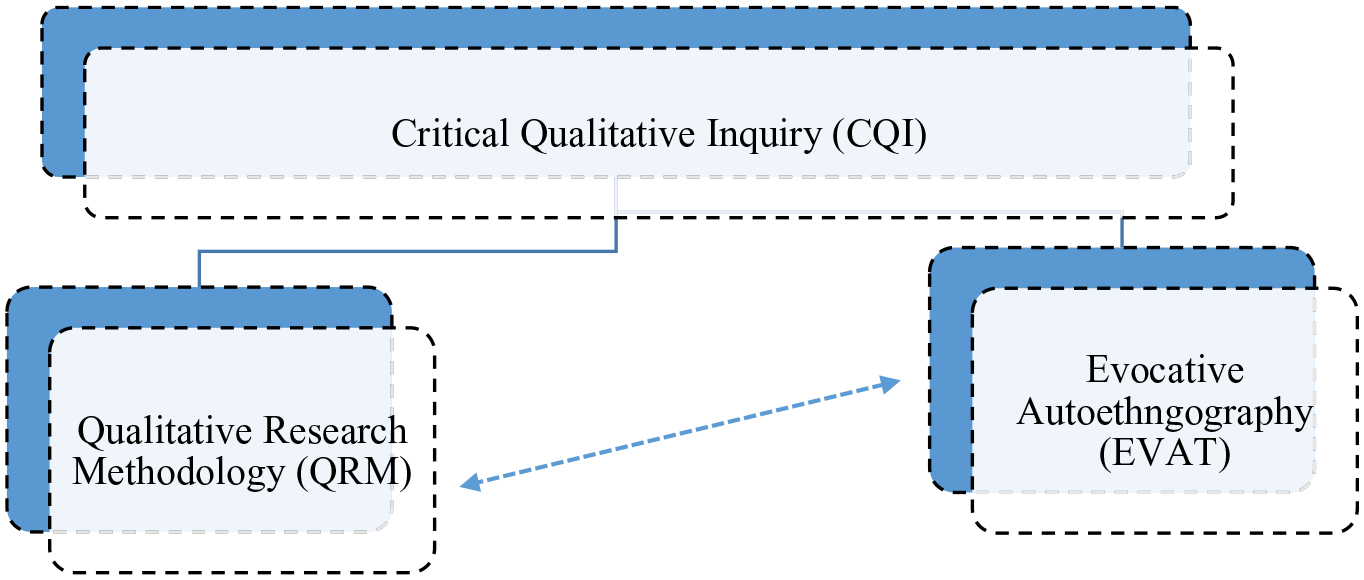
Note. EVAT = evocative autoethnography; CQI = critical qualitative inquiry; QRM = qualitative research methodology.
As shown in Table 7, QRM would be an offshoot of CQI in those many instances when a QRM study has a socially committed purpose. This, conversely, implies that QRM produces noncritical research studies. In such cases, QRM would not be a coordinate of CQI but rather a superordinate, heading up a scheme similar in structure to that of Table 5. Similarly, one cannot go with the blanket assumption that EVAT would be critically engaged in all of its studies or papers (Adams, 2018, pp. 204-205). Notwithstanding, I would maintain that most EVAT, like the previously mentioned Schutt and Kien papers, is critical. In this spirit, therefore, I represent EVAT as a direct offshoot of CQI, as indicated in Table 7 (below). Accordingly, evocative autoethnography (EVAT) shares a social justice–related consciousness with critically oriented QRM, and in that sense, as suggested by the broken-line arrow in Table 7, EVAT maintains a tangential relationship with QRM, as if that of cousin.
This shared bloodline involves criticality. When deconstructing EVAT as to its critical engagement, one is led back to the critical turn in QRM. We can envision this by momentarily setting aside the adjective “evocative,” reiterating the critical tendencies of autoethnography, taking into account the “moments” of qualitative research methodology (QRM), and considering the emergence of CQI. The first step is to reiterate that autoethnography relies on the author “connecting” her or his “stories and experiences to larger social forces” (Corroto, Kaukas, & Havenband, 2016, p. 111), an action which, in turn, involves “individuals and groups universalizing in their singularity the transformative life experiences of their historical moment” (Denzin, 2015, p. 33). As such, autoethnography becomes privy to those “shared and taken-for-granted assumptions” as well as “dominant cultural and social patterns” that hinder or marginalize (Corroto et al., 2016, p. 111). Hence, autoethnography is predisposed toward critically. It is already saddened by, yet wisened to, the memory and ongoing possibility of “being hustled with dice or a deck or a derringer,” as urban novelist/poet Algren describes the blatant oppression suffered by the indigenous Pottowattomie people at the hands of the businessmen who founded the city of Chicago by violently appropriating indigenous lands during the turn of the 19th century (Algren, 1951/2011, p. 12; cf. Sughrua, 2019).
That such repression has continued and continues in some form or another both before and after the founding of Chicago is heeded by autoethnography. While the armed or gunned-up “Hustlertown keeps spreading itself all over the prairie grass,” the “high broken horizon of its towers overlooking this inland sea with more dignity than Athen’s and more majesty than Troy’s” (Algren, 1951/2011, p. 48), autoethnography packs up its “notion of critical” which is “an engagement of discernment of the deep meanings in any given situation with the potentials and possibilities of transformation” (Alexander, 2016, p. 115) and then moves itself and its parcel into the cover of CQI. From its new vantage point beneath the “red-lit rain” of CQI (Algren, 1951/2011, p. 72), autoethnography sees that the “caissons below the towers somehow never secure a strong natural grip on the prairie grasses” (Algren, 1951/2011, p. 48): a pleasant irony revealing that “critical qualitative research . . . can find entry points for social change” (Nagasawa & Swadener, 2015, p. 178). This activistic CQI became home for autoethnography soon after 2005, the onset of the ninth moment of qualitative research methodology (QRM), which is approximated to have been primarily developed up until 2010, and which is still active today. 9
During this ninth QRM moment, “the social sciences and the humanities” more consciously became “sites for critical conversations about democracy, race, gender, class, nation-states, globalization, freedom, and community” (Denzin & Lincoln, 2005, p. 3), and the already existent experimental and literary-type of ethnography, in written, spoken, and “acted” form and as introduced and promulgated in previous moments six, seven, and eight, was now looked to with a renewed enthusiasm, in the belief that this type of writing could be more effective than conventionally written or presented research papers, or at least provide an enriched parallel track to run alongside standard academic research, to engage the above-mentioned “critical conversations” (Denzin, 2010, pp. 12-14; Denzin & Lincoln, 2005, p. 3, 2011, p. 3, 2018, pp. 1-20).
With this ninth moment-originated CQI and its repertoires including autoethnography, the task was “no longer . . . to just interpret the world, which was the mandate of traditional qualitative inquiry,” but rather “to change the world and to change it in ways that resist injustice while celebrating freedom and full, inclusive, participatory democracy” (Denzin, 2015, p. 32, italics in original). In the Rawlsian sense (above), this “democracy” does not necessarily involve the sense of governance but rather the humane sense of equality regardless of race, ethnicity, sexual orientation, social class, religion, (dis)ableness, and any other detrimental difference within society (also cf. Pasque & Salazar Pérez, 2015, p. 140). These differences are wide-reaching; they respond to distinctions of socioeconomic class while erasing the boundaries of socioeconomic class, as they regard all-inflicting harmful differences and marginalization. In reaching toward this equitable democracy, CQI intends to prompt the readership to take action (Cannella & Lincoln, 2015, pp. 258-260); to significantly “turn a point of view” on critical issues (Stake & Rosu, 2012, p. 52); and to hope for continued societal transformation (Denzin & Giardina, 2012, p. 20); all the while, throughout these three main objectives, autoethnography is partnered up with, and working under the auspices of, CQI. This intersectionality of critical advocacy with autoethnographic-like writing and performance, as ushered in by the ninth moment of QRM, has proven essential to present-day critical autoethnography such as EVAT.
With respect to EVAT, I am now closely approaching the “CQI” suffix of the superordinate form termed “critical-oriented evocative autoethnography as a methodology without methods and situated within critical qualitative inquiry” (CEAM-CQI). The objective in constructing CEAM-CQI, as mentioned previously, is to create the scenario whereby the apparently inevitable atomization of EVAT, now as CEAM-CQI, becomes mediated by a respectful and tolerant disposition toward critiquing and dialoguing with other atomized camps and, in particular, that of ANAT (following from Gergen, 2001). I discuss this more below.
For now, though, I return to my final lead-up to the CQI suffix. I do so, now, by backing up from the ninth moment of QRM so as to work toward completing the background of EVAT and hence facilitating its transition into CEAM-CQI.
Let me say, to begin, that prior to the currently active ninth moment which began in 2005 and would also incorporate EVAT and by extension CEAM-CQI, and long before Ellis and Bochner’s (2000) Handbook chapter (above), autoethnography, as mentioned previously, was apparently born out of “the rise of identity politics” in the mid-1970s and then took on more impetus approximately 15 years later during the 1980s to 1990s “crisis of representation” (Adams, Holman Jones, & Ellis, 2015, pp. 1, 15-16). This “crisis” contested “the idea that ethnographers should—or could—hide behind or perpetuate an aura of objectivity” in their project results (Adams et al., 2015, pp. 16, 21). At this time, autoethnography gained significant momentum (Adams et al., 2015, pp. 16-17, 21-22). Its manner of “being personally, emotionally, aesthetically, and narratively connected to a cultural group or experience” (p. 18) responded to the need for “something new . . . and qualitatively different” from the heretofore “traditional idea of an objectively accessible reality” promoted by the “‘scientific method’” and now deemed “‘neither clear nor useful’” (Bochner & Ellis, 2016, pp. 48-49; referring to and partly quoting from Rorty, 1982, p. 195). And autoethnography, its presence already having been established as of the 1990s, fit the bill, and by the end of this same decade, it was recognized as a type of submethodology under the umbrella of qualitative research methodology (QRM), as explained by Bochner and Ellis (2016, p. 53) and Gannon (2017, p. 2). 10 Thereafter, from the late-1990s and well out of the “crisis of representation,” autoethnography steadfastly developed itself within the reaches of QRM.
Its prodigal submethodology “autoethnography” now in tow, QRM, apparently having had taken its initial cues or inspiration from the crisis-era complaint that “empiricism’s value neutrality masks domination, conserves the interest of the status quo, and reinforces oppressive social practices” (Bochner & Ellis, 2016, p. 49; referring to Bernstein, 1983; Giroux, 1984; Habermas, 1985), soon contemplated critical engagement. This means “to address processes of unfairness or injustice within a particular lived domain” so as “to make a contribution toward changing those conditions toward greater freedom and equity” (Madison, 2012, p. 5). This critical consciousness seemed to divide QRM, and apparently autoethnography as well, into a critical camp and a noncritical camp (Esposito, Kaufman, & Evans-Winters, 2018; Pasque & Salazar Pérez, 2015). The critical camp of QRM—along with its seemingly quite sizable, critical-oriented, subcamp autoethnography—began to peak approximately as of 2005, the onset of the ninth moment, as mentioned above. This seemed a turning point as it fueled “critical qualitative inquiry” (CQI).
I state this with more assurance than trepidation. Granted, to identify watersheds and assign them “years” or “periods” is an approximation. In the present case, for instance, Cannella (2015) describes traces of CQI within the 1960s to 1980s “postmodern revolution in research” that reconsidered “the roles/purposes of intellectuals as scholar researchers and cultural workers” in light of the perceived breakdown of “modernist universals like truth, linearity, dichotomous thought, predetermined outcomes, and even notions of progress” (pp. 11-12). Notwithstanding, and generally speaking, I would assert that sometime after the onset of the ninth moment in 2005, there began what Denzin (2015) calls “a shifting center to the project” (p. 36) whereupon QRM, which by its very nature is destined to have “constant breaks and ruptures” and to fracture into parallel but also superimposed forms, somehow made a carbon-copy of itself and colored in that copy with its acknowledgment of “a historical present that cries out for emancipatory visions” (Denzin, 2015, pp. 31, 36). This marks the emergence of “critical qualitative inquiry” (CQI) which does not “impose a single, umbrella-like paradigm” over itself but rather incorporates “multiple interpretative projects” including the mainstay autoethnography (Denzin, 2015, p. 35).
This multiplicity of CQI seemed to have necessitated that CQI break rank from its once-parent QRM and autonomize itself into lead position over QRM, as shown in previous Table 7. Now as a superordinate itself, CQI is able to head up most or all qualitative endeavors that are critically inspired. To illustrate this, I now transform Table 7 into Table 8 (below).
CQI as Superordinate.
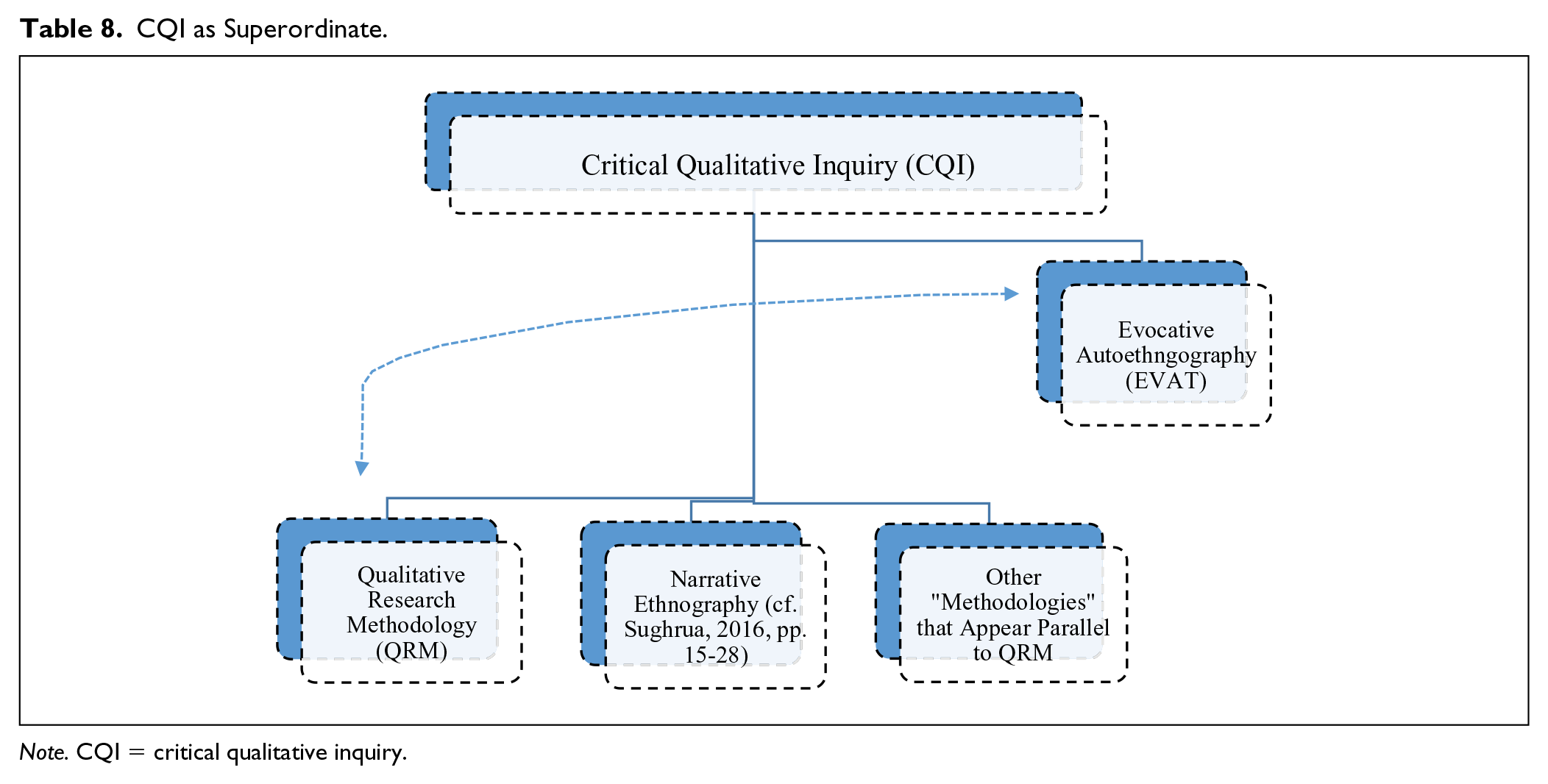

Note. CQI = critical qualitative inquiry.
A discussion about methodologies apparently parallel to QRM being beyond the scope of this article, I draw attention to the first and second rows of Table 8 while reiterating that the ushering in of the ninth moment of QRM marked not only the emergence of CQI but also the intersection of critical autoethnography with CQI.
Ambiguity I do not intend by dating this autoethnography/CQI praxis as sometime “shortly post”-2005. While I realize identifying a specific or approximate year does not mean much in itself, I feel compelled to think of QRM and its critically transformed self, CQI, within the widely discussed chronology of QR. The chronology spans from 1900 to the present, consisting of 11 moments in total, each of which not referring to an exclusive use or practice QR but the time period when the particular practice first appeared on the scene as required by the then-current academic and social conditions, and all of which apparently still active today (Denzin, 2010; Denzin & Lincoln, 2005, 2011, 2018). 11 Because the ninth apparently is the “moment” with the most forceful call for advocacy and directly follows the “moment” when autoethnography began to be perceived as a QR methodology in the mid- to late-1990s, I see CQI constructing itself on or about 2005 (above). At this time, CQI moved swiftly in its self-construction, at least to the extent of being able to step out onto the qualitative terrain, “a grey subcivilization surrounded by green suburbs,” pull itself up into the “midnight” just within its reach, and then nudge its way into the academic dialogue within the “battle-colored sky” where “ceaseless signal-fires of the great refineries wave an all-night alarm” (Algren, 1951/2011, pp. 25, 95). For directly following the ninth moment in chronology while paralleling it in application is the tenth, called the “fractured, posthumanist present” estimated to have begun in 2010 (Denzin & Lincoln, 2018, pp. 9-10; cf. Notes 10 and 11). This marks the realization of a wide divide or chasm separating science-based researchers from CQI researchers (Denzin & Lincoln, 2018, pp. 7-17).
This “fractured” moment, foreseeing the detrimental effect of this continued methodological conflict, calls for mediation to be extended across “the bright carnival of the boulevards” (Algren, 1951/2011), as Denzin (2010, pp. 42-43; 2015, pp. 42-45) has nobly done. To reiterate, the “fractured” tenth moment runs generally parallel to the ninth moment. This contemporaneity of both the ninth and tenth moments suggests that CQI not only quickly nudged into the academic dialogue on or about 2005 but also afflicted some dents and bruises along the way, enough so as to provoke “the methodological backlash associated with the evidence-based social movement” as seen in the tenth moment (Denzin, 2010, p. 13). Hence, the approximated “soon after”-2005 inception date of CQI and hence, no doubt, some of that “backlash” directed to CQI’s star lieutenant: EVAT which is an advocate of critical engagement as well as a methodology without methods. When seen primarily as an advocate, EVAT seems regulated to the role of player on the autoethnographic team (cf. Table 4); alternately, when seen primarily as a methodologist achieving advocacy, EVAT becomes team captain under the auspices of CQI (cf. Tables 7 and 8 above).
CEAM-CQI as a Lead Descriptor
The latter scenario, Captain EVAT, seems preferable, at least for atomization purposes (cf. above; below). This, nomenclaturally, would be evident in the acronym CEAM-CQI. To construct this acronym, however, one needs to move beyond the team player scenario. How does this scenario emerge in the first place? It seems a consequence of seeing critical advocacy as the singular importance of EVAT. Although critical research with “its explicit interest in the abolition of social injustice” certainly can be transcendent and utopic (Bronner, 2002, p. 5), its concern with histories and power struggles of a localized context (Rehbein, 2015, pp. 79-101; Thompson, 2017, pp. 1-14) seems to run the risk of stifling criticality, keeping it so community-specific as to require a redefinition or repurposing from one place to the next, from one study to another. Furthermore, the contemporary “glocal” vision, which holds the so-called international or otherwise “more universal” nature of the local as meaningful insofar as it reflects back onto the particular locality (Guilherme & Menezes de Souza, 2019; Pennycook, 2010), is insightful and significant. Nonetheless, the “glocal” mostly represents a range of isolated, vertical movements, as if in the form of long iron rods skyward, one rod from each community pointing up into the universal. The alternate image, or at least a complimentary one, could be seen as lines like communication cables criss-crossing horizontally from community to community.
Indeed, this last image can be stated as the goal of criticality, or both images together can represent a critical enterprise. This I would certainly concede. My point, however, is that the inherent specificity of criticality always poses the danger to fall into or dwell too much within the first image of independent and parallel hierarchies. This would seem to happen when the criticality, as relating to a given work including autoethnography, is pondered over in an isolated manner that sees the ends as more important than the means. For example, if the sole or primary value of the Schutt (2018) “evocative autoethnography” would be seen as its critical message involving identity construction upon the Tel Aviv landscape where one perceives sociopolitical challenges, and if the rhetorical performativity of the paper would be seen as mainly technical or instrumental in arriving at that critical message, then the resonance of the Schutt (2018) paper would center exclusively or near-exclusively on the critical message, as if a set of “talking points,” regarding identity struggle in Tel Aviv. In this sense, then, an EVAT like the Schutt paper could become a period piece of single-issue importance, and as such, EVAT could be destined to its own slot or drawer in the line-up of autoethnographic repertoires (cf. Table 4), perhaps as that of a locale-based, critical-message bearer.
Admittedly, I am exaggerating here to make a point, and this point is that the situatedness of a critical-oriented autoethnography like EVAT creates a tension between singular importance and collective value. The former, singularity, is described above. The latter, collectivity, comes about when the critical message is seen as integrated with the rhetorical performance of the autoethnography. Take, again, the Schutt (2018) paper. This paper, as described previously, involves autoethnographer Schutt whose biological father is Israeli. Touring Tel Aviv in the company of his biological father and his father’s relatives is the focus of the autoethnography, as recounted in the combined dramaturgical narrative, travelogue entries, and scholarly discussion of the text. Hence partly and significantly performative and EVAT-oriented (above), while enacting the previously mentioned autoethnographic credo to explore the self as its impacts upon and is impacted by the larger community (Boylorn & Orbe, 2016, pp. 16-17; Spry, 2001, pp. 708-711), the Schutt (2018) paper shows the author-autoethnographer physically immersed within the Tel Aviv setting, affectively “zoom[ing] backward and forward, inward and outward, [as] distinctions between the personal and cultural become blurred, sometimes beyond recognition” (Ellis & Bochner, 2000, p. 739).
For Schutt, such a “blurring” between one’s own self and the selves of those in community becomes cleared up, or at least reprieved, in the final scene when he, once home in Australia, glues the fragile wooden Oud back together (cf. above). This dramatically rendered scene seems to remind Schutt and, by extension, his readers that “[i]t is crucial . . . to consider privilege and penalty alongside the social forces they perceive, identify, and study in relation to themselves” (Hughes & Pennington, 2017, p. 23). This is not necessarily a happy ending for the autoethnographer Schutt because the “attempt to link facets of . . . selfness with public discourses about larger issues” can be unpredictable, leading not to closure per se but rather “some serious re-thinking” and “unsettling disconnect” (Rinehart, 2018, pp. 74, 78, 82, italics in original), as with Schutt (2018) above. Nonetheless, Schutt can console himself by acknowledging that his EVAT paper has offered up a “template theme.” By this I mean a critical message that seems mainly topic-oriented (e.g., apparently in Schutt’s case, the notion of identity as the drive for rebirth or reinvention). This template theme, as staged illocution with a postponed impact, has shades of subjectivity and gaps needing specificity and interpretation by the reader, and the reader, in turn, feels encouraged to oblige, arriving at one of many possible interpretations (e.g., the willingness to close the gap between oneself and the estranged other, whether or not a family member, as part of the pro-inclusion mind-set). Key to this transformation from a “template theme” to a “personally empowering theme” is the rhetorical performativity or dramaturgical development of the autoethnography, which enacts or acts out “the perspective of the interacting individual” caught up in experiences which reflect and are reflected by societal phenomena as well as the passage of time and the envisioned future (Denzin, 2015, pp. 36, 40, 46).
This utopic and Rawlsian-like hope of overcoming oppression (Denzin, 2015, pp. 36, 40, 46; cf. Rawls, 1971/2003) is held by each of the particular types of autoethnography identified in the above descriptive list numbered 1 to 13 as well as in Table 1, that is, at the moment those types become critically engaged methodologies under the auspices of CQI, as already discussed. Furthermore, within this realm of critical engagement, it is the rhetorical performativity of each of the autoethnographic types that “move[s]” the autoethnographer “back and forth between the personal and the political, the biographical and the historical” (Denzin, 2015, pp. 36, 46), as seen in the Schutt (2018) autoethnography. The resultant confluence between rhetorical performativity and critical engagement seems strongly evoked by the descriptor “evocative,” which according to Sparkes (2018) stands for “structurally complex narratives that are told in a temporal framework representing the curve of time” (p. 259). In this sense, then, the “evocative” adjective within the nomenclatural acronym EVAT can serve as a superordinate category, unifying the various descriptors of autoethnography in Table 1. It is for this reason, for example, that while I see Schutt (2018) and Kien (2013) as eclectic combinations of specific types of autoethnography (above), I also see both Schutt (2018) and Kien (2013) more generally as EVAT (cf. Note 6). This basis of EVAT as an umbrella-category (cf. Table 3) would be the aesthetics of enacting literary-like conventions such as dialogue, conversation, scene, and plot and thereby appealing to the reader’s affective sensibilities (Bochner & Ellis, 2016, pp. 75-119) while performing or rendering a critically oriented “template theme” within the mandate of CQI (cf. Tables 7 and 8). And as a result, we arrive at the nomenclatural acronym CEAM-CQI, standing for “critical-oriented evocative autoethnography as a methodology without methods and situated within critical qualitative inquiry.”
An Opposing Pillar
As explained in the final part of the above section, we arrive at CEAM-CQI by resisting the view of EVAT as “primarily critical” and instead seeing EVAT as “primarily dramaturgical and consequently critical.” With CEAM-CQI as its shell, EVAT forms its own base or delegation within autoethnography. In this domain, the ANAT delegation—already present (cf. Table 2)—matches the apparent strength and scope of CEAM-CQI. This sets the stage for a unified EVAT under the heading of CEAM-CQI. Accordingly, I modify previous Table 2 and as a result present Table 9 (above).
In-Progress Nomenclature of Autoethnography: Final: Stage 5 of 5.

Note. EVAT = evocative autoethnography.
It should be stressed here that while CEAM-CQI is always in some way critical or social justice–oriented (above), ANAT certainly can be critically engaged, if so inclined. This makes ANAT potentially derivative of CQI, as is CEAM. For that reason, when discussing both ANAT and CEAM-CQI together, I momentarily drop the “/CQI” suffix from the nomenclatural acronym CEAM-CQI so as not to imply that CEAM and ANAT are unequal as to critical orientation. Furthermore, as shown here in Table 9, both ANAT (column [i-a]) and CEAM (column [ii-a-1]) oversee the same types of autoethnography. These types, however, are in different cloaks, depending on their affiliation. When on the ANAT team (column [i-a]), the autoethnographic types operate as methods in the sense of treating “direct empirical data” (column [i]), and when on the CEAM team (column [ii-a-1], the types operate as methodless methodology in the sense of involving “contemplated life experience” (column [ii]). The result is polarization—and also binarism, which however can be mediated (below). That said, one should acknowledge the notable presence of a mixed empiricist/experiential construct named “analytical/evocative” (column [i-b-1] of Table 9). However, as a midpoint nomenclaturally giving equal credit to each of the two sides by way of its compound name, the “analytical/evocative” construct evidences the firm foundation of each side much more than it integrates or blurs the two sides. The result, therefore, is the presence of two pillars, one named ANAT with its key word being “analytical” and the other CEAM with its key word being “evocative,” each of apparently quite similar force, and both virtually polar opposites as to their take on what it means to be research-driven within autoethnography, the former pledged to scienticism with its resultant conventionality in academic writing such as the IMRD (introduction–method–results–conclusion) structure, the latter sworn to experientiality with its resultant dramaturgy and literariness. In this counterpoint position, the latter, CEAM, may include within its ranks the “singularly evocative” type of method-oriented autoethnography (column [1-b-2] of Table 9) in those instances when this autoethographic type successfully conceals its use of methods such as field diaries beneath the surface of its usually first-person experiential discussion. Whether alone or embolded by the “singular evocative” column ([i-b-2] of Table 9), the CEAM pillar ([ii-a-1]) has the capability to enact the previously described “atomization” (Gergen, 2001, pp. 50-57).
CEAM-CQI in Respectful and Seemingly Unavoidable Opposition: Dealing With Binarism
As explained above, atomization occurs when one community (e.g., ANAT or CEAM) within an academic area or discipline (e.g., autoethnography) feels stunted or threatened by a nemesis community (e.g., the nemesis CEAM, from the perspective of ANAT, or, conversely, the nemesis ANAT, from the perspective of CEAM). As a result, the respective community (e.g., ANAT or CEAM) hunkers down around its own academic values while taking cover in the tenets of the paradigm to which it sees itself as belonging (cf. Note 3). The example given by Gergen (2001, pp. 51-52) is the critical branch of social psychology which in the 1970s broke off from the more traditional and cognitive-based hub of social psychology. Thus, founding and molding its tailor-fit academic journals, conferences, and research agendas so as to prosper in its own knowledge production, the critically inspired “anti-foundationalist” group in social psychology has created its own atomized circle, which in turn has prompted the other side, the “traditionalists,” to tighten its own circle as well (Gergen, 2001; above).
Not as extreme, however, would be the atomization of CEAM and ANAT within autoethnography. This is because CEAM and ANAT generally share the same academic milieu as in book series, journals, and conferences. Within the wide field or circle of social science research, one finds the atomized terrain of autoethnography, whose formation apparently began in earnest in the mid-1970s, rose to prominence in 2000, and has steadily maintained itself until the present day (cf. above), and within this atomized circle of autoethnography, one finds the two circles or columns of ANAT and CEAM, as shown in Table 9. Although apparently not going to the extreme of creating their own respective publication venues such as academic journals, ANAT and CEAM reflect the same atomized energy and intentions as those of the “traditionalists” and “anti-foundationalists” in social psychology, at least in terms of hovering closely around their respective research views, agendas, and paradigms. In this sense, the side-by-side circles or pillars of “traditionalists” and “anti-foundationalists” upon the ground of social psychology seem analogous to the parallel pillars of ANAT and CEAM in autoethnography.
For ANAT and CEAM—as well as the “traditionalists” and “anti-foundationalists”—atomization poses disadvantages and advantages to be taken into account and mediated. That the pros and cons of atomization seem something to be reckoned with by ANAT and CEAM, however, suggests the presupposition that atomization is an undeniable scenario. This prompts the questions: Is atomization avoidable? Can it be ignored? Probably not, I would hazard to say. This would be due to binarism, which is related to atomization. Although binarism is largely seen in the negative light of hegemony (e.g., Gale, 2017; Gergen, 2001; MacLure, 2015; Pasque, Salazar, & Pérez, 2015; cf. Note 2), it nevertheless can be countered and held in check by its sister-construct, atomization. Before going into binarism and then proceeding to the pros and cons of atomization, I briefly account for the connection between atomization and binarism, this connection itself being evident in nomenclature.
As alluded to previously, Gergen’s (2001, p. 27) notion of “presence” and “absence” involves naming. For example, the adjectival descriptor in the name “evocative autoethnography” (EVAT, aka CEAM) suggests sensorial and dramaturgical rendering, whereas the descriptor in the name “analytical autoethnography (ANAT) suggests informative and expositorial explaining. These research and writing intentions of EVAT and ANAT appear in opposition: the former, primarily emotive and interpretative; the latter, primarily reasoned and instructive. Along this same line, therefore, CEAM and ANAT seem in direct opposition. Of course, this opposition can be resisted. I will shortly get to the point of resistance and mediation. Meanwhile, please bear with me, as I continue with the threat of binarism for CEAM and ANAT. That one is not the other or that one is what the other is not seems to have played a key role in each of the two camps atomizing themselves (above). As a result, even within its own circle, for the mainly emotive CEAM to be noticed or otherwise “present,” its counterpart the mainly reasoned ANAT needs to be not only “absent” but also acknowledged or felt to be “absent,” and conversely, the same for ANAT (following from Gergen, 2001, p. 27). Each needs the other as its foil, that is, the “presence of the absence” (Gergen, 2001, p. 27).
Related to Gergen’s (2001) “presence/absence” is Derrida’s (1976/1997) différance. As explained by Ramanathan (2010), Derridean différance holds that words exist “by virtue of being different from related words,” such as “‘[p]it’ which is pit because it is not a well, not a ditch, not a trench” (p. 109); consequently, according to Derrida, words are not self-referential but rather empty vessels in the de Saussurean (1916/2013) sense of “always pointing away from . . . signifieds, not to them” (Ramanathan, 2010, p. 109). Accordingly, words “defer” any meaning to be intuited in the affirmative (e.g., a “pit” is a purpose-intended hole in the ground, such as that for cooking) and instead latch onto the negative (e.g., a “pit” is not what is commonly thought of as a “well”). For Derrida, then, the word is naught but a movement toward the “presence of the absence” (Gergen, 2001), and so “[m]eaning, thus, is built on the quicksand of difference” (Ramanathan, 2010, p. 109; referring to Derrida, 1976/1997).
This same “presence/absence” and “différance” energies, at the core of atomization, is what seems to drive binarism (Gergen, 2001, p. 27). Adding to the description of binarism as set forth in Note 2, and quoting from MacLure (2015), I would synopsize binarism as the view that “the world is demarcated or divided into asymmetrically valued categories” or otherwise binaries, some examples being “authentic and inauthentic, true and false, good and bad” (p. 97). Subject to this “bifurcation of nature” (MacLure, 2015, p. 97), each of the dual concepts (e.g., good) remains forever dependent on its opposing concept (e.g., bad), and vice versa. This is in order for either of the two opposing concepts (e.g., good and bad) to be understood, to have been socially constructed or reconstructed in the first place, and to remain in flux and in continual redefinition as situations and contexts may require. As a result, even when only one concept (e.g., good) is mentioned, alluded to, thought of by a person or persons, or somehow made manifest within an object such as a constructed building, a written text such as a poem, a spoken text such as a speech, a performance such as a musical concert (and so on), the complete binary pair (e.g., good/bad) hovers above the moment, situation, or event. This shifting binary backdrop, however, often asserts “hegemonic ways of knowing” (Diversi & Moreira, 2009/2016, p. 25; referring to Anzaldúa). The reason is that one side “aspires to negate” the other “in the interests of a greater moral authority or a smarter take on what’s really going on” (MacLure, 2015, p. 97). Consequently, “binary divisions serve to ‘guarantee’ truth through excluding and devaluing the ‘inferior’ part of the binary” (Barker & Jane, 2016, p. 98). For instance, by way of this “hierarchical . . . opposition” within binaries such as those of “speech-writing” and “reality-appearance,” it seems that “within the conventions of western culture, speech is privileged over writing, reality over appearance” (Barker & Jane, 2016, p. 98).
Such marginalized entities as “writing” from the “speech-writing binary” and “appearance” from the “reality-appearance binary” may be rescued and transferred into alternative schemes such as new materialism (Lather, 2015; MacLure, 2015, 2017; St. Pierre, 2015). Largely following from Deleuze and Guattari’s (1987/2004) concept of assemblages as well Barad’s (2007) concept of entanglement, the new materialist ontology, based on the belief that “matter” constructs and shapes “social and cultural practices,” seeks to “start in the middle of things where there is no transitivity . . . which will separate and simultaneously lock together subjects and their objects” (MacLure, 2015, pp. 95, 97). Upon the new materialist field, therefore, “writing” and “appearance” (cf. Barker & Jane, 2016; above) would gain value from their presence within the various and perhaps infinite intersections of different “matter” in diverse forms such as human (e.g., one’s teacher, oneself), nonhuman (e.g., rain, shadow), animate (e.g., a tree, a household pet), concrete (e.g., a bicycle tire, a swimming pool), abstract (e.g., friendship, calculus), phenomena (e.g., space, belief), occurrence (e.g., an election, elementary school years), or any combination thereof. Materialistically speaking, therefore, “writing” and “appearance” would fare much better than they had in their previous binary abodes of “speech-writing” and “reality-appearance,” respectively. Nevertheless, despite this more immediate fairness afforded by ontologies such as new materialism which are avidly anti-binary, I would posit that the rough-and-tumble terrain of binarism should not be ignored. At least every now and then, one should show up at the field.
For the binary game goes on regardless. This is suggested by Gergen (2001) who, based on the presence/absence notion (cf. above), uses the materiality/spirituality counterpoint as an example: In the world-view of materialism, the spiritual world is marginalized (thrust into the unnoticed margins of the page). The spirit is the unspoken absence. However, without the presence of this absence, the very sense of “the cosmos is material” is destroyed. As we might say, the entire world-view of the materialist rests on a suppression of the spirit. (p. 27, parenthesis in original)
By claiming or demonstrating what it is not, or simply going about its business and hence being what it is not, materiality inadvertently alludes to the existence or is-ness of the what (i.e., spirituality, catching its breath on the sidelines, or resting at home, having acquiesced to yet another no-show and automatic loss by forfeit). In other words, by virtue of the presence/absence interplay within binarism, both sides on the binary divide are naturally validated and empowered. It thus seems that for the “‘violent hierarchy’ of binary opposition” to occur (MacLure, 2015, p. 96; citing Derrida), the somehow weakened or nonmainstream side would have to let down its guard or to become tragically abandoned. Consequently, it could become incumbent on spirituality, on its own or most likely with the help of sympathetic others, to scramble back onto the playing field, or to arrive at the field, so as to assemble its own players and attempt to recruit the opposing players such as “cosmos.”
Perhaps easier said than done, and perhaps unavoidable. For it seems that binarism cannot be wished away. After all, even the new materialist ontology which looks to replace binarism (above) seems itself situated within a binary. “[F]undamentally oppos[ing] . . . the constitutional division of the world into mutually exclusive categories” such as “general over particular” and hence frequently describing its own notion of “differential movements of forces and intensities” as to the manner in which this notion differs from the opposing notion of “burification” (MacLure, 2015, pp. 96-97), new materialism paradoxically seats itself at the binary of dual-point linearity vs. entangled collage—or more broadly, the binary of binarism vs. new materialism. In other words, new materialism, though strongly against binarism and wishing its demise, props itself up on the “presence of the absence” of binarism, and therefore, for new materialism to survive and thrive, binarism must be preserved at all costs. It may prevail as a dimension parallel to that of new materialism, or it be one of the many entities caught up within the enmeshment or entanglement promoted by new materialism—as in those straight lines of paint drippings caught in the otherwise chaotic tangle of splatter in Jackson Pollock’s expressionist artwork, those several straight lines hauntingly perfect in their rectitude, with paint droplets on each end to mark binary lines, a feeble but notable call for contrived rationality amid the jumble upon the canvas (e.g., Pollock, 1948).
By perhaps implying that the expressionist Pollock seems more forthcoming on the prevalence of binarism than does new materialism, I do not intend to demean new materialism nor to catch it in a fundamental contradiction. Rather, I intend to illustrate that “anything that we recognize as a culturally intelligible action gains its significance as such by virtue of what it is not (i.e., alternative patterns of action)” (Gergen, 2001, p. 22), as also set forth by Derrida’s différance (above) as well as de Saussure’s (1916/2013) structuralist-based syntagmatic/paradigmatic theory. Reluctantly or nonreluctantly acknowledging that “paradigms . . . generate scientific progress not as a linear continuous succession” (Klüver, 2002, p. 274; cf. Note 3), one should be tolerant within one’s current paradigmatic positioning (e.g., postmodernism) so as to consider the credence of Derrida’s and de Sausurre’s apparently structuralist-derivative act of constructing “meaning through the existence of difference” (Gergen, 2001, p. 22). In this scenario, an entity or phenomenon such as spirituality, new materialism, or CEAM can go on to assimilate or mediate binarism without jeopardizing its critical or socially committed identity.
This seems accomplished by CEAM—as well as ANAT—through atomization. First of all, CEAM heeds the binary logic by differentiating itself from ANAT and thereby attests to its extantness. However, rather than teetering upon the binary wire in a mano a mano “fight in a sterile battle for sovereignty” with its nemesis (MacLure, 2015, p. 96), CEAM retreats to the huddle or atomized circle of like-minded cohorts. Once there, CEAM reflects upon and socializes its differentiation from ANAT. Certainly, ANAT, for its own agenda, does the same. This is shown in Figure 1 (above).
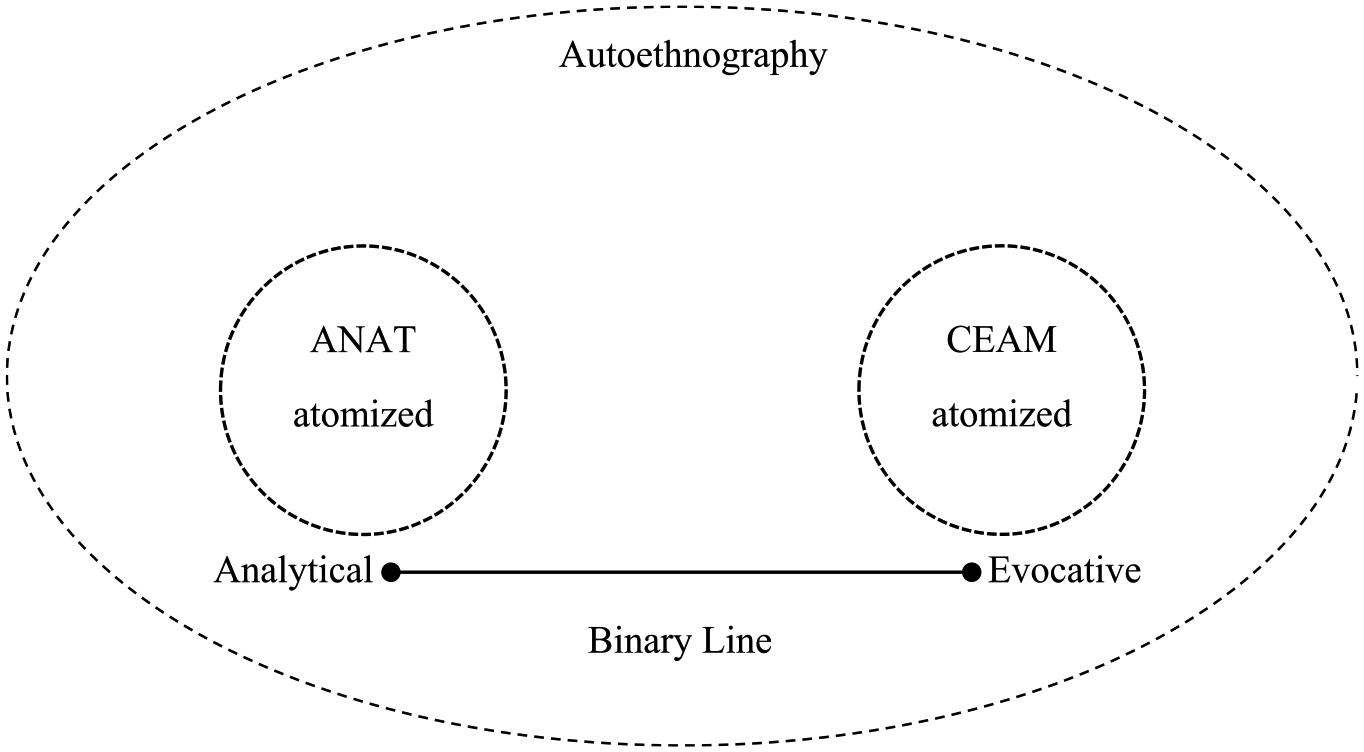
CEAM mediating binarism by situating itself within atomization: Stage 1 of 2.
Within its atomized circle, as seen in Figure 1, CEAM remains alert to the wake-up call of binarism: that things seem “neither intelligible nor valuable in themselves” (Gergen, 2001, p. 22). However, now in its cohort circle rather than in its one-person show staged on the binary wire, CEAM is afforded the opportunity to both deepen and transcend its “what-I’m-not” identity to propel itself and autoethnography into new knowledge and practices. This atomized socialization, however, is not without its risks. Two main disadvantages prevail, the first leading to the second, and the second one giving way to two remedies, which in the end enhance atomization as a mediated alternative to binarism. I begin with the first disadvantage.
This would be closed-mindedness. As Gergen (2001) would hold, atomization enacted by both ANAT and CEAM is potentially undemocratic as “communication across boundaries becomes increasingly arduous,” resulting in conceptual exclusivities, such as scienticism as opposed to experientiality, that “solidify with little means for reconciliation” (p. 51). The atomization logic, therefore, risks being illogical. For example, the divide between a socially scientific research orientation (ANAT) and an artistically repertorial research orientation (CEAM) would not hold up if one follows the influential environmental philosophy of Abram (1997) who maintains that “[o]ur spontaneous experience of the world, charged with subjective, emotional, and intuitive content, remains the vital and dark ground of all our objectivity” (p. 34). As if aware of its own disregard of integrated and nuanced views such as that of Abram (1997), and hence as if aware of the sort of unfoundedness or strawperson-like assertiveness to result, an atomized circle, when critiquing another circle or circles, seems to avoid content-based issues which could lead to a compromising communication revealing shortcomings. This is the second disadvantage to atomization. It involves the atomized circle (e.g., CEAM or ANAT) wielding “critique as a rhetorical move” (Gergen, 2001, p. 55), which seems much more a strategy of self-defense than a vehicle of constructive criticism (Gergen, 2001, pp. 50-57).
It begins with one side “confirming the common consciousness of those placed in question,” or highlighting or even inadvertently creating a “common consciousness” among the other group that otherwise “might have gone unnoticed” (Gergen, 2001, p. 51). Following from Gergen here, I would pose a hypothetical example. This would be an ANAT paper relating the experience of a Canadian teacher of English as an additional language (EAL), working with a group of students at a public high school in Brazil, and encountering among the students a range of different attitudes toward the importance of acquiring or learning English. Imagine, now, that this ANAT paper would be critiqued by CEAM. In doing so, CEAM would raise the important base issue of how to depict student attitudes in autoethnographic research; however, at the same time, due to its own encircled or atomized enclave, CEAM would be inclined to dress up its constructive critique centered on research representation with what Gergen (2001) refers to as rhetoricity (pp. 55-57). For instance, CEAM could allege that the ANAT paper is experimental-minded in research strategy (i.e., perhaps a “common consciousness” of ANAT) and covertly quantitative-oriented in data analysis (i.e., perhaps a now suddenly highlighted, heretofore mostly unrecognized, or now created “consciousness” of ANAT, with paradoxical thanks to CEAM for coining this description of ANAT; based on Gergen, 2001, pp. 50-57). Put into gear by the nomenclatural power of the categories experimental-minded and covertly quantitative-oriented, ANAT may lose sense of the underlying context of the critique launched by CEAM (e.g., that experimentalism and quantitativeness may not bode well with EAL educational research focusing on group attitudes); as a result, ANAT may rally around its extant identity as being experimental-minded as well as its newly confirmed or discovered identity as being covertly quantitative-oriented, while being “put on notice that all those who share their particular assumptions (and associated practices) are discredited” (Gergen, 2001, p. 51, parenthesis in original; my example).
This sense of its “identit[y] being imperiled” could lead ANAT to largely ignore the context of the critique launched by CEAM (e.g., that experimentalism and statistics may not compatible with attitude-related research); instead, therefore, ANAT would most likely direct its energy to “collective defence” by launching a rebuttal to CEAM that focuses more on the virtues of its (ANAT’s) experimental and covertly quantitative-oriented identity than on the nuances of researching into student-belief systems, the topic underlying the initial critique made by CEAM in the first place (Gergen, 2001, p. 51; my example). Because CEAM is likely to respond in kind to ANAT, an opportunity at constructive debate and bridge-building between ANAT and CEAM is lost, at the fault of both sides for engaging in rhetorical critique, which leaves healthy “criticisms . . . unheeded” and the “common quest for understanding . . . destroyed or, more precisely, reserved for relations within the restricted boundaries of each group” (Gergen, 2001, p. 51). This is the dark side of atomization. It requires remedy by way of what Gergen (2001) terms “separating self from discourse” and “polyvocal potentials” (pp. 55-62).
Both of these remedies aim to alleviate the detrimental effects of rhetorical critique, which, as just explained, is situated within a binary-aware “tradition emphasizing mutual annihilation on the one hand, and arguments as expressions of one’s core self on the other” (Gergen, 2001, p. 57). The first remedy, partitioning the self, intends “to remove from the field the emphasis on the ego, the sense of authorial ownership of arguments and the threat of destroyed identities” (Gergen, 2001, p. 57). In this regard, Adams (2018) calls out from his apparent position within the atomized circle of CEAM so as to give due respect to ANAT. Considering autoethnography as belonging to the four-part classification of “analytic, interpretative, evocative, and critical,” Adams (2018) states the evaluative criteria used in assessing a given autoethnographic work should be directed to what seems its main tendency (p. 205). Therefore, as Adams (2008) concedes, “if an author is more analytic and/or interpretative in their orientation to autoethnography (e.g., focusing on fieldwork and thick description), then a reviewer should not expect the project to espouse critical values (e.g., advocating explicitly for social change)” (p. 205, parentheses in original). In valuing ANAT for being true to itself, Adams (2018) has seemed, in this instance, to bracket off his own autoethnographic self as “a critically-oriented autoethnographer, someone who identifies, and tries to remedy, instances of oppression and who values social justice” (p. 206). His CEAM/CQI-self deliberately forgets itself during this one moment when giving assurance to the opposition seems needed and when expressing solidarity in terms of entities subject to assessment and validation seems in order. This attitude is responsible, and also respectful of autoethnographic diversity.
Similarly diverse or “fundamentally multiplicitous” is the second way to counter the stifling atmosphere of atomization (Gergen, 2001, p. 49). This centers on polyvocality, which refers to the ability and willingness “to articulate many sides of an issue” while recognizing and exhibiting that one’s particular contentions or beliefs result not from “introspective discernment” but rather from “social positioning” (Gergen, 2001, p. 59). Because this “social positioning” most likely is the same as or similar to that undertaken by those on the other side of the argument, polyvocal-oriented individuals are aware of “harbor[ing] suppositions that would also support their opposition” (Gergen, 2001, p. 59), and as such, both sides can readily and cordially agree on underlying issues without detracting from their particular stance. An example, from within CEAM-CQI, is the following comment made by Denzin (2018b): Apples and oranges, are these different tasks, or different sides of the same coin? C. Wright Mills and Holman Jones want to re-write history. Anderson wants to improve autoethnography by using analytic reflexivity. Ellis wants to embed the personal in the social. Spry’s (2011) self-narratives critique the social situatedness of identity (see also Adams 2011). Neumann (1996) wants to “democratize the representational sphere of culture” by writing outward from the self to the social (p. 186). So do I. I want to turn the autoethnographic project into a critical, performative practice, a practice that begins with the biography of the writer and moves outward to culture, discourse, history, and ideology. Interpretative autoethnography allows the researcher to take up each person’s life in its immediate particularity and to ground the life in its historical moment. (p. 33)
Here, Denzin enacts the polyvocality described by Gergen (2001). As seen in this extract, Denzin places the varied CEAM theorized and written by himself and colleague-autoethnographers Holman Jones, Ellis, and Spry onto the same table as the ANAT written by Anderson who is viewed as a leading autoethnographer on the ANAT side (cf. Hughes & Pennington, 2017). Viewing the CEAM and ANAT on the table, Denzin wonders whether they both are disparate (as in “apples and oranges”) or distinct while somehow fundamentally similar (as in “two sides of the same coin”). He opts for the latter. While apparently conceding that CEAM and ANAT both seek to interpret the construction or reconstruction mutually engaged in by the self and history (final three lines of the extract), Denzin suggests an underlying solidarity between CEAM and ANAT, both of which can be seen acquiescing on (auto)biographical historicism (Mills) and collective identity (Neumann). Thus opening up dialogue on such issues between CEAM and ANAT, Denzin demonstrates that “[h]aving a view . . . derives from a particular form of social process as opposed to an interior origin” (Gergen, 2001, p. 60).
Consequently, “to manifest one’s polyvocality,” as Denzin has done here on behalf of CEAM, “is also to demonstrate a degree of similarity to one putative antagonist,” in this case ANAT (Gergen, 2001, p. 60). As a result, “[r]ather than demonstrating the kind of coherence designed to repudiate all who would differ—thus establishing an unbreachable gap between the self and other—the revelation of one’s counter-capacities renders one ‘part of the other’” (Gergen, 2001, p. 60). Although “[a] space of vulnerability is [thereby] created which invites the other in as collaborator as opposed to an antagonist” on commonly held issues such as (auto)biographical historicism and collective identity in the case of CEAM and ANAT (Gergen, 2001, p. 60), the overall distinct positions between the two or more camps usually remain in full force. CEAM therefore “offer[s] strategic forms of resistance to the narrow, hegemonic scientifically based research framework” of ANAT while maintaining a “spirit of cooperation and collaboration and mutual respect” (Denzin, 2019, pp. x, xiii) with those such as “Anderson . . . and . . . Chang” whom “tend to be seen as champions” of the ANAT cause (cf. Hughes & Pennington, 2017, p. 28). The result, then, are the “two sides of the same coin” (Denzin, 2018b).
If I may be allowed to push this coin metaphor a bit, I would present the two coin-sides in a parallel position, as if photocopied onto the same side of a page. Or, perhaps the coin would be flipped twice, turned over in the air, first the ANAT side of the coin and then the CEAM side; in one’s constructed memory, both distinct sides would remain suspended, side-by-side, and so hence the image in Figure 1—albeit with a caveat. The image now needs to be modified so as to show that efforts at “polyvocal potentials” as well as “separating self from discourse” work to remedy the rhetorical critique so damaging among atomized circles (Gergen, 2001, p. 60).
For this, Figure 2 (below), complementing previous Table 9, confirms EVAT in its final stage of development, whereby it becomes assembled according to the nomenclatural category of CEAM-CQI and held within a mediated type of disciplinary atomization that acknowledges but does not succumb to binarism. To briefly recap, I now comment on Figure 2.
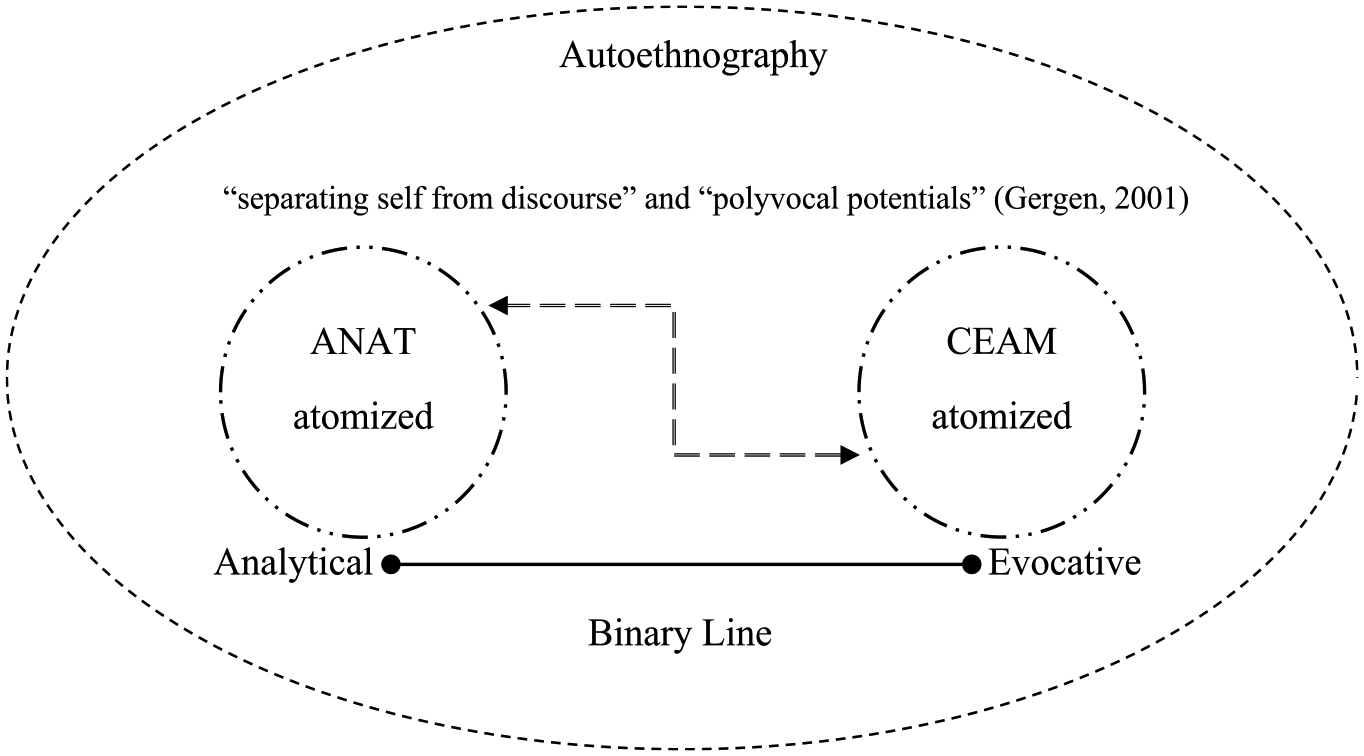
CEAM mediating binarism by situating itself within atomization: Stage 2 of 2.
A Summation
Taking into account Figure 2 while considering the above descriptions of EVAT which transforms into CEAM-CQI and which is referred to as CEAM when in an oppository position to ANAT, one observes that CEAM is able to hold on to its distinct positions and differentiation from ANAT as to the following:
Arguing an issue by way of rhetorical performativity as opposed to expository explanation.
Considering research methodology as a reflection of life lived and imagined rather than as a contrived filter such as an interview protocol thorough which to view that life.
Structuring a paper in the manner of dramaturgy instead of a research report.
Other related factors.
As well, ANAT, in reverse, does the same, and all the power to it. Indeed, all the power to both of them. For the like-minded camaraderie and socialization had within their respective atomizations (i.e., the two circles in above Figure 2) intensify their respective research agendas (i.e., solid segments of the circular lines). Why is this important?
In answering, I do not intend to speak on behalf of ANAT. With regard to CEAM, however, it seems that the above four positions, which generally involve the manner in which “evocative autoethnography aims toward the researcher’s introspection on a particular topic to allow readers to make a connection with the researcher’s feelings and experiences” (Méndez, 2013, p. 281), are key to the overall purpose of critical autoethnography. Some of these purposes are:
Revealing “insider experience” on a phenomena or situation such as racism (Adams et al., 2015, p. 21).
Allowing the reader entry “into the lived experience of a presumed ‘Other’ and to experience it viscerally” (Boylorn & Orbe, 2016, p. 15).
Exposing the “[i]ntersectionality” of oppressive power wielded by “institutions, attitudes, and actions in cultures” (Holman Jones, 2018, p. 5).
Exploring issues that require a more flexible and nuanced development than that provided by “standardized” academic writing such as the IMRD research article (Ellis & Adams, 2014, pp. 262-263, 265). 12
Achieving such purposes, CEAM needs to follow through on its tenets identified above as 1, 2, 3, and 4; in so doing, CEAM stakes out its differentiation from “analytic autoethnography [ANAT]” which is “directed towards objective writing and analysis of a particular group” (Méndez, 2013, p. 281).
As a result, CEAM isolates itself from ANAT into an atomized circle, and ANAT, for its own purposes, does the same (cf. Figure 2). This speaks to the difficulty or impossibility of ignoring their respective places on the binary of “evocative vs. analytical.” Because of the apparent prevalence of the “presence/absence” interplay described by Gergen (2001) as well as the différance phenomenon described by Derrida (1976/1997; cf. Ramanathan, 2010, pp. 95-115), binarism seems unavoidable, though it may be resisted. For example, even Derrida, as explained by Ramanathan (2010), claims that “the articulation of . . . difference relies upon an open acknowledgement of a ‘past/present’ binarism” (p. 98). Notwithstanding, as Ramanathan (2010, p. 98) continues to explain, Derrida resists what he sees as the “violence” of binarism by disregarding the past/present dualism and instead focusing “on an infinity of ‘presents.’” Just as Derrida at least in temporal moments escapes binarism by moving into the sense of a continual present tense affected by the consecutively repeated “deferrals” into what “something is not,” CEAM and ANAT, likewise, flee from their binary positions into their respective circles of atomization (cf. Figure 2).
Although separated in this regard (i.e., the two circles in Figure 2), CEAM and ANAT are not closed off to dialogue. They participate in constructive dialogue with the common objective of contributing to the theory and practice of autoethnography (i.e., the open segments of their circular lines). For example, as described above, CEAM is able to reach out to ANAT on common underlying issues such as historicism. This is done by capitalizing on at least two advantages of disciplinary atomization set forth by Gergen (2001): separating the self from discourse and enacting polyvocality (i.e., the double arrow in Figure 2). The result, for the CEAM side, is the power of assembly, that is, a socialization around a common research agenda which is cloistered off enough so as to mobilize and energize the CEAM members but not so claustrophobic as to disallow constructive and cordial dialogue with the opposition.
Closing
Hence, one finds the evocative variants of particular autoethnographic types such as betweener, Mystory, reflexive, and others (collectively called EVAT, the precursor to CEAM/CQI) in a state of “healthful” assembly or atomization (cf. Table 9, Figure 2) according to their paradigmatic positioning (cf. Note 3) so as to exercise their core tenets (e.g., 1, 2, 3, and 4 above) with the intention of achieving social justice–related purposes (e.g., a, b, c, and d above). This socially committed desire “to tell a critical story of meaning situated in a cultural context with potential to transform self and society” (Alexander, 2016, p. 114; referring to Spry, 2001), along with “the personal narrative in all its emotional and intellectual capacities” that dramaturgically renders this desire (Pelias, 2013, p. 387), seems effectively socialized and constructed within atomization. This leads one to wonder: What is the force driving this atomization? What keeps it all together? Nomenclature or the act of naming, I would say. One reason is that deep within the atomization of EVAT, as described previously, is “the making of presence (and by implication absence),” and because “[t]he nature of the presence made through . . . [a] work of art” such as EVAT “has everything to do with the problematicized relation to the referent” (Elson & Shubert, 2017, p. 251, parentheses in original), the act of naming comes into play, at least to the extent that “we name things and then we can talk about them,” including the identity of referents (Wittgenstein, 1953/1986, p. 128; cited in Berg & Vuolteenaho, 2009, p. 3).
Consequently, “the social operations of naming and the rites of institution through which they are accomplished” (Bourdieu, 1991, p. 190, italics in original) collects entities into “a structured and controlled . . . classification system,” such as that used for cataloging collections of human-made artifacts” within the area of museum science (Bourcier, Rogers, & the Nomenclature Committee, 2010, p. xv). Although requiring the viewer to counter possible hegemonic consequences, nomenclatural designations such as the superordinate “documentary artefacts” assembling the subcategories “declaratory documents,” “government records,” and “legal documents” ultimately “facilitate the sharing of data with researchers, other museums, and the public at large” (Bourcier et al., 2010, pp. xv, 15, 439, 442, 490). In other words, nomenclature—albeit its rigidity as seen in museum-artifact taxonomy—is commensurate with fluid socialization. Along this analogous line, the transformation of EVAT from apparent cohort of autoethnographic types to superordinate leader of those types in the renamed form of critical-oriented evocative autoethnography as a methodology without methods and situated within critical qualitative inquiry (CEAM/CQI) seems that which rallies betweener, Mystory, reflexive, and other critical and evocative autoethnographies (EVAT) into their atomization (cf. Figure 2).
To enable this disciplinary atomization which would allow EVAT-inclined researchers and sympathizers a productive circle of socialization, EVAT seems quite inclined to its transformation into CEAM/CQI. Proposed by Ellis and Bochner (2000) as well as Bochner and Ellis (2016), the term “evocative” or EVAT has come to be used as a single descriptor for a range of autoethnographic types (e.g., Adams, 2018; Chang, 2013; Colyar, 2013; Pelias, 2013; Sparkes, 2018). Furthermore, the detailed description and discussion of EVAT found in Bochner and Ellis (2016, pp. 75-119) attests to the formidable and wide-ranging presence of EVAT within autoethnography, and even Anderson (2006), one of the leading proponents of ANAT, has said that “autoethnography has become almost exclusively identified with those advocating the descriptive literary approach of evocative autoethnography” (p. 377, italics in original; quoted in Hughes & Pennington, 2017, p. 29). In other words, at present, EVAT seems a de facto leader within autoethnography. This leadership role, then, would be more recognized or formalized if EVAT were to be transformed into CEAM/CQI.
Hence a nomenclatural power not to be discredited but rather managed (Bourdieu, 1991, pp. 105-106), CEAM-CQI within autoethnography has resonance and influence beyond the systematically lexical. This is not unlike that of the Latin noun “Mare,” in the 17th century, assembling the names Mare Tranquillitatis, Mare Serenitatus, and Mare Imbrium to designate “the dark lunar spots” observable on the “Moon’s face” (Whitaker, 1999/2003, pp. 3-7). That those same darkened lunar areas have been widely associated, since ancient times, with “divergent imagined likenesses” such as “the head of a rabbit,” “left eye,” and “right eye” (respectively) suggests that the above nomenclature of the Maria incorporates or at least alludes to the cultural value emanating from such images (Whitaker, 1999/2003, p. 3). Further, that those isolated images combine with other images alluded by the lunar surface with the effect of creating temporal and spatial scenes such as the same “rabbit [now] sitting on its haunches pounding rice,” “two children carrying a bucket,” and “an old man carrying a bundle of sticks” (Whitaker, 1999/2003, p. 3) suggests that “lunar nomenclature” is in the quest of story making. Similarly, CEAM-CQI, as a designator and assembler of the critical-oriented variants of betweener, Mystory, reflexive, and other autoethnographies (cf. Table 9), does it part “to story a future,” one “marked by compassion, by solidarity and communion, by change and justice, and by hope” (Adams et al., 2013, p. 699), as the autoethnographer may now join the two children in helping the old man retrieve his bundle that had spilled out onto the lunar dust, the one common bucket soon filled with sticks, “a new politics of possibility” (Denzin, 2018b, p. 27). Underlying the making of such a story would be disciplinary atomization, in vigor and in check.
For atomization to be held in check, as previously mentioned, it would need continued attempts at “separating self from discourse” and “polyvocal potentials” (Gergen, 2001, pp. 55-62), such as that already demonstrated by CEAM (e.g., Adams, 2018; Denzin, 2018b) as well as ANAT (e.g., Anderson & Glass-Coffin, 2013; Chang, 2013). In this way, CEAM can remain atomized and circled around its own critical research agenda while staying open to constructive criticism and lessons to be had from other camps such as ANAT. Furthermore, CEAM-CQI needs to count on the longevity of its own atomization. In this regard, it is interesting to note that, as Gergen (2001, p. 52) indicates, the atomization of the “anti-foundationalist” group in social psychology is apparently at least 30 years in the running, is still strong and unified, and is heterogeneous within the paradigmatic boundaries of its critically engaged and ideologically tolerant beliefs (cf. Note 3). Likewise, as seemingly evidenced by its various types of autoethnography (cf. Table 9), the CEAM-CQI banner is diverse and heterogeneous within its atomization. This makes knowledge production all the more fruitful for both the anti-foundationalists and CEAM-CQI.
However, at the same time, if one considers that heterogeneity implies varied and potentially divergent interests, and if one concedes that atomization itself runs the risk of inertia (Gergen, 2001, pp. 50-51) while nomenclature depends upon hierarchy, then one perhaps cannot disallow the possibility of atomization falling back on itself: that is, the already multi-varied interests within the atomized camp (e.g., critically engaged social psychologists; CEAM-CQI autoethnographers) eventually becoming further split on matters of not only theory and aesthetics but also closure and hierarchy, some interests groups or cliques seeing the latter pair of issues unbearably oppressive and thus striking out on their own. In this case, subgroups and sub-subgroups (within CEAM-CQI, for instance) could splinter off, however gradually or perhaps generationally. This is not say, however, that such splintering off would be negative. Certainly, subatomizations could advance knowledge production. To the extent, though, that some would see potential subatomizations as watering down the assembly power of CEAM-CQI, worries do not seem in order, at least not for now. Taking into account that the diverse anti-foundationalists of social psychology, after 30 years, continue at full throttle (Gergen, 2001), I would maintain that subatomization is slow-in-coming. I also would contend that knowledge seems the most effectively produced during those seemingly long periods when the various interest groups of a given discipline remain atomized in a mediated manner and maintain their inherent diversity unified so as to engage in constructive heterogeneity within their porous borders. I thus would urge CEAM-CQI to seize the day—or, perhaps better said, seize the decade or century.
Footnotes
Declaration of Conflicting Interests
The author(s) declared no potential conflicts of interest with respect to the research, authorship, and/or publication of this article.
Funding
The author(s) received no financial support for the research, authorship, and/or publication of this article.
