




Abstract
I discuss my efforts as a “good enough” photographer and describe the role photographs play communicating important moments from a series of ethnodramas I built about the Chicago Public Schools. I discuss my early efforts to use photography to legitimize my arts-based research practice, describe how my goals changed, and explain how I created images to communicate the energy of live theater. Building on Eisner’s theoretical work, I discuss three tensions of my photographic practice: intention versus improvisation, action versus artifice, and safety versus possibility. These tensions emphasize my limits as a photographer and the possibilities of arts-based research.
Keywords
A major challenge for performative researchers is transforming the ephemeral highlights of their careers into enduring scholarship. The written word endures; live performance perishes. Books and articles live on beyond the original intentions of the author; the energy of live theater flames and burns out. If, with Eisner (1995, 2008), we believe the central focus of arts-based research practice in education should be the production of rigorous and aesthetically powerful works about schools, students, and communities, how might performative researchers communicate the excellence of their endeavors to people who have never seen the show?
One answer to this question comes from the research on A/r/tography and ScholarArtistry (Carter et al., 2011; Cole & Knowles, 2011; Knowles et al., 2008; Siegesmund, 2017; Springgay et al., 2005). ScholarArtists are polyvocal. Their art-making and their writing come out of a unified commitment to understand the struggles that shape people’s lives. As artists, these performances bring to life the passion of working for change in organizations shaped by hope and the lies, violence, and injustice of the past and present (Denzin, 2009; S. Finley, 2011).
Yes, the curtain will fall, and the actors and audience members will go their separate ways, but the writing produced from the performance will endure.
Perhaps.
It would be pretty to think so.
We might question, however, whether a performance practice that exists to produce text will succeed in “deepening meaning, expanding awareness and enlarging understanding” (Eisner, 1997, as cited in, Bagley, 2008, p. 55).
A second path forward is video. Many performative researchers—including myself—have been beguiled by dreams of recording their work as it happens and sending dispatches to the public across the World Wide Web. Such dreams tend to die—as mine did—once the ScholarArtist pulls up the footage.
Over the years, I have been able to create two high-quality videos of my work. The first was produced by a seasoned crew of four professionals who regularly worked together at the Gerald R. Ford School of Public Policy (Vanover, 2019); the second was produced in collaboration with my colleagues at The Studio@620, in St Petersburg, Florida, and built on the many years of social capital produced by artists in that space, along with US$40,000 of borrowed equipment (Vanover & Jones, forthcoming). Every other video of my work looks like mud.
This article describes my experience using photos to communicate a selection of the performances I developed over the last 6 years for the Inquiry Theatre series. 1 I discuss my initial efforts to use photography to document my work and then discuss projects and epiphanies that changed my working methods and transformed my life (Denzin, 2014). In the “Discussion: Tensions of a ‘Good Enough’ Photographer” section, I share three tensions of my photographic practice that emphasize my limits as a photographer. In the “Conclusion: The Unity of Art and Research?” section, I discuss the implications of this work for other researchers.
Literature Review: Performing on the Periphery
Although it is possible, with Favorini (1995), to trace the genealogy of research-informed theater to the ancient Greeks, I do not believe it unreasonable to trace the current round of scholarly performance to the efforts of anthropologists and aligned researchers to reconstitute their fields in the aftermath of the attacks leveled against naïve, positivistic ethnography (e. g. Clifford & Marcus, 1986; Fabian, 1983; Rosaldo, 1993). Rather than talk about ritual, performance creates it (Turner & Turner, 1982). Rather than describing injustice, performance helps people feel and transform it (Bagley, 2008; Boal, 1995; Conquergood, 1985, 2002; Mienczakowski, 1995). Performance offers a technology to evoke the everyday world and provides ground for scholars to engage in a new way of life (Bickel, 2005; Callier, 2016; Goldstein, 2012; Gouzouasis, 2006; Spry, 2001; Teman & Saldaña, 2019).
Arts-based research demands that university professionals leave the safety of our offices and live out new relationships and practices (Conrad, 2008; Leavy, 2015, 2016). For scholars based in theater departments and other arts-settings, important steps in the journey might be developing the research relationships to communicate something that matters about the struggles of 21st century life. For scholars working within liberal arts and social science disciplines, essential steps might be developing the skills and relationships to inspire audiences within and outside the university. University professionals’ work as producers of culture raises a host of questions and possibilities (Cahnmann-Taylor, 2017; Callier & Hill, 2019; Gray & Kontos, 2015; Harris & Sinclair, 2014; Lea & Belliveau, 2015).
Dwight Conquergood’s career is instructive (Conquergood & Johnson, 2013; Jackson, 2006). Conquergood’s dissertation subject was boasts in Beowulf, but none of his major works contributed to medieval studies. Conquergood patterned a performative career in anthropology through deep commitments to artistry, activism, and qualitative methods. As a researcher, Conquergood’s work was embedded in critical ethnography: Conquergood lived with the people he studied with and he advocated for their needs. Conquergood lived in refugee camps in the Gaza Strip and South East Asia; he followed the refugees he studied with into the Chicago neighborhood of Albany Park, which at that time was an impoverished port of first call. The relationships Conquergood developed at the Ban Vinai Refugee Camp in Thailand, and the Big Red apartment building in Chicago led to live performances and documentaries about the worlds he and his neighbors experienced (Conquergood, 1988, Conquergood & Siegel, 1990). These works are aesthetically powerful—pirated copies of Conquergood and colleagues’ documentary on the Latin Kings street gang are posted on YouTube channels devoted to Chicago gang life 30 years after the documentary was premiered. These performances also provided grounds for articles that continue to influence the fields of performance studies and arts-based research (Conquergood, 2002; Madison & Hamera, 2006). Conquergood’s move to performance did not cause him to relax his commitments to research and activism.
One irony is how little impact performance has had on the core academic disciplines of the humanities, social sciences, and professions. It has been 30 years since the initial theorizing in anthropology and 20 years after a second wave of performative research was fashioned by qualitative researchers (Denzin, 2003; Donmoyer & Donmoyer, 1995; M. Finley, 2000; Saldaña, 2003; Spry, 1997; Wolcott, 2002), but outside of conferences and special interest groups explicitly devoted to the arts and, occasionally, qualitative research, performance is practice of the periphery. Almost all formal, face-to-face communications in university settings in the 21st century are organized around PowerPoint lectures and other computerized presentation technologies. As much research shows, the reliance on such practices has profoundly negative implications for dialogue (Craig & Amernic, 2006; Tufte, 2003; Wecker, 2012). The world is more than headlines, pictures, and clumps of bullets. For whatever reason, most university professionals have ignored this news.
A practical problem for anyone whose work violates the University’s taken-for-granted communication routines is few people within academic life understand what performance might do for them. Among discipline-based academic researchers, there is little hunger to breakout of the endless loop of PowerPoint presentations that define the current era, except, perhaps, among those leading-edge figures who’ve switched to Prezi. There is little understanding of how the evolution toward a performative social science might improve the content, depth, and influence of a discipline’s research output. As someone who has done performative work for more than a decade, it has been my experience that despite years of theory building (Barone & Eisner, 2012; Belliveau, 2014; Boydell et al., 2016; Cranston & Kusanovich, 2016; Denzin, 2009; Norris, 2009; Prendergast, 2011; Rossiter et al., 2008; Saldaña, 2011; Snyder-Young, 2010), few people outside the field understand what arts-based research looks like or why it matters.
Sensuous communications whose edges have been sharpened through cycles of research, rehearsal, and performance (Bagley, 2008; Bagley & Castro-Salazar, 2012) pose a threat to contemporary academic cultures where participants are terrified of causing offense. The world is inhuman. Art is not produced by following the rules. Few careers in any fields are constructed by walking the accepted path in the accepted manner.
Even if performance were a common feature of academic life, the work would continue to be filled with risk. As many researchers have emphasized, successful live performance creates hope and connection (Denzin, 2003; Saldaña, 2005), unsuccessful work breaches the bonds between performers and audience members and creates feelings of rage (Goffman, 1959; Heritage, 1984). Conquergood (1998) described leading a performance where he offended his audience so deeply, the group spent the entire talkback attacking him, before asking him to come back for a second meeting that began with an extended outpouring of abuse. In many ways, the true worth of a performative researcher is not how many performances they staged, but how many bad performances they survived (see discussion in Belliveau & Prendergast, 2017).
Performance and other forms of arts-based research offer means to communicate to the public. We don’t know what might happen if that commitment was acted upon across academic fields or what it might mean to work in disciplines that truly unify art and research.
Position
I am a White man who worked in the Chicago Public Schools (CPS) for 8 years before I won fellowship to study educational policy at a major public research university. At that university, I worked in multiyear, longitudinal mixed-methods research projects and I studied both quantitative and qualitative methods. My years as a freelance writer in Chicago and the artistic commitments of my family made me better at qualitative than quantitative research, but during my PhD studies, I honestly enjoyed taking quantitative classes from Stephen Raudenbush and Dwane Alwin almost as much as qualitative classes from Martha Feldman and Ruth Behar. I am now an associate professor of Educational Leadership at a branch campus of a university system moving toward, for what it is worth, pre-eminent, Research One status. I had a challenging tenure run (see Vanover, 2017) but now am a leader within my local college of education.
In the 8 years, I worked in the CPS, I experienced joy and happiness I never recaptured, and I suffered in ways I will never forget. Children and teenagers walked into the libraries and classrooms where I worked and they checked out books, wrote poems, and looked up stuff in the encyclopedia. The CPS went its own way, friends died from the AIDS epidemic, I was sick with bronchitis and sinus infections 4 times a year and, eventually, I won a fellowship to study educational policy and left the city and its schools.
Research Methods
After I left CPS for the university, I returned to Chicago to collect data for my dissertation in the summer of 2004. I interviewed five beginning teachers and seven accomplished National Board of Professional Teaching Standards–certified teachers (Berliner, 2002; National Research Council, 2008), all from CPS elementary schools. Every teacher was interviewed 4 times each, for an output of 48 interviews. I used semi-structured narrative interviewing techniques based on Benner et al. (1996) and Weiss (1995). At the university, I diligently transcribed the first round of interviews by hand, coded my findings, and slowly wrote up my dissertation. 2 I collected my data in 2004; I graduated from the university in 2009. During the 5 years when I analyzed and wrote up my data, I developed an ethnodrama with Johnny Saldaña and then a play of my own (Vanover, 2014a; Vanover & Saldaña, 2005) in-between analyzing more than 100 interviews for the mixed-methods studies that paid my graduate research assistantship.
I won a tenure-track job in 2009 at a branch campus in the University of South Florida system and, as I will discuss, I become completely stuck until I restarted my performative work. For me, for better and for worse, performance became the solution to the practical issues of survival and productivity within the university. Performance worked for me at a time in my life when, quite honestly, little else did, and that is why I became a performative researcher.
Deeds Not Words
I have developed this visual ethnography following Eisner’s maxim that deeds not words are the best way forward for arts-based research. My focus is on what I have done, and I don’t apologize for the messiness of my methods. Similar to many qualitative researchers, I make things up as I go along.
I was not and I am not a photographer. Given my intentions and limits, this article is mostly embedded in research in performance, rather than the rich literature on visual arts-based methods (e.g., Bickel & Hugill, 2011; Chilton & Scotti, 2014; Eisner, 1995; Harris, 2016; Hofsess, 2015; Lasczik Cutcher & Irwin, 2017; Leavy & Scotti, 2017; Pink, 2013; Siegesmund, 2017). Photographs are a support for my performative practice, rather than the central focus of my arts-based research.
The practices I used to develop this article are quite simple. I began by looking through the many folders of rehearsal and performance photos I uploaded onto my computer. I then went online and examined the two major online archives I had created for these images: The archive connected to my name at the Nelson Poynter Digital Library 3 and then the Inquiry Theatre Facebook page. 4 I chose images from my private and published work that highlight critical aspects of my major projects and decided to introduce them with short descriptions. I presented this paper at the American Educational Research Association in April of 2019 as part of a juried symposium for the Arts and Inquiry Special Interest Group. The paper I wrote was too long to be published, and I put the work on hold before returning to it in December of 2019 and cutting the manuscript.
I regularly dig through the thousands of photos I store in my computer. A couple of pictures attached to an email, or dropped into a paper or proposal, communicate what my collaborators and I do more effectively than my words. I have to say, I was surprised at how much emotion I felt when I first pulled up the image folders for 2012–2016 and remembered the professional and personal chaos I experienced as I worked toward tenure.
The only thing that was working for me professionally was my arts-based research and I decided to focus in on that. Ten years after writing the script, and after having the manuscript I developed from those performances rejected by two other journals, I had my second play accepted for publication. 5 It was fun to imagine myself as an emerging playwright, but I had never found a way forward as a theater artist after my first two ethnodramas. As I will discuss, in November of 2012, I had a breakthrough where I learned, despite my years of academic training, to trust “the magic of theatre.”
I did many things in the 4 years before I received tenure in 2016—I taught six to eight Masters level writing courses a year and I started dating the woman who became my wife—but if you asked me what I remember the most, I would have to say, “Waking up every morning terrified I would not get tenure.” My theory of action at the start of the journey was that maybe I would get tenure and maybe I would fail, but at least I would spend the next couple of years doing something I enjoyed. This theory of action did not lessen my terror, but it did make my anxiety more interesting.
Equipment
I took almost all the photos in this article and in the files on my computer on a Nikon 5100 with the two kit, zoom lenses. I bought this camera in December 2012 when I had recommitted to arts-based research and I decided that I need high-quality photographs to communicate and market my work. I stopped using that camera when I started work on the Chicago Butoh project. In March of 2018, a month before we traveled to New York to put up our peer-reviewed show for the American Educational Research Association, my Nikon was stolen. I had decided at the last moment not to take it to an event at a school we were researching, and the camera was stolen out of my car when I forgot to lock the doors. The rehearsal photos on pages 29 and 30 were shot with my wife’s Cannon Rebel XSI.
Photographic Practice
I am not a trained photographer. The goal of my practice is to create images that are “good enough” (see discussions in Chilton & Leavy, 2014; Leavy, 2015) to communicate important dimensions of my performative projects and to market my work to the wide-array of stakeholders that influence my professional career. Over the years, I learned what works best for me is to shoot on impulse and make most artistic decisions after the fact—when I look over the uploaded images on my computer. During a given photo session, I might shoot around 60 photos with my camera set on automatic. I then upload the contents and select the images that are most filled with life (Carlsen & Dutton, 2011) to put up on Facebook, my university archive, or papers and reports to funders.
I use simple photo-editing software to crop the photos and change the light and color settings; I don’t engage in major manipulations. There was a time when I would delete many of the images that were out of focus, but now I rarely erase. I learned that my tastes change and that photos I had no interest in become alive in different contexts.
The Magic of Theater: Select Photographs From the Inquiry Theatre Series
The core insight I used to develop the Inquiry Theatre series came to me during a workshop performance I staged at Canterbury House in Ann Arbor on the Tuesday after Thanksgiving break in 2012. I had pulled together a set of interview excerpts to create a simple and easily staged performance that would, eventually, become “What Does It Mean to Work in a System that Fails You and Your Kids?” (“System Failure”), Vanover (2019). My original idea was to have my friend, Jennifer Jean Smith, read sections of the verbatim text from an interview I had conducted with a beginning teacher, and then for me to lecture between those selections. Building, albeit imperfectly, on work in duoethnography (Sawyer & Norris, 2013, 2015), Jennifer would perform the teacher’s stories and I would guide the audience through each verbatim excerpt, freely sharing my insights. During our rehearsal the night before the performance, I realized my presence was redundant: I could erase myself (see Siegesmund, 2014, p. 6). I told Jennifer, “You can read the whole thing. The individual sections of the narrative will hold together without me, thanks to the magic of theatre.”
Jennifer, quite honestly, had some doubts about whether the magic of theater would come to our aid. She was concerned about the performance, given many of our friends would be in the audience.
Erasing myself turned out to be the best single idea I had in my career. Everything worked better than planned. People responded to the love and suffering evoked by Jennifer’s performance. The post-show discussion ran for almost an hour.
In fact, while I cut myself out of the phase of the ethnodrama I called the scripted performance, I was very present in “System Failure’s” extended introduction and the long discussions that followed. As a piece of theater, the text of the interview I built into “System Failure” conveys events and epiphanies in the CPS that are difficult to understand without insider knowledge. Much of the play’s conflict is caused by the operation of the CPS’s student retention policies (for extended discussions of these CPS practices, see Anagnostopoulos, 2006; Jacob et al., 2004; Roderick et al., 2005). The final excerpt in the script evokes how the teacher was required to fail about two thirds of her class because her kids’ test scores were below the threshold set by the CPS. Before Jennifer performed the script, I thought it important to spend time explaining these policies and procedures.
I took no photos of the November 2012 performance at Canterbury House, Ann Arbor. That next month, as I worked out the details of new series of plays, I realized it was critical to document my work. To communicate the magic of theater, I went to Best Buy and bought a Nikon D5100 for Christmas. Photo 1 shows how well that camera worked when I had enough light to shoot.

Jennifer Jean Smith rehearsing “System Failure,” Vanover (2019), for a performance for the University of Chicago’s Committee on Education, Chicago, Illinois, May 2013.
My campus library offered faculty the ability to put papers and other materials from their work online for, what they said, was perpetuity. The archive’s entry for the performance of “System Failure” we staged for the juried program of the University of Pennsylvania’s Ethnography in Education Forum, for instance, includes posters, handouts, and photos of our performance. The images from the Ethnography Forum shown in Photos 2 and 3, below, were published on Facebook and illustrate my role as facilitator of the show. These photos were taken with my camera, and they convey the exact message I hoped to communicate: “System Failure” was performed for a full house at the University of Pennsylvania Ethnography in Education Forum and the audience was deeply engaged in this unique and important work.

The author performing “System Failure” at the University of Pennsylvania’s Ethnography in Education Forum, Philadelphia, PA, March 2013.
Photo 3—the photo of the dynamic middle-aged playwright taking notes during the discussion of his work at Penn—is an example of entire genre of academic photography: the heroic professor doing good. Such photographs and their aligned videos are strewn throughout most academic fields and are the primary contact most academics have with arts-based research. These heroic works communicate vital information to university stakeholders—yes, indeed, the project was a unique success.
I believe Photo 3 makes an important contribution to this genre. There is something about the jut of the playwright’s jaw. . .
Given it is important to attempt to master the artistic forms of one’s community before, perhaps, transcending them, I make no apologies for my efforts to report our performances’ uniquely good news. What the photos on Facebook and on my computer do not convey is the anxiety that accompanies such adventures. I have no records of the terror I felt when I hit send on each proposal we sent to The University of Pennsylvania Ethnography in Education Forum. I have the jaunty emails I sent to my friends as we worked to organize the performances of “System Failure” at The University of Chicago and Northwestern University, but I have no written records of how my heart traveled up my throat when I set foot on those campuses.
Crossing Boundaries
The second ethnodrama in the Inquiry Theatre series, “They are Only Going to Steal Your Cars” (“Cars”), Vanover, Thomas, Lubin Langtiw (working script), changed my life. The first play in the Inquiry Theatre, “System Failure”, developed organically as I struggled to develop a new way of work. “Cars” is the first performance I built from those lessons.
The verbatim script excerpts I used to build “Cars” evoke an accomplished, African American teacher’s decision to leave an impoverished and chaotic African American public school. Ohio Ontario, pseudonym, told me she gave her heart to the kids in that building, but she could not stay in her school because of the way it was managed. Following pathways outlined in the quantitative research on teachers’ careers (see Allensworth et al., 2009; Hanushek et al., 2004), Ohio moved to another African American school in the CPS, but a school in a much wealthier neighborhood. This transfer was accompanied by a number of life changes—Ohio had become pregnant with her first child—and the veteran African American teacher used our interview sessions to take stock of a period of constant change.
Crossing borders is a theme of many of the stories Ohio told during her interview. Ohio did not grow up in a segregated, African American neighborhood, and she was unfamiliar with the hyper-segregated community where her old school was located. Ohio was also unfamiliar with the demands of teaching the more affluent African American students in her new building.
To produce an ethnodrama based on Ohio’s interview, I also had to cross many boundaries. Following the precepts of A/r/tography and ScholarArtistry (Knowles et al., 2008; Springgay et al., 2005), I had to understand Ohio’s interview well enough to dramatize it, and I had to understand this dramatized experience well enough to speak authentically about the performance. The most important issue was I had to find people of color to perform Ohio’s part and comment on my choices as I developed the script.
I was abetted in this labor by the excellence of Ohio’s character. Ohio was a teacher’s teacher who had received prestigious National Board for Professional Teaching Standards (NBPTS) certification (National Research Council, 2008) while working in a poor and, in her account, badly managed elementary school in the CPS. Ohio was also the type of African American woman other people of color liked. Ohio was able to talk about her choices and her struggles in a way that drew actors and audience members to her stories. Most everyone who worked in “Cars” became my friend, and many of those relationships blossomed into years of collaborative work.
I did not feel quite so self-conscious when I took out my Nikon and began to shoot. Photo 4 evokes the sense of loss communicated by Ohio’s narrative. Photo 5 is one of our most liked photos on Facebook. The photo was taken immediately after a performance of “Cars” at a session at The Qualitative Report Conference (TQRC) and it captures the exhilaration of staging the show.
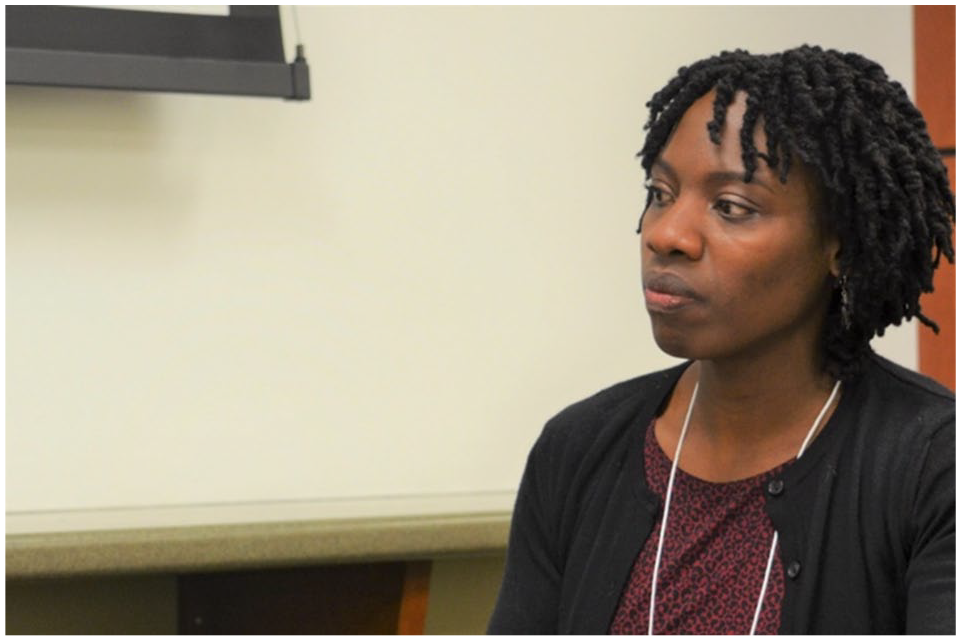
Dr. Cynthia Lubin Langtiw performing “They are Only Going to Steal Your Cars” at the 2014 The Qualitative Report Conference, Nova Southeastern University, January 2014.
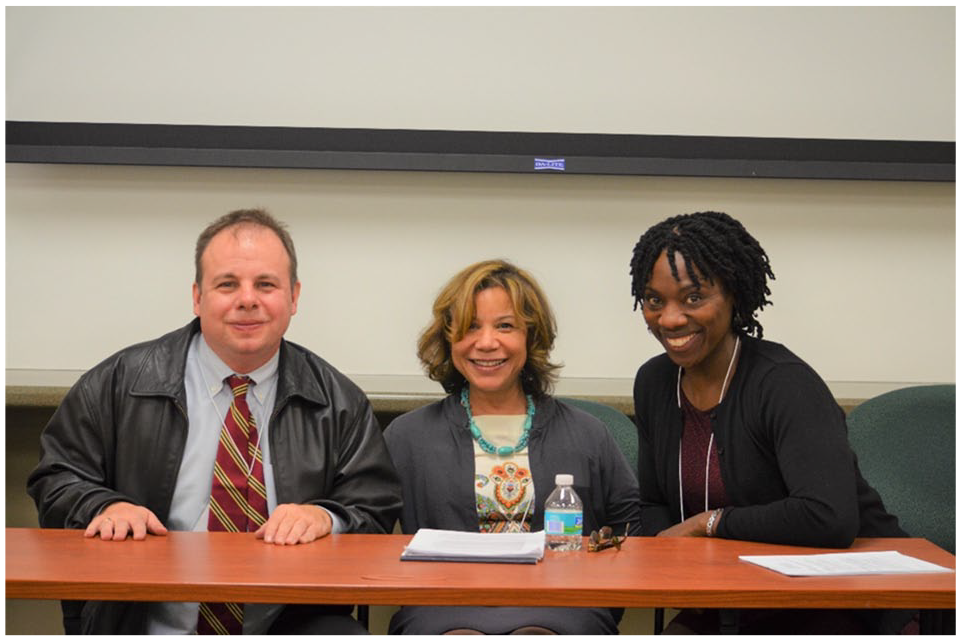
Drs. Charles Vanover, Rose Thomas, and Cynthia Lubin Langtiw after performing “Cars” at the 2014 The Qualitative Report Conference.
For arts-based researchers with nontraditional backgrounds—people like me who don’t have arts-degrees—one of the most challenging moments in their careers tends to come during their first public performance at their home university. Photos 6 and 7 were shot at the first performance I staged my university, a workshop of “Cars” that stared La’Kesha O’Neal. As part of the preparation for the show, I recruited Bob Devin Jones, the Artistic Director of a local St. Petersburg arts space, The Studio@620, to provide feedback on the piece. Bob liked the script enough we were later able to stage the show with La’Kesha as the star at a donation show at The Studio.
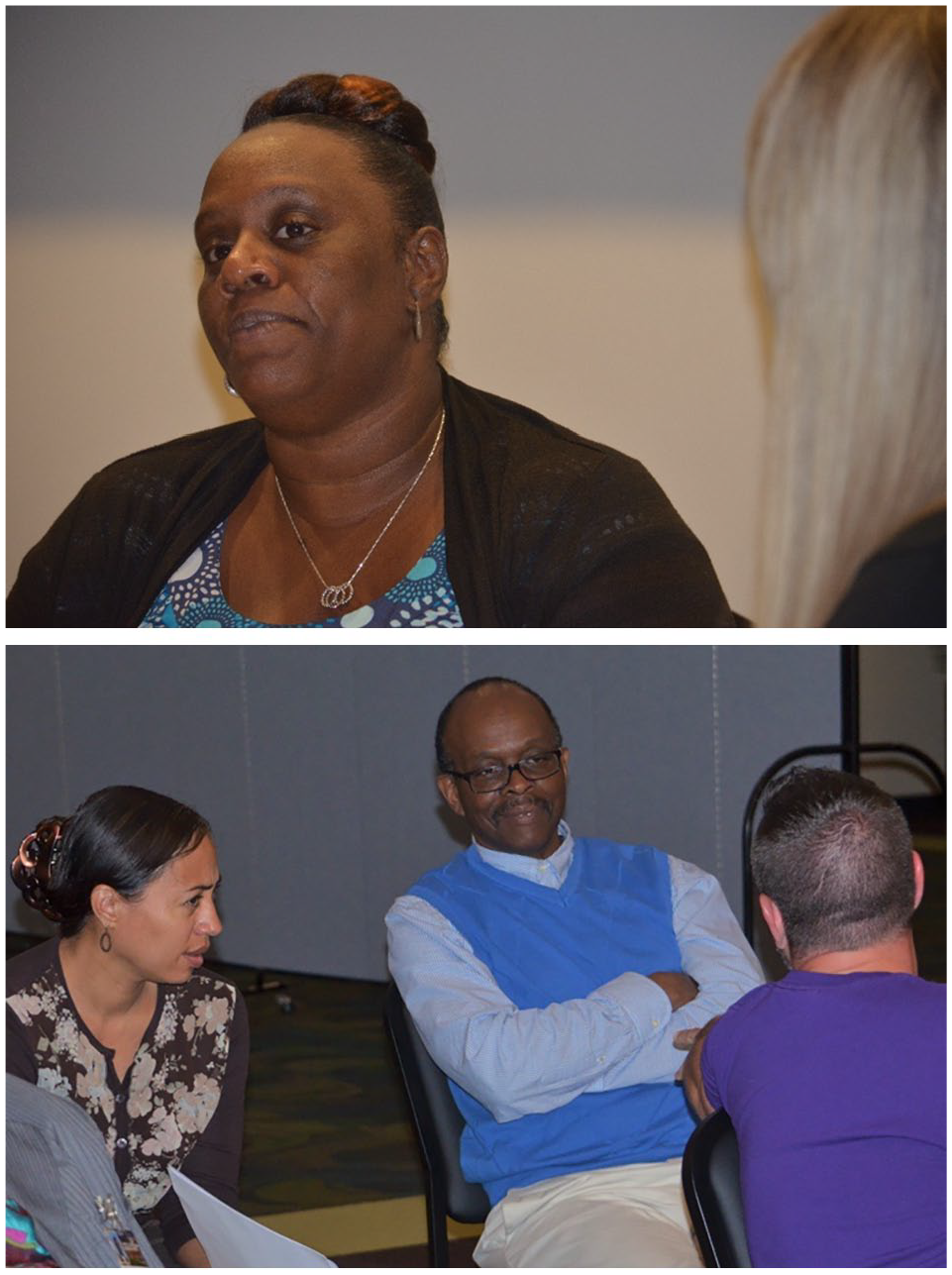
La’Kesha O’Neal staring in “They are Only Going to Steal Your Cars” and audience members Dr. Vonzell Agosto, Bob Devin Jones and Benjamin Smet discussing her performance at the University of South Florida St Petersburg, April 2014.
Each of these shows made me more conscious of the artistic dimensions of my work. Performing at conferences and other academic spaces will always be challenging—the light is never kind and there is never enough time to perfect the work. Despite these limitations, I wished to become a better artist, and observing Bob as he directed “Cars” was an amazing learning opportunity.
As I discovered, there are problems with the script. Scholarly performances should run for between 20 and 40 min. “Cars” runs between 50 min to an hour. An hour is too long a time to ask audience members to sit for readers’ theater. However, I had become a good enough playwright that most everyone who participated in the show become a friend and collaborator. Bob and I have put up four other shows at The Studio@620, including two which won University of South Florida Creative Scholarship Grants.
Probably the most important photo I took at this time is Photo 6. “Cars” speaks to a core question: How does one lead a good life, when racism and other forms of injustice impact the world where one lives and works. I use songs by John Coltrane (e.g., Coltrane, 1957) to score the show, and I took Photo 6 at rehearsal during a pause in the play. During this segment, Ohio talks about the very poor students in her old school and how hard it was to say goodbye to the kids in that building. The image inspired me to move beyond documenting the performances to, imperfectly, capturing the scripts’ psychological drama.
La’Kesha’s photo illustrates the stakes involved. Crossing the boundaries between script and performance is always complex. Racial differences add to these challenges, but they also energize the work. One outcome is certain: When people of color take center stage, they change the conversation (Brown et al., 2014; Hill, 2016).
Working Intentionally
From a formal perspective, “Listening to the Silences,” Vanover (2016b), is the most perfect play in the Inquiry Theatre series. The show evokes a White, female, beginning teacher’s first year in an African American elementary school in Chicago. The teacher spent that year alone, surrounded by schoolchildren. During her interview, the teacher told me she was new to the city, her principal never walked into her classroom, and she did not connect with the other educators in her new school. Perhaps as a result of this isolation, the teacher would pause during her interview—sometimes for 3, 5, or even 10 s—as she struggled to put memories into words. As I went over her transcripts to develop the script, I realized those pauses were powerful dramatic content. The vulnerability of the first-year teacher’s voice and the simplicity of her narrative help the audience imagine life at school.
I decided to score the teacher’s narrative with religious music, and I experimented with many different pieces find the perfect set of songs. I did not write down the moment when I realized selections from a single CD—Rudolf Werthen’s versions of Arvo Pärt’s (1977/1995) Frates—were the perfect accompaniment to the stories the young woman struggled to tell. “Listening to the Silences” creates its own space with little need for my efforts as a facilitator. The show runs for 35 to 40 min and fits easily into academic spaces.
In the show we staged a Temple University, I needed to do little more than give a short introduction and then sit at my computer and play the selections from Frates while the actors read the script. After the show ended, the students in the audience and the actors who performed the ethnodrama spent almost an hour talking about the show.
I enjoyed sitting quietly. The dialogue did not center on beginning teachers’ experience, although most of the audience members were in Temple’s teacher education program. Instead, audience members talked about their own experience in beginning teachers’ classrooms and the traumas they, as students, experienced.
We premiered the show at the University of Pennsylvania Ethnography in Education Forum 2 days later. For both the Temple and Penn shows, I cast the same two professional actors. It requires a great deal of skill to pause for 3, 5, or even 10 and communicate inarticulateness. My experience working with Rose Thomas, Cynthia Lubin Langtiw and La’Kesha O’Neal on “Cars” had been so powerful, I decided, to use a term from Conquergood (2002), to intervene in the audience’s preconceptions and understandings. I cast two women of color, Kisha Barr and Jenna Lam, to play the part of the teacher and the interviewer, even though, in “real life” both the teacher and the interviewer were White.
The conference organizers at Penn had assigned the session to a room with wonderful natural light. It was amazing to see the show come to life. Kisha and Jenna glowed. After the session was over and the audience had left for the evening keynote, Kisha and Jenna and I created a set of photos I published with the playscript for “Listening to the Silences,” Vanover (2016b), including Photo 8.
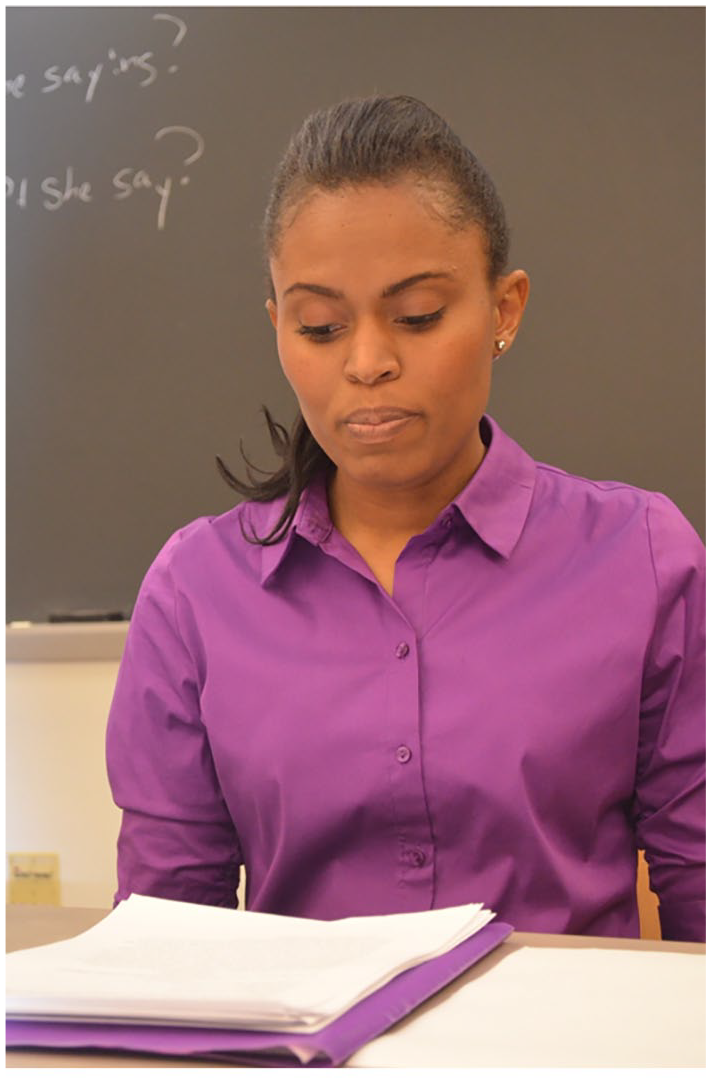
Kisha Barr performing “Listening to the Silences”, Vanover (2016b), as part of the peer-reviewed program of the Ethnography in Education Forum at the University of Pennsylvania, Philadelphia, Pennsylvania, February 2015.
As Hobson (2016) discussed who are talked about and acted on in a review of this performance, not everyone in the audience believed the show achieved perfection. Some people at Penn objected to the way I threw them into the beginning teacher’s experience. After the Temple show, I cut the introduction. When we performed at Penn, I played Frates for Strings and Percussion into the room’s sound system and then Jenna Lam walked on stage carrying the props we created for the performance—a set of Institutional Review Board (IRB) forms. When the last person was seated, Kisha Barr walked on stage, signed the IRB forms, and the play began. Throughout the performance, I stood off to the side and played versions of Frates from my computer. When the scripted performance ended, I let the audience make sense of the show on their own. I walked out of the room and had a cup of tea.
When I came back for the general talk back 15 min later, not everyone was happy with the performance. There were some folks in the audience who thought I was putting the institution of teacher education in doubt by producing an ethnodrama that centered on a young teacher’s vulnerability and suffering. I understood these audience members concerns; I know all too well that it is a terrible thing to spend one’s first-year teaching alone among schoolchildren. Almost all research on the matter strongly recommends that beginning teachers receive high levels of support (see the discussions of this issue in Beltman et al., 2011; Darling-Hamond, 2010; Day & Hong, 2016; Dell’Angelo, 2021; Johnson & Down, 2013; Margolis et al., 2014). As is often the case, such support was not given to the young woman I interviewed.
I was able to stage two other performances of “Listening to the Silences” in St. Petersburg at the Studio@620. I have not put up the show again because I have not found the appropriate resources. I would like to find a way to perform “Listening to the Silences” with a live orchestra and use the art of theater to help the audience imagine what it means to serve the poor.
Working Together
The script to what will be the last verbatim show from my dissertation data set, “Chicago Butoh,” Vanover and Jones (forthcoming), has helped me explore a core weakness in my research design: my ethnodramas explore teachers’ lives and not students’ testimony. We staged four early performances of “Chicago Butoh” at a performing arts high school in Florida, before we changed our direction to pull the show together into its final form: a two-person ethnodrama. For these realized performances at American Educational Research Association (AERA) and The Studio@620, we asked a White, female actor to read the teacher’s words and asked a female, African American actor—West Coast Theater’s Jai Shanae—to respond to the White teacher’s stories. African American students who are talked about and acted on, act out (see photos 9–11). Jai’s performance brought down the house at every show we staged.
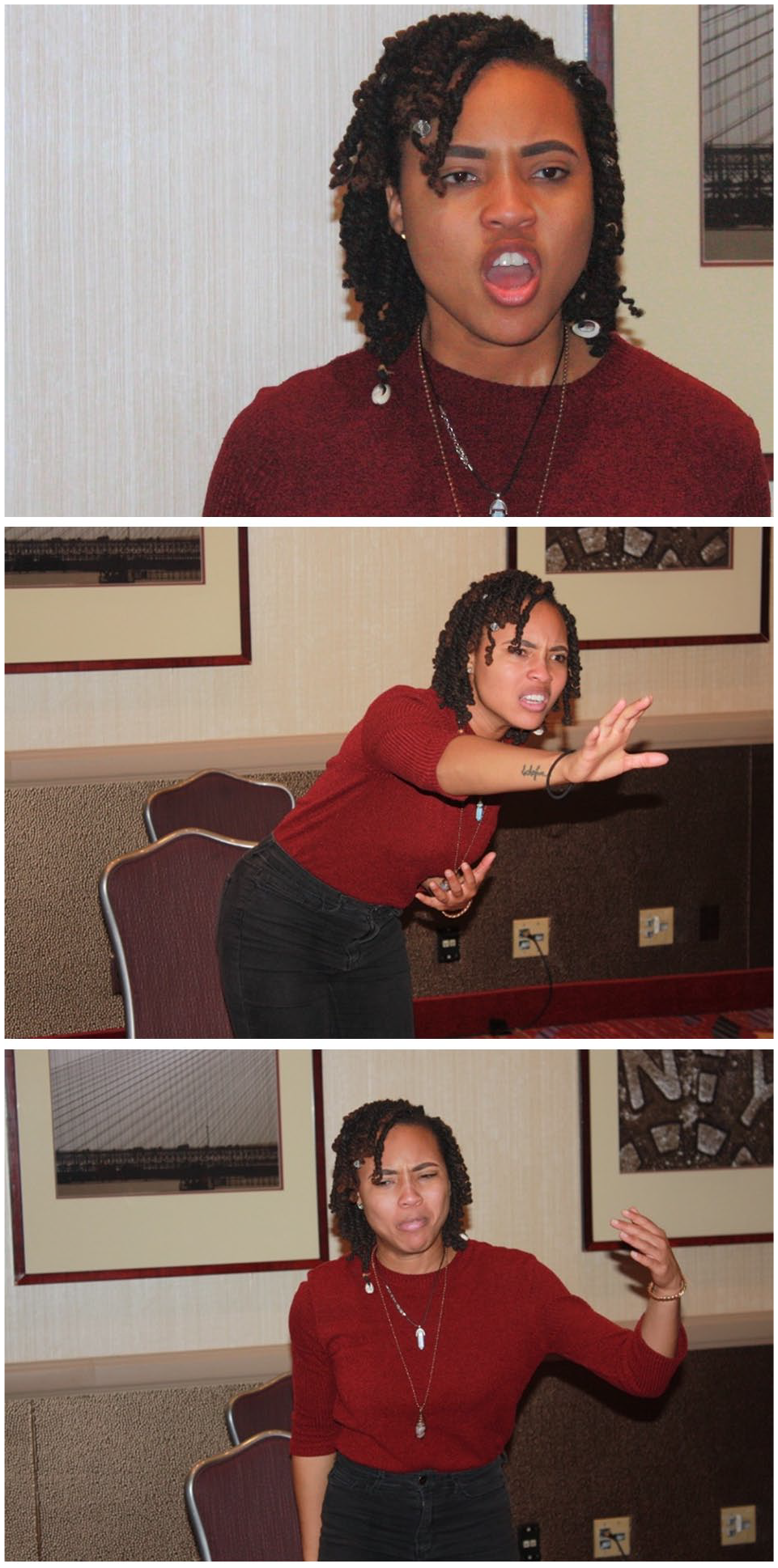
Jai Shanae rehearsing “Chicago Butoh”, Vanover & Jones (forthcoming) for the 2018 Annual Conference of the American Educational Research Association, New York, New York, April 2018. Image credit: Charles Vanover.
“Chicago Butoh” taught me the limits of my work as photographer. When I shoot, I take lots of photographs to find a raw image that evokes the magic of theater. What I don’t do is “see the photo in advance” and intentionally capture a specific moment. Teithis Miller, the photographer I hired at the performing arts high school where we produced the original workshops for “Chicago Butoh,” however, is able to see his photographs before he shoots. Teithis’ images have an inevitability my work lacks.
I become aware of Teithis when the choreographer we were working with at the performing arts high school asked him shot our first workshop performance. Teithis was 19 years old and had just graduated from high school and his photos were better than anything I ever shot. I featured Teithis’ photos in our proposal to stage “Chicago Butoh” at AERA 2018 in New York City, and I believe his images influenced the reviewers’ impressions of our work. The next fall, when we filmed two performances of “Chicago Butoh” at the Studio@620, I had no choice but to fire the original photographer—me—to have Teithis shoot the show. Artistic quality matters in arts-based research.
My photography has come along through the years, but the limits of my work are highlighted by Teithis’ photos in the appendix. I am proud that “Chicago Butoh” was able to attract a photographer of Teithis’ expertise. However, part of me wishes to be something more than a “good enough” photographer. Instead, like Teithis, I want to be good.
Discussion: Tensions of a “Good Enough” Photographer
This article was developed for an AERA symposium intended to provide guidance for increasing the legitimacy of arts-based research. A major theme of the session was the importance of raising the field’s artistic quality. During my portion of the session, I discussed my efforts as a photographer and shared with the audience an early version of this “Discussion: Tensions of a ‘Good Enough’ Photographer” section.
As I photographed the ethnodramas in the Inquiry Theatre series, I struggled to balance the demands of art, activism, and analysis (see Madison & Hamera, 2006). Building on Eisner (2008), I share three major tensions.
Tension 1—Intention Versus Improvisation
The photos in this article demonstrate that for at least one important audience—myself—my photography is “good enough” to evoke critical moments from our ethnodramas. When I get ready to shoot, some questions I ask are, “What aspects of the work do I need to communicate? What type of images do I need to convey the performance?” As I discussed in the previous sections, the focus of my photography has changed. I moved from audience shots intended to legitimize my efforts to performance shots that attempt to convey the magic of theater.
From one perspective, as shared in an interviews conducted with my collaborators Bob Devin Jones and Teithis Miller (see Jones & Vanover, submitted; Miller, forthcoming), art is intentional. In this view, as the director and/or producer, I must understand the performances I stage so completely, I can envision each image the creative team brings to life. To fully realize the performance, I must have the artistic control necessary to produce a set of perfect moments, both for the audience and the camera. From another perspective, what is best is to be open to the moment. I take the best photographs I can given the time I have available: These improvised images are usually good enough.
In every performance, I find myself operating at the beyond my skill level. I am never sure what future audiences need to see. I am never certain how much time I should allow for setting up the photos and how much time I should allow for everything else. Sometimes, I am skillful enough to capture a powerful image. Sometimes I fail to see it, or I find the perfect moment and the image never comes to focus.
Tension 2—Action Versus Artifice
Sometimes, I shoot performances. Sometimes, I shoot rehearsals. Frequently this decision is made based on the technical demands of the production, rather than the artistic necessity of the photoshoot. In three of the performances discussed in this article—“Cars,” “Chicago Butoh” and “Listening to the Silences”—I play recorded music as the actors read the script. It is impossible for me to photograph the show live unless I ask or hire someone.
One way to manage this dilemma is to shoot rehearsals or create a photoshoot after the show. A problem with this approach is that a rehearsal or a photoshoot is not the same as a live performance. There have been times when I have worked with actors after the show and the energy flagged and I took shot after shot and failed to capture the magic of theater. There are ways to work around this problem, but ideally, live performance should be shot live.
One issue that does not concern me at all is the fear the photographer might alter the audience’s experience of the performance. The teachers’ stories have so much emotion, their narratives take over the room. If people leave the session—and at performances at academic conferences people do leave the session—its either because folks have something else to do or they don’t like what they see. The photographer disappears into the background and adds to the formality of the event. The audience is participating in an arts-based research process. Such processes make different demands upon audience members than conventional theater.
What I don’t do as frequently as I once did is take audience photos. I tell the audience we are shooting and I place posters around the performance site, but there are always people who are uncomfortable being photographed.
Tension 3—Safety Versus Possibility
The two safest photos I have produced are Photos 2 and 3 on page 5 of this article. These photos reveal that I am capable of performing the part of a middle-aged academic who says interesting things. Such photos have their uses, but I believe it important to aim for something more.
As Saldaña (2005) emphasizes, an ethnodrama succeeds by creating the most powerful artistic representation its author can produce. Arts-based research cannot play it safe; it must transgress and cross borders to evoke lives of constant change and conflict (Bhattacharya, 2009; Callier, 2016; Denzin, 2009). Ethnodrama must live on the edge because our world stands on the precipice. Until the world is safe, we must confront the audience with reality theater.
I will note that there is a deep hunger among audience members for a different approach. There are always people who wish I might serve up representations of what social justice looks like in the CPS and communicate the positive dimensions of life in urban classrooms. My response is that all of the ethnodramas in the Inquiry Theatre series evoke what working for social justice looks like in the CPS. To be a teacher means making mistakes and being vulnerable (Kelchtermans, 2005; Kleinfeld, 1992; Santoro, 2011). It is challenging for audience members to witness insider accounts of life in school because teachers’ mistakes hurt young people
It is also the case that, for my dissertation, I did interview accomplished teachers in the CPS who shared streams of stories about kids of color having a wonderful year in the classroom. The problem with these interviews is, of course, there is nothing dramatic in such content. The kids spent the school year reading books and writing reports and studying mathematics and developing friendships—during the hours they spent inside their classroom their lives became drama-free. As Saldaña and Omasta (2018) emphasize, ethnodrama is just one tool for qualitative inquiry. If the event is not dramatic, perhaps it might be best expressed in a visual ethnography (Pink, 2013), a dance (Boydell, 2011), or even plain text (Charmaz, 2014).
Conclusion: The Unity of Art and Research?
I hope that the photos and writing I have shared communicate how performance has helped me shape a vital career. At a time when qualitative researchers remain isolated and marginalized, performance is a way to take center stage. Performance is a wonderful way to live.
One of the questions I asked in the introduction is what arts-based research might do for fields and disciplines, rather than individual researchers. How might academic life be transformed if we lived in a university culture that truly spoke to the public? What type of impact might we have if we worked in a truly performative social science (Denzin, 2001; Leavy, 2015) and folks left their PowerPoints behind and worked together to develop great art and great research?
I don’t need people to do what I do. I have no interest in seeding the universe with verbatim theater. I do wish there were more people out there fighting to take the work public. It might just be possible to change the world.
Footnotes
Appendix
Teithis Miller’s photos of Jai Schanae and Lisa Tricomi in the community performances of “Chicago Butoh” at the Studio@620 in St Petersburg, FL, October, 2018.
Acknowledgements
I would like to acknowledge for rich conversations and writings about arts-based research, Carl Bagley, Discussant, Tiffany Harris, Chair, and fellow authors Tabitha Dell’Angelo, Alan Amtzis, Graham W. Lea and Melisa Cahnmann-Taylor developed for the symposium, Arts-Based Research Methods as Innovation and Aesthetic Responsibility, which we organized for AERA 2019 in Toronto. I would also like to acknowledge the collaborators whose commitment to art and research made this work possible. These include ScholarArtists, Cynthia Lubin Langtiw, Rose Thomas, and La’Keisha O’Neal, and artists connected to The Studio@620 in St Petersburg, Florida, Bob Devin Jones, Teithis Miller, Jai Schanae, Trace Taylor, and Lisa Tricomi. My mistakes and misperformances are my own.
Author’s Note
This paper was developed from Arts-Based Research Methods as Innovation and Aesthetic Responsibility symposium for Arts and Inquiry Special Interest Group, held at the Annual Conference of the American Educational Research Association, Toronto, Canada, April 2019 (Chair: Tiffany Octavia Harris; Discussant: Carl Bagley).
Declaration of Conflicting Interests
The author(s) declared no potential conflicts of interest with respect to the research, authorship, and/or publication of this article.
Funding
The author(s) disclosed receipt of the following financial support for the research, authorship, and/or publication of this article: The performance series discussed in this article received two Creative Scholarship Grants from the University of South Florida Research & Innovation Internal Awards Program under Grant No 0077505.
