




Abstract
This short performative essay reflects on the author’s Black mother teaching him about cultural critique, particularly as this relates to the social construction of the Black female body. The author structures his reflections and lessons learned through the construct of fat asses, weight gain, and the White feminine commodification (contortion) of Black female bounty. He uses contemporary exemplars to reinforce aspects of his mother’s lived experience as a Black woman with a full body.
Keywords
Growing up, my mother was a good Catholic girl who performed a kind of piety mixed with the frank sensibility of a sassy Black woman from the South. A reverence that could easily turn irreverent with a penchant for cultural critique through the frame of the politics of race and difference that was her experience in the Jim Crow South of Louisiana. 1 There are many lessons that my mother taught me—through critique and through scripture. I offer three ways in which my mother taught me to read culture through the irreverence of my own construction of fat asses, weight gain, and the White feminine commodification (contortion) of Black female bounty. 2 I only hope to come close to her brilliance in cultural critique that was never intended to defame or even to be unkind, which was not in her nature nor mine.
My mother’s intention was always to direct my attention to the shifting and critical expressions that fueled racial bias, relative to Whites talking about Blacks through different sanctioned symbols and to illuminate the ubiquity and magnitude of power in racism that often defamed the Black female body (Madison, 2005). She was always involved in the dual processes of foregrounding cultural critique and instilling a commitment to her own proud flesh. And in the process of this engagement, I am aware of the tensiveness between being critical and just being crass, hoping that my analysis still evidence an intellectual engagement of the cultural subjects and the antiracism project to which it seeks to inform. All of which my mother would ask me to continue offering both care and caution—so I proceed with both, not denigrating others but re-instilling the value of Black humanity through cultural critique.
Fat Asses
Sometimes in public spaces my mother would observe and then comment on an obese and unkept White woman. Usually, a White woman with a flowy dress (or worse yet, a fitted dress) that showed her ample unkept breasts and a protruding ass with dimples that had no apparent means of support. This at a time in the South of the United States, when the assumed “true lady” wore pantyhose.
3
My mother used the cultural colloquium of “faunky” (which was about unkemptness and presumed uncleanliness). To complete her description my mother would say, “In my day, you would never see a White woman with a faunky ass like that in public.”
4
I would always giggle, and she would immediately admonish me. She would go on to unpack the nature of her comment not as being mean-spirited and evaluative but being descriptively historical. In other words, “no tea no shade.”
5
Her logic was always linked to the performativity of racism and the socially problematized bodies of Black women in the outwardly voiced White imagination. Her point was grounded in the observation that the bounty of Black female bodies and the confidence that Black women claimed in their bodies as they occupied place and space were always seen as animalistic and critiqued as such by the White folks of her time and community: A critique that was always delivered as an assumed stage whisper, the intention of which, was to be overheard out loud through the gestural performativity of assumed discretion. Or the overheard critiques that White women offered to each other when they thought they were not being heard in a public bathroom or in the living room, as my mother noted—when she was the domestic help around bathrooms and around the corner in the same house of White women, cleaning.
6
A critique that was linked with the presumption of the hypersexuality of African women based on the fullness of their bodies. “one of the most devasating results of this aggressively consistent mythology is that contemporary Black women are trapped by this externally imposed second skin of misconception and misrepresentation.”
7
A critique that was linked in a presumed bestial and unnatural way, not unlike our sister Saartjie (Sarah) Baartman, the presumed and historically characterized Hottentot Venus, whose body was put on display in life and death (in whole and parts), as spectacle.
8
A critique that equated the Black female body as unkept and undesirable (in size and color); or in contradistinction to White men—the African/Black female body that was also “identified as erotic objects [that] symbolized the most extreme sexuality imaginable: wild, insatiable, and deviant.”
9
And thus sexually accessible and abused within the historicity of chattel slavery and male domination.
10
A productivity in the increase of others born into slavery but as an assumed degeneracy of humanity; with African/Black mothers presumed to “transmit inferior physical traits to the product of conception through their genes” (Roberts, 1997). This in relation to the White female body—which was assumed chaste, contained, controlled, consigned and congenial as the ideal representation of femininity, productivity, and propriety—to claim hierarchy.
11
Hence, when my mother would make these observations of an unkept White woman she was signaling (and signifyin’) (Gates, 1989) not on a physiological evolution but a presentational cultural shift. Or the always and already White privilege of naming and characterizing others; the Black other, relative to the sanctity of their own protected personas—whether in public or private. My mother was commenting on the new ease in which certain White women revealed the actuality of their once cloaked bodies, along with the presumption of still being beyond reproach to be critiqued unlike Black women (both publicly and privately). My mother engaged in this cultural critique as an act of freedom from the past recriminations of her own girlhood traumas in the South. And she engaged in a carefully contained performance of pride in how she carried her own full Black woman body in relation to the faunkiness of the White female body that was momentarily under her critique. All in a liberating reversal of the critical gaze. Again, not to demean, but to foreground the historicity of difference and indifference grounded in racism.
Weight Gain
There is a commercial that runs, and I see it often. I see it on those days when the television is on in the background as White noise to my daily activities in my home office. The commercial for “CB-1 Weight Gainer” features customers who share their experience using the weight-gaining pill.
12
In the commercial there are three testimonials, one from a Black woman, a White-appearing male, and a decidedly non-Black “man-of-color”—each offering disconnected testimonials on the product. The first to appear in the commercial is the Black woman who states, “I gained 53 lbs. on CB-1 Weight Gainer . . .” In the moment of the ellipsis, the announcer interrupts to ask the rather excited and speculative question, “Gained weight?!!! The question is accompanied by a visual distortion of the image—like the striped color check on old televisions. This is in contradistinction to the countless ads and programs for weight loss products, and in relation to the very particular body celebrating the weight gain. The testimony of the Black woman begins as follows: Black woman: (delivered with energy, pride, and enthusiasm). “I gained 53 lbs. . . .”
Freeze screen—Interruption of announcer voice
Announcer: (delivered with incredulousness) “Did she say, GAINED WEIGHT ????!!!”
Release screen and return to Black woman
Black Woman: “I gained 53lbs . . . with CB-1 Weight Gainer and I feel pumped!””
The promotion continues with the usual infomercial-type sales pitch with testimonies of the product. The Black woman repeats her celebration of weight gain, and like the other testimonials they show a before and after photo—from thin to more pronouncedly filled-out bodies.
While I believe that the commercial tries to show three racially diverse individuals using the product, two men and a woman. It is the use of the Black woman that draws my attention. It is the use of the initial interruption of her testimony with the incredulousness of the question: “Did she say, GAINED WEIGHT ????!!!” What I find interesting in the commercial is the choice to use a Black woman. Here I am not making a speculation that some women, Black or otherwise, who are naturally thin or small, purposefully seek to gain weight. But I believe that relative to the previous narrative, Black female bodies have always been targeted as excessive in one way or another. So, there is a “shared understanding among [B]lack folk of the similar ways in which they are viewed and treated within society despite their differences from one another.”
13
And while the volitional qualities and desire about body-type and self-presentation are personal, I find myself fixated on the commercial: I am fixated on the announcer’s voice that to me seems to hover on “She” and “Gained” in the delivery of the phrase: “Did I am fixated that while the actuality of this Black woman’s desire (and choice) is to gain weight, I feel that her body is also being used as patsy and pawn in a broader argument about Black female bodies—especially as she is the lead testimony to which the incredulousness of the speculation is directed (“Did SHE say, Weight GAIN”?). This transcends not just the usual excess of weight loss commercials to make an argument for its opposite. And to use a Black woman as the introductory testimony is interesting to me as promotion, not just of personal volition, but the realization of the always and expected image of Black female bodies—either as critique or the fulfilling of the desired expected through intentional weight gain. I am fixated on whether the commercial perpetuates a psychology of Black women wanting to be bigger based on personal desire, or the bought-into social construction of the expected. Is the announcer White? (Of course, I am pushing my luck with the argument here. There is also the social construction of some Black (heterosexual) men wanting their women to be “thicker.”
In my eyes, in both her before and after photo, this Black woman is beautiful. Her assumed desire to be heavier, as presented in the commercial, is her business. I am interested in the ways in which the bodies of Black woman are always presented for cultural speculation for beauty, desirability, and for the politics of otherness whether that is for the White gaze, or otherwise including my own analysis.
They like me because of my big ass.
And while many of those in the group joined in the laughter, in the moment I am taken aback. I am sure that I heard her say, “ Did SHE say, GAINED WEIGHT ????!!!
In my audiencing of the story then, and reflection on the happening now, I am fixated on who the “THEY” are in this narrative. Are “THEY” the organizers of the Apollo Theater in general, or are “THEY,” Black people (which may be one in the same). And I am thinking about the assumption of her saying, “They like my
I could not laugh at her telling of this story. The other Black man and I shared a quick glance at each other, along with that familiar Black cultural nod that can signify both recognition and commentary. I then excused myself, which is my own performance of professionalism and propriety. And we never talked about our reading of the moment (at least not aloud). I think my mother would be proud of both my observation then and my critique now.
Commodification Rebounding
I:
I am looking and seeing the pronounced increase in unnaturally appearing asses on White woman, mostly celebrity asses that get a lot of profiled television time on red carpets designed to feature style and fashion. Is this the new style? The new fashion?
I am wondering when we talk about “Keeping up with the Kardasians,” what are we talking about? Is it the spectacle of the life of the rich and famous? The antics of “rich girl” troubles? Is it the presentation of their pronounced body-ody-odies and the revolving bedroom door of their Black male partners? Are we attracted to the spectacle of it all—the reversal of fate, faith, and features, even the sex/gender transformation of Bruce to Kathlyn? Same family.
********
II:
I am reminded of the ways in which the lips of African/Black people have been historically critiqued by Whites, lips that were mimicked, anthropomorphized, and minstrelized. And I am sitting there watching this White woman at the carwash and I am wondering, which of those looks she was going for? And if blackface is rooted in racism, what stereotyped presentation of this White-faced self am I witnessing? 17 And then I stop, because I don’t want to own the White historicity of those performative presentations of African/Black people that reinforced the White sense of superiority through mockery, now appropriation? 18 Still, I wonder if something has turned in the White social construction of White beauty as I witness this spectacle of surgical contortion.
As if sensing that I am staring, she turns and looks at me. It is a cinematic moment, a slow turn with eyes first, followed by face with a flip of blond hair, angled head, and a strained smile with performatively pursed lips. I am embarrassed to maintain eye contact with her relative to my internal critique, and the fact that I think she looks ridiculous. I sustain the gaze long enough to sense what my mother would call, “a come-hither look” of a White woman to a Black man. Sexually, I am the wrong audience for that performance, and the invitation has historically been deadly for some Black men. I smiled and returned to my reading. But in my own slow motion cinematic retreat, I could tell that she seemed to be annoyed that I did not give her the time. And that annoyance, as perceived rejection, has also had historical repercussions for Black men in the United States, and particularly in the South of my upbringing.
**********
III:
In a filmed sketch “Thee Stallion Turns Basics into Bad Bitches in 'Hot Girl Hospital’” . . . Megan stars with Ego Nwodim and Punkie Johnson [the two Black female SNL cast members] as three Black women dedicated to curing the world of basic White women. Wheeling in a middle-aged woman (played by Heidi Gardner), Nwodim shouts, “I need a BBL stat, six cc’s of Tummy Tea, and whatever Fashion Nova we got!” “You gonna be a bad bitch real soon,” insists Megan as she clutches Gardner to her ample breast. The scene is critically hilarious. I am using this construction to suggest that while funny, it is a commentary not just on the situation and the prescribed remedy for this basic White woman, through the framing logics of these Black Hot Girl nurses. For me, the sketch does a double reach to show, maybe the operations of the White girl mind that is already seeking to transform her basicness into fabulousness by enlarging features of her body in this emergency hospital setting. After hearing the diagnosed treatment, Gardner on the stretcher states, “Forget the BBL just let my basic ass die.” The scene is advocacy for body and fashion positivity particularly for (from) Black girls, but a critique of the increasing number of White girls who are enlarging their features to increase their attractiveness quotient—as an act of emergency. There are several cases that come into the emergency room of “Hot Girl Hospital.” “Gardner’s character . . . [returns] at the end of the sketch in a tight pink dress, long flowing [hair], and a plump [ass] courtesy of the aforementioned, Brazilian butt lift. [BBL].” She says of the makeover . . . “It’s giving . . . thank you.” 19
In another sketch, Thee Stallion leads a booty positive workout class. 20 In this sketch, wearing a bright purple exercise ensemble that hugs all her curves, she takes on the politics of self-image helping the class to develop their booties. At one point she states, “With a big ass comes big responsibilities.” Her counterpoints in the class are two White women played by Heidi Gardner and Chloe Fineman with decidedly presented flat asses. After Thee Stallion displays a series of profiled booty pops, she states relative to the intention of the class: “If you need a modified version [meaning the opposite of big ass] train your eye to Keely and Kay.” The camera then shifts to show both Gardner and Fineman in tight fitting beige lycra exercise gear. It appears that their rear ends have been hyper constricted as they say: “That’s right, anybody looking not to get a butt, look our way.” Gesturing to each other they say, “That’s Keely, that’s Kalie Kay.” They later apologize for not being “Kardasians.” While dispositive of the appearance of these two White girls, relative to the class, the sketch does not make an overarching negativity on the later, as much a celebration of the former. Thee Stallion’s character states, “Not everybody has been butt blessed.” Well, the starkness of the contrast of the body types of the two White girls, in relation to Thee Stallion and the intent of the class—does make its own gesture to an ideal sense of beauty through a comparative critique. And I can see how there might be some pity (or maybe even anger from White viewers) for how the two White girls are depicted (by White female actors. This is not minstrelsy.). But the intention of the sketch then turns to a broader commentary on body shaming, a discourse that seeks to recover the two White girls—by inviting them into a more foregrounded instructional moment in the class. But for me, that commentary on “body shaming” is in fact revenge of the historical mischaracterization of Black female bounty. And just to be clear, this is a performative activism of Thee Stallion for all Black girls, as a Black motion back to Black—with a kinder gesture to “the other” (now the White girls in the sketch and beyond).
Both sketches offer “booty positivity,” especially as alluded to Black female bounty (relative to Thee Stallion’s lead and modeling), 21 while also making comments on desire and disdain by invoking “body shaming.” In this case, as a reconfigured historical truism—using the White female body as foil to comment on the historical denigration of Black female bounty—with a potential of a relational and social recovery (or reconciliation) in the exercise of the sketch.
Cultural Critique as Political Activism: A Conclusion
In working the title of this short piece, I waffled between the word commodification
Here I am interested in cultural criticism both as the close examination of social phenomenon and a form of political activism against the misrepresentation of the presumed other. I am interested in the depiction and exemplification of the process of cultural critique made manifest in shifting contexts from my mother in her everyday—through me in this rarified academic arena. I am interested in cultural criticism as an examination of social texts that are relational that both effects and affects others—and has the practice of illuminating social ill with the intention to influence positive change, not just to perpetuate violence (Burger, 1994; hooks & Mesa-Bains, 2017). I am always my mother’s boy.
So, I return to my mother; my mother whose critique was both witty and cutting, grounded in an everyday experience of racism in the Jim Crow South of her time. But luckily, she was born into a community of strong Black women. Black woman who claimed space, not just in the proportions of their bodies but in a political agency that signified a confidence in their sense of self-importance with a deep historical and spiritual understanding in the origins of their beauty, Africa. This as they owned the power in the reach of their arms, in the span of their hips, in the stride of their step, and the curl of their lips—that made them phenomenal, as Maya would say it. 24 Or as my mother would say through scripture: Ephesians 2:10, “For we are his workmanship, created in Christ Jesus unto good works, which God hath before ordained that we should walk in them” (King James Version). My mother’s commentary was a critical act of political activism, “to provide insight and inspire acts of justice; and to name and analyze what is intuitively felt” (Madison, 2005). This was my mother’s contribution to educating my whole person 25 —as her Black son gaining a fuller sense of the Black woman experience in America with a deep appreciation and respect for the weight of it all. Further instilling in me, my own commitment to proud Black flesh. 26
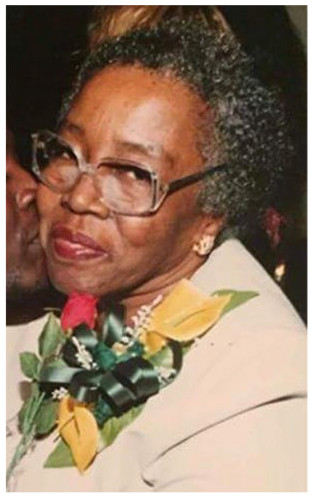
This piece is dedicated to my mother, Velma Ray Bell Alexander: 1937-2003.
Footnotes
Declaration of Conflicting Interests
The author(s) declared no potential conflicts of interest with respect to the research, authorship, and/or publication of this article.
Funding
The author(s) received no financial support for the research, authorship, and/or publication of this article.
